

The DOI matches its Crossref record; 49 of the 49 references it cites were found in a registry or an index.
Homocysteine-Lowering by B Vitamins Slows the Rate of Accelerated Brain Atrophy in Mild Cognitive Impairment: A Randomized Controlled Trial
Open accessAbstract
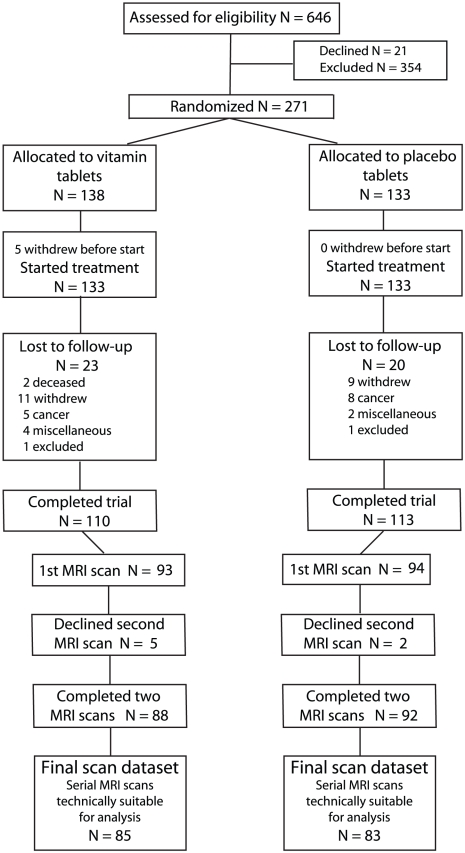
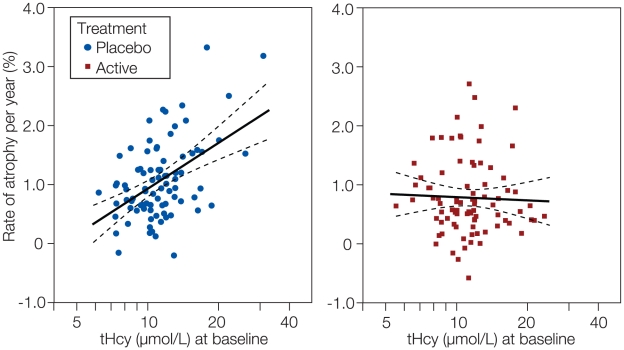
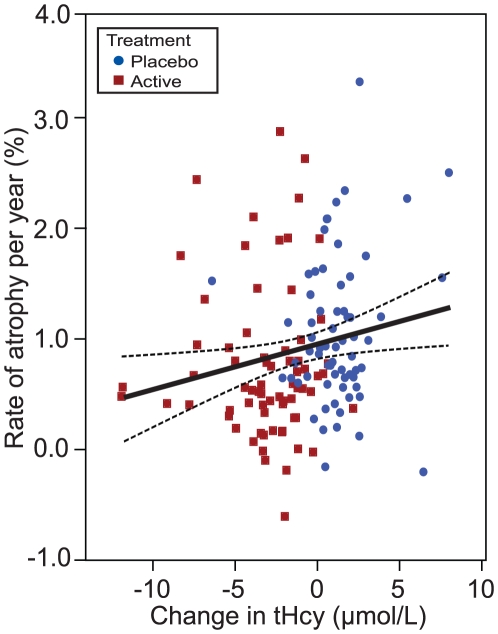
BACKGROUND: An increased rate of brain atrophy is often observed in older subjects, in particular those who suffer from cognitive decline. Homocysteine is a risk factor for brain atrophy, cognitive impairment and dementia. Plasma concentrations of homocysteine can be lowered by dietary administration of B vitamins. OBJECTIVE: To determine whether supplementation with B vitamins that lower levels of plasma total homocysteine can slow the rate of brain atrophy in subjects with mild cognitive impairment in a randomised controlled trial (VITACOG, ISRCTN 94410159). METHODS AND FINDINGS: Single-center, randomized, double-blind controlled trial of high-dose folic acid, vitamins B(6) and B(12) in 271 individuals (of 646 screened) over 70 y old with mild cognitive impairment. A subset (187) volunteered to have cranial MRI scans at the start and finish of the study. Participants were randomly assigned to two groups of equal size, one treated with folic acid (0.8 mg/d), vitamin B(12) (0.5 mg/d) and vitamin B(6) (20 mg/d), the other with placebo; treatment was for 24 months. The main outcome measure was the change in the rate of atrophy of the whole brain assessed by serial volumetric MRI scans. RESULTS: A total of 168 participants (85 in active treatment group; 83 receiving placebo) completed the MRI section of the trial. The mean rate of brain atrophy per year was 0.76% [95% CI, 0.63-0.90] in the active treatment group and 1.08% [0.94-1.22] in the placebo group (P = 0.001). The treatment response was related to baseline homocysteine levels: the rate of atrophy in participants with homocysteine >13 µmol/L was 53% lower in the active treatment group (P = 0.001). A greater rate of atrophy was associated with a lower final cognitive test scores. There was no difference in serious adverse events according to treatment category. CONCLUSIONS AND SIGNIFICANCE: The accelerated rate of brain atrophy in elderly with mild cognitive impairment can be slowed by treatment with homocysteine-lowering B vitamins. Sixteen percent of those over 70 y old have mild cognitive impairment and half of these develop Alzheimer's disease. Since accelerated brain atrophy is a characteristic of subjects with mild cognitive impairment who convert to Alzheimer's disease, trials are needed to see if the same treatment will delay the development of Alzheimer's disease. TRIAL REGISTRATION: Controlled-Trials.com ISRCTN94410159.
Overview
The claims and statistics of this paper haven’t been checked yet.
Run the check — free, no account needed. It reads the open-access text and checks the sources it cites.
Integrity signals
Registry
Cites
Statistics
Figures
Verification
Claims the paper makes
The claims and statistics of this paper haven’t been checked yet.
Run the check — free, no account needed. It reads the open-access text and checks the sources it cites.
Claims other papers make about this one
Each is checked against this paper’s own text: does it say what the citing paper says it does?
The source backs part of the claim, not all of it — or backs it for a different population, condition or comparison.
In the citing paper
“Finally, dietary approaches in terms of nutrition supplementation, such as combined formulation of specific active ingredients or probiotics, or nutritional guidance, such as fasting intermitting or Mediterranean diet, ameliorate both cognition and function of prodromal and mild AD patients [200,201,202].”
From Treatment of Alzheimer’s Disease: Beyond Symptomatic Therapies (2023) · cites this paper as [200]
Experimental — accuracy not yet measuredThe cited source says what the claim attributes to it.
In the citing paper
“While some degree of brain atrophy is common in older age, even in people who are cognitively healthy, atrophy is accelerated in people with Alzheimer's dementia.”
From 2024 Alzheimer's disease facts and figures (2024) · cites this paper as [20]
Self-check
Percentages, sums and reported differences re-computed from the paper’s own numbers.
The self-check needs the paper’s full text.
Citations
Cites
Folstein, M. F., Folstein, S. E., & McHugh, P. R. (1975) · Journal of Psychiatric Research · doi:10.1016/0022-3956(75)90026-6 · Cited by 88,282 · cited 5×
“First, in studies over longer periods (up to 5 years) it has been found that the rate of whole brain atrophy in MCI is correlated with cognitive decline in several tests, including the MMSE [5].”
InfluentialMoms, J. C., Heyman, A., Mohs, R. C., Hughes, J. P., van Belle, G., Fillenbaum, G., Mellits, E. D., & Clark, C. (1989) · Neurology · doi:10.1212/wnl.39.9.1159 · Cited by 4,130 · cited 1×
“…daily living based on the Cambridge Behavioural Inventory [26], an objective memory problem assessed with the ‘Telephone interview of cognitive status, modified’ (TICS-M) [27], a test without a ceiling effect [28], and category fluency [29] based on previously defined cut-off scores for MCI [28].”
Consortium to Establish a Registry for Alzheimer's Disease (CERAD)
Fillenbaum, G., & Heyman, A. (2002) · doi:10.1002/0470846410.ch42(iii · Cited by 2,859
Accurate, Robust, and Automated Longitudinal and Cross-Sectional Brain Change Analysis
Smith, S. M., Zhang, Y., Jenkinson, M., Chen, J. M., Matthews, P. M., Federico, A., & Stefano, N. D. (2002) · NeuroImage · doi:10.1006/nimg.2002.1040 · Cited by 2,013 · cited 3×
“A cross-sectional method (SIENAX) was used to estimate normalized brain volume from a single image, using the skull to normalize spatially, with respect to a standard image [31].”
InfluentialSelf-citationMild Cognitive Impairment: Ten Years Later
Petersen, R. C., Roberts, R. O., Knopman, D. S., Boeve, B. F., Geda, Y. E., Ivnik, R. J., Smith, G. E., & Jack, C. R. (2009) · Archives of Neurology · doi:10.1001/archneurol.2009.266 · Cited by 1,447
Longitudinal Magnetic Resonance Imaging Studies of Older Adults: A Shrinking Brain
Resnick, S. M., Pham, D. L., Kraut, M. A., Zonderman, A. B., & Davatzikos, C. (2003) · The Journal of Neuroscience · doi:10.1523/jneurosci.23-08-03295.2003 · Cited by 1,425 · cited 1×
“The atrophy occurs even in cognitively healthy subjects [1] but is much accelerated in patients suffering from Alzheimer’s disease [2,3,4,5].”
Folate, Vitamin B12, and Serum Total Homocysteine Levels in Confirmed Alzheimer Disease
Clarke, R., Smith, A. D., Jobst, K. A., Refsum, H., Sutton, L., & Ueland, P. M. (1998) · Archives of Neurology · doi:10.1001/archneur.55.11.1449 · Cited by 1,408 · cited 3×
“The results also fit with our earlier finding that raised tHcy predicts the rate of shrinkage of the medial temporal lobe in patients with Alzheimer’s disease [12].”
Self-citationMorris, J. C., Mohs, R. C., Rogers, H., Fillenbaum, G. G., & Heyman, A. (1988) · PubMed · Cited by 1,131
Facts and recommendations about total homocysteine determinations: an expert opinion
Refsum, H., Smith, A. D., Ueland, P. M., Nexo, E., Clarke, R., McPartlin, J., Johnston, C., Engbaek, F., Schneede, J., McPartlin, C., et al. (2004) · Clinical Chemistry · doi:10.1373/clinchem.2003.021634 · Cited by 1,056 · cited 1×
“The tissue and plasma concentrations of homocysteine are largely determined by the body’s status of certain B vitamins (folate, B6 and B12), which are cofactors or substrates for enzymes involved in homocysteine metabolism [22].”
Self-citationPrevalence of Cognitive Impairment without Dementia in the United States
Plassman, B. L., Langa, K. M., Fisher, G. G., Heeringa, S. G., Weir, D. R., Ofstedal, M. B., Burke, J. R., Hurd, M. D., Potter, G. G., Rodgers, W. L., et al. (2008) · Annals of Internal Medicine · doi:10.7326/0003-4819-148-6-200803180-00005 · Cited by 946 · cited 1×
“The prevalence of MCI is between 14% and 18% in those over 70 years-old [24,41], which means that about 5 million people in the USA and 14 million in greater Europe suffer from this condition.”
Cited by
Sorted by citations
Items 801–813 of 813
Dhal, A. K., George, J. K., & Raparthi, M. (2026) · Biochemistry · doi:10.5772/intechopen.1016034
Feng, C., Zhang, T., Liu, X., Liu, Z., Zhao, Y., & Zhang, P. (2026) · Biology · doi:10.3390/biology15161423
“In addition, B-vitamin treatment that lowers HCY has been reported to slow the rate of brain atrophy in older adults with MCI [10], whereas a similar intervention in patients with mild-to-moderate AD did not show clear cognitive benefit [11].”
Wang, Y.-X., Qin, S.-H., Liu, Q., Zhou, X.-W., Zhang, C.-Y., & Ma, Z.-Y. (2026) · Medicinal Chemistry Research · doi:10.1007/s00044-026-03611-9
“Research indicates that the two major brain changes in AD are: (1) the aggregation of beta-amyloid protein frag - ments outside neurons and other brain cells to form plaques; (2) the accumulation of abnormal tau protein forms within neurons, forming tau tangles [5–8].”
Kotredes, K. P., Pandey, R. S., Reagan, A. M., Sarica, Z., O’Rourke, R., Herrick, S., Davis, A., Garceau, D. T., Sasner, M., Carter, G. W., et al. (2026) · bioRxiv (Cold Spring Harbor Laboratory) · doi:10.64898/2026.08.25.746973
Lee, J. H., Won, G. H., Lee, S.-I., Shin, C.-J., Son, J.-W., Kim, S., Ju, G., Chung, S., Jung, J. H., & Initiative, A. D. N. (2026) · Journal of Alzheimer s Disease · doi:10.1177/13872877261481063
“38,39 However, fi ndings from the VITACOG trial suggested that B-vitamin supplementation reduced brain atrophy in individuals with MCI, particularly among those with elevated baseline plasma Hcy levels.”
Sierralta, I., Pinilla, M., Servili, E., Ormazabal, P., Bastías-Pérez, M., Cisternas, P., & Inestrosa, N. C. (2026) · Nutrients · doi:10.3390/nu18183025
“Among the 187 participants who underwent serial MRI, the annual rate of whole-brain atrophy was lower with B-vitamin treatment, with the largest effect among participants with elevated baseline homocysteine [83,84].”
Nutritional Modulation of Cognitive Function and Brain Networks: A Comprehensive Review
Krishna, D., Mishra, A., J, S. K., & Dhevi, B. (2026) · Brain Science Advances · doi:10.26599/bsa.2026.905024
Choi, S., Kang, H. J., Jung, S., Seo, Y., Kim, M., Ku, S., Kwon, S. H., Huang, Y., Choi, J. Y., Han, S., et al. (2026) · Journal of Nutrition · doi:10.1016/j.tjnut.2026.101837
Chu, K.-Y. (2026) · Journal of Public Health Dentistry · doi:10.1111/jphd.70087
Kotredes, K. P., Pandey, R. S., Reagan, A. M., Sarica, Z., O’Rourke, R., Herrick, S., Davis, A., Garceau, D., Sasner, M., Carter, G. W., et al. (2026) · Research Square · doi:10.21203/rs.3.rs-11166891/v1
MTHFR C677T and Brain MRI Patterns Across Cognitive and Vascular Disorders: A Systematic Review
Gogu, A. A., Axelerad, A. D., Gogu, A. E., Benta, M. M., Neda-Stepan, O., & Bredicean, A. C. (2026) · Biomedicines · doi:10.3390/biomedicines14102368
“Five studies examined AD [52,53,56,57,60], three MCI [20,51,58], three symptomatic CSVD [50,59,61], and two mixed cognitively impaired cohorts [54,55].”
InfluentialRosenberg, I. H. (2026) · Biochimie · doi:10.1016/j.biochi.2026.10.024 · Cited by 1
Sobów, T. (2013) · DOAJ (DOAJ: Directory of Open Access Journals)
Metadata
- Authors
- Smith, A. D., Smith, S. M., de Jager, C. A., Whitbread, P., Johnston, C., Agacinski, G., Oulhaj, A., Bradley, K. M., Jacoby, R., & Refsum, H.
- Affiliations
- University of Oxford (GB)
- University of Oslo (NO)
- Corresponding author
- Smith, A. David
- Venue
- PLoS ONE
- Publisher
- Public Library of Science (PLoS)
- Published
- 2010-09-08
- Volume
- 5
- Issue
- 9
- Pages
- e12244
- ISSN
- 1932-6203 (ISSN-L)
- PMC
- PMC2935890
- OpenAlex
- W2156635660
- Cited by
- 813
- References
- 49
- Citations by year
- 2026: 50 · 2025: 49 · 2024: 34 · 2023: 44 · 2022: 58 · 2021: 58 · 2020: 66 · 2019: 39 · 2018: 43 · 2017: 55 · 2016: 59 · 2015: 49 · 2014: 44 · 2013: 58 · 2012: 59
- FWCI
- 36.35
- Type
- journal article
- Language
- en
- Open access
- gold
- doi.org
- Locations
- PLoS ONE (publishedVersion, cc-by)
- PubMed Central (publishedVersion, cc-by)
- PubMed (publishedVersion)
- ORCA Online Research @Cardiff (Cardiff University) (acceptedVersion)
- DOAJ (DOAJ: Directory of Open Access Journals) (submittedVersion, cc-by-sa)
- Figshare (submittedVersion, cc-by)
- Funders
- Alzheimer's Research Trust
- National Institute for Health and Care Research
- University of Oxford
- Medical Research Council
- Topics
- Health Sciences › Nursing › Nutrition and Dietetics › Folate and B Vitamins Research
- Health Sciences › Medicine › Psychiatry and Mental health › Dementia and Cognitive Impairment Research
- Health Sciences › Medicine › Clinical Neurology › Alcoholism and Thiamine Deficiency
- Keywords
- homocysteine, B vitamins, folic acid, vitamin B6, vitamin B12, brain atrophy, mild cognitive impairment, cognitive decline, dementia prevention, older adults, plasma homocysteine, volumetric MRI, cognitive performance, adverse events
- MeSH terms
- Aged, Aged, 80 and over, Atrophy, Brain, Cognition Disorders, Female, Homocysteine, Humans, Magnetic Resonance Imaging, Male, Radiography, Vitamin B Complex, Treatment Outcome
About these checks
Registry, retraction, Cites and statistics results are computed, not judged, with one exception: a printed reference that no index lists is read once by a model before it counts as a citation error. Claims are extracted by a model and kept only when their quote appears verbatim in the text; each cited source is then checked, with a model’s help, for whether it says what the claim relies on. Those verdicts can be wrong — read the claim’s quote and the cited source before relying on one.
Statistics and arithmetic are recomputed, not judged.
Confidence bands are shown only for fields calibrated on our annotated test set. None is calibrated yet, so no band is shown.
What counts as a claim ›How we measure confidence ›How we check this ›
Are you an author, or do you see a problem with this page? Request a review
