

Identifying the World's Most Climate Change Vulnerable Species: A Systematic Trait-Based Assessment of all Birds, Amphibians and Corals
Open accessThe DOI matches its Crossref record; 42 of the 43 references it cites were found in a registry or an index.
Abstract
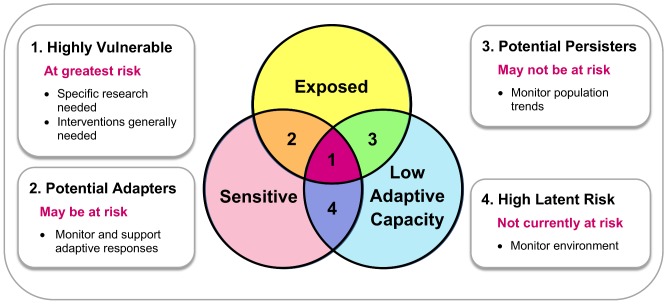
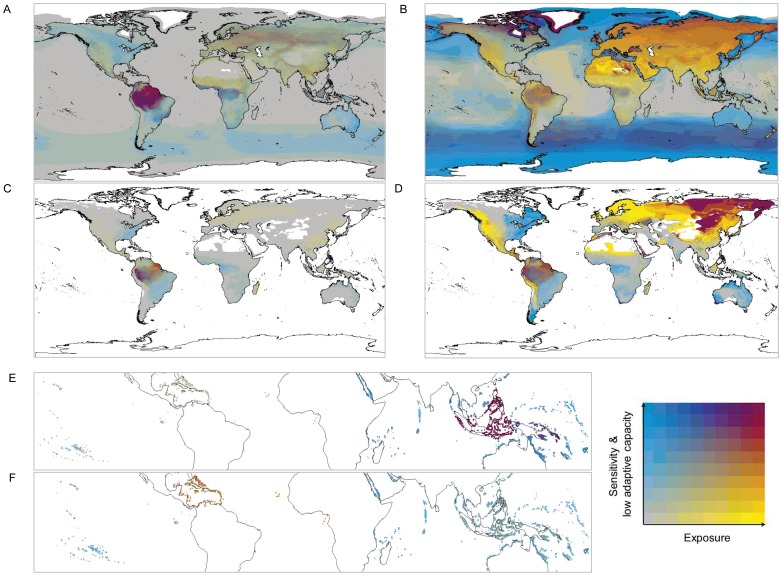
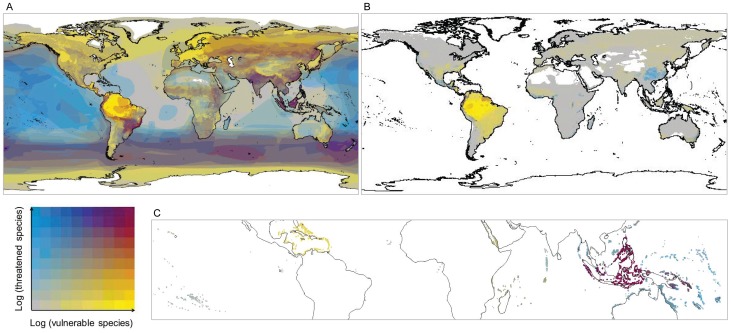
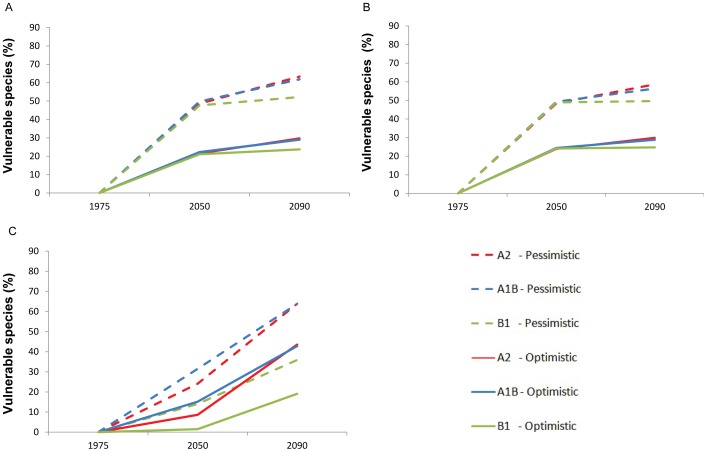
Climate change will have far-reaching impacts on biodiversity, including increasing extinction rates. Current approaches to quantifying such impacts focus on measuring exposure to climatic change and largely ignore the biological differences between species that may significantly increase or reduce their vulnerability. To address this, we present a framework for assessing three dimensions of climate change vulnerability, namely sensitivity, exposure and adaptive capacity; this draws on species' biological traits and their modeled exposure to projected climatic changes. In the largest such assessment to date, we applied this approach to each of the world's birds, amphibians and corals (16,857 species). The resulting assessments identify the species with greatest relative vulnerability to climate change and the geographic areas in which they are concentrated, including the Amazon basin for amphibians and birds, and the central Indo-west Pacific (Coral Triangle) for corals. We found that high concentration areas for species with traits conferring highest sensitivity and lowest adaptive capacity differ from those of highly exposed species, and we identify areas where exposure-based assessments alone may over or under-estimate climate change impacts. We found that 608-851 bird (6-9%), 670-933 amphibian (11-15%), and 47-73 coral species (6-9%) are both highly climate change vulnerable and already threatened with extinction on the IUCN Red List. The remaining highly climate change vulnerable species represent new priorities for conservation. Fewer species are highly climate change vulnerable under lower IPCC SRES emissions scenarios, indicating that reducing greenhouse emissions will reduce climate change driven extinctions. Our study answers the growing call for a more biologically and ecologically inclusive approach to assessing climate change vulnerability. By facilitating independent assessment of the three dimensions of climate change vulnerability, our approach can be used to devise species and area-specific conservation interventions and indices. The priorities we identify will strengthen global strategies to mitigate climate change impacts.
Overview
The claims and statistics of this paper haven’t been checked yet.
Free: it reads the open-access text and checks the first 5 claims that cite a source we can check. Create a free account to check every claim.
Integrity signals
Registry
Cites
Statistics
Figures
Verification
Claims the paper makes
The claims and statistics of this paper haven’t been checked yet.
Free: it reads the open-access text and checks the first 5 claims that cite a source we can check. Create a free account to check every claim.
Claims other papers make about this one
Each is checked against this paper’s own text: does it say what the citing paper says it does?
The source backs part of the claim, not all of it — or backs it for a different population, condition or comparison.
In the citing paper
“Climate change will become an increasingly dominant problem in the biodiversity crisis 3 .”
From Biodiversity: The ravages of guns, nets and bulldozers (2016) · cites this paper as [3]
Experimental — accuracy not yet measuredThe cited source says what the claim attributes to it.
In the citing paper
“Finally, the balance of threats driving extinction risk for many of the world's species will change, even over the next few decades 3 .”
From Biodiversity: The ravages of guns, nets and bulldozers (2016) · cites this paper as [3]
Self-check
Percentages, sums and reported differences re-computed from the paper’s own numbers.
The self-check needs the paper’s full text.
Citations
Cites
Very high resolution interpolated climate surfaces for global land areas
Hijmans, R. J., Cameron, S. E., Parra, J. L., Jones, P. G., & Jarvis, A. (2005) · International Journal of Climatology · doi:10.1002/joc.1276 · Cited by 19,825
Global Biodiversity Scenarios for the Year 2100
Sala, O. E., Stuart Chapin, F., III, Armesto, J. J., Berlow, E., Bloomfield, J., Dirzo, R., Huber-Sanwald, E., Huenneke, L. F., Jackson, R. B., et al. (2000) · Science · doi:10.1126/science.287.5459.1770 · Cited by 9,280 · cited 1×
“However, anthropogenic climate change is becoming a significant new threat [4–7].”
BackgroundClimate Change 2007: Impacts, Adaptation and Vulnerability
Parry, M. L., Canziani, O. F., Palutikof, J. P., van der Linden, P., & Hanson, C. (2007) · Centre for Environmental Data Analysis Digital Repository (Centre for Environmental Data Analysis) · doi:10.5281/zenodo.7356334 · Cited by 9,136
Extinction risk from climate change
Thomas, C. D., Cameron, A., Green, R. E., Bakkenes, M., Beaumont, L. J., Collingham, Y. C., Erasmus, B. F. N., de Siqueira, M. F., Grainger, A., Hannah, L., et al. (2004) · Nature · doi:10.1038/nature02121 · Cited by 7,695
Predicting species distribution: offering more than simple habitat models
Guisan, A., & Thuiller, W. (2005) · Ecology Letters · doi:10.1111/j.1461-0248.2005.00792.x · Cited by 6,587 · cited 1×
“These and most other similar large-scale assessments are based primarily on species distribution (bioclimatic envelope) models, which use correlations between species’ observed distributions and climate variables to predict their distributions and hence their extinction risk under future climate scenarios [9–11].”
BackgroundSpecial report on emissions scenarios
Nakićenović, N., Alcamo, J., Davis, G. R., de Vries, B. J. M., Fenhann, J. V., Gaffin, S., Gregory, K., Grübler, A., Jung, T. Y., Kram, T., et al. (2000) · Cited by 6,262
Has the Earth’s sixth mass extinction already arrived?
Barnosky, A. D., Matzke, N., Tomiya, S., Wogan, G. O. U., Swartz, B., Quental, T. B., Marshall, C., McGuire, J. L., Lindsey, E. L., Maguire, K. C., et al. (2011) · Nature · doi:10.1038/nature09678 · Cited by 4,400 · cited 1×
“Vertebrate extinction rates are currently estimated to be 10–100 times greater than background [1], largely due to the effects of habitat loss, over-exploitation and invasive species [2,3].”
BackgroundPearson, R. G., & Dawson, T. P. (2003) · Global Ecology and Biogeography · doi:10.1046/j.1466-822x.2003.00042.x · Cited by 4,252
Impacts of climate warming on terrestrial ectotherms across latitude
Deutsch, C. A., Tewksbury, J. J., Huey, R. B., Sheldon, K. S., Ghalambor, C. K., Haak, D. C., & Martin, P. R. (2008) · Proceedings of the National Academy of Sciences · doi:10.1073/pnas.0709472105 · Cited by 3,840 · cited 1×
“ranges are particularly vulnerable to climate [16].”
Scenarios for Global Biodiversity in the 21st Century
Pereira, H. M., Leadley, P. W., Proença, V., Alkemade, R., Scharlemann, J. P. W., Fernandez-Manjarrés, J. F., Araújo, M. B., Balvanera, P., Biggs, R., Cheung, W. W. L., et al. (2010) · Science · doi:10.1126/science.1196624 · Cited by 2,077 · cited 1×
“However, anthropogenic climate change is becoming a significant new threat [4–7].”
BackgroundSelf-citation
Cited by
Items 901–989 of 989
Caminhos para a intensificação ecológica através da restauração e da certificação agrícola
d’Albertas, F. (2022) · Digital Library of Theses and Dissertations (Universidade de São Paulo) · doi:10.11606/t.41.2022.tde-12052022-153255 · Cited by 1
Genetic Variation and Phenotypic Plasticity
Hutchings, J. A. (2021) · Oxford University Press eBooks · doi:10.1093/oso/9780198839873.003.0003
Hutchings, J. A. (2021) · Oxford University Press eBooks · doi:10.1093/oso/9780198839873.003.0008
Matos, C. B. (2022) · Digital Library of Theses and Dissertations (Universidade de São Paulo) · doi:10.11606/t.41.2022.tde-02082022-194152 · Cited by 1
Alves, A. N., Chakraborty, A., Wansbrough, M., Walter, G. M., Piper, M. D. W., Sgrò, C. M., & Mirth, C. K. (2023) · bioRxiv (Cold Spring Harbor Laboratory) · doi:10.1101/2023.03.07.531575
“Nutritional stress is one of the most common stressors faced by animals in nature and will become increasingly so with climate change (Scheffers et al., 2016; Houghton et al., 1990; Dawson et al., 2011; Thomas et al., 2004; Foden et al., 2013).”
Bishop, P. J., Wren, S., Angulo, A., & Griffiths, R. A. (2023) · Cambridge University Press eBooks · doi:10.1017/9781108758826.009
Self-citationSilva, M. S., & Júnior, P. D. M. (2023) · Research Square · doi:10.21203/rs.3.rs-3100630/v1
(2021) · Oxford University Press eBooks · doi:10.1093/oso/9780198839873.002.0005
(2021) · Oxford University Press eBooks · doi:10.1093/oso/9780198839873.002.0003
(2021) · Oxford University Press eBooks · doi:10.1093/oso/9780198839873.002.0004
Climate Change: Adapting for Resilience
Urban, D. L. (2023) · Springer eBooks · doi:10.1007/978-3-031-40254-8_10
Berberi, S., Ibrahimi, E., & Bego, F. (2023) · Biology Bulletin · doi:10.1134/s1062359023603762
“Despite being relatively vulnerable (Foden et al., 2013), birds are also highly capable of adapting (Radchuk et al., 2019), particularly in response to warming temperatures (Lemoine et al., 2007).”
Traits, threats, and popularity explain extinction risk of birds globallyPreprint
Serrano, J., Iversen, L. L., & Pollock, L. J. (2024) · doi:10.32942/x2rg9p
Rutherford, C. R., Rogers, A. M., Prober, S. M., Roper, E. M., Cook, E. K., & Reside, A. E. (2024) · Australian Journal of Botany · doi:10.1071/bt23092
Katori, T., & Oguro, M. (2025) · bioRxiv (Cold Spring Harbor Laboratory) · doi:10.1101/2025.03.16.643436
Parab, T., Dar, S. A., & Singh, A. P. (2025) · Ornithology Research · doi:10.1007/s43388-025-00246-z
“Approximately 6–9% of the global bird populations are extremely vulnerable to climate change (Foden et al. 2013).”
Laugier, C., Roos, D., Belloeil, P., Mahé, K., Nithard, A., Rungassamy, T., Pelletier, D., Tessier, E., Trindade‐Santos, I., Robert, M., et al. (2025) · Global Ecology and Conservation · doi:10.1016/j.gecco.2025.e03750
Characterizing climate- and fire-driven habitat vulnerability for an old-forest species
Goldberg, J. F., Rodman, K. C., & Jones, G. M. (2025) · Landscape Ecology · doi:10.1007/s10980-025-02171-4
“Ecologically rare features face heightened vulnerability to climate-and disturbance-driven losses (Foden et al. 2013, 2019).”
Conservation Planning for Climate Change Vulnerability across the Islands of the Californias
Brenner, L. J., Wallingford, P. D., Holmes, N. D., Knapp, J. J., Randall, J. M., & Morrison, S. A. (2025) · Western North American Naturalist · doi:10.3398/064.085.0217
Reimer, J., Bousquin, J. J., & Awkerman, J. A. (2025) · Integrated Environmental Assessment and Management · doi:10.1093/inteam/vjaf109
Red List criteria underestimate climate-related extinction risk of range-shifting speciesPreprint
Keuth, R., Fritz, S. A., & Zurell, D. (2025) · bioRxiv (Cold Spring Harbor Laboratory) · doi:10.1101/2025.08.20.671260
“Stronger dispersal ability is expected to improve climate tracking and the survival of range-shifting species under climate change 32,41 .”
Battamo, A. Y., Kelly‐Quinn, M., O’Sullivan, J., Eichelmann, E., Habib, M. A., Wei, W., & Salauddin, M. (2025) · Environmental Research Letters · doi:10.1088/1748-9326/ae0e37
“First, it is explicitly designed for EWEs whereas prior VAS frameworks have focused on gradual, long-term climatic change [16, 17, 43–45], overlooking the increasing the frequency, intensity, and duration risks posed by EWEs [5, 8, 10, 46].”
Using climate change metrics to inform conservation of Canada's Priority Places for Species at Risk
Lin, H., Ryan, M., Camfield, A. F., Carlson, M., Carrière, M., Raymond, C. V., & Naujokaitis‐Lewis, I. (2025) · FACETS · doi:10.1139/facets-2025-0060
Vulnerability to Climate Changes of Tropical Forests Across Africa
Madingou, M. P. N., Dauby, G., Fayolle, A., & Gorel, A. (2025) · Diversity and Distributions · doi:10.1111/ddi.70104 · Cited by 1
“It depends on the rate and magnitude of change in climatic variables (MAT, MAP and CWD) in regions occupied by the species (Dawson et al. 2011; Foden et al. 2013).”
An exploration of adaptation strategies for addressing climate change risks to Korea’s ecosystems
Lee, K., & Hong, S. (2025) · Journal of Climate Change Research · doi:10.15531/ksccr.2025.16.5.1117
Predicted Fish Vulnerability to Stream Drying in the Western U.S.A.
Rieger, E. A., Clancy, N. G., McShane, R. R., Sando, R., & Walters, A. W. (2025) · Ecology Of Freshwater Fish · doi:10.1111/eff.70030
Greenspan, S. E., Peloso, P. L. V., Fuentes-González, J. A., Bletz, M. C., Lyra, M. L., Machado, I. F., Martins, R. A., Medina, D., Moura‐Campos, D., Neely, W. J., et al. (2024) · Figshare · doi:10.6084/m9.figshare.26558243
Rather, T. A., Kumar, S., & Khan, J. A. (2020) · Figshare · doi:10.6084/m9.figshare.13172535
Rather, T. A., Kumar, S., & Khan, J. A. (2020) · Figshare · doi:10.6084/m9.figshare.13172541
Rather, T. A., Kumar, S., & Khan, J. A. (2020) · Figshare · doi:10.6084/m9.figshare.13172520
Greenspan, S. E., Peloso, P. L. V., Fuentes-González, J. A., Bletz, M. C., Lyra, M. L., Machado, I. F., Martins, R. A., Medina, D., Moura‐Campos, D., Neely, W. J., et al. (2024) · Figshare · doi:10.6084/m9.figshare.26558246
Rather, T. A., Kumar, S., & Khan, J. A. (2020) · Figshare · doi:10.6084/m9.figshare.13172538
Rubenstein, M. A., Weiskopf, S. R., Carter, S. L., Eaton, M. J., Johnson, C. G., Lynch, A. J., Miller, B. W., Morelli, T. L., Rodriguez, M. A., Terando, A. J., et al. (2020) · Figshare · doi:10.6084/m9.figshare.12308606
Rubenstein, M. A., Weiskopf, S. R., Carter, S. L., Eaton, M. J., Johnson, C. G., Lynch, A. J., Miller, B. W., Morelli, T. L., Rodriguez, M. A., Terando, A. J., et al. (2020) · Figshare · doi:10.6084/m9.figshare.12308609
Buss, N., Swierk, L., & Hua, J. (2021) · Figshare · doi:10.6084/m9.figshare.14850845
Singini, E. J. (2025) · Biodiversity and Conservation · doi:10.1007/s10531-025-03234-3
“Precipitation variables emerged as the strongest climatic determinants of extinction risk, with reduced rainfall during critical growing seasons increasing species vulnerability (Bom - hard et al. 2005 ; Foden et al. 2013 ; Singini and Baso, 2025).”
InfluentialRationales for microbial conservation: A quantitative global assessmentPreprint
Junker, R. R. (2026) · bioRxiv (Cold Spring Harbor Laboratory) · doi:10.64898/2026.02.02.703404 · Cited by 1
“Vulnerability is composed of three components: exposure, sensitivity and adaptive capacity (Turner et al. 2003; Foden et al. 2013).”
Generation time is not a universal constraint on adaptive evolutionPreprint
Chaparro‐Pedraza, P. C., & Rees-Baylis, E. (2026) · bioRxiv (Cold Spring Harbor Laboratory) · doi:10.64898/2026.02.04.703757
“Conversely, in slow-living species, the dominance of pre-maturity survival corresponds to the regime in which where long-lived species are often assumed to have inherently limited adaptive capacity in climate vulnerability assessments [40–42].”
Climate as Structure and Process: A Systems Perspective on Ecological Transformation
Ogwu, M. C., & Izah, S. C. (2026) · World-systems evolution and global futures · doi:10.1007/978-3-032-17639-4_3 · Cited by 1
Alves, A. N., Chakraborty, A., Wansbrough, M., Walter, G. M., Piper, M. D. W., Sgrò, C. M., & Mirth, C. K. (2026) · Journal of Evolutionary Biology · doi:10.1093/jeb/voag010
García, P. J. M., González, J. M., Luna, J. A. N., Sosa-Díaz, L., & Flores, A. L. (2026) · American Journal of Climate Change · doi:10.4236/ajcc.2026.151002
Stony coral symbioses show variable responses to future ocean conditions
de Souza, M. R., Bruce, J., Cros, A., Jury, C. P., Drury, C., & Toonen, R. J. (2026) · Science Advances · doi:10.64898/2026.03.06.710183
Moreira, M. O., Paúl, M. J., Liz, A. V., Carnaval, A. C., Carstens, B. C., & Carvalho, S. B. (2026) · Molecular Ecology · doi:10.1111/mec.70321 · Cited by 1
Wong, A., Frommel, A. Y., Sumaila, U. R., & Cheung, W. W. L. (2026) · Fish and Fisheries · doi:10.1111/faf.70081
Britez, M. R. D. (2016) · theses.fr (ABES) · doi:10.70675/5d6e6303z2822z456dz9c38z3a77c2f8187e · Cited by 1
Social-ecological vulnerability : from assessment to action
Thiault, L. (2017) · theses.fr (ABES) · doi:10.70675/eed39161z4318z418azbd6bz928f189cefda · Cited by 1
“This conceptual model of vulnerability has also been used to understand risk and response options in both ecological and social systems and has provided the framework for vulnerability assessments at local, regional and global scales (Johnson & Marshall 2007; Acosta-Michlik & Espaldon 2008; Allison et al. 2009; Fazey…”
BackgroundMethodInfluentialLa diversification au sein du Plateau des Guyanes vue à travers le prisme des amphibiens anoures
Vacher, J. (2017) · theses.fr (ABES) · doi:10.70675/d10b13d9z32e5z4dc0z8194zf111541428a1
Comte, A. (2018) · theses.fr (ABES) · doi:10.70675/61c898f2z9a0az4bc1zb89cz7ceb78e9556a · Cited by 2
“…Yohe and Tol, 2002), en géographie (Adger, 2006; Brooks et al., 2005; Magnan et al., 2012; Moser, 2010; Vogel et al., 2007) en sciences de l’environnement (Füssel and Klein, 2006; Mcfadden, 2007; Preston et al., 2011; Turner et al., 2003) et en écologie (Foden et al., 2013; Graham et al., 2011).”
BackgroundRonget, V. (2018) · theses.fr (ABES) · doi:10.70675/cea7486dz210bz4551z9cd7zf3089f8120fb · Cited by 1
From models to data : understanding biodiversity patterns from environmental DNA data
Sommeria‐Klein, G. (2017) · theses.fr (ABES) · doi:10.70675/f0c971b9zb978z455dz80a0z2d75d2c0ea62
Legrand, B. (2016) · theses.fr (ABES) · doi:10.70675/84027472zbaa4z4d1bza7bbz000cae87d088 · Cited by 2
Leclerc, C. (2019) · theses.fr (ABES) · doi:10.70675/b904df63z6b64z4ee8za1beze28092d9379f
Pérez‐Rosales, G. (2022) · theses.fr (ABES) · doi:10.70675/519b6235zcffbz482azaf6cz36a6badd82ed
Bouraï, L. (2022) · theses.fr (ABES) · doi:10.70675/1384c6dbz528az423cz80d7zaa57eb9f3d72 · Cited by 2
Ullah, H., Qin, Z., Ahmad, S., & Li, Z. (2026) · Global Ecology and Conservation · doi:10.1016/j.gecco.2026.e04198
A Framework for Estimating Climate Change Vulnerability Based on Conditional Relationships
Burger, I. J., & Riddell, E. A. (2026) · Integrative and Comparative Biology · doi:10.1093/icb/icag022
Vulnerability of Canadian forests to invasive insects under climate change
Aubin, I., Roe, A. D., Marquis, B., Boisvert‐Marsh, L., Pedlar, J., Erni, S., Hamel, B., Lawrence, G., McKenney, D. W., & Scarr, T. A. (2026) · Canadian Journal of Forest Research · doi:10.1139/cjfr-2025-0328
Modeliranje prostorskega vzorca biodiverzitete sekundarnih travišč: primer kraškega podeželja
Davidović, D., Pipenbaher, N., Škornik, S., & Ivajnšič, D. (2026) · doi:10.18690/um.ff.4.2026.7
Lois, N. A., Mindlin, J., Balza, U., Pütz, K., Mahler, B., & Rey, A. R. (2026) · Frontiers in Marine Science · doi:10.3389/fmars.2026.1794894
“Several approaches have been proposed to estimate sensitivity and adaptive capacity to climate change impacts on biodiversity, being life-history trait-based estimations the most prevalent in recent literature (Butt et al., 2022; Foden et al., 2013).”
Ballesteros-Barrera, C., Tapia-Pérez, O., Leyte-Manrique, A., Martínez-Bernal, A., Zárate-Hernández, R., Vargas-Miranda, B., Martinéz-Coronel, M., & Ortiz-Burgos, S. (2026) · Climate · doi:10.3390/cli14060114
Maina, J. N. (2026) · Birds · doi:10.3390/birds7020032
“…usually by determining indicator-based quantities that assess a species’ ability to cope with or adjust to changing climatic conditions [52,53]. https://doi.org/10.3390/birds7020032 • A ‘vulnerability assessment model’ evaluates the adaptive capacity of a species to climate change while…”
InfluentialYong, F., ZHANG, Y. J., Guo, W., Liu, Y., Zhou, X., Lei, G., Lin, R., Ma, F., & Cui, P. (2026) · iScience · doi:10.1016/j.isci.2026.116262 · Cited by 1
“18,19 Specifically, its potential to utilize expanding human-modified land-scapes (e.g., degraded forests and farmland 20 ) suggests that its range may stabilize or even expand.”
A global early warning system for predicting exposure of biodiversity to extreme heat
Serra-Diaz, J. M., Andrews, L. C., Meyer, A. B., Carlson, B., Maitner, B., Pinilla‐Buitrago, G. E., Pigot, A. L., Trisos, C. H., Wilson, A. M., Urban, M. C., et al. (2026) · Nature Climate Change · doi:10.1038/s41558-026-02642-9 · Cited by 3
“Although other weather variables (for example, precipitation) and additional information (for example, sensitivity and adaptation 21,22,40 ) are needed to fully assess an individual species’ vulnerability, focusing on temperature exposure provides a tool for rapidly identifying potential risks…”
Liberatore, L., Semeraro, T., Titocci, J., & Basset, A. (2026) · SSRN Electronic Journal · doi:10.2139/ssrn.6909264
López-Zuluaga, M., Remacha, C., Bermejo, A., Escudero, E., de la Puente, J., & Pérez‐Tris, J. (2026) · bioRxiv (Cold Spring Harbor Laboratory) · doi:10.64898/2026.06.07.725434
Climatic exposure of Italian habitats
Mezzanotte, V., Cimatti, M., Burrascano, S., & Marco, M. D. (2026) · Biological Conservation · doi:10.1016/j.biocon.2026.111961
At the leading edge: advancing and bridging the science and management of range-shifting species
Comte, L., Weiskopf, S. R., Thompson, L. M., Valler, J. B., Rubenstein, M. A., O’Hara, C. C., Bamzai‐Dodson, A., Lynch, A. J., Clark‐Wolf, T. J., Couriot, O. H., et al. (2026) · BioScience · doi:10.1093/biosci/biag088
Prieto-Torres, D. A., & Sánchez‐González, L. A. (2026) · Springer eBooks · doi:10.1007/978-3-032-21559-8_15
Mohamed, A. D. A. (2026) · Journal of Hunger & Environmental Nutrition · doi:10.1080/19320248.2026.2715610
Bae, M., Lee, D., Lee, D.-Y., Kim, E.-J., Kim, S.-H., & Park, Y. (2026) · Environmental and Sustainability Indicators · doi:10.1016/j.indic.2026.101472
de Sousa, K. W. C., Salustio‐Gomes, C., Reis, D. O., Rodrigues, W. D. S., Brasil-Peixoto, S. N. R., Barros, M. C., Ubaid, F. K., & da Paixão, R. M. C. (2026) · Anais da Academia Brasileira de Ciências · doi:10.1590/0001-3765202620250843
Guo, F., McKirdy, S., Gao, L., & Gao, G. (2026) · Functional Ecology · doi:10.1111/1365-2435.70445
Ding, C., Newbold, T., Etard, A., Cornford, R., Jung, M., Brumm, K. J., Jiang, Z., Visconti, P., & Wang, Z. (2026) · bioRxiv (Cold Spring Harbor Laboratory) · doi:10.64898/2026.10.08.757631 · Cited by 1
“Given that broad niches and high mobility help species persist under environmental change 36–38 , we expected groups characterised by broader habitat and thermal niches, wider geographic ranges and greater dispersal or reproductive capacity to be less negatively affected, or potentially favoured,…”
Mota, E. P., LIMA, A. P., Bittencourt, P., Nunes, M. D. S., de Carvalho, V. T., Rojas, R. R., de Almeida, A. P., Gordo, M., Polo, É. M., Hrbek, T., et al. (2026) · Systematics and Biodiversity · doi:10.1080/14772000.2026.2692965
SILVA, K. M. O., Tirelli, F. P., Teston, J. A., Júnior, P. D. M., & Ferro, V. G. (2026) · Journal of Insect Conservation · doi:10.1007/s10841-026-00817-5
“This framework can be treated as a spatial problem, in which exposure corresponds to the overlap between threats and species distributions (Dawson et al. 2011; Foden et al. 2013 ).”
Morgante, I., Cheung, W. W. L., & Bopp, L. (2026) · Global Change Biology · doi:10.1111/gcb.71114
“Life history and ecological traits are widely used as proxies to assess the intrinsic vulnerability of marine fish to climate stressors in place of detailed population-level data which is often limited (Cheung et al. 2005; Foden et al. 2013).”
de Moraes, K. F., Lima, M. G. M., Gonçalves, G. S. R., Molina‐Marin, D. A., Almeida, S. M., & Santos, M. P. D. (2026) · Animal Conservation · doi:10.1111/acv.70107 · Cited by 1
Ruperto, E. F., Quiroga‐Carmona, M., Menéndez, J., Patterson, F. A., Novillo, A., & Sassi, P. L. (2026) · Journal of Zoology · doi:10.1111/jzo.70168
Katori, T., & Oguro, M. (2026) · Applications in Plant Sciences · doi:10.1002/aps3.70083
“…trait data provide valuable insights into ecological functions and species' responses to environmental changes (Valladares et al., 2007; Ordoñez et al., 2009; Ho ff mann and Sgrò, 2011; Foden et al., 2013), underscoring the importance of systematically compiling and publishing trait information.”
Gunderson, R. (2026) · Journal for Nature Conservation · doi:10.1016/j.jnc.2026.127470
Prioritizing reducing impacts on species to minimize residual reserves
Fleury, A. G., O’Hara, C. C., Everett, J. D., Halpern, B. S., Klein, C. J., Richardson, A. J., & Dunn, D. C. (2026) · Science Advances · doi:10.1126/sciadv.aeh8129
“As such, global trait-based frameworks have been developed to quantify species’ vulnerability to anthropogenic stressors, with a particular focus on marine taxa ( 47 , 48 ).”
Diggins, C. A., Beever, E. A., & Zímová, M. (2026) · BioScience · doi:10.1093/biosci/biag056
Metadata
- Authors
- Foden, W. B., Butchart, S. H. M., Stuart, S. N., Vié, J.-C., Akçakaya, H. R., Angulo, A., DeVantier, L. M., Gutsche, A., Turak, E., Cao, L., Donner, S. D., Katariya, V., Bernard, R., Holland, R. A., Hughes, A. F., O’Hanlon, S. E., Garnett, S. T., Şekercioğlu, Ç. H., & Mace, G. M.
- Affiliations
- University of the Witwatersrand (ZA)
- BirdLife International (KE)
- UN Environment Programme World Conservation Monitoring Centre (GB)
- International Union for Conservation of Nature (CH)
- Museum für Naturkunde (DE)
- James Cook University (AU)
- Zhejiang University (CN)
- University of British Columbia (CA)
- International Union for Conservation of Nature (United Kingdom) (GB)
- Imperial College London (GB)
- University of Southampton (GB)
- Anglia Ruskin University (GB)
- Charles Darwin University (AU)
- University College London (GB)
- Corresponding author
- Foden, Wendy B.
- Butchart, Stuart H. M.
- Stuart, Simon N.
- Vié, Jean-Christophe
- Angulo, Ariadne
- DeVantier, Lyndon M.
- Gutsche, Alexander
- Turak, Emre
- Cao, Long
- Donner, Simon D.
- Katariya, Vineet
- Bernard, Rodolphe
- Holland, Robert A.
- Hughes, Adrian F.
- O’Hanlon, Susannah E.
- Garnett, Stephen T.
- Mace, Georgina M.
- ORCID
- Venue
- PLoS ONE
- Publisher
- Public Library of Science (PLoS)
- Published
- 2013-06-12
- Volume
- 8
- Issue
- 6
- Pages
- e65427
- ISSN
- 1932-6203 (ISSN-L)
- PMC
- PMC3680427
- OpenAlex
- W2113487278
- Cited by
- 988
- References
- 43
- Citations by year
- 2026: 59 · 2025: 59 · 2024: 65 · 2023: 73 · 2022: 72 · 2021: 90 · 2020: 119 · 2019: 83 · 2018: 88 · 2017: 87 · 2016: 66 · 2015: 65 · 2014: 50 · 2013: 12
- FWCI
- 42.61
- Type
- journal article
- Language
- en
- Open access
- gold
- doi.org
- Locations
- PLoS ONE (publishedVersion, cc-by)
- Europe PMC (PubMed Central) (publishedVersion, other-oa)
- PubMed Central (publishedVersion, cc-by)
- PubMed (publishedVersion)
- ePrints Soton (University of Southampton) (acceptedVersion)
- CDU eSpace Institutional Repository (Charles Darwin University) (submittedVersion)
- ResearchOnline - JCU (James Cook University) (submittedVersion)
- DOAJ (DOAJ: Directory of Open Access Journals) (submittedVersion, cc-by-sa)
- UCL Discovery (University College London) (submittedVersion)
- Figshare (submittedVersion, cc-by)
- Funders
- John D. and Catherine T. MacArthur Foundation
- Imperial College London
- Topics
- Physical Sciences › Environmental Science › Ecological Modeling › Species Distribution and Climate Change
- Physical Sciences › Environmental Science › Nature and Landscape Conservation › Ecology and Vegetation Dynamics Studies
- Physical Sciences › Environmental Science › Global and Planetary Change › Climate Change and Environmental Impact
- Keywords
- climate change vulnerability, climate change sensitivity, climate change exposure, adaptive capacity, biological characteristics, birds, amphibians, coral, extinction risk, IUCN Red List, conservation prioritization, Amazon basin, Coral Triangle, biodiversity conservation
- MeSH terms
- Acclimatization, Amphibians, Animals, Birds, Conservation of Natural Resources, Anthozoa, Biodiversity, Climate Change
About these checks
Registry, retraction, Cites and statistics results are computed, not judged, with one exception: a printed reference that no index lists is read once by a model before it counts as a citation error. Claims are extracted by a model and kept only when their quote appears verbatim in the text; each cited source is then checked, with a model’s help, for whether it says what the claim relies on. Those verdicts can be wrong — read the claim’s quote and the cited source before relying on one.
Statistics and arithmetic are recomputed, not judged.
Confidence bands are shown only for fields calibrated on our annotated test set. None is calibrated yet, so no band is shown.
What counts as a claim ›How we measure confidence ›How we check this ›
Are you an author, or do you see a problem with this page? Request a review
Data sources
Bibliographic data: Semantic Scholar, OpenAlex, Crossref.
Contains information from the Semantic Scholar Academic Graph Datasets, made available under the ODC Attribution License (ODC-BY 1.0).
Semantic Scholar’s data is described in: Kinney, R., et al. (2023). The Semantic Scholar Open Data Platform. arXiv:2301.10140.
