

Identifying the World's Most Climate Change Vulnerable Species: A Systematic Trait-Based Assessment of all Birds, Amphibians and Corals
Open accessThe DOI matches its Crossref record; 42 of the 43 references it cites were found in a registry or an index.
Abstract
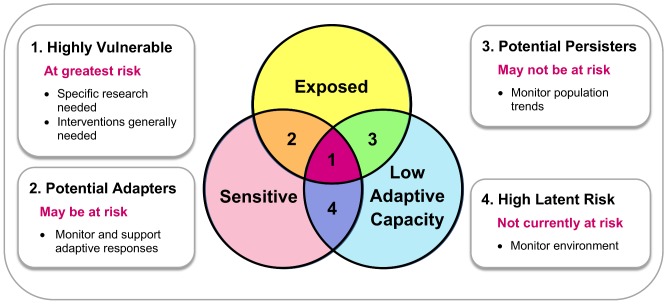
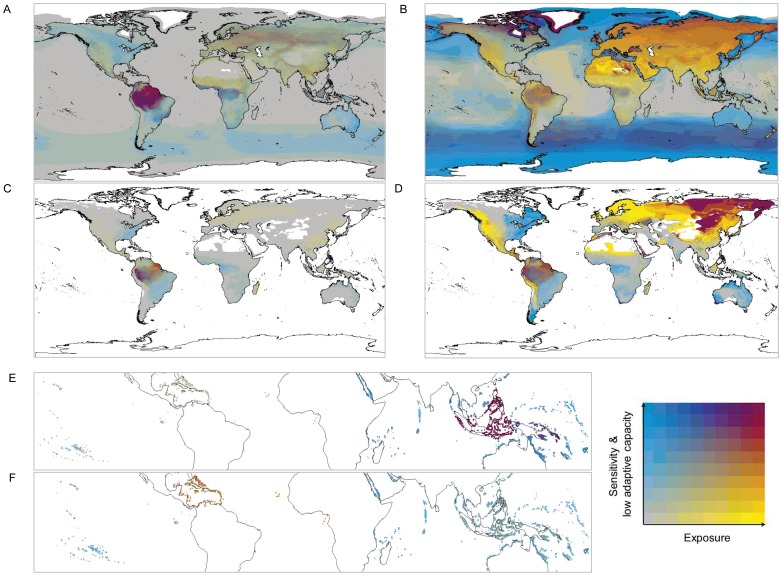
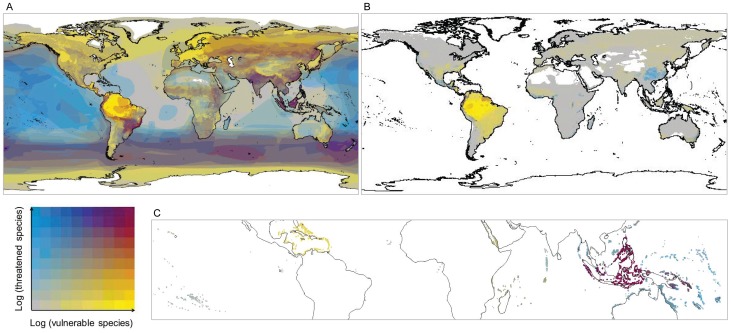
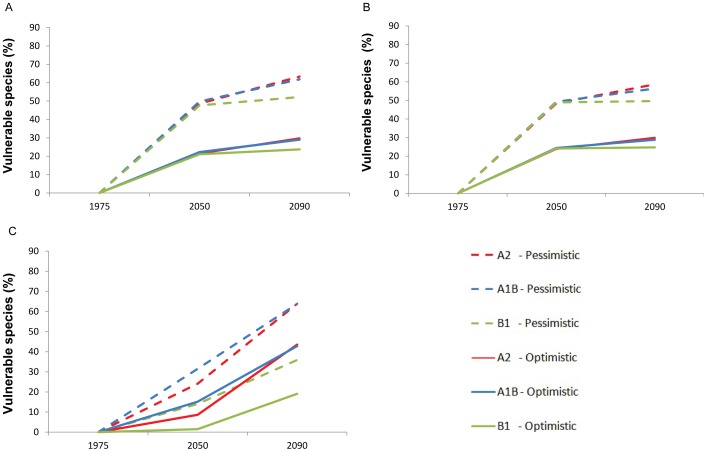
Climate change will have far-reaching impacts on biodiversity, including increasing extinction rates. Current approaches to quantifying such impacts focus on measuring exposure to climatic change and largely ignore the biological differences between species that may significantly increase or reduce their vulnerability. To address this, we present a framework for assessing three dimensions of climate change vulnerability, namely sensitivity, exposure and adaptive capacity; this draws on species' biological traits and their modeled exposure to projected climatic changes. In the largest such assessment to date, we applied this approach to each of the world's birds, amphibians and corals (16,857 species). The resulting assessments identify the species with greatest relative vulnerability to climate change and the geographic areas in which they are concentrated, including the Amazon basin for amphibians and birds, and the central Indo-west Pacific (Coral Triangle) for corals. We found that high concentration areas for species with traits conferring highest sensitivity and lowest adaptive capacity differ from those of highly exposed species, and we identify areas where exposure-based assessments alone may over or under-estimate climate change impacts. We found that 608-851 bird (6-9%), 670-933 amphibian (11-15%), and 47-73 coral species (6-9%) are both highly climate change vulnerable and already threatened with extinction on the IUCN Red List. The remaining highly climate change vulnerable species represent new priorities for conservation. Fewer species are highly climate change vulnerable under lower IPCC SRES emissions scenarios, indicating that reducing greenhouse emissions will reduce climate change driven extinctions. Our study answers the growing call for a more biologically and ecologically inclusive approach to assessing climate change vulnerability. By facilitating independent assessment of the three dimensions of climate change vulnerability, our approach can be used to devise species and area-specific conservation interventions and indices. The priorities we identify will strengthen global strategies to mitigate climate change impacts.
Overview
The claims and statistics of this paper haven’t been checked yet.
Free: it reads the open-access text and checks the first 5 claims that cite a source we can check. Create a free account to check every claim.
Integrity signals
Registry
Cites
Statistics
Figures
Verification
Claims the paper makes
The claims and statistics of this paper haven’t been checked yet.
Free: it reads the open-access text and checks the first 5 claims that cite a source we can check. Create a free account to check every claim.
Claims other papers make about this one
Each is checked against this paper’s own text: does it say what the citing paper says it does?
The source backs part of the claim, not all of it — or backs it for a different population, condition or comparison.
In the citing paper
“Climate change will become an increasingly dominant problem in the biodiversity crisis 3 .”
From Biodiversity: The ravages of guns, nets and bulldozers (2016) · cites this paper as [3]
Experimental — accuracy not yet measuredThe cited source says what the claim attributes to it.
In the citing paper
“Finally, the balance of threats driving extinction risk for many of the world's species will change, even over the next few decades 3 .”
From Biodiversity: The ravages of guns, nets and bulldozers (2016) · cites this paper as [3]
Self-check
Percentages, sums and reported differences re-computed from the paper’s own numbers.
The self-check needs the paper’s full text.
Citations
Cites
Very high resolution interpolated climate surfaces for global land areas
Hijmans, R. J., Cameron, S. E., Parra, J. L., Jones, P. G., & Jarvis, A. (2005) · International Journal of Climatology · doi:10.1002/joc.1276 · Cited by 19,825
Global Biodiversity Scenarios for the Year 2100
Sala, O. E., Stuart Chapin, F., III, Armesto, J. J., Berlow, E., Bloomfield, J., Dirzo, R., Huber-Sanwald, E., Huenneke, L. F., Jackson, R. B., et al. (2000) · Science · doi:10.1126/science.287.5459.1770 · Cited by 9,280 · cited 1×
“However, anthropogenic climate change is becoming a significant new threat [4–7].”
BackgroundClimate Change 2007: Impacts, Adaptation and Vulnerability
Parry, M. L., Canziani, O. F., Palutikof, J. P., van der Linden, P., & Hanson, C. (2007) · Centre for Environmental Data Analysis Digital Repository (Centre for Environmental Data Analysis) · doi:10.5281/zenodo.7356334 · Cited by 9,136
Extinction risk from climate change
Thomas, C. D., Cameron, A., Green, R. E., Bakkenes, M., Beaumont, L. J., Collingham, Y. C., Erasmus, B. F. N., de Siqueira, M. F., Grainger, A., Hannah, L., et al. (2004) · Nature · doi:10.1038/nature02121 · Cited by 7,695
Predicting species distribution: offering more than simple habitat models
Guisan, A., & Thuiller, W. (2005) · Ecology Letters · doi:10.1111/j.1461-0248.2005.00792.x · Cited by 6,587 · cited 1×
“These and most other similar large-scale assessments are based primarily on species distribution (bioclimatic envelope) models, which use correlations between species’ observed distributions and climate variables to predict their distributions and hence their extinction risk under future climate scenarios [9–11].”
BackgroundSpecial report on emissions scenarios
Nakićenović, N., Alcamo, J., Davis, G. R., de Vries, B. J. M., Fenhann, J. V., Gaffin, S., Gregory, K., Grübler, A., Jung, T. Y., Kram, T., et al. (2000) · Cited by 6,262
Has the Earth’s sixth mass extinction already arrived?
Barnosky, A. D., Matzke, N., Tomiya, S., Wogan, G. O. U., Swartz, B., Quental, T. B., Marshall, C., McGuire, J. L., Lindsey, E. L., Maguire, K. C., et al. (2011) · Nature · doi:10.1038/nature09678 · Cited by 4,400 · cited 1×
“Vertebrate extinction rates are currently estimated to be 10–100 times greater than background [1], largely due to the effects of habitat loss, over-exploitation and invasive species [2,3].”
BackgroundPearson, R. G., & Dawson, T. P. (2003) · Global Ecology and Biogeography · doi:10.1046/j.1466-822x.2003.00042.x · Cited by 4,252
Impacts of climate warming on terrestrial ectotherms across latitude
Deutsch, C. A., Tewksbury, J. J., Huey, R. B., Sheldon, K. S., Ghalambor, C. K., Haak, D. C., & Martin, P. R. (2008) · Proceedings of the National Academy of Sciences · doi:10.1073/pnas.0709472105 · Cited by 3,840 · cited 1×
“ranges are particularly vulnerable to climate [16].”
Scenarios for Global Biodiversity in the 21st Century
Pereira, H. M., Leadley, P. W., Proença, V., Alkemade, R., Scharlemann, J. P. W., Fernandez-Manjarrés, J. F., Araújo, M. B., Balvanera, P., Biggs, R., Cheung, W. W. L., et al. (2010) · Science · doi:10.1126/science.1196624 · Cited by 2,077 · cited 1×
“However, anthropogenic climate change is becoming a significant new threat [4–7].”
BackgroundSelf-citation
Cited by
Items 801–900 of 989
Bellis, J. M. (2018) · Liverpool John Moores University · doi:10.24377/ljmu.t.00007858 · Cited by 1
“Only a limited proportion of species will possess the traits required to adapt in situ to changing environmental conditions (Foden et al. 2013), while the majority will have to shift their distributions in the direction of suitable climate, or face extinction.”
BackgroundInfluentialData on the conservation potential of fish and coral populations in aquariums
da Silva, R., & Conde, D. A. (2018) · Data in Brief · doi:10.1016/j.dib.2018.12.083 · Cited by 1
Management of animal ecology and adaptation to climate change in the Iraqi marshlands
Fazaa, N. A. (2018) · Cited by 1
Bird populations most exposed to climate change are less responsive to climatic variationPreprint
Bailey, L. D., van de Pol, M., Adriaensen, F., Barba, E., Bellamy, P. E., Bouvier, J., Burgess, M. D., Charmantier, A., Cusimano, C. A., Doligez, B., et al. (2020) · bioRxiv (Cold Spring Harbor Laboratory) · doi:10.1101/2020.08.16.252379 · Cited by 1
Spatial and temporal distribution of butterfly in highland and lowland forests of Johor
Ismail, N. (2017) · UTHM Institutional Repository (Universiti Tun Hussein Onn Malaysia) · Cited by 4
Biodiversity and Protected Areas
Beazley, K., & Baldwin, R. F. (2019) · MDPI eBooks · doi:10.3390/books978-3-03897-733-9 · Cited by 3
Extinction Risk of Sonoran Desert Annuals Following Potential Changes in Precipitation RegimesPreprint
Cuello, W. S., Schreiber, S. J., Gremer, J. R., Venable, D. L., Trimmer, P. C., & Sih, A. (2022) · bioRxiv (Cold Spring Harbor Laboratory) · doi:10.1101/2022.02.02.478887 · Cited by 1
“Depending on the severity of future climatic shifts, anywhere from 0% to 54% of species could risk extinction if forecasts for precipitation and temperature hold (Urban, 2015; Foden et al., 2013; Miles et al., 2004).”
BackgroundBuilding the Climate Change Resilience of Mongolia’s Blue Pearl:
Bank, A. D. (2021) · doi:10.22617/tcs200404-2 · Cited by 1
Consistent covariation of dispersal, life history and thermal niche across terrestrial arthropodsPreprint
Logghe, G., Batsleer, F., Fandós, G., Maes, D., & Bonte, D. (2025) · bioRxiv (Cold Spring Harbor Laboratory) · doi:10.1101/2025.01.10.632369 · Cited by 1
“…accurate trait data into extinction risk projections (La Sorte & Jetz 2010; Thomas et al. 2004), thereby informing vulnerability assessments (Foden et al. 2013; Foden & Young 2016) and refining predictions of emerging community assemblages (Stralberg et al. 2009; Williams & Jackson 2007).”
Muñiz-Castillo, A. I., McField, M., & González, J. E. A. (2022) · Research Square · doi:10.21203/rs.3.rs-1689589/v1 · Cited by 1
Pollom, R., Cheok, J., Pacoureau, N., Gledhill, K. S., Kyne, P. M., Ebert, D. A., Jabado, R. W., Herman, K. B., Bennett, R., Silva, C., et al. (2022) · Research Square · doi:10.21203/rs.3.rs-984080/v2 · Cited by 3
Assessment of animal acoustic diversity in neotropical forest
Ulloa, J. S. (2018) · theses.fr (ABES) · doi:10.70675/f03269a0zd10cz4a68z85e3zfffb2ab1eda6 · Cited by 2
Microrefugia and Climate Change Adaptation: A Practical Guide for Wildland Managers
Olson, D. M. (2015) · Elsevier eBooks · doi:10.1016/b978-0-12-409548-9.09353-2
Improving the role of vulnerability assessments In decision support for effective climate adaptation
Joyce, L. A., & Millar, C. I. (2014)
Schmidt, G., Schönrock, S., & Schröder, W. (2014) · SpringerBriefs in environmental science · doi:10.1007/978-3-319-09090-0_1
Quantifying sensitivity and exposure to climate change in Western North American species
Rinnan, D. S. (2015) · ResearchWorks at the University of Washington (University of Washington)
Species loss: a crude view of climate
Advani, N. K., Evans, S. M. J., & Stevens, A. (2016) · Nature · doi:10.1038/537617c
Kofron, C. P., & Havlik, N. (2016) · Bulletin Southern California Academy of Sciences · doi:10.3160/0038-3872-115.3.156
“Species with small geographic ranges are more vulnerable to climate change (e.g., Foden et al. 2013), and of particular concern are associated extreme weather events.”
BackgroundAssessing Climate Change Vulnerability of Species in Northwestern North America
Case, M. J. (2014) · ResearchWorks at the University of Washington (University of Washington)
Distribution of Plethodon cinereus Color Morphs in New England: 40 Years Later
Fossella, M. (2017) · Journal of international women's studies · doi:10.13140/rg.2.2.15236.42887
Ameca, E. I., Ju, Y., Ellis, E. A., & Rodríguez‐Luna, E. (2015)
Buschke, F., Brendonck, L., & Vanschoenwinkel, B. (2017) · Biodiversity and Conservation · doi:10.1007/s10531-017-1449-y
Biodiversity loss under future global socio-economic and climate scenariosPreprint
Chaudhary, A., & Mooers, A. Ø. (2017) · bioRxiv (Cold Spring Harbor Laboratory) · doi:10.1101/235705
“385 Climate change can lead to loss of habitat for several species and drive them to extinction [47-50].”
BackgroundRelating alpha diversity of gastropods in predicting climate change
Lumeran, B. T. (2017) · IEEE International Conference on Engineering Technologies and Applied Sciences (ICETAS) · doi:10.1109/icetas.2017.8277900
Anfibios y Reptiles: enfermedades, hospederos y vectores
de Herpetologia, R. L. (2018) · Revista Latinoamericana de Herpetología · doi:10.22201/fc.25942158e.2018.1.19
Seeing Red: Analyzing IUCN Red List Data of South and Southeast Asian Amphibians
Gonzalez, A. (2018) · USF Scholarship Repository (University of San Francisco)
Macroevolutionary drivers of extinction and quantitative stratigraphy of graptolites
Boyle, J. (2018) · doi:10.13140/rg.2.2.13727.41128 · Cited by 1
Grogan, S. V. (2018) · Digital Commons - University of South Florida (University of South Florida)
Assessment and planning for emerging impacts of climate change on species
Maxwell, S. (2018) · The University of Queensland · doi:10.14264/uql.2018.789
Disease in a Changing Ocean: Ecoimmunological Approaches to Coral Reef Ecology
Fuess, L. E. (2018) · UTA ResearchCommons (University of Texas Arlington) · Cited by 1
Assessing biodiversity responses to changes in climate and land use
Nunez, S. (2019) · doi:10.18174/496549 · Cited by 1
Romney, S. E. (2017) · OakTrust (Texas A&M University Libraries)
Hannah, L. (2014) · Elsevier eBooks · doi:10.1016/b978-0-12-420218-4.00016-0
Responses of Dwarf Chameleons to Global Change Drivers
Clark, T. K. (2019) · Cited by 1
Establishing the Social, Political and Ethical Context
Maxted, N., Hunter, D., & Ríos, R. O. (2020) · Cambridge University Press eBooks · doi:10.1017/9781139024297.004
Britton, M. R. (2020) · FIU - Digital Commons (Florida International University) · doi:10.25148/etd.fidc008895
Conservation Strategies and Techniques
Maxted, N., Hunter, D., & Ríos, R. O. (2020) · Cambridge University Press eBooks · doi:10.1017/9781139024297.009
Harper, J. R. M. (2020) · Open University of Cape Town (University of Cape Town)
Maxted, N., Hunter, D., & Ríos, R. O. (2020) · Cambridge University Press eBooks · doi:10.1017/9781139024297.020
Assessment of the Karner Blue Butterfly’S Response and Managed Relocation Under Climate Change
Li, Y. (2020) · University of Minnesota Digital Conservancy (University of Minnesota) · Cited by 2
Making Tough Decisions: Prioritizing Species for Conservation
Scott, J. M., Wiens, J. A., Horne, B. V., & Goble, D. D. (2020) · Cambridge University Press eBooks · doi:10.1017/9781108377898.011 · Cited by 1
Assessing biotope vulnerability to landscape changes
Weißhuhn, P. (2020) · publish.UP (University of Potsdam) · doi:10.25932/publishup-44277
“Further, rare species include those that may be locally abundant but are geographically highly restricted (Foden et al., 2013) and species rare locally but may be relatively common regionally (Margules and Usher, 1981).”
BackgroundExtinction and the Challenge of Conservation Reliance
Scott, J. M., Wiens, J. A., Horne, B. V., & Goble, D. D. (2020) · Cambridge University Press eBooks · doi:10.1017/9781108377898.002
What’s in the Conservationist’s Toolbox: Species-Centered Approaches
Scott, J. M., Wiens, J. A., Horne, B. V., & Goble, D. D. (2020) · Cambridge University Press eBooks · doi:10.1017/9781108377898.008
Ecological indicators for climate change
Bosman, A. C. (2015)
Maxted, N., Hunter, D., & Ríos, R. O. (2020) · Cambridge University Press eBooks · doi:10.1017/9781139024297.007
Common and Scientific Names of Species Mentioned in the Text
Scott, J. M., Wiens, J. A., Horne, B. V., & Goble, D. D. (2020) · Cambridge University Press eBooks · doi:10.1017/9781108377898.014
Maxted, N., Hunter, D., & Ríos, R. O. (2020) · Cambridge University Press eBooks · doi:10.1017/9781139024297.008
The Genesis of Conservation Reliance and the Language of Conservation
Scott, J. M., Wiens, J. A., Horne, B. V., & Goble, D. D. (2020) · Cambridge University Press eBooks · doi:10.1017/9781108377898.004
Applications: Conservation Biology
Hutchings, J. A. (2021) · Oxford University Press eBooks · doi:10.1093/oso/9780198839873.003.0009
Hutchings, J. A. (2021) · Oxford University Press eBooks · doi:10.1093/oso/9780198839873.003.0007
Hutchings, J. A. (2021) · Oxford University Press eBooks · doi:10.1093/oso/9780198839873.003.0004
Applications: Sustainable Exploitation of Evolving Resources
Hutchings, J. A. (2021) · Oxford University Press eBooks · doi:10.1093/oso/9780198839873.003.0010
Nagayi, J. K. Y., Kisakye, J. J., Mwanja, M. T., Nattabi, J. K., & Opio, A. (2021) · African Journal of Ecology · doi:10.1111/aje.12939
Hannah, L. (2021) · Elsevier eBooks · doi:10.1016/b978-0-08-102975-6.00019-4
How exposure to land use impacts and climate change may prune the tetrapod tree of lifePreprint
Beaumont, L. J., Nipperess, D. A., Wilson, P. D., Baumgartner, J. B., & Esperón‐Rodríguez, M. (2022) · bioRxiv (Cold Spring Harbor Laboratory) · doi:10.1101/2022.02.01.478740
“However, 157 realized responses to these impacts will depend not just on their respective magnitudes, but also 158 on species’ sensitivities (38) and the success of conservation actions and land use policies.”
BackgroundScott, J. M., Wiens, J. A., Horne, B. V., & Goble, D. D. (2020) · Cambridge University Press eBooks · doi:10.1017/9781108377898.012
Maxted, N., Hunter, D., & Ríos, R. O. (2020) · Cambridge University Press eBooks · doi:10.1017/9781139024297.016
Maxted, N., Hunter, D., & Ríos, R. O. (2020) · Cambridge University Press eBooks · doi:10.1017/9781139024297.021
Scott, J. M., Wiens, J. A., Horne, B. V., & Goble, D. D. (2020) · Cambridge University Press eBooks · doi:10.1017/9781108377898.003
Maxted, N., Hunter, D., & Ríos, R. O. (2020) · Cambridge University Press eBooks · doi:10.1017/9781139024297.013
Maxted, N., Hunter, D., & Ríos, R. O. (2020) · Cambridge University Press eBooks · doi:10.1017/9781139024297.018
Emerging Threats in a Rapidly Changing World
Scott, J. M., Wiens, J. A., Horne, B. V., & Goble, D. D. (2020) · Cambridge University Press eBooks · doi:10.1017/9781108377898.006
“…specialists; are large; are top predators; have long generation times and/or low fecundity; are sedentary or immobile; have a small population that is endemic to a small area; are already at their physiological limits; or have little genetic diversity (Foden et al. 2013; Pacifici et al. 2015).”
BackgroundMaxted, N., Hunter, D., & Ríos, R. O. (2020) · Cambridge University Press eBooks · doi:10.1017/9781139024297.001
Maxted, N., Hunter, D., & Ríos, R. O. (2020) · Cambridge University Press eBooks · doi:10.1017/9781139024297.002
Scott, J. M., Wiens, J. A., Horne, B. V., & Goble, D. D. (2020) · Cambridge University Press eBooks · doi:10.1017/9781108377898.005
Maxted, N., Hunter, D., & Ríos, R. O. (2020) · Cambridge University Press eBooks · doi:10.1017/9781139024297.017
Maxted, N., Hunter, D., & Ríos, R. O. (2020) · Cambridge University Press eBooks · doi:10.1017/9781139024297.003
Conservation Reliance Is a Human Issue
Scott, J. M., Wiens, J. A., Horne, B. V., & Goble, D. D. (2020) · Cambridge University Press eBooks · doi:10.1017/9781108377898.010
Expanding the Conservationist’s Toolbox: Going Beyond Species
Scott, J. M., Wiens, J. A., Horne, B. V., & Goble, D. D. (2020) · Cambridge University Press eBooks · doi:10.1017/9781108377898.009
(2015) · Elsevier eBooks · doi:10.1016/b978-0-08-102975-6.16001-7
Maxted, N., Hunter, D., & Ríos, R. O. (2020) · Cambridge University Press eBooks · doi:10.1017/9781139024297.014
Scott, J. M., Wiens, J. A., Horne, B. V., & Goble, D. D. (2020) · Cambridge University Press eBooks · doi:10.1017/9781108377898.013
Scott, J. M., Wiens, J. A., Horne, B. V., & Goble, D. D. (2020) · Cambridge University Press eBooks · doi:10.1017/9781108377898.015
Scott, J. M., Wiens, J. A., Horne, B. V., & Goble, D. D. (2020) · Cambridge University Press eBooks · doi:10.1017/9781108377898.001
Maxted, N., Hunter, D., & Ríos, R. O. (2020) · Cambridge University Press eBooks · doi:10.1017/9781139024297.023
Scott, J. M., Wiens, J. A., Horne, B. V., & Goble, D. D. (2020) · Cambridge University Press eBooks · doi:10.1017/9781108377898.016
Maxted, N., Hunter, D., & Ríos, R. O. (2020) · Cambridge University Press eBooks · doi:10.1017/9781139024297.005
Huang, Q., Bateman, B. L., Michel, N. L., Pidgeon, A. M., Radeloff, V. C., Heglund, P. J., Allstadt, A. J., Wong, J., & Sauer, J. R. (2022) · SSRN Electronic Journal · doi:10.2139/ssrn.4016133
Impacts of climate change on interacting plant and bird species : a trait-based perspective
Nowak, L. (2021) · Publication Server of Goethe University Frankfurt am Main (Goethe University Frankfurt) · doi:10.21248/gups.62379
Scott, J. M., Wiens, J. A., Horne, B. V., & Goble, D. D. (2020) · Cambridge University Press eBooks · doi:10.1017/9781108377898.017
(2014) · Elsevier eBooks · doi:10.1016/b978-0-12-420218-4.16001-9
A Review of the Relationship between Cooperative Breeding and Climate in Birds
李, 晨. (2019) · Open Journal of Natural Science · doi:10.12677/ojns.2019.73024
Microrefugia and Climate Change Adaptation: A Practical Guide for Wildland Managers
Olson, D. (2017) · Elsevier eBooks · doi:10.1016/b978-0-12-809665-9.09353-8
Nations, U. (2017) · Cambridge University Press eBooks · doi:10.1017/9781108186148.048
Maxted, N., Hunter, D., & Ríos, R. O. (2020) · Cambridge University Press eBooks · doi:10.1017/9781139024297.022
VanderWerf, E. A., Taylor, P. E., & Dittmar, E. (2021) · The Wilson Journal of Ornithology · doi:10.1676/19-22
“…org 924 Island-endemic species often are especially sensitive to environmental change because their limited range can prevent geographic relocation and they can have lower genetic variation that limits selection and adaptation (Lind and Johansson 2007, Foden et al. 2013).”
Background
Metadata
- Authors
- Foden, W. B., Butchart, S. H. M., Stuart, S. N., Vié, J.-C., Akçakaya, H. R., Angulo, A., DeVantier, L. M., Gutsche, A., Turak, E., Cao, L., Donner, S. D., Katariya, V., Bernard, R., Holland, R. A., Hughes, A. F., O’Hanlon, S. E., Garnett, S. T., Şekercioğlu, Ç. H., & Mace, G. M.
- Affiliations
- University of the Witwatersrand (ZA)
- BirdLife International (KE)
- UN Environment Programme World Conservation Monitoring Centre (GB)
- International Union for Conservation of Nature (CH)
- Museum für Naturkunde (DE)
- James Cook University (AU)
- Zhejiang University (CN)
- University of British Columbia (CA)
- International Union for Conservation of Nature (United Kingdom) (GB)
- Imperial College London (GB)
- University of Southampton (GB)
- Anglia Ruskin University (GB)
- Charles Darwin University (AU)
- University College London (GB)
- Corresponding author
- Foden, Wendy B.
- Butchart, Stuart H. M.
- Stuart, Simon N.
- Vié, Jean-Christophe
- Angulo, Ariadne
- DeVantier, Lyndon M.
- Gutsche, Alexander
- Turak, Emre
- Cao, Long
- Donner, Simon D.
- Katariya, Vineet
- Bernard, Rodolphe
- Holland, Robert A.
- Hughes, Adrian F.
- O’Hanlon, Susannah E.
- Garnett, Stephen T.
- Mace, Georgina M.
- ORCID
- Venue
- PLoS ONE
- Publisher
- Public Library of Science (PLoS)
- Published
- 2013-06-12
- Volume
- 8
- Issue
- 6
- Pages
- e65427
- ISSN
- 1932-6203 (ISSN-L)
- PMC
- PMC3680427
- OpenAlex
- W2113487278
- Cited by
- 988
- References
- 43
- Citations by year
- 2026: 59 · 2025: 59 · 2024: 65 · 2023: 73 · 2022: 72 · 2021: 90 · 2020: 119 · 2019: 83 · 2018: 88 · 2017: 87 · 2016: 66 · 2015: 65 · 2014: 50 · 2013: 12
- FWCI
- 42.61
- Type
- journal article
- Language
- en
- Open access
- gold
- doi.org
- Locations
- PLoS ONE (publishedVersion, cc-by)
- Europe PMC (PubMed Central) (publishedVersion, other-oa)
- PubMed Central (publishedVersion, cc-by)
- PubMed (publishedVersion)
- ePrints Soton (University of Southampton) (acceptedVersion)
- CDU eSpace Institutional Repository (Charles Darwin University) (submittedVersion)
- ResearchOnline - JCU (James Cook University) (submittedVersion)
- DOAJ (DOAJ: Directory of Open Access Journals) (submittedVersion, cc-by-sa)
- UCL Discovery (University College London) (submittedVersion)
- Figshare (submittedVersion, cc-by)
- Funders
- John D. and Catherine T. MacArthur Foundation
- Imperial College London
- Topics
- Physical Sciences › Environmental Science › Ecological Modeling › Species Distribution and Climate Change
- Physical Sciences › Environmental Science › Nature and Landscape Conservation › Ecology and Vegetation Dynamics Studies
- Physical Sciences › Environmental Science › Global and Planetary Change › Climate Change and Environmental Impact
- Keywords
- climate change vulnerability, climate change sensitivity, climate change exposure, adaptive capacity, biological characteristics, birds, amphibians, coral, extinction risk, IUCN Red List, conservation prioritization, Amazon basin, Coral Triangle, biodiversity conservation
- MeSH terms
- Acclimatization, Amphibians, Animals, Birds, Conservation of Natural Resources, Anthozoa, Biodiversity, Climate Change
About these checks
Registry, retraction, Cites and statistics results are computed, not judged, with one exception: a printed reference that no index lists is read once by a model before it counts as a citation error. Claims are extracted by a model and kept only when their quote appears verbatim in the text; each cited source is then checked, with a model’s help, for whether it says what the claim relies on. Those verdicts can be wrong — read the claim’s quote and the cited source before relying on one.
Statistics and arithmetic are recomputed, not judged.
Confidence bands are shown only for fields calibrated on our annotated test set. None is calibrated yet, so no band is shown.
What counts as a claim ›How we measure confidence ›How we check this ›
Are you an author, or do you see a problem with this page? Request a review
Data sources
Bibliographic data: Semantic Scholar, OpenAlex, Crossref.
Contains information from the Semantic Scholar Academic Graph Datasets, made available under the ODC Attribution License (ODC-BY 1.0).
Semantic Scholar’s data is described in: Kinney, R., et al. (2023). The Semantic Scholar Open Data Platform. arXiv:2301.10140.
