

The DOI matches its Crossref record; 47 of the 49 references it cites were found in a registry or an index; none of the 32 sources its claims cite is checked for support yet.
The Effects of Anti-Vaccine Conspiracy Theories on Vaccination Intentions
Open accessAbstract
The current studies investigated the potential impact of anti-vaccine conspiracy beliefs, and exposure to anti-vaccine conspiracy theories, on vaccination intentions. In Study 1, British parents completed a questionnaire measuring beliefs in anti-vaccine conspiracy theories and the likelihood that they would have a fictitious child vaccinated. Results revealed a significant negative relationship between anti-vaccine conspiracy beliefs and vaccination intentions. This effect was mediated by the perceived dangers of vaccines, and feelings of powerlessness, disillusionment and mistrust in authorities. In Study 2, participants were exposed to information that either supported or refuted anti-vaccine conspiracy theories, or a control condition. Results revealed that participants who had been exposed to material supporting anti-vaccine conspiracy theories showed less intention to vaccinate than those in the anti-conspiracy condition or controls. This effect was mediated by the same variables as in Study 1. These findings point to the potentially detrimental consequences of anti-vaccine conspiracy theories, and highlight their potential role in shaping health-related behaviors.
Overview
AI snapshot
Written from the paper’s full text.
TL;DR
Two studies show that anti-vaccine conspiracy beliefs and exposure to anti-vaccine conspiracy material are associated with lower intentions to vaccinate a fictitious child. These effects were mediated by perceived vaccine dangers, powerlessness, disillusionment, and mistrust in authorities.
Key findings
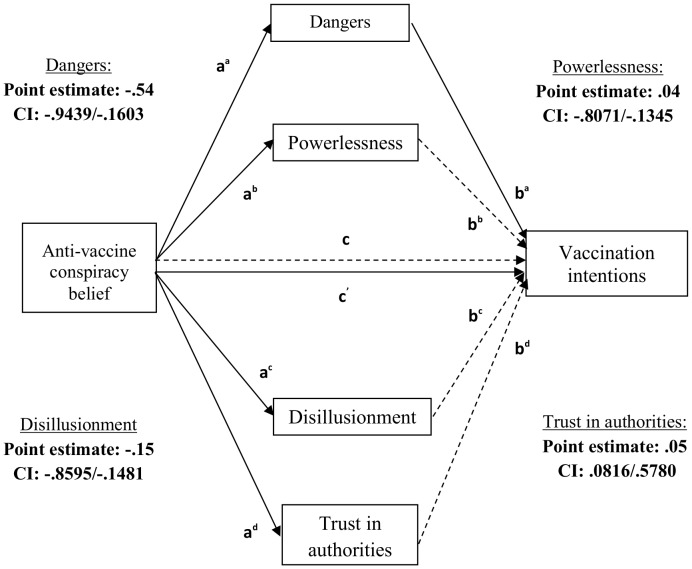
- In Study 1, anti-vaccine conspiracy beliefs significantly negatively predicted vaccination intentions, \(F(1, 87) = 15.97, p < .001, R^2 = .16, \beta = -.63\). Perceived dangers of vaccines, powerlessness, disillusionment, and trust in authorities each significantly mediated this relationship.
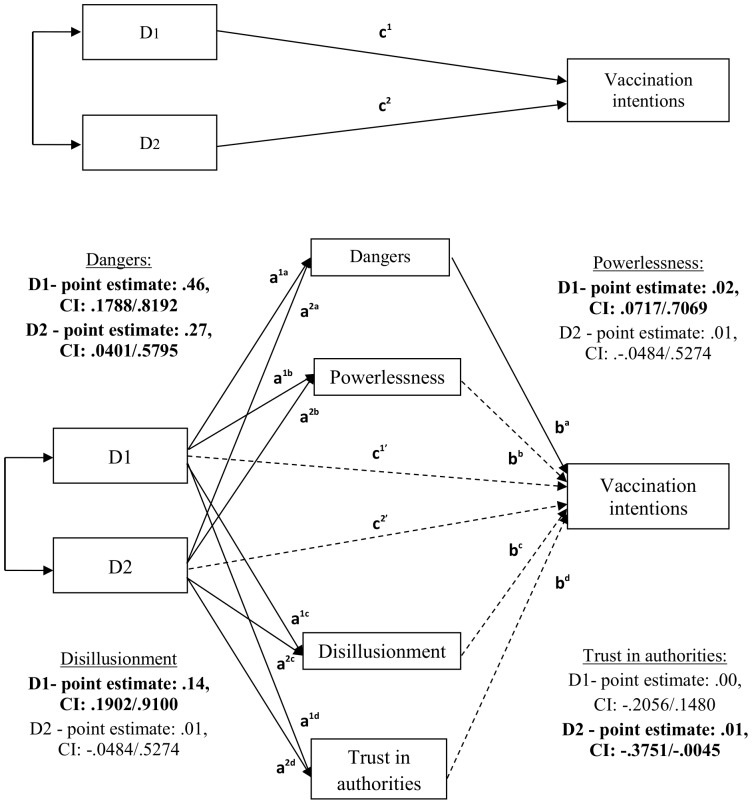
- In Study 2, vaccination intentions were significantly lower in the pro-conspiracy condition (\(M = 4.87, SD = 1.74\)) than in the anti-conspiracy condition (\(M = 5.69, SD = 1.31, p = .003\)) and the control condition (\(M = 5.47, SD = 1.50, p = .028\)), overall \(F(2, 185) = 4.81, p = .009, \eta^2 = .05\).
- The manipulation check showed higher endorsement of anti-vaccine conspiracy theories in the pro-conspiracy condition (\(M = 4.11, SD = 1.41\)) than the anti-conspiracy condition (\(M = 2.93, SD = 1.14, p < .001\)) and control condition (\(M = 3.56, SD = 1.21, p = .014\)).
- Perceived vaccine dangers consistently mediated the effects; powerlessness and disillusionment mediated the pro- versus anti-conspiracy difference, and trust in authorities mediated the pro-conspiracy versus control difference.
Methods
- Study 1 used a correlational online questionnaire with 89 British parents (\(80\) women, \(9\) men; \(M\) age \(= 38.06, SD = 9.25\)). Participants completed measures of anti-vaccine conspiracy beliefs, perceived dangers, powerlessness, disillusionment, trust in authorities, and intention to vaccinate a fictitious 8-month-old child against a made-up disease, dysomeria.
- Study 2 recruited 246 U.S. MTurk participants, with a final analyzed sample of 188 after screening exclusions. Participants were randomly assigned to pro-conspiracy, anti-conspiracy, or control information, then completed the same mediator measures and vaccination intention measure.
- Both studies used bootstrapping mediation analyses with 5000 bootstrap samples; Study 2 used ANOVA and indicator-coded mediation to compare the three conditions.
Limitations
- The paper states that effect sizes were small (e.g., \(\eta^2 = .05\) in Study 2), conspiracy endorsement was generally around or below the midpoint except in the pro-conspiracy condition (\(M = 4.11\)), the mediation pattern was less clear in Study 2, and findings relied on self-reported intentions for a fictional child and made-up disease rather than actual vaccination behavior.
- The paper notes that future research should examine larger samples, actual vaccination behavior, additional or isolated mediators, and geographical areas with dangerously low vaccination uptake.
- Evident from the text: Study 1 is correlational and cannot establish causality, and both studies use hypothetical vaccination scenarios, which may limit ecological validity.
Model-written summary. Check it against the paper before relying on it.
Integrity signals
Registry
Cites
Statistics
Figures
Verification
Claims the paper makes
37 Own result · 21 Not checked yet · 20 Own interpretation · 12 Own method
A result the paper reports from its own data — it cites no other source for it, so there is none to check. The quote shows it is in the paper.
In the paper
“Results revealed a significant negative relationship between anti-vaccine conspiracy beliefs and vaccination intentions.”
- Also stated in: § Results and Discussion · plain
“As predicted, regression analyses revealed that anti-vaccine conspiracy beliefs were a significant negative predictor of vaccination intentions, F(1, 87) = 15.97, p<.001, R2 = .16, β = −.63, t = − 3.10, p<. 001.”
- Also stated in: § Results and Discussion · plain
“Participants who endorsed anti-vaccine conspiracy theories to a greater extent indicated less intention to vaccinate.”
§ The Effects of Anti-Vaccine Conspiracy Theories on Vaccination Intentions > Abstract
plaincorrelational- Asserted: passes — The authors put it forward as true.
- Checkable: passes — It can be checked against evidence.
- Load-bearing: passes — The paper’s conclusions depend on it.
- Based: passes — The paper gives a reason why it holds.
- Also stated in: § Results and Discussion · plain
A result the paper reports from its own data — it cites no other source for it, so there is none to check. The quote shows it is in the paper.
In the paper
“As shown in Table 2, anti-vaccine conspiracy beliefs were a significant predictor of perceived dangers of vaccines, and feelings of powerlessness, disillusionment and trust in authorities, F(5, 83) = 120.37, p<.001, R2 = .58; F(5, 83) = 41.70, p<.001, R2 = .32; F(5, 83) = 74.43, p<.001, R2 = .46; F(5, 83) = 23.00, p<.001, R2 = .20, respectively.”
§ The Effects of Anti-Vaccine Conspiracy Theories on Vaccination Intentions > Study 1 > Results and Discussion
plaincorrelational- Asserted: passes — The authors put it forward as true.
- Checkable: passes — It can be checked against evidence.
- Load-bearing: passes — The paper’s conclusions depend on it.
- Based: passes — The paper gives a reason why it holds.
A result the paper reports from its own data — it cites no other source for it, so there is none to check. The quote shows it is in the paper.
In the paper
“Results revealed that participants who had been exposed to material supporting anti-vaccine conspiracy theories showed less intention to vaccinate than those in the anti-conspiracy condition or controls.”
§ The Effects of Anti-Vaccine Conspiracy Theories on Vaccination Intentions > Abstract
plaindirect- Asserted: passes — The authors put it forward as true.
- Checkable: passes — It can be checked against evidence.
- Load-bearing: passes — The paper’s conclusions depend on it.
- Based: passes — The paper gives a reason why it holds.
A result the paper reports from its own data — it cites no other source for it, so there is none to check. The quote shows it is in the paper.
In the paper
“This effect was mediated by the same variables as in Study 1.”
§ The Effects of Anti-Vaccine Conspiracy Theories on Vaccination Intentions > Abstract
plaindirect- Asserted: passes — The authors put it forward as true.
- Checkable: passes — It can be checked against evidence.
- Load-bearing: passes — The paper’s conclusions depend on it.
- Based: passes — The paper gives a reason why it holds.
A result the paper reports from its own data — it cites no other source for it, so there is none to check. The quote shows it is in the paper.
In the paper
“This effect was mediated by the perceived dangers of vaccines, and feelings of powerlessness, disillusionment and mistrust in authorities.”
- Also stated in: § Results and Discussion · hedged
“The multiple mediation analysis of the effect of anti-vaccine conspiracy beliefs on vaccination intentions indicated that perceived dangers of vaccines and feelings of powerlessness, disillusionment and trust in authorities (controlling for each other) were each significant mediators of this effect.”
- Also stated in: § Results and Discussion · plain
“When all factors were taken into account, each was a significant mediator of the relationship between anti-vaccine conspiracy beliefs and vaccination intentions.”
§ The Effects of Anti-Vaccine Conspiracy Theories on Vaccination Intentions > Abstract
plaincorrelational- Asserted: passes — The authors put it forward as true.
- Checkable: passes — It can be checked against evidence.
- Load-bearing: passes — The paper’s conclusions depend on it.
- Based: passes — The paper gives a reason why it holds.
- Also stated in: § Results and Discussion · hedged
A result the paper reports from its own data — it cites no other source for it, so there is none to check. The quote shows it is in the paper.
In the paper
“As shown in Table 2, anti-vaccine conspiracy beliefs were a significant predictor of perceived dangers of vaccines, and feelings of powerlessness, disillusionment and trust in authorities, F(5, 83) = 120.37, p<.001, R2 = .58; F(5, 83) = 41.70, p<.001, R2 = .32; F(5, 83) = 74.43, p<.001, R2 = .46; F(5, 83) = 23.00, p<.001, R2 = .20, respectively.”
§ The Effects of Anti-Vaccine Conspiracy Theories on Vaccination Intentions > Study 1 > Results and Discussion
plaincorrelational- Asserted: passes — The authors put it forward as true.
- Checkable: passes — It can be checked against evidence.
- Load-bearing: passes — The paper’s conclusions depend on it.
- Based: passes — The paper gives a reason why it holds.
A result the paper reports from its own data — it cites no other source for it, so there is none to check. The quote shows it is in the paper.
In the paper
“The results of this analysis therefore support the use of four separate mediators.”
§ The Effects of Anti-Vaccine Conspiracy Theories on Vaccination Intentions > Study 1 > Results and Discussion
plain- Asserted: passes — The authors put it forward as true.
- Checkable: passes — It can be checked against evidence.
- Load-bearing: passes — The paper’s conclusions depend on it.
- Based: passes — The paper gives a reason why it holds.
A result the paper reports from its own data — it cites no other source for it, so there is none to check. The quote shows it is in the paper.
In the paper
“Finally, results revealed no significant difference in trust in authorities between conditions, F(2, 185) = 2.32, p = .10, η2 = .03.”
§ The Effects of Anti-Vaccine Conspiracy Theories on Vaccination Intentions > Study 2 > Results and Discussion
plain- Asserted: passes — The authors put it forward as true.
- Checkable: passes — It can be checked against evidence.
- Load-bearing: unclear — It is unclear whether the paper’s conclusions depend on it.
- Based: passes — The paper gives a reason why it holds.
A result the paper reports from its own data — it cites no other source for it, so there is none to check. The quote shows it is in the paper.
In the paper
“Perceived dangers were higher in the pro-conspiracy condition (M = 4.00, SD = 1.46) than the anti-conspiracy condition (M = 2.97, SD = 1.42, p<.001) and the control condition (M = 2.39, SD = 1.71, p = .021).”
§ The Effects of Anti-Vaccine Conspiracy Theories on Vaccination Intentions > Study 2 > Results and Discussion
plain- Asserted: passes — The authors put it forward as true.
- Checkable: passes — It can be checked against evidence.
- Load-bearing: passes — The paper’s conclusions depend on it.
- Based: passes — The paper gives a reason why it holds.
- Probably not a substantial claim. 18
- It may state two separate claims as one. 9
- The quote only partly states this claim. 2
What the paper did — it cites no source for this, so there is none to check. The quote shows it is in the paper.
In the paper
“There were eight statements (e.g., “Vaccines lead to allergies”, α = .86)”
§ The Effects of Anti-Vaccine Conspiracy Theories on Vaccination Intentions > Study 1 > Methods
plain- Asserted: passes — The authors put it forward as true.
- Checkable: passes — It can be checked against evidence.
- Load-bearing: fails — The paper’s conclusions may not depend on it.
- Based: passes — The paper gives a reason why it holds.
Probably not a substantial claim. The paper’s conclusions may not depend on it.
What the paper did — it cites no source for this, so there is none to check. The quote shows it is in the paper.
In the paper
“Participants were asked to read the statements (e.g., “I feel that my actions will not stop the negative outcomes of immunizations”, α = .82)”
§ The Effects of Anti-Vaccine Conspiracy Theories on Vaccination Intentions > Study 1 > Methods
plain- Asserted: passes — The authors put it forward as true.
- Checkable: passes — It can be checked against evidence.
- Load-bearing: fails — The paper’s conclusions may not depend on it.
- Based: passes — The paper gives a reason why it holds.
Probably not a substantial claim. The paper’s conclusions may not depend on it.
What the paper did — it cites no source for this, so there is none to check. The quote shows it is in the paper.
In the paper
“consisted of four statements (e.g., “I am very disappointed with those who are involved in immunizations (e.g., the government, pharmaceutical companies)”, α = .89)”
§ The Effects of Anti-Vaccine Conspiracy Theories on Vaccination Intentions > Study 1 > Methods
plain- Asserted: passes — The authors put it forward as true.
- Checkable: passes — It can be checked against evidence.
- Load-bearing: fails — The paper’s conclusions may not depend on it.
- Based: passes — The paper gives a reason why it holds.
Probably not a substantial claim. The paper’s conclusions may not depend on it.
In the paper
“and also that feelings of political powerlessness mediate the relationship between exposure to conspiracy theories and voting intentions [22].”
§ The Effects of Anti-Vaccine Conspiracy Theories on Vaccination Intentions > Introduction
What the sources say
- Not checked yetcites [22] Jolley D, Douglas KM (2013) The social consequences of conspiracism: Exposure to conspiracy theories decreases the intention to engage in politics and to reduce one’s carbon footprint. Br J Psychol: in press. doi:10.1111/bjop.12018. source
plaindirect- Asserted: passes — The authors put it forward as true.
- Checkable: passes — It can be checked against evidence.
- Load-bearing: passes — The paper’s conclusions depend on it.
- Based: passes — The paper gives a reason why it holds.
Probably not a substantial claim.
In the paper
“Further, polls demonstrate that more than 20% of respondents endorse the idea that there is a link between childhood vaccines and autism [13].”
§ The Effects of Anti-Vaccine Conspiracy Theories on Vaccination Intentions > Introduction
What the sources say
- Not checked yetcites [13] Public Policy Polling (2013) Democrats and Republicans differ on conspiracy theory beliefs. Available: http://www.publicpolicypolling.com/pdf/2011/PPP_Release_National_ConspiracyTheories_040213.pdf. Accessed: 2013 Nov 27.
boosted- Asserted: passes — The authors put it forward as true.
- Checkable: passes — It can be checked against evidence.
- Load-bearing: fails — The paper’s conclusions may not depend on it.
- Based: passes — The paper gives a reason why it holds.
Probably not a substantial claim. The paper’s conclusions may not depend on it.
In the paper
“Previous research has demonstrated that exposure to conspiracy theories increases political disillusionment [22]”
§ The Effects of Anti-Vaccine Conspiracy Theories on Vaccination Intentions > Introduction
What the sources say
- Not checked yetcites [22] Jolley D, Douglas KM (2013) The social consequences of conspiracism: Exposure to conspiracy theories decreases the intention to engage in politics and to reduce one’s carbon footprint. Br J Psychol: in press. doi:10.1111/bjop.12018. source
boosteddirect- Asserted: passes — The authors put it forward as true.
- Checkable: passes — It can be checked against evidence.
- Load-bearing: passes — The paper’s conclusions depend on it.
- Based: passes — The paper gives a reason why it holds.
Probably not a substantial claim.
None of the sources cited for this claim have been checked yet.
In the paper
“Endorsement of these conspiracy theories amongst African Americans has been found to be associated with negative attitudes towards contraceptive behaviors, which may potentially expose people to the risk of unwanted pregnancies and sexually transmitted illnesses [23], [24], [25].”
§ The Effects of Anti-Vaccine Conspiracy Theories on Vaccination Intentions > Introduction
What the sources say
- Not checked yetcites [23] ST Bird, 2003, Birth control conspiracy beliefs, perceived discrimination, and contraception among African Americans, Journal of Health Psychology source
- Not checked yetcites [24] LM Bogart, 2006, Relationship of African Americans’ socio demographic characteristics to belief in conspiracies about HIV/AIDS and birth control, Journal of the National Medical Association
- Not checked yetcites [25] MA Hoyt, 2012, HIV/AIDS-related institutional mistrust among multiethnic men who have sex with men: Effects on HIV testing and risk behaviors, Health Psychology source
plaincorrelational- Asserted: passes — The authors put it forward as true.
- Checkable: passes — It can be checked against evidence.
- Load-bearing: fails — The paper’s conclusions may not depend on it.
- Based: passes — The paper gives a reason why it holds.
Probably not a substantial claim. The paper’s conclusions may not depend on it.
What the paper did — it cites no source for this, so there is none to check. The quote shows it is in the paper.
In the paper
“The order of measures was counterbalanced.”
§ The Effects of Anti-Vaccine Conspiracy Theories on Vaccination Intentions > Study 1 > Methods
plain- Asserted: passes — The authors put it forward as true.
- Checkable: passes — It can be checked against evidence.
- Load-bearing: fails — The paper’s conclusions may not depend on it.
- Based: passes — The paper gives a reason why it holds.
Probably not a substantial claim. The paper’s conclusions may not depend on it.
What the paper did — it cites no source for this, so there is none to check. The quote shows it is in the paper.
In the paper
“The study was approved by the Psychology Ethics Committee at the University of Kent and all participants provided their written, informed consent.”
§ The Effects of Anti-Vaccine Conspiracy Theories on Vaccination Intentions > Study 1 > Methods
plain- Asserted: passes — The authors put it forward as true.
- Checkable: passes — It can be checked against evidence.
- Load-bearing: fails — The paper’s conclusions may not depend on it.
- Based: passes — The paper gives a reason why it holds.
Probably not a substantial claim. The paper’s conclusions may not depend on it. It may state two separate claims as one.
What the paper did — it cites no source for this, so there is none to check. The quote shows it is in the paper.
In the paper
“There were two trust sources (corporations and government; Spearman-Brown Coefficient = .82)”
§ The Effects of Anti-Vaccine Conspiracy Theories on Vaccination Intentions > Study 1 > Methods
plain- Asserted: passes — The authors put it forward as true.
- Checkable: passes — It can be checked against evidence.
- Load-bearing: fails — The paper’s conclusions may not depend on it.
- Based: passes — The paper gives a reason why it holds.
Probably not a substantial claim. The paper’s conclusions may not depend on it. The quote only partly states this claim.
None of the sources cited for this claim have been checked yet.
In the paper
“Also, exposure to conspiracy theories has been found to have detrimental effects in other domains, such as reducing pro-environmental intentions and willingness to engage in politics [21], [22].”
§ The Effects of Anti-Vaccine Conspiracy Theories on Vaccination Intentions > Introduction
What the sources say
- Not checked yetcites [21] LD Butler, 1995, The psychological impact of viewing the film JFK: Emotions, beliefs and political behavioral intentions, Political Psychology source
- Not checked yetcites [22] Jolley D, Douglas KM (2013) The social consequences of conspiracism: Exposure to conspiracy theories decreases the intention to engage in politics and to reduce one’s carbon footprint. Br J Psychol: in press. doi:10.1111/bjop.12018. source
plaindirect- Asserted: passes — The authors put it forward as true.
- Checkable: passes — It can be checked against evidence.
- Load-bearing: fails — The paper’s conclusions may not depend on it.
- Based: passes — The paper gives a reason why it holds.
Probably not a substantial claim. The paper’s conclusions may not depend on it.
A conclusion the paper draws from its own results — it cites no other source for it, so there is none to check. The quote shows it is in the paper.
In the paper
“In Study 2, feelings of powerlessness and disillusionment mediated the difference between the pro- and anti-conspiracy conditions, and mistrust in authorities mediated the difference between the pro-conspiracy and control conditions.”
§ The Effects of Anti-Vaccine Conspiracy Theories on Vaccination Intentions > General Discussion
plaindirect- Asserted: passes — The authors put it forward as true.
- Checkable: passes — It can be checked against evidence.
- Load-bearing: passes — The paper’s conclusions depend on it.
- Based: passes — The paper gives a reason why it holds.
It may state two separate claims as one.
A conclusion the paper draws from its own results — it cites no other source for it, so there is none to check. The quote shows it is in the paper.
In the paper
“This means that the proportion of variance in vaccine intentions explained by exposure to conspiracy theories was quite modest and there are potentially many other factors that contribute to vaccine intentions.”
§ The Effects of Anti-Vaccine Conspiracy Theories on Vaccination Intentions > General Discussion
hedgedcorrelational- Asserted: passes — The authors put it forward as true.
- Checkable: passes — It can be checked against evidence.
- Load-bearing: passes — The paper’s conclusions depend on it.
- Based: passes — The paper gives a reason why it holds.
It may state two separate claims as one.
What the paper did — it cites no source for this, so there is none to check. The quote shows it is in the paper.
In the paper
“The final sample size used for data analysis was therefore 188 (112 women and 76 men, M age = 36.33, SD = 13.40).”
§ The Effects of Anti-Vaccine Conspiracy Theories on Vaccination Intentions > Study 2 > Methods
plainn = 188- Asserted: passes — The authors put it forward as true.
- Checkable: passes — It can be checked against evidence.
- Load-bearing: fails — The paper’s conclusions may not depend on it.
- Based: passes — The paper gives a reason why it holds.
Probably not a substantial claim. The paper’s conclusions may not depend on it.
A conclusion the paper draws from its own results — it cites no other source for it, so there is none to check. The quote shows it is in the paper.
In the paper
“Further, feelings of powerlessness and disillusionment mediated the difference between the pro- and anti-conspiracy conditions, and mistrust in authorities mediated the difference between the pro-conspiracy and control conditions.”
§ The Effects of Anti-Vaccine Conspiracy Theories on Vaccination Intentions > Study 2 > Results and Discussion
plaindirectn = 188- Asserted: passes — The authors put it forward as true.
- Checkable: passes — It can be checked against evidence.
- Load-bearing: passes — The paper’s conclusions depend on it.
- Based: passes — The paper gives a reason why it holds.
It may state two separate claims as one.
What the paper did — it cites no source for this, so there is none to check. The quote shows it is in the paper.
In the paper
“There were 60 participants in the pro-conspiracy condition, 62 in the anti-conspiracy condition, and 66 in the control condition.”
§ The Effects of Anti-Vaccine Conspiracy Theories on Vaccination Intentions > Study 2 > Methods
plainn = 60- Asserted: passes — The authors put it forward as true.
- Checkable: passes — It can be checked against evidence.
- Load-bearing: fails — The paper’s conclusions may not depend on it.
- Based: passes — The paper gives a reason why it holds.
Probably not a substantial claim. The paper’s conclusions may not depend on it. It may state two separate claims as one.
None of the sources cited for this claim have been checked yet.
In the paper
“As is well known, intentions do not always translate into behaviors [47], [48], [49].”
§ The Effects of Anti-Vaccine Conspiracy Theories on Vaccination Intentions > General Discussion
What the sources say
- Not checked yetcites [47] RT LaPiere, 1934, Attitudes vs. actions, Social Forces source
- Not checked yetcites [48] LS Linn, 1965, Verbal attitudes and overt behavior: A study of racial discrimination, Social Forces source
- Not checked yetcites [49] Sheeran P (2002) Intention-behavior relations: A conceptual and empirical review. In: Stroebe W, Hewstone M, editors. European Review of Social Psychology. Chichester, UK: Wiley. Vol. 12, 1–36. source
boosted- Asserted: passes — The authors put it forward as true.
- Checkable: passes — It can be checked against evidence.
- Load-bearing: passes — The paper’s conclusions depend on it.
- Based: passes — The paper gives a reason why it holds.
Probably not a substantial claim.
In the paper
“Similarly, different strategies for successful intervention may apply for people who hold strong anti-vaccine conspiracy beliefs than those who do not hold strong beliefs [44].”
§ The Effects of Anti-Vaccine Conspiracy Theories on Vaccination Intentions > General Discussion
What the sources say
- Not checked yetcites [44] CR Sunstein, 2009, Conspiracy theories: Causes and cures, J Polit Philos source
hedgedconditional- Asserted: passes — The authors put it forward as true.
- Checkable: fails — It may be too vague to check against evidence.
- Load-bearing: fails — The paper’s conclusions may not depend on it.
- Based: passes — The paper gives a reason why it holds.
Probably not a substantial claim. It may be too vague to check against evidence. The paper’s conclusions may not depend on it.
None of the sources cited for this claim have been checked yet.
In the paper
“Psychologists are learning more about the traits and characteristics associated with beliefs in conspiracy theories more generally, such as mistrust, anomie, political cynicism and Machiavellianism [8], [20], [31], [50]”
§ The Effects of Anti-Vaccine Conspiracy Theories on Vaccination Intentions > General Discussion
What the sources say
- Not checked yetcites [8] T Goertzel, 1994, Belief in conspiracy theories, Polit Psychol source
- Not checked yetcites [20] KM Douglas, 2008, The hidden impact of conspiracy theories: Perceived and actual influence of theories surrounding the death of Princess Diana, Br J Soc Psychol source
- Not checked yetcites [31] M Abalakina-Paap, 1999, Beliefs in conspiracies, Political Psychology source
plaincorrelational- Asserted: passes — The authors put it forward as true.
- Checkable: passes — It can be checked against evidence.
- Load-bearing: fails — The paper’s conclusions may not depend on it.
- Based: passes — The paper gives a reason why it holds.
Probably not a substantial claim. The paper’s conclusions may not depend on it.
A conclusion the paper draws from its own results — it cites no other source for it, so there is none to check. The quote shows it is in the paper.
In the paper
“Specifically, they appear to reduce vaccination intentions by inducing undue concern about the dangers of vaccines, and increasing powerlessness, disillusionment, and mistrust.”
§ The Effects of Anti-Vaccine Conspiracy Theories on Vaccination Intentions > General Discussion
hedgeddirect- Asserted: passes — The authors put it forward as true.
- Checkable: passes — It can be checked against evidence.
- Load-bearing: passes — The paper’s conclusions depend on it.
- Based: passes — The paper gives a reason why it holds.
It may state two separate claims as one.
A conclusion the paper draws from its own results — it cites no other source for it, so there is none to check. The quote shows it is in the paper.
In the paper
“Therefore, the participants were not strong endorsers of anti-vaccine conspiracy theories, meaning that different patterns of findings may emerge for those who do strongly endorse conspiracy theories.”
§ The Effects of Anti-Vaccine Conspiracy Theories on Vaccination Intentions > General Discussion
hedged- Asserted: passes — The authors put it forward as true.
- Checkable: passes — It can be checked against evidence.
- Load-bearing: unclear — It is unclear whether the paper’s conclusions depend on it.
- Based: passes — The paper gives a reason why it holds.
It may state two separate claims as one.
A conclusion the paper draws from its own results — it cites no other source for it, so there is none to check. The quote shows it is in the paper.
In the paper
“Therefore, overall, anti-vaccine conspiracy theories appear to introduce undue suspicion about vaccine safety, and increase feelings of powerlessness and disillusionment, whilst decreasing trust in authorities, which in turn introduce reluctance to vaccinate.”
§ The Effects of Anti-Vaccine Conspiracy Theories on Vaccination Intentions > General Discussion
hedgeddirect- Asserted: passes — The authors put it forward as true.
- Checkable: passes — It can be checked against evidence.
- Load-bearing: passes — The paper’s conclusions depend on it.
- Based: passes — The paper gives a reason why it holds.
It may state two separate claims as one.
What the paper did — it cites no source for this, so there is none to check. The quote shows it is in the paper.
In the paper
“Participants were randomly assigned to one of the three conditions.”
§ The Effects of Anti-Vaccine Conspiracy Theories on Vaccination Intentions > Study 2 > Methods
plain- Asserted: passes — The authors put it forward as true.
- Checkable: passes — It can be checked against evidence.
- Load-bearing: passes — The paper’s conclusions depend on it.
- Based: passes — The paper gives a reason why it holds.
Probably not a substantial claim.
What the paper did — it cites no source for this, so there is none to check. The quote shows it is in the paper.
In the paper
“The study was approved by the Psychology Ethics Committee at the University of Kent and all participants provided their written, informed consent.”
§ The Effects of Anti-Vaccine Conspiracy Theories on Vaccination Intentions > Study 1 > Methods
plain- Asserted: fails — The authors may not put it forward as true.
- Checkable: passes — It can be checked against evidence.
- Load-bearing: fails — The paper’s conclusions may not depend on it.
- Based: fails — The paper may give no reason why it holds.
Probably not a substantial claim. The authors may not put it forward as true. The paper’s conclusions may not depend on it. The paper may give no reason why it holds. It may state two separate claims as one. The quote only partly states this claim.
The paper relies on this without support.
The measured mediators (perceived vaccine dangers, powerlessness, disillusionment, and trust in authorities) are causally prior to and influence vaccination intentions, as required for the mediation analysis.
“Each of the candidate mediators was then examined in a test of mediation in order to explain the effect of the conspiracy conditions (pro-conspiracy versus anti-conspiracy, versus control) on vaccination intentions.”
Statistics recomputed
Every reported test result, recomputed from its test statistic and degrees of freedom. A result shows as not adding up only once an independent check has confirmed it.
- Consistentχ²(136) = 4544.44reported p < .001 · recomputed p < .001
“X 2 (136) = 4544.44, p < .001”
- ConsistentF(1, 87) = 15.97reported p < .001 · recomputed p < .001
“F(1, 87) = 15.97, p < .001”
- ConsistentF(5, 83) = 120.37reported p < .001 · recomputed p < .001
“F(5, 83) = 120.37, p < .001”
- ConsistentF(5, 83) = 41.7reported p < .001 · recomputed p < .001
“F(5, 83) = 41.70, p < .001”
- ConsistentF(5, 83) = 74.43reported p < .001 · recomputed p < .001
“F(5, 83) = 74.43, p < .001”
- ConsistentF(5, 83) = 23reported p < .001 · recomputed p < .001
“F(5, 83) = 23.00, p < .001”
- ConsistentF(2, 185) = 4.81reported p = .009 · recomputed p = .009
“F(2, 185) = 4.81, p = .009”
- ConsistentF(2, 185) = 7.61reported p = .001 · recomputed p < .001
“F(2, 185) = 7.61, p = .001”
- ConsistentF(2, 185) = 3.44reported p = .034 · recomputed p = .034
“F(2, 185) = 3.44, p = .034”
- ConsistentF(2, 185) = 7.46reported p = .001 · recomputed p < .001
“F(2, 185) = 7.46, p = .001”
- ConsistentF(2, 185) = 2.32reported p = .1 · recomputed p = .101
“F(2, 185) = 2.32, p = .10”
Self-check
Percentages, sums and reported differences re-computed from the paper’s own numbers.
Each contradiction between two passages listed here was confirmed by an independent check.
Rated minor: it would not touch a result — a value no result rests on, a p-value that stays on the same side of the significance level, or a conflict that is clerical, resolved elsewhere in the paper, or outside its own findings.
In the paper
§ The Effects of Anti-Vaccine Conspiracy Theories on Vaccination Intentions > Study 1 > Results and Discussion
“| (2) Immunisation intention | 5.63 (1.42) | −.40*** | – | −.49*** | .29** | −.36*** | .20¥ |”
§ The Effects of Anti-Vaccine Conspiracy Theories on Vaccination Intentions > Study 1 > Results and Discussion
“| (3) Dangers | 2.97 (1.37) | .76*** | −.48*** | – | .58*** | .60*** | −.48*** |”
Rated minor: it would not touch a result — a value no result rests on, a p-value that stays on the same side of the significance level, or a conflict that is clerical, resolved elsewhere in the paper, or outside its own findings.
In the paper
“F(1, 87) = 15.97, p<.001, R2 = .16, β = −.63, t = − 3.10, p<. 001.”
§ The Effects of Anti-Vaccine Conspiracy Theories on Vaccination Intentions > Study 1 > Results and Discussion
Reported 15.97 · recomputed 9.61
Rated minor: it would not touch a result — a value no result rests on, a p-value that stays on the same side of the significance level, or a conflict that is clerical, resolved elsewhere in the paper, or outside its own findings.
In the paper
§ The Effects of Anti-Vaccine Conspiracy Theories on Vaccination Intentions > Study 1 > Results and Discussion
“| (3) Dangers | 2.97 (1.37) | .76*** | −.48*** | – | .58*** | .60*** | −.48*** |”
§ The Effects of Anti-Vaccine Conspiracy Theories on Vaccination Intentions > Study 1 > Results and Discussion
“| (5) Disillusionment | 2.45 (1.40) | .68*** | −.36*** | .59*** | .59*** | – | −.41*** |”
Rated minor: it would not touch a result — a value no result rests on, a p-value that stays on the same side of the significance level, or a conflict that is clerical, resolved elsewhere in the paper, or outside its own findings.
In the paper
§ The Effects of Anti-Vaccine Conspiracy Theories on Vaccination Intentions > Study 1 > Results and Discussion
“β = −.63”
§ The Effects of Anti-Vaccine Conspiracy Theories on Vaccination Intentions > Study 1 > Results and Discussion
“| (1) Anti-vaccine conspiracy belief | 2.00 (.89) | – | −.40*** | .76*** | .57*** | .68*** | −.46*** |”
Rated minor: it would not touch a result — a value no result rests on, a p-value that stays on the same side of the significance level, or a conflict that is clerical, resolved elsewhere in the paper, or outside its own findings.
In the paper
§ The Effects of Anti-Vaccine Conspiracy Theories on Vaccination Intentions > Study 1 > Results and Discussion
“F(5, 83) = 120.37, p<.001, R2 = .58; F(5, 83) = 41.70, p<.001, R2 = .32; F(5, 83) = 74.43, p<.001, R2 = .46; F(5, 83) = 23.00, p<.001, R2 = .20, respectively.”
§ The Effects of Anti-Vaccine Conspiracy Theories on Vaccination Intentions > Study 1 > Results and Discussion
“Table: Table 2 Four separate regressions examining anti-conspiracy belief as predictor, and four mediator variables as criterions.”
Citations
Cites
Preacher, K. J., & Hayes, A. F. (2008) · Behavior Research Methods · doi:10.3758/brm.40.3.879 · Cited by 34,117 · cited 1×
“By repeating this process thousands of times, it builds an empirical approximation of the sampling distribution that constructs the confidence intervals [39].”
Amazon's Mechanical Turk: A New Source of Inexpensive, Yet High-Quality, Data?
Buhrmester, M., Kwang, T., & Gosling, S. D. (2011) · Perspectives on Psychological Science · doi:10.1177/1745691610393980 · Cited by 9,996
Beyond Baron and Kenny: Statistical Mediation Analysis in the New Millennium
Hayes, A. F. (2009) · Communication Monographs · doi:10.1080/03637750903310360 · Cited by 9,757 · cited 5×
“As argued by Hayes [40], an indirect effect is estimated as being significant if the confidence intervals do not contain a zero, as opposed to significance in the individual paths.”
InfluentialNew Environmental Theories: Toward a Coherent Theory of Environmentally Significant Behavior
Stern, P. C. (2000) · Journal of Social Issues · doi:10.1111/0022-4537.00175 · Cited by 8,682
A Second Generation Little Jiffy
Kaiser, H. F. (1970) · Psychometrika · doi:10.1007/bf02291817 · Cited by 4,855
Running experiments on Amazon Mechanical Turk
Paolacci, G., Chandler, J., & Ipeirotis, P. G. (2010) · Judgment and Decision Making · doi:10.1017/s1930297500002205 · Cited by 3,767
Intention—Behavior Relations: A Conceptual and Empirical Review
Sheeran, P. (2002) · European Review of Social Psychology · doi:10.1080/14792772143000003 · Cited by 3,688 · cited 1×
“As is well known, intentions do not always translate into behaviors [47], [48], [49].”
Statistical mediation analysis with a multicategorical independent variable
Hayes, A. F., & Preacher, K. J. (2014) · British Journal of Mathematical and Statistical Psychology · doi:10.1111/bmsp.12028 · Cited by 3,403 · cited 3×
“This was carried out using Hayes and Preacher’s [38] bootstrapping method for indirect effects, as in Study 1.”
Misinformation and Its Correction: Continued Influence and Successful Debiasing
Lewandowsky, S., Ecker, U. K. H., Seifert, C. M., Schwarz, N., & Cook, J. (2012) · Psychological Science in the Public Interest · doi:10.1177/1529100612451018 · Cited by 2,920
A Note on the Multiplying Factors for Various χ2 Approximations
Bartlett, M. S. (1954) · Journal of the Royal Statistical Society Series B (Statistical Methodology) · doi:10.1111/j.2517-6161.1954.tb00174.x · Cited by 2,168
LaPiere, R. T. (1934) · Social Forces · doi:10.2307/2570339 · Cited by 1,720
A postmodern Pandora's box: anti-vaccination misinformation on the internet
Kata, A. (2010) · Vaccine · doi:10.1016/j.vaccine.2009.12.022 · Cited by 1,208
Values, Environmental Concern, and Environmental Behavior
Poortinga, W., Steg, L., & Vlek, C. A. J. (2004) · Environment and Behavior · doi:10.1177/0013916503251466 · Cited by 1,136
Kata, A. (2012) · Vaccine · doi:10.1016/j.vaccine.2011.11.112 · Cited by 1,094
Goertzel, T. (1994) · Political Psychology · doi:10.2307/3791630 · Cited by 1,094 · cited 5×
“Psychologists are learning more about the traits and characteristics associated with beliefs in conspiracy theories more generally, such as mistrust, anomie, political cynicism and Machiavellianism [8], [20], [31], [50], and it will be useful to know if the same, or different factors predict anti-vaccine conspiracy be…”
InfluentialConspiracy theories: Causes and cures
Sunstein, C. R., & Vermeule, A. (2009) · Journal of Political Philosophy · doi:10.1111/j.1467-9760.2008.00325.x · Cited by 1,050
The Role of Conspiracist Ideation and Worldviews in Predicting Rejection of Science
Lewandowsky, S., Gignac, G. E., & Oberauer, K. (2013) · PLoS ONE · doi:10.1371/journal.pone.0075637 · Cited by 693 · cited 1×
“Directly relevant to the current investigation, it has recently been shown that endorsement of a variety of unrelated conspiracy theories is associated with negative attitudes toward vaccination [26].”
Jolley, D., & Douglas, K. M. (2014) · British Journal of Psychology · doi:10.1111/bjop.12018 · Cited by 685 · cited 7×
“Research has demonstrated that powerlessness is associated with beliefs in conspiracy theories [22], [31] and also that feelings of political powerlessness mediate the relationship between exposure to conspiracy theories and voting intentions [22].”
InfluentialSelf-citationDead and Alive: Beliefs in Contradictory Conspiracy Theories
Wood, M. J., Douglas, K. M., & Sutton, R. M. (2012) · Social Psychological and Personality Science · doi:10.1177/1948550611434786 · Cited by 660
Self-citationLewandowsky, S., Oberauer, K., & Gignac, G. E. (2013) · Psychological Science · doi:10.1177/0956797612457686 · Cited by 638 · cited 3×
“The current research also speaks to a broader concern about conspiracy theorizing and science denial [8], [16], [44].”
Abalakina‐Paap, M., Stephan, W. G., Craig, T., & Gregory, W. L. (1999) · Political Psychology · doi:10.1111/0162-895x.00160 · Cited by 589 · cited 3×
“Psychologists are learning more about the traits and characteristics associated with beliefs in conspiracy theories more generally, such as mistrust, anomie, political cynicism and Machiavellianism [8], [20], [31], [50], and it will be useful to know if the same, or different factors predict anti-vaccine conspiracy be…”
Explicit warnings reduce but do not eliminate the continued influence of misinformation
Ecker, U. K. H., Lewandowsky, S., & Tang, D. (2010) · Memory & Cognition · doi:10.3758/mc.38.8.1087 · Cited by 519
Swami, V., Chamorro‐Premuzic, T., & Furnham, A. (2010) · Applied Cognitive Psychology · doi:10.1002/acp.1583 · Cited by 499 · cited 1×
“Psychologists are learning more about the traits and characteristics associated with beliefs in conspiracy theories more generally, such as mistrust, anomie, political cynicism and Machiavellianism [8], [20], [31], [50], and it will be useful to know if the same, or different factors predict anti-vaccine conspiracy be…”
Mills, E., Jadad, A. R., Ross, C., & Wilson, K. (2005) · Journal of Clinical Epidemiology · doi:10.1016/j.jclinepi.2005.09.002 · Cited by 374 · cited 2×
“suggests that such conspiracy theories tend to feature prominently in focus group discussions about vaccination [19].”
Swami, V. (2012) · Frontiers in Psychology · doi:10.3389/fpsyg.2012.00280 · Cited by 337 · cited 1×
“Kennedy’s death [12].”
Douglas, K. M., & Sutton, R. M. (2011) · British Journal of Social Psychology · doi:10.1111/j.2044-8309.2010.02018.x · Cited by 261 · cited 1×
“Conspiracy theories are attempts to explain events as the secret acts of powerful, malevolent forces [7], [8], [9], [10], [11].”
Self-citationDouglas, K. M., & Sutton, R. M. (2008) · The Journal of Social Psychology · doi:10.3200/socp.148.2.210-222 · Cited by 247 · cited 2×
“Psychologists are learning more about the traits and characteristics associated with beliefs in conspiracy theories more generally, such as mistrust, anomie, political cynicism and Machiavellianism [8], [20], [31], [50], and it will be useful to know if the same, or different factors predict anti-vaccine conspiracy be…”
Self-citationParents’ vaccination comprehension and decisions
Downs, J. S., de Bruin, W. B., & Fischhoff, B. (2008) · Vaccine · doi:10.1016/j.vaccine.2008.01.011 · Cited by 245 · cited 1×
“In particular, parents who are faced with the decision to have their children vaccinated may be more likely to seek information about vaccines via the Internet than through their doctor [18].”
Debunking vaccination myths: Strong risk negations can increase perceived vaccination risks.
Betsch, C., & Sachse, K. (2012) · Health Psychology · doi:10.1037/a0027387 · Cited by 215 · cited 1×
“Next, participants completed a scale measuring the perceived dangers of vaccines, adapted from existing materials [32].”
Conroy, K., Rosenthal, S. L., Zimet, G. D., Jin, Y., Bernstein, D. I., Glynn, S. M., & Kahn, J. A. (2009) · Journal of Women s Health · doi:10.1089/jwh.2008.1329 · Cited by 208 · cited 2×
“Although a variety of attempts to increase vaccination intentions have shown promising success in recent years [5], [6], the current research suggests that future attempts to intervene on vaccine reluctance should also consider the role of conspiracy theorizing.”
Climate change, powerlessness and the commons dilemma: Assessing New Zealanders’ preparedness to act
Aitken, C., Chapman, R., & McClure, J. (2011) · Global Environmental Change · doi:10.1016/j.gloenvcha.2011.01.002 · Cited by 206 · cited 1×
“Research has linked beliefs in conspiracy theories with low levels of trust [8], [33].”
Hopfer, S. (2011) · Prevention Science · doi:10.1007/s11121-011-0254-1 · Cited by 204 · cited 2×
“Although a variety of attempts to increase vaccination intentions have shown promising success in recent years [5], [6], the current research suggests that future attempts to intervene on vaccine reluctance should also consider the role of conspiracy theorizing.”
Butler, L. D., Koopman, C., & Zimbardo, P. G. (1995) · Political Psychology · doi:10.2307/3791831 · Cited by 199 · cited 1×
“Also, exposure to conspiracy theories has been found to have detrimental effects in other domains, such as reducing pro-environmental intentions and willingness to engage in politics [21], [22].”
Burgess, D., Burgess, M. A., & Leask, J. (2006) · Vaccine · doi:10.1016/j.vaccine.2006.02.033 · Cited by 144 · cited 1×
“One contributor to this particular decline appears to have been the publication of Andrew Wakefield’s article in The Lancet in 1998 concerning a possible link between the MMR vaccination and the appearance of autism [2], [3].”
The popularity of conspiracy theories of presidential assassination: A Bayesian analysis.
McCauley, C., & Jacques, S. (1979) · Journal of Personality and Social Psychology · doi:10.1037/0022-3514.37.5.637 · Cited by 135 · cited 1×
“Conspiracy theories are attempts to explain events as the secret acts of powerful, malevolent forces [7], [8], [9], [10], [11].”
Verbal attitudes and overt behavior: A study of racial discrimination
Linn, L. S. (1965) · Social Forces · doi:10.2307/2574765 · Cited by 116 · cited 1×
“As is well known, intentions do not always translate into behaviors [47], [48], [49].”
The truth is out there: belief in conspiracy theories
Swami, V., & Coles, R. L. (2010) · WestminsterResearch (University of Westminster) · Cited by 108
Betsch, C., Renkewitz, F., & Haase, N. (2012) · Medical Decision Making · doi:10.1177/0272989x12452342 · Cited by 106 · cited 1×
“Finally, participants were asked to imagine a scenario in which they were the parent of an infant (Sophie, aged 8 months) [34], [35].”
Choosing not to immunize: are parents making informed decisions?
Sporton, R. K., & Francis, S.-A. (2001) · Family Practice · doi:10.1093/fampra/18.2.181 · Cited by 101
Parental vaccine refusal in Wisconsin: a case-control study.
Salmon, D. A., Sotir, M. J., Pan, W., Berg, J. L., Omer, S. B., Stokley, S. K., Hopfensperger, D. J., Davis, J. P., & Halsey, N. A. (2009) · PubMed · Cited by 101
Deadly Choices: How the Anti-Vaccine Movement Threatens Us All
Offit, P. A. (2010) · Cited by 99
Bogart, L. M., & Thorburn, S. (2006) · PubMed Central · Cited by 82
Thorburn Bird, S., & Bogart, L. M. (2003) · Journal of Health Psychology · doi:10.1177/1359105303008002669 · Cited by 82
Hoyt, M. A., Rubin, L. R., Nemeroff, C. J., Lee, J., Huebner, D. M., & Proeschold-Bell, R. J. (2012) · Health Psychology · doi:10.1037/a0025953 · Cited by 64
Assuring research integrity in the wake of Wakefield
Opel, D. J., Diekema, D. S., & Marcuse, E. K. (2011) · BMJ · doi:10.1136/bmj.d2 · Cited by 26 · cited 1×
“One contributor to this particular decline appears to have been the publication of Andrew Wakefield’s article in The Lancet in 1998 concerning a possible link between the MMR vaccination and the appearance of autism [2], [3].”
The Marital Disillusionment Scale: Development and Psychometric Properties
Niehuis, S., & Bartell, D. S. (2006) · North American journal of psychology · Cited by 24
Factors influencing the immunization status of children in a rural setting
Wilson, T. (2000) · Journal of Pediatric Health Care · doi:10.1016/s0891-5245(00)70022-8 · Cited by 22 · cited 1×
“First, perceiving danger in vaccines tends to be associated with reluctance to vaccinate [27].”
Cited by
Sorted by citations
Using social and behavioural science to support COVID-19 pandemic response
Bavel, J. J. V., Baicker, K., Boggio, P. S., Capraro, V., Cichocka, A., Cikara, M., Crockett, M. J., Crum, A. J., Douglas, K. M., Druckman, J. N., et al. (2020) · Nature Human Behaviour · doi:10.1038/s41562-020-0884-z · Cited by 4,964
Self-citationUnderstanding Conspiracy Theories
Douglas, K. M., Uscinski, J. E., Sutton, R. M., Cichocka, A., Nefes, T., Ang, C. S., & Deravi, F. (2019) · Political Psychology · doi:10.1111/pops.12568 · Cited by 1,511
Self-citationSusceptibility to misinformation about COVID-19 around the world
Roozenbeek, J., Schneider, C. R., Dryhurst, S., Kerr, J., Freeman, A. L. J., Recchia, G., van der Bles, A. M., & van der Linden, S. (2020) · Royal Society Open Science · doi:10.1098/rsos.201199 · Cited by 1,447
The Psychology of Conspiracy Theories
Douglas, K. M., Sutton, R. M., & Cichocka, A. (2017) · Current Directions in Psychological Science · doi:10.1177/0963721417718261 · Cited by 1,316
“It also causes disenchantment with politicians and scientists ( Jolley & Douglas, 2014a).”
BackgroundSelf-citationConspiracy theories as barriers to controlling the spread of COVID-19 in the U.S.
Römer, D., & Jamieson, K. H. (2020) · Social Science & Medicine · doi:10.1016/j.socscimed.2020.113356 · Cited by 1,065
“Previous research has linked conspiracy beliefs with vaccination hesitancy (Hornsey et al., 2020; Jolley and Douglas, 2014).”
Background
Metadata
- Authors
- Jolley, D., & Douglas, K. M.
- Affiliations
- University of Kent (GB)
- Corresponding author
- Jolley, Daniel
- Douglas, Karen M.
- Venue
- PLoS ONE
- Publisher
- Public Library of Science (PLoS)
- Published
- 2014-02-20
- Volume
- 9
- Issue
- 2
- Pages
- e89177
- ISSN
- 1932-6203 (ISSN-L)
- PMC
- PMC3930676
- OpenAlex
- W2016520072
- Cited by
- 1,232
- References
- 49
- Citations by year
- 2026: 68 · 2025: 92 · 2024: 116 · 2023: 147 · 2022: 225 · 2021: 232 · 2020: 147 · 2019: 51 · 2018: 72 · 2017: 39 · 2016: 19 · 2015: 18 · 2014: 6
- FWCI
- 89.08
- Type
- journal article
- Language
- en
- Open access
- gold
- doi.org
- Locations
- PLoS ONE (publishedVersion, cc-by)
- Europe PMC (PubMed Central) (publishedVersion, cc-by)
- PubMed Central (publishedVersion, cc-by)
- PubMed (publishedVersion)
- Staffordshire Online Repository (Staffordshire University) (acceptedVersion)
- Northumbria Research Link (Northumbria University) (acceptedVersion)
- Kent Academic Repository (University of Kent) (submittedVersion)
- RePEc: Research Papers in Economics (submittedVersion)
- DOAJ (DOAJ: Directory of Open Access Journals) (submittedVersion, cc-by-sa)
- Lancaster EPrints (Lancaster University) (submittedVersion)
- Figshare (submittedVersion, cc-by)
- Repository@Nottingham (University of Nottingham) (submittedVersion, cc-by)
- Topics
- Social Sciences › Sociology and Political Science › Misinformation and Its Impacts
- Social Sciences › Health › Vaccine Coverage and Hesitancy
- Social Sciences › Sociology and Political Science › Risk Perception and Management
- Keywords
- vaccination intention, vaccine hesitancy, powerlessness, misinformation exposure, health behavior, parents
- MeSH terms
- Adult, Child, Preschool, Culture, Female, Humans, Health Knowledge, Attitudes, Practice, Male, Surveys and Questionnaires, Vaccination, Vaccines, Intention
About these checks
Registry, retraction, Cites and statistics results are computed, not judged, with one exception: a printed reference that no index lists is read once by a model before it counts as a citation error. Claims are extracted by a model and kept only when their quote appears verbatim in the text; each cited source is then checked, with a model’s help, for whether it says what the claim relies on. Those verdicts can be wrong — read the claim’s quote and the cited source before relying on one.
A language model drew the claims from the paper on 2026-10-09, under version 3 of the claim definition (model deepseek-v4.1-flash, prompt extract-v3).
A second model labelled each claim on 2026-10-09 (model jev-1.13-20260917, definition revision gold-guideline-v0.2).
Statistics and arithmetic are recomputed, not judged.
Confidence bands are shown only for fields calibrated on our annotated test set. None is calibrated yet, so no band is shown.
What counts as a claim ›How we measure confidence ›How we check this ›
Are you an author, or do you see a problem with this page? Request a review
