

The DOI matches its Crossref record; 47 of the 49 references it cites were found in a registry or an index; none of the 32 sources its claims cite is checked for support yet.
The Effects of Anti-Vaccine Conspiracy Theories on Vaccination Intentions
Open accessAbstract
The current studies investigated the potential impact of anti-vaccine conspiracy beliefs, and exposure to anti-vaccine conspiracy theories, on vaccination intentions. In Study 1, British parents completed a questionnaire measuring beliefs in anti-vaccine conspiracy theories and the likelihood that they would have a fictitious child vaccinated. Results revealed a significant negative relationship between anti-vaccine conspiracy beliefs and vaccination intentions. This effect was mediated by the perceived dangers of vaccines, and feelings of powerlessness, disillusionment and mistrust in authorities. In Study 2, participants were exposed to information that either supported or refuted anti-vaccine conspiracy theories, or a control condition. Results revealed that participants who had been exposed to material supporting anti-vaccine conspiracy theories showed less intention to vaccinate than those in the anti-conspiracy condition or controls. This effect was mediated by the same variables as in Study 1. These findings point to the potentially detrimental consequences of anti-vaccine conspiracy theories, and highlight their potential role in shaping health-related behaviors.
Overview
AI snapshot
Written from the paper’s full text.
TL;DR
Two studies show that anti-vaccine conspiracy beliefs and exposure to anti-vaccine conspiracy material are associated with lower intentions to vaccinate a fictitious child. These effects were mediated by perceived vaccine dangers, powerlessness, disillusionment, and mistrust in authorities.
Key findings
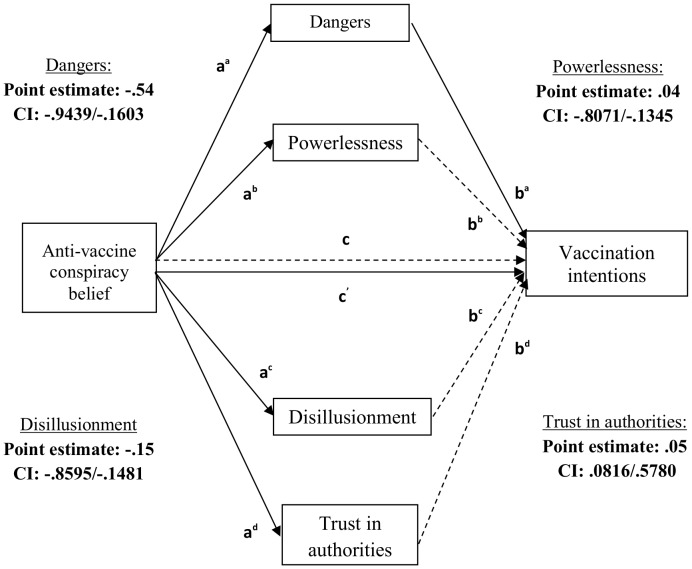
- In Study 1, anti-vaccine conspiracy beliefs significantly negatively predicted vaccination intentions, \(F(1, 87) = 15.97, p < .001, R^2 = .16, \beta = -.63\). Perceived dangers of vaccines, powerlessness, disillusionment, and trust in authorities each significantly mediated this relationship.
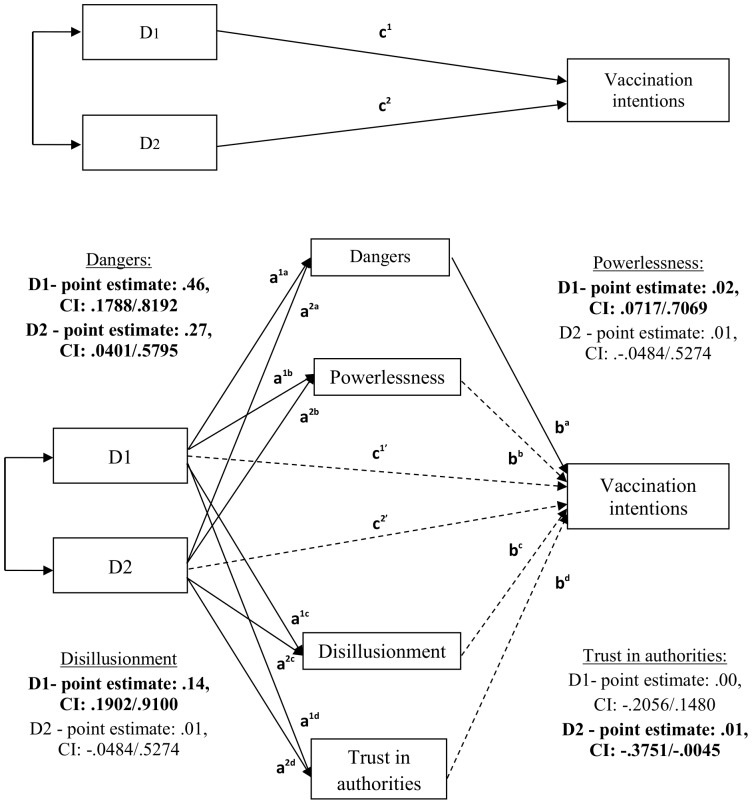
- In Study 2, vaccination intentions were significantly lower in the pro-conspiracy condition (\(M = 4.87, SD = 1.74\)) than in the anti-conspiracy condition (\(M = 5.69, SD = 1.31, p = .003\)) and the control condition (\(M = 5.47, SD = 1.50, p = .028\)), overall \(F(2, 185) = 4.81, p = .009, \eta^2 = .05\).
- The manipulation check showed higher endorsement of anti-vaccine conspiracy theories in the pro-conspiracy condition (\(M = 4.11, SD = 1.41\)) than the anti-conspiracy condition (\(M = 2.93, SD = 1.14, p < .001\)) and control condition (\(M = 3.56, SD = 1.21, p = .014\)).
- Perceived vaccine dangers consistently mediated the effects; powerlessness and disillusionment mediated the pro- versus anti-conspiracy difference, and trust in authorities mediated the pro-conspiracy versus control difference.
Methods
- Study 1 used a correlational online questionnaire with 89 British parents (\(80\) women, \(9\) men; \(M\) age \(= 38.06, SD = 9.25\)). Participants completed measures of anti-vaccine conspiracy beliefs, perceived dangers, powerlessness, disillusionment, trust in authorities, and intention to vaccinate a fictitious 8-month-old child against a made-up disease, dysomeria.
- Study 2 recruited 246 U.S. MTurk participants, with a final analyzed sample of 188 after screening exclusions. Participants were randomly assigned to pro-conspiracy, anti-conspiracy, or control information, then completed the same mediator measures and vaccination intention measure.
- Both studies used bootstrapping mediation analyses with 5000 bootstrap samples; Study 2 used ANOVA and indicator-coded mediation to compare the three conditions.
Limitations
- The paper states that effect sizes were small (e.g., \(\eta^2 = .05\) in Study 2), conspiracy endorsement was generally around or below the midpoint except in the pro-conspiracy condition (\(M = 4.11\)), the mediation pattern was less clear in Study 2, and findings relied on self-reported intentions for a fictional child and made-up disease rather than actual vaccination behavior.
- The paper notes that future research should examine larger samples, actual vaccination behavior, additional or isolated mediators, and geographical areas with dangerously low vaccination uptake.
- Evident from the text: Study 1 is correlational and cannot establish causality, and both studies use hypothetical vaccination scenarios, which may limit ecological validity.
Model-written summary. Check it against the paper before relying on it.
Integrity signals
Registry
Cites
Statistics
Figures
Verification
Claims the paper makes
37 Own result · 21 Not checked yet · 20 Own interpretation · 12 Own method
A result the paper reports from its own data — it cites no other source for it, so there is none to check. The quote shows it is in the paper.
In the paper
“Results revealed a significant negative relationship between anti-vaccine conspiracy beliefs and vaccination intentions.”
- Also stated in: § Results and Discussion · plain
“As predicted, regression analyses revealed that anti-vaccine conspiracy beliefs were a significant negative predictor of vaccination intentions, F(1, 87) = 15.97, p<.001, R2 = .16, β = −.63, t = − 3.10, p<. 001.”
- Also stated in: § Results and Discussion · plain
“Participants who endorsed anti-vaccine conspiracy theories to a greater extent indicated less intention to vaccinate.”
§ The Effects of Anti-Vaccine Conspiracy Theories on Vaccination Intentions > Abstract
plaincorrelational- Asserted: passes — The authors put it forward as true.
- Checkable: passes — It can be checked against evidence.
- Load-bearing: passes — The paper’s conclusions depend on it.
- Based: passes — The paper gives a reason why it holds.
- Also stated in: § Results and Discussion · plain
A result the paper reports from its own data — it cites no other source for it, so there is none to check. The quote shows it is in the paper.
In the paper
“As shown in Table 2, anti-vaccine conspiracy beliefs were a significant predictor of perceived dangers of vaccines, and feelings of powerlessness, disillusionment and trust in authorities, F(5, 83) = 120.37, p<.001, R2 = .58; F(5, 83) = 41.70, p<.001, R2 = .32; F(5, 83) = 74.43, p<.001, R2 = .46; F(5, 83) = 23.00, p<.001, R2 = .20, respectively.”
§ The Effects of Anti-Vaccine Conspiracy Theories on Vaccination Intentions > Study 1 > Results and Discussion
plaincorrelational- Asserted: passes — The authors put it forward as true.
- Checkable: passes — It can be checked against evidence.
- Load-bearing: passes — The paper’s conclusions depend on it.
- Based: passes — The paper gives a reason why it holds.
A result the paper reports from its own data — it cites no other source for it, so there is none to check. The quote shows it is in the paper.
In the paper
“Results revealed that participants who had been exposed to material supporting anti-vaccine conspiracy theories showed less intention to vaccinate than those in the anti-conspiracy condition or controls.”
§ The Effects of Anti-Vaccine Conspiracy Theories on Vaccination Intentions > Abstract
plaindirect- Asserted: passes — The authors put it forward as true.
- Checkable: passes — It can be checked against evidence.
- Load-bearing: passes — The paper’s conclusions depend on it.
- Based: passes — The paper gives a reason why it holds.
A result the paper reports from its own data — it cites no other source for it, so there is none to check. The quote shows it is in the paper.
In the paper
“This effect was mediated by the same variables as in Study 1.”
§ The Effects of Anti-Vaccine Conspiracy Theories on Vaccination Intentions > Abstract
plaindirect- Asserted: passes — The authors put it forward as true.
- Checkable: passes — It can be checked against evidence.
- Load-bearing: passes — The paper’s conclusions depend on it.
- Based: passes — The paper gives a reason why it holds.
A result the paper reports from its own data — it cites no other source for it, so there is none to check. The quote shows it is in the paper.
In the paper
“This effect was mediated by the perceived dangers of vaccines, and feelings of powerlessness, disillusionment and mistrust in authorities.”
- Also stated in: § Results and Discussion · hedged
“The multiple mediation analysis of the effect of anti-vaccine conspiracy beliefs on vaccination intentions indicated that perceived dangers of vaccines and feelings of powerlessness, disillusionment and trust in authorities (controlling for each other) were each significant mediators of this effect.”
- Also stated in: § Results and Discussion · plain
“When all factors were taken into account, each was a significant mediator of the relationship between anti-vaccine conspiracy beliefs and vaccination intentions.”
§ The Effects of Anti-Vaccine Conspiracy Theories on Vaccination Intentions > Abstract
plaincorrelational- Asserted: passes — The authors put it forward as true.
- Checkable: passes — It can be checked against evidence.
- Load-bearing: passes — The paper’s conclusions depend on it.
- Based: passes — The paper gives a reason why it holds.
- Also stated in: § Results and Discussion · hedged
A result the paper reports from its own data — it cites no other source for it, so there is none to check. The quote shows it is in the paper.
In the paper
“As shown in Table 2, anti-vaccine conspiracy beliefs were a significant predictor of perceived dangers of vaccines, and feelings of powerlessness, disillusionment and trust in authorities, F(5, 83) = 120.37, p<.001, R2 = .58; F(5, 83) = 41.70, p<.001, R2 = .32; F(5, 83) = 74.43, p<.001, R2 = .46; F(5, 83) = 23.00, p<.001, R2 = .20, respectively.”
§ The Effects of Anti-Vaccine Conspiracy Theories on Vaccination Intentions > Study 1 > Results and Discussion
plaincorrelational- Asserted: passes — The authors put it forward as true.
- Checkable: passes — It can be checked against evidence.
- Load-bearing: passes — The paper’s conclusions depend on it.
- Based: passes — The paper gives a reason why it holds.
A result the paper reports from its own data — it cites no other source for it, so there is none to check. The quote shows it is in the paper.
In the paper
“The results of this analysis therefore support the use of four separate mediators.”
§ The Effects of Anti-Vaccine Conspiracy Theories on Vaccination Intentions > Study 1 > Results and Discussion
plain- Asserted: passes — The authors put it forward as true.
- Checkable: passes — It can be checked against evidence.
- Load-bearing: passes — The paper’s conclusions depend on it.
- Based: passes — The paper gives a reason why it holds.
A result the paper reports from its own data — it cites no other source for it, so there is none to check. The quote shows it is in the paper.
In the paper
“Finally, results revealed no significant difference in trust in authorities between conditions, F(2, 185) = 2.32, p = .10, η2 = .03.”
§ The Effects of Anti-Vaccine Conspiracy Theories on Vaccination Intentions > Study 2 > Results and Discussion
plain- Asserted: passes — The authors put it forward as true.
- Checkable: passes — It can be checked against evidence.
- Load-bearing: unclear — It is unclear whether the paper’s conclusions depend on it.
- Based: passes — The paper gives a reason why it holds.
A result the paper reports from its own data — it cites no other source for it, so there is none to check. The quote shows it is in the paper.
In the paper
“Perceived dangers were higher in the pro-conspiracy condition (M = 4.00, SD = 1.46) than the anti-conspiracy condition (M = 2.97, SD = 1.42, p<.001) and the control condition (M = 2.39, SD = 1.71, p = .021).”
§ The Effects of Anti-Vaccine Conspiracy Theories on Vaccination Intentions > Study 2 > Results and Discussion
plain- Asserted: passes — The authors put it forward as true.
- Checkable: passes — It can be checked against evidence.
- Load-bearing: passes — The paper’s conclusions depend on it.
- Based: passes — The paper gives a reason why it holds.
- Probably not a substantial claim. 18
- It may state two separate claims as one. 9
- The quote only partly states this claim. 2
What the paper did — it cites no source for this, so there is none to check. The quote shows it is in the paper.
In the paper
“There were eight statements (e.g., “Vaccines lead to allergies”, α = .86)”
§ The Effects of Anti-Vaccine Conspiracy Theories on Vaccination Intentions > Study 1 > Methods
plain- Asserted: passes — The authors put it forward as true.
- Checkable: passes — It can be checked against evidence.
- Load-bearing: fails — The paper’s conclusions may not depend on it.
- Based: passes — The paper gives a reason why it holds.
Probably not a substantial claim. The paper’s conclusions may not depend on it.
What the paper did — it cites no source for this, so there is none to check. The quote shows it is in the paper.
In the paper
“Participants were asked to read the statements (e.g., “I feel that my actions will not stop the negative outcomes of immunizations”, α = .82)”
§ The Effects of Anti-Vaccine Conspiracy Theories on Vaccination Intentions > Study 1 > Methods
plain- Asserted: passes — The authors put it forward as true.
- Checkable: passes — It can be checked against evidence.
- Load-bearing: fails — The paper’s conclusions may not depend on it.
- Based: passes — The paper gives a reason why it holds.
Probably not a substantial claim. The paper’s conclusions may not depend on it.
What the paper did — it cites no source for this, so there is none to check. The quote shows it is in the paper.
In the paper
“consisted of four statements (e.g., “I am very disappointed with those who are involved in immunizations (e.g., the government, pharmaceutical companies)”, α = .89)”
§ The Effects of Anti-Vaccine Conspiracy Theories on Vaccination Intentions > Study 1 > Methods
plain- Asserted: passes — The authors put it forward as true.
- Checkable: passes — It can be checked against evidence.
- Load-bearing: fails — The paper’s conclusions may not depend on it.
- Based: passes — The paper gives a reason why it holds.
Probably not a substantial claim. The paper’s conclusions may not depend on it.
In the paper
“and also that feelings of political powerlessness mediate the relationship between exposure to conspiracy theories and voting intentions [22].”
§ The Effects of Anti-Vaccine Conspiracy Theories on Vaccination Intentions > Introduction
What the sources say
- Not checked yetcites [22] Jolley D, Douglas KM (2013) The social consequences of conspiracism: Exposure to conspiracy theories decreases the intention to engage in politics and to reduce one’s carbon footprint. Br J Psychol: in press. doi:10.1111/bjop.12018. source
plaindirect- Asserted: passes — The authors put it forward as true.
- Checkable: passes — It can be checked against evidence.
- Load-bearing: passes — The paper’s conclusions depend on it.
- Based: passes — The paper gives a reason why it holds.
Probably not a substantial claim.
In the paper
“Further, polls demonstrate that more than 20% of respondents endorse the idea that there is a link between childhood vaccines and autism [13].”
§ The Effects of Anti-Vaccine Conspiracy Theories on Vaccination Intentions > Introduction
What the sources say
- Not checked yetcites [13] Public Policy Polling (2013) Democrats and Republicans differ on conspiracy theory beliefs. Available: http://www.publicpolicypolling.com/pdf/2011/PPP_Release_National_ConspiracyTheories_040213.pdf. Accessed: 2013 Nov 27.
boosted- Asserted: passes — The authors put it forward as true.
- Checkable: passes — It can be checked against evidence.
- Load-bearing: fails — The paper’s conclusions may not depend on it.
- Based: passes — The paper gives a reason why it holds.
Probably not a substantial claim. The paper’s conclusions may not depend on it.
In the paper
“Previous research has demonstrated that exposure to conspiracy theories increases political disillusionment [22]”
§ The Effects of Anti-Vaccine Conspiracy Theories on Vaccination Intentions > Introduction
What the sources say
- Not checked yetcites [22] Jolley D, Douglas KM (2013) The social consequences of conspiracism: Exposure to conspiracy theories decreases the intention to engage in politics and to reduce one’s carbon footprint. Br J Psychol: in press. doi:10.1111/bjop.12018. source
boosteddirect- Asserted: passes — The authors put it forward as true.
- Checkable: passes — It can be checked against evidence.
- Load-bearing: passes — The paper’s conclusions depend on it.
- Based: passes — The paper gives a reason why it holds.
Probably not a substantial claim.
None of the sources cited for this claim have been checked yet.
In the paper
“Endorsement of these conspiracy theories amongst African Americans has been found to be associated with negative attitudes towards contraceptive behaviors, which may potentially expose people to the risk of unwanted pregnancies and sexually transmitted illnesses [23], [24], [25].”
§ The Effects of Anti-Vaccine Conspiracy Theories on Vaccination Intentions > Introduction
What the sources say
- Not checked yetcites [23] ST Bird, 2003, Birth control conspiracy beliefs, perceived discrimination, and contraception among African Americans, Journal of Health Psychology source
- Not checked yetcites [24] LM Bogart, 2006, Relationship of African Americans’ socio demographic characteristics to belief in conspiracies about HIV/AIDS and birth control, Journal of the National Medical Association
- Not checked yetcites [25] MA Hoyt, 2012, HIV/AIDS-related institutional mistrust among multiethnic men who have sex with men: Effects on HIV testing and risk behaviors, Health Psychology source
plaincorrelational- Asserted: passes — The authors put it forward as true.
- Checkable: passes — It can be checked against evidence.
- Load-bearing: fails — The paper’s conclusions may not depend on it.
- Based: passes — The paper gives a reason why it holds.
Probably not a substantial claim. The paper’s conclusions may not depend on it.
What the paper did — it cites no source for this, so there is none to check. The quote shows it is in the paper.
In the paper
“The order of measures was counterbalanced.”
§ The Effects of Anti-Vaccine Conspiracy Theories on Vaccination Intentions > Study 1 > Methods
plain- Asserted: passes — The authors put it forward as true.
- Checkable: passes — It can be checked against evidence.
- Load-bearing: fails — The paper’s conclusions may not depend on it.
- Based: passes — The paper gives a reason why it holds.
Probably not a substantial claim. The paper’s conclusions may not depend on it.
What the paper did — it cites no source for this, so there is none to check. The quote shows it is in the paper.
In the paper
“The study was approved by the Psychology Ethics Committee at the University of Kent and all participants provided their written, informed consent.”
§ The Effects of Anti-Vaccine Conspiracy Theories on Vaccination Intentions > Study 1 > Methods
plain- Asserted: passes — The authors put it forward as true.
- Checkable: passes — It can be checked against evidence.
- Load-bearing: fails — The paper’s conclusions may not depend on it.
- Based: passes — The paper gives a reason why it holds.
Probably not a substantial claim. The paper’s conclusions may not depend on it. It may state two separate claims as one.
What the paper did — it cites no source for this, so there is none to check. The quote shows it is in the paper.
In the paper
“There were two trust sources (corporations and government; Spearman-Brown Coefficient = .82)”
§ The Effects of Anti-Vaccine Conspiracy Theories on Vaccination Intentions > Study 1 > Methods
plain- Asserted: passes — The authors put it forward as true.
- Checkable: passes — It can be checked against evidence.
- Load-bearing: fails — The paper’s conclusions may not depend on it.
- Based: passes — The paper gives a reason why it holds.
Probably not a substantial claim. The paper’s conclusions may not depend on it. The quote only partly states this claim.
None of the sources cited for this claim have been checked yet.
In the paper
“Also, exposure to conspiracy theories has been found to have detrimental effects in other domains, such as reducing pro-environmental intentions and willingness to engage in politics [21], [22].”
§ The Effects of Anti-Vaccine Conspiracy Theories on Vaccination Intentions > Introduction
What the sources say
- Not checked yetcites [21] LD Butler, 1995, The psychological impact of viewing the film JFK: Emotions, beliefs and political behavioral intentions, Political Psychology source
- Not checked yetcites [22] Jolley D, Douglas KM (2013) The social consequences of conspiracism: Exposure to conspiracy theories decreases the intention to engage in politics and to reduce one’s carbon footprint. Br J Psychol: in press. doi:10.1111/bjop.12018. source
plaindirect- Asserted: passes — The authors put it forward as true.
- Checkable: passes — It can be checked against evidence.
- Load-bearing: fails — The paper’s conclusions may not depend on it.
- Based: passes — The paper gives a reason why it holds.
Probably not a substantial claim. The paper’s conclusions may not depend on it.
A conclusion the paper draws from its own results — it cites no other source for it, so there is none to check. The quote shows it is in the paper.
In the paper
“In Study 2, feelings of powerlessness and disillusionment mediated the difference between the pro- and anti-conspiracy conditions, and mistrust in authorities mediated the difference between the pro-conspiracy and control conditions.”
§ The Effects of Anti-Vaccine Conspiracy Theories on Vaccination Intentions > General Discussion
plaindirect- Asserted: passes — The authors put it forward as true.
- Checkable: passes — It can be checked against evidence.
- Load-bearing: passes — The paper’s conclusions depend on it.
- Based: passes — The paper gives a reason why it holds.
It may state two separate claims as one.
A conclusion the paper draws from its own results — it cites no other source for it, so there is none to check. The quote shows it is in the paper.
In the paper
“This means that the proportion of variance in vaccine intentions explained by exposure to conspiracy theories was quite modest and there are potentially many other factors that contribute to vaccine intentions.”
§ The Effects of Anti-Vaccine Conspiracy Theories on Vaccination Intentions > General Discussion
hedgedcorrelational- Asserted: passes — The authors put it forward as true.
- Checkable: passes — It can be checked against evidence.
- Load-bearing: passes — The paper’s conclusions depend on it.
- Based: passes — The paper gives a reason why it holds.
It may state two separate claims as one.
What the paper did — it cites no source for this, so there is none to check. The quote shows it is in the paper.
In the paper
“The final sample size used for data analysis was therefore 188 (112 women and 76 men, M age = 36.33, SD = 13.40).”
§ The Effects of Anti-Vaccine Conspiracy Theories on Vaccination Intentions > Study 2 > Methods
plainn = 188- Asserted: passes — The authors put it forward as true.
- Checkable: passes — It can be checked against evidence.
- Load-bearing: fails — The paper’s conclusions may not depend on it.
- Based: passes — The paper gives a reason why it holds.
Probably not a substantial claim. The paper’s conclusions may not depend on it.
A conclusion the paper draws from its own results — it cites no other source for it, so there is none to check. The quote shows it is in the paper.
In the paper
“Further, feelings of powerlessness and disillusionment mediated the difference between the pro- and anti-conspiracy conditions, and mistrust in authorities mediated the difference between the pro-conspiracy and control conditions.”
§ The Effects of Anti-Vaccine Conspiracy Theories on Vaccination Intentions > Study 2 > Results and Discussion
plaindirectn = 188- Asserted: passes — The authors put it forward as true.
- Checkable: passes — It can be checked against evidence.
- Load-bearing: passes — The paper’s conclusions depend on it.
- Based: passes — The paper gives a reason why it holds.
It may state two separate claims as one.
What the paper did — it cites no source for this, so there is none to check. The quote shows it is in the paper.
In the paper
“There were 60 participants in the pro-conspiracy condition, 62 in the anti-conspiracy condition, and 66 in the control condition.”
§ The Effects of Anti-Vaccine Conspiracy Theories on Vaccination Intentions > Study 2 > Methods
plainn = 60- Asserted: passes — The authors put it forward as true.
- Checkable: passes — It can be checked against evidence.
- Load-bearing: fails — The paper’s conclusions may not depend on it.
- Based: passes — The paper gives a reason why it holds.
Probably not a substantial claim. The paper’s conclusions may not depend on it. It may state two separate claims as one.
None of the sources cited for this claim have been checked yet.
In the paper
“As is well known, intentions do not always translate into behaviors [47], [48], [49].”
§ The Effects of Anti-Vaccine Conspiracy Theories on Vaccination Intentions > General Discussion
What the sources say
- Not checked yetcites [47] RT LaPiere, 1934, Attitudes vs. actions, Social Forces source
- Not checked yetcites [48] LS Linn, 1965, Verbal attitudes and overt behavior: A study of racial discrimination, Social Forces source
- Not checked yetcites [49] Sheeran P (2002) Intention-behavior relations: A conceptual and empirical review. In: Stroebe W, Hewstone M, editors. European Review of Social Psychology. Chichester, UK: Wiley. Vol. 12, 1–36. source
boosted- Asserted: passes — The authors put it forward as true.
- Checkable: passes — It can be checked against evidence.
- Load-bearing: passes — The paper’s conclusions depend on it.
- Based: passes — The paper gives a reason why it holds.
Probably not a substantial claim.
In the paper
“Similarly, different strategies for successful intervention may apply for people who hold strong anti-vaccine conspiracy beliefs than those who do not hold strong beliefs [44].”
§ The Effects of Anti-Vaccine Conspiracy Theories on Vaccination Intentions > General Discussion
What the sources say
- Not checked yetcites [44] CR Sunstein, 2009, Conspiracy theories: Causes and cures, J Polit Philos source
hedgedconditional- Asserted: passes — The authors put it forward as true.
- Checkable: fails — It may be too vague to check against evidence.
- Load-bearing: fails — The paper’s conclusions may not depend on it.
- Based: passes — The paper gives a reason why it holds.
Probably not a substantial claim. It may be too vague to check against evidence. The paper’s conclusions may not depend on it.
None of the sources cited for this claim have been checked yet.
In the paper
“Psychologists are learning more about the traits and characteristics associated with beliefs in conspiracy theories more generally, such as mistrust, anomie, political cynicism and Machiavellianism [8], [20], [31], [50]”
§ The Effects of Anti-Vaccine Conspiracy Theories on Vaccination Intentions > General Discussion
What the sources say
- Not checked yetcites [8] T Goertzel, 1994, Belief in conspiracy theories, Polit Psychol source
- Not checked yetcites [20] KM Douglas, 2008, The hidden impact of conspiracy theories: Perceived and actual influence of theories surrounding the death of Princess Diana, Br J Soc Psychol source
- Not checked yetcites [31] M Abalakina-Paap, 1999, Beliefs in conspiracies, Political Psychology source
plaincorrelational- Asserted: passes — The authors put it forward as true.
- Checkable: passes — It can be checked against evidence.
- Load-bearing: fails — The paper’s conclusions may not depend on it.
- Based: passes — The paper gives a reason why it holds.
Probably not a substantial claim. The paper’s conclusions may not depend on it.
A conclusion the paper draws from its own results — it cites no other source for it, so there is none to check. The quote shows it is in the paper.
In the paper
“Specifically, they appear to reduce vaccination intentions by inducing undue concern about the dangers of vaccines, and increasing powerlessness, disillusionment, and mistrust.”
§ The Effects of Anti-Vaccine Conspiracy Theories on Vaccination Intentions > General Discussion
hedgeddirect- Asserted: passes — The authors put it forward as true.
- Checkable: passes — It can be checked against evidence.
- Load-bearing: passes — The paper’s conclusions depend on it.
- Based: passes — The paper gives a reason why it holds.
It may state two separate claims as one.
A conclusion the paper draws from its own results — it cites no other source for it, so there is none to check. The quote shows it is in the paper.
In the paper
“Therefore, the participants were not strong endorsers of anti-vaccine conspiracy theories, meaning that different patterns of findings may emerge for those who do strongly endorse conspiracy theories.”
§ The Effects of Anti-Vaccine Conspiracy Theories on Vaccination Intentions > General Discussion
hedged- Asserted: passes — The authors put it forward as true.
- Checkable: passes — It can be checked against evidence.
- Load-bearing: unclear — It is unclear whether the paper’s conclusions depend on it.
- Based: passes — The paper gives a reason why it holds.
It may state two separate claims as one.
A conclusion the paper draws from its own results — it cites no other source for it, so there is none to check. The quote shows it is in the paper.
In the paper
“Therefore, overall, anti-vaccine conspiracy theories appear to introduce undue suspicion about vaccine safety, and increase feelings of powerlessness and disillusionment, whilst decreasing trust in authorities, which in turn introduce reluctance to vaccinate.”
§ The Effects of Anti-Vaccine Conspiracy Theories on Vaccination Intentions > General Discussion
hedgeddirect- Asserted: passes — The authors put it forward as true.
- Checkable: passes — It can be checked against evidence.
- Load-bearing: passes — The paper’s conclusions depend on it.
- Based: passes — The paper gives a reason why it holds.
It may state two separate claims as one.
What the paper did — it cites no source for this, so there is none to check. The quote shows it is in the paper.
In the paper
“Participants were randomly assigned to one of the three conditions.”
§ The Effects of Anti-Vaccine Conspiracy Theories on Vaccination Intentions > Study 2 > Methods
plain- Asserted: passes — The authors put it forward as true.
- Checkable: passes — It can be checked against evidence.
- Load-bearing: passes — The paper’s conclusions depend on it.
- Based: passes — The paper gives a reason why it holds.
Probably not a substantial claim.
What the paper did — it cites no source for this, so there is none to check. The quote shows it is in the paper.
In the paper
“The study was approved by the Psychology Ethics Committee at the University of Kent and all participants provided their written, informed consent.”
§ The Effects of Anti-Vaccine Conspiracy Theories on Vaccination Intentions > Study 1 > Methods
plain- Asserted: fails — The authors may not put it forward as true.
- Checkable: passes — It can be checked against evidence.
- Load-bearing: fails — The paper’s conclusions may not depend on it.
- Based: fails — The paper may give no reason why it holds.
Probably not a substantial claim. The authors may not put it forward as true. The paper’s conclusions may not depend on it. The paper may give no reason why it holds. It may state two separate claims as one. The quote only partly states this claim.
The paper relies on this without support.
The measured mediators (perceived vaccine dangers, powerlessness, disillusionment, and trust in authorities) are causally prior to and influence vaccination intentions, as required for the mediation analysis.
“Each of the candidate mediators was then examined in a test of mediation in order to explain the effect of the conspiracy conditions (pro-conspiracy versus anti-conspiracy, versus control) on vaccination intentions.”
Statistics recomputed
Every reported test result, recomputed from its test statistic and degrees of freedom. A result shows as not adding up only once an independent check has confirmed it.
- Consistentχ²(136) = 4544.44reported p < .001 · recomputed p < .001
“X 2 (136) = 4544.44, p < .001”
- ConsistentF(1, 87) = 15.97reported p < .001 · recomputed p < .001
“F(1, 87) = 15.97, p < .001”
- ConsistentF(5, 83) = 120.37reported p < .001 · recomputed p < .001
“F(5, 83) = 120.37, p < .001”
- ConsistentF(5, 83) = 41.7reported p < .001 · recomputed p < .001
“F(5, 83) = 41.70, p < .001”
- ConsistentF(5, 83) = 74.43reported p < .001 · recomputed p < .001
“F(5, 83) = 74.43, p < .001”
- ConsistentF(5, 83) = 23reported p < .001 · recomputed p < .001
“F(5, 83) = 23.00, p < .001”
- ConsistentF(2, 185) = 4.81reported p = .009 · recomputed p = .009
“F(2, 185) = 4.81, p = .009”
- ConsistentF(2, 185) = 7.61reported p = .001 · recomputed p < .001
“F(2, 185) = 7.61, p = .001”
- ConsistentF(2, 185) = 3.44reported p = .034 · recomputed p = .034
“F(2, 185) = 3.44, p = .034”
- ConsistentF(2, 185) = 7.46reported p = .001 · recomputed p < .001
“F(2, 185) = 7.46, p = .001”
- ConsistentF(2, 185) = 2.32reported p = .1 · recomputed p = .101
“F(2, 185) = 2.32, p = .10”
Self-check
Percentages, sums and reported differences re-computed from the paper’s own numbers.
Each contradiction between two passages listed here was confirmed by an independent check.
Rated minor: it would not touch a result — a value no result rests on, a p-value that stays on the same side of the significance level, or a conflict that is clerical, resolved elsewhere in the paper, or outside its own findings.
In the paper
§ The Effects of Anti-Vaccine Conspiracy Theories on Vaccination Intentions > Study 1 > Results and Discussion
“| (2) Immunisation intention | 5.63 (1.42) | −.40*** | – | −.49*** | .29** | −.36*** | .20¥ |”
§ The Effects of Anti-Vaccine Conspiracy Theories on Vaccination Intentions > Study 1 > Results and Discussion
“| (3) Dangers | 2.97 (1.37) | .76*** | −.48*** | – | .58*** | .60*** | −.48*** |”
Rated minor: it would not touch a result — a value no result rests on, a p-value that stays on the same side of the significance level, or a conflict that is clerical, resolved elsewhere in the paper, or outside its own findings.
In the paper
“F(1, 87) = 15.97, p<.001, R2 = .16, β = −.63, t = − 3.10, p<. 001.”
§ The Effects of Anti-Vaccine Conspiracy Theories on Vaccination Intentions > Study 1 > Results and Discussion
Reported 15.97 · recomputed 9.61
Rated minor: it would not touch a result — a value no result rests on, a p-value that stays on the same side of the significance level, or a conflict that is clerical, resolved elsewhere in the paper, or outside its own findings.
In the paper
§ The Effects of Anti-Vaccine Conspiracy Theories on Vaccination Intentions > Study 1 > Results and Discussion
“| (3) Dangers | 2.97 (1.37) | .76*** | −.48*** | – | .58*** | .60*** | −.48*** |”
§ The Effects of Anti-Vaccine Conspiracy Theories on Vaccination Intentions > Study 1 > Results and Discussion
“| (5) Disillusionment | 2.45 (1.40) | .68*** | −.36*** | .59*** | .59*** | – | −.41*** |”
Rated minor: it would not touch a result — a value no result rests on, a p-value that stays on the same side of the significance level, or a conflict that is clerical, resolved elsewhere in the paper, or outside its own findings.
In the paper
§ The Effects of Anti-Vaccine Conspiracy Theories on Vaccination Intentions > Study 1 > Results and Discussion
“β = −.63”
§ The Effects of Anti-Vaccine Conspiracy Theories on Vaccination Intentions > Study 1 > Results and Discussion
“| (1) Anti-vaccine conspiracy belief | 2.00 (.89) | – | −.40*** | .76*** | .57*** | .68*** | −.46*** |”
Rated minor: it would not touch a result — a value no result rests on, a p-value that stays on the same side of the significance level, or a conflict that is clerical, resolved elsewhere in the paper, or outside its own findings.
In the paper
§ The Effects of Anti-Vaccine Conspiracy Theories on Vaccination Intentions > Study 1 > Results and Discussion
“F(5, 83) = 120.37, p<.001, R2 = .58; F(5, 83) = 41.70, p<.001, R2 = .32; F(5, 83) = 74.43, p<.001, R2 = .46; F(5, 83) = 23.00, p<.001, R2 = .20, respectively.”
§ The Effects of Anti-Vaccine Conspiracy Theories on Vaccination Intentions > Study 1 > Results and Discussion
“Table: Table 2 Four separate regressions examining anti-conspiracy belief as predictor, and four mediator variables as criterions.”
Citations
Cites
Preacher, K. J., & Hayes, A. F. (2008) · Behavior Research Methods · doi:10.3758/brm.40.3.879 · Cited by 34,117 · cited 1×
“By repeating this process thousands of times, it builds an empirical approximation of the sampling distribution that constructs the confidence intervals [39].”
Amazon's Mechanical Turk: A New Source of Inexpensive, Yet High-Quality, Data?
Buhrmester, M., Kwang, T., & Gosling, S. D. (2011) · Perspectives on Psychological Science · doi:10.1177/1745691610393980 · Cited by 9,996
Beyond Baron and Kenny: Statistical Mediation Analysis in the New Millennium
Hayes, A. F. (2009) · Communication Monographs · doi:10.1080/03637750903310360 · Cited by 9,757 · cited 5×
“As argued by Hayes [40], an indirect effect is estimated as being significant if the confidence intervals do not contain a zero, as opposed to significance in the individual paths.”
InfluentialNew Environmental Theories: Toward a Coherent Theory of Environmentally Significant Behavior
Stern, P. C. (2000) · Journal of Social Issues · doi:10.1111/0022-4537.00175 · Cited by 8,682
A Second Generation Little Jiffy
Kaiser, H. F. (1970) · Psychometrika · doi:10.1007/bf02291817 · Cited by 4,855
Running experiments on Amazon Mechanical Turk
Paolacci, G., Chandler, J., & Ipeirotis, P. G. (2010) · Judgment and Decision Making · doi:10.1017/s1930297500002205 · Cited by 3,767
Intention—Behavior Relations: A Conceptual and Empirical Review
Sheeran, P. (2002) · European Review of Social Psychology · doi:10.1080/14792772143000003 · Cited by 3,688 · cited 1×
“As is well known, intentions do not always translate into behaviors [47], [48], [49].”
Statistical mediation analysis with a multicategorical independent variable
Hayes, A. F., & Preacher, K. J. (2014) · British Journal of Mathematical and Statistical Psychology · doi:10.1111/bmsp.12028 · Cited by 3,403 · cited 3×
“This was carried out using Hayes and Preacher’s [38] bootstrapping method for indirect effects, as in Study 1.”
Misinformation and Its Correction: Continued Influence and Successful Debiasing
Lewandowsky, S., Ecker, U. K. H., Seifert, C. M., Schwarz, N., & Cook, J. (2012) · Psychological Science in the Public Interest · doi:10.1177/1529100612451018 · Cited by 2,920
A Note on the Multiplying Factors for Various χ2 Approximations
Bartlett, M. S. (1954) · Journal of the Royal Statistical Society Series B (Statistical Methodology) · doi:10.1111/j.2517-6161.1954.tb00174.x · Cited by 2,168
Cited by
Sorted by citations
Using social and behavioural science to support COVID-19 pandemic response
Bavel, J. J. V., Baicker, K., Boggio, P. S., Capraro, V., Cichocka, A., Cikara, M., Crockett, M. J., Crum, A. J., Douglas, K. M., Druckman, J. N., et al. (2020) · Nature Human Behaviour · doi:10.1038/s41562-020-0884-z · Cited by 4,964
Self-citationUnderstanding Conspiracy Theories
Douglas, K. M., Uscinski, J. E., Sutton, R. M., Cichocka, A., Nefes, T., Ang, C. S., & Deravi, F. (2019) · Political Psychology · doi:10.1111/pops.12568 · Cited by 1,511
Self-citationSusceptibility to misinformation about COVID-19 around the world
Roozenbeek, J., Schneider, C. R., Dryhurst, S., Kerr, J., Freeman, A. L. J., Recchia, G., van der Bles, A. M., & van der Linden, S. (2020) · Royal Society Open Science · doi:10.1098/rsos.201199 · Cited by 1,447
The Psychology of Conspiracy Theories
Douglas, K. M., Sutton, R. M., & Cichocka, A. (2017) · Current Directions in Psychological Science · doi:10.1177/0963721417718261 · Cited by 1,316
“It also causes disenchantment with politicians and scientists ( Jolley & Douglas, 2014a).”
BackgroundSelf-citationConspiracy theories as barriers to controlling the spread of COVID-19 in the U.S.
Römer, D., & Jamieson, K. H. (2020) · Social Science & Medicine · doi:10.1016/j.socscimed.2020.113356 · Cited by 1,065
“Previous research has linked conspiracy beliefs with vaccination hesitancy (Hornsey et al., 2020; Jolley and Douglas, 2014).”
BackgroundVaccine hesitancy, vaccine refusal and the anti-vaccine movement: influence, impact and implications
Dubé, È., Vivion, M., & MacDonald, N. E. (2014) · Expert Review of Vaccines · doi:10.1586/14760584.2015.964212 · Cited by 1,042
Allington, D., Duffy, B., Wessely, S., Dhavan, N., & Rubin, J. (2021) · Psychological Medicine · doi:10.1017/s003329172000224x · Cited by 904
The psychological roots of anti-vaccination attitudes: A 24-nation investigation.
Hornsey, M. J., Harris, E. A., & Fielding, K. S. (2018) · Health Psychology · doi:10.1037/hea0000586 · Cited by 852
“There are a number of conspiracy beliefs that are circulated among antivaccination websites: most prevalent is the notion that Big Pharma and other vested interests exaggerate the benefits of vaccines and fail to report the dangers (Jolley & Douglas, 2014).”
BackgroundConspiracy theories as part of history: The role of societal crisis situations
van Prooijen, J.-W., & Douglas, K. M. (2017) · Memory Studies · doi:10.1177/1750698017701615 · Cited by 764
“…as withdrawal from politics, a decreased willingness to reduce one’s carbon footprint (in response to climate conspiracy belief), and a decreased willingness to have a child vaccinated (in response to vaccine conspiracy beliefs; Jolley and Douglas, 2014a, 2014b; see also Douglas and Sutton, 2015).”
Self-citationSee Something, Say Something: Correction of Global Health Misinformation on Social Media
Bode, L., & Vraga, E. K. (2017) · Health Communication · doi:10.1080/10410236.2017.1331312 · Cited by 817
“Further, misinformation beliefs in health domains are particularly problematic, given that they can limit effective treatment options or preventative behaviors (Jolley & Douglas, 2014a).”
BackgroundAnalytic thinking reduces belief in conspiracy theories
Swami, V., Voracek, M., Stieger, S., Tran, U. S., & Furnham, A. (2014) · Cognition · doi:10.1016/j.cognition.2014.08.006 · Cited by 726
Coronavirus conspiracy beliefs, mistrust, and compliance with government guidelines in England
Freeman, D., Waite, F., Rosebrock, L., Petit, A., Causier, C., East, A., Jenner, L., Teale, A.-L., Carr, L., Mulhall, S., et al. (2022) · Psychological Medicine · doi:10.1017/s0033291720001890 · Cited by 714
“For instance, parental belief in anti-vaccine conspiracy theories is associated with lower intent to vaccinate a child (Jolley & Douglas, 2014), while such theories are cited by parents who do not vaccinate their children (Attwell, Leask, Meyer, Rokkas, & Ward, 2017; Luthy, Beckstrand, Callister, &…”
Sallam, M., Dababseh, D., Eid, H., Al-Mahzoum, K., Al-Haidar, A., Taim, D., Yaseen, A., Ababneh, N. A., Bakri, F. G., & Mahafzah, A. (2021) · Vaccines · doi:10.3390/vaccines9010042 · Cited by 675
Chou, W. S., & Budenz, A. (2020) · Health Communication · doi:10.1080/10410236.2020.1838096 · Cited by 673
Predictors of intention to vaccinate against COVID-19: Results of a nationwide survey
Ruiz, J. B., & Bell, R. A. (2021) · Vaccine · doi:10.1016/j.vaccine.2021.01.010 · Cited by 618
How to unring the bell: A meta-analytic approach to correction of misinformation
Walter, N., & Murphy, S. T. (2018) · Communication Monographs · doi:10.1080/03637751.2018.1467564 · Cited by 561
“While some studies record substantial reductions in reported misinformation (e.g., Ecker, Lewandowsky, & Apai, 2011), other studies reveal nonsignificant results (e.g., Jolley & Douglas, 2014).”
ResultTowards a More Inclusive and Dynamic Understanding of Medical Mistrust Informed by Science
Jaiswal, J., & Halkitis, P. N. (2019) · Behavioral Medicine · doi:10.1080/08964289.2019.1619511 · Cited by 515
Prevention is better than cure: addressing anti-vaccine conspiracy theories
Jolley, D., & Douglas, K. M. (2017) · Journal of Applied Social Psychology · doi:10.1111/jasp.12453 · Cited by 446
“As Jolley and Douglas (2014a) argued, “once the very idea of a conspiracy has been mentioned and taken root, even strong [anti-conspiracy] arguments may be unable to lead to behavioural action” (p. 8).”
BackgroundMethodResultInfluentialSelf-citationWhy do people believe COVID-19 conspiracy theories?
Uscinski, J. E., Enders, A. M., Klofstad, C., Seelig, M. I., Funchion, J., Everett, C., Wuchty, S., Premaratne, K., & Murthi, M. N. (2020) · Harvard Kennedy School Misinformation Review · doi:10.37016/mr-2020-015 · Cited by 430
“Conspiracy beliefs – especially those regarding science, medicine, and health-related topics – are widespread (Oliver and Wood 2014) and capable of prompting people to eschew appropriate healthrelated behaviors (Jolley and Douglas 2014).”
BackgroundSomeone is pulling the strings: hypersensitive agency detection and belief in conspiracy theories
Douglas, K. M., Sutton, R. M., Callan, M. J., Dawtry, R. J., & Harvey, A. J. (2016) · Thinking & Reasoning · doi:10.1080/13546783.2015.1051586 · Cited by 414
“For example, exposure to anti-vaccine conspiracy theories decreases people’s intentions to vaccinate (Jolley & Douglas, 2014b), an effect mediated by feelings of powerlessness, disillusionment and mistrust.”
BackgroundInfluentialSelf-citationThe spread of medical fake news in social media – The pilot quantitative study
Waszak, P. M., Kasprzycka-Waszak, W., & Kubanek, A. (2018) · Health Policy and Technology · doi:10.1016/j.hlpt.2018.03.002 · Cited by 406
Douglas, K. M. (2021) · Group Processes & Intergroup Relations · doi:10.1177/1368430220982068 · Cited by 404
“People are also likely to feel powerless rather than powerful as a result of consuming conspiracy theories (Jolley & Douglas, 2014), and this may further limit their access to the benefits of group membership.”
BackgroundSelf-citationWang, K., Wong, E. L., Ho, K., Cheung, A. W. L., Chan, E. Y. Y., Yeoh, E., & Wong, S. Y. S. (2020) · Vaccine · doi:10.1016/j.vaccine.2020.09.021 · Cited by 388
van der Linden, S. (2015) · Personality and Individual Differences · doi:10.1016/j.paid.2015.07.045 · Cited by 391
“For example, recent research has shown that reading information about specific conspiracy theories can decrease people's intention to vote and vaccinate (Jolley & Douglas, 2014).”
ResultBelief in conspiracy theories: Basic principles of an emerging research domain
van Prooijen, J., & Douglas, K. M. (2018) · European Journal of Social Psychology · doi:10.1002/ejsp.2530 · Cited by 483
Self-citationBertin, P., Nera, K., & Delouvée, S. (2020) · Frontiers in Psychology · doi:10.3389/fpsyg.2020.565128 · Cited by 336
“…of two vaccine-related outcomes: attitude toward vaccination science (Studies 1 and 2), conceptually replicating a research by Lewandowsky et al. (2013), and intention to be vaccinated against COVID-19 when a vaccine becomes available (Study 2), conceptually replicating Jolley and Douglas (2014).”
BackgroundResultInfluentialvan Prooijen, J., Douglas, K. M., & De Inocencio, C. (2018) · European Journal of Social Psychology · doi:10.1002/ejsp.2331 · Cited by 355
“To test this line of reasoning, in Study 5 we manipulated belief in a conspiracy theory through a validated procedure (cf. Jolley & Douglas, 2014a, 2014b).”
MethodInfluentialSelf-citationCichocka, A. K., Marchlewska, M., & de Zavala, A. G. (2015) · Social Psychological and Personality Science · doi:10.1177/1948550615616170 · Cited by 390
“For example, exposure to conspiracy theories can decrease political engagement or pro-environmental behavior (Jolley & Douglas, 2014a, 2014b).”
BackgroundCOVID-19 conspiracy beliefs, health behaviors, and policy support
Earnshaw, V. A., Eaton, L. A., Kalichman, S. C., Brousseau, N. M., Hill, E. C., & Fox, A. B. (2020) · Translational Behavioral Medicine · doi:10.1093/tbm/ibaa090 · Cited by 359
“Yet, conspiracy beliefs have undermined vaccination efforts to such a degree that they have been implicated in recent resurgences of polio and measles [8,9].”
BackgroundResultMotta, M., Callaghan, T., & Sylvester, S. M. (2018) · Social Science & Medicine · doi:10.1016/j.socscimed.2018.06.032 · Cited by 357
Hornsey, M. J., & Fielding, K. S. (2017) · American Psychologist · doi:10.1037/a0040437 · Cited by 382
Antecedents and consequences of COVID-19 conspiracy beliefs: A systematic review
van Mulukom, V., Pummerer, L., Alper, S., Bai, H., Čavojová, V., Farias, J. E. M., Kay, C. S., Lazarević, L. B., Lobato, E. J. C., Marinthe, G., et al. (2022) · Social Science & Medicine · doi:10.1016/j.socscimed.2022.114912 · Cited by 437
“…well-being, as being exposed to conspiracy theories led to feelings of powerlessness in political (Jolley and Douglas, 2014b) and health (Jolley and Douglas, 2014a) contexts, as well as to higher feelings of anomie (Jolley et al., 2019), which describes perceptions of alienation, the…”
Biddlestone, M., Green, R., & Douglas, K. M. (2020) · British Journal of Social Psychology · doi:10.1111/bjso.12397 · Cited by 330
“For example, Jolley andDouglas (2014b) found that feelings of powerlessness mediated the relationship between conspiracy beliefs and lower vaccination intentions, a relationship they also demonstrated for climate-friendly behaviours (Jolley & Douglas, 2014a).”
BackgroundResultInfluentialSelf-citationConspiracy Theories and Their Societal Effects During the COVID-19 Pandemic
Pummerer, L., BOHM, R. M., Lilleholt, L., Winter, K., Zettler, I., & Sassenberg, K. (2021) · Social Psychological and Personality Science · doi:10.1177/19485506211000217 · Cited by 344
Lindholt, M. F., Jørgensen, F. J., Bor, A., & Petersen, M. B. (2021) · BMJ Open · doi:10.1136/bmjopen-2020-048172 · Cited by 350
What Drives Conspiratorial Beliefs? The Role of Informational Cues and Predispositions
Uscinski, J. E., Klofstad, C., & Atkinson, M. D. (2016) · Political Research Quarterly · doi:10.1177/1065912915621621 · Cited by 478
Conspiracy Theories: Evolved Functions and Psychological Mechanisms
van Prooijen, J.-W., & van Vugt, M. (2018) · Perspectives on Psychological Science · doi:10.1177/1745691618774270 · Cited by 414
Douglas, K. M., & Sutton, R. M. (2022) · Annual Review of Psychology · doi:10.1146/annurev-psych-032420-031329 · Cited by 376
Self-citationAddicted to answers: need for cognitive closure and the endorsement of conspiracy beliefs
Marchlewska, M., Cichocka, A., & Kossowska, M. (2018) · European Journal of Social Psychology · doi:10.1002/ejsp.2308 · Cited by 311
Coninck, D. D., Frissen, T., Matthijs, K., d’Haenens, L., Lits, G., Champagne-Poirier, O., Carignan, M.-È., David, M. D., Pignard-Cheynel, N., Salerno, S., et al. (2021) · Frontiers in Psychology · doi:10.3389/fpsyg.2021.646394 · Cited by 359
“Furthermore, previous studies have shown that exposure to disease-related conspiracy theories is associated with lower vaccination intentions (Jolley and Douglas, 2014), lower levels of trust in governmental and health institutions (Lutkenhaus et al., 2019), and less willingness to follow…”
BackgroundInfluentialAllington, D., McAndrew, S., Moxham-Hall, V. L., & Duffy, B. (2021) · Psychological Medicine · doi:10.1017/s0033291721001434 · Cited by 301
“There is also experimental support for a causal relationship between exposure to anti-vaccination materials (including conspiracy theories) and reduced intention to vaccinate (Betsch, Renkewitz, Betsch, & Ulshöfer, 2010; Chen, Zhang, Young, Wu, & Zhu, 2020; Jolley & Douglas, 2014).”
BackgroundEvidence-Based Strategies for Clinical Organizations to Address COVID-19 Vaccine Hesitancy
Rutten, L. J. F., Zhu, X., Leppin, A. L., Ridgeway, J. L., Swift, M. D., Griffin, J. M., Sauver, J. L. S., Virk, A., & Jacobson, R. M. (2020) · Mayo Clinic Proceedings · doi:10.1016/j.mayocp.2020.12.024 · Cited by 305
Goreis, A., & Voracek, M. (2019) · Frontiers in Psychology · doi:10.3389/fpsyg.2019.00205 · Cited by 333
Conspiracy Theories and the People Who Believe Them
(2018) · doi:10.1093/oso/9780190844073.001.0001 · Cited by 294
Exposure to intergroup conspiracy theories promotes prejudice which spreads across groups
Jolley, D., Meleady, R., & Douglas, K. M. (2020) · British Journal of Psychology · doi:10.1111/bjop.12385 · Cited by 268
“Prior to data analysis, an anticipated small–medium effect size (g2) of 0.059 based on previous research (e.g., Jolley & Douglas, 2014a,b) required a sample size of approximately 150 for 80% power of detecting the effect (ClarkCarter, 1997).”
InfluentialSelf-citationHornsey, M. J., Finlayson, M., Chatwood, G., & Begeny, C. T. (2020) · Journal of Experimental Social Psychology · doi:10.1016/j.jesp.2019.103947 · Cited by 273
Imhoff, R., & Lamberty, P. (2018) · European Journal of Social Psychology · doi:10.1002/ejsp.2494 · Cited by 267
Misinformation of COVID-19 vaccines and vaccine hesitancy
Lee, S. K., Sun, J., Jang, S., & Connelly, S. (2022) · Scientific Reports · doi:10.1038/s41598-022-17430-6 · Cited by 289
Validation of the vaccine conspiracy beliefs scale
Shapiro, G., Holding, A., Perez, S., Amsel, R., & Rosberger, Z. (2016) · Papillomavirus Research · doi:10.1016/j.pvr.2016.09.001 · Cited by 242
“Ten items were used by Jolley and Douglas to examine the efficacy of a conspiracy theory manipulation task [16].”
BackgroundMethodInfluentialWang, K., Wong, E. L., Ho, K., Cheung, A. W.-L., Yau, P. S.-Y., Dong, D., Wong, S. Y. S., & Yeoh, E. (2021) · Vaccines · doi:10.3390/vaccines9010062 · Cited by 270
Belief in COVID‐19 Conspiracy Theories Reduces Social Distancing over Time
Bierwiaczonek, K., Kunst, J. R., & Pich, O. (2020) · Applied Psychology Health and Well-Being · doi:10.1111/aphw.12223 · Cited by 266
Agley, J. D., & Xiao, Y. (2021) · BMC Public Health · doi:10.1186/s12889-020-10103-x · Cited by 266
Vaccination, politics and COVID-19 impacts
Albrecht, D. (2022) · BMC Public Health · doi:10.1186/s12889-021-12432-x · Cited by 264
A systematic literature review on disinformation: Toward a unified taxonomical framework
Kapantai, E., Christopoulou, A., Berberidis, C., & Peristeras, V. (2020) · New Media & Society · doi:10.1177/1461444820959296 · Cited by 333
“In medicine and healthcare, extensively studied topics involving disinforma-tion are vaccination, cancer, nutrition, and smoking (Albarracin et al., 2018; Jolley and Douglas, 2014; Syed-Abdul et al., 2013; Wang et al., 2019).”
BackgroundImhoff, R., Dieterle, L., & Lamberty, P. (2021) · Social Psychological and Personality Science · doi:10.1177/1948550619896491 · Cited by 208
“Exposure to information supporting conspiracy theories decreases intentions to engage in politics and civic behaviors (Jolley & Douglas, 2014a, 2014b) but increases intentions to engage in everyday crime (Jolley et al., 2019), a finding interpretable as a quid pro quo reaction to the perceived…”
BackgroundTrent, M. J., Seale, H., Chughtai, A. A., Salmon, D. A., & MacIntyre, C. R. (2021) · Vaccine · doi:10.1016/j.vaccine.2021.06.048 · Cited by 260
Sallam, M., Dababseh, D., Yaseen, A. I. B., Al-Haidar, A., Ababneh, N. A., Bakri, F. G., & Mahafzah, A. M. (2020) · International Journal of Environmental Research and Public Health · doi:10.3390/ijerph17144915 · Cited by 259
“Another example, is the vaccination conspiracy theories, with sinister outcomes manifested by re-occurrence of outbreaks of infectious diseases including measles, mumps and rubella [25, 26].”
BackgroundAn Existential Threat Model of Conspiracy Theories
van Prooijen, J. (2019) · European Psychologist · doi:10.1027/1016-9040/a000381 · Cited by 237
Vaccine hesitancy and (fake) news: Quasi‐experimental evidence from Italy
Carrieri, V., Madio, L., & Principe, F. (2019) · Health Economics · doi:10.1002/hec.3937 · Cited by 235
“The spread of fake news and misinformation on social media is blamed as a primary cause of vaccine hesitancy (Aquino et al., 2017; Dube, Vivion, & MacDonald, 2015; Jolley & Douglas, 2014; Smith & Marshall, 2010).”
News media literacy and conspiracy theory endorsement
Craft, S., Ashley, S., & Maksl, A. (2017) · Communication and the Public · doi:10.1177/2057047317725539 · Cited by 261
“Specifically, “learning” that global warming is a hoax makes people less likely to want to decrease their carbon footprint (Jolley & Douglas, 2014b), and exposure to anti-vaccination information reduces intention to vaccinate (Jolley & Douglas, 2014a).”
BackgroundPredictors of Vaccine Hesitancy: Implications for COVID-19 Public Health Messaging
Hudson, A., & Montelpare, W. J. (2021) · International Journal of Environmental Research and Public Health · doi:10.3390/ijerph18158054 · Cited by 234
“Peer-led outreach activities are highly valued by people who access them, as they increase one’s sense of self-determination and internalize the locus of control [50].”
BackgroundBrowne, M., Thomson, P., Rockloff, M., & Pennycook, G. (2015) · PLoS ONE · doi:10.1371/journal.pone.0132562 · Cited by 249
“In extreme cases, this may take the form of conspiracy ideation [32].”
BackgroundQorib, M., Oladunni, T., Denis, M. F., Ososanya, E., & Cotae, P. (2022) · Expert Systems with Applications · doi:10.1016/j.eswa.2022.118715 · Cited by 226
“Some anti-vaccine arguments focused on the vaccine development process, and its long-term side effects (Douglas & Joelley, 2014).”
A survey on COVID-19 vaccine acceptance and concern among Malaysians
Alwi, S. A. R. S., Elias, R., Arabi, Z., Omar, J., Brohi, I. B., & Lukas, S. B. (2021) · BMC Public Health · doi:10.1186/s12889-021-11071-6 · Cited by 230
Self-reported changes in anxiety, depression and suicidality during the COVID-19 lockdown in Greece
Fountoulakis, K., Apostolidou, M., Atsiova, M. B., Filippidou, A. K., Florou, A. K., Gousiou, D. S., Katsara, A. R., Mantzari, S. N., Padouva-Markoulaki, M., Papatriantafyllou, E. I., et al. (2020) · Journal of Affective Disorders · doi:10.1016/j.jad.2020.10.061 · Cited by 190
Measuring Belief in Conspiracy Theories: Validation of a French and English Single-Item Scale
Lantian, A., Muller, D., Nurra, C., & Douglas, K. M. (2016) · International Review of Social Psychology · doi:10.5334/irsp.8 · Cited by 187
Self-citationCompton, J., van der Linden, S., Cook, J., & Basol, M. (2021) · Social & Personality Psychology Compass · doi:10.1111/spc3.12602 · Cited by 184
“Research shows that exposure to such myths and anti‐vaccine conspiracies can fuel vaccine hesitancy and harm intentions to vaccinate (Dixon & Clarke, 2013; Jolley & Douglas, 2014).”
BackgroundMeasuring the 7Cs of Vaccination Readiness
Geiger, M., Rees, F., Lilleholt, L., Santana, A. P., Zettler, I., Wilhelm, O., Betsch, C., & BOHM, R. M. (2021) · European Journal of Psychological Assessment · doi:10.1027/1015-5759/a000663 · Cited by 204
The effect of conspiratorial thinking and motivated reasoning on belief in election fraud
Edelson, J., Alduncin, A., Krewson, C., Sieja, J. A., & Uscinski, J. E. (2017) · Political Research Quarterly · doi:10.1177/1065912917721061 · Cited by 198
Teovanović, P., Lukić, P., Zupan, Z., Lazić, A., Ninković, M., & Žeželj, I. L. (2020) · Applied Cognitive Psychology · doi:10.1002/acp.3770 · Cited by 207
“…with a range of risky health behaviors including less sunscreen use, not getting annual check-ups or vaccinations, less contraceptive use, and HIV medication nonadherence (e.g., Bogart et al., 2010; Jolley & Douglas, 2014; Oliver & Wood, 2014; Setbon & Raude, 2010; Thorburn & Bogart, 2005).”
BackgroundSallam, M., Dababseh, D., Eid, H., Hasan, H., Taim, D., Al-Mahzoum, K., Al-Haidar, A., Yaseen, A. I. B., Ababneh, N. A., Assaf, A. M., et al. (2021) · International Journal of Environmental Research and Public Health · doi:10.3390/ijerph18052407 · Cited by 202
“, vaccination, contraceptive behaviors) [43].”
Alper, S., Bayrak, F., & Yilmaz, O. (2021) · Current Psychology · doi:10.1007/s12144-020-00903-0 · Cited by 192
Climate change: Why the conspiracy theories are dangerous
Douglas, K. M., & Sutton, R. M. (2015) · Bulletin of the Atomic Scientists · doi:10.1177/0096340215571908 · Cited by 211
“For example, social psychologist Daniel Jolley and one of the authors of this article asked people participating in a study to read a fictitious article about vaccines (Jolley and Douglas, 2014a).”
BackgroundSelf-citationSwami, V., Barron, D. S., Weis, L., Voracek, M., Stieger, S., & Furnham, A. F. (2017) · PLoS ONE · doi:10.1371/journal.pone.0172617 · Cited by 212
“As a second measure of convergent validity, we included an 8-item measure of belief in anti-vaccination conspiracy theories [13] .”
BackgroundResultInfluentialBelief in conspiracy theories and intentions to engage in everyday crime
Jolley, D., Douglas, K. M., Leite, A. C., & Schrader, T. (2019) · British Journal of Social Psychology · doi:10.1111/bjso.12311 · Cited by 186
“The conspiracy article, adapted from Jolley and Douglas (2014b), began by raising questions pertaining to significant international events and the role that governments play in plots and schemes.”
BackgroundMethodResultInfluentialSelf-citationHornik, R., Kikut, A., Jesch, E., Woko, C., Siegel, L. N., & Kim, K. (2020) · Health Communication · doi:10.1080/10410236.2020.1847437 · Cited by 189
Oleksy, T., Wnuk, A., Maison, D. A., & Łyś, A. E. (2020) · Personality and Individual Differences · doi:10.1016/j.paid.2020.110289 · Cited by 200
Climate Change Conspiracy Theories
Uscinski, J. E., Douglas, K. M., & Lewandowsky, S. (2016) · Oxford University Press eBooks · doi:10.1093/acrefore/9780190228620.013.328 · Cited by 205
Self-citation“I Know Things They Don’t Know!”: The Role of Need for Uniqueness in Belief in Conspiracy Theories
Lantian, A., Muller, D., Nurra, C., & Douglas, K. M. (2017) · Social Psychology · doi:10.1027/1864-9335/a000306 · Cited by 176
Jamison, A., Broniatowski, D. A., Dredze, M. H., Sangraula, A., Smith, M. C., & Quinn, S. C. (2020) · Harvard Kennedy School Misinformation Review · doi:10.37016/mr-2020-38 · Cited by 177
“By conspiracist, we are describing attempts to “explain events as secret acts of powerful, malevolent forces”(Jolley & Douglas, 2014).”
BackgroundMistrust and misinformation: A two-component, socio-epistemic model of belief in conspiracy theories
Pierre, J. M. (2020) · Journal of Social and Political Psychology · doi:10.5964/jspp.v8i2.1362 · Cited by 202
Jolley, D., Douglas, K. M., & Sutton, R. M. (2018) · Political Psychology · doi:10.1111/pops.12404 · Cited by 170
Sternisko, A., Cichocka, A. K., Cisłak, A., & Bavel, J. J. V. (2021) · Personality and Social Psychology Bulletin · doi:10.1177/01461672211054947 · Cited by 199
“Conspiracy theories can undermine trust in science (Van der Linden et al., 2021) and government (Einstein & Glick, 2015) and have been linked to rejection of medical recommendations (Jolley & Douglas, 2014).”
BackgroundBeyond “Monologicality”? Exploring Conspiracist Worldviews
Franks, B., Bangerter, A., Bauer, M. W., Hall, M., & Noort, M. C. (2017) · Frontiers in Psychology · doi:10.3389/fpsyg.2017.00861 · Cited by 166
Burke, P. F., Masters, D., & Massey, G. R. (2021) · Vaccine · doi:10.1016/j.vaccine.2021.07.056 · Cited by 166
Individual difference factors and beliefs in medical and political conspiracy theories
Galliford, N., & Furnham, A. F. (2017) · Scandinavian Journal of Psychology · doi:10.1111/sjop.12382 · Cited by 163
Why conspiracy theories matter: A social psychological analysis
Douglas, K. M., & Sutton, R. M. (2018) · European Review of Social Psychology · doi:10.1080/10463283.2018.1537428 · Cited by 114
“Our research described earlier (Jolley & Douglas, 2014b, Study 2) provides further evidence of the effectiveness of fact-based arguments.”
BackgroundMethodResultInfluentialSelf-citationĐorđević, J. M., Mari, S., Vdović, M., & Milošević, A. (2021) · Social Science & Medicine · doi:10.1016/j.socscimed.2021.113930 · Cited by 164
Marchlewska, M., Cichocka, A., Łozowski, F., Górska, P., & Winiewski, M. (2019) · The Journal of Social Psychology · doi:10.1080/00224545.2019.1586637 · Cited by 156
Marinthe, G., Brown, G., Delouvée, S., & Jolley, D. (2020) · British Journal of Health Psychology · doi:10.1111/bjhp.12449 · Cited by 159
“For example, researchers have found that exposure to conspiracy information can reduce intentions to engage in politics (Jolley & Douglas, 2014a).”
BackgroundSelf-citationVaccine Rejecting Parents’ Engagement With Expert Systems That Inform Vaccination Programs
Attwell, K., Leask, J., Meyer, S. B., Rokkas, P., & Ward, P. (2016) · Journal of Bioethical Inquiry · doi:10.1007/s11673-016-9756-7 · Cited by 157
Rutjens, B. T., Heine, S. J., Sutton, R. M., & van Harreveld, F. (2017) · Advances in experimental social psychology · doi:10.1016/bs.aesp.2017.08.001 · Cited by 163
Moulding, R., Nix-Carnell, S., Schnabel, A., Nedeljkovic, M., Burnside, E. E., Lentini, A., & Mehzabin, N. (2016) · Personality and Individual Differences · doi:10.1016/j.paid.2016.04.060 · Cited by 115
Alsanafi, M., & Sallam, M. (2021) · Vaccines · doi:10.3390/vaccines9070701 · Cited by 154
“This value of such studies can be justified by the high prevalence of misinformation and beliefs in conspiracies regarding several aspects of COVID-19 including vaccination in this region [23,34].”
BackgroundMotta, M. (2021) · Social Science & Medicine · doi:10.1016/j.socscimed.2020.113642 · Cited by 151
Effects of fact-checking social media vaccine misinformation on attitudes toward vaccines
Zhang, J., Featherstone, J. D., Calabrese, C. R., & Wojcieszak, M. (2020) · Preventive Medicine · doi:10.1016/j.ypmed.2020.106408 · Cited by 161
Scannell, D., Desens, L., Guadagno, M., Tra, Y., Acker, E., Clay, K. S., Rosner, M., Mathieu, J. J., & Fulk, M. (2021) · Journal of Health Communication · doi:10.1080/10810730.2021.1955050 · Cited by 153
“Exposure to anti-vaccine conspiracy theories on social media and other online platforms is associated with increased vaccine hesitancy and delay, as well as doubt around established scientific consensus (Bernard et al., 2020; Jolley & Douglas, 2014).”
BackgroundHornsey, M. J., Lobera, J. A., & Díaz‐Catalán, C. (2020) · Social Science & Medicine · doi:10.1016/j.socscimed.2020.113019 · Cited by 146
Tangherlini, T. R., Shahsavari, S., Shahbazi, B., Ebrahimzadeh, E., & Roychowdhury, V. (2020) · PLoS ONE · doi:10.1371/journal.pone.0233879 · Cited by 171
Featherstone, J. D., & Zhang, J. (2020) · Journal of Health Communication · doi:10.1080/10810730.2020.1838671 · Cited by 145
Metadata
- Authors
- Jolley, D., & Douglas, K. M.
- Affiliations
- University of Kent (GB)
- Corresponding author
- Jolley, Daniel
- Douglas, Karen M.
- Venue
- PLoS ONE
- Publisher
- Public Library of Science (PLoS)
- Published
- 2014-02-20
- Volume
- 9
- Issue
- 2
- Pages
- e89177
- ISSN
- 1932-6203 (ISSN-L)
- PMC
- PMC3930676
- OpenAlex
- W2016520072
- Cited by
- 1,232
- References
- 49
- Citations by year
- 2026: 68 · 2025: 92 · 2024: 116 · 2023: 147 · 2022: 225 · 2021: 232 · 2020: 147 · 2019: 51 · 2018: 72 · 2017: 39 · 2016: 19 · 2015: 18 · 2014: 6
- FWCI
- 89.08
- Type
- journal article
- Language
- en
- Open access
- gold
- doi.org
- Locations
- PLoS ONE (publishedVersion, cc-by)
- Europe PMC (PubMed Central) (publishedVersion, cc-by)
- PubMed Central (publishedVersion, cc-by)
- PubMed (publishedVersion)
- Staffordshire Online Repository (Staffordshire University) (acceptedVersion)
- Northumbria Research Link (Northumbria University) (acceptedVersion)
- Kent Academic Repository (University of Kent) (submittedVersion)
- RePEc: Research Papers in Economics (submittedVersion)
- DOAJ (DOAJ: Directory of Open Access Journals) (submittedVersion, cc-by-sa)
- Lancaster EPrints (Lancaster University) (submittedVersion)
- Figshare (submittedVersion, cc-by)
- Repository@Nottingham (University of Nottingham) (submittedVersion, cc-by)
- Topics
- Social Sciences › Sociology and Political Science › Misinformation and Its Impacts
- Social Sciences › Health › Vaccine Coverage and Hesitancy
- Social Sciences › Sociology and Political Science › Risk Perception and Management
- Keywords
- vaccination intention, vaccine hesitancy, powerlessness, misinformation exposure, health behavior, parents
- MeSH terms
- Adult, Child, Preschool, Culture, Female, Humans, Health Knowledge, Attitudes, Practice, Male, Surveys and Questionnaires, Vaccination, Vaccines, Intention
About these checks
Registry, retraction, Cites and statistics results are computed, not judged, with one exception: a printed reference that no index lists is read once by a model before it counts as a citation error. Claims are extracted by a model and kept only when their quote appears verbatim in the text; each cited source is then checked, with a model’s help, for whether it says what the claim relies on. Those verdicts can be wrong — read the claim’s quote and the cited source before relying on one.
A language model drew the claims from the paper on 2026-10-09, under version 3 of the claim definition (model deepseek-v4.1-flash, prompt extract-v3).
A second model labelled each claim on 2026-10-09 (model jev-1.13-20260917, definition revision gold-guideline-v0.2).
Statistics and arithmetic are recomputed, not judged.
Confidence bands are shown only for fields calibrated on our annotated test set. None is calibrated yet, so no band is shown.
What counts as a claim ›How we measure confidence ›How we check this ›
Are you an author, or do you see a problem with this page? Request a review
