

Wasted Food: U.S. Consumers' Reported Awareness, Attitudes, and Behaviors
Open accessThe DOI matches its Crossref record; 33 of the 34 references it cites were found in a registry or an index.
Abstract
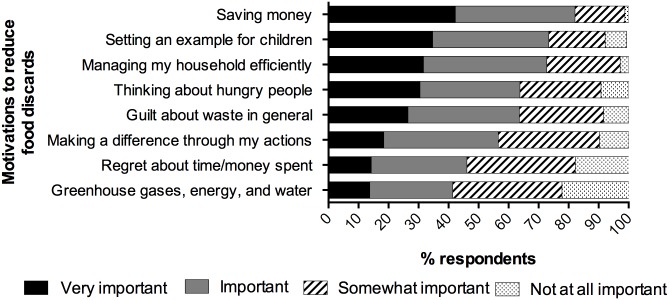
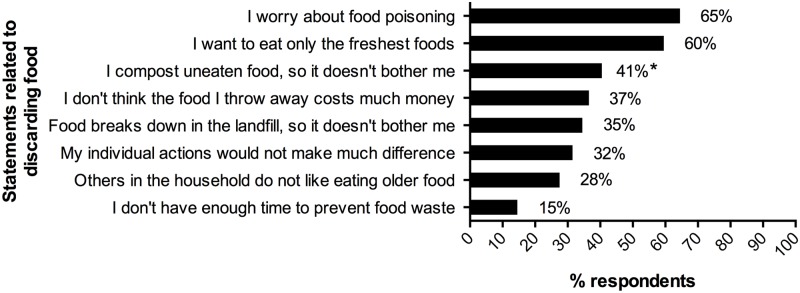
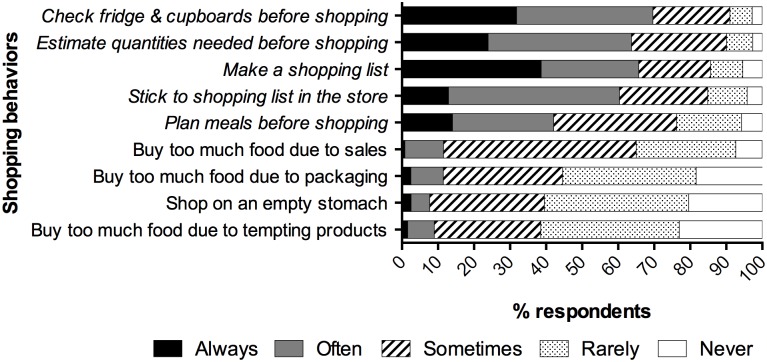
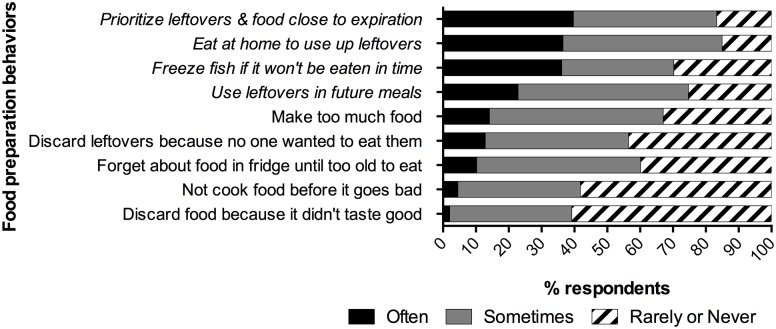
The U.S. wastes 31 to 40% of its post-harvest food supply, with a substantial portion of this waste occurring at the consumer level. Globally, interventions to address wasted food have proliferated, but efforts are in their infancy in the U.S. To inform these efforts and provide baseline data to track change, we performed a survey of U.S. consumer awareness, attitudes and behaviors related to wasted food. The survey was administered online to members of a nationally representative panel (N=1010), and post-survey weights were applied. The survey found widespread (self-reported) awareness of wasted food as an issue, efforts to reduce it, and knowledge about how to do so, plus moderately frequent performance of waste-reducing behaviors. Three-quarters of respondents said they discard less food than the average American. The leading motivations for waste reduction were saving money and setting an example for children, with environmental concerns ranked last. The most common reasons given for discarding food were concern about foodborne illness and a desire to eat only the freshest food. In some cases there were modest differences based on age, parental status, and income, but no differences were found by race, education, rural/urban residence or other demographic factors. Respondents recommended ways retailers and restaurants could help reduce waste. This is the first nationally representative consumer survey focused on wasted food in the U.S. It provides insight into U.S. consumers' perceptions related to wasted food, and comparisons to existing literature. The findings suggest approaches including recognizing that many consumers perceive themselves as being already-knowledgeable and engaged, framing messages to focus on budgets, and modifying existing messages about food freshness and aesthetics. This research also suggests opportunities to shift retail and restaurant practice, and identifies critical research gaps.
Overview
The claims and statistics of this paper haven’t been checked yet.
Free: it reads the open-access text and checks the first 5 claims that cite a source we can check. Create a free account to check every claim.
Integrity signals
Registry
Cites
Statistics
Figures
Verification
Claims the paper makes
The claims and statistics of this paper haven’t been checked yet.
Free: it reads the open-access text and checks the first 5 claims that cite a source we can check. Create a free account to check every claim.
Claims other papers make about this one
Each is checked against this paper’s own text: does it say what the citing paper says it does?
The source backs part of the claim, not all of it — or backs it for a different population, condition or comparison.
In the citing paper
“Survey respondents tend to substantially under-report their waste levels and in contrast to over-report their effort levels (Neff et al. 2015; Qi and Roe 2016; van Geffen et al. 2020).”
From COVID-19 virus outbreak lockdown: What impacts on household food wastage? (2020) · cites this paper as Neff et al. 2015
Experimental — accuracy not yet measuredThe source backs part of the claim, not all of it — or backs it for a different population, condition or comparison.
In the citing paper
“while previous survey work in the United States [30] show food waste reduction is perceived as pro-social by a majority and pro-environmental by more than 40% of respondents.”
From Household Food Waste: Multivariate Regression and Principal Components Analyses of Awareness and Attitudes among U.S. Consumers (2016) · cites this paper as [30]
Experimental — accuracy not yet measuredThe source backs part of the claim, not all of it — or backs it for a different population, condition or comparison.
In the citing paper
“Ethical considerations regarding a lack of food in other countries have been noted by a number of authors (Blichfeldt et al., 2015;Ganglbauer et al., 2013;Neff et al., 2015;Pearson et al., 2016).”
From Food waste matters - A systematic review of household food waste practices and their policy implications (2018) · cites this paper as Neff et al., 2015
Experimental — accuracy not yet measuredThe source backs part of the claim, not all of it — or backs it for a different population, condition or comparison.
In the citing paper
“Alternatively, consumers may believe their impact to be minimized because of composting food waste or feeding food surplus to their pets (Graham-Rowe et al., 2014;Neff et al., 2015).”
From Food waste matters - A systematic review of household food waste practices and their policy implications (2018) · cites this paper as Neff et al., 2015
Experimental — accuracy not yet measuredThe source backs part of the claim, not all of it — or backs it for a different population, condition or comparison.
In the citing paper
“Two studies in the U.S. have found a modest role of environmental concerns with only 40% (Neff et al., 2015) and 58.4% (Qi and Roe, 2016) of respondents expressing concerns about the environmental consequences associated with throwing away food.”
From Food waste matters - A systematic review of household food waste practices and their policy implications (2018) · cites this paper as Neff et al., 2015
Experimental — accuracy not yet measured
23 more claims about this paper
Create a free account to see every claim other papers make about this one.
Self-check
Percentages, sums and reported differences re-computed from the paper’s own numbers.
The self-check needs the paper’s full text.
Citations
Cites
Tversky, A., & Kahneman, D. (1974) · Science · doi:10.1126/science.185.4157.1124 · Cited by 28,810 · cited 1×
“For example, the estimate that 40% of all food is wasted would lead most people to say that they waste less than that [2,3,28].”
Judgment under Uncertainty: Heuristics and Biases
Tversky, A., & Kahneman, D. (1975) · Utility, Probability, and Human Decision Making · doi:10.1007/978-94-010-1834-0_8 · Cited by 22,650
Kollmuss, A., & Agyeman, J. (2002) · Environmental Education Research · doi:10.1080/13504620220145401 · Cited by 8,866
Social determinants of health inequalities
Marmot, M. (2005) · The Lancet · doi:10.1016/s0140-6736(05)71146-6 · Cited by 5,086
Bamberg, S., & Möser, G. (2007) · Journal of Environmental Psychology · doi:10.1016/j.jenvp.2006.12.002 · Cited by 4,140
World agriculture towards 2030/2050: the 2012 revision
Alexandratos, N., Bruinsma, J., Alexandratos, N., & Bruinsma, J. (2012) · RePEc: Research Papers in Economics · doi:10.22004/ag.econ.288998 · Cited by 3,093
Methods of coping with social desirability bias: A review
Nederhof, A. J. (1985) · European Journal of Social Psychology · doi:10.1002/ejsp.2420150303 · Cited by 2,340 · cited 1×
“The survey used anonymous administration and randomized question order to reduce bias [47].”
MethodObesity Stigma: Important Considerations for Public Health
Puhl, R. M., & Heuer, C. A. (2010) · American Journal of Public Health · doi:10.2105/ajph.2009.159491 · Cited by 1,917 · cited 1×
“Extensive evidence from public health and related fields shows limitations of the individual responsibility frame [42], and highlights that shame and blame can be counterproductive [43].”
BackgroundKummu, M., de Moel, H., Porkka, M., Siebert, S., Varis, O., & Ward, P. J. (2012) · Science of The Total Environment · doi:10.1016/j.scitotenv.2012.08.092 · Cited by 1,300 · cited 1×
“Wasted food in North America/Oceania also accounts for an estimated 35% of freshwater consumption, 31% of cropland, and 30% of fertilizer usage[8]; as well as 2% of U.”
Background(2002) · Medical Entomology and Zoology · Cited by 1,279
Cited by
Items 201–300 of 468
Shoffe, Y. A., & Johnson, L. K. (2024) · Sustainability · doi:10.3390/su16177803 · Cited by 30
“Stay at Home”: The Effects of the COVID-19 Lockdown on Household Food Waste in Colombia
Mejía, D., Díaz, M. F., Charry, A., Enciso, K., Ramírez, Ó., & Burkart, S. (2021) · Frontiers in Psychology · doi:10.3389/fpsyg.2021.764715 · Cited by 29
“• The budget available for food purchase (household income): The more is spent on food, the higher the food waste is (Watson andMeah, 2012; Quested et al., 2013; Neff et al., 2015; Parizeau et al., 2015).”
BackgroundDiekmann, L., & Germelmann, C. C. (2021) · Sustainability · doi:10.3390/su132413564 · Cited by 27
“They assume that they are wasting nothing, or far less food than they actually do [92], and less than other consumers [93].”
BackgroundSobaih, A. E. E. (2023) · International Journal of Environmental Research and Public Health · doi:10.3390/ijerph20043126 · Cited by 28
“[47] EFB_1 I intend to purchase larger quantities of food than we currently require, when there are quantity discounts,”
BackgroundWhy do we waste so much food? Understanding household food waste through a theoretical framework
Deliberador, L. R., Batalha, M. O., César, A. D. S., Azeem, M. M., Lane, J. L., & Carrijo, P. R. S. (2023) · Journal of Cleaner Production · doi:10.1016/j.jclepro.2023.137974 · Cited by 31
A field experiment to assess barriers to accurate household food waste measurements
Merian, S., O'Sullivan, K., Stöckli, S., Beretta, C., Müller‐Fischer, N., Tiefenbeck, V., Fleisch, E., & Natter, M. (2024) · Resources Conservation and Recycling · doi:10.1016/j.resconrec.2024.107644 · Cited by 27
Seçer, A., Masotti, M., Iori, E., & Vittuari, M. (2023) · Sustainable Production and Consumption · doi:10.1016/j.spc.2023.03.024 · Cited by 28
Predicting food waste reduction behavior among students in higher education institutions
Valentin, A. P. M., Vega, A. M. D., Kho, M. I., Licayan, S. R., Nierras, E. L., & Pabalate, J. C. (2023) · International Journal of Sustainability in Higher Education · doi:10.1108/ijshe-08-2023-0368 · Cited by 29
Fox, D. E., Ioannidi, E., Sun, Y.-T., Jape, V. W., Bawono, W. R., Zhang, S., & Pérez-Cueto, F. J. A. (2017) · International Journal of Gastronomy and Food Science · doi:10.1016/j.ijgfs.2017.11.005 · Cited by 30
Transdisciplinary interventions for environmental sustainability
Chammas, G., Kayed, S., Shami, A. A., Kays, W., Citton, M., Kalot, M. A., Marj, E. A., Fakhr, M., Yehya, N. A., Talhouk, S. N., et al. (2020) · Waste Management · doi:10.1016/j.wasman.2020.03.043 · Cited by 31
Portugal, T., Freitas, S., Cunha, L. M., & da Rocha, A. M. C. N. (2020) · Sustainability · doi:10.3390/su12218781 · Cited by 28
Chawla, G., Lugosi, P., & Hawkins, R. (2021) · Tourism and Hospitality · doi:10.3390/tourhosp2030019 · Cited by 33
Liao, C., Qiao, L., Wang, X., & Lu, S. (2022) · Frontiers in Sustainable Food Systems · doi:10.3389/fsufs.2022.988260 · Cited by 26
“It does not conform to previous studies, in which saving money is always a major motivation for food waste reduction (Neff et al., 2015).”
BackgroundResultInfluentialTrue to type? EU-style date marking and the valuation of perishable food
D’Amato, A., Goeschl, T., Lorè, L., & Zoli, M. (2022) · Food Policy · doi:10.1016/j.foodpol.2022.102381 · Cited by 27
Mucha, L., & Oravecz, T. (2025) · Scientific Reports · doi:10.1038/s41598-025-86252-z · Cited by 28
Understanding Behavior of Household Food Waste Management: Food Waste Hierarchy Context
Ariyani, L., & Ririh, K. R. (2020) · Jurnal Ilmiah Teknik Industri · doi:10.23917/jiti.v19i2.11994 · Cited by 33
What a Waste: Confronting Consumer Food Waste Behavior in Hospitality Settings
Sharma, T. (2020) · Emerald Group Publishing Limited eBooks · doi:10.1108/s1745-354220200000016013 · Cited by 23
Wasting less food: smart mass customisation of food provision
Woolley, E., Jellil, A., & Simeone, A. (2021) · Procedia CIRP · doi:10.1016/j.procir.2021.01.073 · Cited by 24
Weis, C., Narang, A., Rickard, B. J., & Monteiro, D. M. S. (2021) · Sustainability · doi:10.3390/su13147897 · Cited by 21
“The majority of consumers discard food because they perceive it to be spoiled or they believe that it has lost its taste and freshness [8].”
BackgroundEat or Throw Away? Factors Differentiating High Food Wasters from Low Food Wasters
Eičaitė, O., Alenčikienė, G., Pauliukaitytė, I., & Šalaševičienė, A. (2021) · Sustainability · doi:10.3390/su131910741 · Cited by 25
Azazz, A. M. S., & Elshaer, I. A. (2022) · Sustainability · doi:10.3390/su14116786 · Cited by 29
Is it more convenient to waste? Trade‐offs between grocery shopping and waste behaviors
Ellison, B., Fan, L., & Wilson, N. L. W. (2022) · Agricultural Economics · doi:10.1111/agec.12720 · Cited by 25
Community-Based Food Waste Modeling and Planning Framework for Urban Regions
Ai, N., & Zheng, J. (2019) · Journal of Agriculture Food Systems and Community Development · doi:10.5304/jafscd.2019.091.009 · Cited by 33
Throwing Food Away and Food Rescue Practices in Russia (Microlevel Analysis)
Андриановна, Ш. М. (2022) · Journal of Economic Sociology · doi:10.17323/1726-3247-2022-1-11-38 · Cited by 28
Kawasaki, Y., Akamatsu, R., & Warschburger, P. (2022) · Waste Management · doi:10.1016/j.wasman.2022.04.020 · Cited by 22
Wakeman, S. W., Tsalis, G., Jensen, B. B., & Aschemann‐Witzel, J. (2021) · Journal of Business Ethics · doi:10.1007/s10551-021-04823-2 · Cited by 23
Food Waste and Food Retail Density
Landry, C. E., Smith, T. A., & Turner, D. (2017) · Journal of Food Products Marketing · doi:10.1080/10454446.2018.1472697 · Cited by 27
“In a survey of U.S. consumers, Neff, Spiker, and Truant (2015) find that freshness and food safety were the main drivers of food waste.”
Plant compounds for the potential reduction of food waste – a focus on antimicrobial peptides
Shwaiki, L. N., Arendt, E. K., & Lynch, K. M. (2021) · Critical Reviews in Food Science and Nutrition · doi:10.1080/10408398.2021.1873733 · Cited by 22
Ghaziani, S., Ghodsi, D., Schweikert, K., Dehbozorgi, G., Faghih, S., Mohabati, S., & Doluschitz, R. (2022) · Foods · doi:10.3390/foods11091188 · Cited by 20
“A lower purchasing power may encourage consumers to adopt a more frugal lifestyle and motivate them to avoid food waste to reduce monetary loss [78,79].”
BackgroundGrant, F., & Rossi, L. (2022) · Frontiers in Nutrition · doi:10.3389/fnut.2022.1026829 · Cited by 19
Less Is More: Preventing Household Food Waste through an Integrated Mobile Application
Castro, C., Chitikova, E., Magnani, G., Merkle, J., & Heitmayer, M. (2023) · Sustainability · doi:10.3390/su151310597 · Cited by 23
Asyari, A., Susanto, P., Hoque, M. E., Widianita, R., Alam, M. K., & Mamun, A. A. (2024) · International Journal of Ethics and Systems · doi:10.1108/ijoes-10-2023-0231 · Cited by 32
Roe, B. E., Qi, D., Bender, K. E., & Julia, H. (2019) · Sustainability · doi:10.3390/su11247183 · Cited by 19
“For example, Qi and Roe [4] found 70% of U.S. respondents agreed that throwing away food after its label date has passed will reduce the odds of foodborne illness, while Neff, Spiker, and Truant [5] found that 65% of U.S. respondents listed food poisoning as a motivation for discarding food in their homes.”
BackgroundFood waste at the consumer segment: Impact and action
ZHANG, P.-P., Bai, J., Liu, X., & Cheng, S. (2019) · 自然资源学报 · doi:10.31497/zrzyxb.20190218 · Cited by 24
Sun, H., Sun, Y., Jin, M., Ripp, S. A., Sayler, G. S., & Zhuang, J. (2022) · Waste Management · doi:10.1016/j.wasman.2022.07.006 · Cited by 20
Heidig, W., Dobbelstein, T., & Mason, R. (2024) · Sustainable Development · doi:10.1002/sd.3288 · Cited by 24
Archer, E., Thomas, D. M., McDonald, S. M., Pavela, G., Lavie, C. J., Hill, J. O., & Blair, S. N. (2016) · Current Problems in Cardiology · doi:10.1016/j.cpcardiol.2016.10.007 · Cited by 21
HOUSEHOLD FOOD WASTE IN MONTENEGRO
Berjan, S., Мрдаљ, В., Bilali, H. E., Velimirović, A., Blagojević, Z., Bottalico, F., Debs, P., & Capone, R. (2019) · Italian Journal of Food Science · doi:10.14674/ijfs-1276 · Cited by 22
Got waste: knowledge, behavior and self-assessment on food waste of university students in Germany
Gabriel, A., Rombach, M., Wieser, H., & Bitsch, V. (2021) · The International Food and Agribusiness Management Review · doi:10.22434/ifamr2020.0145 · Cited by 26
Consumer Seafood Waste and the Potential of a ‘Direct-from-Frozen’ Approach to Prevention
Neff, R., Love, D. C., Overbey, K. N., Biehl, E., Deutsch, J. M., Gorski, I., Pearson, P., Vigil, T. N., Turvey, C., & Fry, J. P. (2021) · Foods · doi:10.3390/foods10112524 · Cited by 18
“The level of interest in preventing waste may be low among those who perceive themselves as wasting little, and those with little knowledge of the environmental impacts of seafood production [24,26].”
BackgroundInfluentialSelf-citationPalmieri, N., & Palmieri, S. (2022) · Journal of International Food & Agribusiness Marketing · doi:10.1080/08974438.2022.2066594 · Cited by 21
“…economic consequences of food waste are understood (Gaiani, Caldeira, Adorno, Segr (cid:1) e, & Vittuari, 2018; Hamilton, Denniss, & Baker, 2012; Neff et al., 2015; Scherhaufer et al., 2015; Segr (cid:1) e, 2014; Segr (cid:1) e & Falasconi, 2011; Silvenius et al., 2014; Waste & Resources Action…”
Food Wastage Attitudes among the United Arab Emirates Population: The Role of Social Media
Osaili, T. M. I., Obaid, R. S., AlQutub, R., Akkila, R., Habil, A., Dawoud, A., Duhair, S., Hasan, F., Hashim, M. S., Ismail, L. C., et al. (2022) · Sustainability · doi:10.3390/su14031870 · Cited by 20
Economic and waste flow analysis of available scenarios to improve food waste management in Tehran
Badeenezhad, A., Darabi, K., Torkashvand, J., Khosravani, F., & Moein, H. (2024) · Results in Engineering · doi:10.1016/j.rineng.2024.102852 · Cited by 23
Current trends and prospects of transforming food waste to biofuels in India
Jeno, J. G. A., Viveka, R., Varjani, S., Nagappan, S., & Nakkeeran, E. (2021) · Elsevier eBooks · doi:10.1016/b978-0-12-821879-2.00014-4 · Cited by 19
Lins, M. F. C., Zandonadi, R. P., Strasburg, V. J., Nakano, E. Y., Botelho, R. B. A., Raposo, A., & Ginani, V. C. (2021) · Foods · doi:10.3390/foods10061369 · Cited by 25
“They also make paid salaries in the restaurant more efficient and profitable [24,50,51].”
BackgroundDetermining the effective factors on restaurant customers’ plate waste
Cerrah, S., & Yiğitoğlu, V. (2022) · International Journal of Gastronomy and Food Science · doi:10.1016/j.ijgfs.2022.100469 · Cited by 17
Food waste perceptions: vice versus virtue foods
Seo, J. Y., & Yoon, S. (2022) · Journal of Consumer Marketing · doi:10.1108/jcm-07-2020-3997 · Cited by 18
Food Waste and Its Association with Diet Quality of Foods Purchased in South Florida
Mijares, V., Alcivar, J., & Palacios, C. S. (2021) · Nutrients · doi:10.3390/nu13082535 · Cited by 24
“Other studies have also reported that the main reasons for wasting food were concerns about food safety (65%), preferences for the freshest foods (60%) [17], and because the food was spoiled [21,37].”
BackgroundGhaziani, S., Ghodsi, D., Schweikert, K., Dehbozorgi, G., Rasekhi, H., Faghih, S., & Doluschitz, R. (2022) · Foods · doi:10.3390/foods11182886 · Cited by 20
“Such households have a lower purchasing power and, therefore, tend to avoid over-purchasing [47,49] while utilizing their food frugally [92,93].”
BackgroundBallan, D., Picot, A., Rolland, N., Bovo, C., Prévost, C., Coton, E., & Mounier, J. (2025) · International Journal of Food Microbiology · doi:10.1016/j.ijfoodmicro.2025.111204 · Cited by 18
Are consumers more or less averse to wasting organic food?
Nadricka, K., Millet, K., & Aydinli, A. (2023) · Journal of Environmental Psychology · doi:10.1016/j.jenvp.2023.102222 · Cited by 15
“The two important concerns about food waste are financial concerns such as squandering money (Graham-Rowe et al., 2014; Neff, Spiker, & Truant, 2015), and environmental concerns such as harming the environment (Qi & Roe, 2016; Quested, Marsh, Stunell, & Parry, 2013).”
BackgroundResultInfluentialFood systems sustainability: The complex challenge of food loss and waste
Vittuari, M., Menna, F. D., García-Herrero, L., Pagani, M., Brenes-Peralta, L., & Segrè, A. (2019) · Elsevier eBooks · doi:10.1016/b978-0-12-813411-5.00017-x · Cited by 23
Food waste: causes and economic losses estimation at household level in Pakistan
Khalid, S., Malik, A. U., Ullah, M. I., Khalid, M. S., Javeed, H. M. R., Naeem, M. A., & Naseer, A. (2023) · Environmental Science and Pollution Research · doi:10.1007/s11356-023-28775-4 · Cited by 18
“…in the UK, 69% of the consumers agreed to discard food (WRAP 2007) and in the USA, 56% of the respondents indicated that they discarded 10% of the purchased food (Neff et al. 2015), whereas in a recent study, 95% of US residents reported that they waste food at household level (Ahmed et al. 2021).”
BackgroundResultInfluentialMapping the landscape of Consumer Food Waste
Harvey, J., Nica‐Avram, G., Smith, M., Hibbert, S. A., & Muthuri, J. N. (2021) · Appetite · doi:10.1016/j.appet.2021.105702 · Cited by 17
Chen, M. (2024) · British Food Journal · doi:10.1108/bfj-05-2024-0426 · Cited by 16
APAKAH KONSUMEN RESTO HOTEL MENGETAHUI ISU FOOD WASTE?
Ramadhita, A. N., Ekayani, M., & Suharti, S. (2021) · Jurnal Ilmu Keluarga dan Konsumen · doi:10.24156/jikk.2021.14.1.88 · Cited by 18
Gooch, M., Matsubuchi-Shaw, M., Bucknell, D., LaPlain, D., & Kohler, L. (2022) · Canadian Geographies / Géographies canadiennes · doi:10.1111/cag.12794 · Cited by 18
An Investigation into the Causes of Food Waste by Tourists in All-inclusive Resorts in Turkey
Çetin, K., & Süren, T. (2022) · Journal of Quality Assurance in Hospitality & Tourism · doi:10.1080/1528008x.2022.2135162 · Cited by 16
“In addition, when comparing their own food waste with other tourists, nearly all participants expressed that they generated less food waste, similar to previous studies (Neff et al., 2015; Nikolaus et al., 2018; Parizeau et al., 2015).”
ResultWhy do we waste food? In-depth interviews with consumers
Ilakovac, B., Cerjak, M., & Voća, N. (2020) · Energy Sources Part A Recovery Utilization and Environmental Effects · doi:10.1080/15567036.2020.1787564 · Cited by 16
“Neff, Spiker, and Truant (2015) discovered wide-ranging awareness of food waste among US consumers, and Griffin, Sobal, and Lyson (2009) proved the consumer’s concern because of the impact of their food style on other individuals and the environment.”
Geislar, S. (2018) · Elsevier eBooks · doi:10.1016/b978-0-08-100596-5.22448-7 · Cited by 18
Food Waste and Consumer Behavior: A Bibliometric and Review Study and Future Research Directions
Salume, P. K., Barbosa, M. W., & Pinto, M. D. R. (2026) · Foods · doi:10.3390/foods15020380 · Cited by 15
“This methodological limitation is further corroborated by Neff et al. [31], who documented substantial discrepancies between reported awareness and actual waste generation among U.S. consumers.”
InfluentialUnderstanding the Effect of Dining and Motivational Factors on Out-Of-Home Consumer Food Waste
Goodman-Smith, F., Mirosa, R., & Mirosa, M. (2020) · Sustainability · doi:10.3390/su12166507 · Cited by 18
Sustainable food. Production and consumption perspectives
(2024) · doi:10.18559/978-83-8211-209-2 · Cited by 13
Literature Review Investigating Intersections between US Foodservice Food Recovery and Safety
Zagorski, J., Reyes, G. A., Prescott, M. P., & Stasiewicz, M. J. (2020) · Resources Conservation and Recycling · doi:10.1016/j.resconrec.2020.105304 · Cited by 21
Household food waste collection: Building service networks through neighborhood expansion
Armington, W. R., & Chen, R. B. (2018) · Waste Management · doi:10.1016/j.wasman.2018.04.012 · Cited by 13
Feeding the Globe Nutritious Food in 2050
Nadathur, S., Wanasundara, J. P. D., & Scanlin, L. (2016) · Elsevier eBooks · doi:10.1016/b978-0-12-802778-3.00025-1 · Cited by 13
Food waste as a consequence of an inefficient consumer’s choices: a microeconomic approach
Annunziata, A., Agovino, M., Ferraro, A., & Mariani, A. (2021) · Applied Economics · doi:10.1080/00036846.2021.1937503 · Cited by 14
“…to parents’ time constraints (Visschers, Wickli, and Siegrist 2016), children’s unpredictable food preferences (Jörissen, Priefer, and Bräutigam 2015; Neff, Spiker, and Truant 2015), or the evidence that households with children tend to cook more often than households without children (Ponis et…”
BackgroundInfluentialHousehold Solid Waste Management and Composition in Bekasi, Indonesia
Kusumaningtiar, D. A., & Vionalita, G. (2022) · Open Access Macedonian Journal of Medical Sciences · doi:10.3889/oamjms.2022.9884 · Cited by 13
How duration of storage affects food waste behavior
Xie, V., & Bagchi, R. (2023) · Journal of Consumer Psychology · doi:10.1002/jcpy.1389 · Cited by 13
The Piggy Solution: Harnessing Food Waste for Sustainable Hog Farming
Ogwu, M. C., Hills, C. E., & Pietrosemoli, S. (2025) · Global Challenges · doi:10.1002/gch2.202500073 · Cited by 13
Fligstein, N., & McAdam, D. (2022) · Journal of Economic Sociology · doi:10.17323/1726-3247-2022-1-60-100 · Cited by 21
Creating resilient interventions to food waste: aligning and leveraging systems and design thinking
Lake, D., McFarland, A., & Vogelzang, J. (2020) · Food Waste Management · doi:10.1007/978-3-030-20561-4_8 · Cited by 10
Yang, X., Campbell, C. G., Gusto, C., Kelsey, K. D., Haase, H., Robertson, K., Cohen, N., Kiker, G. A., & Boz, Z. (2025) · Foods · doi:10.3390/foods14223883 · Cited by 12
Scaling up of food waste valorization market outlooks: key concerns
Meena, R. A. A., Ghosh, A., Sathishkumar, P., & Jayabalan, R. (2020) · Elsevier eBooks · doi:10.1016/b978-0-12-818353-3.00019-5 · Cited by 12
Schmidt, K., & Bldg. 24, R. 3. (2016) · International Journal of Food and Nutritional Science · doi:10.15436/2377-0619.16.936 · Cited by 12
Is it food or is it waste? Determinants of decisions to throw food away
Eves, A., Kim, B.-R., Hodgkins, C. E., Raats, M. M., & Timotijević, L. (2024) · Sustainable Production and Consumption · doi:10.1016/j.spc.2024.12.016 · Cited by 14
Modeling American Household Fluid Milk Consumption and their Resulting Greenhouse Gas Emissions
Stankiewicz, S., Auras, R. A., & Selke, S. E. M. (2019) · Sustainability · doi:10.3390/su11072152 · Cited by 11
Chai, D., Yu, S., & Meng, T. (2024) · Food Policy · doi:10.1016/j.foodpol.2024.102767 · Cited by 10
Exploratory Study of Romanian Generation Z Perceptions of Green Restaurants
Chiciudean, D. I., Shonkwiler, V. P., Mureșan, I. C., Zaharia, A., & Chiciudean, G. O. (2024) · Administrative Sciences · doi:10.3390/admsci14010021 · Cited by 10
Six Behaviors Policymakers Should Promote to Mitigate Climate Change
Heller, K., Berger, M., Gagern, A., Rakhimov, A., Thomas, J., & Thulin, E. W. (2021) · Behavioral Science & Policy · doi:10.1177/237946152100700206 · Cited by 9
Misconceptions on Food Date Labels and Consumer Welfare Implications
Li, X., Hu, W., Jiang, Q., Li, J., & Qing, P. (2025) · Agricultural Economics · doi:10.1111/agec.70031 · Cited by 9
Satchapappichit, S., Leerattananugulsiri, A., Kayom, W., Thanasarn, K., & Girum, T. (2023) · Journal of Hospitality and Tourism Insights · doi:10.1108/jhti-07-2022-0305 · Cited by 9
Investigating the factors influencing food waste behavior in the Egyptian society
Adel, A. M., Dai, X., & Roshdy, R. S. (2023) · Journal of Humanities and Applied Social Sciences · doi:10.1108/jhass-06-2023-0067 · Cited by 12
From kitchen scraps to delicacies to food waste
Knorr, D., & Augustin, M. A. (2024) · Sustainable Food Technology · doi:10.1039/d4fb00012a · Cited by 14
Asefi, B., Maenrouf, M. S., Nkinahamira, F., Xian, C. Y., Han, S. J., & Wang, P. (2024) · Sustainable Chemistry and Pharmacy · doi:10.1016/j.scp.2024.101571 · Cited by 14
Morals over money: The relationship between moral motivations and consumers' food waste
Ribbers, D., van Herpen, E., Pandelaere, M., & Geuens, M. (2024) · Sustainable Production and Consumption · doi:10.1016/j.spc.2024.09.012 · Cited by 13
Business Incentive to Reduce Food Losses in Japan
Igeta, J., & Nakamura, H. (2022) · Sustainability · doi:10.3390/su14042266 · Cited by 10
Tomaszewska, M., Bilska, B., & Kołożyn‐Krajewska, D. (2022) · Sustainability · doi:10.3390/su14138153 · Cited by 9
Food Shopping Behavior: A Long Way to Prevent Food Waste
Krisjanti, M. N., & Quita, A. G. (2020) · Media Ekonomi dan Manajemen · doi:10.24856/mem.v35i1.1251 · Cited by 10
“Motivation to reduce food waste is the first variable, which is comprising 7 items which were modified from Neff et al (2015).”
BackgroundResultFood Loss and Waste: Some Guidance
Koester, U., Loy, J., & Ren, Y. (2020) · EuroChoices · doi:10.1111/1746-692x.12248 · Cited by 10
Determinants of sustainable diets
Sabaté, J., & Jehi, T. (2019) · Elsevier eBooks · doi:10.1016/b978-0-12-811660-9.00012-6 · Cited by 10
Jones, K., Magliocca, N. R., & Hondula, K. L. (2017) · University Libraries (University of Maryland) · doi:10.13016/m2bk10 · Cited by 12
“Concern for foodborne illness is the most common reason for discarding food by American consumers (Neff et al., 2015).”
BackgroundHousehold Food Waste: Theory and EmpiricsPreprint
Landry, C. E., & Smith, T. A. (2017) · SSRN Electronic Journal · doi:10.2139/ssrn.3060838 · Cited by 10
Sustainable Food Waste Management in Food Service Establishments in Relation to Unserved Dishes
Tomaszewska, M., Bilska, B., Tul-Krzyszczuk, A., & Kołożyn‐Krajewska, D. (2024) · Sustainability · doi:10.3390/su16156631 · Cited by 10
Management of hospitality food waste and the role of consumer behavior
Filimonau, V., & Todorova, E. (2020) · Elsevier eBooks · doi:10.1016/b978-0-12-817121-9.00021-8 · Cited by 7
Ismaıl, H. B., Jrıbı, S., Dogui, D., & Debbabi, H. (2022) · The North African Journal of Food and Nutrition Research · doi:10.51745/najfnr.6.13.46-54 · Cited by 10
Drivers of Food Waste Habits at Household Level in Vietnam
Ngan, D. T. M., Ghi, T. N., & Tien, H. V. (2024) · International Journal of Sustainable Development and Planning · doi:10.18280/ijsdp.190713 · Cited by 9
Thaore, V. B., Bahramian, M., Boudou, M., Hynds, P. D., & Priyadarshini, A. (2024) · Environmental Research · doi:10.1016/j.envres.2024.120247 · Cited by 8
Food Waste Management and Green Purchasing Behaviour Among Youths in Malaysia
Zain, I. N. M., & Rahman, H. A. (2021) · International Journal of Academic Research in Business and Social Sciences · doi:10.6007/ijarbss/v11-i15/10635 · Cited by 11
Hemphill, T. A. (2022) · Technological Sustainability · doi:10.1108/techs-01-2022-0006 · Cited by 9
Metadata
- Authors
- Neff, R. A., Spiker, M. L., & Truant, P. L.
- Affiliations
- Johns Hopkins University (US)
- Corresponding author
- Neff, Roni A.
- Venue
- PLOS ONE
- Publisher
- Public Library of Science (PLoS)
- Published
- 2015-06-10
- Volume
- 10
- Issue
- 6
- Pages
- e0127881
- ISSN
- 1932-6203 (ISSN-L)
- PMC
- PMC4465675
- OpenAlex
- W591450021
- Cited by
- 461
- References
- 34
- Citations by year
- 2026: 34 · 2025: 36 · 2024: 40 · 2023: 38 · 2022: 58 · 2021: 62 · 2020: 61 · 2019: 50 · 2018: 35 · 2017: 24 · 2016: 19 · 2015: 3
- FWCI
- 36.05
- Type
- journal article
- Language
- en
- Open access
- gold
- doi.org
- Licence
- Locations
- PLoS ONE (publishedVersion, cc-by)
- Europe PMC (PubMed Central) (publishedVersion, cc-by)
- PubMed Central (publishedVersion, cc-by)
- PubMed (publishedVersion)
- RePEc: Research Papers in Economics (submittedVersion)
- DOAJ (DOAJ: Directory of Open Access Journals) (submittedVersion)
- Figshare (submittedVersion, cc-by)
- Funders
- Johns Hopkins University
- Università di Bologna
- Johns Hopkins Bloomberg School of Public Health
- Topics
- Life Sciences › Agricultural and Biological Sciences › Food Science › Food Waste Reduction and Sustainability
- Physical Sciences › Environmental Science › Ecology › Agriculture Sustainability and Environmental Impact
- Health Sciences › Medicine › Public Health, Environmental and Occupational Health › Food Security and Health in Diverse Populations
- Keywords
- food waste, consumer awareness, consumer attitudes, food freshness, food aesthetics, United States consumers
- MeSH terms
- Adult, Aged, Attitude, Awareness, Female, Food Supply, Humans, Health Knowledge, Attitudes, Practice, Male, Middle Aged, Surveys and Questionnaires, Social Behavior, United States, Waste Products
About these checks
Registry, retraction, Cites and statistics results are computed, not judged, with one exception: a printed reference that no index lists is read once by a model before it counts as a citation error. Claims are extracted by a model and kept only when their quote appears verbatim in the text; each cited source is then checked, with a model’s help, for whether it says what the claim relies on. Those verdicts can be wrong — read the claim’s quote and the cited source before relying on one.
Statistics and arithmetic are recomputed, not judged.
Confidence bands are shown only for fields calibrated on our annotated test set. None is calibrated yet, so no band is shown.
What counts as a claim ›How we measure confidence ›How we check this ›
Are you an author, or do you see a problem with this page? Request a review
Data sources
Bibliographic data: Semantic Scholar, OpenAlex, Crossref.
Contains information from the Semantic Scholar Academic Graph Datasets, made available under the ODC Attribution License (ODC-BY 1.0).
Semantic Scholar’s data is described in: Kinney, R., et al. (2023). The Semantic Scholar Open Data Platform. arXiv:2301.10140.
