

Wasted Food: U.S. Consumers' Reported Awareness, Attitudes, and Behaviors
Open accessThe DOI matches its Crossref record; 33 of the 34 references it cites were found in a registry or an index.
Abstract
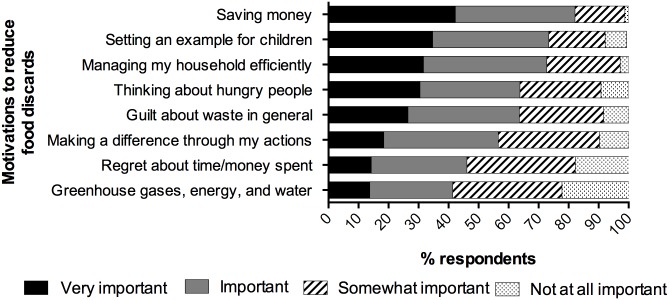
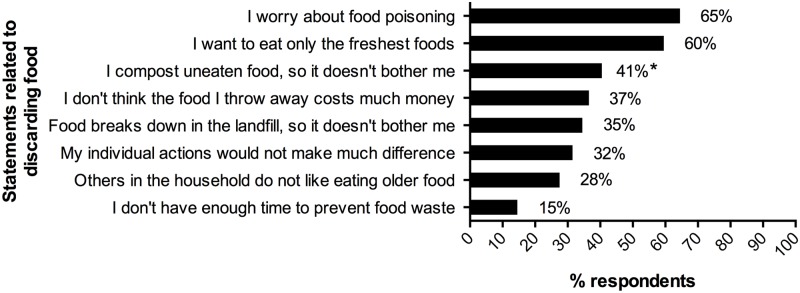
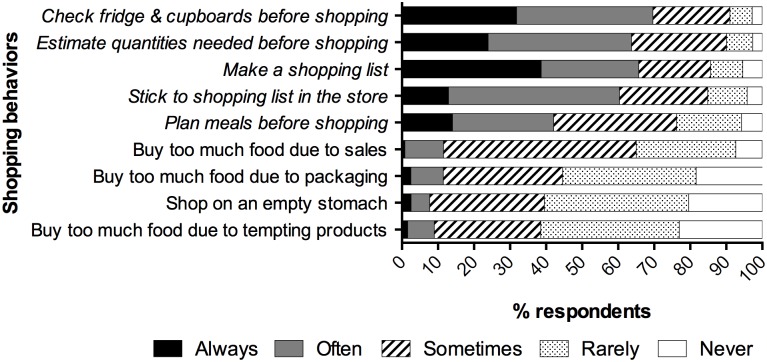
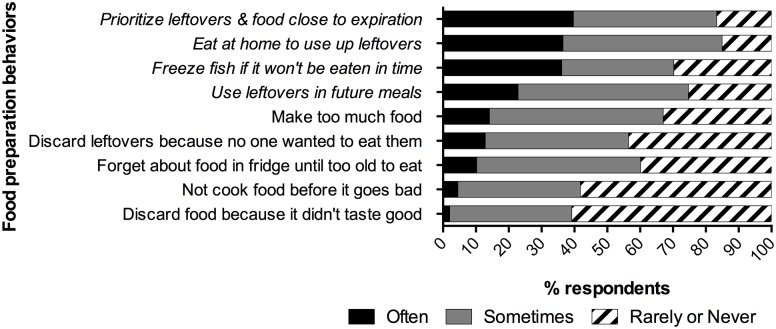
The U.S. wastes 31 to 40% of its post-harvest food supply, with a substantial portion of this waste occurring at the consumer level. Globally, interventions to address wasted food have proliferated, but efforts are in their infancy in the U.S. To inform these efforts and provide baseline data to track change, we performed a survey of U.S. consumer awareness, attitudes and behaviors related to wasted food. The survey was administered online to members of a nationally representative panel (N=1010), and post-survey weights were applied. The survey found widespread (self-reported) awareness of wasted food as an issue, efforts to reduce it, and knowledge about how to do so, plus moderately frequent performance of waste-reducing behaviors. Three-quarters of respondents said they discard less food than the average American. The leading motivations for waste reduction were saving money and setting an example for children, with environmental concerns ranked last. The most common reasons given for discarding food were concern about foodborne illness and a desire to eat only the freshest food. In some cases there were modest differences based on age, parental status, and income, but no differences were found by race, education, rural/urban residence or other demographic factors. Respondents recommended ways retailers and restaurants could help reduce waste. This is the first nationally representative consumer survey focused on wasted food in the U.S. It provides insight into U.S. consumers' perceptions related to wasted food, and comparisons to existing literature. The findings suggest approaches including recognizing that many consumers perceive themselves as being already-knowledgeable and engaged, framing messages to focus on budgets, and modifying existing messages about food freshness and aesthetics. This research also suggests opportunities to shift retail and restaurant practice, and identifies critical research gaps.
Overview
The claims and statistics of this paper haven’t been checked yet.
Free: it reads the open-access text and checks the first 5 claims that cite a source we can check. Create a free account to check every claim.
Integrity signals
Registry
Cites
Statistics
Figures
Verification
Claims the paper makes
The claims and statistics of this paper haven’t been checked yet.
Free: it reads the open-access text and checks the first 5 claims that cite a source we can check. Create a free account to check every claim.
Claims other papers make about this one
Each is checked against this paper’s own text: does it say what the citing paper says it does?
The source backs part of the claim, not all of it — or backs it for a different population, condition or comparison.
In the citing paper
“Survey respondents tend to substantially under-report their waste levels and in contrast to over-report their effort levels (Neff et al. 2015; Qi and Roe 2016; van Geffen et al. 2020).”
From COVID-19 virus outbreak lockdown: What impacts on household food wastage? (2020) · cites this paper as Neff et al. 2015
Experimental — accuracy not yet measuredThe source backs part of the claim, not all of it — or backs it for a different population, condition or comparison.
In the citing paper
“while previous survey work in the United States [30] show food waste reduction is perceived as pro-social by a majority and pro-environmental by more than 40% of respondents.”
From Household Food Waste: Multivariate Regression and Principal Components Analyses of Awareness and Attitudes among U.S. Consumers (2016) · cites this paper as [30]
Experimental — accuracy not yet measuredThe source backs part of the claim, not all of it — or backs it for a different population, condition or comparison.
In the citing paper
“Ethical considerations regarding a lack of food in other countries have been noted by a number of authors (Blichfeldt et al., 2015;Ganglbauer et al., 2013;Neff et al., 2015;Pearson et al., 2016).”
From Food waste matters - A systematic review of household food waste practices and their policy implications (2018) · cites this paper as Neff et al., 2015
Experimental — accuracy not yet measuredThe source backs part of the claim, not all of it — or backs it for a different population, condition or comparison.
In the citing paper
“Alternatively, consumers may believe their impact to be minimized because of composting food waste or feeding food surplus to their pets (Graham-Rowe et al., 2014;Neff et al., 2015).”
From Food waste matters - A systematic review of household food waste practices and their policy implications (2018) · cites this paper as Neff et al., 2015
Experimental — accuracy not yet measuredThe source backs part of the claim, not all of it — or backs it for a different population, condition or comparison.
In the citing paper
“Two studies in the U.S. have found a modest role of environmental concerns with only 40% (Neff et al., 2015) and 58.4% (Qi and Roe, 2016) of respondents expressing concerns about the environmental consequences associated with throwing away food.”
From Food waste matters - A systematic review of household food waste practices and their policy implications (2018) · cites this paper as Neff et al., 2015
Experimental — accuracy not yet measured
23 more claims about this paper
Create a free account to see every claim other papers make about this one.
Self-check
Percentages, sums and reported differences re-computed from the paper’s own numbers.
The self-check needs the paper’s full text.
Citations
Cites
Tversky, A., & Kahneman, D. (1974) · Science · doi:10.1126/science.185.4157.1124 · Cited by 28,810 · cited 1×
“For example, the estimate that 40% of all food is wasted would lead most people to say that they waste less than that [2,3,28].”
Judgment under Uncertainty: Heuristics and Biases
Tversky, A., & Kahneman, D. (1975) · Utility, Probability, and Human Decision Making · doi:10.1007/978-94-010-1834-0_8 · Cited by 22,650
Kollmuss, A., & Agyeman, J. (2002) · Environmental Education Research · doi:10.1080/13504620220145401 · Cited by 8,866
Social determinants of health inequalities
Marmot, M. (2005) · The Lancet · doi:10.1016/s0140-6736(05)71146-6 · Cited by 5,086
Bamberg, S., & Möser, G. (2007) · Journal of Environmental Psychology · doi:10.1016/j.jenvp.2006.12.002 · Cited by 4,140
World agriculture towards 2030/2050: the 2012 revision
Alexandratos, N., Bruinsma, J., Alexandratos, N., & Bruinsma, J. (2012) · RePEc: Research Papers in Economics · doi:10.22004/ag.econ.288998 · Cited by 3,093
Methods of coping with social desirability bias: A review
Nederhof, A. J. (1985) · European Journal of Social Psychology · doi:10.1002/ejsp.2420150303 · Cited by 2,340 · cited 1×
“The survey used anonymous administration and randomized question order to reduce bias [47].”
MethodObesity Stigma: Important Considerations for Public Health
Puhl, R. M., & Heuer, C. A. (2010) · American Journal of Public Health · doi:10.2105/ajph.2009.159491 · Cited by 1,917 · cited 1×
“Extensive evidence from public health and related fields shows limitations of the individual responsibility frame [42], and highlights that shame and blame can be counterproductive [43].”
BackgroundKummu, M., de Moel, H., Porkka, M., Siebert, S., Varis, O., & Ward, P. J. (2012) · Science of The Total Environment · doi:10.1016/j.scitotenv.2012.08.092 · Cited by 1,300 · cited 1×
“Wasted food in North America/Oceania also accounts for an estimated 35% of freshwater consumption, 31% of cropland, and 30% of fertilizer usage[8]; as well as 2% of U.”
Background(2002) · Medical Entomology and Zoology · Cited by 1,279
Cited by
Items 401–468 of 468
Comparison between Chinese and American Practices in Food Banking System
Yang, Y. (2022) · Advances in economics, business and management research/Advances in Economics, Business and Management Research · doi:10.2991/aebmr.k.220405.026 · Cited by 1
Borga, M. V. (2021) · El Servicio de Difusión de la Creación Intelectual (National University of La Plata) · doi:10.35537/10915/147378
Food waste governance in small scale restaurants in Australia
Adan, N. (2023) · Queensland University of Technology · doi:10.5204/thesis.eprints.238821
Food Waste Generation Behavior: A Bibliographic PerspectivePreprint
Mendez, C., Ramón-Jerónimo, M. Á., & López, V. (2023) · SSRN Electronic Journal · doi:10.2139/ssrn.4528996 · Cited by 1
DESPERDÍCIOS DE ALIMENTOS EM DOMICÍLIOS: COMO A LITERATURA TEM ABORDADO ESSE DESAFIO?
Deliberador, L. R., Santos, M. C. B., BATALHA, M. O., & César, A. D. S. (2023) · Anais do 60º Congresso da Sociedade Brasileira de Economia, Administração e Sociologia Rural (SOBER) · doi:10.29327/sober2023.626643
-, P. R., Kumar, A., -, P. S., -, A. C., -, R. D., -, M. K., & -, R. K. (2023) · International Journal For Multidisciplinary Research · doi:10.36948/ijfmr.2023.v05i06.9161
Household food waste—the origin, level, structure and methods of prevention
Pierański, B., & Smutka, Ľ. (2024) · doi:10.18559/978-83-8211-209-2/11
Food Waste—Introduction and Origin
Lobo, R. E., Guzmán, B., Cataldo, P. G., Hebert, E. M., Taranto, M. P., García, M. S., Rodríguez‐Cabello, J. C., & Torino, M. I. (2024) · Materials horizons · doi:10.1007/978-981-97-1160-4_4 · Cited by 1
Jäger, J., Darnhofer, I., Dobernig, K., Kettner, C., Leitinger, G., Meyer, I., Scharler, M., Sinabell, F., & Weber, G. (2024) · Springer eBooks · doi:10.1007/978-3-662-67864-0_8 · Cited by 2
The Morality of Food Wasting Behaviour. A Theory-Driven ApproachPreprint
Misiak, M., Curry, O. S., Sobol, M., Stefańczyk, M., & Idziak, P. (2024) · PsyArXiv (OSF Preprints) · doi:10.31234/osf.io/zjdwx
Shafira, F., Sari, H., & Hardyanti, N. (2024) · SSRN Electronic Journal · doi:10.2139/ssrn.5056562
Barbera, F. L., Altamura, C., & Riverso, R. (2024) · International Multidisciplinary Scientific GeoConference SGEM ... · doi:10.5593/sgem2024v/4.2/s20.55
Food Waste and Its Biotechnological Application
Amir, M., Singh, P., Bano, N., & Roohi, R. (2025) · Springer eBooks · doi:10.1007/978-3-031-86688-3_13
Shan, L., Xu, Y., Xu, L., & Xia, T. (2025) · Research Square · doi:10.21203/rs.3.rs-6294015/v1
Food waste (un)sustainability: A social-psychological perspective
Barbera, F. L., & Altamura, C. (2025) · Elsevier eBooks · doi:10.1016/b978-0-443-33140-4.00010-5
Perfil de consumo de hortaliças e frutas: escolhas conscientes ou contribuições ao desperdício?
Hay, J. A., de Souza, N. M., & Neto, P. H. W. (2025) · REVISTA BRASILEIRA DE AGROECOLOGIA · doi:10.33240/rba.v20i2.56113
Jariyah, A., & Muslimah, F. (2025) · Jurnal Dinamika Sosial dan Sains · doi:10.60145/jdss.v1i4.89
Investigating factors on the intention to use mobile apps against food waste
Boecker, L., Hübner, D.-S., Radtke, U., Tóth, G., & Wohllebe, A. (2025) · International journal on food system dynamics · doi:10.1163/18696945-bja00009 · Cited by 2
Gıda İsrafını Önleme Motivasyonlarının Bireylerin Kişilik Özelliklerine Göre Değerlendirilmesi
Davras, G. M. (2025) · Gaziantep University Journal of Social Sciences · doi:10.21547/jss.1627410 · Cited by 1
Processing Fruits and Vegetables as a Way to Prevent Their Waste
Juszczak, K., Kowalczuk, I., Olewnicki, D., Kosicka-Gębska, M., & Stangierska, D. (2025) · Sustainability · doi:10.3390/su17146610 · Cited by 1
Aktas, B. E., Balçık, S. M., & Ozmen, S. A. (2025) · Social Development · doi:10.1111/sode.70028
Food waste collection and characterization: Technologies and challenges
Lim, A. F. L. A. F., Amran, S. A., Nazri, R. Y. M., Romli, S. R., & Seow, E. (2025) · Elsevier eBooks · doi:10.1016/b978-0-443-36302-3.00013-3
Shan, L., Xu, Y., Xu, L., & Xia, T. (2025) · Research Square · doi:10.21203/rs.3.rs-6294015/v2
How young children come to recommend resource choices that reduce waste
Sehl, C. G., Friedman, O., & Denison, S. (2025) · Cognitive Development · doi:10.1016/j.cogdev.2025.101642 · Cited by 1
From waste to value: Exploring the social representations of composting
Lapeyre, A., Ayadi, N., & Gonzalez, C. (2025) · Journal of Cleaner Production · doi:10.1016/j.jclepro.2025.147087 · Cited by 1
Conrad, Z. (2020) · W&M Publish (College of William & Mary) · doi:10.6084/m9.figshare.12153921
Determinants of Household Intention to Reduce Food Waste in the Jabodetabek Region
Salim, L., & Yulia, V. (2025) · IJBE (Integrated Journal of Business and Economics) · doi:10.33019/ijbe.v9i4.1183
Socio-demographic influences on the value and quantity of avoidable food waste in Germany
Hermanussen, H., Campos, B. C., & Loy, J. (2026) · British Food Journal · doi:10.1108/bfj-06-2025-0821
Al-Tuwaijri, O. M., Aldosari, F. O., Algannbi, M. A., Motawei, M. I., Mousa, H. M., & Barakat, H. (2026) · Sustainability · doi:10.3390/su18020686 · Cited by 1
Baía, S. R. D., Sousa, T. A. D. S., de Almeida, K. M., de Alencar, B. E. B., Pessoa, J. M., de Azevedo, C. C., & Caluête, M. E. E. (2026) · OBSERVATÓRIO DE LA ECONOMÍA LATINOAMERICANA · doi:10.55905/oelv24n1-123
The Role of Surplus Food Recovery in Tackling Food Loss and Waste and Hunger in Sub-Saharan Africa
Gikuri, A., & Motebang, M. S. (2026) · Sustainable development goals series · doi:10.1007/978-3-032-09881-8_12 · Cited by 1
Closed‐Loop Recycling and Circular Economy for Conversion of Solid Food Waste Into Biochar: A Review
Rosli, N. S. M., Abdullah, R., Lan, J. C., Srimongkol, P., Srinuanpan, S., & Khoo, K. S. (2026) · ChemBioEng Reviews · doi:10.1002/cben.70044 · Cited by 3
Lee, S. (2026) · Sustainable Development · doi:10.1002/sd.70802
Lu, J., Kayelle, P. K., & Yiridoe, E. K. (2026) · British Food Journal · doi:10.1108/bfj-04-2025-0496
Blok, A. E., & Steenbekkers, B. L. P. A. (2026) · British Food Journal · doi:10.1108/bfj-04-2025-0483
Revelou, P., Manthati, A., Canaj, E., Gogou, E., Batrinou, A., & Strati, I. F. (2026) · World · doi:10.3390/world7030042
Survey and analysis of consumer behavior for food waste management in Bangladesh
Haque, M. A., Azad, A. M. A. S., Ankhi, I. J., Faisal, A. K. M., & Masud, M. H. (2026) · Energy Nexus · doi:10.1016/j.nexus.2026.100695
İnan, C. M., Kahraman, C. Ş., Çetiner, Ö., & Soylu, M. (2026) · Clinical and Experimental Health Sciences · doi:10.33808/clinexphealthsci.1806872
Gaspillage alimentaire, une approche du comportement du consommateur
Birau, M. M. (2017) · theses.fr (ABES) · doi:10.70675/813048e1z5981z4de0zbebaz7d1b140968d8
Santos, L. A., Rodrigues, C., & Oliveira, V. (2026) · Lecture notes on multidisciplinary industrial engineering · doi:10.1007/978-3-032-21853-7_10
Adding a Safety Date to a Freshness Date Label Reduces Premature Food Disposal
Kim, H. J., Jin, H. S., Janiszewski, C. A., & Ban, J. (2026) · Business & Society · doi:10.1177/00076503261449363
Stangierska, D., Kowalczuk, I., Ksenia, J.-S., Olewnicki, D., & Kosicka-Gębska, M. (2026) · Sustainability · doi:10.3390/su18115452
What really drives food waste? Advancing food waste prevention through behavioral evidence
Deliberador, L. R., Batalha, M. O., & César, A. D. S. (2026) · Socio-Economic Planning Sciences · doi:10.1016/j.seps.2026.102530
Deep Learning-Based Ripeness Detection for Smart Refrigerators
Καραγιάννης, Γ., Bompotas, A., Kalogeropoulos, N.-R., & Makris, C. H. (2026) · IFIP advances in information and communication technology · doi:10.1007/978-3-032-30801-6_14
Kanwal, M., & Ali, R. (2025) · Sustainable Business and Society in Emerging Economies · doi:10.26710/sbsee.v7i4.3833
Kanwal, M., & Ali, R. (2026) · Journal of Accounting and Finance in Emerging Economies · doi:10.26710/jafee.v12i2.3856
Yıldırım, P., & Aydın, A. E. (2026) · Journal of Behavioral and Experimental Economics · doi:10.1016/j.socec.2026.102635
Determinants of take-out food waste among Chinese youth
Zheng, M., Qian, L., & Song, L. (2026) · Frontiers in Sustainability · doi:10.3389/frsus.2026.1870905
Impact of Sustainable Practices on Retail Supply Chain Management: A Systematic Literature Review
Salvador-Reyes, R., Acuña, V. G. T., & Barzola, L. A. Z. (2026) · LACCEI International Multi-Conference for Engineering, Education and Technology (LACCEI) · doi:10.18687/laccei2026.1.1.510
CONSUMER ATTITUDES AND BEHAVIORS TOWARDS THE PROBLEM OF FOOD WASTE AND THEIR DETERMINANTS
Czernyszewicz, E., Król, J., Bobruk, E., Brodziak, A., & Sikora, T. (2026) · International Journal for Quality Research · doi:10.24874/ijqr20.02-11
Behavioral Interventions for Consumer Food Waste Reduction: A Multi-Level Governance Perspective
Zhao, X., & Zhang, Z. (2026) · Foods · doi:10.3390/foods15162865 · Cited by 1
“Related studies have shown that consumers generally underestimate the extent of their own food waste and its potential consequences; such systematic underestimation has been identified as an important cognitive barrier to waste-reduction behaviors [40].”
Yangui, A., Ouertani, E., & Gandouzi, G. (2026) · Foods · doi:10.3390/foods15162880 · Cited by 1
“Furthermore, labeling and esthetic standards—often perceived as indicators of quality and/or safety—can lead consumers to prematurely discard food to avoid health risks or to adhere to a preference for freshness [6,36,37].”
Enhancing meat preservation with eco-friendly, antibiotic-free yeast-encapsulated essential oils
Azimzadeh, B., Akinyemi, M. O., & Onarinde, B. A. (2026) · World Journal of Microbiology and Biotechnology · doi:10.1007/s11274-026-05213-4
“Food waste is a major challenge in modern society, caused either by spoilage or by the common belief that food past its “best by” date should be thrown away, even if it’s still safe to eat (Neff et al. 2015 ; Petchwattana et al. 2021 ).”
Conrad, Z. (2020) · W&M Publish (College of William & Mary)
Conrad, Z. (2020) · W&M Publish (College of William & Mary)
Conrad, Z. (2020) · W&M Publish (College of William & Mary)
Conrad, Z. (2020) · W&M Publish (College of William & Mary)
Conrad, Z. (2020) · W&M Publish (College of William & Mary)
Conrad, Z. (2020) · W&M Publish (College of William & Mary)
EKONOMİ OKURYAZARLIĞI VE GIDA İSRAFI: ÜNİVERSİTE ÖĞRENCİLERİ ÜZERİNE BİR ARAŞTIRMA
AVUNÇ, F., & Dilek, S. (2026) · Toplum Ekonomi ve Yönetim Dergisi · doi:10.58702/teyd.1905244
Kravitz, C., Chaparro, M. P., & Langellier, B. A. (2026) · Journal of Nutrition Education and Behavior · doi:10.1016/j.jneb.2026.09.007
Demographic and psychographic factors associated with food waste reduction behaviors
McCartney, J. B., Shackell, M. B., Bramhandkar, A., & Drozdenko, R. (2026) · British Food Journal · doi:10.1108/bfj-04-2025-0524
Kokthi, E., Bytyçi, P., Gura, S., Zhuniqi, O., Thaqi, L., & Mestani, M. (2026) · International Journal of Gastronomy and Food Science · doi:10.1016/j.ijgfs.2026.101680
Understanding Psychological Drivers of Food Consumption and Waste: Pathways to Sustainable Choices
(2026) · Frontiers research topics · doi:10.3389/978-2-8325-8259-6
Predicting food waste from dynamic inconsistency
Danzer, A. M., & Zeidler, H. (2026) · Journal of Economic Behavior & Organization · doi:10.1016/j.jebo.2026.107810
Metadata
- Authors
- Neff, R. A., Spiker, M. L., & Truant, P. L.
- Affiliations
- Johns Hopkins University (US)
- Corresponding author
- Neff, Roni A.
- Venue
- PLOS ONE
- Publisher
- Public Library of Science (PLoS)
- Published
- 2015-06-10
- Volume
- 10
- Issue
- 6
- Pages
- e0127881
- ISSN
- 1932-6203 (ISSN-L)
- PMC
- PMC4465675
- OpenAlex
- W591450021
- Cited by
- 461
- References
- 34
- Citations by year
- 2026: 34 · 2025: 36 · 2024: 40 · 2023: 38 · 2022: 58 · 2021: 62 · 2020: 61 · 2019: 50 · 2018: 35 · 2017: 24 · 2016: 19 · 2015: 3
- FWCI
- 36.05
- Type
- journal article
- Language
- en
- Open access
- gold
- doi.org
- Licence
- Locations
- PLoS ONE (publishedVersion, cc-by)
- Europe PMC (PubMed Central) (publishedVersion, cc-by)
- PubMed Central (publishedVersion, cc-by)
- PubMed (publishedVersion)
- RePEc: Research Papers in Economics (submittedVersion)
- DOAJ (DOAJ: Directory of Open Access Journals) (submittedVersion)
- Figshare (submittedVersion, cc-by)
- Funders
- Johns Hopkins University
- Università di Bologna
- Johns Hopkins Bloomberg School of Public Health
- Topics
- Life Sciences › Agricultural and Biological Sciences › Food Science › Food Waste Reduction and Sustainability
- Physical Sciences › Environmental Science › Ecology › Agriculture Sustainability and Environmental Impact
- Health Sciences › Medicine › Public Health, Environmental and Occupational Health › Food Security and Health in Diverse Populations
- Keywords
- food waste, consumer awareness, consumer attitudes, food freshness, food aesthetics, United States consumers
- MeSH terms
- Adult, Aged, Attitude, Awareness, Female, Food Supply, Humans, Health Knowledge, Attitudes, Practice, Male, Middle Aged, Surveys and Questionnaires, Social Behavior, United States, Waste Products
About these checks
Registry, retraction, Cites and statistics results are computed, not judged, with one exception: a printed reference that no index lists is read once by a model before it counts as a citation error. Claims are extracted by a model and kept only when their quote appears verbatim in the text; each cited source is then checked, with a model’s help, for whether it says what the claim relies on. Those verdicts can be wrong — read the claim’s quote and the cited source before relying on one.
Statistics and arithmetic are recomputed, not judged.
Confidence bands are shown only for fields calibrated on our annotated test set. None is calibrated yet, so no band is shown.
What counts as a claim ›How we measure confidence ›How we check this ›
Are you an author, or do you see a problem with this page? Request a review
Data sources
Bibliographic data: Semantic Scholar, OpenAlex, Crossref.
Contains information from the Semantic Scholar Academic Graph Datasets, made available under the ODC Attribution License (ODC-BY 1.0).
Semantic Scholar’s data is described in: Kinney, R., et al. (2023). The Semantic Scholar Open Data Platform. arXiv:2301.10140.
