

Wasted Food: U.S. Consumers' Reported Awareness, Attitudes, and Behaviors
Open accessThe DOI matches its Crossref record; 33 of the 34 references it cites were found in a registry or an index.
Abstract
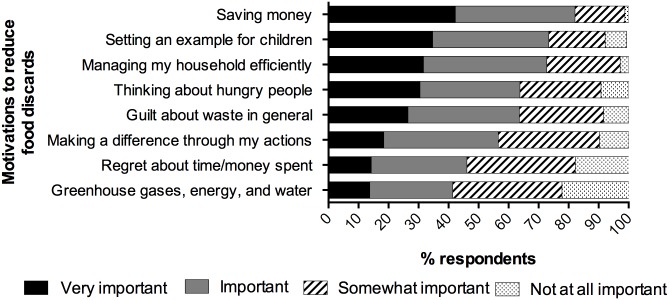
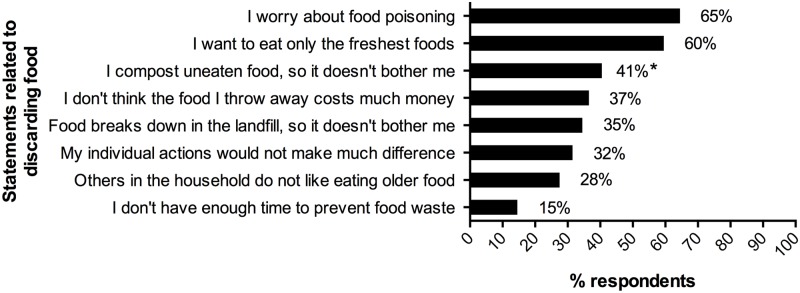
The U.S. wastes 31 to 40% of its post-harvest food supply, with a substantial portion of this waste occurring at the consumer level. Globally, interventions to address wasted food have proliferated, but efforts are in their infancy in the U.S. To inform these efforts and provide baseline data to track change, we performed a survey of U.S. consumer awareness, attitudes and behaviors related to wasted food. The survey was administered online to members of a nationally representative panel (N=1010), and post-survey weights were applied. The survey found widespread (self-reported) awareness of wasted food as an issue, efforts to reduce it, and knowledge about how to do so, plus moderately frequent performance of waste-reducing behaviors. Three-quarters of respondents said they discard less food than the average American. The leading motivations for waste reduction were saving money and setting an example for children, with environmental concerns ranked last. The most common reasons given for discarding food were concern about foodborne illness and a desire to eat only the freshest food. In some cases there were modest differences based on age, parental status, and income, but no differences were found by race, education, rural/urban residence or other demographic factors. Respondents recommended ways retailers and restaurants could help reduce waste. This is the first nationally representative consumer survey focused on wasted food in the U.S. It provides insight into U.S. consumers' perceptions related to wasted food, and comparisons to existing literature. The findings suggest approaches including recognizing that many consumers perceive themselves as being already-knowledgeable and engaged, framing messages to focus on budgets, and modifying existing messages about food freshness and aesthetics. This research also suggests opportunities to shift retail and restaurant practice, and identifies critical research gaps.
Overview
The claims and statistics of this paper haven’t been checked yet.
Free: it reads the open-access text and checks the first 5 claims that cite a source we can check. Create a free account to check every claim.
Integrity signals
Registry
Cites
Statistics
Figures
Verification
Claims the paper makes
The claims and statistics of this paper haven’t been checked yet.
Free: it reads the open-access text and checks the first 5 claims that cite a source we can check. Create a free account to check every claim.
Claims other papers make about this one
Each is checked against this paper’s own text: does it say what the citing paper says it does?
The source backs part of the claim, not all of it — or backs it for a different population, condition or comparison.
In the citing paper
“Survey respondents tend to substantially under-report their waste levels and in contrast to over-report their effort levels (Neff et al. 2015; Qi and Roe 2016; van Geffen et al. 2020).”
From COVID-19 virus outbreak lockdown: What impacts on household food wastage? (2020) · cites this paper as Neff et al. 2015
Experimental — accuracy not yet measuredThe source backs part of the claim, not all of it — or backs it for a different population, condition or comparison.
In the citing paper
“while previous survey work in the United States [30] show food waste reduction is perceived as pro-social by a majority and pro-environmental by more than 40% of respondents.”
From Household Food Waste: Multivariate Regression and Principal Components Analyses of Awareness and Attitudes among U.S. Consumers (2016) · cites this paper as [30]
Experimental — accuracy not yet measuredThe source backs part of the claim, not all of it — or backs it for a different population, condition or comparison.
In the citing paper
“Ethical considerations regarding a lack of food in other countries have been noted by a number of authors (Blichfeldt et al., 2015;Ganglbauer et al., 2013;Neff et al., 2015;Pearson et al., 2016).”
From Food waste matters - A systematic review of household food waste practices and their policy implications (2018) · cites this paper as Neff et al., 2015
Experimental — accuracy not yet measuredThe source backs part of the claim, not all of it — or backs it for a different population, condition or comparison.
In the citing paper
“Alternatively, consumers may believe their impact to be minimized because of composting food waste or feeding food surplus to their pets (Graham-Rowe et al., 2014;Neff et al., 2015).”
From Food waste matters - A systematic review of household food waste practices and their policy implications (2018) · cites this paper as Neff et al., 2015
Experimental — accuracy not yet measuredThe source backs part of the claim, not all of it — or backs it for a different population, condition or comparison.
In the citing paper
“Two studies in the U.S. have found a modest role of environmental concerns with only 40% (Neff et al., 2015) and 58.4% (Qi and Roe, 2016) of respondents expressing concerns about the environmental consequences associated with throwing away food.”
From Food waste matters - A systematic review of household food waste practices and their policy implications (2018) · cites this paper as Neff et al., 2015
Experimental — accuracy not yet measured
23 more claims about this paper
Create a free account to see every claim other papers make about this one.
Self-check
Percentages, sums and reported differences re-computed from the paper’s own numbers.
The self-check needs the paper’s full text.
Citations
Cites
Tversky, A., & Kahneman, D. (1974) · Science · doi:10.1126/science.185.4157.1124 · Cited by 28,810 · cited 1×
“For example, the estimate that 40% of all food is wasted would lead most people to say that they waste less than that [2,3,28].”
Judgment under Uncertainty: Heuristics and Biases
Tversky, A., & Kahneman, D. (1975) · Utility, Probability, and Human Decision Making · doi:10.1007/978-94-010-1834-0_8 · Cited by 22,650
Kollmuss, A., & Agyeman, J. (2002) · Environmental Education Research · doi:10.1080/13504620220145401 · Cited by 8,866
Social determinants of health inequalities
Marmot, M. (2005) · The Lancet · doi:10.1016/s0140-6736(05)71146-6 · Cited by 5,086
Bamberg, S., & Möser, G. (2007) · Journal of Environmental Psychology · doi:10.1016/j.jenvp.2006.12.002 · Cited by 4,140
World agriculture towards 2030/2050: the 2012 revision
Alexandratos, N., Bruinsma, J., Alexandratos, N., & Bruinsma, J. (2012) · RePEc: Research Papers in Economics · doi:10.22004/ag.econ.288998 · Cited by 3,093
Methods of coping with social desirability bias: A review
Nederhof, A. J. (1985) · European Journal of Social Psychology · doi:10.1002/ejsp.2420150303 · Cited by 2,340 · cited 1×
“The survey used anonymous administration and randomized question order to reduce bias [47].”
MethodObesity Stigma: Important Considerations for Public Health
Puhl, R. M., & Heuer, C. A. (2010) · American Journal of Public Health · doi:10.2105/ajph.2009.159491 · Cited by 1,917 · cited 1×
“Extensive evidence from public health and related fields shows limitations of the individual responsibility frame [42], and highlights that shame and blame can be counterproductive [43].”
BackgroundKummu, M., de Moel, H., Porkka, M., Siebert, S., Varis, O., & Ward, P. J. (2012) · Science of The Total Environment · doi:10.1016/j.scitotenv.2012.08.092 · Cited by 1,300 · cited 1×
“Wasted food in North America/Oceania also accounts for an estimated 35% of freshwater consumption, 31% of cropland, and 30% of fertilizer usage[8]; as well as 2% of U.”
Background(2002) · Medical Entomology and Zoology · Cited by 1,279
Cited by
Schanes, K., Dobernig, K., & Gözet, B. (2018) · Journal of Cleaner Production · doi:10.1016/j.jclepro.2018.02.030 · Cited by 1,365
Drivers of food waste and their implications for sustainable policy development
Thyberg, K. L., & Tonjes, D. J. (2016) · Resources, Conservation and Recycling · doi:10.1016/j.resconrec.2015.11.016 · Cited by 928
Understanding Food Loss and Waste—Why Are We Losing and Wasting Food?
Ishangulyyev, R., Kim, S., & Lee, S. (2019) · Foods · doi:10.3390/foods8080297 · Cited by 586
“Consumption Stage - Household size and composition [21,34,39,51,86–88] - Household income [15,24,88–90] - Household demographics [39,51,86,88,91,92] - Household culture [1,93–96] - Individual attitude [97–103] - Cooking process and method, storage in household, over cooking [43,64,66,104,105]”
BackgroundFood waste management in hospitality operations: A critical review
Filimonau, V., & De Coteau, D. A. (2019) · Tourism Management · doi:10.1016/j.tourman.2018.10.009 · Cited by 448
Household food waste: drivers and potential intervention points for design – an extensive review
Hebrok, M., & Boks, C. (2017) · Journal of Cleaner Production · doi:10.1016/j.jclepro.2017.03.069 · Cited by 501
“A general problem in studies of food waste is that waste levels are underreported and efforts and environmental awareness exaggerated (Neff et al., 2015).”
BackgroundMourad, M. (2016) · Journal of Cleaner Production · doi:10.1016/j.jclepro.2016.03.084 · Cited by 479
“…food poverty (Escajedo San-epifanio and De Renobales Scheifler, 2015; Neff et al., 2015a), studies assessing the potential of food redistribution (O'Donnell et al., 2015; Phillips et al., 2011; Reynolds et al., 2015; Schneider, 2013b) should be put into perspective with social and political…”
BackgroundCOVID-19 virus outbreak lockdown: What impacts on household food wastage?
Jribi, S., Ben Ismail, H., Doggui, D., & Debbabi, H. (2020) · Environment, Development and Sustainability · doi:10.1007/s10668-020-00740-y · Cited by 473
Porat, R., Lichter, A., Terry, L. A., Harker, R., & Buzby, J. (2018) · Postharvest Biology and Technology · doi:10.1016/j.postharvbio.2017.11.019 · Cited by 420
“For example, an online survey (n = 1,010) of US consumer awareness revealed that three-quarters of respondents said they discarded less food than the average American (Neff et al., 2015), and interviews with 1,862 consumers in the UK revealed that only a few admitted that they wasted significant amounts of food (WRAP,…”
BackgroundInfluentialFood waste and the food-energy-water nexus: A review of food waste management alternatives
Kibler, K. M., Reinhart, D., Hawkins, C., Motlagh, A. M., & Wright, J. (2018) · Waste Management · doi:10.1016/j.wasman.2018.01.014 · Cited by 356
Reducing Food Loss and Waste to Enhance Food Security and Environmental Sustainability
Shafiee-Jood, M., & Cai, X. (2016) · Environmental Science & Technology · doi:10.1021/acs.est.6b01993 · Cited by 327
On the measurement of food waste
Bellemare, M. F., Çakir, M., Peterson, H. H., Novak, L., & Rudi, J. (2017) · American Journal of Agricultural Economics · doi:10.1093/ajae/aax034 · Cited by 324
“On the consumer side, efforts are currently underway to understand consumer awareness, attitudes, and behavior (Neff et al., 2015; Qi and Roe, 2016; and Wilson et al., 2017).”
Wang, L.-E., Liu, G., Liu, X., Liu, Y., Gao, J., Zhou, B., Gao, S., & Cheng, S. (2017) · Waste Management · doi:10.1016/j.wasman.2017.04.007 · Cited by 306
“wastes 31–40% of its post-harvest food supply, with a substantial portion occurring at the consumer level (Neff et al., 2015).”
BackgroundQi, D., & Roe, B. E. (2016) · PLoS ONE · doi:10.1371/journal.pone.0159250 · Cited by 299
Romani, S., Grappi, S., Bagozzi, R. P., & Barone, A. M. (2018) · Appetite · doi:10.1016/j.appet.2017.11.093 · Cited by 276
Food Loss and Waste: Measurement, Drivers, and Solutions
Spang, E. S., Moreno, L. C., Pace, S. A., Achmon, Y., Donis-Gonzalez, I., Gosliner, W. A., Jablonski-Sheffield, M. P., Momin, M. A., Quested, T. E., Winans, K. S., et al. (2019) · Annual Review of Environment and Resources · doi:10.1146/annurev-environ-101718-033228 · Cited by 245
Food Waste Drivers in Europe, from Identification to Possible Interventions
Canali, M., Amani, P., Aramyan, L., Gheoldus, M., Moates, G., Östergren, K., Silvennoinen, K., Waldron, K., & Vittuari, M. (2016) · Sustainability · doi:10.3390/su9010037 · Cited by 235
“In general, the economic motivation figures as the main reason for consumers to avoid FW, followed by personal gratification, while socio-environmental reasons are the weakest motivators [18,22,25,27,147,148,175,181,182].”
BackgroundFood waste: The role of date labels, package size, and product category
Wilson, N. L. W., Rickard, B. J., Saputo, R., & Ho, S.-T. (2017) · Food Quality and Preference · doi:10.1016/j.foodqual.2016.08.004 · Cited by 238
Block, L. G., Keller, P. A., Vallen, B., Williamson, S., Birau, M. M., Grinstein, A., Haws, K. L., LaBarge, M. C., Lamberton, C., Moore, E. S., et al. (2016) · Journal of Public Policy & Marketing · doi:10.1509/jppm.15.132 · Cited by 231
Towards Zero Waste: an Exploratory Study on Restaurant managers
Principato, L., Pratesi, C. A., & Secondi, L. (2018) · International Journal of Hospitality Management · doi:10.1016/j.ijhm.2018.02.022 · Cited by 219
Food wasters: Profiling consumers’ attitude to waste food in Italy
Gaiani, S., Caldeira, S., Adorno, V., Segrè, A., & Vittuari, M. (2018) · Waste Management · doi:10.1016/j.wasman.2017.11.012 · Cited by 201
Hörisch, J., Kollat, J., & Brieger, S. A. (2017) · Small Business Economics · doi:10.1007/s11187-016-9765-2 · Cited by 205
“As parenthood is frequently expected to increase environmental consciousness (Neff et al. 2015), further research on the influence of age on the environmental orientation of entrepreneurs should control for the effect of parenthood.”
BackgroundFilimonau, V., Matute, J., Kubal-Czerwińska, M., Krzesiwo, K., & Mika, M. (2020) · Journal of Cleaner Production · doi:10.1016/j.jclepro.2019.119105 · Cited by 185
“This is in line with the literature which established this correlation in other geographical markets of out-of-home food consumption, but not specifically in the context of restaurant food waste (Jang et al. 2015; Neff et al. 2015; Shin et al. 2017).”
ResultSocio-Demographic Predictors of Food Waste Behavior in Denmark and Spain
Grasso, A. C., Olthof, M. R., Boevé, A. J., van Dooren, C., Lähteenmäki, L., & Brouwer, I. A. (2019) · Sustainability · doi:10.3390/su11123244 · Cited by 167
“Adults 65 years of age or older in particular have been found to practice food waste reducing behaviors such as planning meals in advance, and have more knowledge of food waste than younger adults [39,40].”
BackgroundContextualising food waste prevention-Decisive moments within everyday practices
Hebrok, M., & Heidenstrøm, N. (2019) · Journal of Cleaner Production · doi:10.1016/j.jclepro.2018.11.141 · Cited by 170
Schmidt, K. (2016) · Resources, Conservation and Recycling · doi:10.1016/j.resconrec.2016.04.006 · Cited by 168
Diaz-Ruiz, R., Costa-Font, M., & Gil, J. M. (2018) · Journal of Cleaner Production · doi:10.1016/j.jclepro.2017.10.148 · Cited by 167
“219 In fact, recent studies have shown consumers’ environmental awareness about food waste 220 consequences (Neff et al., 2015; Principato et al., 2015).”
Backgroundvan Geffen, L. E. J., van Herpen, E., Sijtsema, S. J., & van Trijp, J. C. M. (2019) · Resources Conservation & Recycling X · doi:10.1016/j.rcrx.2019.100026 · Cited by 207
“Given that food waste is linked to many foodhandling practices, the framework could refer to a wide range of abilities, including knowledge concerning date-labeling or planning skills (Neff et al., 2015; Quested et al., 2013).”
BackgroundBorsellino, V., Kaliji, S. A., & Schimmenti, E. (2020) · Sustainability · doi:10.3390/su12208366 · Cited by 189
“According to past studies of consumer behaviour [127,128], and the results of”
ResultEstimating Food Waste as Household Production Inefficiency
Yu, Y., & Jaenicke, E. C. (2020) · American Journal of Agricultural Economics · doi:10.1002/ajae.12036 · Cited by 184
Filimonau, V., Todorova, E., Mzembe, A. N., Sauer, L., & Yankholmes, A. (2020) · Journal of Cleaner Production · doi:10.1016/j.jclepro.2020.120775 · Cited by 202
“Reduce Food Waste, Save Money”: Testing a Novel Intervention to Reduce Household Food Waste
van der Werf, P., Seabrook, J. A., & Gilliland, J. (2019) · Environment and Behavior · doi:10.1177/0013916519875180 · Cited by 190
“, larger and with children; Baker, Fear, & Denniss, 2009; Koivupuro, Hartikainen, Silvennoinen, Katajajuuri, & Heikintalo, 2012; Neff, 2015; Parizeau, von Massow, & Martin, 2015), higher household income (Fusions, 2014; Neff, 2015; Stancu, Haugaard, & Lahteenmaki, 2016), and gender (with males potentially wasting more…”
BackgroundInfluentialMoshtaghian, H., Bolton, K., & Rousta, K. (2021) · Foods · doi:10.3390/foods10112874 · Cited by 150
“Wasted food implies the loss of food as a valuable resource, whereas food waste conveys the generation of valueless materials as waste [28,29].”
BackgroundFood Waste and the ‘Green’ Consumer
McCarthy, B., & Liu, H. (2017) · Australasian Marketing Journal (AMJ) · doi:10.1016/j.ausmj.2017.04.007 · Cited by 194
“Scholarly research on food waste has grown in recent years (Gjerris and Gaiani, 2013; Neff et al., 2015).”
BackgroundArun, T. M., Kaur, P., Ferraris, A., & Dhir, A. (2021) · Business Strategy and the Environment · doi:10.1002/bse.2755 · Cited by 149
“Other consumer-level internal antecedents included individuals' PBC (Ajzen, 1991), while their awareness and ability to select a green restaurant indirectly played a role in their selection process (S. Y. Jang et al., 2015; Y. J. Kim et al., 2013; Neff et al., 2015; Shin et al., 2018).”
BackgroundEvery plate counts: Evaluation of a food waste reduction campaign in a university dining hall
Ellison, B., Savchenko, O. M., Nikolaus, C. J., & Duff, B. R. L. (2019) · Resources Conservation and Recycling · doi:10.1016/j.resconrec.2019.01.046 · Cited by 177
What gets measured gets managed: A new method of measuring household food waste
Elimelech, E., Ayalon, O., & Ert, E. (2018) · Waste Management · doi:10.1016/j.wasman.2018.03.031 · Cited by 139
Mapping the Influence of Food Waste in Food Packaging Environmental Performance Assessments
Heller, M. C., Selke, S. E. M., & Keoleian, G. A. (2019) · Journal of Industrial Ecology · doi:10.1111/jiec.12743 · Cited by 142
“…psychology with regard to both packaging and food waste provides a starting point for initiatives and packaging design aimed at reducing consumer-level food waste (Aschemann-Witzel et al. 2015; Stancu et al. 2016; Secondi et al. 2015; Neff et al. 2015; Martinho et al. 2015; Wikström et al. 2016).”
BackgroundGiordano, C., Alboni, F., & Falasconi, L. (2019) · Sustainability · doi:10.3390/su11123381 · Cited by 163
“Differently from most of the studies that enquired into the motivations to reduce food waste [31,33,46,51], our study compared the motivation with the average food waste reported in diaries, so they are not result of a respondent’s belief but actual waste.”
MethodResultAschemann-Witzel, J., Giménez, A., & Ares, G. (2018) · Global Environmental Change · doi:10.1016/j.gloenvcha.2018.02.002 · Cited by 134
“Awareness levels are high in countries where the food waste issue has been on the agenda in the media (Neff et al., 2015; Aschemann-Witzel, 2018).”
BackgroundVittuari, M., García-Herrero, L., Masotti, M., Iori, E., Caldeira, C., Qian, Z., Bruns, H., van Herpen, E., Obersteiner, G., Kaptan, G., et al. (2023) · Sustainable Production and Consumption · doi:10.1016/j.spc.2023.03.023 · Cited by 169
“Education level (Schanes et al., 2018b; Cecere et al., 2014; Neff et al., 2015).”
Backgroundvan der Werf, P., Seabrook, J. A., & Gilliland, J. (2019) · Canadian Geographies / Géographies canadiennes · doi:10.1111/cag.12519 · Cited by 164
“set meal, or, as is often the case for children, general fussiness (Evans 2012; Neff 2015; Porpino 2016).”
BackgroundResultAssessing U.S. food wastage and opportunities for reduction
Dou, Z., Ferguson, J. D., Galligan, D. T., Kelly, A. M., Finn, S. M., & Giegengack, R. F. (2016) · Global Food Security · doi:10.1016/j.gfs.2016.02.001 · Cited by 143
“Despite growing awareness, the American public is yet to be significantly engaged, as the scope and scale of food waste have not yet registered with the average consumer (Neff et al., 2015).”
BackgroundWu, Y., Tian, X., Li, X., Yuan, H., & Liu, G. (2019) · Resources Conservation and Recycling · doi:10.1016/j.resconrec.2019.05.022 · Cited by 148
Rodgers, R. F., Lombardo, C., Cerolini, S., Franko, D. L., Omori, M., Linardon, J., Guillaume, S., Fischer, L., & Tyszkiewicz, M. F. (2021) · Appetite · doi:10.1016/j.appet.2021.105110 · Cited by 140
“has lagged behind other countries in terms of successful efforts to address food waste (Neff et al., 2015).”
BackgroundLin, B., & Guan, C. (2021) · Journal of Environmental Management · doi:10.1016/j.jenvman.2021.113577 · Cited by 139
Consumer knowledge and behaviors regarding food date labels and food waste
Kavanaugh, M., & Quinlan, J. J. (2020) · Food Control · doi:10.1016/j.foodcont.2020.107285 · Cited by 148
“As with our analysis, the majority of recent investigations have been survey-based (Davenport et al., 2019; Jorissen, Pfiefer, & Brautigam, 2015; Kosa et al., 2007; Neff et al., 2015; Stancu, Haugaard, & Lähteenmäki, 2016; Toma et al., 2017; van Boxstael et al., 2014).”
MethodResultvan der Werf, P., Seabrook, J. A., & Gilliland, J. (2019) · Waste Management · doi:10.1016/j.wasman.2019.09.032 · Cited by 141
“World food production and per capita calorie intake has increased substantially in the past century (Nellemann et al., 2009).”
BackgroundComparing diaries and waste compositional analysis for measuring food waste in the home
Quested, T. E., Palmer, G., Moreno, L. C., McDermott, C., & Schumacher, K. A. (2020) · Journal of Cleaner Production · doi:10.1016/j.jclepro.2020.121263 · Cited by 143
Consumers’ food cycle and household waste. When behaviors matter
Setti, M., Banchelli, F., Falasconi, L., Segrè, A., & Vittuari, M. (2018) · Journal of Cleaner Production · doi:10.1016/j.jclepro.2018.03.024 · Cited by 120
Ananda, J., Karunasena, G. G., Mitsis, A., Kansal, M., & Pearson, D. H. (2021) · Journal of Cleaner Production · doi:10.1016/j.jclepro.2021.127280 · Cited by 140
Neff, R., Spiker, M. L., Rice, C., Alexandra, S., Greenberg, S., & Leib, E. B. (2019) · Waste Management · doi:10.1016/j.wasman.2019.01.023 · Cited by 137
Self-citationHousehold food waste-how to avoid it? An integrative review
van Geffen, L., van Herpen, E., & van Trijp, H. (2020) · Food Waste Management · doi:10.1007/978-3-030-20561-4_2 · Cited by 112
“Consequently, it makes people feel guilty (Abeliotis et al. 2014; Graham-Rowe et al. 2014; Neff et al. 2015; Stancu et al. 2016).”
BackgroundAschemann‐Witzel, J., Giménez, A., & Ares, G. (2019) · Resources Conservation and Recycling · doi:10.1016/j.resconrec.2019.03.001 · Cited by 134
Strategies to reduce food waste in the foodservices sector: A systematic review
Vizzoto, F., Testa, F., & Iraldo, F. (2021) · International Journal of Hospitality Management · doi:10.1016/j.ijhm.2021.102933 · Cited by 136
Wasted Positive Intentions: The Role of Affection and Abundance on Household Food Waste
Porpino, G., Wansink, B., & Parente, J. (2016) · Journal of Food Products Marketing · doi:10.1080/10454446.2015.1121433 · Cited by 109
““Preference for freshness,” mentioned by 40% of the mothers, is also cited by Neff, Spiker, and Truant (2015) as a top cause for wasting food.”
BackgroundBehavioral impacts on residential food provisioning, use, and waste during the COVID-19 pandemic
Babbitt, C. W., Babbitt, G. A., & Oehman, J. M. (2021) · Sustainable Production and Consumption · doi:10.1016/j.spc.2021.04.012 · Cited by 117
“However, it is un- ikely that environmental motivations for waste minimization were he primary drivers for these shifts ( Neff et al., 2015 ).”
BackgroundWasted food: A qualitative study of U.S. young adults' perceptions, beliefs and behaviors
Nikolaus, C. J., Nickols‐Richardson, S. M., & Ellison, B. (2018) · Appetite · doi:10.1016/j.appet.2018.07.026 · Cited by 130
Estrada, A., Garber, P. A., & Chaudhary, A. (2020) · PeerJ · doi:10.7717/peerj.9816 · Cited by 115
Consumer-related antecedents of food provisioning behaviors that promote food waste
Stancu, V., & Lähteenmäki, L. (2022) · Food Policy · doi:10.1016/j.foodpol.2022.102236 · Cited by 122
Characteristics and Determinants of Domestic Food Waste: A Representative Diary Study across Germany
Herzberg, R., Schmidt, T., & Schneider, F. (2020) · Sustainability · doi:10.3390/su12114702 · Cited by 113
“[34] suggest that eating behavior of children is not always predictable resulting in too much food served on the plate.”
BackgroundInfluentialFood Waste on Foodservice: An Overview through the Perspective of Sustainable Dimensions
Lins, M. F. C., Zandonadi, R. P., Raposo, A., & Ginani, V. C. (2021) · Foods · doi:10.3390/foods10061175 · Cited by 130
“Consequently, production will be more efficient and profitable, with the acquisition of better-quality raw materials and rational use of energy [82,83,85].”
BackgroundValuing the multiple impacts of household food waste
von Massow, M., Parizeau, K., Gallant, M., Wickson, M., Haines, J., Ma, D. W. L., Wallace, A., Carroll, N., & Duncan, A. M. (2019) · Frontiers in Nutrition · doi:10.3389/fnut.2019.00143 · Cited by 103
Use of intelligent applications to reduce household food waste
Liegeard, J., & Manning, L. (2019) · Critical Reviews in Food Science and Nutrition · doi:10.1080/10408398.2018.1556580 · Cited by 114
“Furthermore, due to potential bias, studies that are based on self-reported behaviors cannot necessarily provide usable results to assess household food waste as respondents may be motivated to misreport (Møller et al. 2013; Neff et al. 2015).”
BackgroundConrad, Z., & Blackstone, N. T. (2020) · Nutrition Reviews · doi:10.1093/nutrit/nuaa035 · Cited by 117
Talwar, S., Kaur, P., Okumuş, B., Ahmed, U., & Dhir, A. (2021) · International Journal of Hospitality Management · doi:10.1016/j.ijhm.2021.103033 · Cited by 105
“These studies also offer substantial evidence for the influence of attitudes on consumer intentions (Neff et al., 2015; Zeweld et al., 2017).”
BackgroundAre questionnaires a reliable method to measure food waste? A pilot study on Italian households
Giordano, C., Piras, S., Boschini, M., & Falasconi, L. (2018) · British Food Journal · doi:10.1108/bfj-02-2018-0081 · Cited by 96
Foodservice Composting Crowds Out Consumer Food Waste Reduction Behavior in a Dining Experiment
Qi, D., & Roe, B. E. (2017) · American Journal of Agricultural Economics · doi:10.1093/ajae/aax050 · Cited by 91
“Most consumer food waste studies explore consumers’ awareness and attitudes toward food waste (Neff, Spiker, and Truant 2015; Qi and Roe 2016a) and the association between food waste behaviors and demographic characteristics (Kuo and Shih 2016; Secondi, Principato, and Laureti 2015).”
BackgroundReducing Food Loss And Waste While Improving The Public’s Health
Neff, R. A., Kanter, R., & Vandevijvere, S. (2015) · Health Affairs · doi:10.1377/hlthaff.2015.0647 · Cited by 93
Self-citationVerma, M. V. D. B., de Vreede, L., Achterbosch, T. J., & Rutten, M. M. (2020) · PLoS ONE · doi:10.1371/journal.pone.0228369 · Cited by 113
Cho, M., & Yoo, J. J.-E. (2021) · International Journal of Contemporary Hospitality Management · doi:10.1108/ijchm-06-2021-0697 · Cited by 108
Davenport, M., Qi, D., & Roe, B. E. (2019) · Resources Conservation and Recycling · doi:10.1016/j.resconrec.2019.104440 · Cited by 96
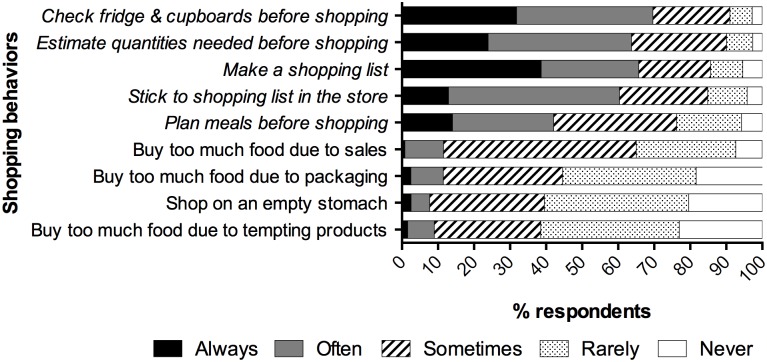
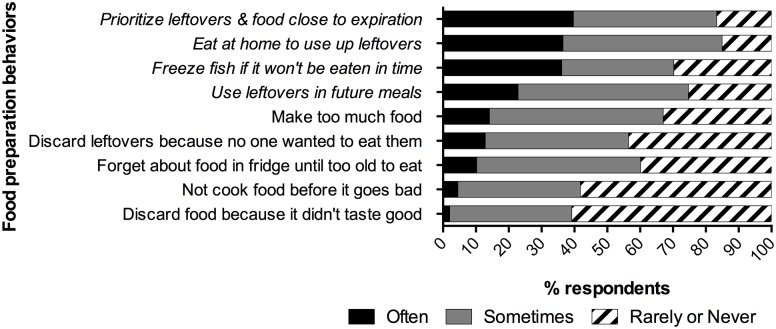
“While at least one study (Neff et al., 2015) reports the incidence of a variety of shopping and food preparation habits and routines in the U.”
BackgroundResultInfluentialExamining Household Food Waste Decisions: A Vignette Approach
Ellison, B., & Lusk, J. L. (2017) · Applied Economic Perspectives and Policy · doi:10.1093/aepp/ppx059 · Cited by 111
Shin, Y.-U., Yoo, H.-Y., Kim, S., Chung, K.-M., Park, Y.-G., Hwang, K.-H., Hong, S. W., Park, H., Cho, K., & Lee, J. (2017) · Environmental Science & Technology · doi:10.1021/acs.est.7b02018 · Cited by 87
Household Food Waste: A Case Study in Southern Italy
Annunziata, A., Agovino, M., Ferraro, A., & Mariani, A. (2020) · Sustainability · doi:10.3390/su12041495 · Cited by 93
The Impact of Religiosity and Food Consumption Culture on Food Waste Intention in Saudi Arabia
Elshaer, I., Sobaih, A. E. E., Alyahya, M., & Abu Elnasr, A. (2021) · Sustainability · doi:10.3390/su13116473 · Cited by 84
“The food waste literature has indicated multiple reasons for causing food waste by individuals, the majority of the factors are influenced by religiosity [13]; personal attitudes towards food waste [6–19], and culture [19,20].”
BackgroundInfluence of the COVID-19 Pandemic on Household Food Waste Behavior in Japan
Qian, K., Javadi, F., & Hiramatsu, M. (2020) · Sustainability · doi:10.3390/su12239942 · Cited by 102
“All 19 food waste questions were originally developed by referring to several previous studies on food waste [2,3,33,34].”
BackgroundRasool, S., Cerchione, R., Salo, J., Ferraris, A., & Abbate, S. (2021) · British Food Journal · doi:10.1108/bfj-02-2021-0160 · Cited by 95
Delley, M., & Brunner, T. A. (2017) · Resources, Conservation and Recycling · doi:10.1016/j.resconrec.2017.02.008 · Cited by 82
“…packaging waste is a greater environmental issue than food thrown awayR WRAP (2007b) Leftovers fed to pets are absolutely unproblematic for the environmentR Porpino et al. (2015)† Composted food is not a problem for the environment since the nutrients are recycledR Neff et al. (2015) 7.”
BackgroundInfluentialComparison of life cycle environmental impacts from meal kits and grocery store meals
Heard, B. R., Bandekar, M., Vassar, B., & Miller, S. A. (2019) · Resources Conservation and Recycling · doi:10.1016/j.resconrec.2019.04.008 · Cited by 94
“(Neff et al., 2015) find that many consumers are recepetive to food waste prevention efforts, and perceive themselves as wasting less food than they do: with nearly ¾ of (U.S.) respondants believing they dispose of less food than the average American.”
BackgroundOehman, J. M., Babbitt, C. W., & Flynn, C. (2022) · Resources Conservation and Recycling · doi:10.1016/j.resconrec.2022.106492 · Cited by 99
“In addition, educating individuals about the meaning of food date labels could prevent confusion and the discard of food that is still good (Neff et al., 2015; van der Werf et al., 2019).”
Giordano, C., Alboni, F., Cicatiello, C., & Falasconi, L. (2019) · International Journal of Consumer Studies · doi:10.1111/ijcs.12499 · Cited by 81
Diet change and food loss reduction: What is their combined impact on global water use and scarcity?
Jalava, M., Guillaume, J. H. A., Kummu, M., Porkka, M., Siebert, S., & Varis, O. (2016) · Earth s Future · doi:10.1002/2015ef000327 · Cited by 90
“Loss reduction similarly requires changes in attitudes [Neff et al., 2015], but might be easier to adopt than changing the contents of the diet.”
MethodTypology of university students regarding attitudes towards food waste
Knežević, B., Živadinović, N. K., & Anić, I. (2019) · British Food Journal · doi:10.1108/bfj-05-2018-0316 · Cited by 84
Everitt, H., van der Werf, P., Seabrook, J. A., Wray, A. J. D., & Gilliland, J. (2021) · Socio-Economic Planning Sciences · doi:10.1016/j.seps.2021.101110 · Cited by 85
Han, Z. S., Chen, K., & Ma, Z. (2023) · Journal of Retailing and Consumer Services · doi:10.1016/j.jretconser.2023.103525 · Cited by 87
McCarthy, B., & Liu, H. (2017) · British Food Journal · doi:10.1108/bfj-03-2017-0163 · Cited by 95
Sustainable food literacy: A measure to promote sustainable diet practices
Teng, C.-C. C., & Chih, C. (2022) · Sustainable Production and Consumption · doi:10.1016/j.spc.2022.01.008 · Cited by 89
Waste less, enjoy more: forming a messaging campaign and reducing food waste in restaurants
Chen, H. S., & Jai, T.-M. C. (2018) · Journal of Quality Assurance in Hospitality & Tourism · doi:10.1080/1528008x.2018.1483282 · Cited by 93
“Therefore, more research is required to understand what motivates consumers to prioritize their food related consumption and behavior (GrahamRowe et al., 2014; Neff et al., 2015).”
BackgroundFactors influencing consumers' food waste reduction behaviour at university canteens
Pandey, S., Budhathoki, M., Pérez-Cueto, F. J. A., & Thomsen, M. (2023) · Food Quality and Preference · doi:10.1016/j.foodqual.2023.104991 · Cited by 84
Altintzoglou, T., Honkanen, P., & Whitaker, R. D. (2021) · Journal of Cleaner Production · doi:10.1016/j.jclepro.2020.125487 · Cited by 73
“For example, consumers may believe that food waste is worse at home and may not be informed about the high potential for improvement towards a cleaner food production process that generates less waste (Neff et al., 2015).”
BackgroundPerilaku Membuang Sampah Makanan dan Pengelolaan Sampah Makanan di Berbagai Negara: Review
Chaerul, M., & Zatadini, S. U. (2020) · Jurnal Ilmu Lingkungan · doi:10.14710/jil.18.3.455-466 · Cited by 73
Nadathur, S., Wanasundara, J. P. D., & Scanlin, L. (2016) · Elsevier eBooks · doi:10.1016/b978-0-12-802778-3.00001-9 · Cited by 92
Circular agri-food approaches: will consumers buy novel products made from vegetable waste?
McCarthy, B., Kapetanaki, A. B., & Wang, P. (2019) · Rural Society · doi:10.1080/10371656.2019.1656394 · Cited by 86
Daily cost of consumer food wasted, inedible, and consumed in the United States, 2001–2016
Conrad, Z. (2020) · Nutrition Journal · doi:10.1186/s12937-020-00552-w · Cited by 82
“Importantly, many Americans report that saving money is the most salient motivator for reducing food waste [10].”
BackgroundNeubig, C. M., Vranken, L., Roosen, J., Grasso, S., Hieke, S., Knoepfle, S., Macready, A. L., & Masento, N. A. (2020) · Journal of Cleaner Production · doi:10.1016/j.jclepro.2020.121126 · Cited by 81
Nguyen, T. T. T., Malek, L., Umberger, W. J., & O’Connor, P. (2022) · Journal of Cleaner Production · doi:10.1016/j.jclepro.2022.134636 · Cited by 88
Postharvest Losses and Management of Horticultural Produce: A Review
Bisht, A., & Singh, S. P. (2024) · Journal of Scientific Research and Reports · doi:10.9734/jsrr/2024/v30i31881 · Cited by 82
Adel, A. M., Dai, X., & Roshdy, R. S. (2021) · British Food Journal · doi:10.1108/bfj-03-2021-0211 · Cited by 81
Food Waste Avoidance Actions in Food Retailing: The Case of Denmark
Kulikovskaja, V., & Aschemann-Witzel, J. (2017) · Journal of International Food & Agribusiness Marketing · doi:10.1080/08974438.2017.1350244 · Cited by 66
Household food waste reduction: Italian consumers’ analysis for improving food management
Pellegrini, G., Sillani, S., Gregori, M., & Spada, A. (2019) · British Food Journal · doi:10.1108/bfj-07-2018-0425 · Cited by 78
Metadata
- Authors
- Neff, R. A., Spiker, M. L., & Truant, P. L.
- Affiliations
- Johns Hopkins University (US)
- Corresponding author
- Neff, Roni A.
- Venue
- PLOS ONE
- Publisher
- Public Library of Science (PLoS)
- Published
- 2015-06-10
- Volume
- 10
- Issue
- 6
- Pages
- e0127881
- ISSN
- 1932-6203 (ISSN-L)
- PMC
- PMC4465675
- OpenAlex
- W591450021
- Cited by
- 461
- References
- 34
- Citations by year
- 2026: 34 · 2025: 36 · 2024: 40 · 2023: 38 · 2022: 58 · 2021: 62 · 2020: 61 · 2019: 50 · 2018: 35 · 2017: 24 · 2016: 19 · 2015: 3
- FWCI
- 36.05
- Type
- journal article
- Language
- en
- Open access
- gold
- doi.org
- Licence
- Locations
- PLoS ONE (publishedVersion, cc-by)
- Europe PMC (PubMed Central) (publishedVersion, cc-by)
- PubMed Central (publishedVersion, cc-by)
- PubMed (publishedVersion)
- RePEc: Research Papers in Economics (submittedVersion)
- DOAJ (DOAJ: Directory of Open Access Journals) (submittedVersion)
- Figshare (submittedVersion, cc-by)
- Funders
- Johns Hopkins University
- Università di Bologna
- Johns Hopkins Bloomberg School of Public Health
- Topics
- Life Sciences › Agricultural and Biological Sciences › Food Science › Food Waste Reduction and Sustainability
- Physical Sciences › Environmental Science › Ecology › Agriculture Sustainability and Environmental Impact
- Health Sciences › Medicine › Public Health, Environmental and Occupational Health › Food Security and Health in Diverse Populations
- Keywords
- food waste, consumer awareness, consumer attitudes, food freshness, food aesthetics, United States consumers
- MeSH terms
- Adult, Aged, Attitude, Awareness, Female, Food Supply, Humans, Health Knowledge, Attitudes, Practice, Male, Middle Aged, Surveys and Questionnaires, Social Behavior, United States, Waste Products
About these checks
Registry, retraction, Cites and statistics results are computed, not judged, with one exception: a printed reference that no index lists is read once by a model before it counts as a citation error. Claims are extracted by a model and kept only when their quote appears verbatim in the text; each cited source is then checked, with a model’s help, for whether it says what the claim relies on. Those verdicts can be wrong — read the claim’s quote and the cited source before relying on one.
Statistics and arithmetic are recomputed, not judged.
Confidence bands are shown only for fields calibrated on our annotated test set. None is calibrated yet, so no band is shown.
What counts as a claim ›How we measure confidence ›How we check this ›
Are you an author, or do you see a problem with this page? Request a review
Data sources
Bibliographic data: Semantic Scholar, OpenAlex, Crossref.
Contains information from the Semantic Scholar Academic Graph Datasets, made available under the ODC Attribution License (ODC-BY 1.0).
Semantic Scholar’s data is described in: Kinney, R., et al. (2023). The Semantic Scholar Open Data Platform. arXiv:2301.10140.
