

Wasted Food: U.S. Consumers' Reported Awareness, Attitudes, and Behaviors
Open accessThe DOI matches its Crossref record; 33 of the 34 references it cites were found in a registry or an index.
Abstract
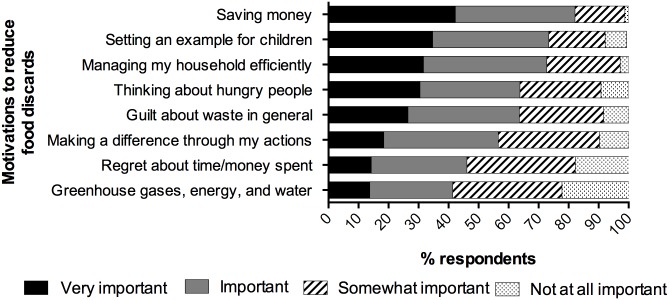
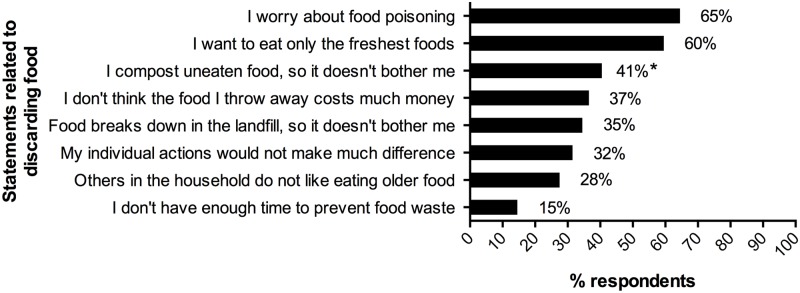
The U.S. wastes 31 to 40% of its post-harvest food supply, with a substantial portion of this waste occurring at the consumer level. Globally, interventions to address wasted food have proliferated, but efforts are in their infancy in the U.S. To inform these efforts and provide baseline data to track change, we performed a survey of U.S. consumer awareness, attitudes and behaviors related to wasted food. The survey was administered online to members of a nationally representative panel (N=1010), and post-survey weights were applied. The survey found widespread (self-reported) awareness of wasted food as an issue, efforts to reduce it, and knowledge about how to do so, plus moderately frequent performance of waste-reducing behaviors. Three-quarters of respondents said they discard less food than the average American. The leading motivations for waste reduction were saving money and setting an example for children, with environmental concerns ranked last. The most common reasons given for discarding food were concern about foodborne illness and a desire to eat only the freshest food. In some cases there were modest differences based on age, parental status, and income, but no differences were found by race, education, rural/urban residence or other demographic factors. Respondents recommended ways retailers and restaurants could help reduce waste. This is the first nationally representative consumer survey focused on wasted food in the U.S. It provides insight into U.S. consumers' perceptions related to wasted food, and comparisons to existing literature. The findings suggest approaches including recognizing that many consumers perceive themselves as being already-knowledgeable and engaged, framing messages to focus on budgets, and modifying existing messages about food freshness and aesthetics. This research also suggests opportunities to shift retail and restaurant practice, and identifies critical research gaps.
Overview
The claims and statistics of this paper haven’t been checked yet.
Free: it reads the open-access text and checks the first 5 claims that cite a source we can check. Create a free account to check every claim.
Integrity signals
Registry
Cites
Statistics
Figures
Verification
Claims the paper makes
The claims and statistics of this paper haven’t been checked yet.
Free: it reads the open-access text and checks the first 5 claims that cite a source we can check. Create a free account to check every claim.
Claims other papers make about this one
Each is checked against this paper’s own text: does it say what the citing paper says it does?
The source backs part of the claim, not all of it — or backs it for a different population, condition or comparison.
In the citing paper
“Survey respondents tend to substantially under-report their waste levels and in contrast to over-report their effort levels (Neff et al. 2015; Qi and Roe 2016; van Geffen et al. 2020).”
From COVID-19 virus outbreak lockdown: What impacts on household food wastage? (2020) · cites this paper as Neff et al. 2015
Experimental — accuracy not yet measuredThe source backs part of the claim, not all of it — or backs it for a different population, condition or comparison.
In the citing paper
“while previous survey work in the United States [30] show food waste reduction is perceived as pro-social by a majority and pro-environmental by more than 40% of respondents.”
From Household Food Waste: Multivariate Regression and Principal Components Analyses of Awareness and Attitudes among U.S. Consumers (2016) · cites this paper as [30]
Experimental — accuracy not yet measuredThe source backs part of the claim, not all of it — or backs it for a different population, condition or comparison.
In the citing paper
“Ethical considerations regarding a lack of food in other countries have been noted by a number of authors (Blichfeldt et al., 2015;Ganglbauer et al., 2013;Neff et al., 2015;Pearson et al., 2016).”
From Food waste matters - A systematic review of household food waste practices and their policy implications (2018) · cites this paper as Neff et al., 2015
Experimental — accuracy not yet measuredThe source backs part of the claim, not all of it — or backs it for a different population, condition or comparison.
In the citing paper
“Alternatively, consumers may believe their impact to be minimized because of composting food waste or feeding food surplus to their pets (Graham-Rowe et al., 2014;Neff et al., 2015).”
From Food waste matters - A systematic review of household food waste practices and their policy implications (2018) · cites this paper as Neff et al., 2015
Experimental — accuracy not yet measuredThe source backs part of the claim, not all of it — or backs it for a different population, condition or comparison.
In the citing paper
“Two studies in the U.S. have found a modest role of environmental concerns with only 40% (Neff et al., 2015) and 58.4% (Qi and Roe, 2016) of respondents expressing concerns about the environmental consequences associated with throwing away food.”
From Food waste matters - A systematic review of household food waste practices and their policy implications (2018) · cites this paper as Neff et al., 2015
Experimental — accuracy not yet measured
23 more claims about this paper
Create a free account to see every claim other papers make about this one.
Self-check
Percentages, sums and reported differences re-computed from the paper’s own numbers.
The self-check needs the paper’s full text.
Citations
Cites
Tversky, A., & Kahneman, D. (1974) · Science · doi:10.1126/science.185.4157.1124 · Cited by 28,810 · cited 1×
“For example, the estimate that 40% of all food is wasted would lead most people to say that they waste less than that [2,3,28].”
Judgment under Uncertainty: Heuristics and Biases
Tversky, A., & Kahneman, D. (1975) · Utility, Probability, and Human Decision Making · doi:10.1007/978-94-010-1834-0_8 · Cited by 22,650
Kollmuss, A., & Agyeman, J. (2002) · Environmental Education Research · doi:10.1080/13504620220145401 · Cited by 8,866
Social determinants of health inequalities
Marmot, M. (2005) · The Lancet · doi:10.1016/s0140-6736(05)71146-6 · Cited by 5,086
Bamberg, S., & Möser, G. (2007) · Journal of Environmental Psychology · doi:10.1016/j.jenvp.2006.12.002 · Cited by 4,140
World agriculture towards 2030/2050: the 2012 revision
Alexandratos, N., Bruinsma, J., Alexandratos, N., & Bruinsma, J. (2012) · RePEc: Research Papers in Economics · doi:10.22004/ag.econ.288998 · Cited by 3,093
Methods of coping with social desirability bias: A review
Nederhof, A. J. (1985) · European Journal of Social Psychology · doi:10.1002/ejsp.2420150303 · Cited by 2,340 · cited 1×
“The survey used anonymous administration and randomized question order to reduce bias [47].”
MethodObesity Stigma: Important Considerations for Public Health
Puhl, R. M., & Heuer, C. A. (2010) · American Journal of Public Health · doi:10.2105/ajph.2009.159491 · Cited by 1,917 · cited 1×
“Extensive evidence from public health and related fields shows limitations of the individual responsibility frame [42], and highlights that shame and blame can be counterproductive [43].”
BackgroundKummu, M., de Moel, H., Porkka, M., Siebert, S., Varis, O., & Ward, P. J. (2012) · Science of The Total Environment · doi:10.1016/j.scitotenv.2012.08.092 · Cited by 1,300 · cited 1×
“Wasted food in North America/Oceania also accounts for an estimated 35% of freshwater consumption, 31% of cropland, and 30% of fertilizer usage[8]; as well as 2% of U.”
Background(2002) · Medical Entomology and Zoology · Cited by 1,279
Cited by
Items 301–400 of 468
Students’ Food Consumption Behavior during COVID-19 Lockdown
Skawińska, E., Zalewski, R. I., & Wyrwa, J. P. (2023) · Sustainability · doi:10.3390/su15129449 · Cited by 7
Wen, H., Wu, X., Cui, T., Yang, Z., & Chen, Y.-H. (2023) · Waste Management & Research The Journal for a Sustainable Circular Economy · doi:10.1177/0734242x231219628 · Cited by 8
“Environmental concerns (Melbye et al., 2017), feelings of guilt (Neff et al., 2015; Parizeau et al., 2015; Qi and Roe, 2016; Quested et al., 2013), personal norms (Visschers et al., 2016) and ethical considerations (Blichfeldt et al., 2015; Ganglbauer et al., 2013; Neff et al., 2015; Pearson et…”
Food waste and pay‐as‐you‐throw systems
Wang, Z., Kim, M., & Kim, H.-N. (2026) · Journal of the Agricultural and Applied Economics Association · doi:10.1002/jaa2.70035 · Cited by 7
Challenges and Innovations in Food Waste-to-Energy Management and Logistics
Armington, W. R., Chen, R. B., & Babbitt, C. W. (2018) · Elsevier eBooks · doi:10.1016/b978-0-12-811157-4.00013-9 · Cited by 10
The Ethics of Labeling Food Safety Risks
Swartz, H. (2019) · Food Ethics · doi:10.1007/s41055-019-00035-7 · Cited by 7
Gleaning: Turning Food Waste at Farms into Marketable Products
Kowalczyk, C. M., Taillon, B. J., & Hearn, L. (2019) · Springer eBooks · doi:10.1007/978-3-030-20561-4_13 · Cited by 9
Household food waste in Belgrade - sin and unconcern
Janjić, J., Popović, M. B., Radosavac, A., Sarcevic, D., Grbić, S., Starčević, M., & Baltić, M. Ž. (2019) · IOP Conference Series Earth and Environmental Science · doi:10.1088/1755-1315/333/1/012039 · Cited by 8
Zhang, R. J., Lee, B., & Chang, H. (2019) · Sustainability · doi:10.3390/su11247146 · Cited by 9
Can packaging transparency influence consumer food waste behavior?
Mahmoudi, M., & Mashayekhian, M. (2025) · PLoS ONE · doi:10.1371/journal.pone.0329151 · Cited by 8
Tang, Y., Kuang, Y., Li, H., Cao, B., & Qing, P. (2021) · British Food Journal · doi:10.1108/bfj-03-2021-0318 · Cited by 6
Self-Employment, Secondary Jobholding, and Labor Income Inequality
Lukiyanova, A. (2022) · Journal of Economic Sociology · doi:10.17323/1726-3247-2022-1-101-124 · Cited by 6
Unsustainable societal demands on the food system
Laestadius, L. I., & Wolfson, J. A. (2019) · Elsevier eBooks · doi:10.1016/b978-0-12-811660-9.00005-9 · Cited by 14
Sustainable Food Waste Management: A Review
Singh, K. (2020) · Springer eBooks · doi:10.1007/978-981-15-8967-6_1 · Cited by 6
Date labels, food waste and supply chain implications
Rickard, B. J., Ho, S., Livat, F., & Okrent, A. M. (2022) · European Review of Agricultural Economics · doi:10.1093/erae/jbac021 · Cited by 5
Household Food Waste in Morocco: An Exploratory Survey in the Province of Kenitra
Belfakira, C., Hindi, Z., Lafram, A., Bikri, S., Benayad, A., Bilali, H. E., Bügel, S., Średnicka-Tober, D., Pugliese, P., Strassner, C., et al. (2024) · Sustainability · doi:10.3390/su16114474 · Cited by 6
Bellows, A. L., Ganpule-Rao, A., Raza, A., Kapoor, D., Musicus, A. A., Spiker, M. L., & Jaacks, L. M. (2024) · Current Developments in Nutrition · doi:10.1016/j.cdnut.2024.103791 · Cited by 6
“Although consumer underreporting of household food waste has been noted in high-income country contexts (the United States and United Kingdom) [49,50], the extent of potential underreporting among vendors in this context is not known, particularly because the majority of food waste data for food…”
BackgroundSelf-citationThe Association Between Safety Preference and Household Food Waste: Evidence from Chinese Households
Zhang, L., Ye, L., Qian, L., & Zheng, M. (2024) · Sustainability · doi:10.3390/su162410929 · Cited by 7
Lebedeva, D. (2022) · Journal of Economic Sociology · doi:10.17323/1726-3247-2022-1-154-170 · Cited by 5
Consumers' Behavior Regarding Food Waste Prevention
Abeliotis, K., Chroni, C., & Lasaridi, K. (2018) · Elsevier eBooks · doi:10.1016/b978-0-08-100596-5.22297-x · Cited by 6
The association between sensory preference and household food waste: evidence from China
Zhang, L., Ye, L., Zuo, X., Qian, L., & Zheng, M. (2025) · Frontiers in Sustainable Food Systems · doi:10.3389/fsufs.2025.1566289 · Cited by 7
“This was consistent with the findings of previous studies (Neff, 2015; Aleshaiwi and Harries, 2021; Chia et al., 2024; De Hooge et al., 2017), confirming the significant impact of consumer sensory preference on household food waste.”
Food Waste among Young Adults: Behaviors, Barriers, and Opportunities for Intervention
Vandersip, S. E., Taillie, L. S., Grummon, A. H., Prestemon, C. E., & Reimold, A. E. (2025) · Current Developments in Nutrition · doi:10.1016/j.cdnut.2025.107541 · Cited by 7
“Select all that apply, ” with food-saving and food-wasting behavior response options [18] presented in a randomly assigned order.”
InfluentialThe rising trend of food prices: A factor in changing consumer behaviour regarding food waste
Nefovski, S., Petreska, L., & Stojanova, P. (2023) · Economics of Sustainable Development · doi:10.5937/esd2302033n · Cited by 4
Cheng, S., Shi, X., Ren, Y., & Zhao, M. (2025) · Agricultural Economics (Zemědělská ekonomika) · doi:10.17221/166/2024-agricecon · Cited by 6
Wasting nature’s harvest: Understanding the drivers of household fruit and vegetable waste
Ananda, J., Abeygunasekera, A. W. J. C., & Pearson, D. H. (2025) · Waste Management · doi:10.1016/j.wasman.2025.02.053 · Cited by 5
Where and when matter: uncovering the hidden influences on household food waste generation rates
Jehlička, P., Veselá, L., & Kubíčková, L. (2025) · British Food Journal · doi:10.1108/bfj-12-2024-1271 · Cited by 5
Mu, J., Zhou, L., & Yang, C. K. (2025) · Frontiers in Psychology · doi:10.3389/fpsyg.2025.1630861 · Cited by 4
The cost of confusion: How label knowledge and risk attitude shape household food waste
Natali, N. G., Charlebois, S., Aghakhani, H., Özbilge, A., & Vézeau, J. (2025) · Resources Conservation & Recycling Advances · doi:10.1016/j.rcradv.2025.200300 · Cited by 8
Environmental footprints of German food consumption by gender and socio-economic status
Grabow, S., Laa, E., MacLean, J., Reynolds, C. J., & Brückner, M. (2026) · Ecological Economics · doi:10.1016/j.ecolecon.2025.108908 · Cited by 5
FEED - Modeling the relationship between education and food waste
Ghinea, V. M., Cantaragiu, R. E., & Ghinea, M. (2020) · Proceedings of the ... International Conference on Business Excellence · doi:10.2478/picbe-2020-0072 · Cited by 5
“Some studies have found no significant correlation between the level of education and the amount of food wasted by households (Koivupuro et al., 2012; Neff et al., 2015), while other studies have found that households with a higher level of education waste less food than households with a lower level of education (Abd…”
BackgroundResultInfluentialSantos, A. L. S. S. S., Alves, M. M., & Nunes, Z. M. P. (2020) · Research Society and Development · doi:10.33448/rsd-v9i9.8259 · Cited by 4
A Behavioural Model of Urban Household Food Waste Reduction: An Empirical Study in Beijing, China
Lu, J., Zhang, W., Xiao, Y., & Yiridoe, E. K. (2022) · Approaches to global sustainability, markets, and governance · doi:10.1007/978-981-19-2408-8_3 · Cited by 4
Don't Blame Me! Using Neutralisation Theory to Understand Household Food Waste
McCarthy, B., Kapetanaki, A. B., & Wang, P. (2025) · International Journal of Consumer Studies · doi:10.1111/ijcs.70059 · Cited by 8
Exploring Food Waste at a Residential Youth Summer Camp: A Mixed-Methods Study
Chen, S., Kraak, V. I., Price, T. T., Love, K. P., Shanks, C. B., & Serrano, E. L. (2020) · Journal of Hunger & Environmental Nutrition · doi:10.1080/19320248.2020.1806981 · Cited by 4
“have focused on adult populations.(3,4) The few published food waste studies that involved children took place in school settings.”
BackgroundWhat Types of Consumer Behaviors Produce the Most Household Food Waste? A Literature Review
Nonomura, M. (2018) · Journal of the Japan Society of Material Cycles and Waste Management · doi:10.3985/jjsmcwm.29.152 · Cited by 9
Ismaıl, H. B., Rezgui, M., Jrıbı, S., Dogui, D., & Debbabi, H. (2021) · International Journal of Innovative Approaches in Agricultural Research · doi:10.29329/ijiaar.2021.339.4 · Cited by 4
Transdisciplinary approaches to graduate student training for food–energy–water challenges
Gittlin, M. L., Clarizio, T., Lamiño, P., Michels, A., Opejin, A., & Barrera, E. L. (2023) · Natural sciences education · doi:10.1002/nse2.20119 · Cited by 5
Ririh, K. R., & Ariyani, L. (2021) · Jurnal Ilmiah Teknik Industri · doi:10.23917/jiti.v20i1.13758 · Cited by 4
“A positive attitude towards household waste management will make a person aware of the importance of household waste management (Barone et al., 2019; Neff et al., 2015; Park et al., 2002; Rajesh, 2019; Savelli et al., 2019; Taylor & Todd, 1997).”
BackgroundInfluentialHousehold food waste behaviour in Sarawak, Malaysia: a hierarchical regression analysis
Rahman, M. M., & TUNG, W. L. (2023) · Rwanda medical journal · doi:10.4314/rmj.v80i2.5 · Cited by 4
“Further analyses depicted that age and gender were significant predictors of food waste behaviour, which contradict the reports from previous studies [29,40,41].”
ResultBİREYLERİN HANE İÇİ GIDA İSRAFI İLE İLGİLİ ALGILAMALARINI DEĞERLENDİRMEYE YÖNELİK BİR ARAŞTIRMA
DEMİR, Y. (2020) · Karadeniz Uluslararası Bilimsel Dergi · doi:10.17498/kdeniz.750092 · Cited by 8
张盼盼, ZHANG, P.-P., 白军飞, 成升魁, 刘晓洁, Jun-fei, B., Sheng-kui, C., & Xiao-jie, L. (2018) · 自然资源学报 · doi:10.31497/zrzyxb.20171273 · Cited by 9
Marczak, M., Marchewka, A., Wypych, M., Misiak, M., Droździel, D., Sorokowski, P., & Sorokowska, A. (2019) · bioRxiv (Cold Spring Harbor Laboratory) · doi:10.1101/750299 · Cited by 5
Iovino, R., Thøgersen, J. B., Testa, F., & Tosi, D. (2024) · Journal of Foodservice Business Research · doi:10.1080/15378020.2024.2442782 · Cited by 4
“Unlike economic concern, previous studies have found environmental concern to be a weak predictor of avoidance of food waste, as if consumers rarely consider the link between food wastage and environmental consequences (Neff et al., 2015; Quested et al., 2013; Schanes et al., 2018).”
InfluentialTopaloglu, O., Calkan, Z. T., & Topaloglu, E. (2025) · Journal of Foodservice Business Research · doi:10.1080/15378020.2025.2523623 · Cited by 3
Discarding decisions: A behavioral analysis of consumer food waste in Indonesia
Ariutama, I. G. A., Pandit, R., White, B., & Polyakov, M. (2025) · Food Quality and Preference · doi:10.1016/j.foodqual.2025.105814 · Cited by 3
Bem, A., Ucieklak-Jeż, P., Szajt, M., & Prędkiewicz, P. (2026) · Sustainability · doi:10.3390/su18020880 · Cited by 3
Piochi, M., Migliavada, R., Onorati, M. G., Fassio, F., & Torri, L. (2026) · Foods · doi:10.3390/foods15030456 · Cited by 4
Social Mobility of Russians in Terms of Life Chances and Risks
Slobodenyuk, E. D. (2022) · Journal of Economic Sociology · doi:10.17323/1726-3247-2022-1-39-59 · Cited by 3
Determining the influence of food user value on the intention to waste tomatoes at home
Tüfer, G., & Brunner, T. A. (2023) · Resources Environment and Sustainability · doi:10.1016/j.resenv.2023.100111 · Cited by 4
“…shows that ‘‘odor’’ and ‘‘looks safe to eat’’ are highly important considerations when deciding on whether to keep food or throw it out (Davenport et al., 2019) and, among US participants, worrying about food poisoning is a strongly prevalent reason to dispose of food (Neff et al., 2015).”
Turchetto, Q., de Oliveira, M. L. C., Andreazzi, M. A., & Emanuelli, I. P. (2021) · Research Society and Development · doi:10.33448/rsd-v10i13.20914 · Cited by 5
Determinants of municipal‐level household food waste
Deng, W., & Lin, Y. (2023) · Agribusiness · doi:10.1002/agr.21878 · Cited by 4
Exploring the economic and environmental effects of food waste in Uruguayan households
Giménez, A., Alcaire, F., Vitola, A., Curutchet, M. R., & Ares, G. (2022) · Enterprise Development and Microfinance · doi:10.3362/1755-1986.22-00061 · Cited by 4
Harvesting Solutions: An Inquiry Into Food Waste Management for a Sustainable Future
Raina, A., & Bathla, G. (2024) · Advances in hospitality, tourism and the services industry (AHTSI) book series · doi:10.4018/979-8-3693-1814-0.ch013 · Cited by 3
Learning What Works: A Mixed-Methods Study of American Self-identified Food Conservers
Balto, G., Palmer, S., Hamann, J., Gutierrez, E., Liu, Y., & Prescott, M. P. (2024) · Journal of Nutrition Education and Behavior · doi:10.1016/j.jneb.2023.12.003 · Cited by 4
Mourad, M. (2018) · theses.fr (ABES) · doi:10.70675/4f618208z088ez4598z81d5zdc67d6c70a47 · Cited by 23
Mapping moral judgments of food waste: Moving beyond truisms
Misiak, M., Sobol, M., Stefańczyk, M., Sakowski, Ł., Idziak, P., & Curry, O. S. (2025) · Personality and Individual Differences · doi:10.1016/j.paid.2025.113184 · Cited by 5
Bouledroua, D., Debbabi, H., Khaled, M. B., Ismaıl, H. B., Jrıbı, S., Dogui, D., & Sfayhi, D. (2025) · The North African Journal of Food and Nutrition Research · doi:10.51745/najfnr.9.20.193-218 · Cited by 2
Zacharaki, K., Prat-i-Pubill, Q., Nguyen, J., Agell, N., & Agell, N. (2024) · Cognitive Systems Research · doi:10.1016/j.cogsys.2024.101318 · Cited by 2
Consumers and Household Food Waste : Attitudes, Behaviors, and Food Waste Reduction Interventions
Nonomura, M. (2020) · Material Cycles and Waste Management Research · doi:10.3985/mcwmr.31.253 · Cited by 5
Food Wastage Prevention as a Means for Saving Food
Abeliotis, K., Chroni, C., & Lasaridi, K. (2019) · Springer eBooks · doi:10.1007/978-3-319-55387-0_62 · Cited by 3
Do Restaurants Promote Their Sustainable Practices Online? Examining the Virtual Front of House
Koupaei, S. N., Ballantine, P. W., & Ozanne, L. K. (2024) · Practice, progress, and proficiency in sustainability · doi:10.4018/979-8-3693-2181-2.ch001 · Cited by 4
Food Waste in Three-Star Hotels in Egypt: Quantification and Potential for Reduction
Kamar, M. A. (2017) · International Journal of Heritage, Tourism, and Hospitality · doi:10.21608/ijhth.2017.30201 · Cited by 3
“On the other hand, in the United States, about 31%-40% of post-harvest food supplies are lost or wasted, much of which occurs at the consumption level (Neff et al., 2015).”
BackgroundDrivers and Solutions for Food Waste in the Restoration Sector: A Case Study
Campillo, X. R., & Bulmer, E. (2020) · Journal of Food Research · doi:10.5539/jfr.v9n5p32 · Cited by 2
Fieldwork Challenges Stemming from Doing Studies in Illegal Wildlife Trade (IWT)
Ermolin, I., Svolkinas, L., Суворков, П., Holmes, G., & Goodman, S. J. (2022) · Journal of Economic Sociology · doi:10.17323/1726-3247-2022-1-125-153 · Cited by 3
Pruden, B., Reznar, M. M., Gunen, B., Yan, S., Neff, R., Poirier, L., Hinman, S. J., Park, R., Katragadda, N., Goscinski, N., et al. (2022) · Journal of Hunger & Environmental Nutrition · doi:10.1080/19320248.2022.2032896 · Cited by 3
“However, research also suggests that individuals tend to underestimate the amount of food they waste.(24,38) We asked consumers to estimate the amount of a food item they used, what happened to the item, and a reason.”
BackgroundMethodSelf-citation“Emplaced” Waste: A Content Analysis of Food Waste Household Surveys
Henderson, H. (2024) · Geographical Review · doi:10.1080/00167428.2024.2329604 · Cited by 2
Understanding Food Waste Behavior and Ways To Influence Positive Change and Waste Reduction
Hubinger, D. (2022) · Digital USD (University of San Diego) · doi:10.22371/05.2022.006 · Cited by 4
Evaluation of Behavior of Consumers with Respect to Expired FoodPreprint
Córdova‐Ramos, J. S., García, D., Montenegro, L. O., Ruiz, A., Mendez, A., Huaman, T. G., & Ruiz, J. M. (2023) · Preprints.org · doi:10.20944/preprints202308.1290.v1 · Cited by 3
Shoffstall, E. J., & Somor, J. L. (2022) · Zoo Biology · doi:10.1002/zoo.21727 · Cited by 1
Composting and food waste on google news: Connections to nutrition and health
Basch, E. D., & Samuel, L. (2024) · Nutrition and Health · doi:10.1177/02601060241306787 · Cited by 1
“Consumer awareness of the implications of food waste (Neff et al., 2015) and adherence to composting guidelines (Closed Loop, 2023) remain relatively low.”
Food waste behavior and neural response: an ERP study of Chinese urban residents
Jia, Y., Xue-yan, Z. H. A. O., Hou, C., Zhang, M., Wang, X., Zhang, X., Han, B., Li, J., & Sun, L. (2025) · Environment Development and Sustainability · doi:10.1007/s10668-025-06122-6 · Cited by 1
Food waste factors in university restaurants: evidence from Brazilian students
de Campos, E. A. R., Günther, W. M. R., Ribeiro, J. L. D., de Paula, I. C., & ten Caten, C. S. (2025) · International Journal of Sustainability in Higher Education · doi:10.1108/ijshe-08-2024-0581 · Cited by 3
Behavioral Drivers of Food Waste Reduction in Urban Vietnam
Nguyen, T. T. G., & Nguyen, G. H. (2025) · The Journal of Behavioral Science · doi:10.69523/tjbs.2025.278953 · Cited by 3
Meng, Y., Schnur, D., Erickson, A., Padasas, I. O., Price, N. F., Hartmann, J., VanCleave-Hunt, V., & Neelon, M. (2026) · Sustainability · doi:10.3390/su18021078 · Cited by 2
Saboori, B., Zaibet, L., Abri, I. A., & Ghodsi, D. (2026) · Sustainable Futures · doi:10.1016/j.sftr.2026.102077 · Cited by 1
Nutrition and sustainable development goal 12: Responsible consumption
(2024) · Frontiers research topics · doi:10.3389/978-2-8325-4706-9 · Cited by 1
Reviving Resources: The Role of Upcycled Foods in the Future of Food
Kataria, P. (2025) · Food Science and Nutrition Cases · doi:10.1079/fsncases.2025.0019 · Cited by 1
Quantifying Food Waste Produced in Dormitories: A Case Study from a University in New York, USA
Kilgore, S. M., Krasinski, K. E., Olushola-Oni, M. A., Lieu, C., Javier, C., Baca, J. L. P., & Snyder, B. (2026) · Challenges · doi:10.3390/challe17010011 · Cited by 2
“A survey of U.S. consumers indicated the primary motivations for food wastage were concerns for foodborne illness, and a desire to eat the freshest food [62].”
Обращение с продуктами питания как сфера (не)этичного потребления в России
Андриановна, Ш. М. (2026) · Journal of Economic Sociology · doi:10.17323/1726-3247-2026-2-11-51 · Cited by 1
Reducing Food Waste and Saving Money: A Guide for Nutritionists
Conrad, Z., Reinhardt, S., McDowell, A., & Nance, J. (2021) · Nutrition Today · doi:10.1097/nt.0000000000000457 · Cited by 1
Consumer Attitude and Intention Toward Avoiding Food Waste: The Role of Perceived Risk
Aydın, A. E., & Yıldırım, P. (2022) · Springer eBooks · doi:10.1007/978-981-16-6433-5_19 · Cited by 1
Exploring The Dimensionality for Sustainable Food Waste Management Framework: A Pilot Study Approach
Masdek, N. R. N. M., Wong, K. K. S., Nawi, N. M., Sharifuddin, J., & Li, W. W. (2022) · The Journal of Management Theory and Practice (JMTP) · doi:10.37231/jmtp.2022.3.2.241 · Cited by 1
Ground beef waste in Mexican households
Maldonado-Simán, E. D. J., Martínez-Hernández, P. A., Zaragoza‐Ramírez, J. L., González-Gardúño, R., Arriaga-Lorenzo, P., & Garcia-Garcia, D. S. (2023) · Ukrainian Food Journal · doi:10.24263/2304-974x-2023-12-3-6 · Cited by 1
Food Waste to Food and Nutrition Security—Need of the Hour
Arivuchudar, R. (2024) · Springer eBooks · doi:10.1007/978-3-031-48143-7_1 · Cited by 1
IFWASTE: An Agent-Based Model for the Estimation of Household Food Waste
Boz, Z., Kiker, G. A., Haase, H., Orr, R., Vignesh, A., Campbell, C. G., Cohen, N., Gusto, C., Robertson, K., & Clemen, T. (2026) · Sustainability · doi:10.3390/su18126091 · Cited by 4
Food Wastage Prevention as a Means for Saving Food
Abeliotis, K., Chroni, C., & Lasaridi, K. (2017) · Springer eBooks · doi:10.1007/978-3-319-40007-5_62-1 · Cited by 2
Qoura, O. E. S., & Ali, E. H. (2018) · International Journal of Heritage, Tourism, and Hospitality · doi:10.21608/ijhth.2019.32001 · Cited by 1
“According to Buzby et al. (2014) and Neff et al. (2015) consumer food leftovers in food services relates to menu offerings, taste, portion sizes, and serving styles, In addition to consumers’ consumption attitudes and subjective norms.”
BackgroundDesperdício Alimentar em Residências no Estado do Rio de Janeiro: Alternativas para Redução
Aragão, L. D. O., Veiga, L. B. E., & Quitério, S. L. (2021) · Revista de Gestão Social e Ambiental · doi:10.24857/rgsa.v15i2.2739 · Cited by 1
Food Waste Diversion Programming in Post-Secondary Education
Alattar, M. (2000) · doi:10.15760/etd.6140 · Cited by 1
Role of Green Marketing in the Adoption of Intelligent Food Containers
Khodabandeh, R. B. (2017) · Carleton University's Institutional Repository (MacOdrum Library, Carleton University) · doi:10.22215/etd/2017-12235 · Cited by 2
Wang, L., Qiao, G., Zhang, X., Zhang, Q., & Li, J. (2024) · Wiley eBooks · doi:10.1002/9781119753797.ch32
Sebbane, M. (2018) · theses.fr (ABES) · doi:10.70675/edbc82e7zf973z4526zb9bczb8f567b8f386 · Cited by 1
Opinions and behaviours contributing to household level food waste in Langley
Daniszewski, K. (2016) · Summit (Simon Fraser University) · Cited by 2
Weber, R., Strotmann, C., & Ritter, G. (2019) · Österreichische Wasser- und Abfallwirtschaft · doi:10.1007/s00506-019-0579-8
Understanding food waste behaviours along the food supply chain-a mutilevel approach
Ruiz, R. D. (2018) · UPCommons institutional repository (Universitat Politècnica de Catalunya) · doi:10.5821/dissertation-2117-131411 · Cited by 3
“…et al., 2011; Strotmann et al., 2017), the retail (e.g., Brancoli et al., 2017; Cicatiello et al., 2017; Mena et al., 2011b), the food service (e.g., Derqui et al., 2018; Falasconi et al., 2015; Roe et al., 2018), or the households (e.g., Neff et al., 2015; Qi and Roe, 2016; Setti et al., 2016).”
BackgroundConsumer Food Waste: Understanding Why Consumers Do Not Eat the Food They Acquire
Drijfhout, M. (2020) · University of Groningen research database (University of Groningen / Centre for Information Technology) · doi:10.33612/diss.136231073
The relationship between household-generated food waste in rural and urban Lesotho: an investigation
Chenene, L. M. L. (2020) · Cited by 1
Date Marks, Valuation, and Food Waste: Three In-Store ‘Eggsperiments’
D’Amato, A., Goeschl, T., Lorè, L., & Zoli, M. (2020) · heiDOK (Heidelberg University) · doi:10.11588/heidok.00029047 · Cited by 3
Variáveis influenciadoras das perdas no varejo alimentar
Pecht, L. H. (2017) · Digital Library of Theses and Dissertations (Universidade de São Paulo) · doi:10.11606/d.12.2017.tde-13122017-155623 · Cited by 1
Theoretical Model of Food Loss and Waste (FLW) Generation in Household and Empirical EvidencePreprint
Kojima, R., Ishikawa, M., Matsuoka, N., & Ohashi, H. (2021) · SSRN Electronic Journal · doi:10.2139/ssrn.3980403
How Can Plastics Help Curb Food Waste?
American Chemistry Council (ACC) (2015) · Plastics Engineering · doi:10.1002/j.1941-9635.2015.tb01397.x
Metadata
- Authors
- Neff, R. A., Spiker, M. L., & Truant, P. L.
- Affiliations
- Johns Hopkins University (US)
- Corresponding author
- Neff, Roni A.
- Venue
- PLOS ONE
- Publisher
- Public Library of Science (PLoS)
- Published
- 2015-06-10
- Volume
- 10
- Issue
- 6
- Pages
- e0127881
- ISSN
- 1932-6203 (ISSN-L)
- PMC
- PMC4465675
- OpenAlex
- W591450021
- Cited by
- 461
- References
- 34
- Citations by year
- 2026: 34 · 2025: 36 · 2024: 40 · 2023: 38 · 2022: 58 · 2021: 62 · 2020: 61 · 2019: 50 · 2018: 35 · 2017: 24 · 2016: 19 · 2015: 3
- FWCI
- 36.05
- Type
- journal article
- Language
- en
- Open access
- gold
- doi.org
- Licence
- Locations
- PLoS ONE (publishedVersion, cc-by)
- Europe PMC (PubMed Central) (publishedVersion, cc-by)
- PubMed Central (publishedVersion, cc-by)
- PubMed (publishedVersion)
- RePEc: Research Papers in Economics (submittedVersion)
- DOAJ (DOAJ: Directory of Open Access Journals) (submittedVersion)
- Figshare (submittedVersion, cc-by)
- Funders
- Johns Hopkins University
- Università di Bologna
- Johns Hopkins Bloomberg School of Public Health
- Topics
- Life Sciences › Agricultural and Biological Sciences › Food Science › Food Waste Reduction and Sustainability
- Physical Sciences › Environmental Science › Ecology › Agriculture Sustainability and Environmental Impact
- Health Sciences › Medicine › Public Health, Environmental and Occupational Health › Food Security and Health in Diverse Populations
- Keywords
- food waste, consumer awareness, consumer attitudes, food freshness, food aesthetics, United States consumers
- MeSH terms
- Adult, Aged, Attitude, Awareness, Female, Food Supply, Humans, Health Knowledge, Attitudes, Practice, Male, Middle Aged, Surveys and Questionnaires, Social Behavior, United States, Waste Products
About these checks
Registry, retraction, Cites and statistics results are computed, not judged, with one exception: a printed reference that no index lists is read once by a model before it counts as a citation error. Claims are extracted by a model and kept only when their quote appears verbatim in the text; each cited source is then checked, with a model’s help, for whether it says what the claim relies on. Those verdicts can be wrong — read the claim’s quote and the cited source before relying on one.
Statistics and arithmetic are recomputed, not judged.
Confidence bands are shown only for fields calibrated on our annotated test set. None is calibrated yet, so no band is shown.
What counts as a claim ›How we measure confidence ›How we check this ›
Are you an author, or do you see a problem with this page? Request a review
Data sources
Bibliographic data: Semantic Scholar, OpenAlex, Crossref.
Contains information from the Semantic Scholar Academic Graph Datasets, made available under the ODC Attribution License (ODC-BY 1.0).
Semantic Scholar’s data is described in: Kinney, R., et al. (2023). The Semantic Scholar Open Data Platform. arXiv:2301.10140.
