

CATALISE: A Multinational and Multidisciplinary Delphi Consensus Study. Identifying Language Impairments in Children
Open accessThe DOI matches its Crossref record; 127 of the 129 references it cites were found in a registry or an index.
Abstract
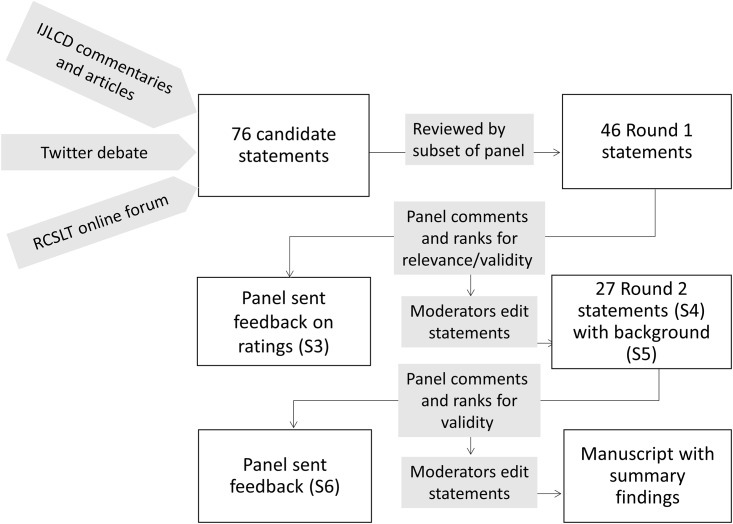
Delayed or impaired language development is a common developmental concern, yet there is little agreement about the criteria used to identify and classify language impairments in children. Children's language difficulties are at the interface between education, medicine and the allied professions, who may all adopt different approaches to conceptualising them. Our goal in this study was to use an online Delphi technique to see whether it was possible to achieve consensus among professionals on appropriate criteria for identifying children who might benefit from specialist services. We recruited a panel of 59 experts representing ten disciplines (including education, psychology, speech-language therapy/pathology, paediatrics and child psychiatry) from English-speaking countries (Australia, Canada, Ireland, New Zealand, United Kingdom and USA). The starting point for round 1 was a set of 46 statements based on articles and commentaries in a special issue of a journal focusing on this topic. Panel members rated each statement for both relevance and validity on a seven-point scale, and added free text comments. These responses were synthesised by the first two authors, who then removed, combined or modified items with a view to improving consensus. The resulting set of statements was returned to the panel for a second evaluation (round 2). Consensus (percentage reporting 'agree' or 'strongly agree') was at least 80 percent for 24 of 27 round 2 statements, though many respondents qualified their response with written comments. These were again synthesised by the first two authors. The resulting consensus statement is reported here, with additional summary of relevant evidence, and a concluding commentary on residual disagreements and gaps in the evidence base.
Overview
The claims and statistics of this paper haven’t been checked yet.
Free: it reads the open-access text and checks the first 5 claims that cite a source we can check. Create a free account to check every claim.
Integrity signals
Registry
Cites
Statistics
Figures
Verification
Claims the paper makes
The claims and statistics of this paper haven’t been checked yet.
Free: it reads the open-access text and checks the first 5 claims that cite a source we can check. Create a free account to check every claim.
Self-check
Percentages, sums and reported differences re-computed from the paper’s own numbers.
The self-check needs the paper’s full text.
Citations
Cites
R: A Language and Environment for Statistical Computing
R Core Team (2025) · doi:10.32614/r.manuals · Cited by 352,181
Diagnostic and Statistical Manual of Mental Disorders
Williams, J. B. W., & First, M. (2013) · Encyclopedia of Social Work · doi:10.1093/acrefore/9780199975839.013.104 · Cited by 109,519
Research guidelines for the Delphi survey technique
Hasson, F. (2000) · Journal of Advanced Nursing · doi:10.1046/j.1365-2648.2000.01567.x · Cited by 5,951 · cited 2×
“The issues we focused on are equally challenging in other countries, but manifestations of language difficulty, and terminology used to describe these, differ across languages [21].”
BackgroundMethodThe Delphi method as a research tool: an example, design considerations and applications
Okoli, C., & Pawlowski, S. D. (2004) · Information & Management · doi:10.1016/j.im.2003.11.002 · Cited by 4,771 · cited 1×
“The advantage of a larger panel is more representative coverage of experts, but a corresponding disadvantage is that the group discussion that is an inherent part of the process gets harder to achieve when more than 40 or 50 participants are involved [27].”
BackgroundThe Delphi Technique: Making Sense of Consensus
Hsu, C.-C., & Sandford, B. A. (2007) · University of Massachusetts Amherst · doi:10.7275/pdz9-th90 · Cited by 4,500
Principles and Practice of Screening for Disease.
(1968) · Annals of Internal Medicine · doi:10.7326/0003-4819-69-5-1085_2 · Cited by 3,066 · cited 1×
“However, as emphasised in the classic text by Wilson and Jungner [33], any screening program must beware of over-identification of problems, which can lead to resources being diverted to cases that do not need them.”
BackgroundPvclust: an R package for assessing the uncertainty in hierarchical clustering
Suzuki, R., & Shimodaira, H. (2006) · Bioinformatics · doi:10.1093/bioinformatics/btl117 · Cited by 2,451 · cited 1×
“The analysis was performed using the R statistical software [31] using the pvclust package [32], which performs hypothesis tests, via bootstrapping, to determine whether a cluster truly exists.”
MethodBoulkedid, R., Abdoul, H., Loustau, M., Sibony, O., & Alberti, C. (2011) · PLoS ONE · doi:10.1371/journal.pone.0020476 · Cited by 2,045 · cited 1×
“Selection of an expert panel is a key part of any Delphi exercise, and has been a topic of some debate in the literature [23].”
BackgroundCurrent validity of the Delphi method in social sciences
Landeta, J. (2006) · Technological Forecasting and Social Change · doi:10.1016/j.techfore.2005.09.002 · Cited by 1,353 · cited 1×
“Although we have noted the advantages of the Delphi technique over in-person consensus meetings, it is important also to recognise its limitations [120].”
BackgroundAn investigation of language impairment in autism: Implications for genetic subgroups
Kjelgaard, M. M., & Tager-Flusberg, H. (2001) · Language and Cognitive Processes · doi:10.1080/01690960042000058 · Cited by 1,130 · cited 1×
“On the other hand, a high proportion of verbal children with ASD have language difficulties similar to those seen in non-autistic children, especially with grammar or phonology [107], though there is debate as to whether the similarities are merely superficial [108].”
Background
Research works printed but not linked: 6
- Baird G (2014) Lumping, splitting, drawing lines, statistical cutoffs and impairment. Commentary on Bishop, D.V.M., 2014, Ten questions about terminology for children with unexplained language problems. Int J Lang Comm Disord 49: 381– 415. PMC4314704 25142090
- Hansson K, Sandgren O, Sahlén B (2014) Changing labels for a concept in change. Commentary on Bishop, D.V.M., 2014, Ten questions about terminology for children with unexplained language problems. Int J Lang Comm Disord 49: 381– 415. PMC4314704 25142090
- Rice M (2014) Advocating for SLI. Commentary on Bishop, D.V.M., 2014, Ten questions about terminology for children with unexplained language problems. Int J Lang Comm Disord 49: 381– 415. PMC4314704 25142090
- Snowling MJ (2014) SLI: Not just a semantic issue. Commentary on Reilly S., Tomblin B., Law J., McKean C., Mensah F. K., Morgan A., Goldfeld S., Nicholson J.M. and Wake M., 2014, Specific language impairment: a convenient label for whom? Int J Lang Comm Disord 49: 416– 451. PMC4303922 25142091 · DOI · Paper page
- Tomblin JB, Zhang X (1999) Are children with SLI a unique group of language learners? In: Tager-Flusberg H, editor. Neurodevelopmental Disorders: contributions to a New Framework from the Cognitive Neuroscience. Cambridge, MA: MIT Press pp. 361– 382.
- Stevenson J (1996) Developmental changes in the mechanisms linking language disabilities and behavior disorders In: Beitchman JH, Cohen NJ, Konstantareas MM, Tannock R, editors. Language, learning, and behavior disorders. Cambridge: Cambridge University Press pp. 78– 100.
Cited by
Items 901–1,000 of 1,001
Kehityksellisen kielihäiriön monet kasvot
Elina, M.-A. (2022) · UTUPub (University of Turku)
Hossain, T. (2025) · BRAC University Institutional Repository (BRAC University)
Bouhajeb, F. (2025) · doi:10.71781/197 · Cited by 1
Language Difficulties, and Developmental Language disorder (DLD) in a Bilingual Context
Pert, S. (2025) · Research Explorer (The University of Manchester)
Aide au diagnostic pour le trouble développemental du langage : la boite à outils du TDL (partie 1)
Maillart, C. (2023) · ORBi (University of Liège)
Tesa Serrate, A., & Latorre Cosculluela, C. (2025) · Zaguan (University of Zaragoza Repository)
Nog har det varit kämpigt, man får nog jobba : Språkstörning i skolan - ett föräldraperspektiv
Bredenberg, R. (2024) · Doria (University of Helsinki)
Tiala, R. (2023) · Doria (University of Helsinki) · Cited by 1
Cognitive predictors of individual differences in language acquisition
Blake, A. R. (2024) · University of Birmingham Institutional Research Archive (University of Birmingham)
Genomic Insights Into Developmental Language Disorders: Biomarkers and Their Interactions
Hassan, R. N. A., & Al-Fatlawi, A. H. (2025) · Frontiers in Bioscience-Scholar · doi:10.31083/fbs38706
Çocukluk Çağı Dil Bozukluklarında Anlatı Müdahalesine Yönelik Bir Derleme
Durmuş, B., & Balo, S. S. (2025) · Dil Konuşma ve Yutma Araştırmaları Dergisi · doi:10.58563/dkyad-2025.83.10
Modelo neuroeducativo de la competencia emocional en el Trastorno del Desarrollo del Lenguaje
Montoya, J. C. C. (2026) · EDUCA Revista Internacional para la calidad educativa · doi:10.55040/ebjsbr46
Montoya, J. C. C. (2026) · EDUCA Revista Internacional para la calidad educativa · doi:10.55040/k01w7q33
Melogno, S., & Pinto, M. A. (2025) · Springer eBooks · doi:10.1007/978-3-032-03024-5_3
Кортезова, Е. (2025) · Педагогически форум · doi:10.15547/pf.2025.028
Audiovisual speech integration in Catalan-Spanish children with developmental language disorder
Ferinu, L. (2025) · Tesis Doctorals en Xarxa (Consorci de Serveis Universitaris de Catalunya) · Cited by 1
Wedasingha, N., Rajasekaran, A., & Hakmana, N. T. (2026) · SSRN Electronic Journal · doi:10.2139/ssrn.6173274
Investigating Morphosyntactic Patterns and Phonological Memory in Children With ASD and DLD
Baranes, Y., & Segal, O. (2026) · Autism & Developmental Language Impairments · doi:10.1177/23969415261418495
“…differ in their primary characteristics: DLD involves persistent language dif fi culties without hearing, neurological, or motor de fi cits (Bishop, 2017; Bishop et al., 2016; Norbury et al., 2024), while ASD is de fi ned by challenges in social communication and restricted or repetitive behaviors…”
10. Alternativ og supplerende kommunikasjon i rollelek
Heimstad-Bergseng, C. (2026) · Fagbokforlaget eBooks · doi:10.55669/oa711010
6. Riskofylt lek i et spesialpedagogisk perspektiv
Larsen, K., & Wilhelmsen, T. (2026) · Fagbokforlaget eBooks · doi:10.55669/oa711006
8. Hvordan implementere endrings- og utviklingsarbeid i barnehagen
Nielsen, B. J. (2026) · Fagbokforlaget eBooks · doi:10.55669/oa711008
Fra teori til praksis i barnehagen
Gunnerud, H. L., Heimstad-Bergseng, C., Larsen, K., Stangeland, E. B., Baarli-Evenstuen, I., Finstad-Vik, E. R., Skansen, H., Korsgaard, T., & Johnsen, C. (2026) · Fagbokforlaget eBooks · doi:10.55669/oa7110
Wilhelmsen, T., & Larsen, K. (2026) · Fagbokforlaget eBooks · doi:10.55669/oa711007
Heimstad-Bergseng, C. (2026) · Fagbokforlaget eBooks · doi:10.55669/oa711011
Lancaster, H. S., Nayak, S., Buttner, A. P., & Davis, T. N. (2026) · BMJ Open · doi:10.1136/bmjopen-2025-103384
Neurodevelopmental Disorders in Educational Contexts
(2026) · IGI Global eBooks · doi:10.4018/979-8-3693-6331-7.ch001
Archibald, L. M. D. (2026) · Journal of Child Psychology and Psychiatry · doi:10.1111/jcpp.70135
Validity of the Verbal Intelligence Quotient as a Proxy for Language Ability
de Oliveira, L. R. (2019) · TSpace (University of Toronto)
Kielihäiriön esiintyvyys nuorilla rikoksentekijöillä : Integroiva kirjallisuuskatsaus
Vestelin, J. (2024) · Tampere University Institutional Repository (Tampere University)
Livermore, S., Botting, J., & Botting, N. (2026) · Clinical Child Psychology and Psychiatry · doi:10.1177/13591045261430411
“In light of this high prevalence, it is noteworthy that the term DLD is relatively new, the result of consideration by multi-national, multi-disciplinary professionals to gain a consensus about the criteria for diagnosis and agreed terminology (Bishop et al., 2016).”
Ronderos, J., & Castilla-Earls, A. P. (2026) · American Journal of Speech-Language Pathology · doi:10.1044/2025_ajslp-25-00223
Bhattacharjee, A., & Spaulding, T. J. (2026) · Intelligence · doi:10.1016/j.intell.2026.102017
Perez, N. L. M., & Santillan, J. M. H. (2025) · LA Referencia (Red Federada de Repositorios Institucionales de Publicaciones Científicas)
(2022) · Directory of Open access Books (OAPEN Foundation)
Cygan, H. B., & Bryłka, M. (2026) · Nowa Audiofonologia · doi:10.17431/na/209943
Tsitsipa, K., Talli, I., & Ανδρέου, Γ. (2026) · Reading and Writing · doi:10.1007/s11145-026-10809-1
History of the Language Acquisition
Yllescas, J. C. T. (2026) · Elsevier eBooks · doi:10.1016/b978-0-323-95504-1.01448-4
Graff, I. (2020) · theses.fr (ABES) · doi:10.70675/c816fde7za07dz45c2z816ez65fd9397e25a · Cited by 1
Brunooghe, D. (2020) · theses.fr (ABES) · doi:10.70675/661ae282za15bz478fza990z5a9e8911e75b
Harrar-Eskinazi, K. L. (2023) · theses.fr (ABES) · doi:10.70675/fcb4ed6cz7c22z4021z98aazbc8372ed86ab · Cited by 1
Bénain, A.-L. (2024) · theses.fr (ABES) · doi:10.70675/226936edz19efz4497z815azf22b5da88501
Investigating causal factors of early linguistic competency : a daycare intervention study
Crimon, C. (2024) · theses.fr (ABES) · doi:10.70675/169471b5z51d3z4f2dz9b66z0b1ecfa2d742 · Cited by 1
Florit‐Pons, J., Prieto, P., & Igualada, A. (2026) · Early Childhood Education Journal · doi:10.1007/s10643-026-02190-z
“Finally, we follow CATALISE’s (Bishop et al., 2016, 2017) approach to prioritize more the needs children have (i.e., functional diagnosis) rather than a diagnostic label.”
Taylor, A. L., Leitão, S., Smart, S. J., Wheldall, R., Claessen, M., Vanluydt, E., & Boyes, M. E. (2026) · International Journal of Language & Communication Disorders · doi:10.1111/1460-6984.70246
“…procedures to combine data sources are not typically used in clinical contexts, to support clinical reasoning and diagnostic decision-making, speech pathologists may find it useful to map data onto the framework for the identification of language disorders as outlined by Bishop et al. ( 2016 ).”
InfluentialHarker, B., & Stevenson, N. A. (2026) · Language Speech and Hearing Services in Schools · doi:10.1044/2025_lshss-25-00109
Hughes, L., Croot, L., Newton, C., & Best, W. (2026) · International Journal of Language & Communication Disorders · doi:10.1111/1460-6984.70234
Heilmann, J., Wojtyna, A., Merth-Johnson, D., Bizub, J., & Chase, J. (2026) · Language Speech and Hearing Services in Schools · doi:10.1044/2026_lshss-25-00117
Stasica, E., Pouw, C., Berard, L., Doedens, W., & Martin, V. (2026) · IEEE International Conference on Acoustics Speech and Signal Processing · doi:10.1109/icassp55912.2026.11462967
Guirado-Moreno, J. L., Penadés, R. L., Esteller, À., Blom, E., Aguilar-Mediavilla, E. M., & Adrover‐Roig, D. (2026) · PeerJ · doi:10.7717/peerj.21177
Limbocker, M. B. (2026) · SHAREOK (University of Oklahoma; Oklahoma State University; Central Oklahoma University)
İki Dilli Çocuklarda Dil ve Erken Okuryazarlık Becerilerinin Değerlendirilmesi: Vaka Çalışması
Saban-Dülger, N. S., Erbaş, A. N., & Kulak-Kayıkçı, M. E. (2026) · Dil Konuşma ve Yutma Araştırmaları Dergisi · doi:10.58563/dkyad-2026.96
Under-resourced or overloaded? Rethinking working memory deficits in developmental language disorderPreprint
Westermann, G., & Jones, S. D. (2022) · OSF Preprints (OSF Preprints)
Tığrak, T. K., & Özcebe, E. (2026) · Reading & Writing Quarterly · doi:10.1080/10573569.2026.2669638
Delage, H. (2025) · Language Problems & Language Planning · doi:10.1075/lplp.00138.del
Spencer, S., Kaur-Bola, K., Reeves, L., Best, W., Stringer, H., & Pennington, L. (2026) · International Journal of Language & Communication Disorders · doi:10.1111/1460-6984.70266
Svaldi, C., Vos, K., Reinders, A., Ćurĉić‐Blake, B., Tseng, J., Jonkers, R., & de Aguiar, V. (2026) · Cortex · doi:10.1016/j.cortex.2026.05.012
Pham, T., Csercsics, A. L., & Archibald, L. M. D. (2026) · Journal of Communication Disorders · doi:10.1016/j.jcomdis.2026.106661
Oonk, A. (2026) · ACM Conference on User Modeling, Adaptation and Personalization (UMAP) · doi:10.1145/3774935.3803061
“There is a significant amount of literature on specific language difficulties of this group [5, 9].”
InfluentialBagioka, D. V., Theodorou, E., & Terzi, A. (2026) · Clinical Linguistics & Phonetics · doi:10.1080/02699206.2026.2678207
Antolí, A., Vacas, J., Sánchez-Raya, A., Dueñas, C. P., Cañas, J. J., & Cuadrado, F. (2026) · Scientific Reports · doi:10.1038/s41598-026-56117-0
Bilinguisme et troubles développementaux du langage : enjeux diagnostiques et cliniques
Duguine, I., & Speranza, M. (2026) · Neuropsychiatrie de l Enfance et de l Adolescence · doi:10.1016/j.neurenf.2026.04.012
State of the art in speech perception assessment
Wathour, J., Grégoire, A., Décultot, A., & Borel, S. (2026) · Journal of Communication Disorders · doi:10.1016/j.jcomdis.2026.106663
Neely, C., & Wild, E. (2026) · Lund University Publications Student Papers (Lund University)
Reimagining Speech Therapy for Developmental Language Disorder through Music and Digital Practice
Sander, S. R., Astuti, F., Ardipal, & Indrayuda (2026) · Musikolastika Jurnal Pertunjukan dan Pendidikan Musik · doi:10.24036/musikolastika.v8i1.374
“…lisan, sehingga berdampak pada kesulitan dalam berkomunikasi dan berinteraksi dengan lingkungan sekitarnya serta dapat memicu pada penurunan kepercayaan diri, kecemasan sosial, hingga penarikan diri dari lingkungan sosial apabila tidak ditangani secara tepat dan berkelanjutan (Bishop et al., 2016).”
Entersten, M., & Nyman, C. (2026) · DiVA (Luleå University of Technology)
Montoya, J. C. C. (2026) · EDUCA Revista Internacional para la calidad educativa · doi:10.55040/pqqn5y93
Andreu, L., Bel, A., Guerra, E., Ahufinger, N., & Sanz‐Torrent, M. (2026) · Applied Psycholinguistics · doi:10.1017/s014271642610068x
“It is characterized by significant and lasting difficulties in acquiring and developing oral language that cannot be explained by other medical conditions such as hearing impairment, intellectual disability, autism, neurological disorders, or genetic syndromes (Bishop et al., 2016).”
Corujo, L. S. (2026) · Gredos (University of Salamanca)
Almohammadi, A. A. (2026) · Journal of Indian Speech Language & Hearing Association · doi:10.4103/jisha.jisha_37_25
Uloga jezika u uspjehu u matematici u djece s razvojnim jezičnim poremećajem
Čučak, D., Kelić, M., & Martan, V. (2026) · Govor/Speech · doi:10.22210/govor.2026.43.03
Estudio de consenso Delphi sobre el trastorno del lenguaje oral en los países hispanohablantes
Andreu, L., Benavides, A. A., Coloma, C. J., Chocano, A. D., Díaz, M. F. L., Maggio, V., Simon‐Cereijido, G., & AHITL, C. (2026) · Revista de Investigación en Logopedia · doi:10.5209/rlog.106526
“Comentario complementario: En la 1ª ronda se preguntó por la propuesta del consorcio CATALISE (Bishop et al., 2016) que acordó la eliminación de un punto de corte en los tests estandarizados de evalua-ción del lenguaje para el diagnóstico de TDL y en su lugar optó por visión más holística que…”
InfluentialLe trouble développemental du langage, un enjeu de santé publique
Perrone‐Bertolotti, M., Gillet-Perret, E., Faure, L., & Zoubrinetzky, R. (2026) · The Conversation · doi:10.64628/aak.fkya93efx
Bonillo-Llavero, B. M., Cano‐Villagrasa, A., & López‐Zamora, M. (2026) · Behavioral Sciences · doi:10.3390/bs16071199
“The CATALISE consensus recommendations have emphasized function-based identification and clarified that a low nonverbal IQ (NVIQ) is not a requirement for diagnosis, improving comparability across studies and clinical decision-making (Bishop et al., 2016).”
Johnstone‐Cooke, V., Rutherford, M., Sheripkanova, A., Hutcheson, R., & Hodson, A. (2026) · International Journal of Language & Communication Disorders · doi:10.1111/1460-6984.70304
“…exclusion criteria specify that the disorder cannot be explained by sensory, motor, neurological, intellectual, or biomedical conditions, nor by other neurodevelopmental conditions such as autism (American Psychiatric Association 2013 ; Bishop et al. 2016 ; World Health Organization 2022 ).”
InfluentialDebating the Delphi View of Dyslexia: A Response to Metsala, Morsanyi and Colleagues
Carroll, J. M., Holden, C., Kirby, P., Snowling, M. J., & Thompson, P. A. (2026) · Dyslexia · doi:10.1002/dys.70042
Self-citationCrespo, K., Khandelwal, M., & Rushi, G. (2026) · Journal of Speech Language and Hearing Research · doi:10.1044/2026_jslhr-25-00736
Fitriyah, F., & Retnaningsih, R. (2026) · Health and Technology Journal (HTechJ) · doi:10.53713/htechj.v4i4.607
“International terminology guidance emphasizes careful classification and functional impact (Bishop et al., 2016, 2017).”
Mateus-Moreno, A., Guirado-Moreno, J. L., Penadés, R. L., Aguilar-Mediavilla, E. M., & Adrover‐Roig, D. (2026) · Child Development · doi:10.1093/chidev/aacag141
Gibson, J. L., Botting, N., Barker, E., Jackson, E., Leitão, S., & Clair, M. S. (2026) · Autism & Developmental Language Impairments · doi:10.1177/23969415261461413
“Although this would exclude them from DLD diagnosis when strictly applying current diagnostic criteria (Bishop et al., 2016), we recognize that the pathways and diagnostic boundaries of communication dif fi culties are complex (Thomas et al., 2019), and thus we did not exclude these individuals from…”
Bodócs, D. L., Ragó, A., Farkas, N., Lakatos, A., Kas, B., Lukács, Á., Jermendy, Á., Hernádfői, M., Lökkös, E., Kiss, N., et al. (2026) · BMJ Open · doi:10.1136/bmjopen-2026-120474
Penadés, R. L., Esteller, À., Sanchez-Azanza, V. A., Aguilar-Mediavilla, E. M., & Adrover‐Roig, D. (2026) · Journal of Speech Language and Hearing Research · doi:10.1044/2026_jslhr-25-00859
Xue, J., Zhuo, J., Li, P., & Geva, E. (2026) · International Journal of Speech-Language Pathology · doi:10.1080/17549507.2026.2705422
Hizkuntzaren garapenaren nahasmendua: esku-hartze goiztiar baten proposamena haur hezkuntzan
Imbuluzqueta, M. B. I. (2026) · Academica-e (Universidad Pública de Navarra)
Estimated Prevalence of Developmental Language Disorder Risk in West Virginia Schools
Israelsen-Augenstein, M., Moore, M. W., Toman, T., & Rosborough, A. (2026) · Language Speech and Hearing Services in Schools · doi:10.1044/2026_lshss-25-00248
Dargiewicz, L., Wehrhöfer, S., Ohle-Peters, A., Ludewig, U., Lauermann, F., & McElvany, N. (2026) · Educational Research Review · doi:10.1016/j.edurev.2026.100834
A dialogic exploration of communication in young children with speech and language needs
Paily, J. (2026) · University of Canterbury Research Repository (University of Canterbury) · doi:10.26021/16631
Campbell, Z. C., Boyes, M. E., Vanluydt, E., Padgett, R. N., Hill, E., Leitão, S., & Griffiths, S. (2026) · Child Development · doi:10.1093/chidev/aacag172 · Cited by 1
Shahraki, B. F. (2026) · Brock University Digital Repository (Brock University)
Characteristics of Developmental Language Disorder in Adults: A Scoping Review
Morken, F., Jones, L. Ø., & Helland, W. A. (2026) · Journal of Speech Language and Hearing Research · doi:10.1044/2026_jslhr-25-00722
Price, C., Munro, N., Bernie, C., Hadley, P. A., & Baker, E. (2026) · American Journal of Speech-Language Pathology · doi:10.1044/2026_ajslp-25-00607
Savi-Karayol, S., Botting, N., & Morgan, G. (2026) · First Language · doi:10.1177/01427237261479804
Relating object memory to word learning: Data from a new test of toddlers' object recognition
Bakopoulou, M., Archer, J., & Samuelson, L. K. (2026) · British Journal of Developmental Psychology · doi:10.1111/bjdp.70070
Bastías-Ardiles, J., Silva-Pezoa, R., Lizama, J., & Moya-Daza, M. P. (2026) · Revista de Logopedia Foniatría y Audiología · doi:10.1016/j.rlfa.2026.100586
Metadata
- Authors
- Bishop, D. V. M., Snowling, M. J., Thompson, P. A., Greenhalgh, T., & CATALISE consortium
- Affiliations
- University of Oxford (GB)
- Corresponding author
- Bishop, D. V. M.
- Venue
- PLOS ONE
- Publisher
- Public Library of Science (PLoS)
- Published
- 2016-07-08
- Volume
- 11
- Issue
- 7
- Pages
- e0158753
- ISSN
- 1932-6203 (ISSN-L)
- PMC
- PMC4938414
- OpenAlex
- W2336526731
- Cited by
- 831
- References
- 129
- Citations by year
- 2026: 73 · 2025: 105 · 2024: 89 · 2023: 85 · 2022: 99 · 2021: 104 · 2020: 118 · 2019: 67 · 2018: 55 · 2017: 30 · 2016: 4
- FWCI
- 121.75
- Type
- journal article
- Language
- en
- Update notices
- correction (2016-12-09)
- Open access
- gold
- doi.org
- Licence
- Locations
- PLoS ONE (publishedVersion, cc-by)
- PubMed Central (publishedVersion, cc-by)
- PubMed (publishedVersion)
- OpenBU (Boston University) (publishedVersion, cc-by)
- University of Birmingham Research Portal (University of Birmingham) (publishedVersion, other-oa)
- White Rose Research Online (University of Leeds, The University of Sheffield, University of York) (acceptedVersion)
- Strathprints: The University of Strathclyde institutional repository (University of Strathclyde) (acceptedVersion)
- Arrow@dit (Dublin Institute of Technology) (acceptedVersion)
- Griffith Research Online (submittedVersion, cc-by)
- UTUPub (University of Turku) (submittedVersion)
- UWA Profiles and Research Repository (UWA) (submittedVersion, cc-by)
- Cork Open Research Archive (University College Cork, Ireland) (submittedVersion, cc-by)
- DOAJ (DOAJ: Directory of Open Access Journals) (submittedVersion, cc-by-sa)
- Stirling Online Research Repository (University of Stirling) (submittedVersion, cc-by)
- UCL Discovery (University College London) (submittedVersion)
- Figshare (submittedVersion, cc-by-nc-sa)
- Figshare (submittedVersion)
- Figshare (submittedVersion, cc-by)
- The HKU Scholars Hub (University of Hong Kong) (submittedVersion, cc-by-nc-nd)
- Scholarship@Western (Western University) (submittedVersion, cc-by)
- Minerva Access (University of Melbourne) (submittedVersion, cc-by)
- Open Research Exeter (University of Exeter) (submittedVersion)
- Research Explorer (The University of Manchester) (submittedVersion, cc-by)
- Edinburgh Research Explorer (University of Edinburgh) (submittedVersion, cc-by)
- ResearchSpace (University of Auckland) (submittedVersion, cc-by)
- University of Limerick Institutional Repository (University of Limerick) (submittedVersion, cc-by-nc-sa)
- Scholarship@Western (Western University) (submittedVersion)
- Warwick Research Archive Portal (University of Warwick) (submittedVersion)
- Funders
- Wellcome Trust (082498/Z/07/Z)
- Topics
- Social Sciences › Psychology › Developmental and Educational Psychology › Language Development and Disorders
- Social Sciences › Psychology › Neuropsychology and Physiological Psychology › Developmental and Educational Neuropsychology
- Health Sciences › Health Professions › Speech and Hearing › Voice and Speech Disorders
- Keywords
- language impairment, children, diagnostic criteria, multidisciplinary consensus, language delay, speech-language pathology, child psychiatry
- MeSH terms
- Australia, Canada, Delphi Technique, United Kingdom, Humans, Ireland, Language Disorders, New Zealand, Interdisciplinary Studies
About these checks
Registry, retraction, Cites and statistics results are computed, not judged, with one exception: a printed reference that no index lists is read once by a model before it counts as a citation error. Claims are extracted by a model and kept only when their quote appears verbatim in the text; each cited source is then checked, with a model’s help, for whether it says what the claim relies on. Those verdicts can be wrong — read the claim’s quote and the cited source before relying on one.
Statistics and arithmetic are recomputed, not judged.
Confidence bands are shown only for fields calibrated on our annotated test set. None is calibrated yet, so no band is shown.
What counts as a claim ›How we measure confidence ›How we check this ›
Are you an author, or do you see a problem with this page? Request a review
Data sources
Bibliographic data: Semantic Scholar, OpenAlex, Crossref.
Contains information from the Semantic Scholar Academic Graph Datasets, made available under the ODC Attribution License (ODC-BY 1.0).
Semantic Scholar’s data is described in: Kinney, R., et al. (2023). The Semantic Scholar Open Data Platform. arXiv:2301.10140.
