

CATALISE: A Multinational and Multidisciplinary Delphi Consensus Study. Identifying Language Impairments in Children
Open accessThe DOI matches its Crossref record; 127 of the 129 references it cites were found in a registry or an index.
Abstract
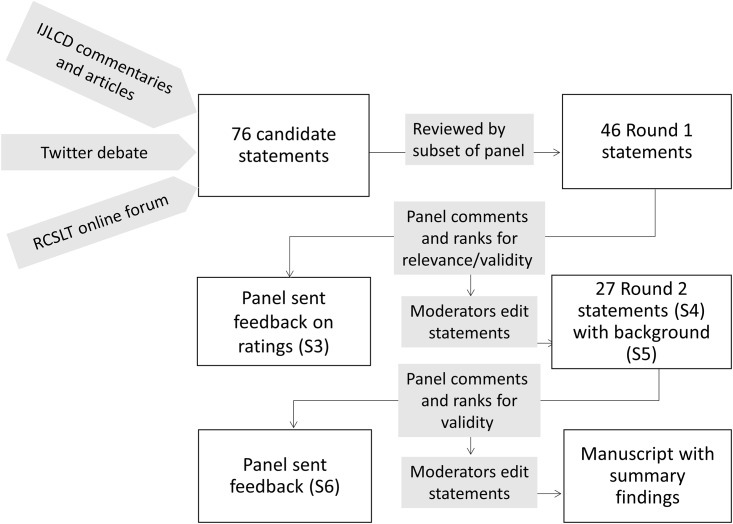
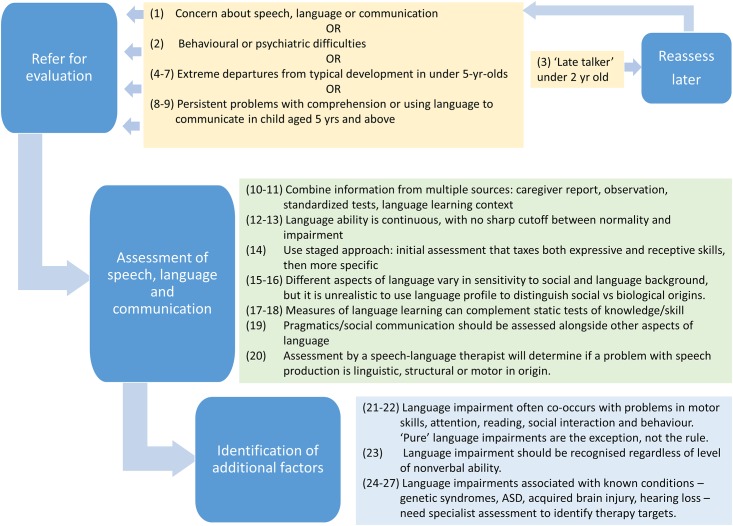
Delayed or impaired language development is a common developmental concern, yet there is little agreement about the criteria used to identify and classify language impairments in children. Children's language difficulties are at the interface between education, medicine and the allied professions, who may all adopt different approaches to conceptualising them. Our goal in this study was to use an online Delphi technique to see whether it was possible to achieve consensus among professionals on appropriate criteria for identifying children who might benefit from specialist services. We recruited a panel of 59 experts representing ten disciplines (including education, psychology, speech-language therapy/pathology, paediatrics and child psychiatry) from English-speaking countries (Australia, Canada, Ireland, New Zealand, United Kingdom and USA). The starting point for round 1 was a set of 46 statements based on articles and commentaries in a special issue of a journal focusing on this topic. Panel members rated each statement for both relevance and validity on a seven-point scale, and added free text comments. These responses were synthesised by the first two authors, who then removed, combined or modified items with a view to improving consensus. The resulting set of statements was returned to the panel for a second evaluation (round 2). Consensus (percentage reporting 'agree' or 'strongly agree') was at least 80 percent for 24 of 27 round 2 statements, though many respondents qualified their response with written comments. These were again synthesised by the first two authors. The resulting consensus statement is reported here, with additional summary of relevant evidence, and a concluding commentary on residual disagreements and gaps in the evidence base.
Overview
The claims and statistics of this paper haven’t been checked yet.
Free: it reads the open-access text and checks the first 5 claims that cite a source we can check. Create a free account to check every claim.
Integrity signals
Registry
Cites
Statistics
Figures
Verification
Claims the paper makes
The claims and statistics of this paper haven’t been checked yet.
Free: it reads the open-access text and checks the first 5 claims that cite a source we can check. Create a free account to check every claim.
Self-check
Percentages, sums and reported differences re-computed from the paper’s own numbers.
The self-check needs the paper’s full text.
Citations
Cites
R: A Language and Environment for Statistical Computing
R Core Team (2025) · doi:10.32614/r.manuals · Cited by 352,181
Diagnostic and Statistical Manual of Mental Disorders
Williams, J. B. W., & First, M. (2013) · Encyclopedia of Social Work · doi:10.1093/acrefore/9780199975839.013.104 · Cited by 109,519
Research guidelines for the Delphi survey technique
Hasson, F. (2000) · Journal of Advanced Nursing · doi:10.1046/j.1365-2648.2000.01567.x · Cited by 5,951 · cited 2×
“The issues we focused on are equally challenging in other countries, but manifestations of language difficulty, and terminology used to describe these, differ across languages [21].”
BackgroundMethodThe Delphi method as a research tool: an example, design considerations and applications
Okoli, C., & Pawlowski, S. D. (2004) · Information & Management · doi:10.1016/j.im.2003.11.002 · Cited by 4,771 · cited 1×
“The advantage of a larger panel is more representative coverage of experts, but a corresponding disadvantage is that the group discussion that is an inherent part of the process gets harder to achieve when more than 40 or 50 participants are involved [27].”
BackgroundThe Delphi Technique: Making Sense of Consensus
Hsu, C.-C., & Sandford, B. A. (2007) · University of Massachusetts Amherst · doi:10.7275/pdz9-th90 · Cited by 4,500
Principles and Practice of Screening for Disease.
(1968) · Annals of Internal Medicine · doi:10.7326/0003-4819-69-5-1085_2 · Cited by 3,066 · cited 1×
“However, as emphasised in the classic text by Wilson and Jungner [33], any screening program must beware of over-identification of problems, which can lead to resources being diverted to cases that do not need them.”
BackgroundPvclust: an R package for assessing the uncertainty in hierarchical clustering
Suzuki, R., & Shimodaira, H. (2006) · Bioinformatics · doi:10.1093/bioinformatics/btl117 · Cited by 2,451 · cited 1×
“The analysis was performed using the R statistical software [31] using the pvclust package [32], which performs hypothesis tests, via bootstrapping, to determine whether a cluster truly exists.”
MethodBoulkedid, R., Abdoul, H., Loustau, M., Sibony, O., & Alberti, C. (2011) · PLoS ONE · doi:10.1371/journal.pone.0020476 · Cited by 2,045 · cited 1×
“Selection of an expert panel is a key part of any Delphi exercise, and has been a topic of some debate in the literature [23].”
BackgroundCurrent validity of the Delphi method in social sciences
Landeta, J. (2006) · Technological Forecasting and Social Change · doi:10.1016/j.techfore.2005.09.002 · Cited by 1,353 · cited 1×
“Although we have noted the advantages of the Delphi technique over in-person consensus meetings, it is important also to recognise its limitations [120].”
BackgroundAn investigation of language impairment in autism: Implications for genetic subgroups
Kjelgaard, M. M., & Tager-Flusberg, H. (2001) · Language and Cognitive Processes · doi:10.1080/01690960042000058 · Cited by 1,130 · cited 1×
“On the other hand, a high proportion of verbal children with ASD have language difficulties similar to those seen in non-autistic children, especially with grammar or phonology [107], though there is debate as to whether the similarities are merely superficial [108].”
Background
Research works printed but not linked: 6
- Baird G (2014) Lumping, splitting, drawing lines, statistical cutoffs and impairment. Commentary on Bishop, D.V.M., 2014, Ten questions about terminology for children with unexplained language problems. Int J Lang Comm Disord 49: 381– 415. PMC4314704 25142090
- Hansson K, Sandgren O, Sahlén B (2014) Changing labels for a concept in change. Commentary on Bishop, D.V.M., 2014, Ten questions about terminology for children with unexplained language problems. Int J Lang Comm Disord 49: 381– 415. PMC4314704 25142090
- Rice M (2014) Advocating for SLI. Commentary on Bishop, D.V.M., 2014, Ten questions about terminology for children with unexplained language problems. Int J Lang Comm Disord 49: 381– 415. PMC4314704 25142090
- Snowling MJ (2014) SLI: Not just a semantic issue. Commentary on Reilly S., Tomblin B., Law J., McKean C., Mensah F. K., Morgan A., Goldfeld S., Nicholson J.M. and Wake M., 2014, Specific language impairment: a convenient label for whom? Int J Lang Comm Disord 49: 416– 451. PMC4303922 25142091 · DOI · Paper page
- Tomblin JB, Zhang X (1999) Are children with SLI a unique group of language learners? In: Tager-Flusberg H, editor. Neurodevelopmental Disorders: contributions to a New Framework from the Cognitive Neuroscience. Cambridge, MA: MIT Press pp. 361– 382.
- Stevenson J (1996) Developmental changes in the mechanisms linking language disabilities and behavior disorders In: Beitchman JH, Cohen NJ, Konstantareas MM, Tannock R, editors. Language, learning, and behavior disorders. Cambridge: Cambridge University Press pp. 78– 100.
Cited by
Items 501–600 of 1,001
Wong, A. M.-Y., Au, C. W.-S., Chan, A., & Momenian, M. (2024) · Brain and Language · doi:10.1016/j.bandl.2024.105404 · Cited by 3
“Developmental language disorder (DLD) is a language learning disability that persists over time (see Bishop et al., 2016 for a recent review).”
Predictors of language and reading outcomes in 12‐year‐old children born very preterm
Hedenius, M., Johansson, M., Kaul, Y. F., Andersson, E., Montgomery, C., Hellström-Westas, L. K., & Kochukhova, O. (2024) · Acta Paediatrica · doi:10.1111/apa.17408 · Cited by 3
Bouzid, A., Belcadhi, M., Souissi, A., Chelly, M., Frikha, F., Gargouri, H., Bonnet, C., Jebali, F., Loukil, S., Petit, C., et al. (2025) · Scientific Reports · doi:10.1038/s41598-024-83115-x · Cited by 3
“…the term DLD was considered to describe children with developmental language difficulties across many modalities of language and communication (including speech) that are not co-occurring with any intellectual disability, other neuro-developmental disorders, or hearing impairment 11,12 .”
Augmentative and alternative communication as language development
von Tetzchner, S. (2025) · Revista de Logopedia Foniatría y Audiología · doi:10.1016/j.rlfa.2025.100535 · Cited by 5
Perichon, J., Paul, M. J., Chabanal, D., & Maïonchi‐Pino, N. (2025) · International Journal of Language & Communication Disorders · doi:10.1111/1460-6984.70086 · Cited by 5
“It generally refers to difficulties that hinder individuals from carrying out daily activities or building social relationships (Bishop et al. 2016; McGregor et al. 2020; Waine et al. 2023).”
InfluentialForrest, C. L., Gibson, J. L., Button, K. S., Halligan, S. L., & Clair, M. S. (2025) · Journal of Autism and Developmental Disorders · doi:10.1007/s10803-025-06984-9 · Cited by 4
A longitudinal exploration of inhibitory control in children with Developmental Language Disorder
Guirado-Moreno, J. L., Sanchez-Azanza, V. A., Esteller, À., Aguilar-Mediavilla, E. M., & Adrover‐Roig, D. (2025) · Journal of Communication Disorders · doi:10.1016/j.jcomdis.2025.106561 · Cited by 3
Examination of Visual Perception Skills of Children With Developmental Language Disorder
Durmuş, B., & Özkan, E. T. (2025) · Communication Disorders Quarterly · doi:10.1177/15257401251368363 · Cited by 3
“Some studies state that the children with DLD may have difficulties not only in language skills but also in nonverbal skills (Bishop et al., 2016; Lara-Díaz et al., 2024; Vugs et al., 2014).”
Staples of Screening for Dyslexia in University Students
Saunders, K. V., Sun, S., Tibi, S., Dawson, K., & Lombardino, L. J. (2025) · Dyslexia · doi:10.1002/dys.70011 · Cited by 3
Developmental Language Disorder: A Consequence of Exemplar-Based Learning?
Riches, N. G. (2025) · First Language · doi:10.1177/01427237251371762 · Cited by 5
“…the finding that language profiles are largely unaffected by IQ constitutes an important motivation for lowering IQ cut-offs in the CATALISE consensus definition of DLD (Bishop et al., 2016, Criteria and Terminology Applied to Language Impairments: Synthesising the Evidence, statement 23, pg.15).”
Sleep Duration and Screen Time in Young Children with Mild Language Delays
Malik, S., Gonzalez, M., Rayneri, P., Ma, R., Natale, R., & Mansoor, E. (2025) · Children · doi:10.3390/children12111467 · Cited by 5
“There was no indication of a regression in language acquisition; therefore, the challenges observed were interpreted as delays rather than deterioration [48,49].”
Subcortical correlates of developmental language disorder: more than the neostriatum
Cler, G. J., Asaridou, S. S., Bahar, N., Krishnan, S., Smith, H. J., Willis, H. E., Healy, M. P., & Watkins, K. E. (2025) · Brain Communications · doi:10.1093/braincomms/fcaf493 · Cited by 4
“25,33-40 175 participants were recruited and underwent a 2-h comprehensive neuropsychological test battery and a 1-h MRI scan session.”
Neiling, S. L., Alt, M., & Kapa, L. L. (2026) · Language Speech and Hearing Services in Schools · doi:10.1044/2026_lshss-25-00141 · Cited by 3
Dynamic Assessment of Learners of a Signed Language
Mann, W., Hoskin, J., & Dumbrill, H. (2021) · Oxford University Press eBooks · doi:10.1093/oso/9780190885052.003.0009 · Cited by 4
Chilla, S. (2022) · Literacy studies · doi:10.1007/978-3-030-80072-7_16 · Cited by 4
Language-Specific Non-Words for the Assessment of Working Memory: Dealing With Bilingual Children
Zaretsky, E. V., & Lange, B. P. (2022) · Communication Disorders Quarterly · doi:10.1177/15257401221113064 · Cited by 3
Hughes, L., Corrin, J., Newton, C., & Best, W. (2022) · Journal of Interactional Research in Communication Disorders · doi:10.1558/jircd.20235 · Cited by 3
Kotsis, K. T., Boukouvala, M., Tzotzi, A., Koullourou, I., Mitropoulou, A., Serdari, A., Siafaka, V., & Hyphantis, T. N. (2024) · Healthcare · doi:10.3390/healthcare12040470 · Cited by 4
“Developmental language disorder (DLD, formerly known as specific language impairment, as well as other terms) refers to low language abilities in the absence of biomedical conditions that could explain the deficit [1,2], and it is a quite common developmental disorder diagnosed in preschool years.”
BackgroundCruz, A. D., Caballero, Á. A., Rodríguez, V. M. A., & González, M. (2024) · RELIEVE - Revista Electrónica de Investigación y Evaluación Educativa · doi:10.30827/relieve.v30i2.28737 · Cited by 3
Godin, M., & Leblanc, A. (2025) · Reading and Writing · doi:10.1007/s11145-025-10637-9 · Cited by 3
“They exhibit marked language difficulties that are not attributable, for instance, to known biomedical conditions or to environmental deprivation (Bishop et al., 2016, 2017).”
Photobiomodulation on vocal training and rehabilitation: Delphi consensus based on experts
Pontes, É. S., Vaiano, T., Bastos, R. S. D. A., Duarte, J. M. D. T., Santana, É. R., & Lopes, L. W. (2025) · CoDAS · doi:10.1590/2317-1782/e20230356en · Cited by 3
“These skills primarily depend on the experts’ knowledge (41,42) .”
Knowledge mapping of Specific Language Impairment in children: A bibliometric analysis (2010–2024)
Hu, Z., Luo, F., Yao, Q., Zhang, T., Hong, X., Zhang, L., Jiang, F., & Ding, Z. (2025) · Applied Neuropsychology Child · doi:10.1080/21622965.2025.2520462 · Cited by 3
Tomás, C. M., Baciero, A., & HINOJOSA, J. A. (2025) · Revista de Investigación en Logopedia · doi:10.5209/rlog.102111 · Cited by 6
Distributed Language for Learning in the Wild
Hellermann, J., & Thorne, S. L. (2020) · Cambridge University Press eBooks · doi:10.1017/9781108658089.018 · Cited by 4
Regneri, M., King, D., Walji, F., & Palikara, O. (2020) · Workshop on Cognitive Modeling and Computational Linguistics (CMCL) · doi:10.18653/v1/2020.cmcl-1.2 · Cited by 3
Cronin, P., & Goodall, S. (2021) · International Journal of Environmental Research and Public Health · doi:10.3390/ijerph18084112 · Cited by 6
“2 to 3 years Communications skills scales [30] Parent reported questionnaire, carries out instructions, asks for question repeated, follows conversation, passes on message, uses speech that can be understood, clearly explains things (Never/sometimes/always).”
BackgroundMethodInfluentialKnudsen, H. B. S., Jalali‐Moghadam, N., Nieva, S., Czaplewska, E., Laasonen, M. R., Gerrits, E., McKean, C., & Law, J. (2021) · Research in Developmental Disabilities · doi:10.1016/j.ridd.2021.103936 · Cited by 3
RetractedThe use of information and computer technologies in the conditions of inclusive education
Tyutryumova, E., & Pomytkina, T. Y. (2021) · E3S Web of Conferences · doi:10.1051/e3sconf/202127312089 · Cited by 3
Knowland, V. C. P., Baker, D. H., Gaskell, M. G., van Rijn, E., Walker, S. A., Norbury, C., & Henderson, L. M. (2022) · Journal of Cognition · doi:10.5334/joc.204 · Cited by 4
Hill, E., Wilmot, A., Roberts, O., Tonta, K. E., & Boyes, M. E. (2024) · Journal of Clinical Practice in Speech-Language Pathology · doi:10.1080/22000259.2024.2317469 · Cited by 3
Armstrong-Gallegos, S., & Nicolson, R. I. (2024) · International Journal of Disability Development and Education · doi:10.1080/1034912x.2024.2370801 · Cited by 3
“Also for DLD, previously known as Specific Language Impairment (Bishop et al., 2016), studies have demonstrated heterogeneity in sensory profiles, in particular for auditory sensory processing (McArthur & Bishop, 2005; Simpson et al., 2020; Taal et al., 2013; van der Linde et al., 2013).”
Helm, K., & Selin, C. M. (2024) · Perspectives of the ASHA Special Interest Groups · doi:10.1044/2024_persp-23-00299 · Cited by 4
Investigating Task Persistence in Preschool Children With Developmental Language Disorder
Formanek, M., & Spaulding, T. J. (2024) · Language Speech and Hearing Services in Schools · doi:10.1044/2024_lshss-23-00196 · Cited by 3
Mengisidou, M., & Balladares, J. (2023) · UCL Discovery (University College London) · doi:10.26262/hjp.v20i1.8985 · Cited by 3
Georgiou, G. P., & Theodorou, E. (2026) · Advances in Neurodevelopmental Disorders · doi:10.1007/s41252-025-00463-z · Cited by 3
Phonographic spelling errors in developmental language disorder: Insights from executive functions
Godin, M., Gagné, A., & Chapleau, N. (2018) · Neuroeducation · doi:10.24046/neuroed.20180502.46 · Cited by 5
“Developmental language disorder (DLD), formerly called specific language impairment (SLI), refers to a disorder affecting oral language despite the absence of a mental or physical handicap, hearing impairment, or environmental deprivation (Bishop et al., 2017; Bishop et al., 2016; Leonard, 2014).”
BackgroundHarvey, H., & Spencer, S. (2019) · Child Language Teaching and Therapy · doi:10.1177/0265659019849455 · Cited by 4
Approaches to Research in Applied Linguistics
Hartig, A. J. (2020) · Cambridge University Press eBooks · doi:10.1017/9781108658089.002 · Cited by 3
Krikheli, L., Carey, L. B., Erickson, S., Carey‐Sargeant, C. L., & Mathisen, B. (2021) · International Journal of Speech-Language Pathology · doi:10.1080/17549507.2020.1866073 · Cited by 3
“The use of Delphi studies has recently begun to gain traction for the purposes of gaining consensus on best practice within speech-language pathology (Bishop et al., 2016; Roberts & Greenwood, 2019; Wallace, Worrall, Rose, & Le Dorze, 2016).”
MethodDiferencias del vocabulario en niños con y sin retraso del lenguaje
Lanchares, A. A., Pardo, R. B. S., & Requies, I. R. (2022) · HUMAN REVIEW International Humanities Review / Revista Internacional de Humanidades · doi:10.37467/revhuman.v11.4188 · Cited by 3
“…multinacional y multidisciplinario en relación con los “Criterios y Terminología Aplicada a los Trastornos del Lenguaje: sintetizando la evidencia” denominado CATALISE (Bishop et al., 2016); este estudio recomendó que se use el término trastorno del lenguaje en niños con dificultades del lenguaje.”
BackgroundInfluentialHannus, S. (2018) · Helda - University of Helsinki Institutional Repository · Cited by 6
Tancredi, H. (2018) · Queensland University of Technology · doi:10.5204/thesis.eprints.122876 · Cited by 11
David, R., & Brown, K. (2020) · Cambridge University Press eBooks · doi:10.1017/9781108658089.027 · Cited by 3
Editorial. Investigación en el trastorno del desarrollo del lenguaje en población hispanohablante
Igualada, A. (2021) · Revista de Investigación en Logopedia · doi:10.5209/rlog.75183 · Cited by 8
Epistemology of Monolingual Bias: Contexts from a Tagalog StandpointPreprint
Manalili, M. A. R. (2021) · PsyArXiv (OSF Preprints) · doi:10.31234/osf.io/46emd · Cited by 3
Csercsics, A. L., Denusik, L., & Cunningham, B. J. (2024) · American Journal of Speech-Language Pathology · doi:10.1044/2024_ajslp-24-00272 · Cited by 2
Dolón-Poza, M., Gabaldón-Pérez, A.-M., Berrezueta-Guzmán, J., Gracia, D. L., Martín-Ruiz, M.-L., & Pau, I. (2025) · JMIR Human Factors · doi:10.2196/60424 · Cited by 2
“This collaboration facilitates the creation of adequate evaluation and intervention plans that meet the diverse needs of individuals with language difficulties, enhancing the quality of care and inclusivity [22,26,30,31,38,40].”
Optimizing a Vietnamese Sentence Repetition Task Using Item Response Theory
Pham, G. T., Tucci, A., Do, N., & Ebert, K. D. (2025) · American Journal of Speech-Language Pathology · doi:10.1044/2024_ajslp-24-00381 · Cited by 2
Dahlberg, A., Larsson, A., & Fäldt, A. E. (2025) · Acta Paediatrica · doi:10.1111/apa.70080 · Cited by 2
Gürsoy, M. D., & Özcebe, E. (2025) · International Journal of Speech-Language Pathology · doi:10.1080/17549507.2025.2481860 · Cited by 3
“A family history of language disorder has been identified as a risk factor for children having persistent language disorder (Bishop et al., 2016; Sansavini et al., 2021).”
Sandgren, O., Sahlén, B. S., Samuelsson, C., & Ekström, A. (2025) · Child Language Teaching and Therapy · doi:10.1177/02656590251339377 · Cited by 2
“The questions were based on current knowledge of “ red fl ags ” for language development (Bishop et al., 2016; Calder et al., 2023) and included forced-choice questions on current or previous concern for the child ’ s language development, heredity for language or literacy related disorders, age at…”
Zampini, L., Provera, A., Zanchi, P., Silibello, G., Mastromattei, D., Angeleri, F., Costantino, M. A., & Ajmone, P. F. (2025) · Journal of Speech Language and Hearing Research · doi:10.1044/2025_jslhr-24-00808 · Cited by 2
Larsson, A., Häll, A., Granér, E., & Carlsson, E. (2025) · Frontiers in Pediatrics · doi:10.3389/fped.2025.1570793 · Cited by 2
Liu, H.-M., Hsu, C.-Y., Tsai, C.-L., Spencer, L. J., Weiler, B. K., & Guo, L.-Y. (2025) · Language Speech and Hearing Services in Schools · doi:10.1044/2025_lshss-24-00150 · Cited by 2
Shelton, N., Munro, N., Starling, J., Tieu, L., & Keep, M. (2025) · Language Speech and Hearing Services in Schools · doi:10.1044/2025_lshss-24-00081 · Cited by 2
Hansen, P. B., Krysztofiak, M., Łuniewska, M., Burdach, M., Hernæs, K., Kilanowska, J., Krajewski, G., Krupa-Gaweł, K., Pacewicz, J., Sandbakken, M., et al. (2025) · International Journal of Bilingual Education and Bilingualism · doi:10.1080/13670050.2025.2576067 · Cited by 2
“If data on the other language(s) are missing, it is difficult to determine whether the lower scores are due to language impairment or little exposure to the tested language (Bishop et al. 2016).”
EEG neurosubtyping of infants predicts language trajectories
Blanco-Gomez, G., Wright, N., O’Reilly, C., Webb, S. J., Elsabbagh, M., & The BASIS Team (2025) · Journal of Neural Transmission · doi:10.1007/s00702-025-03063-2 · Cited by 2
Developmental Language Disorder: Current Understanding, Clinical Implications, and Future Directions
Shim, Y., Yang, D. H., Eun, B., & Byeon, J. H. (2026) · Annals of Child Neurology · doi:10.26815/acn.2025.01144 · Cited by 2
“…by the Criteria and Terminology Applied to Language Impairments: Synthesising the Evidence (CATALISE) consortium to establish a unified diagnostic framework for children with persistent, unexplained language difficulties, replacing earlier labels such as specific language impairment (SLI) [5].”
Stringer, H., Burr, S., Cleland, J., Harding, S. A., Wren, Y. E., & Panel, T. M. E. (2026) · International Journal of Language & Communication Disorders · doi:10.1111/1460-6984.70188 · Cited by 3
“This recruitment and retention compares favourably with similar studies in speech and language therapy (Bishop et al. 2016 ; Denman et al. 2021 ; Wallace et al. 2018, 2022 ) where both clinical and academic SLTs have been recruited.”
Being understood: Neurodivergent care leavers’ perspectives on their own communication skills
Spencer, S., Roberts, V., Schroeter, K., & Clegg, J. (2026) · Child Language Teaching and Therapy · doi:10.1177/02656590251411749 · Cited by 2
“Developmental language disorder (DLD) is a lifelong form of neurodiversity which affects phonology, vocabulary, syntax, semantics and/or pragmatics, not due to another cause such as hearing impairment or learning disability (Bishop et al., 2016).”
Pratt, A., Ramos, M. N., Peña, E. D., & Bedore, L. M. (2026) · Journal of Speech Language and Hearing Research · doi:10.1044/2025_jslhr-24-00606 · Cited by 3
Høgetveit, A. M., Canrinus, E. T., Donolato, E., & Melby‐Lervåg, M. (2026) · Journal of Child Psychology and Psychiatry · doi:10.1111/jcpp.70138 · Cited by 2
Castilla-Earls, A. P., Ronderos, J., Jasso, J., & Hernández, M. (2026) · Language Speech and Hearing Services in Schools · doi:10.1044/2025_lshss-24-00143 · Cited by 2
Long-term association between the COVID-19 pandemic and language development at 3 years of age
Matsuo, R., Matsumoto, N., Nakamura, K., Mitsuhashi, T., & Yorifuji, T. (2026) · Pediatric Research · doi:10.1038/s41390-026-05207-w · Cited by 2
Domby, L., & Washington, S. C. (2026) · Language Speech and Hearing Services in Schools · doi:10.1044/2026_lshss-25-00126 · Cited by 2
de López, K. M. J., Gabaj, M., Gupta, V., Knudsen, H. B. S., & Kraljević, J. K. (2026) · Language Speech and Hearing Services in Schools · doi:10.1044/2026_lshss-25-00142 · Cited by 2
Victorino, K. R., & Magaldi, N. (2019) · Communication Disorders Quarterly · doi:10.1177/1525740119857701 · Cited by 2
“Finally, DLD was used 5 times (2%), four of which were in 2017, after the publication of Bishop et al. (2017, 2016).”
BackgroundMethodRamalho, A. M., & Freitas, M. J. (2019) · Fórum Linguístico · doi:10.5007/1984-8412.2019v16n2p3790 · Cited by 2
The Effects of Genetic Disorders on Language
Rossi, N. F., & Giacheti, C. M. (2019) · Autism and child psychopathology series · doi:10.1007/978-3-030-20843-1_18 · Cited by 2
Language and Literacy in the Context of Early Life Adversity
Snow, P. C., Leitão, S., & Kippin, N. R. (2021) · Wiley eBooks · doi:10.1002/9781119606987.ch13 · Cited by 4
Holzinger, D., Weber, C., & Jezek, M. (2022) · Frontiers in Pediatrics · doi:10.3389/fped.2022.814415 · Cited by 2
İletişim Bozuklukları Bağlamında Erken Okuryazarlık Becerileri Üzerine Genel Bir Bakış
ERİM, A., & Kılıç, M. (2022) · Samsun Sağlık Bilimleri Dergisi · doi:10.47115/jshs.1074836 · Cited by 2
Magaldi, N., & Victorino, K. R. (2022) · Teaching and Learning in Communication Sciences & Disorders · doi:10.30707/tlcsd6.3.1664996985.123944 · Cited by 2
Macedo, L. M. M. A., Azevedo, A. I. D. L., Messias, B. L. C., de Vasconcelos, M. E. J., & Azoni, C. A. S. (2022) · Revista CEFAC · doi:10.1590/1982-0216/202224312021s · Cited by 7
Conciencias lingüísticas para el desarrollo del lenguaje de los niños.
Tiván, C. G. H., Romero, A. G. M., & Cárdenas, T. L. V. (2023) · Dilemas contemporáneos Educación Política y Valores · doi:10.46377/dilemas.v11i1.3708 · Cited by 4
Redmond, S. M., Ash, A. C., & Zhang, Y. (2023) · Clinical Linguistics & Phonetics · doi:10.1080/02699206.2023.2273750 · Cited by 2
“Developmental language disorder (DLD) (Bishop et al., 2016), an expansion of the earlier clinical designation of Specific Language Impairment (SLI) (Leonard, 2014), represents another relatively common neurodevelopmental condition that may commonly co-occur with ADHD.”
Indices of Narrative Language Associated with Disability
Almubark, N. M., Silva-Maceda, G., Foster, M. E., & Spencer, T. D. (2023) · Children · doi:10.3390/children10111815 · Cited by 2
Ralli, A. M., Alexandri, M., & Sofologi, M. (2023) · Advances in psychology, mental health, and behavioral studies (APMHBS) book series · doi:10.4018/979-8-3693-1982-6.ch006 · Cited by 2
Functional Vocabulary Measurement
Pratomo, H. T. A., Siswanto, A., & Purnaningrum, W. D. (2023) · Interest Jurnal Ilmu Kesehatan · doi:10.37341/interest.v12i1.565 · Cited by 2
Lloyd‐Esenkaya, V., Russell, A., & Clair, M. S. (2024) · British Journal of Developmental Psychology · doi:10.1111/bjdp.12475 · Cited by 3
“Grammar, I hate” or “I grammar hate”?
Han, W. (2024) · Studies in bilingualism · doi:10.1075/sibil.66.07han · Cited by 2
THE USE OF CLASSIFIERS IN VIETNAMESE IN TYPICAL AND ATYPICAL LANGUAGE DEVELOPMENT.
Pham, G. T., & Simpson, A. (2024) · PubMed · doi:10.6519/tjl.202401_22(1).0004 · Cited by 2
Balboa-Castells, R., Ahufinger, N., Ferinu, L., Castilla-Earls, A. P., Andreu, L., & Sanz‐Torrent, M. (2024) · Clinical Linguistics & Phonetics · doi:10.1080/02699206.2024.2350492 · Cited by 2
“However, currently, it is known that DLD is associated with behavioural and emotional difficulties and this is not a criteria for exclusion (Bishop et al., 2016).”
EXPLORING THE CONSISTENCY BETWEEN TEACHERS' AND PARENTS' RATINGS OF CHILDREN'S LANGUAGE SKILLS
Trinīte, B., Tomele, G., & Raščevska, M. (2024) · SOCIETY INTEGRATION EDUCATION Proceedings of the International Scientific Conference · doi:10.17770/sie2024vol2.7856 · Cited by 2
“It is recommended that assessments draw from various information sources, such as interviews or questionnaires with parents or teachers, direct observations, and standardized tests or criterion-based assessments (Bishop et al., 2016; Paul, 2007; Sattler, 1992).”
BackgroundEarly detection of mental disorders in child psychiatry: the accuracy of parental concerns
Valade, F., Béliveau, M., Breault, C., & Labelle, F. (2024) · Early Child Development and Care · doi:10.1080/03004430.2024.2356241 · Cited by 2
“Following the CATALISE (Bishop, Snowling, Thompson, Greenhalgh, & Schiller, 2016) and DSM-5-TR (American Psychiatric Association, 2022) criteria, children who received a diagnosis of language disorder but who were also diagnosed with ID, ASD, hearing impairment, or biomedical problems such as epilepsy or cerebral pals…”
Aguilar-Mediavilla, E. M., Pedroche, A. S., Buil‐Legaz, L., Pérez-Castelló, J. A., & Adrover‐Roig, D. (2024) · Bilingual processing and acquisition · doi:10.1075/bpa.18.12san · Cited by 4
Thordardottir, E. T., & Plez, L. (2024) · Journal of Speech Language and Hearing Research · doi:10.1044/2024_jslhr-23-00568 · Cited by 2
Manley, N. R., & Wilder, A. (2024) · Perspectives of the ASHA Special Interest Groups · doi:10.1044/2024_persp-24-00076 · Cited by 4
Is language impaired in Spanish-speaking children with autism spectrum disorder level 1?
Pedroche, A. S., Valera-Pozo, M., Mateus-Moreno, A., Díaz, M. F. L., Aguilar-Mediavilla, E. M., & Adrover‐Roig, D. (2024) · Autism & Developmental Language Impairments · doi:10.1177/23969415241275931 · Cited by 3
“Our study also supports the results of the CATALISE project (Bishop et al., 2016, 2017), which concludes that some — but not all — children and adolescents with ASD can experience a language disorder.”
ResultDynamics of Motor Skill Learning in American and Israeli Toddlers With Varied Language Proficiency
DeVeney, S. L., Dotan, S., Weberman, I., Julius, M. S., & Adi‐Japha, E. (2024) · American Journal of Speech-Language Pathology · doi:10.1044/2024_ajslp-24-00142 · Cited by 2
Stankova, M., Tuparov, G., & Mihova, P. (2024) · Smart innovation, systems and technologies · doi:10.1007/978-981-97-4954-6_14 · Cited by 2
A Bibliometric and Visualized Study of the Knowledge Domain of Language Disorder Research
Hu, M., Fan, L., & Wang, Z. (2024) · SAGE Open · doi:10.1177/21582440241289816 · Cited by 2
“The first category concerns criteria and terminology for language problems with children (Bishop, 2017; Bishop et al., 2016, 2017).”
InfluentialGordon, K. R., Lewis, D. E., Lowry, S., Smith, M., Stecker, G. C., & McCreery, R. W. (2024) · Language Speech and Hearing Services in Schools · doi:10.1044/2024_lshss-24-00018 · Cited by 2
“Given that four children did not achieve the cut point on the TNL-2 to qualify within the DLD group at the time of the study, we elected to use the broader category of LD to describe the sample as a whole (Bishop et al., 2016, 2017).”
Lu, H., Liang, S.-Y., & Huang, Y.-C. (2025) · JMIR Pediatrics and Parenting · doi:10.2196/60333 · Cited by 2
Arizmendi, G. D. (2025) · Language Speech and Hearing Services in Schools · doi:10.1044/2025_lshss-24-00166 · Cited by 3
Horsham, J., Maras, K., Fraser, D. S., Barker, E., Hobson, H., & Clair, M. S. (2025) · International Journal of Language & Communication Disorders · doi:10.1111/1460-6984.70060 · Cited by 2
“Language is a vital aspect of communication involving the understanding and use of words to convey information (Bishop et al. 2016).”
Wilson, E., Cain, K., Davies, C., Gibson, J. L., Joseph, H., Serratrice, L., & Vogelzang, M. (2024) · Lancaster EPrints (Lancaster University) · doi:10.25405/ncl.34491873 · Cited by 2
Language, the Law, and Forensic Linguistics
Walters, K. (2020) · Cambridge University Press eBooks · doi:10.1017/9781108658089.029 · Cited by 2
Moore, E., & Nash, A. (2020) · Cambridge University Press eBooks · doi:10.1017/9781108658089.004 · Cited by 2
Data resource profile: The Child LAnguage REpository (CLARE)
Reilly, S., Cini, E., Gold, L. H., Goldfeld, S. R., Law, J., Levickis, P. A., Mensah, F. K., Morgan, A. T., Nicholson, J. M., Le, H., et al. (2018) · International Journal of Epidemiology · doi:10.1093/ije/dyy034 · Cited by 2
Metadata
- Authors
- Bishop, D. V. M., Snowling, M. J., Thompson, P. A., Greenhalgh, T., & CATALISE consortium
- Affiliations
- University of Oxford (GB)
- Corresponding author
- Bishop, D. V. M.
- Venue
- PLOS ONE
- Publisher
- Public Library of Science (PLoS)
- Published
- 2016-07-08
- Volume
- 11
- Issue
- 7
- Pages
- e0158753
- ISSN
- 1932-6203 (ISSN-L)
- PMC
- PMC4938414
- OpenAlex
- W2336526731
- Cited by
- 831
- References
- 129
- Citations by year
- 2026: 73 · 2025: 105 · 2024: 89 · 2023: 85 · 2022: 99 · 2021: 104 · 2020: 118 · 2019: 67 · 2018: 55 · 2017: 30 · 2016: 4
- FWCI
- 121.75
- Type
- journal article
- Language
- en
- Update notices
- correction (2016-12-09)
- Open access
- gold
- doi.org
- Licence
- Locations
- PLoS ONE (publishedVersion, cc-by)
- PubMed Central (publishedVersion, cc-by)
- PubMed (publishedVersion)
- OpenBU (Boston University) (publishedVersion, cc-by)
- University of Birmingham Research Portal (University of Birmingham) (publishedVersion, other-oa)
- White Rose Research Online (University of Leeds, The University of Sheffield, University of York) (acceptedVersion)
- Strathprints: The University of Strathclyde institutional repository (University of Strathclyde) (acceptedVersion)
- Arrow@dit (Dublin Institute of Technology) (acceptedVersion)
- Griffith Research Online (submittedVersion, cc-by)
- UTUPub (University of Turku) (submittedVersion)
- UWA Profiles and Research Repository (UWA) (submittedVersion, cc-by)
- Cork Open Research Archive (University College Cork, Ireland) (submittedVersion, cc-by)
- DOAJ (DOAJ: Directory of Open Access Journals) (submittedVersion, cc-by-sa)
- Stirling Online Research Repository (University of Stirling) (submittedVersion, cc-by)
- UCL Discovery (University College London) (submittedVersion)
- Figshare (submittedVersion, cc-by-nc-sa)
- Figshare (submittedVersion)
- Figshare (submittedVersion, cc-by)
- The HKU Scholars Hub (University of Hong Kong) (submittedVersion, cc-by-nc-nd)
- Scholarship@Western (Western University) (submittedVersion, cc-by)
- Minerva Access (University of Melbourne) (submittedVersion, cc-by)
- Open Research Exeter (University of Exeter) (submittedVersion)
- Research Explorer (The University of Manchester) (submittedVersion, cc-by)
- Edinburgh Research Explorer (University of Edinburgh) (submittedVersion, cc-by)
- ResearchSpace (University of Auckland) (submittedVersion, cc-by)
- University of Limerick Institutional Repository (University of Limerick) (submittedVersion, cc-by-nc-sa)
- Scholarship@Western (Western University) (submittedVersion)
- Warwick Research Archive Portal (University of Warwick) (submittedVersion)
- Funders
- Wellcome Trust (082498/Z/07/Z)
- Topics
- Social Sciences › Psychology › Developmental and Educational Psychology › Language Development and Disorders
- Social Sciences › Psychology › Neuropsychology and Physiological Psychology › Developmental and Educational Neuropsychology
- Health Sciences › Health Professions › Speech and Hearing › Voice and Speech Disorders
- Keywords
- language impairment, children, diagnostic criteria, multidisciplinary consensus, language delay, speech-language pathology, child psychiatry
- MeSH terms
- Australia, Canada, Delphi Technique, United Kingdom, Humans, Ireland, Language Disorders, New Zealand, Interdisciplinary Studies
About these checks
Registry, retraction, Cites and statistics results are computed, not judged, with one exception: a printed reference that no index lists is read once by a model before it counts as a citation error. Claims are extracted by a model and kept only when their quote appears verbatim in the text; each cited source is then checked, with a model’s help, for whether it says what the claim relies on. Those verdicts can be wrong — read the claim’s quote and the cited source before relying on one.
Statistics and arithmetic are recomputed, not judged.
Confidence bands are shown only for fields calibrated on our annotated test set. None is calibrated yet, so no band is shown.
What counts as a claim ›How we measure confidence ›How we check this ›
Are you an author, or do you see a problem with this page? Request a review
Data sources
Bibliographic data: Semantic Scholar, OpenAlex, Crossref.
Contains information from the Semantic Scholar Academic Graph Datasets, made available under the ODC Attribution License (ODC-BY 1.0).
Semantic Scholar’s data is described in: Kinney, R., et al. (2023). The Semantic Scholar Open Data Platform. arXiv:2301.10140.
