

CATALISE: A Multinational and Multidisciplinary Delphi Consensus Study. Identifying Language Impairments in Children
Open accessThe DOI matches its Crossref record; 127 of the 129 references it cites were found in a registry or an index.
Abstract
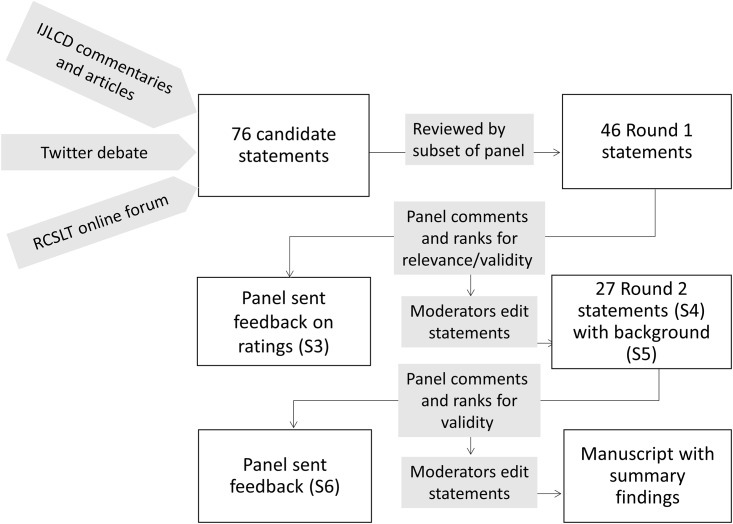
Delayed or impaired language development is a common developmental concern, yet there is little agreement about the criteria used to identify and classify language impairments in children. Children's language difficulties are at the interface between education, medicine and the allied professions, who may all adopt different approaches to conceptualising them. Our goal in this study was to use an online Delphi technique to see whether it was possible to achieve consensus among professionals on appropriate criteria for identifying children who might benefit from specialist services. We recruited a panel of 59 experts representing ten disciplines (including education, psychology, speech-language therapy/pathology, paediatrics and child psychiatry) from English-speaking countries (Australia, Canada, Ireland, New Zealand, United Kingdom and USA). The starting point for round 1 was a set of 46 statements based on articles and commentaries in a special issue of a journal focusing on this topic. Panel members rated each statement for both relevance and validity on a seven-point scale, and added free text comments. These responses were synthesised by the first two authors, who then removed, combined or modified items with a view to improving consensus. The resulting set of statements was returned to the panel for a second evaluation (round 2). Consensus (percentage reporting 'agree' or 'strongly agree') was at least 80 percent for 24 of 27 round 2 statements, though many respondents qualified their response with written comments. These were again synthesised by the first two authors. The resulting consensus statement is reported here, with additional summary of relevant evidence, and a concluding commentary on residual disagreements and gaps in the evidence base.
Overview
The claims and statistics of this paper haven’t been checked yet.
Free: it reads the open-access text and checks the first 5 claims that cite a source we can check. Create a free account to check every claim.
Integrity signals
Registry
Cites
Statistics
Figures
Verification
Claims the paper makes
The claims and statistics of this paper haven’t been checked yet.
Free: it reads the open-access text and checks the first 5 claims that cite a source we can check. Create a free account to check every claim.
Self-check
Percentages, sums and reported differences re-computed from the paper’s own numbers.
The self-check needs the paper’s full text.
Citations
Cites
R: A Language and Environment for Statistical Computing
R Core Team (2025) · doi:10.32614/r.manuals · Cited by 352,181
Diagnostic and Statistical Manual of Mental Disorders
Williams, J. B. W., & First, M. (2013) · Encyclopedia of Social Work · doi:10.1093/acrefore/9780199975839.013.104 · Cited by 109,519
Research guidelines for the Delphi survey technique
Hasson, F. (2000) · Journal of Advanced Nursing · doi:10.1046/j.1365-2648.2000.01567.x · Cited by 5,951 · cited 2×
“The issues we focused on are equally challenging in other countries, but manifestations of language difficulty, and terminology used to describe these, differ across languages [21].”
BackgroundMethodThe Delphi method as a research tool: an example, design considerations and applications
Okoli, C., & Pawlowski, S. D. (2004) · Information & Management · doi:10.1016/j.im.2003.11.002 · Cited by 4,771 · cited 1×
“The advantage of a larger panel is more representative coverage of experts, but a corresponding disadvantage is that the group discussion that is an inherent part of the process gets harder to achieve when more than 40 or 50 participants are involved [27].”
BackgroundThe Delphi Technique: Making Sense of Consensus
Hsu, C.-C., & Sandford, B. A. (2007) · University of Massachusetts Amherst · doi:10.7275/pdz9-th90 · Cited by 4,500
Principles and Practice of Screening for Disease.
(1968) · Annals of Internal Medicine · doi:10.7326/0003-4819-69-5-1085_2 · Cited by 3,066 · cited 1×
“However, as emphasised in the classic text by Wilson and Jungner [33], any screening program must beware of over-identification of problems, which can lead to resources being diverted to cases that do not need them.”
BackgroundPvclust: an R package for assessing the uncertainty in hierarchical clustering
Suzuki, R., & Shimodaira, H. (2006) · Bioinformatics · doi:10.1093/bioinformatics/btl117 · Cited by 2,451 · cited 1×
“The analysis was performed using the R statistical software [31] using the pvclust package [32], which performs hypothesis tests, via bootstrapping, to determine whether a cluster truly exists.”
MethodBoulkedid, R., Abdoul, H., Loustau, M., Sibony, O., & Alberti, C. (2011) · PLoS ONE · doi:10.1371/journal.pone.0020476 · Cited by 2,045 · cited 1×
“Selection of an expert panel is a key part of any Delphi exercise, and has been a topic of some debate in the literature [23].”
BackgroundCurrent validity of the Delphi method in social sciences
Landeta, J. (2006) · Technological Forecasting and Social Change · doi:10.1016/j.techfore.2005.09.002 · Cited by 1,353 · cited 1×
“Although we have noted the advantages of the Delphi technique over in-person consensus meetings, it is important also to recognise its limitations [120].”
BackgroundAn investigation of language impairment in autism: Implications for genetic subgroups
Kjelgaard, M. M., & Tager-Flusberg, H. (2001) · Language and Cognitive Processes · doi:10.1080/01690960042000058 · Cited by 1,130 · cited 1×
“On the other hand, a high proportion of verbal children with ASD have language difficulties similar to those seen in non-autistic children, especially with grammar or phonology [107], though there is debate as to whether the similarities are merely superficial [108].”
Background
Research works printed but not linked: 6
- Baird G (2014) Lumping, splitting, drawing lines, statistical cutoffs and impairment. Commentary on Bishop, D.V.M., 2014, Ten questions about terminology for children with unexplained language problems. Int J Lang Comm Disord 49: 381– 415. PMC4314704 25142090
- Hansson K, Sandgren O, Sahlén B (2014) Changing labels for a concept in change. Commentary on Bishop, D.V.M., 2014, Ten questions about terminology for children with unexplained language problems. Int J Lang Comm Disord 49: 381– 415. PMC4314704 25142090
- Rice M (2014) Advocating for SLI. Commentary on Bishop, D.V.M., 2014, Ten questions about terminology for children with unexplained language problems. Int J Lang Comm Disord 49: 381– 415. PMC4314704 25142090
- Snowling MJ (2014) SLI: Not just a semantic issue. Commentary on Reilly S., Tomblin B., Law J., McKean C., Mensah F. K., Morgan A., Goldfeld S., Nicholson J.M. and Wake M., 2014, Specific language impairment: a convenient label for whom? Int J Lang Comm Disord 49: 416– 451. PMC4303922 25142091 · DOI · Paper page
- Tomblin JB, Zhang X (1999) Are children with SLI a unique group of language learners? In: Tager-Flusberg H, editor. Neurodevelopmental Disorders: contributions to a New Framework from the Cognitive Neuroscience. Cambridge, MA: MIT Press pp. 361– 382.
- Stevenson J (1996) Developmental changes in the mechanisms linking language disabilities and behavior disorders In: Beitchman JH, Cohen NJ, Konstantareas MM, Tannock R, editors. Language, learning, and behavior disorders. Cambridge: Cambridge University Press pp. 78– 100.
Cited by
Items 401–500 of 1,001
Developmental Language Disorder: The Childhood Condition We Need to Start Talking About
Kuiack, A. K., & Archibald, L. M. D. (2019) · Frontiers for Young Minds · doi:10.3389/frym.2019.00094 · Cited by 7
“In 2015 and 2016, a group of experts from around the world came together to solve this problem [4, 5].”
BackgroundVacas, J., Antolí, A., Sánchez-Raya, A., Dueñas, C. P., & Cuadrado, F. (2021) · Revista de Investigación en Logopedia · doi:10.5209/rlog.70221 · Cited by 9
“…el TEL se ha reconceptualizado como un trastorno más amplio, que no incluye limitaciones diagnósticas como CI no verbal y que pierde el carácter de específico, ya que se asume que la afectación del lenguaje puede aparecer sola o ir asociada a otra condición biomédica (Bishop et al., 2016, 2017).”
BackgroundGallagher, A., Island, K., & Shea, J. O. (2023) · International Journal of Language & Communication Disorders · doi:10.1111/1460-6984.12912 · Cited by 9
Serra, M. (2021) · Revista de Logopedia Foniatría y Audiología · doi:10.1016/j.rlfa.2020.07.001 · Cited by 9
Identifying and Supporting Children’s Early Language Needs
Law, J. (2021) · Aberdeen University Research Archive (Aberdeen University) · doi:10.25405/data.ncl.14386805 · Cited by 7
Defining Developmental Language Disorder and Dyslexia in Schools: A Mixed-Methods Analysis
DeLuca, T., Radville, K. M., Pfeiffer, D. L., & Hogan, T. P. (2025) · Journal of Speech Language and Hearing Research · doi:10.1044/2024_jslhr-24-00202 · Cited by 6
Kautto, A., Railo, H., & Mainela‐Arnold, E. (2024) · Neurobiology of Language · doi:10.1162/nol_a_00129 · Cited by 7
“LT has a relatively good prognosis, and most of these children catch up the delay to their peers by school age (Bishop et al., 2016; Rescorla, 2011).”
BackgroundVerb Vocabulary Supports Event Probability Use in Developmental Language Disorder
Kueser, J. B., Borovsky, A., Deevy, P., Muezzinoglu, M., Outzen, C., & Leonard, L. B. (2024) · Journal of Speech Language and Hearing Research · doi:10.1044/2024_jslhr-23-00600 · Cited by 8
“…difficulty with language use and understanding that cannot be attributed to hearing loss, gross neurological impairment, or low nonverbal intelligence (Bishop et al., 2016) and are frequently encountered in the general population (comprising 7% of school-age children; Tomblin et al., 1997).”
BackgroundFu, N. C., Chan, A., Chen, S., Polišenská, K., & Chiat, S. (2024) · Brain and Language · doi:10.1016/j.bandl.2024.105450 · Cited by 6
“…a neurodevelopmental disorder where children have significant difficulties in understanding and using language that are not associated with other biomedical conditions such as hearing impairment, intellectual disability, autism spectrum disorder (ASD), and brain injury (Bishop et al., 2016, 2017).”
Durgungöz, F. C., & Clair, M. S. (2024) · European Journal of Special Needs Education · doi:10.1080/08856257.2024.2407659 · Cited by 10
“Recent studies prove that DLD is not only characterised by difficulty of understanding and using language (Bishop et al. 2016), but also difficulties with emotional recognition (ER; Van den Bedem et al. 2018) and regulation skills (St Clair et al. 2019).”
Gürsoy, M. D., Erbaş, A. N., Esen, H. T. Ç., Köse, A., & Özcebe, E. (2025) · Journal of Speech Language and Hearing Research · doi:10.1044/2025_jslhr-24-00672 · Cited by 6
Andreu, L., Balboa-Castells, R., Ahufinger, N., Ferinu, L., & Sanz‐Torrent, M. (2025) · Revista de Investigación en Logopedia · doi:10.5209/rlog.101268 · Cited by 7
A nyelvi fejlődés nehézségei és a diszlexia
Gyarmathy, É. (2018) · Gyermeknevelés Tudományos Folyóirat · doi:10.31074/201837792 · Cited by 9
Early intervention in the lexical organization of pupils with developmental language disorders
Rodríguez, V. M. A., Ramírez, G., & Caballero, Á. A. (2020) · Revista de Psicodidáctica (English ed ) · doi:10.1016/j.psicoe.2020.05.001 · Cited by 7
Zulkifli, S., Short, K., Kleiman, C., Kidd, J. C., Earley, J., Beckett, S., Descallar, J., & McCabe, P. (2022) · International Journal of Speech-Language Pathology · doi:10.1080/17549507.2022.2080270 · Cited by 6
“…because (1) the children in this study were too young to be classified as having a Developmental Language Disorder based on the CATALISE consensus (Bishop et al., 2016) and (2) there is no agreed terminology for children within the age range of this study or for the various labels such as “late…”
BackgroundQuigley, D., Smith, M., & Hayes, N. (2022) · Irish Educational Studies · doi:10.1080/03323315.2022.2088592 · Cited by 6
“Others may suggest that this ignores the proportion of children in the community who will not improve with universal, general input and require more individualised interventions in order to make progress and reach their communicative potential (Bishop et al. 2016).”
Kiese-Himmel, C. (2022) · Bundesgesundheitsblatt - Gesundheitsforschung - Gesundheitsschutz · doi:10.1007/s00103-022-03571-6 · Cited by 6
Impact of language-training programs on French educators’ interactions and child syntax development
Canut, E., Masson, C., & Husianycia, M. (2022) · Language and Education · doi:10.1080/09500782.2022.2127323 · Cited by 8
“…to use complex syntactic constructions allows the comprehension and production of discourse genres (narration, explanation, etc.) and children who do not, or insufficiently, develop complex syntactic skills are thus at greater risk for developmental and academic difficulties (Bishop et al. 2016).”
BackgroundSpelling problems after early oral language difficulties
Buil‐Legaz, L., Suárez‐Coalla, P., Rabanal, L. S., Martínez‐García, C., Rodríguez‐Ferreiro, J., & Cuetos, F. (2022) · International Journal of Language & Communication Disorders · doi:10.1111/1460-6984.12819 · Cited by 6
Ahufinger, N., & Aguilera, M. (2022) · Revista Chilena de Fonoaudiología · doi:10.5354/0719-4692.2022.68921 · Cited by 7
“…interpretación del trastorno se ha ampliado para dar espacio también al estudio del impacto que tiene en otras áreas que van más allá del lenguaje (Bishop et al., 2016, 2017; Tager-Flusberg y Cooper, 1999) como son el desarrollo académico (Aguilar-Mediavilla et al., 2019; Beitchman et al., 1996),…”
BackgroundCarreño-Sepúlveda, F., & Gutiérrez, B. M. A. (2024) · Revista Chilena de Fonoaudiología · doi:10.5354/0719-4692.2024.66839 · Cited by 9
Fotobiomodulação na habilitação e reabilitação vocal: consenso Delphi baseado em especialistas
Pontes, É. S., Vaiano, T., Bastos, R. S. D. A., Duarte, J. M. D. T., Santana, É. R., & Lopes, L. W. (2025) · CoDAS · doi:10.1590/2317-1782/e20230356pt · Cited by 6
Communication Disorders: Neurodevelopmental Considerations
Dockrell, J. E., & Joye, N. (2018) · Oxford University Press eBooks · doi:10.1093/oxfordhb/9780190634841.013.53 · Cited by 6
Salmenlinna, I., & Laakso, M. (2020) · Clinical Linguistics & Phonetics · doi:10.1080/02699206.2020.1734863 · Cited by 6
Communication disorders in preschool children
O'Hare, A. E. (2017) · Paediatrics and Child Health · doi:10.1016/j.paed.2017.06.001 · Cited by 6
Children with Language Disorders or Late Bloomers – the problem of differential diagnosis
Czaplewska, E. (2016) · Polish Psychological Bulletin · doi:10.1515/ppb-2016-0031 · Cited by 9
“A detailed diagnosis in the case of more serious disorders can and should be conducted in parallel with the therapy, and ought to take into account the child’s response to the therapeutic measures (Bishop et al., 2016).”
BackgroundInfluentialMcDonald, D. J., Colmer, S., Guest, S., Humber, D., Ward, C., & Young, J. M. (2019) · Child Language Teaching and Therapy · doi:10.1177/0265659019842244 · Cited by 6
Kelley, L. E., & McCann, J. P. (2021) · Language Speech and Hearing Services in Schools · doi:10.1044/2021_lshss-21-00038 · Cited by 6
Nonword repetition to identify DLD in older school-age children
Thordardottir, E. T., & Reid, H. J. (2022) · Enfance · doi:10.3917/enf2.221.0059 · Cited by 8
Developmental language disorders in Cyprus
Theodorou, E., Kambanaros, M., & Petinou, K. (2022) · Journal of Monolingual and Bilingual Speech · doi:10.1558/jmbs.20329 · Cited by 6
Puglisi, M. L., Blasi, H. F., & Snowling, M. J. (2020) · Language, Speech, and Hearing Services in Schools · doi:10.1044/2020_lshss-19-00083 · Cited by 5
Self-citationKleemans, T., Vissers, C., & Segers, E. (2024) · Learning and Instruction · doi:10.1016/j.learninstruc.2024.102019 · Cited by 5
Blake, A., Dąbrowska, E., & Riches, N. G. (2025) · Journal of Communication Disorders · doi:10.1016/j.jcomdis.2025.106541 · Cited by 6
Florit‐Pons, J., Pronina, M., Igualada, A., Prieto, P., & Norbury, C. (2025) · Child Development · doi:10.1111/cdev.70015 · Cited by 6
Davis, B. H. (2020) · Cambridge University Press eBooks · doi:10.1017/9781108658089.019 · Cited by 9
Godin, M., Berthiaume, R., & Daigle, D. (2021) · Language Speech and Hearing Services in Schools · doi:10.1044/2021_lshss-21-00004 · Cited by 6
Assessing Language Delay in Twins: Low Gesture Use and Birth History Factors
Foran, L., Evans, K. J., & Beverly, B. L. (2021) · Infants & Young Children · doi:10.1097/iyc.0000000000000202 · Cited by 5
Consensus Methods for Health Research in a Global Setting
Carter, S. A., Tong, A., Craig, J. C., Teixeira-Pinto, A. M., & Manera, K. (2023) · Springer eBooks · doi:10.1007/978-3-031-25110-8_65 · Cited by 5
Leitão, S., Jackson, E., Kippin, N. R., Glisson, L., Tomlin, T., & Boyes, M. E. (2023) · Child Language Teaching and Therapy · doi:10.1177/02656590231201740 · Cited by 5
Bryłka, M., & Cygan, H. B. (2023) · Research in Developmental Disabilities · doi:10.1016/j.ridd.2023.104637 · Cited by 6
Social media use by young people with language disorders: a scoping review
Shelton, N., Munro, N., Starling, J., Tieu, L., & Keep, M. (2024) · Disability and Rehabilitation · doi:10.1080/09638288.2024.2325039 · Cited by 5
“Given the myriad terms that have historically been used to describe language disorders [38,39], a Google Scholar scoping search was undertaken on the 138 possible terms identified by Bishop [40].”
Saban-Dülger, N. S., & Özcebe, E. (2024) · Perspectives of the ASHA Special Interest Groups · doi:10.1044/2024_persp-23-00067 · Cited by 5
Working Toward Recommended Terminology in the Canadian Preschool Speech-Language Pathology Context
Csercsics, A. L., Archibald, L. M. D., & Cunningham, B. J. (2024) · American Journal of Speech-Language Pathology · doi:10.1044/2024_ajslp-23-00414 · Cited by 5
Aguilar-Mediavilla, E. M., Valera-Pozo, M., Buil‐Legaz, L., Guirado-Moreno, J. L., & Adrover‐Roig, D. (2024) · Revista de Logopedia Foniatría y Audiología · doi:10.1016/j.rlfa.2024.100500 · Cited by 5
Mayer-Crittenden, C., Bélanger, R., & Minor-Corriveau, M. (2024) · Glossa. · doi:10.61989/37my4s19 · Cited by 5
“…Impairments: Synthesising the Evidence [critère et terminologie utilisés pour les troubles du langage : une synthèse de l’évidence]) datent de 2016-2017 (Bishop et al., 2016 ; 2017), ces études qui ont incité les professionnels et les chercheurs à uniformiser les critères et la terminologie…”
BackgroundInfluentialCapelli, E., Dondena, C., Lorusso, M. L., Mascheretti, S., Pozzoli, R., Salandi, A., Molteni, M., Riva, V., & Cantiani, C. (2024) · Journal of Speech Language and Hearing Research · doi:10.1044/2024_jslhr-23-00815 · Cited by 7
Exploring vowel errors produced in nonword repetition in children with speech and language disorders
Vuolo, J., & Gifford, T. L. (2024) · International Journal of Language & Communication Disorders · doi:10.1111/1460-6984.13120 · Cited by 7
Arrimada, M., & Castro, L. S. (2025) · Revista de Psicología y Educación - Journal of Psychology and Education · doi:10.70478/rpye.2025.20.07 · Cited by 7
Saloranta, E., Yada, A., McCauley, S. M., Yli-Savola, A., Savo, S., Renvall, K., Eskola, E., Fernandes, M., Korja, R., Karlsson, H., et al. (2025) · Journal of Speech Language and Hearing Research · doi:10.1044/2025_jslhr-24-00767 · Cited by 5
Al‐Qahtani, S. M., Shiba, H. A. A., Ahmed, H. A. A., Shati, A. A., Alshmrani, L. S., Alqahtani, R. M., Almater, R. S., Alqahtani, R. S., Alshehri, R., Alshehri, Y. A. S., et al. (2025) · Medicine · doi:10.1097/md.0000000000043459 · Cited by 5
“[9] In Europe, around 5.8 million children and adolescents are affected by DLD. [10] Across the Middle East and North Africa, Arabic is the native language, making it the fifth most widely spoken language globally.”
InfluentialArtuso, C., Fratini, E., & Belacchi, C. (2021) · Journal of Psycholinguistic Research · doi:10.1007/s10936-021-09788-x · Cited by 5
“…(DLD) display limited linguistic competence despite being apparently typical in other respects (namely, at the cognitive, neurological, sensory and psychiatric levels), and despite receiving adequate social and educational opportunities for language learning (Bishop et al., 2016; Leonard, 1998).”
BackgroundVermeij, B. A. M., Wiefferink, C. H., Scholte, R. H. J., & Knoors, H. E. T. (2022) · Frontiers in Communication · doi:10.3389/fcomm.2022.1011175 · Cited by 6
“However, some studies indicate that both children with a higher as well as with a lower cognitive non-verbal ability can benefit from language intervention (Boyle et al., 2007; Bowyer-Crane et al., 2011; Bishop et al., 2016).”
BackgroundMichalek, A. M. P., Raver, S. A., Richels, C. G., Murphy, K. A., & Alshammari, R. M. (2019) · Deafness & Education International · doi:10.1080/14643154.2019.1627737 · Cited by 6
A neural perspective on implicit learning: A reply to Kamhi (2019)
Plante, E. (2019) · Journal of Communication Disorders · doi:10.1016/j.jcomdis.2019.105948 · Cited by 5
Definition und Klassifikation von Sprachstörungen
Noterdaeme, M. A. (2020) · Springer eBooks · doi:10.1007/978-3-662-60498-4_11 · Cited by 5
Fatani, S., Bakke, D., Halpape, K., D’Eon, M. F., & El‐Aneed, A. (2021) · Journal of the American Pharmacists Association · doi:10.1016/j.japh.2021.08.018 · Cited by 5
Detección precoz de los trastornos del lenguaje oral en la infancia y su clasificación
Coffre, A., Giraud, L., Rebière, C., Rivron, A., Troussier, J., & Righini, C. A. (2022) · EMC - Otorrinolaringología · doi:10.1016/s1632-3475(22)46711-7 · Cited by 7
Williams, G. J., & Larkin, R. F. (2023) · Topics in Language Disorders · doi:10.1097/tld.0000000000000324 · Cited by 7
“Terminology has changed over time (e.g., specific language impairment, or SLI, and language learning diffi-culties, or LLD) with developmental language disorder (DLD), derived through a Delphi study, as the most recently proposed unified description (Bishop et al., 2016, 2017).”
BackgroundMethodEl Trastorno del desarrollo del lenguaje (TDL): Dificultades lingüísticas y no lingüísticas
Sanz‐Torrent, M., & Andreu, L. (2021) · Revista de Logopedia Foniatría y Audiología · doi:10.1016/j.rlfa.2021.01.001 · Cited by 10
Measuring Vocal Fatigability in Teachers: The Vocal Fatigability Scale for Teachers (VFS-T)
Contreras-Regatero, S., & Vila-Rovira, J. (2024) · Journal of Voice · doi:10.1016/j.jvoice.2024.04.014 · Cited by 4
Partanen, P., & Hallin, A. E. (2025) · Child Language Teaching and Therapy · doi:10.1177/02656590251326275 · Cited by 4
“…one of the most common developmental disorders, with a prevalence of 7 – 10% (Norbury et al., 2016), and the associated dif fi culty acquiring and using one ’ s native language(s) compared to peers affects both learning in general, reading and writing ability and social life (Bishop et al., 2016).”
Doucet, G. E., Kruse, J. A., Eden, N. M., Goffman, L., & McGregor, K. K. (2025) · Brain and Language · doi:10.1016/j.bandl.2025.105637 · Cited by 5
“This perspective perhaps helps, after the fact, explain why the term developmental language disorder (DLD) emerged as the term of choice from a group of 59 experts drawn from six English-speaking countries (Bishop et al., 2016; Bishop et al., 2017).”
Hearing and language screening in preschoolers
Magalhães, C. I. D. O., Labanca, L., Gonçalves, D. U., de Melo, S. M., Pedra, E. D. F. P., Carvalho, S. A. D. S., & Parlato-Oliveira, É. (2021) · Revista CEFAC · doi:10.1590/1982-0216/20212350121 · Cited by 4
Allende, N. C., Figueroa-Leighton, A., & Costa, B. G. (2021) · Logos Revista de Lingüística Filosofía y Literatura · doi:10.15443/rl3120 · Cited by 4
Macedo, L. M. M. A., Azevedo, A. I. D. L., Messias, B. L. C., de Vasconcelos, M. E. J., & Azoni, C. A. S. (2022) · Revista CEFAC · doi:10.1590/1982-0216/202224312021 · Cited by 5
“The term DLD was proposed by a group of researchers 12 .”
Boukouvala, M., Hyphantis, T. N., Koullourou, I., Tzotzi, A., Mitropoulou, A., Mantas, C., Petrikis, P., Serdari, A., Siafaka, V., & Kotsis, K. T. (2023) · Behavioral Sciences · doi:10.3390/bs13121017 · Cited by 5
“It refers to low language ability in the absence of biomedical conditions that could explain the deficit [4,5].”
BackgroundMethodScope of School Psychological Practice in Germany: Part 1
von Hagen, A., Müller, B., Vannini, N., Rublevskis, N., Schaaf, M., Jeck, S., Müller-Staske, M., Bachmann, G., Sedlak, A., Wegerer, J., et al. (2024) · Canadian Journal of School Psychology · doi:10.1177/08295735231226195 · Cited by 4
“We followed and slightly adapted the procedure described by Bishop et al. (2016).”
InfluentialArchibald, L. M. D., & Kuyvenhoven, C. (2024) · American Journal of Speech-Language Pathology · doi:10.1044/2024_ajslp-23-00170 · Cited by 4
Chepngeno, M., Joyce, E., York, A., Sandgren, O., & Ekström, A. (2025) · Scandinavian Journal of Educational Research · doi:10.1080/00313831.2025.2506386 · Cited by 4
“Developmental Language Disorder (DLD) is a neurodevelopmental disorder, which impedes a person’s ability to understand, use, and develop language (Bishop et al., 2016).”
Hoyda, J. C., Stewart, H. J., Vannest, J. J., Washington, K. N., & Moore, D. R. (2025) · Brain Imaging and Behavior · doi:10.1007/s11682-025-01040-7 · Cited by 4
Kazmierczak-Murray, S., Kenny, N., Carolan, S., & Doyle, A. (2025) · PLoS ONE · doi:10.1371/journal.pone.0327373 · Cited by 4
Economic cost of language disorders in childhood: Evidence from Saudi Arabia
Aljahlan, Y., Alsulaiman, R., Alroqi, H., Almohammadi, A., Alaslani, K., Albeeshi, A., & Alnemary, F. M. (2025) · Journal of Communication Disorders · doi:10.1016/j.jcomdis.2025.106552 · Cited by 4
Leitão, S., Claessen, M., Visentin, D. C., & Calder, S. D. (2025) · International Journal of Speech-Language Pathology · doi:10.1080/17549507.2025.2536816 · Cited by 4
“These participants had been diagnosed by their SLP with DLD, based on significance, persistence, and the functional impact of their language difficulties (Bishop et al., 2016).”
Hau, F. F.-W., Wong, A. M.-Y., & Ng, M. W.-Y. (2020) · Child Language Teaching and Therapy · doi:10.1177/0265659020967710 · Cited by 4
“In line with Fey and Finestack’s (2009) programmatic approach to evaluating intervention efficacy, it is necessary to conduct feasibility studies to ascertain that ECR is clinically useful for the training of Cantonese-Chinese grammatical morphemes and to demonstrate that ECR has the potential to result in positive le…”
MethodInfluentialExperts' Perceptions of Water Security in Central Asia: results from a Delphi study
Assubayeva, A. (2021) · Central Asian Journal of Water Research · doi:10.29258/cajwr/2021-r1.v7-1/50-69.eng · Cited by 4
Narrative retells in Swedish school-aged children – a clinical pilot study
Hällström, E., Myr, J., & Hallin, A. E. (2021) · Logopedics Phoniatrics Vocology · doi:10.1080/14015439.2021.1966833 · Cited by 4
Kwok, E. Y. L., Cermak, C. A., Hatherly, K., & Cunningham, B. J. (2022) · American Journal of Speech-Language Pathology · doi:10.1044/2021_ajslp-21-00226 · Cited by 4
Conway, M., Krahe, M. A., Weir, K. A., & Reilly, S. (2021) · Journal of Public Health · doi:10.1093/pubmed/fdaa275 · Cited by 5
Long-term prognosis of low language proficiency in children
Hagen, Å. M. M., Rogde, K., Lervåg, A., Melby‐Lervåg, M., & Norbury, C. (2023) · Cochrane Database of Systematic Reviews · doi:10.1002/14651858.cd015268 · Cited by 5
“Therefore, the term language disorder refers to challenges in understanding or producing language that affect a child’s everyday functioning (Bishop 2016).”
InfluentialHapsari, I. (2023) · Jurnal Obsesi Jurnal Pendidikan Anak Usia Dini · doi:10.31004/obsesi.v7i3.4308 · Cited by 6
“…language impairment, language disorder, language delay, etc. 2770 | Jurnal Obsesi : Jurnal Pendidikan Anak Usia Dini, 7(3), 2023 This lack of agreement on terms spurred the initiative to get a consensus term among the allied professions that work with children with DLD (Bishop et al., 2016, 2017).”
BackgroundBackman, E., Miniscalco, C., & Thunberg, G. (2024) · Disability and Rehabilitation Assistive Technology · doi:10.1080/17483107.2024.2398606 · Cited by 4
Application of Media Big Book to Develop the Ability to Read the Beginning in Madrasah Ibtidaiyah
Zainudin, A., Febriyanti, B. D., & Zubaidah, S. (2023) · EDUCARE Journal of Primary Education · doi:10.35719/educare.v4i2.230 · Cited by 5
Kornelis, M., Lee, H., Riegelman, A., & Finestack, L. H. (2025) · Journal of Speech Language and Hearing Research · doi:10.1044/2024_jslhr-24-00496 · Cited by 4
Development of verb inflections among Bangla‐speaking children with language disorder
Sultana, A., Stokes, S. F., Klee, T. M., & Fletcher, P. J. (2018) · International Journal of Language & Communication Disorders · doi:10.1111/1460-6984.12438 · Cited by 5
Language Varieties and Education
Reaser, J. (2020) · Cambridge University Press eBooks · doi:10.1017/9781108658089.012 · Cited by 4
Reading and Writing Empirical Papers in Applied Linguistics
Santelmann, L. M. (2020) · Cambridge University Press eBooks · doi:10.1017/9781108658089.025 · Cited by 4
Who is Right? A Word-Identification-in-Noise Test for Young Children Using Minimal Pair Distracters
Evans, S., & Rosen, S. (2021) · Journal of Speech Language and Hearing Research · doi:10.1044/2021_jslhr-20-00658 · Cited by 4
How children with developmental language disorders solve nonverbal tasks
Maryniak, A. (2022) · Psychology of Language and Communication · doi:10.2478/plc-2022-0008 · Cited by 4
Language and quality of life in Swedish children with mild hearing loss
McPherson, A., Webb, G., Miniscalco, C., & Flynn, T. S. (2022) · Deafness & Education International · doi:10.1080/14643154.2022.2158522 · Cited by 4
“Studies have shown that di ffi culties with recalling sentences occur to a large extent in children with LD (Bishop et al., 2016).”
BackgroundAndres, E. M., Earnest, K. K., Xuan, H. M., Zhong, C., Rice, M. L., & Raza, M. H. (2023) · Children · doi:10.3390/children10071119 · Cited by 5
“SLI remains a valid phenotype in the scientific literature, but we also note a recently updated term, developmental language disorder (DLD), which includes those who do not meet the specific criteria for SLI, as well as those who do meet the diagnostic criteria for SLI [10,11].”
BackgroundDionne, M., Lamarre, É., Hussain, F. N., Trudeau, N., & Rezzonicco, S. (2024) · Éla Études de linguistique appliquée · doi:10.3917/ela.210.0089 · Cited by 6
Fradley, K., Oldfield, J., Marshall, J., & Toseeb, U. (2024) · Journal of Research in Special Educational Needs · doi:10.1111/1471-3802.12654 · Cited by 5
Soltaninejad, N., Jalilevand, N., Kamali, M., & Mohamadi, R. (2020) · International Journal of Pediatric Otorhinolaryngology · doi:10.1016/j.ijporl.2020.110009 · Cited by 4
Parental involvement: Types and effects
Driessen, G. W. J. M. (2021) · Zenodo (CERN European Organization for Nuclear Research) · doi:10.5281/zenodo.6760015 · Cited by 11
Editorial: The search for core symptoms – will this help clinical decision‐making?
Norbury, C. (2016) · Journal of Child Psychology and Psychiatry · doi:10.1111/jcpp.12603 · Cited by 4
Dawes, E. (2017) · eSpace (Curtin University) · Cited by 12
Radville, K. M., Komesidou, R., Wolter, J. A., Ricketts, J., & Hogan, T. P. (2022) · OSF Preprints (OSF Preprints) · doi:10.31219/osf.io/8jy94 · Cited by 4
Learning to Read with a Language or Hearing Impairment
Adlof, S. M., Chan, J. S., Werfel, K. L., & Catts, H. W. (2022) · Wiley eBooks · doi:10.1002/9781119705116.ch21 · Cited by 5
Ross-Lévesque, É., Careau, E., & Desmarais, C. (2023) · Child Language Teaching and Therapy · doi:10.1177/02656590231155862 · Cited by 3
“Language development needs must be promoted to positively influence services for children with DLD in the 0–5 age group, and SLT roles in each tier have to be better defined and encouraged (Bishop et al., 2016; Ebbels et al., 2019; Law et al., 2003; Snow et al., 2015).”
BackgroundWriting Skills of Individuals With Developmental Language Disorder (DLD)
Aslanoglou, V., Ανδρέου, Γ., Vlachos, F. M., & Lymperopoulou, V. (2023) · Advances in psychology, mental health, and behavioral studies (APMHBS) book series · doi:10.4018/979-8-3693-0644-4.ch024 · Cited by 3
Metadata
- Authors
- Bishop, D. V. M., Snowling, M. J., Thompson, P. A., Greenhalgh, T., & CATALISE consortium
- Affiliations
- University of Oxford (GB)
- Corresponding author
- Bishop, D. V. M.
- Venue
- PLOS ONE
- Publisher
- Public Library of Science (PLoS)
- Published
- 2016-07-08
- Volume
- 11
- Issue
- 7
- Pages
- e0158753
- ISSN
- 1932-6203 (ISSN-L)
- PMC
- PMC4938414
- OpenAlex
- W2336526731
- Cited by
- 831
- References
- 129
- Citations by year
- 2026: 73 · 2025: 105 · 2024: 89 · 2023: 85 · 2022: 99 · 2021: 104 · 2020: 118 · 2019: 67 · 2018: 55 · 2017: 30 · 2016: 4
- FWCI
- 121.75
- Type
- journal article
- Language
- en
- Update notices
- correction (2016-12-09)
- Open access
- gold
- doi.org
- Licence
- Locations
- PLoS ONE (publishedVersion, cc-by)
- PubMed Central (publishedVersion, cc-by)
- PubMed (publishedVersion)
- OpenBU (Boston University) (publishedVersion, cc-by)
- University of Birmingham Research Portal (University of Birmingham) (publishedVersion, other-oa)
- White Rose Research Online (University of Leeds, The University of Sheffield, University of York) (acceptedVersion)
- Strathprints: The University of Strathclyde institutional repository (University of Strathclyde) (acceptedVersion)
- Arrow@dit (Dublin Institute of Technology) (acceptedVersion)
- Griffith Research Online (submittedVersion, cc-by)
- UTUPub (University of Turku) (submittedVersion)
- UWA Profiles and Research Repository (UWA) (submittedVersion, cc-by)
- Cork Open Research Archive (University College Cork, Ireland) (submittedVersion, cc-by)
- DOAJ (DOAJ: Directory of Open Access Journals) (submittedVersion, cc-by-sa)
- Stirling Online Research Repository (University of Stirling) (submittedVersion, cc-by)
- UCL Discovery (University College London) (submittedVersion)
- Figshare (submittedVersion, cc-by-nc-sa)
- Figshare (submittedVersion)
- Figshare (submittedVersion, cc-by)
- The HKU Scholars Hub (University of Hong Kong) (submittedVersion, cc-by-nc-nd)
- Scholarship@Western (Western University) (submittedVersion, cc-by)
- Minerva Access (University of Melbourne) (submittedVersion, cc-by)
- Open Research Exeter (University of Exeter) (submittedVersion)
- Research Explorer (The University of Manchester) (submittedVersion, cc-by)
- Edinburgh Research Explorer (University of Edinburgh) (submittedVersion, cc-by)
- ResearchSpace (University of Auckland) (submittedVersion, cc-by)
- University of Limerick Institutional Repository (University of Limerick) (submittedVersion, cc-by-nc-sa)
- Scholarship@Western (Western University) (submittedVersion)
- Warwick Research Archive Portal (University of Warwick) (submittedVersion)
- Funders
- Wellcome Trust (082498/Z/07/Z)
- Topics
- Social Sciences › Psychology › Developmental and Educational Psychology › Language Development and Disorders
- Social Sciences › Psychology › Neuropsychology and Physiological Psychology › Developmental and Educational Neuropsychology
- Health Sciences › Health Professions › Speech and Hearing › Voice and Speech Disorders
- Keywords
- language impairment, children, diagnostic criteria, multidisciplinary consensus, language delay, speech-language pathology, child psychiatry
- MeSH terms
- Australia, Canada, Delphi Technique, United Kingdom, Humans, Ireland, Language Disorders, New Zealand, Interdisciplinary Studies
About these checks
Registry, retraction, Cites and statistics results are computed, not judged, with one exception: a printed reference that no index lists is read once by a model before it counts as a citation error. Claims are extracted by a model and kept only when their quote appears verbatim in the text; each cited source is then checked, with a model’s help, for whether it says what the claim relies on. Those verdicts can be wrong — read the claim’s quote and the cited source before relying on one.
Statistics and arithmetic are recomputed, not judged.
Confidence bands are shown only for fields calibrated on our annotated test set. None is calibrated yet, so no band is shown.
What counts as a claim ›How we measure confidence ›How we check this ›
Are you an author, or do you see a problem with this page? Request a review
Data sources
Bibliographic data: Semantic Scholar, OpenAlex, Crossref.
Contains information from the Semantic Scholar Academic Graph Datasets, made available under the ODC Attribution License (ODC-BY 1.0).
Semantic Scholar’s data is described in: Kinney, R., et al. (2023). The Semantic Scholar Open Data Platform. arXiv:2301.10140.
