

CATALISE: A Multinational and Multidisciplinary Delphi Consensus Study. Identifying Language Impairments in Children
Open accessThe DOI matches its Crossref record; 127 of the 129 references it cites were found in a registry or an index.
Abstract
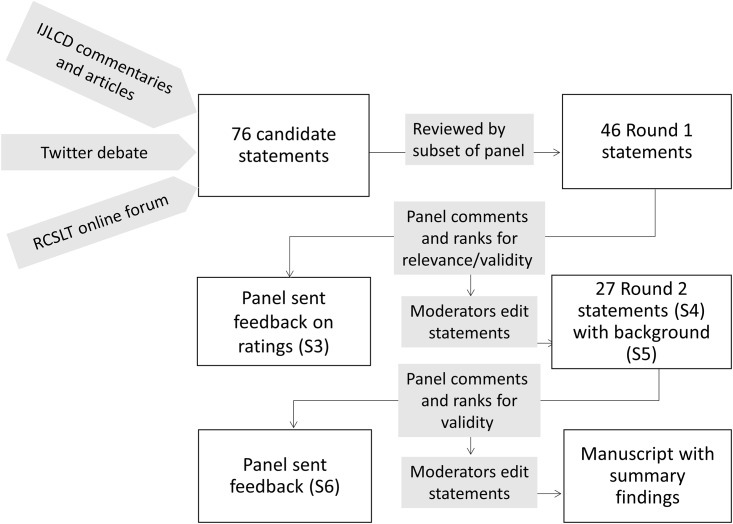
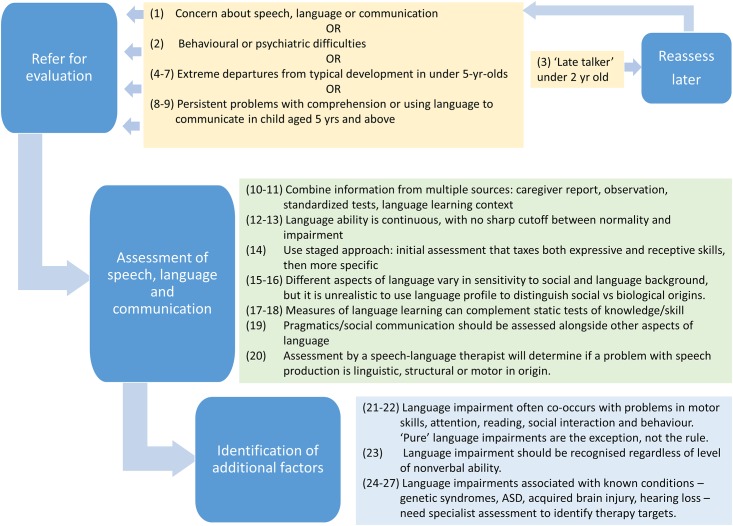
Delayed or impaired language development is a common developmental concern, yet there is little agreement about the criteria used to identify and classify language impairments in children. Children's language difficulties are at the interface between education, medicine and the allied professions, who may all adopt different approaches to conceptualising them. Our goal in this study was to use an online Delphi technique to see whether it was possible to achieve consensus among professionals on appropriate criteria for identifying children who might benefit from specialist services. We recruited a panel of 59 experts representing ten disciplines (including education, psychology, speech-language therapy/pathology, paediatrics and child psychiatry) from English-speaking countries (Australia, Canada, Ireland, New Zealand, United Kingdom and USA). The starting point for round 1 was a set of 46 statements based on articles and commentaries in a special issue of a journal focusing on this topic. Panel members rated each statement for both relevance and validity on a seven-point scale, and added free text comments. These responses were synthesised by the first two authors, who then removed, combined or modified items with a view to improving consensus. The resulting set of statements was returned to the panel for a second evaluation (round 2). Consensus (percentage reporting 'agree' or 'strongly agree') was at least 80 percent for 24 of 27 round 2 statements, though many respondents qualified their response with written comments. These were again synthesised by the first two authors. The resulting consensus statement is reported here, with additional summary of relevant evidence, and a concluding commentary on residual disagreements and gaps in the evidence base.
Overview
The claims and statistics of this paper haven’t been checked yet.
Free: it reads the open-access text and checks the first 5 claims that cite a source we can check. Create a free account to check every claim.
Integrity signals
Registry
Cites
Statistics
Figures
Verification
Claims the paper makes
The claims and statistics of this paper haven’t been checked yet.
Free: it reads the open-access text and checks the first 5 claims that cite a source we can check. Create a free account to check every claim.
Self-check
Percentages, sums and reported differences re-computed from the paper’s own numbers.
The self-check needs the paper’s full text.
Citations
Cites
R: A Language and Environment for Statistical Computing
R Core Team (2025) · doi:10.32614/r.manuals · Cited by 352,181
Diagnostic and Statistical Manual of Mental Disorders
Williams, J. B. W., & First, M. (2013) · Encyclopedia of Social Work · doi:10.1093/acrefore/9780199975839.013.104 · Cited by 109,519
Research guidelines for the Delphi survey technique
Hasson, F. (2000) · Journal of Advanced Nursing · doi:10.1046/j.1365-2648.2000.01567.x · Cited by 5,951 · cited 2×
“The issues we focused on are equally challenging in other countries, but manifestations of language difficulty, and terminology used to describe these, differ across languages [21].”
BackgroundMethodThe Delphi method as a research tool: an example, design considerations and applications
Okoli, C., & Pawlowski, S. D. (2004) · Information & Management · doi:10.1016/j.im.2003.11.002 · Cited by 4,771 · cited 1×
“The advantage of a larger panel is more representative coverage of experts, but a corresponding disadvantage is that the group discussion that is an inherent part of the process gets harder to achieve when more than 40 or 50 participants are involved [27].”
BackgroundThe Delphi Technique: Making Sense of Consensus
Hsu, C.-C., & Sandford, B. A. (2007) · University of Massachusetts Amherst · doi:10.7275/pdz9-th90 · Cited by 4,500
Principles and Practice of Screening for Disease.
(1968) · Annals of Internal Medicine · doi:10.7326/0003-4819-69-5-1085_2 · Cited by 3,066 · cited 1×
“However, as emphasised in the classic text by Wilson and Jungner [33], any screening program must beware of over-identification of problems, which can lead to resources being diverted to cases that do not need them.”
BackgroundPvclust: an R package for assessing the uncertainty in hierarchical clustering
Suzuki, R., & Shimodaira, H. (2006) · Bioinformatics · doi:10.1093/bioinformatics/btl117 · Cited by 2,451 · cited 1×
“The analysis was performed using the R statistical software [31] using the pvclust package [32], which performs hypothesis tests, via bootstrapping, to determine whether a cluster truly exists.”
MethodBoulkedid, R., Abdoul, H., Loustau, M., Sibony, O., & Alberti, C. (2011) · PLoS ONE · doi:10.1371/journal.pone.0020476 · Cited by 2,045 · cited 1×
“Selection of an expert panel is a key part of any Delphi exercise, and has been a topic of some debate in the literature [23].”
BackgroundCurrent validity of the Delphi method in social sciences
Landeta, J. (2006) · Technological Forecasting and Social Change · doi:10.1016/j.techfore.2005.09.002 · Cited by 1,353 · cited 1×
“Although we have noted the advantages of the Delphi technique over in-person consensus meetings, it is important also to recognise its limitations [120].”
BackgroundAn investigation of language impairment in autism: Implications for genetic subgroups
Kjelgaard, M. M., & Tager-Flusberg, H. (2001) · Language and Cognitive Processes · doi:10.1080/01690960042000058 · Cited by 1,130 · cited 1×
“On the other hand, a high proportion of verbal children with ASD have language difficulties similar to those seen in non-autistic children, especially with grammar or phonology [107], though there is debate as to whether the similarities are merely superficial [108].”
Background
Research works printed but not linked: 6
- Baird G (2014) Lumping, splitting, drawing lines, statistical cutoffs and impairment. Commentary on Bishop, D.V.M., 2014, Ten questions about terminology for children with unexplained language problems. Int J Lang Comm Disord 49: 381– 415. PMC4314704 25142090
- Hansson K, Sandgren O, Sahlén B (2014) Changing labels for a concept in change. Commentary on Bishop, D.V.M., 2014, Ten questions about terminology for children with unexplained language problems. Int J Lang Comm Disord 49: 381– 415. PMC4314704 25142090
- Rice M (2014) Advocating for SLI. Commentary on Bishop, D.V.M., 2014, Ten questions about terminology for children with unexplained language problems. Int J Lang Comm Disord 49: 381– 415. PMC4314704 25142090
- Snowling MJ (2014) SLI: Not just a semantic issue. Commentary on Reilly S., Tomblin B., Law J., McKean C., Mensah F. K., Morgan A., Goldfeld S., Nicholson J.M. and Wake M., 2014, Specific language impairment: a convenient label for whom? Int J Lang Comm Disord 49: 416– 451. PMC4303922 25142091 · DOI · Paper page
- Tomblin JB, Zhang X (1999) Are children with SLI a unique group of language learners? In: Tager-Flusberg H, editor. Neurodevelopmental Disorders: contributions to a New Framework from the Cognitive Neuroscience. Cambridge, MA: MIT Press pp. 361– 382.
- Stevenson J (1996) Developmental changes in the mechanisms linking language disabilities and behavior disorders In: Beitchman JH, Cohen NJ, Konstantareas MM, Tannock R, editors. Language, learning, and behavior disorders. Cambridge: Cambridge University Press pp. 78– 100.
Cited by
Items 601–700 of 1,001
Diversity, Equity, and Language Teacher Education
David, R. D., & Brown, K. A. (2020) · Cambridge University Press eBooks · doi:10.1017/9781108658089.020 · Cited by 3
Automated Assessment of Language
Lu, X., & Bluemel, B. (2020) · Cambridge University Press eBooks · doi:10.1017/9781108658089.006 · Cited by 6
Developmental Language Disorder and Bilingualism
Thordardottir, E. T. (2020) · Cambridge University Press eBooks · doi:10.1017/9781108658089.007 · Cited by 2
Rééducation cognitive chez l’enfant
Roy, A. (2018) · De Boeck Supérieur eBooks · doi:10.3917/dbu.segui.2018.01.0087 · Cited by 3
READING AND CHILDREN WITH DEVELOPMENTAL LANGUAGE DISORDER: A CASE OF GREEK STUDENTS
Ανδρέου, Γ., Aslanoglou, V., & Lymperopoulou, V. (2022) · International Conference on Education and Education of Social Sciences (INTCESS) · doi:10.51508/intcess.202271 · Cited by 2
Ann, L. W. H. (2020) · Cambridge University Press eBooks · doi:10.1017/9781108658089.011 · Cited by 2
Introduction to the Field of Applied Linguistics
Conrad, S., Hartig, A. J., & Santelmann, L. M. (2020) · Cambridge University Press eBooks · doi:10.1017/9781108658089.001 · Cited by 2
Syntactic priming and alignment in children with autism spectrum disorder
Hopkins, Z. (2022) · Trends in language acquisition research · doi:10.1075/tilar.31.08hop · Cited by 27
Vaughn, L. E., Oetting, J. B., & McDonald, J. L. (2023) · Journal of Speech Language and Hearing Research · doi:10.1044/2023_jslhr-22-00431 · Cited by 2
Assessing the Language Abilities of Bahamian Creole English–Speaking Children
Moss, D., & Timler, G. R. (2023) · Perspectives of the ASHA Special Interest Groups · doi:10.1044/2023_persp-23-00070 · Cited by 2
TERMINOLOGI FOR VANSKER MED SPRÅK HOS BARN OG UNGE – EN KONSENSUSSTUDIE
Kristoffersen, K. E., Rygvold, A. L., Klem, M., Valand, S. B., Asbjørnsen, A. E., & Næss, K.-A. B. (2021) · Norsk tidsskrift for logopedi · doi:10.5617/ntl.13767 · Cited by 8
“Målet med den norske CATALISE-studien var derfor knyttet til identifisering og klassifisering av vansker med språk hos barn, samt termer knyttet til dette.”
InfluentialKorrel, H. (2017) · Minerva Access (University of Melbourne) · Cited by 2
Durgungöz, F. C. (2019) · Nottingham ePrints (University of Nottingham) · Cited by 2
Literacy Education and Systemic Functional Linguistics
Rose, D. H. (2020) · Cambridge University Press eBooks · doi:10.1017/9781108658089.008 · Cited by 5
Cheng, W., & Lam, P. W. Y. (2020) · Cambridge University Press eBooks · doi:10.1017/9781108658089.023 · Cited by 3
Stylistics and the Digital Humanities
Mahlberg, M., & Wiegand, V. (2020) · Cambridge University Press eBooks · doi:10.1017/9781108658089.015 · Cited by 2
Hesketh, E., White, P., Simkiss, D., & Roulstone, S. (2023) · International Journal of Language & Communication Disorders · doi:10.1111/1460-6984.12877 · Cited by 3
Wiefferink, C. H., Adriaanse, C., van Denderen, M., van Schie, C., & Uilenburg, N. N. (2023) · Infants & Young Children · doi:10.1097/iyc.0000000000000256 · Cited by 1
“This is complicated by the fact that it is dif-ficult to diagnose DLD in children younger than 5 years (Bishop et al., 2016).”
BackgroundLanguage ability in 5–12-year-old children with new-onset epilepsy
Nordberg, Å., Miniscalco, C., & Norrelgen, F. (2024) · Logopedics Phoniatrics Vocology · doi:10.1080/14015439.2024.2379297 · Cited by 1
Mowzoon, H., Hassanati, F., Nilipour, R., Mohammadzamani, M., & Ghoreishi, Z. S. (2024) · فصلنامه علمی پژوهشی توانبخشی · doi:10.32598/rj.25.specialissue.3837.1 · Cited by 1
Etkileşimli Kitap Okumanın Gelişimsel Dil Bozukluğuna Etkileri: Ön Çalışma
Tığrak, T. K., & Özcebe, E. (2024) · Hacettepe Üniversitesi Sağlık Bilimleri Fakültesi Dergisi · doi:10.21020/husbfd.1413484 · Cited by 1
OVERVIEW OF LANGUAGE ACQUISITION FOR AN EFFICIENT INCLUSION
Ramacciotti, M. C. C., Bailer, C., & Noro, G. (2023) · Organon · doi:10.22456/2238-8915.135031 · Cited by 2
Borisenkov, M. F., Arbuzova, M., Khusametdinova, V., & Ryabinina, E. (2024) · Chronobiology International · doi:10.1080/07420528.2024.2444678 · Cited by 1
“Studies (Bishop et al. 2016, 2017) have shown that when diagnosing developmental language disorders and making decisions about sending children for correction of language difficulties/disorders, it is necessary to rely on the opinions not only of language therapists but also of people involved in…”
InfluentialKapa, L. L. (2025) · Journal of Speech Language and Hearing Research · doi:10.1044/2024_jslhr-24-00549 · Cited by 2
Lindfors, H., Hansson, K., Cohn, N., & Andersson, A. (2025) · Frontiers in Psychology · doi:10.3389/fpsyg.2025.1548289 · Cited by 1
“The condition DLD involves long-lasting language learning difficulties and below average language comprehension and production, that impair communication in everyday life (Bishop et al., 2016; Bishop et al., 2017; World Health Organization, 2019).”
Hapsari, I., Spencer, S., & Clegg, J. (2025) · Speech Language and Hearing · doi:10.1080/2050571x.2025.2481701 · Cited by 2
“A Delphi study led by Bishop and colleagues (Bishop et al., 2016, 2017) resulted in an agreed term, Developmental Language Disorder (DLD), to be used for allied professions in speech and language.”
Developing a language screening scale that considers linguistic diversity in pre-school children
Kanikli, A., Spanoudis, G. C., & Theodorou, E. (2025) · Frontiers in Communication · doi:10.3389/fcomm.2025.1532948 · Cited by 1
Reznik-Nevet, L., Share, D. L., & Cohen‐Mimran, R. (2025) · Journal of Communication Disorders · doi:10.1016/j.jcomdis.2025.106532 · Cited by 1
Lindgren, J., & Tselekidou, F. (2025) · ZAS Papers in Linguistics · doi:10.21248/zaspil.66.2025.882 · Cited by 1
Blake, A., Dąbrowska, E., & Llompart, M. (2025) · Journal of Speech Language and Hearing Research · doi:10.1044/2025_jslhr-24-00557 · Cited by 1
Surrey Communication and Language in Education Study (SCALES): cohort profile
Norbury, C., Griffiths, S., Lucas, L., Gooch, D., Baird, G., Charman, T., Pickles, A. R., Vamvakas, G., & Simonoff, E. A. (2025) · BMJ Open · doi:10.1136/bmjopen-2025-100710 · Cited by 1
“Bivariate latent change score models using data from years 3, 6 and 8 found that initial vocabulary scores predicted growth in non-verbal cognition and similarly, initial non-verbal ability scores predicted growth Open access in vocabulary, and these mutualistic relationships were intact in…”
Peixoto, V., Cruz‐Santos, A., & Martins, P. C. (2025) · IGI Global eBooks · doi:10.4018/979-8-3693-6432-1.ch002
Ferinu, L., Ahufinger, N., Guerra, E., García‐Arch, J., Sanz‐Torrent, M., & Andreu, L. (2026) · Clinical Linguistics & Phonetics · doi:10.1080/02699206.2026.2656205 · Cited by 1
A multidimensional investigation of the oral language abilities of Australian school entrants
Taylor, A. L., Boyes, M. E., Smart, S. J., Wheldall, R., Claessen, M., Gray, N., & Leitão, S. (2025) · International Journal of Speech-Language Pathology · doi:10.1080/17549507.2025.2541681 · Cited by 1
“Supported by the CATALISE Consortium (Bishop et al., 2016), a multidimensional assessment approach is considered important for identifying children with language difficulties who may require monitoring, further evaluation or meet criteria for language disorder.”
Coves-Martínez, A. M., Pacheco‐Costa, A., & Guzmán‐Simón, F. (2025) · Childhood · doi:10.1177/09075682251379607 · Cited by 1
“A revision of the disorder and a uni fi cation of its terminology, diagnosis and criteria for exclusion in English speaking countries was proposed by Bishop et al. (2016) or Reilly et al. (2014) among others.”
Hatherly, K., Denusik, L., Earle, C., Cardy, J. O., & Cunningham, B. J. (2025) · International Journal of Speech-Language Pathology · doi:10.1080/17549507.2025.2563843 · Cited by 1
“Intervention periods for both the immediate and delayed treatment groups are bolded. due to the difficulties with predicting which children are likely to be late bloomers (Bishop et al., 2016; Reilly et al., 2018).”
InfluentialHsueh, T.-Y., Hsu, H. J., & Tseng, Y. (2025) · Journal of Speech Language and Hearing Research · doi:10.1044/2025_jslhr-25-00062 · Cited by 1
Helo, A., Martín-Aragoneses, M. T., Guerra, E., & Coloma, C. J. (2025) · Journal of Communication Disorders · doi:10.1016/j.jcomdis.2025.106578 · Cited by 1
Bélanger, R., & O’Coin, J. (2025) · Early Childhood Education Journal · doi:10.1007/s10643-025-02014-6 · Cited by 2
Eriksson, M., & Myrberg, K. (2025) · BMJ Paediatrics Open · doi:10.1136/bmjpo-2024-003188 · Cited by 1
Wallmann, J., Samuelsson, C., Sahlén, B. S., Reuterskiöld, C., Sandgren, O., & Ekström, A. (2025) · Language Speech and Hearing Services in Schools · doi:10.1044/2025_lshss-25-00084 · Cited by 1
“Individuals with developmental language disorder (DLD) have difficulties in using, comprehending, and learning language (Bishop et al., 2016).”
Ward, L., Bannard, C., Norbury, C., & Polišenská, K. (2026) · Journal of Speech Language and Hearing Research · doi:10.1044/2025_jslhr-25-00058 · Cited by 1
Kirkley, K. M. (2026) · Perspectives of the ASHA Special Interest Groups · doi:10.1044/2026_persp-25-00209 · Cited by 1
Hickman, A., Baxter, R., Hartwell, K., Pagnamenta, E., Stojanovik, V., Loveall, S. J., & Burgoyne, K. (2026) · Frontiers in Psychology · doi:10.3389/fpsyg.2026.1795715 · Cited by 1
“Additionally, measuring engagement alongside vocabulary scores can refine individualised intervention targets (Bishop et al., 2016).”
Jasso, J., Castilla-Earls, A. P., & Horne, A. O. V. (2026) · Bilingualism Language and Cognition · doi:10.1017/s1366728926101321 · Cited by 1
“…ability, we review what is known about bilingual children with DLD 1 , a language-based disorder characterized by below-average language performance across multiple domains that is not the result of reduced language experience or other neurodevelopmental profiles (Bishop et al., 2016, 2017).”
InfluentialPritchard, A., Hogan, A. C., & Ziegenfusz, S. (2026) · International Journal of Speech-Language Pathology · doi:10.1080/17549507.2026.2670447 · Cited by 1
“…Inquiry in a quality improvement project within a public health service in the Northern Territory (NT), Australia, aimed at embedding the Developmental Language Disorder (DLD) diagnostic criteria proposed by Bishop et al. (2016, 2017) into local assessment and decision-making processes.”
Simsek, A., & Güneş, Z. (2026) · Frontiers in Public Health · doi:10.3389/fpubh.2026.1817290 · Cited by 1
Language and False Beliefs of School-Aged Children With Developmental Language Disorder
Bagioka, D. V., Marinis, T., & Terzi, A. (2026) · Journal of Speech Language and Hearing Research · doi:10.1044/2026_jslhr-25-00210 · Cited by 1
Fäldt, A. E., Liljekvist, I., & Dahlberg, A. (2026) · Acta Paediatrica · doi:10.1111/apa.70712 · Cited by 1
Theofilogiannakou, N. D., & Samuelson, L. K. (2026) · Developmental Review · doi:10.1016/j.dr.2026.101291 · Cited by 1
Mathematical Skills of Children With Specific Language Impairments: Testing Developmental Theory
Donlan, C. (2018) · Elsevier eBooks · doi:10.1016/b978-0-12-812574-8.00006-7 · Cited by 1
Forum on Morphosyntax Assessment and Intervention for Children
Horne, A. O. V. (2020) · Language Speech and Hearing Services in Schools · doi:10.1044/2020_lshss-20-00018 · Cited by 1
Literacy, Digital Literacy, Language Education, and Equity
Harris, K., & Jacobs, G. (2020) · Cambridge University Press eBooks · doi:10.1017/9781108658089.031 · Cited by 1
La memòria implícita i el trastorn del desenvolupament de llenguatge
Ahufinger, N., Ferinu, L., Andreu, L., & Sanz‐Torrent, M. (2020) · Llengua societat i comunicació · doi:10.1344/lsc-2020.18.2 · Cited by 2
Sahlén, B. S., Ibertsson, T., Asker-Árnason, L., Brännström, K. J., & Hansson, K. (2021) · Logopedics Phoniatrics Vocology · doi:10.1080/14015439.2021.1951347 · Cited by 1
Geronikolou, S. A., Bacopoulou, F., Chryssanthopoulos, S., Koutelekos, I. G., Lambrou, G. Ι., & Cokkinos, D. V. (2021) · Advances in experimental medicine and biology · doi:10.1007/978-3-030-78787-5_17 · Cited by 1
Leblanc, A., Côté, M.-F., & Laplante, L. (2026) · Didactique · doi:10.37571/2026.0208 · Cited by 1
Pauls, L. J. (2018) · Scholarship@Western (Western University) · Cited by 1
Dotti, H., Corrêa, L. M. S., Rivera, G., Benassi, J., & Formichelli, C. (2018) · Revista Argentina de Ciencias del Comportamiento ( RACC ) · doi:10.32348/1852.4206.v10.n2.19772 · Cited by 4
Morgia, F. L. (2018) · Trinity's Access to Research Output (TARA) (Trinity College Dublin) · Cited by 1
Corrêa, L. M. S. (2020) · Studies in theoretical psycholinguistics · doi:10.1007/978-94-024-1932-0_11 · Cited by 2
Alkhlouf, A. M., Wahid, N. A., Kazakzeh, M. A. R., & Yunus, A. M. (2020) · International Journal of Education Psychology and Counseling · doi:10.35631/ijepc.5350025 · Cited by 1
Language Socialization and Culture in Study Abroad Programs
Brown, L. (2020) · Cambridge University Press eBooks · doi:10.1017/9781108658089.010 · Cited by 1
Pickering, L. (2020) · Cambridge University Press eBooks · doi:10.1017/9781108658089.013 · Cited by 1
Supporting school aged children with Developmental Language Disorder (DLD)
Walker, C., & Haddock, R. (2021) · Analysis & Policy Observatory · doi:10.25916/2ga4-rw42 · Cited by 1
Кирилова, Л. Г., Мирошников, А. А., & Юзва, А. А. (2021) · Педиатрия Восточная Европа · doi:10.34883/pi.2021.9.3.013 · Cited by 2
Effects of Specific Language Impairment (SLI) and bilingualism on verbal short-term memory
Meir, N. (2021) · Trends in language acquisition research · doi:10.1075/tilar.29.07mei · Cited by 1
Multilingual Children with Special Needs in Early Education
Novogrodsky, R., & Meir, N. (2022) · Springer international handbooks of education · doi:10.1007/978-3-030-91662-6_18 · Cited by 1
Language Documentation and Revitalization
Childs, G. T. (2020) · Cambridge University Press eBooks · doi:10.1017/9781108658089.014 · Cited by 1
Žodžių suvokimo ir ekspresyviosios kalbos ypatumai neišplėtotos kalbos atveju
Kamandulytė-Merfeldienė, L., & Makauskienė, V. (2022) · Special Education · doi:10.15388/se.2021.v2i43.8 · Cited by 1
“Dabašinskienė and Ruzaitė (2010) indicate that a specific language disorder is diagnosed in children of typical development who do not have brain damage, hearing or intellectual impairment.”
BackgroundAutism Spectrum Disorder Versus Communication Disorders
Paul, R. (2022) · Oxford University Press eBooks · doi:10.1093/med-psych/9780197516881.003.0003 · Cited by 1
Sultana, A. (2026) · Journal of Monolingual and Bilingual Speech · doi:10.3138/jmbs-2024-0007 · Cited by 1
Iwamura, K., Isaki, M., Uchiyama, C., Nomura, K., Tanimoto, A., Kuroiwa, H., Kozono, M., Iwashita, Y., Iwamura, J., & Hyodo, M. (2023) · Laryngoscope Investigative Otolaryngology · doi:10.1002/lio2.1055 · Cited by 1
“with sufficient experience in working with children with language disorders) from Europe and the USA to form a consensus regarding the concepts and terms involved.(2,3)”
BackgroundResultBektaşoğlu, E. E., & Yeşilyurt, M. (2023) · Dil Konuşma ve Yutma Araştırmaları Dergisi · doi:10.58563/dkyad-2023.61.5 · Cited by 2
Managing the child born preterm after hospital discharge
Sánchez, K., Martens, A., & Zimmerman, E. (2022) · Speech Language and Hearing · doi:10.1080/2050571x.2022.2117507 · Cited by 1
Consensus Methods for Health Research in a Global Setting
Carter, S. A., Tong, A., Craig, J. C., Teixeira-Pinto, A. M., & Manera, K. (2023) · Springer eBooks · doi:10.1007/978-3-030-96778-9_65-2 · Cited by 1
Comorbid psychiatric illnesses in developmental dysphasia (developmental language disorder)
Pospíšilová, L. (2023) · Listy klinické logopedie · doi:10.36833/lkl.2023.018 · Cited by 2
Markers for the Support of Clinical Tele-Assessment: The Case of Autism Spectrum Disorders
Toki, E. I., Zakopoulou, V., Tatsis, G., Plachouras, K., & Pange, J. (2023) · Lecture notes in networks and systems · doi:10.1007/978-3-031-42467-0_72 · Cited by 2
Dahlberg, A., Levin, A. S., & Fäldt, A. E. (2024) · Acta Paediatrica · doi:10.1111/apa.17183 · Cited by 1
Gomozova, M., Lezzhova, V., Dragoy, O., & Lopukhina, A. (2024) · Journal of Speech Language and Hearing Research · doi:10.1044/2024_jslhr-23-00596 · Cited by 1
Bachourou, T., Stavrakaki, S., Koukoulioti, V., & Talli, I. (2024) · Brain Sciences · doi:10.3390/brainsci14060580 · Cited by 1
“…criteria set by the CATALISE group put an end to the obligatory differentiation between verbal and non-verbal intelligence and accept the coexistence of DLD with other neurodevelopmental disorders, such as ADHD, speech sound disorder, behavioral disorders, or below average non-verbal ability [3].”
BackgroundTaruna, R. (2024) · Jurnal Terapi Wicara dan Bahasa · doi:10.59686/jtwb.v2i2.117 · Cited by 1
Teaching Students to Read: A Call to Action for Social Justice in School Psychology
Truckenmiller, A. J., Barrett, C. A., & Hogan, T. P. (2024) · Canadian Journal of School Psychology · doi:10.1177/08295735241262849 · Cited by 1
“The term DLD only recently became the consensus term in 2016 (Bishop et al., 2016).”
Reasoning about self and others: A dynamic process
Geveke, C. H., Veenker, H., & Steenbeek, H. (2024) · Autism & Developmental Language Impairments · doi:10.1177/23969415241268192 · Cited by 1
“Several researchers investigated overlaps between children with Developmental Language Disorder (formerly referred to as Speci fi c Language Impairment [SLI], for an overview see Bishop et al. (2016) and autistic children.”
Radville, K. M., Komesidou, R., Wolter, J. A., Ricketts, J., & Hogan, T. P. (2024) · International Journal of Speech-Language Pathology · doi:10.1080/17549507.2024.2364811 · Cited by 1
Parental Questionnaires as a Reliable Instrument for the Assessment of Child Language Development
(2024) · Frontiers research topics · doi:10.3389/978-2-8325-5426-5 · Cited by 1
Smirnov, I. I., Popova, E. S., Serebrovskaya, O. V., Skipetrova, L. A., Cheremin, R. A., & Fateeva, V. V. (2024) · S S Korsakov Journal of Neurology and Psychiatry · doi:10.17116/jnevro2024124112103 · Cited by 1
Sosyal İletişim Bozukluğu: Dil ve Konuşma Terapistleri için Klinik Görünüm ve Müdahale Stratejileri
Kütükçü, D. K. (2024) · Dil Konuşma ve Yutma Araştırmaları Dergisi · doi:10.58563/dkyad-2024.73.5 · Cited by 2
Lanchares, A. A., Requies, I. R., & Pardo, R. B. S. (2025) · Research in Developmental Disabilities · doi:10.1016/j.ridd.2025.104945 · Cited by 1
Sindhu, V. P. M., Brignell, A., Moses, M., Kallady, K., Bellgrove, M. A., & Johnson, B. P. (2025) · Autism Research · doi:10.1002/aur.70021 · Cited by 1
“Multiple perspectives have been used to define “language” and language disorders, influenced by diverse professional view-points from healthcare and education systems and research methodologies applied to study children's language difficulties (Bishop et al. 2016; Le et al. 2021).”
Radville, K. M., DeLuca, T., Pfeiffer, D. L., Ziegenfusz, S., Rasner, M., & Hogan, T. P. (2025) · Language Speech and Hearing Services in Schools · doi:10.1044/2025_lshss-24-00091 · Cited by 1
Wortfindungsstörungen im Grundschul- und jungen Erwachsenenalter
Glück, C. W. (2020) · publish.UP (University of Potsdam) · doi:10.25932/publishup-47485 · Cited by 2
Disciplinary Education and Language for Specific Purposes
Hartig, A. J. (2020) · Cambridge University Press eBooks · doi:10.1017/9781108658089.009 · Cited by 1
Repetición de pseudopalabras en trastorno específico del lenguaje
Herráiz, C. P., & Sepúlveda, E. M. (2021) · Revista de Investigación en Logopedia · doi:10.5209/rlog.70098 · Cited by 2
Children with Developmental Language Disorder : A Proposal for the Future Project
Ndiaye, M. (2021) · The International Journal of Language and Cultural (TIJOLAC) · doi:10.5281/zenodo.4643054 · Cited by 1
Armon-Lotem, S., & Grohmann, K. Κ. (2021) · Trends in language acquisition research · doi:10.1075/tilar.29.int · Cited by 1
Working Memory in Children with Speech, Language and Communication Needs
Clegg, J., & Joffe, V. (2017) · Child Language Teaching and Therapy · doi:10.1177/0265659017693143 · Cited by 1
Statistical Word-Learning in Catalan-Spanish Children with Specific Language Impairment
Ahufinger, N. (2019) · Dipòsit Digital de la Universitat de Barcelona (Universitat de Barcelona) · Cited by 1
Pert, S., & Stow, C. (2019) · Research Explorer (The University of Manchester) · Cited by 1
Metadata
- Authors
- Bishop, D. V. M., Snowling, M. J., Thompson, P. A., Greenhalgh, T., & CATALISE consortium
- Affiliations
- University of Oxford (GB)
- Corresponding author
- Bishop, D. V. M.
- Venue
- PLOS ONE
- Publisher
- Public Library of Science (PLoS)
- Published
- 2016-07-08
- Volume
- 11
- Issue
- 7
- Pages
- e0158753
- ISSN
- 1932-6203 (ISSN-L)
- PMC
- PMC4938414
- OpenAlex
- W2336526731
- Cited by
- 831
- References
- 129
- Citations by year
- 2026: 73 · 2025: 105 · 2024: 89 · 2023: 85 · 2022: 99 · 2021: 104 · 2020: 118 · 2019: 67 · 2018: 55 · 2017: 30 · 2016: 4
- FWCI
- 121.75
- Type
- journal article
- Language
- en
- Update notices
- correction (2016-12-09)
- Open access
- gold
- doi.org
- Licence
- Locations
- PLoS ONE (publishedVersion, cc-by)
- PubMed Central (publishedVersion, cc-by)
- PubMed (publishedVersion)
- OpenBU (Boston University) (publishedVersion, cc-by)
- University of Birmingham Research Portal (University of Birmingham) (publishedVersion, other-oa)
- White Rose Research Online (University of Leeds, The University of Sheffield, University of York) (acceptedVersion)
- Strathprints: The University of Strathclyde institutional repository (University of Strathclyde) (acceptedVersion)
- Arrow@dit (Dublin Institute of Technology) (acceptedVersion)
- Griffith Research Online (submittedVersion, cc-by)
- UTUPub (University of Turku) (submittedVersion)
- UWA Profiles and Research Repository (UWA) (submittedVersion, cc-by)
- Cork Open Research Archive (University College Cork, Ireland) (submittedVersion, cc-by)
- DOAJ (DOAJ: Directory of Open Access Journals) (submittedVersion, cc-by-sa)
- Stirling Online Research Repository (University of Stirling) (submittedVersion, cc-by)
- UCL Discovery (University College London) (submittedVersion)
- Figshare (submittedVersion, cc-by-nc-sa)
- Figshare (submittedVersion)
- Figshare (submittedVersion, cc-by)
- The HKU Scholars Hub (University of Hong Kong) (submittedVersion, cc-by-nc-nd)
- Scholarship@Western (Western University) (submittedVersion, cc-by)
- Minerva Access (University of Melbourne) (submittedVersion, cc-by)
- Open Research Exeter (University of Exeter) (submittedVersion)
- Research Explorer (The University of Manchester) (submittedVersion, cc-by)
- Edinburgh Research Explorer (University of Edinburgh) (submittedVersion, cc-by)
- ResearchSpace (University of Auckland) (submittedVersion, cc-by)
- University of Limerick Institutional Repository (University of Limerick) (submittedVersion, cc-by-nc-sa)
- Scholarship@Western (Western University) (submittedVersion)
- Warwick Research Archive Portal (University of Warwick) (submittedVersion)
- Funders
- Wellcome Trust (082498/Z/07/Z)
- Topics
- Social Sciences › Psychology › Developmental and Educational Psychology › Language Development and Disorders
- Social Sciences › Psychology › Neuropsychology and Physiological Psychology › Developmental and Educational Neuropsychology
- Health Sciences › Health Professions › Speech and Hearing › Voice and Speech Disorders
- Keywords
- language impairment, children, diagnostic criteria, multidisciplinary consensus, language delay, speech-language pathology, child psychiatry
- MeSH terms
- Australia, Canada, Delphi Technique, United Kingdom, Humans, Ireland, Language Disorders, New Zealand, Interdisciplinary Studies
About these checks
Registry, retraction, Cites and statistics results are computed, not judged, with one exception: a printed reference that no index lists is read once by a model before it counts as a citation error. Claims are extracted by a model and kept only when their quote appears verbatim in the text; each cited source is then checked, with a model’s help, for whether it says what the claim relies on. Those verdicts can be wrong — read the claim’s quote and the cited source before relying on one.
Statistics and arithmetic are recomputed, not judged.
Confidence bands are shown only for fields calibrated on our annotated test set. None is calibrated yet, so no band is shown.
What counts as a claim ›How we measure confidence ›How we check this ›
Are you an author, or do you see a problem with this page? Request a review
Data sources
Bibliographic data: Semantic Scholar, OpenAlex, Crossref.
Contains information from the Semantic Scholar Academic Graph Datasets, made available under the ODC Attribution License (ODC-BY 1.0).
Semantic Scholar’s data is described in: Kinney, R., et al. (2023). The Semantic Scholar Open Data Platform. arXiv:2301.10140.
