

CATALISE: A Multinational and Multidisciplinary Delphi Consensus Study. Identifying Language Impairments in Children
Open accessThe DOI matches its Crossref record; 127 of the 129 references it cites were found in a registry or an index.
Abstract
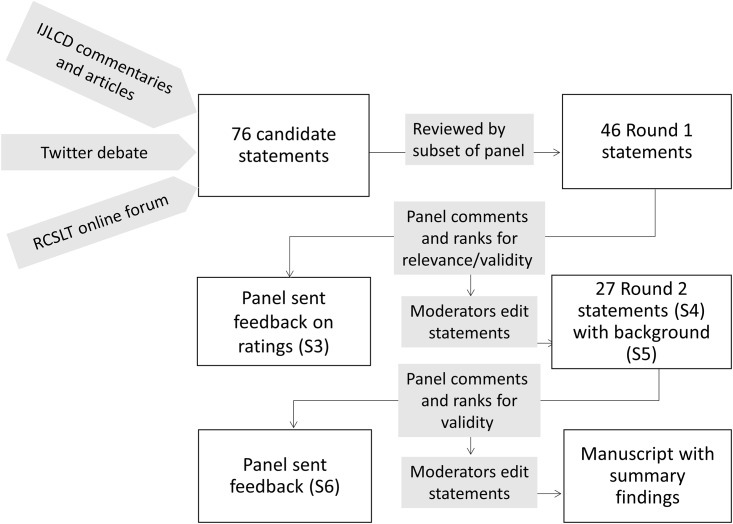
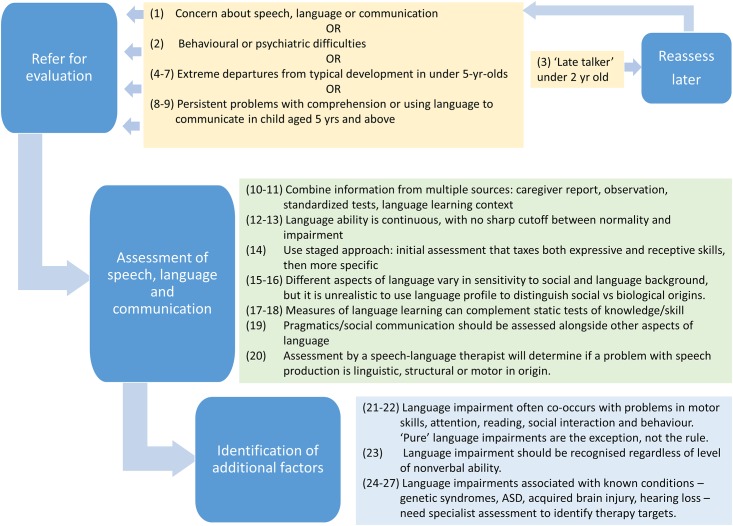
Delayed or impaired language development is a common developmental concern, yet there is little agreement about the criteria used to identify and classify language impairments in children. Children's language difficulties are at the interface between education, medicine and the allied professions, who may all adopt different approaches to conceptualising them. Our goal in this study was to use an online Delphi technique to see whether it was possible to achieve consensus among professionals on appropriate criteria for identifying children who might benefit from specialist services. We recruited a panel of 59 experts representing ten disciplines (including education, psychology, speech-language therapy/pathology, paediatrics and child psychiatry) from English-speaking countries (Australia, Canada, Ireland, New Zealand, United Kingdom and USA). The starting point for round 1 was a set of 46 statements based on articles and commentaries in a special issue of a journal focusing on this topic. Panel members rated each statement for both relevance and validity on a seven-point scale, and added free text comments. These responses were synthesised by the first two authors, who then removed, combined or modified items with a view to improving consensus. The resulting set of statements was returned to the panel for a second evaluation (round 2). Consensus (percentage reporting 'agree' or 'strongly agree') was at least 80 percent for 24 of 27 round 2 statements, though many respondents qualified their response with written comments. These were again synthesised by the first two authors. The resulting consensus statement is reported here, with additional summary of relevant evidence, and a concluding commentary on residual disagreements and gaps in the evidence base.
Overview
The claims and statistics of this paper haven’t been checked yet.
Free: it reads the open-access text and checks the first 5 claims that cite a source we can check. Create a free account to check every claim.
Integrity signals
Registry
Cites
Statistics
Figures
Verification
Claims the paper makes
The claims and statistics of this paper haven’t been checked yet.
Free: it reads the open-access text and checks the first 5 claims that cite a source we can check. Create a free account to check every claim.
Self-check
Percentages, sums and reported differences re-computed from the paper’s own numbers.
The self-check needs the paper’s full text.
Citations
Cites
R: A Language and Environment for Statistical Computing
R Core Team (2025) · doi:10.32614/r.manuals · Cited by 352,181
Diagnostic and Statistical Manual of Mental Disorders
Williams, J. B. W., & First, M. (2013) · Encyclopedia of Social Work · doi:10.1093/acrefore/9780199975839.013.104 · Cited by 109,519
Research guidelines for the Delphi survey technique
Hasson, F. (2000) · Journal of Advanced Nursing · doi:10.1046/j.1365-2648.2000.01567.x · Cited by 5,951 · cited 2×
“The issues we focused on are equally challenging in other countries, but manifestations of language difficulty, and terminology used to describe these, differ across languages [21].”
BackgroundMethodThe Delphi method as a research tool: an example, design considerations and applications
Okoli, C., & Pawlowski, S. D. (2004) · Information & Management · doi:10.1016/j.im.2003.11.002 · Cited by 4,771 · cited 1×
“The advantage of a larger panel is more representative coverage of experts, but a corresponding disadvantage is that the group discussion that is an inherent part of the process gets harder to achieve when more than 40 or 50 participants are involved [27].”
BackgroundThe Delphi Technique: Making Sense of Consensus
Hsu, C.-C., & Sandford, B. A. (2007) · University of Massachusetts Amherst · doi:10.7275/pdz9-th90 · Cited by 4,500
Principles and Practice of Screening for Disease.
(1968) · Annals of Internal Medicine · doi:10.7326/0003-4819-69-5-1085_2 · Cited by 3,066 · cited 1×
“However, as emphasised in the classic text by Wilson and Jungner [33], any screening program must beware of over-identification of problems, which can lead to resources being diverted to cases that do not need them.”
BackgroundPvclust: an R package for assessing the uncertainty in hierarchical clustering
Suzuki, R., & Shimodaira, H. (2006) · Bioinformatics · doi:10.1093/bioinformatics/btl117 · Cited by 2,451 · cited 1×
“The analysis was performed using the R statistical software [31] using the pvclust package [32], which performs hypothesis tests, via bootstrapping, to determine whether a cluster truly exists.”
MethodBoulkedid, R., Abdoul, H., Loustau, M., Sibony, O., & Alberti, C. (2011) · PLoS ONE · doi:10.1371/journal.pone.0020476 · Cited by 2,045 · cited 1×
“Selection of an expert panel is a key part of any Delphi exercise, and has been a topic of some debate in the literature [23].”
BackgroundCurrent validity of the Delphi method in social sciences
Landeta, J. (2006) · Technological Forecasting and Social Change · doi:10.1016/j.techfore.2005.09.002 · Cited by 1,353 · cited 1×
“Although we have noted the advantages of the Delphi technique over in-person consensus meetings, it is important also to recognise its limitations [120].”
BackgroundAn investigation of language impairment in autism: Implications for genetic subgroups
Kjelgaard, M. M., & Tager-Flusberg, H. (2001) · Language and Cognitive Processes · doi:10.1080/01690960042000058 · Cited by 1,130 · cited 1×
“On the other hand, a high proportion of verbal children with ASD have language difficulties similar to those seen in non-autistic children, especially with grammar or phonology [107], though there is debate as to whether the similarities are merely superficial [108].”
Background
Research works printed but not linked: 6
- Baird G (2014) Lumping, splitting, drawing lines, statistical cutoffs and impairment. Commentary on Bishop, D.V.M., 2014, Ten questions about terminology for children with unexplained language problems. Int J Lang Comm Disord 49: 381– 415. PMC4314704 25142090
- Hansson K, Sandgren O, Sahlén B (2014) Changing labels for a concept in change. Commentary on Bishop, D.V.M., 2014, Ten questions about terminology for children with unexplained language problems. Int J Lang Comm Disord 49: 381– 415. PMC4314704 25142090
- Rice M (2014) Advocating for SLI. Commentary on Bishop, D.V.M., 2014, Ten questions about terminology for children with unexplained language problems. Int J Lang Comm Disord 49: 381– 415. PMC4314704 25142090
- Snowling MJ (2014) SLI: Not just a semantic issue. Commentary on Reilly S., Tomblin B., Law J., McKean C., Mensah F. K., Morgan A., Goldfeld S., Nicholson J.M. and Wake M., 2014, Specific language impairment: a convenient label for whom? Int J Lang Comm Disord 49: 416– 451. PMC4303922 25142091 · DOI · Paper page
- Tomblin JB, Zhang X (1999) Are children with SLI a unique group of language learners? In: Tager-Flusberg H, editor. Neurodevelopmental Disorders: contributions to a New Framework from the Cognitive Neuroscience. Cambridge, MA: MIT Press pp. 361– 382.
- Stevenson J (1996) Developmental changes in the mechanisms linking language disabilities and behavior disorders In: Beitchman JH, Cohen NJ, Konstantareas MM, Tannock R, editors. Language, learning, and behavior disorders. Cambridge: Cambridge University Press pp. 78– 100.
Cited by
Items 301–400 of 1,001
Fulcher-Rood, K., & Castilla-Earls, A. P. (2023) · Language Speech and Hearing Services in Schools · doi:10.1044/2023_lshss-22-00185 · Cited by 11
Asaridou, S. S., Cler, G. J., Wiedemann, A., Krishnan, S., Smith, H. J., Willis, H. E., Healy, M. P., & Watkins, K. E. (2024) · Neurobiology of Language · doi:10.1162/nol_a_00142 · Cited by 12
“…including problems in speech sound discrimination and phonology, in word learning and vocabulary, expressive and receptive grammar (Conti-Ramsden et al., 2001; Krishnan et al., 2021), as well as pragmatics (Bishop, 2014; see Bishop et al., 2016, 2017 for detailed description and terminology).”
BackgroundRedmond, S. M., Ash, A. C., Li, H., & Zhang, Y. (2024) · American Journal of Speech-Language Pathology · doi:10.1044/2024_ajslp-23-00388 · Cited by 13
Decolonizing theory reveals psycholinguistic injustice in the field of speech/language pathology
Manalili, M. A. R. (2025) · The Journal of Deaf Studies and Deaf Education · doi:10.1093/jdsade/enaf023 · Cited by 11
Barbieri, Z. D., Fernández, M. A., Newbury, D. F., & Villanueva, P. (2018) · International Journal of Language & Communication Disorders · doi:10.1111/1460-6984.12377 · Cited by 11
“This terminology has been endorsed by the Royal College of Speech and Language Therapists (RCSLT) in the UK (Bishop et al. 2016, 2017).”
MethodLaw, J. (2018) · International Journal of Language & Communication Disorders · doi:10.1111/1460-6984.12424 · Cited by 13
Castilla-Earls, A. P., Pérez‐Leroux, A. T., & Benavides, A. A. (2021) · Revista de Logopedia Foniatría y Audiología · doi:10.1016/j.rlfa.2021.02.002 · Cited by 12
Loeb, D. F., Davis, E. S., & Lee, T. (2021) · American Journal of Speech-Language Pathology · doi:10.1044/2021_ajslp-20-00310 · Cited by 11
Rinker, T., Yu, Y. H., Wagner, M., & Shafer, V. L. (2022) · Frontiers in Human Neuroscience · doi:10.3389/fnhum.2021.706926 · Cited by 11
Pereira, T., & Lousada, M. (2022) · Journal of Autism and Developmental Disorders · doi:10.1007/s10803-022-05481-7 · Cited by 14
Troia, G. A., Hennenfent, L., & Shen, M. (2023) · Topics in Language Disorders · doi:10.1097/tld.0000000000000317 · Cited by 12
“, Snowling & Melby-Lervåg, 2016) or, conversely, the downstream effects of dyslexia, often diagnosed in the elementary grades, on later language learning (Bishop et al., 2016; Paul, 2020).”
BackgroundVerly, M., Gerrits, R., Lagae, L. G., Sunaert, S. G., Rommel, N., & Zink, I. (2017) · Brain and Language · doi:10.1016/j.bandl.2017.03.006 · Cited by 11
“Although DD refers to children with a resistant language deficit, in the international literature, DD (Parisse & Maillart, 2009), developmental language disorder (Bishop et al., 2016; Rapin & Dunn, 2003) and specific language impairment (Bishop, 1991, 2006) are often used interchangeably (De Guibert et al.”
Children's Language Disorders: What's in a Name?
Paul, R. (2020) · Perspectives of the ASHA Special Interest Groups · doi:10.1044/2019_pers-sig1-2019-0012 · Cited by 11
Ahufinger, N., Aguilera, M., Guerra, E., Giberga, A., Verdaguer-Ribas, O., Balboa-Castells, R., Andreu, L., Esteve‐Gibert, N., & Sanz‐Torrent, M. (2025) · Acta Psychologica · doi:10.1016/j.actpsy.2025.104927 · Cited by 11
Cleland, J., Burr, S., Harding, S. A., Stringer, H., & Wren, Y. E. (2025) · International Journal of Language & Communication Disorders · doi:10.1111/1460-6984.70052 · Cited by 14
“This differs considerably from the contro-versythatformerlysurroundedchildhoodlanguageimpairments, where an international consensus exercise using Delphi methodology was necessary to arrive at the new term – Developmental Language Disorder (Bishop et al. 2016).”
Does an SLI Label Really Restrict Services?
Volkers, N. (2018) · ASHA Leader · doi:10.1044/leader.ftr2.23122018.54 · Cited by 10
The effect of picture support on narrative retells in Swedish adolescents with ADHD
Bergman, A., & Hallin, A. E. (2020) · Clinical Linguistics & Phonetics · doi:10.1080/02699206.2020.1825816 · Cited by 11
“No adolescents included in the study had an additional diagnosis of developmental language disorder (DLD) (Bishop et al. 2016), but the results on sentence repetition scores (CELF-4) differed significantly between the groups, which might indicate language processing deficits in the ADHD group (see also Kim & Kaiser, 2…”
ResultPrioritising Targets for School-Based ADHD Interventions: A Delphi Survey
Perry, R. C., Ford, T. J., O’Mahen, H., & Russell, A. E. (2021) · School Mental Health · doi:10.1007/s12310-020-09408-4 · Cited by 12
Kilcoyne, S., Luscombe, C., Scully, P., Overton, S., Brockbank, S., Swan, M. C., Johnson, D., Wall, S. A., & Wilkie, A. O. M. (2021) · Journal of Craniofacial Surgery · doi:10.1097/scs.0000000000008019 · Cited by 10
Waine, H., Bates, S., Frizelle, P., & Oh, T. M. (2023) · International Journal of Language & Communication Disorders · doi:10.1111/1460-6984.12883 · Cited by 13
Eriksson, M., & Myrberg, K. (2023) · Frontiers in Psychology · doi:10.3389/fpsyg.2023.1176028 · Cited by 10
Ardanouy, E., Delage, H., & Zesiger, P. (2023) · Child Language Teaching and Therapy · doi:10.1177/02656590231188523 · Cited by 11
Campos, A., Tuomainen, J., & Tuomainen, O. (2023) · Brain Sciences · doi:10.3390/brainsci14010042 · Cited by 10
“Importantly, a large body of evidence indicates that the language and cognitive symptoms in DLD are dynamic over time [88,89], suggesting that identifying neural markers of language outcomes at the group level could be more challenging than expected.”
BackgroundNew and Not‐Well‐Known Research about Reading Disabilities: Teachers Want to Know
Truckenmiller, A. J. (2024) · The Reading Teacher · doi:10.1002/trtr.2280 · Cited by 10
Frizelle, P., Harte, J., O’Sullivan, K., Fletcher, P. J., & GIBBON, F. E. (2017) · PLoS ONE · doi:10.1371/journal.pone.0180496 · Cited by 10
Developmental Language Disorder : The Term Is Not Confined to Monolingual Children
Bishop, D. (2020) · Perspectives of the ASHA Special Interest Groups · doi:10.1044/2020_persp-20-00061 · Cited by 10
Self-citationCowal, J., & Leung, G. Y. (2020) · Cambridge University Press eBooks · doi:10.1017/9781108658089.028 · Cited by 13
Nicholas, K., Plante, E., Gómez, R. L., & Vance, R. (2021) · Journal of Speech Language and Hearing Research · doi:10.1044/2021_jslhr-20-00367 · Cited by 10
Boerma, T., Everaert, E., Vlieger, D., Steggink, M. G. A., Selten, I. S., Houben, M. L., Vorstman, J. A. S., Gerrits, E., & Wijnen, F. N. K. (2023) · Frontiers in Communication · doi:10.3389/fcomm.2023.1111584 · Cited by 11
Calder, S. D., Visentin, D. C., Claessen, M., Hollingsworth, L., Ebbels, S. H., Smith‐Lock, K. M., & Leitão, S. (2023) · Clinical Linguistics & Phonetics · doi:10.1080/02699206.2023.2236768 · Cited by 12
“Children with DLD have a slower pace of language development and difficulty producing and understanding language (Bishop et al., 2016).”
Episodic memory retrieval in adolescents with and without developmental language disorder (DLD)
Lee, J. C. (2017) · International Journal of Language & Communication Disorders · doi:10.1111/1460-6984.12340 · Cited by 10
Nayeb, L., Lagerberg, D., Westerlund, M., Sarkadi, A., Lucas, S., & Eriksson, M. (2019) · Acta Paediatrica · doi:10.1111/apa.14790 · Cited by 9
“General screening of speech and language in preschool children has therefore not been recommended (1,4).”
BackgroundInfluentialHunt, E. F., Nang, C., Meldrum, S. J., & Armstrong, E. (2025) · International Journal of Speech-Language Pathology · doi:10.1080/17549507.2025.2499516 · Cited by 9
“…criteria for DLD include: a) Language skills being significantly different to those expected for the child’s age, b) persistent language difficulties throughout development and c) the language difficulties causing a functional impact upon social and academic activities (Bishop et al., 2016, 2017).”
InfluentialAlvarez-Amado, D. E., & Barragán-Pérez, E. (2022) · Revista Médica Clínica Las Condes · doi:10.1016/j.rmclc.2022.08.004 · Cited by 15
Describing communication profiles of low-risk preterm and full-term late talkers
Zuccarini, M., Guarini, A., Gibertoni, D., Suttora, C., Aceti, A., Corvaglia, L., Bello, A., Caselli, M. C., & Sansavini, A. (2023) · Journal of Communication Disorders · doi:10.1016/j.jcomdis.2023.106336 · Cited by 9
Employment and Work Task Characteristics of 111 Swedish School-Based Speech-Language Pathologists
Sandgren, O., Samuelsson, C., Fredriksson, E., Järnvall, E., & Ekström, A. (2023) · Perspectives of the ASHA Special Interest Groups · doi:10.1044/2023_persp-22-00262 · Cited by 9
Haukedal, C. L., Wie, O. B., Schauber, S. K., & Torkildsen, J. V. K. (2023) · Journal of Speech Language and Hearing Research · doi:10.1044/2023_jslhr-22-00742 · Cited by 9
Subordination in Turkish Heritage Children with and without Developmental Language Impairment
Şan, N. H. (2023) · Languages · doi:10.3390/languages8040239 · Cited by 10
„Hogy mondjam?” – a nyelvfejlődési zavar jelensége és hatása a fejlődésre
Kas, B., & Lukács, Á. (2020) · Anyanyelv-pedagógia · doi:10.21030/anyp.2020.3.1 · Cited by 11
Bergeron, L., Bergeron, G., & Tardif, S. (2019) · McGill Journal of Education / Revue des sciences de l'éducation de McGill · doi:10.7202/1065658ar · Cited by 13
Nordahl‐Hansen, A., Donolato, E., Lervåg, A., Norbury, C., & Melby‐Lervåg, M. (2019) · Campbell Systematic Reviews · doi:10.1002/cl2.1062 · Cited by 9
“Similarly, the CATALISE consortium clearly rejected the use of non‐verbal ability as an exclusion criteria for LD (Bishop et al., 2016) and does not appear to associate with rate of language change, at least in the primary school years (Norbury et al.”
BackgroundMethodVisser‐Bochane, M. I., Luinge, M. R., Dieleman, L., van der Schans, C. P., & Reijneveld, S. A. (2020) · Acta Paediatrica · doi:10.1111/apa.15447 · Cited by 10
Por que devemos falar sobre transtorno do desenvolvimento da linguagem
Cáceres-Assenço, A. M., Giusti, E., Gândara, J. P., Puglisi, M. L., & Takiuchi, N. (2020) · Audiology - Communication Research · doi:10.1590/2317-6431-2020-2342 · Cited by 13
“Utilizando o método Delphi, os pesquisadores chegaram, finalmente, a um consenso sobre critérios diagnósticos e a terminologia a ser utilizada para definir esses quadros (24,25) .”
BackgroundNot All Procedural Learning Tasks Are Difficult for Adults With Developmental Language Disorder
Gerken, L., Plante, E., & Goffman, L. (2021) · Journal of Speech Language and Hearing Research · doi:10.1044/2020_jslhr-20-00548 · Cited by 10
“Members of the DLD group met the definition of the CATALISE group (Bishop et al., 2016) for DLD as having a language disorder not due to another biological etiology.”
MethodImpaired Audiovisual Representation of Phonemes in Children with Developmental Language Disorder
Kaganovich, N., Schumaker, J., & Christ, S. L. (2021) · Brain Sciences · doi:10.3390/brainsci11040507 · Cited by 9
Cronin, P., & Addo, R. (2021) · International Journal of Language & Communication Disorders · doi:10.1111/1460-6984.12628 · Cited by 11
External Validation of BMT-i Computerized Test Battery for Diagnosis of Learning Disabilities
Billard, C., Jung, C., Münnich, A., Gassama, S., Touzin, M., Mirassou, A., & Willig, T.-N. (2021) · Frontiers in Pediatrics · doi:10.3389/fped.2021.733713 · Cited by 9
Vazeux, M., Nail, P. L., & Doignon‐Camus, N. (2023) · Research in Developmental Disabilities · doi:10.1016/j.ridd.2023.104455 · Cited by 9
Marton, K., Kövi, Z., & Egri, T. (2017) · Research in Developmental Disabilities · doi:10.1016/j.ridd.2017.11.007 · Cited by 9
Matov, J., Mensah, F. K., Cook, F., & Reilly, S. (2018) · International Journal of Language & Communication Disorders · doi:10.1111/1460-6984.12378 · Cited by 11
“…in how language difficulties are identified, defined and labelled, but the consensus is that a clinical diagnosis of ‘developmental language disorder’ (DLD) should arise from the collection of information from multiple sources and include evidence of functional impact (Bishop et al. 2016, 2017).”
BackgroundHasselaar, J., Letts, C. A., & McKean, C. (2018) · Clinical Linguistics & Phonetics · doi:10.1080/02699206.2018.1505955 · Cited by 9
Sedgwick, A., & Stothard, J. (2019) · Educational Psychology in Practice · doi:10.1080/02667363.2019.1598939 · Cited by 9
“…practice in mainstream settings Accurate identification of need is a precursor to effective intervention (Fletcher, Lyon, Fuchs, & Barnes, 2006) and Bishop et al. (2016) suggested that identification of SLCN by people who know the child is preferable to reliance on universal screening administered…”
BackgroundWilder, A., & Redmond, S. M. (2020) · Clinical Linguistics & Phonetics · doi:10.1080/02699206.2020.1740323 · Cited by 9
“DLD expands its coverage to include children with co-occurring weaknesses in nonverbal IQ that fall below the normal range of performance but who do not reach conventional criteria for intellectual disability (i.e., a standard score of 70) (D. V. M. Bishop et al., 2016).”
BackgroundRodríguez, V. M. A., Ramírez, G., & Caballero, Á. A. (2020) · Revista de Psicodidáctica · doi:10.1016/j.psicod.2020.04.001 · Cited by 9
Shahmahmood, T. M., Soleymani, Z., Kazemi, Y., Haresabadi, F., Eghbal, N., Kazemi, H., & Amin, S. (2020) · Journal of Psycholinguistic Research · doi:10.1007/s10936-020-09734-3 · Cited by 9
Multilingual Children with Special Needs in Early Education
Novogrodsky, R., & Meir, N. (2020) · Springer international handbooks of education · doi:10.1007/978-3-030-47073-9_18-1 · Cited by 11
Kautto, A., Jansson-Verkasalo, E. M., & Mainela‐Arnold, E. (2021) · Journal of Speech Language and Hearing Research · doi:10.1044/2020_jslhr-20-00523 · Cited by 9
Duinmeijer, I., Peet, S. L., Janssen, L., Scheper, A., Zwitserlood-Nijenhuis, M., Bliekendaal, W., Zoons, M., & Hakvoort, B. E. (2025) · International Journal of Language & Communication Disorders · doi:10.1111/1460-6984.70037 · Cited by 11
“This means they have difficulties acquiring language that are not explained by impairments in hearing, motor skills, neurological conditions or cognition (Bishop et al. 2016).”
InfluentialStakeholders’ perspectives on the inclusion of neurodiverse learners in the mainstream curricula
Ndou-Chikwena, N. N., & Sefotho, M. M. (2025) · South African Journal of Childhood Education · doi:10.4102/sajce.v15i1.1622 · Cited by 8
Reevaluating the classification of pediatric speech sound disorders: a ground truthing perspective
Namasivayam, A. K., Kent, R., Preston, J. L., Maassen, B., Hagedorn, C., Nip, I. S. B., McAllister, A. M., Wang, J., Hustad, K. C., Ménard, L., et al. (2025) · Frontiers in Human Neuroscience · doi:10.3389/fnhum.2025.1700505 · Cited by 8
Using AAC to unlock communicative potential in late-talking toddlers
Navarro, I. I., Cretcher, S. R., McCarron, A., Figueroa, C. R., & Alt, M. (2020) · Journal of Communication Disorders · doi:10.1016/j.jcomdis.2020.106025 · Cited by 10
Ireland, M. C., McLeod, S. L., & Verdon, S. E. (2023) · Language Speech and Hearing Services in Schools · doi:10.1044/2023_lshss-23-00039 · Cited by 8
Balboa-Castells, R., Ahufinger, N., Sanz‐Torrent, M., & Andreu, L. (2024) · Frontiers in Psychology · doi:10.3389/fpsyg.2024.1360245 · Cited by 8
Suárez‐Coalla, P., Suárez-Romón, M., & Martínez, V. (2024) · Reading Psychology · doi:10.1080/02702711.2024.2359930 · Cited by 8
“…development is related to reading speed and accuracy in Spanish-speaking children with DLD. DLD is a developmental disorder affecting one or more domains of language at different levels, both expressive and receptive language (Bishop, Snowling, Thompson, Greenhalgh, & CATALISE Consortium, 2016).”
Variability of theory of mind versus pragmatic ability in typical and atypical development
Babarczy, A., Dobó, D., Nagy, P., Mészáros, A., & Lukács, Á. (2024) · Journal of Communication Disorders · doi:10.1016/j.jcomdis.2024.106466 · Cited by 8
Pereira, T., Ramalho, A. M., Sá‐Couto, P., & Lousada, M. (2024) · Autism · doi:10.1177/13623613241287017 · Cited by 10
“The term applies to significant difficulties in one or more language domains, in expressive and/or receptive language that affect communication and learning without an associated biomedical condition (Bishop et al., 2016, 2017).”
Al‐Bluwi, G. S. M., AlNababteh, A. H., Marquis, A. R., Al‐Rifai, R. H., Elbarazi, I., & Ahmed, L. A. (2025) · BMJ Open · doi:10.1136/bmjopen-2024-089667 · Cited by 8
Deng, L., Xu, M., Hu, Y., Liu, Y., Chen, Z., Tan, H., Du, W., Xiao, Y., & Li, F. (2025) · Autism Research · doi:10.1002/aur.70045 · Cited by 8
“Our results indicated that the CVABS-III did not strongly discriminate the SLDD group in the youngest cohort (ages 1–2 years), consistent with challenges many developmental scales face in detecting subtle issues at such early stages (Bishop et al. 2016; Law et al. 2000).”
ITB Italian Group, TANTI, A. D., Scarponi, F., Bertoni, M., Gasperini, G., Lanzillo, B., Molteni, F., Posteraro, F., Vitale, D. F., & Zanpolini, M. (2017) · Neurological Sciences · doi:10.1007/s10072-017-2972-z · Cited by 8
POYRAZ, A., & Gül, F. (2022) · İstanbul Gelişim Üniversitesi Sağlık Bilimleri Dergisi · doi:10.38079/igusabder.977376 · Cited by 8
Soares, A. P., Gutiérrez-Domínguez, F.-J., Oliveira, H. M., Lages, A., Guerra, N., Pereira, A. R., Tomé, D., & Lousada, M. (2022) · Frontiers in Psychology · doi:10.3389/fpsyg.2022.905762 · Cited by 10
Labra, M., Martínez, L. M., Ávila, J. A. S., & González, C. (2022) · Revista Médica Clínica Las Condes · doi:10.1016/j.rmclc.2022.09.003 · Cited by 12
“En el proyecto CATALISE se identificaron las características de las dificultades del lenguaje 8 y se llegó a consenso sobre su terminología 9 : el término gené-rico trastornos del lenguaje debería usarse para toda desviación de este sin importar su causa, y el término trastorno del desa-rrollo del…”
Atypical phonological processes in naming errors of children with language impairment
Biran, M., Tubul‐Lavy, G., & Novogrodsky, R. (2022) · Clinical Linguistics & Phonetics · doi:10.1080/02699206.2022.2126331 · Cited by 8
“The term developmental in the DLD diagnosis highlights its influence on language acquisition during childhood and the term disorder emphasises that it is a lifelong impairment that affects academic and social functioning (Bishop et al., 2016; Novogrodsky & Kreiser, 2019).”
BackgroundGallagher, A., Finn, S., Dolan, R., & Dunphy, E. (2023) · Advances in Communication and Swallowing · doi:10.3233/acs-220011 · Cited by 8
“The IASLT has been actively engaged in leading on diffusion and dissemination efforts focused on preadoption and early use concerns since the publication of the CATALISE recommendations in 2017 (Bishop et al., 2016, 2017).”
Gatt, D., Camilleri, L., & Grech, C. (2023) · Frontiers in Psychology · doi:10.3389/fpsyg.2023.1214518 · Cited by 9
“Moreover, preterm birth and middle ear infections do not feature in models of strongly weighted risk factors for later language disorder (e.g., Ellis and Thal, 2008; Zambrana et al., 2014; Bishop et al., 2016).”
BackgroundCalder, S. D., Boyes, M. E., Brennan‐Jones, C. G., Whitehouse, A., Robinson, M., & Hill, E. (2023) · International Journal of Language & Communication Disorders · doi:10.1111/1460-6984.12950 · Cited by 10
“In the international CATALISE study for consensus on identifying DLD, Bishop et al. (2016) outlined the following consensus statements relating to early identification of children at-risk of DLD: in the preschool/early school years (aged 4–5 years), even if there is no intervention.”
BackgroundMethodMurphy, C. (2018) · International Journal of Language & Communication Disorders · doi:10.1111/1460-6984.12425 · Cited by 10
The Changing Perception of Communication Needs—A Litmus Test for the Warnock Legacy
Law, J. (2019) · Frontiers in Education · doi:10.3389/feduc.2019.00042 · Cited by 9
“Most of the intervention studies concerning DLD have been carried out by specialist clinicians and could be described as “targetedindicated” interventions whereby children are identified by a diagnostic process prior to attending the service (Law et al., 2003).”
BackgroundInfluentialTeacher Report of Students' Dialect Use and Language Ability
Hendricks, A. E., & Jimenez, C. (2021) · Language Speech and Hearing Services in Schools · doi:10.1044/2020_lshss-19-00113 · Cited by 8
Ottow‐Henning, E., & Keij, B. (2020) · International Journal of Speech-Language Pathology · doi:10.1080/17549507.2020.1842496 · Cited by 8
Gillam, R. B., Serang, S., Montgomery, J. W., & Evans, J. L. (2021) · Frontiers in Psychology · doi:10.3389/fpsyg.2021.724356 · Cited by 10
Assessing EAL Children’s Oral Language: A Survey of Professional Practices in the UKPreprint
Oxley, E., Cattani, A., Chondrogianni, V., Floccia, C., White, L., & CAT, C. D. (2019) · OSF Preprints (OSF Preprints) · doi:10.31219/osf.io/2vjwe · Cited by 11
Hadad, E., & Segal, O. (2025) · Journal of Speech Language and Hearing Research · doi:10.1044/2025_jslhr-24-00921 · Cited by 7
Boucher, A. R., Rappolt‐Schlichtmann, G., & Hensler, E. (2025) · Language Speech and Hearing Services in Schools · doi:10.1044/2025_lshss-24-00142 · Cited by 7
Annual Research Review: Developmental language disorder – a hidden condition with lifelong impact
Iverson, J. M., & Williams, D. L. (2025) · Journal of Child Psychology and Psychiatry · doi:10.1111/jcpp.70067 · Cited by 8
Pronina, M., Grofulović, J., Castillo, E., Prieto, P., & Igualada, A. (2023) · Journal of Speech Language and Hearing Research · doi:10.1044/2022_jslhr-21-00414 · Cited by 7
Christopulos, T. T., & Redmond, S. M. (2023) · Language Speech and Hearing Services in Schools · doi:10.1044/2022_lshss-22-00048 · Cited by 7
Steffes, E., & Finestack, L. H. (2023) · Language Speech and Hearing Services in Schools · doi:10.1044/2023_lshss-22-00116 · Cited by 7
“In the United States, the most prominent diffusion efforts of DLD terminology have been through published studies (e.g., Bishop et al., 2016, 2017) and articles (e.g., McGregor, 2020; McGregor et al., 2020).”
BackgroundExploring clinical reasoning in child language assessment through decoloniality
Samaraweera, B. P., Pillay, M., Muttiah, N., & Moodley, L. (2024) · International Journal of Speech-Language Pathology · doi:10.1080/17549507.2023.2296864 · Cited by 7
Scheffer, A., Keij, B., Hakvoort, B. E., Ottow‐Henning, E., Gerrits, E., & Wijnen, F. N. K. (2024) · International Journal of Language & Communication Disorders · doi:10.1111/1460-6984.13109 · Cited by 8
Alsiddiqi, Z. A., Stojanovik, V., & Pagnamenta, E. (2024) · Journal of Speech Language and Hearing Research · doi:10.1044/2024_jslhr-23-00643 · Cited by 8
Barmak, E., & Baş, B. (2024) · Brain and Behavior · doi:10.1002/brb3.70105 · Cited by 7
Bahn, D., Türk, D. D., Tsenkova, N., Schwarzer, G., Võ, M. L. ‐., & Kauschke, C. (2025) · Brain Sciences · doi:10.3390/brainsci15020139 · Cited by 9
Speech profiles of Spanish-Catalan children with developmental language disorder
Aguilar-Mediavilla, E. M., Buil‐Legaz, L., & Sanchez-Azanza, V. A. (2019) · Clinical Linguistics & Phonetics · doi:10.1080/02699206.2019.1619096 · Cited by 7
“Following the DLD and previous SLI diagnostic criteria (Bishop et al., 2017, 2016; Stark & Tallal, 1981), we only selected those childrenwhohad language problems in a standardized test, average non-verbal IQ (greater than 85) and no history of cognitive, auditory, social or neurological damage.”
MethodLi, M., Truong, D. T., DeMille, M. M. C., Malins, J. G., Lovett, M. W., Bosson-Heenan, J. M., Gruen, J. R., on behalf of the Genes, R., & Frijters, J. C. (2019) · Child Neuropsychology · doi:10.1080/09297049.2019.1648642 · Cited by 8
James, K. E., Munro, N., Togher, L., & Cordier, R. (2019) · Language Speech and Hearing Services in Schools · doi:10.1044/2019_lshss-18-0090 · Cited by 9
Maillart, C. (2018) · De Boeck Supérieur eBooks · doi:10.3917/dbu.roy.2018.01.0068 · Cited by 7
Morphological and phonological errors in the written language production of children with DLD
Ανδρέου, Γ., Aslanoglou, V., Lymperopoulou, V., & Vlachos, F. M. (2023) · European Journal of Special Needs Education · doi:10.1080/08856257.2023.2207055 · Cited by 8
“While the term SLI was more commonly used in the literature, a group of specialists led by Dorothy Bishop (Bishop et al. 2016, 2017), proposed the term Developmental Language Impairment (DLD) in order to include children with non-acquired language difficulties that impede communication and learning…”
MethodA maturational frequency discrimination deficit may explain developmental language disorder.
Jones, S. D., Stewart, H. J., & Westermann, G. (2024) · Psychological Review · doi:10.1037/rev0000436 · Cited by 8
“…disrupted in DLD, from phonology through to syntax and pragmatics, and children often show concurrent developmental dif fi culties, for instance in motor control, or comorbidity with conditions such as developmental dyslexia or attention-de fi cit/hyperactivity disorder (ADHD; Bishop et al., 2016).”
BackgroundDialogic Reading Strategy for Billingual Child with Language Difficulties
Novara, A. A., & Widyasari, P. (2023) · Jurnal Obsesi Jurnal Pendidikan Anak Usia Dini · doi:10.31004/obsesi.v7i6.5451 · Cited by 7
“In general, language abilities of children with language difficulty are usually delayed in all language features at the same level (Bishop et al., 2016; Heward et al., 2017).”
BackgroundMethodInfluential
Metadata
- Authors
- Bishop, D. V. M., Snowling, M. J., Thompson, P. A., Greenhalgh, T., & CATALISE consortium
- Affiliations
- University of Oxford (GB)
- Corresponding author
- Bishop, D. V. M.
- Venue
- PLOS ONE
- Publisher
- Public Library of Science (PLoS)
- Published
- 2016-07-08
- Volume
- 11
- Issue
- 7
- Pages
- e0158753
- ISSN
- 1932-6203 (ISSN-L)
- PMC
- PMC4938414
- OpenAlex
- W2336526731
- Cited by
- 831
- References
- 129
- Citations by year
- 2026: 73 · 2025: 105 · 2024: 89 · 2023: 85 · 2022: 99 · 2021: 104 · 2020: 118 · 2019: 67 · 2018: 55 · 2017: 30 · 2016: 4
- FWCI
- 121.75
- Type
- journal article
- Language
- en
- Update notices
- correction (2016-12-09)
- Open access
- gold
- doi.org
- Licence
- Locations
- PLoS ONE (publishedVersion, cc-by)
- PubMed Central (publishedVersion, cc-by)
- PubMed (publishedVersion)
- OpenBU (Boston University) (publishedVersion, cc-by)
- University of Birmingham Research Portal (University of Birmingham) (publishedVersion, other-oa)
- White Rose Research Online (University of Leeds, The University of Sheffield, University of York) (acceptedVersion)
- Strathprints: The University of Strathclyde institutional repository (University of Strathclyde) (acceptedVersion)
- Arrow@dit (Dublin Institute of Technology) (acceptedVersion)
- Griffith Research Online (submittedVersion, cc-by)
- UTUPub (University of Turku) (submittedVersion)
- UWA Profiles and Research Repository (UWA) (submittedVersion, cc-by)
- Cork Open Research Archive (University College Cork, Ireland) (submittedVersion, cc-by)
- DOAJ (DOAJ: Directory of Open Access Journals) (submittedVersion, cc-by-sa)
- Stirling Online Research Repository (University of Stirling) (submittedVersion, cc-by)
- UCL Discovery (University College London) (submittedVersion)
- Figshare (submittedVersion, cc-by-nc-sa)
- Figshare (submittedVersion)
- Figshare (submittedVersion, cc-by)
- The HKU Scholars Hub (University of Hong Kong) (submittedVersion, cc-by-nc-nd)
- Scholarship@Western (Western University) (submittedVersion, cc-by)
- Minerva Access (University of Melbourne) (submittedVersion, cc-by)
- Open Research Exeter (University of Exeter) (submittedVersion)
- Research Explorer (The University of Manchester) (submittedVersion, cc-by)
- Edinburgh Research Explorer (University of Edinburgh) (submittedVersion, cc-by)
- ResearchSpace (University of Auckland) (submittedVersion, cc-by)
- University of Limerick Institutional Repository (University of Limerick) (submittedVersion, cc-by-nc-sa)
- Scholarship@Western (Western University) (submittedVersion)
- Warwick Research Archive Portal (University of Warwick) (submittedVersion)
- Funders
- Wellcome Trust (082498/Z/07/Z)
- Topics
- Social Sciences › Psychology › Developmental and Educational Psychology › Language Development and Disorders
- Social Sciences › Psychology › Neuropsychology and Physiological Psychology › Developmental and Educational Neuropsychology
- Health Sciences › Health Professions › Speech and Hearing › Voice and Speech Disorders
- Keywords
- language impairment, children, diagnostic criteria, multidisciplinary consensus, language delay, speech-language pathology, child psychiatry
- MeSH terms
- Australia, Canada, Delphi Technique, United Kingdom, Humans, Ireland, Language Disorders, New Zealand, Interdisciplinary Studies
About these checks
Registry, retraction, Cites and statistics results are computed, not judged, with one exception: a printed reference that no index lists is read once by a model before it counts as a citation error. Claims are extracted by a model and kept only when their quote appears verbatim in the text; each cited source is then checked, with a model’s help, for whether it says what the claim relies on. Those verdicts can be wrong — read the claim’s quote and the cited source before relying on one.
Statistics and arithmetic are recomputed, not judged.
Confidence bands are shown only for fields calibrated on our annotated test set. None is calibrated yet, so no band is shown.
What counts as a claim ›How we measure confidence ›How we check this ›
Are you an author, or do you see a problem with this page? Request a review
Data sources
Bibliographic data: Semantic Scholar, OpenAlex, Crossref.
Contains information from the Semantic Scholar Academic Graph Datasets, made available under the ODC Attribution License (ODC-BY 1.0).
Semantic Scholar’s data is described in: Kinney, R., et al. (2023). The Semantic Scholar Open Data Platform. arXiv:2301.10140.
