

CATALISE: A Multinational and Multidisciplinary Delphi Consensus Study. Identifying Language Impairments in Children
Open accessThe DOI matches its Crossref record; 127 of the 129 references it cites were found in a registry or an index.
Abstract
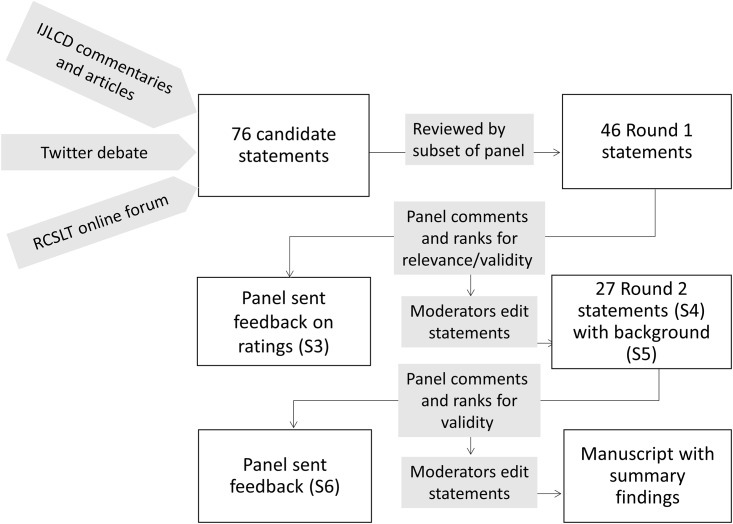
Delayed or impaired language development is a common developmental concern, yet there is little agreement about the criteria used to identify and classify language impairments in children. Children's language difficulties are at the interface between education, medicine and the allied professions, who may all adopt different approaches to conceptualising them. Our goal in this study was to use an online Delphi technique to see whether it was possible to achieve consensus among professionals on appropriate criteria for identifying children who might benefit from specialist services. We recruited a panel of 59 experts representing ten disciplines (including education, psychology, speech-language therapy/pathology, paediatrics and child psychiatry) from English-speaking countries (Australia, Canada, Ireland, New Zealand, United Kingdom and USA). The starting point for round 1 was a set of 46 statements based on articles and commentaries in a special issue of a journal focusing on this topic. Panel members rated each statement for both relevance and validity on a seven-point scale, and added free text comments. These responses were synthesised by the first two authors, who then removed, combined or modified items with a view to improving consensus. The resulting set of statements was returned to the panel for a second evaluation (round 2). Consensus (percentage reporting 'agree' or 'strongly agree') was at least 80 percent for 24 of 27 round 2 statements, though many respondents qualified their response with written comments. These were again synthesised by the first two authors. The resulting consensus statement is reported here, with additional summary of relevant evidence, and a concluding commentary on residual disagreements and gaps in the evidence base.
Overview
The claims and statistics of this paper haven’t been checked yet.
Free: it reads the open-access text and checks the first 5 claims that cite a source we can check. Create a free account to check every claim.
Integrity signals
Registry
Cites
Statistics
Figures
Verification
Claims the paper makes
The claims and statistics of this paper haven’t been checked yet.
Free: it reads the open-access text and checks the first 5 claims that cite a source we can check. Create a free account to check every claim.
Self-check
Percentages, sums and reported differences re-computed from the paper’s own numbers.
The self-check needs the paper’s full text.
Citations
Cites
R: A Language and Environment for Statistical Computing
R Core Team (2025) · doi:10.32614/r.manuals · Cited by 352,181
Diagnostic and Statistical Manual of Mental Disorders
Williams, J. B. W., & First, M. (2013) · Encyclopedia of Social Work · doi:10.1093/acrefore/9780199975839.013.104 · Cited by 109,519
Research guidelines for the Delphi survey technique
Hasson, F. (2000) · Journal of Advanced Nursing · doi:10.1046/j.1365-2648.2000.01567.x · Cited by 5,951 · cited 2×
“The issues we focused on are equally challenging in other countries, but manifestations of language difficulty, and terminology used to describe these, differ across languages [21].”
BackgroundMethodThe Delphi method as a research tool: an example, design considerations and applications
Okoli, C., & Pawlowski, S. D. (2004) · Information & Management · doi:10.1016/j.im.2003.11.002 · Cited by 4,771 · cited 1×
“The advantage of a larger panel is more representative coverage of experts, but a corresponding disadvantage is that the group discussion that is an inherent part of the process gets harder to achieve when more than 40 or 50 participants are involved [27].”
BackgroundThe Delphi Technique: Making Sense of Consensus
Hsu, C.-C., & Sandford, B. A. (2007) · University of Massachusetts Amherst · doi:10.7275/pdz9-th90 · Cited by 4,500
Principles and Practice of Screening for Disease.
(1968) · Annals of Internal Medicine · doi:10.7326/0003-4819-69-5-1085_2 · Cited by 3,066 · cited 1×
“However, as emphasised in the classic text by Wilson and Jungner [33], any screening program must beware of over-identification of problems, which can lead to resources being diverted to cases that do not need them.”
BackgroundPvclust: an R package for assessing the uncertainty in hierarchical clustering
Suzuki, R., & Shimodaira, H. (2006) · Bioinformatics · doi:10.1093/bioinformatics/btl117 · Cited by 2,451 · cited 1×
“The analysis was performed using the R statistical software [31] using the pvclust package [32], which performs hypothesis tests, via bootstrapping, to determine whether a cluster truly exists.”
MethodBoulkedid, R., Abdoul, H., Loustau, M., Sibony, O., & Alberti, C. (2011) · PLoS ONE · doi:10.1371/journal.pone.0020476 · Cited by 2,045 · cited 1×
“Selection of an expert panel is a key part of any Delphi exercise, and has been a topic of some debate in the literature [23].”
BackgroundCurrent validity of the Delphi method in social sciences
Landeta, J. (2006) · Technological Forecasting and Social Change · doi:10.1016/j.techfore.2005.09.002 · Cited by 1,353 · cited 1×
“Although we have noted the advantages of the Delphi technique over in-person consensus meetings, it is important also to recognise its limitations [120].”
BackgroundAn investigation of language impairment in autism: Implications for genetic subgroups
Kjelgaard, M. M., & Tager-Flusberg, H. (2001) · Language and Cognitive Processes · doi:10.1080/01690960042000058 · Cited by 1,130 · cited 1×
“On the other hand, a high proportion of verbal children with ASD have language difficulties similar to those seen in non-autistic children, especially with grammar or phonology [107], though there is debate as to whether the similarities are merely superficial [108].”
Background
Research works printed but not linked: 6
- Baird G (2014) Lumping, splitting, drawing lines, statistical cutoffs and impairment. Commentary on Bishop, D.V.M., 2014, Ten questions about terminology for children with unexplained language problems. Int J Lang Comm Disord 49: 381– 415. PMC4314704 25142090
- Hansson K, Sandgren O, Sahlén B (2014) Changing labels for a concept in change. Commentary on Bishop, D.V.M., 2014, Ten questions about terminology for children with unexplained language problems. Int J Lang Comm Disord 49: 381– 415. PMC4314704 25142090
- Rice M (2014) Advocating for SLI. Commentary on Bishop, D.V.M., 2014, Ten questions about terminology for children with unexplained language problems. Int J Lang Comm Disord 49: 381– 415. PMC4314704 25142090
- Snowling MJ (2014) SLI: Not just a semantic issue. Commentary on Reilly S., Tomblin B., Law J., McKean C., Mensah F. K., Morgan A., Goldfeld S., Nicholson J.M. and Wake M., 2014, Specific language impairment: a convenient label for whom? Int J Lang Comm Disord 49: 416– 451. PMC4303922 25142091 · DOI · Paper page
- Tomblin JB, Zhang X (1999) Are children with SLI a unique group of language learners? In: Tager-Flusberg H, editor. Neurodevelopmental Disorders: contributions to a New Framework from the Cognitive Neuroscience. Cambridge, MA: MIT Press pp. 361– 382.
- Stevenson J (1996) Developmental changes in the mechanisms linking language disabilities and behavior disorders In: Beitchman JH, Cohen NJ, Konstantareas MM, Tannock R, editors. Language, learning, and behavior disorders. Cambridge: Cambridge University Press pp. 78– 100.
Cited by
Items 701–800 of 1,001
Springle, A. P. (2020) · ODU Digital Commons (Old Dominion University) · doi:10.25777/ydms-9d51 · Cited by 1
“…be noted that language impairment is a heterogeneous label, including oral and written language delays and disorders, as well as more narrowly defined impairments, such as specific language impairment, developmental language delay, and even dyslexia (Berninger & Wolf, 2016; Bishop et al., 2016).”
Background(2018) · Elsevier eBooks · doi:10.1016/b978-0-323-44234-3.00024-5 · Cited by 1
Glasby, J. (2021) · Queensland University of Technology · doi:10.5204/thesis.eprints.210531 · Cited by 4
Hulme, C., McGrane, J. A., Duta, M. D., West, G., Cripps, D., Hearne, S., & Snowling, M. J. (2023) · OSF Preprints (OSF Preprints) · doi:10.31219/osf.io/gq6fh · Cited by 1
Self-citationStigma Associated with Speech Delay in the Middle East and North Africa
Ghazy, R. M., Shiba, H. A. A., & Alsaleem, S. A. (2025) · Springer eBooks · doi:10.1007/978-3-031-40858-8_344-1 · Cited by 4
Achim, É. (2024) · Spectrum Research Repository (Concordia University) · Cited by 1
Marinho, L. S. T. (2021) · Portuguese National Funding Agency for Science, Research and Technology (RCAAP Project by FCT) · Cited by 1
Speech and Language in Posterior Fossa Syndrome
de Aguiar, V., Reinders, A., & Svaldi, C. (2026) · Elsevier eBooks · doi:10.1016/b978-0-323-95504-1.01236-9 · Cited by 1
Goble, G., Hennessy, V., Cheng, T.-H. Z., Rodda, A., Taulu, S., Gordon, R. L., & Zhao, T. C. (2026) · PLOS One · doi:10.1371/journal.pone.0335596
Hellström, J., Markgren, S., & Meier, O. C. (2017) · Lund University Publications Student Papers (Lund University) · Cited by 1
Ahlfont, A., & Nilsson, L. E. (2017) · Lund University Publications Student Papers (Lund University)
Can children with developmental language disorder explain actions in terms of intentions?
Donaldson, M. L., Reid, J., & Murray, C. (2017) · First Language · doi:10.1177/0142723717743156
Bélanger, R., Mayer-Crittenden, C., & Brouillette, M. (2017) · Clinical Archives of Communication Disorders · doi:10.21849/cacd.2016.00101 · Cited by 1
Balilah, A. M. (2018) · Scholarship@Western (Western University) · doi:10.13140/rg.2.2.20438.40005 · Cited by 1
Conway, L. J. (2017) · Minerva Access (University of Melbourne)
Developmental Language Disorder (DLD): A persistent language disorder of unknown aetiology
Archibald, L. M. D. (2018) · Scholarship@Western (Western University)
Degabriele, J. (2018) · Trinity's Access to Research Output (TARA) (Trinity College Dublin)
Bernardi, M. (2018) · City Research Online (City University London) · Cited by 1
Kjeldset, A. (2018) · NORA - Norwegian Open Research Archives
Longitudinal associations between language difficulties and internalizing problems
Helland, S. S. (2018) · NVA (Nasjonalt vitenarkiv)
Detection of specific language impairment in young children in well-child healthcare
Diepeveen, F. B. (2019) · Leiden Repository (Leiden University)
Predicting Expressive Language Change in Children With Autism Spectrum Disorder
Rose, V. (2018) · Griffith Research Online · doi:10.25904/1912/3574
Węsierska, M. (2018) · White Rose eTheses Online (University of Leeds, The University of Sheffield, University of York) · Cited by 1
Zweisprachigkeit und das semantische Lexikon
Wahn, C. (2019) · Peter Lang D eBooks · doi:10.3726/b16156
Aylward, G. P. (2020) · Elsevier eBooks · doi:10.1016/b978-0-12-817754-9.00011-8
Pabón, G. A., Díaz, M. F. L., Rojas, J. C. B., & Mateus-Moreno, A. (2019) · Revista Iberoamericana de Psicología · doi:10.33881/2027-1786.rip.12208
Jones, S. (2020) · Lancaster EPrints (Lancaster University) · doi:10.17635/lancaster/thesis/956
Orðaforðakennsla með sögulestri fyrir börn með málþroskaröskun
Sigfúsdóttir, S. A., Einarsdóttir, J. T., Karlsson, Þ., & Bergþórsdóttir, Í. Ö. (2020) · Netla · doi:10.24270/netla.2020.4 · Cited by 8
A study of inhibition in preschool children at risk of Developmental Language Disorder
Thomas, S. A. (2020) · University of Hertfordshire Research Archive (University of Hertfordshire) · doi:10.18745/th.23062
“The term DLD was proposed following the CATALISE consultation with language professionals from several countries (Bishop et al. 2016) as this was thought to provide a more appropriate diagnostic description of the difficulties faced by children with language problems which may not be specific to…”
BackgroundMethodInfluentialAcquisition of Literacy in a Second Language
Koda, K. (2020) · Cambridge University Press eBooks · doi:10.1017/9781108658089.017 · Cited by 2
Conrad, S., Hartig, A. J., & Santelmann, L. M. (2020) · Cambridge University Press eBooks · doi:10.1017/9781108658089.034
Second Language Acquisition and the Teaching of Pragmatics
Santelmann, L. M., & Sydorenko, T. (2020) · Cambridge University Press eBooks · doi:10.1017/9781108658089.003
Influential factors in driving confidence among hearing-impaired older adults in Cape Town
Cohen, R. (2020) · Open University of Cape Town (University of Cape Town)
Kilpatrick, T. (2020) · eSpace (Curtin University)
Ferinu, L., Ahufinger, N., Sanz‐Torrent, M., & Andreu, L. (2020) · Llengua societat i comunicació · doi:10.1344/lsc-2020.18.3 · Cited by 1
Síndromes genéticas e a atuação fonoaudiológica
Maximino, L. P., Cavalheiro, M. G., & Corrêa, C. D. C. (2020) · Faculdade de Filosofia e Ciências eBooks · doi:10.36311/2020.978-65-86546-87-3.p165-184
Diagnóstico fonoaudiológico de crianças com transtorno do neurodesenvolvimento
Lamônica, D. A. C., & Ferreira‐Vasques, A. T. (2020) · Faculdade de Filosofia e Ciências eBooks · doi:10.36311/2020.978-65-86546-87-3.p207-222
El lenguaje en los alumnos con Trastorno por Déficit de Atención y/o Hiperactividad
Pérez-Castelló, J. A., & Alvarado-Alonso, H. (2020) · Llengua societat i comunicació · doi:10.1344/lsc-2020.18.8
Actes des Journées Développement de l’articulation : du développement typique à la dyspraxie verbale
Vilain, A., Lœvenbruck, H., Meloni, G., Gillet-Perret, E., & Nguyen-Morel, M.-A. (2017) · HAL
Validity of the Verbal Intelligence Quotient as a Proxy for Language Ability
de Oliveira, L. R. (2019)
França, T. (2020) · Portuguese National Funding Agency for Science, Research and Technology (RCAAP Project by FCT)
Author, U. (2020) · BGRO - Business, Governance and Religious Organisations Repository · doi:10.24385/lincoln.24326365 · Cited by 1
Public awareness of developmental language disorders in Slovenia
Čamernik, T. (2020) · Repository of the University of Ljubljana (University of Ljubljana)
Phan, L. (2021) · TSpace (University of Toronto)
Khater, M. (2021) · Studies in Arabic linguistics · doi:10.1075/sal.10.07kha
Språkutvecklande klassrumsmiljö : en jämförande studie mellan traditionell och kooperativ skolkultur
Fältros, M. (2020) · Diva portal (Dalarna University Library)
Grenner, E. (2021) · Lund University Publications (Lund University) · Cited by 4
Fradley, K. (2026) · e-space (Manchester Metropolitan University) · doi:10.83056/mmu.32478144
Working Memory Task Performance in Children With SLI: A Behavioral and ERP Study
McVeety, M. (2021) · CUNY Academic Works (City University of New York)
Cost-reducing strategies in the production of Brazilian Portuguese relative clauses
Corrêa, L. M. S., & Augusto, M. R. A. (2021) · Language acquisition & language disorders · doi:10.1075/lald.65.03cor
Murphy, C., Frizelle, P., McKean, C., & Quinto-Pozos, D. G. (2021) · Oxford University Press eBooks · doi:10.1093/oso/9780190885052.003.0016
SLT- practical aspects: inquiries, good practices and evidence based interventions
Tudorean, O.-C. (2021) · Revista Română de Terapia Tulburărilor de Limbaj şi Comunicare · doi:10.26744/rrttlc.2021.7.2.04
Score Use and Interpretation of First Spoken Language Assessments
Camilleri, B. (2021) · Oxford University Press eBooks · doi:10.1093/oso/9780190885052.003.0005
Conrad, S., Hartig, A. J., & Santelmann, L. M. (2020) · Cambridge University Press eBooks · doi:10.1017/9781108658089.026
Next Steps as an Applied Linguist
(2020) · Cambridge University Press eBooks · doi:10.1017/9781108658089.032
Community, Group Dynamics, Identity, and Anxiety in Learning an Additional Language
Arnold, N. (2020) · Cambridge University Press eBooks · doi:10.1017/9781108658089.005
Policy and Planning at a Local Level with English as a Lingua Franca and Teacher Education
Gimenez, T., Kadri, M. S. E., & Calvo, L. C. S. (2020) · Cambridge University Press eBooks · doi:10.1017/9781108658089.016
Lanchares, A. A. (2021) · UVaDOC UVaDOC University of Valladolid Documentary Repository (University of Valladolid) · doi:10.35376/10324/51843 · Cited by 3
Editorial: Socio-Emotional and Educational Variables in Developmental Language Disorder (DLD)
Aguilar-Mediavilla, E. M., O’Kearney, R., Adrover‐Roig, D., Simon‐Cereijido, G., & Buil‐Legaz, L. (2022) · Frontiers in Psychology · doi:10.3389/fpsyg.2022.882397
“…language delay not resolved at age five that impacts everyday life communication and learning in the absence of a medical condition, such as brain injury, genetic conditions or chromosomal disorders, hearing loss, autism spectrum disorders or intellectual disability (Bishop et al., 2016, 2017).”
BackgroundKunnari, S., Laasonen, M. R., & Smolander, S. (2019) · Routledge eBooks · doi:10.4324/9780429455308-15
(2020) · Elsevier eBooks · doi:10.1016/b978-0-12-817754-9.09990-6
Twomey, K. E., & Hilton, M. (2020) · Wiley eBooks · doi:10.1002/9781119171492.wecad126
Sprachentwicklungsstörungen (SES)
(2006) · Elsevier eBooks · doi:10.1016/b978-3-437-47785-0.00003-5
A lifespan perspective of cognitive control involvement during language comprehensionPreprint
Tiali, S. E. B., & Perrone‐Bertolotti, M. (2021) · PsyArXiv (OSF Preprints) · doi:10.31234/osf.io/r8y3d
(2020) · Cambridge University Press eBooks · doi:10.1017/9781108658089.035
The origins of sentence processing difficulties in developmental language disorderPreprint
Jones, S. D., & Westermann, G. (2022) · OSF Preprints (OSF Preprints) · doi:10.31219/osf.io/eps3y
Vaughn, L. E. (2021) · Louisiana State University · doi:10.31390/gradschool_dissertations.5693
“The debate was fueled in part by a special volume devoted to the SLI label (Ebbles, 2014), which led to a Delphi consensus study (Bishop et al., 2016), a collection of commentaries about the Delphi study (Bishop et al., 2017), conference panels (e.g., Owen van Horn et al., 2018), opinion papers…”
BackgroundOxley, E., Nash, H. M., & Weighall, A. (2022) · doi:10.31219/osf.io/kd3rs
Early Language Intervention in School Settings: What Works for Whom?
Gândara, J. P., da Silveira, H. G., Sousa, H., Ramacciotti, M. C. C., & Puglisi, M. L. (2022) · Springer eBooks · doi:10.1007/978-3-031-06908-6_18 · Cited by 1
Investigación educacional: evidencias para la innovación educativa
Sánchez Bravo, A. (2022) · Ariadna Ediciones eBooks · doi:10.26448/ae9789566095521.37 · Cited by 1
Leonti, O., Daigle, D., & Montésinos‐Gelet, I. (2022) · Canadian Journal of Education / Revue canadienne de l éducation · doi:10.53967/cje-rce.5163
“…conséquence la plus probante d’un trouble développemental du langage (TDL) est l’acquisition lente et atypique du langage oral (Bishop et al., 2016, 2017 ; Breault et al., 2019 ; Ebbels, 2014 ; Leonard, 2014 ; Ordre des orthophonistes et audiologistes du Québec [OOAQ],…”
BackgroundScreening dei disturbi del linguaggio orale nel bambino e loro classificazione
Coffre, A., Giraud, L., Rebière, C., Rivron, A., Troussier, J., & Righini, C. A. (2022) · EMC - Otorinolaringoiatria · doi:10.1016/s1639-870x(22)46876-0
Strategies for Teaching Verbs to Children with and without Language Impairment
Prahl, A., & McDaniel, J. (2023) · Seminars in Speech and Language · doi:10.1055/s-0043-1773785
Language Acquisition in Diverse Linguistic, Social and Cognitive Circumstances, volume II
Garraffa, M., Morgan, G., Marinis, T., & Guasti, M. T. (2023) · Frontiers research topics · doi:10.3389/978-2-8325-3573-8
Hulme, C., McGrane, J. A., Duta, M. D., West, G., Cripps, D., Dasgupta, A., Hearne, S., Gardner, R., & Snowling, M. J. (2023) · PsyArXiv (OSF Preprints) · doi:10.31234/osf.io/aeqzn
Self-citationZnaczenie sprawności językowych dla rozwoju dziecka w wieku przedszkolnym
Bielenda‐Mazur, E. (2023) · Rocznik Przemyski Literatura i Język · doi:10.4467/24497363rplj.23.010.18962
Westby, C. E. (2024) · Word of Mouth · doi:10.1177/10483950231225114a
“Speech-language pathologists (SLPs) are the professionals with primary responsibility for its treatment (Bishop et al., 2016).”
BackgroundHill, E., Wilmot, A., Leitão, S., Jackson, E., Jones, K., & Boyes, M. E. (2024) · PsyArXiv (OSF Preprints) · doi:10.31234/osf.io/xcsut
Ahufinger, N., Aguilera, M., Guerra, E., Giberga, A., Verdaguer-Ribas, O., Balboa-Castells, R., Andreu, L., Esteve‐Gibert, N., & Sanz‐Torrent, M. (2024) · SSRN Electronic Journal · doi:10.2139/ssrn.4750031
Tiali, S. E. B., & Tiali, B. (2022) · theses.fr (ABES) · doi:10.70675/fc0be2f8zf337z4551z9af4z021eda46ce59
The Role of Research in Applied Linguistics
Żammit, J. (2024) · Advances in educational technologies and instructional design book series · doi:10.4018/979-8-3693-3294-8.ch009
Ahufinger, N., Aguilera, M., Giberga, A., Verdaguer-Ribas, O., Balboa-Castells, R., Andreu, L., Esteve‐Gibert, N., & Sanz‐Torrent, M. (2024) · SSRN Electronic Journal · doi:10.2139/ssrn.4807889
Smit, K., Gelder, C. D., Wardenier, J., Stoker, J., & Marks, F. (2023) · International Conference on Software and e-Business (ICSEB) · doi:10.1145/3641067.3641068
“Definitions of DLD all refer to the significant impact the disorder has on social interactions and educational progress [3].”
BackgroundCooke, L., Andersson, K., & Johansson, M. B. (2024) · Acta logopaedica · doi:10.58986/al.2024.13024
“In assessment, information from teachers and observations are therefore also needed, which aligns with the recommendations of the CATALISE consortium (Bishop et al. , 2016; Waine et al. , 2023).”
BackgroundMethodRučević, S. (2024) · Dijete i obitelj u suvremenom društvu · doi:10.25234/dosd/31500
Frota, S., Cruz, M., Filipe, M. G., Silva, P., & Vigário, M. (2024) · Procedia Computer Science · doi:10.1016/j.procs.2024.06.219 · Cited by 1
Reading Skills of Individuals With Developmental Language Disorder (DLD)
Aslanoglou, V., Ανδρέου, Γ., Vlachos, F. M., & Lymperopoulou, V. (2024) · Advances in psychology, mental health, and behavioral studies (APMHBS) book series · doi:10.4018/979-8-3693-8931-7.ch008
Vilus, E. P. (2024) · Logopedija · doi:10.31299/log.14.1.5
Ambiado-Lillo, M. M., & Blake, M. G. (2024) · Revista Médica Clínica Las Condes · doi:10.1016/j.rmclc.2024.07.007
Jiang, X., & Chen, L. (2024) · Clinical Linguistics & Phonetics · doi:10.1080/02699206.2024.2419415
ÇOCUKLARINDA GELİŞİMSEL DİL BOZUKLUĞU OLAN AİLELERİN TERAPİ SÜRECİ HAKKINDA GÖRÜŞLERİNİN ALINMASI
Kütükçü, D. K., & Kahraman, S. A. (2024) · Samsun Sağlık Bilimleri Dergisi · doi:10.47115/jshs.1436257
Kramarić, M. (2024) · Hrvatska revija za rehabilitacijska istraživanja · doi:10.31299/hrri.60.2.1
Combining genetic and behavioral predictors of 11-year language outcomePreprint
Gasparini, L., Shepherd, D. A., Lange, K., Wang, J., Verhoef, E., Bavin, E. L., Reilly, S., Pourcain, B. S., Wake, M. A., & Morgan, A. T. (2025) · PsyArXiv (OSF Preprints) · doi:10.31234/osf.io/x4fye
Tığrak, T. K., Tığrak, A., Şimşek, D. Ö., & Özcebe, E. (2025) · International Journal of Language & Communication Disorders · doi:10.1111/1460-6984.70010
Metadata
- Authors
- Bishop, D. V. M., Snowling, M. J., Thompson, P. A., Greenhalgh, T., & CATALISE consortium
- Affiliations
- University of Oxford (GB)
- Corresponding author
- Bishop, D. V. M.
- Venue
- PLOS ONE
- Publisher
- Public Library of Science (PLoS)
- Published
- 2016-07-08
- Volume
- 11
- Issue
- 7
- Pages
- e0158753
- ISSN
- 1932-6203 (ISSN-L)
- PMC
- PMC4938414
- OpenAlex
- W2336526731
- Cited by
- 831
- References
- 129
- Citations by year
- 2026: 73 · 2025: 105 · 2024: 89 · 2023: 85 · 2022: 99 · 2021: 104 · 2020: 118 · 2019: 67 · 2018: 55 · 2017: 30 · 2016: 4
- FWCI
- 121.75
- Type
- journal article
- Language
- en
- Update notices
- correction (2016-12-09)
- Open access
- gold
- doi.org
- Licence
- Locations
- PLoS ONE (publishedVersion, cc-by)
- PubMed Central (publishedVersion, cc-by)
- PubMed (publishedVersion)
- OpenBU (Boston University) (publishedVersion, cc-by)
- University of Birmingham Research Portal (University of Birmingham) (publishedVersion, other-oa)
- White Rose Research Online (University of Leeds, The University of Sheffield, University of York) (acceptedVersion)
- Strathprints: The University of Strathclyde institutional repository (University of Strathclyde) (acceptedVersion)
- Arrow@dit (Dublin Institute of Technology) (acceptedVersion)
- Griffith Research Online (submittedVersion, cc-by)
- UTUPub (University of Turku) (submittedVersion)
- UWA Profiles and Research Repository (UWA) (submittedVersion, cc-by)
- Cork Open Research Archive (University College Cork, Ireland) (submittedVersion, cc-by)
- DOAJ (DOAJ: Directory of Open Access Journals) (submittedVersion, cc-by-sa)
- Stirling Online Research Repository (University of Stirling) (submittedVersion, cc-by)
- UCL Discovery (University College London) (submittedVersion)
- Figshare (submittedVersion, cc-by-nc-sa)
- Figshare (submittedVersion)
- Figshare (submittedVersion, cc-by)
- The HKU Scholars Hub (University of Hong Kong) (submittedVersion, cc-by-nc-nd)
- Scholarship@Western (Western University) (submittedVersion, cc-by)
- Minerva Access (University of Melbourne) (submittedVersion, cc-by)
- Open Research Exeter (University of Exeter) (submittedVersion)
- Research Explorer (The University of Manchester) (submittedVersion, cc-by)
- Edinburgh Research Explorer (University of Edinburgh) (submittedVersion, cc-by)
- ResearchSpace (University of Auckland) (submittedVersion, cc-by)
- University of Limerick Institutional Repository (University of Limerick) (submittedVersion, cc-by-nc-sa)
- Scholarship@Western (Western University) (submittedVersion)
- Warwick Research Archive Portal (University of Warwick) (submittedVersion)
- Funders
- Wellcome Trust (082498/Z/07/Z)
- Topics
- Social Sciences › Psychology › Developmental and Educational Psychology › Language Development and Disorders
- Social Sciences › Psychology › Neuropsychology and Physiological Psychology › Developmental and Educational Neuropsychology
- Health Sciences › Health Professions › Speech and Hearing › Voice and Speech Disorders
- Keywords
- language impairment, children, diagnostic criteria, multidisciplinary consensus, language delay, speech-language pathology, child psychiatry
- MeSH terms
- Australia, Canada, Delphi Technique, United Kingdom, Humans, Ireland, Language Disorders, New Zealand, Interdisciplinary Studies
About these checks
Registry, retraction, Cites and statistics results are computed, not judged, with one exception: a printed reference that no index lists is read once by a model before it counts as a citation error. Claims are extracted by a model and kept only when their quote appears verbatim in the text; each cited source is then checked, with a model’s help, for whether it says what the claim relies on. Those verdicts can be wrong — read the claim’s quote and the cited source before relying on one.
Statistics and arithmetic are recomputed, not judged.
Confidence bands are shown only for fields calibrated on our annotated test set. None is calibrated yet, so no band is shown.
What counts as a claim ›How we measure confidence ›How we check this ›
Are you an author, or do you see a problem with this page? Request a review
Data sources
Bibliographic data: Semantic Scholar, OpenAlex, Crossref.
Contains information from the Semantic Scholar Academic Graph Datasets, made available under the ODC Attribution License (ODC-BY 1.0).
Semantic Scholar’s data is described in: Kinney, R., et al. (2023). The Semantic Scholar Open Data Platform. arXiv:2301.10140.
