

CATALISE: A Multinational and Multidisciplinary Delphi Consensus Study. Identifying Language Impairments in Children
Open accessThe DOI matches its Crossref record; 127 of the 129 references it cites were found in a registry or an index.
Abstract
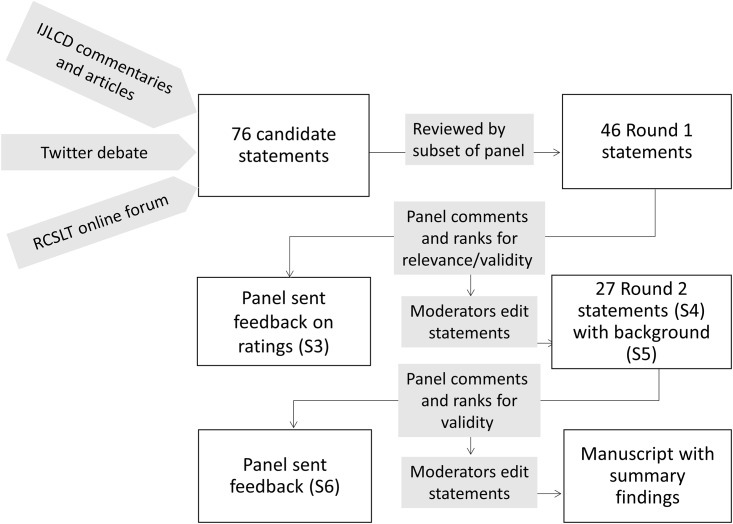
Delayed or impaired language development is a common developmental concern, yet there is little agreement about the criteria used to identify and classify language impairments in children. Children's language difficulties are at the interface between education, medicine and the allied professions, who may all adopt different approaches to conceptualising them. Our goal in this study was to use an online Delphi technique to see whether it was possible to achieve consensus among professionals on appropriate criteria for identifying children who might benefit from specialist services. We recruited a panel of 59 experts representing ten disciplines (including education, psychology, speech-language therapy/pathology, paediatrics and child psychiatry) from English-speaking countries (Australia, Canada, Ireland, New Zealand, United Kingdom and USA). The starting point for round 1 was a set of 46 statements based on articles and commentaries in a special issue of a journal focusing on this topic. Panel members rated each statement for both relevance and validity on a seven-point scale, and added free text comments. These responses were synthesised by the first two authors, who then removed, combined or modified items with a view to improving consensus. The resulting set of statements was returned to the panel for a second evaluation (round 2). Consensus (percentage reporting 'agree' or 'strongly agree') was at least 80 percent for 24 of 27 round 2 statements, though many respondents qualified their response with written comments. These were again synthesised by the first two authors. The resulting consensus statement is reported here, with additional summary of relevant evidence, and a concluding commentary on residual disagreements and gaps in the evidence base.
Overview
The claims and statistics of this paper haven’t been checked yet.
Free: it reads the open-access text and checks the first 5 claims that cite a source we can check. Create a free account to check every claim.
Integrity signals
Registry
Cites
Statistics
Figures
Verification
Claims the paper makes
The claims and statistics of this paper haven’t been checked yet.
Free: it reads the open-access text and checks the first 5 claims that cite a source we can check. Create a free account to check every claim.
Self-check
Percentages, sums and reported differences re-computed from the paper’s own numbers.
The self-check needs the paper’s full text.
Citations
Cites
R: A Language and Environment for Statistical Computing
R Core Team (2025) · doi:10.32614/r.manuals · Cited by 352,181
Diagnostic and Statistical Manual of Mental Disorders
Williams, J. B. W., & First, M. (2013) · Encyclopedia of Social Work · doi:10.1093/acrefore/9780199975839.013.104 · Cited by 109,519
Research guidelines for the Delphi survey technique
Hasson, F. (2000) · Journal of Advanced Nursing · doi:10.1046/j.1365-2648.2000.01567.x · Cited by 5,951 · cited 2×
“The issues we focused on are equally challenging in other countries, but manifestations of language difficulty, and terminology used to describe these, differ across languages [21].”
BackgroundMethodThe Delphi method as a research tool: an example, design considerations and applications
Okoli, C., & Pawlowski, S. D. (2004) · Information & Management · doi:10.1016/j.im.2003.11.002 · Cited by 4,771 · cited 1×
“The advantage of a larger panel is more representative coverage of experts, but a corresponding disadvantage is that the group discussion that is an inherent part of the process gets harder to achieve when more than 40 or 50 participants are involved [27].”
BackgroundThe Delphi Technique: Making Sense of Consensus
Hsu, C.-C., & Sandford, B. A. (2007) · University of Massachusetts Amherst · doi:10.7275/pdz9-th90 · Cited by 4,500
Principles and Practice of Screening for Disease.
(1968) · Annals of Internal Medicine · doi:10.7326/0003-4819-69-5-1085_2 · Cited by 3,066 · cited 1×
“However, as emphasised in the classic text by Wilson and Jungner [33], any screening program must beware of over-identification of problems, which can lead to resources being diverted to cases that do not need them.”
BackgroundPvclust: an R package for assessing the uncertainty in hierarchical clustering
Suzuki, R., & Shimodaira, H. (2006) · Bioinformatics · doi:10.1093/bioinformatics/btl117 · Cited by 2,451 · cited 1×
“The analysis was performed using the R statistical software [31] using the pvclust package [32], which performs hypothesis tests, via bootstrapping, to determine whether a cluster truly exists.”
MethodBoulkedid, R., Abdoul, H., Loustau, M., Sibony, O., & Alberti, C. (2011) · PLoS ONE · doi:10.1371/journal.pone.0020476 · Cited by 2,045 · cited 1×
“Selection of an expert panel is a key part of any Delphi exercise, and has been a topic of some debate in the literature [23].”
BackgroundCurrent validity of the Delphi method in social sciences
Landeta, J. (2006) · Technological Forecasting and Social Change · doi:10.1016/j.techfore.2005.09.002 · Cited by 1,353 · cited 1×
“Although we have noted the advantages of the Delphi technique over in-person consensus meetings, it is important also to recognise its limitations [120].”
BackgroundAn investigation of language impairment in autism: Implications for genetic subgroups
Kjelgaard, M. M., & Tager-Flusberg, H. (2001) · Language and Cognitive Processes · doi:10.1080/01690960042000058 · Cited by 1,130 · cited 1×
“On the other hand, a high proportion of verbal children with ASD have language difficulties similar to those seen in non-autistic children, especially with grammar or phonology [107], though there is debate as to whether the similarities are merely superficial [108].”
Background
Research works printed but not linked: 6
- Baird G (2014) Lumping, splitting, drawing lines, statistical cutoffs and impairment. Commentary on Bishop, D.V.M., 2014, Ten questions about terminology for children with unexplained language problems. Int J Lang Comm Disord 49: 381– 415. PMC4314704 25142090
- Hansson K, Sandgren O, Sahlén B (2014) Changing labels for a concept in change. Commentary on Bishop, D.V.M., 2014, Ten questions about terminology for children with unexplained language problems. Int J Lang Comm Disord 49: 381– 415. PMC4314704 25142090
- Rice M (2014) Advocating for SLI. Commentary on Bishop, D.V.M., 2014, Ten questions about terminology for children with unexplained language problems. Int J Lang Comm Disord 49: 381– 415. PMC4314704 25142090
- Snowling MJ (2014) SLI: Not just a semantic issue. Commentary on Reilly S., Tomblin B., Law J., McKean C., Mensah F. K., Morgan A., Goldfeld S., Nicholson J.M. and Wake M., 2014, Specific language impairment: a convenient label for whom? Int J Lang Comm Disord 49: 416– 451. PMC4303922 25142091 · DOI · Paper page
- Tomblin JB, Zhang X (1999) Are children with SLI a unique group of language learners? In: Tager-Flusberg H, editor. Neurodevelopmental Disorders: contributions to a New Framework from the Cognitive Neuroscience. Cambridge, MA: MIT Press pp. 361– 382.
- Stevenson J (1996) Developmental changes in the mechanisms linking language disabilities and behavior disorders In: Beitchman JH, Cohen NJ, Konstantareas MM, Tannock R, editors. Language, learning, and behavior disorders. Cambridge: Cambridge University Press pp. 78– 100.
Cited by
Items 101–200 of 1,001
Diverging Views on Language Disorders
Volkers, N. (2018) · ASHA Leader · doi:10.1044/leader.ftr1.23122018.44 · Cited by 40
Language characterization in 16p11.2 deletion and duplication syndromes
Kim, S. H., Green‐Snyder, L., Lord, C., Bishop, S. L., Steinman, K. J., Bernier, R., Hanson, E. M., Goin‐Kochel, R. P., & Chung, W. K. (2020) · American Journal of Medical Genetics Part B Neuropsychiatric Genetics · doi:10.1002/ajmg.b.32809 · Cited by 39
Intervención en Trastorno del Desarrollo del Lenguaje (TDL). Una revisión sistemática (2000-2020)
Godoy, C. B., Serrat, E., & Suñé, M. V. I. (2021) · Revista de Investigación en Logopedia · doi:10.5209/rlog.71975 · Cited by 48
“…que permitan establecer la distinción respecto de la población con desarrollo típico del lenguaje; así como las dificultades asociadas y derivadas del TDL, entre otras (Aguado et al., 2015; Aguilar-Mediavilla, Buil-Legaz, Esteller-Cano & Pérez-Castelló, 2019; Bishop et al., 2016; Mendoza, 2016).”
BackgroundInfluentialDenman, D., Cordier, R., Kim, J., Munro, N., & Speyer, R. (2021) · Language Speech and Hearing Services in Schools · doi:10.1044/2021_lshss-20-00053 · Cited by 39
Reilly, S., & McKean, C. (2023) · International Journal of Language & Communication Disorders · doi:10.1111/1460-6984.12929 · Cited by 44
Guo, L.-Y., Eisenberg, S. L., Schneider, P., & Spencer, L. J. (2019) · American Journal of Speech-Language Pathology · doi:10.1044/2019_ajslp-18-0228 · Cited by 35
Nudel, R., Christiani, C. J., Ohland, J., Uddin, M. J., Hemager, N., Ellersgaard, D., Spang, K. S., Burton, B. K., Greve, A. N., Gantriis, D. L., et al. (2019) · Autism Research · doi:10.1002/aur.2211 · Cited by 38
Toseeb, U., & Clair, M. S. (2020) · Journal of Communication Disorders · doi:10.1016/j.jcomdis.2020.105984 · Cited by 36
“It is a neurodevelopmental disorder which is characterised by difficulties in using and/or understanding oral language in the absence of any other neurodevelopment disorder or substantial hearing loss (Bishop et al., 2016).”
BackgroundResultBruinsma, G. I., Wijnen, F. N. K., & Gerrits, E. (2022) · International Journal of Language & Communication Disorders · doi:10.1111/1460-6984.12821 · Cited by 39
Analysis of behavioural characteristics of children with developmental language disorders
Özcebe, E., Erbaş, A. N., & Tığrak, T. K. (2019) · International Journal of Speech-Language Pathology · doi:10.1080/17549507.2019.1571631 · Cited by 42
“A recent multinational and multidisciplinary consensus has been created regarding language disorder classifications and terminology, and the term developmental language disorder (DLD) (Bishop et al., 2016, 2017) embraced.”
BackgroundInfluentialCastilla-Earls, A. P., Pérez‐Leroux, A. T., Fulcher-Rood, K., & Barr, C. D. (2021) · Language Speech and Hearing Services in Schools · doi:10.1044/2020_lshss-20-00017 · Cited by 34
Systematic Review and Meta-Analysis of Screening Tools for Language Disorder
So, K. K. H., & To, C. K. S. (2022) · Frontiers in Pediatrics · doi:10.3389/fped.2022.801220 · Cited by 39
“Referral to evaluation may not be not based on positive results in universal screening, but mainly concerns from caregivers, the presence of extreme deviation in development, or the manifestation of behavioral or psychiatric disturbances under 5 years old (9).”
BackgroundLavelli, M., Barachetti, C., Majorano, M., Florit, E., Brotto, C., & Miottello, P. (2019) · International Journal of Language & Communication Disorders · doi:10.1111/1460-6984.12460 · Cited by 37
Burnley, A., St Clair, M., Bedford, R., Wren, Y., & Dack, C. (2023) · Journal of Neurodevelopmental Disorders · doi:10.1186/s11689-023-09486-w · Cited by 33
“Background Developmental language disorder (DLD) is characterised by difficulties with expressive and receptive language, impacting individuals’ everyday lives and social interactions [1].”
BackgroundPigdon, L., Willmott, C., Reilly, S., Conti‐Ramsden, G., Liegeois, F. J., Connelly, A., & Morgan, A. T. (2020) · Neuropsychologia · doi:10.1016/j.neuropsychologia.2019.107312 · Cited by 36
Ehrhorn, A. M., Adlof, S. M., Fogerty, D., & Laing, S. (2020) · Scientific Studies of Reading · doi:10.1080/10888438.2020.1849223 · Cited by 38
Quantitative analysis of disfluency in children with autism spectrum disorder or language impairment
MacFarlane, H., Gorman, K., Ingham, R., Presmanes Hill, A., Papadakis, K., Kiss, G., & van Santen, J. (2017) · PLOS ONE · doi:10.1371/journal.pone.0173936 · Cited by 32
Alduais, A. M. S., Al-Qaderi, I. A. U., & Alfadda, H. A. (2022) · Children · doi:10.3390/children9091407 · Cited by 38
Sleep behaviour relates to language skills in children with and without communication disorders
Botting, N., & Baraka, N. (2017) · International Journal of Developmental Disabilities · doi:10.1080/20473869.2017.1283766 · Cited by 40
“Two main groups of children with communication difficulties are those with developmental language disorder (DLD — sometimes referred to as specific language impairment but see Bishop 2014; Bishop et al. 2016) and those with autism spectrum disorder (ASD).”
BackgroundUse of diverse diagnostic criteria for acquired apraxia of speech: a scoping review
Molloy, J., & Jagoe, C. (2019) · International Journal of Language & Communication Disorders · doi:10.1111/1460-6984.12494 · Cited by 34
Frizelle, P., Tolonen, A., Tulip, J., Murphy, C., Saldaña, D., & McKean, C. (2021) · Journal of Speech Language and Hearing Research · doi:10.1044/2021_jslhr-20-00734 · Cited by 35
Capturing the Nature of the Spelling Errors in Developmental Language Disorder: A Scoping Review
Broc, L., Joye, N., Dockrell, J. E., & Olive, T. (2021) · Language Speech and Hearing Services in Schools · doi:10.1044/2021_lshss-20-00086 · Cited by 38
Wilder, A., & Redmond, S. M. (2022) · Journal of Speech Language and Hearing Research · doi:10.1044/2022_jslhr-21-00628 · Cited by 36
Nitin, R., Shaw, D. M., Rocha, D. B., Walters, C. E., Chabris, C. F., Camarata, S., Gordon, R. L., & Below, J. E. (2022) · JAMA Network Open · doi:10.1001/jamanetworkopen.2022.48060 · Cited by 36
Dockrell, J. E., & Hurry, J. (2018) · Research in Developmental Disabilities · doi:10.1016/j.ridd.2018.04.009 · Cited by 37
Diagnostic Decisions in Child Language Assessment: Findings From a Case Review Assessment Task
Fulcher-Rood, K., Castilla-Earls, A. P., & Higginbotham, D. J. (2019) · Language Speech and Hearing Services in Schools · doi:10.1044/2019_lshss-18-0044 · Cited by 31
Redmond, S. M. (2020) · Journal of Speech Language and Hearing Research · doi:10.1044/2020_jslhr-20-00050 · Cited by 32
“Specifically, an alternative designation, developmental language disorder (DLD), associated with more flexible criteria than customarily associated with SLI and proposed by the CATALISE international consortium of scholars and practitioners led by D. V. M. Bishop (Bishop et al., 2016.”
Cross-situational statistical learning in children with developmental language disorder
Ahufinger, N., Guerra, E., Ferinu, L., Andreu, L., & Sanz‐Torrent, M. (2021) · Language Cognition and Neuroscience · doi:10.1080/23273798.2021.1922723 · Cited by 32
“Children with DLD have a severe and persistent neurodevelopmental disorder in the acquisition and development of oral language, not associated with a medical condition (Bishop et al., 2016, 2017).”
BackgroundProfiling Bilingual Children: Using Monolingual Assessment to Inform Diagnosis
Rose, K., Armon-Lotem, S., & Altman, C. (2022) · Language Speech and Hearing Services in Schools · doi:10.1044/2021_lshss-21-00099 · Cited by 31
Evans, J. L., Gillam, R. B., & Montgomery, J. W. (2018) · Journal of Speech Language and Hearing Research · doi:10.1044/2018_jslhr-l-17-0150 · Cited by 31
Hayiou‐Thomas, M. E., Smith‐Woolley, E., & Dale, P. S. (2020) · Developmental Science · doi:10.1111/desc.12998 · Cited by 32
“Family aggregation and family risk studies strongly suggest that what is shared in the family is not specifically dyslexia or DLD, but rather weak language skills more broadly defined: a child with DLD is as likely to have parents or siblings who have dyslexia, as s/he is to have family members with oral language diff…”
BackgroundBruinsma, G. I., Wijnen, F. N. K., & Gerrits, E. (2020) · Language Speech and Hearing Services in Schools · doi:10.1044/2020_lshss-19-00069 · Cited by 32
Calder, S. D., Claessen, M., Ebbels, S. H., & Leitão, S. (2020) · Language Speech and Hearing Services in Schools · doi:10.1044/2019_lshss-19-00060 · Cited by 35
García, I. S., Valera-Pozo, M., Sanchez-Azanza, V. A., Adrover‐Roig, D., & Aguilar-Mediavilla, E. M. (2021) · Frontiers in Psychology · doi:10.3389/fpsyg.2021.718110 · Cited by 31
Working Memory Performance in Children With Developmental Language Disorder: The Role of Domain
Larson, C., & Weismer, S. E. (2022) · Journal of Speech Language and Hearing Research · doi:10.1044/2022_jslhr-21-00420 · Cited by 34
Lüke, C., Kauschke, C., Dohmen, A., Haid, A., Leitinger, C., Männel, C., Penz, T., Sachse, S., Rethfeldt, W. S., Spranger, J., et al. (2023) · PLoS ONE · doi:10.1371/journal.pone.0293736 · Cited by 33
Morgan, L., Delehanty, A., Cleary Dillon, J., Schatschneider, C., & Wetherby, A. M. (2020) · Early Childhood Research Quarterly · doi:10.1016/j.ecresq.2019.12.005 · Cited by 29
Children with specific language impairment are more likely to reach motor milestones late
Diepeveen, F. B., van Dommelen, P., Oudesluys‐Murphy, A. M., & Verkerk, P. H. (2018) · Child Care Health and Development · doi:10.1111/cch.12614 · Cited by 33
“” (Bishop, et al., 2016).”
Hulme, C., McGrane, J. A., Duta, M. D., West, G., Cripps, D., Dasgupta, A., Hearne, S., Gardner, R., & Snowling, M. J. (2024) · Language Speech and Hearing Services in Schools · doi:10.1044/2024_lshss-24-00004 · Cited by 34
“…with speech than in the case of children with language difficulties, and an issue of concern is that DLDs may only come to light after a child is referred for treatment of a behavioral disorder (Bishop et al., 2016; Kaiser et al., 2022; McGregor, 2020; Paul, 2007; Tannock & Schachar, 1996).”
Self-citationSyntax and working memory in typically-developing children: Focus on syntactic complexity
Delage, H., & Frauenfelder, U. H. (2019) · Language Interaction and Acquisition · doi:10.1075/lia.18013.del · Cited by 46
Coales, C., Heaney, N., Ricketts, J., Dockrell, J. E., Lindsay, G., Palikara, O., & Charman, T. (2019) · Autism & Developmental Language Impairments · doi:10.1177/2396941519851225 · Cited by 28
Wang, D., Li, Z., Lin, Y., Zhang, Y., & Sheng, L. (2022) · Journal of Speech Language and Hearing Research · doi:10.1044/2021_jslhr-21-00401 · Cited by 28
Stevenson, J., Pimperton, H., Kreppner, J., Worsfold, S., Terlektsi, E., Mahon, M., & Kennedy, C. (2017) · Journal of Child Psychology and Psychiatry · doi:10.1111/jcpp.12803 · Cited by 34
Cordier, R., Munro, N., Wilkes‐Gillan, S., Speyer, R., Parsons, L., & Joosten, A. V. (2019) · Frontiers in Psychology · doi:10.3389/fpsyg.2019.00408 · Cited by 27
Schachinger-Lorentzon, U., Kadesjö, B., Gillberg, C., & Miniscalco, C. (2018) · Neuropsychiatric Disease and Treatment · doi:10.2147/ndt.s179055 · Cited by 29
Multimedia as a Learning Tool in Training Reading Skills of Elementary Schools Students
Siregar, E. S., Kurniati, R., & Rahayu, S. (2022) · Journal of Education Technology · doi:10.23887/jet.v6i2.44601 · Cited by 32
“They can begin their reading journey by reading an English comic online (Bishop et al., 2016; Mindog, 2016).”
BackgroundRethfeldt, W. S., McNeilly, L. G., Laasonen, M. R., Meir, N., Abutbul-Oz, H., Smolander, S., de Goulart, B. N. G., & Hunt, E. F. (2023) · Folia Phoniatrica et Logopaedica · doi:10.1159/000533139 · Cited by 27
“Anyway, age-related percentile ranks do not capture the impact of a language disorder on everyday functioning, although this is necessary for ICF-oriented diagnosis [20, 57, 94].”
BackgroundMethodDifferences in Cortical Surface Area in Developmental Language Disorder
Bahar, N., Cler, G. J., Krishnan, S., Asaridou, S. S., Smith, H. J., Willis, H. E., Healy, M. P., & Watkins, K. E. (2024) · Neurobiology of Language · doi:10.1162/nol_a_00127 · Cited by 26
A Brain Marker for Developmental Speech Disorders
Morgan, A. T., Su, M. T., Reilly, S., Conti‐Ramsden, G., Connelly, A., & Liegeois, F. J. (2018) · The Journal of Pediatrics · doi:10.1016/j.jpeds.2018.02.043 · Cited by 29
“…and language pathways was not detected, is that white matter disruption may be highly heterogeneous in children with DLD, in line with the incongruence of findings from past MRI studies in this field, 10-12 and the recognised phenotypic heterogeneity of this group, 1-4 including in our sample.”
ResultSutherland, R., Hodge, A., Chan, E., & Silove, N. (2021) · International Journal of Language & Communication Disorders · doi:10.1111/1460-6984.12666 · Cited by 26
Castilla-Earls, A. P., Ronderos, J., & Fitton, L. (2023) · Journal of Speech Language and Hearing Research · doi:10.1044/2023_jslhr-23-00091 · Cited by 25
“Bilingual children with DLD exhibit difficulties learning language(s), with particular problems in the area of production morphosyntax (Bishop et al., 2016; Leonard, 2014).”
BackgroundJustice, L. M., Ahn, W., & Logan, J. A. R. (2019) · Journal of Learning Disabilities · doi:10.1177/0022219419845070 · Cited by 29
Hegarty, N., Titterington, J., & Taggart, L. (2020) · International Journal of Speech-Language Pathology · doi:10.1080/17549507.2020.1769728 · Cited by 27
Hobson, H., & van den Bedem, N. P. (2021) · International Journal of Environmental Research and Public Health · doi:10.3390/ijerph18168309 · Cited by 30
“Finally, this sample were recruited prior to a consensus building exercise and update to the criteria used to diagnose DLD [34], although we do not expect that this would have had a great impact on who was included in the DLD sample.”
MethodBarrow, C. W., Körner, K., & Strömbergsson, S. (2021) · Logopedics Phoniatrics Vocology · doi:10.1080/14015439.2021.1977383 · Cited by 27
Burnley, A., Clair, M. S., Dack, C., Thompson, H., & Wren, Y. E. (2023) · Journal of Autism and Developmental Disorders · doi:10.1007/s10803-023-05946-3 · Cited by 32
“Whilst recognising these themes, attention must be given to the difficult and was required; Bishop et al., 2016).”
BackgroundInfluentialGenetic outcomes in children with developmental language disorder: a systematic review
van Wijngaarden, V., de Wilde, H., van der Molen, D. R. M., Petter, J., Stegeman, I., Gerrits, E., Smit, A. L., & van den Boogaard, M. H. (2024) · Frontiers in Pediatrics · doi:10.3389/fped.2024.1315229 · Cited by 29
Enrichment of rare copy number variation in children with developmental language disorder
Kalnak, N., Stamouli, S., Peyrard‐Janvid, M., Rabkina, I., Becker, M., Klingberg, T., Kere, J., Forssberg, H., & Tammimies, K. (2018) · Clinical Genetics · doi:10.1111/cge.13389 · Cited by 25
Charest, M., & Skoczylas, M. J. (2019) · American Journal of Speech-Language Pathology · doi:10.1044/2019_ajslp-18-0143 · Cited by 27
Grey matter volume in developmental speech and language disorder
Pigdon, L., Willmott, C., Reilly, S., Conti‐Ramsden, G., Gaser, C., Connelly, A., & Morgan, A. T. (2019) · Brain Structure and Function · doi:10.1007/s00429-019-01978-7 · Cited by 28
Hall, M. L., & Anda, S. D. (2020) · Journal of Speech Language and Hearing Research · doi:10.1044/2020_jslhr-20-00439 · Cited by 30
Hardin, K., Black, C., Caldbick, K., Kelly, M., Malhotra, A., Tidd, C., Vallentin, T., & Turkstra, L. S. (2021) · American Journal of Speech-Language Pathology · doi:10.1044/2021_ajslp-20-00311 · Cited by 25
de López, K. M. J., Feilberg, J., Baena, S., Lyons, R., Harding, S. A., Kelić, M., Klatte, I. S., Mantel, T. C., Novogrodsky, R., Ulfsdottir, T. S., et al. (2021) · Research in Developmental Disabilities · doi:10.1016/j.ridd.2021.103963 · Cited by 26
Calder, S. D., Claessen, M., Leitão, S., & Ebbels, S. H. (2021) · Clinical Linguistics & Phonetics · doi:10.1080/02699206.2021.1931454 · Cited by 28
“Overall, there was considerable variability in scores across all measures for the current sample, which was not unexpected given the heterogeneity of presentation of skills in the DLD population (Bishop et al., 2016).”
BackgroundInfluentialLangner, J., & Fukkink, R. G. (2022) · International Journal of Language & Communication Disorders · doi:10.1111/1460-6984.12789 · Cited by 30
Long-Term Effects of Early Communication Interventions: A Systematic Review and Meta-Analysis
Pak, N. S., Chow, J. C., Dillehay, K. M., & Kaiser, A. P. (2023) · Journal of Speech Language and Hearing Research · doi:10.1044/2023_jslhr-22-00711 · Cited by 31
Effects of Specific Language Impairment (SLI) and bilingualism on verbal short-term memory
Meir, N. (2017) · Linguistic Approaches to Bilingualism · doi:10.1075/lab.15033.mei · Cited by 30
Predictive processing and developmental language disorder
Jones, S. D., & Westermann, G. (2021) · Journal of Speech, Language, and Hearing Research · doi:10.1044/2020_jslhr-20-00409 · Cited by 23
Communication in children born very preterm: a prospective cohort study
Sánchez, K., Boyce, J. O., Mei, C., John, M. S., Smith, J., Leembruggen, L., Mills, S., Spittle, A. J., & Morgan, A. T. (2019) · Developmental Medicine & Child Neurology · doi:10.1111/dmcn.14360 · Cited by 23
“Language difficulties include deficits in receptive (understanding) and expressive (production) domains, across the areas of phonology, syntax, word finding and semantics, pragmatics, discourse, and verbal learning and memory, and may occur in isolation or as part of a broader profile of functional difficulties.(6) Sp…”
BackgroundThe significance of nonverbal performance in children with developmental language disorder
Saar, V., Komulainen, E. J., & Levänen, S. (2022) · Child Neuropsychology · doi:10.1080/09297049.2022.2077324 · Cited by 25
“, attentional, social, or behavioral problems) should be documented and considered when planning intervention strategies (Bishop et al., 2016).”
BackgroundInfluentialPereira, T., Ramalho, A. M., Valente, A. R., Sá‐Couto, P., & Lousada, M. (2022) · Brain Sciences · doi:10.3390/brainsci12121640 · Cited by 30
“The term applies to significant difficulties in one or more language domains, in expressive and/or receptive language that affects communication and learning without an associated biomedical condition [7,8].”
BackgroundCalder, S. D., Brennan‐Jones, C. G., Robinson, M., Whitehouse, A., & Hill, E. (2023) · International Journal of Speech-Language Pathology · doi:10.1080/17549507.2023.2171488 · Cited by 24
“Recent inter- national consensus efforts (Bishop et al., 2016, 2017) and updates to international classifications for disabil- ity (i.e. Diagnostic and Statistical Manual [DSM]-5; American Psychological Association [APA], 2013; International Classification of Diseases [ICD]-11; World Health…”
BackgroundPereira, V. J., & Sell, D. (2023) · International Journal of Language & Communication Disorders · doi:10.1111/1460-6984.12946 · Cited by 23
Identifying and describing developmental language disorder in children
Kuiack, A. K., & Archibald, L. M. D. (2023) · International Journal of Language & Communication Disorders · doi:10.1111/1460-6984.12984 · Cited by 25
Justice, L. M., Jiang, H., Logan, J. A. R., & Schmitt, M. B. (2017) · Journal of Speech Language and Hearing Research · doi:10.1044/2016_jslhr-l-16-0026 · Cited by 24
Bahn, D., Vesker, M., Schwarzer, G., & Kauschke, C. (2021) · Journal of Speech Language and Hearing Research · doi:10.1044/2020_jslhr-20-00413 · Cited by 22
The Engage with Developmental Language Disorder (E‐DLD) project: Cohort profile
Clair, M. S., Horsham, J., Lloyd‐Esenkaya, V., Jackson, E., Gibson, J. L., Leitão, S., & Botting, N. (2022) · International Journal of Language & Communication Disorders · doi:10.1111/1460-6984.12835 · Cited by 22
Developmental Language Disorder and Writing: A Scoping Review From Childhood to Adulthood
Tucci, A., & Choi, E. (2023) · Journal of Speech Language and Hearing Research · doi:10.1044/2023_jslhr-22-00583 · Cited by 23
Farnia, F., & Geva, E. (2019) · Journal of Learning Disabilities · doi:10.1177/0022219419866645 · Cited by 24
Adams, C., & Gaile, J. (2020) · Research in Developmental Disabilities · doi:10.1016/j.ridd.2020.103752 · Cited by 24
Tribushinina, E., Dubinkina, E., & Рабкина, Н. В. (2020) · Journal of Communication Disorders · doi:10.1016/j.jcomdis.2020.106049 · Cited by 22
Oliveira, C. M., Vale, A. P., & Thomson, J. (2021) · Journal of Clinical and Experimental Neuropsychology · doi:10.1080/13803395.2020.1870101 · Cited by 23
Sociodemographic and Pre-Linguistic Factors in Early Vocabulary Acquisition
Serrat, E., Aguilar-Mediavilla, E. M., Sanz‐Torrent, M., Andreu, L., Amadó, A., & Serra, M. (2021) · Children · doi:10.3390/children8030206 · Cited by 27
Sansavini, A., Zuccarini, M., Gibertoni, D., Bello, A., Caselli, M. C., Corvaglia, L., & Guarini, A. (2021) · Journal of Speech Language and Hearing Research · doi:10.1044/2021_jslhr-20-00636 · Cited by 23
“or persistent after 3 years of age (Bishop et al., 2003, 2016).”
BackgroundSelin, C. M., Rice, M. L., Girolamo, T. M., & Wang, C. J. (2022) · American Journal of Speech-Language Pathology · doi:10.1044/2021_ajslp-21-00024 · Cited by 24
Deliberato, D., Jennische, M., Oxley, J. D., Nunes, L. R. D. D. P., Walter, C. C. D. F., Massaro, M., Almeida, M. A., Stadskleiv, K., Basil, C., Coronas, M., et al. (2018) · Augmentative and Alternative Communication · doi:10.1080/07434618.2017.1420691 · Cited by 22
“Language (in different modalities) involves the comprehension and use of words and sentences to convey ideas and information (Bishop et al., 2016) learned through use in a variety of communicative situations (Bruner, 1983; Tomasello, 2003).”
BackgroundSmit, L., Knoors, H. E. T., Rabeling-Keus, I. M., Verhoeven, L. T. W., & Vissers, C. (2024) · International Journal of Language & Communication Disorders · doi:10.1111/1460-6984.13011 · Cited by 21
Gracia‐Sánchez, A., López‐Pineda, A., Lázaro‐Martínez, J. L., Pérez, A., Pomares, F., Fernández-Seguín, L. M., Gil-Guillén, V. F., & Chicharro‐Luna, E. (2023) · Brazilian Journal of Physical Therapy · doi:10.1016/j.bjpt.2023.100500 · Cited by 22
Bruinsma, G. I., Wijnen, F. N. K., & Gerrits, E. (2023) · Language Speech and Hearing Services in Schools · doi:10.1044/2023_lshss-23-00051 · Cited by 25
“Children with DLD show severe difficulties in their language development and experience serious limitations in communication (Bishop et al., 2016).”
Miniscalco, C., Fernell, E., Thompson, L. C., Sandberg, E., Kadesjö, B., & Gillberg, C. (2018) · Acta Paediatrica · doi:10.1111/apa.14358 · Cited by 22
Lieser, A. M., der Voort, D. V., & Spaulding, T. J. (2019) · Journal of Communication Disorders · doi:10.1016/j.jcomdis.2019.105920 · Cited by 21
Suozzi, A., & Gagliardi, G. (2022) · CHIMERA Revista de Corpus de Lenguas Romances y Estudios Lingüísticos · doi:10.15366/chimera2022.9.012 · Cited by 19
“Il DPL si manifesta con quadri clinici estremamente variegati (Bishop et al. 2016, 2017): le compromissioni possono interessare una o più sottocompetenze linguistiche (es. fonetico-fonologica, lessicale, morfo-sintattica, pragmatica), a li-vello espressivo e, nei casi più gravi, anche recettivo.”
BackgroundMartinelli, A. M., Rice, M. L., Talcott, J. B., Diaz, R., Smith, S. D., Raza, M. H., Snowling, M. J., Hulme, C., Stein, J. F., Hayiou‐Thomas, M. E., et al. (2021) · Human Molecular Genetics · doi:10.1093/hmg/ddab111 · Cited by 25
Self-citationIntroduction. Le trouble développemental du langage : enjeux actuels
Maillart, C. (2022) · Enfance · doi:10.3917/enf2.221.0005 · Cited by 26
Teachers’ Views of Children With Developmental Language Disorder in Greek Mainstream Schools
Ralli, A. M., Kalliontzi, E., & Kazali, E. (2022) · Frontiers in Education · doi:10.3389/feduc.2022.832240 · Cited by 22
Bischetti, L., Pompei, C., Scalingi, B., Frau, F., Bosia, M., Arcara, G., & Bambini, V. (2023) · Language Resources and Evaluation · doi:10.1007/s10579-023-09667-y · Cited by 21
“For instance, recommendations for the assessment of pragmatics in children and adults by rehabilitation professionals have come from the American Speech-Language-Hearing Association (Turkstra et al., 2017) as well as from a multinational and multidisciplinary Delphi study (Bishop et al., 2016).”
Kleemans, T., Segers, E., & Verhoeven, L. T. W. (2018) · Early Childhood Research Quarterly · doi:10.1016/j.ecresq.2018.01.005 · Cited by 23
Aguado, G., Salceda, J. C. R., Montesinos, M. M. T., & Gibson, M. (2018) · Revista de Logopedia Foniatría y Audiología · doi:10.1016/j.rlfa.2018.04.003 · Cited by 22
Lloyd‐Esenkaya, V., Forrest, C. L., Jordan, A. L., Russell, A., & Clair, M. S. (2021) · Autism & Developmental Language Impairments · doi:10.1177/23969415211005307 · Cited by 23
“Research shows individuals with LDs frequently experience higher than average levels of emotional, behavioural and social difficulties, including peer problems (Beitchman et al., 2001; Bercow, 2018; Bishop et al., 2016; Brownlie et al., 2016; Conti-Ramsden & Botting, 2008).”
BackgroundInfluentialThe challenges raised by comorbidity in psychiatric research: The case of autism
Petrolini, V., & Vicente, A. (2022) · Philosophical Psychology · doi:10.1080/09515089.2022.2052829 · Cited by 22
“There has been some debate about whether autism can be comorbid with developmental language disorders (DLD) – see, (Bishop et al., 2016; Tager-Flusberg, 2015).”
Background
Metadata
- Authors
- Bishop, D. V. M., Snowling, M. J., Thompson, P. A., Greenhalgh, T., & CATALISE consortium
- Affiliations
- University of Oxford (GB)
- Corresponding author
- Bishop, D. V. M.
- Venue
- PLOS ONE
- Publisher
- Public Library of Science (PLoS)
- Published
- 2016-07-08
- Volume
- 11
- Issue
- 7
- Pages
- e0158753
- ISSN
- 1932-6203 (ISSN-L)
- PMC
- PMC4938414
- OpenAlex
- W2336526731
- Cited by
- 831
- References
- 129
- Citations by year
- 2026: 73 · 2025: 105 · 2024: 89 · 2023: 85 · 2022: 99 · 2021: 104 · 2020: 118 · 2019: 67 · 2018: 55 · 2017: 30 · 2016: 4
- FWCI
- 121.75
- Type
- journal article
- Language
- en
- Update notices
- correction (2016-12-09)
- Open access
- gold
- doi.org
- Licence
- Locations
- PLoS ONE (publishedVersion, cc-by)
- PubMed Central (publishedVersion, cc-by)
- PubMed (publishedVersion)
- OpenBU (Boston University) (publishedVersion, cc-by)
- University of Birmingham Research Portal (University of Birmingham) (publishedVersion, other-oa)
- White Rose Research Online (University of Leeds, The University of Sheffield, University of York) (acceptedVersion)
- Strathprints: The University of Strathclyde institutional repository (University of Strathclyde) (acceptedVersion)
- Arrow@dit (Dublin Institute of Technology) (acceptedVersion)
- Griffith Research Online (submittedVersion, cc-by)
- UTUPub (University of Turku) (submittedVersion)
- UWA Profiles and Research Repository (UWA) (submittedVersion, cc-by)
- Cork Open Research Archive (University College Cork, Ireland) (submittedVersion, cc-by)
- DOAJ (DOAJ: Directory of Open Access Journals) (submittedVersion, cc-by-sa)
- Stirling Online Research Repository (University of Stirling) (submittedVersion, cc-by)
- UCL Discovery (University College London) (submittedVersion)
- Figshare (submittedVersion, cc-by-nc-sa)
- Figshare (submittedVersion)
- Figshare (submittedVersion, cc-by)
- The HKU Scholars Hub (University of Hong Kong) (submittedVersion, cc-by-nc-nd)
- Scholarship@Western (Western University) (submittedVersion, cc-by)
- Minerva Access (University of Melbourne) (submittedVersion, cc-by)
- Open Research Exeter (University of Exeter) (submittedVersion)
- Research Explorer (The University of Manchester) (submittedVersion, cc-by)
- Edinburgh Research Explorer (University of Edinburgh) (submittedVersion, cc-by)
- ResearchSpace (University of Auckland) (submittedVersion, cc-by)
- University of Limerick Institutional Repository (University of Limerick) (submittedVersion, cc-by-nc-sa)
- Scholarship@Western (Western University) (submittedVersion)
- Warwick Research Archive Portal (University of Warwick) (submittedVersion)
- Funders
- Wellcome Trust (082498/Z/07/Z)
- Topics
- Social Sciences › Psychology › Developmental and Educational Psychology › Language Development and Disorders
- Social Sciences › Psychology › Neuropsychology and Physiological Psychology › Developmental and Educational Neuropsychology
- Health Sciences › Health Professions › Speech and Hearing › Voice and Speech Disorders
- Keywords
- language impairment, children, diagnostic criteria, multidisciplinary consensus, language delay, speech-language pathology, child psychiatry
- MeSH terms
- Australia, Canada, Delphi Technique, United Kingdom, Humans, Ireland, Language Disorders, New Zealand, Interdisciplinary Studies
About these checks
Registry, retraction, Cites and statistics results are computed, not judged, with one exception: a printed reference that no index lists is read once by a model before it counts as a citation error. Claims are extracted by a model and kept only when their quote appears verbatim in the text; each cited source is then checked, with a model’s help, for whether it says what the claim relies on. Those verdicts can be wrong — read the claim’s quote and the cited source before relying on one.
Statistics and arithmetic are recomputed, not judged.
Confidence bands are shown only for fields calibrated on our annotated test set. None is calibrated yet, so no band is shown.
What counts as a claim ›How we measure confidence ›How we check this ›
Are you an author, or do you see a problem with this page? Request a review
Data sources
Bibliographic data: Semantic Scholar, OpenAlex, Crossref.
Contains information from the Semantic Scholar Academic Graph Datasets, made available under the ODC Attribution License (ODC-BY 1.0).
Semantic Scholar’s data is described in: Kinney, R., et al. (2023). The Semantic Scholar Open Data Platform. arXiv:2301.10140.
