

CATALISE: A Multinational and Multidisciplinary Delphi Consensus Study. Identifying Language Impairments in Children
Open accessThe DOI matches its Crossref record; 127 of the 129 references it cites were found in a registry or an index.
Abstract
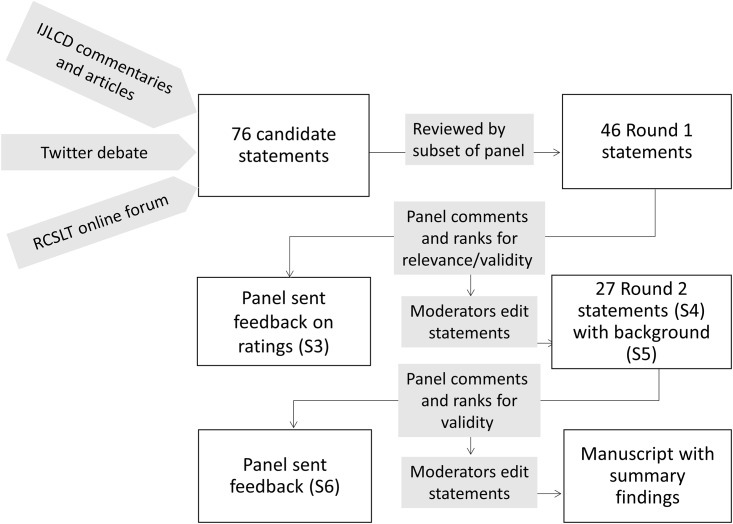
Delayed or impaired language development is a common developmental concern, yet there is little agreement about the criteria used to identify and classify language impairments in children. Children's language difficulties are at the interface between education, medicine and the allied professions, who may all adopt different approaches to conceptualising them. Our goal in this study was to use an online Delphi technique to see whether it was possible to achieve consensus among professionals on appropriate criteria for identifying children who might benefit from specialist services. We recruited a panel of 59 experts representing ten disciplines (including education, psychology, speech-language therapy/pathology, paediatrics and child psychiatry) from English-speaking countries (Australia, Canada, Ireland, New Zealand, United Kingdom and USA). The starting point for round 1 was a set of 46 statements based on articles and commentaries in a special issue of a journal focusing on this topic. Panel members rated each statement for both relevance and validity on a seven-point scale, and added free text comments. These responses were synthesised by the first two authors, who then removed, combined or modified items with a view to improving consensus. The resulting set of statements was returned to the panel for a second evaluation (round 2). Consensus (percentage reporting 'agree' or 'strongly agree') was at least 80 percent for 24 of 27 round 2 statements, though many respondents qualified their response with written comments. These were again synthesised by the first two authors. The resulting consensus statement is reported here, with additional summary of relevant evidence, and a concluding commentary on residual disagreements and gaps in the evidence base.
Overview
The claims and statistics of this paper haven’t been checked yet.
Free: it reads the open-access text and checks the first 5 claims that cite a source we can check. Create a free account to check every claim.
Integrity signals
Registry
Cites
Statistics
Figures
Verification
Claims the paper makes
The claims and statistics of this paper haven’t been checked yet.
Free: it reads the open-access text and checks the first 5 claims that cite a source we can check. Create a free account to check every claim.
Self-check
Percentages, sums and reported differences re-computed from the paper’s own numbers.
The self-check needs the paper’s full text.
Citations
Cites
R: A Language and Environment for Statistical Computing
R Core Team (2025) · doi:10.32614/r.manuals · Cited by 352,181
Diagnostic and Statistical Manual of Mental Disorders
Williams, J. B. W., & First, M. (2013) · Encyclopedia of Social Work · doi:10.1093/acrefore/9780199975839.013.104 · Cited by 109,519
Research guidelines for the Delphi survey technique
Hasson, F. (2000) · Journal of Advanced Nursing · doi:10.1046/j.1365-2648.2000.01567.x · Cited by 5,951 · cited 2×
“The issues we focused on are equally challenging in other countries, but manifestations of language difficulty, and terminology used to describe these, differ across languages [21].”
BackgroundMethodThe Delphi method as a research tool: an example, design considerations and applications
Okoli, C., & Pawlowski, S. D. (2004) · Information & Management · doi:10.1016/j.im.2003.11.002 · Cited by 4,771 · cited 1×
“The advantage of a larger panel is more representative coverage of experts, but a corresponding disadvantage is that the group discussion that is an inherent part of the process gets harder to achieve when more than 40 or 50 participants are involved [27].”
BackgroundThe Delphi Technique: Making Sense of Consensus
Hsu, C.-C., & Sandford, B. A. (2007) · University of Massachusetts Amherst · doi:10.7275/pdz9-th90 · Cited by 4,500
Principles and Practice of Screening for Disease.
(1968) · Annals of Internal Medicine · doi:10.7326/0003-4819-69-5-1085_2 · Cited by 3,066 · cited 1×
“However, as emphasised in the classic text by Wilson and Jungner [33], any screening program must beware of over-identification of problems, which can lead to resources being diverted to cases that do not need them.”
BackgroundPvclust: an R package for assessing the uncertainty in hierarchical clustering
Suzuki, R., & Shimodaira, H. (2006) · Bioinformatics · doi:10.1093/bioinformatics/btl117 · Cited by 2,451 · cited 1×
“The analysis was performed using the R statistical software [31] using the pvclust package [32], which performs hypothesis tests, via bootstrapping, to determine whether a cluster truly exists.”
MethodBoulkedid, R., Abdoul, H., Loustau, M., Sibony, O., & Alberti, C. (2011) · PLoS ONE · doi:10.1371/journal.pone.0020476 · Cited by 2,045 · cited 1×
“Selection of an expert panel is a key part of any Delphi exercise, and has been a topic of some debate in the literature [23].”
BackgroundCurrent validity of the Delphi method in social sciences
Landeta, J. (2006) · Technological Forecasting and Social Change · doi:10.1016/j.techfore.2005.09.002 · Cited by 1,353 · cited 1×
“Although we have noted the advantages of the Delphi technique over in-person consensus meetings, it is important also to recognise its limitations [120].”
BackgroundAn investigation of language impairment in autism: Implications for genetic subgroups
Kjelgaard, M. M., & Tager-Flusberg, H. (2001) · Language and Cognitive Processes · doi:10.1080/01690960042000058 · Cited by 1,130 · cited 1×
“On the other hand, a high proportion of verbal children with ASD have language difficulties similar to those seen in non-autistic children, especially with grammar or phonology [107], though there is debate as to whether the similarities are merely superficial [108].”
Background
Research works printed but not linked: 6
- Baird G (2014) Lumping, splitting, drawing lines, statistical cutoffs and impairment. Commentary on Bishop, D.V.M., 2014, Ten questions about terminology for children with unexplained language problems. Int J Lang Comm Disord 49: 381– 415. PMC4314704 25142090
- Hansson K, Sandgren O, Sahlén B (2014) Changing labels for a concept in change. Commentary on Bishop, D.V.M., 2014, Ten questions about terminology for children with unexplained language problems. Int J Lang Comm Disord 49: 381– 415. PMC4314704 25142090
- Rice M (2014) Advocating for SLI. Commentary on Bishop, D.V.M., 2014, Ten questions about terminology for children with unexplained language problems. Int J Lang Comm Disord 49: 381– 415. PMC4314704 25142090
- Snowling MJ (2014) SLI: Not just a semantic issue. Commentary on Reilly S., Tomblin B., Law J., McKean C., Mensah F. K., Morgan A., Goldfeld S., Nicholson J.M. and Wake M., 2014, Specific language impairment: a convenient label for whom? Int J Lang Comm Disord 49: 416– 451. PMC4303922 25142091 · DOI · Paper page
- Tomblin JB, Zhang X (1999) Are children with SLI a unique group of language learners? In: Tager-Flusberg H, editor. Neurodevelopmental Disorders: contributions to a New Framework from the Cognitive Neuroscience. Cambridge, MA: MIT Press pp. 361– 382.
- Stevenson J (1996) Developmental changes in the mechanisms linking language disabilities and behavior disorders In: Beitchman JH, Cohen NJ, Konstantareas MM, Tannock R, editors. Language, learning, and behavior disorders. Cambridge: Cambridge University Press pp. 78– 100.
Cited by
Items 801–900 of 1,001
Zaretsky, E., & Lange, B. P. (2024) · The Canadian Journal of Linguistics / La revue canadienne de linguistique · doi:10.1017/cnj.2024.31
“…language impairments in children), ED children are those with insufficient exposure to the language used by the school or community to be fully fluent in it and who do not have a language impairment (Bishop et al. 2017), whereas MED children are those with language impairments (Bishop et al. 2016).”
Narušené porozumění v klinickém obraze dětí s vývojovou poruchou jazyka
Karlova, 1. L. F. U., Solná, G., Vítkovice, N. A. O. , Červenková, B., & Jiravský, O. (2025) · Ceskoslovenska psychologie · doi:10.51561/cspsych.69.2.81
Language of Individuals With SLI/DLD
Savić, M., & Čolić, G. (2025) · Elsevier eBooks · doi:10.1016/b978-0-323-95504-1.00583-4
Ανδρέου, Γ., Lymperopoulou, V., & Papoudi, D. (2025) · Advances in Neurodevelopmental Disorders · doi:10.1007/s41252-025-00438-0
Case Marking in Turkish Heritage Children With and Without Developmental Language Disorder
Şan, N. H. (2025) · Languages · doi:10.3390/languages10050103
“The CATALISE consortium (Bishop et al., 2016, 2017) recommends using the term developmental language disorder (DLD) to refer to children’s language deficits that create communication or learning barriers and are unlikely to resolve by the age of five.”
Augusto, M. R. A., Rodrigues, E. D. S., Brandão, R., & Corrêa, L. M. S. (2025) · ZAS Papers in Linguistics · doi:10.21248/zaspil.66.2025.886
“The term DLD has recently replaced the widely used term SLI (Specific Language Impairment) as the result of a consensus in the CATALISE Consortium (Bishop et al., 2016, 2017).”
Assessing the Spoken Language Skills of Deaf Children and Young People
Martin, W. (2025) · Oxford University Press eBooks · doi:10.1093/9780191983726.003.0011
Diferencias del vocabulario en niños con y sin retraso del lenguaje
Lanchares, A. A., Pardo, R. B. S., & Requies, I. R. (2022) · HUMAN REVIEW International Humanities Review / Revista Internacional de Humanidades · doi:10.37819/revhuman.v14i6.1279
Developmental Language Disorders
Thordardottir, E. T. (2024) · Elsevier eBooks · doi:10.1016/b978-0-443-10944-7.00072-x
Botana, I., Valenzuela, M., & Pérez, M. V. (2025) · Revista de Logopedia Foniatría y Audiología · doi:10.1016/j.rlfa.2025.100534
The phonology (prosody)-syntax interface in children with developmental language disorder
Chen, C., & Yang, Y. (2025) · International Journal of Chinese Linguistics · doi:10.1075/ijchl.00036.che
Hus, Y., & Segal, O. (2025) · Exploration of Neuroprotective Therapy · doi:10.37349/ent.2025.1004110 · Cited by 1
LLM-based personalization of learning materials for children with a developmental language disorder.
Veldkamp, B. P. (2025) · ACM International Conference on Interaction Design and Children (IDC) · doi:10.1145/3713043.3731519
“In a classroom setting, students with DLD face various difficulties that impact their ability to engage in education, such as difficulty understanding complex sentences, difficulties in following and remembering instructions and difficulty in telling or retelling the events of a story [2, 7].”
InfluentialBrown, S., & Wright, S. (2025) · DECP Debate · doi:10.53841/bpsdeb.2025.1.191.23
Thordardottir, E. T., Law, J., & Roulstone, S. (2020) · The Conversation · doi:10.64628/aam.whevn5rkq
Combining genetic and behavioral predictors of 11-year language outcomePreprint
Gasparini, L., Shepherd, D. A., Lange, K., Wang, J., Verhoef, E., Bavin, E. L., Reilly, S., Pourcain, B. S., Wake, M. A., & Morgan, A. T. (2025) · PsyArXiv (OSF Preprints) · doi:10.31234/osf.io/x4fye_v2
Group training of narrative skills in French-speaking children with developmental language disorder
Hadjadj, O., Ardanouy, E., & Delage, H. (2025) · Child Language Teaching and Therapy · doi:10.1177/02656590251370107
“Narration is one of the (oral) language domains affected by DLD, which is a severe and persistent language impairment (Bishop et al., 2016, 2017; Leonard, 2014).”
Progress and Perspectives on Developmental Language and Reading Disorders
van Bergen, E., Dawson, N., James, E., & Krishnan, S. (2026) · Quarterly Journal of Experimental Psychology · doi:10.1177/17470218261486347
de Araújo, S. C. C. S. (2025) · Digital Library of Theses and Dissertations (Universidade de São Paulo) · doi:10.11606/t.5.2025.tde-07102025-141732
Development and Validation of a Scale to Detect Late Language Emergence in Spanish-Speaking Children
Martínez, V., Solano, P., & Núñez, J. C. (2025) · Psicothema · doi:10.70478/psicothema.2025.37.28
Cesari, E., Laks, B., & Isel, F. (2025) · NeuroSci · doi:10.3390/neurosci6040112
Combining genetic and behavioral predictors of 11-year language outcome
Gasparini, L., Shepherd, D. A., Lange, K., Wang, J., Verhoef, E., Bavin, E. L., Reilly, S., Pourcain, B. S., Wake, M. A., & Morgan, A. T. (2025) · Psychiatry Research · doi:10.1016/j.psychres.2025.116826
Chocano, A. D., Rocca, J. J. D., Zamora, J. M. C., Guillén, Y. E. S., Cáceda, J. B. M., Guanilo, C. D. A., Espinoza, L. A., Pernia, C. A. C., Torres, R. N. C., Montalván, M. E. A., et al. (2025) · Propósitos y Representaciones · doi:10.20511/pyr2025.v13.2036
La communication sociale et le TDAH dans le système scolaire : l’orthophonie y a sa place
Mayer-Crittenden, C., & Dupuis, G. (2024) · Revue du Nouvel-Ontario · doi:10.7202/1121270ar
Normand, M. L., & Van, H. T. (2025) · Scientific Reports · doi:10.1038/s41598-025-26862-9 · Cited by 1
Elever med särskild begåvning och dyslexi : Ömsesidig maskering i tester och skolpraktik
Ekelund, T. (2025) · doi:10.59217/oqjq4847 · Cited by 1
Lanchares, A. A., Herrera, D. P., Pardo, R. B. S., & Requies, I. R. (2025) · Speech Language and Hearing · doi:10.1080/2050571x.2025.2592405
“DLD is a neurodevelopmental disorder characterized by unexplained and persistent difficulties in language acquisition (American Psychiatric Association, 2013).”
InfluentialHedström, I., & Löfkvist, U. (2025) · Frontiers in Pediatrics · doi:10.3389/fped.2025.1717513
Editorial: Developmental Language Disorder in Chinese
Sheng, L., & Wong, A. M.-Y. (2025) · Brain and Language · doi:10.1016/j.bandl.2025.105686
Σίμου, Ε. (2023) · Institutional Repository Hellanicus · doi:10.26215/heal.uoa.1289
Larochelle-Courchesne, C. (2025) · Le dépôt institutionnel (Université du Québec à Trois-Rivières)
Forprófun á nýju málþroskaprófi fyrir 6–10 ára: Flokkun orða, mál- og hljóðkerfisvitund og málnotkun
Ómarsdóttir, E. B. (2024) · Skemman · Cited by 1
Jóhannsdóttir, V. S. (2024) · Skemman
Utmaningarna med språkstörning i SO-undervisningen
Rama, V., & Strenglund, D. (2023) · KTH Publication Database DiVA (KTH Royal Institute of Technology)
Vårdnadshavares upplevelser av språkstimulansföreläsningen vid Norrlands universitetssjukhus
Huuhka, F., & Lax, J. (2023) · DiVA at Umeå University (Umeå University)
Understanding the emotional rollercoaster in children with Developmental Language Disorder (DLD)
Vijayakumar, K. (2025) · Jönköping University Publications (Jönköping University)
Sevä, M., & Fahlström, A.-L. (2023) · KTH Publication Database DiVA (KTH Royal Institute of Technology)
Gustafsson, I., & Wadman Drakenfors, T. (2023) · Lund University Publications Student Papers (Lund University)
Ross-Lévesque, É., Leclercq, A.-L., Maillart, C., & Desmarais, C. (2024) · ORBi (University of Liège)
Fjeldvang, R. T., & Nordaas, M. G. (2020) · NVA (Nasjonalt vitenarkiv) · Cited by 2
Pereira, C. A. F. (2024) · Portuguese National Funding Agency for Science, Research and Technology (RCAAP Project by FCT)
Cano Villagrasa, A. (2023) · Repository of Digital Objects for Teaching Research and Culture (University of Valencia)
Jämförelse mellan bedömningsinstrumenten Bayley-4 och Nya Reynell
Andersson, K. (2024) · Lund University Publications Student Papers (Lund University)
Laniel, P. (2023) · Papyrus : Institutional Repository (Université de Montréal) · doi:10.71781/17729
Lærerens tilrettelegging av språkvansker i skolen på barnetrinnet. En kvalitativ intervjustudie.
Gronostajska, J. (2018) · NORA - Norwegian Open Research Archives
Löfmark, C., & Nevala, I. (2024) · DiVA (Mälardalen University College)
Tidlig behandling av en fonologisk uttalevanske med Hodson & Paden – en sirkulær tilnærming
Theisens, F. (2020) · NORA - Norwegian Open Research Archives
Äidin raskaudenaikaisten ahdistusoireiden vaikutus lapsen varhaiseen kielenkehitykseen
Läntinen, J. (2022) · UTUPub (University of Turku)
Kehityksellisen kielihäiriön monet kasvot
Loukusa, S., Tolonen, A.-K., Nylund, A., & Kautto, A. (2025) · UTUPub (University of Turku)
Þórisdóttir, D. L. (2024) · Skemman
„Sértæk“ málþroskaröskun: Hugtakabreyting og áhrif hennar
Friðgeirsdóttir, A. M. (2020) · Skemman
Lövgren, A., & Andersson, U. (2025) · KTH Publication Database DiVA (KTH Royal Institute of Technology)
Dynamic Assessment of Spanish-English Speaking Children for Developmental Language Disorder
Neiling, S. L., & Neiling, S. L. (2024) · UA Campus Repository (The University of Arizona)
Domain-general mechanisms underlying individual differences in language acquisition
Kautto, A. (2024) · UTUPub (University of Turku)
Opitz, M. (2023) · Common Library Network (Der Gemeinsame Bibliotheksverbund) · Cited by 3
Skattningsformulär för vårdnadshavare gällande barns språkliga förmåga
Ahlfors, E., & Olander, M. (2021) · Lund University Publications Student Papers (Lund University)
Aalto, O., & Suominen, A. (2024) · UTUPub (University of Turku)
Conocimiento, experiencia, formación y creencias de los docentes de Colombia sobre el TDL.
Cantor, A. M. G., & Modrego Alarcón, M. (2023) · Zaguan (University of Zaragoza Repository)
Breault, C. (2023) · Papyrus : Institutional Repository (Université de Montréal) · doi:10.71781/26037 · Cited by 2
Labelle, F. (2023) · Papyrus : Institutional Repository (Université de Montréal) · doi:10.71781/17793
Virtanen, S. (2024) · Lauda (University of Lapland)
Predictive processing and developmental language disorderPreprint
Westermann, G., & Jones, S. D. (2020) · OSF Preprints (OSF Preprints)
Logopedisk oppfølging av barn med leppe-kjeve-ganespalte
Tandberg, M. G. (2019) · NORA - Norwegian Open Research Archives
1980, H. R. S. (2018) · Skemman
Favret, E. (2021) · QSpace (Queen's University Library)
Réttmætisathugun á Málfærni eldri leikskólabarna (MELB): Samanburður við málsýni og HLJÓM-2
Björgvinsdóttir, B. (2020) · Skemman
Chavaren, C., & Muratore, C. (2024) · HAL
Papadopoulou, E. (2025) · Jonkoping University Library (Jönköping University)
Valade, F. (2023) · Papyrus : Institutional Repository (Université de Montréal) · doi:10.71781/19147
Courteau, É. (2022) · Papyrus : Institutional Repository (Université de Montréal) · doi:10.71781/32012
Kippin, N. R. (2021) · eSpace (Curtin University)
Kladouchou, V. (2021) · City Research Online (City University London) · Cited by 1
Sørli, L. W. (2020) · NORA - Norwegian Open Research Archives
Slušná, D. (2022) · Repositori digital de la UPF (Universitat Pompeu Fabra)
Styrking av ordforrådet til barn med utviklingsmessige språkvansker
Hestnes, H. D. (2020) · NORA - Norwegian Open Research Archives
Brozzoli, C., Roscigni, L., Dufour, M., Roy, A. C., & Véronique Boulenger, A. (2024) · HAL
Zaretsky, E. V., Lange, B. P., & Hey, C. (2023) · CU Digital Repository
Ucarli, G. (2021) · NORA - Norwegian Open Research Archives
Calder, S. D. (2021) · eSpace (Curtin University)
Adrover‐Roig, D., Valera-Pozo, M., Esteller, À., Penadés, R. L., Sanchez-Azanza, V. A., Oliver, A. F., Sureda García, I., Pérez Castelló, J. A., Buil‐Legaz, L., Guirado-Moreno, J. L., et al. (2023) · Dialnet (Universidad de la Rioja)
Language difficulties in looked-after children aged 5 to 14 years
Savi-Karayol, S. (2023) · City Research Online (City University London)
L'intervention indirecte dans le cadre d'un trouble développemental du langage
Lozac’h, N. (2023) · HAL
Varhaisten sosioemotionaalisten oireiden yhteys myöhempiin kielellisiin taitoihin
Pyykönen, J., & Peltonen, M. (2025) · UTUPub (University of Turku)
Äidin raskaudenaikaisen tupakoinnin yhteys lapsen kielellisiin taitoihin
Viitamaa, M. (2022) · UTUPub (University of Turku)
DeRobles, A. K. (2021) · ScholarsArchive (Brigham Young University)
García Laus, L. (2024) · UVaDOC UVaDOC University of Valladolid Documentary Repository (University of Valladolid)
Nilsen, M. I. (2021) · NORA - Norwegian Open Research Archives
Chepngeno, M., Joyce, E., & York, A. (2023) · DiVA (Linkoping University)
Moran, A. (2022) · City Research Online (City University London) · Cited by 1
การฝึกเล่าเรื่องสำหรับเด็กที่มีความบกพร่องเฉพาะด้านภาษา
วาณิชย์เจริญ, ณ. (2024) · วารสารวิจัยและพัฒนาการศึกษาพิเศษ
Metadata
- Authors
- Bishop, D. V. M., Snowling, M. J., Thompson, P. A., Greenhalgh, T., & CATALISE consortium
- Affiliations
- University of Oxford (GB)
- Corresponding author
- Bishop, D. V. M.
- Venue
- PLOS ONE
- Publisher
- Public Library of Science (PLoS)
- Published
- 2016-07-08
- Volume
- 11
- Issue
- 7
- Pages
- e0158753
- ISSN
- 1932-6203 (ISSN-L)
- PMC
- PMC4938414
- OpenAlex
- W2336526731
- Cited by
- 831
- References
- 129
- Citations by year
- 2026: 73 · 2025: 105 · 2024: 89 · 2023: 85 · 2022: 99 · 2021: 104 · 2020: 118 · 2019: 67 · 2018: 55 · 2017: 30 · 2016: 4
- FWCI
- 121.75
- Type
- journal article
- Language
- en
- Update notices
- correction (2016-12-09)
- Open access
- gold
- doi.org
- Licence
- Locations
- PLoS ONE (publishedVersion, cc-by)
- PubMed Central (publishedVersion, cc-by)
- PubMed (publishedVersion)
- OpenBU (Boston University) (publishedVersion, cc-by)
- University of Birmingham Research Portal (University of Birmingham) (publishedVersion, other-oa)
- White Rose Research Online (University of Leeds, The University of Sheffield, University of York) (acceptedVersion)
- Strathprints: The University of Strathclyde institutional repository (University of Strathclyde) (acceptedVersion)
- Arrow@dit (Dublin Institute of Technology) (acceptedVersion)
- Griffith Research Online (submittedVersion, cc-by)
- UTUPub (University of Turku) (submittedVersion)
- UWA Profiles and Research Repository (UWA) (submittedVersion, cc-by)
- Cork Open Research Archive (University College Cork, Ireland) (submittedVersion, cc-by)
- DOAJ (DOAJ: Directory of Open Access Journals) (submittedVersion, cc-by-sa)
- Stirling Online Research Repository (University of Stirling) (submittedVersion, cc-by)
- UCL Discovery (University College London) (submittedVersion)
- Figshare (submittedVersion, cc-by-nc-sa)
- Figshare (submittedVersion)
- Figshare (submittedVersion, cc-by)
- The HKU Scholars Hub (University of Hong Kong) (submittedVersion, cc-by-nc-nd)
- Scholarship@Western (Western University) (submittedVersion, cc-by)
- Minerva Access (University of Melbourne) (submittedVersion, cc-by)
- Open Research Exeter (University of Exeter) (submittedVersion)
- Research Explorer (The University of Manchester) (submittedVersion, cc-by)
- Edinburgh Research Explorer (University of Edinburgh) (submittedVersion, cc-by)
- ResearchSpace (University of Auckland) (submittedVersion, cc-by)
- University of Limerick Institutional Repository (University of Limerick) (submittedVersion, cc-by-nc-sa)
- Scholarship@Western (Western University) (submittedVersion)
- Warwick Research Archive Portal (University of Warwick) (submittedVersion)
- Funders
- Wellcome Trust (082498/Z/07/Z)
- Topics
- Social Sciences › Psychology › Developmental and Educational Psychology › Language Development and Disorders
- Social Sciences › Psychology › Neuropsychology and Physiological Psychology › Developmental and Educational Neuropsychology
- Health Sciences › Health Professions › Speech and Hearing › Voice and Speech Disorders
- Keywords
- language impairment, children, diagnostic criteria, multidisciplinary consensus, language delay, speech-language pathology, child psychiatry
- MeSH terms
- Australia, Canada, Delphi Technique, United Kingdom, Humans, Ireland, Language Disorders, New Zealand, Interdisciplinary Studies
About these checks
Registry, retraction, Cites and statistics results are computed, not judged, with one exception: a printed reference that no index lists is read once by a model before it counts as a citation error. Claims are extracted by a model and kept only when their quote appears verbatim in the text; each cited source is then checked, with a model’s help, for whether it says what the claim relies on. Those verdicts can be wrong — read the claim’s quote and the cited source before relying on one.
Statistics and arithmetic are recomputed, not judged.
Confidence bands are shown only for fields calibrated on our annotated test set. None is calibrated yet, so no band is shown.
What counts as a claim ›How we measure confidence ›How we check this ›
Are you an author, or do you see a problem with this page? Request a review
Data sources
Bibliographic data: Semantic Scholar, OpenAlex, Crossref.
Contains information from the Semantic Scholar Academic Graph Datasets, made available under the ODC Attribution License (ODC-BY 1.0).
Semantic Scholar’s data is described in: Kinney, R., et al. (2023). The Semantic Scholar Open Data Platform. arXiv:2301.10140.
