

Improved quality of life and reduced depressive symptoms in medical students after a single-session intervention
Open accessThe DOI matches its Crossref record; 63 of the 63 references it cites were found in a registry or an index; 14 of the 29 sources its claims cite were checked for support.
Abstract
Objective: Anxiety and depression are prevalent among medical students. Brazilian medical students have higher levels of depression and lower quality of life than their U.S. counterparts, and no preventive intervention exists for this risk group in Brazil. The Unified Protocol for Transdiagnostic Treatment of Emotional Disorders (UP), a cognitive-behavioral treatment protocol for neuroticism, was recently adapted into a single-session, preventive intervention. This study tested the impact of this protocol on psychiatric symptoms and quality of life in Brazilian medical students. Methods: In this open trial, the intervention protocol was translated and adapted to Brazilian Portuguese. Medical students over 18 years of age without psychotic symptoms, severe depressive episodes, or acute psychiatric risk were included, undergoing a psychiatric clinical interview (Mini-International Neuropsychiatric Interview [MINI]) and evaluation at baseline and at 7 and 30 days after a single-session UP that included experimental avoidance, quality of life, self-esteem, empathy, and anxiety symptom scales. A new evaluation was performed 90 days after the intervention. Results: Sixty-two students participated. Ninety days after the intervention, there were significant reductions in the number of students who met the criteria for social anxiety disorder (p = 0.013) or panic disorder (p = 0.001). There were also significant improvements in depressive symptoms (Beck Depression Inventory, p o 0.001) and quality of life (Quality of Life Enjoyment and Satisfaction Questionnaire, p o 0.001). Conclusion: UP improved anxiety and depressive symptoms in medical students. The single-session group format could reduce costs and facilitate application. Future placebo-controlled studies are necessary to confirm these findings. © 2020, Associacao Brasileira de Psiquiatria. All rights reserved.
Overview
CoChat Summary
## TL;DR
This open trial adapted a single-session Unified Protocol workshop for Brazilian medical students and found improvements at 90 days in depressive symptoms and quality of life, with reductions in social anxiety disorder and panic disorder. The authors conclude the format was acceptable and feasible, but call for placebo-controlled randomized studies.
## Key findings
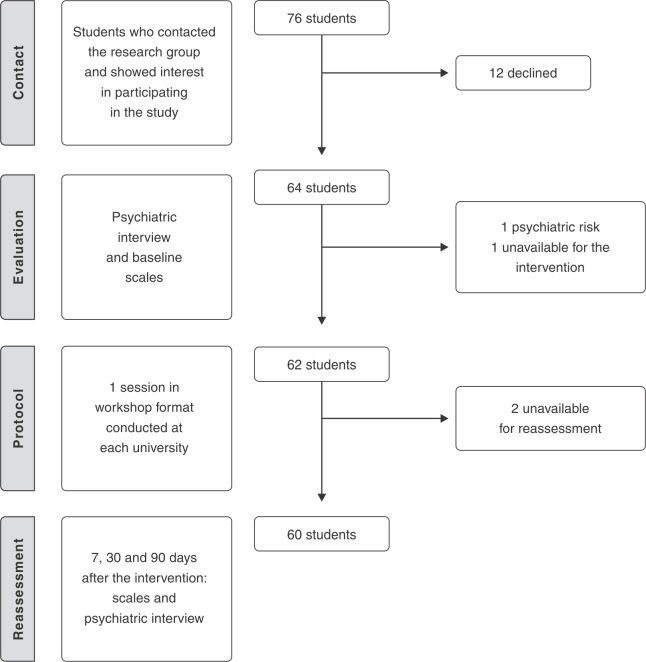
- 62 students participated in the intervention; 76 contacted the researchers and 64 attended the initial evaluation, with 2 excluded before the session and 2 excluded from follow-up because they were unavailable.
- At 90 days, there were significant reductions in the number of students meeting criteria for social anxiety disorder (p = 0.013) and panic disorder (p = 0.001).
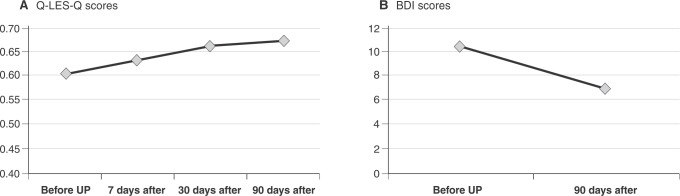
- Self-report outcomes improved significantly: BDI scores decreased from 11.64 to 7.82 (p < 0.001) and Q-LES-Q scores increased from 0.602 to 0.675 (p < 0.001).
- The study reports that 79.8% of students gave the intervention a subjective improvement rating of 3 or higher on a 1–5 scale; more than 70% said they could deal more appropriately with their emotions after the intervention.
## Methods
- Design: Open trial of a single 2-hour group preventive intervention based on the Unified Protocol, delivered in person in classrooms at two federal universities in southern Brazil in the second semester of 2017.
- Sample/data: Medical students over 18 years old who were willing to participate; excluded if they had psychotic symptoms, severe depressive episode, acute psychiatric risk, or suicidal ideation. Participants were assessed at baseline and again at 7, 30, and 90 days.
- Main analysis: Psychiatric interview plus MINI and self-report scales including MEAQ, Q-LES-Q-SF, RSE, IRI, OASIS, and BDI; statistical tests included t-test/Wilcoxon, chi-square/Fisher/Yates, ANOVA with post-hoc Bonferroni, Spearman correlations, and logistic regression, with p < 0.05 as the significance threshold.
## Limitations
- The authors explicitly note it was a convenience sample, which could cause selection bias; they also note that students without symptoms may have been less motivated to participate, and students with social impairment might have avoided participation.
- The study was open and had no control group; the authors also state there were no comparisons between subjects receiving individual therapy and those on a waiting list.
- Evident from the text: the intervention effects may be confounded because some students started psychotherapy or medication during follow-up, and the authors note that simply meeting and discussing emotions might itself have helped.
Model-written summary. Check it against the paper before relying on it.
Integrity signals
Registry
Cites
Statistics
Figures
Verification
Claims the paper makes
10 Valid · 0 Not valid · 6 Not checked · 27 Own results and interpretations
Every source the paper cites for this claim was checked and supports it.
In the paper
“Recently, the developers of the UP adapted the original treatment protocol into a single-session, transdiagnostic intervention aimed at preventing emotional disorders in at-risk college students.39”
§ Improved quality of life and reduced depressive symptoms in medical students after a single-session intervention > Introduction
What the sources say
- Supportedcites [39] Bentley KH Boettcher H Bullis JR Carl JR Conklin LR Sauer-Zavala S Development of a single-session, transdiagnostic preventive intervention for young adults at risk for emotional disorders Behav Modif 2018 42 781 805 29029563 source
The Study Aims section says the authors developed a one-session, transdiagnostic preventive intervention for emotional disorders in a college setting. The Intervention section says its four modules were distilled from the full UP treatment, and the Discussion identifies the participants as at-risk undergraduates. (LLM, conf=0.92)
plain- Asserted: passes — The authors put it forward as true.
- Checkable: passes — It can be checked against evidence.
- Load-bearing: passes — The paper’s conclusions depend on it.
- Based: passes — The paper gives a reason why it holds.
- Supported
A result the paper reports from its own data — it cites no other source for it, so there is none to check. The quote shows it is in the paper.
In the paper
“Ninety days after the intervention, there were significant reductions in the number of students who met the criteria for social anxiety disorder (p = 0.013) or panic disorder (p = 0.001).”
- Also stated in: § Results · plain
“Compared with baseline values, we observed clinical improvements in social anxiety disorder (p = 0.013) and panic disorder (p = 0.001) at 90 days after the UP.”
§ Improved quality of life and reduced depressive symptoms in medical students after a single-session intervention > Abstract > Results:
plainstates a cause- Asserted: passes — The authors put it forward as true.
- Checkable: passes — It can be checked against evidence.
- Load-bearing: passes — The paper’s conclusions depend on it.
- Based: passes — The paper gives a reason why it holds.
- Also stated in: § Results · plain
A result the paper reports from its own data — it cites no other source for it, so there is none to check. The quote shows it is in the paper.
In the paper
“There were also significant improvements in depressive symptoms (Beck Depression Inventory, p < 0.001) and quality of life (Quality of Life Enjoyment and Satisfaction Questionnaire, p < 0.001).”
- Also stated in: § Results · plain
“We observed statistically significant improvement in depressive symptoms (BDI 11.64 vs. 7.82, p < 0.001) and in QoL (Q-LES-Q 0.602 vs. 0.675, p < 0.001) in the self-report scales.”
§ Improved quality of life and reduced depressive symptoms in medical students after a single-session intervention > Abstract > Results:
plainstates a cause- Asserted: passes — The authors put it forward as true.
- Checkable: passes — It can be checked against evidence.
- Load-bearing: passes — The paper’s conclusions depend on it.
- Based: passes — The paper gives a reason why it holds.
- Also stated in: § Results · plain
A result the paper reports from its own data — it cites no other source for it, so there is none to check. The quote shows it is in the paper.
In the paper
“Regarding QoL, Q-LES-Q score improvement was moderately influenced by reduced anxiety severity (OASIS, p = 0.034) and depression symptoms (BDI, p = 0.005).”
§ Improved quality of life and reduced depressive symptoms in medical students after a single-session intervention > Results
plainstates an association- Asserted: passes — The authors put it forward as true.
- Checkable: passes — It can be checked against evidence.
- Load-bearing: unclear — It is unclear whether the paper’s conclusions depend on it.
- Based: passes — The paper gives a reason why it holds.
A result the paper reports from its own data — it cites no other source for it, so there is none to check. The quote shows it is in the paper.
In the paper
“Ninety days after the intervention, there were significant reductions in the number of students who met the criteria for social anxiety disorder (p = 0.013) or panic disorder (p = 0.001).”
- Also stated in: § Results · plain
“Compared with baseline values, we observed clinical improvements in social anxiety disorder (p = 0.013) and panic disorder (p = 0.001) at 90 days after the UP.”
§ Improved quality of life and reduced depressive symptoms in medical students after a single-session intervention > Abstract > Results:
plainstates a cause- Asserted: passes — The authors put it forward as true.
- Checkable: passes — It can be checked against evidence.
- Load-bearing: passes — The paper’s conclusions depend on it.
- Based: passes — The paper gives a reason why it holds.
- Also stated in: § Results · plain
19 more claims
Create a free account to see all 43 claims and to verify the 3 references still open.
- Probably not a substantial claim. 14
- It may state two separate claims as one. 12
Citations
Cites
An inventory for measuring depression
BECK, A. T. (1961) · Archives of General Psychiatry · doi:10.1001/archpsyc.1961.01710120031004 · Cited by 38,032
Measuring individual differences in empathy: Evidence for a multidimensional approach.
Davis, M. H. (1983) · Journal of Personality and Social Psychology · doi:10.1037/0022-3514.44.1.113 · Cited by 10,272
(1979) · Medical Entomology and Zoology · Cited by 5,872
Dyrbye, L. N., Thomas, M. R., & Shanafelt, T. D. (2006) · Academic Medicine · doi:10.1097/00001888-200604000-00009 · Cited by 2,909
Rotenstein, L. S., Ramos, M. A., Torre, M., Segal, J. B., Peluso, M. J., Guille, C., Sen, S., & Mata, D. A. (2016) · JAMA · doi:10.1001/jama.2016.17324 · Cited by 2,479
(1993) · PubMed · Cited by 1,900
Stress and depression among medical students: a cross-sectional study
Dahlin, M., Joneborg, N., & Runeson, B. (2005) · Medical Education · doi:10.1111/j.1365-2929.2005.02176.x · Cited by 1,226
Medical Student Distress: Causes, Consequences, and Proposed Solutions
Dyrbye, L. N., Thomas, M. R., & Shanafelt, T. D. (2005) · Mayo Clinic Proceedings · doi:10.4065/80.12.1613 · Cited by 1,137
Amorim, P. (2000) · Revista Brasileira de Psiquiatria · doi:10.1590/s1516-44462000000300003 · Cited by 1,070
Relationship Between Burnout and Professional Conduct and Attitudes Among US Medical Students
Dyrbye, L. N., Massie, F. S., Eacker, A., Harper, W., Power, D., Durning, S. J., Thomas, M. R., Moutier, C., Satele, D., Sloan, J., et al. (2010) · JAMA · doi:10.1001/jama.2010.1318 · Cited by 896
Suicide Rates Among Physicians: A Quantitative and Gender Assessment (Meta-Analysis)
Schernhammer, E. S., & Colditz, G. A. (2004) · American Journal of Psychiatry · doi:10.1176/appi.ajp.161.12.2295 · Cited by 876
(1996) · PubMed · Cited by 863
Barlow, D. H., Farchione, T. J., Bullis, J. R., Gallagher, M. W., Murray-Latin, H., Sauer-Zavala, S., Bentley, K. H., Thompson-Hollands, J., Conklin, L. R., Boswell, J. F., et al. (2017) · JAMA Psychiatry · doi:10.1001/jamapsychiatry.2017.2164 · Cited by 853
Self-citationDevelopment and validation of an Overall Anxiety Severity and Impairment Scale (OASIS)
Norman, S. B., Hami Cissell, S., Means-Christensen, A. J., & Stein, M. B. (2006) · Depression and Anxiety · doi:10.1002/da.20182 · Cited by 770
Langford, R., Bonell, C. P., Jones, H. E., Pouliou, T., Murphy, S. M., Waters, E., Komro, K. A., Gibbs, L. F., Magnus, D., & Campbell, R. (2014) · Cochrane Database of Systematic Reviews · doi:10.1002/14651858.cd008958.pub2 · Cited by 768
Unified Protocol for Transdiagnostic Treatment of Emotional Disorders: A Randomized Controlled Trial
Farchione, T. J., Fairholme, C. P., Ellard, K. K., Boisseau, C. L., Thompson-Hollands, J., Carl, J. R., Gallagher, M. W., & Barlow, D. H. (2012) · Behavior Therapy · doi:10.1016/j.beth.2012.01.001 · Cited by 746
Neuroticism and common mental disorders: meaning and utility of a complex relationship.
Ormel, J., Jeronimus, B. F., Kotov, R., Riese, H., Bos, E. H., Hankin, B., Rosmalen, J. G. M., & Oldehinkel, A. J. (2013) · Clinical Psychology Review · doi:10.1016/j.cpr.2013.04.003 · Cited by 703
Risk Factors for Suicide and Attempted Suicide among Young People
Beautrais, A. L. (2000) · Australian & New Zealand Journal of Psychiatry · doi:10.1046/j.1440-1614.2000.00691.x · Cited by 598
Depressed Medical Studentsʼ Use of Mental Health Services and Barriers to Use
Givens, J. L., & Tjia, J. (2002) · Academic Medicine · doi:10.1097/00001888-200209000-00024 · Cited by 583
Gámez, W., Chmielewski, M., Kotov, R., Ruggero, C., & Watson, D. (2011) · Psychological Assessment · doi:10.1037/a0023242 · Cited by 524
Factors associated to depression and anxiety in medical students: a multicenter study
Brenneisen Mayer, F., Souza Santos, I., Silveira, P. S. P., Itaqui Lopes, M. H., de Souza, A. R. N. D., Campos, E. P., de Abreu, B. A. L., Hoffman II, I., Magalhães, C. R., Lima, M. C. P., et al. (2016) · BMC Medical Education · doi:10.1186/s12909-016-0791-1 · Cited by 364
Prevalência de Sintomas de Ansiedade e Depressão em Estudantes de Medicina
de Vasconcelos, T. C., Dias, B. R. T., Andrade, L. R., Melo, G. F., Barbosa, L. N. F., & Souza, E. D. S. (2015) · Revista Brasileira de Educação Médica · doi:10.1590/1981-52712015v39n1e00042014 · Cited by 348
de Moor, M. H. M., van den Berg, S. M., Verweij, K. J. H., Krueger, R. F., Luciano, M., Arias Vasquez, A., Matteson, L. K., Derringer, J., Esko, T., Amin, N., et al. (2015) · JAMA Psychiatry · doi:10.1001/jamapsychiatry.2015.0554 · Cited by 345
Burnout and Alcohol Abuse/Dependence Among U.S. Medical Students
Jackson, E. R., Shanafelt, T. D., Hasan, O., Satele, D. V., & Dyrbye, L. N. (2016) · Academic Medicine · doi:10.1097/acm.0000000000001138 · Cited by 341
Wilamowska, Z. A., Thompson-Hollands, J., Fairholme, C. P., Ellard, K. K., Farchione, T. J., & Barlow, D. H. (2010) · Depression and Anxiety · doi:10.1002/da.20735 · Cited by 314
The prevention of child and adolescent anxiety: a meta-analytic review
Fisak, B. J., Richard, D., & Mann, A. (2011) · Prevention Science · doi:10.1007/s11121-011-0210-0 · Cited by 271
Relationship among Medical Student Resilience, Educational Environment and Quality of Life
Tempski, P., Santos, I. S., Mayer, F. B., Enns, S. C., Perotta, B., Paro, H. B. M. S., Gannam, S., Peleias, M., Garcia, V. L., Baldassin, S., et al. (2015) · PLOS ONE · doi:10.1371/journal.pone.0131535 · Cited by 259
Vicissitudes of Depressed Mood During Four Years of Medical School
Clark, D. C. (1988) · JAMA: The Journal of the American Medical Association · doi:10.1001/jama.1988.03410170069036 · Cited by 249
Stress, coping and health: enhancing well‐being during medical school
WOLF, T. M. (1994) · Medical Education · doi:10.1111/j.1365-2923.1994.tb02679.x · Cited by 239
Dvořáková, K., Kishida, M., Li, J., Elavsky, S., Broderick, P. C., Agrusti, M. R., & Greenberg, M. T. (2017) · Journal of American College Health · doi:10.1080/07448481.2017.1278605 · Cited by 231
Dialectical behavior therapy (DBT) applied to college students: A randomized clinical trial.
Pistorello, J., Fruzzetti, A. E., MacLane, C., Gallop, R., & Iverson, K. M. (2012) · Journal of Consulting and Clinical Psychology · doi:10.1037/a0029096 · Cited by 228
What do medical students think about their quality of life? A qualitative study
Tempski, P., Bellodi, P. L., Paro, H. B., Enns, S. C., Martins, M. A., & Schraiber, L. B. (2012) · BMC Medical Education · doi:10.1186/1472-6920-12-106 · Cited by 207
Kanner, A. M., Barry, J. J., Gilliam, F., Hermann, B., & Meador, K. J. (2010) · Epilepsia · doi:10.1111/j.1528-1167.2010.02582.x · Cited by 182
The Economic Analysis of Prevention in Mental Health Programs
Mihalopoulos, C., Vos, T., Pirkis, J., & Carter, R. (2011) · Annual Review of Clinical Psychology · doi:10.1146/annurev-clinpsy-032210-104601 · Cited by 159
“Face-to-face with It”: Medical Studentsʼ Narratives about Their End-of-life Education
Wear, D. (2002) · Academic Medicine · doi:10.1097/00001888-200204000-00003 · Cited by 156
Early clinical exposure to people who are dying: learning to care at the end of life
MacLeod, R. D., Parkin, C., Pullon, S., & Robertson, G. (2003) · Medical Education · doi:10.1046/j.1365-2923.2003.01412.x · Cited by 155
An idiographic analysis of change processes in the unified transdiagnostic treatment of depression
Boswell, J. F., Anderson, L. M., & Barlow, D. H. (2014) · Journal of Consulting and Clinical Psychology · doi:10.1037/a0037403 · Cited by 138
Sauer-Zavala, S., Bentley, K. H., & Wilner, J. G. (2016) · Journal of Personality Disorders · doi:10.1521/pedi_2015_29_179 · Cited by 128
Self-citationAssociation between neuroticism and amygdala responsivity emerges under stressful conditions
Everaerd, D., Klumpers, F., van Wingen, G., Tendolkar, I., & Fernández, G. (2015) · NeuroImage · doi:10.1016/j.neuroimage.2015.03.014 · Cited by 115
Lucchetti, G., Damiano, R. F., DiLalla, L. F., Lucchetti, A. L. G., Moutinho, I. L. D., da Silva Ezequiel, O., & Kevin Dorsey, J. (2018) · Academic Psychiatry · doi:10.1007/s40596-017-0777-2 · Cited by 110
Downs, N. S., Feng, W., Kirby, B., McGuire, T., Moutier, C. Y., Norcross, W. A., Norman, M. A., Young, I. T., & Zisook, S. (2014) · Academic Psychiatry · doi:10.1007/s40596-014-0115-x · Cited by 96
Pössel, P., Baldus, C., Horn, A. B., Groen, G., & Hautzinger, M. (2005) · Journal of Child Psychology and Psychiatry · doi:10.1111/j.1469-7610.2004.00395.x · Cited by 93
Ciraulo, D. A., Barlow, D. H., Gulliver, S. B., Farchione, T., Morissette, S. B., Kamholz, B. W., Eisenmenger, K., Brown, B., Devine, E., Brown, T. A., et al. (2013) · Behaviour Research and Therapy · doi:10.1016/j.brat.2013.08.003 · Cited by 89
Sainsbury, K., Mullan, B., & Sharpe, L. (2013) · Journal of Psychosomatic Research · doi:10.1016/j.jpsychores.2013.05.011 · Cited by 83
Adaptação e validação interna de duas escalas de empatia para uso no Brasil
Koller, S. H., Camino, C., & Ribeiro, J. (2001) · Estudos de Psicologia (Campinas) · doi:10.1590/s0103-166x2001000300004 · Cited by 82
Thompson-Brenner, H., Boswell, J. F., Espel-Huynh, H., Brooks, G., & Lowe, M. R. (2019) · Psychotherapy Research · doi:10.1080/10503307.2018.1446563 · Cited by 80
Bentley, K. H., Nock, M. K., Sauer-Zavala, S., Gorman, B. S., & Barlow, D. H. (2017) · Journal of Consulting and Clinical Psychology · doi:10.1037/ccp0000205 · Cited by 72
Self-citationVázquez, F. L., Torres, A., Blanco, V., Díaz, O., Otero, P., & Hermida, E. (2012) · Journal of Psychiatric Research · doi:10.1016/j.jpsychires.2012.08.007 · Cited by 71
Amaral, C. E. M., Campos, R. T. O., de Oliveira, P. R. S., Pereira, M. B., Ricci, É. C., Pequeno, M. L., Emerich, B. F., dos Santos, R. C., & Thornicroft, G. (2018) · International Journal of Mental Health Systems · doi:10.1186/s13033-018-0237-8 · Cited by 69
Skorek, M., Song, A. V., & Dunham, Y. (2014) · PLoS ONE · doi:10.1371/journal.pone.0112086 · Cited by 57
Lin, C.-H., Yen, Y.-C., Chen, M.-C., & Chen, C.-C. (2014) · Journal of Affective Disorders · doi:10.1016/j.jad.2014.03.039 · Cited by 57
Bentley, K. H., Boettcher, H., Bullis, J. R., Carl, J. R., Conklin, L. R., Sauer-Zavala, S., Pierre-Louis, C., Farchione, T. J., & Barlow, D. H. (2018) · Behavior Modification · doi:10.1177/0145445517734354 · Cited by 56
Self-citationHope and Posttraumatic Stress Disorder
Long, L. J., & Gallagher, M. W. (2017) · Oxford Handbooks Online · doi:10.1093/oxfordhb/9780199399314.013.24 · Cited by 42
Depression correlates with quality of life in people with epilepsy independent of the measures used
Agrawal, N., Bird, J. S., von Oertzen, T. J., Cock, H., Mitchell, A. J., & Mula, M. (2016) · Epilepsy & Behavior · doi:10.1016/j.yebeh.2016.07.020 · Cited by 36
Dyrbye, L. N., West, C. P., Satele, D., Boone, S. L., Sloan, J. A., & Shanafelt, T. D. (2014) · Academic Medicine · doi:10.1097/acm.0000000000000604 · Cited by 35
Spinhoven, P., Penelo, E., de Rooij, M., Penninx, B. W., & Ormel, J. (2014) · Psychological Medicine · doi:10.1017/s0033291713000822 · Cited by 33
Raab, P. A., Mackintosh, M.-A., Gros, D. F., & Morland, L. A. (2015) · Journal of Rehabilitation Research and Development · doi:10.1682/jrrd.2014.05.0130 · Cited by 29
Barros, F. C., Matijasevich, A., Santos, I. S., Horta, B. L., da Silva, B. G. C., Munhoz, T. N., Fazel, S., Stein, A. L., Pearson, R. M., Anselmi, L., et al. (2018) · Social Psychiatry and Psychiatric Epidemiology · doi:10.1007/s00127-018-1526-x · Cited by 28
Zubaran, C., Foresti, K., Thorell, M. R., Franceschini, P. R., & Homero, W. (2009) · Revista Panamericana de Salud Pública · doi:10.1590/s1020-49892009000500010 · Cited by 24
Perfil de la disfunción de memoria en la esquizofrenia: una revisión teórica
Timón, M., Jarne, A., & Costa, J. M. A. (1997) · Studies in Psychology Estudios de Psicología · doi:10.1174/021093997320954845 · Cited by 15
Dernovšek, M. Z., & Šprah, L. (2008) · PubMed · Cited by 3
Helena Koller, S. (2016) · Acta Psychopathologica · doi:10.4172/2469-6676.100045 · Cited by 1
Research works printed but not linked: 1
- DiniI GM Quaresma MR Ferreira LM Translation into portuguese, cultural adaptation and validation of the Rosenberg self-esteem scale Rev Bras Cir Plast 2004 19 42 52
Cited by
Carlucci, L., Saggino, A., & Balsamo, M. (2021) · Clinical Psychology Review · doi:10.1016/j.cpr.2021.101999 · Cited by 234
Liu, X., Guo, Y.-X., Zhang, W., & Gao, W. (2022) · World Journal of Psychiatry · doi:10.5498/wjp.v12.i7.860 · Cited by 210
González-Martín, A. M., Aibar‐Almazán, A., Rivas-Campo, Y., Castellote‐Caballero, Y., & Carcelén‐Fraile, M. D. C. (2023) · Frontiers in Public Health · doi:10.3389/fpubh.2023.1284632 · Cited by 160
“Reducing depression and anxiety has profound clinical implications for students’ quality of life, as these disorders can significantly impact their overall wellbeing (63).”
BackgroundEnhancing self-care education amongst medical students: a systematic scoping review
Wan, D. W. J., Goh, L. S. H., Teo, M. Y. K., Loh, C. J. L., Yak, G. H. K., Lee, J., Ravindran, N., Rahman, N. D. A., Chiam, M., Ong, E. K., et al. (2024) · BMC Medical Education · doi:10.1186/s12909-023-04965-z · Cited by 61
“…130–132, 136, 137, 139, 143–145, 154, 155, 157, 158, 161, 165–167, 170, 172–174, 177, 180, 184, 187, 188] [49, 190] Lecture setting [75, 86, 87, 92, 110, 112, 113, 149, 159, 170] Classroom setting [54, 66, 93, 140, 142] Online [64, 68, 78, 100, 118, 121–123, 129, 138, 157, 158, 168, 178–180,…”
BackgroundYang, L., Wu, Z., Cao, L., Wang, Y., Su, Y., Huang, J., Fang, M., Yao, Z., Wang, Z., Wang, F., et al. (2021) · Journal of Psychiatric Research · doi:10.1016/j.jpsychires.2021.03.063 · Cited by 9
Metadata
- Authors
- Bermudez, M. B., Costanzi, M., Macedo, M. J. A., Tatton-Ramos, T., Xavier, A. C. M., Ferrão, Y. A., Bentley, K. H., Manfro, G. G., & Dreher, C. B.
- Affiliations
- Universidade Federal de Ciências da Saúde de Porto Alegre, Brazil
- Universidade Federal de Ciências da Saúde de Porto Alegre (BR)
- Universidade Federal do Rio Grande do Sul (BR)
- Harvard University (US)
- ORCID
- Venue
- Brazilian Journal of Psychiatry
- Publisher
- EDITORA SCIENTIFIC
- Published
- 2020-04
- Volume
- 42
- Issue
- 2
- Pages
- 145-152
- ISSN
- 1516-4446 (ISSN-L)
- 1809-452X
- PMC
- PMC7115440
- OpenAlex
- W2995467710
- Cited by
- 25
- References
- 63
- Citations by year
- 2026: 3 · 2025: 1 · 2024: 4 · 2023: 4 · 2022: 4 · 2021: 8 · 2020: 1
- FWCI
- 4.42
- Type
- journal article
- Language
- en
- Open access
- diamond
- doi.org
- Licence
- cc-by-nc
- creativecommons.org/licenses/by-nc/4.0/ (vor)
- creativecommons.org/licenses/by-nc/4.0/ (am)
- creativecommons.org/licenses/by-nc/4.0/ (tdm)
- Locations
- Brazilian Journal of Psychiatry (publishedVersion, cc-by-nc)
- PubMed Central (publishedVersion, cc-by-nc)
- PubMed (publishedVersion)
- LA Referencia (Red Federada de Repositorios Institucionales de Publicaciones Científicas) (publishedVersion, other-oa)
- Americanae (AECID Library) (submittedVersion, other-oa)
- DOAJ (DOAJ: Directory of Open Access Journals) (submittedVersion, cc-by-sa)
- LA Referencia (Red Federada de Repositorios Institucionales de Publicaciones Científicas) (submittedVersion, cc-by-nc-sa)
- Topics
- Health Sciences › Health Professions › General Health Professions › Healthcare professionals’ stress and burnout
- Social Sciences › Psychology › Experimental and Cognitive Psychology › Anxiety, Depression, Psychometrics, Treatment, Cognitive Processes
- Health Sciences › Medicine › Psychiatry and Mental health › Mental Health Treatment and Access
- Keywords
- medical students, quality of life, depressive symptoms, social anxiety disorder, panic disorder, Unified Protocol for Transdiagnostic Treatment of Emotional Disorders, single-session intervention, preventive interventions, cognitive behavioral therapy, neuroticism, self-esteem, empathy, Brazilian Portuguese adaptation
- MeSH terms
- Depression, Female, Humans, Male, Psychiatric Status Rating Scales, Quality of Life, Students, Medical, Cognitive Behavioral Therapy, Young Adult
About these checks
Registry, retraction, Cites and statistics results are computed, not judged, with one exception: a printed reference that no index lists is read once by a model before it counts as a citation error. Claims are extracted by a model and kept only when their quote appears verbatim in the text; each cited source is then checked, with a model’s help, for whether it says what the claim relies on. Those verdicts can be wrong — read the claim’s quote and the cited source before relying on one.
The claim verdicts this report counts are experimental: their accuracy is not yet measured.
A language model drew the claims from the paper on 2026-10-11, under version 3 of the claim definition (model deepseek-v4.1-flash, prompt extract-v3).
A second model labelled each claim on 2026-10-11 (model jev-1.13-20260917, definition revision gold-guideline-v0.2).
Cited sources are checked with a language model’s help (gpt-6-sol).
Statistics and arithmetic are recomputed, not judged.
Confidence bands are shown only for fields calibrated on our annotated test set. None is calibrated yet, so no band is shown.
What counts as a claim ›How we measure confidence ›How we check this ›
Are you an author, or do you see a problem with this page? Request a review
Data sources
Bibliographic data: Semantic Scholar, OpenAlex, Crossref.
Contains information from the Semantic Scholar Academic Graph Datasets, made available under the ODC Attribution License (ODC-BY 1.0).
Semantic Scholar’s data is described in: Kinney, R., et al. (2023). The Semantic Scholar Open Data Platform. arXiv:2301.10140.
