

Reading Wikipedia to Answer Open-Domain Questions
Open accessThe DOI matches its Crossref record; 34 of the 39 references it cites were found in a registry or an index.
Abstract
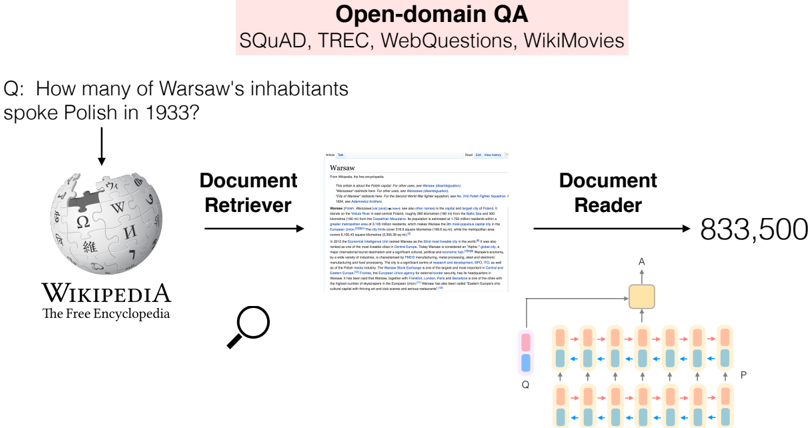
This paper proposes to tackle open-domain question answering using Wikipedia as the unique knowledge source: the answer to any factoid question is a text span in a Wikipedia article. This task of machine reading at scale combines the challenges of document retrieval (finding the relevant articles) with that of machine comprehension of text (identifying the answer spans from those articles). Our approach combines a search component based on bigram hashing and TF-IDF matching with a multi-layer recurrent neural network model trained to detect answers in Wikipedia paragraphs. Our experiments on multiple existing QA datasets indicate that (1) both modules are highly competitive with respect to existing counterparts and (2) multitask learning using distant supervision on their combination is an effective complete system on this challenging task.
Overview
The claims and statistics of this paper haven’t been checked yet.
Free: it reads the open-access text and checks the first 5 claims that cite a source we can check. Create a free account to check every claim.
Integrity signals
Registry
Cites
Statistics
Figures
Verification
Claims the paper makes
The claims and statistics of this paper haven’t been checked yet.
Free: it reads the open-access text and checks the first 5 claims that cite a source we can check. Create a free account to check every claim.
Claims other papers make about this one
Each is checked against this paper’s own text: does it say what the citing paper says it does?
The source backs part of the claim, not all of it — or backs it for a different population, condition or comparison.
In the citing paper
“In particular, the presence of low-value or semantically irrelevant entries dilutes the contribution of high-quality information in retrieval results, impairing downstream task performance and leading to measurable declines in metrics [5].”
From SEDM: Selective Self-Evolving Distributed Memory for Agents (2025) · cites this paper as [5]
Experimental — accuracy not yet measuredThe source backs part of the claim, not all of it — or backs it for a different population, condition or comparison.
In the citing paper
“Prior work has shown that retrieval improves performance across a variety of NLP tasks when considered in isolation.”
From Retrieval-Augmented Generation for Knowledge-Intensive NLP Tasks (2020) · cites this paper as [5]
Experimental — accuracy not yet measuredThe cited source says what the claim attributes to it.
In the citing paper
“This is in agreement with prior work that treated Wikipedia as a general knowledge source under the same reason (Chen et al., 2017; Petroni et al., 2021).”
From FActScore: Fine-grained Atomic Evaluation of Factual Precision in Long Form Text Generation (2023) · cites this paper as Chen et al., 2017
The cited source says what the claim attributes to it.
In the citing paper
“In-context learning methods now routinely invoke tools, leading to LM pipelines that use retrieval models (Chen et al., 2017; Lewis et al., 2020; Guu et al., 2020; Lazaridou et al., 2022; Izacard et al., 2022), multimodal foundation models, and more traditional tools like APIs (Nakano et al., 2021) and calculators.”
From DSPy: Compiling Declarative Language Model Calls into Self-Improving Pipelines (2023) · cites this paper as Chen et al., 2017
Self-check
Percentages, sums and reported differences re-computed from the paper’s own numbers.
The self-check needs the paper’s full text.
Citations
Cites
Adam: A Method for Stochastic Optimization
Kingma, D. P., & Ba, J. (2014) · arXiv · doi:10.48550/arxiv.1412.6980 · Cited by 98,946 · cited 1×
“We use Adamax for optimization as described in (Kingma and Ba, 2014).”
MethodGlove: Global Vectors for Word Representation
Pennington, J., Socher, R., & Manning, C. (2014) · Proceedings of the 2014 Conference on Empirical Methods in Natural Language Processing (EMNLP) · doi:10.3115/v1/d14-1162 · Cited by 34,071 · cited 2×
“The feature vector ˜ p i is comprised of the following parts: We use the 300-dimensional Glove word embeddings trained from 840B Web crawl data (Pennington et al., 2014).”
MethodNeural Machine Translation by Jointly Learning to Align and Translate
Bahdanau, D., Cho, K., & Bengio, Y. (2014) · arXiv · doi:10.48550/arxiv.1409.0473 · Cited by 16,213 · cited 2×
“…has made considerable progress recently thanks to new deep learning architectures like attention-based and memory-1 augmented neural networks (Bahdanau et al., 2015; Weston et al., 2015; Graves et al., 2014) and release of new training and evaluation datasets like QuizBowl (Iyyer et al., 2014),…”
BackgroundThe Stanford CoreNLP Natural Language Processing Toolkit
Manning, C., Surdeanu, M., Bauer, J., Finkel, J., Bethard, S., & McClosky, D. (2014) · Proceedings of 52nd Annual Meeting of the Association for Computational Linguistics: System Demonstrations · doi:10.3115/v1/p14-5010 · Cited by 7,037 · cited 2×
“We apply the Stanford CoreNLP toolkit (Manning et al., 2014) for tokenization and also generating lemma, part-of-speech, and named entity manual features.”
MethodSQuAD: 100,000+ Questions for Machine Comprehension of Text
Rajpurkar, P., Zhang, J., Lopyrev, K., & Liang, P. (2016) · Proceedings of the 2016 Conference on Empirical Methods in Natural Language Processing · doi:10.18653/v1/d16-1264 · Cited by 6,208 · cited 10×
“Next we evaluate our Document Reader component on the standard SQuAD evaluation (Rajpurkar et al., 2016).”
BackgroundMethodInfluentialA unified architecture for natural language processing: deep neural networks with multitask learning
Collobert, R., & Weston, J. (2008) · Proceedings of the 25th international conference on Machine learning - ICML '08 · doi:10.1145/1390156.1390177 · Cited by 5,058 · cited 1×
“Multitask learning (Caruana, 1998) and task transfer have a rich history in machine learning (e.g., using ImageNet in the computer vision community (Huh et al., 2016)), as well as in NLP in particular (Collobert and Weston, 2008).”
MethodSelf-citationFreebase: a collaboratively created graph database for structuring human knowledge
Bollacker, K., Evans, C., Paritosh, P., Sturge, T., & Taylor, J. (2008) · Proceedings of the 2008 ACM SIGMOD international conference on Management of data · doi:10.1145/1376616.1376746 · Cited by 4,852 · cited 11×
“Unlike knowledge bases (KBs) such as Freebase (Bollacker et al., 2008) or DBPedia (Auer et al.”
BackgroundMethodInfluentialDistant supervision for relation extraction without labeled data
Mintz, M., Bills, S., Snow, R., & Jurafsky, D. (2009) · Proceedings of the Joint Conference of the 47th Annual Meeting of the ACL and the 4th International Joint Conference on Natural Language Processing of the AFNLP: Volume 2 - ACL-IJCNLP '09 · doi:10.3115/1690219.1690287 · Cited by 2,752 · cited 1×
“Following previous work on distant supervision (DS) for relation extraction (Mintz et al., 2009), we use a”
MethodTeaching Machines to Read and Comprehend
Hermann, K. M., Kočiský, T., Grefenstette, E., Espeholt, L., Kay, W., Suleyman, M., & Blunsom, P. (2015) · arXiv (Cornell University) · doi:10.48550/arxiv.1506.03340 · Cited by 2,521 · cited 7×
“…Graves et al., 2014) and release of new training and evaluation datasets like QuizBowl (Iyyer et al., 2014), CNN/Daily Mail based on news articles (Hermann et al., 2015), CBT based on children books (Hill et al., 2016), or SQuAD (Rajpurkar et al., 2016) and WikiReading (Hewlett et al., 2016),…”
BackgroundMethodInfluentialDBpedia: A Nucleus for a Web of Open Data
Auer, S., Bizer, C., Kobilarov, G., Lehmann, J., Cyganiak, R., & Ives, Z. (2007) · Lecture Notes in Computer Science · doi:10.1007/978-3-540-76298-0_52 · Cited by 2,454 · cited 3×
“Unlike knowledge bases (KBs) such as Freebase (Bollacker et al., 2008) or DB-Pedia (Auer et al., 2007), which are easier for computers to process but too sparsely populated for open-domain question answering (Miller et al., 2016), Wikipedia contains up-to-date knowledge that humans are interested in.”
Background
Research works printed but not linked: 5
- Petr Baudiˇ s. 2015. YodaQA: a modular question answering system pipeline. In POSTER 2015-19th International Student Conference on Electrical Engineering . pages 1156-1165.
- Eric Brill, Susan Dumais, and Michele Banko. 2002. Ananalysis of the AskMSR question-answering system. In Empirical Methods in Natural Language Processing (EMNLP) . pages 257-264.
- Rudolf Kadlec, Ondrej Bajgar, and Jan Kleindienst. 2016. From particular to general: A preliminary case study of transfer learning in reading comprehension. Machine Intelligence Workshop, NIPS .
- Alexander H. Miller, Adam Fisch, Jesse Dodge, AmirHossein Karimi, Antoine Bordes, and Jason Weston. 2016. Key-value memory networks for directly reading documents. In Empirical Methods in Natural Language Processing (EMNLP) . pages 14001409.
- Jason Weston, Sumit Chopra, and Antoine Bordes. 2015. Memory networks. In International Conference on Learning Representations (ICLR) .
Cited by
Items 901–1,000 of 1,042
ReviewQA: a relational aspect-based opinion reading datasetPreprint
Grail, Q., & Pérez, J. (2018) · arXiv (Cornell University) · doi:10.48550/arxiv.1810.12196 · Cited by 10
Are you tough enough? Framework for Robustness Validation of Machine Comprehension SystemsPreprint
Rychalska, B., Basaj, D., & Biecek, P. (2018) · arXiv (Cornell University) · doi:10.48550/arxiv.1812.02205 · Cited by 9
“We investigate three popular architectures: DrQA [2], BiDAF [12] and QANet [14].”
MethodMulti-task Learning with Sample Re-weighting for Machine Reading ComprehensionPreprint
Xu, Y., Liu, X., Shen, Y., Liu, J., & Gao, J. (2018) · arXiv (Cornell University) · doi:10.48550/arxiv.1809.06963 · Cited by 5
“At last, we provide some additional results on combining MTL with DrQA (Chen et al., 2017) to show the flexibility of our approach 1 .”
MethodInfluentialAnswering while Summarizing: Multi-task Learning for Multi-hop QA with Evidence ExtractionPreprint
Nishida, K., Nishida, K., Nagata, M., Otsuka, A., Saito, I., Asano, H., & Tomita, J. (2019) · arXiv (Cornell University) · doi:10.48550/arxiv.1905.08511 · Cited by 5
“For such datasets, the document retrieval model is combined with the contextquery matching model (Chen et al., 2017a; Wang et al., 2018a,b; Nishida et al., 2018).”
MethodDoes it care what you asked? Understanding Importance of Verbs in Deep Learning QA System
Rychalska, B., Basaj, D., Wróblewska, A., & Biecek, P. (2018) · BlackboxNLP Workshop on Analyzing and Interpreting Neural Networks for NLP (BlackboxNLP) · doi:10.18653/v1/w18-5436 · Cited by 7
“Question self-attention As described in Chen et al. (2017), question self-attention learns to encode importance of each question word.”
BackgroundMethodLarge Scale Question Answering using Tourism DataPreprint
Contractor, D., Shah, K., Partap, A., Mausam, & Singla, P. (2019) · arXiv.org · doi:10.48550/arxiv.1909.03527 · Cited by 11
“like BM25 (Robertson and Zaragoza, 2009) to retrieve and sub-select candidate documents (Chen et al., 2017); reasoning is then performed over this reduced space to return answers.”
BackgroundMethodInfluentialPruning the Index Contents for Memory Efficient Open-Domain QAPreprint
Fajčík, M., Dočekal, M., Ondrej, K., & Smrž, P. (2021) · arXiv (Cornell University) · doi:10.13140/rg.2.2.32959.02727 · Cited by 9
Using Machine Learning to Extract Insights From Consumer Data
Chang, H. H., & Mukherjee, A. (2023) · IGI Global eBooks · doi:10.4018/978-1-7998-9220-5.ch107 · Cited by 8
RAVEN: In-Context Learning with Retrieval Augmented Encoder-Decoder Language Models
Huang, J., Ping, W., Xu, P., Shoeybi, M., Chang, K. C.-C., & Catanzaro, B. (2023) · arXiv · doi:10.48550/arxiv.2308.07922 · Cited by 5
How Context Affects Language Models' Factual Predictions
Fabio Petroni, P. L. (2020) · Automated Knowledge Base Construction (AKBC) · doi:10.24432/c5201w · Cited by 4
“2 Baselines We consider DrQA [Chen et al., 2017], a popular system for open-domain question answering.”
BackgroundMethodInfluentialLawrence, B., Wang, Y., Pan, Y., & Alexander, C. S. (2022) · Industrial Marketing Management · doi:10.1016/j.indmarman.2022.10.002 · Cited by 4
Enhancing Sparse Retrieval via Unsupervised Learning
Ma, X., Fun, H., Yin, X., Mallia, A., & Lin, J. (2023) · Annual International ACM SIGIR Conference on Research and Development in Information Retrieval in the Asia Pacific Region (SIGIR-AP) · doi:10.1145/3624918.3625334 · Cited by 5
“1 Although such methods date back many decades, they remain strong baselines [18] in various ranking tasks [1, 2], even in the age of deep neural networks [19].”
BackgroundModeling and Analysis of Question Answering for Long Context and Compound Questions Using BERT Model
Sivakumar, S., & Meenakshi, S. P. (2025) · Procedia Computer Science · doi:10.1016/j.procs.2025.04.529 · Cited by 4
Pham-Phuc, T., Cao, N. D. D., Tran, K. Q., & Nguyen, K. V. (2025) · Artificial Intelligence and Law · doi:10.1007/s10506-025-09457-7 · Cited by 11
Xavier, O. C., & Soares, A. D. S. (2025) · Simpósio Brasileiro de Bancos de Dados (SBBD) · doi:10.5753/sbbd.2025.247297 · Cited by 5
“Text-based Open-Domain QA : Another line of work uses an information retrieval (IR) component to fetch text passages (e.g., from Wikipedia) and then applies a reading comprehension model to extract answers [Chen et al. 2017, Karpukhin et al. 2020].”
Effective Strategies for Low-Resource Reading Comprehension
Jing, Y., & Xiong, D. (2020) · International Conference on Asian Language Processing · doi:10.1109/ialp51396.2020.9310502 · Cited by 4
“In this paper, we use the V-DrQA (a variation of the Document Reader of DrQA) [17] as our baseline model. model takes a triple (P, Q, A) as input, where P = { p 1 , p 2 , ..., p m } , Q = { q 1 , q 2 , ..., q n } are word representations of a single passage and a question, and A = { a start , a end…”
BackgroundMethodCombining Open Domain Question Answering with a Task-Oriented Dialog System
Nehring, J., Feldhus, N., Kaur, H., & Ahmed, A. (2021) · doi:10.18653/v1/2021.dialdoc-1.5 · Cited by 7
“The evaluation of DrQA reports an F1 score of 0.36 in the non-modular setting which is comparable to the results reported in the original paper (Chen et al., 2017).”
BackgroundMethodResultInfluentialCollaborative System for Question Answering in German Case Law Documents
Hoppe-Ludwig, C., Migenda, N., Pelkmann, D., Hötte, D., & Schenck, W. (2022) · IFIP advances in information and communication technology · doi:10.1007/978-3-031-14844-6_24 · Cited by 6
To Answer or Not to Answer? Filtering Questions for QA Systems
Pirozelli, P., Brandão, A. A. F., Peres, S. M., & Cozman, F. G. (2022) · Lecture notes in computer science · doi:10.1007/978-3-031-21689-3_33 · Cited by 4
“DrQA [4], for instance, has a document retriever, based on bigram hashing and TF-IDF matching, and a document reader, which uses an achitecture of bidirectional LSTMs.”
Contrastive Refinement for Dense Retrieval Inference in the Open-Domain Question Answering Task
Zhai, Q., Zhu, W., Zhang, X., & Liu, C. (2023) · Future Internet · doi:10.3390/fi15040137 · Cited by 7
Multi-Row, Multi-Span Distant Supervision For Table+Text Question Answering
Kumar, V., Gupta, Y., Chemmengath, S., Sen, J., Chakrabarti, S., Bharadwaj, S., & Pan, F. (2023) · Proceedings of the conference - Association for Computational Linguistics. Meeting · doi:10.18653/v1/2023.acl-long.449 · Cited by 28
“Many existing QA datasets and benchmarks measure performance over homogeneous data sources, such as text (Rajpurkar et al., 2016; Chen et al., 2017a; Joshi et al., 2017; Dua et al., 2019) and more recently tables (Pasupat and Liang, 2015; Zhong et al., 2017; Liang et al., 2017; Herzig et al., 2020;…”
BackgroundMethodDo Question Answering Modeling Improvements Hold Across Benchmarks?
Liu, N. F., Lee, T., Jia, R., & Liang, P. (2023) · Proceedings of the conference - Association for Computational Linguistics. Meeting · doi:10.18653/v1/2023.acl-long.736 · Cited by 41
“These modeling approaches include RaSoR (Lee et al., 2016), BiDAF (Seo et al., 2017), DocumentReader (Chen et al., 2017), QANet (Yu et al., 2018), BiDAF++ (Clark and Gardner, 2018), MnemonicReader (Hu et al., 2017), FusionNet (Huang et al., 2018), BERT (Devlin et al., 2019), ALBERT (Lan et al.,…”
MethodInfluentialData-Efficient Auto-Regressive Document Retrieval for Fact Verification
Thorne, J. (2022) · Workshop on Simple and Efficient Natural Language Processing (SustaiNLP) · doi:10.18653/v1/2022.sustainlp-1.7 · Cited by 11
Knowledge Transfer from Answer Ranking to Answer Generation
Gabburo, M., Koncel-Kedziorski, R., Garg, S., Soldaini, L., & Moschitti, A. (2022) · Conference on Empirical Methods in Natural Language Processing (EMNLP) · doi:10.18653/v1/2022.emnlp-main.645 · Cited by 10
Simple Questions Generate Named Entity Recognition Datasets
Kim, H., Yoo, J., Yoon, S., Lee, J., & Kang, J. (2022) · Conference on Empirical Methods in Natural Language Processing (EMNLP) · doi:10.18653/v1/2022.emnlp-main.417 · Cited by 7
Toward Connecting Speech Acts and Search Actions in Conversational Search Tasks
Ghosh, S., Ghosh, S., & Shah, C. S. (2023) · ACM/IEEE Joint Conference on Digital Libraries · doi:10.1109/jcdl57899.2023.00027 · Cited by 7
“Attention mechanism has been used in various fields like machine translation [8], language inference [74], questionanswering system [21], and document classification [112].”
MethodCAPSTONE: Curriculum Sampling for Dense Retrieval with Document Expansion
He, X., Gong, Y., Jin, A.-L., Zhang, H., Dong, A., Jiao, J., Yiu, S., & Duan, N. (2023) · Conference on Empirical Methods in Natural Language Processing (EMNLP) · doi:10.18653/v1/2023.emnlp-main.651 · Cited by 10
End-to-End Question Answering System for Indonesian Documents Using TF-IDF and IndoBERT
Ahmad, G. N., & Romadhony, A. (2023) · International Conference on Advanced Informatics: Concepts, Theory and Applications (ICAICTA) · doi:10.1109/icaicta59291.2023.10390111 · Cited by 4
“One of the studies that implemented the retriever-reader architecture in QAS is by Chen et al. [5].”
BackgroundMethodKnowledge-augmented Methods for Natural Language Generation
Jiang, M., Lin, B. Y., Wang, S., Yi‐chong, X., Yu, W., & Zhu, C. (2024) · SpringerBriefs in computer science · doi:10.1007/978-981-97-0747-8_4 · Cited by 7
Farea, A., & Emmert‐Streib, F. (2024) · Journal of Artificial Intelligence Research · doi:10.1613/jair.1.15642 · Cited by 7
“Definition 1 [EM normalized-based (nb)] The exact match which is normalized-based, EM nb , is evaluated by (see (Devlin et al., 2018; Wolf et al., 2020; Liu et al., 2017b; Chen et al., 2017; Wang & Jiang, 2016; Rajpurkar et al., 2016, 2018)) In Eqn.”
MethodBehmanesh, S., Talebpour, A., Shamsfard, M., & Jafari, M. M. M. (2024) · IEEE Access · doi:10.1109/access.2024.3490452 · Cited by 4
“In Text-based QA (TextQA), systems like Wikipedia serve as rich information sources, but integrating free text with knowledge bases remains challenging [46], [47], [48], [49], [50], [51].”
Liu, J., Ren, J., Bai, R., Zhang, Z., & Lu, Z. (2024) · Expert Systems with Applications · doi:10.1016/j.eswa.2024.125701 · Cited by 5
Zhang, W., Huang, J.-H., Vakulenko, S., Xu, Y., Rajapakse, T. C., & Kanoulas, E. (2024) · Lecture notes in computer science · doi:10.1007/978-3-031-78495-8_6 · Cited by 18
Chen, Q., Zhou, W., Cheng, J., & Yang, J. X. (2024) · Applied Sciences · doi:10.3390/app142411529 · Cited by 9
Chorowski, J., Łańcucki, A., Malik, S., Pawlikowski, M., Rychlikowski, P., & Zykowski, P. (2018) · The Springer series on challenges in machine learning · doi:10.1007/978-3-319-94042-7_4 · Cited by 4
ECNU at SemEval-2018 Task 11: Using Deep Learning Method to Address Machine Comprehension Task
Sheng, Y., Lan, M., & Wu, Y. (2018) · International Workshop on Semantic Evaluation (SemEval) · doi:10.18653/v1/s18-1175 · Cited by 4
“For the input word vectors of D , we also include a 5-dim binary feature to indicates the overlap be-tween the ducument and the question(or choices) which inspired by (Chen et al., 2017).”
MethodA Fully Attention-Based Information Retriever
Correia, A. H. C., Silva, J. L. M., Martins, T. D. C., & Cozman, F. G. (2018) · International Joint Conference on Neural Networks (IJCNN) · doi:10.1109/ijcnn.2018.8489656 · Cited by 4
“…72.139 81.048 smartnet [12] 71.415 80.160 Ruminating Reader [13] 70.639 79.456 jNet [14] 70.607 79.821 ReasoNet [15] 70.555 79.364 Document Reader [16] 70.733 79.353 RaSoR [17] 70.849 78.741 FastQAExt [18] 70.849 78.857 Multi-Perspective Matching [19] 70.387 78.784 SEDT [20] 68.163 77.527 FABIR…”
InfluentialKnowledge and Cross-Pair Pattern Guided Semantic Matching for Question Answering
Xu, Z., Zheng, H.-T., Zhai, S., & Wang, D. (2020) · Proceedings of the AAAI Conference on Artificial Intelligence · doi:10.1609/aaai.v34i05.6478 · Cited by 5
“Some recent work leverages Wikipedia (Chen et al. 2017), knowledge bases (Shen et al. 2018) or other ex-ternal resources to provide background information for QA.”
BackgroundA Multi-modal Approach to Fine-grained Opinion Mining on Video Reviews
Marrese-Taylor, E., Rodríguez, C., Balazs, J., Gould, S. J., & Matsuo, Y. (2020) · doi:10.18653/v1/2020.challengehml-1.2 · Cited by 5
Transformer-Based Open Domain Biomedical Question Answering at BioASQ8 Challenge.
Kazaryan, A., Sazanovich, U., & Belyaev, V. (2020) · CLEF (Working Notes) · Cited by 6
Language-based General Action Template for Reinforcement Learning Agents
Kohita, R., Wachi, A., Kimura, D., Chaudhury, S., Tatsubori, M., & Munawar, A. (2021) · Findings of the Association for Computational Linguistics: ACL (Findings of ACL) · doi:10.18653/v1/2021.findings-acl.187 · Cited by 5
“Research on NLP has created various resources such as for retrieving information from Wikipedia (Chen et al., 2017), inferring the next action from a current state (Zellers et al.”
BackgroundImproving Low resource Reading Comprehension via Cross lingual Transposition Rethinking
Wu, G., Xu, B., Qin, Y., Wang, W., & Wang, G. (2021) · International Joint Conference on Knowledge Graphs (IJCKG) · doi:10.1145/3502223.3502234 · Cited by 6
“Question Answering (QA) is a comprehensive practically-useful task which also can be used to evaluate how well computer systems understand human languages [5, 18].”
BackgroundChicaiza, J. A., & Nadjet Bouayad-agha, A. (2021) · Lecture notes in networks and systems · doi:10.1007/978-981-16-6369-7_22 · Cited by 4
Interactive Gated Decoder for Machine Reading Comprehension
Cui, Y., Che, W., Yang, Z., Liu, T., Qin, B., Wang, S., & Hu, G. (2022) · ACM Transactions on Asian and Low-Resource Language Information Processing · doi:10.1145/3501399 · Cited by 4
“Machine reading comprehension is a task to read and comprehend given articles and answer the questions based on them, which consists of various sub-genres, such as cloze-style MRC [11, 12], span-extraction MRC [24], open-domain MRC [3], multiple-choice MRC [17, 25], and so on.”
BackgroundSurvey of Machine Reading Comprehension Models and its Evaluation Metrics
Therasa, M., & Mathivanan, G. (2022) · International Conference on Computing Methodologies and Communication (ICCMC) · doi:10.1109/iccmc53470.2022.9754070 · Cited by 6
Reddy, R. G., Sultan, M. A., Franz, M., Sil, A., & Ji, H. (2022) · International ACM SIGIR Conference on Research and Development in Information Retrieval (SIGIR) · doi:10.1145/3477495.3531878 · Cited by 6
“[3] and the BM25 implementation provided by Pyserini3.”
BackgroundGameOfThronesQA: Answer-Aware Question-Answer Pairs for TV Series
Lahiri, A. K., & Hu, Q. (2022) · Lecture notes in computer science · doi:10.1007/978-3-030-99739-7_21 · Cited by 7
A Semantics-Aware Approach to Automated Claim Verification
Figueras, B. C., Oller, M., & Agerri, R. (2022) · Fact Extraction and VERification Workshop (FEVER) · doi:10.18653/v1/2022.fever-1.5 · Cited by 5
“These datasets have enabled the development of models for the three tasks involved in the claim-verification pipeline: document retrieval (Chen et al., 2017a; Nogueira and Cho, 2020), sentence retrieval (Danesh et al., 2015; Hanselowski et al., 2018), and natural language inference (Parikh et al.,…”
BackgroundMethodSS-BERT: A Semantic Information Selecting Approach for Open-Domain Question Answering
Fu, X., Du, J., Zheng, H.-T., Li, J., Hou, C., Zhou, Q., & Kim, H. (2023) · Electronics · doi:10.3390/electronics12071692 · Cited by 6
“DrQA [5] is the first Open-Domain QA model to use Neural Machine Reading Comprehension (Neural MRC) in Open-Domain QA, resulting in a two-stage structure QA system which consists of a retriever and a reader.”
MethodZaikis, D., Kokkas, S., & Vlahavas, I. P. (2023) · Communications in computer and information science · doi:10.1007/978-3-031-34204-2_47 · Cited by 5
A Survey on Conversational Search and Applications in Biomedicine
Adatrao, N. S. K., Gadireddy, G. R., & Noh, J. (2023) · ACM Southeast Regional Conference (ACMSE) · doi:10.1145/3564746.3587001 · Cited by 8
“They proposed an MRC model with the history attention mechanism to demonstrate the importance of positional information of utterances in conversation modeling.”
InfluentialSil, A., Sen, J., Iyer, B., Franz, M., Fadnis, K., Bornea, M. A., Rosenthal, S., McCarley, S., Zhang, R., Kumar, V., et al. (2023) · Proceedings of the conference - Association for Computational Linguistics. Meeting · doi:10.18653/v1/2023.acl-demo.5 · Cited by 9
Araujo, V., Soto, Á., & Moens, M. (2023) · Findings of the Association for Computational Linguistics: ACL (Findings of ACL) · doi:10.18653/v1/2023.findings-acl.830 · Cited by 7
UnifEE: Unified Evidence Extraction for Fact Verification
Hu, N., Wu, Z., Lai, Y., Zhang, C., & Feng, Y. (2023) · Conference of the European Chapter of the Association for Computational Linguistics · doi:10.18653/v1/2023.eacl-main.82 · Cited by 4
“The official baseline (Aly et al., 2021) uses DrQA (Chen et al., 2017) to extract sentences and tables.”
MethodInfluentialInvestigating better context representations for generative question answering
Francis, S., & Moens, M. (2023) · Information Retrieval · doi:10.1007/s10791-023-09420-7 · Cited by 6
“Pipeline-based models (Chen et al., 2017; Wang et al., 2018b; Clark & Gardner, 2018) use a ranker to first rank all the passages based on their relevance to the question and then utilize a question-answering module using the selected passage to answer the question.”
Detrimental Contexts in Open-Domain Question Answering
Oh, P., & Thorne, J. (2023) · Findings of the Association for Computational Linguistics: EMNLP (Findings of EMNLP) · doi:10.18653/v1/2023.findings-emnlp.776 · Cited by 16
Open-Domain Question Answering using Feature Encoded Dynamic Coattention Networks
Kale, S. S., Kulkarni, A., Patil, R., Haribhakta, Y. V., Bhattacharjee, K., Mehta, S., Mithran, S., & Kumar, A. (2018) · International Conference on Advances in Computing, Communications and Informatics (ICACCI) · doi:10.1109/icacci.2018.8554458 · Cited by 3
“DrQA [2] is an existing available open-domain QA system.”
BackgroundMethodBarz, M., & Sonntag, D. (2021) · Lecture notes in electrical engineering · doi:10.1007/978-981-15-9323-9_34 · Cited by 5
“g-based QA systems. 2 Related Work The broad field of QA includes research ranging from retrieval-based [29, 8, 15, 9] to generative [21, 20], as well as, from closed-domain [10, 16] to open-domain QA [20, 13, 18, 7]. We focus on the notion of improving an already deployed system. For QA dialogues based on structured k…”
MethodWu, J. F., Hoque, M. R. U., Reiske, G., Weigle, M. C., Bradshaw, B. T., Gaff, H. D., Li, J., & Kwan, C. (2020) · ACM/IEEE Joint Conference on Digital Libraries · doi:10.1145/3383583.3398602 · Cited by 6
“The attention mechanism has been adopted in many NLP tasks such as machine translation [11] and question-answering [4].”
Query Expansion Framework Leveraging Clinical Diagnosis Information Ontology
Malik, S., Shoaib, U., El‐Sayed, H., & Khan, M. A. (2020) · International Conference on Innovations in Information Technology · doi:10.1109/iit50501.2020.9299028 · Cited by 4
“These KBs have been exploited, in various researches, and concludingly suffer from the fixed schema, data incompleteness, and sparsity which stimulate researchers to practice unstructured KBs [21] [22].”
BackgroundMedical Entity Relation Verification with Large-scale Machine Reading Comprehension
Yuan, X., Wang, C., Shi, Z., Zhou, J., Lü, C., Huang, H., & Xiong, H. (2021) · ACM SIGKDD Conference on Knowledge Discovery and Data Mining (KDD) · doi:10.1145/3447548.3467144 · Cited by 4
“[3] propose to tackle open-domain question answering using Wikipedia as the unique knowledge source.”
BackgroundContext-Aware Question-Answer for Interactive Media Experiences
Jorgensen, K., Zhao, Z., Wang, H., Wang, M., & He, Z. (2021) · ACM International Conference on Interactive Media Experiences · doi:10.1145/3452918.3458795 · Cited by 6
“DrQA [3] uses a term frequency-inverse document frequency (TF-IDF) with weighted n-grams to match relevant Wikipedia articles with questions in their system.”
MethodYiğit, G., & Amasyalı, M. F. (2021) · Bilişim Teknolojileri Dergisi · doi:10.17671/gazibtd.810362 · Cited by 5
Gashkov, A., Perevalov, A., Eltsova, M., & Both, A. (2021) · International Conference on Intelligent Systems and Knowledge Engineering (ISKE) · doi:10.1109/iske54062.2021.9755382 · Cited by 4
TT-Net: Topic Transfer-Based Neural Network for Conversational Reading Comprehension
Gu, Y., Gui, X., & Li, D. (2019) · IEEE Access · doi:10.1109/access.2019.2936011 · Cited by 4
“The passage and questions are embedded into word representations first which are enhanced by the additional features such as POS-tag, NER and word matching features [8].”
BackgroundMethodInfluentialELMo+Gated Self-attention Network Based on BiDAF for Machine Reading Comprehension
Zhang, W. W., & Ren, F. (2020) · IEEE International Conference on Software Engineering and Service Science (ICSESS) · doi:10.1109/icsess49938.2020.9237663 · Cited by 4
“…Matching [18] 65.5 75.1 Dynamic Coattention Networks 66.2 75.9 Bidirectional Attention Flow [13] 68.0 77.3 RaSoR [6] 69.6 77.7 ReasoNet [14] 69.1 78.9 FastQAExt [19] 70.8 78.9 Document Reader [1] 70.7 79.4 JNet [24] 70.6 79.8 R-net [2] 72.3 80.7 ELMo+Gated Self-BIDAF (Ours) 74.5 83.1”
InfluentialSynthetic Target Domain Supervision for Open Retrieval QA
Reddy, R. G., Iyer, B., Sultan, M. A., Zhang, R., Sil, A., Castelli, V., Florian, R., & Roukos, S. (2021) · International ACM SIGIR Conference on Research and Development in Information Retrieval (SIGIR) · doi:10.1145/3404835.3463085 · Cited by 9
“[21] shows that distant supervision for neural passage retrieval can be derived from annotated MRC data, yielding a superior approach [17, 28] to classical term matching methods like BM25 [9, 34].”
BackgroundMethodOh, J., Iida, R., Kloetzer, J., & Torisawa, K. (2021) · doi:10.18653/v1/2021.acl-long.164 · Cited by 7
“It also outperformed the SOTA method of open-domain QA (Chen et al., 2017) on Quasar-T (Dhingra et al., 2017) and SearchQA (Dunn et al., 2017) using either ALBERT or RoBERTa.”
MethodInfluentialKratzwald, B., & Feuerriegel, S. (2018) · arXiv (Cornell University) · doi:10.48550/arxiv.1804.07097 · Cited by 4
FastFusionNet: New State-of-the-Art for DAWNBench SQuADPreprint
Wu, F., Li, B., Wang, L., Lao, N., Blitzer, J. C., & Weinberger, K. Q. (2019) · arXiv (Cornell University) · doi:10.48550/arxiv.1902.11291 · Cited by 6
“DrQA [2] is one of the simplest reading comprehension model, which employs a variety of features including pre-trained word vectors, term frequencies, part-of-speech tags, name entity relations, and the fact that whether a context word is in the question or not, encodes the features with RNNs, and…”
InfluentialKnowledge Distillation in Document RetrievalPreprint
Shakeri, S., Sethy, A., & Cheng, C. (2019) · arXiv (Cornell University) · doi:10.48550/arxiv.1911.11065 · Cited by 11
“DrQA (Chen et al. (2017)) is employed to find the k nearest documents of a claim from the entire corpus based on cosine similarity of TF-IDF vectors.”
MethodSirenLess: reveal the intention behind newsPreprint
Chen, X., Lo, L. Y., & Qu, H. (2020) · arXiv (Cornell University) · doi:10.48550/arxiv.2001.02731 · Cited by 4
Siblini, W., Challal, M., & Pasqual, C. (2020) · arXiv (Cornell University) · doi:10.48550/arxiv.2010.08422 · Cited by 4
“In the meantime, Bert was released and Yang et al. (2019a) proposed a first successful usage for ODQA, by simply combining answerini/Lucene with a Bert base fine-tuned on SQuAD, which achieved the new state-of-the art performance on the reference benchmark Open-SQuAD (Chen et al. 2017).”
BackgroundMethodInfluentialInteractive Teaching for Conversational AIPreprint
Ping, Q., Niu, F., Thattai, G., Chengottusseriyil, J., Gao, Q., Reganti, A., Rajagopal, P., Tür, G., Hakkani-Tür, D. Z., & Natarajan, P. (2020) · arXiv (Cornell University) · doi:10.48550/arxiv.2012.00958 · Cited by 13
“Those works typically learn a representation for the question and passage, and then predict the start and end of the answer with attention mechanism between question, passage and answer [3, 2].”
BackgroundA Graph-guided Multi-round Retrieval Method for Conversational Open-domain Question AnsweringPreprint
Li, Y., Li, W., & Nie, L. (2021) · arXiv (Cornell University) · doi:10.48550/arxiv.2104.08443 · Cited by 12
“Open-domain question answering (QA) [3, 31, 32], which aims to answer questions from the Web, has attracted wide attention from the academic field in recent years.”
From Classification to Generation: Insights into Crosslingual Retrieval Augmented ICL
Li, X., Nie, E., & Liang, S. (2023) · arXiv · doi:10.48550/arxiv.2311.06595 · Cited by 4
AKER: Arabic Knowledge-enriched Reader for Machine Reading Comprehension
Albilali, E., Al-Twairesh, N., & Hosny, M. (2025) · ACM Transactions on Asian and Low-Resource Language Information Processing · doi:10.1145/3736164 · Cited by 3
“In this article, we focus solely on pure KGE models, which do not exploit auxiliary information such as textual data or logical rules.”
FoodPuzzle: Toward Developing Large Language Model Agents as Autonomous Flavor Scientists
Huang, T., Lee, D. H., Sweeney, J., Shi, J., Steliotes, E., Lange, M. C., May, J., & Chen, M. (2025) · ACM SIGKDD Conference on Knowledge Discovery and Data Mining (KDD) · doi:10.1145/3711896.3737384 · Cited by 3
“Retrieval-Augmented Language Models (RALMs) enhance the reasoning process by incorporating external knowledge sources, thus providing additional contextual information (Chen et al., 2017; Lee et al., 2019b; Karpukhin et al., 2020; Borgeaud et al., 2022; Zhang, 2024).”
Investigating the Effect of Background Knowledge on Natural Questions
Balachandran, V., Dhingra, B., Sun, H., Collins, M., & Cohen, W. W. (2021) · Workshop on Knowledge Extraction and Integration for Deep Learning Architectures: Deep Learning Inside Out (DeeLIO) · doi:10.18653/v1/2021.deelio-1.3 · Cited by 4
“, 2016), DocReader (Chen et al., 2017), and BertJoint (Alberti et al.”
BackgroundLite Unified Modeling for Discriminative Reading Comprehension
Zhao, Y., Zhao, H., Shen, L., & Zhao, Y. (2022) · Proceedings of the conference - Association for Computational Linguistics. Meeting · doi:10.18653/v1/2022.acl-long.594 · Cited by 5
Retrieval Augmented via Execution Guidance in Open-domain Table QA
Chen, S., Liu, Y., Wu, J., & Hou, M. (2022) · International Conference on Algorithms, Computing and Artificial Intelligence (ACAI) · doi:10.1145/3579654.3579656 · Cited by 5
“The mainstream approach for open-domain QA is based on twostage framework described by [1] split into the Retrieval stage and the Reader stage, which can be viewed as a closed-domain QA task.”
MethodSingle Sequence Prediction over Reasoning Graphs for Multi-hop QA
Ramesh, G., Sreedhar, M. N., & Hu, J. (2023) · Proceedings of the 61st Annual Meeting of the Association for Computational Linguistics (Volume 1: Long Papers) · doi:10.18653/v1/2023.acl-long.642 · Cited by 3
RobustQA: Benchmarking the Robustness of Domain Adaptation for Open-Domain Question Answering
Han, R., Qi, P., Zhang, Y., Liu, L., Burger, J., Wang, W. Y., Huang, Z., Xiang, B., & Roth, D. (2023) · Findings of the Association for Computational Linguistics: ACL (Findings of ACL) · doi:10.18653/v1/2023.findings-acl.263 · Cited by 28
“ODQA has been studied by a large body of work (Chen et al., 2017; Kwiatkowski et al., 2019; Izacard and Grave, 2021).”
1-PAGER: One Pass Answer Generation and Evidence Retrieval
Jain, P., Soares, L. B., & Kwiatkowski, T. (2023) · Findings of the Association for Computational Linguistics: EMNLP (Findings of EMNLP) · doi:10.18653/v1/2023.findings-emnlp.967 · Cited by 10
Weight Averaging and re-adjustment ensemble for QRCD
Aftab, E., & Malik, M. K. (2024) · Journal of King Saud University - Computer and Information Sciences · doi:10.1016/j.jksuci.2024.102037 · Cited by 3
“Some of the earlier neural models designed for QA task include BiDAF (Seo et al., 2017), DrQA (Chen et al., 2017) and QANet (Yu et al., 2018).”
Generative Reader Optimization in the RAG-System
Sokolov, A., Zamelin, P., Kamelina, Y., & Plastova, P. (2024) · International Conference on Neural Networks and Neurotechnologies (NeuroNT) · doi:10.1109/neuront62606.2024.10585446 · Cited by 4
“We’ve investigated following lexical similarity metrics: F1-score [11] and METEOR [12].”
MethodAutomatic Question Answering From Large ESG Reports
Parikh, P., & Penfield, J. (2024) · International Journal of Data Warehousing and Mining · doi:10.4018/ijdwm.352513 · Cited by 8
Retrieval-Enhanced Machine Learning: Synthesis and Opportunities
Diaz, F., Drozdov, A., Kim, T. E., Salemi, A., & Zamani, H. (2024) · SIGIR-AP · doi:10.1145/3673791.3698439 · Cited by 16
“Some focus on end-to-end evaluation, while others provide retrieval evaluation labels.”
InfluentialA Chinese Short Text Similarity Method Integrating Sentence-Level and Phrase-Level Semantics
Shen, Z., & Xiao, Z. (2024) · Electronics · doi:10.3390/electronics13244868 · Cited by 5
Park, S.-I., & Lee, J.-Y. (2024) · Transactions of the Association for Computational Linguistics · doi:10.1162/tacl_a_00724 · Cited by 23
“Notably, in open-domain question answering (QA) tasks (Chen et al., 2017) that require substantial knowledge, Retrieval Augmented Language Models (RALMs) have proven to be highly effective (Lewis et al., 2020; Guu et al., 2020; Izacard and Grave, 2021; Izacard et al., 2022; Lin et al., 2023).”
LocatingGPT: A multi-modal document retrieval method based on retrieval-augmented generation
Chen, Z., Zhang, P., Xu, M., Gao, X., Liu, D., Luo, X., Huang, R., & Zhang, T. (2024) · IEEE International Conference on Data Science in Cyberspace · doi:10.1109/dsc63484.2024.00038 · Cited by 4
Bayesian-error-informed contrastive learning for knowledge-based question answering systems
Yerragunta, S., Prasath, R., & Girish, G. N. (2025) · Computers & Electrical Engineering · doi:10.1016/j.compeleceng.2025.110142 · Cited by 4
AdQuestA: Knowledge-Guided Visual Question Answer Framework for Advertisements
Choudhary, N., Goyal, P., Siwatch, D., Chandak, A., Mahajan, H., Khurana, V., & Kumar, Y. (2025) · IEEE Winter Conference on Applications of Computer Vision · doi:10.1109/wacv61041.2025.00567 · Cited by 5
“This choice was made because our dataset includes descriptive answers, and crucial context might be concealed within keywords rather than solely relying on the formation of sentence matching with the gt.”
ARLED: Leveraging LED-Based ARMAN Model for Abstractive Summarization of Persian Long Documents
Zangooei, S., Darmani, A., Nezhad, H. F., & Mahmoudi, L. (2025) · International Conference on Web Research (ICWR) · doi:10.1109/icwr65219.2025.11006228 · Cited by 4
“Another popular approach, particularly for multihop and open-domain question-answering tasks, is a two-stage model where the first stage retrieves relevant documents, which are then passed onto the second stage for answer extraction [22], [23].”
A RAG Approach for Multi-Modal Open-ended Lifelog Question-Answering
Tran, Q.-L., Pham, N. N. D., Truong, Q. T., Nguyễn, M. H., Le, H. C., Vu, D. K., Nguyen, V. M. T., Nguyen, V. K., Nguyen, L. P. N. L., Le, T., et al. (2025) · International Conference on Multimedia Retrieval · doi:10.1145/3731715.3733263 · Cited by 3
“Tran et al. [31] proposed an interactive lifelog QA system by employing an open-domain QA pipeline [3] with a retriever-reader architecture to create an interactive lifelog QA system.”
DeepClean: Data Cleaning via Question Asking
Zhang, X., Ji, Y., Nguyen, C., & Wang, T. H. (2018) · IEEE International Conference on Data Science and Advanced Analytics (DSAA) · doi:10.1109/dsaa.2018.00039 · Cited by 6
“We use the SQL dump of the English Wikipedia as of 11/03/2017 as the free-text knowledge source, and adopt the DrQA model [14] as its question-answering (QA) interface, which together constitute D EEP C LEAN ’s backend, as shown in Figure2.”
BackgroundMethodInfluentialQuestion answering via web extracted tables
Karki, B., Hu, F., Haridas, N., Barot, S., Liu, Z., Callebert, L., Grabmair, M., & Tomasic, A. (2019) · International Workshop on Exploiting Artificial Intelligence Techniques for Data Management (aiDM) · doi:10.1145/3329859.3329879 · Cited by 3
“[3] propose to tackle open domain QA using Wikipedia as the knowledge source.”
BackgroundAn XML Parser for Turkish Wikipedia
Furkan, V. U., Tevfik, D. I., & Demir, Ş. (2019) · Signal Processing and Communications Applications Conference (SIU) · doi:10.1109/siu.2019.8806399 · Cited by 3
“Literatürde atıf çözümleme [5], özel isim belirleme [6], metin sınıflandırma [7] ve soru cevaplama [8] gibi çalışmalarda Vikipedi’nin kullandığı gözlemlenmiştir.”
Metadata
- Authors
- Chen, D., Fisch, A., Weston, J., & Bordes, A.
- Affiliations
- Meta (United States) (US)
- ORCID
- Chen, Danqi
- Venue
- Proceedings of the 55th Annual Meeting of the Association for Computational Linguistics (Volume 1: Long Papers)
- Published
- 2017
- Pages
- 1870-1879
- ISSN
- 0736-587X (ISSN-L)
- OpenAlex
- W2962985038
- Cited by
- 1,546
- References
- 39
- Citations by year
- 2026: 61 · 2025: 105 · 2024: 123 · 2023: 218 · 2022: 209 · 2021: 268 · 2020: 202 · 2019: 199 · 2018: 142 · 2017: 18
- FWCI
- 69.97
- Type
- conference paper
- Language
- en
- Open access
- hybrid
- doi.org
- Licence
- cc-by
- Locations
- Proceedings of the conference - Association for Computational Linguistics. Meeting (publishedVersion, cc-by)
- arXiv (Cornell University) (submittedVersion)
- arXiv (Cornell University)
- Topics
- Physical Sciences › Computer Science › Artificial Intelligence › Topic Modeling
- Physical Sciences › Computer Science › Information Systems › Information Retrieval and Search Behavior
- Physical Sciences › Computer Science › Artificial Intelligence › Natural Language Processing Techniques
- Keywords
- open-domain question answering, Wikipedia, machine reading, document retrieval, recurrent neural networks, multi-task learning, distant supervision, factoid questions
About these checks
Registry, retraction, Cites and statistics results are computed, not judged, with one exception: a printed reference that no index lists is read once by a model before it counts as a citation error. Claims are extracted by a model and kept only when their quote appears verbatim in the text; each cited source is then checked, with a model’s help, for whether it says what the claim relies on. Those verdicts can be wrong — read the claim’s quote and the cited source before relying on one.
Statistics and arithmetic are recomputed, not judged.
Confidence bands are shown only for fields calibrated on our annotated test set. None is calibrated yet, so no band is shown.
What counts as a claim ›How we measure confidence ›How we check this ›
Are you an author, or do you see a problem with this page? Request a review
Data sources
Bibliographic data: Semantic Scholar, OpenAlex, Crossref.
Contains information from the Semantic Scholar Academic Graph Datasets, made available under the ODC Attribution License (ODC-BY 1.0).
Semantic Scholar’s data is described in: Kinney, R., et al. (2023). The Semantic Scholar Open Data Platform. arXiv:2301.10140.
