

Reading Wikipedia to Answer Open-Domain Questions
Open accessThe DOI matches its Crossref record; 34 of the 39 references it cites were found in a registry or an index.
Abstract
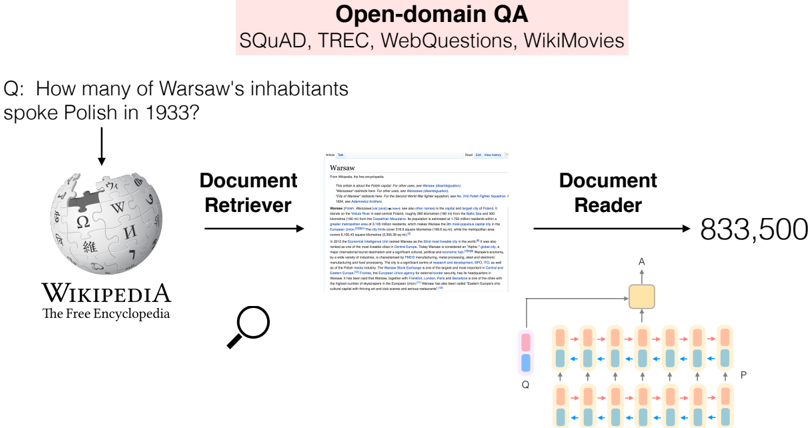
This paper proposes to tackle open-domain question answering using Wikipedia as the unique knowledge source: the answer to any factoid question is a text span in a Wikipedia article. This task of machine reading at scale combines the challenges of document retrieval (finding the relevant articles) with that of machine comprehension of text (identifying the answer spans from those articles). Our approach combines a search component based on bigram hashing and TF-IDF matching with a multi-layer recurrent neural network model trained to detect answers in Wikipedia paragraphs. Our experiments on multiple existing QA datasets indicate that (1) both modules are highly competitive with respect to existing counterparts and (2) multitask learning using distant supervision on their combination is an effective complete system on this challenging task.
Overview
The claims and statistics of this paper haven’t been checked yet.
Free: it reads the open-access text and checks the first 5 claims that cite a source we can check. Create a free account to check every claim.
Integrity signals
Registry
Cites
Statistics
Figures
Verification
Claims the paper makes
The claims and statistics of this paper haven’t been checked yet.
Free: it reads the open-access text and checks the first 5 claims that cite a source we can check. Create a free account to check every claim.
Claims other papers make about this one
Each is checked against this paper’s own text: does it say what the citing paper says it does?
The source backs part of the claim, not all of it — or backs it for a different population, condition or comparison.
In the citing paper
“In particular, the presence of low-value or semantically irrelevant entries dilutes the contribution of high-quality information in retrieval results, impairing downstream task performance and leading to measurable declines in metrics [5].”
From SEDM: Selective Self-Evolving Distributed Memory for Agents (2025) · cites this paper as [5]
Experimental — accuracy not yet measuredThe source backs part of the claim, not all of it — or backs it for a different population, condition or comparison.
In the citing paper
“Prior work has shown that retrieval improves performance across a variety of NLP tasks when considered in isolation.”
From Retrieval-Augmented Generation for Knowledge-Intensive NLP Tasks (2020) · cites this paper as [5]
Experimental — accuracy not yet measuredThe cited source says what the claim attributes to it.
In the citing paper
“This is in agreement with prior work that treated Wikipedia as a general knowledge source under the same reason (Chen et al., 2017; Petroni et al., 2021).”
From FActScore: Fine-grained Atomic Evaluation of Factual Precision in Long Form Text Generation (2023) · cites this paper as Chen et al., 2017
The cited source says what the claim attributes to it.
In the citing paper
“In-context learning methods now routinely invoke tools, leading to LM pipelines that use retrieval models (Chen et al., 2017; Lewis et al., 2020; Guu et al., 2020; Lazaridou et al., 2022; Izacard et al., 2022), multimodal foundation models, and more traditional tools like APIs (Nakano et al., 2021) and calculators.”
From DSPy: Compiling Declarative Language Model Calls into Self-Improving Pipelines (2023) · cites this paper as Chen et al., 2017
Self-check
Percentages, sums and reported differences re-computed from the paper’s own numbers.
The self-check needs the paper’s full text.
Citations
Cites
Adam: A Method for Stochastic Optimization
Kingma, D. P., & Ba, J. (2014) · arXiv · doi:10.48550/arxiv.1412.6980 · Cited by 98,946 · cited 1×
“We use Adamax for optimization as described in (Kingma and Ba, 2014).”
MethodGlove: Global Vectors for Word Representation
Pennington, J., Socher, R., & Manning, C. (2014) · Proceedings of the 2014 Conference on Empirical Methods in Natural Language Processing (EMNLP) · doi:10.3115/v1/d14-1162 · Cited by 34,071 · cited 2×
“The feature vector ˜ p i is comprised of the following parts: We use the 300-dimensional Glove word embeddings trained from 840B Web crawl data (Pennington et al., 2014).”
MethodNeural Machine Translation by Jointly Learning to Align and Translate
Bahdanau, D., Cho, K., & Bengio, Y. (2014) · arXiv · doi:10.48550/arxiv.1409.0473 · Cited by 16,213 · cited 2×
“…has made considerable progress recently thanks to new deep learning architectures like attention-based and memory-1 augmented neural networks (Bahdanau et al., 2015; Weston et al., 2015; Graves et al., 2014) and release of new training and evaluation datasets like QuizBowl (Iyyer et al., 2014),…”
BackgroundThe Stanford CoreNLP Natural Language Processing Toolkit
Manning, C., Surdeanu, M., Bauer, J., Finkel, J., Bethard, S., & McClosky, D. (2014) · Proceedings of 52nd Annual Meeting of the Association for Computational Linguistics: System Demonstrations · doi:10.3115/v1/p14-5010 · Cited by 7,037 · cited 2×
“We apply the Stanford CoreNLP toolkit (Manning et al., 2014) for tokenization and also generating lemma, part-of-speech, and named entity manual features.”
MethodSQuAD: 100,000+ Questions for Machine Comprehension of Text
Rajpurkar, P., Zhang, J., Lopyrev, K., & Liang, P. (2016) · Proceedings of the 2016 Conference on Empirical Methods in Natural Language Processing · doi:10.18653/v1/d16-1264 · Cited by 6,208 · cited 10×
“Next we evaluate our Document Reader component on the standard SQuAD evaluation (Rajpurkar et al., 2016).”
BackgroundMethodInfluentialA unified architecture for natural language processing: deep neural networks with multitask learning
Collobert, R., & Weston, J. (2008) · Proceedings of the 25th international conference on Machine learning - ICML '08 · doi:10.1145/1390156.1390177 · Cited by 5,058 · cited 1×
“Multitask learning (Caruana, 1998) and task transfer have a rich history in machine learning (e.g., using ImageNet in the computer vision community (Huh et al., 2016)), as well as in NLP in particular (Collobert and Weston, 2008).”
MethodSelf-citationFreebase: a collaboratively created graph database for structuring human knowledge
Bollacker, K., Evans, C., Paritosh, P., Sturge, T., & Taylor, J. (2008) · Proceedings of the 2008 ACM SIGMOD international conference on Management of data · doi:10.1145/1376616.1376746 · Cited by 4,852 · cited 11×
“Unlike knowledge bases (KBs) such as Freebase (Bollacker et al., 2008) or DBPedia (Auer et al.”
BackgroundMethodInfluentialDistant supervision for relation extraction without labeled data
Mintz, M., Bills, S., Snow, R., & Jurafsky, D. (2009) · Proceedings of the Joint Conference of the 47th Annual Meeting of the ACL and the 4th International Joint Conference on Natural Language Processing of the AFNLP: Volume 2 - ACL-IJCNLP '09 · doi:10.3115/1690219.1690287 · Cited by 2,752 · cited 1×
“Following previous work on distant supervision (DS) for relation extraction (Mintz et al., 2009), we use a”
MethodTeaching Machines to Read and Comprehend
Hermann, K. M., Kočiský, T., Grefenstette, E., Espeholt, L., Kay, W., Suleyman, M., & Blunsom, P. (2015) · arXiv (Cornell University) · doi:10.48550/arxiv.1506.03340 · Cited by 2,521 · cited 7×
“…Graves et al., 2014) and release of new training and evaluation datasets like QuizBowl (Iyyer et al., 2014), CNN/Daily Mail based on news articles (Hermann et al., 2015), CBT based on children books (Hill et al., 2016), or SQuAD (Rajpurkar et al., 2016) and WikiReading (Hewlett et al., 2016),…”
BackgroundMethodInfluentialDBpedia: A Nucleus for a Web of Open Data
Auer, S., Bizer, C., Kobilarov, G., Lehmann, J., Cyganiak, R., & Ives, Z. (2007) · Lecture Notes in Computer Science · doi:10.1007/978-3-540-76298-0_52 · Cited by 2,454 · cited 3×
“Unlike knowledge bases (KBs) such as Freebase (Bollacker et al., 2008) or DB-Pedia (Auer et al., 2007), which are easier for computers to process but too sparsely populated for open-domain question answering (Miller et al., 2016), Wikipedia contains up-to-date knowledge that humans are interested in.”
Background
Research works printed but not linked: 5
- Petr Baudiˇ s. 2015. YodaQA: a modular question answering system pipeline. In POSTER 2015-19th International Student Conference on Electrical Engineering . pages 1156-1165.
- Eric Brill, Susan Dumais, and Michele Banko. 2002. Ananalysis of the AskMSR question-answering system. In Empirical Methods in Natural Language Processing (EMNLP) . pages 257-264.
- Rudolf Kadlec, Ondrej Bajgar, and Jan Kleindienst. 2016. From particular to general: A preliminary case study of transfer learning in reading comprehension. Machine Intelligence Workshop, NIPS .
- Alexander H. Miller, Adam Fisch, Jesse Dodge, AmirHossein Karimi, Antoine Bordes, and Jason Weston. 2016. Key-value memory networks for directly reading documents. In Empirical Methods in Natural Language Processing (EMNLP) . pages 14001409.
- Jason Weston, Sumit Chopra, and Antoine Bordes. 2015. Memory networks. In International Conference on Learning Representations (ICLR) .
Cited by
Items 501–600 of 1,042
Answer Sentence Selection Using Local and Global Context in Transformer Models
Lauriola, I., & Moschitti, A. (2021) · Lecture notes in computer science · doi:10.1007/978-3-030-72113-8_20 · Cited by 26
“, retrieved by a search engine), consists in selecting the sentence that correctly answers the question with the highest probability; and (ii) Machine Reading (MR) comprehension [2], which, given a question and a reference text, involves finding an exact text span answering it.”
BackgroundShen, Y., Lai, E. M.-K., & Mohaghegh, M. (2022) · Neural Processing Letters · doi:10.1007/s11063-021-10730-4 · Cited by 20
“Other examples of such QA systems include FastQA [23], SAN [27], QANet [14], DocQA [29], DrQA [30] and FusionNet [31].”
BackgroundXu, S., Pang, L., Shen, H., & Cheng, X. (2022) · ACM International Conference on Information and Knowledge Management (CIKM) · doi:10.1145/3511808.3557388 · Cited by 25
“It is shown that exact matching signals are important in all text matching tasks, for example, query term importance in DR [18, 47], lexical overlap features in PI [10] and bigram counts in QA [7].”
BackgroundMethodGenerative Multi-hop Retrieval
Lee, H., Yang, S., Oh, H., & Seo, M. (2022) · Proceedings of the 2022 Conference on Empirical Methods in Natural Language Processing · doi:10.18653/v1/2022.emnlp-main.92 · Cited by 15
“[3] Danqi Chen, Adam Fisch, Jason Weston, and Antoine Bordes.”
BackgroundMPMRC-MNER: A Unified MRC framework for Multimodal Named Entity Recognition based Multimodal Prompt
Bao, X., Tian, M., Zha, Z., & Qin, B. (2023) · ACM International Conference on Information and Knowledge Management (CIKM) · doi:10.1145/3583780.3614975 · Cited by 26
Wu, J., Gong, C., Cao, Z., & Fu, G. (2023) · ACM International Conference on Multimedia (ACM MM) · doi:10.1145/3581783.3612470 · Cited by 27
“Following [4, 51], Precision ( Pre.”
RaLLe: A Framework for Developing and Evaluating Retrieval-Augmented Large Language Models
Hoshi, Y., Miyashita, D., Ng, Y., Tatsuno, K., Morioka, Y., Torii, O., & Deguchi, J. (2023) · Conference on Empirical Methods in Natural Language Processing: System Demonstrations (EMNLP) · doi:10.18653/v1/2023.emnlp-demo.4 · Cited by 24
Machine Reading Comprehension for Answer Re-Ranking in Customer Support Chatbots
Hardalov, M., Koychev, I. K., & Nakov, P. (2019) · Information · doi:10.3390/info10030082 · Cited by 21
An End-to-End Multi-task Learning Model for Fact Checking
Li, S., Zhao, S., Cheng, B. H., & Yang, H. (2018) · Fact Extraction and VERification Workshop (FEVER) · doi:10.18653/v1/w18-5523 · Cited by 25
“Another relative task is question answering (QA) and machine reading comprehension (MRC), for which approaches have recently been extended to handle large-scale resources such as Wikipedia (Chen et al., 2017).”
BackgroundMethodBERT for Evidence Retrieval and Claim Verification
Soleimani, A., Monz, C., & Worring, M. (2020) · Lecture notes in computer science · doi:10.1007/978-3-030-45442-5_45 · Cited by 188
“In addition to the DrQA retrieval component, the Sweeper team (Hidey and Diab, 2018) considers lexical and syntactic features for the claim and first two sentences in the pages.”
BackgroundInfluentialOpenMatch: An Open Source Library for Neu-IR Research
Liu, Z., Zhang, K., Xiong, C., Liu, Z., & Sun, M. (2021) · International ACM SIGIR Conference on Research and Development in Information Retrieval (SIGIR) · doi:10.1145/3404835.3462789 · Cited by 25
“With the rapid development of deep neural networks, Information Retrieval (IR) shows better performance and benefits lots of applications, such as open-domain question answering [5] and fact verification [37].”
BackgroundAutomatic Solution Summarization for Crash Bugs
Wang, H., Xia, X., Lo, D., Grundy, J., & Wang, X. (2021) · ACM/IEEE International Conference on Software Engineering: Companion Proceedings (ICSE-Companion) · doi:10.1109/icse43902.2021.00117 · Cited by 19
“Unlike the question answering task [17]–[19], a crash trace may share no lexical units with an answer and the information”
BackgroundMa, X., Li, M., Sun, K., Xin, J., & Lin, J. (2021) · Conference on Empirical Methods in Natural Language Processing (EMNLP) · doi:10.18653/v1/2021.emnlp-main.227 · Cited by 40
“, 2017) have established strong baselines in open-domain QA (Chen et al., 2017; Yang et al., 2019).”
BackgroundMethodQATest: A Uniform Fuzzing Framework for Question Answering Systems
Liu, Z., Feng, Y., Yin, Y., Sun, J., Chen, Z., & Xu, B. (2022) · IEEE/ACM International Conference on Automated Software Engineering (ASE) · doi:10.1145/3551349.3556929 · Cited by 32
“DrQA [11] is a system for reading comprehension applied to open-domain question answering, which is released by FaceBook.”
BackgroundFAMOUS: Fake News Detection Model Based on Unified Key Sentence Information
Kim, N., Seo, D., & Jeong, C. (2018) · IEEE International Conference on Software Engineering and Service Science (ICSESS) · doi:10.1109/icsess.2018.8663864 · Cited by 16
“BiLSTM with attention model has been used for answering about the question to a passage and finding a similar sentence in the paragraph[25,26].”
MethodDeQA: On-Device Question Answering
Cao, Q., Weber, N., Balasubramanian, N., & Balasubramanian, A. (2019) · International Conference on Mobile Systems, Applications, and Services · doi:10.1145/3307334.3326071 · Cited by 21
“To this end, given the questions and their answers, we use the distant super-vision procedure described in DrQA [23] to automatically locate the answers within the text and generate labeled answer spans.”
BackgroundMethodInfluentialJoint Verification and Reranking for Open Fact Checking Over Tables
Schlichtkrull, M., Karpukhin, V, Oguz, B., Lewis, M., Yih, W., & Riedel, S. (2021) · UCL Discovery (University College London) · Cited by 16
Smarnet: Teaching Machines to Read and Comprehend Like HumanPreprint
Chen, Z., Yang, R., Cao, B., Zhao, Z., Cai, D., & He, X. (2017) · arXiv (Cornell University) · doi:10.48550/arxiv.1710.02772 · Cited by 22
“Inspired by Yang et al. (Yang et al. 2016) (Monsalve, Frank, and Vigliocco 2012) (Liu et al. 2017) and (Chen et al. 2017), we adopt a more fine-grained dynamic gating mechanism to model the lexical properties related to the question and the passage.”
MethodTextFlint: Unified Multilingual Robustness Evaluation Toolkit for Natural Language ProcessingPreprint
Gui, T., Wang, X., Zhang, Q., Liu, Q., Zou, Y., Zhou, X., Zheng, R., Zhang, C., Wu, Q., Ye, J., et al. (2021) · arXiv (Cornell University) · doi:10.48550/arxiv.2103.11441 · Cited by 44
Neural Machine Translation with Monolingual Translation MemoryPreprint
Cai, D., Yan, W., Li, H., Lam, W. P., & Liu, L. (2021) · arXiv (Cornell University) · doi:10.48550/arxiv.2105.11269 · Cited by 16
“One typical use is to retrieve supporting evidence for open-domain question answering (e.g., Chen et al., 2017; Lee et al., 2019; Karpukhin et al., 2020).”
BackgroundModel Editing Harms General Abilities of Large Language Models: Regularization to the Rescue
Gu, J.-C., Xu, H.-X., Ma, J.-Y., Lu, P., Ling, Z.-H., Chang, K.-W., & Peng, N. (2024) · arXiv · doi:10.48550/arxiv.2401.04700 · Cited by 16
Sun, S., Zhang, K., Li, J., Yu, M., Hou, K., Wang, Y., & Cheng, X. (2025) · Information Processing & Management · doi:10.1016/j.ipm.2025.104147 · Cited by 25
Joint Models for Answer Verification in Question Answering Systems
Zhang, Z., Vu, T., & Moschitti, A. (2021) · doi:10.18653/v1/2021.acl-long.252 · Cited by 26
“…systems, we focus on Answer Sentence Selection (AS2) research, originated from TREC-QA track (Voorhees and Tice, 1999), as it proposes efficient models that are more suitable for a production setting, e.g., they are more efficient than those developed in machine reading (MR) work (Chen et al., 2017).”
BackgroundTunBERT: Pretrained Contextualized Text Representation for Tunisian Dialect
Messaoudi, A., Cheikhrouhou, A., Haddad, H., Ferchichi, N., HajHmida, M. B., Korched, A., Naski, M., Ghriss, F., & Kerkeni, A. (2022) · Communications in computer and information science · doi:10.1007/978-3-031-08277-1_23 · Cited by 19
Natural language query formalization to SPARQL for querying knowledge bases using Rasa
Mishra, D. S., Agarwal, A., Swathi, B. P., & Akshay, K. C. (2021) · Progress in Artificial Intelligence · doi:10.1007/s13748-021-00271-1 · Cited by 20
“[5] offer solutions to open domain questions answered usingWikipedia as a single source of knowledge, considering the answer to any factual question being the text in the Wikipedia article.”
BackgroundKia, M. A., Garifullina, A., Kern, M., Chamberlain, J., & Jameel, S. (2022) · IEEE Access · doi:10.1109/access.2022.3170466 · Cited by 22
“In DrQA [24], various features, such as POS, named entities (NE), and term frequencies (TF), are extracted from the context.”
BackgroundA Retrieve-and-Read Framework for Knowledge Graph Link Prediction
Pahuja, V., Wang, B., Latapie, H. M., Srinivasa, J., & Su, Y. (2023) · ACM International Conference on Information and Knowledge Management (CIKM) · doi:10.1145/3583780.3614769 · Cited by 23
“Such a retrieve-and-read framework has been widely used for the open-domain question answering (QA) problem [8, 76], which faces a similar fundamental challenge: it also needs to answer a question in a massive corpus where only a small fraction is relevant to each specific question.”
BackgroundMethodHybrid Hierarchical Retrieval for Open-Domain Question Answering
Arivazhagan, M. G., Liu, L., Qi, P., Chen, X., Wang, W. Y., & Huang, Z. (2023) · Findings of the Association for Computational Linguistics: ACL (Findings of ACL) · doi:10.18653/v1/2023.findings-acl.679 · Cited by 56
“ODQA systems often rely on efficient and accurate retrievers to find relevant context to answer questions (Chen et al., 2017), where retrieval performance is usually critical to QA accuracy (Karpukhin et al.”
BackgroundMethodComparative Analysis of Neural QA models on SQuAD
Wadhwa, S., Chandu, K. R., & Nyberg, E. (2018) · Workshop on Machine Reading for Question Answering (MRQA) · doi:10.18653/v1/w18-2610 · Cited by 25
“, 2017), Document Reader (DrQA) (Chen et al., 2017), MultiParagraph Reading Comprehension (DocQA) (Clark and Gardner, 2017), and the Logistic Regression baseline model (Rajpurkar et al.”
BackgroundMethodInfluentialAnswering Ambiguous Questions through Generative Evidence Fusion and Round-Trip Prediction
Gao, Y., Zhu, H., Ng, P., dos Santos, C. N., Wang, Z., Nan, F., Zhang, D., Nallapati, R. M., Arnold, A. O., & Xiang, B. (2021) · doi:10.18653/v1/2021.acl-long.253 · Cited by 36
“Open-domain Question Answering (QA) is the task of answering questions using a collection of passages with diverse topics (Chen et al., 2017; Guu et al., 2020; Karpukhin et al., 2020).”
Improving question answering performance using knowledge distillation and active learning
Boreshban, Y., Mirbostani, S. M., Ghassem-Sani, G., Mirroshandel, S. A., & Amiriparian, S. (2023) · Engineering Applications of Artificial Intelligence · doi:10.1016/j.engappai.2023.106137 · Cited by 23
Question Answering Survey: Directions, Challenges, Datasets, Evaluation Matrices
Pandya, H. A., & Bhatt, B. (2021) · Journal of Xidian University · doi:10.37896/jxu15.4/014 · Cited by 46
“Starting from such Information Retrieval (IR) tasks to current encoder-decoder based question-answering, the field has witnessed tremendous progress especially after the involvement of machine learning and deep learning techniques in the field [88, 11, 103, 121, 20, 58, 42, 72].”
InfluentialTay, Y., Wang, S., Tuan, L. A., Fu, J., Phan, M. C., Yuan, X., Rao, J., Hui, S. C., & Zhang, A. (2019) · arXiv (Cornell University) · doi:10.48550/arxiv.1905.10847 · Cited by 15
“The challenges of having a long context have been traditionally mitigated by a two-step approach - retrieval first and then reading second (Chen et al., 2017; Wang et al., 2018; Lin et al., 2018).”
BackgroundLiu, N. F., Lee, T., Jia, R., & Liang, P. (2021) · arXiv (Cornell University) · Cited by 19
FActScore: Fine-grained Atomic Evaluation of Factual Precision in Long Form Text Generation
Min, S., Krishna, K., Lyu, X., Lewis, M., Yih, W.-T., Koh, P. W., Iyyer, M., Zettlemoyer, L., & Hajishirzi, H. (2023) · arXiv · doi:10.48550/arxiv.2305.14251 · Cited by 14
“Estimated = 90% This is in agreement with prior work that treated Wikipedia as a general knowledge source under the same reason (Chen et al., 2017; Petroni et al., 2021).”
ResultQuery Rewriting for Retrieval-Augmented Large Language Models
Ma, X., Gong, Y., He, P., Zhao, H., & Duan, N. (2023) · arXiv · doi:10.48550/arxiv.2305.14283 · Cited by 14
“Earlier studies use sparse retriever (Chen et al., 2017) or dense retriever (Karpukhin et al., 2020) in front of a pre-trained language model (PrLM).”
MethodA Survey on Natural Language Processing for Fake News Detection
Oshikawa, R., Qian, J., & Wang, W. Y. (2018) · arXiv (Cornell University) · doi:10.48550/arxiv.1811.00770 · Cited by 270
“Thorne et al. (2018) rank the sentences using TF-IDF and DrQA sys-tem (Chen et al., 2017).”
MethodLi, Z., Sharma, P., Lù, X. H., Cheung, J., & Reddy, S. (2022) · Findings · doi:10.18653/v1/2022.findings-acl.75 · Cited by 37
“Whilst there are different variants of QA tasks, this paper focuses primarily on retrieval-based QA (RQA; Chen et al. 2017; Lee et al. 2019).”
MethodDuReadervis: A : A Chinese Dataset for Open-domain Document Visual Question Answering
Qi, L., Lv, S., Li, H., Liu, J., Zhang, Y., She, Q., Wu, H. J., Wang, H., & Liu, T. (2022) · Findings of the Association for Computational Linguistics: ACL (Findings of ACL) · doi:10.18653/v1/2022.findings-acl.105 · Cited by 29
“Chen et al., 2017a), enterprise QA (Castelli et al., 2020), biomedical QA (Levy et al., 2021), etc.”
BackgroundSaving Dense Retriever from Shortcut Dependency in Conversational Search
Kim, S., & Kim, G. (2022) · Conference on Empirical Methods in Natural Language Processing (EMNLP) · doi:10.18653/v1/2022.emnlp-main.701 · Cited by 21
Tu, S., Zhang, Z., Yu, J., Li, C., Zhang, S., Yao, Z., Hou, L., & Li, J. (2023) · ACM International Conference on Information and Knowledge Management (CIKM) · doi:10.1145/3583780.3615484 · Cited by 28
Boateng, G., John, S., Boateng, S. T., Badu, P., Agyeman-Budu, P., & Kumbol, V. W.-A. (2024) · Lecture notes in computer science · doi:10.1007/978-3-031-64299-9_9 · Cited by 29
A Joint LLM-KG System for Disease Q&A
Sukhwal, P. C., Rajan, V., & Kankanhalli, A. (2024) · IEEE Journal of Biomedical and Health Informatics · doi:10.1109/jbhi.2024.3514659 · Cited by 21
“LLM-basedsystemsfornaturalQAcanbe:(1)extractive[37], where answers are assumed to be present in a given KB and the system extracts the relevant string (span of text) as the answer, or (2) generative [38], where the QA system tries to infer and construct an answer based on its understanding of the…”
Kpodo, J., & Nejadhashemi, A. P. (2025) · Artificial Intelligence in Agriculture · doi:10.1016/j.aiia.2025.04.001 · Cited by 26
CliCR: a Dataset of Clinical Case Reports for Machine Reading Comprehension
Šuster, S., & Daelemans, W. M. P. (2018) · Conference of the North American Chapter of the Association for Computational Linguistics: Human Language Technologies (NAACL-HLT) · doi:10.18653/v1/n18-1140 · Cited by 130
“C L ] 2 6 M ar 2 01 8 document retrieval to perform machine reading at scale, such as in the models of Chen et al. (2017) and Watanabe et al. (2017) for the general domain.”
MethodEpisodic Memory Reader: Learning What to Remember for Question Answering from Streaming Data
Han, M., Kang, M., Jung, H., & Hwang, S. J. (2019) · Proceedings of the conference - Association for Computational Linguistics. Meeting · doi:10.18653/v1/p19-1434 · Cited by 25
“To overcome such scalability problems, researchers have proposed pipelining or confidence based selection methods that combine paragraph-level models to obtain a document-level model (Joshi et al., 2017; Chen et al., 2017; Clark and Gardner, 2018; Wang et al., 2018b).”
Answering questions by learning to rank - Learning to rank by answering questions
Pîrtoacă, G.-S., Rebedea, T. E., & Ruşeţi, Ş. (2019) · Conference on Empirical Methods in Natural Language Processing (EMNLP) · doi:10.18653/v1/d19-1256 · Cited by 14
“Chen et al. (2017) proposed a model, called DrQA, that was trained on the SQuAD 1.1 dataset (Rajpurkar et al., 2016) to find the correct answer to open-domain questions.”
MethodInfluentialRen, Q., Cheng, X., & Su, S. (2020) · Proceedings of the AAAI Conference on Artificial Intelligence · doi:10.1609/aaai.v34i05.6396 · Cited by 13
“Similar to existing work (Chen et al. 2017), we consider Ex-act Match (EM) and F1 score as the performance metrics.”
Constrained BERT BiLSTM CRF for understanding multi-sentence entity-seeking questions
Contractor, D., Patra, B., Mausam, M., & Singla, P. (2020) · Natural Language Engineering · doi:10.1017/s1351324920000017 · Cited by 16
“, 2013) Unstructured Text Spans (Rajpurkar et al., 2016; Trischler et al., 2016; Trivedi et al., 2017; Chen et al., 2017; Joshi et al., 2017) Unstructured Text Passages (Vtyurina and Clarke, 2016; Wang and Nyberg, 2016, 2015) Multiple choice answers Answers from specified choices (Guo et al.”
Hu, X., Yu, S., Xiong, C., Liu, Z., Liu, Z., & Yu, G. (2022) · International ACM SIGIR Conference on Research and Development in Information Retrieval (SIGIR) · doi:10.1145/3477495.3531786 · Cited by 20
“, question answering [5, 9, 21] and fact verification [13].”
BackgroundOn the Role of Relevance in Natural Language Processing Tasks
Sauchuk, A., Thorne, J., Halevy, A. Y., Tonellotto, N., & Silvestri, F. (2022) · International ACM SIGIR Conference on Research and Development in Information Retrieval (SIGIR) · doi:10.1145/3477495.3532034 · Cited by 27
“This context is different from extractive query answering [2, 13] where only a single document is needed from which an answer can be extracted.”
BackgroundMethodVLSP 2021-ViMRC Challenge: Vietnamese Machine Reading Comprehension
Nguyen, K. V., Tran, S. Q., Nguyen, L. T., Huynh, T. V., Luu, S. T., & Nguyen, N. L.-T. (2022) · VNU Journal of Science Computer Science and Communication Engineering · doi:10.25073/2588-1086/vnucsce.340 · Cited by 15
“0 can also be used to evaluate various other NLP tasks: question answering that uses retrieverreader techniques [37, 27], question generation [38], and information retrieval [39].”
BackgroundMethodInfluentialReasoning over Public and Private Data in Retrieval-Based Systems
Arora, S., Lewis, P., Fan, A., Kahn, J., & Ré, C. (2023) · Transactions of the Association for Computational Linguistics · doi:10.1162/tacl_a_00580 · Cited by 39
“Modern retrieval systems typically collect documents that are most similar to a user’s question from a massive corpus, and provide the resulting documents to a separate model, which reasons over the information to output an answer (Chen et al., 2017).”
Speed Reading: Learning to Read ForBackward via Shuttle
Fu, T.-J., & Ma, W.-Y. (2018) · Conference on Empirical Methods in Natural Language Processing (EMNLP) · doi:10.18653/v1/d18-1474 · Cited by 17
“…2014; Le and Mikolov, 2014a), cloze (Srinivasan et al., 2018), machine translation (Bahdanau et al., 2015), dialogue modeling (Mei et al., 2017), document summarization (Allahyari et al., 2017), automatic knowledge extraction (Durme and Schubert, 2008), and question answering (Chen et al., 2017).”
BackgroundA Multi-answer Multi-task Framework for Real-world Machine Reading Comprehension
Liu, J., Wan, W., Sun, M., Chen, H., Du, Y., & Lin, D. (2018) · Conference on Empirical Methods in Natural Language Processing (EMNLP) · doi:10.18653/v1/d18-1235 · Cited by 17
“• Word-in-question feature: following Chen et al. (2017) and Weissenborn et al. (2017), we use one additional binary feature wiq for each passage word, indicating whether this word occurs in the question.”
MethodTowards Achieving Machine Comprehension Using Deep Learning on Non-GPU Machines
Khan, M. U. S., Khan, K., Hassan, F., Siddiqui, A., & Afaq, M. (2019) · Engineering Technology & Applied Science Research · doi:10.48084/etasr.2734 · Cited by 14
“Various open source libraries are available for this purpose [4].”
BackgroundNeural Re-rankers for Evidence Retrieval in the FEVEROUS Task
Saeed, M., Alfarano, G., Nguyen, K., Pham, D., Troncy, R., & Papotti, P. (2021) · Fact Extraction and VERification Workshop (FEVER) · doi:10.18653/v1/2021.fever-1.12 · Cited by 20
“For (i), a combination of entity-matching and TF-IDF scoring are used to identify the most prominent Wikipedia pages (Chen et al., 2017). k pages are selected by matching entities extracted from the claim to Wikipedia pages.”
MethodDynamic Fusion Networks for Machine Reading ComprehensionPreprint
Xu, Y., Liu, J., Gao, J., Shen, Y., & Liu, X. (2017) · arXiv (Cornell University) · doi:10.48550/arxiv.1711.04964 · Cited by 39
End-to-End QA on COVID-19: Domain Adaptation with Synthetic TrainingPreprint
Reddy, R. G., Iyer, B., Sultan, M. A., Zhang, R., Sil, A., Castelli, V., Florian, R., & Roukos, S. (2020) · arXiv (Cornell University) · doi:10.48550/arxiv.2012.01414 · Cited by 23
Reasoning Over Virtual Knowledge Bases With Open Predicate Relations
Sun, H., Verga, P., Dhingra, B., Salakhutdinov, R., & Cohen, W. W. (2021) · arXiv · doi:10.48550/arxiv.2102.07043 · Cited by 14
“, 2016) and DrQA (Chen et al., 2017) are another two widely-used open-domain QA baselines.”
BackgroundMethodLegal AI in Low-Resource Languages: Building and Evaluating QA Systems for the Kazakh Legislation
Rakhimova, D., Turarbek, A., Karyukin, V., Sarsenbayeva, A., & Alieyev, R. (2025) · Computers · doi:10.3390/computers14090354 · Cited by 18
Xu, C., Pei, J., Wu, H., Liu, Y., & Li, C. (2020) · Proceedings of the conference - Association for Computational Linguistics. Meeting · doi:10.18653/v1/2020.acl-main.330 · Cited by 17
Hyperlink-induced Pre-training for Passage Retrieval in Open-domain Question Answering
Zhou, J., Li, X., Shang, L., Luo, L., Zhan, K., Hu, E., Zhang, X., Jiang, H., Cao, Z., Yu, F., et al. (2022) · Proceedings of the conference - Association for Computational Linguistics. Meeting · doi:10.18653/v1/2022.acl-long.493 · Cited by 34
TVShowGuess: Character Comprehension in Stories as Speaker Guessing
Sang, Y., Mou, X., Yu, M., Yao, S., Li, J., & Stanton, J. M. (2022) · Conference of the North American Chapter of the Association for Computational Linguistics: Human Language Technologies (NAACL-HLT) · doi:10.18653/v1/2022.naacl-main.317 · Cited by 33
TunBERT: Pretraining BERT for Tunisian Dialect Understanding
Haddad, H., Rouhou, A. C., Messaoudi, A., Korched, A., Fourati, C., Sellami, A., HajHmida, M. B., & Ghriss, F. (2023) · SN Computer Science · doi:10.1007/s42979-022-01541-y · Cited by 13
“Following the guidelines proposed in [13], we decided to use a dialectal version of the Tunisian constitution.”
MethodHarnessing Multi-Role Capabilities of Large Language Models for Open-Domain Question Answering
Sun, H., Liu, Y., Wu, C., Yan, H., Tai, C., Gao, X., Shang, S., & Yan, R. (2024) · International World Wide Web Conference (WWW) · doi:10.1145/3589334.3645670 · Cited by 27
“To identify the most appropriate documents, we divide this document selection process into two distinct stages: (1) Coarse-grained retrieval of top-𝑛 documents: we first retrieve a set of top-𝑛 documents that are potentially relevant to the given question by employing established information retrieval techniques such…”
InfluentialReading Comprehension with Graph-based Temporal-Casual Reasoning
Sun, Y., Gong, C., & Qu, Y. (2018) · International Conference on Computational Linguistics · Cited by 13
Evidence Integration for Multi-Hop Reading Comprehension With Graph Neural Networks
Song, L., Wang, Z., Yu, M., Zhang, Y., Florian, R., & Gildea, D. (2020) · IEEE Transactions on Knowledge and Data Engineering · doi:10.1109/tkde.2020.2982894 · Cited by 159
“However, most existing work on multi-passage QA selects the most relevant passage for answering the given question, thus reducing the problem to single-passage reading comprehension [32], [33], [34], [35], [36].”
BackgroundOn the Importance of Adaptive Data Collection for Extremely Imbalanced Pairwise Tasks
Mussmann, S., Jia, R., & Liang, P. (2020) · Findings of the Association for Computational Linguistics: EMNLP (Findings of EMNLP) · doi:10.18653/v1/2020.findings-emnlp.305 · Cited by 20
Weakly-Supervised Open-Retrieval Conversational Question Answering
Qu, C., Liu, Y., Chen, C., Croft, W. B., Krishna, K., & Iyyer, M. (2021) · Lecture notes in computer science · doi:10.1007/978-3-030-72113-8_35 · Cited by 13
Conversational Entity Linking: Problem Definition and Datasets
Joko, H., Hasibi, F., Balog, K., & de Vries, A. P. (2021) · NORA - Norwegian Open Research Archives · Cited by 13
Asking questions on handwritten document collections
Mathew, M., Gómez, L., Karatzas, D., & Jawahar, C. V. (2021) · International Journal on Document Analysis and Recognition (IJDAR) · doi:10.1007/s10032-021-00383-3 · Cited by 31
“derstanding paragraphs and electronic text collections with Question Answering (QA) skills [14, 15, 16, 17].”
BackgroundMethodBuilding a Question Answering System for the Manufacturing Domain
Xingguang, L., Zhenbo, C., Shen, Z., Haoxin, Z., Hangcheng, M., Xu, X., & Xiao, G. (2022) · IEEE Access · doi:10.1109/access.2022.3191678 · Cited by 14
Another Look at DPR: Reproduction of Training and Replication of Retrieval
Ma, X., Sun, K., Pradeep, R., Li, M., & Lin, J. (2022) · Lecture notes in computer science · doi:10.1007/978-3-030-99736-6_41 · Cited by 30
Have my arguments been replied to? Argument Pair Extraction as Machine Reading Comprehension
Bao, J., Sun, J., Zhu, Q., & Xu, R. (2022) · Proceedings of the conference - Association for Computational Linguistics. Meeting · doi:10.18653/v1/2022.acl-short.4 · Cited by 13
“Machine reading comprehension (MRC) aims to extract answer spans from a passage according to a given query (Seo et al., 2017; Chen et al., 2017; Devlin et al., 2019; Wen et al., 2021).”
BackgroundDual-Channel Evidence Fusion for Fact Verification over Texts and Tables
Hu, N., Wu, Z., Lai, Y., Liu, X., & Feng, Y. (2022) · Conference of the North American Chapter of the Association for Computational Linguistics: Human Language Technologies (NAACL-HLT) · doi:10.18653/v1/2022.naacl-main.384 · Cited by 15
“We use DRQA (Chen et al., 2017) to extract k sentences S = {si}i=1 and n tables T = {ti}i=1 from the retrieved pages, respectively.”
MethodInfluentialTransliteration Better than Translation? Answering Code-mixed Questions over a Knowledge Base
Gupta, V., Chinnakotla, M. K., & Shrivastava, M. (2018) · Workshop on Computational Approaches to Code Switching · doi:10.18653/v1/w18-3205 · Cited by 19
“However, many approaches (Lukovnikov et al., 2017; Yin et al., 2016; Fader et al., 2014; Chen et al., 2017a; Hermann et al., 2015) attempted in QA so far have been focused on monolingual questions.”
BackgroundInfluentialTask-Oriented Dialog Generation with Enhanced Entity Representation
He, Z., Wang, J., & Chen, J. (2020) · Interspeech (USB) · doi:10.21437/interspeech.2020-1037 · Cited by 21
“Similar to the prior work [16], we introduce an aligned context embedding to add soft alignments between entity and similar words in the dialog history.”
MethodOpen-Retrieval Conversational Machine ReadingPreprint
Gao, Y., Li, J., Wu, C.-S., Lyu, M. R.-T., & King, I. (2021) · arXiv (Cornell University) · doi:10.48550/arxiv.2102.08633 · Cited by 17
“We further take the local word order into account with bigram features which is proven to be effective in (Chen et al., 2017).”
BackgroundQAScore—An Unsupervised Unreferenced Metric for the Question Generation Evaluation
Ji, T., Lyu, C., Jones, G., Zhou, L., & Graham, Y. (2022) · Entropy · doi:10.3390/e24111514 · Cited by 12
“Question Answering Question Answering (QA) aims to provide answers a to the corresponding questions q, Based on the availability of context c, QA can be categorized into Open-domain QA (without context) [21,22] and Machine Reading comprehension (with context) [23,24].”
Information retrieval and question answering: A case study on COVID-19 scientific literature
Otegi, A., Vicente, I. S., Saralegi, X., Peñas, A., Lozano, B., & Agirre, E. (2021) · Knowledge-Based Systems · doi:10.1016/j.knosys.2021.108072 · Cited by 26
“Most recent work is inconclusive about which type of textual length (full documents [5], natural passages [28] or sentences [29]) works best.”
Mixed-modality Representation Learning and Pre-training for Joint Table-and-Text Retrieval in OpenQA
Huang, J., Zhong, W., Liu, Q., Gong, M., Jiang, D., & Duan, N. (2022) · Findings of the Association for Computational Linguistics: EMNLP (Findings of EMNLP) · doi:10.18653/v1/2022.findings-emnlp.303 · Cited by 30
Dual-Feedback Knowledge Retrieval for Task-Oriented Dialogue Systems
Shi, T., Li, L., Lin, Z., Yang, T., Quan, X., & Wang, Q. (2023) · Conference on Empirical Methods in Natural Language Processing (EMNLP) · doi:10.18653/v1/2023.emnlp-main.405 · Cited by 33
Heterogeneous Graph Reasoning for Fact Checking over Texts and Tables
Gong, H., Xu, W., Wu, S., Liu, Q., & Wang, L. (2024) · Proceedings of the AAAI Conference on Artificial Intelligence · doi:10.1609/aaai.v38i1.27760 · Cited by 27
Raptor-T: A Fused and Memory-Efficient Sparse Transformer for Long and Variable-Length Sequences
Wang, H., Yang, D., Xia, Y., Zhang, Z., Wang, Q., Fan, J., Zhou, X., & Cheng, D. (2024) · IEEE Transactions on Computers · doi:10.1109/tc.2024.3389507 · Cited by 13
“…excel by simultaneously attending to all positions of the input sequences, allowing them to effectively handle long sequences and achieve significant breakthroughs in long-sequence tasks, such as long document classification [6], [7], question answering [8], [9], and text summarization [10], [11].”
BackgroundSpoken Dialogue for Information Navigation
Papangelis, A., Papadakos, P., Stylianou, Y., & Tzitzikas, Y. (2018) · Annual Meeting of the Special Interest Group on Discourse and Dialogue · doi:10.18653/v1/w18-5025 · Cited by 14
“Deep learning and joint optimisations of SDS components are becoming the standard approach e.g., (Chen et al., 2017; Li et al., 2016; Williams et al., 2017; Liu et al., 2017; Wen et al., 2017; Cuay´ahuitl et al., 2017; Yang et al., 2017), showing many benefits but also limitations and disadvantages.”
Translucent Answer Predictions in Multi-Hop Reading Comprehension
Bhargav, G. P. S., Glass, M., Garg, D., Shevade, S., Dana, S., Khandelwal, D., Subramaniam, L. V., & Gliozzo, A. (2020) · Proceedings of the AAAI Conference on Artificial Intelligence · doi:10.1609/aaai.v34i05.6272 · Cited by 16
“For end-to-end question answering, Chen et al. (2017), Wang et al. (2018a), Lin et al. (2018), Yan et al. (2019), Clark and Gardner (2018) use an IR technique to first shortlist N documents.”
MethodArtificial Intelligence Based System for Preliminary Rounds of Recruitment Process
Uttarwar, S., Gambani, S., Thakkar, T., & Mulla, N. (2020) · Advances in intelligent systems and computing · doi:10.1007/978-3-030-37218-7_97 · Cited by 13
Query and Answer Expansion from Conversation History.
Yang, J.-H., Lin, S.-C., Wang, C., Lin, J., & Tsai, M.-F. (2019) · Text REtrieval Conference · Cited by 14
Progressively Pretrained Dense Corpus Index for Open-Domain Question Answering
Xiong, W., Wang, H., & Wang, W. Y. (2021) · Conference of the European Chapter of the Association for Computational Linguistics · doi:10.18653/v1/2021.eacl-main.244 · Cited by 20
SKR-QA: Semantic ranking and knowledge revise for multi-choice question answering
Ren, M., Huang, H., & Gao, Y. (2021) · Neurocomputing · doi:10.1016/j.neucom.2021.06.076 · Cited by 12
Narrative Question Answering with Cutting-Edge Open-Domain QA Techniques: A Comprehensive Study
Mou, X., Yang, C., Yu, M., Yao, B., Guo, X., Potdar, S., & Su, H. (2021) · Transactions of the Association for Computational Linguistics · doi:10.1162/tacl_a_00411 · Cited by 34
“The recent work naturally adopts a ranker-reader framework (Chen et al., 2017).”
Fast neural ranking on bipartite graph indices
Tan, S., Zhao, W., & Li, P. (2021) · Proceedings of the VLDB Endowment · doi:10.14778/3503585.3503589 · Cited by 17
“Thus, neural network based ranking models are usually used in offline ranking or re-ranking on preproduced small subsets [2, 4, 5].”
BackgroundMethodData Augmentation for Biomedical Factoid Question Answering
Pappas, D., Malakasiotis, P., & Androutsopoulos, I. (2022) · Workshop on Biomedical Language Processing (BioNLP) · doi:10.18653/v1/2022.bionlp-1.6 · Cited by 24
Investigating Lstm with k-Max Pooling for Text Classification
Shu, B., Ren, F., & Bao, Y. (2018) · International Conference on Intelligent Computation Technology and Automation · doi:10.1109/icicta.2018.00015 · Cited by 12
Talk to Papers: Bringing Neural Question Answering to Academic Search
Zhao, T., & Lee, K. (2020) · Annual Meeting of the Association for Computational Linguistics: System Demonstrations (ACL Demo) · doi:10.18653/v1/2020.acl-demos.5 · Cited by 13
Conversational Entity Linking: Problem Definition and Datasets
Joko, H., Hasibi, F., Balog, K., & de Vries, A. P. (2021) · International ACM SIGIR Conference on Research and Development in Information Retrieval (SIGIR) · doi:10.1145/3404835.3463258 · Cited by 33
“Research on conversational entity linking has been mainly focused on employing traditional entity linking and named entity recognition methods in conversational and QA systems [7, 14, 15, 38, 39, 56].”
BackgroundAddressing Semantic Drift in Generative Question Answering with Auxiliary Extraction
Li, C., Bi, B., Yan, M., Wang, W., & Huang, S. (2021) · Annual Meeting of the Association for Computational Linguistics · doi:10.18653/v1/2021.acl-short.118 · Cited by 32
“Current mainstream approaches (Chen et al., 2017; Wang et al., 2018; Yan et al., 2018) treat MRC as a process of extracting a consecutive piece of text from a document to a given question.”
BackgroundMulti-way matching based fine-grained sentiment analysis for user reviews
Guo, X., Zhang, G., Wang, S., & Chen, Q. (2020) · Neural Computing and Applications · doi:10.1007/s00521-019-04686-9 · Cited by 13
“DocRNN: We adopt document reader module from DrQA model proposed in [32] as our comparative model, and its input feature is comprised of word embedding, exact match feature, POS, NER and term frequency feature and aligned aspect embedding.”
BackgroundMethodInfluentialWeaver: Deep Co-Encoding of Questions and Documents for Machine ReadingPreprint
Raison, M., Mazaré, P.-E., Das, R., & Bordes, A. (2018) · arXiv (Cornell University) · doi:10.48550/arxiv.1804.10490 · Cited by 18
“As a result, its versatility and robustness make Weaver a very promising reader component for machine reading at scale, better suited than the original DrQA reader was.”
BackgroundMethodInfluentialSelf-citation
Metadata
- Authors
- Chen, D., Fisch, A., Weston, J., & Bordes, A.
- Affiliations
- Meta (United States) (US)
- ORCID
- Chen, Danqi
- Venue
- Proceedings of the 55th Annual Meeting of the Association for Computational Linguistics (Volume 1: Long Papers)
- Published
- 2017
- Pages
- 1870-1879
- ISSN
- 0736-587X (ISSN-L)
- OpenAlex
- W2962985038
- Cited by
- 1,546
- References
- 39
- Citations by year
- 2026: 61 · 2025: 105 · 2024: 123 · 2023: 218 · 2022: 209 · 2021: 268 · 2020: 202 · 2019: 199 · 2018: 142 · 2017: 18
- FWCI
- 69.97
- Type
- conference paper
- Language
- en
- Open access
- hybrid
- doi.org
- Licence
- cc-by
- Locations
- Proceedings of the conference - Association for Computational Linguistics. Meeting (publishedVersion, cc-by)
- arXiv (Cornell University) (submittedVersion)
- arXiv (Cornell University)
- Topics
- Physical Sciences › Computer Science › Artificial Intelligence › Topic Modeling
- Physical Sciences › Computer Science › Information Systems › Information Retrieval and Search Behavior
- Physical Sciences › Computer Science › Artificial Intelligence › Natural Language Processing Techniques
- Keywords
- open-domain question answering, Wikipedia, machine reading, document retrieval, recurrent neural networks, multi-task learning, distant supervision, factoid questions
About these checks
Registry, retraction, Cites and statistics results are computed, not judged, with one exception: a printed reference that no index lists is read once by a model before it counts as a citation error. Claims are extracted by a model and kept only when their quote appears verbatim in the text; each cited source is then checked, with a model’s help, for whether it says what the claim relies on. Those verdicts can be wrong — read the claim’s quote and the cited source before relying on one.
Statistics and arithmetic are recomputed, not judged.
Confidence bands are shown only for fields calibrated on our annotated test set. None is calibrated yet, so no band is shown.
What counts as a claim ›How we measure confidence ›How we check this ›
Are you an author, or do you see a problem with this page? Request a review
Data sources
Bibliographic data: Semantic Scholar, OpenAlex, Crossref.
Contains information from the Semantic Scholar Academic Graph Datasets, made available under the ODC Attribution License (ODC-BY 1.0).
Semantic Scholar’s data is described in: Kinney, R., et al. (2023). The Semantic Scholar Open Data Platform. arXiv:2301.10140.
