

Reading Wikipedia to Answer Open-Domain Questions
Open accessThe DOI matches its Crossref record; 34 of the 39 references it cites were found in a registry or an index.
Abstract
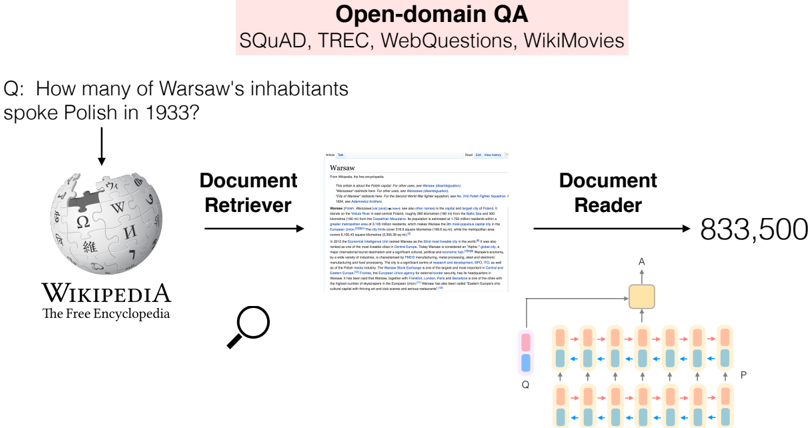
This paper proposes to tackle open-domain question answering using Wikipedia as the unique knowledge source: the answer to any factoid question is a text span in a Wikipedia article. This task of machine reading at scale combines the challenges of document retrieval (finding the relevant articles) with that of machine comprehension of text (identifying the answer spans from those articles). Our approach combines a search component based on bigram hashing and TF-IDF matching with a multi-layer recurrent neural network model trained to detect answers in Wikipedia paragraphs. Our experiments on multiple existing QA datasets indicate that (1) both modules are highly competitive with respect to existing counterparts and (2) multitask learning using distant supervision on their combination is an effective complete system on this challenging task.
Overview
The claims and statistics of this paper haven’t been checked yet.
Free: it reads the open-access text and checks the first 5 claims that cite a source we can check. Create a free account to check every claim.
Integrity signals
Registry
Cites
Statistics
Figures
Verification
Claims the paper makes
The claims and statistics of this paper haven’t been checked yet.
Free: it reads the open-access text and checks the first 5 claims that cite a source we can check. Create a free account to check every claim.
Claims other papers make about this one
Each is checked against this paper’s own text: does it say what the citing paper says it does?
The source backs part of the claim, not all of it — or backs it for a different population, condition or comparison.
In the citing paper
“In particular, the presence of low-value or semantically irrelevant entries dilutes the contribution of high-quality information in retrieval results, impairing downstream task performance and leading to measurable declines in metrics [5].”
From SEDM: Selective Self-Evolving Distributed Memory for Agents (2025) · cites this paper as [5]
Experimental — accuracy not yet measuredThe source backs part of the claim, not all of it — or backs it for a different population, condition or comparison.
In the citing paper
“Prior work has shown that retrieval improves performance across a variety of NLP tasks when considered in isolation.”
From Retrieval-Augmented Generation for Knowledge-Intensive NLP Tasks (2020) · cites this paper as [5]
Experimental — accuracy not yet measuredThe cited source says what the claim attributes to it.
In the citing paper
“This is in agreement with prior work that treated Wikipedia as a general knowledge source under the same reason (Chen et al., 2017; Petroni et al., 2021).”
From FActScore: Fine-grained Atomic Evaluation of Factual Precision in Long Form Text Generation (2023) · cites this paper as Chen et al., 2017
The cited source says what the claim attributes to it.
In the citing paper
“In-context learning methods now routinely invoke tools, leading to LM pipelines that use retrieval models (Chen et al., 2017; Lewis et al., 2020; Guu et al., 2020; Lazaridou et al., 2022; Izacard et al., 2022), multimodal foundation models, and more traditional tools like APIs (Nakano et al., 2021) and calculators.”
From DSPy: Compiling Declarative Language Model Calls into Self-Improving Pipelines (2023) · cites this paper as Chen et al., 2017
Self-check
Percentages, sums and reported differences re-computed from the paper’s own numbers.
The self-check needs the paper’s full text.
Citations
Cites
Adam: A Method for Stochastic Optimization
Kingma, D. P., & Ba, J. (2014) · arXiv · doi:10.48550/arxiv.1412.6980 · Cited by 98,946 · cited 1×
“We use Adamax for optimization as described in (Kingma and Ba, 2014).”
MethodGlove: Global Vectors for Word Representation
Pennington, J., Socher, R., & Manning, C. (2014) · Proceedings of the 2014 Conference on Empirical Methods in Natural Language Processing (EMNLP) · doi:10.3115/v1/d14-1162 · Cited by 34,071 · cited 2×
“The feature vector ˜ p i is comprised of the following parts: We use the 300-dimensional Glove word embeddings trained from 840B Web crawl data (Pennington et al., 2014).”
MethodNeural Machine Translation by Jointly Learning to Align and Translate
Bahdanau, D., Cho, K., & Bengio, Y. (2014) · arXiv · doi:10.48550/arxiv.1409.0473 · Cited by 16,213 · cited 2×
“…has made considerable progress recently thanks to new deep learning architectures like attention-based and memory-1 augmented neural networks (Bahdanau et al., 2015; Weston et al., 2015; Graves et al., 2014) and release of new training and evaluation datasets like QuizBowl (Iyyer et al., 2014),…”
BackgroundThe Stanford CoreNLP Natural Language Processing Toolkit
Manning, C., Surdeanu, M., Bauer, J., Finkel, J., Bethard, S., & McClosky, D. (2014) · Proceedings of 52nd Annual Meeting of the Association for Computational Linguistics: System Demonstrations · doi:10.3115/v1/p14-5010 · Cited by 7,037 · cited 2×
“We apply the Stanford CoreNLP toolkit (Manning et al., 2014) for tokenization and also generating lemma, part-of-speech, and named entity manual features.”
MethodSQuAD: 100,000+ Questions for Machine Comprehension of Text
Rajpurkar, P., Zhang, J., Lopyrev, K., & Liang, P. (2016) · Proceedings of the 2016 Conference on Empirical Methods in Natural Language Processing · doi:10.18653/v1/d16-1264 · Cited by 6,208 · cited 10×
“Next we evaluate our Document Reader component on the standard SQuAD evaluation (Rajpurkar et al., 2016).”
BackgroundMethodInfluentialA unified architecture for natural language processing: deep neural networks with multitask learning
Collobert, R., & Weston, J. (2008) · Proceedings of the 25th international conference on Machine learning - ICML '08 · doi:10.1145/1390156.1390177 · Cited by 5,058 · cited 1×
“Multitask learning (Caruana, 1998) and task transfer have a rich history in machine learning (e.g., using ImageNet in the computer vision community (Huh et al., 2016)), as well as in NLP in particular (Collobert and Weston, 2008).”
MethodSelf-citationFreebase: a collaboratively created graph database for structuring human knowledge
Bollacker, K., Evans, C., Paritosh, P., Sturge, T., & Taylor, J. (2008) · Proceedings of the 2008 ACM SIGMOD international conference on Management of data · doi:10.1145/1376616.1376746 · Cited by 4,852 · cited 11×
“Unlike knowledge bases (KBs) such as Freebase (Bollacker et al., 2008) or DBPedia (Auer et al.”
BackgroundMethodInfluentialDistant supervision for relation extraction without labeled data
Mintz, M., Bills, S., Snow, R., & Jurafsky, D. (2009) · Proceedings of the Joint Conference of the 47th Annual Meeting of the ACL and the 4th International Joint Conference on Natural Language Processing of the AFNLP: Volume 2 - ACL-IJCNLP '09 · doi:10.3115/1690219.1690287 · Cited by 2,752 · cited 1×
“Following previous work on distant supervision (DS) for relation extraction (Mintz et al., 2009), we use a”
MethodTeaching Machines to Read and Comprehend
Hermann, K. M., Kočiský, T., Grefenstette, E., Espeholt, L., Kay, W., Suleyman, M., & Blunsom, P. (2015) · arXiv (Cornell University) · doi:10.48550/arxiv.1506.03340 · Cited by 2,521 · cited 7×
“…Graves et al., 2014) and release of new training and evaluation datasets like QuizBowl (Iyyer et al., 2014), CNN/Daily Mail based on news articles (Hermann et al., 2015), CBT based on children books (Hill et al., 2016), or SQuAD (Rajpurkar et al., 2016) and WikiReading (Hewlett et al., 2016),…”
BackgroundMethodInfluentialDBpedia: A Nucleus for a Web of Open Data
Auer, S., Bizer, C., Kobilarov, G., Lehmann, J., Cyganiak, R., & Ives, Z. (2007) · Lecture Notes in Computer Science · doi:10.1007/978-3-540-76298-0_52 · Cited by 2,454 · cited 3×
“Unlike knowledge bases (KBs) such as Freebase (Bollacker et al., 2008) or DB-Pedia (Auer et al., 2007), which are easier for computers to process but too sparsely populated for open-domain question answering (Miller et al., 2016), Wikipedia contains up-to-date knowledge that humans are interested in.”
Background
Research works printed but not linked: 5
- Petr Baudiˇ s. 2015. YodaQA: a modular question answering system pipeline. In POSTER 2015-19th International Student Conference on Electrical Engineering . pages 1156-1165.
- Eric Brill, Susan Dumais, and Michele Banko. 2002. Ananalysis of the AskMSR question-answering system. In Empirical Methods in Natural Language Processing (EMNLP) . pages 257-264.
- Rudolf Kadlec, Ondrej Bajgar, and Jan Kleindienst. 2016. From particular to general: A preliminary case study of transfer learning in reading comprehension. Machine Intelligence Workshop, NIPS .
- Alexander H. Miller, Adam Fisch, Jesse Dodge, AmirHossein Karimi, Antoine Bordes, and Jason Weston. 2016. Key-value memory networks for directly reading documents. In Empirical Methods in Natural Language Processing (EMNLP) . pages 14001409.
- Jason Weston, Sumit Chopra, and Antoine Bordes. 2015. Memory networks. In International Conference on Learning Representations (ICLR) .
Cited by
Items 701–800 of 1,042
SenseDefs: a multilingual corpus of semantically annotated textual definitions
Camacho-Collados, J., Bovi, C. D., Raganato, A., & Roberto Navigli, A. (2018) · Language Resources and Evaluation · doi:10.1007/s10579-018-9421-3 · Cited by 9
“5.1) and extrinsically on two Natural Language Processing tasks (Sect.”
BackgroundInfluentialMCˆ2: Multi-perspective Convolutional Cube for Conversational Machine Reading Comprehension
Zhang, X. (2019) · Proceedings of the conference - Association for Computational Linguistics. Meeting · doi:10.18653/v1/p19-1622 · Cited by 9
“Most of existing methods consider conversation history by prepending previous questions and answers to the current question, such as BiDAF++ (Yatskar, 2019), DrQA+PGNet (Reddy et al., 2019), SDNet (Zhu et al., 2018) and so on.”
MethodInfluentialSimple yet Effective Bridge Reasoning for Open-Domain Multi-Hop Question Answering
Xiong, W., Yu, M., Guo, X., Wang, H., Chang, S., Campbell, M. S., & Wang, W. Y. (2019) · Workshop on Machine Reading for Question Answering (MRQA) · doi:10.18653/v1/d19-5806 · Cited by 14
“The typical pipeline of open-domain QA systems (Chen et al., 2017; Wang et al., 2018; Htut et al., 2018) is to first use an IR system to retrieve a compact set of paragraphs and then run a machine reading model over the concatenated or reranked paragraphs.”
MethodPark, C., Song, H.-J., & Lee, C. (2020) · ACM Transactions on Asian and Low-Resource Language Information Processing · doi:10.1145/3365679 · Cited by 9
“End-to-end deep learning models such as DrQA [2], FastQA [23], r-net [22], and Bidirectional Attention Flow (BiDAF) [19] have also been studied with regard to performing MRC-QA tasks.”
BackgroundMethodInfluentialMining Implicit Relevance Feedback from User Behavior for Web Question Answering
Shou, L., Bo, S., Cheng, F., Gong, M., Pei, J., & Jiang, D. (2020) · ACM SIGKDD Conference on Knowledge Discovery and Data Mining (KDD) · doi:10.1145/3394486.3403343 · Cited by 10
“The purpose of web QA is to offer users an efficient information access mechanism by directly presenting an answer passage to the web search engine users [2, 6, 8].”
BackgroundMaking Neural Machine Reading Comprehension FasterPreprint
Chatterjee, D. (2019) · arXiv (Cornell University) · doi:10.48550/arxiv.1904.00796 · Cited by 15
“ationally faster neural architecture which performs reasonably well on SQuAD task. 2 Chapter 2 Literature Review Most of the papers that approach to solve SQuAD problem have utilized RNN based models [3, 5, 7, 9, 13, 14, 16, 17, 20, 22{24, 26, 29{31, 34{39, 41, 43] and they follow a similar chain of processes. This be…”
MethodLiu, Y., Chowdhury, S., Zhang, C., Caragea, C., & Yu, P. S. (2020) · arXiv (Cornell University) · doi:10.48550/arxiv.2008.02434 · Cited by 21
“Multi-step-reasoner [10] the multi-step framework using reinforcement learning (RL) where retriever and reader (DrQA) iteratively interact with each other to get the final answer.”
BackgroundMethodInfluentialBiomedical Question Answering: A Comprehensive Review.Preprint
Jin, Q., Yuan, Z. P., Xiong, G., Yu, Q., Tan, C., Chen, M., Huang, S., Liu, X., & Yu, S. (2021) · arXiv (Cornell University) · Cited by 11
(2019) · doi:10.18653/v1/p19-4 · Cited by 9
“2017) helps in matching queries against documents (Ensan and Bagheri, 2017), clustering search results (Scaiella et al., 2012), answer (Chen et al., 2017) and entity retrieval (Ma et al., 2018) and retrieving knowledge panels for queries asking about popular entities.”
Efficient Fine-Tuning Large Language Models for Knowledge-Aware Response Planning
Nguyen, M., Kishan, K. C., Nguyen, T., Chadha, A., & Vu, T. (2023) · Lecture Notes in Computer Science · doi:10.1007/978-3-031-43415-0_35 · Cited by 8
“This is different from the previous work that aim to generate a response by either harnessing parametric knowledge (e.g., ChatGPT) or retrieving from external knowledge such as knowledge bases [2, 3, 65, 51], web documents [68, 6, 67, 7, 13], or a provided context [15, 45, 59, 10].”
BackgroundFaithful Temporal Question Answering over Heterogeneous Sources
Jia, Z., Christmann, P., & Weikum, G. (2024) · International World Wide Web Conference (WWW) · doi:10.1145/3589334.3645547 · Cited by 29
Building efficient and effective OpenQA systems for low-resource languages
Budur, E., Özçelik, R., Soylu, D., Khattab, O., Güngör, T., & Potts, C. (2024) · Knowledge-Based Systems · doi:10.1016/j.knosys.2024.112243 · Cited by 14
“These results show that ColBERT-QA performs significantly better than BM25, which also outperforms DPR in the task of ranking relevant passages.”
BackgroundLLM-augmented multi-agent cooperative framework for medical case retrieval in cardiology
Deng, L., Hu, H., Lu, K., & He, P. (2025) · Journal of King Saud University Computer and Information Sciences · doi:10.1007/s44443-025-00311-z · Cited by 8
“…specific instantiation of this trend: weeffectivelycreateanagent that asks implicit questions (via query reformulation) and another that provides answers (via retrieval results), iterating until satisfied (Mialon et al. 2023; Lazaridou et al. 2022; Chen et al. 2017; Qu et al. 2020; Zhao et al. 2023).”
Embedding Syntax and Semantics of Prepositions via Tensor Decomposition
Gong, H., Bhat, S., & Viswanath, P. (2018) · Conference of the North American Chapter of the Association for Computational Linguistics: Human Language Technologies (NAACL-HLT) · doi:10.18653/v1/n18-1082 · Cited by 8
“Word embeddings have brought a renaissance in NLP research; they have been very successful in capturing word similarities as well as analogies (both syntactic and semantic) and are now mainstream in nearly all downstream NLP tasks (such as question-answering (Chen et al., 2017)).”
BackgroundQuestion Answering over Curated and Open Web Sources
Roy, R. S., & Anand, A. (2020) · International ACM SIGIR Conference on Research and Development in Information Retrieval (SIGIR) · doi:10.1145/3397271.3401421 · Cited by 16
“leled growth of QA warrants a new tutorial to cover recent advances in the field. Primarily a direction dominated by template-based [2, 80] approaches, QA now includes a large number of neural methods [15, 16, 19, 43], graphbased [54, 55] methods, and even a handful that explore reinforcement learning [24, 59, 61]. Acr…”
BackgroundMethodInfluentialCombining Lexical and Dense Retrieval for Computationally Efficient Multi-hop Question Answering
Sidiropoulos, G., Voskarides, N., Vakulenko, S., & Kanoulas, E. (2021) · Workshop on Simple and Efficient Natural Language Processing (SustaiNLP) · doi:10.18653/v1/2021.sustainlp-1.7 · Cited by 10
“QA systems typically consist of (i) a retriever that identifies the passage/document in the underlying collection that contains the answer to the user’s question, and (ii) a reader that extracts or generates the answer from the identified passage (Chen et al., 2017).”
Triple-Fact Retriever: An explainable reasoning retrieval model for multi-hop QA problem
Wu, C., Hu, E., Zhan, K., Luo, L., Zhang, X., Jiang, H., Wang, Q., Cao, Z., Yu, F., & Chen, L. (2022) · IEEE International Conference on Data Engineering (ICDE) · doi:10.1109/icde53745.2022.00095 · Cited by 8
Few-shot Reranking for Multi-hop QA via Language Model Prompting
Khalifa, M., Logeswaran, L., Lee, M., Lee, H., & Wang, L. (2023) · Proceedings of the conference - Association for Computational Linguistics. Meeting · doi:10.18653/v1/2023.acl-long.885 · Cited by 37
“TF-IDF retrieves top similar documents to the question using TF-IDF similarity and TF-IDF + BM25 adds an extra step # Ex.”
MethodInfluentialRSpell: Retrieval-Augmented Framework for Domain Adaptive Chinese Spelling Check
Song, S., Lv, Q., Geng, L., Cao, Z., & Fu, G. (2023) · Lecture notes in computer science · doi:10.1007/978-3-031-44693-1_43 · Cited by 8
Anserini Gets Dense Retrieval: Integration of Lucene's HNSW Indexes
Ma, X., Teofili, T., & Lin, J. (2023) · ACM International Conference on Information and Knowledge Management (CIKM) · doi:10.1145/3583780.3615112 · Cited by 15
Graph reasoning over explicit semantic relation
Zhu, T., Liu, S., Li, B., Liu, J., Liu, P., & Zheng, F. (2023) · High-Confidence Computing · doi:10.1016/j.hcc.2023.100190 · Cited by 8
QACheck: A Demonstration System for Question-Guided Multi-Hop Fact-Checking
Pan, L., Lu, X., Kan, M., & Nakov, P. (2023) · Conference on Empirical Methods in Natural Language Processing: System Demonstrations (EMNLP) · doi:10.18653/v1/2023.emnlp-demo.23 · Cited by 44
Controlling Risk of Web Question Answering
Su, L., Guo, J., Fan, Y., Lan, Y., & Cheng, X. (2019) · International ACM SIGIR Conference on Research and Development in Information Retrieval (SIGIR) · doi:10.1145/3331184.3331261 · Cited by 12
“ains any direct answer and extracts the answer as the output if it exists. Without loss of generality, the Web QA component could be implemented by applying machine reading comprehension (MRC) models [6, 33, 43, 44] over the retrieved passages. In recent years, with the development of deep learning techniques, state-o…”
MethodEnhancing Machine Reading Comprehension With Position Information
Xu, Y., Liu, W., Chen, G., Ren, B., Zhang, S., Gao, S., & Guo, J. H. (2019) · IEEE Access · doi:10.1109/access.2019.2930407 · Cited by 9
X-WikiRE: A Large, Multilingual Resource for Relation Extraction as Machine Comprehension
Abdou, M., Sas, C., Aralikatte, R., Augenstein, I., & Søgaard, A. (2019) · Workshop on Deep Learning Approaches for Low-Resource NLP (DeepLo) · doi:10.18653/v1/d19-6130 · Cited by 14
“Then, a reading comprehension model (Seo et al., 2016; Chen et al., 2017) can be trained on question, answer, and context examples where the x slot is filled with an entity and the y slot is either an answer if the answer is present in the context, or NIL.”
MethodContext-Based Quotation Recommendation
MacLaughlin, A., Чен, Т., Ayan, B. K., & Roth, D. (2021) · Proceedings of the International AAAI Conference on Web and Social Media · doi:10.1609/icwsm.v15i1.18070 · Cited by 10
Approximation of Response Knowledge Retrieval in Knowledge-grounded Dialogue Generation
Zheng, W., Milić-Frayling, N., & Zhou, K. (2020) · Findings of the Association for Computational Linguistics: EMNLP (Findings of EMNLP) · doi:10.18653/v1/2020.findings-emnlp.321 · Cited by 8
“DrQA (Chen et al., 2017) uses bigram hashing and TF-IDF matching with a multi-layer recurrent neural network model.”
MethodFu, M., Guan, J., Zheng, X., Zhou, J., Lu, J., Zhang, T., Zhuo, S., Zhan, L., & Yang, J. Y. (2020) · Lecture notes in computer science · doi:10.1007/978-3-030-65310-1_26 · Cited by 14
Yadav, V., Bethard, S. J., & Surdeanu, M. (2021) · Conference of the North American Chapter of the Association for Computational Linguistics: Human Language Technologies (NAACL-HLT) · doi:10.18653/v1/2021.naacl-main.363 · Cited by 17
“Further, several works have demonstrated that retrieve and read approaches (similar to ours) tend to achieve higher performance than the former QA methods (Chen et al., 2017; Qi et al., 2019).”
ResultIntelliTag: An Intelligent Cloud Customer Service System Based on Tag Recommendation
Yang, M., Cao, S., Hu, B., Chen, X., Cui, H., Zhang, Z., Zhou, J., & Li, X. (2021) · IEEE International Conference on Data Engineering (ICDE) · doi:10.1109/icde51399.2021.00287 · Cited by 11
“Next, we select the user’s high-rated content to questions replied by manual customer service, and apply machine reading comprehension [6], [31], [68] to find out suitable answers.”
MethodEfficient Nearest Neighbor Emotion Classification with BERT-whitening
Yin, W., & Shang, L. (2022) · Conference on Empirical Methods in Natural Language Processing · doi:10.18653/v1/2022.emnlp-main.312 · Cited by 12
“…tasks such as language modeling(Khandelwal et al., 2019; Guu et al., 2020), machine translation(Gu et al., 2018; Bapna and Fi-rat, 2019; Khandelwal et al., 2020; Zheng et al., 2021), question answering(Chen et al., 2017; Lee et al., 2019), and computer vision(Devlin et al., 2015; Gur et al., 2021).”
BackgroundKim, M., Kim, C., Song, Y. H., Hwang, S.-W., & Yeo, J. (2022) · Conference on Empirical Methods in Natural Language Processing (EMNLP) · doi:10.18653/v1/2022.emnlp-main.344 · Cited by 20
IfQA: A Dataset for Open-domain Question Answering under Counterfactual Presuppositions
Yu, W., Jiang, M., Clark, P., & Sabharwal, A. (2023) · Conference on Empirical Methods in Natural Language Processing (EMNLP) · doi:10.18653/v1/2023.emnlp-main.515 · Cited by 43
Semi-Distantly Supervised Neural Model for Generating Compact Answers to Open-Domain Why Questions
Ishida, R., Torisawa, K., Oh, J., Iida, R., Kruengkrai, C., & Kloetzer, J. (2018) · Proceedings of the AAAI Conference on Artificial Intelligence · doi:10.1609/aaai.v32i1.12064 · Cited by 8
“Though DrQA works quite well for the SQuAD dataset, it achieved significantly worse performance than those of our proposed methods.”
MethodResultInfluentialWang, X., Shou, L., Gong, M., Duan, N., & Jiang, D. (2020) · Findings of the Association for Computational Linguistics: EMNLP (Findings of EMNLP) · doi:10.18653/v1/2020.findings-emnlp.370 · Cited by 8
Towards building a Robust Industry-scale Question Answering System
Chakravarti, R., Ferritto, A., Iyer, B., Pan, L., Florian, R., Roukos, S., & Sil, A. (2020) · International Conference on Computational Linguistics · doi:10.18653/v1/2020.coling-industry.9 · Cited by 12
“We compare G AA M A against three strong competitors from the industry research: 1) A hybrid of a decomposable attention model for Natural Language Inference (Parikh et al., 2016) and DrQA (Chen et al., 2017), a retrieve and rank QA model, which obtains commendable results on SQuAD.”
MethodCao, R., & Luo, P. (2021) · Proceedings of the AAAI Conference on Artificial Intelligence · doi:10.1609/aaai.v35i14.17494 · Cited by 11
“Wikipedia, the largest online encyclopedia to date, is widely used for distant supervision and model pretraining in many existing studies [Nguyen and Moschitti 2011; Chen et al. 2017].”
MethodA Few More Examples May Be Worth Billions of Parameters
Kirstain, Y., Lewis, P., Riedel, S., & Levy, O. (2022) · Findings of the Association for Computational Linguistics: EMNLP (Findings of EMNLP) · doi:10.18653/v1/2022.findings-emnlp.72 · Cited by 35
Learning to Search in Long Documents Using Document StructurePreprint
Geva, M., & Berant, J. (2018) · arXiv (Cornell University) · doi:10.48550/arxiv.1806.03529 · Cited by 14
“As mentioned, some approaches use IR for reducing the amount of processed text (Chen et al., 2017; Clark and Gardner, 2017), while others use cheap or parallelizable models to handle long documents (Hewlett et al.”
MethodInfluentialA Vietnamese Dataset for Evaluating Machine Reading ComprehensionPreprint
Nguyen, K. V., Nguyen, D.-V., Nguyen, A. G.-T., & Nguyen, N. L.-T. (2020) · arXiv (Cornell University) · doi:10.48550/arxiv.2009.14725 · Cited by 8
“…in the development and evaluation of various deep neural network models in NLP, such as Match-LSTM (Wang and Jiang, 2016), BiDAF (Seo et al., 2016), R-Net (Wang et al., 2017), DrQA (Chen et al., 2017), FusionNet (Huang et al., 2017), FastQA (Weissenborn et al., 2017) and QANet (Yu et al., 2018).”
BackgroundMethodInfluentialDimsum @LaySumm 20: BART-based Approach for Scientific Document SummarizationPreprint
Yu, T., Su, D., Dai, W., & Fung, P. (2020) · arXiv (Cornell University) · doi:10.48550/arxiv.2010.09252 · Cited by 8
“Data augmentation has been an effective technique to create new training instances when the training data is not enough, as demonstrated in computer vision as well as for many NLP tasks (Chen et al., 2017; Yang et al., 2019; Yuan et al., 2017).”
BackgroundMethodEcoAssistant: Using LLM Assistant More Affordably and Accurately
Zhang, J., Krishna, R., Awadallah, A. H., & Wang, C. (2023) · arXiv · doi:10.48550/arxiv.2310.03046 · Cited by 8
“This characteristic differentiates code-driven question answering from existing question answering paradigms such as open-domain question answering (Lee et al., 2019; Chen et al., 2017) or browser-assistant question answering (Nakano et al.”
BackgroundA survey of consumer health question answering systems
Welivita, A., & Pu, P. (2023) · AI Magazine · doi:10.1002/aaai.12140 · Cited by 8
Time-Sensitve Retrieval-Augmented Generation for Question Answering
Wu, F., Liu, L., He, W., Liu, Z., Zhang, Z., Wang, H., & Wang, M. (2024) · Proceedings of the 33rd ACM International Conference on Information and Knowledge Management · doi:10.1145/3627673.3679800 · Cited by 10
“In open-domain QA, retrievers are employed to extract relevant documents pertaining to a given query to provide candidate contexts [1, 2].”
A Comprehensive Evaluation of Embedding Models and LLMs for IR and QA Across English and Italian
Oro, E., Granata, F. M., & Ruffolo, M. (2025) · Big Data and Cognitive Computing · doi:10.3390/bdcc9050141 · Cited by 15
“SQuAD Open was developed for passage retrieval based on SQuAD 1.1 [45,46].”
InfluentialFinding Needles in an Encyclopedic Haystack: Detecting Classes Among Wikipedia Articles
PAŞCA, M. A. (2018) · International World Wide Web Conference (WWW) · doi:10.1145/3178876.3186025 · Cited by 8
“Within that area, previous work proposes extraction methods operating over Wikipedia data [8, 14, 31, 33, 34]; or illustrate Wikipedia’s role in knowledge acquisition [14, 19, 34, 36], information retrieval [5, 15, 27], and construction of structured knowledge repositories [1, 14, 32, 35].”
MethodThe Effectiveness of Intermediate-Task Training for Code-Switched Natural Language Understanding
Prasad, A., Rehan, M. A., Pathak, S. P., & Jyothi, P. (2021) · Workshop on Multilingual Representation Learning (MRL) · doi:10.18653/v1/2021.mrl-1.16 · Cited by 13
Hi-DST: A Hierarchical Approach for Scalable and Extensible Dialogue State Tracking
Dey, S., & Desarkar, M. S. (2021) · Annual Meeting of the Special Interest Group on Discourse and Dialogue · doi:10.18653/v1/2021.sigdial-1.23 · Cited by 6
“These methods usually formulate the slot-value prediction as a reading comprehension (Chen et al., 2017) or text summarization (See et al., 2017) task.”
MethodLadRa-Net: Locally Aware Dynamic Reread Attention Net for Sentence Semantic Matching
Zhang, K., Lv, G., Wu, L., Chen, E., Liu, Q., & Wang, M. (2021) · IEEE Transactions on Neural Networks and Learning Systems · doi:10.1109/tnnls.2021.3103185 · Cited by 8
“For more comprehensive access to the semantics of each word in sentences, we adopt the concatenation of pretrained word embedding [19], character features [53], and syntactical features [54], [55] to represent”
Keywords-aware dynamic graph neural network for multi-hop reading comprehension
Jia, M., Liao, L., Wang, W., Li, F., Chen, Z., Li, J., & Huang, H. (2022) · Neurocomputing · doi:10.1016/j.neucom.2022.05.110 · Cited by 8
ConReader: Exploring Implicit Relations in Contracts for Contract Clause Extraction
Xu, W., Deng, Y., Lei, W., Zhao, W., Chua, T., & Lam, W. P. (2022) · Conference on Empirical Methods in Natural Language Processing (EMNLP) · doi:10.18653/v1/2022.emnlp-main.166 · Cited by 16
XMQAs: Constructing Complex-Modified Question-Answering Dataset for Robust Question Understanding
Chen, Y., Xiao, Y., Li, Z., & Liu, B. (2023) · IEEE Transactions on Knowledge and Data Engineering · doi:10.1109/tkde.2023.3303916 · Cited by 26
“We build a Word Interpreter (WI) to paraphrase ordinary words in the input questions with the popular Cambridge dictionary, 7 as shown in Fig.”
MethodMulti-Evidence Based Fact Verification via A Confidential Graph Neural Network
Lan, Y., Liu, Z., Gu, Y., Yi, X., Li, X., Yang, L., & Yu, G. (2024) · IEEE Transactions on Big Data · doi:10.1109/tbdata.2024.3403382 · Cited by 14
“Existing work usually employs a three-step pipeline model [18], [19], [20] to verify the given claims.”
Large Language Models and Recommendation Systems: A Proof-of-Concept Study on Public Procurements
Nai, R., Sulis, E., Fatima, I., & Meo, R. (2024) · Lecture notes in computer science · doi:10.1007/978-3-031-70242-6_27 · Cited by 18
Li, R., Wang, Y., Wen, Z., Cui, M., & Miao, Q. (2024) · Knowledge-Based Systems · doi:10.1016/j.knosys.2024.112789 · Cited by 14
DIM Reader: Dual Interaction Model for Machine Comprehension
Liu, Z., Huang, D., Huang, K., & Zhang, J. (2017) · Lecture notes in computer science · doi:10.1007/978-3-319-69005-6_32 · Cited by 7
“Document Reader[7] and Dynamic Coattention Networks[2] utilized a multi-hop pointing decoder to indicate the answer span iteratively, and Answer Pointer[31] and Ruminating Reader[10] focused on the query-aware context representation and use query-independent pointer vector to select the answer boundary.”
MethodPhotoshopQuiA: A Corpus of Non-Factoid Questions and Answers for Why-Question Answering
Dulceanu, A., Dinh, T. L., Chang, W. H., Bui, T., Kim, D. S., Vu, M. C., & Kim, S. (2018) · Language Resources and Evaluation Conference (LREC) · doi:10.63317/2qxky84mur43 · Cited by 15
“The majority of these datasets were open-domain (Bollacker et al., 2008; Ignatova et al., 2009; Cai and Yates, 2013; Yang et al., 2015; Chen et al., 2017).”
BackgroundLearning to refine source representations for neural machine translation
Geng, X., Wang, L., Wang, X., Yang, M., Feng, X., Qin, B., & Tu, Z. (2022) · International Journal of Machine Learning and Cybernetics · doi:10.1007/s13042-022-01515-9 · Cited by 11
“The encoder–decoder framework has achieved promising progress in sequence generation tasks including dialog system [26, 27, 42, 56, 67], question answering [4, 37, 66], syntactic parsing [57], text summarization [8, 15, 36, 38, 40] as well as machine translation [1, 21, 28, 30, 44, 48, 51, 52, 54].”
MethodEnriching textbooks by Question-Answers using cQA
Kumar, S., & Chauhan, A. (2019) · IEEE Region 10 Conference (TENCON) · doi:10.1109/tencon.2019.8929272 · Cited by 7
Coarse and Fine Granularity Graph Reasoning for Interpretable Multi-Hop Question Answering
Zhang, M., Li, F., Wang, Y., Zhang, Z., Zhou, Y., & Li, X. (2020) · IEEE Access · doi:10.1109/access.2020.2981134 · Cited by 9
“[17] proposed a retrieval-extraction framework.”
BackgroundRecommending Question-Answers for Enriching Textbooks
Kumar, S., & Chauhan, A. (2020) · Lecture notes in computer science · doi:10.1007/978-3-030-66665-1_20 · Cited by 7
Developing a Ophthalmic Chatbot System
Lee, J. H., Jeong, M.-S., Cho, J.-U., Jeon, H.-K., Park, J.-H., Shin, K.-D., Song, S.-J., & Cheong, Y.-G. (2021) · International Conference on Ubiquitous Information Management and Communication (IMCOM) · doi:10.1109/imcom51814.2021.9377398 · Cited by 9
How Fast can BERT Learn Simple Natural Language Inference?
Lin, Y., & Su, K. (2021) · Conference of the European Chapter of the Association for Computational Linguistics · doi:10.18653/v1/2021.eacl-main.51 · Cited by 13
“Inspired by Chen et al. (2017), we think whether two entities are exactly the same is quite crucial in making the above NLI.”
NewsLink: Empowering Intuitive News Search with Knowledge Graphs
Yang, Y., Li, Y., & Tung, A. K. H. (2021) · IEEE International Conference on Data Engineering (ICDE) · doi:10.1109/icde51399.2021.00081 · Cited by 7
“This finding is in line with many deep learning approaches on machine reading comprehension tasks [54], [55], where using KG as external training sources leads to better results.”
ResultNandy, A., Sharma, S., Maddhashiya, S., Sachdeva, K., Goyal, P., & Ganguly, N. (2021) · Findings of the Association for Computational Linguistics: EMNLP (Findings of EMNLP) · doi:10.18653/v1/2021.findings-emnlp.392 · Cited by 32
Virtual Teaching Assistants: Technologies, Applications and Challenges
Liu, J., Zhang, L., Wei, B., & Zheng, Q. (2021) · Springer eBooks · doi:10.1007/978-3-030-72188-6_13 · Cited by 10
Machine Reading at Scale: A Search Engine for Scientific and Academic Research
Sousa, N., Oliveira, N. R. B. D., & Praça, I. (2022) · Systems · doi:10.3390/systems10020043 · Cited by 10
Asai, A., Longpre, S., Kasai, J., Lee, C.-H., Zhang, R., Hu, J., Yamada, I., Clark, J. H., & Choi, E. (2022) · doi:10.18653/v1/2022.mia-1.11 · Cited by 21
BEEDS: Large-Scale Biomedical Event Extraction using Distant Supervision and Question Answering
Wang, X. D., Leser, U., & Weber, L. (2022) · Workshop on Biomedical Language Processing (BioNLP) · doi:10.18653/v1/2022.bionlp-1.28 · Cited by 15
“DrQA answers questions posed to a Wikipedia corpus and uses two models, the BM25 algorithm for retrieval (Robertson and Walker, 1994) and a deep learning model consisting of an LSTM (Long short-term memory) for reading.”
MethodUKP-SQUARE: An Online Platform for Question Answering Research
Baumgärtner, T., Wang, K., Sachdeva, R. S., Geigle, G., Eichler, M., Poth, C., Sterz, H., Puerto, H., Ribeiro, L. F. R., Pfeiffer, J., et al. (2022) · Annual Meeting of the Association for Computational Linguistics: System Demonstrations (ACL Demo) · doi:10.18653/v1/2022.acl-demo.2 · Cited by 10
RELiC: Retrieving Evidence for Literary Claims
Thai, K., Chang, Y., Krishna, K., & Iyyer, M. (2022) · Proceedings of the conference - Association for Computational Linguistics. Meeting · doi:10.18653/v1/2022.acl-long.517 · Cited by 28
Calibration of Machine Reading Systems at Scale
Dhuliawala, S., Adolphs, L., Das, R. K., & Sachan, M. (2022) · Findings of the Association for Computational Linguistics: ACL (Findings of ACL) · doi:10.18653/v1/2022.findings-acl.133 · Cited by 13
An Encoder Attribution Analysis for Dense Passage Retriever in Open-Domain Question Answering
Li, M., Ma, X., & Lin, J. (2022) · Workshop on Trustworthy Natural Language Processing (TrustNLP) · doi:10.18653/v1/2022.trustnlp-1.1 · Cited by 13
“In this paper, we are interested in the encoder attribution problem of dense passage retrievers (DPR) (Karpukhin et al., 2020; Zhan et al., 2020b) for open-domain question answering (Voorhees and Tice, 2000; Chen et al., 2017).”
BackgroundMethodqaAskeR$$^+$$: a novel testing method for question answering software via asking recursive questions
Xie, X., Jin, S., & Chen, S. (2023) · Automated Software Engineering · doi:10.1007/s10515-023-00380-2 · Cited by 10
“With the introduction materials about this movie provided by Wikipedia, we learn that the director of “A Visit to the Seaside” is “George Albert Smith”.”
BackgroundInfluentialElaboration-Generating Commonsense Question Answering at Scale
Wang, W., Srikumar, V., Hajishirzi, H., & Smith, N. A. (2023) · Proceedings of the conference - Association for Computational Linguistics. Meeting · doi:10.18653/v1/2023.acl-long.90 · Cited by 16
Zemi: Learning Zero-Shot Semi-Parametric Language Models from Multiple Tasks
Wang, Z., Pan, X., Yu, D., Yu, D., Chen, J., & Ji, H. (2023) · Findings of the Association for Computational Linguistics: ACL (Findings of ACL) · doi:10.18653/v1/2023.findings-acl.246 · Cited by 13
Xu, S., Pang, L., Shen, H., & Cheng, X. (2023) · Proceedings of the conference - Association for Computational Linguistics. Meeting · doi:10.18653/v1/2023.acl-long.365 · Cited by 22
RFiD: Towards Rational Fusion-in-Decoder for Open-Domain Question Answering
Wang, C., Yu, H., & Zhang, Y. (2023) · Findings of the Association for Computational Linguistics: ACL (Findings of ACL) · doi:10.18653/v1/2023.findings-acl.155 · Cited by 26
Double Retrieval and Ranking for Accurate Question Answering
Zhang, Z., Vu, T., & Moschitti, A. (2023) · Findings of the Association for Computational Linguistics: EACL · doi:10.18653/v1/2023.findings-eacl.130 · Cited by 12
Verification of the Expected Answer Type for Biomedical Question Answering
Kamath, S., Grau, B., & Ma, Y. (2018) · International World Wide Web Conference (WWW) · doi:10.1145/3184558.3191542 · Cited by 7
“We use a similar approach for transfer learning with the DRQA model by [3] as it obtains comparable results on open domain QA and its implementation is available 2 .”
MethodA Hybrid Network Model for Tibetan Question Answering
Sun, Y., & Xia, T. (2019) · IEEE Access · doi:10.1109/access.2019.2911320 · Cited by 8
“RELATED WORK In recent years, many end-to-end network models have been proposed, such as BiDAF [4], R-net [5], DCN [6], ReasonNet [7], Document Reader [8], Interactive AoA Reader [9] and Reinforced Mnemonic Reader [10].”
MethodLatent Question Interpretation Through Variational Adaptation
Parshakova, T., Rameau, F., Serdega, A., Kweon, I. S., & Kim, D. (2019) · IEEE/ACM Transactions on Audio Speech and Language Processing · doi:10.1109/taslp.2019.2929647 · Cited by 9
“To address this problem, we propose to integrate a module that Adapts Parameters through Interpretation Policy (APIP) within a conventional QA model (in our case DrQA [6]).”
BackgroundMethodInfluentialKamath, S., Grau, B., & Ma, Y. (2020) · Communications in computer and information science · doi:10.1007/978-3-030-43887-6_58 · Cited by 7
Yu, T., Su, D., Dai, W., & Fung, P. (2020) · Workshop on Scholarly Document Processing (SDP) · doi:10.18653/v1/2020.sdp-1.35 · Cited by 22
Natural Language Processing Applications: A New Taxonomy using Textual Entailment
Elshazly, M., Haggag, M. H., & Ehssan, S. A. (2021) · International Journal of Advanced Computer Science and Applications · doi:10.14569/ijacsa.2021.0120580 · Cited by 10
“o Google Custom Search API: inspired by previous research [20], the Custom Search API of Google was used first to retrieve documents having information about the claim.”
MethodEnabling deep learning for large scale question answering in Italian
Croce, D., Zelenanska, A., & Basili, R. (2019) · Intelligenza Artificiale · doi:10.3233/ia-190018 · Cited by 10
“For this study, we adopted a recent state-of-the-art neural-based QA architecture, presented in [5] that allowed us to release the first neural-based QA system over Italian texts.”
InfluentialSRQA: Synthetic Reader for Factoid Question Answering
Wang, J., Xu, W., Fu, X., Yang, W., Jin, L., Chen, Z., Xu, G., & Wu, Y. (2019) · Knowledge-Based Systems · doi:10.1016/j.knosys.2019.105415 · Cited by 9
“Attention near embedding module (lowlevel, syntactic attention) aims to attend the embedding from the question to the passage [7].”
BackgroundMethodInfluentialSWAT: A System for Detecting Salient Wikipedia Entities in TextsPreprint
Ponza, M., Ferragina, P., & Piccinno, F. (2018) · arXiv (Cornell University) · doi:10.48550/arxiv.1804.03580 · Cited by 7
“, 2013) and Question Answering (Chen et al., 2017), just to mention a few .”
BackgroundInteractive Language Learning by Question AnsweringPreprint
Yuan, X., Côté, M.-A., Fu, J., Lin, Z., Pal, C., Bengio, Y., & Trischler, A. (2019) · arXiv (Cornell University) · doi:10.48550/arxiv.1908.10909 · Cited by 16
“, 2018) and a host of neural models that address them (Wang and Jiang, 2016; Wang et al., 2017; Chen et al., 2017).”
BackgroundProceedings of the Third Workshop on Fact Extraction and VERification (FEVER)
(2020) · doi:10.18653/v1/2020.fever-1 · Cited by 8
“This extension is similar to the extension of existing factoid machine comprehension with Wikipedia texts’ paragraphs as contexts to open domain machine comprehension with the whole Wikipedia articles (Chen et al., 2017).”
RIGHT: retrieval-augmented generation for mainstream hashtag recommendation
Fan, R.-Z., Fan, Y., Chen, J., Guo, J., Zhang, R., & Cheng, X. (2024) · Lecture Notes in Computer Science · doi:10.1007/978-3-031-56027-9_3 · Cited by 6
Constructing and Evaluating Declarative RAG Pipelines in PyTerrier
Macdonald, C., Fang, J., Parry, A., & Meng, Z. (2025) · International ACM SIGIR Conference on Research and Development in Information Retrieval (SIGIR) · doi:10.1145/3726302.3730150 · Cited by 12
“To address this issue, recent research has proposed iterative or adaptive RAG models, which perform multiple rounds of retrieval and reasoning to progressively gather the necessary information [1, 41, 45] and determine the answer [7, 9].”
Answering Open-Domain Multi-Answer Questions via a Recall-then-Verify Framework
Shao, Z., & Huang, M. (2022) · Proceedings of the 60th Annual Meeting of the Association for Computational Linguistics (Volume 1: Long Papers) · doi:10.18653/v1/2022.acl-long.128 · Cited by 6
“Open-domain question answering (Voorhees, 1999; Chen et al., 2017) is a long-standing task where a question answering system goes through a large-scale corpus to answer information-seeking questions.”
Language Models Are Poor Learners of Directional Inference
Li, T., Hosseini, M. J., Weber, S., & Steedman, M. J. (2022) · Findings of the Association for Computational Linguistics: EMNLP (Findings of EMNLP) · doi:10.18653/v1/2022.findings-emnlp.64 · Cited by 12
From Pre-Training to Meta-Learning: A Journey in Low-Resource-Language Representation Learning
Zaikis, D., & Vlahavas, I. P. (2023) · IEEE Access · doi:10.1109/access.2023.3326337 · Cited by 14
“However, these methods may suffer from information loss or cascading errors due to truncation or multi-stage processing [14].”
BackgroundContextualization Strategies and Reading Comprehension: An Investigation among IELTS Test-Takers
Baddane, K., & Ennam, A. (2023) · International Journal of Linguistics Literature & Translation · doi:10.32996/ijllt.2023.6.11.19 · Cited by 9
Optimizing Retrieval-augmented Reader Models via Token Elimination
Berchansky, M., Izsak, P., Caciularu, A., Dagan, I., & Wasserblat, M. (2023) · Conference on Empirical Methods in Natural Language Processing (EMNLP) · doi:10.18653/v1/2023.emnlp-main.93 · Cited by 23
Tu, S., Wang, Y., Yu, J., Xie, Y., Shi, Y., Wang, X., Zhang, J., Hou, L., & Li, J. (2024) · ACM SIGKDD Conference on Knowledge Discovery and Data Mining (KDD) · doi:10.1145/3637528.3671564 · Cited by 14
“…acceptedprocessesinBloom’s taxonomy [16] for organizing the tasks in R-Eval benchmark: • Knowledge Seeking (KS) is designed to assess the model’s capacity to accurately recall established facts from the environment, as demonstrated by the prior Open-domain QA task [4].”
BackgroundPipeline and dataset generation for automated fact-checking in almost any language
Drchal, J., Ullrich, H., Mlynář, T., & Moravec, V. (2024) · Neural Computing and Applications · doi:10.1007/s00521-024-10113-5 · Cited by 12
“In contrast, the cross-encoder model employs a single language model that processes query and document simultaneously, capturing a joint understanding throughout the entire forward pass.”
An evidence-based approach for open-domain question answering
Jafarzadeh, P., & Ensan, F. (2024) · Knowledge and Information Systems · doi:10.1007/s10115-024-02269-2 · Cited by 7
“The primary goal is to accurately and efficiently retrieve information in response to queries across a wide array of topics, without restriction to a predefined domain of knowledge [2, 3].”
Metadata
- Authors
- Chen, D., Fisch, A., Weston, J., & Bordes, A.
- Affiliations
- Meta (United States) (US)
- ORCID
- Chen, Danqi
- Venue
- Proceedings of the 55th Annual Meeting of the Association for Computational Linguistics (Volume 1: Long Papers)
- Published
- 2017
- Pages
- 1870-1879
- ISSN
- 0736-587X (ISSN-L)
- OpenAlex
- W2962985038
- Cited by
- 1,546
- References
- 39
- Citations by year
- 2026: 61 · 2025: 105 · 2024: 123 · 2023: 218 · 2022: 209 · 2021: 268 · 2020: 202 · 2019: 199 · 2018: 142 · 2017: 18
- FWCI
- 69.97
- Type
- conference paper
- Language
- en
- Open access
- hybrid
- doi.org
- Licence
- cc-by
- Locations
- Proceedings of the conference - Association for Computational Linguistics. Meeting (publishedVersion, cc-by)
- arXiv (Cornell University) (submittedVersion)
- arXiv (Cornell University)
- Topics
- Physical Sciences › Computer Science › Artificial Intelligence › Topic Modeling
- Physical Sciences › Computer Science › Information Systems › Information Retrieval and Search Behavior
- Physical Sciences › Computer Science › Artificial Intelligence › Natural Language Processing Techniques
- Keywords
- open-domain question answering, Wikipedia, machine reading, document retrieval, recurrent neural networks, multi-task learning, distant supervision, factoid questions
About these checks
Registry, retraction, Cites and statistics results are computed, not judged, with one exception: a printed reference that no index lists is read once by a model before it counts as a citation error. Claims are extracted by a model and kept only when their quote appears verbatim in the text; each cited source is then checked, with a model’s help, for whether it says what the claim relies on. Those verdicts can be wrong — read the claim’s quote and the cited source before relying on one.
Statistics and arithmetic are recomputed, not judged.
Confidence bands are shown only for fields calibrated on our annotated test set. None is calibrated yet, so no band is shown.
What counts as a claim ›How we measure confidence ›How we check this ›
Are you an author, or do you see a problem with this page? Request a review
Data sources
Bibliographic data: Semantic Scholar, OpenAlex, Crossref.
Contains information from the Semantic Scholar Academic Graph Datasets, made available under the ODC Attribution License (ODC-BY 1.0).
Semantic Scholar’s data is described in: Kinney, R., et al. (2023). The Semantic Scholar Open Data Platform. arXiv:2301.10140.
