

Reading Wikipedia to Answer Open-Domain Questions
Open accessThe DOI matches its Crossref record; 34 of the 39 references it cites were found in a registry or an index.
Abstract
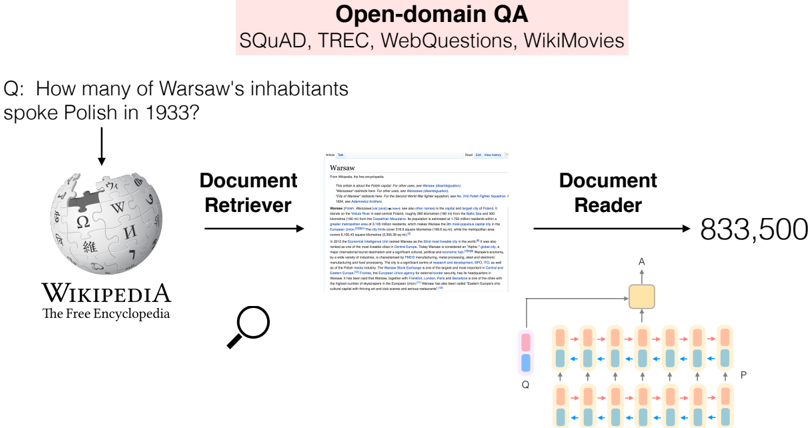
This paper proposes to tackle open-domain question answering using Wikipedia as the unique knowledge source: the answer to any factoid question is a text span in a Wikipedia article. This task of machine reading at scale combines the challenges of document retrieval (finding the relevant articles) with that of machine comprehension of text (identifying the answer spans from those articles). Our approach combines a search component based on bigram hashing and TF-IDF matching with a multi-layer recurrent neural network model trained to detect answers in Wikipedia paragraphs. Our experiments on multiple existing QA datasets indicate that (1) both modules are highly competitive with respect to existing counterparts and (2) multitask learning using distant supervision on their combination is an effective complete system on this challenging task.
Overview
The claims and statistics of this paper haven’t been checked yet.
Free: it reads the open-access text and checks the first 5 claims that cite a source we can check. Create a free account to check every claim.
Integrity signals
Registry
Cites
Statistics
Figures
Verification
Claims the paper makes
The claims and statistics of this paper haven’t been checked yet.
Free: it reads the open-access text and checks the first 5 claims that cite a source we can check. Create a free account to check every claim.
Claims other papers make about this one
Each is checked against this paper’s own text: does it say what the citing paper says it does?
The source backs part of the claim, not all of it — or backs it for a different population, condition or comparison.
In the citing paper
“In particular, the presence of low-value or semantically irrelevant entries dilutes the contribution of high-quality information in retrieval results, impairing downstream task performance and leading to measurable declines in metrics [5].”
From SEDM: Selective Self-Evolving Distributed Memory for Agents (2025) · cites this paper as [5]
Experimental — accuracy not yet measuredThe source backs part of the claim, not all of it — or backs it for a different population, condition or comparison.
In the citing paper
“Prior work has shown that retrieval improves performance across a variety of NLP tasks when considered in isolation.”
From Retrieval-Augmented Generation for Knowledge-Intensive NLP Tasks (2020) · cites this paper as [5]
Experimental — accuracy not yet measuredThe cited source says what the claim attributes to it.
In the citing paper
“This is in agreement with prior work that treated Wikipedia as a general knowledge source under the same reason (Chen et al., 2017; Petroni et al., 2021).”
From FActScore: Fine-grained Atomic Evaluation of Factual Precision in Long Form Text Generation (2023) · cites this paper as Chen et al., 2017
The cited source says what the claim attributes to it.
In the citing paper
“In-context learning methods now routinely invoke tools, leading to LM pipelines that use retrieval models (Chen et al., 2017; Lewis et al., 2020; Guu et al., 2020; Lazaridou et al., 2022; Izacard et al., 2022), multimodal foundation models, and more traditional tools like APIs (Nakano et al., 2021) and calculators.”
From DSPy: Compiling Declarative Language Model Calls into Self-Improving Pipelines (2023) · cites this paper as Chen et al., 2017
Self-check
Percentages, sums and reported differences re-computed from the paper’s own numbers.
The self-check needs the paper’s full text.
Citations
Cites
Adam: A Method for Stochastic Optimization
Kingma, D. P., & Ba, J. (2014) · arXiv · doi:10.48550/arxiv.1412.6980 · Cited by 98,946 · cited 1×
“We use Adamax for optimization as described in (Kingma and Ba, 2014).”
MethodGlove: Global Vectors for Word Representation
Pennington, J., Socher, R., & Manning, C. (2014) · Proceedings of the 2014 Conference on Empirical Methods in Natural Language Processing (EMNLP) · doi:10.3115/v1/d14-1162 · Cited by 34,071 · cited 2×
“The feature vector ˜ p i is comprised of the following parts: We use the 300-dimensional Glove word embeddings trained from 840B Web crawl data (Pennington et al., 2014).”
MethodNeural Machine Translation by Jointly Learning to Align and Translate
Bahdanau, D., Cho, K., & Bengio, Y. (2014) · arXiv · doi:10.48550/arxiv.1409.0473 · Cited by 16,213 · cited 2×
“…has made considerable progress recently thanks to new deep learning architectures like attention-based and memory-1 augmented neural networks (Bahdanau et al., 2015; Weston et al., 2015; Graves et al., 2014) and release of new training and evaluation datasets like QuizBowl (Iyyer et al., 2014),…”
BackgroundThe Stanford CoreNLP Natural Language Processing Toolkit
Manning, C., Surdeanu, M., Bauer, J., Finkel, J., Bethard, S., & McClosky, D. (2014) · Proceedings of 52nd Annual Meeting of the Association for Computational Linguistics: System Demonstrations · doi:10.3115/v1/p14-5010 · Cited by 7,037 · cited 2×
“We apply the Stanford CoreNLP toolkit (Manning et al., 2014) for tokenization and also generating lemma, part-of-speech, and named entity manual features.”
MethodSQuAD: 100,000+ Questions for Machine Comprehension of Text
Rajpurkar, P., Zhang, J., Lopyrev, K., & Liang, P. (2016) · Proceedings of the 2016 Conference on Empirical Methods in Natural Language Processing · doi:10.18653/v1/d16-1264 · Cited by 6,208 · cited 10×
“Next we evaluate our Document Reader component on the standard SQuAD evaluation (Rajpurkar et al., 2016).”
BackgroundMethodInfluentialA unified architecture for natural language processing: deep neural networks with multitask learning
Collobert, R., & Weston, J. (2008) · Proceedings of the 25th international conference on Machine learning - ICML '08 · doi:10.1145/1390156.1390177 · Cited by 5,058 · cited 1×
“Multitask learning (Caruana, 1998) and task transfer have a rich history in machine learning (e.g., using ImageNet in the computer vision community (Huh et al., 2016)), as well as in NLP in particular (Collobert and Weston, 2008).”
MethodSelf-citationFreebase: a collaboratively created graph database for structuring human knowledge
Bollacker, K., Evans, C., Paritosh, P., Sturge, T., & Taylor, J. (2008) · Proceedings of the 2008 ACM SIGMOD international conference on Management of data · doi:10.1145/1376616.1376746 · Cited by 4,852 · cited 11×
“Unlike knowledge bases (KBs) such as Freebase (Bollacker et al., 2008) or DBPedia (Auer et al.”
BackgroundMethodInfluentialDistant supervision for relation extraction without labeled data
Mintz, M., Bills, S., Snow, R., & Jurafsky, D. (2009) · Proceedings of the Joint Conference of the 47th Annual Meeting of the ACL and the 4th International Joint Conference on Natural Language Processing of the AFNLP: Volume 2 - ACL-IJCNLP '09 · doi:10.3115/1690219.1690287 · Cited by 2,752 · cited 1×
“Following previous work on distant supervision (DS) for relation extraction (Mintz et al., 2009), we use a”
MethodTeaching Machines to Read and Comprehend
Hermann, K. M., Kočiský, T., Grefenstette, E., Espeholt, L., Kay, W., Suleyman, M., & Blunsom, P. (2015) · arXiv (Cornell University) · doi:10.48550/arxiv.1506.03340 · Cited by 2,521 · cited 7×
“…Graves et al., 2014) and release of new training and evaluation datasets like QuizBowl (Iyyer et al., 2014), CNN/Daily Mail based on news articles (Hermann et al., 2015), CBT based on children books (Hill et al., 2016), or SQuAD (Rajpurkar et al., 2016) and WikiReading (Hewlett et al., 2016),…”
BackgroundMethodInfluentialDBpedia: A Nucleus for a Web of Open Data
Auer, S., Bizer, C., Kobilarov, G., Lehmann, J., Cyganiak, R., & Ives, Z. (2007) · Lecture Notes in Computer Science · doi:10.1007/978-3-540-76298-0_52 · Cited by 2,454 · cited 3×
“Unlike knowledge bases (KBs) such as Freebase (Bollacker et al., 2008) or DB-Pedia (Auer et al., 2007), which are easier for computers to process but too sparsely populated for open-domain question answering (Miller et al., 2016), Wikipedia contains up-to-date knowledge that humans are interested in.”
Background
Research works printed but not linked: 5
- Petr Baudiˇ s. 2015. YodaQA: a modular question answering system pipeline. In POSTER 2015-19th International Student Conference on Electrical Engineering . pages 1156-1165.
- Eric Brill, Susan Dumais, and Michele Banko. 2002. Ananalysis of the AskMSR question-answering system. In Empirical Methods in Natural Language Processing (EMNLP) . pages 257-264.
- Rudolf Kadlec, Ondrej Bajgar, and Jan Kleindienst. 2016. From particular to general: A preliminary case study of transfer learning in reading comprehension. Machine Intelligence Workshop, NIPS .
- Alexander H. Miller, Adam Fisch, Jesse Dodge, AmirHossein Karimi, Antoine Bordes, and Jason Weston. 2016. Key-value memory networks for directly reading documents. In Empirical Methods in Natural Language Processing (EMNLP) . pages 14001409.
- Jason Weston, Sumit Chopra, and Antoine Bordes. 2015. Memory networks. In International Conference on Learning Representations (ICLR) .
Cited by
Items 801–900 of 1,042
Summarizing News Articles Using Question-and-Answer Pairs via Learning
Wang, X., & Yu, C. (2019) · Lecture notes in computer science · doi:10.1007/978-3-030-30793-6_40 · Cited by 6
“For example, [3] tackles open-domain question answering using Wikipedia as the unique knowledge source.”
BackgroundNadine-Bot: An Open Domain Migrant Integration Administrative Agent
Lelis, A., Vretos, N., & Daras, P. (2020) · IEEE International Conference on Multimedia & Expo Workshops (ICMEW) · doi:10.1109/icmew46912.2020.9106024 · Cited by 10
Join the club? Peer effects on information value perception
Rusho, Y., & Raban, D. R. (2020) · Journal of the Association for Information Science and Technology · doi:10.1002/asi.24396 · Cited by 6
Cross-language Sentence Selection via Data Augmentation and Rationale Training
Chen, Y., Kedzie, C., Nair, S., Galuščáková, P., Zhang, R., Oard, D. W., & McKeown, K. R. (2021) · doi:10.18653/v1/2021.acl-long.300 · Cited by 10
“, 2017) and open-domain question answering (Chen et al., 2017; Dhingra et al., 2017; Kale et al., 2018).”
BackgroundWhen Retriever-Reader Meets Scenario-Based Multiple-Choice Questions
Huang, Z., Wu, A., Shen, Y., Cheng, G., & Qu, Y. (2021) · Findings of the Association for Computational Linguistics: EMNLP (Findings of EMNLP) · doi:10.18653/v1/2021.findings-emnlp.84 · Cited by 9
Zhao, C., Xiong, C., Boyd-Graber, J. L., & Daumé, H. (2021) · Conference on Empirical Methods in Natural Language Processing (EMNLP) · doi:10.18653/v1/2021.emnlp-main.756 · Cited by 15
“This could improve the reader to answer numerical reasoning (Dua et al., 2019), temporal reasoning (Ning et al., 2020), multi-model reasoning (Lei et al., 2018), or combination of these skills (Bartolo et al., 2020).”
BackgroundLi, R., Wang, L., Jiang, Z., Hu, Z., Zhao, M., & Lu, X. (2022) · Neural Computing and Applications · doi:10.1007/s00521-022-07072-0 · Cited by 7
“Therefore, the consensus in the literature is to disassemble the system into a retriever and a reader [4].”
BackgroundRetrieval Data Augmentation Informed by Downstream Question Answering Performance
Ferguson, J., Hajishirzi, H., Dasigi, P., & Khot, T. (2022) · Fact Extraction and VERification Workshop (FEVER) · doi:10.18653/v1/2022.fever-1.1 · Cited by 6
“These learned retrieval models are more effective than those that use simple word overlap signals (Robertson and Zaragoza, 2009; Chen et al., 2017), but they require the positive retrieval targets for each question labeled.”
BackgroundPU-GEN: Enhancing generative commonsense reasoning for language models with human-centered knowledge
Seo, J., Oh, D., Eo, S., Park, C., Yang, K., Moon, H., Park, K., & Lim, H. (2022) · Knowledge-Based Systems · doi:10.1016/j.knosys.2022.109861 · Cited by 7
Multi-views contrastive learning for dense text retrieval
Yu, Y., Zeng, J., Zhong, L., Gao, M., Wen, J., & Wu, Y. (2023) · Knowledge-Based Systems · doi:10.1016/j.knosys.2023.110624 · Cited by 7
Rejimoan, R., Gnanapriya, B., & Jayasudha, J. S. (2023) · IEEE Delhi Section Conference (DELCON) · doi:10.1109/delcon57910.2023.10127327 · Cited by 8
“Furthermore, NLP addresses practical issues such as extraction of appropriate facts from texts, text translation between languages, document summarization, automatic question answering, and document classification and clustering [1].”
BackgroundMixture-of-Experts for Biomedical Question Answering
Dai, D., Jiang, W., Zhang, J., Lyu, Y., Sui, Z., & Chang, B. (2023) · Lecture notes in computer science · doi:10.1007/978-3-031-44693-1_47 · Cited by 15
Mitigating Temporal Misalignment by Discarding Outdated Facts
Zhang, M., & Choi, E. (2023) · Conference on Empirical Methods in Natural Language Processing (EMNLP) · doi:10.18653/v1/2023.emnlp-main.879 · Cited by 39
Brilla AI: AI Contestant for the National Science and Maths Quiz
Boateng, G., Mensah, J. A., Yeboah, K. T., Edor, W., Mensah-Onumah, A. K., Ibrahim, N. D., & Yeboah, N. S. (2024) · Communications in computer and information science · doi:10.1007/978-3-031-64315-6_17 · Cited by 6
Leveraging Intent Entity Enhancement for Task-Oriented Dialogue
Chen, J., Li, S., Kan, B., Wang, F. L., & Hao, T. (2024) · International Joint Conference on Neural Networks (IJCNN) · doi:10.1109/ijcnn60899.2024.10649940 · Cited by 9
“DrQA [17] integrated a search component based on bigram hashing and TF-IDF matching with a multi-layer recurrent neural network model trained to detect answers in Wikipedia paragraphs.”
MethodDependency graph for short text extraction and summarization
Franciscus, N., Ren, X., & Stantić, B. (2019) · Journal of Information and Telecommunication · doi:10.1080/24751839.2019.1598771 · Cited by 11
Prediction of Answer Keywords using Char-RNN
Pratheek, I., & Paulose, J. (2019) · International Journal of Electrical and Computer Engineering (IJECE) · doi:10.11591/ijece.v9i3.pp2164-2176 · Cited by 7
“The closest implementation of this nature was attempted by the Facebook Research team(5).”
MethodRanking and Sampling in Open-Domain Question Answering
Xu, Y., Lin, Z., Liu, Y., Liu, R., Wang, W., & Meng, D. (2019) · Conference on Empirical Methods in Natural Language Processing (EMNLP) · doi:10.18653/v1/d19-1245 · Cited by 6
“, 2018a) and multi-paragraph approaches (Chen et al., 2017; Clark and Gardner, 2018; Pang et al., 2019).”
BackgroundMethodInfluentialAdversarial Language Games for Advanced Natural Language Intelligence
Yao, Y., Zhong, H., Zhang, Z., Han, X., Wang, X., Zhang, K., Xiao, C., Zeng, G., Liu, Z., & Sun, M. (2021) · Proceedings of the AAAI Conference on Artificial Intelligence · doi:10.1609/aaai.v35i16.17676 · Cited by 13
Learn with Noisy Data via Unsupervised Loss Correction for Weakly Supervised Reading Comprehension
Zhang, X., Zhou, K., Wang, S., Zhang, F., Wang, Z., & Liu, J. (2020) · International Conference on Computational Linguistics · doi:10.18653/v1/2020.coling-main.236 · Cited by 6
“Following Chen et al. (2017) and Lee et al.”
MethodOpen-Domain Question Answering with Pre-Constructed Question Spaces
Xiao, J., Wang, L., Dernoncourt, F., Bui, T., Sun, T., & Han, J. (2021) · Conference of the North American Chapter of the Association for Computational Linguistics: Student Research Workshop (NAACL SRW) · doi:10.18653/v1/2021.naacl-srw.9 · Cited by 7
Technical Question Answering across Tasks and Domains
Yu, W., Wu, L., Deng, Y., Zeng, Q., Mahindru, R., Güven, S., & Jiang, M. (2021) · Conference of the North American Chapter of the Association for Computational Linguistics: Human Language Technologies (NAACL-HLT) · doi:10.18653/v1/2021.naacl-industry.23 · Cited by 10
Answering POI-recommendation Questions using Tourism Reviews
Contractor, D., Shah, K., Partap, A., Singla, P., & Mausam, M. (2021) · ACM International Conference on Information and Knowledge Management (CIKM) · doi:10.1145/3459637.3482320 · Cited by 10
Integrating Question Answering and Text-to-SQL in Portuguese
José, M. M., José, M. A., Mauá, D. D., & Cozman, F. G. (2022) · Lecture notes in computer science · doi:10.1007/978-3-030-98305-5_26 · Cited by 6
“Some proposals use neural transformers both in the retriever and the reader [8], while others use keyword-based models for the retriever [4].”
MethodZero-shot cross-lingual open domain question answering
Agarwal, S. D., Tripathi, S., Mitamura, T., & Rosé, C. P. (2022) · doi:10.18653/v1/2022.mia-1.9 · Cited by 9
“…passage re-triever trained on large-scale English QA datasets to fetch evidence passages (Karpukhin et al., 2020), while Reader aims at inferring the final answer from the retrieved documents, which is usually a neural MRC model (Chen et al., 2017) or a generative model (Izacard and Grave, 2021).”
BackgroundIntegrating Entity Linking and Evidence Ranking for Fact Extraction and Verification
Taniguchi, M., Taniguchi, T., Takahashi, T., Miura, Y., & Ohkuma, T. (2018) · Fact Extraction and VERification Workshop (FEVER) · doi:10.18653/v1/w18-5520 · Cited by 7
“This corresponds roughly to the accuracy of 10 nearest documents retrieved by the DrQA (Chen et al., 2017) based retrieval approach used in the baseline system.”
MethodQuestion Answering over Curated and Open Web Sources
Roy, R. S., & Anand, A. (2020) · ACM SIGIR International Conference on Theory of Information Retrieval (ICTIR) · doi:10.1145/3409256.3409809 · Cited by 7
ClaiRE at SemEval-2018 Task 7: Classification of Relations using Embeddings
Hettinger, L., Dallmann, A., Zehe, A., Niebler, T., & Hotho, A. (2018) · International Workshop on Semantic Evaluation (SemEval) · doi:10.18653/v1/s18-1134 · Cited by 10
“…make use of semantic background knowledge and add pre-trained word embeddings to the SVM, as word embeddings have been shown to improve performance in a series of NLP tasks, such as sentiment analysis (Kim, 2014), question answering (Chen et al., 2017) or relation extraction (Dligach et al., 2017).”
An Interface for Annotating Science Questions
Boratko, M., Padigela, H., Mikkilineni, D., Yuvraj, P., Das, R., McCallum, A., Chang, M., Fokoue, A., Kapanipathi, P., Mattei, N., et al. (2018) · Conference on Empirical Methods in Natural Language Processing: System Demonstrations (EMNLP) · doi:10.18653/v1/d18-2018 · Cited by 6
“However, most work in open domain settings (Chen et al., 2017; Clark and Gardner, 2017; Wang et al., 2018) only uses simple retrievers (such as TF-IDF based ones).”
BackgroundSogou Machine Reading Comprehension ToolkitPreprint
Wu, J., Yang, Y., Deng, C., Tang, H., Wang, B., Sun, H., Yao, T., & Zhang, Q. (2019) · arXiv (Cornell University) · doi:10.48550/arxiv.1903.11848 · Cited by 5
“Table 4 suggests that DrQA is more sensitive to the word embedding and ELMo helps improve the score consistently (here, when ELMo was used, no word embedding was concatenated).”
BackgroundMethodInfluentialMulti-span Style Extraction for Generative Reading ComprehensionPreprint
Yang, J., Zhang, Z., & Zhao, H. (2020) · arXiv (Cornell University) · doi:10.48550/arxiv.2009.07382 · Cited by 12
“Pipeline-based models (Chen et al., 2017; Wang et al., 2018a; Clark and Gardner, 2018) adopt a ranker to first rank all the passages based on its relevance to the question and then utilize a question-answering module to read the selected passages.”
MethodProceedings of the First Workshop on NLP for Conversational AI
(2019) · doi:10.18653/v1/w19-41 · Cited by 7
Complex QA and language models hybrid architectures, SurveyPreprint
Daull, X., Bellot, P., Bruno, E., Martin, V., & Murisasco, É. (2023) · arXiv (Cornell University) · doi:10.48550/arxiv.2302.09051 · Cited by 44
RINK: Reader-Inherited Evidence Reranker for Table-and-Text Open Domain Question Answering
Park, E., Lee, S.-M., Seo, D., Kim, S., Kang, I., & Na, S.-H. (2023) · Proceedings of the AAAI Conference on Artificial Intelligence · doi:10.1609/aaai.v37i11.26577 · Cited by 5
“Open-Domain Question Answering ODQA (Chen et al. 2017) is a task that finds the answer to a given question from a large set of data in multiple domains.”
BackgroundRK-VQA: Rational knowledge-aware fusion-in-decoder for knowledge-based visual question answering
Chen, W., Huang, X. Q., Liu, Z., Liu, J., Yin, H., & Yo, L. (2025) · Information Fusion · doi:10.1016/j.inffus.2025.102969 · Cited by 7
Retrieval augmentation for text-to-table generation
Zhang, J., Tan, M., Zhang, J., Zhang, X., Zhou, J., & Li, C. (2025) · Information Processing & Management · doi:10.1016/j.ipm.2025.104135 · Cited by 6
Unveiling Knowledge Utilization Mechanisms in LLM-based Retrieval-Augmented Generation
Wang, Y., Ren, R., Wang, Y., Zhao, W. X., Liu, J., Wu, H., & Wang, H. (2025) · International ACM SIGIR Conference on Research and Development in Information Retrieval (SIGIR) · doi:10.1145/3726302.3730112 · Cited by 26
“In this study, we investigate the mechanisms of knowledge utilization in RAG within its typical application scenarios: open-domain question answering (ODQA) [3].”
TACR: A Table Alignment-based Cell Selection Method for HybridQA
Wu, J., Xu, Y., Gao, Y., Lou, J., Karlsson, B. F., & Okumura, M. (2023) · Findings of the Association for Computational Linguistics: ACL (Findings of ACL) · doi:10.18653/v1/2023.findings-acl.409 · Cited by 13
Liu, J., Liu, J., Yang, Y., Wang, J., Wu, W., Zhao, D., & Yan, R. (2022) · Findings of the Association for Computational Linguistics: EMNLP (Findings of EMNLP) · doi:10.18653/v1/2022.findings-emnlp.39 · Cited by 10
“In the first-stage retrieval, traditional approaches (Chen et al., 2017) implemented term-based retriever (e.g. TF-IDF and BM25) by weighting terms based on their frequency, which have limitations on representing semantics of text.”
BackgroundMethodNguyen, D.-H., Le, N.-K., & Nguyen, L.-M. (2023) · Information Processing & Management · doi:10.1016/j.ipm.2023.103514 · Cited by 9
Techniques, datasets, evaluation metrics and future directions of a question answering system
Qamar, F., Latif, S., & Shah, A. (2023) · Knowledge and Information Systems · doi:10.1007/s10115-023-02019-w · Cited by 4
“Authors [6–20] worked on factoid type question answering system using machine or deep learning techniques.”
Semantic search as extractive paraphrase span detection
Kanerva, J., Kitti, H., Chang, L., Vahtola, T., Creutz, M., & Ginter, F. (2024) · Language Resources and Evaluation · doi:10.1007/s10579-023-09715-7 · Cited by 14
“…property of the dataset is to the best of our knowledge unique to this corpus and in turn allows us to take a novel approach to semantic search, by casting it as paraphrase span detection: Given a segment of text as a query, the task of the model is to identify its paraphrase from the given…”
SpeechDPR: End-To-End Spoken Passage Retrieval For Open-Domain Spoken Question Answering
Lin, C.-J., Lin, G.-T., Chuang, Y.-S., Wu, W.-L., Li, S.-W. D., Mohamed, A., Lee, H.-Y., & Lee, L.-S. (2024) · IEEE International Conference on Acoustics Speech and Signal Processing · doi:10.1109/icassp48485.2024.10448210 · Cited by 24
“The latter is usually achieved by cascading a text retriever in front of a text reader (or TQA) [5, 6, 7].”
BackgroundMethodMulti-Passage Machine Reading Comprehension Through Multi-Task Learning and Dual Verification
Li, X., Cheng, X., Xia, M., Ren, Q., He, Z., & Su, S. (2024) · IEEE Transactions on Knowledge and Data Engineering · doi:10.1109/tkde.2024.3383103 · Cited by 5
K-CSRL: Knowledge Enhanced Conversational Semantic Role Labeling
He, B., Wu, H., Li, C., Song, L., & Chen, W. (2021) · International Conference on Machine Learning and Computing (ICMLC) · doi:10.1145/3457682.3457763 · Cited by 5
Building a Question and Answer System for News Domain
Darapaneni, N., Chetan, P., Paduri, A. R., Gaddala, A., Tiwari, G., Basu, S., & Parvathaneni, S. (2021) · International Conference on Secure Cyber Computing and Communications (ICSCCC) · doi:10.1109/icsccc51823.2021.9478180 · Cited by 6
Relation-Guided Pre-Training for Open-Domain Question Answering
Hu, Z., Sun, Y., & Chang, K.-W. (2021) · Findings of the Association for Computational Linguistics: EMNLP (Findings of EMNLP) · doi:10.18653/v1/2021.findings-emnlp.292 · Cited by 8
Implicit Relation Inference with Deep Path Extraction for Commonsense Question Answering
Yang, P., Liu, Z., Li, B., & Zhang, P. (2022) · Neural Processing Letters · doi:10.1007/s11063-022-10831-8 · Cited by 7
“Chen et al. [5] take the text-retrieved inference module on open-sourced text corpora to attain unstructured evidence that is inextricably linked with the structure evidence from KG. Lv et al. [31] propose an inference model that combines the strengths of structured evidence from ConceptNet [50]…”
MethodEnd-to-end Distantly Supervised Information Extraction with Retrieval Augmentation
Zhang, Y., Fei, H., & Li, P. (2022) · International ACM SIGIR Conference on Research and Development in Information Retrieval (SIGIR) · doi:10.1145/3477495.3531876 · Cited by 11
“DrQA [7] is one of the earlier systems using Wikipedia as the knowledge source to answer any factoid questions.”
Structure and Semantics Preserving Document Representations
Raman, N., Shah, S., & Veloso, M. (2022) · International ACM SIGIR Conference on Research and Development in Information Retrieval (SIGIR) · doi:10.1145/3477495.3532062 · Cited by 7
“3532062 such as question answering [5], summarization [43], recommendation [3], and search and navigation [35] and are of fundamental research interest.”
BackgroundLi, K., Zhang, T., Tang, L., Li, J., Lu, H., Wu, X., & Meng, H. M. L. (2022) · DialDoc Workshop on Document-grounded Dialogue and Conversational Question Answering (DialDoc) · doi:10.18653/v1/2022.dialdoc-1.13 · Cited by 14
“Open-domain Question Answering systems have evolved to adopt the popular “Retriever-Reader (Generator)” architecture since DrQA (Chen et al., 2017).”
BackgroundAnswering Count Questions with Structured Answers from Text
Ghosh, S., Razniewski, S., & Weikum, G. (2022) · Journal of Web Semantics · doi:10.1016/j.websem.2022.100769 · Cited by 7
“This is commonly used in textual QA (Chen et al., 2017; Wang et al., 2018).”
BackgroundMethodPre-processing Matters! Improved Wikipedia Corpora for Open-Domain Question Answering
Tamber, M. S., Pradeep, R., & Lin, J. (2023) · Lecture notes in computer science · doi:10.1007/978-3-031-28241-6_11 · Cited by 13
Query Context Expansion for Open-Domain Question Answering
Zhu, W., Zhang, X., Liang, Y., & Zhai, Q. (2023) · ACM Transactions on Asian and Low-Resource Language Information Processing · doi:10.1145/3603498 · Cited by 6
Bai, Y., Colas, A., & Wang, D. Z. (2023) · International ACM SIGIR Conference on Research and Development in Information Retrieval (SIGIR) · doi:10.1145/3539618.3591907 · Cited by 7
“Recently, new domains are introduced for check-worthy claim detection, such as social media [28, 34], news articles [2], Wikipedia [39] and COVID-19 [1].”
BackgroundMethodInfluentialPlug-and-Play Document Modules for Pre-trained Models
Xiao, C., Zhang, Z., Han, X., Chan, C.-M., Lin, Y., Liu, Z., Li, X., Li, Z., Cao, Z., & Sun, M. (2023) · Proceedings of the conference - Association for Computational Linguistics. Meeting · doi:10.18653/v1/2023.acl-long.875 · Cited by 18
Exploiting Abstract Meaning Representation for Open-Domain Question Answering
Wang, C., Xu, Z., Guo, Q., Hu, X., Bai, X., Zhang, Z., & Zhang, Y. (2023) · Findings of the Association for Computational Linguistics: ACL (Findings of ACL) · doi:10.18653/v1/2023.findings-acl.131 · Cited by 21
Du, K., Zhang, X., Gao, C., Zhu, R., Nong, Q., Yang, X., & Yin, C. (2023) · Multimedia Tools and Applications · doi:10.1007/s11042-023-16592-3 · Cited by 5
“As observed by Gong et al [10] and Chen et al [59], the simple exact alignment function does help the model to understand the sentences better.”
Spans, Not Tokens: A Span-Centric Model for Multi-Span Reading Comprehension
Huang, Z., Zhou, J., Niu, C., & Cheng, G. (2023) · ACM International Conference on Information and Knowledge Management (CIKM) · doi:10.1145/3583780.3615064 · Cited by 15
“In order to promote the development of QA system, machine reading comprehension (MRC) which aims to extract a span from a given context for answering a question has been extensively studied [13, 27, 28] and regarded as a foundational task of many QA systems [3, 21].”
BackgroundImproving Aspect Sentiment Classification via Retrieving from Training Data
Ling, T., Chen, L., Liao, C., Huang, S., Yu, Z., & Liu, Y. (2023) · Asia-Pacific Signal and Information Processing Association Annual Summit and Conference (APSIPA ASC) · doi:10.1109/apsipaasc58517.2023.10317451 · Cited by 6
“As a result, a series of retrieval-based approaches have been applied with great success to many NLP tasks such as language modeling [13, 14], open-domain question answering [15] and machine translation [16].”
BackgroundAllies: Prompting Large Language Model with Beam Search
Sun, H., Liu, X., Gong, Y., Zhang, Y., Jiang, D., Yang, L., & Duan, N. (2023) · Findings of the Association for Computational Linguistics: EMNLP (Findings of EMNLP) · doi:10.18653/v1/2023.findings-emnlp.247 · Cited by 20
“The retriever’s role is to retrieve relevant information from a corpus such as Wikipedia [Chen et al., 2017, Izacard and Grave, 2021] or web pages [Lazaridou et al., 2022, Nakano et al., 2021], while the reader focuses on answering the question based on the retrieved information.”
BackgroundMethodkNN-LM Does Not Improve Open-ended Text Generation
Wang, S., Song, Y., Drozdov, A., Garimella, A., Manjunatha, V., & Iyyer, M. (2023) · Conference on Empirical Methods in Natural Language Processing (EMNLP) · doi:10.18653/v1/2023.emnlp-main.929 · Cited by 24
KIMedQA: towards building knowledge-enhanced medical QA models
Zafar, A., Sahoo, S. K., Varshney, D., Das, A., & Ekbal, A. (2024) · Journal of Intelligent Information Systems · doi:10.1007/s10844-024-00844-1 · Cited by 11
“Extractive models, which belong to open-domain QA models, have recently sparked a lot of attention (Chen et al., 2017; Clark et al., 2018; Wang et al., 2019; Buscaldi et al., 2010).”
Math Word Problem Generation via Disentangled Memory Retrieval
Qin, W., Wang, X., Hu, Z., Wang, L., Lan, Y., & Hong, R. (2024) · ACM Transactions on Knowledge Discovery from Data · doi:10.1145/3639569 · Cited by 12
“The memory retrieval module has been demonstrated to enhance a variety of text generation tasks, such as open-domain question answering [4, 18, 23], dialogue response generation [1, 2, 27, 60, 63], and machine translation [3].”
BackgroundA simple and efficient dialogue generation model incorporating commonsense knowledge
Son, G., & Kim, M. (2024) · Expert Systems with Applications · doi:10.1016/j.eswa.2024.123584 · Cited by 6
Manufacturing Domain QA with Integrated Term Enhanced RAG
Bei, Y., Fang, Z., Mao, S., Yu, S., Jiang, Y., Tong, Y., & Cai, W. (2024) · International Joint Conference on Neural Networks (IJCNN) · doi:10.1109/ijcnn60899.2024.10649905 · Cited by 11
“There are mainly two methods for searching relevant documents: sparse retrievers and dense retrievers [17], [18].”
MethodSelf Data Augmentation for Open Domain Question Answering
Zhang, Q., Zheng, M., Chen, S., Liu, H., & Fang, M. (2025) · ACM Transactions on Information Systems · doi:10.1145/3707449 · Cited by 9
“Earlier works [6] adopted non-parametric sparse methods, such as BM25 [50] and TF-IDF, as the retriever.”
Ijebu, F. F., Liu, Y., Sun, C., Jere, N. R., Mienye, I. D., & Inyang, U. G. (2025) · Technologies · doi:10.3390/technologies13030119 · Cited by 6
“Two revolutionizing works in the QA domain are the SQuAD dataset [18] and the work in [19], where Wikipedia is used as a knowledge source for QA [20].”
A Corpus for Hybrid Question Answering Systems
Grau, B., & Ligozat, A. (2018) · International World Wide Web Conference (WWW) · doi:10.1145/3184558.3191540 · Cited by 5
“It also ranges from feature based learning approaches [10] to neural network approaches [5]3 One of the main challenges when querying a KB given a NL question concerns the alignment of a question with the KB triples, which needs to overcome lexical gap and to adapt the question”
BackgroundMethodA3Net:Adversarial-and-Attention Network for Machine Reading Comprehension
Wang, J., Fu, X., Xu, G., Wu, Y., Chen, Z., Yang, W., & Jin, L. (2018) · Lecture notes in computer science · doi:10.1007/978-3-319-99495-6_6 · Cited by 5
“DrQA [2] simply use a bilinear term to compute the attention weights, so as to get word level question-merged passage representation.”
InfluentialLinguistically-Based Deep Unstructured Question Answering
Aghaebrahimian, A. (2018) · Conference on Computational Natural Language Learning · doi:10.18653/v1/k18-1042 · Cited by 5
“…is the use of a variant of uni-or bi-directional attention schemes (question to context and vice-versa) to encode the semantic content of ques-tions’ words with a focus on their context’s words (Seo et al., 2016; Xiong et al., 2016; Weis-senborn et al., 2017b; Chen et al., 2017; Wang et al., 2017).”
BackgroundExtracting Short Entity Descriptions for Open-World Extension to Knowledge Graph Completion Models
Zhu, W., Zhi, X., & Tong, W. (2020) · Lecture notes in computer science · doi:10.1007/978-3-030-55130-8_2 · Cited by 7
Don’t Read Too Much Into It: Adaptive Computation for Open-Domain Question Answering
Wu, Y., Riedel, S., Minervini, P., & Stenetorp, P. (2020) · Conference on Empirical Methods in Natural Language Processing (EMNLP) · doi:10.18653/v1/2020.emnlp-main.244 · Cited by 11
Memory-Augmented Neural Networks on FPGA for Real-Time and Energy-Efficient Question Answering
Park, S., Jang, J., Kim, S., Na, B., & Yoon, S. (2020) · IEEE Transactions on Very Large Scale Integration (VLSI) Systems · doi:10.1109/tvlsi.2020.3037166 · Cited by 5
“It focused on accelerating large-scale memory, which is usually required in open-domain QA [43].”
BackgroundBeyond Probability Ranking Principle: Modeling the Dependencies among Documents
Pang, L., Ai, Q., & Xu, J. (2021) · ACM International Conference on Web Search and Data Mining (WSDM) · doi:10.1145/3437963.3441662 · Cited by 5
Li, B., Xu, W., Xu, Z., Li, J., & Peng, P. (2021) · Applied Intelligence · doi:10.1007/s10489-021-02269-7 · Cited by 5
“Nowadays the mechanisms of Qabots can be mainly divided into: knowledge-based Qabots [12, 27], open domain Qabots [5, 20] or text information extraction Qabots [2, 31], etc.”
BackgroundMethodAdaptive Batch Scheduling for Open-Domain Question Answering
Choi, D., Shin, M., Kim, E., & Shin, D. R. (2021) · IEEE Access · doi:10.1109/access.2021.3103963 · Cited by 7
Knowledge-Enhanced Evidence Retrieval for Counterargument Generation
Jo, Y., Yoo, H., Bak, J., Oh, A. H., Reed, C., & Hovy, E. H. (2021) · Findings of the Association for Computational Linguistics: EMNLP (Findings of EMNLP) · doi:10.18653/v1/2021.findings-emnlp.264 · Cited by 20
BiRdQA: A Bilingual Dataset for Question Answering on Tricky Riddles
Zhang, Y., & Wan, X. (2022) · Proceedings of the AAAI Conference on Artificial Intelligence · doi:10.1609/aaai.v36i10.21430 · Cited by 18
Ni, A., Gardner, M., & Dasigi, P. (2021) · Conference on Empirical Methods in Natural Language Processing (EMNLP) · doi:10.18653/v1/2021.emnlp-main.497 · Cited by 15
SANTM: Efficient Self-attention-driven Network for Text Matching
Tiwari, P., Jaiswal, A. K., Garg, S., & You, I. (2021) · ACM Transactions on Internet Technology · doi:10.1145/3426971 · Cited by 6
“Recent works [4, 6, 12] have shown significant improvement in the NLI models on very high and famous benchmarks such as the SNLI [3] and MultiNLI [58] datasets.”
BackgroundWikiMulti: A Corpus for Cross-Lingual Summarization
Tikhonov, P., & Malykh, V. (2022) · Communications in computer and information science · doi:10.1007/978-3-031-23372-2_6 · Cited by 8
Learning Answer Generation using Supervision from Automatic Question Answering Evaluators
Gabburo, M., Garg, S., Koncel-Kedziorski, R., & Moschitti, A. (2023) · Proceedings of the conference - Association for Computational Linguistics. Meeting · doi:10.18653/v1/2023.acl-long.467 · Cited by 10
Automatic Creation of Named Entity Recognition Datasets by Querying Phrase Representations
Kim, H., Yoo, J., Yoon, S., & Kang, J. (2023) · Proceedings of the conference - Association for Computational Linguistics. Meeting · doi:10.18653/v1/2023.acl-long.394 · Cited by 8
NIR-Prompt: A Multi-task Generalized Neural Information Retrieval Training Framework
Xu, S., Pang, L., Shen, H., & Cheng, X. (2023) · ACM Transactions on Information Systems · doi:10.1145/3626092 · Cited by 6
“In exact matching, DrQA [ 9] combines TF-IDF weighted bag-of-words vectors and bigram to represent the text.”
BackgroundMethodInfluentialGuo, W., Luo, L., Lai, H., & Yin, J. P. (2023) · Conference on Empirical Methods in Natural Language Processing (EMNLP) · doi:10.18653/v1/2023.emnlp-main.720 · Cited by 7
Knowledge Rumination for Pre-trained Language Models
Yao, Y., Wang, P., Mao, S., Tan, C., Huang, F., Chen, H., & Zhang, N. (2023) · Conference on Empirical Methods in Natural Language Processing (EMNLP) · doi:10.18653/v1/2023.emnlp-main.206 · Cited by 9
Zafar, A., Varshney, D., Sahoo, S. K., Das, A., & Ekbal, A. (2024) · Applied Intelligence · doi:10.1007/s10489-024-05282-8 · Cited by 8
A Survey Of Automatic Fact Verification Research
Yang, S., Xue, Y., Gan, T., & Wu, Y. C. (2024) · World Conference on Computing and Communication Technologies (WCCCT) · doi:10.1109/wccct60665.2024.10541489 · Cited by 7
“The goal of the document retrieval subtask is to locate documents from a large knowledge base that are relevant to a given claim [17].”
BackgroundMethodLearning the Chinese Sentence Representation with LSTM Autoencoder
Chen, M., Huang, T., Shu, Y., Chen, C., Hsieh, T.-C., & Yen, N. Y. (2018) · International World Wide Web Conference (WWW) · doi:10.1145/3184558.3186355 · Cited by 5
“Chen et al. [13] also conducted research on QA system.”
BackgroundMultiple Attention Networks with Temporal Convolution for Machine Reading Comprehension
Guo, J., Liu, G., & Xiong, C. (2019) · IEEE International Conference on Electronics Information and Emergency Communication · doi:10.1109/iceiec.2019.8784662 · Cited by 5
“, 100-dim word embeddings, 100-dim char embeddings ,1024-dim ELMo embeddings, 12-dim POS embedding ,8-dim NER embedding and a normalized term frequency for passage P as suggested in[15].”
BackgroundLatent cognizance: what machine really learns
Nakjai, P., Ponsawat, J., & Katanyukul, T. (2019) · doi:10.1145/3357254.3357266 · Cited by 5
“BACKGROUND An inference machine has been widely used in multiple application domains[9-20].”
MethodEvolution of Techniques for Question Answering over Knowledge Base: A Survey
Salunkhe, A. (2020) · International Journal of Computer Applications · doi:10.5120/ijca2020919817 · Cited by 6
Chen, T., Li, H., Kasamatsu, M., Utsuro, T., & Kawada, Y. (2020) · Fact Extraction and VERification Workshop (FEVER) · doi:10.18653/v1/2020.fever-1.4 · Cited by 5
“This extension is similar to the extension of existing factoid machine comprehension with Wikipedia texts’ paragraphs as contexts to open domain machine comprehension with the whole Wikipedia articles (Chen et al., 2017).”
MethodRethinking the Objectives of Extractive Question Answering
Fajčík, M., Jon, J., & Smrž, P. (2021) · Workshop on Machine Reading for Question Answering (MRQA) · doi:10.18653/v1/2021.mrqa-1.2 · Cited by 8
Learning to Answer Complex Questions with Evidence Graph
Gu, G., Li, B., Gao, H., & Wang, M. (2020) · Lecture notes in computer science · doi:10.1007/978-3-030-60259-8_20 · Cited by 5
Answering Count Queries with Explanatory Evidence
Ghosh, S., Razniewski, S., & Weikum, G. (2022) · Annual International ACM SIGIR Conference on Research and Development in Information Retrieval · doi:10.1145/3477495.3531870 · Cited by 6
“This is commonly used in textual QA [3, 28].”
BackgroundMethodDocument Retrieval for Biomedical Question Answering with Neural Sentence Matching
Noh, J., & Kavuluru, R. (2018) · International Conference on Machine Learning and Applications · doi:10.1109/icmla.2018.00036 · Cited by 8
“For QA in particular, a paragraph can be matched to a question sentence to find an answer phrase span in that paragraph [8].”
Neural Skill Transfer from Supervised Language Tasks to Reading ComprehensionPreprint
Mihaylov, T., Kozareva, Z., & Frank, A. (2017) · arXiv (Cornell University) · doi:10.48550/arxiv.1711.03754 · Cited by 6
“The WE maxsim between two texts has been shown to be helpful for community question answering [5] and discourse relation sense classification [28].”
Background
Metadata
- Authors
- Chen, D., Fisch, A., Weston, J., & Bordes, A.
- Affiliations
- Meta (United States) (US)
- ORCID
- Chen, Danqi
- Venue
- Proceedings of the 55th Annual Meeting of the Association for Computational Linguistics (Volume 1: Long Papers)
- Published
- 2017
- Pages
- 1870-1879
- ISSN
- 0736-587X (ISSN-L)
- OpenAlex
- W2962985038
- Cited by
- 1,546
- References
- 39
- Citations by year
- 2026: 61 · 2025: 105 · 2024: 123 · 2023: 218 · 2022: 209 · 2021: 268 · 2020: 202 · 2019: 199 · 2018: 142 · 2017: 18
- FWCI
- 69.97
- Type
- conference paper
- Language
- en
- Open access
- hybrid
- doi.org
- Licence
- cc-by
- Locations
- Proceedings of the conference - Association for Computational Linguistics. Meeting (publishedVersion, cc-by)
- arXiv (Cornell University) (submittedVersion)
- arXiv (Cornell University)
- Topics
- Physical Sciences › Computer Science › Artificial Intelligence › Topic Modeling
- Physical Sciences › Computer Science › Information Systems › Information Retrieval and Search Behavior
- Physical Sciences › Computer Science › Artificial Intelligence › Natural Language Processing Techniques
- Keywords
- open-domain question answering, Wikipedia, machine reading, document retrieval, recurrent neural networks, multi-task learning, distant supervision, factoid questions
About these checks
Registry, retraction, Cites and statistics results are computed, not judged, with one exception: a printed reference that no index lists is read once by a model before it counts as a citation error. Claims are extracted by a model and kept only when their quote appears verbatim in the text; each cited source is then checked, with a model’s help, for whether it says what the claim relies on. Those verdicts can be wrong — read the claim’s quote and the cited source before relying on one.
Statistics and arithmetic are recomputed, not judged.
Confidence bands are shown only for fields calibrated on our annotated test set. None is calibrated yet, so no band is shown.
What counts as a claim ›How we measure confidence ›How we check this ›
Are you an author, or do you see a problem with this page? Request a review
Data sources
Bibliographic data: Semantic Scholar, OpenAlex, Crossref.
Contains information from the Semantic Scholar Academic Graph Datasets, made available under the ODC Attribution License (ODC-BY 1.0).
Semantic Scholar’s data is described in: Kinney, R., et al. (2023). The Semantic Scholar Open Data Platform. arXiv:2301.10140.
