

Reading Wikipedia to Answer Open-Domain Questions
Open accessThe DOI matches its Crossref record; 34 of the 39 references it cites were found in a registry or an index.
Abstract
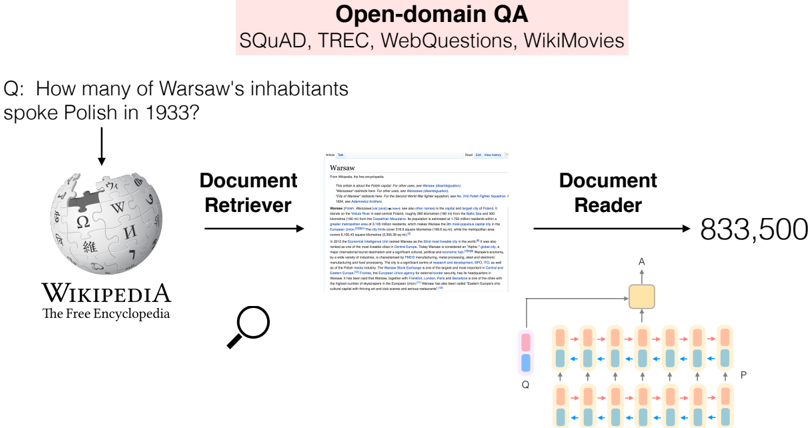
This paper proposes to tackle open-domain question answering using Wikipedia as the unique knowledge source: the answer to any factoid question is a text span in a Wikipedia article. This task of machine reading at scale combines the challenges of document retrieval (finding the relevant articles) with that of machine comprehension of text (identifying the answer spans from those articles). Our approach combines a search component based on bigram hashing and TF-IDF matching with a multi-layer recurrent neural network model trained to detect answers in Wikipedia paragraphs. Our experiments on multiple existing QA datasets indicate that (1) both modules are highly competitive with respect to existing counterparts and (2) multitask learning using distant supervision on their combination is an effective complete system on this challenging task.
Overview
The claims and statistics of this paper haven’t been checked yet.
Free: it reads the open-access text and checks the first 5 claims that cite a source we can check. Create a free account to check every claim.
Integrity signals
Registry
Cites
Statistics
Figures
Verification
Claims the paper makes
The claims and statistics of this paper haven’t been checked yet.
Free: it reads the open-access text and checks the first 5 claims that cite a source we can check. Create a free account to check every claim.
Claims other papers make about this one
Each is checked against this paper’s own text: does it say what the citing paper says it does?
The source backs part of the claim, not all of it — or backs it for a different population, condition or comparison.
In the citing paper
“In particular, the presence of low-value or semantically irrelevant entries dilutes the contribution of high-quality information in retrieval results, impairing downstream task performance and leading to measurable declines in metrics [5].”
From SEDM: Selective Self-Evolving Distributed Memory for Agents (2025) · cites this paper as [5]
Experimental — accuracy not yet measuredThe source backs part of the claim, not all of it — or backs it for a different population, condition or comparison.
In the citing paper
“Prior work has shown that retrieval improves performance across a variety of NLP tasks when considered in isolation.”
From Retrieval-Augmented Generation for Knowledge-Intensive NLP Tasks (2020) · cites this paper as [5]
Experimental — accuracy not yet measuredThe cited source says what the claim attributes to it.
In the citing paper
“This is in agreement with prior work that treated Wikipedia as a general knowledge source under the same reason (Chen et al., 2017; Petroni et al., 2021).”
From FActScore: Fine-grained Atomic Evaluation of Factual Precision in Long Form Text Generation (2023) · cites this paper as Chen et al., 2017
The cited source says what the claim attributes to it.
In the citing paper
“In-context learning methods now routinely invoke tools, leading to LM pipelines that use retrieval models (Chen et al., 2017; Lewis et al., 2020; Guu et al., 2020; Lazaridou et al., 2022; Izacard et al., 2022), multimodal foundation models, and more traditional tools like APIs (Nakano et al., 2021) and calculators.”
From DSPy: Compiling Declarative Language Model Calls into Self-Improving Pipelines (2023) · cites this paper as Chen et al., 2017
Self-check
Percentages, sums and reported differences re-computed from the paper’s own numbers.
The self-check needs the paper’s full text.
Citations
Cites
Adam: A Method for Stochastic Optimization
Kingma, D. P., & Ba, J. (2014) · arXiv · doi:10.48550/arxiv.1412.6980 · Cited by 98,946 · cited 1×
“We use Adamax for optimization as described in (Kingma and Ba, 2014).”
MethodGlove: Global Vectors for Word Representation
Pennington, J., Socher, R., & Manning, C. (2014) · Proceedings of the 2014 Conference on Empirical Methods in Natural Language Processing (EMNLP) · doi:10.3115/v1/d14-1162 · Cited by 34,071 · cited 2×
“The feature vector ˜ p i is comprised of the following parts: We use the 300-dimensional Glove word embeddings trained from 840B Web crawl data (Pennington et al., 2014).”
MethodNeural Machine Translation by Jointly Learning to Align and Translate
Bahdanau, D., Cho, K., & Bengio, Y. (2014) · arXiv · doi:10.48550/arxiv.1409.0473 · Cited by 16,213 · cited 2×
“…has made considerable progress recently thanks to new deep learning architectures like attention-based and memory-1 augmented neural networks (Bahdanau et al., 2015; Weston et al., 2015; Graves et al., 2014) and release of new training and evaluation datasets like QuizBowl (Iyyer et al., 2014),…”
BackgroundThe Stanford CoreNLP Natural Language Processing Toolkit
Manning, C., Surdeanu, M., Bauer, J., Finkel, J., Bethard, S., & McClosky, D. (2014) · Proceedings of 52nd Annual Meeting of the Association for Computational Linguistics: System Demonstrations · doi:10.3115/v1/p14-5010 · Cited by 7,037 · cited 2×
“We apply the Stanford CoreNLP toolkit (Manning et al., 2014) for tokenization and also generating lemma, part-of-speech, and named entity manual features.”
MethodSQuAD: 100,000+ Questions for Machine Comprehension of Text
Rajpurkar, P., Zhang, J., Lopyrev, K., & Liang, P. (2016) · Proceedings of the 2016 Conference on Empirical Methods in Natural Language Processing · doi:10.18653/v1/d16-1264 · Cited by 6,208 · cited 10×
“Next we evaluate our Document Reader component on the standard SQuAD evaluation (Rajpurkar et al., 2016).”
BackgroundMethodInfluentialA unified architecture for natural language processing: deep neural networks with multitask learning
Collobert, R., & Weston, J. (2008) · Proceedings of the 25th international conference on Machine learning - ICML '08 · doi:10.1145/1390156.1390177 · Cited by 5,058 · cited 1×
“Multitask learning (Caruana, 1998) and task transfer have a rich history in machine learning (e.g., using ImageNet in the computer vision community (Huh et al., 2016)), as well as in NLP in particular (Collobert and Weston, 2008).”
MethodSelf-citationFreebase: a collaboratively created graph database for structuring human knowledge
Bollacker, K., Evans, C., Paritosh, P., Sturge, T., & Taylor, J. (2008) · Proceedings of the 2008 ACM SIGMOD international conference on Management of data · doi:10.1145/1376616.1376746 · Cited by 4,852 · cited 11×
“Unlike knowledge bases (KBs) such as Freebase (Bollacker et al., 2008) or DBPedia (Auer et al.”
BackgroundMethodInfluentialDistant supervision for relation extraction without labeled data
Mintz, M., Bills, S., Snow, R., & Jurafsky, D. (2009) · Proceedings of the Joint Conference of the 47th Annual Meeting of the ACL and the 4th International Joint Conference on Natural Language Processing of the AFNLP: Volume 2 - ACL-IJCNLP '09 · doi:10.3115/1690219.1690287 · Cited by 2,752 · cited 1×
“Following previous work on distant supervision (DS) for relation extraction (Mintz et al., 2009), we use a”
MethodTeaching Machines to Read and Comprehend
Hermann, K. M., Kočiský, T., Grefenstette, E., Espeholt, L., Kay, W., Suleyman, M., & Blunsom, P. (2015) · arXiv (Cornell University) · doi:10.48550/arxiv.1506.03340 · Cited by 2,521 · cited 7×
“…Graves et al., 2014) and release of new training and evaluation datasets like QuizBowl (Iyyer et al., 2014), CNN/Daily Mail based on news articles (Hermann et al., 2015), CBT based on children books (Hill et al., 2016), or SQuAD (Rajpurkar et al., 2016) and WikiReading (Hewlett et al., 2016),…”
BackgroundMethodInfluentialDBpedia: A Nucleus for a Web of Open Data
Auer, S., Bizer, C., Kobilarov, G., Lehmann, J., Cyganiak, R., & Ives, Z. (2007) · Lecture Notes in Computer Science · doi:10.1007/978-3-540-76298-0_52 · Cited by 2,454 · cited 3×
“Unlike knowledge bases (KBs) such as Freebase (Bollacker et al., 2008) or DB-Pedia (Auer et al., 2007), which are easier for computers to process but too sparsely populated for open-domain question answering (Miller et al., 2016), Wikipedia contains up-to-date knowledge that humans are interested in.”
Background
Research works printed but not linked: 5
- Petr Baudiˇ s. 2015. YodaQA: a modular question answering system pipeline. In POSTER 2015-19th International Student Conference on Electrical Engineering . pages 1156-1165.
- Eric Brill, Susan Dumais, and Michele Banko. 2002. Ananalysis of the AskMSR question-answering system. In Empirical Methods in Natural Language Processing (EMNLP) . pages 257-264.
- Rudolf Kadlec, Ondrej Bajgar, and Jan Kleindienst. 2016. From particular to general: A preliminary case study of transfer learning in reading comprehension. Machine Intelligence Workshop, NIPS .
- Alexander H. Miller, Adam Fisch, Jesse Dodge, AmirHossein Karimi, Antoine Bordes, and Jason Weston. 2016. Key-value memory networks for directly reading documents. In Empirical Methods in Natural Language Processing (EMNLP) . pages 14001409.
- Jason Weston, Sumit Chopra, and Antoine Bordes. 2015. Memory networks. In International Conference on Learning Representations (ICLR) .
Cited by
Items 601–700 of 1,042
Answering Science Exam Questions Using Query Rewriting with Background KnowledgePreprint
Musa, R., Wang, X., Fokoue, A., Mattei, N., Chang, M., Kapanipathi, P., Makni, B., Talamadupula, K., & Witbrock, M. (2018) · arXiv (Cornell University) · doi:10.48550/arxiv.1809.05726 · Cited by 13
“They quantitatively measure the effectiveness of such an approach by demonstrating a 42% increase in score on ARC-Easy using a pre-trained version of the DrQA model [Chen et al., 2017].”
MethodDC-BERT: Decoupling Question and Document for Efficient Contextual EncodingPreprint
Zhang, Y., Nie, P., Geng, X., Ramamurthy, A., Song, L., & Jiang, D. (2020) · arXiv (Cornell University) · doi:10.48550/arxiv.2002.12591 · Cited by 12
“(2019) for Natural Questions Open, and use the DrQA (Chen et al., 2017) TF-IDF retriever to collect 80 documents for SQuAD Open.”
MethodInfluentialDual-Feedback Knowledge Retrieval for Task-Oriented Dialogue Systems
Shi, T., Li, L., Lin, Z., Yang, T., Quan, X., & Wang, Q. (2023) · arXiv · doi:10.48550/arxiv.2310.14528 · Cited by 12
“Previous research has extensively explored meth-ods for knowledge retrieval across various tasks, including question answering (Chen et al., 2017; Kwiatkowski et al., 2019), fact checking (Thorne et al., 2018), and dialogue systems (Dinan et al., 2019).”
BackgroundLabutov, I., Yang, B., Prakash, A., & Azaria, A. (2018) · Proceedings of the conference - Association for Computational Linguistics. Meeting · doi:10.18653/v1/p18-1077 · Cited by 16
“, 2016) and attention-based neural networks (Hermann et al., 2015; Chen et al., 2016; Kadlec et al., 2016; Dhingra et al., 2017; Xiong et al., 2017; Seo et al., 2017; Chen et al., 2017).”
BackgroundMethodInfluentialNeural Article Pair Modeling for Wikipedia Sub-article Matching
Chen, M., Meng, C., Huang, G., & Zaniolo, C. (2019) · Lecture notes in computer science · doi:10.1007/978-3-030-10997-4_1 · Cited by 12
Bouyamourn, A. Z. A. (2023) · Conference on Empirical Methods in Natural Language Processing (EMNLP) · doi:10.18653/v1/2023.emnlp-main.192 · Cited by 33
Hai-yang, Y., Wang, E., Lang, Q., & Wang, J. (2024) · IEEE Transactions on Learning Technologies · doi:10.1109/tlt.2024.3364155 · Cited by 20
“Initially, keywords are extracted from a pool of 1000 entrepreneurship-related documents (comprising reports and articles) utilizing the term frequency-inverse document frequency (TFIDF) [63] algorithm as delineated in (2), aimed at extracting pertinent questions.”
TinyML-Enabled Intelligent Question-Answer Services in IoT Edge Consumer Devices
Wu, X., Lin, X., Zhang, Z., Chen, C., Gadekallu, T. R., Kumari, S., & Kumar, S. (2024) · IEEE Transactions on Consumer Electronics · doi:10.1109/tce.2024.3417890 · Cited by 13
“Forthetask of reading comprehension, Chen et al. from Facebook along with researchers from Stanford University have proposed a DrQA question answering system based on reading comprehension [15].”
A Knowledge Graph Embedding Model for Answering Factoid Entity Questions
Jafarzadeh, P., Ensan, F., Alavi, M. A. A., & Zarrinkalam, F. (2025) · ACM Transactions on Information Systems · doi:10.1145/3678003 · Cited by 13
“Similarly, DrQA [8] involves extracting information from Wikipedia to match user queries with relevant content and employs a Recurrent Neural Network as a reader to extract the answer from the content.”
Srivastava, A., & Memon, A. M. (2024) · IEEE Access · doi:10.1109/access.2024.3446854 · Cited by 22
“In DrQA [3], WebQuestions was used as an ODQA dataset by changing answer identifiers from Freebase to human-readable entity names and leveraging English Wikipedia as the external knowledge source.”
BackgroundMethodInfluentialRECIPE: Applying Open Domain Question Answering to Privacy Policies
Shvartzshanider, Y., Balashankar, A., Wies, T., & Subramanian, L. (2018) · Workshop on Machine Reading for Question Answering (MRQA) · doi:10.18653/v1/w18-2608 · Cited by 11
“Motivated by their success, we set to apply one such model (Chen et al., 2017) to evaluate an out-of-domain QA task to assist in analysis and understanding of privacy policies.”
BackgroundMethodInfluentialA Reading Comprehension Style Question Answering Model Based On Attention Mechanism
Xiao, L., Wang, N., & Yang, G. (2018) · IEEE International Conference on Application-specific Systems, Architectures and Processors (ASAP) · doi:10.1109/asap.2018.8445117 · Cited by 14
“Drawing inspiration from DrQA [1], which is a question and answering system proposed by Facebook, this paper proposes an attention-based question and answering model.”
BackgroundMethodInfluentialA Machine Reading Comprehension-Based Approach for Featured Snippet Extraction
Zhang, C., Zhang, X., & Wang, H. (2018) · Proceedings · doi:10.1109/icdm.2018.00195 · Cited by 11
“For Task 4 of QA system, two QA systems, confidence-based DrQA [7] and pipeline-based R(3) [6] are compared.”
MethodInfluentialSwat : A system for detecting salient Wikipedia entities in texts
Ponza, M., Ferragina, P., & Piccinno, F. (2019) · Computational Intelligence · doi:10.1111/coin.12216 · Cited by 20
“, 2013) and Question Answering (Chen et al., 2017), just to mention a few .”
BackgroundInteractive Attention Networks for Semantic Text Matching
Zhao, S., Huang, Y., Su, C., Li, Y., & Wang, F. (2020) · Proceedings · doi:10.1109/icdm50108.2020.00095 · Cited by 14
“Another type of method related to our proposed model is attention-based machine comprehension models [32], [33], [45]–[48].”
BackgroundMethodConversational Machine Reading Comprehension for Vietnamese Healthcare Texts
Luu, S. T., Bui, M. N., Nguyen, L. D., Tran, K. V., Nguyen, K. V., & Nguyen, N. L.-T. (2021) · Communications in computer and information science · doi:10.1007/978-3-030-88113-9_44 · Cited by 13
“GraphFlow and FlowQA offer the most relevant answer than DrQA for the question Q3.”
BackgroundMethodInfluentialSlot Filling for Biomedical Information Extraction
Papanikolaou, Y., Staib, M., Grace, J., & Bennett, F. (2022) · Workshop on Biomedical Language Processing (BioNLP) · doi:10.18653/v1/2022.bionlp-1.7 · Cited by 15
Disentangled Retrieval and Reasoning for Implicit Question Answering
Liu, Q., Geng, X., Wang, Y., Cambria, E., & Jiang, D. (2022) · IEEE Transactions on Neural Networks and Learning Systems · doi:10.1109/tnnls.2022.3220933 · Cited by 17
“Traditional methods [3] leverage sparse methods like TF-IDF [15] and BM25 [16, 17] to retrieve candidates from the evidence collection.”
BackgroundMethodLi, M., Lin, S.-C., Oğuz, B., Ghoshal, A., Lin, J., Mehdad, Y., Yih, W.-T., & Chen, X. (2023) · Proceedings of the conference - Association for Computational Linguistics. Meeting · doi:10.18653/v1/2023.acl-long.663 · Cited by 53
Ranking Documents by Answer-Passage Quality
Yulianti, E., Chen, R.-C., Scholer, F., Croft, W. B., & Sanderson, M. (2018) · International ACM SIGIR Conference on Research and Development in Information Retrieval (SIGIR) · doi:10.1145/3209978.3210028 · Cited by 12
“We also implement an alternative answer-passage scoring framework based on a recent open-domain question answering model, called Document Reader (DR) [9].”
MethodInfluentialMemoReader: Large-Scale Reading Comprehension through Neural Memory Controller
Back, S., Yu, S., Indurthi, S. R., Kim, J., & Choo, J. (2018) · Conference on Empirical Methods in Natural Language Processing (EMNLP) · doi:10.18653/v1/d18-1237 · Cited by 13
“(Salant and Berant, 2017) 77.58 84.16 QANet (Yu et al., 2018a) 76.24 84.60 SAN (Liu et al., 2017b) 76.83 84.40 FusionNet (Huang et al., 2017b) 75.97 83.90 RaSoR + TR (Salant and Berant, 2017) 75.79 83.26 Conducter-net (Liu et al., 2017a) 74.41 82.74 Reinforced Mnemonic Reader (Hu et al., 2017) 73.20 81.80 BiDAF + Self…”
InfluentialA Pattern-Based Method for Medical Entity Recognition From Chinese Diagnostic Imaging Text
Liang, Z., Chen, J., Xu, Z., Chen, Y., & Hao, T. (2019) · Frontiers in Artificial Intelligence · doi:10.3389/frai.2019.00001 · Cited by 12
“In addition, the wide application of the technique (Mikolov et al., 2013; Chung et al., 2014; Rajpurkar et al., 2016; Chen et al., 2017) proved the impact and importance of introducing discourse knowledge.”
BackgroundDiao, Y., Lin, H., Yang, L., Fan, X., Chu, Y., Wu, D., Xu, K., & Xu, B. (2019) · Neural Computing and Applications · doi:10.1007/s00521-019-04308-4 · Cited by 13
“The traditional attention module is standard in almost every previous reading comprehension models such as Mallinson et al. [42] and Chen et al. [43].”
Lu, Z., Wang, J. X., & Li, X. (2021) · Journal of Medical Internet Research · doi:10.2196/22860 · Cited by 13
“Chen et al [13] used term frequency–inverse document frequency (TF-IDF) first to narrow the search space so that the following steps could focus only on the relevant passages.”
MethodSentence Extraction-Based Machine Reading Comprehension for Vietnamese
Nguyen-Thuan, P., Nguyen, N. D., Huynh, T. V., Nguyen, K. V., Nguyen, A. G.-T., & Nguyen, N. L.-T. (2021) · Lecture notes in computer science · doi:10.1007/978-3-030-82147-0_42 · Cited by 23
Threshold-Based Retrieval and Textual Entailment Detection on Legal Bar Exam QuestionsPreprint
Wehnert, S., Hoque, S. A., Fenske, W., & Saake, G. (2019) · arXiv (Cornell University) · doi:10.48550/arxiv.1905.13350 · Cited by 12
MA-DST: Multi-Attention Based Scalable Dialog State TrackingPreprint
Kumar, A., Ku, P., Goyal, A. K., Metallinou, A., & Hakkani-Tür, D. Z. (2020) · arXiv (Cornell University) · doi:10.48550/arxiv.2002.08898 · Cited by 12
“We are also inspired by the work in reading comprehension where cross attention is used to compute relations between a long passage and a query question (Zhu, Zeng, and Huang 2018; Chen et al. 2017).”
SiReRAG: Indexing Similar and Related Information for Multihop ReasoningPreprint
Zhang, N., Choubey, P. K., Fabbri, A. R., Bernadett-Shapiro, G., Zhang, R., Mitra, P., Xiong, C., & Wu, C.-S. (2024) · Qeios · doi:10.32388/93o2s3 · Cited by 38
A Corpus for Understanding and Generating Moral Stories
Guan, J., Liu, Z., & Huang, M. (2022) · Conference of the North American Chapter of the Association for Computational Linguistics: Human Language Technologies (NAACL-HLT) · doi:10.18653/v1/2022.naacl-main.374 · Cited by 37
Cao, X., Liu, Y., & Sun, F. R. (2023) · Knowledge-Based Systems · doi:10.1016/j.knosys.2023.110820 · Cited by 11
EQUALS: A Real-world Dataset for Legal Question Answering via Reading Chinese Laws
Chen, A., Yao, F., Zhao, X., Zhang, Y., Sun, C., Liu, Y., & Shen, W. (2023) · International Conference on Artificial Intelligence and Law · doi:10.1145/3594536.3595159 · Cited by 50
BERT-CNN based evidence retrieval and aggregation for Chinese legal multi-choice question answering
Li, Y., Wu, J., & Luo, X. (2024) · Neural Computing and Applications · doi:10.1007/s00521-023-09380-5 · Cited by 14
“Machine reading comprehension (MRC) techniques [4, 10, 48], for example, are used heavily on this task with good results.”
Retrieve What You Need: A Mutual Learning Framework for Open-domain Question Answering
Wang, D., Huang, Q., Jackson, M., & Gao, J. (2024) · Transactions of the Association for Computational Linguistics · doi:10.1162/tacl_a_00646 · Cited by 26
“We use the Wikipedia dump from Dec. 20, 2018 for support passages, splitting articles into non-overlapping passages of 100 tokens, and applying the same pre-processing as Chen et al. (2017).”
BackgroundMethodFinQAPT: Empowering Financial Decisions with End-to-End LLM-driven Question Answering Pipeline
Singh, K., Kaur, S., & Smiley, C. (2024) · ACM International Conference on AI in Finance (ICAIF) · doi:10.1145/3677052.3698682 · Cited by 27
“Open-domain question answering has seen signi fi cant progress with methods like DrQA [5], R3 [28], and OpenBookQA [10, 11, 14, 16].”
Unleashing Potential of Evidence in Knowledge-Intensive Dialogue Generation
Wu, X., Yang, J., Li, T., Zhang, S., Du, Y., Chai, L., Liang, D., & Li, Z. (2025) · IEEE International Conference on Acoustics Speech and Signal Processing · doi:10.1109/icassp49660.2025.10890206 · Cited by 25
“Some researchers retrieve Wikipedia documents to extract answers for knowledge-driven dialogue, subsequently integrating this information into models through training data [15], [16].”
Enhancing Retrieval Augmented Generation with Hierarchical Text Segmentation Chunking
Nguyen, H.-T., Nguyen, T.-D., & Nguyen, V.-H. (2025) · Communications in computer and information science · doi:10.1007/978-981-96-4288-5_17 · Cited by 27
HeterRAG: Heterogeneous Processing-in-Memory Acceleration for Retrieval-augmented Generation
Liu, C., Liu, H., Chen, D., Huang, Y., Zhang, Y., Xiao, W., Liao, X., & Jin, H. (2025) · Proceedings - International Symposium on Computer Architecture/Proceedings · doi:10.1145/3695053.3731089 · Cited by 26
“The knowledge base is constructed based on the Wikipedia corpus [10] and uses the graph-based ANNS algorithm HNSW [58] for retrieval.”
Self-citationNeural architectures for open-type relation argument extraction
Roth, B., Conforti, C., Poerner, N., Karn, S. K., & Schütze, H. (2018) · Natural Language Engineering · doi:10.1017/s1351324918000451 · Cited by 11
“Seo et al. (2016) and Chen et al. (2017) introduce an efficient method of aligning question and paragraph words through an attention mechanism (Bahdanau et al., 2014) to obtain an answer span.”
MethodCross-document attention-based gated fusion network for automated medical licensing exam
Liu, J., Ren, J., Lu, Z., He, W., Cui, M., Zhang, Z., & Bai, R. (2022) · Expert Systems with Applications · doi:10.1016/j.eswa.2022.117588 · Cited by 10
Fan, A., & Gardent, C. (2022) · Proceedings of the conference - Association for Computational Linguistics. Meeting · doi:10.18653/v1/2022.acl-long.586 · Cited by 39
Building a deep learning-based QA system from a CQA dataset
Jin, S., Lian, X., Jung, H., Park, J., & Suh, J. (2023) · Decision Support Systems · doi:10.1016/j.dss.2023.114038 · Cited by 13
Structure-Aware Language Model Pretraining Improves Dense Retrieval on Structured Data
Li, X., Liu, Z., Xiong, C., Shi, Y., Gu, Y., Liu, Z., & Yu, G. (2023) · Findings of the Association for Computational Linguistics: ACL (Findings of ACL) · doi:10.18653/v1/2023.findings-acl.734 · Cited by 52
He, X., Gong, Y., Jin, A.-L., Qi, W., Zhang, H., Jiao, J., Zhou, B., Cheng, B., Yiu, S., & Duan, N. (2022) · Conference on Empirical Methods in Natural Language Processing (EMNLP) · doi:10.18653/v1/2022.emnlp-main.53 · Cited by 21
You can’t pick your neighbors, or can you? When and How to Rely on Retrieval in the kNN-LM
Drozdov, A., Wang, S., Rahimi, R., McCallum, A., Zamani, H., & Iyyer, M. (2022) · Findings of the Association for Computational Linguistics: EMNLP (Findings of EMNLP) · doi:10.18653/v1/2022.findings-emnlp.218 · Cited by 35
Re-Examining Calibration: The Case of Question Answering
Si, C., Zhao, C., Min, S., & Boyd-Graber, J. L. (2022) · Findings of the Association for Computational Linguistics: EMNLP (Findings of EMNLP) · doi:10.18653/v1/2022.findings-emnlp.204 · Cited by 52
“We re-examine calibration and apply it to a complex task with real-world applications: opendomain question answering (ODQA; Chen et al., 2017).”
OPERA: Harmonizing Task-Oriented Dialogs and Information Seeking Experience
Li, M., Peng, B., Gao, J., & Zhang, Z. (2024) · ACM Transactions on the Web · doi:10.1145/3623381 · Cited by 17
Dynamically retrieving knowledge via query generation for informative dialogue generation
Hu, Z., Wang, L., Chen, Y., Liu, Y., Li, R., Zhao, M., Lu, X., & Jiang, Z. (2023) · Neurocomputing · doi:10.1016/j.neucom.2023.127036 · Cited by 13
PluDG: enhancing task-oriented dialogue system with knowledge graph plug-in module
Dong, X., & Chen, J. (2023) · PeerJ Computer Science · doi:10.7717/peerj-cs.1707 · Cited by 14
“Following Chen et al. (2017) , the Context-KB Alignment module aims to capture the alignment representation of each entity in the knowledge base through the incorporation of dialogue history.”
MethodDrilling Down into the Discourse Structure with LLMs for Long Document Question Answering
Nair, I., Somasundaram, S., Saxena, A., & Goswami, K. (2023) · Findings of the Association for Computational Linguistics: EMNLP (Findings of EMNLP) · doi:10.18653/v1/2023.findings-emnlp.972 · Cited by 23
Machine Comprehension of Spoken Content: TOEFL Listening Test and Spoken SQuAD
Lee, C., Lee, H.-Y., Wu, S.-L., Liu, C.-L., Fang, W., Hsu, J.-Y., & Tseng, B.-H. (2019) · IEEE/ACM Transactions on Audio Speech and Language Processing · doi:10.1109/taslp.2019.2913499 · Cited by 12
Short Text Understanding Combining Text Conceptualization and Transformer Embedding
Li, J., Huang, G., Chen, J., & Wang, Y. (2019) · IEEE Access · doi:10.1109/access.2019.2938303 · Cited by 13
“Compared to RNNs, self-attention has been proven to perform well on multiple tasks, such as machine reading [13], [14] and learning sentence representations [15].”
MethodMultiple Interaction Attention Model for Open-World Knowledge Graph Completion
Fu, C., Li, Z., Yang, Q., Chen, Z., Fang, J., Zhao, P., & Xu, J. (2019) · Lecture notes in computer science · doi:10.1007/978-3-030-34223-4_40 · Cited by 12
Capturing Sentence Relations for Answer Sentence Selection with Multi-Perspective Graph Encoding
Tian, Z., Zhang, Y., Feng, X., Jiang, W., Lyu, Y., Liu, K., & Zhao, J. (2020) · Proceedings of the AAAI Conference on Artificial Intelligence · doi:10.1609/aaai.v34i05.6436 · Cited by 13
“We concatenate the hidden of all 3 layers, so the output dimension size of the Document Reader Encoder is 768.”
MethodInfluentialText Embeddings for Retrieval from a Large Knowledge Base
Çakaloğlu, T., Szegedy, C., & Xu, X. (2020) · Lecture notes in business information processing · doi:10.1007/978-3-030-50316-1_20 · Cited by 18
Latent Retrieval for Large-Scale Fact-Checking and Question Answering with NLI training
Samarinas, C., Hsu, W., & Lee, M. L. (2020) · IEEE International Conference on Tools with Artificial Intelligence (ICTAI) · doi:10.1109/ictai50040.2020.00147 · Cited by 16
“Until recently, most approaches have relied on the traditional TF-IDF or BM25 retrieval [19], [20].”
MethodContinual Domain Adaptation for Machine Reading Comprehension
Su, L., Guo, J., Zhang, R., Fan, Y., Lan, Y., & Cheng, X. (2020) · ACM International Conference on Information and Knowledge Management (CIKM) · doi:10.1145/3340531.3412047 · Cited by 14
“, Web QA [6], MRC plays a vital role which attempts to comprehend the retrieved documents to extract a concise answer for a given question.”
BackgroundConversational Intelligence Challenge: Accelerating Research with Crowd Science and Open Source
Burtsev, M., & Logacheva, V. (2020) · AI Magazine · doi:10.1609/aimag.v41i3.5324 · Cited by 13
“They used established QA architectures, such as DrQA (Chen et al. 2017) or FastQA (Weissenborn, Wiese, and Seiffe 2017), or designed their own approaches.”
MethodAnswer Complex Questions: Path Ranker Is All You Need
Zhang, X., Zhan, K., Hu, E., Fu, C., Luo, L., Jiang, H., Jia, Y., Yu, F., Dou, Z., Cao, Z., et al. (2021) · International ACM SIGIR Conference on Research and Development in Information Retrieval (SIGIR) · doi:10.1145/3404835.3462942 · Cited by 14
“[4] has firstly proposed open-domain QA task, many papers have made improvement on the retriever (Nie et al.”
BackgroundMethodA Unified Machine Reading Comprehension Framework for Cohort Selection
Xiong, Y., Peng, W., Chen, Q., Huang, Z., & Tang, B. (2021) · IEEE Journal of Biomedical and Health Informatics · doi:10.1109/jbhi.2021.3095478 · Cited by 13
Multi-Task Dense Retrieval via Model Uncertainty Fusion for Open-Domain Question Answering
Li, M., Li, M., Xiong, K., & Lin, J. (2021) · Findings of the Association for Computational Linguistics: EMNLP (Findings of EMNLP) · doi:10.18653/v1/2021.findings-emnlp.26 · Cited by 21
Lewis, P., Oğuz, B., Xiong, W., Petroni, F., Yih, S., & Riedel, S. (2022) · Conference of the North American Chapter of the Association for Computational Linguistics: Human Language Technologies (NAACL-HLT) · doi:10.18653/v1/2022.naacl-main.226 · Cited by 15
Ji, Y., Chen, L., Dou, C., Ma, B., & Li, X. (2022) · Findings of the Association for Computational Linguistics: NAACL · doi:10.18653/v1/2022.findings-naacl.96 · Cited by 14
Enhancement of Question Answering System Accuracy via Transfer Learning and BERT
Duan, K., Du, S., Zhang, Y., Lin, Y.-R., Wu, H., & Zhang, Q. (2022) · Applied Sciences · doi:10.3390/app122211522 · Cited by 19
Open-Domain Why-Question Answering with Adversarial Learning to Encode Answer Texts
Oh, J., Kadowaki, K., Kloetzer, J., Iida, R., & Torisawa, K. (2019) · Proceedings of the conference - Association for Computational Linguistics. Meeting · doi:10.18653/v1/p19-1414 · Cited by 10
“Finally, we applied our AGR to a distantly sur pervised open-domain QA (DS-QA) task (Chen et al., 2017), which is an extension of a machine-reading task, to check whether it is applicable to other datasets.”
MethodAnswering Event-Related Questions over Long-Term News Article Archives
Wang, J., Jatowt, A., Färber, M., & Yoshikawa, M. (2020) · Lecture notes in computer science · doi:10.1007/978-3-030-45439-5_51 · Cited by 18
“[9] propose one of the most well-known large scale question answering system, DrQA whose IR component is based on a TF-IDF retriever that uses bigrams with TF-IDF matching.”
MethodInfluentialLearning a Cost-Effective Annotation Policy for Question Answering
Kratzwald, B., Feuerriegel, S., & Sun, H. (2020) · Conference on Empirical Methods in Natural Language Processing (EMNLP) · doi:10.18653/v1/2020.emnlp-main.246 · Cited by 13
Multi-style Generative Reading ComprehensionPreprint
Nishida, K., Saito, I., Nishida, K., Shinoda, K., Otsuka, A., Asano, H., & Tomita, J. (2019) · arXiv (Cornell University) · doi:10.48550/arxiv.1901.02262 · Cited by 10
“e sharing ofthe question-passages reader module among the RC, passage ranking, and answer possibility classification tasks. In multi-task learning without task-specific layers, Devlin et al. (2018) and Chen et al. (2017) improved RC performance by learning multiple datasets from the same extractive RC setting. McCann et…”
BackgroundMethodInfluentialA Survey of Document Grounded Dialogue Systems (DGDS)Preprint
Ma, L., Zhang, W., Li, M., & Liu, T. (2020) · arXiv (Cornell University) · doi:10.48550/arxiv.2004.13818 · Cited by 23
“The Web), because it usually adopts common IR technology (e.g. Keywords, TF-IDF) to find some candidate document(s) [6, 18, 56, 98, 99], and assumes that ideally, the top-N results cover the most related knowledge.”
BackgroundMethodKnowledge-Aided Open-Domain Question AnsweringPreprint
Zhou, M., Shi, Z., Huang, M., & Zhu, X. (2020) · arXiv (Cornell University) · doi:10.48550/arxiv.2006.05244 · Cited by 18
“[3] developed DrQA which first retrieves Wiki documents using bigram hashing and TF-IDF matching, and then extracts answers from top-K articles with a multi-layer RNN RC model.”
BackgroundMethodInfluentialAccelerating Real-Time Question Answering via Question GenerationPreprint
Fang, Y., Wang, S., Gan, Z., Sun, S., Liu, J., & Zhu, C. (2020) · arXiv (Cornell University) · doi:10.48550/arxiv.2009.05167 · Cited by 20
“A Two-step Ranker DrQA (Chen et al. 2017) has demonstrated strong capability in finding relevant documents based on bi-gram hashing and TF-IDF matching.”
BackgroundMethodInfluentialMore Than Reading Comprehension: A Survey on Datasets and Metrics of Textual Question AnsweringPreprint
Bai, Y., & Wang, D. Z. (2021) · arXiv (Cornell University) · doi:10.48550/arxiv.2109.12264 · Cited by 22
“, conversational QA[10][11][12], multi-hop QA[13][14][15], long-form QA[16][17][18], and cross-language QA[19][20][21], which are referred to as novel MRC in this paper; or in a related form, such as open-domain QA(ODQA)[22][23][24][25], or commonsense QA[26][27][28][29][30].”
BackgroundMethodInfluentialLM-CORE: Language Models with Contextually Relevant External Knowledge
Kaur, J. N., Bhatia, S., Aggarwal, M., Bansal, R., & Krishnamurthy, B. (2022) · Findings of the Association for Computational Linguistics: NAACL · doi:10.18653/v1/2022.findings-naacl.57 · Cited by 16
“…of finding contextually relevant facts given the input query text as an information retrieval (IR) problem and adopt a retrieve and re-rank approach that has empirically been found to perform well in a variety of tasks (Chen et al., 2017; Wang et al., 2017; Das et al., 2019; Yang et al., 2019).”
BackgroundPrompt-Guided Retrieval Augmentation for Non-Knowledge-Intensive Tasks
Guo, Z., Cheng, S., Wang, Y., Li, P., & Liu, Y. (2023) · Findings of the Association for Computational Linguistics: ACL (Findings of ACL) · doi:10.18653/v1/2023.findings-acl.693 · Cited by 43
A Unified Encoder-Decoder Framework with Entity Memory
Zhang, Z., Yu, W., Zhu, C., & Jiang, M. (2022) · Conference on Empirical Methods in Natural Language Processing (EMNLP) · doi:10.18653/v1/2022.emnlp-main.43 · Cited by 15
Dimension Reduction for Efficient Dense Retrieval via Conditional Autoencoder
Liu, Z., Zhang, H., Xiong, C., Liu, Z., Gu, Y., & Li, X. (2022) · Conference on Empirical Methods in Natural Language Processing (EMNLP) · doi:10.18653/v1/2022.emnlp-main.384 · Cited by 29
Case Retrieval for Legal Judgment Prediction in Legal Artificial Intelligence
Zhang, H., & Dou, Z. (2023) · Lecture notes in computer science · doi:10.1007/978-981-99-6207-5_27 · Cited by 24
IAG: Induction-Augmented Generation Framework for Answering Reasoning Questions
Zhang, Z., Zhang, X., Ren, Y., Shi, S., Han, M., Wu, Y., Lai, R., & Cao, Z. (2023) · Conference on Empirical Methods in Natural Language Processing (EMNLP) · doi:10.18653/v1/2023.emnlp-main.1 · Cited by 38
Towards Optimizing a Retrieval Augmented Generation using Large Language Model on Academic Data
Afzal, A., Vladika, J., Fazlija, G., Staradubets, A., & Matthes, F. (2024) · International Conference on Natural Language Processing and Information Retrieval (NLPIR) · doi:10.1145/3711542.3711575 · Cited by 14
“Early approaches to RAG involved relatively simple methods of retrieving relevant documents based on the query and then processing these documents to come up with a response to a given question [6].”
Multi-view Knowledge Graph for Explainable Course Content Recommendation in Course Discussion Posts
Bhattacharjee, S. D., Gokaraju, J. S. A. V., Yuan, J., & Kalwa, A. (2022) · Proceedings - International Conference on Pattern Recognition/Proceedings/International Conference on Pattern Recognition · doi:10.1109/icpr56361.2022.9956098 · Cited by 9
XLMRQA: Open-Domain Question Answering on Vietnamese Wikipedia-Based Textual Knowledge Source
Nguyen, K. V., Nguyen-Thuan, P., Nguyen, N. D., Huynh, T. V., Nguyen, A. G.-T., & Nguyen, N. L.-T. (2022) · Lecture notes in computer science · doi:10.1007/978-3-031-21743-2_30 · Cited by 11
CsFEVER and CTKFacts: acquiring Czech data for fact verification
Ullrich, H., Drchal, J., Rýpar, M., Vincourová, H., & Moravec, V. (2023) · Language Resources and Evaluation · doi:10.1007/s10579-023-09654-3 · Cited by 18
“, 2018a), we employ document retrieval part of DrQA (Chen et al., 2017) model. The model was originally used for answering questions based on Wikipedia corpus, which is relatively close to the task of factchecking. The DR part itself is based on TF-IDF weighting of BoW vectors while optimized by using hashing. We calc…”
MethodInfluentialCombo of Thinking and Observing for Outside-Knowledge VQA
Si, Q., Mo, Y., Lin, Z., Ji, H., & Wang, W. (2023) · Proceedings of the conference - Association for Computational Linguistics. Meeting · doi:10.18653/v1/2023.acl-long.614 · Cited by 32
Attacking Open-domain Question Answering by Injecting Misinformation
Pan, L., Chen, W., Kan, M.-Y., & Wang, W. Y. (2023) · Proceedings of the 13th International Joint Conference on Natural Language Processing and the 3rd Conference of the Asia-Pacific Chapter of the Association for Computational Linguistics (Volume 1: Long Papers) · doi:10.18653/v1/2023.ijcnlp-main.35 · Cited by 9
“A typical Question Answering (QA) system (Chen et al., 2017; Yang et al., 2019; Karpukhin et al., 2020; Yamada et al., 2021; Glass et al., 2022) starts by retrieving a set of relevant context documents from the Web, which is then examined by a machine reader to identify the correct answer.”
BackgroundMultilevel Image-Enhanced Sentence Representation Net for Natural Language Inference
Zhang, K., Lv, G., Wu, L., Chen, E., Liu, Q., Wu, H., Xie, X., & Wu, F. (2019) · IEEE Transactions on Systems Man and Cybernetics Systems · doi:10.1109/tsmc.2019.2932410 · Cited by 10
“In order to better represent each word, we utilize the concatenation of pretrained word embedding [49], character features [50], and syntactical features [47], [51] to represent each word in sentences.”
MethodEnd-to-End Neural Context Reconstruction in Chinese Dialogue
Yang, W., Qiao, R., Qin, H., Sun, A., Tan, L., Xiong, K., & Li, M. (2019) · Workshop on NLP for Conversational AI (NLP4ConvAI) · doi:10.18653/v1/w19-4108 · Cited by 9
“Recent researches on open-domain chat-ting systems (Lowe et al., 2017; Mei et al., 2015), open-domain question answering systems (Mi-naee and Liu, 2017; Chen et al., 2017) have shown promising results on single-round conversations.”
BackgroundDirectional attention weaving for text-grounded conversational question answering
Li, R., Jiang, Z., Wang, L., Lu, X., & Zhao, M. (2020) · Neurocomputing · doi:10.1016/j.neucom.2020.01.056 · Cited by 10
The influence of semantic link network on the ability of question-answering system
Xu, B., & Zhuge, H. (2020) · Future Generation Computer Systems · doi:10.1016/j.future.2020.02.042 · Cited by 10
IntKB: A Verifiable Interactive Framework for Knowledge Base Completion
Kratzwald, B., Guo, K., Feuerriegel, S., & Diefenbach, D. (2020) · International Conference on Computational Linguistics · doi:10.18653/v1/2020.coling-main.490 · Cited by 11
Unsupervised Relation Extraction from Language Models using Constrained Cloze Completion
Goswami, A. J., Bhat, A., Ohana, H., & Rekatsinas, T. (2020) · Findings of the Association for Computational Linguistics: EMNLP (Findings of EMNLP) · doi:10.18653/v1/2020.findings-emnlp.113 · Cited by 17
Kwame: A Bilingual AI Teaching Assistant for Online SuaCode Courses
Boateng, G. (2021) · Lecture notes in computer science · doi:10.1007/978-3-030-78270-2_16 · Cited by 8
AnswerQuest: A System for Generating Question-Answer Items from Multi-Paragraph Documents
Roemmele, M., Sidhpura, D., DeNeefe, S., & Tsou, L. (2021) · Conference of the European Chapter of the Association for Computational Linguistics · doi:10.18653/v1/2021.eacl-demos.6 · Cited by 14
Yan, R., Liao, W., Cui, J., Zhang, H., Hu, Y., & Zhao, D. (2021) · International World Wide Web Conference (WWW) · doi:10.1145/3442381.3449991 · Cited by 15
“In general, the structure of open-domain QA systems include a retriever part and a reader part [7].”
BackgroundFew-Shot Text Ranking with Meta Adapted Synthetic Weak Supervision
Sun, S. Y., Qian, Y., Liu, Z., Xiong, C., Zhang, K., Bao, J., Liu, Z., & Bennett, P. N. (2021) · doi:10.18653/v1/2021.acl-long.390 · Cited by 24
“Text retrieval aims to rank documents to either directly satisfy users’ search needs or find textual information for later processing components, e.g., question answering (Chen et al., 2017) and fact verification (Liu et al., 2020).”
BackgroundData Augmentation for Copy-Mechanism in Dialogue State Tracking
Song, X., Zang, L., & Hu, S. (2021) · Lecture notes in computer science · doi:10.1007/978-3-030-77961-0_59 · Cited by 10
Multi-level retrieval with semantic Axiomatic Fuzzy Set clustering for question answering
Lang, Q., Liu, X., & Deng, Y. (2021) · Applied Soft Computing · doi:10.1016/j.asoc.2021.107858 · Cited by 10
Boosting Search Engines with Interactive Agents
Adolphs, L., Börschinger, B., Buck, C., Huebscher, M. C., Ciaramita, M., Espeholt, L., Hofmann, T., Kilcher, Y., Rothe, S., Sessa, P. G., et al. (2022) · Transactions on machine learning research · doi:10.3929/ethz-b-000591593 · Cited by 24
Context Generation Improves Open Domain Question Answering
Su, D., Patwary, M. A., Prabhumoye, S., Xu, P., Prenger, R., Shoeybi, M., Fung, P., Anandkumar, A., & Catanzaro, B. (2023) · Findings of the Association for Computational Linguistics: EACL · doi:10.18653/v1/2023.findings-eacl.60 · Cited by 18
Neural Knowledge Bank for Pretrained Transformers
Dai, D., Jiang, W., Dong, Q., Lyu, Y., & Sui, Z. (2023) · Lecture notes in computer science · doi:10.1007/978-3-031-44696-2_60 · Cited by 27
Metadata
- Authors
- Chen, D., Fisch, A., Weston, J., & Bordes, A.
- Affiliations
- Meta (United States) (US)
- ORCID
- Chen, Danqi
- Venue
- Proceedings of the 55th Annual Meeting of the Association for Computational Linguistics (Volume 1: Long Papers)
- Published
- 2017
- Pages
- 1870-1879
- ISSN
- 0736-587X (ISSN-L)
- OpenAlex
- W2962985038
- Cited by
- 1,546
- References
- 39
- Citations by year
- 2026: 61 · 2025: 105 · 2024: 123 · 2023: 218 · 2022: 209 · 2021: 268 · 2020: 202 · 2019: 199 · 2018: 142 · 2017: 18
- FWCI
- 69.97
- Type
- conference paper
- Language
- en
- Open access
- hybrid
- doi.org
- Licence
- cc-by
- Locations
- Proceedings of the conference - Association for Computational Linguistics. Meeting (publishedVersion, cc-by)
- arXiv (Cornell University) (submittedVersion)
- arXiv (Cornell University)
- Topics
- Physical Sciences › Computer Science › Artificial Intelligence › Topic Modeling
- Physical Sciences › Computer Science › Information Systems › Information Retrieval and Search Behavior
- Physical Sciences › Computer Science › Artificial Intelligence › Natural Language Processing Techniques
- Keywords
- open-domain question answering, Wikipedia, machine reading, document retrieval, recurrent neural networks, multi-task learning, distant supervision, factoid questions
About these checks
Registry, retraction, Cites and statistics results are computed, not judged, with one exception: a printed reference that no index lists is read once by a model before it counts as a citation error. Claims are extracted by a model and kept only when their quote appears verbatim in the text; each cited source is then checked, with a model’s help, for whether it says what the claim relies on. Those verdicts can be wrong — read the claim’s quote and the cited source before relying on one.
Statistics and arithmetic are recomputed, not judged.
Confidence bands are shown only for fields calibrated on our annotated test set. None is calibrated yet, so no band is shown.
What counts as a claim ›How we measure confidence ›How we check this ›
Are you an author, or do you see a problem with this page? Request a review
Data sources
Bibliographic data: Semantic Scholar, OpenAlex, Crossref.
Contains information from the Semantic Scholar Academic Graph Datasets, made available under the ODC Attribution License (ODC-BY 1.0).
Semantic Scholar’s data is described in: Kinney, R., et al. (2023). The Semantic Scholar Open Data Platform. arXiv:2301.10140.
