

Reading Wikipedia to Answer Open-Domain Questions
Open accessThe DOI matches its Crossref record; 34 of the 39 references it cites were found in a registry or an index.
Abstract
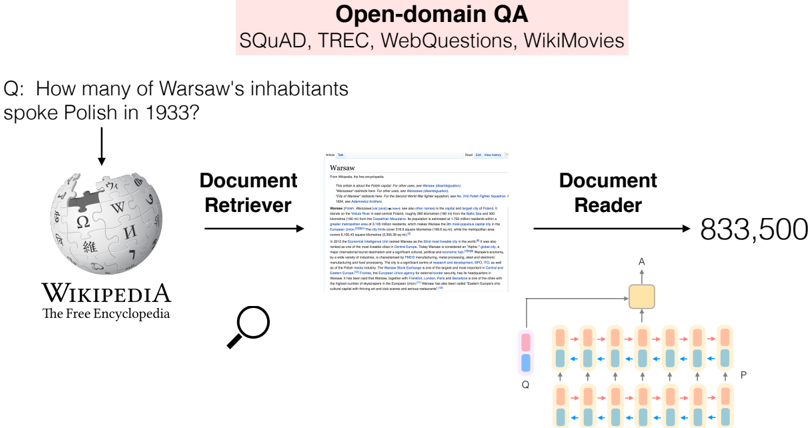
This paper proposes to tackle open-domain question answering using Wikipedia as the unique knowledge source: the answer to any factoid question is a text span in a Wikipedia article. This task of machine reading at scale combines the challenges of document retrieval (finding the relevant articles) with that of machine comprehension of text (identifying the answer spans from those articles). Our approach combines a search component based on bigram hashing and TF-IDF matching with a multi-layer recurrent neural network model trained to detect answers in Wikipedia paragraphs. Our experiments on multiple existing QA datasets indicate that (1) both modules are highly competitive with respect to existing counterparts and (2) multitask learning using distant supervision on their combination is an effective complete system on this challenging task.
Overview
The claims and statistics of this paper haven’t been checked yet.
Free: it reads the open-access text and checks the first 5 claims that cite a source we can check. Create a free account to check every claim.
Integrity signals
Registry
Cites
Statistics
Figures
Verification
Claims the paper makes
The claims and statistics of this paper haven’t been checked yet.
Free: it reads the open-access text and checks the first 5 claims that cite a source we can check. Create a free account to check every claim.
Claims other papers make about this one
Each is checked against this paper’s own text: does it say what the citing paper says it does?
The source backs part of the claim, not all of it — or backs it for a different population, condition or comparison.
In the citing paper
“In particular, the presence of low-value or semantically irrelevant entries dilutes the contribution of high-quality information in retrieval results, impairing downstream task performance and leading to measurable declines in metrics [5].”
From SEDM: Selective Self-Evolving Distributed Memory for Agents (2025) · cites this paper as [5]
Experimental — accuracy not yet measuredThe source backs part of the claim, not all of it — or backs it for a different population, condition or comparison.
In the citing paper
“Prior work has shown that retrieval improves performance across a variety of NLP tasks when considered in isolation.”
From Retrieval-Augmented Generation for Knowledge-Intensive NLP Tasks (2020) · cites this paper as [5]
Experimental — accuracy not yet measuredThe cited source says what the claim attributes to it.
In the citing paper
“This is in agreement with prior work that treated Wikipedia as a general knowledge source under the same reason (Chen et al., 2017; Petroni et al., 2021).”
From FActScore: Fine-grained Atomic Evaluation of Factual Precision in Long Form Text Generation (2023) · cites this paper as Chen et al., 2017
The cited source says what the claim attributes to it.
In the citing paper
“In-context learning methods now routinely invoke tools, leading to LM pipelines that use retrieval models (Chen et al., 2017; Lewis et al., 2020; Guu et al., 2020; Lazaridou et al., 2022; Izacard et al., 2022), multimodal foundation models, and more traditional tools like APIs (Nakano et al., 2021) and calculators.”
From DSPy: Compiling Declarative Language Model Calls into Self-Improving Pipelines (2023) · cites this paper as Chen et al., 2017
Self-check
Percentages, sums and reported differences re-computed from the paper’s own numbers.
The self-check needs the paper’s full text.
Citations
Cites
Adam: A Method for Stochastic Optimization
Kingma, D. P., & Ba, J. (2014) · arXiv · doi:10.48550/arxiv.1412.6980 · Cited by 98,946 · cited 1×
“We use Adamax for optimization as described in (Kingma and Ba, 2014).”
MethodGlove: Global Vectors for Word Representation
Pennington, J., Socher, R., & Manning, C. (2014) · Proceedings of the 2014 Conference on Empirical Methods in Natural Language Processing (EMNLP) · doi:10.3115/v1/d14-1162 · Cited by 34,071 · cited 2×
“The feature vector ˜ p i is comprised of the following parts: We use the 300-dimensional Glove word embeddings trained from 840B Web crawl data (Pennington et al., 2014).”
MethodNeural Machine Translation by Jointly Learning to Align and Translate
Bahdanau, D., Cho, K., & Bengio, Y. (2014) · arXiv · doi:10.48550/arxiv.1409.0473 · Cited by 16,213 · cited 2×
“…has made considerable progress recently thanks to new deep learning architectures like attention-based and memory-1 augmented neural networks (Bahdanau et al., 2015; Weston et al., 2015; Graves et al., 2014) and release of new training and evaluation datasets like QuizBowl (Iyyer et al., 2014),…”
BackgroundThe Stanford CoreNLP Natural Language Processing Toolkit
Manning, C., Surdeanu, M., Bauer, J., Finkel, J., Bethard, S., & McClosky, D. (2014) · Proceedings of 52nd Annual Meeting of the Association for Computational Linguistics: System Demonstrations · doi:10.3115/v1/p14-5010 · Cited by 7,037 · cited 2×
“We apply the Stanford CoreNLP toolkit (Manning et al., 2014) for tokenization and also generating lemma, part-of-speech, and named entity manual features.”
MethodSQuAD: 100,000+ Questions for Machine Comprehension of Text
Rajpurkar, P., Zhang, J., Lopyrev, K., & Liang, P. (2016) · Proceedings of the 2016 Conference on Empirical Methods in Natural Language Processing · doi:10.18653/v1/d16-1264 · Cited by 6,208 · cited 10×
“Next we evaluate our Document Reader component on the standard SQuAD evaluation (Rajpurkar et al., 2016).”
BackgroundMethodInfluentialA unified architecture for natural language processing: deep neural networks with multitask learning
Collobert, R., & Weston, J. (2008) · Proceedings of the 25th international conference on Machine learning - ICML '08 · doi:10.1145/1390156.1390177 · Cited by 5,058 · cited 1×
“Multitask learning (Caruana, 1998) and task transfer have a rich history in machine learning (e.g., using ImageNet in the computer vision community (Huh et al., 2016)), as well as in NLP in particular (Collobert and Weston, 2008).”
MethodSelf-citationFreebase: a collaboratively created graph database for structuring human knowledge
Bollacker, K., Evans, C., Paritosh, P., Sturge, T., & Taylor, J. (2008) · Proceedings of the 2008 ACM SIGMOD international conference on Management of data · doi:10.1145/1376616.1376746 · Cited by 4,852 · cited 11×
“Unlike knowledge bases (KBs) such as Freebase (Bollacker et al., 2008) or DBPedia (Auer et al.”
BackgroundMethodInfluentialDistant supervision for relation extraction without labeled data
Mintz, M., Bills, S., Snow, R., & Jurafsky, D. (2009) · Proceedings of the Joint Conference of the 47th Annual Meeting of the ACL and the 4th International Joint Conference on Natural Language Processing of the AFNLP: Volume 2 - ACL-IJCNLP '09 · doi:10.3115/1690219.1690287 · Cited by 2,752 · cited 1×
“Following previous work on distant supervision (DS) for relation extraction (Mintz et al., 2009), we use a”
MethodTeaching Machines to Read and Comprehend
Hermann, K. M., Kočiský, T., Grefenstette, E., Espeholt, L., Kay, W., Suleyman, M., & Blunsom, P. (2015) · arXiv (Cornell University) · doi:10.48550/arxiv.1506.03340 · Cited by 2,521 · cited 7×
“…Graves et al., 2014) and release of new training and evaluation datasets like QuizBowl (Iyyer et al., 2014), CNN/Daily Mail based on news articles (Hermann et al., 2015), CBT based on children books (Hill et al., 2016), or SQuAD (Rajpurkar et al., 2016) and WikiReading (Hewlett et al., 2016),…”
BackgroundMethodInfluentialDBpedia: A Nucleus for a Web of Open Data
Auer, S., Bizer, C., Kobilarov, G., Lehmann, J., Cyganiak, R., & Ives, Z. (2007) · Lecture Notes in Computer Science · doi:10.1007/978-3-540-76298-0_52 · Cited by 2,454 · cited 3×
“Unlike knowledge bases (KBs) such as Freebase (Bollacker et al., 2008) or DB-Pedia (Auer et al., 2007), which are easier for computers to process but too sparsely populated for open-domain question answering (Miller et al., 2016), Wikipedia contains up-to-date knowledge that humans are interested in.”
Background
Research works printed but not linked: 5
- Petr Baudiˇ s. 2015. YodaQA: a modular question answering system pipeline. In POSTER 2015-19th International Student Conference on Electrical Engineering . pages 1156-1165.
- Eric Brill, Susan Dumais, and Michele Banko. 2002. Ananalysis of the AskMSR question-answering system. In Empirical Methods in Natural Language Processing (EMNLP) . pages 257-264.
- Rudolf Kadlec, Ondrej Bajgar, and Jan Kleindienst. 2016. From particular to general: A preliminary case study of transfer learning in reading comprehension. Machine Intelligence Workshop, NIPS .
- Alexander H. Miller, Adam Fisch, Jesse Dodge, AmirHossein Karimi, Antoine Bordes, and Jason Weston. 2016. Key-value memory networks for directly reading documents. In Empirical Methods in Natural Language Processing (EMNLP) . pages 14001409.
- Jason Weston, Sumit Chopra, and Antoine Bordes. 2015. Memory networks. In International Conference on Learning Representations (ICLR) .
Cited by
Dense Passage Retrieval for Open-Domain Question Answering
Karpukhin, V., Oğuz, B., Min, S., Lewis, P., Wu, L., Edunov, S., Chen, D., & Yih, W.-T. (2020) · arXiv · doi:10.48550/arxiv.2004.04906 · Cited by 5,311
Self-citationDense passage retrieval for open-domain question answering
Karpukhin, V., Oguz, B., Min, S., Lewis, P., Wu, L., Edunov, S., Chen, D., & Yih, W.-T. (2020) · Proceedings of the 2020 Conference on Empirical Methods in Natural Language Processing (EMNLP) · doi:10.18653/v1/2020.emnlp-main.550 · Cited by 3,575
Self-citationRetrieval-Augmented Generation for Knowledge-Intensive NLP Tasks
Lewis, P., Perez, E., Piktus, A., Petroni, F., Karpukhin, V., Goyal, N., Küttler, H., Lewis, M., Yih, W.-T., Rocktäschel, T., et al. (2020) · arXiv · doi:10.48550/arxiv.2005.11401 · Cited by 3,101
“As a demonstration, we build an index using the DrQA Wikipedia dump [5], (dated December 21st, 2016) and compare generations from RAG using this index to the newer index used in our main results (December 20th, 2018).”
BackgroundMethodResultNatural Questions: A benchmark for question answering research
Kwiatkowski, T., Palomaki, J., Redfield, O., Collins, M., Parikh, A., Alberti, C., Epstein, D., Polosukhin, I., Devlin, J., Lee, K., et al. (2019) · Transactions of the Association for Computational Linguistics · doi:10.1162/tacl_a_00276 · Cited by 2,069
“Short answer selection Given a long answer, the Document Reader model (Chen et al., 2017), abbreviated DocReader, is used to extract short answers.”
MethodLanguage Models as Knowledge Bases?
Petroni, F., Rocktäschel, T., Riedel, S., Lewis, P., Bakhtin, A., Wu, Y., & Miller, A. (2019) · Proceedings of the 2019 Conference on Empirical Methods in Natural Language Processing and the 9th International Joint Conference on Natural Language Processing (EMNLP-IJCNLP) · doi:10.18653/v1/d19-1250 · Cited by 1,834
“DrQA: Chen et al. (2017) introduce DrQA, a popular system for open-domain question answering.”
BackgroundHotpotQA: A Dataset for Diverse, Explainable Multi-hop Question Answering
Yang, Z., Qi, P., Zhang, S., Bengio, Y., Cohen, W., Salakhutdinov, R., & Manning, C. D. (2018) · Proceedings of the 2018 Conference on Empirical Methods in Natural Language Processing · doi:10.18653/v1/d18-1259 · Cited by 1,804
“ample we employ bigram tf-idf (Chen et al., 2017) to retrieve 8 paragraphs from Wikipedia as distractors, using the question as the query.”
MethodFEVER: a Large-scale Dataset for Fact Extraction and VERification
Thorne, J., Vlachos, A., Christodoulopoulos, C., & Mittal, A. (2018) · Proceedings of the 2018 Conference of the North American Chapter of the Association for Computational Linguistics: Human Language Technologies, Volume 1 (Long Papers) · doi:10.18653/v1/n18-1074 · Cited by 1,343
“Another related task is question answering (QA), for which approaches have recently been extended to handle large-scale resources such as Wikipedia (Chen et al., 2017).”
BackgroundMethodInfluentialRecent Trends in Deep Learning Based Natural Language Processing
Young, T., Hazarika, D., Poria, S., & Cambria, E. (2017) · arXiv (Cornell University) · doi:10.48550/arxiv.1708.02709 · Cited by 1,192
“More specific use cases include applications such as document classification (Chaturvedi et al., 2016), multi-label text categorization (Chen et al., 2017), multimodal sentiment analysis (Poria et al., 2017; Zadeh et al., 2017; Tong et al., 2017), and subjectivity detection (Chaturvedi et al.,…”
MethodPersonalizing Dialogue Agents: I have a dog, do you have pets too?
Zhang, S., Dinan, E., Urbanek, J., Szlam, A., Kiela, D., & Weston, J. (2018) · Proceedings of the 56th Annual Meeting of the Association for Computational Linguistics (Volume 1: Long Papers) · doi:10.18653/v1/p18-1205 · Cited by 1,177
“This has been a problem in some recent datasets: for example, the dataset curation technique used for the well-known SQuAD dataset suffers from this word overlap problem to a certain extent (Chen et al., 2017).”
MethodSelf-citationQANet: Combining Local Convolution with Global Self-Attention for Reading Comprehension
Yu, A. W., Dohan, D., Luong, M.-T., Zhao, R., Chen, K., Norouzi, M., & Le, Q. V. (2018) · arXiv · doi:10.48550/arxiv.1804.09541 · Cited by 1,118
Leveraging Passage Retrieval with Generative Models for Open Domain Question Answering
Izacard, G., & Grave, E. (2021) · Proceedings of the 16th Conference of the European Chapter of the Association for Computational Linguistics: Main Volume · doi:10.18653/v1/2021.eacl-main.74 · Cited by 1,109
CoQA: A Conversational Question Answering Challenge
Reddy, S., Chen, D., & Manning, C. D. (2019) · Transactions of the Association for Computational Linguistics · doi:10.1162/tacl_a_00266 · Cited by 975
“The state-of-the-art reading comprehension models for extractive question answering focus on finding a span in the passage that matches the question best (Seo et al., 2016; Chen et al., 2017; Yu et al., 2018).”
BackgroundMethodSelf-citationA Survey on RAG Meeting LLMs: Towards Retrieval-Augmented Large Language Models
Fan, W., Ding, Y., Ning, L., Wang, S., Li, H., Yin, D., Chua, T.-S., & Li, Q. (2024) · Proceedings of the 30th ACM SIGKDD Conference on Knowledge Discovery and Data Mining · doi:10.1145/3637528.3671470 · Cited by 827
“In this part, we will briefly review studies with these two types of generators: parameter-accessible (white-box) and parameter-inaccessible (black-box).”
Advances in Pre-Training Distributed Word Representations
Mikolov, T., Grave, É., Bojanowski, P., Puhrsch, C., & Joulin, A. (2018) · Language Resources and Evaluation Conference (LREC) · doi:10.63317/4b3prw5a5tze · Cited by 354
OK-VQA: A Visual Question Answering Benchmark Requiring External Knowledge
Marino, K., Rastegari, M., Farhadi, A., & Mottaghi, R. (2019) · 2019 IEEE/CVF Conference on Computer Vision and Pattern Recognition (CVPR) · doi:10.1109/cvpr.2019.00331 · Cited by 703
Jin, D., Pan, E., Oufattole, N., Weng, W.-H., Fang, H., & Szolovits, P. (2021) · doi:10.20944/preprints202105.0498.v1 · Cited by 718
A Unified MRC Framework for Named Entity Recognition
Li, X., Feng, J., Meng, Y., Han, Q., Wu, F., & Li, J. (2020) · Proceedings of the 58th Annual Meeting of the Association for Computational Linguistics · doi:10.18653/v1/2020.acl-main.519 · Cited by 697
Dice Loss for Data-imbalanced NLP Tasks
Li, X., Sun, X., Meng, Y., Liang, J., Wu, F., & Li, J. (2020) · Proceedings of the 58th Annual Meeting of the Association for Computational Linguistics · doi:10.18653/v1/2020.acl-main.45 · Cited by 646
Can a Suit of Armor Conduct Electricity? A New Dataset for Open Book Question Answering
Mihaylov, T., Clark, P., Khot, T., & Sabharwal, A. (2018) · Proceedings of the 2018 Conference on Empirical Methods in Natural Language Processing · doi:10.18653/v1/d18-1260 · Cited by 649
“For Question Match and ESIM we also experiment with ELMo (Peters et al., 2018) which improved their score on Test with 0.4% and 1.8%.”
BackgroundMethodInfluentialAdversarial NLI: A New Benchmark for Natural Language Understanding
Nie, Y., Williams, A., Dinan, E., Bansal, M., Weston, J., & Kiela, D. (2020) · Proceedings of the 58th Annual Meeting of the Association for Computational Linguistics · doi:10.18653/v1/2020.acl-main.441 · Cited by 656
Self-citationHow Much Knowledge Can You Pack into the Parameters of a Language Model?
Roberts, A., Raffel, C., & Shazeer, N. (2020) · Proceedings of the 2020 Conference on Empirical Methods in Natural Language Processing (EMNLP) · doi:10.18653/v1/2020.emnlp-main.437 · Cited by 638
Nogueira, R., & Cho, K. (2019) · arXiv · doi:10.48550/arxiv.1901.04085 · Cited by 615
“…MS MARCO (Nguyen et al., 2016), SearchQA (Dunn et al., 2017), TriviaQA (Joshi et al., 2017), and QUASAR-T (Dhingra et al., 2017), and the broad adoption of neural models, such as BiDAF (Seo et al., 2016), DrQA (Chen et al., 2017), DocumentQA (Clark & Gardner, 2017), and QAnet (Yu et al., 2018).”
MethodJin, D., Pan, E., Oufattole, N., Weng, W.-H., Fang, H., & Szolovits, P. (2021) · Applied Sciences · doi:10.3390/app11146421 · Cited by 718
Retrieval Augmentation Reduces Hallucination in Conversation
Shuster, K., Poff, S., Chen, M., Kiela, D., & Weston, J. (2021) · Findings of the Association for Computational Linguistics: EMNLP 2021 · doi:10.18653/v1/2021.findings-emnlp.320 · Cited by 575
Self-citationREALM: Retrieval-Augmented Language Model Pre-Training
Guu, K., Lee, K., Tung, Z., Pasupat, P., & Chang, M.-W. (2020) · arXiv · doi:10.48550/arxiv.2002.08909 · Cited by 574
“Numerous prior works have demonstrated the benefit of adding a discrete retrieval step to neural networks (Miller et al., 2016; Chen et al., 2017), but did not apply the framework to language model pre-training and employed nonlearned retrievers to handle large-scale document collections.”
BackgroundMethodInfluentialOpen Domain Question Answering Using Early Fusion of Knowledge Bases and Text
Sun, H., Dhingra, B., Zaheer, M., Mazaitis, K., Salakhutdinov, R., & Cohen, W. (2018) · Proceedings of the 2018 Conference on Empirical Methods in Natural Language Processing · doi:10.18653/v1/d18-1455 · Cited by 716
“These systems assume that the answer-containing passage is known apriori, but there has been progress when this assumption is relaxed (Chen et al., 2017; Raison et al., 2018; Dhingra et al., 2017; Wang et al., 2018, 2017; Watanabe et al., 2017).”
BackgroundMethodInfluentialEnd-to-End Open-Domain Question Answering with
Yang, W., Xie, Y., Lin, A., Li, X., Tan, L., Xiong, K., Li, M., & Lin, J. (2019) · Proceedings of the 2019 Conference of the North · doi:10.18653/v1/n19-4013 · Cited by 391
“The article setting matches the retrieval condition in Chen et al. (2017).”
BackgroundMethodInfluentialIn-Context Retrieval-Augmented Language Models
Ram, O., Levine, Y., Dalmedigos, I., Muhlgay, D., Shashua, A., Leyton-Brown, K., & Shoham, Y. (2023) · Transactions of the Association for Computational Linguistics · doi:10.1162/tacl_a_00605 · Cited by 449
“Retrieval Corpora For WikiText-103 and ODQA datasets, we used the Wikipedia corpus from Dec. 20, 2018, standardized by Karpukhin et al. (2020) using the preprocessing from Chen et al. (2017).”
MethodBERT Post-Training for Review Reading Comprehension and Aspect-based Sentiment Analysis
Xu, H., Liu, B., Shu, L., & Yu, P. S. (2019) · arXiv (Cornell University) · doi:10.48550/arxiv.1904.02232 · Cited by 354
“DrQA is a baseline from the document reader of DrQA (Chen et al., 2017).”
BackgroundSimple and Effective Multi-Paragraph Reading Comprehension
Clark, C., & Gardner, M. (2018) · Proceedings of the 56th Annual Meeting of the Association for Computational Linguistics (Volume 1: Long Papers) · doi:10.18653/v1/p18-1078 · Cited by 396
“Open question answering with neural models was considered by Chen et al. (2017), where researchers trained a model on SQuAD and combined it with a retrieval engine for Wikipedia articles.”
BackgroundMethodResultInfluentialMultilingual Universal Sentence Encoder for Semantic Retrieval
Yang, Y., Cer, D., Ahmad, A., Guo, M., Law, J., Constant, N., Abrego, G. H., Yuan, S., Tar, C., Sung, Y.-H., et al. (2020) · Proceedings of the 58th Annual Meeting of the Association for Computational Linguistics: System Demonstrations · doi:10.18653/v1/2020.acl-demos.12 · Cited by 399
Qu, Y., Ding, Y., Liu, J., Liu, K., Ren, R., Zhao, W. X., Dong, D., Wu, H., & Wang, H. (2021) · Proceedings of the 2021 Conference of the North American Chapter of the Association for Computational Linguistics: Human Language Technologies · doi:10.18653/v1/2021.naacl-main.466 · Cited by 356
PullNet: Open Domain Question Answering with Iterative Retrieval on Knowledge Bases and Text
Sun, H., Bedrax-Weiss, T., & Cohen, W. (2019) · Proceedings of the 2019 Conference on Empirical Methods in Natural Language Processing and the 9th International Joint Conference on Natural Language Processing (EMNLP-IJCNLP) · doi:10.18653/v1/d19-1242 · Cited by 327
“signed which use a “retrieve and read” pipeline (Chen et al., 2017; Dhingra et al., 2017; Joshi et al., 2017; Dunn et al., 2017; Wang et al., 2018, 2017), in which a retrieval system with high recall is piped into a reading comprehension system”
BackgroundMethodApproximate Nearest Neighbor Negative Contrastive Learning for Dense Text Retrieval
Xiong, L., Xiong, C., Li, Y., Tang, K., Liu, J., Bennett, P. N., Ahmed, J., & Overwikj, A. (2021) · International Conference on Learning Representations · Cited by 1,139
R3: Reinforced Ranker-Reader for Open-Domain Question Answering
Wang, S., Yu, M., Guo, X., Wang, Z., Klinger, T., Zhang, W., Chang, S., Tesauro, G., Zhou, B., & Jiang, J. (2018) · Proceedings of the AAAI Conference on Artificial Intelligence · doi:10.1609/aaai.v32i1.12053 · Cited by 351
“Moreover, unlike DrQA, our models are all trained using distant supervision and, without pre-training on the original SQuAD dataset 11 , our Single Reader model still achieves better performance on the WikiMovie and Cu-ratedTREC datasets.”
BackgroundMethodInfluentialClark, J. H., Choi, E., Collins, M., Garrette, D., Kwiatkowski, T., Nikolaev, V., & Palomaki, J. (2020) · Transactions of the Association for Computational Linguistics · doi:10.1162/tacl_a_00317 · Cited by 342
“, 2019) ranging from generating an answer word-by-word (Mitra, 2017) or finding an answer from within an entire corpus as in TREC (Voorhees and Tice, 2000) and DrQA (Chen et al., 2017).”
BackgroundLearning To Retrieve Prompts for In-Context Learning
Rubin, O., Herzig, J., & Berant, J. (2022) · Proceedings of the 2022 Conference of the North American Chapter of the Association for Computational Linguistics: Human Language Technologies · doi:10.18653/v1/2022.naacl-main.191 · Cited by 374
Gupta, S., Ranjan, R., & Singh, S. N. (2024) · arXiv · doi:10.48550/arxiv.2410.12837 · Cited by 342
LinkBERT: Pretraining Language Models with Document Links
Yasunaga, M., Leskovec, J., & Liang, P. (2022) · Proceedings of the 60th Annual Meeting of the Association for Computational Linguistics (Volume 1: Long Papers) · doi:10.18653/v1/2022.acl-long.551 · Cited by 327
ELI5: Long Form Question Answering
Fan, A., Jernite, Y., Perez, E., Grangier, D., Weston, J., & Auli, M. (2019) · arXiv · doi:10.48550/arxiv.1907.09190 · Cited by 325
“Wikipedia has been found effective for factoid-oriented questions (Joshi et al., 2017; Chen et al., 2017).”
MethodSelf-citationParlAI: A Dialog Research Software Platform
Miller, A., Feng, W., Batra, D., Bordes, A., Fisch, A., Lu, J., Parikh, D., & Weston, J. (2017) · Proceedings of the 2017 Conference on Empirical Methods in Natural Language Processing: System Demonstrations · doi:10.18653/v1/d17-2014 · Cited by 315
“However, this also results in a slight drop in performance because less information is given5 (66.4 EM vs. 69.5 EM, see (Chen et al., 2017), which is still in the range of many existing well-performing methods, see https://stanford-qa.com).”
MethodInfluentialSelf-citationELI5: long form question answering
Fan, A., Jernite, Y., Perez, E., Grangier, D., Weston, J., & Auli, M. (2019) · Proceedings of the 57th Annual Meeting of the Association for Computational Linguistics · doi:10.18653/v1/p19-1346 · Cited by 319
“Wikipedia has been found effective for factoid-oriented questions (Joshi et al., 2017; Chen et al., 2017).”
MethodSelf-citationSimple Recurrent Units for Highly Parallelizable Recurrence
Lei, T., Zhang, Y., Wang, S. I., Dai, H., & Artzi, Y. (2018) · Proceedings of the 2018 Conference on Empirical Methods in Natural Language Processing · doi:10.18653/v1/d18-1477 · Cited by 289
“Setup We use the Document Reader model of Chen et al. (2017) as our base architecture for this task.”
BackgroundMethodResultInfluentialBERT Post-Training for Review Reading Comprehension and Aspect-based Sentiment Analysis
Xu, H., Liu, B., Shu, L., & Yu, P. S. (2019) · Conference of the North American Chapter of the Association for Computational Linguistics: Human Language Technologies (NAACL-HLT) · doi:10.18653/v1/n19-1242 · Cited by 642
“DrQA is a baseline from the document reader of DrQA (Chen et al., 2017).”
BackgroundGraph Neural Networks for Natural Language Processing: A Survey
Wu, L., Chen, Y., Shen, K., Guo, X., Gao, H., Li, S., Pei, J., & Long, B. (2023) · Foundations and Trends in Machine Learning · doi:10.1561/2200000096 · Cited by 278
Query Rewriting in Retrieval-Augmented Large Language Models
Ma, X., Gong, Y., He, P., Zhao, H., & Duan, N. (2023) · Proceedings of the 2023 Conference on Empirical Methods in Natural Language Processing · doi:10.18653/v1/2023.emnlp-main.322 · Cited by 263
TVR: A Large-Scale Dataset for Video-Subtitle Moment Retrieval
Lei, J., Yu, L., Berg, T. L., & Bansal, M. (2020) · Lecture Notes in Computer Science · doi:10.1007/978-3-030-58589-1_27 · Cited by 255
ReasoNet: Learning to Stop Reading in Machine Comprehension
Shen, Y., Huang, P.-S., Gao, J., & Chen, W. (2017) · Proceedings of the 23rd ACM SIGKDD International Conference on Knowledge Discovery and Data Mining · doi:10.1145/3097983.3098177 · Cited by 262
“…Matching [28] 68 Iterative Co-attention Network α 67.5 76.8 - - FastQA [30] 68.4 77.1 70.8 78.9 jNet [36] 68.7 77.4 - - Document Reader [4] 69.9 78.9 - - R-Net [27] 71.3 79.7 75.9 82.9 Vocab Size : We use the python NLTK tokenizer 6 to preprocess passages and questions, and obtain…”
InfluentialPathologies of Neural Models Make Interpretations Difficult
Feng, S., Wallace, E., Grissom II, A., Iyyer, M., Rodriguez, P., & Boyd-Graber, J. (2018) · Proceedings of the 2018 Conference on Empirical Methods in Natural Language Processing · doi:10.18653/v1/d18-1407 · Cited by 245
Constructing A Multi-hop QA Dataset for Comprehensive Evaluation of Reasoning Steps
Ho, X., Duong Nguyen, A.-K., Sugawara, S., & Aizawa, A. (2020) · Proceedings of the 28th International Conference on Computational Linguistics · doi:10.18653/v1/2020.coling-main.580 · Cited by 287
“(2019), we used bigram tf-idf (Chen et al., 2017) to retrieve the top-50 paragraphs from Wikipedia that are most similar to the question.”
MethodMulti-passage BERT: A Globally Normalized BERT Model for Open-domain Question Answering
Wang, Z., Ng, P., Ma, X., Nallapati, R., & Xiang, B. (2019) · Proceedings of the 2019 Conference on Empirical Methods in Natural Language Processing and the 9th International Joint Conference on Natural Language Processing (EMNLP-IJCNLP) · doi:10.18653/v1/d19-1599 · Cited by 116
“Effect of passage granularity : Previous work usually defines passages as articles (Chen et al., 2017), paragraphs (Yang et al., 2019), or sentences (Wang et al., 2018a; Lin et al., 2018).”
BackgroundNatural Language Inference over Interaction Space
Gong, Y., Luo, H., & Zhang, J. (2017) · arXiv (Cornell University) · doi:10.48550/arxiv.1709.04348 · Cited by 208
“The exact match feature is simple while found extremely useful in reading comprehension task (Chen et al., 2017a).”
BackgroundCognitive Graph for Multi-Hop Reading Comprehension at Scale
Ding, M., Zhou, C., Chen, Q., Yang, H., & Tang, J. (2019) · Proceedings of the 57th Annual Meeting of the Association for Computational Linguistics · doi:10.18653/v1/p19-1259 · Cited by 222
“It follows the retrieval-extraction framework of DrQA (2017) and subsumes the advanced techniques in QA, such as self-attention, character-level model, bi-attention.”
BackgroundInfluentialBERT with History Answer Embedding for Conversational Question Answering
Qu, C., Yang, L., Qiu, M., Croft, W. B., Zhang, Y., & Iyyer, M. (2019) · Proceedings of the 42nd International ACM SIGIR Conference on Research and Development in Information Retrieval · doi:10.1145/3331184.3331341 · Cited by 155
“he best performance of PH(Q)A occurs at considering only 1 or 2 history turns. This is consistent with the results by Reddy et al. [13], who use the same history modeling approach on Seq2Seq and DrQA [2]. The low performance when prepending a large amount of history suggests that a BERT-based ConvQA model is especiall…”
BackgroundResultAutoregressive Entity Retrieval
Cao, N. D., Izacard, G., Riedel, S., & Petroni, F. (2020) · arXiv (Cornell University) · doi:10.48550/arxiv.2010.00904 · Cited by 193
“…chat-bots and question answering systems, that are often equipped with retrieval components to surface specific KB entries (e.g., Wikipedia articles) to find knowledge for sustaining a conversation or answering a question (Ferrucci, 2012; Chen et al., 2017; Lewis et al., 2020; Roller et al., 2020).”
BackgroundMRQA 2019 Shared Task: Evaluating Generalization in Reading Comprehension
Fisch, A., Talmor, A., Jia, R., Seo, M., Choi, E., & Chen, D. (2019) · Proceedings of the 2nd Workshop on Machine Reading for Question Answering · doi:10.18653/v1/d19-5801 · Cited by 215
“It remains challenging to build MRQA systems that generalize to new test distributions (Chen et al., 2017; Levy et al., 2017; Yogatama et al., 2019) and are robust to test-time perturbations (Jia and Liang, 2017; Ribeiro et al., 2018).”
BackgroundMethodSelf-citationNeural Approaches to Conversational AI
Gao, J., Galley, M., & Li, L. (2019) · Foundations and Trends® in Information Retrieval · doi:10.1561/1500000074 · Cited by 209
Advantages and constraints of a hybrid model K–12 e-learning assistant chatbot
Wu, E. H.-K., Lin, C.-H., Ou, Y.-Y., Liu, C.-Z., Wang, W.-K., & Chao, C.-Y. (2020) · IEEE Access · doi:10.1109/access.2020.2988252 · Cited by 205
HybridQA: A Dataset of Multi-Hop Question Answering over Tabular and Textual Data
Chen, W., Zha, H., Chen, Z., Xiong, W., Wang, H., & Wang, W. Y. (2020) · Findings of the Association for Computational Linguistics: EMNLP 2020 · doi:10.18653/v1/2020.findings-emnlp.91 · Cited by 201
Approximate Nearest Neighbor Negative Contrastive Learning for Dense Text Retrieval
Xiong, L., Xiong, C., Li, Y., Tang, K.-F., Liu, J., Bennett, P., Ahmed, J., & Overwijk, A. (2020) · arXiv · doi:10.48550/arxiv.2007.00808 · Cited by 204
Stochastic Answer Networks for Machine Reading Comprehension
Liu, X., Shen, Y., Duh, K., & Gao, J. (2018) · Proceedings of the 56th Annual Meeting of the Association for Computational Linguistics (Volume 1: Long Papers) · doi:10.18653/v1/p18-1157 · Cited by 197
“It is simple yet efficient and can be trained using the classical back-propagation algorithm, thus it is adopted by most of systems (Chen et al., 2016; Seo et al., 2016; Wang et al., 2017; Liu et al., 2017; Chen et al., 2017; Weissenborn et al., 2017; Hu et al., 2017).”
BackgroundMethodKRISP: Integrating Implicit and Symbolic Knowledge for Open-Domain Knowledge-Based VQA
Marino, K., Chen, X., Parikh, D., Gupta, A., & Rohrbach, M. (2021) · 2021 IEEE/CVF Conference on Computer Vision and Pattern Recognition (CVPR) · doi:10.1109/cvpr46437.2021.01389 · Cited by 185
“In the NLP literature, there has been much work in question answering from knowledge sources [9, 81, 11] including for open-domain question answering [12, 75, 80, 79], and including mixed symbolic/implicit methods for question answering [48, 32].”
BackgroundGEAR: Graph-based Evidence Aggregating and Reasoning for Fact Verification
Zhou, J., Han, X., Yang, C., Liu, Z., Wang, L., Li, C., & Sun, M. (2019) · Proceedings of the 57th Annual Meeting of the Association for Computational Linguistics · doi:10.18653/v1/p19-1085 · Cited by 194
“…to train complicated neural models which have achieved the state-of-the-art results (Bowman et al., 2015; Parikh et al., 2016; Sha et al., 2016; Chen et al., 2017b,c; Munkhdalai and Yu, 2017; Nie and Bansal, 2017; Conneau et al., 2017; Gong et al., 2018; Tay et al., 2018; Ghaeini et al., 2018).”
BackgroundInfluentialReinforced Mnemonic Reader for Machine Reading Comprehension
Hu, M., Peng, Y., Huang, Z., Qiu, X., Wei, F., & Zhou, M. (2018) · Proceedings of the Twenty-Seventh International Joint Conference on Artificial Intelligence · doi:10.24963/ijcai.2018/570 · Cited by 199
“In addition, we use binary feature of exact match, POS embedding and NER embedding for both question and context, as suggested in [Chen et al., 2017].”
MethodMulti-hop Reading Comprehension through Question Decomposition and Rescoring
Min, S., Zhong, V., Zettlemoyer, L., & Hajishirzi, H. (2019) · Proceedings of the 57th Annual Meeting of the Association for Computational Linguistics · doi:10.18653/v1/p19-1613 · Cited by 197
“Distractor setting contains the question and a collection of 10 paragraphs: 2 paragraphs are provided to crowd workers to write a multi-hop question, and 8 distractor paragraphs are collected separately via TF-IDF between the question and the paragraph. on TF-IDF similarity between the question and the paragraph, usin…”
MethodInfluentialAmbigQA: Answering Ambiguous Open-domain Questions
Min, S., Michael, J., Hajishirzi, H., & Zettlemoyer, L. (2020) · Proceedings of the 2020 Conference on Empirical Methods in Natural Language Processing (EMNLP) · doi:10.18653/v1/2020.emnlp-main.466 · Cited by 87
StarSpace: Embed All The Things!
Wu, L., Fisch, A., Chopra, S., Adams, K., Bordes, A., & Weston, J. (2018) · Proceedings of the AAAI Conference on Artificial Intelligence · doi:10.1609/aaai.v32i1.11996 · Cited by 187
Self-citationInternet-Augmented Dialogue Generation
Komeili, M., Shuster, K., & Weston, J. (2022) · Proceedings of the 60th Annual Meeting of the Association for Computational Linguistics (Volume 1: Long Papers) · doi:10.18653/v1/2022.acl-long.579 · Cited by 192
Self-citationemrQA: A Large Corpus for Question Answering on Electronic Medical Records
Pampari, A., Raghavan, P., Liang, J., & Peng, J. (2018) · Proceedings of the 2018 Conference on Empirical Methods in Natural Language Processing · doi:10.18653/v1/d18-1258 · Cited by 191
“Machine Comprehension : To do extractive QA on EMRs, we use DrQA’s (Chen et al., 2017) document reader which is a multi-layer RNN based MC model.”
MethodGraph-Based Reasoning over Heterogeneous External Knowledge for Commonsense Question Answering
Lv, S., Guo, D., Xu, J., Tang, D., Duan, N., Gong, M., Shou, L., Jiang, D., Cao, G., & Hu, S. (2020) · Proceedings of the AAAI Conference on Artificial Intelligence · doi:10.1609/aaai.v34i05.6364 · Cited by 183
Beyond Goldfish Memory: Long-Term Open-Domain Conversation
Xu, J., Szlam, A., & Weston, J. (2022) · Proceedings of the 60th Annual Meeting of the Association for Computational Linguistics (Volume 1: Long Papers) · doi:10.18653/v1/2022.acl-long.356 · Cited by 188
Self-citationTANDA: Transfer and Adapt Pre-Trained Transformer Models for Answer Sentence Selection
Garg, S., Vu, T., & Moschitti, A. (2020) · Proceedings of the AAAI Conference on Artificial Intelligence · doi:10.1609/aaai.v34i05.6282 · Cited by 177
Jiang, Z., Araki, J., Ding, H., & Neubig, G. (2021) · Transactions of the Association for Computational Linguistics · doi:10.1162/tacl_a_00407 · Cited by 177
“We follow (Petroni et al., 2020a) to retrieve the most relevant Wikipedia article using TF-IDF-based retrieval systems used in DrQA (Chen et al., 2017) and append the first paragraph of the article to the input.”
MethodSurvey on reinforcement learning for language processing
Uc-Cetina, V., Navarro-Guerrero, N., Martin-Gonzalez, A., Weber, C., & Wermter, S. (2023) · Artificial Intelligence Review · doi:10.1007/s10462-022-10205-5 · Cited by 177
“Pretrained information retrieval systems can be integrated with RL agents [13] to improve the quality of the queries.”
BackgroundSUMBT: Slot-Utterance Matching for Universal and Scalable Belief Tracking
Lee, H., Lee, J., & Kim, T.-Y. (2019) · Proceedings of the 57th Annual Meeting of the Association for Computational Linguistics · doi:10.18653/v1/p19-1546 · Cited by 172
“Inspired by machine reading comprehension techniques (Chen et al., 2017; Seo et al., 2017), SUMBT considers a domain-slot-”
MethodHierarchical Graph Network for Multi-hop Question Answering
Fang, Y., Sun, S., Gan, Z., Pillai, R., Wang, S., & Liu, J. (2020) · Proceedings of the 2020 Conference on Empirical Methods in Natural Language Processing (EMNLP) · doi:10.18653/v1/2020.emnlp-main.710 · Cited by 176
Knowledge Graph Prompting for Multi-Document Question Answering
Wang, Y., Lipka, N., Rossi, R. A., Siu, A., Zhang, R., & Derr, T. (2024) · Proceedings of the AAAI Conference on Artificial Intelligence · doi:10.1609/aaai.v38i17.29889 · Cited by 164
Knowledge Graph Prompting for Multi-Document Question Answering
Wang, Y., Lipka, N., Rossi, R. A., Siu, A., Zhang, R., & Derr, T. (2023) · arXiv · doi:10.48550/arxiv.2308.11730 · Cited by 170
Harvesting Paragraph-level Question-Answer Pairs from Wikipedia
Du, X., & Cardie, C. (2018) · Proceedings of the 56th Annual Meeting of the Association for Computational Linguistics (Volume 1: Long Papers) · doi:10.18653/v1/p18-1177 · Cited by 168
“The question-answer pairs were generated by annotators from a paragraph; and although the dataset is typically used to evaluate reading comprehension, it has also been used in an open domain QA setting (Chen et al., 2017; Wang et al., 2018).”
MethodDialog State Tracking: A Neural Reading Comprehension Approach
Gao, S., Sethi, A., Agarwal, S., Chung, T., & Hakkani-Tur, D. (2019) · Proceedings of the 20th Annual SIGdial Meeting on Discourse and Dialogue · doi:10.18653/v1/w19-5932 · Cited by 164
“We use a simple attention-based neural network model to find answer spans by directly pointing to the to-kens within the dialog, which is similar to Chen et al. (2017).”
BackgroundMethodInfluentialPersonalizing Dialogue Agents: I have a dog, do you have pets too?
Zhang, S., Dinan, E., Urbanek, J., Szlam, A., Kiela, D., & Weston, J. (2018) · arXiv · doi:10.48550/arxiv.1801.07243 · Cited by 165
“This has been a problem in some recent datasets: for example, the dataset curation technique used for the well-known SQuAD dataset suffers from this word overlap problem to a certain extent (Chen et al., 2017).”
MethodSelf-citationMaking Neural QA as Simple as Possible but not Simpler
Weissenborn, D., Wiese, G., & Seiffe, L. (2017) · Proceedings of the 21st Conference on Computational Natural Language Learning (CoNLL 2017) · doi:10.18653/v1/k17-1028 · Cited by 164
“In parallel to this work Chen et al. (2017) introduced a very similar model to FastQA, which relies on a few more hand-crafted features and a 3-layer encoder instead of a single layer in this work.”
MethodQA Dataset Explosion: A Taxonomy of NLP Resources for Question Answering and Reading Comprehension
Rogers, A., Gardner, M., & Augenstein, I. (2023) · ACM Computing Surveys · doi:10.1145/3560260 · Cited by 156
“It is however possible to achieve search-engine-like behavior even without unanswerable questions [45, 52].”
BackgroundNeural Machine Reading Comprehension: Methods and Trends
Liu, S., Zhang, X., Zhang, S., Wang, H., & Zhang, W. (2019) · Applied Sciences · doi:10.3390/app9183698 · Cited by 158
How Context Affects Language Models' Factual Predictions
Petroni, F., Lewis, P., Piktus, A., Rocktäschel, T., Wu, Y., Miller, A. H., & Riedel, S. (2020) · arXiv · doi:10.48550/arxiv.2005.04611 · Cited by 154
“2 Baselines We consider DrQA [Chen et al., 2017], a popular system for open-domain question answering.”
BackgroundMethodInfluentialOpen-Retrieval Conversational Question Answering
Qu, C., Yang, L., Chen, C., Qiu, M., Croft, W. B., & Iyyer, M. (2020) · Proceedings of the 43rd International ACM SIGIR Conference on Research and Development in Information Retrieval · doi:10.1145/3397271.3401110 · Cited by 84
“Previous works [4, 11, 26] present a distantly-supervised setting, where they only have access to QA pairs without gold passages.”
BackgroundMethodInfluentialEfficient and Robust Question Answering from Minimal Context over Documents
Min, S., Zhong, V., Socher, R., & Xiong, C. (2018) · Proceedings of the 56th Annual Meeting of the Association for Computational Linguistics (Volume 1: Long Papers) · doi:10.18653/v1/p18-1160 · Cited by 145
“For SQuAD-Open, they are DrQA (Chen et al., 2017) (Multitask), R3 (Wang et al.”
BackgroundMethodResultInfluentialBeyond Goldfish Memory: Long-Term Open-Domain Conversation
Xu, J., Szlam, A., & Weston, J. (2021) · arXiv · doi:10.48550/arxiv.2107.07567 · Cited by 148
“…methods consider ways to select the pertinent parts of the context to keep in the considered set of tokens (Dinan et al., 2019; Lewis et al., 2020b; Shuster et al., 2021) which can be linked to earlier methods in memory networks (Weston et al., 2014) and neural QA (Chen et al., 2017).”
BackgroundMethodSelf-citationRetrieving and Reading: A Comprehensive Survey on Open-domain Question Answering
Zhu, F., Lei, W., Wang, C., Zheng, J., Poria, S., & Chua, T. (2021) · arXiv (Cornell University) · doi:10.48550/arxiv.2101.00774 · Cited by 143
“DrQA [3] is the very first approach to modern OpenQA systems and developed by combining classical IR techniques and neural MRC models to answer open-domain factoid questions.”
BackgroundMethodInfluentialPAQ: 65 Million Probably-Asked Questions and What You Can Do With Them
Lewis, P., Wu, Y., Liu, L., Minervini, P., Küttler, H., Piktus, A., Stenetorp, P., & Riedel, S. (2021) · Transactions of the Association for Computational Linguistics · doi:10.1162/tacl_a_00415 · Cited by 146
“They typically index the whole corpus, and then retrieve-and-read documents in order to answer questions on-the-fly (Chen et al., 2017; Lee et al., 2019a, inter alia).”
BackgroundGeneration-Augmented Retrieval for Open-Domain Question Answering
Mao, Y., He, P., Liu, X., Shen, Y., Gao, J., Han, J., & Chen, W. (2021) · Proceedings of the 59th Annual Meeting of the Association for Computational Linguistics and the 11th International Joint Conference on Natural Language Processing (Volume 1: Long Papers) · doi:10.18653/v1/2021.acl-long.316 · Cited by 146
“Early opendomain QA methods (Chen et al., 2017) use sparse representations for retrieval, while more recent methods (Guu et al.”
MethodInfluentialDenoising Distantly Supervised Open-Domain Question Answering
Lin, Y., Ji, H., Liu, Z., & Sun, M. (2018) · Proceedings of the 56th Annual Meeting of the Association for Computational Linguistics (Volume 1: Long Papers) · doi:10.18653/v1/p18-1161 · Cited by 56
“For other parameters, since they have little effect on the re-sults, we simply follow the settings used in (Chen et al., 2017).”
BackgroundMethodInfluentialA Discrete Hard EM Approach for Weakly Supervised Question Answering
Min, S., Chen, D., Hajishirzi, H., & Zettlemoyer, L. (2019) · Proceedings of the 2019 Conference on Empirical Methods in Natural Language Processing and the 9th International Joint Conference on Natural Language Processing (EMNLP-IJCNLP) · doi:10.18653/v1/d19-1284 · Cited by 141
“Following Clark and Gardner (2018), we filter a subset of segments in T RIVIA QA through TF-IDF similarity between a segment and a question to maintain a reasonable length.”
MethodSelf-citationRARR: Researching and revising what language models say, using language models
Gao, L., Dai, Z., Pasupat, P., Chen, A., Chaganty, A. T., Fan, Y., Zhao, V., Lao, N., Lee, H., Juan, D.-C., et al. (2023) · Proceedings of the 61st Annual Meeting of the Association for Computational Linguistics (Volume 1: Long Papers) · doi:10.18653/v1/2023.acl-long.910 · Cited by 141
“Retrieval-augmented models RAMs have proven to be effective for a wide range of tasks such as question answering (Chen et al., 2017; Lee et al., 2019; Nakano et al., 2021), machine translation (Zhang et al., 2018), code generation (Hayati et al., 2018), language modeling (Khandelwal et al., 2020),…”
BackgroundReal-Time Open-Domain Question Answering with Dense-Sparse Phrase Index
Seo, M., Lee, J., Kwiatkowski, T., Parikh, A., Farhadi, A., & Hajishirzi, H. (2019) · Proceedings of the 57th Annual Meeting of the Association for Computational Linguistics · doi:10.18653/v1/p19-1436 · Cited by 141
“The baselines include DrQA (Chen et al., 2017), MINIMAL (Min et al.”
BackgroundMethodInfluentialJEC-QA: A Legal-Domain Question Answering Dataset
Zhong, H., Xiao, C., Tu, C., Zhang, T., Liu, Z., & Sun, M. (2020) · Proceedings of the AAAI Conference on Artificial Intelligence · doi:10.1609/aaai.v34i05.6519 · Cited by 129
Compositional Questions Do Not Necessitate Multi-hop Reasoning
Min, S., Wallace, E., Singh, S., Gardner, M., Hajishirzi, H., & Zettlemoyer, L. (2019) · Proceedings of the 57th Annual Meeting of the Association for Computational Linguistics · doi:10.18653/v1/p19-1416 · Cited by 138
“We follow Chen et al. (2017) and retrieve paragraphs using bigram TF-IDF similarity with the question.”
MethodImproving Question Answering over Incomplete KBs with Knowledge-Aware Reader
Xiong, W., Yu, M., Chang, S., Guo, X., & Wang, W. Y. (2019) · Proceedings of the 57th Annual Meeting of the Association for Computational Linguistics · doi:10.18653/v1/p19-1417 · Cited by 126
“On the other hand, the vast amount of unstructured text on the Internet can easily cover a wide range of evolving knowledge, which is commonly used for open-domain question answering (Chen et al., 2017; Wang et al., 2018).”
BackgroundMethodRodríguez-Opazo, C., Marrese-Taylor, E., Saleh, F. S., Li, H., & Gould, S. J. (2020) · IEEE Winter Conference on Applications of Computer Vision · doi:10.1109/wacv45572.2020.9093328 · Cited by 187
“Recent works on temporal action localization with natu-ral language [16] has adopted an approach akin to Machine Reading Comprehension (MC) [6], but in a multi-modal setting.”
Multi-Modal Answer Validation for Knowledge-Based VQA
Wu, J., Lu, J., Sabharwal, A., & Mottaghi, R. (2022) · Proceedings of the AAAI Conference on Artificial Intelligence · doi:10.1609/aaai.v36i3.20174 · Cited by 128
Metadata
- Authors
- Chen, D., Fisch, A., Weston, J., & Bordes, A.
- Affiliations
- Meta (United States) (US)
- ORCID
- Chen, Danqi
- Venue
- Proceedings of the 55th Annual Meeting of the Association for Computational Linguistics (Volume 1: Long Papers)
- Published
- 2017
- Pages
- 1870-1879
- ISSN
- 0736-587X (ISSN-L)
- OpenAlex
- W2962985038
- Cited by
- 1,546
- References
- 39
- Citations by year
- 2026: 61 · 2025: 105 · 2024: 123 · 2023: 218 · 2022: 209 · 2021: 268 · 2020: 202 · 2019: 199 · 2018: 142 · 2017: 18
- FWCI
- 69.97
- Type
- conference paper
- Language
- en
- Open access
- hybrid
- doi.org
- Licence
- cc-by
- Locations
- Proceedings of the conference - Association for Computational Linguistics. Meeting (publishedVersion, cc-by)
- arXiv (Cornell University) (submittedVersion)
- arXiv (Cornell University)
- Topics
- Physical Sciences › Computer Science › Artificial Intelligence › Topic Modeling
- Physical Sciences › Computer Science › Information Systems › Information Retrieval and Search Behavior
- Physical Sciences › Computer Science › Artificial Intelligence › Natural Language Processing Techniques
- Keywords
- open-domain question answering, Wikipedia, machine reading, document retrieval, recurrent neural networks, multi-task learning, distant supervision, factoid questions
About these checks
Registry, retraction, Cites and statistics results are computed, not judged, with one exception: a printed reference that no index lists is read once by a model before it counts as a citation error. Claims are extracted by a model and kept only when their quote appears verbatim in the text; each cited source is then checked, with a model’s help, for whether it says what the claim relies on. Those verdicts can be wrong — read the claim’s quote and the cited source before relying on one.
Statistics and arithmetic are recomputed, not judged.
Confidence bands are shown only for fields calibrated on our annotated test set. None is calibrated yet, so no band is shown.
What counts as a claim ›How we measure confidence ›How we check this ›
Are you an author, or do you see a problem with this page? Request a review
Data sources
Bibliographic data: Semantic Scholar, OpenAlex, Crossref.
Contains information from the Semantic Scholar Academic Graph Datasets, made available under the ODC Attribution License (ODC-BY 1.0).
Semantic Scholar’s data is described in: Kinney, R., et al. (2023). The Semantic Scholar Open Data Platform. arXiv:2301.10140.
