

Reading Wikipedia to Answer Open-Domain Questions
Open accessThe DOI matches its Crossref record; 34 of the 39 references it cites were found in a registry or an index.
Abstract
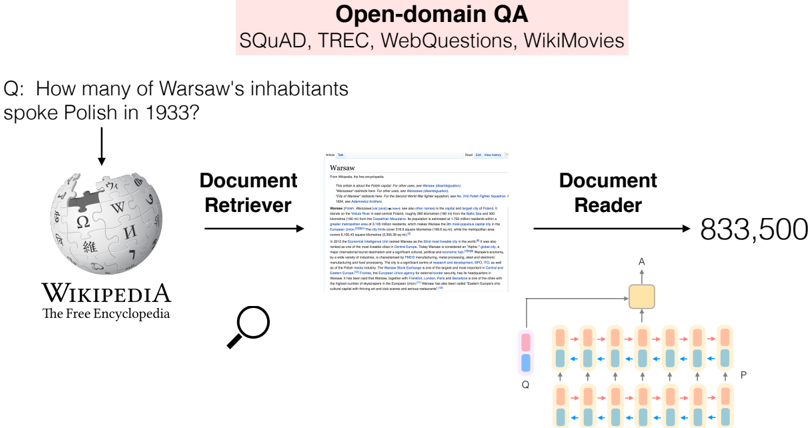
This paper proposes to tackle open-domain question answering using Wikipedia as the unique knowledge source: the answer to any factoid question is a text span in a Wikipedia article. This task of machine reading at scale combines the challenges of document retrieval (finding the relevant articles) with that of machine comprehension of text (identifying the answer spans from those articles). Our approach combines a search component based on bigram hashing and TF-IDF matching with a multi-layer recurrent neural network model trained to detect answers in Wikipedia paragraphs. Our experiments on multiple existing QA datasets indicate that (1) both modules are highly competitive with respect to existing counterparts and (2) multitask learning using distant supervision on their combination is an effective complete system on this challenging task.
Overview
The claims and statistics of this paper haven’t been checked yet.
Free: it reads the open-access text and checks the first 5 claims that cite a source we can check. Create a free account to check every claim.
Integrity signals
Registry
Cites
Statistics
Figures
Verification
Claims the paper makes
The claims and statistics of this paper haven’t been checked yet.
Free: it reads the open-access text and checks the first 5 claims that cite a source we can check. Create a free account to check every claim.
Claims other papers make about this one
Each is checked against this paper’s own text: does it say what the citing paper says it does?
The source backs part of the claim, not all of it — or backs it for a different population, condition or comparison.
In the citing paper
“In particular, the presence of low-value or semantically irrelevant entries dilutes the contribution of high-quality information in retrieval results, impairing downstream task performance and leading to measurable declines in metrics [5].”
From SEDM: Selective Self-Evolving Distributed Memory for Agents (2025) · cites this paper as [5]
Experimental — accuracy not yet measuredThe source backs part of the claim, not all of it — or backs it for a different population, condition or comparison.
In the citing paper
“Prior work has shown that retrieval improves performance across a variety of NLP tasks when considered in isolation.”
From Retrieval-Augmented Generation for Knowledge-Intensive NLP Tasks (2020) · cites this paper as [5]
Experimental — accuracy not yet measuredThe cited source says what the claim attributes to it.
In the citing paper
“This is in agreement with prior work that treated Wikipedia as a general knowledge source under the same reason (Chen et al., 2017; Petroni et al., 2021).”
From FActScore: Fine-grained Atomic Evaluation of Factual Precision in Long Form Text Generation (2023) · cites this paper as Chen et al., 2017
The cited source says what the claim attributes to it.
In the citing paper
“In-context learning methods now routinely invoke tools, leading to LM pipelines that use retrieval models (Chen et al., 2017; Lewis et al., 2020; Guu et al., 2020; Lazaridou et al., 2022; Izacard et al., 2022), multimodal foundation models, and more traditional tools like APIs (Nakano et al., 2021) and calculators.”
From DSPy: Compiling Declarative Language Model Calls into Self-Improving Pipelines (2023) · cites this paper as Chen et al., 2017
Self-check
Percentages, sums and reported differences re-computed from the paper’s own numbers.
The self-check needs the paper’s full text.
Citations
Cites
Adam: A Method for Stochastic Optimization
Kingma, D. P., & Ba, J. (2014) · arXiv · doi:10.48550/arxiv.1412.6980 · Cited by 98,946 · cited 1×
“We use Adamax for optimization as described in (Kingma and Ba, 2014).”
MethodGlove: Global Vectors for Word Representation
Pennington, J., Socher, R., & Manning, C. (2014) · Proceedings of the 2014 Conference on Empirical Methods in Natural Language Processing (EMNLP) · doi:10.3115/v1/d14-1162 · Cited by 34,071 · cited 2×
“The feature vector ˜ p i is comprised of the following parts: We use the 300-dimensional Glove word embeddings trained from 840B Web crawl data (Pennington et al., 2014).”
MethodNeural Machine Translation by Jointly Learning to Align and Translate
Bahdanau, D., Cho, K., & Bengio, Y. (2014) · arXiv · doi:10.48550/arxiv.1409.0473 · Cited by 16,213 · cited 2×
“…has made considerable progress recently thanks to new deep learning architectures like attention-based and memory-1 augmented neural networks (Bahdanau et al., 2015; Weston et al., 2015; Graves et al., 2014) and release of new training and evaluation datasets like QuizBowl (Iyyer et al., 2014),…”
BackgroundThe Stanford CoreNLP Natural Language Processing Toolkit
Manning, C., Surdeanu, M., Bauer, J., Finkel, J., Bethard, S., & McClosky, D. (2014) · Proceedings of 52nd Annual Meeting of the Association for Computational Linguistics: System Demonstrations · doi:10.3115/v1/p14-5010 · Cited by 7,037 · cited 2×
“We apply the Stanford CoreNLP toolkit (Manning et al., 2014) for tokenization and also generating lemma, part-of-speech, and named entity manual features.”
MethodSQuAD: 100,000+ Questions for Machine Comprehension of Text
Rajpurkar, P., Zhang, J., Lopyrev, K., & Liang, P. (2016) · Proceedings of the 2016 Conference on Empirical Methods in Natural Language Processing · doi:10.18653/v1/d16-1264 · Cited by 6,208 · cited 10×
“Next we evaluate our Document Reader component on the standard SQuAD evaluation (Rajpurkar et al., 2016).”
BackgroundMethodInfluentialA unified architecture for natural language processing: deep neural networks with multitask learning
Collobert, R., & Weston, J. (2008) · Proceedings of the 25th international conference on Machine learning - ICML '08 · doi:10.1145/1390156.1390177 · Cited by 5,058 · cited 1×
“Multitask learning (Caruana, 1998) and task transfer have a rich history in machine learning (e.g., using ImageNet in the computer vision community (Huh et al., 2016)), as well as in NLP in particular (Collobert and Weston, 2008).”
MethodSelf-citationFreebase: a collaboratively created graph database for structuring human knowledge
Bollacker, K., Evans, C., Paritosh, P., Sturge, T., & Taylor, J. (2008) · Proceedings of the 2008 ACM SIGMOD international conference on Management of data · doi:10.1145/1376616.1376746 · Cited by 4,852 · cited 11×
“Unlike knowledge bases (KBs) such as Freebase (Bollacker et al., 2008) or DBPedia (Auer et al.”
BackgroundMethodInfluentialDistant supervision for relation extraction without labeled data
Mintz, M., Bills, S., Snow, R., & Jurafsky, D. (2009) · Proceedings of the Joint Conference of the 47th Annual Meeting of the ACL and the 4th International Joint Conference on Natural Language Processing of the AFNLP: Volume 2 - ACL-IJCNLP '09 · doi:10.3115/1690219.1690287 · Cited by 2,752 · cited 1×
“Following previous work on distant supervision (DS) for relation extraction (Mintz et al., 2009), we use a”
MethodTeaching Machines to Read and Comprehend
Hermann, K. M., Kočiský, T., Grefenstette, E., Espeholt, L., Kay, W., Suleyman, M., & Blunsom, P. (2015) · arXiv (Cornell University) · doi:10.48550/arxiv.1506.03340 · Cited by 2,521 · cited 7×
“…Graves et al., 2014) and release of new training and evaluation datasets like QuizBowl (Iyyer et al., 2014), CNN/Daily Mail based on news articles (Hermann et al., 2015), CBT based on children books (Hill et al., 2016), or SQuAD (Rajpurkar et al., 2016) and WikiReading (Hewlett et al., 2016),…”
BackgroundMethodInfluentialDBpedia: A Nucleus for a Web of Open Data
Auer, S., Bizer, C., Kobilarov, G., Lehmann, J., Cyganiak, R., & Ives, Z. (2007) · Lecture Notes in Computer Science · doi:10.1007/978-3-540-76298-0_52 · Cited by 2,454 · cited 3×
“Unlike knowledge bases (KBs) such as Freebase (Bollacker et al., 2008) or DB-Pedia (Auer et al., 2007), which are easier for computers to process but too sparsely populated for open-domain question answering (Miller et al., 2016), Wikipedia contains up-to-date knowledge that humans are interested in.”
Background
Research works printed but not linked: 5
- Petr Baudiˇ s. 2015. YodaQA: a modular question answering system pipeline. In POSTER 2015-19th International Student Conference on Electrical Engineering . pages 1156-1165.
- Eric Brill, Susan Dumais, and Michele Banko. 2002. Ananalysis of the AskMSR question-answering system. In Empirical Methods in Natural Language Processing (EMNLP) . pages 257-264.
- Rudolf Kadlec, Ondrej Bajgar, and Jan Kleindienst. 2016. From particular to general: A preliminary case study of transfer learning in reading comprehension. Machine Intelligence Workshop, NIPS .
- Alexander H. Miller, Adam Fisch, Jesse Dodge, AmirHossein Karimi, Antoine Bordes, and Jason Weston. 2016. Key-value memory networks for directly reading documents. In Empirical Methods in Natural Language Processing (EMNLP) . pages 14001409.
- Jason Weston, Sumit Chopra, and Antoine Bordes. 2015. Memory networks. In International Conference on Learning Representations (ICLR) .
Cited by
Items 401–500 of 1,042
Dense Hierarchical Retrieval for Open-domain Question Answering
Liu, Y., Hashimoto, K., Zhou, Y., Yavuz, S., Xiong, C., & Yu, P. S. (2021) · Findings of the Association for Computational Linguistics: EMNLP (Findings of EMNLP) · doi:10.18653/v1/2021.findings-emnlp.19 · Cited by 66
Reinforcement learning-driven deep question generation with rich semantics
Guan, M., Mondal, S. K., Dai, H., & Bao, H. (2022) · Information Processing & Management · doi:10.1016/j.ipm.2022.103232 · Cited by 33
Content-Aware Adaptive Device–Cloud Collaborative Inference for Object Detection
Hu, Y., Li, Z., Chen, Y., Cheng, Y., Cao, Z., & Liu, J. (2023) · IEEE Internet of Things Journal · doi:10.1109/jiot.2023.3279579 · Cited by 30
Event Detection using Hierarchical Multi-Aspect Attention
Mehta, S., Islam, M. R., Rangwala, H., & Ramakrishnan, N. (2019) · International World Wide Web Conference (WWW) · doi:10.1145/3308558.3313659 · Cited by 28
“4 which has shown promising results in question answering tasks [2, 8].”
BackgroundRelational memory-augmented language models
Liu, Q., Yogatama, D., & Blunsom, P. (2022) · Transactions of the Association for Computational Linguistics · doi:10.1162/tacl_a_00476 · Cited by 23
“Retrievalaugmented models are now widely adopted in open-domain question answering (Chen et al., 2017; Lewis et al., 2020; de Masson d’Autume et al., 2019; Izacard and Grave, 2021), dialogue (Dinan et al.”
BackgroundSARD: Fake news detection based on CLIP contrastive learning and multimodal semantic alignment
Yan, F., Zhang, M., Wei, B., Ren, K., & Jiang, W. (2024) · Journal of King Saud University - Computer and Information Sciences · doi:10.1016/j.jksuci.2024.102160 · Cited by 34
Joffe, I., Felobes, G., Elgouhari, Y., Talebi-Kalaleh, M., Mei, Q., & Chui, Y. H. (2025) · Journal of Computing in Civil Engineering · doi:10.1061/jccee5.cpeng-6037 · Cited by 34
A Nil-Aware Answer Extraction Framework for Question Answering
Kundu, S., & Ng, H. T. (2018) · Conference on Empirical Methods in Natural Language Processing (EMNLP) · doi:10.18653/v1/d18-1456 · Cited by 21
“We extend DrQA (Chen et al., 2017) to NDrQA by integrating our proposed nil-aware answer extraction framework.”
BackgroundMethodResultInfluentialLearning from On-Line User Feedback in Neural Question Answering on the Web
Kratzwald, B., & Feuerriegel, S. (2019) · International World Wide Web Conference (WWW) · doi:10.1145/3308558.3313661 · Cited by 26
“Previous use cases include, for example, locating correct answers in text passages [28] or for data augmentation [11, 19].”
BackgroundMethodInfluentialCluster-Former: Clustering-based Sparse Transformer for Question Answering
Wang, S., Zhou, L., Gan, Z., Chen, Y.-C., Fang, Y., Sun, S., Cheng, Y., & Liu, J. (2021) · Findings of the Association for Computational Linguistics: ACL (Findings of ACL) · doi:10.18653/v1/2021.findings-acl.346 · Cited by 38
“Long Sequence in Question Answering For tasks such as open-domain question answering (Chen et al., 2017), a large volume of documents or paragraphs is usually retrieved to infer the answer, yielding extremely long context content.”
BackgroundMethodInfluentialIyer, S., Min, S., Mehdad, Y., & Yih, W.-T. (2021) · Proceedings of the 2021 Conference of the North American Chapter of the Association for Computational Linguistics: Human Language Technologies · doi:10.18653/v1/2021.naacl-main.100 · Cited by 23
“…Answering (Voorhees et al., 1999) (QA) involves answering questions by extracting correct answer spans from a large corpus of passages, and is typically accomplished by a light-weight passage retrieval model followed by a heavier Machine Reading Comprehension (MRC) model (Chen et al., 2017).”
MethodInfluentialGenerating Query Focused Summaries from Query-Free Resources
Xu, Y., & Lapata, M. (2021) · doi:10.18653/v1/2021.acl-long.475 · Cited by 40
“We retrieve N i − 1 other summaries S i with the bigram hashing and TF-IDF matching method described in Chen et al. (2017).”
MethodForecastQA: A Question Answering Challenge for Event Forecasting with Temporal Text Data
Jin, W., Khanna, R., Kim, S., Lee, D., Morstatter, F., Galstyan, A., & Ren, X. (2021) · Annual Meeting of the Association for Computational Linguistics · doi:10.18653/v1/2021.acl-long.357 · Cited by 52
“We further test several retrieval methods: BM25 (Robertson et al., 1995; Qi et al., 2019), TF-IDF (Chen et al., 2017a), and a pre-trained dense passage retriever (DPR) (Karpukhin et al., 2020).”
BackgroundMethodInfluentialKETOD: Knowledge-Enriched Task-Oriented Dialogue
Chen, Z., Liu, B., Moon, S., Sankar, C., Crook, P., & Wang, W. Y. (2022) · Findings of the Association for Computational Linguistics: NAACL · doi:10.18653/v1/2022.findings-naacl.197 · Cited by 45
Modeling Multi-hop Question Answering as Single Sequence Prediction
Yavuz, S., Hashimoto, K., Zhou, Y., Keskar, N. S., & Xiong, C. (2022) · Proceedings of the conference - Association for Computational Linguistics. Meeting · doi:10.18653/v1/2022.acl-long.69 · Cited by 40
Question Answer System: A State-of-Art Representation of Quantitative and Qualitative Analysis
Zope, B., Mishra, S., Shaw, K., Vora, D. R., Kotecha, K. V., & Bidwe, R. V. (2022) · Big Data and Cognitive Computing · doi:10.3390/bdcc6040109 · Cited by 28
Description-Enhanced Label Embedding Contrastive Learning for Text Classification
Zhang, K., Wu, L., Lv, G., Chen, E., Ruan, S., Liu, J., Zhang, Z., Zhou, J., & Wang, M. (2023) · IEEE Transactions on Neural Networks and Learning Systems · doi:10.1109/tnnls.2023.3282020 · Cited by 33
“Question answering (QA) topic classification requires an agent to select the most suitable topic for a given question–answer pair [3].”
BackgroundCrossing Variational Autoencoders for Answer Retrieval
Yu, W., Wu, L., Zeng, Q., Tao, S., Deng, Y., & Jiang, M. (2020) · Proceedings of the conference - Association for Computational Linguistics. Meeting · doi:10.18653/v1/2020.acl-main.498 · Cited by 25
Word2Bits - Quantized Word VectorsPreprint
Lam, M. (2018) · arXiv (Cornell University) · doi:10.48550/arxiv.1803.05651 · Cited by 33
“Intrinsic tasks were unaffected by this phenomena as vectors were normalized before processing them (unlike the default DrQA code which does not normalize the word vectors).”
BackgroundMethodInfluentialYang, H., Li, Z., Zhang, Y., Wang, J., Cheng, N., Li, M., & Xiao, J. (2023) · Proceedings of the 2023 Conference on Empirical Methods in Natural Language Processing · doi:10.18653/v1/2023.emnlp-main.326 · Cited by 23
Baradaran, R., & Amirkhani, H. (2021) · Neurocomputing · doi:10.1016/j.neucom.2021.08.095 · Cited by 25
NewsPod: Automatic and Interactive News Podcasts
Laban, P., Ye, E., Korlakunta, S., Canny, J., & Hearst, M. A. (2022) · ACM International Conference on Intelligent User Interfaces (IUI) · doi:10.1145/3490099.3511147 · Cited by 36
“, all of English Wikipedia [6]), creating an engineering challenge in retrieving the needle of relevant paragraphs from the large haystack of paragraphs in the text corpus.”
BackgroundDeep learning-based approach for Arabic open domain question answering
Alsubhi, K., Jamal, A. T., & Alhothali, A. (2022) · PeerJ Computer Science · doi:10.7717/peerj-cs.952 · Cited by 31
“While in the second stage, a passage reader analyzes the retrieved passages to extract the correct answer ( Chen et al., 2017 ).”
FIT-RAG: Black-Box RAG with Factual Information and Token Reduction
Mao, Y.-R., Dong, X.-M., Xu, W.-Y., Gao, Y.-J., Wei, B., & Zhang, Y. (2024) · ACM Trans. Inf. Syst. · doi:10.1145/3676957 · Cited by 35
“This substantial increase in scale brings about a significant enhancement in the model’s capacity.”
BioRead: A New Dataset for Biomedical Reading Comprehension
Pappas, D., Androutsopoulos, I., & Papageorgiou, H. (2018) · Language Resources and Evaluation Conference (LREC) · doi:10.63317/2k6jps9hh3ui · Cited by 47
“We are interested in a setting where an Information Retrieval engine retrieves document passages that may be relevant to a question, and then MRC is used to identify exact answers (e.g., named entities) in the passages (Sultan et al., 2016; Chen et al., 2017).”
BackgroundExploiting Sentence Embedding for Medical Question Answering
Hao, Y., Liu, X., Wu, J. Y., & Lv, P. (2019) · Proceedings of the AAAI Conference on Artificial Intelligence · doi:10.1609/aaai.v33i01.3301938 · Cited by 33
Quizbowl: The Case for Incremental Question AnsweringPreprint
Rodríguez, P., Feng, S., Iyyer, M., He, H., & Boyd-Graber, J. L. (2019) · arXiv (Cornell University) · doi:10.48550/arxiv.1904.04792 · Cited by 63
EDUQA: Educational Domain Question Answering System Using Conceptual Network Mapping
Agarwal, A., Sachdeva, N., Yadav, R. K., Udandarao, V., Mittal, V., Gupta, A., & Mathur, A. (2019) · IEEE International Conference on Acoustics Speech and Signal Processing · doi:10.1109/icassp.2019.8683538 · Cited by 21
“One of the popular ODQA model is such as Question Answering via Semantic Enrichment (DrQA) [1].”
MethodResults of the sixth edition of the BioASQ Challenge
Nentidis, A., Krithara, A., Bougiatiotis, K., Παλιούρας, Γ., & Kakadiaris, I. A. (2018) · doi:10.18653/v1/w18-5301 · Cited by 26
“An interesting approach comes from the “ L2PS ” team where they use an open-domain model (Chen et al., 2017), pre-trained on the SQUAD (Rajpurkar et al., 2016) dataset, and fine-tuned to the biomedical domain.”
MethodCheng, H., Chang, M.-W., Lee, K., & Toutanova, K. (2020) · Proceedings of the conference - Association for Computational Linguistics. Meeting · doi:10.18653/v1/2020.acl-main.501 · Cited by 23
How Robust are Fact Checking Systems on Colloquial Claims?
Kim, B., Kim, H., Hong, S., & Kim, G. (2021) · Conference of the North American Chapter of the Association for Computational Linguistics: Human Language Technologies (NAACL-HLT) · doi:10.18653/v1/2021.naacl-main.121 · Cited by 32
“We compare three document retrieval methods along with the oracle: WikiAPI, DrQA (Chen et al., 2017), and Dense Passage Retrieval (DPR).”
MethodMGRC: An End-to-End Multigranularity Reading Comprehension Model for Question Answering
Liu, Q., Geng, X., Huang, H., Qin, T., Lü, J., & Jiang, D. (2021) · IEEE Transactions on Neural Networks and Learning Systems · doi:10.1109/tnnls.2021.3107029 · Cited by 25
“1) SQuAD-Open [29]: It is an open-domain MRC dataset where the evidence text for each question is the entire Wikipedia domain.”
BackgroundAFS Graph: Multidimensional Axiomatic Fuzzy Set Knowledge Graph for Open-Domain Question Answering
Lang, Q., Liu, X., & Jia, W. (2022) · IEEE Transactions on Neural Networks and Learning Systems · doi:10.1109/tnnls.2022.3171677 · Cited by 24
“For each question, the term frequency-inverse document frequency (TFIDF) algorithm [33] retrieves a large number of related candidate documents, and each document consists of a title and several paragraphs from Wikipedia.”
BackgroundMethodInfluentialCross-Lingual Retrieval Augmented Prompt for Low-Resource Languages
Nie, E., Liang, S., Schmid, H., & Schütze, H. (2023) · Findings of the Association for Computational Linguistics: ACL 2023 · doi:10.18653/v1/2023.findings-acl.528 · Cited by 17
Chain of Thought Prompting Elicits Knowledge Augmentation
Wu, D., Zhang, J., & Huang, X. (2023) · Findings of the Association for Computational Linguistics: ACL (Findings of ACL) · doi:10.18653/v1/2023.findings-acl.408 · Cited by 68
Grape: Knowledge Graph Enhanced Passage Reader for Open-domain Question Answering
Ju, M., Yu, W., Zhao, T., Zhang, C., & Ye, Y. (2022) · Findings of the Association for Computational Linguistics: EMNLP 2022 · doi:10.18653/v1/2022.findings-emnlp.13 · Cited by 8
A Deep Reinforcement Learning Based Multi-Step Coarse to Fine Question Answering (MSCQA) System
Wang, Y., & Jin, H. (2019) · Proceedings of the AAAI Conference on Artificial Intelligence · doi:10.1609/aaai.v33i01.33017224 · Cited by 27
“Context-Query Attention Layer This is a standard module in many earlier reading comprehension models (Weissenborn, Wiese, and Seiffe 2017; Chen et al. 2017; Yu et al. 2018).”
Soni, S., & Roberts, K. E. (2020) · Language Resources and Evaluation · Cited by 61
Improving question answering for event-focused questions in temporal collections of news articles
Wang, J., Jatowt, A., Färber, M., & Yoshikawa, M. (2021) · Information Retrieval · doi:10.1007/s10791-020-09387-9 · Cited by 28
“We can see that the performance of QANA far exceeds the one of DrQA-NYT, which is one of the most notable QA systems and is often used as a baseline in QA researches.”
MethodInfluentialReadsRE: Retrieval-Augmented Distantly Supervised Relation Extraction
Zhang, Y., Fei, H., & Li, P. (2021) · International ACM SIGIR Conference on Research and Development in Information Retrieval (SIGIR) · doi:10.1145/3404835.3463103 · Cited by 33
“DrQA [5] is one of the earlier systems using Wikipedia as the unique knowledge source to answer any factoid questions, where the search component is based on bigram hashing and TF-IDF matching.”
MethodUnstructured Text Enhanced Open-Domain Dialogue System: A Systematic Survey
Ma, L., Li, M., Zhang, W., Li, J., & Liu, T. (2021) · ACM Transactions on Information Systems · doi:10.1145/3464377 · Cited by 29
“Although these models conducted experiments on UTED datasets with given texts, they can be easily generalized to online models with a decent Information Retrieval (IR) module collecting related knowledge [14, 151].”
A Comprehensive Review on the Application of Large Language Models (LLMs) in Power Systems
Ghafari, M., Sami, A., Rezapour, H., Saravani Ghayour, S., Lin, F., Basaran, K., Cristian Lazaroiu, G., & Siano, P. (2025) · IEEE Access · doi:10.1109/access.2025.3637226 · Cited by 25
“The concept of retrieval was first introduced by [24], who used it to gather relevant contextual information from Wikipedia.”
Learning to Diagnose: Assimilating Clinical Narratives using Deep Reinforcement Learning
Yuan, L., Hasan, S. A., Datla, V. V., Qadir, A., Lee, K., Liu, J., & Farri, O. (2017) · International Joint Conference on Natural Language Processing · Cited by 28
Learning Comment Generation by Leveraging User-generated Data
Lin, Z., Winata, G. I., & Fung, P. (2019) · IEEE International Conference on Acoustics Speech and Signal Processing · doi:10.1109/icassp.2019.8682945 · Cited by 23
Image-Enhanced Multi-level Sentence Representation Net for Natural Language Inference
Zhang, K., Lv, G., Wu, L., Chen, E., Liu, Q., Wu, H., & Wu, F. (2018) · Proceedings · doi:10.1109/icdm.2018.00090 · Cited by 23
“The syntactical features consist of the embedding of part-of-speech tagging feature, binary exact match feature, and binary antonym feature, which has been proved useful for sentence semantic understanding [38], [43].”
BackgroundAutomatic Question Answering for Medical MCQs: Can It Go Further than Information Retrieval?
Research Institute in Information and Language Processing, U. O. W., Ha, L. A., & Yaneva, V. (2019) · Proceedings - Natural Language Processing in a Deep Learning World · doi:10.26615/978-954-452-056-4_049 · Cited by 20
“…of large-scale question-answering data sets such as SQuAD (Rajpurkar et al., 2016), NewsQA (Trischler et al., 2016), WikiMovies benchmark (Chen et al., 2017), Triv-iaQA (Joshi et al., 2017) (to name a few), as well as the organisation of workshops such as the Machine Reading for Question…”
BackgroundGuo, X., Yu, M., Gao, Y., Gan, C., Campbell, M. S., & Chang, S. (2020) · Conference on Empirical Methods in Natural Language Processing (EMNLP) · doi:10.18653/v1/2020.emnlp-main.624 · Cited by 35
Are we there yet? Exploring clinical domain knowledge of BERT models
Sushil, M., Šuster, S., & Daelemans, W. M. P. (2021) · Workshop on Biomedical Language Processing (BioNLP) · doi:10.18653/v1/2021.bionlp-1.5 · Cited by 28
“Use of TF-IDF (Ullman, 2011) and BM25 scores has been frequently explored for evidence retrieval from Wikipedia for open domain QA (Chen et al., 2017; Wang et al., 2018; Glass et al., 2020).”
MethodParSQuAD: Machine Translated SQuAD dataset for Persian Question Answering
Abadani, N., Mozafari, J., Fatemi, A., Nematbakhsh, M. A., & Kazemi, A. (2021) · International Conference on Web Research (ICWR) · doi:10.1109/icwr51868.2021.9443126 · Cited by 40
“By adopting neural MRC methods to extract the answer to a given question from the relevant document(s), traditional OpenQA systems have evolved into a modern architecture [6–9].”
MethodEvaluating Entity Disambiguation and the Role of Popularity in Retrieval-Based NLP
Chen, A., Gudipati, P., Longpre, S., Ling, X., & Singh, S. (2021) · Proceedings of the 59th Annual Meeting of the Association for Computational Linguistics and the 11th International Joint Conference on Natural Language Processing (Volume 1: Long Papers) · doi:10.18653/v1/2021.acl-long.345 · Cited by 20
“However, there is growing interest in “opendomain” tasks, where relevant documents need to be retrieved from a knowledge source before an NLP system can perform reasoning and produce an answer (Chen et al., 2017; Petroni et al., 2021).”
BackgroundUsing transformers to improve answer retrieval for legal questions
Vold, A., & Conrad, J. G. (2021) · Proceedings of the Eighteenth International Conference on Artificial Intelligence and Law · doi:10.1145/3462757.3466102 · Cited by 19
Multi-stage Training with Improved Negative Contrast for Neural Passage Retrieval
Lu, J. R., Ábrego, G. H., Ma, J., Ni, J., & Yang, Y. (2021) · Conference on Empirical Methods in Natural Language Processing (EMNLP) · doi:10.18653/v1/2021.emnlp-main.492 · Cited by 35
“We conduct experiments on three different datasets: SQuAD (Chen et al., 2017), N atural Q uestions (Kwiatkowski et al., 2019) MARCO (Nguyen et al., 2016).”
MethodSearch Augmented Instruction Learning
Luo, H., Zhang, T., Chuang, Y.-S., Gong, Y., Kim, Y., Wu, X., Meng, H. M. L., & Glass, J. R. (2023) · Findings of the Association for Computational Linguistics: EMNLP (Findings of EMNLP) · doi:10.18653/v1/2023.findings-emnlp.242 · Cited by 58
Wasim, M., Mahmood, W., Asim, M. N., & Khan, M. U. G. (2018) · IEEE Access · doi:10.1109/access.2018.2887165 · Cited by 21
Document Gated Reader for Open-Domain Question Answering
Wang, B., Yao, T., Zhang, Q., Xu, J., Tian, Z., Liu, K., & Zhao, J. (2019) · International ACM SIGIR Conference on Research and Development in Information Retrieval (SIGIR) · doi:10.1145/3331184.3331190 · Cited by 21
“Similar with previous methods [8, 48, 52], we use two seperate classifiers to predict the start and end position of the answer span independently.”
BackgroundMethodResultInfluentialHardalov, M., Koychev, I. K., & Nakov, P. (2019) · International conference Recent advances in natural language processing · doi:10.26615/978-954-452-056-4_053 · Cited by 30
“Chen et al. (2017b) used a student-teacher framework to train an NMT model, using a third language as a pivot.”
BackgroundMethodDistant Supervision for Multi-Stage Fine-Tuning in Retrieval-Based Question Answering
Xie, Y., Yang, W., Tan, L., Xiong, K., Yuan, N. J., Huai, B., Li, M., & Lin, J. (2020) · International World Wide Web Conference (WWW) · doi:10.1145/3366423.3380060 · Cited by 27
“in a retrieval-based setting, identifying answers from a Wikipedia corpus [4].”
BackgroundQuery Reformulation using Query History for Passage Retrieval in Conversational SearchPreprint
Lin, S.-C., Yang, J.-H., Nogueira, R. F., Tsai, M.-F., Wang, C., & Lin, J. (2020) · arXiv (Cornell University) · Cited by 20
Baleen: Robust Multi-Hop Reasoning at Scale via Condensed Retrieval
Khattab, O., Potts, C., & Zaharia, M. (2021) · neural information processing systems · doi:10.48550/arxiv.2101.00436 · Cited by 77
“The most popular such task is arguably open-domain question answering (OpenQA; Chen et al. [2]), which extends the well-studied machine reading comprehension (MRC) problem over supplied question–passage pairs to answering questions given only a large text corpus like Wikipedia.”
BackgroundQuestion Answering Survey: Directions, Challenges, Datasets, Evaluation MatricesPreprint
Pandya, H. A., & Bhatt, B. (2021) · Preprints.org · doi:10.20944/preprints202112.0136.v1 · Cited by 20
Alawwad, H. A., Alhothali, A., Naseem, U., Alkhathlan, A., & Jamal, A. T. (2024) · SSRN Electronic Journal · doi:10.2139/ssrn.4761601 · Cited by 20
Standing on the Shoulders of Giant Frozen Language Models
Levine, Y., Dalmedigos, I., Ram, O., Zeldes, Y., Jannai, D., Muhlgay, D., Osin, Y., Lieber, O., Lenz, B., Shalev-Shwartz, S., et al. (2022) · arXiv · doi:10.48550/arxiv.2204.10019 · Cited by 20
Robust Document Retrieval and Individual Evidence Modeling for Fact Extraction and Verification.
Chakrabarty, T., Alhindi, T., & Muresan, S. (2018) · Fact Extraction and VERification Workshop (FEVER) · doi:10.18653/v1/w18-5521 · Cited by 28
“Thorne et al. (2018) used a modified document retrieval component of DrQA (Chen et al., 2017) to select the top most similar sentences w.r.t the claim, using bigram TF-IDF with binning.”
BackgroundMethodInfluentialNeural Retrieval for Question Answering with Cross-Attention Supervised Data Augmentation
Yang, Y., Jin, N., Lin, K., Guo, M., & Cer, D. M. (2021) · doi:10.18653/v1/2021.acl-short.35 · Cited by 36
“Open domain question answering (QA) involves finding answers to questions from an open corpus (Surdeanu et al., 2008; Yang et al., 2015; Chen et al., 2017; Ahmad et al., 2019).”
BackgroundAnswering Any-hop Open-domain Questions with Iterative Document Reranking
Zhang, Y., Nie, P., Ramamurthy, A., & Song, L. (2021) · International ACM SIGIR Conference on Research and Development in Information Retrieval (SIGIR) · doi:10.1145/3404835.3462853 · Cited by 38
“[3], which builds a simple pipeline with a TF-IDF retriever module and a RNN-based reader module to produce answers from the top 5 retrieved documents.”
MethodInfluentialCodRED: A Cross-Document Relation Extraction Dataset for Acquiring Knowledge in the Wild
Yao, Y., Du, J., Lin, Y., Li, P., Liu, Z., Zhou, J., & Sun, M. (2021) · Conference on Empirical Methods in Natural Language Processing (EMNLP) · doi:10.18653/v1/2021.emnlp-main.366 · Cited by 40
“Compared with natural language queries in open domain question answering (Chen et al., 2017), the sparse query information in entity pairs presents unique challenges to document retrieval ability.”
BackgroundExpand, Rerank, and Retrieve: Query Reranking for Open-Domain Question Answering
Chuang, Y.-S., Fang, W., Li, S.-W. D., Yih, W.-T., & Glass, J. R. (2023) · Findings of the Association for Computational Linguistics: ACL (Findings of ACL) · doi:10.18653/v1/2023.findings-acl.768 · Cited by 66
JustiLM: Few-shot Justification Generation for Explainable Fact-Checking of Real-world Claims
Zeng, F., & Gao, W. G. (2024) · Transactions of the Association for Computational Linguistics · doi:10.1162/tacl_a_00649 · Cited by 67
“Equipping language models (LM) with external memory has shown to enhance their performance in knowledge intensive NLP tasks (Chen et al., 2017; Thorne et al., 2018; Guu et al., 2020; Lewis et al., 2020b; Sachan et al., 2021; Izacard and Grave, 2021b; Borgeaud et al., 2022; Izacard et al., 2023).”
BackgroundLiu, Z., Xiong, C., Dai, Z., Sun, S. Y., Sun, M., & Liu, Z. (2020) · Findings of the Association for Computational Linguistics: EMNLP (Findings of EMNLP) · doi:10.18653/v1/2020.findings-emnlp.216 · Cited by 23
Menda, J. R. (2022) · International Journal of Scientific Research in Computer Science Engineering and Information Technology · doi:10.32628/cseit2215512 · Cited by 19
RelNet: End-to-End Modeling of Entities & RelationsPreprint
Bansal, T., Neelakantan, A., & McCallum, A. (2017) · arXiv (Cornell University) · doi:10.48550/arxiv.1706.07179 · Cited by 32
Multi-Mention Learning for Reading Comprehension with Neural CascadesPreprint
Swayamdipta, S., Parikh, A. P., & Kwiatkowski, T. (2017) · arXiv (Cornell University) · doi:10.48550/arxiv.1711.00894 · Cited by 36
“Chen et al. (2017a) propose scoring spans in each paragraph with a recurrent network architecture separately and then take taking the span with the highest score.”
BackgroundMethodInfluentialHindsight: Posterior-guided training of retrievers for improved open-ended generationPreprint
Paranjape, A., Khattab, O., Potts, C., Zaharia, M., & Manning, C. D. (2021) · arXiv (Cornell University) · doi:10.48550/arxiv.2110.07752 · Cited by 49
“QA (Chen et al., 2017), the first neural system for factoid open-QA, used an off-the-shelf retriever (e.”
MethodLee, C., Chen, Y.-N., & Lee, H.-Y. (2019) · IEEE International Conference on Acoustics Speech and Signal Processing · doi:10.1109/icassp.2019.8683377 · Cited by 25
Benchmarking Machine Reading Comprehension: A Psychological Perspective
Sugawara, S., Stenetorp, P., & Aizawa, A. (2021) · Conference of the European Chapter of the Association for Computational Linguistics · doi:10.18653/v1/2021.eacl-main.137 · Cited by 31
“…are listed in Appendix A. Context Styles A context can be given in various forms with different lengths such as a single passage (MCTest (Richardson et al., 2013)), a set of passages (HotpotQA (Yang et al., 2018)), a longer document (CBT (Hill et al., 2016)), or open domain (Chen et al., 2017).”
BackgroundGonzález, A. V., Bansal, G., Fan, A., Mehdad, Y., Jia, R., & Iyer, S. V. (2021) · Findings of the Association for Computational Linguistics: ACL (Findings of ACL) · doi:10.18653/v1/2021.findings-acl.95 · Cited by 29
“Recent models for ODQA use a pipelined approach and contain two components: a document retriever that finds a subset of the most relevant documents from the corpus, and a reader that selects an answer span from the retrieved documents (Chen et al., 2017; Lee et al., 2019a).”
BackgroundMethodCliniQG4QA: Generating Diverse Questions for Domain Adaptation of Clinical Question Answering
Yue, X., Zhang, X. F., Yao, Z., Lin, S. M., & Sun, H. (2021) · IEEE International Conference on Bioinformatics and Biomedicine (BIBM) · doi:10.1109/bibm52615.2021.9669300 · Cited by 41
UnifieR: A Unified Retriever for Large-Scale Retrieval
Shen, T., Geng, X., Tao, C., Xu, C., Long, G., Zhang, K., & Jiang, D. (2023) · ACM SIGKDD Conference on Knowledge Discovery and Data Mining (KDD) · doi:10.1145/3580305.3599927 · Cited by 42
“, information retrieval (IR) [2], open-domain question answering (ODQA) [3], knowledge-grounded conversation (KGC) [63], and recommendation system [67].”
BackgroundDRLK: Dynamic Hierarchical Reasoning with Language Model and Knowledge Graph for Question Answering
Zhang, M., Dai, R., Dong, M., & He, T. (2022) · Conference on Empirical Methods in Natural Language Processing (EMNLP) · doi:10.18653/v1/2022.emnlp-main.342 · Cited by 26
Islamaj, R., Wilbur, W. J., Xie, N., Gonzales, N. R., Thanki, N., Yamashita, R. A., Zheng, C., Marchler‐Bauer, A., & Lu, Z. (2019) · Database · doi:10.1093/database/baz064 · Cited by 19
“Problems have varied from labeling different classes of entities that appear in text (13–15) or types of relations between entities that may appear in text (16, 17), to answering specific questions posed by a user from the text (18, 19), to summarizing the text (20), to deciding if the text might contain useful inform…”
BackgroundIdentifying Supporting Facts for Multi-hop Question Answering with Document Graph Networks
Thayaparan, M., Valentino, M., Schlegel, V., & Freitas, A. (2019) · Workshop on Graph Based Methods for Natural Language Processing · doi:10.18653/v1/d19-5306 · Cited by 23
“Despite these methods have demonstrated impressive results reaching in some cases super-human performances (Seo et al., 2016; Chen et al., 2017; Yu et al., 2018), recent studies have raised important concerns related to generalisation (Wiese et al., 2017; Dhingra et al., 2017) complex reasoning…”
ResultEvaluating Document Coherence Modeling
Shen, A., Mistica, M., Salehi, B., Li, H., Baldwin, T., & Qi, J. (2021) · Transactions of the Association for Computational Linguistics · doi:10.1162/tacl_a_00388 · Cited by 34
What’s in a Name? Answer Equivalence For Open-Domain Question Answering
Si, C., Zhao, C., & Boyd-Graber, J. L. (2021) · Conference on Empirical Methods in Natural Language Processing (EMNLP) · doi:10.18653/v1/2021.emnlp-main.757 · Cited by 35
QA4IE: A Question Answering Based Framework for Information Extraction
Qiu, L., Zhou, H., Qu, Y., Zhang, W., Li, S., Rong, S., Ru, D., Qian, L., Tu, K., & Yu, Y. H. (2018) · Lecture notes in computer science · doi:10.1007/978-3-030-00671-6_12 · Cited by 25
“Processing longer documents is a tough problem [7] and we leave this to our future work.”
BackgroundAugmenting Transformers with KNN-Based Composite Memory for DialoguePreprint
Fan, A., Gardent, C., Braud, C., & Bordes, A. (2020) · arXiv (Cornell University) · doi:10.48550/arxiv.2004.12744 · Cited by 18
Self-citationYang, H., Li, Z., Zhang, Y., Wang, J., Cheng, N., Li, M., & Xiao, J. (2023) · arXiv · doi:10.48550/arxiv.2310.18347 · Cited by 18
“To achieve this, retrieval augmentation is employed (Chen et al., 2017; Pan et al., 2019; Izacard and Grave, 2021), and comprised of two key components: a retriever and a generator.”
MethodActive Retrieval Augmented Generation
Jiang, Z., Xu, F. F., Gao, L., Sun, Z., Liu, Q., Dwivedi-Yu, J., Yang, Y., Callan, J., & Neubig, G. (2023) · arXiv · doi:10.48550/arxiv.2305.06983 · Cited by 18
Knowledge-Aware Procedural Text Understanding with Multi-Stage Training
Zhang, Z., Geng, X., Qin, T., Wu, Y., & Jiang, D. (2021) · International World Wide Web Conference (WWW) · doi:10.1145/3442381.3450126 · Cited by 22
“To collect additional procedural text, for each paragraph P in our target dataset, we split Wiki documents into paragraphs and use DrQA’s TF-IDF ranker [5] to retrieve top 50 Wiki paragraphs that are most similar to P .”
MethodExploring Dual Encoder Architectures for Question Answering
Dong, Z., Ni, J., Bikel, D., Alfonseca, E., Wang, Y., Qu, C., & Zitouni, I. (2022) · Conference on Empirical Methods in Natural Language Processing (EMNLP) · doi:10.18653/v1/2022.emnlp-main.640 · Cited by 46
ViDeBERTa: A powerful pre-trained language model for Vietnamese
Tran, C. D., Pham, N. H., Nguyen, A. T., Hy, T. S., & Vu, T. (2023) · Findings of the Association for Computational Linguistics: EACL · doi:10.18653/v1/2023.findings-eacl.79 · Cited by 30
Parameter-Efficient Prompt Tuning Makes Generalized and Calibrated Neural Text Retrievers
Tam, W., Liu, X., Ji, K., Xue, L., Liu, J., Li, T., Dong, Y., & Tang, J. (2023) · Findings of the Association for Computational Linguistics: EMNLP (Findings of EMNLP) · doi:10.18653/v1/2023.findings-emnlp.874 · Cited by 40
Predictive Chemistry Augmented with Text Retrieval
Qian, Y., Li, Z., Tu, Z., Coley, C. W., & Barzilay, R. (2023) · Conference on Empirical Methods in Natural Language Processing (EMNLP) · doi:10.18653/v1/2023.emnlp-main.784 · Cited by 35
“Earlier works on open-domain question answering adopted standalone retrievers to identify supporting paragraphs for the given questions (Chen et al., 2017; Lee et al., 2019; Karpukhin et al., 2020).”
BackgroundFaltings, F., Galley, M., Hintz, G., Brockett, C., Quirk, C., Gao, J., & Dolan, B. (2021) · Conference of the North American Chapter of the Association for Computational Linguistics: Human Language Technologies (NAACL-HLT) · doi:10.18653/v1/2021.naacl-main.414 · Cited by 51
Coarse-grained decomposition and fine-grained interaction for multi-hop question answering
Cao, X., & Liu, Y. (2021) · Journal of Intelligent Information Systems · doi:10.1007/s10844-021-00645-w · Cited by 26
“Tasks requiring reasoning include question answering (QA)[1,2], machine reading comprehension[3,4] (MRC), dialogue systems[5,6], and sentiment analysis[7].”
BackgroundA Multi-Level Attention Model for Evidence-Based Fact Checking
Kruengkrai, C., Yamagishi, J., & Wang, X. (2021) · Findings of the Association for Computational Linguistics: ACL (Findings of ACL) · doi:10.18653/v1/2021.findings-acl.217 · Cited by 35
TaCube: Pre-computing Data Cubes for Answering Numerical-Reasoning Questions over Tabular Data
Zhou, F., Hu, M., Dong, H., Cheng, Z., Cheng, F., Shi, H., & Zhang, D. (2022) · Conference on Empirical Methods in Natural Language Processing (EMNLP) · doi:10.18653/v1/2022.emnlp-main.145 · Cited by 38
Augmenting Pre-trained Language Models with QA-Memory for Open-Domain Question Answering
Chen, W., Verga, P., de Jong, M., Wieting, J., & Cohen, W. W. (2023) · Conference of the European Chapter of the Association for Computational Linguistics · doi:10.18653/v1/2023.eacl-main.117 · Cited by 37
Review Conversational Reading ComprehensionPreprint
Xu, H., Liu, B., Shu, L., & Yu, P. S. (2019) · arXiv (Cornell University) · doi:10.48550/arxiv.1902.00821 · Cited by 24
Proceedings of the 13th Linguistic Annotation Workshop
Friedrich, A., Zeyrek, D., & Hoek, J. (2019) · doi:10.18653/v1/w19-40 · Cited by 17
Metadata
- Authors
- Chen, D., Fisch, A., Weston, J., & Bordes, A.
- Affiliations
- Meta (United States) (US)
- ORCID
- Chen, Danqi
- Venue
- Proceedings of the 55th Annual Meeting of the Association for Computational Linguistics (Volume 1: Long Papers)
- Published
- 2017
- Pages
- 1870-1879
- ISSN
- 0736-587X (ISSN-L)
- OpenAlex
- W2962985038
- Cited by
- 1,546
- References
- 39
- Citations by year
- 2026: 61 · 2025: 105 · 2024: 123 · 2023: 218 · 2022: 209 · 2021: 268 · 2020: 202 · 2019: 199 · 2018: 142 · 2017: 18
- FWCI
- 69.97
- Type
- conference paper
- Language
- en
- Open access
- hybrid
- doi.org
- Licence
- cc-by
- Locations
- Proceedings of the conference - Association for Computational Linguistics. Meeting (publishedVersion, cc-by)
- arXiv (Cornell University) (submittedVersion)
- arXiv (Cornell University)
- Topics
- Physical Sciences › Computer Science › Artificial Intelligence › Topic Modeling
- Physical Sciences › Computer Science › Information Systems › Information Retrieval and Search Behavior
- Physical Sciences › Computer Science › Artificial Intelligence › Natural Language Processing Techniques
- Keywords
- open-domain question answering, Wikipedia, machine reading, document retrieval, recurrent neural networks, multi-task learning, distant supervision, factoid questions
About these checks
Registry, retraction, Cites and statistics results are computed, not judged, with one exception: a printed reference that no index lists is read once by a model before it counts as a citation error. Claims are extracted by a model and kept only when their quote appears verbatim in the text; each cited source is then checked, with a model’s help, for whether it says what the claim relies on. Those verdicts can be wrong — read the claim’s quote and the cited source before relying on one.
Statistics and arithmetic are recomputed, not judged.
Confidence bands are shown only for fields calibrated on our annotated test set. None is calibrated yet, so no band is shown.
What counts as a claim ›How we measure confidence ›How we check this ›
Are you an author, or do you see a problem with this page? Request a review
Data sources
Bibliographic data: Semantic Scholar, OpenAlex, Crossref.
Contains information from the Semantic Scholar Academic Graph Datasets, made available under the ODC Attribution License (ODC-BY 1.0).
Semantic Scholar’s data is described in: Kinney, R., et al. (2023). The Semantic Scholar Open Data Platform. arXiv:2301.10140.
