

Reading Wikipedia to Answer Open-Domain Questions
Open accessThe DOI matches its Crossref record; 34 of the 39 references it cites were found in a registry or an index.
Abstract
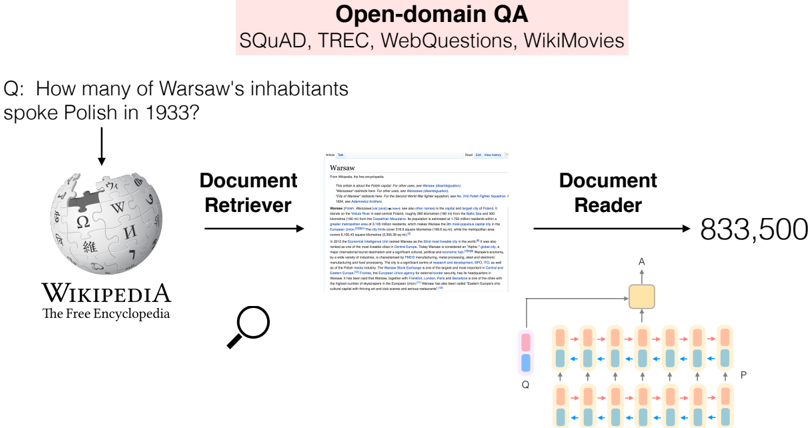
This paper proposes to tackle open-domain question answering using Wikipedia as the unique knowledge source: the answer to any factoid question is a text span in a Wikipedia article. This task of machine reading at scale combines the challenges of document retrieval (finding the relevant articles) with that of machine comprehension of text (identifying the answer spans from those articles). Our approach combines a search component based on bigram hashing and TF-IDF matching with a multi-layer recurrent neural network model trained to detect answers in Wikipedia paragraphs. Our experiments on multiple existing QA datasets indicate that (1) both modules are highly competitive with respect to existing counterparts and (2) multitask learning using distant supervision on their combination is an effective complete system on this challenging task.
Overview
The claims and statistics of this paper haven’t been checked yet.
Free: it reads the open-access text and checks the first 5 claims that cite a source we can check. Create a free account to check every claim.
Integrity signals
Registry
Cites
Statistics
Figures
Verification
Claims the paper makes
The claims and statistics of this paper haven’t been checked yet.
Free: it reads the open-access text and checks the first 5 claims that cite a source we can check. Create a free account to check every claim.
Claims other papers make about this one
Each is checked against this paper’s own text: does it say what the citing paper says it does?
The source backs part of the claim, not all of it — or backs it for a different population, condition or comparison.
In the citing paper
“In particular, the presence of low-value or semantically irrelevant entries dilutes the contribution of high-quality information in retrieval results, impairing downstream task performance and leading to measurable declines in metrics [5].”
From SEDM: Selective Self-Evolving Distributed Memory for Agents (2025) · cites this paper as [5]
Experimental — accuracy not yet measuredThe source backs part of the claim, not all of it — or backs it for a different population, condition or comparison.
In the citing paper
“Prior work has shown that retrieval improves performance across a variety of NLP tasks when considered in isolation.”
From Retrieval-Augmented Generation for Knowledge-Intensive NLP Tasks (2020) · cites this paper as [5]
Experimental — accuracy not yet measuredThe cited source says what the claim attributes to it.
In the citing paper
“This is in agreement with prior work that treated Wikipedia as a general knowledge source under the same reason (Chen et al., 2017; Petroni et al., 2021).”
From FActScore: Fine-grained Atomic Evaluation of Factual Precision in Long Form Text Generation (2023) · cites this paper as Chen et al., 2017
The cited source says what the claim attributes to it.
In the citing paper
“In-context learning methods now routinely invoke tools, leading to LM pipelines that use retrieval models (Chen et al., 2017; Lewis et al., 2020; Guu et al., 2020; Lazaridou et al., 2022; Izacard et al., 2022), multimodal foundation models, and more traditional tools like APIs (Nakano et al., 2021) and calculators.”
From DSPy: Compiling Declarative Language Model Calls into Self-Improving Pipelines (2023) · cites this paper as Chen et al., 2017
Self-check
Percentages, sums and reported differences re-computed from the paper’s own numbers.
The self-check needs the paper’s full text.
Citations
Cites
Adam: A Method for Stochastic Optimization
Kingma, D. P., & Ba, J. (2014) · arXiv · doi:10.48550/arxiv.1412.6980 · Cited by 98,946 · cited 1×
“We use Adamax for optimization as described in (Kingma and Ba, 2014).”
MethodGlove: Global Vectors for Word Representation
Pennington, J., Socher, R., & Manning, C. (2014) · Proceedings of the 2014 Conference on Empirical Methods in Natural Language Processing (EMNLP) · doi:10.3115/v1/d14-1162 · Cited by 34,071 · cited 2×
“The feature vector ˜ p i is comprised of the following parts: We use the 300-dimensional Glove word embeddings trained from 840B Web crawl data (Pennington et al., 2014).”
MethodNeural Machine Translation by Jointly Learning to Align and Translate
Bahdanau, D., Cho, K., & Bengio, Y. (2014) · arXiv · doi:10.48550/arxiv.1409.0473 · Cited by 16,213 · cited 2×
“…has made considerable progress recently thanks to new deep learning architectures like attention-based and memory-1 augmented neural networks (Bahdanau et al., 2015; Weston et al., 2015; Graves et al., 2014) and release of new training and evaluation datasets like QuizBowl (Iyyer et al., 2014),…”
BackgroundThe Stanford CoreNLP Natural Language Processing Toolkit
Manning, C., Surdeanu, M., Bauer, J., Finkel, J., Bethard, S., & McClosky, D. (2014) · Proceedings of 52nd Annual Meeting of the Association for Computational Linguistics: System Demonstrations · doi:10.3115/v1/p14-5010 · Cited by 7,037 · cited 2×
“We apply the Stanford CoreNLP toolkit (Manning et al., 2014) for tokenization and also generating lemma, part-of-speech, and named entity manual features.”
MethodSQuAD: 100,000+ Questions for Machine Comprehension of Text
Rajpurkar, P., Zhang, J., Lopyrev, K., & Liang, P. (2016) · Proceedings of the 2016 Conference on Empirical Methods in Natural Language Processing · doi:10.18653/v1/d16-1264 · Cited by 6,208 · cited 10×
“Next we evaluate our Document Reader component on the standard SQuAD evaluation (Rajpurkar et al., 2016).”
BackgroundMethodInfluentialA unified architecture for natural language processing: deep neural networks with multitask learning
Collobert, R., & Weston, J. (2008) · Proceedings of the 25th international conference on Machine learning - ICML '08 · doi:10.1145/1390156.1390177 · Cited by 5,058 · cited 1×
“Multitask learning (Caruana, 1998) and task transfer have a rich history in machine learning (e.g., using ImageNet in the computer vision community (Huh et al., 2016)), as well as in NLP in particular (Collobert and Weston, 2008).”
MethodSelf-citationFreebase: a collaboratively created graph database for structuring human knowledge
Bollacker, K., Evans, C., Paritosh, P., Sturge, T., & Taylor, J. (2008) · Proceedings of the 2008 ACM SIGMOD international conference on Management of data · doi:10.1145/1376616.1376746 · Cited by 4,852 · cited 11×
“Unlike knowledge bases (KBs) such as Freebase (Bollacker et al., 2008) or DBPedia (Auer et al.”
BackgroundMethodInfluentialDistant supervision for relation extraction without labeled data
Mintz, M., Bills, S., Snow, R., & Jurafsky, D. (2009) · Proceedings of the Joint Conference of the 47th Annual Meeting of the ACL and the 4th International Joint Conference on Natural Language Processing of the AFNLP: Volume 2 - ACL-IJCNLP '09 · doi:10.3115/1690219.1690287 · Cited by 2,752 · cited 1×
“Following previous work on distant supervision (DS) for relation extraction (Mintz et al., 2009), we use a”
MethodTeaching Machines to Read and Comprehend
Hermann, K. M., Kočiský, T., Grefenstette, E., Espeholt, L., Kay, W., Suleyman, M., & Blunsom, P. (2015) · arXiv (Cornell University) · doi:10.48550/arxiv.1506.03340 · Cited by 2,521 · cited 7×
“…Graves et al., 2014) and release of new training and evaluation datasets like QuizBowl (Iyyer et al., 2014), CNN/Daily Mail based on news articles (Hermann et al., 2015), CBT based on children books (Hill et al., 2016), or SQuAD (Rajpurkar et al., 2016) and WikiReading (Hewlett et al., 2016),…”
BackgroundMethodInfluentialDBpedia: A Nucleus for a Web of Open Data
Auer, S., Bizer, C., Kobilarov, G., Lehmann, J., Cyganiak, R., & Ives, Z. (2007) · Lecture Notes in Computer Science · doi:10.1007/978-3-540-76298-0_52 · Cited by 2,454 · cited 3×
“Unlike knowledge bases (KBs) such as Freebase (Bollacker et al., 2008) or DB-Pedia (Auer et al., 2007), which are easier for computers to process but too sparsely populated for open-domain question answering (Miller et al., 2016), Wikipedia contains up-to-date knowledge that humans are interested in.”
Background
Research works printed but not linked: 5
- Petr Baudiˇ s. 2015. YodaQA: a modular question answering system pipeline. In POSTER 2015-19th International Student Conference on Electrical Engineering . pages 1156-1165.
- Eric Brill, Susan Dumais, and Michele Banko. 2002. Ananalysis of the AskMSR question-answering system. In Empirical Methods in Natural Language Processing (EMNLP) . pages 257-264.
- Rudolf Kadlec, Ondrej Bajgar, and Jan Kleindienst. 2016. From particular to general: A preliminary case study of transfer learning in reading comprehension. Machine Intelligence Workshop, NIPS .
- Alexander H. Miller, Adam Fisch, Jesse Dodge, AmirHossein Karimi, Antoine Bordes, and Jason Weston. 2016. Key-value memory networks for directly reading documents. In Empirical Methods in Natural Language Processing (EMNLP) . pages 14001409.
- Jason Weston, Sumit Chopra, and Antoine Bordes. 2015. Memory networks. In International Conference on Learning Representations (ICLR) .
Cited by
Items 201–300 of 1,042
Pre-trained transformers: an empirical comparison
Casola, S., Lauriola, I., & Lavelli, A. (2022) · Machine Learning with Applications · doi:10.1016/j.mlwa.2022.100334 · Cited by 90
Efficient Passage Retrieval with Hashing for Open-domain Question Answering
Yamada, I., Asai, A., & Hajishirzi, H. (2021) · Proceedings of the 59th Annual Meeting of the Association for Computational Linguistics and the 11th International Joint Conference on Natural Language Processing (Volume 2: Short Papers) · doi:10.18653/v1/2021.acl-short.123 · Cited by 58
“Recent stateof-the-art QA models are typically based on a twostage retriever–reader approach (Chen et al., 2017) using a retriever that obtains a small number of relevant passages from a large knowledge source and a reader that processes these passages to produce an answer.”
BackgroundResultGenerating risk response measures for subway construction by fusion of knowledge and deep learning
Zhou, H. M., Tang, S., Huang, W. T., & Zhao, X. (2023) · Automation in Construction · doi:10.1016/j.autcon.2023.104951 · Cited by 67
Verify-and-edit: A knowledge-enhanced chain-of-thought framework
Zhao, R., Li, X., Joty, S., Qin, C., & Bing, L. (2023) · Proceedings of the 61st Annual Meeting of the Association for Computational Linguistics (Volume 1: Long Papers) · doi:10.18653/v1/2023.acl-long.320 · Cited by 55
Document Modeling with Graph Attention Networks for Multi-grained Machine Reading Comprehension
Zheng, B., Wen, H., Liang, Y., Duan, N., Che, W., Jiang, D., Zhou, M., & Liu, T. (2020) · Proceedings of the conference - Association for Computational Linguistics. Meeting · doi:10.18653/v1/2020.acl-main.599 · Cited by 57
RikiNet: Reading Wikipedia Pages for Natural Question Answering
Liu, D., Gong, Y., Fu, J., Yan, Y., Chen, J., Jiang, D., Lv, J., & Duan, N. (2020) · Proceedings of the 58th Annual Meeting of the Association for Computational Linguistics · doi:10.18653/v1/2020.acl-main.604 · Cited by 57
CorpusBrain: Pre-train a Generative Retrieval Model for Knowledge-Intensive Language Tasks
Chen, J., Zhang, R., Guo, J., Liu, Y., Fan, Y., & Cheng, X. (2022) · Proceedings of the 31st ACM International Conference on Information & Knowledge Management · doi:10.1145/3511808.3557271 · Cited by 57
“The typical methods in this category are TF-IDF and BM25 [40].”
BackgroundMethodInfluentialNeural Argument Generation Augmented with Externally Retrieved Evidence
Hua, X., & Wang, L. (2018) · Proceedings of the 56th Annual Meeting of the Association for Computational Linguistics (Volume 1: Long Papers) · doi:10.18653/v1/p18-1021 · Cited by 54
“We first create an inverted index lookup table for Wikipedia as done in Chen et al. (2017).”
MethodRetrieve, Read, Rerank: Towards End-to-End Multi-Document Reading Comprehension
Hu, M., Peng, Y., Huang, Z., & Li, D. (2019) · Proceedings of the conference - Association for Computational Linguistics. Meeting · doi:10.18653/v1/p19-1221 · Cited by 73
“Recently, several large datasets have been proposed to facilitate the research in document-level reading comprehension (RC) (Clark and Gard-ner, 2018) or even open-domain question answering (Chen et al., 2017).”
InfluentialCao, Y. H., Fang, M., & Tao, D. (2019) · arXiv (Cornell University) · doi:10.48550/arxiv.1904.04969 · Cited by 56
“Extended work was done to meet practical demand, such as DrQA (Chen et al., 2017) answering a SQuAD question based on the whole Wikipedia instead of single paragraph.”
MethodCan Generative Pre-trained Language Models Serve As Knowledge Bases for Closed-book QA?
Wang, C., Liu, P., & Zhang, Y. (2021) · Proceedings of the 59th Annual Meeting of the Association for Computational Linguistics and the 11th International Joint Conference on Natural Language Processing (Volume 1: Long Papers) · doi:10.18653/v1/2021.acl-long.251 · Cited by 55
“Chen et al. (2017) first try to retrieve related passages from Wikipedia for each question and encode both the question and passages into the model, then output the answer.”
BackgroundMethodInfluentialMedical Exam Question Answering with Large-scale Reading Comprehension
Zhang, X., Wu, J., He, Z., Liu, X., & Su, Y. (2018) · Proceedings of the AAAI Conference on Artificial Intelligence · doi:10.1609/aaai.v32i1.11970 · Cited by 55
End-to-End Training of Multi-Document Reader and Retriever for Open-Domain Question Answering
Sachan, D. S., Reddy, S., Hamilton, W. L., Dyer, C., & Yogatama, D. (2021) · neural information processing systems · doi:10.48550/arxiv.2106.05346 · Cited by 129
“In this approach, the model consists of two core components (Chen et al., 2017): (i) an information retrieval system to identify useful pieces of text from the knowledge source (the retriever); and (ii) a system to produce the answer given the retrieved documents and the question (the reader).”
MethodDecontextualization: Making Sentences Stand-Alone
Choi, E., Palomaki, J., Lamm, M., Kwiatkowski, T., Das, D., & Collins, M. (2021) · Transactions of the Association for Computational Linguistics · doi:10.1162/tacl_a_00377 · Cited by 54
“Specifically, we construct a passage retrieval corpus for open domain question answering (Chen et al., 2017) with decontextualized sentences.”
MethodEvidence Sentence Extraction for Machine Reading Comprehension
Wang, H., Yu, D., Sun, K., Chen, J., Yu, D., McAllester, D., & Roth, D. (2019) · Conference on Computational Natural Language Learning · doi:10.18653/v1/k19-1065 · Cited by 60
“Previous studies investigate paragraph retrieval for factoid question answering (Chen et al., 2017; Wang et al., 2018c; Choi et al., 2017; Lin et al., 2018), sentence selection for machine reading comprehension (Hewlett et al., 2017; Min et al., 2018), and fact verification (Yin and Roth, 2018;…”
BackgroundAnswering Complex Questions by Joining Multi-Document Evidence with Quasi Knowledge Graphs
(376528), X. L., (20096703), S. P., (20096706), R. R., (20096709), A. A., (3824542), Y. W., & Weikum, G. (2019) · Figshare · Cited by 53
ExCL: Extractive Clip Localization Using Natural Language Descriptions
Ghosh, S., Agarwal, A., Parekh, Z., & Hauptmann, A. G. (2019) · Conference of the North American Chapter of the Association for Computational Linguistics: Human Language Technologies (NAACL-HLT) · doi:10.18653/v1/n19-1198 · Cited by 210
“Our technique is similar to text-based Machine Comprehension (Chen et al., 2017) but in a multimodal setting where the video is analogous to the text passage and the targetclip is analogous to the text span corresponding to the correct answer.”
MethodInfluentialArabic machine reading comprehension on the Holy Qur’an using CL-AraBERT
Malhas, R., & Elsayed, T. (2022) · Information Processing & Management · doi:10.1016/j.ipm.2022.103068 · Cited by 52
SPARTA: Efficient Open-Domain Question Answering via Sparse Transformer Matching Retrieval
Zhao, T., Lu, X., & Lee, K. (2021) · Conference of the North American Chapter of the Association for Computational Linguistics: Human Language Technologies (NAACL-HLT) · doi:10.18653/v1/2021.naacl-main.47 · Cited by 124
Demonstrate-Search-Predict: Composing retrieval and language models for knowledge-intensive NLP
Khattab, O., Santhanam, K., Li, X. L., Hall, D., Liang, P., Potts, C., & Zaharia, M. (2022) · arXiv · doi:10.48550/arxiv.2212.14024 · Cited by 52
“2017), as processed by Khattab et al. (2021b).”
AI for Testing Today and Tomorrow: Industry Perspectives
King, T. M., Arbon, J., Santiago, D., Adamo, D., Chin, W., & Shanmugam, R. (2019) · International Conference on Artificial Intelligence Testing · doi:10.1109/aitest.2019.000-3 · Cited by 35
“The repository includes code, data, and pre-trained models for querying Wikipedia as described in [34].”
MethodRepresentation Learning for Natural Language Processing
Liu, Z., Lin, Y., & Sun, M. (2023) · Springer eBooks · doi:10.1007/978-981-99-1600-9 · Cited by 81
HEAD-QA: A Healthcare Dataset for Complex Reasoning
Vilares, D., & Gómez-Rodríguez, C. (2019) · Proceedings of the 57th Annual Meeting of the Association for Computational Linguistics · doi:10.18653/v1/p19-1092 · Cited by 46
“Following Chen et al. (2017), we use Wikipedia as our source of information ( D ) 10 for all the baselines.”
BackgroundMethodInfluentialDeveloping a Vietnamese Tourism Question Answering System Using Knowledge Graph and Deep Learning
Do, P., Phan, T. H. V., & Gupta, B. B. (2021) · ACM Transactions on Asian and Low-Resource Language Information Processing · doi:10.1145/3453651 · Cited by 59
Movie Plot Analysis via Turning Point Identification
Papalampidi, P., Keller, F., & Lapata, M. (2019) · Conference on Empirical Methods in Natural Language Processing (EMNLP) · doi:10.18653/v1/d19-1180 · Cited by 83
“Common approaches to summarization and QA of long or multiple documents (Chen et al., 2017; Yang et al., 2018; Kratzwald and Feuerriegel, 2018; Elgohary et al., 2018) include a retrieval system as the first step, which selects a subset of relevant passages for further processing.”
Deep learning based question answering system in Bengali
Mayeesha, T. T., Sarwar, A. M., & Rahman, R. M. (2020) · Journal of Information and Telecommunication · doi:10.1080/24751839.2020.1833136 · Cited by 66
“While models like BiDAF (Seo et al., 2016), DocQA (Clark & Gardner, 2017), DrQA (Chen et al., 2017) showed good performance on SquAD 1.1 leaderboard, all of the current high performing models in SquAD 2.0 use variations of BERT based models which can produce contextualized representations of words.”
BackgroundMethodInfluentialAlawwad, H. A., Alhothali, A., Naseem, U., Alkhathlan, A., & Jamal, A. T. (2025) · Pattern Recognition · doi:10.1016/j.patcog.2024.111332 · Cited by 109
“Retrievers can be sparse, relying on classical information retrieval (IR) methods like TF-IDF [19], dense, incorporating DL retrieval methods as in REALM [20] and ORQA [21], or iterative, as in MUPPET [22].”
Results of the Seventh Edition of the BioASQ Challenge
Nentidis, A., Bougiatiotis, K., Krithara, A., & Παλιούρας, Γ. (2020) · Communications in computer and information science · doi:10.1007/978-3-030-43887-6_51 · Cited by 79
“For the RC regime they use DRQA’s document reader [7] while for the Open QA they utilize the PSPR model [27].”
MethodWabiQA: A Wikipedia-Based Thai Question-Answering System
Noraset, T., Lowphansirikul, L., & Tuarob, S. (2020) · Information Processing & Management · doi:10.1016/j.ipm.2020.102431 · Cited by 58
Multi-task Learning with Sample Re-weighting for Machine Reading Comprehension
Xu, Y., Liu, X., Shen, Y., Liu, J., & Gao, J. (2019) · Conference of the North American Chapter of the Association for Computational Linguistics: Human Language Technologies (NAACL-HLT) · doi:10.18653/v1/n19-1271 · Cited by 75
“At last, we provide some additional results on combining MTL with DrQA (Chen et al., 2017) to show the flexibility of our approach 1 .”
MethodInfluentialExplore, Propose, and Assemble: An Interpretable Model for Multi-Hop Reading Comprehension
Jiang, Y., Joshi, N., Chen, Y.-C., & Bansal, M. (2019) · Proceedings of the 57th Annual Meeting of the Association for Computational Linguistics · doi:10.18653/v1/p19-1261 · Cited by 47
“Clark and Gardner (2018) and Chen et al. (2017) used a simple TF-IDF based document-selection procedure to find the context that is most relevant to the query for multi-document QA.”
MethodMA-DST: Multi-Attention-Based Scalable Dialog State Tracking
Kumar, A., Ku, P., Goyal, A. K., Metallinou, A., & Hakkani-Tür, D. Z. (2020) · Proceedings of the AAAI Conference on Artificial Intelligence · doi:10.1609/aaai.v34i05.6322 · Cited by 61
A Review on Fact Extraction and Verification
Bekoulis, G., Papagiannopoulou, C., & Deligiannis, N. (2023) · ACM Computing Surveys · doi:10.1145/3485127 · Cited by 48
“DrQA: Several approaches, which have been exploited to partly solve the FEVER task, rely on the DrQA component [17] for retrieving relevant information from Wikipedia.”
BackgroundMethodA Unified Query-based Generative Model for Question Generation and Question Answering
Song, L., Wang, Z., & Hamza, W. (2017) · arXiv (Cornell University) · doi:10.48550/arxiv.1709.01058 · Cited by 46
“For question answering (QA), most previous works (Wang and Jiang, 2016; Wang et al., 2016; Shen et al., 2016; Wang et al., 2017; Chen et al., 2017; Xiong, Zhong, and Socher, 2016; Seo et al., 2016; Lee et al., 2016; Yu et al., 2016; Dhingra et al., 2017) focus on the extractive QA scenario, which predicts a continuous…”
BackgroundInfluentialResponse Quality in Human-Chatbot Collaborative Systems
Jiang, J., & Ahuja, N. (2020) · International ACM SIGIR Conference on Research and Development in Information Retrieval (SIGIR) · doi:10.1145/3397271.3401234 · Cited by 53
“We used the Document Retriever [1] to find articles relevant to the current conversation based on up to two previous dialog turns.”
MethodAnswering Questions on COVID-19 in Real-Time
Lee, J., Yi, S. S., Jeong, M., Sung, M., Yoon, W., Choi, Y., Ko, M., & Kang, J. (2020) · Workshop on NLP for COVID-19 (NLP-COVID19) · doi:10.18653/v1/2020.nlpcovid19-2.1 · Cited by 58
Ohsugi, Y., Saito, I., Nishida, K., Asano, H., & Tomita, J. (2019) · Workshop on NLP for Conversational AI (NLP4ConvAI) · doi:10.18653/v1/w19-4102 · Cited by 62
“For CoQA, the comparison system is DrQA+PGNet (Reddy et al., 2018), BiDAF++ w/ x-ctx, FlowQA, and SDNet (Zhu et al., 2018).”
BackgroundMethodInfluentialProgram Enhanced Fact Verification with Verbalization and Graph Attention Network
Yang, X., Nie, F., Feng, Y., Liu, Q., Chen, Z., & Zhu, X. (2020) · Conference on Empirical Methods in Natural Language Processing (EMNLP) · doi:10.18653/v1/2020.emnlp-main.628 · Cited by 62
Semantic reasoning in service robots using expert systems
Savage, J., Rosenblueth, D. A., Matamoros, M., Negrete, M., Contreras, L., Cruz, J., Martell, R., Estrada, H., & Okada, H. (2019) · Robotics and Autonomous Systems · doi:10.1016/j.robot.2019.01.007 · Cited by 48
SAS: Dialogue State Tracking via Slot Attention and Slot Information Sharing
Hu, J., Yang, Y. T., Chen, C., He, L., & Yu, Z. (2020) · Proceedings of the conference - Association for Computational Linguistics. Meeting · doi:10.18653/v1/2020.acl-main.567 · Cited by 50
“Inspired by the (Chen et al., 2017; Chen, 2018), (Chen et al., 2019) studied on utilizing attention mechanism to deal with the long distance slot carryover problem.”
MethodExplain Me the Painting: Multi-Topic Knowledgeable Art Description Generation
Bai, Z., Nakashima, Y., & García, N. (2021) · IEEE/CVF International Conference on Computer Vision (ICCV) · doi:10.1109/iccv48922.2021.00537 · Cited by 68
“DrQA and BERT hyperparameters are set as in [7] and [14], respectively.”
BackgroundMethodInfluentialQuery Prior Matters: A MRC Framework for Multimodal Named Entity Recognition
Jia, M., Shen, X., Shen, L., Pang, J., Liao, L., Song, Y., Chen, M., & He, X. (2022) · ACM International Conference on Multimedia (ACM MM) · doi:10.1145/3503161.3548427 · Cited by 72
“In previous work, Recurrent Neural Network (RNN) was adopted to encode query and context, multiple RNN and linear projection were stacked to predict answer span in stages [3, 21, 36].”
MethodAn Autoregressive Text-to-Graph Framework for Joint Entity and Relation Extraction
Zaratiana, U., Tomeh, N., Holat, P., & Charnois, T. (2024) · Proceedings of the AAAI Conference on Artificial Intelligence · doi:10.1609/aaai.v38i17.29919 · Cited by 74
ODSQA: Open-Domain Spoken Question Answering Dataset
Lee, C., Wang, S.-M., Chang, H.-C., & Lee, H.-Y. (2018) · IEEE Spoken Language Technology Workshop (SLT) · doi:10.1109/slt.2018.8639505 · Cited by 65
Training a Ranking Function for Open-Domain Question Answering
Htut, P. M., Bowman, S. R., & Cho, K. (2018) · Conference of the North American Chapter of the Association for Computational Linguistics: Student Research Workshop (NAACL SRW) · doi:10.18653/v1/n18-4017 · Cited by 54
“As machine readers are excellent at this task, there have been attempts to combine search engines with machine reading for corpus-based open-domain QA (Chen et al., 2017; Wang et al., 2017).”
BackgroundMethodInfluentialAdaptable and Interpretable Neural MemoryOver Symbolic Knowledge
Verga, P., Sun, H., Baldini Soares, L., & Cohen, W. (2021) · Proceedings of the 2021 Conference of the North American Chapter of the Association for Computational Linguistics: Human Language Technologies · doi:10.18653/v1/2021.naacl-main.288 · Cited by 41
“Generally, open book models refer to ’retrieve and read’ pipelines (Chen et al., 2017) which, given a”
BackgroundExploring Listwise Evidence Reasoning with T5 for Fact Verification
Jiang, K., Pradeep, R., & Lin, J. (2021) · doi:10.18653/v1/2021.acl-short.51 · Cited by 87
“…the initial top-scoring systems (Nie et al., 2019a; Hanselowski et al., 2018) employed variations of the Enhanced Sequential Inference Model (ESIM) (Chen et al., 2017b), which consists of Bidirectional Long Short-Term Memory networks (BiLSTMs) (Schuster and Paliwal, 1997) as its primary building…”
MethodInfluentialMachine Reading Comprehension: The Role of Contextualized Language Models and BeyondPreprint
Zhang, Z., Zhao, H., & Wang, R. (2020) · arXiv (Cornell University) · doi:10.48550/arxiv.2005.06249 · Cited by 80
“Document Reader (Chen et al. 2017) RNN 70.”
BEIR: A Heterogenous Benchmark for Zero-shot Evaluation of Information Retrieval Models
Thakur, N., Reimers, N., Rücklé, A., Srivastava, A., & Gurevych, I. (2021) · arXiv · doi:10.48550/arxiv.2104.08663 · Cited by 45
“Examples are opendomain question-answering (Chen et al., 2017), claim-verification (Thorne et al.”
BackgroundMultiDoc2Dial: Modeling Dialogues Grounded in Multiple Documents
Feng, S., Patel, S. S., Wan, H., & Joshi, S. (2021) · Proceedings of the 2021 Conference on Empirical Methods in Natural Language Processing · doi:10.18653/v1/2021.emnlp-main.498 · Cited by 44
“Our proposed data and tasks are also related to open domain question answering (Chen et al., 2017; Lee et al., 2019; Kwiatkowski et al., 2019; Min et al., 2020; Qu et al., 2020b; Mao et al., 2020; Zhu et al., 2021; Izacard and Grave, 2021; Li et al., 2021; Xiong et al., 2021; Yu et al., 2021).”
BackgroundDistant supervision for relation extraction with hierarchical selective attention
Zhou, P., Xu, J., Qi, Z., Bao, H., Chen, Z., & Xu, B. (2018) · Neural Networks · doi:10.1016/j.neunet.2018.08.016 · Cited by 48
Explicit Utilization of General Knowledge in Machine Reading Comprehension
Wang, C., & Jiang, H. (2019) · Proceedings of the conference - Association for Computational Linguistics. Meeting · doi:10.18653/v1/p19-1219 · Cited by 53
Ruminating Reader: Reasoning with Gated Multi-hop Attention
Gong, Y., & Bowman, S. R. (2018) · Workshop on Machine Reading for Question Answering (MRQA) · doi:10.18653/v1/w18-2601 · Cited by 46
Visual Question Answering as Reading Comprehension
Li, H., Wang, P., Shen, C., & van den Hengel, A. (2019) · IEEE Computer Society Conference on Computer Vision and Pattern Recognition/Proceedings - IEEE Computer Society Conference on Computer Vision and Pattern Recognition/Proceedings · doi:10.1109/cvpr.2019.00648 · Cited by 55
“Significant progress has been made over the past years due to the using of end-to-end neural network models and attention mechanism, such as DMN [17], r-net [31], DrQA [6], QANet [36], and most recently BERT [7].”
BackgroundRUArt: A Novel Text-Centered Solution for Text-Based Visual Question Answering
Jin, Z., Wu, H., Yang, C. H., Zhou, F., Qin, J., Xiao, L., & Yin, X.-C. (2021) · IEEE Transactions on Multimedia · doi:10.1109/tmm.2021.3120194 · Cited by 54
IIRC: A Dataset of Incomplete Information Reading Comprehension Questions
Ferguson, J., Gardner, M., Hajishirzi, H., Khot, T., & Dasigi, P. (2020) · Proceedings of the 2020 Conference on Empirical Methods in Natural Language Processing (EMNLP) · doi:10.18653/v1/2020.emnlp-main.86 · Cited by 41
Qsearch: Answering Quantity Queries from Text
Ho, V. T., Ibrahim, Y., Pal, K., Berberich, K., & Weikum, G. (2019) · Lecture notes in computer science · doi:10.1007/978-3-030-30793-6_14 · Cited by 54
DAMO-NLP at SemEval-2022 Task 11: A Knowledge-based System for Multilingual Named Entity Recognition
Wang, X., Shen, Y., Cai, J., Wang, T., Wang, X., Xie, P., Huang, F., Lü, W., Zhuang, Y., Tu, K., et al. (2022) · International Workshop on Semantic Evaluation (SemEval) · doi:10.18653/v1/2022.semeval-1.200 · Cited by 54
Chakraborty, N., Ornik, M., & Driggs-Campbell, K. (2025) · ACM Computing Surveys · doi:10.1145/3716846 · Cited by 97
Attentive Convolution: Equipping CNNs with RNN-style Attention Mechanisms
Yin, W., & Schütze, H. (2018) · Transactions of the Association for Computational Linguistics · doi:10.1162/tacl_a_00249 · Cited by 64
“%) and outperforms the representative attentive-LSTM (>4%).”
BackgroundMethodInfluentialAnswering Complex Questions by Joining Multi-Document Evidence with Quasi Knowledge Graphs
Lu, X., Pramanik, S., Saha Roy, R., Abujabal, A., Wang, Y., & Weikum, G. (2019) · Proceedings of the 42nd International ACM SIGIR Conference on Research and Development in Information Retrieval · doi:10.1145/3331184.3331252 · Cited by 42
“ComplexQuestions from Trends (CQ-T) Top Strata-1 Strata-2 Strata-3 Strata-4 Strata-5 Top Strata-1 Strata-2 Strata-3 Strata-4 Strata-5 QUEST MRR 0.355 *380 340 302 356 318 467 436 426 460 409 384 DrQA [12] 0 .226 0 237 0 257 0 256 0 215 0 248 0 355 0 330 0 356 0 369 0 365 0 380 BFS [38] 0 .249 0 256 0266 0 212 0 219 02…”
BackgroundMethodResultInfluentialPhrase-Indexed Question Answering: A New Challenge for Scalable Document Comprehension
Seo, M., Kwiatkowski, T., Parikh, A., Farhadi, A., & Hajishirzi, H. (2018) · Proceedings of the 2018 Conference on Empirical Methods in Natural Language Processing · doi:10.18653/v1/d18-1052 · Cited by 41
“Choi et al. (2017); Chen et al. (2017); Clark and Gardner (2017); Min et al. (2018) tackled large-scale QA by using a fast, coarse model (e.g. TF-IDF) to retrieve few documents or sentences and then using a slower, accurate model to obtain the answer.”
BackgroundMethodHAS-QA: Hierarchical Answer Spans Model for Open-Domain Question Answering
Pang, L., Lan, Y., Guo, J., Xu, J., Su, L., & Cheng, X. (2019) · Proceedings of the AAAI Conference on Artificial Intelligence · doi:10.1609/aaai.v33i01.33016875 · Cited by 41
The Adapter-Bot: All-In-One Controllable Conversational Model
Lin, Z., Madotto, A., Bang, Y., & Fung, P. (2021) · Proceedings of the AAAI Conference on Artificial Intelligence · doi:10.1609/aaai.v35i18.18018 · Cited by 66
A survey of deep learning techniques for machine reading comprehension
Kazi, S., Khoja, S. A., & Daud, A. Y. (2023) · Artificial Intelligence Review · doi:10.1007/s10462-023-10583-4 · Cited by 52
Discourse Marker Augmented Network with Reinforcement Learning for Natural Language Inference
Pan, B., Yang, Y., Zhao, Z., Zhuang, Y., Cai, D., & He, X. (2018) · Proceedings of the conference - Association for Computational Linguistics. Meeting · doi:10.18653/v1/p18-1091 · Cited by 47
“Exact Match: Inspired by the machine comprehension tasks(Chen et al., 2017a), we want to know whether every word in P is in H (and H in P ).”
BackgroundMethodInfluentialDRr-Net: Dynamic Re-Read Network for Sentence Semantic Matching
Zhang, K., Lv, G., Wang, L., Wu, L., Chen, E., Wu, F., & Xie, X. (2019) · Proceedings of the AAAI Conference on Artificial Intelligence · doi:10.1609/aaai.v33i01.33017442 · Cited by 42
“The syntactical features consist of the embedding of part-of-speech tagging feature, binary exact match feature, and binary antonym feature, which have been proved useful for sentence semantic understanding (Chen et al. 2017a; Gururangan et al. 2018).”
BackgroundMethodJoint Training of Candidate Extraction and Answer Selection for Reading Comprehension
Wang, Z., Liu, J., Xiao, X., Lyu, Y., & Wu, T. B. (2018) · Proceedings of the conference - Association for Computational Linguistics. Meeting · doi:10.18653/v1/p18-1159 · Cited by 42
“Specifically, introducing the independent representation of the question and its common words with the passage seems an efficient way to consider the information of questions, which is consistent with previous work (Li et al., 2016b; Chen et al., 2017).”
ResultReinforced Dynamic Reasoning for Conversational Question Generation
Pan, B., Li, H., Yao, Z., Cai, D., & Sun, H. (2019) · Proceedings of the 57th Annual Meeting of the Association for Computational Linguistics · doi:10.18653/v1/p19-1203 · Cited by 40
“Since the CoQA contains abstractive answers, we apply DrQA as our question answering model and follow Yatskar (2018) to separately train a binary classifier to produce “yes” or “no” for yes/no questions 4 .”
MethodInfluentialA Systematic Classification of Knowledge, Reasoning, and Context within the ARC Dataset
Boratko, M., Padigela, H., Mikkilineni, D., Yuvraj, P., Das, R., McCallum, A., Chang, M., Fokoue-Nkoutche, A., Kapanipathi, P., Mattei, N., et al. (2018) · Proceedings of the Workshop on Machine Reading for Question Answering · doi:10.18653/v1/w18-2607 · Cited by 37
Learning to Transform, Combine, and Reason in Open-Domain Question Answering
Dehghani, M., Azarbonyad, H., Kamps, J., & de Rijke, M. (2019) · ACM International Conference on Web Search and Data Mining (WSDM) · doi:10.1145/3289600.3291012 · Cited by 41
“Most of the previous approaches focused on removing noise in the retrieval steps of the question answering pipeline [4, 14, 15, 19, 34].”
InfluentialMai, G., Yan, B., Janowicz, K., & Zhu, R. (2019) · Lecture notes in geoinformation and cartography · doi:10.1007/978-3-030-14745-7_2 · Cited by 58
“…current QA research can be classified into three categories: unstructured data-based QA (Rajpurkar et al. 2016, Miller et al. 2016, Yang et al. 2017, Chen et al. 2017, Mai, Janowicz, He, Liu & Lao 2018), semi-structure table-based QA (Pasupat & Liang 2015), and structured-KB-based QA (so-called…”
BackgroundImproving Subject-Area Question Answering with External Knowledge
Pan, X., Sun, K., Yu, D., Chen, J., Ji, H., Cardie, C., & Yu, D. (2019) · Workshop on Machine Reading for Question Answering (MRQA) · doi:10.18653/v1/d19-5804 · Cited by 71
“trieving relevant documents in Wikipedia and then running a MRC model to extract a text span from the documents based on the question (Chen et al., 2017; Wang et al., 2018b; Kratzwald and Feuerriegel, 2018; Lee et al., 2018; Lin et al., 2018).”
BackgroundMethodAugmenting Transformers with KNN-Based Composite Memory for Dialog
Fan, A., Gardent, C., Braud, C., & Bordes, A. (2021) · Transactions of the Association for Computational Linguistics · doi:10.1162/tacl_a_00356 · Cited by 20
Self-citationAnswering Open-Domain Questions of Varying Reasoning Steps from Text
Qi, P., Lee, H., Sido, T., & Manning, C. (2021) · Proceedings of the 2021 Conference on Empirical Methods in Natural Language Processing · doi:10.18653/v1/2021.emnlp-main.292 · Cited by 38
“SQuAD Open (Chen et al., 2017) designates the development set of the original SQuADdataset as its”
BackgroundMethodResultInfluentialBreak It Down: A Question Understanding BenchmarkPreprint
Wolfson, T., Geva, M., Gupta, A., Gardner, M., Goldberg, Y., Deutch, D., & Berant, J. (2020) · arXiv (Cornell University) · doi:10.48550/arxiv.2001.11770 · Cited by 40
“As our IR model we use bigram TF-IDF, proposed by Chen et al. (2017). Because the RC model is run on single-hop questions, we use the BERTbased RC model from Min et al.”
MethodComplex Factoid Question Answering with a Free-Text Knowledge Graph
Zhao, C., Xiong, C., Qian, X., & Boyd-Graber, J. (2020) · International World Wide Web Conference (WWW) · doi:10.1145/3366423.3380197 · Cited by 49
“delft outperforms machine reading based model [11], bert-based answer ranking [14], and a bert-based memory network approach [56] that uses the same evidence but no graph structure, with significant margins.”
BackgroundMethodAithal, S. G., Rao, A. B., & Singh, S. (2021) · Applied Intelligence · doi:10.1007/s10489-021-02348-9 · Cited by 45
“Both unanswerable and irrelevant questions are taken from the SQuAD 2.0 dataset [7] for the experiments.”
BackgroundMethodInfluentialLearning from Language Description: Low-shot Named Entity Recognition via Decomposed Framework
Wang, Y., Chu, H., Zhang, C., & Gao, J. (2021) · Findings of the Association for Computational Linguistics: EMNLP (Findings of EMNLP) · doi:10.18653/v1/2021.findings-emnlp.139 · Cited by 53
Jiang, Z., Araki, J., Ding, H., & Neubig, G. (2020) · arXiv (Cornell University) · doi:10.48550/arxiv.2012.00955 · Cited by 39
“We follow (Petroni et al., 2020a) to retrieve the most relevant Wikipedia article using TF-IDF-based retrieval systems used in DrQA (Chen et al., 2017) and append the first paragraph of the article to the input.”
MethodTesting Your Question Answering Software via Asking Recursively
Chen, S., Jin, S., & Xie, X. (2021) · IEEE/ACM International Conference on Automated Software Engineering (ASE) · doi:10.1109/ase51524.2021.9678670 · Cited by 63
“It usually requires to first retrieve the reference from the web or construct a knowledge base before performing comprehension and inference [19].”
BackgroundCode-Mixed Question Answering Challenge: Crowd-sourcing Data and Techniques
Chandu, K. R., Loginova, E., Gupta, V., van Genabith, J., Neumann, G., Chinnakotla, M. K., Nyberg, E., & Black, A. W. (2018) · Workshop on Computational Approaches to Code Switching · doi:10.18653/v1/w18-3204 · Cited by 48
“A pre-trained Document Reader model DrQA proposed by Chen et al. (2017) on a popular machine reading QA dataset SQuAD (Rajpurkar et al., 2016) is used for this domain.”
MethodA dataset and baselines for sequential open-domain question answering
Elgohary, A., Zhao, C., & Boyd-Graber, J. L. (2018) · Conference on Empirical Methods in Natural Language Processing (EMNLP) · doi:10.18653/v1/d18-1134 · Cited by 52
“We use the reader network of Chen et al. (2017).”
BackgroundMethodInfluentialDifferentiable Open-Ended Commonsense Reasoning
Lin, B. Y., Sun, H., Dhingra, B., Zaheer, M., Ren, X., & Cohen, W. W. (2021) · Conference of the North American Chapter of the Association for Computational Linguistics: Human Language Technologies (NAACL-HLT) · doi:10.18653/v1/2021.naacl-main.366 · Cited by 63
Open-Domain Conversational Agents: Current Progress, Open Problems, and Future Directions
Roller, S., Boureau, Y.-L., Weston, J., Bordes, A., Dinan, E., Fan, A., Gunning, D., Ju, D., Li, M., Poff, S., et al. (2020) · arXiv · doi:10.48550/arxiv.2006.12442 · Cited by 38
“Questionanswering, which can be thought of as a single turn task is similar, either requiring reading comprehension (Rajpurkar et al., 2016) or retrieval as well in the more realistic case (Nguyen et al., 2016; Chen et al., 2017).”
BackgroundMethodInfluentialSelf-citationRead before Generate! Faithful Long Form Question Answering with Machine Reading
Su, D., Li, X., Zhang, J., Shang, L., Jiang, X., Liu, Q., & Fung, P. (2022) · Findings of the Association for Computational Linguistics: ACL 2022 · doi:10.18653/v1/2022.findings-acl.61 · Cited by 37
An Empirical Study of Retrieval-Augmented Code Generation: Challenges and Opportunities
Yang, Z., Chen, S., Gao, C., Li, Z., Hu, X., Liu, K., & Xia, X. (2025) · ACM Transactions on Software Engineering and Methodology · doi:10.1145/3717061 · Cited by 37
“A similar workflow has been proposed and developed [8, 49] before REALM occurs.”
Humpty Dumpty: Controlling Word Meanings via Corpus Poisoning
Schuster, R., Schuster, T., Meri, Y., & Shmatikov, V. (2020) · IEEE Symposium on Security and Privacy (S&P) · doi:10.1109/sp40000.2020.00115 · Cited by 46
“Furthermore, pre-trained embeddings can directly solve subtasks in information retrieval systems, such as expanding search queries to include related terms [21, 39, 61], predicting question-answer relatedness [14, 35], deriving the word’s kmeans cluster [54], and more.”
BackgroundHHGN: A Hierarchical Reasoning-based Heterogeneous Graph Neural Network for fact verification
Chen, C., Cai, F., Hu, X., Chen, W., & Chen, H. (2021) · Information Processing & Management · doi:10.1016/j.ipm.2021.102659 · Cited by 40
Technical report on Conversational Question Answering
Ju, Y., Zhao, F., Chen, S., Zheng, B., Yang, X., & Liu, Y. (2019) · arXiv (Cornell University) · doi:10.48550/arxiv.1909.10772 · Cited by 36
“Many MRC models have been proposed to tackle single-turn QA, such as BiDAF(Seo et al., 2016), DrQA(Chen et al., 2017), R-Net(Wang et al., 2017) and QANet(Yu et al., 2018) in SQuAD dataset.”
MethodRead before Generate! Faithful Long Form Question Answering with Machine Reading
Su, D., Li, X., Zhang, J., Shang, L., Jiang, X., Liu, Q., & Fung, P. (2022) · arXiv · doi:10.48550/arxiv.2203.00343 · Cited by 37
Roy, R. S., & Anand, A. (2021) · Synthesis lectures on information concepts, retrieval, and services · doi:10.2200/s0113ed1v01y202109icr076 · Cited by 42
Tree of Clarifications: Answering Ambiguous Questions with Retrieval-Augmented Large Language Models
Kim, G., Kim, S., Jeon, B., Park, J., & Kang, J. (2023) · Proceedings of the 2023 Conference on Empirical Methods in Natural Language Processing · doi:10.18653/v1/2023.emnlp-main.63 · Cited by 35
Knowledge-based natural answer generation via effective graph learning
Liu, Z., Li, J., Huang, Y., Cui, N., & Pei, L. (2025) · Knowledge-Based Systems · doi:10.1016/j.knosys.2025.113288 · Cited by 38
Summary-aware attention for social media short text abstractive summarization
Wang, Q., & Ren, J. (2020) · Neurocomputing · doi:10.1016/j.neucom.2020.04.136 · Cited by 43
Sentence Similarity Based on Contexts
Sun, X., Meng, Y., Ao, X., Wu, F. Q., Zhang, T., Li, J., & Fan, C. C. (2022) · Transactions of the Association for Computational Linguistics · doi:10.1162/tacl_a_00477 · Cited by 58
“This two-step selection strategy is akin to the pipelined selection system (Chen et al., 2017; Karpukhin et al., 2020) in open-domain QA which contains document retrieval using IR systems and fine-grained question answering using neural QA models.”
MethodRAPTOR: Recursive Abstractive Processing for Tree-Organized Retrieval
Sarthi, P., Abdullah, S., Tuli, A., Khanna, S., Goldie, A., & Manning, C. D. (2024) · arXiv · doi:10.48550/arxiv.2401.18059 · Cited by 36
“An alternative approach, pioneered in open domain question answering systems (Chen et al., 2017; Yu et al., 2018), is to index large quantities of text, after splitting it into chunks (paragraphs), in a separate information retrieval system.”
R2-D2: A Modular Baseline for Open-Domain Question Answering
Fajcik, M., Docekal, M., Ondrej, K., & Smrz, P. (2021) · Findings of the Association for Computational Linguistics: EMNLP 2021 · doi:10.18653/v1/2021.findings-emnlp.73 · Cited by 36
DC-BERT: Decoupling Question and Document for Efficient Contextual Encoding
Nie, P., Zhang, Y., Geng, X., Ramamurthy, A., Song, L., & Jiang, D. (2020) · International ACM SIGIR Conference on Research and Development in Information Retrieval (SIGIR) · doi:10.1145/3397271.3401271 · Cited by 68
“(2019) for Natural Questions Open, and use the DrQA (Chen et al., 2017) TF-IDF retriever to collect 80 documents for SQuAD Open.”
MethodInfluentialNew Vietnamese Corpus for Machine Reading Comprehension of Health News Articles
Nguyen, K. V., Huynh, T. V., Nguyen, D.-V., Nguyen, A. G.-T., & Nguyen, N. L.-T. (2022) · ACM Transactions on Asian and Low-Resource Language Information Processing · doi:10.1145/3527631 · Cited by 55
“, 2017), DrQA (Chen et al., 2017), FusionNet (Huang et al.”
BackgroundMethodInfluential
Metadata
- Authors
- Chen, D., Fisch, A., Weston, J., & Bordes, A.
- Affiliations
- Meta (United States) (US)
- ORCID
- Chen, Danqi
- Venue
- Proceedings of the 55th Annual Meeting of the Association for Computational Linguistics (Volume 1: Long Papers)
- Published
- 2017
- Pages
- 1870-1879
- ISSN
- 0736-587X (ISSN-L)
- OpenAlex
- W2962985038
- Cited by
- 1,546
- References
- 39
- Citations by year
- 2026: 61 · 2025: 105 · 2024: 123 · 2023: 218 · 2022: 209 · 2021: 268 · 2020: 202 · 2019: 199 · 2018: 142 · 2017: 18
- FWCI
- 69.97
- Type
- conference paper
- Language
- en
- Open access
- hybrid
- doi.org
- Licence
- cc-by
- Locations
- Proceedings of the conference - Association for Computational Linguistics. Meeting (publishedVersion, cc-by)
- arXiv (Cornell University) (submittedVersion)
- arXiv (Cornell University)
- Topics
- Physical Sciences › Computer Science › Artificial Intelligence › Topic Modeling
- Physical Sciences › Computer Science › Information Systems › Information Retrieval and Search Behavior
- Physical Sciences › Computer Science › Artificial Intelligence › Natural Language Processing Techniques
- Keywords
- open-domain question answering, Wikipedia, machine reading, document retrieval, recurrent neural networks, multi-task learning, distant supervision, factoid questions
About these checks
Registry, retraction, Cites and statistics results are computed, not judged, with one exception: a printed reference that no index lists is read once by a model before it counts as a citation error. Claims are extracted by a model and kept only when their quote appears verbatim in the text; each cited source is then checked, with a model’s help, for whether it says what the claim relies on. Those verdicts can be wrong — read the claim’s quote and the cited source before relying on one.
Statistics and arithmetic are recomputed, not judged.
Confidence bands are shown only for fields calibrated on our annotated test set. None is calibrated yet, so no band is shown.
What counts as a claim ›How we measure confidence ›How we check this ›
Are you an author, or do you see a problem with this page? Request a review
Data sources
Bibliographic data: Semantic Scholar, OpenAlex, Crossref.
Contains information from the Semantic Scholar Academic Graph Datasets, made available under the ODC Attribution License (ODC-BY 1.0).
Semantic Scholar’s data is described in: Kinney, R., et al. (2023). The Semantic Scholar Open Data Platform. arXiv:2301.10140.
