

Reading Wikipedia to Answer Open-Domain Questions
Open accessThe DOI matches its Crossref record; 34 of the 39 references it cites were found in a registry or an index.
Abstract
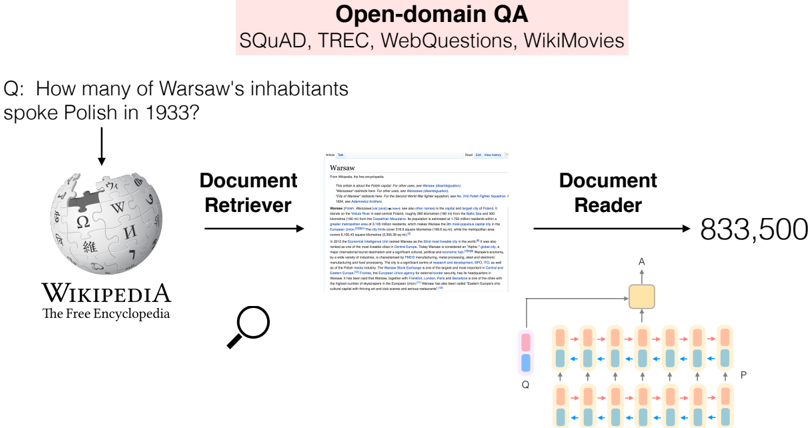
This paper proposes to tackle open-domain question answering using Wikipedia as the unique knowledge source: the answer to any factoid question is a text span in a Wikipedia article. This task of machine reading at scale combines the challenges of document retrieval (finding the relevant articles) with that of machine comprehension of text (identifying the answer spans from those articles). Our approach combines a search component based on bigram hashing and TF-IDF matching with a multi-layer recurrent neural network model trained to detect answers in Wikipedia paragraphs. Our experiments on multiple existing QA datasets indicate that (1) both modules are highly competitive with respect to existing counterparts and (2) multitask learning using distant supervision on their combination is an effective complete system on this challenging task.
Overview
The claims and statistics of this paper haven’t been checked yet.
Free: it reads the open-access text and checks the first 5 claims that cite a source we can check. Create a free account to check every claim.
Integrity signals
Registry
Cites
Statistics
Figures
Verification
Claims the paper makes
The claims and statistics of this paper haven’t been checked yet.
Free: it reads the open-access text and checks the first 5 claims that cite a source we can check. Create a free account to check every claim.
Claims other papers make about this one
Each is checked against this paper’s own text: does it say what the citing paper says it does?
The source backs part of the claim, not all of it — or backs it for a different population, condition or comparison.
In the citing paper
“In particular, the presence of low-value or semantically irrelevant entries dilutes the contribution of high-quality information in retrieval results, impairing downstream task performance and leading to measurable declines in metrics [5].”
From SEDM: Selective Self-Evolving Distributed Memory for Agents (2025) · cites this paper as [5]
Experimental — accuracy not yet measuredThe source backs part of the claim, not all of it — or backs it for a different population, condition or comparison.
In the citing paper
“Prior work has shown that retrieval improves performance across a variety of NLP tasks when considered in isolation.”
From Retrieval-Augmented Generation for Knowledge-Intensive NLP Tasks (2020) · cites this paper as [5]
Experimental — accuracy not yet measuredThe cited source says what the claim attributes to it.
In the citing paper
“This is in agreement with prior work that treated Wikipedia as a general knowledge source under the same reason (Chen et al., 2017; Petroni et al., 2021).”
From FActScore: Fine-grained Atomic Evaluation of Factual Precision in Long Form Text Generation (2023) · cites this paper as Chen et al., 2017
The cited source says what the claim attributes to it.
In the citing paper
“In-context learning methods now routinely invoke tools, leading to LM pipelines that use retrieval models (Chen et al., 2017; Lewis et al., 2020; Guu et al., 2020; Lazaridou et al., 2022; Izacard et al., 2022), multimodal foundation models, and more traditional tools like APIs (Nakano et al., 2021) and calculators.”
From DSPy: Compiling Declarative Language Model Calls into Self-Improving Pipelines (2023) · cites this paper as Chen et al., 2017
Self-check
Percentages, sums and reported differences re-computed from the paper’s own numbers.
The self-check needs the paper’s full text.
Citations
Cites
Adam: A Method for Stochastic Optimization
Kingma, D. P., & Ba, J. (2014) · arXiv · doi:10.48550/arxiv.1412.6980 · Cited by 98,946 · cited 1×
“We use Adamax for optimization as described in (Kingma and Ba, 2014).”
MethodGlove: Global Vectors for Word Representation
Pennington, J., Socher, R., & Manning, C. (2014) · Proceedings of the 2014 Conference on Empirical Methods in Natural Language Processing (EMNLP) · doi:10.3115/v1/d14-1162 · Cited by 34,071 · cited 2×
“The feature vector ˜ p i is comprised of the following parts: We use the 300-dimensional Glove word embeddings trained from 840B Web crawl data (Pennington et al., 2014).”
MethodNeural Machine Translation by Jointly Learning to Align and Translate
Bahdanau, D., Cho, K., & Bengio, Y. (2014) · arXiv · doi:10.48550/arxiv.1409.0473 · Cited by 16,213 · cited 2×
“…has made considerable progress recently thanks to new deep learning architectures like attention-based and memory-1 augmented neural networks (Bahdanau et al., 2015; Weston et al., 2015; Graves et al., 2014) and release of new training and evaluation datasets like QuizBowl (Iyyer et al., 2014),…”
BackgroundThe Stanford CoreNLP Natural Language Processing Toolkit
Manning, C., Surdeanu, M., Bauer, J., Finkel, J., Bethard, S., & McClosky, D. (2014) · Proceedings of 52nd Annual Meeting of the Association for Computational Linguistics: System Demonstrations · doi:10.3115/v1/p14-5010 · Cited by 7,037 · cited 2×
“We apply the Stanford CoreNLP toolkit (Manning et al., 2014) for tokenization and also generating lemma, part-of-speech, and named entity manual features.”
MethodSQuAD: 100,000+ Questions for Machine Comprehension of Text
Rajpurkar, P., Zhang, J., Lopyrev, K., & Liang, P. (2016) · Proceedings of the 2016 Conference on Empirical Methods in Natural Language Processing · doi:10.18653/v1/d16-1264 · Cited by 6,208 · cited 10×
“Next we evaluate our Document Reader component on the standard SQuAD evaluation (Rajpurkar et al., 2016).”
BackgroundMethodInfluentialA unified architecture for natural language processing: deep neural networks with multitask learning
Collobert, R., & Weston, J. (2008) · Proceedings of the 25th international conference on Machine learning - ICML '08 · doi:10.1145/1390156.1390177 · Cited by 5,058 · cited 1×
“Multitask learning (Caruana, 1998) and task transfer have a rich history in machine learning (e.g., using ImageNet in the computer vision community (Huh et al., 2016)), as well as in NLP in particular (Collobert and Weston, 2008).”
MethodSelf-citationFreebase: a collaboratively created graph database for structuring human knowledge
Bollacker, K., Evans, C., Paritosh, P., Sturge, T., & Taylor, J. (2008) · Proceedings of the 2008 ACM SIGMOD international conference on Management of data · doi:10.1145/1376616.1376746 · Cited by 4,852 · cited 11×
“Unlike knowledge bases (KBs) such as Freebase (Bollacker et al., 2008) or DBPedia (Auer et al.”
BackgroundMethodInfluentialDistant supervision for relation extraction without labeled data
Mintz, M., Bills, S., Snow, R., & Jurafsky, D. (2009) · Proceedings of the Joint Conference of the 47th Annual Meeting of the ACL and the 4th International Joint Conference on Natural Language Processing of the AFNLP: Volume 2 - ACL-IJCNLP '09 · doi:10.3115/1690219.1690287 · Cited by 2,752 · cited 1×
“Following previous work on distant supervision (DS) for relation extraction (Mintz et al., 2009), we use a”
MethodTeaching Machines to Read and Comprehend
Hermann, K. M., Kočiský, T., Grefenstette, E., Espeholt, L., Kay, W., Suleyman, M., & Blunsom, P. (2015) · arXiv (Cornell University) · doi:10.48550/arxiv.1506.03340 · Cited by 2,521 · cited 7×
“…Graves et al., 2014) and release of new training and evaluation datasets like QuizBowl (Iyyer et al., 2014), CNN/Daily Mail based on news articles (Hermann et al., 2015), CBT based on children books (Hill et al., 2016), or SQuAD (Rajpurkar et al., 2016) and WikiReading (Hewlett et al., 2016),…”
BackgroundMethodInfluentialDBpedia: A Nucleus for a Web of Open Data
Auer, S., Bizer, C., Kobilarov, G., Lehmann, J., Cyganiak, R., & Ives, Z. (2007) · Lecture Notes in Computer Science · doi:10.1007/978-3-540-76298-0_52 · Cited by 2,454 · cited 3×
“Unlike knowledge bases (KBs) such as Freebase (Bollacker et al., 2008) or DB-Pedia (Auer et al., 2007), which are easier for computers to process but too sparsely populated for open-domain question answering (Miller et al., 2016), Wikipedia contains up-to-date knowledge that humans are interested in.”
Background
Research works printed but not linked: 5
- Petr Baudiˇ s. 2015. YodaQA: a modular question answering system pipeline. In POSTER 2015-19th International Student Conference on Electrical Engineering . pages 1156-1165.
- Eric Brill, Susan Dumais, and Michele Banko. 2002. Ananalysis of the AskMSR question-answering system. In Empirical Methods in Natural Language Processing (EMNLP) . pages 257-264.
- Rudolf Kadlec, Ondrej Bajgar, and Jan Kleindienst. 2016. From particular to general: A preliminary case study of transfer learning in reading comprehension. Machine Intelligence Workshop, NIPS .
- Alexander H. Miller, Adam Fisch, Jesse Dodge, AmirHossein Karimi, Antoine Bordes, and Jason Weston. 2016. Key-value memory networks for directly reading documents. In Empirical Methods in Natural Language Processing (EMNLP) . pages 14001409.
- Jason Weston, Sumit Chopra, and Antoine Bordes. 2015. Memory networks. In International Conference on Learning Representations (ICLR) .
Cited by
Items 1,001–1,042 of 1,042
SimpleLSTM: A Deep-Learning Approach to Simple-Claims Classification
Chawla, P., Esteves, D., Pujar, K., & Lehmann, J. (2019) · Lecture notes in computer science · doi:10.1007/978-3-030-30244-3_21 · Cited by 5
Safiulin, I., Butakov, N. A., Alexandrov, D., & Nasonov, D. A. (2019) · Procedia Computer Science · doi:10.1016/j.procs.2019.08.191 · Cited by 3
Question Answering System Using LSTM and Keyword Generation
Tomer, M., & Kumar, M. (2020) · Lecture notes in networks and systems · doi:10.1007/978-981-15-5421-6_28 · Cited by 3
Block-wise Word Embedding Compression Revisited: Better Weighting and Structuring
Lee, J.-R., Lee, Y.-J., & Moon, Y.-H. (2021) · Findings of the Association for Computational Linguistics: EMNLP (Findings of EMNLP) · doi:10.18653/v1/2021.findings-emnlp.372 · Cited by 3
“, 2016) and the DrQA model proposed in (Chen et al., 2017).”
MethodInfluentialPreprocessing of normative documents for interactive question answering
Pisařovic, I., Dařena, F., Procházka, D., & Janiš, V. (2021) · Expert Systems with Applications · doi:10.1016/j.eswa.2021.116314 · Cited by 4
Multi-task Learning for Multi-turn Dialogue Generation with Topic Drift Modeling
Zeng, H., Hong, Z., Liu, J., & Wei, B. (2021) · IEEE International Conference on Big Knowledge (ICBK) · doi:10.1109/ickg52313.2021.00061 · Cited by 3
C-MORE: Pretraining to Answer Open-Domain Questions by Consulting Millions of References
Yue, X., Pan, X., Yao, W., Yu, D., Yu, D., & Chen, J. (2022) · Proceedings of the conference - Association for Computational Linguistics. Meeting · doi:10.18653/v1/2022.acl-short.41 · Cited by 6
Variational Open-Domain Question Answering
Liévin, V., Motzfeldt, A. G., Jensen, I. R., & Winther, O. (2022) · Research at the University of Copenhagen (University of Copenhagen) · doi:10.48550/arxiv.2210.06345 · Cited by 19
“The technique was introduced initially as open-domain question answering (ODQA) to answer questions using the whole Wikipedia (Chen et al., 2017) and was later applied to language modelling (Guu et al.”
BackgroundMethodInfluentialInvestigating the role of Named Entity Recognition in Question Answering Models
Nadapana, V., & Bindu, K. H. (2022) · IEEE Global Conference for Advancement in Technology (GCAT) · doi:10.1109/gcat55367.2022.9972157 · Cited by 3
RDVI: A Retrieval–Detection Framework for Verbal Irony Detection
Wen, Z., Wang, R., Chen, S., Wang, Q., Ding, K., Liang, B., & Xu, R. (2023) · Electronics · doi:10.3390/electronics12122673 · Cited by 3
Asymmetric Hashing for Fast Ranking via Neural Network Measures
Doan, K. D., Tan, S., Zhao, W., & Li, P. (2023) · International ACM SIGIR Conference on Research and Development in Information Retrieval (SIGIR) · doi:10.1145/3539618.3591640 · Cited by 4
“Recently, neural network-based models have been proposed for the ranking problems such as recommendation, information retrieval, ads ranking, and retrieval-based question answering (Xiong et al., 2017; Chen et al., 2017; Devlin et al., 2019; Fan et al., 2019; Huang et al., 2019).”
BackgroundInfluentialDua, D., Strubell, E., Singh, S., & Verga, P. (2023) · Proceedings of the conference - Association for Computational Linguistics. Meeting · doi:10.18653/v1/2023.acl-long.807 · Cited by 11
An efficient method for Natural Language Querying on Structured Data
Bhathena, H., Joshi, A., & Singh, P. (2023) · Proceedings of the conference - Association for Computational Linguistics. Meeting · doi:10.18653/v1/2023.acl-industry.31 · Cited by 3
“A large majority of work in large scale QA systems has been on documentQA (Chen et al., 2017; Karpukhin et al., 2020), wherein both the query and the retrieval unit is of text modality.”
BackgroundAnswering Ambiguous Questions via Iterative Prompting
Sun, W., Cai, H., Chen, H., Ren, P., Chen, Z., de Rijke, M., & Ren, Z. (2023) · Proceedings of the conference - Association for Computational Linguistics. Meeting · doi:10.18653/v1/2023.acl-long.424 · Cited by 23
Cross-document Event Coreference Search: Task, Dataset and Modeling
Eirew, A., Caciularu, A., & Dagan, I. (2022) · Conference on Empirical Methods in Natural Language Processing (EMNLP) · doi:10.18653/v1/2022.emnlp-main.58 · Cited by 17
Shen, T., Liu, M., Zhou, M., & Xiong, D. (2022) · Conference on Empirical Methods in Natural Language Processing (EMNLP) · doi:10.18653/v1/2022.emnlp-main.730 · Cited by 9
“It can be also integrated as a core component to solve many Natural Language Processing (NLP) problems, e.g., open domain question answering (Chen et al., 2017), fact checking (Thorne et al., 2018), etc. Powered by large scale pretrained language models (e.g. BERT (Devlin et al., 2019), RoBERTa…”
BackgroundMulti-hop question answering over incomplete knowledge graph with abstract conceptual evidence
Sun, Q., Zhang, C., Hu, Z., Jin, Z., Yu, J., & Liu, L. (2023) · Applied Intelligence · doi:10.1007/s10489-023-04849-1 · Cited by 6
“First, based on each question, we leverage DrQA [48] to retrieve the top-5 relevant Wikipedia articles.”
MethodCho, S., Seo, J., Jeong, S., & Park, J. C. (2023) · Findings of the Association for Computational Linguistics: EMNLP (Findings of EMNLP) · doi:10.18653/v1/2023.findings-emnlp.207 · Cited by 20
Pre-training Language Models for Comparative Reasoning
Yu, M., Zhang, Z., Yu, W., & Jiang, M. (2023) · Conference on Empirical Methods in Natural Language Processing (EMNLP) · doi:10.18653/v1/2023.emnlp-main.763 · Cited by 13
Input-oriented demonstration learning for hybrid evidence fact verification
Chen, C., Chen, W., Zheng, J., Luo, A., Cai, F., & Zhang, Y. (2024) · Expert Systems with Applications · doi:10.1016/j.eswa.2024.123191 · Cited by 5
BigText-QA: Question Answering over a Large-Scale Hybrid Knowledge Graph
Xu, J., Biryukov, M., Theobald, M., & Venugopal, V. E. (2024) · Lecture notes of the Institute for Computer Sciences, Social Informatics and Telecommunications Engineering · doi:10.1007/978-3-031-52265-9_3 · Cited by 6
“Systems like START [31] were early such approaches, while DrQA [8] and later also DocumentQA [32] and R3 [33] involved neural-network techniques to improve the matching.”
MethodResultWang, M., He, X., Liu, L., Fang, Q.-M., Zhang, M., Chen, H., & Liu, Y. (2024) · IEEE Journal of Biomedical and Health Informatics · doi:10.1109/jbhi.2024.3368288 · Cited by 5
“(cid:2) DrQA [66] is a multi-layer recurrent neural network model trained to identify answers in Wikipedia passages, incorporating a bigram hashing and TF-IDF matching search component.”
BackgroundA Survey on Conversational AI Question answering System for Low Resource Language
Chaudhari, D. A. (2024) · Journal of Electrical Systems · doi:10.52783/jes.3240 · Cited by 5
“A different strategy investigated by Chen et al. [18] makes use of Wikipedia as the knowledge source to respond to the query.”
MethodOpen-Domain Factoid Question-Answering in Urdu: Data and Methods
Shakeel, M., & Nawab, R. M. A. (2025) · IEEE Access · doi:10.1109/access.2025.3540939 · Cited by 4
A novel Data Extraction Framework Using Natural Language Processing (DEFNLP) techniques
Hussain, T., Akram, M. U., & Salam, A. A. (2025) · Natural Language Processing Journal · doi:10.1016/j.nlp.2025.100149 · Cited by 4
Automatic Acceptance Prediction for Answers in Online Healthcare Community
Liu, Q., Liao, K., & Wei, Z. (2018) · IEEE International Conference on Bioinformatics and Biomedicine (BIBM) · doi:10.1109/bibm.2018.8621209 · Cited by 4
“*Corresponding author Recently, the deep neural network has been employed in different tasks of natural language processing, such as machine translation [13], [14], text generation [15], [16], question and answering [17], [18], dialogue systems [19]–[21], where a sequence of words are represented by a vector encoded w…”
BackgroundKamath, S., Grau, B., & Ma, Y. (2018) · doi:10.18653/v1/w18-5309 · Cited by 2
“We present here the adaptation of an existing model named DRQA reader by (Chen et al., 2017) to the biomedical domain as presented in (Kamath et al., 2018).”
MethodSelecting Paragraphs to Answer Questions for Multi-passage Machine Reading Comprehension
Lin, D., Tang, J., Pang, K., Li, S., & Wang, T. (2019) · Lecture notes in computer science · doi:10.1007/978-3-030-31624-2_10 · Cited by 3
Discourse-Based Approach to Involvement of Background Knowledge for Question Answering
Galitsky, B. A., & Ilvovsky, D. (2019) · International conference Recent advances in natural language processing · doi:10.26615/978-954-452-056-4_044 · Cited by 3
“The complexity of multi-sentence convergent questions, which was evaluated in, for example (Chen et al., 2017) is way below that one of a real user asking questions in the domains of the current study.”
BackgroundIIT-KGP at COIN 2019: Using pre-trained Language Models for modeling Machine Comprehension
Sharma, P., & Roychowdhury, S. (2019) · doi:10.18653/v1/d19-6009 · Cited by 3
“MRC consists of various sub-tasks Chen et al. (2018), such as cloze-style reading comprehension Hermann et al. (2015); Hill et al. (2015); Cui et al. (2018), span-extraction reading comprehension Rajpurkar et al. (2016) and open-domain reading comprehension Chen et al. (2017), etc. Earlier approaches to machine readin…”
BackgroundMethodInfluentialFactoid Question Answering over Bangla Comprehension
Haque, M. A., Sultana, S., Islam, M. J., Islam, M. A., & Ovi, J. A. (2020) · International Symposium on Multidisciplinary Studies and Innovative Technologies (ISMSIT) · doi:10.1109/ismsit50672.2020.9254680 · Cited by 4
QuesBELM: A BERT based Ensemble Language Model for Natural Questions
Pranesh, R. R., Shekhar, A., & Pallavi, S. (2020) · International Conference on Computing, Communication and Security (ICCCS) · doi:10.1109/icccs49678.2020.9277176 · Cited by 3
“DocumentQA* [19], DecAtt [18], and Document Reader [21] baseline models used in NQ dataset paper [3].”
MethodTraining Adaptive Computation for Open-Domain Question Answering with Computational Constraints
Wu, Y., Minervini, P., Stenetorp, P., & Riedel, S. (2021) · doi:10.18653/v1/2021.acl-short.57 · Cited by 6
“The retriever-reader architecture, popularised by Chen et al. (2017), has shown great success in this task.”
BackgroundMethodFact-checking: relevance assessment of references in the Polish political domain
Sawczyn, A., Binkowski, J., Janiak, D., Augustyniak, Ł., & Kajdanowicz, T. J. (2021) · Procedia Computer Science · doi:10.1016/j.procs.2021.08.132 · Cited by 4
Question Answering in Natural Language: the Special Case of Temporal Expressions
LISN-CNRS, U. P.-S., & Stricker, A. (2021) · Student Research Workshop .../Proceedings of the Student Research Workshop ... · doi:10.26615/issn.2603-2821.2021_026 · Cited by 4
“We implemented a model inspired by the Document Reader component of the DrQA system designed by Chen & al.”
MethodInstruction-tuned Language Models are Better Knowledge Learners
Jiang, Z., Sun, Z., Shi, W., Rodriguez, P., Zhou, C., Neubig, G., Lin, X. V., Yih, W.-T., & Iyer, S. (2024) · arXiv · doi:10.48550/arxiv.2402.12847 · Cited by 3
1-PAGER: One Pass Answer Generation and Evidence Retrieval
Jain, P., Soares, L. B., & Kwiatkowski, T. (2023) · arXiv · doi:10.48550/arxiv.2310.16568 · Cited by 3
Low Resource Question Answering: An Amharic Benchmarking Dataset
Taffa, T. A., Usbeck, R., & Assabie, Y. (2024) · Proceedings of the Language Resources and Evaluation Conference · doi:10.63317/283hsucqvqy9 · Cited by 2
“Using a passage-based retrieval approach instead of a full-document retrieval approach has the advantage of returning short text excerpts instead of entire documents, which are easier to process by later components of the question-answering sys-tem (Chen et al., 2017).”
BackgroundMethodInfluentialHELMET: How to Evaluate Long-Context Language Models Effectively and Thoroughly
Yen, H., Gao, T., Hou, M., Ding, K., Fleischer, D., Izsak, P., Wasserblat, M., & Chen, D. (2024) · arXiv · Cited by 2
“We use open-domain question answering (ODQA)—which requires retrieving from a knowledge corpus and then generating correct answers (Chen et al., 2017)—as a representation of retrieval-augmented generation (RAG) applications.”
MethodSelf-citationBerges, V.-P., Oğuz, B., Haziza, D., Yih, W.-T., Zettlemoyer, L., & Ghosh, G. (2024) · arXiv · doi:10.48550/arxiv.2412.09764 · Cited by 46
“Factual text generation has long been considered a fundamental capability for generative models, typically benchmarked through factual open domain question answering (Chen et al., 2017; Chen and Yih, 2020) and other knowledge-intensive tasks (Petroni et al., 2021).”
End-to-End Beam Retrieval for Multi-Hop Question Answering
Zhang, J., Zhang, H., Zhang, D., Liu, Y., & Huang, S. (2023) · arXiv · doi:10.48550/arxiv.2308.08973 · Cited by 1
“In open-domain multi-hop QA, retrievers can be categorized into semantic retrieval methods like BM25 (Chen et al., 2017) and dense retrieval methods like MDR (Xiong et al., 2021) and BeamDR (Zhao et al., 2021).”
MethodSEDM: Selective Self-Evolving Distributed Memory for Agents
Liu, Y., Min, A., Wang, Y., Yao, Y., Han, Y., Zhang, R., He, J., Li, Z., Qi, Y., Xu, H., et al. (2025) · arXiv · doi:10.48550/arxiv.2509.09498 · Cited by 20
“In particular, the presence of low-value or semantically irrelevant entries dilutes the contribution of high-quality information in retrieval results, impairing downstream task performance and leading to measurable declines in metrics [5].”
Metadata
- Authors
- Chen, D., Fisch, A., Weston, J., & Bordes, A.
- Affiliations
- Meta (United States) (US)
- ORCID
- Chen, Danqi
- Venue
- Proceedings of the 55th Annual Meeting of the Association for Computational Linguistics (Volume 1: Long Papers)
- Published
- 2017
- Pages
- 1870-1879
- ISSN
- 0736-587X (ISSN-L)
- OpenAlex
- W2962985038
- Cited by
- 1,546
- References
- 39
- Citations by year
- 2026: 61 · 2025: 105 · 2024: 123 · 2023: 218 · 2022: 209 · 2021: 268 · 2020: 202 · 2019: 199 · 2018: 142 · 2017: 18
- FWCI
- 69.97
- Type
- conference paper
- Language
- en
- Open access
- hybrid
- doi.org
- Licence
- cc-by
- Locations
- Proceedings of the conference - Association for Computational Linguistics. Meeting (publishedVersion, cc-by)
- arXiv (Cornell University) (submittedVersion)
- arXiv (Cornell University)
- Topics
- Physical Sciences › Computer Science › Artificial Intelligence › Topic Modeling
- Physical Sciences › Computer Science › Information Systems › Information Retrieval and Search Behavior
- Physical Sciences › Computer Science › Artificial Intelligence › Natural Language Processing Techniques
- Keywords
- open-domain question answering, Wikipedia, machine reading, document retrieval, recurrent neural networks, multi-task learning, distant supervision, factoid questions
About these checks
Registry, retraction, Cites and statistics results are computed, not judged, with one exception: a printed reference that no index lists is read once by a model before it counts as a citation error. Claims are extracted by a model and kept only when their quote appears verbatim in the text; each cited source is then checked, with a model’s help, for whether it says what the claim relies on. Those verdicts can be wrong — read the claim’s quote and the cited source before relying on one.
Statistics and arithmetic are recomputed, not judged.
Confidence bands are shown only for fields calibrated on our annotated test set. None is calibrated yet, so no band is shown.
What counts as a claim ›How we measure confidence ›How we check this ›
Are you an author, or do you see a problem with this page? Request a review
Data sources
Bibliographic data: Semantic Scholar, OpenAlex, Crossref.
Contains information from the Semantic Scholar Academic Graph Datasets, made available under the ODC Attribution License (ODC-BY 1.0).
Semantic Scholar’s data is described in: Kinney, R., et al. (2023). The Semantic Scholar Open Data Platform. arXiv:2301.10140.
