

Reading Wikipedia to Answer Open-Domain Questions
Open accessThe DOI matches its Crossref record; 34 of the 39 references it cites were found in a registry or an index.
Abstract
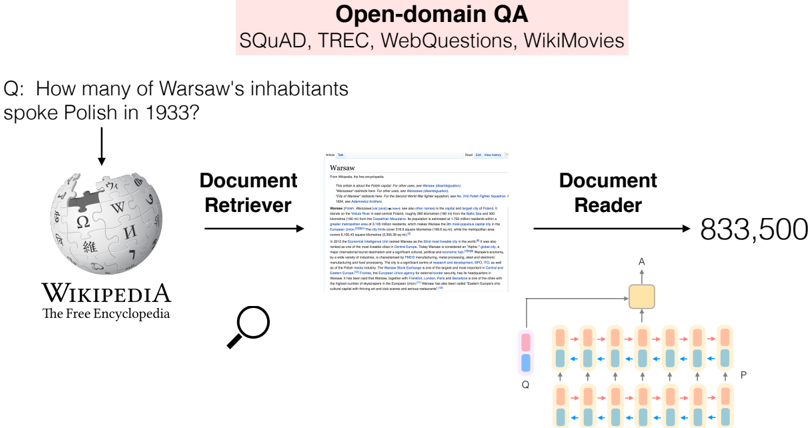
This paper proposes to tackle open-domain question answering using Wikipedia as the unique knowledge source: the answer to any factoid question is a text span in a Wikipedia article. This task of machine reading at scale combines the challenges of document retrieval (finding the relevant articles) with that of machine comprehension of text (identifying the answer spans from those articles). Our approach combines a search component based on bigram hashing and TF-IDF matching with a multi-layer recurrent neural network model trained to detect answers in Wikipedia paragraphs. Our experiments on multiple existing QA datasets indicate that (1) both modules are highly competitive with respect to existing counterparts and (2) multitask learning using distant supervision on their combination is an effective complete system on this challenging task.
Overview
The claims and statistics of this paper haven’t been checked yet.
Free: it reads the open-access text and checks the first 5 claims that cite a source we can check. Create a free account to check every claim.
Integrity signals
Registry
Cites
Statistics
Figures
Verification
Claims the paper makes
The claims and statistics of this paper haven’t been checked yet.
Free: it reads the open-access text and checks the first 5 claims that cite a source we can check. Create a free account to check every claim.
Claims other papers make about this one
Each is checked against this paper’s own text: does it say what the citing paper says it does?
The source backs part of the claim, not all of it — or backs it for a different population, condition or comparison.
In the citing paper
“In particular, the presence of low-value or semantically irrelevant entries dilutes the contribution of high-quality information in retrieval results, impairing downstream task performance and leading to measurable declines in metrics [5].”
From SEDM: Selective Self-Evolving Distributed Memory for Agents (2025) · cites this paper as [5]
Experimental — accuracy not yet measuredThe source backs part of the claim, not all of it — or backs it for a different population, condition or comparison.
In the citing paper
“Prior work has shown that retrieval improves performance across a variety of NLP tasks when considered in isolation.”
From Retrieval-Augmented Generation for Knowledge-Intensive NLP Tasks (2020) · cites this paper as [5]
Experimental — accuracy not yet measuredThe cited source says what the claim attributes to it.
In the citing paper
“This is in agreement with prior work that treated Wikipedia as a general knowledge source under the same reason (Chen et al., 2017; Petroni et al., 2021).”
From FActScore: Fine-grained Atomic Evaluation of Factual Precision in Long Form Text Generation (2023) · cites this paper as Chen et al., 2017
The cited source says what the claim attributes to it.
In the citing paper
“In-context learning methods now routinely invoke tools, leading to LM pipelines that use retrieval models (Chen et al., 2017; Lewis et al., 2020; Guu et al., 2020; Lazaridou et al., 2022; Izacard et al., 2022), multimodal foundation models, and more traditional tools like APIs (Nakano et al., 2021) and calculators.”
From DSPy: Compiling Declarative Language Model Calls into Self-Improving Pipelines (2023) · cites this paper as Chen et al., 2017
Self-check
Percentages, sums and reported differences re-computed from the paper’s own numbers.
The self-check needs the paper’s full text.
Citations
Cites
Adam: A Method for Stochastic Optimization
Kingma, D. P., & Ba, J. (2014) · arXiv · doi:10.48550/arxiv.1412.6980 · Cited by 98,946 · cited 1×
“We use Adamax for optimization as described in (Kingma and Ba, 2014).”
MethodGlove: Global Vectors for Word Representation
Pennington, J., Socher, R., & Manning, C. (2014) · Proceedings of the 2014 Conference on Empirical Methods in Natural Language Processing (EMNLP) · doi:10.3115/v1/d14-1162 · Cited by 34,071 · cited 2×
“The feature vector ˜ p i is comprised of the following parts: We use the 300-dimensional Glove word embeddings trained from 840B Web crawl data (Pennington et al., 2014).”
MethodNeural Machine Translation by Jointly Learning to Align and Translate
Bahdanau, D., Cho, K., & Bengio, Y. (2014) · arXiv · doi:10.48550/arxiv.1409.0473 · Cited by 16,213 · cited 2×
“…has made considerable progress recently thanks to new deep learning architectures like attention-based and memory-1 augmented neural networks (Bahdanau et al., 2015; Weston et al., 2015; Graves et al., 2014) and release of new training and evaluation datasets like QuizBowl (Iyyer et al., 2014),…”
BackgroundThe Stanford CoreNLP Natural Language Processing Toolkit
Manning, C., Surdeanu, M., Bauer, J., Finkel, J., Bethard, S., & McClosky, D. (2014) · Proceedings of 52nd Annual Meeting of the Association for Computational Linguistics: System Demonstrations · doi:10.3115/v1/p14-5010 · Cited by 7,037 · cited 2×
“We apply the Stanford CoreNLP toolkit (Manning et al., 2014) for tokenization and also generating lemma, part-of-speech, and named entity manual features.”
MethodSQuAD: 100,000+ Questions for Machine Comprehension of Text
Rajpurkar, P., Zhang, J., Lopyrev, K., & Liang, P. (2016) · Proceedings of the 2016 Conference on Empirical Methods in Natural Language Processing · doi:10.18653/v1/d16-1264 · Cited by 6,208 · cited 10×
“Next we evaluate our Document Reader component on the standard SQuAD evaluation (Rajpurkar et al., 2016).”
BackgroundMethodInfluentialA unified architecture for natural language processing: deep neural networks with multitask learning
Collobert, R., & Weston, J. (2008) · Proceedings of the 25th international conference on Machine learning - ICML '08 · doi:10.1145/1390156.1390177 · Cited by 5,058 · cited 1×
“Multitask learning (Caruana, 1998) and task transfer have a rich history in machine learning (e.g., using ImageNet in the computer vision community (Huh et al., 2016)), as well as in NLP in particular (Collobert and Weston, 2008).”
MethodSelf-citationFreebase: a collaboratively created graph database for structuring human knowledge
Bollacker, K., Evans, C., Paritosh, P., Sturge, T., & Taylor, J. (2008) · Proceedings of the 2008 ACM SIGMOD international conference on Management of data · doi:10.1145/1376616.1376746 · Cited by 4,852 · cited 11×
“Unlike knowledge bases (KBs) such as Freebase (Bollacker et al., 2008) or DBPedia (Auer et al.”
BackgroundMethodInfluentialDistant supervision for relation extraction without labeled data
Mintz, M., Bills, S., Snow, R., & Jurafsky, D. (2009) · Proceedings of the Joint Conference of the 47th Annual Meeting of the ACL and the 4th International Joint Conference on Natural Language Processing of the AFNLP: Volume 2 - ACL-IJCNLP '09 · doi:10.3115/1690219.1690287 · Cited by 2,752 · cited 1×
“Following previous work on distant supervision (DS) for relation extraction (Mintz et al., 2009), we use a”
MethodTeaching Machines to Read and Comprehend
Hermann, K. M., Kočiský, T., Grefenstette, E., Espeholt, L., Kay, W., Suleyman, M., & Blunsom, P. (2015) · arXiv (Cornell University) · doi:10.48550/arxiv.1506.03340 · Cited by 2,521 · cited 7×
“…Graves et al., 2014) and release of new training and evaluation datasets like QuizBowl (Iyyer et al., 2014), CNN/Daily Mail based on news articles (Hermann et al., 2015), CBT based on children books (Hill et al., 2016), or SQuAD (Rajpurkar et al., 2016) and WikiReading (Hewlett et al., 2016),…”
BackgroundMethodInfluentialDBpedia: A Nucleus for a Web of Open Data
Auer, S., Bizer, C., Kobilarov, G., Lehmann, J., Cyganiak, R., & Ives, Z. (2007) · Lecture Notes in Computer Science · doi:10.1007/978-3-540-76298-0_52 · Cited by 2,454 · cited 3×
“Unlike knowledge bases (KBs) such as Freebase (Bollacker et al., 2008) or DB-Pedia (Auer et al., 2007), which are easier for computers to process but too sparsely populated for open-domain question answering (Miller et al., 2016), Wikipedia contains up-to-date knowledge that humans are interested in.”
Background
Research works printed but not linked: 5
- Petr Baudiˇ s. 2015. YodaQA: a modular question answering system pipeline. In POSTER 2015-19th International Student Conference on Electrical Engineering . pages 1156-1165.
- Eric Brill, Susan Dumais, and Michele Banko. 2002. Ananalysis of the AskMSR question-answering system. In Empirical Methods in Natural Language Processing (EMNLP) . pages 257-264.
- Rudolf Kadlec, Ondrej Bajgar, and Jan Kleindienst. 2016. From particular to general: A preliminary case study of transfer learning in reading comprehension. Machine Intelligence Workshop, NIPS .
- Alexander H. Miller, Adam Fisch, Jesse Dodge, AmirHossein Karimi, Antoine Bordes, and Jason Weston. 2016. Key-value memory networks for directly reading documents. In Empirical Methods in Natural Language Processing (EMNLP) . pages 14001409.
- Jason Weston, Sumit Chopra, and Antoine Bordes. 2015. Memory networks. In International Conference on Learning Representations (ICLR) .
Cited by
Items 101–200 of 1,042
Pretrained Transformers for Text Ranking: BERT and Beyond
Lin, J., Nogueira, R. F., & Yates, A. (2021) · Synthesis lectures on human language technologies · doi:10.2200/s01123ed1v01y202108hlt053 · Cited by 453
Mind2Web: Towards a Generalist Agent for the Web
Deng, X., Gu, Y., Zheng, B., Chen, S., Stevens, S., Wang, B., Sun, H., & Su, Y. (2023) · arXiv · doi:10.48550/arxiv.2306.06070 · Cited by 134
“For example, it may be used as a plugin for ChatGPT [24] to directly acquire information and carry out actions on HTML websites, instead of only retrieving web content through a retriever tool [8, 18] or relying on pre-defined APIs for each web service [34, 37].”
Method(2023) · doi:10.52202/075280-1220 · Cited by 134
Revealing the Importance of Semantic Retrieval for Machine Reading at Scale
Nie, Y., Wang, S., & Bansal, M. (2019) · Proceedings of the 2019 Conference on Empirical Methods in Natural Language Processing and the 9th International Joint Conference on Natural Language Processing (EMNLP-IJCNLP) · doi:10.18653/v1/d19-1258 · Cited by 132
“Machine Reading at Scale First proposed and formalized in Chen et al. (2017), MRS has gained popularity with increasing amount of work on both dataset collection (Joshi et al., 2017; Welbl et al., 2018) and MRS model developments (Wang et al., 2018; Clark and Gardner, 2017; Htut et al., 2018).”
BackgroundMethodInfluentialA Review on Human-Computer Interaction and Intelligent Robots
Ren, F., & Bao, Y. (2020) · International Journal of Information Technology & Decision Making · doi:10.1142/s0219622019300052 · Cited by 164
Selective Question Answering under Domain Shift
Kamath, A., Jia, R., & Liang, P. (2020) · Proceedings of the 58th Annual Meeting of the Association for Computational Linguistics · doi:10.18653/v1/2020.acl-main.503 · Cited by 126
Machine Knowledge: Creation and Curation of Comprehensive Knowledge Bases
Weikum, G., Dong, X. L., Razniewski, S., & Suchanek, F. M. (2021) · Foundations and Trends in Databases · doi:10.1561/1900000064 · Cited by 205
KAT: A Knowledge Augmented Transformer for Vision-and-Language
Gui, L., Wang, B., Huang, Q., Hauptmann, A., Bisk, Y., & Gao, J. (2022) · Proceedings of the 2022 Conference of the North American Chapter of the Association for Computational Linguistics: Human Language Technologies · doi:10.18653/v1/2022.naacl-main.70 · Cited by 130
Fine-Tuning LLaMA for Multi-Stage Text Retrieval
Ma, X., Wang, L., Yang, N., Wei, F.-R., & Lin, J. (2023) · Annual International ACM SIGIR Conference on Research and Development in Information Retrieval · doi:10.1145/3626772.3657951 · Cited by 515
“Text retrieval is crucial in various natural language comprehension tasks [25], including web search [1], open-domain question answering [2], and fact verification [34].”
BackgroundWord Sense Disambiguation: A comprehensive knowledge exploitation framework
Wang, Y., Wang, M., & Fujita, H. (2019) · Knowledge-Based Systems · doi:10.1016/j.knosys.2019.105030 · Cited by 145
Conversational question answering: a survey
Zaib, M., Zhang, W. E., Sheng, Q. Z., Mahmood, A., & Zhang, Y. (2022) · Knowledge and Information Systems · doi:10.1007/s10115-022-01744-y · Cited by 195
A BERT Baseline for the Natural Questions
Alberti, C., Lee, K., & Collins, M. (2019) · arXiv (Cornell University) · doi:10.48550/arxiv.1901.08634 · Cited by 88
“The systems used in previous NQ baselines are DocumentQA (Clark and Gardner, 2017), DecAtt (Parikh et al., 2016), and Document Reader (Chen et al., 2017). instance to be where each probability p is obtained as a softmax over scores computed by the BERT model as follows: and return the highest…”
MethodUnsupervised Question Decomposition for Question Answering
Perez, E., Lewis, P., Yih, W.-T., Cho, K., & Kiela, D. (2020) · Proceedings of the 2020 Conference on Empirical Methods in Natural Language Processing (EMNLP) · doi:10.18653/v1/2020.emnlp-main.713 · Cited by 123
Lei, T., Zhang, Y., & Artzi, Y. (2017) · Cited by 148
A survey on question answering systems over linked data and documents
Dimitrakis, E., Sgontzos, K., & Tzitzikas, Y. (2019) · Journal of Intelligent Information Systems · doi:10.1007/s10844-019-00584-7 · Cited by 148
Biomedical Question Answering: A Survey of Approaches and Challenges
Jin, Q., Yuan, Z., Xiong, G., Yu, Q., Ying, H., Tan, C., Chen, M., Huang, S., Liu, X., & Yu, S. (2023) · ACM Computing Surveys · doi:10.1145/3490238 · Cited by 118
Case-based Reasoning for Natural Language Queries over Knowledge Bases
Das, R., Zaheer, M., Thai, D., Godbole, A., Perez, E., Lee, J. Y., Tan, L., Polymenakos, L., & McCallum, A. (2021) · Proceedings of the 2021 Conference on Empirical Methods in Natural Language Processing · doi:10.18653/v1/2021.emnlp-main.755 · Cited by 115
“Retrieval augmented QA models (Chen et al., 2017; Guu et al., 2020; Lewis et al., 2020b) augments a reader model with a retriever to find relevant paragraphs from a nonparametric memory.”
MethodCacheGen: KV Cache Compression and Streaming for Fast Large Language Model Serving
Liu, Y., Li, H., Cheng, Y., Ray, S., Huang, Y., Zhang, Q., Du, K., Yao, J., Lu, S., Ananthanarayanan, G., et al. (2024) · Proceedings of the ACM SIGCOMM 2024 Conference · doi:10.1145/3651890.3672274 · Cited by 118
“Evaluation results of CacheGen with more baselines is available §B, including using a smaller-sized model to speed up TTFT and Gisting, another context-shrinking technique.”
MKQA: A Linguistically Diverse Benchmark for Multilingual Open Domain Question Answering
Longpre, S., Lu, Y., & Daiber, J. (2021) · Transactions of the Association for Computational Linguistics · doi:10.1162/tacl_a_00433 · Cited by 280
“A common approach is to combine retrieval and extractive techniques (Chen et al., 2016, 2017; Dhingra et al., 2017; Cui et al., 2017).”
MethodShi, J., Cao, S., Hou, L., Li, J., & Zhang, H. (2021) · Proceedings of the 2021 Conference on Empirical Methods in Natural Language Processing · doi:10.18653/v1/2021.emnlp-main.341 · Cited by 107
“It requires machines to understand the free-form questions and infer the answers by analyzing information from a large corpus (Rajpurkar et al., 2016; Joshi et al., 2017; Chen et al., 2017) or structured knowledge base (Bordes et al., 2015; Yih et al., 2015; Jiang et al., 2019).”
BackgroundSemantic Models for the First-Stage Retrieval: A Comprehensive Review
Guo, J., Cai, Y., Fan, Y., Sun, F., Zhang, R., & Cheng, X. (2022) · ACM Transactions on Information Systems · doi:10.1145/3486250 · Cited by 113
“• SQuAD-open9 [25] is an open version of SQuAD dataset [140], from which only the questionanswer pairs are taken and discard the passages to form an open-domain QA setting.”
BackgroundMethod(2021) · doi:10.18653/v1/2021.naacl-main.46 · Cited by 115
Editing Large Language Models: Problems, Methods, and Opportunities
Yao, Y., Wang, P., Tian, B., Cheng, S., Li, Z., Deng, S., Chen, H., & Zhang, N. (2023) · arXiv · doi:10.48550/arxiv.2305.13172 · Cited by 115
Improving the Robustness of Question Answering Systems to Question Paraphrasing
Gan, W. C., & Ng, H. T. (2019) · Proceedings of the 57th Annual Meeting of the Association for Computational Linguistics · doi:10.18653/v1/p19-1610 · Cited by 112
“We conduct experiments on three state-of-the-art QA models: BERT (Devlin et al., 2018)3, DrQA4 (Chen et al., 2017), and BiDAF5 (Seo et al., 2016).”
MethodFeTaQA: Free-form Table Question Answering
Nan, L., Hsieh, C., Mao, Z., Lin, X. V., Verma, N., Zhang, R., Kryściński, W., Schoelkopf, H., Kong, R., Tang, X., et al. (2022) · Transactions of the Association for Computational Linguistics · doi:10.1162/tacl_a_00446 · Cited by 111
“Question Answering (QA) is the task of producing answers to natural language questions based on knowledge resources (Burke et al., 1997; Yao and Van Durme, 2014; Chen et al., 2017).”
BackgroundAnswering Complex Open-Domain Questions with Multi-Hop Dense Retrieval
Xiong, W., Li, X. L., Iyer, S., Du, J., Lewis, P., Wang, W. Y., Mehdad, Y., Yih, W.-T., Riedel, S., Kiela, D., et al. (2020) · arXiv · doi:10.48550/arxiv.2009.12756 · Cited by 112
“Open-domain QA with Dense Retrieval In contrast to sparse term-index IR methods, which are widely used by existing open-domain QA systems (Chen et al., 2017; Wang et al., 2018; Yang et al., 2019), recent systems (Lee et al., 2019; Guu et al., 2020; Karpukhin et al., 2020) typically uses dense…”
BackgroundMethodIncremental Transformer with Deliberation Decoder for Document Grounded Conversations
Li, Z., Niu, C., Meng, F., Feng, Y., Li, Q., & Zhou, J. (2019) · Proceedings of the 57th Annual Meeting of the Association for Computational Linguistics · doi:10.18653/v1/p19-1002 · Cited by 102
“Documents as a knowledge source provide a wide spectrum of knowledge, including but not limited to factoid, event updates, subjective opinion, etc. Recently, intensive research has been applied on using documents as knowledge sources for Question-Answering (Chen et al., 2017; Huang et al., 2018; Yu et al., 2018; Rajpu…”
MethodTyDi QA: A Benchmark for Information-Seeking Question Answering in Typologically Diverse LanguagesPreprint
Clark, J. H., Choi, E., Collins, M., Garrette, D., Kwiatkowski, T., Nikolaev, V., & Palomaki, J. (2020) · arXiv (Cornell University) · doi:10.48550/arxiv.2003.05002 · Cited by 109
“, 2019) ranging from generating an answer word-by-word (Mitra, 2017) or finding an answer from within an entire corpus as in TREC (Voorhees and Tice, 2000) and DrQA (Chen et al., 2017).”
BackgroundNeural Approaches to Conversational AI
Gao, J., Galley, M., & Li, L. (2019) · now publishers, Inc. eBooks · doi:10.1561/9781680835533 · Cited by 107
Chuang, Y.-S., Liu, C.-L., Lee, H.-Y., & Lee, L.-S. (2020) · Interspeech 2020 · doi:10.21437/interspeech.2020-1570 · Cited by 105
“Testing Set (A) Text (B) ASR (I) trained on text EM F1 EM F1 (a) BiDAF on Text [34] 58.40 69.90 37.02 50.90 (b) Dr.QA on Text [35] 62.84 73.74 41.16 54.51 (c) BERT on Text [10] 76.90 85.71 53.30 66.17 (d) BERT on ASR [10 .”
InfluentialHoVer: A Dataset for Many-Hop Fact Extraction And Claim Verification
Jiang, Y., Bordia, S., Zhong, Z., Dognin, C., Singh, M., & Bansal, M. (2020) · Findings of the Association for Computational Linguistics: EMNLP 2020 · doi:10.18653/v1/2020.findings-emnlp.309 · Cited by 105
B reak It Down: A Question Understanding Benchmark
Wolfson, T., Geva, M., Gupta, A., Gardner, M., Goldberg, Y., Deutch, D., & Berant, J. (2020) · Transactions of the Association for Computational Linguistics · doi:10.1162/tacl_a_00309 · Cited by 105
“As our IR model we use bigram TF-IDF, proposed by Chen et al. (2017). Because the RC model is run on single-hop questions, we use the BERTbased RC model from Min et al.”
MethodCompanion Proceedings of the Web Conference 2022
Guo, K., Defretiere, C., Diefenbach, D., Gravier, C., & Gourru, A. (2022) · doi:10.1145/3487553 · Cited by 107
A Survey on Machine Reading Comprehension—Tasks, Evaluation Metrics and Benchmark Datasets
Zeng, C., Li, S., Li, Q., Hu, J., & Hu, J. (2020) · Applied Sciences · doi:10.3390/app10217640 · Cited by 149
Aly, R., Guo, Z., Schlichtkrull, M. S., Thorne, J., Vlachos, A., Christodoulopoulos, C., Cocarascu, O., & Mittal, A. (2021) · Proceedings of the Fourth Workshop on Fact Extraction and VERification (FEVER) · doi:10.18653/v1/2021.fever-1.1 · Cited by 85
“The first part retrieves the most relevant documents using TF-IDF vector similarity scores between the claim and the title and body text of the documents.”
MethodInfluentialSDNet: Contextualized Attention-based Deep Network for Conversational Question Answering
Zhu, C., Zeng, M., & Huang, X. (2018) · arXiv (Cornell University) · doi:10.48550/arxiv.1812.03593 · Cited by 100
“We compare SDNet with the following baseline models: PGNet (Seq2Seq with copy mechanism) (See et al., 2017), DrQA (Chen et al., 2017), DrQA+PGNet (Reddy et al., 2018), BiDAF++ (Yatskar, 2018) and FlowQA (Huang et al., 2018).”
MethodInfluentialPretrained Transformers for Text Ranking: BERT and Beyond
Lin, J., Nogueira, R. F., & Yates, A. (2020) · arXiv (Cornell University) · doi:10.48550/arxiv.2010.06467 · Cited by 101
Answering Complex Open-domain Questions Through Iterative Query Generation
Qi, P., Lin, X., Mehr, L., Wang, Z., & Manning, C. D. (2019) · Proceedings of the 2019 Conference on Empirical Methods in Natural Language Processing and the 9th International Joint Conference on Natural Language Processing (EMNLP-IJCNLP) · doi:10.18653/v1/d19-1261 · Cited by 96
“Open-domain question answering (QA) Inspired by the series of TREC QA competitions,2 Chen et al. (2017) were among the first to adapt neural QA models to the open-domain setting.”
BackgroundMethodInfluentialTransform-Retrieve-Generate: Natural Language-Centric Outside-Knowledge Visual Question Answering
Gao, F., Ping, Q., Thattai, G., Reganti, A., Wu, Y. N., & Natarajan, P. (2022) · 2022 IEEE/CVF Conference on Computer Vision and Pattern Recognition (CVPR) · doi:10.1109/cvpr52688.2022.00501 · Cited by 92
“There are mainly two streams of approaches, namely knowledge graph-based question answering [10, 32, 38, 52, 59, 65] and knowledge retrieval-based question answering [5, 7, 19, 29, 44, 45, 60, 62].”
BackgroundMethodSimple Entity-Centric Questions Challenge Dense Retrievers
Sciavolino, C., Zhong, Z., Lee, J., & Chen, D. (2021) · Proceedings of the 2021 Conference on Empirical Methods in Natural Language Processing · doi:10.18653/v1/2021.emnlp-main.496 · Cited by 98
“Sparse retrieval Before the emergence of dense retrievers, traditional sparse retrievers such as TF-IDF or BM25 were the de facto method in open-domain question-answering systems (Chen et al., 2017; Yang et al., 2019).”
MethodSelf-citationCogLTX: Applying BERT to Long Texts
Ding, M., Zhou, C., Yang, H., & Tang, J. (2020) · neural information processing systems · Cited by 189
Interpretable Long-Form Legal Question Answering with Retrieval-Augmented Large Language Models
Louis, A., DIJCK, G. V., & Spanakis, G. (2024) · Proceedings of the AAAI Conference on Artificial Intelligence · doi:10.1609/aaai.v38i20.30232 · Cited by 252
Ranking Paragraphs for Improving Answer Recall in Open-Domain Question Answering
Lee, J., Yun, S., Kim, H., Ko, M., & Kang, J. (2018) · Proceedings of the 2018 Conference on Empirical Methods in Natural Language Processing · doi:10.18653/v1/d18-1053 · Cited by 94
“(Chen et al., 2017), the large improvement in the exact match scores shows that future researches would benefit from ranking and reading the more relevant paragraphs.”
BackgroundMethodInfluentialXQA: A Cross-lingual Open-domain Question Answering Dataset
Liu, J., Lin, Y., Liu, Z., & Sun, M. (2019) · Proceedings of the conference - Association for Computational Linguistics. Meeting · doi:10.18653/v1/p19-1227 · Cited by 146
“Chen et al. (2017) proposed DrQA model, which used a text retriever to obtain relevant documents from Wikipedia, and further applied a trained reading comprehension model to extract the answer from the retrieved documents.”
MethodUsing Local Knowledge Graph Construction to Scale Seq2Seq Models to Multi-Document Inputs
Fan, A., Gardent, C., Braud, C., & Bordes, A. (2019) · Proceedings of the 2019 Conference on Empirical Methods in Natural Language Processing and the 9th International Joint Conference on Natural Language Processing (EMNLP-IJCNLP) · doi:10.18653/v1/d19-1428 · Cited by 96
“Various approaches have been proposed, including leveraging TF-IDF and bigram hashing with an RNN to find relevant information (Chen et al., 2017), models that score individual paragraphs for sub-selection (Clark and Gardner, 2017), and nearest neighbor search with paragraph re-ranking (Das et al.”
MethodSelf-citationDeriving Machine Attention from Human Rationales
Bao, Y., Chang, S., Yu, M., & Barzilay, R. (2018) · Conference on Empirical Methods in Natural Language Processing (EMNLP) · doi:10.18653/v1/d18-1216 · Cited by 140
“Attention-based models Attention has been shown to be effective when the model is trained on large amounts of training data (Bahdanau et al., 2014; Luong et al., 2015; Rush et al., 2015; Yang et al., 2016; Lin et al., 2017; Chen et al., 2017; Vaswani et al., 2017).”
BackgroundA Survey on Machine Reading Comprehension Systems
Baradaran, R., Ghiasi, R., & Amirkhani, H. (2022) · Natural Language Engineering · doi:10.1017/s1351324921000395 · Cited by 143
Answering while Summarizing: Multi-task Learning for Multi-hop QA with Evidence Extraction
Nishida, K., Nishida, K., Nagata, M., Otsuka, A., Saito, I., Asano, H., & Tomita, J. (2019) · Proceedings of the 57th Annual Meeting of the Association for Computational Linguistics · doi:10.18653/v1/p19-1225 · Cited by 91
“For such datasets, the document retrieval model is combined with the contextquery matching model (Chen et al., 2017a; Wang et al., 2018a,b; Nishida et al., 2018).”
MethodMulti-Hop Paragraph Retrieval for Open-Domain Question Answering
Feldman, Y., & El-Yaniv, R. (2019) · Proceedings of the 57th Annual Meeting of the Association for Computational Linguistics · doi:10.18653/v1/p19-1222 · Cited by 91
“This task has recently been resurged following the work of Chen et al. (2017), who used a TFIDF based retriever to find potentially relevant documents, followed by a neural RC component that extracted the most probable answer from the retrieved documents.”
MethodInfluentialOpen-Domain, Content-based, Multi-modal Fact-checking of Out-of-Context Images via Online Resources
Abdelnabi, S., Hasan, R., & Fritz, M. (2022) · IEEE Computer Society Conference on Computer Vision and Pattern Recognition/Proceedings - IEEE Computer Society Conference on Computer Vision and Pattern Recognition/Proceedings · doi:10.1109/cvpr52688.2022.01452 · Cited by 170
“Importantly, we retrieve evidence in a fully automated and flexible open-domain manner [8]; no ‘golden evidence’ is pre-identified or curated and given to the model.”
MethodTay, Y., Wang, S., Luu, A. T., Fu, J., Phan, M. C., Yuan, X., Rao, J., Hui, S. C., & Zhang, A. (2019) · Proceedings of the 57th Annual Meeting of the Association for Computational Linguistics · doi:10.18653/v1/p19-1486 · Cited by 88
“The challenges of having a long context have been traditionally mitigated by a two-step approach - retrieval first and then reading second (Chen et al., 2017; Wang et al., 2018; Lin et al., 2018).”
BackgroundImproving Passage Retrieval with Zero-Shot Question Generation
Sachan, D., Lewis, M., Joshi, M., Aghajanyan, A., Yih, W.-T., Pineau, J., & Zettlemoyer, L. (2022) · Proceedings of the 2022 Conference on Empirical Methods in Natural Language Processing · doi:10.18653/v1/2022.emnlp-main.249 · Cited by 90
Conversational Information Seeking
Zamani, H., Trippas, J. R., Dalton, J., & Radlinski, F. (2023) · Foundations and Trends® in Information Retrieval · doi:10.1561/1500000081 · Cited by 79
Paradigm Shift in Natural Language Processing
Sun, T.-X., Liu, X.-Y., Qiu, X.-P., & Huang, X.-J. (2022) · Machine Intelligence Research · doi:10.1007/s11633-022-1331-6 · Cited by 86
Recommendation as a Communication Game: Self-Supervised Bot-Play for Goal-oriented Dialogue
Kang, D., Balakrishnan, A., Shah, P., Crook, P., Boureau, Y.-L., & Weston, J. (2019) · Conference on Empirical Methods in Natural Language Processing (EMNLP) · doi:10.18653/v1/d19-1203 · Cited by 122
“K (10) Aligning dialogue context and movie descriptions: we use dot-product attention(Chen et al., 2017) between the dialogue context and each of the movie descriptions: Generating utterances: G enerate The expert can produce two types of utterances, according to whether it is recommending a movie…”
MethodSelf-citationPlaying Text-Adventure Games with Graph-Based Deep Reinforcement Learning
Ammanabrolu, P., & Riedl, M. O. (2019) · Conference of the North American Chapter of the Association for Computational Linguistics: Human Language Technologies (NAACL-HLT) · doi:10.18653/v1/n19-1358 · Cited by 117
“Since the DrQA embedding layers are initialized with GloVe, we are transferring word embeddings that are tuned during the training of the QA architecture.”
MethodInfluentialJiang, Y., & Bansal, M. (2019) · Proceedings of the 57th Annual Meeting of the Association for Computational Linguistics · doi:10.18653/v1/p19-1262 · Cited by 83
“Yang et al. (2018) then select the top-8 documents from Wikipedia with the shortest bigram TF-IDF (Chen et al., 2017) distance to the question as the distractors to form the context with a total of 10 documents.”
BackgroundMethodPCNNA: A Photonic Convolutional Neural Network Accelerator
Mehrabian, A., Al-Kabani, Y., Sorger, V. J., & El-Ghazawi, T. (2018) · IEEE International System-on-Chip Conference (SOCC) · doi:10.1109/socc.2018.8618542 · Cited by 94
“CNNs have been able to reach record-breaking performance in many tasks including but not limited to computer vision [1], speech recognition [2], and NLP [3].”
BackgroundRepresentation Learning for Natural Language Processing
Liu, Z., Lin, Y., & Sun, M. (2020) · Springer eBooks · doi:10.1007/978-981-15-5573-2 · Cited by 144
Non-Parametric Adaptation for Neural Machine Translation
Bapna, A., & Firat, O. (2019) · Proceedings of the 2019 Conference of the North · doi:10.18653/v1/n19-1191 · Cited by 80
“While our approach relies purely on retrieval from the training corpus, there has been quite a lot of work, especially on Question Answering, that attempts to find additional signals to perform the supervised task in the presence of external knowledge sources (Chen et al., 2017; Wang et al., 2018).”
MethodWang, L., Sun, M., Zhao, W., Shen, K., & Liu, J. (2018) · International Workshop on Semantic Evaluation (SemEval) · doi:10.18653/v1/s18-1120 · Cited by 96
“First, let’s define a sequence attention function (Chen et al., 2017): u and v i are vectors and W 1 is a matrix. f is a non-linear activation function and is set to ReLU .”
BackgroundZero-shot Neural Passage Retrieval via Domain-targeted Synthetic Question Generation
Ma, J., Korotkov, I., Yang, Y., Hall, K., & McDonald, R. (2021) · Proceedings of the 16th Conference of the European Chapter of the Association for Computational Linguistics: Main Volume · doi:10.18653/v1/2021.eacl-main.92 · Cited by 80
“The target collection contains all passages from the development set and is augmented with passages from 2016-12-21 dump of Wikipedia (Chen et al., 2017).”
BackgroundOguz, B., Chen, X., Karpukhin, V., Peshterliev, S., Okhonko, D., Schlichtkrull, M., Gupta, S., Mehdad, Y., & Yih, S. (2022) · Findings of the Association for Computational Linguistics: NAACL 2022 · doi:10.18653/v1/2022.findings-naacl.115 · Cited by 41
“In the neural era, Chen et al. (2017) were179 the first to combine MRC with retrieval for end-to-180 end QA.”
BackgroundHeinzerling, B., & Inui, K. (2021) · Proceedings of the 16th Conference of the European Chapter of the Association for Computational Linguistics: Main Volume · doi:10.18653/v1/2021.eacl-main.153 · Cited by 78
TwoWingOS: A Two-Wing Optimization Strategy for Evidential Claim Verification
Yin, W., & Roth, D. (2018) · Proceedings of the 2018 Conference on Empirical Methods in Natural Language Processing · doi:10.18653/v1/d18-1010 · Cited by 75
“Open-domain question answering (QA) against a text corpus (Chen et al., 2017; Wang et al., 2018) can also be treated as claim entailment problem, if we treat (question, correct answer) as a claim.”
BackgroundMethodInfluentialTopiOCQA: Open-domain Conversational Question Answering with Topic Switching
Adlakha, V., Dhuliawala, S., Suleman, K., de Vries, H., & Reddy, S. (2022) · Transactions of the Association for Computational Linguistics · doi:10.1162/tacl_a_00471 · Cited by 74
“The better performance of DPR Retriever over BM25 indicates that T OPI OCQA requires learning task-specific dense semantic encoding for superior retrieval performance.”
MethodInfluentialChen, X., Meng, F., Li, P., Chen, F., Xu, S., Xu, B., & Zhou, J. (2020) · Conference on Empirical Methods in Natural Language Processing (EMNLP) · doi:10.18653/v1/2020.emnlp-main.275 · Cited by 91
“This pipeline framework has been widely used for the open domain setting (Chen et al., 2017; Min et al., 2018; Nie et al., 2019) and shows promising performance with explicit use of knowledge in”
MethodR$^3$: Reinforced Reader-Ranker for Open-Domain Question AnsweringPreprint
Wang, S., Yu, M., Guo, X., Wang, Z., Klinger, T., Zhang, W., Chang, S., Tesauro, G. J., Zhou, B., & Jiang, J. (2017) · arXiv (Cornell University) · doi:10.48550/arxiv.1709.00023 · Cited by 75
“To evaluate our model we have chosen five challenging datasets under the distant super-vision setting following (Chen et al., 2017a)’s work, including Quasar-T (Dhingra et al., 2017b), SQuAD (Rajpurkar et al., 2016), WikiMovie (Miller et al., 2016), Curat-edTREC (Baudiˇs and ˇSediv`y, 2015), and…”
BackgroundMethodInfluentialDr ChatGPT tell me what I want to hear: How different prompts impact health answer correctness
Koopman, B., & Zuccon, G. (2023) · Proceedings of the 2023 Conference on Empirical Methods in Natural Language Processing · doi:10.18653/v1/2023.emnlp-main.928 · Cited by 73
“This is important when LLMs are integrated in a retrieve-then-generate 1 pipeline (Chen et al., 2017; Karpukhin et al., 2020; Lewis et al., 2020), where information related to the question is first identi-fied from a corpus (e.g., the Web), and this is then passed to the model via the prompt to…”
BackgroundMulti-style Generative Reading Comprehension
Nishida, K., Saito, I., Nishida, K., Shinoda, K., Otsuka, A., Asano, H., & Tomita, J. (2019) · Proceedings of the conference - Association for Computational Linguistics. Meeting · doi:10.18653/v1/p19-1220 · Cited by 93
“e sharing ofthe question-passages reader module among the RC, passage ranking, and answer possibility classification tasks. In multi-task learning without task-specific layers, Devlin et al. (2018) and Chen et al. (2017) improved RC performance by learning multiple datasets from the same extractive RC setting. McCann et…”
BackgroundMethodInfluentialRelevance-guided Supervision for OpenQA with ColBERT
Khattab, O., Potts, C., & Zaharia, M. (2021) · Transactions of the Association for Computational Linguistics · doi:10.1162/tacl_a_00405 · Cited by 71
Self-Training for Jointly Learning to Ask and Answer Questions
Sachan, M., & Xing, E. (2018) · Proceedings of the 2018 Conference of the North American Chapter of the Association for Computational Linguistics: Human Language Technologies, Volume 1 (Long Papers) · doi:10.18653/v1/n18-1058 · Cited by 70
“After the release of large benchmarks such as SQUAD, MS MARCO and WikiQA, there has been a surge in interest on using neural network or deep-learning models for QA (Yin et al., 2015; Seo et al., 2016; Shen et al., 2016; Chen et al., 2017; Liu et al., 2017; Hu et al., 2017).”
MethodGeographic Question Answering: Challenges, Uniqueness, Classification, and Future Directions
Mai, G., Janowicz, K., Zhu, R., Cai, L., & Lao, N. (2021) · AGILE GIScience Series · doi:10.5194/agile-giss-2-8-2021 · Cited by 120
Knowledgeable or Educated Guess? Revisiting Language Models as Knowledge Bases
Cao, B., Lin, H., Han, X., Sun, L., Yan, L., Liao, M., Xue, T., & Xu, J. (2021) · Proceedings of the 59th Annual Meeting of the Association for Computational Linguistics and the 11th International Joint Conference on Natural Language Processing (Volume 1: Long Papers) · doi:10.18653/v1/2021.acl-long.146 · Cited by 71
“” to query MLMs. Specifically, we use the same context retrieval method as Petroni et al. (2020): for each instance, given the subject and relation as query, we use the first paragraph of DRQA’s (Chen et al., 2017) retrieved document as external contexts.”
MethodLearning Dense Representations of Phrases at Scale
Lee, J., Sung, M., Kang, J., & Chen, D. (2021) · Proceedings of the 59th Annual Meeting of the Association for Computational Linguistics and the 11th International Joint Conference on Natural Language Processing (Volume 1: Long Papers) · doi:10.18653/v1/2021.acl-long.518 · Cited by 68
“While a dominating approach is a two-stage retriever-reader approach (Chen et al., 2017; Lee et al., 2019; Guu et al., 2020; Karpukhin et al., 2020), we focus on a recent new paradigm solely based on phrase retrieval (Seo et al., 2019; Lee et al., 2020).”
BackgroundMethodSelf-citationLi, Z., Wu, X., Du, H., Liu, F., Nghiem, H. T., & Shi, G. (2025) · IEEE/CVF Conference on Computer Vision and Pattern Recognition Workshops (CVPRW) · doi:10.1109/cvprw67362.2025.00147 · Cited by 124
“…verbose but correct answers [123], containment exact match [88] is a more practical version used more often in the evaluation, which includes removing articles and space of predicted answers and check whether the normalized predicted answer is contained in the normalized gold answer [26, 105].”
Graph Neural Networks for Natural Language Processing: A SurveyPreprint
Wu, L., Chen, Y., Shen, K., Guo, X., Gao, H., Li, S., Pei, J., & Long, B. (2021) · arXiv (Cornell University) · doi:10.48550/arxiv.2106.06090 · Cited by 70
Open Domain Question Answering based on Text Enhanced Knowledge Graph with Hyperedge Infusion
Han, J., Cheng, B. H., & Wang, X. (2020) · Findings of the Association for Computational Linguistics: EMNLP (Findings of EMNLP) · doi:10.18653/v1/2020.findings-emnlp.133 · Cited by 80
“Also a relevant text corpus D = d 1 , d 2 , ..., d |D| is retrieved from Wikipedia by an off-the-shelf document retriever (Chen et al., 2017), which d i = ( w 1 , w 2 , ..., w | d i | ) represents a document and the entities mentioned in documents have been linked.”
BackgroundMATE: Multi-view Attention for Table Transformer Efficiency
Eisenschlos, J., Gor, M., Müller, T., & Cohen, W. (2021) · Proceedings of the 2021 Conference on Empirical Methods in Natural Language Processing · doi:10.18653/v1/2021.emnlp-main.600 · Cited by 67
“To apply sparse transformers to the HYBRIDQA task, we propose POINTR, a two stage framework in a somewhat similar fashion to open domain QA pipelines (Chen et al., 2017; Lee et al., 2019).”
BackgroundMethodInfluentialBridging the Gap between Relevance Matching and Semantic Matching for Short Text Similarity Modeling
Rao, J., Liu, L., Tay, Y., Yang, W., Shi, P., & Lin, J. (2019) · Conference on Empirical Methods in Natural Language Processing (EMNLP) · doi:10.18653/v1/d19-1540 · Cited by 71
“Though improvements have been shown from adding exact match signals into representation learning, for example, the Dr.QA model of Chen et al. (2017a) concatenates exact match scores to word embeddings, it remains unclear to what extent relevance matching signals can further improve models primarily…”
BackgroundMethodInfluentialSberQuAD – Russian Reading Comprehension Dataset: Description and Analysis
Efimov, P., Chertok, A., Boytsov, L., & Braslavski, P. (2020) · Lecture notes in computer science · doi:10.1007/978-3-030-58219-7_1 · Cited by 106
Discriminative Nearest Neighbor Few-Shot Intent Detection by Transferring Natural Language Inference
Zhang, J., Hashimoto, K., Liu, W., Wu, C.-S., Wan, Y., Yu, P. S., Socher, R., & Xiong, C. (2020) · Conference on Empirical Methods in Natural Language Processing (EMNLP) · doi:10.18653/v1/2020.emnlp-main.411 · Cited by 112
Cognitive Architectures for Language Agents
Sumers, T. R., Yao, S., Narasimhan, K., & Griffiths, T. L. (2023) · arXiv · doi:10.48550/arxiv.2309.02427 · Cited by 798
“A : In natural language processing (NLP), an LLM takes text as input and outputs text.”
MethodInfluentialA Vietnamese Dataset for Evaluating Machine Reading Comprehension
Nguyen, K. V., Nguyen, D.-V., Nguyen, T. H. A., & Nguyen, N. L.-T. (2020) · International Conference on Computational Linguistics · doi:10.18653/v1/2020.coling-main.233 · Cited by 106
DWIE: An entity-centric dataset for multi-task document-level information extraction
Zaporojets, K., Deleu, J., Develder, C., & Demeester, T. (2021) · Information Processing & Management · doi:10.1016/j.ipm.2021.102563 · Cited by 110
Kim, Y., Bang, S., Sohn, J., & Kim, H. (2021) · Automation in Construction · doi:10.1016/j.autcon.2021.104061 · Cited by 73
A medical question answering system using large language models and knowledge graphs
Guo, Q., Cao, S., & Yi, Z. (2022) · International Journal of Intelligent Systems · doi:10.1002/int.22955 · Cited by 65
“Besides, both Chen et al.(20) and Buscaldi et al.”
MethodExtreme Multi-label Learning for Semantic Matching in Product Search
Chang, W.-C., Jiang, D., Yu, H., Teo, C. H., Zhang, J., Zhong, K., Kolluri, K., Hu, Q., Shandilya, N., Ievgrafov, V., et al. (2021) · ACM SIGKDD Conference on Knowledge Discovery and Data Mining (KDD) · doi:10.1145/3447548.3467092 · Cited by 98
“This indicates another unique difference between semantic product search problem and the conventional web retrieval problem where Okapi-BM25 variants are often a strong baseline [8, 14, 27].”
BackgroundWeakly-Supervised Visual-Retriever-Reader for Knowledge-based Question Answering
Luo, M., Zeng, Y., Banerjee, P., & Baral, C. (2021) · Proceedings of the 2021 Conference on Empirical Methods in Natural Language Processing · doi:10.18653/v1/2021.emnlp-main.517 · Cited by 58
“NLI is used widely in the NLP tasks to check whether the hypothesis can be entailed from the given premise, and here we use NLI to check whether the correct answers and the predicted answer are semantically same.”
MethodInfluentialNeural machine translation with monolingual translation memory
Cai, D., Wang, Y., Li, H., Lam, W., & Liu, L. (2021) · Proceedings of the 59th Annual Meeting of the Association for Computational Linguistics and the 11th International Joint Conference on Natural Language Processing (Volume 1: Long Papers) · doi:10.18653/v1/2021.acl-long.567 · Cited by 45
“One typical use is to retrieve supporting evidence for open-domain question answering (e.g., Chen et al., 2017; Lee et al., 2019; Karpukhin et al., 2020).”
BackgroundRetrieval Augmented Visual Question Answering with Outside Knowledge
Lin, W., & Byrne, B. (2022) · Proceedings of the 2022 Conference on Empirical Methods in Natural Language Processing · doi:10.18653/v1/2022.emnlp-main.772 · Cited by 61
PRAG: Paninian Retrieval-Augmented Generation for Safety-Critical Medical Question Answering
Jin, D., Pan, E., Oufattole, N., Weng, W., Fang, H., & Peter Szolovits, B. (2020) · arXiv (Cornell University) · doi:10.48550/arxiv.2009.13081 · Cited by 63
“…previous works for OpenQA focus on datasets in which answers are in the format of spans (several consecutive tokens) and can be found based on the information explicitly expressed in the provided text (Joshi et al. 2017; Chen et al. 2017; Dunn et al. 2017; Dhingra, Mazaitis, and Cohen 2017).”
BackgroundMethodInfluentialRecent Trends in Deep Learning Based Open-Domain Textual Question Answering Systems
Huang, Z., Xu, S., Hu, M., Wang, X., Qiu, J., Fu, Y., Zhao, Y., Peng, Y., & Wang, C. (2020) · IEEE Access · doi:10.1109/access.2020.2988903 · Cited by 85
“Existing predictive reasoning usually supposes that the answer span only appears in the single paragraph, or the answer text is short [37].”
BackgroundMethodInfluentialQuestion Answering with Long Multiple-Span Answers
Zhu, M., Ahuja, A., Juan, D.-C., Wei, W., & Reddy, C. K. (2020) · Findings of the Association for Computational Linguistics: EMNLP 2020 · doi:10.18653/v1/2020.findings-emnlp.342 · Cited by 57
“Baselines and Evaluation Metrics We use the following baseline techniques in this experiment task: DrQA Reader (Chen et al., 2017) uses an RNN-based architecture, along with context-toquery attention, to compute the answer.”
MethodChen, Y., Wu, L., & Zaki, M. J. (2020) · International Joint Conference on Artificial Intelligence · doi:10.24963/ijcai.2020/171 · Cited by 83
“, 2017), DrQA (Chen et al., 2017), DrQA+PGNet (Reddy et al.”
MethodMacaw: An Extensible Conversational Information Seeking Platform
Zamani, H., & Craswell, N. (2020) · International ACM SIGIR Conference on Research and Development in Information Retrieval (SIGIR) · doi:10.1145/3397271.3401415 · Cited by 79
Towards a Robust Deep Neural Network against Adversarial Texts: A Survey
Wang, W., Wang, R., Wang, L., Wang, Z., & Ye, A. (2021) · IEEE Transactions on Knowledge and Data Engineering · doi:10.1109/tkde.2021.3117608 · Cited by 233
Revisiting Large Language Models as Zero-shot Relation Extractors
Li, G., Wang, P., & Ke, W. (2023) · Findings of the Association for Computational Linguistics: EMNLP (Findings of EMNLP) · doi:10.18653/v1/2023.findings-emnlp.459 · Cited by 165
DSPy: Compiling Declarative Language Model Calls into Self-Improving Pipelines
Khattab, O., Singhvi, A., Maheshwari, P., Zhang, Z., Santhanam, K., Vardhamanan, S., Haq, S., Sharma, A., Joshi, T. T., Moazam, H., et al. (2023) · arXiv · doi:10.48550/arxiv.2310.03714 · Cited by 911
“In-context In-context learning methods now routinely invoke tools, leading to LM pipelines that use retrieval (Chen et al., 2017; Lewis et al., 2020; Guu et al., 2020; Lazaridou et al., 2022; Izacard et al., 2022), and APIs (Nakano et al., 2021).”
KG-FiD: Infusing Knowledge Graph in Fusion-in-Decoder for Open-Domain Question Answering
Yu, D., Zhu, C., Fang, Y., Yu, W., Wang, S., Xu, Y., Ren, X., Yang, Y., & Zeng, M. (2022) · Proceedings of the 60th Annual Meeting of the Association for Computational Linguistics (Volume 1: Long Papers) · doi:10.18653/v1/2022.acl-long.340 · Cited by 46
Metadata
- Authors
- Chen, D., Fisch, A., Weston, J., & Bordes, A.
- Affiliations
- Meta (United States) (US)
- ORCID
- Chen, Danqi
- Venue
- Proceedings of the 55th Annual Meeting of the Association for Computational Linguistics (Volume 1: Long Papers)
- Published
- 2017
- Pages
- 1870-1879
- ISSN
- 0736-587X (ISSN-L)
- OpenAlex
- W2962985038
- Cited by
- 1,546
- References
- 39
- Citations by year
- 2026: 61 · 2025: 105 · 2024: 123 · 2023: 218 · 2022: 209 · 2021: 268 · 2020: 202 · 2019: 199 · 2018: 142 · 2017: 18
- FWCI
- 69.97
- Type
- conference paper
- Language
- en
- Open access
- hybrid
- doi.org
- Licence
- cc-by
- Locations
- Proceedings of the conference - Association for Computational Linguistics. Meeting (publishedVersion, cc-by)
- arXiv (Cornell University) (submittedVersion)
- arXiv (Cornell University)
- Topics
- Physical Sciences › Computer Science › Artificial Intelligence › Topic Modeling
- Physical Sciences › Computer Science › Information Systems › Information Retrieval and Search Behavior
- Physical Sciences › Computer Science › Artificial Intelligence › Natural Language Processing Techniques
- Keywords
- open-domain question answering, Wikipedia, machine reading, document retrieval, recurrent neural networks, multi-task learning, distant supervision, factoid questions
About these checks
Registry, retraction, Cites and statistics results are computed, not judged, with one exception: a printed reference that no index lists is read once by a model before it counts as a citation error. Claims are extracted by a model and kept only when their quote appears verbatim in the text; each cited source is then checked, with a model’s help, for whether it says what the claim relies on. Those verdicts can be wrong — read the claim’s quote and the cited source before relying on one.
Statistics and arithmetic are recomputed, not judged.
Confidence bands are shown only for fields calibrated on our annotated test set. None is calibrated yet, so no band is shown.
What counts as a claim ›How we measure confidence ›How we check this ›
Are you an author, or do you see a problem with this page? Request a review
Data sources
Bibliographic data: Semantic Scholar, OpenAlex, Crossref.
Contains information from the Semantic Scholar Academic Graph Datasets, made available under the ODC Attribution License (ODC-BY 1.0).
Semantic Scholar’s data is described in: Kinney, R., et al. (2023). The Semantic Scholar Open Data Platform. arXiv:2301.10140.
