

Reading Wikipedia to Answer Open-Domain Questions
Open accessThe DOI matches its Crossref record; 34 of the 39 references it cites were found in a registry or an index.
Abstract
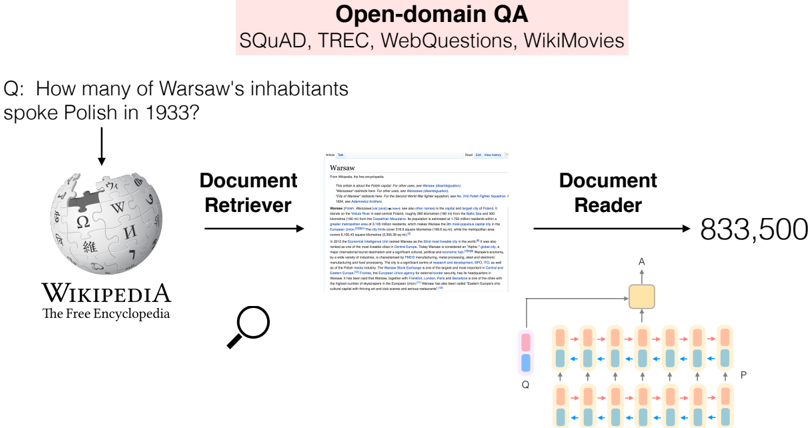
This paper proposes to tackle open-domain question answering using Wikipedia as the unique knowledge source: the answer to any factoid question is a text span in a Wikipedia article. This task of machine reading at scale combines the challenges of document retrieval (finding the relevant articles) with that of machine comprehension of text (identifying the answer spans from those articles). Our approach combines a search component based on bigram hashing and TF-IDF matching with a multi-layer recurrent neural network model trained to detect answers in Wikipedia paragraphs. Our experiments on multiple existing QA datasets indicate that (1) both modules are highly competitive with respect to existing counterparts and (2) multitask learning using distant supervision on their combination is an effective complete system on this challenging task.
Overview
The claims and statistics of this paper haven’t been checked yet.
Free: it reads the open-access text and checks the first 5 claims that cite a source we can check. Create a free account to check every claim.
Integrity signals
Registry
Cites
Statistics
Figures
Verification
Claims the paper makes
The claims and statistics of this paper haven’t been checked yet.
Free: it reads the open-access text and checks the first 5 claims that cite a source we can check. Create a free account to check every claim.
Claims other papers make about this one
Each is checked against this paper’s own text: does it say what the citing paper says it does?
The source backs part of the claim, not all of it — or backs it for a different population, condition or comparison.
In the citing paper
“In particular, the presence of low-value or semantically irrelevant entries dilutes the contribution of high-quality information in retrieval results, impairing downstream task performance and leading to measurable declines in metrics [5].”
From SEDM: Selective Self-Evolving Distributed Memory for Agents (2025) · cites this paper as [5]
Experimental — accuracy not yet measuredThe source backs part of the claim, not all of it — or backs it for a different population, condition or comparison.
In the citing paper
“Prior work has shown that retrieval improves performance across a variety of NLP tasks when considered in isolation.”
From Retrieval-Augmented Generation for Knowledge-Intensive NLP Tasks (2020) · cites this paper as [5]
Experimental — accuracy not yet measuredThe cited source says what the claim attributes to it.
In the citing paper
“This is in agreement with prior work that treated Wikipedia as a general knowledge source under the same reason (Chen et al., 2017; Petroni et al., 2021).”
From FActScore: Fine-grained Atomic Evaluation of Factual Precision in Long Form Text Generation (2023) · cites this paper as Chen et al., 2017
The cited source says what the claim attributes to it.
In the citing paper
“In-context learning methods now routinely invoke tools, leading to LM pipelines that use retrieval models (Chen et al., 2017; Lewis et al., 2020; Guu et al., 2020; Lazaridou et al., 2022; Izacard et al., 2022), multimodal foundation models, and more traditional tools like APIs (Nakano et al., 2021) and calculators.”
From DSPy: Compiling Declarative Language Model Calls into Self-Improving Pipelines (2023) · cites this paper as Chen et al., 2017
Self-check
Percentages, sums and reported differences re-computed from the paper’s own numbers.
The self-check needs the paper’s full text.
Citations
Cites
Adam: A Method for Stochastic Optimization
Kingma, D. P., & Ba, J. (2014) · arXiv · doi:10.48550/arxiv.1412.6980 · Cited by 98,946 · cited 1×
“We use Adamax for optimization as described in (Kingma and Ba, 2014).”
MethodGlove: Global Vectors for Word Representation
Pennington, J., Socher, R., & Manning, C. (2014) · Proceedings of the 2014 Conference on Empirical Methods in Natural Language Processing (EMNLP) · doi:10.3115/v1/d14-1162 · Cited by 34,071 · cited 2×
“The feature vector ˜ p i is comprised of the following parts: We use the 300-dimensional Glove word embeddings trained from 840B Web crawl data (Pennington et al., 2014).”
MethodNeural Machine Translation by Jointly Learning to Align and Translate
Bahdanau, D., Cho, K., & Bengio, Y. (2014) · arXiv · doi:10.48550/arxiv.1409.0473 · Cited by 16,213 · cited 2×
“…has made considerable progress recently thanks to new deep learning architectures like attention-based and memory-1 augmented neural networks (Bahdanau et al., 2015; Weston et al., 2015; Graves et al., 2014) and release of new training and evaluation datasets like QuizBowl (Iyyer et al., 2014),…”
BackgroundThe Stanford CoreNLP Natural Language Processing Toolkit
Manning, C., Surdeanu, M., Bauer, J., Finkel, J., Bethard, S., & McClosky, D. (2014) · Proceedings of 52nd Annual Meeting of the Association for Computational Linguistics: System Demonstrations · doi:10.3115/v1/p14-5010 · Cited by 7,037 · cited 2×
“We apply the Stanford CoreNLP toolkit (Manning et al., 2014) for tokenization and also generating lemma, part-of-speech, and named entity manual features.”
MethodSQuAD: 100,000+ Questions for Machine Comprehension of Text
Rajpurkar, P., Zhang, J., Lopyrev, K., & Liang, P. (2016) · Proceedings of the 2016 Conference on Empirical Methods in Natural Language Processing · doi:10.18653/v1/d16-1264 · Cited by 6,208 · cited 10×
“Next we evaluate our Document Reader component on the standard SQuAD evaluation (Rajpurkar et al., 2016).”
BackgroundMethodInfluentialA unified architecture for natural language processing: deep neural networks with multitask learning
Collobert, R., & Weston, J. (2008) · Proceedings of the 25th international conference on Machine learning - ICML '08 · doi:10.1145/1390156.1390177 · Cited by 5,058 · cited 1×
“Multitask learning (Caruana, 1998) and task transfer have a rich history in machine learning (e.g., using ImageNet in the computer vision community (Huh et al., 2016)), as well as in NLP in particular (Collobert and Weston, 2008).”
MethodSelf-citationFreebase: a collaboratively created graph database for structuring human knowledge
Bollacker, K., Evans, C., Paritosh, P., Sturge, T., & Taylor, J. (2008) · Proceedings of the 2008 ACM SIGMOD international conference on Management of data · doi:10.1145/1376616.1376746 · Cited by 4,852 · cited 11×
“Unlike knowledge bases (KBs) such as Freebase (Bollacker et al., 2008) or DBPedia (Auer et al.”
BackgroundMethodInfluentialDistant supervision for relation extraction without labeled data
Mintz, M., Bills, S., Snow, R., & Jurafsky, D. (2009) · Proceedings of the Joint Conference of the 47th Annual Meeting of the ACL and the 4th International Joint Conference on Natural Language Processing of the AFNLP: Volume 2 - ACL-IJCNLP '09 · doi:10.3115/1690219.1690287 · Cited by 2,752 · cited 1×
“Following previous work on distant supervision (DS) for relation extraction (Mintz et al., 2009), we use a”
MethodTeaching Machines to Read and Comprehend
Hermann, K. M., Kočiský, T., Grefenstette, E., Espeholt, L., Kay, W., Suleyman, M., & Blunsom, P. (2015) · arXiv (Cornell University) · doi:10.48550/arxiv.1506.03340 · Cited by 2,521 · cited 7×
“…Graves et al., 2014) and release of new training and evaluation datasets like QuizBowl (Iyyer et al., 2014), CNN/Daily Mail based on news articles (Hermann et al., 2015), CBT based on children books (Hill et al., 2016), or SQuAD (Rajpurkar et al., 2016) and WikiReading (Hewlett et al., 2016),…”
BackgroundMethodInfluentialDBpedia: A Nucleus for a Web of Open Data
Auer, S., Bizer, C., Kobilarov, G., Lehmann, J., Cyganiak, R., & Ives, Z. (2007) · Lecture Notes in Computer Science · doi:10.1007/978-3-540-76298-0_52 · Cited by 2,454 · cited 3×
“Unlike knowledge bases (KBs) such as Freebase (Bollacker et al., 2008) or DB-Pedia (Auer et al., 2007), which are easier for computers to process but too sparsely populated for open-domain question answering (Miller et al., 2016), Wikipedia contains up-to-date knowledge that humans are interested in.”
Background
Research works printed but not linked: 5
- Petr Baudiˇ s. 2015. YodaQA: a modular question answering system pipeline. In POSTER 2015-19th International Student Conference on Electrical Engineering . pages 1156-1165.
- Eric Brill, Susan Dumais, and Michele Banko. 2002. Ananalysis of the AskMSR question-answering system. In Empirical Methods in Natural Language Processing (EMNLP) . pages 257-264.
- Rudolf Kadlec, Ondrej Bajgar, and Jan Kleindienst. 2016. From particular to general: A preliminary case study of transfer learning in reading comprehension. Machine Intelligence Workshop, NIPS .
- Alexander H. Miller, Adam Fisch, Jesse Dodge, AmirHossein Karimi, Antoine Bordes, and Jason Weston. 2016. Key-value memory networks for directly reading documents. In Empirical Methods in Natural Language Processing (EMNLP) . pages 14001409.
- Jason Weston, Sumit Chopra, and Antoine Bordes. 2015. Memory networks. In International Conference on Learning Representations (ICLR) .
Cited by
Items 301–400 of 1,042
Context-Aware Answer Extraction in Question Answering
Seonwoo, Y., Kim, J., Ha, J.-W., & Oh, A. H. (2020) · Conference on Empirical Methods in Natural Language Processing (EMNLP) · doi:10.18653/v1/2020.emnlp-main.189 · Cited by 42
UnitedQA: A Hybrid Approach for Open Domain Question Answering
Cheng, H., Shen, Y., Liu, X., He, P., Chen, W., & Gao, J. (2021) · Proceedings of the 59th Annual Meeting of the Association for Computational Linguistics and the 11th International Joint Conference on Natural Language Processing (Volume 1: Long Papers) · doi:10.18653/v1/2021.acl-long.240 · Cited by 35
“Retrieval Following Karpukhin et al. (2020), we consider two methods, BM25 and dense passage retrieval (DPR), for retrieving the support passages for a given question.”
BackgroundMethodInfluentialU-Net: Machine Reading Comprehension with Unanswerable QuestionsPreprint
Fu, S., Li, L., Qiu, X., & Liu, Y. (2018) · arXiv (Cornell University) · doi:10.48550/arxiv.1810.06638 · Cited by 44
“Previous work Levy et al.; Clark and Gardner (2017; 2017) has attempted to normalize a no-answer score depending on the probability of all answer spans and still detect boundaries at the same time.”
MethodResultOne Question Answering Model for Many Languages with Cross-lingual Dense Passage Retrieval
Asai, A., Yu, X., Kasai, J., & Hajishirzi, H. (2021) · neural information processing systems · doi:10.48550/arxiv.2107.11976 · Cited by 74
“Despite the rapid progress in open QA (Chen et al., 2017; Karpukhin et al., 2020), most prior work has been exclusively on English (Lewis et al., 2020; Izacard and Grave, 2021b).”
MethodLearning to retrieve passages without supervision
Ram, O., Shachaf, G., Levy, O., Berant, J., & Globerson, A. (2022) · Proceedings of the 2022 Conference of the North American Chapter of the Association for Computational Linguistics: Human Language Technologies · doi:10.18653/v1/2022.naacl-main.193 · Cited by 35
Privformer: Privacy-preserving Transformer with MPC
Akimoto, Y., Fukuchi, K., Akimoto, Y., & Sakuma, J. (2023) · IEEE European Symposium on Security and Privacy · doi:10.1109/eurosp57164.2023.00031 · Cited by 79
A Survey of Question Answering over Knowledge Base
Wu, P., Zhang, X., & Feng, Z. (2019) · Communications in computer and information science · doi:10.1007/978-981-15-1956-7_8 · Cited by 41
An Efficient Memory-Augmented Transformer for Knowledge-Intensive NLP Tasks
Wu, Y., Zhao, Y., Hu, B., Minervini, P., Stenetorp, P., & Riedel, S. (2022) · Proceedings of the 2022 Conference on Empirical Methods in Natural Language Processing · doi:10.18653/v1/2022.emnlp-main.346 · Cited by 34
Empowering Language Models with Knowledge Graph Reasoning for Open-Domain Question Answering
Hu, Z., Xu, Y., Yu, W., Wang, S., Yang, Z., Zhu, C., Chang, K.-W., & Sun, Y. (2022) · Proceedings of the 2022 Conference on Empirical Methods in Natural Language Processing · doi:10.18653/v1/2022.emnlp-main.650 · Cited by 23
“Following the pioneering work by Chen et al. (2017), ODQA systems often assume to access an external text corpus (e.g., Wikipedia) as an external knowledge source.”
BackgroundInfluentialMultiview Identifiers Enhanced Generative Retrieval
Li, Y., Yang, N., Wang, L., Wei, F., & Li, W. (2023) · Proceedings of the 61st Annual Meeting of the Association for Computational Linguistics (Volume 1: Long Papers) · doi:10.18653/v1/2023.acl-long.366 · Cited by 37
Results of the fifth edition of the BioASQ Challenge
Nentidis, A., Bougiatiotis, K., Krithara, A., Παλιούρας, Γ., & Kakadiaris, I. A. (2017) · doi:10.18653/v1/w17-2306 · Cited by 42
Neural Learning for Question Answering in Italian
Croce, D., Zelenanska, A., & Basili, R. (2018) · Lecture notes in computer science · doi:10.1007/978-3-030-03840-3_29 · Cited by 66
Contextualized Sparse Representations for Real-Time Open-Domain Question Answering
Lee, J., Seo, M., Hajishirzi, H., & Kang, J. (2020) · Proceedings of the conference - Association for Computational Linguistics. Meeting · doi:10.18653/v1/2020.acl-main.85 · Cited by 34
“Pipeline-based methods (Chen et al., 2017; Lin et al., 2018; Wang et al., 2019) typically leverage a document retriever to reduce the number of documents to read, but they suffer from error propagation when wrong documents are retrieved and can be still slow due to the heavy reader model.”
BackgroundMethodInfluentialClinical Reading Comprehension: A Thorough Analysis of the emrQA Dataset
Yue, X., Jimenez Gutierrez, B., & Sun, H. (2020) · Proceedings of the 58th Annual Meeting of the Association for Computational Linguistics · doi:10.18653/v1/2020.acl-main.410 · Cited by 33
Semantic matching in machine reading comprehension: An empirical study
Liu, Q., Mao, R., Geng, X., & Cambria, E. (2022) · Information Processing & Management · doi:10.1016/j.ipm.2022.103145 · Cited by 41
“The input context for each question is multiple documents from the entire Wikipedia domain [25].”
BackgroundA Unified Generative Retriever for Knowledge-Intensive Language Tasks via Prompt Learning
Chen, J., Zhang, R., Guo, J., de Rijke, M., Liu, Y., Fan, Y., & Cheng, X. (2023) · Proceedings of the 46th International ACM SIGIR Conference on Research and Development in Information Retrieval · doi:10.1145/3539618.3591631 · Cited by 32
“First, some prior work proposes to search a set of relevant documents with respect to the given query [4, 29, 34, 36].”
BackgroundMethodMavi, V., Jangra, A., & Jatowt, A. (2024) · Foundations and Trends® in Information Retrieval · doi:10.1561/1500000102 · Cited by 169
Retrieval-Augmented Generation (RAG) and LLM Integration
Tural, B., Örpek, Z., & Destan, Z. (2024) · International Symposium on Innovative Approaches in Smart Technologies (ISAS) · doi:10.1109/isas64331.2024.10845308 · Cited by 56
I Know There Is No Answer: Modeling Answer Validation for Machine Reading Comprehension
Tan, C., Wei, F., Zhou, Q. S., Yang, N., Lv, W., & Zhou, M. (2018) · Lecture notes in computer science · doi:10.1007/978-3-319-99495-6_8 · Cited by 33
Interactive Language Learning by Question Answering
Yuan, X., Côté, M.-A., Fu, J., Lin, Z., Pal, C., Bengio, Y., & Trischler, A. (2019) · Conference on Empirical Methods in Natural Language Processing (EMNLP) · doi:10.18653/v1/d19-1280 · Cited by 46
“, 2018) and a host of neural models that address them (Wang and Jiang, 2016; Wang et al., 2017; Chen et al., 2017).”
BackgroundTowards End-to-End Multilingual Question Answering
Loginova, E., Varanasi, S., & Neumann, G. (2020) · Information Systems Frontiers · doi:10.1007/s10796-020-09996-1 · Cited by 44
“Most remarkable ones include BiDAF (Seo et al. 2016), match-LSTM (Wang and Jiang 2016), Multi-Perspective Context Matching (Wang et al. 2016), Dynamic Coattention Networks (Xiong et al. 2016), DRQA (Chen et al. 2017), FastQA (Weissenborn et al. 2017), Ruminating Reader (Gong and Bowman 2017), and, finally, the current…”
BackgroundTemporal Textual Localization in Video via Adversarial Bi-Directional Interaction Networks
Zhang, Z., Zhao, Z., Zhang, Z., Lin, Z., Wang, Q., & Hong, R. (2020) · IEEE Transactions on Multimedia · doi:10.1109/tmm.2020.3023339 · Cited by 32
“Specifically, We compute the matched score F f for the generated global video feature v using a multi-modal fusion [54], [55] function and a MLP, given by”
MethodDeep learning-based question answering system for intelligent humanoid robot
Budiharto, W., Andreas, V., & Gunawan, A. A. S. (2020) · Journal Of Big Data · doi:10.1186/s40537-020-00341-6 · Cited by 42
“Chen et al [9] make unique research, using Wikipedia as the knowledge source to answer the question.”
BackgroundPassage Retrieval for Outside-Knowledge Visual Question Answering
Qu, C., Zamani, H., Yang, L., Croft, W. B., & Miller, E. G. (2021) · International ACM SIGIR Conference on Research and Development in Information Retrieval (SIGIR) · doi:10.1145/3404835.3462987 · Cited by 49
“Therefore, following previous work [5, 16], we use precision-oriented metrics to evaluate the performance of our models.”
MethodEvidentiality-guided Generation for Knowledge-Intensive NLP Tasks
Asai, A., Gardner, M., & Hajishirzi, H. (2022) · Conference of the North American Chapter of the Association for Computational Linguistics: Human Language Technologies (NAACL-HLT) · doi:10.18653/v1/2022.naacl-main.162 · Cited by 71
Sliced Recurrent Neural NetworksPreprint
Yu, Z., & Liu, G. (2018) · arXiv (Cornell University) · doi:10.48550/arxiv.1807.02291 · Cited by 51
“…translation (Cho et al., 2014; Bahdanau et al., 2015; Luong et al., 2015; Bradbury and Socher, 2016), question answering (Xiong et al., 2016; Chen et al., 2017), image caption (Xu et al., 2015; Karpathy and Li, 2015), and document classification (Tang et al., 2015; Yang et al., 2016; Zhou…”
BackgroundKratzwald, B., & Feuerriegel, S. (2018) · ACM Transactions on Management Information Systems · doi:10.1145/3309706 · Cited by 48
RealGen: Retrieval Augmented Generation for Controllable Traffic Scenarios
Ding, W., Cao, Y., Zhao, D. X., Xiao, C., & Pavone, M. (2024) · Lecture notes in computer science · doi:10.1007/978-3-031-73033-7_6 · Cited by 78
Domain adaptation in reinforcement learning: a comprehensive and systematic study
Farhadi, A., Mirzarezaee, M., Sharifi, A., & Teshnehlab, M. (2024) · Frontiers of Information Technology & Electronic Engineering · doi:10.1631/fitee.2300668 · Cited by 39
“To address this issue, a number of datasets have been introduced related to open-domain textual question answering, including Quasar-T (Dhingra et al., 2017), TriviaQA (Joshi et al., 2017), SearchQA (Dunn et al., 2017), and SQuAD-open (Chen DQ et al., 2017).”
Empirical Evaluation of Word Representations on Arabic Sentiment Analysis
Gridach, M., Haddad, H., & Mulki, H. (2018) · Communications in computer and information science · doi:10.1007/978-3-319-73500-9_11 · Cited by 32
Multilingual Transfer Learning for QA using Translation as Data Augmentation
Bornea, M. A., Pan, L., Rosenthal, S., Florian, R., & Sil, A. (2021) · Proceedings of the AAAI Conference on Artificial Intelligence · doi:10.1609/aaai.v35i14.17491 · Cited by 47
Retrieve-and-Read: Multi-task Learning of Information Retrieval and Reading Comprehension
Nishida, K., Saito, I., Otsuka, A., Asano, H., & Tomita, J. (2018) · ACM International Conference on Information and Knowledge Management (CIKM) · doi:10.1145/3269206.3271702 · Cited by 64
“passages. Chen et al. proposed DrQA, which is an opendomainQA system using Wikipedia’s textsas a knowledge source by simply combining an exact-matching IR method with an RC methodbasedonaneuralnetwork[5].Theirsystemshowedpromisingresults;however,theresultsindicatedthattheIRmethod,which retrieved the top five passages f…”
BackgroundMethodInfluentialCui, H. N., Peng, T., Han, R., Zhu, B., Bi, H., & Liu, L. (2023) · Information Processing & Management · doi:10.1016/j.ipm.2023.103283 · Cited by 34
AI-based Question Answering Assistance for Analyzing Natural-language Requirements
Ezzini, S., Abualhaija, S., Arora, C., & Sabetzadeh, M. (2023) · ACM/IEEE International Conference on Software Engineering: Companion Proceedings (ICSE-Companion) · doi:10.1109/icse48619.2023.00113 · Cited by 49
Chen, H.-T., Zhang, M., & Choi, E. (2022) · Proceedings of the 2022 Conference on Empirical Methods in Natural Language Processing · doi:10.18653/v1/2022.emnlp-main.146 · Cited by 31
A Multi-Stage Memory Augmented Neural Network for Machine Reading Comprehension
Yu, S., Indurthi, S. R., Back, S., & Lee, H. (2018) · Workshop on Machine Reading for Question Answering (MRQA) · doi:10.18653/v1/w18-2603 · Cited by 34
Chen, H.-T., Zhang, M. J. Q., & Choi, E. (2022) · arXiv · doi:10.48550/arxiv.2210.13701 · Cited by 31
“Traditionally, QA models have relied on retrieved documents to provide provenance for their answers (Chen et al., 2017).”
Ni, J., Zhu, C., Chen, W., & McAuley, J. (2019) · Conference of the North American Chapter of the Association for Computational Linguistics: Human Language Technologies (NAACL-HLT) · doi:10.18653/v1/n19-1030 · Cited by 47
“, DrQA (Chen et al., 2017)) they achieved an accuracy increase of 42% on a subset of 47 questions.”
BackgroundMethodInfluentialOpen-world knowledge graph completion with multiple interaction attention
Niu, L., Fu, C., Yang, Q., Li, Z., Chen, Z., Liu, Q., & Zheng, K. (2020) · World Wide Web · doi:10.1007/s11280-020-00847-2 · Cited by 35
“Word-level sequence alignment attention mechanism Following [5, 18, 37] and other recent works, given two inputs X and Y = { Y i } mi = 1 , let’s define the attention function: where the attention score a xy i captures the similarity between X and each words Y i , W is a matrix, and α( · ) is a…”
BackgroundExternal features enriched model for biomedical question answering
Xu, G., Rong, W., Wang, Y., Ouyang, Y., & Xiong, Z. (2021) · BMC Bioinformatics · doi:10.1186/s12859-021-04176-7 · Cited by 35
“[3] simply aligned POS and NER features with input text as additional labels in DrQA.”
BackgroundMethodInfluentialLi, C.-H., Wu, S.-L., Liu, C.-L., & Lee, H.-Y. (2018) · arXiv (Cornell University) · doi:10.48550/arxiv.1804.00320 · Cited by 30
“The models are listed as follow: • BiDirectional Attention Flow (BiDAF) [26] • R-NET [27] • Mnemonic Reader [28] • FusionNet [29] • Dr.QA [30] In our task, during the testing, those models take a machine-transcribed spoken document and a question as input, and the output is an extracted text span…”
A review of university chatbots for student support: FAQs and beyond
Peyton, K., Unnikrishnan, S., & Mulligan, B. (2025) · Discover Education · doi:10.1007/s44217-025-00397-7 · Cited by 56
Liu, F., Huang, H. P., Yang, Z., Hao, Z., & Wang, J. (2019) · IEEE Transactions on Emerging Topics in Computational Intelligence · doi:10.1109/tetci.2019.2914280 · Cited by 33
“It was also applied to an open-domain question answering system [9].”
MethodJing, Y., Xiong, D., & Yan, Z. (2019) · Conference on Empirical Methods in Natural Language Processing (EMNLP) · doi:10.18653/v1/d19-1249 · Cited by 41
“It has been regarded as a crucial technology for many applications such as question answering, dialogue systems ( Nguyen et al., 2016; Chen et al 2017; Liu et al., 2018; Wang et al., 2018) and so on.”
BackgroundInfluentialBioMRC: A Dataset for Biomedical Machine Reading Comprehension
Pappas, D., Stavropoulos, P., Androutsopoulos, I., & McDonald, R. (2020) · Proceedings of the 19th SIGBioMed Workshop on Biomedical Language Processing · doi:10.18653/v1/2020.bionlp-1.15 · Cited by 29
Retrieval, Re-ranking and Multi-task Learning for Knowledge-Base Question Answering
Wang, Z., Ng, P., Nallapati, R. M., & Xiang, B. (2021) · Conference of the European Chapter of the Association for Computational Linguistics · doi:10.18653/v1/2021.eacl-main.26 · Cited by 47
“Inspired from the recent success of question answering over free-text corpus (Chen et al., 2017; Wang et al., 2018, 2019), we propose a retrieve-and-rerank method to solve the entity linking task in two steps.”
MethodManual Evaluation Matters: Reviewing Test Protocols of Distantly Supervised Relation Extraction
Gao, T., Han, X., Bai, Y., Qiu, K., Xie, Z., Lin, Y., Liu, Z., Li, P., Sun, M., & Zhou, J. (2021) · Findings of the Association for Computational Linguistics: ACL (Findings of ACL) · doi:10.18653/v1/2021.findings-acl.112 · Cited by 36
ViQuAE, a Dataset for Knowledge-based Visual Question Answering about Named Entities
Lerner, P. J., Ferret, O., Guinaudeau, C., Borgne, H. L., Besançon, R., Moreno, J. G., & Lovón-Melgarejo, J. (2022) · International ACM SIGIR Conference on Research and Development in Information Retrieval (SIGIR) · doi:10.1145/3477495.3531753 · Cited by 111
Conversational Question Answering on Heterogeneous Sources
Christmann, P., Saha Roy, R., & Weikum, G. (2022) · Proceedings of the 45th International ACM SIGIR Conference on Research and Development in Information Retrieval · doi:10.1145/3477495.3531815 · Cited by 22
“Different from the typical span prediction in the retrieve-and-read paradigm [2], FiD generates the answer, following a sequence-to-sequence approach.”
MethodLi, K., Xian, X., Wang, J., & Yu, N. (2018) · Applied Surface Science · doi:10.1016/j.apsusc.2018.11.214 · Cited by 32
“”retrieve then read”. To be more concrete, the retrieval component firstly returns several relevant documents, which are then proposed by the reader to give the answer. DrQA, introduced by Chen et al. [7], is a typical pipeline-based multi-passage MRC model. In retrieve component, they utilize TF-IDF to select five rele…”
BackgroundMethodInfluentialContent-based table retrieval for web queries
Sun, Y., Yan, Z., Tang, D., Duan, N., & Qin, B. (2018) · Neurocomputing · doi:10.1016/j.neucom.2018.10.033 · Cited by 38
Benchmark Evaluations, Applications, and Challenges of Large Vision Language Models: A SurveyPreprint
Li, Z., Wu, X., Du, H., Nghiem, H. T., & Shi, G. (2025) · Qeios · doi:10.32388/gxr68q · Cited by 38
Generative retrieval for conversational question answering
Li, Y., Yang, N., Wang, L., Wei, F., & Li, W. (2023) · Information Processing & Management · doi:10.1016/j.ipm.2023.103475 · Cited by 42
“Open-domain question answering (QA) methods (Chen, Fisch, Weston, & Bordes, 2017; Sun et al., 2015; Wang, Yu, Guo, et al., 2018; Wang, Yu, Jiang, et al., 2018) often use a combination of a retriever and a reading comprehension model to find relevant passages and extract the answer to a question.”
Lee, S., Kim, T., Choi, M.-S., Kwak, Y., Park, J., Hwang, S. J., & Kim, S. (2024) · New Phytologist · doi:10.1111/nph.20012 · Cited by 37
Toward the unification of generative and discriminative visual foundation model: a survey
Liu, X., Zhou, T., Wang, C., Wang, Y., Wang, Y., Cao, Q., Du, W., Yang, Y., He, J., Qiao, Y., et al. (2024) · The Visual Computer · doi:10.1007/s00371-024-03608-8 · Cited by 55
“Generative tasks include activities such as language generation [50–53] and complex reasoning [54], where the model generates new text based on input.”
Team SWEEPer: Joint Sentence Extraction and Fact Checking with Pointer Networks
Hidey, C., & Diab, M. (2018) · Fact Extraction and VERification Workshop (FEVER) · doi:10.18653/v1/w18-5525 · Cited by 27
“The model with lexical and syntactic features obtains around 25 points absolute improvement over the DrQA baseline and the title features when added provide an additional 8 points improvement on the development set and 10.8 points on test.”
MethodInfluentialChen, Q., Ji, F., Chen, H., & Zhang, Y. (2020) · International Conference on Computational Linguistics · doi:10.18653/v1/2020.coling-main.232 · Cited by 37
A Memory Network Information Retrieval Model for Identification of News Misinformation
Ebadi, N., Jozani, M., Choo, K. R., & Rad, P. (2021) · IEEE Transactions on Big Data · doi:10.1109/tbdata.2020.3048961 · Cited by 36
“Memory networks are proven to be effi-cient for the various tasks of sequence tagging, text classifi-cation, aspect level sentiment analysis, and reading comprehension, to name a few, which require transitive, flexible reasoning over a potentially large memory component [24], [40], [41], [42].”
BackgroundDynamic Graph Reasoning for Conversational Open-Domain Question Answering
Li, Y., Li, W., & Nie, L. (2022) · ACM Transactions on Information Systems · doi:10.1145/3498557 · Cited by 44
“[4] first introduced neural methods to open-domain QA using a textual source.”
BackgroundMethodResultInfluentialExpertQA: Expert-Curated Questions and Attributed Answers
Malaviya, C., Lee, S., Chen, S., Sieber, E., Yatskar, M., & Roth, D. (2024) · Proceedings of the 2024 Conference of the North American Chapter of the Association for Computational Linguistics: Human Language Technologies (Volume 1: Long Papers) · doi:10.18653/v1/2024.naacl-long.167 · Cited by 28
Learning to Rank in Generative Retrieval
Li, Y., Yang, N., Wang, L., Wei, F., & Li, W. (2024) · Proceedings of the AAAI Conference on Artificial Intelligence · doi:10.1609/aaai.v38i8.28717 · Cited by 27
xMoCo: Cross Momentum Contrastive Learning for Open-Domain Question Answering
Yang, N., Wei, F., Jiao, B., Jiang, D., & Yang, L. (2021) · doi:10.18653/v1/2021.acl-long.477 · Cited by 35
“Following the pre-processing steps in Karpukhin et al. (2020), we first extract clean texts using pre-processing code from DrQA (Chen et al., 2017), and then split each article into non-overlapping chunks of 100 tokens as the passages for our retrieval task.”
MethodMore Robust Dense Retrieval with Contrastive Dual Learning
Li, Y., Liu, Z., Xiong, C., & Liu, Z. (2021) · ACM SIGIR International Conference on Theory of Information Retrieval (ICTIR) · doi:10.1145/3471158.3472245 · Cited by 53
“The recent dense retrieval provides an opportunity to conduct semantic matches and serves lots of applications, such as open domain question answering [2], conversational search [32, 45], and fact verification [34].”
BackgroundBioReader: a Retrieval-Enhanced Text-to-Text Transformer for Biomedical Literature
Frisoni, G., Mizutani, M., Moro, G., & Valgimigli, L. (2022) · Proceedings of the 2022 Conference on Empirical Methods in Natural Language Processing · doi:10.18653/v1/2022.emnlp-main.390 · Cited by 21
“A popular strategy (Chen et al., 2017; Yang et al., 2019; Nie et al., 2019) relies on collecting passages employing untrained sparse-vector retrieval methods with inverted index matching, such as TF-IDF (Domeniconi et al., 2015) and BM25 (Robertson and Zaragoza, 2009), eventually improved by…”
BackgroundMethodInfluentialFocused Hierarchical RNNs for Conditional Sequence ProcessingPreprint
Ke, N. R., Żołna, K., Sordoni, A., Lin, Z., Trischler, A., Bengio, Y., Pineau, J., Charlin, L., & Pal, C. (2018) · arXiv (Cornell University) · doi:10.48550/arxiv.1806.04342 · Cited by 30
“Following recent work (Cui et al., 2016; Chen et al., 2017), we use a bidirectional LSTM that first reads the question and then performs self-attention to construct a vector representation of it.”
MethodRetrieve-and-Read: Multi-task Learning of Information Retrieval and Reading ComprehensionPreprint
Nishida, K., Saito, I., Otsuka, A., Asano, H., & Tomita, J. (2018) · arXiv (Cornell University) · doi:10.48550/arxiv.1808.10628 · Cited by 27
“passages. Chen et al. proposed DrQA, which is an opendomainQA system using Wikipedia’s textsas a knowledge source by simply combining an exact-matching IR method with an RC methodbasedonaneuralnetwork[5].Theirsystemshowedpromisingresults;however,theresultsindicatedthattheIRmethod,which retrieved the top five passages f…”
BackgroundMethodInfluentialA Survey of Knowledge Enhanced Pre-trained ModelsPreprint
Yang, J., Xiao, G., Shen, Y.-L., Jiang, W., Hu, X., Zhang, Y., & Peng, J. (2021) · arXiv.org · doi:10.48550/arxiv.2110.00269 · Cited by 64
Learning to Rank in Generative Retrieval
Li, Y., Yang, N., Wang, L., Wei, F., & Li, W. (2023) · arXiv · doi:10.48550/arxiv.2306.15222 · Cited by 27
“Text retrieval is a crucial task in information retrieval and has a significant impact on various language systems, including search ranking (Nogueira and Cho, 2019) and open-domain question answering (Chen et al., 2017).”
BackgroundGu, Z., Jia, W., Piccardi, M., & Yu, P. (2025) · Artificial Intelligence in Medicine · doi:10.1016/j.artmed.2025.103078 · Cited by 32
Read, Attend and Comment: A Deep Architecture for Automatic News Comment Generation
Yang, Z., Xu, C., Wu, W., & Li, Z. (2019) · Conference on Empirical Methods in Natural Language Processing (EMNLP) · doi:10.18653/v1/d19-1512 · Cited by 39
“A great number of models have been proposed to tackle the MRC challenges, including BiDAF (Seo et al., 2016), r-net (Wang et al., 2017), DCN (Xiong et al., 2016), Document Reader (Chen and Bordes, 2017), QANet (Yu et al., 2018), and s-net (Tan et al., 2018) etc.”
BackgroundAn entity-graph based reasoning method for fact verification
Chen, C., Cai, F., Hu, X., Zheng, J., Ling, Y., & Chen, H. (2021) · Information Processing & Management · doi:10.1016/j.ipm.2020.102472 · Cited by 30
Dual Reader-Parser on Hybrid Textual and Tabular Evidence for Open Domain Question Answering
Li, A. H., Ng, P., Xu, P., Zhu, H., Wang, Z., & Xiang, B. (2021) · Proceedings of the 59th Annual Meeting of the Association for Computational Linguistics and the 11th International Joint Conference on Natural Language Processing (Volume 1: Long Papers) · doi:10.18653/v1/2021.acl-long.315 · Cited by 12
“Open Domain Question Answering ODQA has been extensively studied recently including ex-tractive models (Chen et al., 2017; Clark and Gard-ner, 2018; Wang et al., 2019; Min et al., 2019; Yang et al., 2019) that predict spans from evidence passages, and generative models (Raffel et al., 2020; Roberts…”
Challenges in Generalization in Open Domain Question Answering
Liu, L., Lewis, P., Riedel, S., & Stenetorp, P. (2022) · Findings of the Association for Computational Linguistics: NAACL · doi:10.18653/v1/2022.findings-naacl.155 · Cited by 53
Achieving Human Parity on Visual Question Answering
Yan, M., Xu, H., Li, C., Tian, J., Bi, B., Wang, W., Xu, X., Zhang, J., Huang, S., Huang, F., et al. (2023) · ACM Transactions on Information Systems · doi:10.1145/3572833 · Cited by 32
“A token-level span prediction classifier is then built upon the token representation to perform an extractive QA task, as widely-used for machine reading comprehension [9, 62].”
MethodSalemi, A., Pizzorno, J. A., & Zamani, H. (2023) · International ACM SIGIR Conference on Research and Development in Information Retrieval (SIGIR) · doi:10.1145/3539618.3591629 · Cited by 47
S 2 ‐Net: Machine reading comprehension with SRU‐based self‐matching networks
Park, C., Lee, C., Hong, L., Hwang, Y.-G., Yoo, T., Jang, J., Hong, Y., Bae, K., & Kim, H. (2019) · ETRI Journal · doi:10.4218/etrij.2017-0279 · Cited by 26
“The exact match feature [4,5] is a binary feature (1 or 0), which verifies that word p t in the paragraph is included in the question, and each word of the paragraph and the question consists of “morpheme/POS tag”.”
BackgroundDiscourse-Aware Semantic Self-Attention for Narrative Reading Comprehension
Mihaylov, T., & Frank, A. (2019) · Conference on Empirical Methods in Natural Language Processing (EMNLP) · doi:10.18653/v1/d19-1257 · Cited by 40
“Previous research has shown that some datasets are not challenging enough, as simple heuristics work well with them (Chen et al., 2016; Weissenborn et al., 2017b; Chen et al., 2017).”
BackgroundConversations with Documents. An Exploration of Document-Centered Assistance
ter Hoeve, M., Sim, R., Nouri, E., Fourney, A., de Rijke, M., & White, R. W. (2020) · UvA-DARE (University of Amsterdam) · doi:10.48550/arxiv.2002.00747 · Cited by 26
“Considerable research has targeted neural QA [e.g., 3, 5, 7, 12, 18].”
Making Retrieval-Augmented Language Models Robust to Irrelevant Context
Yoran, O., Wolfson, T., Ram, O., & Berant, J. (2023) · arXiv · doi:10.48550/arxiv.2310.01558 · Cited by 26
Perceived Usefulness of Conversational Agents Predicts Search Performance in Aerospace Domain
Arnold, A., Dupont, G., Kobus, C., Lancelot, F., & Liu, Y. (2020) · ACM Conference on Conversational User Interfaces (CUI) · doi:10.1145/3405755.3406172 · Cited by 25
“• A dialog engine (based on RASA platform [3]) handling the conversation and identifying a user’s intents ; • A search engine (based on Solr [11]) where the documents collection is indexed following the BM25F relevance framework [10] ; • A QA engine based on [5] where the document retriever has been replaced by Solr a…”
MethodBarron, R., Grantcharov, V., Wanna, S., Eren, M. E., Bhattarai, M., Solovyev, N., Tompkins, G., Nicholas, C., Rasmussen, K. Ø., Matuszek, C., et al. (2024) · International Conference on Machine Learning and Applications · doi:10.1109/icmla61862.2024.00258 · Cited by 57
“Instead, most efforts focus on improving specific aspects of RAG pipelines, e.g., retriever design [15], [16], query intent recognition [17], and KG reasoning [18]–[21].”
Improving Large-Scale Fact-Checking using Decomposable Attention Models and Lexical Tagging
Lee, N., Wu, C.-S., & Fung, P. (2018) · Conference on Empirical Methods in Natural Language Processing (EMNLP) · doi:10.18653/v1/d18-1143 · Cited by 32
“For document retrieval, we extend the method of DrQA (Chen et al., 2017a), which calculates co-sine similarity between query and document, us-ing binned unigram and bigram TF-IDF features.”
MethodToken-level Dynamic Self-Attention Network for Multi-Passage Reading Comprehension
Zhuang, Y., & Wang, H. (2019) · Proceedings of the conference - Association for Computational Linguistics. Meeting · doi:10.18653/v1/p19-1218 · Cited by 32
Cao, Y. H., Fang, M., & Tao, D. (2019) · Conference of the North American Chapter of the Association for Computational Linguistics: Human Language Technologies (NAACL-HLT) · doi:10.18653/v1/n19-1032 · Cited by 125
“Extended work was done to meet practical demand, such as DrQA (Chen et al., 2017) answering a SQuAD question based on the whole Wikipedia instead of single paragraph.”
MethodFg2seq: Effectively Encoding Knowledge for End-To-End Task-Oriented Dialog
He, Z., He, Y., Wu, Q., & Chen, J. (2020) · IEEE International Conference on Acoustics Speech and Signal Processing · doi:10.1109/icassp40776.2020.9053667 · Cited by 36
“Flow Similar to [15], we first align each entity embedding with word embedding in each utterance of the dialog history f ( e ) = t a it φ emb ( w it ) , where the attention score a it captures the similarity between entity e and word w it in the i th utterance.”
MethodArabic Question Answering Systems: Gap Analysis
Biltawi, M. M., Tedmori, S., & Awajan, A. (2021) · IEEE Access · doi:10.1109/access.2021.3074950 · Cited by 33
“This system is similar to the one proposed by Chen et al. [77] in that it also skips the question analysis component and uses only two components: document retrieval and a document reader that represents the answer extraction component.”
MethodKnowing More About Questions Can Help: Improving Calibration in Question Answering
Zhang, S., Gong, C., & Choi, E. (2021) · Findings of the Association for Computational Linguistics: ACL (Findings of ACL) · doi:10.18653/v1/2021.findings-acl.172 · Cited by 60
Contrastive Domain Adaptation for Question Answering using Limited Text Corpora
Yue, Z., Kratzwald, B., & Feuerriegel, S. (2021) · Conference on Empirical Methods in Natural Language Processing (EMNLP) · doi:10.18653/v1/2021.emnlp-main.754 · Cited by 29
“The performance of extractive question answering systems (e.g., Chen et al., 2017b; Kratzwald et al., 2019; Zhang et al., 2020) is known to deteriorate when the training data (source domain) differs from the data used during testing (target domain) (Talmor and Berant, 2019).”
BackgroundReason first, then respond: Modular Generation for Knowledge-infused Dialogue
Adolphs, L., Shuster, K., Urbanek, J., Szlam, A., & Weston, J. (2022) · Findings of the Association for Computational Linguistics: EMNLP 2022 · doi:10.18653/v1/2022.findings-emnlp.527 · Cited by 25
Self-citationMLEC-QA: A Chinese Multi-Choice Biomedical Question Answering Dataset
Li, J., Zhong, S., & Chen, K. (2021) · Conference on Empirical Methods in Natural Language Processing (EMNLP) · doi:10.18653/v1/2021.emnlp-main.698 · Cited by 72
“…on specific biomedical topics, such as BioASQ (Tsatsaronis et al., 2015), emrQA ( Pampari et al., 2018) and PubMedQA (Jin et al., 2019), pioneered by Chen et al. (2017), the modern open-domain BQA systems largely simplified the traditional BQA pipeline to a two-stage retriever-reader framework by…”
BackgroundRetrieval Contrastive Learning for Aspect-Level Sentiment Classification
Jian, Z., Li, J., Wu, Q., & Yao, J. (2023) · Information Processing & Management · doi:10.1016/j.ipm.2023.103539 · Cited by 30
Chern, I.-C., Chern, S., Chen, S., Yuan, W., Feng, K., Zhou, C., He, J., Neubig, G., & Liu, P. (2023) · arXiv · doi:10.48550/arxiv.2307.13528 · Cited by 29
“Knowledge-based QA Knowledge-based (KB) QA (Chen et al., 2017) aims to answer questions”
BackgroundExploring Automated Question Answering Methods for Teaching Assistance
Zylich, B., Viola, A., Toggerson, B., Al-Hariri, L. A., & Lan, A. (2020) · Lecture notes in computer science · doi:10.1007/978-3-030-52237-7_49 · Cited by 38
“First, we adopt an open-domain question answering framework [19] that consists of two steps: retrieving relevant documents from a pool of course materials (including the syllabus, lecture slides, announcement emails, and previous discussion forum posts), and extracting an answer to the question from retrieved document…”
BackgroundMethodInfluentialHopRetriever: Retrieve Hops over Wikipedia to Answer Complex Questions
Li, S., Li, X., Shang, L., Jiang, X., Liu, Q., Sun, C., Ji, Z., & Liu, B. (2021) · Proceedings of the AAAI Conference on Artificial Intelligence · doi:10.1609/aaai.v35i15.17568 · Cited by 38
FaVIQ: FAct Verification from Information-seeking Questions
Park, J., Min, S., Kang, J., Zettlemoyer, L., & Hajishirzi, H. (2022) · Proceedings of the conference - Association for Computational Linguistics. Meeting · doi:10.18653/v1/2022.acl-long.354 · Cited by 49
Uniqorn: Unified question answering over RDF knowledge graphs and natural language text
Pramanik, S., Alabi, J. O., Roy, R. S., & Weikum, G. (2024) · Journal of Web Semantics · doi:10.1016/j.websem.2024.100833 · Cited by 55
Adaptive Information Seeking for Open-Domain Question Answering
Zhu, Y., Pang, L., Lan, Y., Shen, H., & Cheng, X. (2021) · Proceedings of the 2021 Conference on Empirical Methods in Natural Language Processing · doi:10.18653/v1/2021.emnlp-main.293 · Cited by 24
“SQuAD Open (Chen et al., 2017), a single-hop QA benchmark, whose questions are from the SQuAD dataset (Rajpurkar et al., 2016) and can be answered based on a single passage.”
BackgroundMethodInfluentialWu, Z., Lu, B.-R., Hajishirzi, H., & Ostendorf, M. (2021) · Conference on Empirical Methods in Natural Language Processing (EMNLP) · doi:10.18653/v1/2021.emnlp-main.140 · Cited by 39
“Knowledge identification is similar to open question answering (Chen et al., 2017; Min ∗Equal contribution [Sec 1] Private Service Bureau Licenses • Request Name Approval • Before you can apply for a license to operate a PSB, … • After your application is reviewed by the DMV in Albany, … • When the…”
Background
Metadata
- Authors
- Chen, D., Fisch, A., Weston, J., & Bordes, A.
- Affiliations
- Meta (United States) (US)
- ORCID
- Chen, Danqi
- Venue
- Proceedings of the 55th Annual Meeting of the Association for Computational Linguistics (Volume 1: Long Papers)
- Published
- 2017
- Pages
- 1870-1879
- ISSN
- 0736-587X (ISSN-L)
- OpenAlex
- W2962985038
- Cited by
- 1,546
- References
- 39
- Citations by year
- 2026: 61 · 2025: 105 · 2024: 123 · 2023: 218 · 2022: 209 · 2021: 268 · 2020: 202 · 2019: 199 · 2018: 142 · 2017: 18
- FWCI
- 69.97
- Type
- conference paper
- Language
- en
- Open access
- hybrid
- doi.org
- Licence
- cc-by
- Locations
- Proceedings of the conference - Association for Computational Linguistics. Meeting (publishedVersion, cc-by)
- arXiv (Cornell University) (submittedVersion)
- arXiv (Cornell University)
- Topics
- Physical Sciences › Computer Science › Artificial Intelligence › Topic Modeling
- Physical Sciences › Computer Science › Information Systems › Information Retrieval and Search Behavior
- Physical Sciences › Computer Science › Artificial Intelligence › Natural Language Processing Techniques
- Keywords
- open-domain question answering, Wikipedia, machine reading, document retrieval, recurrent neural networks, multi-task learning, distant supervision, factoid questions
About these checks
Registry, retraction, Cites and statistics results are computed, not judged, with one exception: a printed reference that no index lists is read once by a model before it counts as a citation error. Claims are extracted by a model and kept only when their quote appears verbatim in the text; each cited source is then checked, with a model’s help, for whether it says what the claim relies on. Those verdicts can be wrong — read the claim’s quote and the cited source before relying on one.
Statistics and arithmetic are recomputed, not judged.
Confidence bands are shown only for fields calibrated on our annotated test set. None is calibrated yet, so no band is shown.
What counts as a claim ›How we measure confidence ›How we check this ›
Are you an author, or do you see a problem with this page? Request a review
Data sources
Bibliographic data: Semantic Scholar, OpenAlex, Crossref.
Contains information from the Semantic Scholar Academic Graph Datasets, made available under the ODC Attribution License (ODC-BY 1.0).
Semantic Scholar’s data is described in: Kinney, R., et al. (2023). The Semantic Scholar Open Data Platform. arXiv:2301.10140.
