

The DOI matches its Crossref record; 45 of the 46 references it cites were found in a registry or an index; 15 of the 39 sources its claims cite were checked for support.
Effects of COVID-19-Related School Closures on Student Achievement-A Systematic Review
Open accessPublished version of a preprint
Abstract
The COVID-19 pandemic led to numerous governments deciding to close schools for several weeks in spring 2020. Empirical evidence on the impact of COVID-19-related school closures on academic achievement is only just emerging. The present work aimed to provide a first systematic overview of evidence-based studies on general and differential effects of COVID-19-related school closures in spring 2020 on student achievement in primary and secondary education. Results indicate a negative effect of school closures on student achievement, specifically in younger students and students from families with low socioeconomic status. Moreover, certain measures can be identified that might mitigate these negative effects. The findings are discussed in the context of their possible consequences for national educational policies when facing future school closures.
Overview
AI snapshot
Written from the paper’s full text.
TL;DR
This systematic review synthesizes 11 studies on COVID-19-related school closures in spring 2020 and finds mostly negative effects on student achievement, with a median effect of −0.08 SD. Negative effects were especially pronounced for younger students and students from low socioeconomic status families, while some online-learning software studies reported positive effects.
Key findings
- Across included studies, effects ranged from −0.37 SD to +0.25 SD, with a median of −0.08 SD; median effects were −0.10 SD for mathematics and −0.09 SD for reading.
- Seven studies reported negative effects on mathematics, five on reading, and two on other subjects such as science.
- Differential effects: younger children were more negatively affected than older children (−0.37 SD vs. −0.10 SD; Tomasik et al., 2020), and low-SES students were more affected, with one study reporting +60% learning loss in low-SES students (Engzell et al., 2021).
- Three studies using online-learning software reported positive effects (+0.20 SD in Meeter, +0.25 SD for correct solutions to open questions in van der Velde et al., and improved mathematics performance in Spitzer and Musslick).
Methods
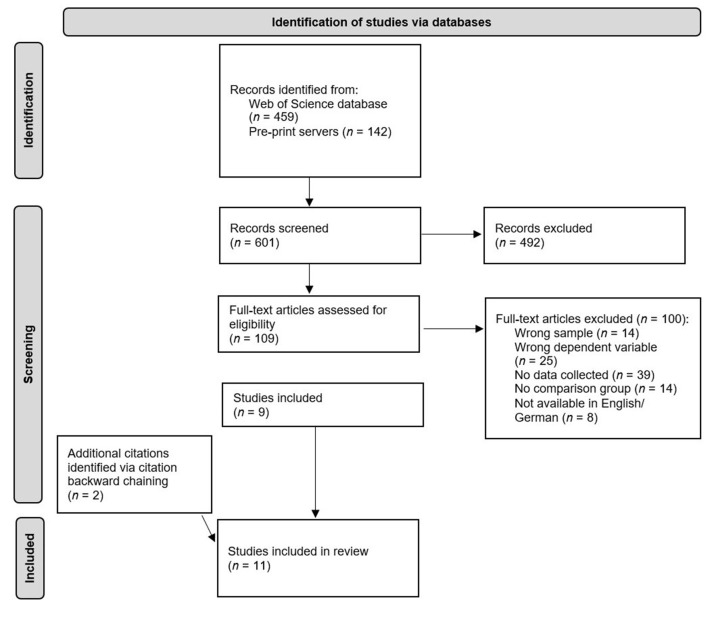
- Systematic review following PRISMA; searched Web of Science from March 1, 2020 to April 30, 2021, plus preprint servers PsyArXiv, EdArXiv, and SocArXiv, yielding 601 potentially relevant studies.
- Inclusion required a focus on COVID-19-related school closures, primary/secondary education, student achievement/test scores as dependent variable, actual data collected prior to and during/after closures, statistical analyses, and reported effect sizes; final inclusion was 9 studies plus 2 from backward reference searching (11 total).
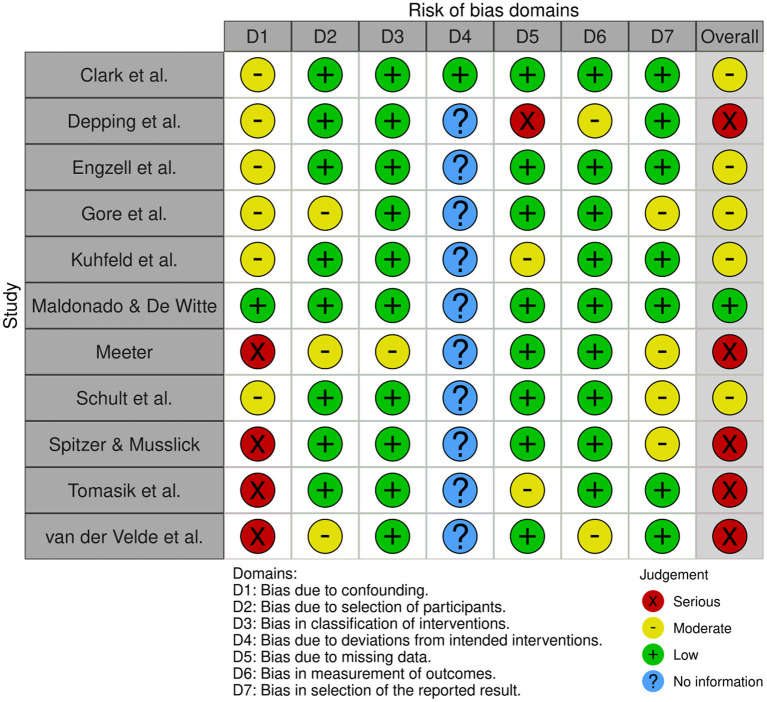
- Risk of bias assessed with ROBINS-I; synthesis extracted country, closure duration, sample, subjects, statistical method, general effects, and differential effects, converting effects to SD where possible and calculating medians; meta-analytic models were not feasible due to the small number of studies.
Limitations
- The paper states that evidence is available for only a small number of countries, clustered around developed countries, with no studies from developing countries yet.
- The paper states that the original studies were not designed to identify reasons for the differential effects, so additional studies are required to explain them exhaustively.
- The paper states that the highest risk of bias was due to lack of inclusion of potential confounding variables (ROBINS-I Domain 1), and that the small number of studies prevented random- or mixed-effects meta-analytic models.
Model-written summary. Check it against the paper before relying on it.
Integrity signals
Registry
Cites
Statistics
Figures
Verification
Claims the paper makes
7 Supported · 7 Partly supported · 7 Sources not found · 7 Own method · 7 Own interpretation · 5 Not checked yet · 4 No full text of the sources · 4 Own result · accuracy not yet measured
Every source the paper cites for this claim was checked and supports it.
In the paper
“Similarly, van der Velde et al. (2021) reported an increase in correct solutions on open questions within a French learning program.”
§ Effects of COVID-19-Related School Closures on Student Achievement-A Systematic Review > Results > General Effects of COVID-19-Related School Closures on Student Achievement
What the sources say
- Supportedcites van der Velde et al., 2021 source
The Trial-level performance section (§3.2.2) reports that accuracy on open-answer questions rose from 77.47% before lockdown to 83.64% during lockdown. It also explains that only multiple-choice performance was reported for English, so the open-answer result concerns the French course. (LLM, conf=0.94)
plain- Asserted: passes — The authors put it forward as true.
- Checkable: passes — It can be checked against evidence.
- Load-bearing: passes — The paper’s conclusions depend on it.
- Based: passes — The paper gives a reason why it holds.
- Supported
Every source the paper cites for this claim was checked and supports it.
In the paper
“Finally, with the possibility to adapt the assignments in online programs individually to the students, low-performing children might have been addressed more thoroughly according to their needs (Spitzer and Musslick, 2021).”
§ Effects of COVID-19-Related School Closures on Student Achievement-A Systematic Review > Results > Differential Effects on Groups of Students
What the sources say
- Supportedcites Spitzer and Musslick, 2021 source
The Discussion (section 4; page not supplied) reports greater performance improvements among low-performing students and offers individualized problem-set assignments as one possible explanation. The citing sentence preserves that uncertainty with “might.” (LLM, conf=0.93)
hedgedconditional- Asserted: passes — The authors put it forward as true.
- Checkable: passes — It can be checked against evidence.
- Load-bearing: unclear — It is unclear whether the paper’s conclusions depend on it.
- Based: passes — The paper gives a reason why it holds.
- Supported
Every source the paper cites for this claim was checked and supports it.
In the paper
“Additionally, low-performing students might be less distracted in comparison to learning in a classroom setting (Spitzer and Musslick, 2021).”
§ Effects of COVID-19-Related School Closures on Student Achievement-A Systematic Review > Results > Differential Effects on Groups of Students
What the sources say
- Supportedcites Spitzer and Musslick, 2021 source
The Discussion proposes that students, especially low-performing students, may have been less distracted by other students, teachers, or stressful classroom settings while learning at home. The citing sentence preserves the paper’s tentative wording; the paper offers this as a possible explanation, not a measured finding. (LLM, conf=0.93)
hedgedconditional- Asserted: passes — The authors put it forward as true.
- Checkable: passes — It can be checked against evidence.
- Load-bearing: unclear — It is unclear whether the paper’s conclusions depend on it.
- Based: passes — The paper gives a reason why it holds.
- Supported
The cited sources support only part of this claim — read each source’s verdict below.
In the paper
“Second, children from families with a low socioeconomic status (SES) were more affected than children from families with a high SES were (Maldonado and De Witte, 2020; Engzell et al., 2021).”
§ Effects of COVID-19-Related School Closures on Student Achievement-A Systematic Review > Results > Differential Effects on Groups of Students
What the sources say
- Not matchedcites Maldonado and De Witte, 2020
Couldn’t be matched to a paper in Crossref, so it can’t be checked.
- Supportedcites Engzell et al., 2021 source
Section 7.10 reports greater learning loss among students from less-educated homes. The Materials and Methods section identifies parental education as the paper’s measure of family disadvantage, supporting the citing sentence’s low-versus-high-SES paraphrase. Page numbers were not provided in our copy. (LLM, conf=0.90)
plaincorrelational- Asserted: passes — The authors put it forward as true.
- Checkable: passes — It can be checked against evidence.
- Load-bearing: passes — The paper’s conclusions depend on it.
- Based: passes — The paper gives a reason why it holds.
- Not matched
The cited sources support only part of this claim — read each source’s verdict below.
In the paper
“Finally, low-performing students benefited more from systematic online-learning methods (Clark et al., 2020; Spitzer and Musslick, 2021).”
§ Effects of COVID-19-Related School Closures on Student Achievement-A Systematic Review > Results > Differential Effects on Groups of Students
What the sources say
- Not matchedcites Clark et al., 2020
Couldn’t be matched to a paper in Crossref, so it can’t be checked.
- Supportedcites Spitzer and Musslick, 2021 source
The Discussion reports that low-performing students showed greater performance improvements than high-performing students in the online mathematics-learning environment. Its conclusion specifies that the greatest improvements were among students who had performed below average in 2019. The finding concerns this software during the 2020 school shutdown, not a comparison with traditional instruction. (LLM, conf=0.89)
plaindirect- Asserted: passes — The authors put it forward as true.
- Checkable: passes — It can be checked against evidence.
- Load-bearing: unclear — It is unclear whether the paper’s conclusions depend on it.
- Based: passes — The paper gives a reason why it holds.
- Not matched
The cited sources support only part of this claim — read each source’s verdict below.
In the paper
“Meeter (2021) and Spitzer and Musslick (2021) showed students to improve their mathematics achievement when learning with an online-learning software during the COVID-related school closures.”
§ Effects of COVID-19-Related School Closures on Student Achievement-A Systematic Review > Results > General Effects of COVID-19-Related School Closures on Student Achievement
What the sources say
- Not matchedcites Meeter, 2021
Couldn’t be matched to a paper in Crossref, so it can’t be checked.
- Supportedcites Spitzer and Musslick, 2021 source
The Abstract reports that German K-12 students’ performance on mathematical problem sets in online learning software increased during the 2020 school shutdown relative to the year before. The Discussion reiterates the improvement. This supports the part of the sentence attributed to Spitzer and Musslick; the verdict does not assess Meeter (2021). (LLM, conf=0.92)
plaindirect- Asserted: passes — The authors put it forward as true.
- Checkable: passes — It can be checked against evidence.
- Load-bearing: passes — The paper’s conclusions depend on it.
- Based: passes — The paper gives a reason why it holds.
- Not matched
A result the paper reports from its own data — it cites no other source for it, so there is none to check. The quote shows it is in the paper.
In the paper
“five studies on reading (Clark et al., 2020; Maldonado and De Witte, 2020; Tomasik et al., 2020; Engzell et al., 2021; Schult et al., 2021)”
§ Effects of COVID-19-Related School Closures on Student Achievement-A Systematic Review > Results > General Effects of COVID-19-Related School Closures on Student Achievement
plaindirect- Asserted: passes — The authors put it forward as true.
- Checkable: passes — It can be checked against evidence.
- Load-bearing: unclear — It is unclear whether the paper’s conclusions depend on it.
- Based: passes — The paper gives a reason why it holds.
None of the sources cited for this claim have been checked yet.
In the paper
“two studies on other subjects, such as science (Maldonado and De Witte, 2020; Engzell et al., 2021).”
§ Effects of COVID-19-Related School Closures on Student Achievement-A Systematic Review > Results > General Effects of COVID-19-Related School Closures on Student Achievement
plaindirectn = 2- Asserted: passes — The authors put it forward as true.
- Checkable: passes — It can be checked against evidence.
- Load-bearing: unclear — It is unclear whether the paper’s conclusions depend on it.
- Based: passes — The paper gives a reason why it holds.
None of the sources cited for this claim have been checked yet.
In the paper
“Seven studies reported a negative effect on mathematics (Clark et al., 2020; Kuhfeld et al., 2020b; Maldonado and De Witte, 2020; Tomasik et al., 2020; Depping et al., 2021; Engzell et al., 2021; Schult et al., 2021)”
§ Effects of COVID-19-Related School Closures on Student Achievement-A Systematic Review > Results > General Effects of COVID-19-Related School Closures on Student Achievement
plaindirect- Asserted: passes — The authors put it forward as true.
- Checkable: passes — It can be checked against evidence.
- Load-bearing: unclear — It is unclear whether the paper’s conclusions depend on it.
- Based: passes — The paper gives a reason why it holds.
In the paper
“First, the main finding was that younger children were more negatively affected in their learning than older children were (-0.37 SD vs.−0.10 SD; Tomasik et al., 2020).”
§ Effects of COVID-19-Related School Closures on Student Achievement-A Systematic Review > Results > Differential Effects on Groups of Students
What the sources say
- Not checked — no full text of the sourcecites Tomasik et al., 2020 source
plaincorrelational- Asserted: passes — The authors put it forward as true.
- Checkable: passes — It can be checked against evidence.
- Load-bearing: passes — The paper’s conclusions depend on it.
- Based: passes — The paper gives a reason why it holds.
- It may state two separate claims as one. 17
- Probably not a substantial claim. 15
The cited sources support only part of this claim — read each source’s verdict below.
In the paper
“Moreover, students increased the time using the online-learning software at home, were less distracted or experienced less time pressure in a home-schooling rather than classroom setting, or were presented with individualized assignments within the online program (see also Meeter, 2021; Spitzer and Musslick, 2021; van der Velde et al., 2021).”
§ Effects of COVID-19-Related School Closures on Student Achievement-A Systematic Review > Results > General Effects of COVID-19-Related School Closures on Student Achievement
What the sources say
- Not matchedcites Meeter, 2021
Couldn’t be matched to a paper in Crossref, so it can’t be checked.
- Partly supportedcites Spitzer and Musslick, 2021 sourceExperimental — accuracy not yet measured
The Introduction reports increased software use during school closures, but measures this as three times more students using it, not more time spent per student. The Discussion proposes reduced distraction at home and individualized problem sets as possible explanations, rather than established findings. It does not identify reduced time pressure as a factor. (LLM, conf=0.86)
- Partly supportedcites van der Velde et al., 2021 sourceExperimental — accuracy not yet measured
The Discussion reports increased use of the online retrieval-practice tool during lockdown. It says higher accuracy and response times on open-answer questions *perhaps* indicated less time pressure or better focus at home; it does not establish that students were less distracted. The Data Set section describes an adaptive tool, but does not say students were given individualized assignments. (LLM, conf=0.86)
plain- Asserted: passes — The authors put it forward as true.
- Checkable: passes — It can be checked against evidence.
- Load-bearing: passes — The paper’s conclusions depend on it.
- Based: passes — The paper gives a reason why it holds.
It may state two separate claims as one.
- Not matched
The cited sources support only part of this claim — read each source’s verdict below.
In the paper
“Additionally, two studies found positive effects on student achievement in mathematics and reading (Gore et al., 2021), or in reading only (Depping et al., 2021).”
§ Effects of COVID-19-Related School Closures on Student Achievement-A Systematic Review > Results > General Effects of COVID-19-Related School Closures on Student Achievement
What the sources say
- Partly supportedcites Gore et al., 2021 sourceExperimental — accuracy not yet measured
The Results sections on student achievement and location report additional mathematics growth for Year 3 students in mid-ICSEA schools and additional reading growth in specific location subgroups. But neither Year 3 nor Year 4 showed an overall difference from the 2019 cohort, and low-ICSEA Year 3 students had less mathematics growth. The claim omits these subgroup limits and implies broadly positive effects in both subjects. (LLM, conf=0.89)
- Not checked — no full text of the sourcecites Depping et al., 2021 source
plaindirect- Asserted: passes — The authors put it forward as true.
- Checkable: passes — It can be checked against evidence.
- Load-bearing: unclear — It is unclear whether the paper’s conclusions depend on it.
- Based: passes — The paper gives a reason why it holds.
It may state two separate claims as one.
- Partly supported
The cited sources support only part of this claim — read each source’s verdict below.
In the paper
“In this context, one study reported an interaction between grade and SES, that is, for younger children from schools with low school-level SES, learning losses of 0.16 SD were found, while younger children from schools with medium school-level SES experienced learning gains of 0.15 SD (Gore et al., 2021).”
§ Effects of COVID-19-Related School Closures on Student Achievement-A Systematic Review > Results > Differential Effects on Groups of Students
What the sources say
- Partly supportedcites Gore et al., 2021 sourceExperimental — accuracy not yet measured
Split into 2 atoms — 0 confirmed, 2 partially supported, 0 disputed, 0 misattributed, 0 unverifiable. Expand the claim to see per-atom verdicts.
plaincorrelational- Asserted: passes — The authors put it forward as true.
- Checkable: passes — It can be checked against evidence.
- Load-bearing: unclear — It is unclear whether the paper’s conclusions depend on it.
- Based: passes — The paper gives a reason why it holds.
It may state two separate claims as one.
- Partly supported
Every source the paper cites for this claim was checked and supports it.
In the paper
“The review is organized following the reporting guidelines of the PRISMA statement (Page et al., 2021)”
§ Effects of COVID-19-Related School Closures on Student Achievement-A Systematic Review > Introduction
What the sources say
- Supportedcites Page et al., 2021 source
The cited paper is the PRISMA statement, an updated reporting guideline for systematic reviews. Its Discussion describes the development of its reporting recommendations. The source therefore supports identifying PRISMA as the guideline the citing authors say they followed, though it cannot independently verify their compliance. (LLM, conf=0.91)
plain- Asserted: passes — The authors put it forward as true.
- Checkable: passes — It can be checked against evidence.
- Load-bearing: fails — The paper’s conclusions may not depend on it.
- Based: passes — The paper gives a reason why it holds.
Probably not a substantial claim. The paper’s conclusions may not depend on it.
- Supported
Every source the paper cites for this claim was checked and supports it.
In the paper
“Moreover, Haeck and Lefebvre (2020) estimated that socioeconomic achievement gaps would increase by up to 30%.”
§ Effects of COVID-19-Related School Closures on Student Achievement-A Systematic Review > Introduction
What the sources say
- Supportedcites Haeck and Lefebvre, 2020 source
The Concluding Remarks state that the authors’ back-of-the-envelope calculation found the socioeconomic-status score gap could increase by as much as 30 percent. No page number is provided in our copy. (LLM, conf=0.94)
hedgeddirect- Asserted: passes — The authors put it forward as true.
- Checkable: passes — It can be checked against evidence.
- Load-bearing: fails — The paper’s conclusions may not depend on it.
- Based: passes — The paper gives a reason why it holds.
Probably not a substantial claim. The paper’s conclusions may not depend on it.
- Supported
Every source the paper cites for this claim was checked and supports it.
In the paper
“Third, low-performing students were more affected by COVID-19-related school closures in mathematics, while high-performing students were more affected by COVID-19-related school closures in reading (Schult et al., 2021).”
§ Effects of COVID-19-Related School Closures on Student Achievement-A Systematic Review > Results > Differential Effects on Groups of Students
What the sources say
- Supportedcites Schult et al., 2021 source
The ‘Comparisons for High-, Average-, and Low-Achieving Groups (RQ2)’ section states that differences in reading comprehension were larger for high-achieving students, whereas differences in mathematics were larger for low-achieving students. This comparison concerns incoming fifth-graders’ 2020 scores against those of pre-pandemic cohorts. (LLM, conf=0.94)
plaindirect- Asserted: passes — The authors put it forward as true.
- Checkable: passes — It can be checked against evidence.
- Load-bearing: passes — The paper’s conclusions depend on it.
- Based: passes — The paper gives a reason why it holds.
It may state two separate claims as one.
- Supported
The cited sources support only part of this claim — read each source’s verdict below.
In the paper
“On the other hand, reasons for finding larger learning losses in mathematics than in reading might be that students spent more time on reading during school closures and that supporting children in their reading skills might have been easier to realize for parents than supporting children in improving their competencies in mathematics (e.g., Depping et al., 2021; Schult et al., 2021).”
§ Effects of COVID-19-Related School Closures on Student Achievement-A Systematic Review > Results > General Effects of COVID-19-Related School Closures on Student Achievement
What the sources say
- Not checked — no full text of the sourcecites Depping et al., 2021 source
- Partly supportedcites Schult et al., 2021 sourceExperimental — accuracy not yet measured
Split into 2 atoms — 1 confirmed, 1 partially supported, 0 disputed, 0 misattributed, 0 unverifiable. Expand the claim to see per-atom verdicts.
hedgedconditional- Asserted: passes — The authors put it forward as true.
- Checkable: passes — It can be checked against evidence.
- Load-bearing: fails — The paper’s conclusions may not depend on it.
- Based: passes — The paper gives a reason why it holds.
Probably not a substantial claim. The paper’s conclusions may not depend on it. It may state two separate claims as one.
Every source the paper cites for this claim was checked and supports it.
In the paper
“The Cochrane Risk Assessment of the included studies was conducted independently by the first and second author using the “Risk Of Bias in Non-Randomized Studies of Interventions” tool (ROBINS-I; Sterne et al., 2016).”
§ Effects of COVID-19-Related School Closures on Student Achievement-A Systematic Review > Method > Risk of Bias Assessment
What the sources say
- Supportedcites Sterne et al., 2016 source
The Abstract identifies ROBINS-I as a tool for evaluating risk of bias in non-randomised studies of interventions, and the Discussion describes its use in systematic reviews. The citation identifies the tool used; the statement that the citing paper’s first and second authors conducted the assessment independently describes their own procedure, not a finding attributed to Sterne et al. (LLM, conf=0.93)
plain- Asserted: passes — The authors put it forward as true.
- Checkable: passes — It can be checked against evidence.
- Load-bearing: fails — The paper’s conclusions may not depend on it.
- Based: passes — The paper gives a reason why it holds.
Probably not a substantial claim. The paper’s conclusions may not depend on it.
- Supported
A result the paper reports from its own data — it cites no other source for it, so there is none to check. The quote shows it is in the paper.
In the paper
“Even though the median for the effect on mathematics and reading is comparable when averaging above all studies (d = −0.10 SD and−0.09 SD for mathematics and reading, respectively)”
§ Effects of COVID-19-Related School Closures on Student Achievement-A Systematic Review > Results > General Effects of COVID-19-Related School Closures on Student Achievement
plain- Asserted: passes — The authors put it forward as true.
- Checkable: passes — It can be checked against evidence.
- Load-bearing: passes — The paper’s conclusions depend on it.
- Based: passes — The paper gives a reason why it holds.
It may state two separate claims as one.
In the paper
“For instance, Woessmann (2020) estimated a negative effect of 0.10 SD on student achievement due to COVID-19-related school closures.”
§ Effects of COVID-19-Related School Closures on Student Achievement-A Systematic Review > Introduction
What the sources say
- Not matchedcites Woessmann, 2020
Couldn’t be matched to a paper in Crossref, so it can’t be checked.
hedgeddirect- Asserted: passes — The authors put it forward as true.
- Checkable: passes — It can be checked against evidence.
- Load-bearing: fails — The paper’s conclusions may not depend on it.
- Based: passes — The paper gives a reason why it holds.
Probably not a substantial claim. The paper’s conclusions may not depend on it.
- Not matched
In the paper
“As another explanation, many students might not speak the language in which they are tested in at home, hence, not benefitting much in their language skills during school closures (e.g., Maldonado and De Witte, 2020).”
§ Effects of COVID-19-Related School Closures on Student Achievement-A Systematic Review > Results > General Effects of COVID-19-Related School Closures on Student Achievement
What the sources say
- Not matchedcites Maldonado and De Witte, 2020
Couldn’t be matched to a paper in Crossref, so it can’t be checked.
hedgedconditional- Asserted: passes — The authors put it forward as true.
- Checkable: passes — It can be checked against evidence.
- Load-bearing: fails — The paper’s conclusions may not depend on it.
- Based: passes — The paper gives a reason why it holds.
Probably not a substantial claim. The paper’s conclusions may not depend on it. It may state two separate claims as one.
- Not matched
What the paper did — it cites no source for this, so there is none to check. The quote shows it is in the paper.
In the paper
“Lastly, bias due to missing data, measurement of outcomes, or selection of reported results is unlikely, as most studies exhibited very small proportions of missing data (except Depping et al., 2021), and were highly transparent in their reporting of the results (except, partially, van der Velde et al., 2021, who only report significant mean differences between groups in sufficient detail).”
§ Effects of COVID-19-Related School Closures on Student Achievement-A Systematic Review > Method > Risk of Bias Assessment
plain- Asserted: passes — The authors put it forward as true.
- Checkable: passes — It can be checked against evidence.
- Load-bearing: unclear — It is unclear whether the paper’s conclusions depend on it.
- Based: passes — The paper gives a reason why it holds.
It may state two separate claims as one.
In the paper
“Nevertheless, the proportion of students enrolled in primary or secondary education is considerably smaller in poorer countries (Ward, 2020).”
§ Effects of COVID-19-Related School Closures on Student Achievement-A Systematic Review > Discussion
What the sources say
- Not checked — no full text of the sourcecites Ward, 2020 source
plaincorrelational- Asserted: passes — The authors put it forward as true.
- Checkable: passes — It can be checked against evidence.
- Load-bearing: fails — The paper’s conclusions may not depend on it.
- Based: passes — The paper gives a reason why it holds.
Probably not a substantial claim. The paper’s conclusions may not depend on it.
What the paper did — it cites no source for this, so there is none to check. The quote shows it is in the paper.
In the paper
“To determine the degree of rater agreement on the selection of the studies, a randomly selected subset of 20 studies was evaluated by both the authors and the research assistants.”
§ Effects of COVID-19-Related School Closures on Student Achievement-A Systematic Review > Method > Selection of Studies
plain- Asserted: passes — The authors put it forward as true.
- Checkable: passes — It can be checked against evidence.
- Load-bearing: fails — The paper’s conclusions may not depend on it.
- Based: passes — The paper gives a reason why it holds.
Probably not a substantial claim. The paper’s conclusions may not depend on it.
In the paper
“The differential effect on low-performing and high-performing students may be due to high-performing students being capable of improving their performance regardless of the learning environment, while low-performing students specifically benefit from systematic online learning (Clark et al., 2020).”
§ Effects of COVID-19-Related School Closures on Student Achievement-A Systematic Review > Results > Differential Effects on Groups of Students
What the sources say
- Not matchedcites Clark et al., 2020
Couldn’t be matched to a paper in Crossref, so it can’t be checked.
hedgedconditional- Asserted: passes — The authors put it forward as true.
- Checkable: passes — It can be checked against evidence.
- Load-bearing: fails — The paper’s conclusions may not depend on it.
- Based: passes — The paper gives a reason why it holds.
Probably not a substantial claim. The paper’s conclusions may not depend on it. It may state two separate claims as one.
- Not matched
None of the sources cited for this claim could be matched to a paper in Crossref, so there is nothing to check it against.
In the paper
“The reported effects are comparable in size to findings of research on summer losses (d = −0.005 SD to −0.05 SD per week; see also Kuhfeld et al., 2020a) and comparable to Woessmann's initial estimate.”
§ Effects of COVID-19-Related School Closures on Student Achievement-A Systematic Review > Discussion
What the sources say
- Not matchedcites Kuhfeld et al., 2020a
Couldn’t be matched to a paper in Crossref, so it can’t be checked.
- Not matchedcites Woessmann, 2020
Couldn’t be matched to a paper in Crossref, so it can’t be checked.
plaincorrelational- Asserted: passes — The authors put it forward as true.
- Checkable: passes — It can be checked against evidence.
- Load-bearing: passes — The paper’s conclusions depend on it.
- Based: passes — The paper gives a reason why it holds.
It may state two separate claims as one.
- Not matched
In the paper
“The reported effects are comparable in size to findings of research on summer losses (d = −0.005 SD to −0.05 SD per week; see also Kuhfeld et al., 2020a)”
§ Effects of COVID-19-Related School Closures on Student Achievement-A Systematic Review > Discussion
What the sources say
- Not matchedcites Kuhfeld et al., 2020a
Couldn’t be matched to a paper in Crossref, so it can’t be checked.
plain- Asserted: passes — The authors put it forward as true.
- Checkable: passes — It can be checked against evidence.
- Load-bearing: passes — The paper’s conclusions depend on it.
- Based: passes — The paper gives a reason why it holds.
Probably not a substantial claim.
- Not matched
A conclusion the paper draws from its own results — it cites no other source for it, so there is none to check. The quote shows it is in the paper.
In the paper
“It has to be noted that the number of countries for which evidence of these effects are available is still small, and clustered around developed countries. Especially studies from developing countries are not available yet.”
§ Effects of COVID-19-Related School Closures on Student Achievement-A Systematic Review > Discussion
plain- Asserted: passes — The authors put it forward as true.
- Checkable: passes — It can be checked against evidence.
- Load-bearing: unclear — It is unclear whether the paper’s conclusions depend on it.
- Based: passes — The paper gives a reason why it holds.
It may state two separate claims as one.
A conclusion the paper draws from its own results — it cites no other source for it, so there is none to check. The quote shows it is in the paper.
In the paper
“Due to the cumulative nature of learning processes and student achievement, additional learning losses are likely.”
§ Effects of COVID-19-Related School Closures on Student Achievement-A Systematic Review > Discussion
hedgedconditional- Asserted: passes — The authors put it forward as true.
- Checkable: fails — It may be too vague to check against evidence.
- Load-bearing: passes — The paper’s conclusions depend on it.
- Based: fails — The paper may give no reason why it holds.
Probably not a substantial claim. It may be too vague to check against evidence. The paper may give no reason why it holds.
- Rests on an assumption: The first COVID-19-related school closures in spring 2020 were followed by similar measures in the fall and winter of 2020/2021.
What the paper did — it cites no source for this, so there is none to check. The quote shows it is in the paper.
In the paper
“Studies were required (1) to have collected actual data prior to and during/after COVID-19-related school closures, and (2) to have applied statistical analyses and to report an effect size.”
§ Effects of COVID-19-Related School Closures on Student Achievement-A Systematic Review > Method > Selection of Studies
plain- Asserted: passes — The authors put it forward as true.
- Checkable: passes — It can be checked against evidence.
- Load-bearing: passes — The paper’s conclusions depend on it.
- Based: passes — The paper gives a reason why it holds.
Probably not a substantial claim. It may state two separate claims as one.
A conclusion the paper draws from its own results — it cites no other source for it, so there is none to check. The quote shows it is in the paper.
In the paper
“This indicates that most remote learning measures implemented during the first school closures in spring 2020 were not effective for student learning; there was no difference between them and the absence of systematic teaching during summer vacation.”
§ Effects of COVID-19-Related School Closures on Student Achievement-A Systematic Review > Discussion
hedged- Asserted: passes — The authors put it forward as true.
- Checkable: passes — It can be checked against evidence.
- Load-bearing: passes — The paper’s conclusions depend on it.
- Based: passes — The paper gives a reason why it holds.
It may state two separate claims as one.
A conclusion the paper draws from its own results — it cites no other source for it, so there is none to check. The quote shows it is in the paper.
In the paper
“The reasons for students from low SES families being more affected relate to access to remote learning, their learning behavior, and the support provided from families and schools.”
§ Effects of COVID-19-Related School Closures on Student Achievement-A Systematic Review > Results > Differential Effects on Groups of Students
plaindirect- Asserted: passes — The authors put it forward as true.
- Checkable: passes — It can be checked against evidence.
- Load-bearing: unclear — It is unclear whether the paper’s conclusions depend on it.
- Based: passes — The paper gives a reason why it holds.
It may state two separate claims as one.
None of the sources cited for this claim have been checked yet.
In the paper
“A learning loss of up to 38 points on the Programme for International Student Assessment (PISA1) scale is estimated, which corresponds to an effect size (Cohen's d) of 0.38 or 0.9 school years (Azevedo et al., 2020; Kuhfeld et al., 2020a; Wyse et al., 2020; Kaffenberger, 2021).”
§ Effects of COVID-19-Related School Closures on Student Achievement-A Systematic Review > Introduction
What the sources say
- Not matchedcites Azevedo et al., 2020
Couldn’t be matched to a paper in Crossref, so it can’t be checked.
- Not matchedcites Kuhfeld et al., 2020a
Couldn’t be matched to a paper in Crossref, so it can’t be checked.
- Not checked — no full text of the sourcecites Wyse et al., 2020 source
hedgeddirect- Asserted: passes — The authors put it forward as true.
- Checkable: passes — It can be checked against evidence.
- Load-bearing: fails — The paper’s conclusions may not depend on it.
- Based: passes — The paper gives a reason why it holds.
Probably not a substantial claim. The paper’s conclusions may not depend on it. It may state two separate claims as one.
- Not matched
None of the sources cited for this claim have been checked yet.
In the paper
“Children from families with a low SES are less likely to have access to remote learning (UNESCO, 2021), are less often provided with active learning assistance from their schools (Tomasik et al., 2020), and spend less time on learning (Meeter, 2021) than children from families with a high SES.”
§ Effects of COVID-19-Related School Closures on Student Achievement-A Systematic Review > Results > Differential Effects on Groups of Students
What the sources say
- Not matchedcites UNESCO, 2021
Couldn’t be matched to a paper in Crossref, so it can’t be checked.
- Not checked — no full text of the sourcecites Tomasik et al., 2020 source
- Not matchedcites Meeter, 2021
Couldn’t be matched to a paper in Crossref, so it can’t be checked.
plaincorrelational- Asserted: passes — The authors put it forward as true.
- Checkable: passes — It can be checked against evidence.
- Load-bearing: passes — The paper’s conclusions depend on it.
- Based: passes — The paper gives a reason why it holds.
It may state two separate claims as one.
- Not matched
In the paper
“This result might be accounted for by the achievement measurement being timed some months after school closures in both studies and the possibility of effective compensatory measures being implemented by teachers, schools, and local policy makers during this time to counteract learning losses, such as offering learning groups during summer vacation in parts of Germany (Depping et al., 2021).”
§ Effects of COVID-19-Related School Closures on Student Achievement-A Systematic Review > Results > General Effects of COVID-19-Related School Closures on Student Achievement
What the sources say
- Not checked — no full text of the sourcecites Depping et al., 2021 source
hedgedconditional- Asserted: passes — The authors put it forward as true.
- Checkable: passes — It can be checked against evidence.
- Load-bearing: unclear — It is unclear whether the paper’s conclusions depend on it.
- Based: passes — The paper gives a reason why it holds.
It may state two separate claims as one.
In the paper
“On the one hand, reasons for finding larger learning losses in reading than in mathematics might be that “mathematics is easier to teach in distance learning, as it is simple to provide exercises and tests digitally or as worksheets” (Maldonado and De Witte, 2020, p. 13).”
§ Effects of COVID-19-Related School Closures on Student Achievement-A Systematic Review > Results > General Effects of COVID-19-Related School Closures on Student Achievement
What the sources say
- Not matchedcites Maldonado and De Witte, 2020
Couldn’t be matched to a paper in Crossref, so it can’t be checked.
hedgedconditional- Asserted: passes — The authors put it forward as true.
- Checkable: passes — It can be checked against evidence.
- Load-bearing: fails — The paper’s conclusions may not depend on it.
- Based: passes — The paper gives a reason why it holds.
Probably not a substantial claim. The paper’s conclusions may not depend on it.
- Not matched
In the paper
“We know, however, that the reduction in in-person learning was smaller for low-income countries than for medium-income countries (UNESCO, 2021).”
§ Effects of COVID-19-Related School Closures on Student Achievement-A Systematic Review > Discussion
What the sources say
- Not matchedcites UNESCO, 2021
Couldn’t be matched to a paper in Crossref, so it can’t be checked.
boostedcorrelational- Asserted: passes — The authors put it forward as true.
- Checkable: passes — It can be checked against evidence.
- Load-bearing: fails — The paper’s conclusions may not depend on it.
- Based: passes — The paper gives a reason why it holds.
Probably not a substantial claim. The paper’s conclusions may not depend on it.
- Not matched
The authors state this as an assumption.
In spring 2020, the ad hoc implementation of online teaching gave students, teachers, schools, and parents little time to prepare for or adapt to measures of remote learning.
“the assumption that, in spring 2020, the ad hoc implementation of online teaching gave students, teachers, schools, and parents little time to prepare for or adapt to measures of remote learning.”
The paper relies on this without support.
COVID-19 related school closures were not intended interventions.
“This is because the COVID-19 related school closures were not intended interventions.”
The paper relies on this without support.
The first COVID-19-related school closures in spring 2020 were followed by similar measures in the fall and winter of 2020/2021.
“The first COVID-19-related school closures in spring 2020 were followed by similar measures in the fall and winter of 2020/2021.”
Claims other papers make about this one
Each is checked against this paper’s own text: does it say what the citing paper says it does?
The source backs part of the claim, not all of it — or backs it for a different population, condition or comparison.
In the citing paper
“Nevertheless, there are several systematic reviews and meta-analyses, and these suggest an average learning loss attributable to COVID-19 school closures of 0.17 of a standard deviation—that is, at least one-third of a year’s worth of learning16–20.”
From COVID-19, school closures, and student learning outcomes. New global evidence from PISA (2025) · cites this paper as [18]
Experimental — accuracy not yet measuredThe cited source says what the claim attributes to it.
In the citing paper
“The results confirm the core conclusion of prior synthesizing research examining the first phase school closures.”
From The Impact of COVID‐19‐Related School Closures on Student Achievement—A Meta‐Analysis (2022) · cites this paper as Hammerstein et al., 2021
The cited source says what the claim attributes to it.
In the citing paper
“Interestingly, our results are similar to what systematic reviews are finding learning16–20,44,45.”
From COVID-19, school closures, and student learning outcomes. New global evidence from PISA (2025) · cites this paper as [18]
Self-check
Percentages, sums and reported differences re-computed from the paper’s own numbers.
Each contradiction between two passages listed here was confirmed by an independent check.
Rated minor: it would not touch a result — a value no result rests on, a p-value that stays on the same side of the significance level, or a conflict that is clerical, resolved elsewhere in the paper, or outside its own findings.
In the paper
§ Effects of COVID-19-Related School Closures on Student Achievement-A Systematic Review > Results > General Effects of COVID-19-Related School Closures on Student Achievement
“two studies on other subjects, such as science (Maldonado and De Witte, 2020; Engzell et al., 2021).”
§ Effects of COVID-19-Related School Closures on Student Achievement-A Systematic Review > Method > Synthesis
“| Engzell et al.(Netherlands) | 8 weeks | Elementary and Secondary | 350,000 | Reading, Mathematics | DiD Regression | −0.09 SD (reading)−0.14 SD (mathematics) | +60% learning loss in low-SES students |”
Citations
Cites
The PRISMA 2020 statement: An updated guideline for reporting systematic reviews
Page, M. J., McKenzie, J. E., Bossuyt, P. M., Boutron, I., Hoffmann, T. C., Mulrow, C. D., Shamseer, L., Tetzlaff, J. M., Akl, E. A., Brennan, S. E., et al. (2021) · BMJ · doi:10.1136/bmj.n71 · Cited by 108,283
Two new Later Stone Age sites from the Final Pleistocene in the Falémé Valley, eastern Senegal
Ndiaye, M., Lespez, L., Tribolo, C., Rassé, M., Hadjas, I., Davidoux, S., Huysecom, É., & Douze, K. (2024) · Monash University Research Portal (Monash University) · doi:10.3929/ethz-b-000667478 · Cited by 24,214
ROBINS-I: a tool for assessing risk of bias in non-randomised studies of interventions
Sterne, J. A., Hernán, M. A., Reeves, B. C., Savović, J., Berkman, N. D., Viswanathan, M., Henry, D., Altman, D. G., Ansari, M. T., Boutron, I., et al. (2016) · BMJ · doi:10.1136/bmj.i4919 · Cited by 20,329
The PRISMA 2020 statement: an updated guideline for reporting systematic reviews
Page, M. J., McKenzie, J., Bossuyt, P., Boutron, I., Hoffmann, T., mulrow, C., Shamseer, L., Tetzlaff, J., Akl, E., Brennan, S. E., et al. (2020) · doi:10.31222/osf.io/v7gm2 · Cited by 5,177
Learning loss due to school closures during the COVID-19 pandemic
Engzell, P., Frey, A., & Verhagen, M. D. (2021) · Proceedings of the National Academy of Sciences · doi:10.1073/pnas.2022376118 · Cited by 1,848
Self-citationLearning loss due to school closures during the COVID-19 pandemic
Engzell, P., Frey, A., & Verhagen, M. D. (2020) · doi:10.31235/osf.io/ve4z7 · Cited by 1,739
Ranking the effectiveness of worldwide COVID-19 government interventions
Haug, N., Geyrhofer, L., Londei, A., Dervic, E., Desvars-Larrive, A., Loreto, V., Pinior, B., Thurner, S., & Klimek, P. (2020) · Nature Human Behaviour · doi:10.1038/s41562-020-01009-0 · Cited by 1,412
Xie, X., Xue, Q., Zhou, Y., Zhu, K., Liu, Q., Zhang, J., & Song, R. (2020) · JAMA Pediatrics · doi:10.1001/jamapediatrics.2020.1619 · Cited by 1,001
Projecting the Potential Impact of COVID-19 School Closures on Academic Achievement
Kuhfeld, M., Soland, J., Tarasawa, B., Johnson, A., Ruzek, E., & Liu, J. (2020) · Educational Researcher · doi:10.3102/0013189x20965918 · Cited by 997
PISA 2018 Results (Volume II): Where All Students Can Succeed
OECD (2019) · PISA · doi:10.1787/b5fd1b8f-en · Cited by 807
Cited by
Sorted by citations
Items 101–200 of 455
Adolescence, Interrupted: A narrative review of the impact of Covid-19 on adolescent wellbeing
Oakley, E. M., Vintges, J., Hamad, B. A. A., Mitu, K., Seager, J. E., Yadete, W., Jones, N., & Baird, S. (2024) · World Development · doi:10.1016/j.worlddev.2024.106786 · Cited by 16
Bem‐Haja, P., Nossa, P. N., Pereira, D. S., & da Silva, C. F. (2022) · Education Sciences · doi:10.3390/educsci12100710 · Cited by 10
Segers, E., Zandt, M. I. '., Stoep, J. M. G. M., Daniels, L., Roelofs, J., & Gubbels, J. (2022) · Reading and Writing · doi:10.1007/s11145-022-10369-0 · Cited by 16
Breit, M., Scherrer, V., Blickle, J., & Preckel, F. (2023) · PLoS ONE · doi:10.1371/journal.pone.0281779 · Cited by 10
Jöbstl, V., Steiner, A. F., Deimann, P., Kastner-Koller, U., & Landerl, K. (2023) · PLoS ONE · doi:10.1371/journal.pone.0285437 · Cited by 10
Analysis Effectiveness of Implementation Assessment as Learning on Metacognitive Skills
Daniar, A. V., Herdyastuti, N., & Lutfi, A. (2023) · IJORER International Journal of Recent Educational Research · doi:10.46245/ijorer.v4i6.392 · Cited by 10
Covid-induced school closures in the United States and Germany: long-term distributional effects
Fuchs‐Schündeln, N. (2022) · Economic Policy · doi:10.1093/epolic/eiac052 · Cited by 19
Schult, J., Mahler, N., Fauth, B., et al. (2022) · doi:10.31234/osf.io/dfqeg · Cited by 10
Fadlallah, R., El‐Jardali, F., Bou-Karroum, L., Kalach, N., Hoteit, R., Aoun, A., Al‐Hakim, L., Verdugo‐Paiva, F., Gabriel Rada, G., Fretheim, A., et al. (2024) · Cochrane Evidence Synthesis and Methods · doi:10.1002/cesm.12055 · Cited by 13
Educational efficiency across Spanish regions: a comparative analysis over time
Ferrera, J. M. C., Sicilia, G., & Simancas, R. (2024) · International Transactions in Operational Research · doi:10.1111/itor.13567 · Cited by 12
Intervention initiatives to raise young people’s interest and participation in STEM
Schneider, B., Chen, I., Bradford, L., & Bartz, K. (2022) · Frontiers in Psychology · doi:10.3389/fpsyg.2022.960327 · Cited by 7
Zhou, X., Chen, C., Yao, Y., Xia, J., Cao, L., & Qin, X. (2022) · Frontiers in Psychology · doi:10.3389/fpsyg.2022.1026712 · Cited by 10
Protective Factors Contributing to Academic Resilience in College Students During COVID-19
Cobb, C., Xie, J., Gallo, K., Boyd, M., Wilkins, M., Wadsworth, M., & Brake, L. (2023) · American Journal of Distance Education · doi:10.1080/08923647.2023.2168106 · Cited by 9
Suwathanpornkul, I., Sarnkhaowkhom, C., Tulmethakaan, M., Sakuntanak, P., & Charoensuk, O. (2023) · BMC Psychology · doi:10.1186/s40359-023-01269-1 · Cited by 15
Žnidaršič, A., Brezavšček, A., Rus, G., & Jerebic, J. (2022) · Mathematics · doi:10.3390/math10132314 · Cited by 9
Asih, F. E., Poedjiastoeti, S., Lutfi, A., Novita, D., Ismono, I., & Purnamasari, A. P. (2022) · Journal of Technology and Science Education · doi:10.3926/jotse.1654 · Cited by 13
Students’ Perceptions of COVID-19 Stress and Internalizing Problems: Is Social Support a Buffer?
Balkundi, S., & Fredrick, S. S. (2023) · Contemporary School Psychology · doi:10.1007/s40688-023-00457-5 · Cited by 10
Bryan, C., & von Suchodoletz, A. (2023) · Gulf Education and Social Policy Review (GESPR) · doi:10.18502/gespr.v4i1.13805 · Cited by 8
A meta-analysis of students’ academic learning losses over the course of the COVID-19 pandemic
Wisenöcker, A. S., Helm, C., Große, C. S., Hübner, N., & Zitzmann, S. (2025) · Learning and Instruction · doi:10.1016/j.learninstruc.2025.102111 · Cited by 19
Santos, M. F., Simões, C., Santos, A. C., Lebre, P., & Grazzani, I. (2022) · International Journal of Environmental Research and Public Health · doi:10.3390/ijerph192416990 · Cited by 8
Vidal, C., Holland, E. T., & Duriseti, R. S. (2023) · PubMed Central · Cited by 8
van Leeuwen, F. D., Lugtig, P. J., & Feskens, R. C. W. (2024) · PLoS ONE · doi:10.1371/journal.pone.0301301 · Cited by 9
Kirsten, C., Kahre, E., Blankenburg, J., et al. (2022) · Infection · doi:10.1007/s15010-022-01824-9 · Cited by 8
Gujski, M., Mularczyk-Tomczewska, P., Raciborski, F., et al. (2022) · Medical Science Monitor · doi:10.12659/msm.936962 · Cited by 8
KESULITAN MEMBACA PERMULAAN PADA PEMBELAJARAN BAHASA INGGRIS SISWA SEKOLAH DASAR
Rofi’i, A., & Susilo, S. V. (2022) · Jurnal Cakrawala Pendas · doi:10.31949/jcp.v8i4.3151 · Cited by 8
Plage, S., Cook, S., Povey, J., et al. (2022) · Australian Journal of Social Issues · doi:10.1002/ajs4.228 · Cited by 8
Trotta, E., Serio, G., Monacis, L., Carlucci, L., Marinelli, C. V., Petito, A., Celia, G., Bonvino, A., Calvio, A., Stallone, R., et al. (2024) · PLoS ONE · doi:10.1371/journal.pone.0303991 · Cited by 10
Česnavičienė, J., Bukšnytė-Marmienė, L., & Brandišauskienė, A. (2022) · The New Educational Review · doi:10.15804/tner.2022.69.3.12 · Cited by 8
Putri, D. P., Jalmo, T., & Suyatna, A. (2023) · Jurnal Penelitian Pendidikan IPA · doi:10.29303/jppipa.v9i4.3004 · Cited by 8
Vogel, S. N. T., Stang‐Rabrig, J., & McElvany, N. (2023) · Social Psychology of Education · doi:10.1007/s11218-023-09801-2 · Cited by 13
Pittas, E., & Papanastasiou, E. C. (2023) · Research in Developmental Disabilities · doi:10.1016/j.ridd.2023.104635 · Cited by 7
Secondary Education and COVID-19
Siakalli, M., Mousoulidou, M., Christodoulou, A., Savvidou, A., & Kouppa, K. (2022) · Encyclopedia · doi:10.3390/encyclopedia2010025 · Cited by 9
Mastrothanasis, K., Dumitru, C., Darie, N., Kladaki, M., Pikoulis, E. A., Sidiropoulou, A., Papouli, E., Papantoniou, D., Pikouli, A., & Karamagioli, E. (2025) · Children · doi:10.3390/children12111498 · Cited by 8
Explaining inequalities of homeschooling in Germany during the first COVID-19 lockdown
Sari, E., Bittmann, F., & Homuth, C. (2023) · Frontiers in Education · doi:10.3389/feduc.2023.1154389 · Cited by 17
Landman, B., Cohen, A., Khoury, E., et al. (2023) · Scientific Reports · doi:10.1038/s41598-023-29193-9 · Cited by 6
Blockmans, L., Kievit, R., Wouters, J. M., Ghesquière, P., & Vandermosten, M. (2023) · Developmental Science · doi:10.1111/desc.13412 · Cited by 11
Special Education Evaluation Considerations in a Post-pandemic Era
Sims, W. A., Yu, R., & Zahn, D. (2023) · Contemporary School Psychology · doi:10.1007/s40688-023-00468-2 · Cited by 6
Ohle-Peters, A., & Shahat, M. A. A. (2023) · Frontiers in Education · doi:10.3389/feduc.2023.1244548 · Cited by 9
Developmental Losses in Young Children from Preprimary Program Closures during the COVID-19 Pandemic
Abufhele, A., Bravo, D., Bóo, F. L., & Soto‐Ramírez, P. (2024) · Comparative Education Review · doi:10.1086/731588 · Cited by 22
Predictors of the Effectiveness of Different Approaches to Pandemic Distance Learning
Kohout, J., Brabcova, D. B., Frank, J., Lukavský, J., Masopust, P., Motlíková, I., Rohlíková, L., Slavík, J., Stacke, V., Vejvodová, J., et al. (2022) · Education Sciences · doi:10.3390/educsci12090605 · Cited by 6
The Effects of COVID-19 on Inequalities in Educational Achievement in ItalyPreprint
Borgonovi, F., & Ferrara, A. (2022) · SSRN Electronic Journal · doi:10.2139/ssrn.4171968 · Cited by 6
Ludewig, U., Strietholt, R., & McElvany, N. (2025) · Learning and Instruction · doi:10.1016/j.learninstruc.2025.102150 · Cited by 5
Kaščák, O., Komárková, T., Kostelecká, Y., et al. (2023) · Children s Geographies · doi:10.1080/14733285.2023.2175314 · Cited by 5
Orbach, L., Fritz, A., Haase, V. G., Dowker, A., & Räsänen, P. (2023) · Frontiers in Education · doi:10.3389/feduc.2023.1083074 · Cited by 15
Liu, W., Hu, Z., Liu, Z., Zhang, F., Ding, Y., Shui, Y., Yang, Z., & Cheng, W. (2023) · Frontiers in Public Health · doi:10.3389/fpubh.2023.1129123 · Cited by 8
Teaching writing during the COVID-19 pandemic in the 2021–2022 school year
Graham, S., Huebner, A. R., Skar, G. B. U., Azani, J., & Weinberg, P. (2023) · Reading and Writing · doi:10.1007/s11145-023-10457-9 · Cited by 7
Baty, J. J., & Bruns, H. A. (2024) · ImmunoHorizons · doi:10.4049/immunohorizons.2300073 · Cited by 5
The impact of COVID-19 school disruptions on children’s learning
Blackwell, C. K., Mansolf, M. A., Deoni, S., Ganiban, J. M., Leve, L. D., Margolis, A. E., McGrath, M., Nozadi, S. S., O’Shea, T. M., Sherlock, P., et al. (2024) · Frontiers in Education · doi:10.3389/feduc.2024.1295910 · Cited by 7
Lamssali, M., Ofori-Boadu, A. N., Ferguson, A., Deng, D., & Hyeng, C. A. B. (2024) · Journal of STEM Education Innovations and Research · doi:10.63504/jstem.v25i3.2630 · Cited by 5
Mastrothanasis, K., Pikoulis, E. A., Kladaki, M., et al. (2025) · Psychology International · doi:10.3390/psycholint7020053 · Cited by 6
Vielfalt. Musikgeragogik und interkulturelles Musizieren
:null (2022) · Waxmann Verlag GmbH eBooks · doi:10.31244/9783830994756 · Cited by 5
Adeyemi, O. O., Ndodo, N. D., Sulaiman, M. K., Ayansola, O., Buhari, O. I. N., Akanbi, O. A., Bolarinwa, O. A., Chukwu, C., Joel, I. Y., Omoare, A. A., et al. (2023) · PLoS ONE · doi:10.1371/journal.pone.0280756 · Cited by 4
Hairol, M. I., Ahmad, M., Zihni, M. A. M., Saidon, N. F. S., Nordin, N., & Kadar, M. (2023) · Children · doi:10.3390/children10060930 · Cited by 6
Stang‐Rabrig, J., Vogel, S. N. T., Forciniti, M., & McElvany, N. (2023) · European Journal of Psychology of Education · doi:10.1007/s10212-023-00739-9 · Cited by 11
Conde, L. A., Yazon, A. D., Tan, C. S., et al. (2023) · Education Policy and Development · doi:10.31098/epd.v1i2.1590 · Cited by 5
Kosiyaporn, H., Phaiyarom, M., Uansri, S., Kunpeuk, W., Julchoo, S., Sinam, P., Pudpong, N., & Suphanchaimat, R. (2023) · PLoS ONE · doi:10.1371/journal.pone.0286674 · Cited by 26
Rothenberg, W. A., Skinner, A. T., Lansford, J. E., Bacchini, D., Bornstein, M. H., Chang, L., Deater-Deckard, K. D., Giunta, L. D., Dodge, K. A., Gurdal, S., et al. (2024) · Development and Psychopathology · doi:10.1017/s0954579423001621 · Cited by 5
Projections of adult skills and the effect of COVID-19
Özdemir, C., Reiter, C., Yıldız, D., & Goujon, A. (2022) · PLoS ONE · doi:10.1371/journal.pone.0277113 · Cited by 5
An Assessment of the Impact of Distance Learning on Pupils’ Performance
Gaidelys, V., Čiūtienė, R., & Cibulskas, G. (2022) · Education Sciences · doi:10.3390/educsci13010003 · Cited by 5
Baboudóttir, F. N., Jandi, Z., Indjai, B., Einarsdóttir, J., & Gunnlaugsson, G. (2023) · International Journal of Environmental Research and Public Health · doi:10.3390/ijerph20075265 · Cited by 5
Mirazchiyski, P., & Mirazchiyski, E. K. (2023) · Large-scale Assessments in Education · doi:10.1186/s40536-023-00173-9 · Cited by 8
Subjektive Fortbildungsbedarfe von Lehrkräften an Schulen in herausfordernden Lagen
Weber, K. E., Hawlitschek, P., Richter, D., & Klusmann, U. (2023) · Zeitschrift für Erziehungswissenschaft · doi:10.1007/s11618-023-01208-1 · Cited by 11
Barn, R., Fattore, T., & Fegter, S. (2023) · International Journal on Child Maltreatment Research Policy and Practice · doi:10.1007/s42448-023-00169-6 · Cited by 5
Editorial: Trauma-informed education
Stokes, H., Brunzell, T., & Howard, J. (2023) · Frontiers in Education · doi:10.3389/feduc.2023.1264629 · Cited by 5
Risks of the Effects of Restrictive Measures on the Democratic Foundations of a State
Tušer, I., Potůček, R., & Hošková-Mayerová, Š. (2022) · Challenges to national defence in a contemporary geopolitical situation · doi:10.47459/cndcgs.2022.28 · Cited by 4
Junger, N., & Hirsch, O. (2024) · Cureus · doi:10.7759/cureus.57960 · Cited by 6
Alwassil, O. I., Almusharraf, A. I., Alzuman, A., Albaz, N., & Alyousif, S. M. (2024) · Humanities and Social Sciences Communications · doi:10.1057/s41599-024-03780-1 · Cited by 6
Examining the Remote Learning Experiences of Children Born Very Preterm During the COVID-19 Pandemic
Vrantsidis, D. M., Horn, T. C., Benkart, R. A., Busch, T. A., Orton, K. E., Neel, M. L., Maitre, N. L., & Taylor, H. G. (2023) · Journal of Early Intervention · doi:10.1177/10538151221142795 · Cited by 5
(2022) · European Journal of Contemporary Education · doi:10.13187/ejced.2022.4.1066 · Cited by 4
Differential impact of COVID-19 school closures on immigrant students: A transnational comparison
Finch, H., Finch, M. E. H., & Avery, B. (2023) · Frontiers in Education · doi:10.3389/feduc.2022.1045313 · Cited by 4
Risk of partial school closure for COVID-19 by socio-economic level in the period 2020–22
Pericas, C., Avcii, G., Baena-Díez, J. M., Domı́nguez, Á., Toledo, D., Redondo, A., Vilaplana-Carnerero, C., & Grau, M. (2023) · Journal of Public Health · doi:10.1093/pubmed/fdad084 · Cited by 4
Setiawan, E., Suherman, W. S., Nurhasan, N., et al. (2023) · Aloma: revista de psicologia, ciències de l'educació i de l'esport Blanquerna · doi:10.51698/aloma.2023.41.2.71-82 · Cited by 4
Developmental Losses of Preschool Children Three Years into the COVID-19 Pandemic
Vásquez‐Echeverría, A., González, M., Loose, T., Ciganda, M., Díaz, B., Liz, M., Llerena, C. T., & Côté, S. M. (2024) · Prevention Science · doi:10.1007/s11121-024-01716-4 · Cited by 4
Maia, T., Yokota, R. T. C., Arnetorp, S., Smith, J. R., Rae-Garwood, G., Settergren, G., Eckerd, M., & Williams, P. R. (2024) · International Journal of Environmental Research and Public Health · doi:10.3390/ijerph21101307 · Cited by 5
Rothenberg, W. A., Lansford, J. E., Skinner, A. T., Chang, L., Deater-Deckard, K. D., Giunta, L. D., Dodge, K. A., Gurdal, S., Junla, D., Liu, Q., et al. (2024) · Prevention Science · doi:10.1007/s11121-024-01726-2 · Cited by 4
Gutmanis, I., Coleman, B. L., Maunder, R., Fischer, K., Zhu, V., & McGeer, A. (2024) · International Journal of Environmental Research and Public Health · doi:10.3390/ijerph21111448 · Cited by 4
Nappo, R., Simeoli, R., Cerasuolo, M., Ciaramella, F., & Rega, A. (2024) · Education Sciences · doi:10.3390/educsci14121396 · Cited by 7
Meneses, F. J., Ortega, L., Kuzmanic, D., & Valenzuela, J. P. (2025) · International Journal of Educational Development · doi:10.1016/j.ijedudev.2025.103221 · Cited by 4
The Role of State Education Regulation: Evidence From the Texas Districts of Innovation Statute
Anglin, K. (2023) · Educational Evaluation and Policy Analysis · doi:10.3102/01623737231176509 · Cited by 4
Welter, V. D. E., Emmerichs, L., & Schlüter, K. (2022) · Education Sciences · doi:10.3390/educsci12060396 · Cited by 7
„Digitalisierung mit der Brechstange“?
Janschitz, G., Zehetner, E., & Fernández, K. (2022) · Zeitschrift für Bildungsforschung · doi:10.1007/s35834-022-00347-5 · Cited by 5
Association of the COVID-19 Pandemic With Medical School Diversity Pathway Programs
Batra, S., Orban, J., Raichur, S., Jennings, N. R., Trivedi, C., Naik, N. S., Bogucki, C., & Haywood, Y. C. (2022) · JAMA Network Open · doi:10.1001/jamanetworkopen.2022.29086 · Cited by 4
Increases in adolescent firearm injuries were associated with school closures during COVID-19
Bliton, J. N., Paul, J., Smith, A. D., Duran, R. G., Sola, R., Chaudhary, S. S., Doh, K. F., Koganti, D., Dantes, G., Irizarry, R. C. H., et al. (2023) · Injury · doi:10.1016/j.injury.2023.05.055 · Cited by 4
Summers, A., Calderon, G. V., Klein, L. M., Wang, J., Dinh, J., Suliman, T., Hager, E. R., Edwards, L. V., Collins, M. E., & Johnson, S. B. (2023) · Frontiers in Public Health · doi:10.3389/fpubh.2023.1285453 · Cited by 4
Didáctica y tecnología. Lecciones docentes desde la escuela remota de emergencia de larga duración
Guerrero, C. S., Lloret-Catalá, C., & Mateu-Luján, B. (2023) · RIED Revista Iberoamericana de Educación a Distancia · doi:10.5944/ried.27.1.37686 · Cited by 7
COVID-19 and child education outcomes in Southern Ghana
Okyere, C. Y., Otchere, F., Darko, J. K., & Osei, C. K. (2024) · Heliyon · doi:10.1016/j.heliyon.2024.e26238 · Cited by 4
Seni, A. J. (2022) · Hometown Advertising Limited. · doi:10.69522/uongozi.v31i1.3 · Cited by 4
University Teacher Students’ Learning in Times of COVID-19
Emmerichs, L., Welter, V. D. E., & Schlüter, K. (2021) · Education Sciences · doi:10.3390/educsci11120776 · Cited by 4
Newly arrived migrant students’ perceptions of emergency remote teaching: A Q methodology study
Seynhaeve, S., Deygers, B., & Simon, E. (2022) · International Journal of Educational Research Open · doi:10.1016/j.ijedro.2022.100169 · Cited by 5
Zhou, Z., Graham, S., & Hsiang, T. P. (2023) · Reading and Writing · doi:10.1007/s11145-022-10398-9 · Cited by 1
Srivastava, P., Lau, N. T. T., Ansari, D., et al. (2022) · medRxiv · doi:10.1101/2022.02.04.22270413 · Cited by 4
Hidden Drop-outs: Secondary Education (unseen) Failure in Pandemic TimesPreprint
Alderighi, L., Ballatore, R. M., & Tonello, M. (2024) · SSRN Electronic Journal · doi:10.2139/ssrn.4849199 · Cited by 4
Kreitz-Sandberg, S., Enderle, C., Isaksson, J., Fredriksson, U., & Backlund, Å. (2025) · Scandinavian Journal of Educational Research · doi:10.1080/00313831.2025.2558721 · Cited by 4
Kastorff, T., & Heine, J.-H. (2025) · Large-scale Assessments in Education · doi:10.1186/s40536-025-00273-8 · Cited by 8
Lindner, K., Ebenbeck, N., Pirker, A., Gebhardt, M., & Schwab, S. (2026) · International Journal of Developmental Disabilities · doi:10.1080/20473869.2026.2625198 · Cited by 3
Vogelsang, C., & Wiethoff, C. (2022) · European Journal of Teacher Education · doi:10.1080/02619768.2022.2158808 · Cited by 3
Ergin, D. A., & Akgül, G. (2023) · The Journal of Nervous and Mental Disease · doi:10.1097/nmd.0000000000001699 · Cited by 3
Denecker, C. (2023) · Concurrent Enrollment Review · doi:10.14305/jn.29945720.1.1.03 · Cited by 3
Tan, T. X., Wang, J. H., & Zhou, Y. (2024) · British Journal of Educational Psychology · doi:10.1111/bjep.12699 · Cited by 3
Metadata
- Authors
- Hammerstein, S., König, C., Dreisörner, T., & Frey, A.
- Affiliations
- Goethe University Frankfurt (DE)
- Corresponding author
- Hammerstein, Svenja
- Venue
- Frontiers in Psychology
- Publisher
- Frontiers Media SA
- Published
- 2021-09-16
- Volume
- 12
- Pages
- 746289-746289
- ISSN
- 1664-1078 (ISSN-L)
- PMC
- PMC8481663
- OpenAlex
- W3172046965
- Semantic Scholar
- 650bd6b2e0b8178e55d72195ab3ccad79308a63f
- Cited by
- 588
- References
- 38
- Citations by year
- 2026: 60 · 2025: 92 · 2024: 129 · 2023: 172 · 2022: 120 · 2021: 15
- FWCI
- 19.31
- Type
- journal article
- Language
- en
- Open access
- gold
- doi.org
- Licence
- Locations
- Frontiers in Psychology (publishedVersion, cc-by)
- PsyArXiv (OSF Preprints) (submittedVersion)
- Europe PMC (PubMed Central) (publishedVersion, other-oa)
- PubMed Central (publishedVersion, cc-by)
- PubMed (publishedVersion)
- OSF Preprints (OSF Preprints) (acceptedVersion)
- NORA - Norwegian Open Research Archives (submittedVersion, cc-by)
- DOAJ (DOAJ: Directory of Open Access Journals) (submittedVersion, cc-by-sa)
- Publication Server of Goethe University Frankfurt am Main (Goethe University Frankfurt) (submittedVersion, cc-by)
- Topics
- Social Sciences › Education › Education during COVID-19 pandemic
- Social Sciences › Economics, Econometrics and Finance › Economics and Econometrics › COVID-19 Pandemic Impacts
- Social Sciences › Education › School Choice and Performance
- Keywords
- COVID-19 pandemic, school closures, academic performance, primary education, secondary education, socioeconomic status, low-income students, younger students, education policy, mitigation measures
About these checks
Registry, retraction, Cites and statistics results are computed, not judged, with one exception: a printed reference that no index lists is read once by a model before it counts as a citation error. Claims are extracted by a model and kept only when their quote appears verbatim in the text; each cited source is then checked, with a model’s help, for whether it says what the claim relies on. Those verdicts can be wrong — read the claim’s quote and the cited source before relying on one.
A language model drew the claims from the paper on 2026-10-07, under version 3 of the claim definition (model deepseek-v4.1-flash, prompt extract-v3).
A second model labelled each claim on 2026-10-07 (model jev-1.13-20260917, definition revision gold-guideline-v0.2).
Cited sources are checked with a language model’s help (gpt-6-sol).
Statistics and arithmetic are recomputed, not judged.
Confidence bands are shown only for fields calibrated on our annotated test set. None is calibrated yet, so no band is shown.
What counts as a claim ›How we measure confidence ›How we check this ›
Are you an author, or do you see a problem with this page? Request a review
