

The DOI matches its Crossref record; 135 of the 136 references it cites were found in a registry or an index; 49 of the 182 sources its claims cite were checked for support.
A Systematic Review of “Helicopter Parenting” and Its Relationship With Anxiety and Depression
Open accessAbstract
Background: Emerging evidence suggests that overprotective and controlling parenting, often referred to as “helicopter parenting” may have negative implications on the child's mental health such as anxiety and depression. However, no systematic review on the topic exists. Objective: Conducting a systematic review to identify all studies where the relationship between helicopter parenting and symptoms of anxiety and/or depression have been investigated. Method: A systematic literature search conducted the 3rd of November 2021 yielded 38 eligible studies. Since helicopter parenting is a fairly new construct, this review considered parental control and overprotective parenting to be dimensions of helicopter parenting and thus, eligible for the study. Study quality was assessed in accordance with Campbells Validity Typology. Results: The majority of the studies included in this review found a direct relationship between helicopter parenting and symptoms of anxiety and depression. However, validity problems undermine these findings with regarding to assessing the causal relationship between helicopter parenting and these symptoms. There were no longitudinal studies of sufficient quality to determine if helicopter parenting precedes the outcome of anxiety and depression. Conclusion: Even though the majority of the studies included in this systematic review found a relationship between helicopter parenting and anxiety and depression, the evidence for this relationship is insufficient and must be investigated further. Findings suggest that it is important to include both maternal and paternal parenting style in future studies as they could affect the outcome of anxiety and depression differently. Systematic Review Registration: PROSPERO 2020 CRD42020167465, https://www.crd.york.ac.uk/prospero/display_record.php?RecordID=167465 .
Overview
AI snapshot
Written from the paper’s full text.
TL;DR
This systematic review of 38 studies found that most included studies reported a direct relationship between helicopter parenting—including controlling and overprotective dimensions—and symptoms of anxiety and/or depression. However, validity problems and few longitudinal studies mean the evidence is insufficient to establish causality.
Key findings
- Across 38 included studies (33 cross-sectional, 5 longitudinal), the majority found a direct relationship between helicopter parenting and anxiety and/or depression: helicopter parenting was directly related to anxiety in 5 of 10 studies and to depression in 9 of 11 studies; controlling parenting was related to anxiety in 11 of 12 studies and to depression in 13 of 15 studies.
- Overprotective parenting was associated with anxiety in the included studies, with no studies finding reduced anxiety; Overbeek et al. (2007) found a relationship between overprotective parenting and depression.
- Only 5 studies were longitudinal: 3 found a relationship with anxiety, 2 found a relationship with both anxiety and depression, and 2 found no relationship with anxiety but did detect a relationship with depression.
- One study (Basili et al., 2021) found parental control predicted lower levels of depression, a finding the review notes as surprising and not supported by other studies.
Methods
- PRISMA-guided systematic review with a PROSPERO-registered protocol; eligibility followed PICO(S), including quantitative non-experimental studies after 1985, participants aged 10 or older, and a valid separate measure of anxiety and/or depression; experimental studies and studies focused on parental psychopathology were excluded.
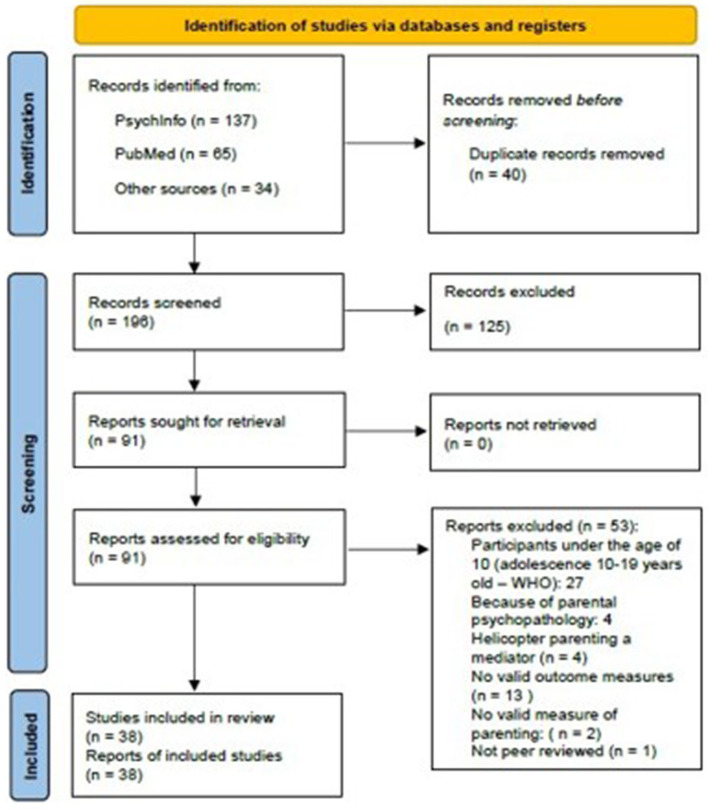
- Searches were run in PsychINFO and PubMed using terms for overprotective, helicopter, and controlling parenting combined with parenting style and anxiety/depression; the initial search was 8 August 2019 and updated 3 November 2021, yielding 202 database records plus 34 hand-searched records, 196 after duplicate removal, 91 full-text retrievals, and 38 included studies.
- Data were extracted into an Excel chart; study quality was assessed with Campbell’s Validity Typology, and findings were synthesized narratively.
Limitations
- Stated by the authors: only one reviewer conducted the electronic literature search, only two databases were searched, one reviewer conducted initial screening and initial quality assessment, and the review did not investigate possible age differences in outcomes.
- Stated by the authors and evident in the text: most included studies were cross-sectional (33 of 38), all used subjective self-report measures for helicopter parenting, and self-report is prone to bias, mono-method bias, and retrospective recall problems; therefore causal direction cannot be established.
- Evident in the text: the review uses narrative synthesis without meta-analysis, and the included studies vary in whether they measure helicopter parenting, controlling parenting, or overprotective parenting, using many different instruments, which limits comparability.
Model-written summary. Check it against the paper before relying on it.
Integrity signals
Registry
Cites
Statistics
Figures
Verification
Claims the paper makes
81 No full text of the sources · 29 Own method · 29 Own result · 27 Own interpretation · 20 Supported · 18 Sources not found · 17 Partly supported · 11 No basis given · 5 Supported so far · 5 Not checked yet · 4 Not supported · accuracy not yet measured
Every source the paper cites for this claim was checked and supports it.
In the paper
“Seery et al. (2010) found that that individuals whom had experienced a moderate amount of adversity had better mental health as opposed to those whom had no such experience, or too much experience with hardship.”
§ A Systematic Review of “Helicopter Parenting” and Its Relationship With Anxiety and Depression > Introduction
What the sources say
- Supportedcites Seery et al., 2010 source
The Discussion (p. 12) reports that people with some lifetime adversity, compared with those with none or high adversity, had lower distress, functional impairment, and posttraumatic stress symptoms, as well as higher life satisfaction. This supports the cited comparison of mental health outcomes; the study describes an association, not a causal effect. (LLM, conf=0.94)
plaincorrelational- Asserted: passes — The authors put it forward as true.
- Checkable: passes — It can be checked against evidence.
- Load-bearing: passes — The paper’s conclusions depend on it.
- Based: passes — The paper gives a reason why it holds.
- Supported
Every source the paper cites for this claim was checked and supports it.
In the paper
“The restriction of exposure to challenges by intervening before a child has struggled or failed undermines the child's effort to establish healthy regulatory strategies (Perry et al., 2018).”
§ A Systematic Review of “Helicopter Parenting” and Its Relationship With Anxiety and Depression > Introduction
What the sources say
- Supportedcites Perry et al., 2018 source
In ‘The Role of Parenting in the Development of Self-Regulatory Skills,’ the paper says that intervening before children try to regulate themselves limits their practice of regulatory strategies, and that shielding them from challenges reduces opportunities to learn to manage difficult situations independently. The Discussion likewise describes how stepping in too early may hinder independent self-regulation. Page numbers are not provided in our copy. (LLM, conf=0.91)
plaindirect- Asserted: passes — The authors put it forward as true.
- Checkable: passes — It can be checked against evidence.
- Load-bearing: passes — The paper’s conclusions depend on it.
- Based: passes — The paper gives a reason why it holds.
- Supported
Every source the paper cites for this claim was checked and supports it.
In the paper
“Additionally, those with a moderate experience of adversity not only reported having better mental health, but they were also less likely to be affected by a recent adverse event (Seery et al., 2010).”
§ A Systematic Review of “Helicopter Parenting” and Its Relationship With Anxiety and Depression > Introduction
What the sources say
- Supportedcites Seery et al., 2010 source
The Hypothesis 2 results (p. 11) report that people with low lifetime adversity were less negatively affected by recent adversity than those with either no or high lifetime adversity. This supports the claim's description of a moderate, rather than absent or high, adversity history. (LLM, conf=0.92)
plaincorrelational- Asserted: passes — The authors put it forward as true.
- Checkable: passes — It can be checked against evidence.
- Load-bearing: passes — The paper’s conclusions depend on it.
- Based: passes — The paper gives a reason why it holds.
- Supported
The cited sources support only part of this claim — read each source’s verdict below.
In the paper
“Consequently, there are fewer regulatory strategies to be called upon when the child is without caregiver assistance (Perry et al., 2018).”
§ A Systematic Review of “Helicopter Parenting” and Its Relationship With Anxiety and Depression > Introduction
What the sources say
- Partly supportedcites Perry et al., 2018 sourceExperimental — accuracy not yet measured
In “The Role of Parenting in the Development of Self-Regulatory Skills,” the paper says that overcontrolling parenting limits opportunities to practice regulation and that fewer strategies *may* be internalized or available without caregiver assistance. The citing sentence presents that qualified possibility as a certainty. (LLM, conf=0.88)
plaindirect- Asserted: passes — The authors put it forward as true.
- Checkable: passes — It can be checked against evidence.
- Load-bearing: passes — The paper’s conclusions depend on it.
- Based: passes — The paper gives a reason why it holds.
- Partly supported
Every source the paper cites for this claim was checked and supports it.
In the paper
“Both forms of parental psychological control (DPC and APC) were related to depressive symptoms”
§ A Systematic Review of “Helicopter Parenting” and Its Relationship With Anxiety and Depression > Results
What the sources say
- Supportedcites Gargurevich and Soenens (2016) source
The Discussion explicitly states that, in correlational analyses of Peruvian late adolescents, both perceived DPC and APC were related to depressive symptoms in paternal and maternal ratings. The Results distinguish this from a model including both as simultaneous predictors, where DPC was not significant; the claim does not assert an independent effect. (LLM, conf=0.95)
plaincorrelational- Asserted: passes — The authors put it forward as true.
- Checkable: passes — It can be checked against evidence.
- Load-bearing: unclear — It is unclear whether the paper’s conclusions depend on it.
- Based: passes — The paper gives a reason why it holds.
- Supported
Every source the paper cites for this claim was checked and supports it.
In the paper
“Helicopter parenting was associated with students' anxiety and depression level”
§ A Systematic Review of “Helicopter Parenting” and Its Relationship With Anxiety and Depression > Results
What the sources say
- Supportedcites Cui et al. (2019) source
The results accompanying Figure 1 report a significant positive association between perceived maternal helicopter parenting and depression among university students in both the U.S. and Finnish samples. The Discussion also identifies depressive symptoms among the well-being problems associated with helicopter parenting. (LLM, conf=0.94)
plaincorrelational- Asserted: passes — The authors put it forward as true.
- Checkable: passes — It can be checked against evidence.
- Load-bearing: passes — The paper’s conclusions depend on it.
- Based: passes — The paper gives a reason why it holds.
- Supported
The cited sources support only part of this claim — read each source’s verdict below.
In the paper
“Lack of autonomy due to maternal control was associated with depressive symptoms”
§ A Systematic Review of “Helicopter Parenting” and Its Relationship With Anxiety and Depression > Results
What the sources say
- Partly supportedcites Cho et al. (2020) sourceExperimental — accuracy not yet measured
The Results (DMCP of MPS; page unavailable) associate differences between mothers’ and children’s parenting-style ratings with higher depression in the children. The Discussion (page unavailable) identifies the significant depression finding specifically with differences in perceived rationality, not a lack of autonomy due to maternal control. The reported autonomy–control correlation compares mothers’ and children’s ratings; it is not a correlation with depression. (LLM, conf=0.84)
plaincorrelational- Asserted: passes — The authors put it forward as true.
- Checkable: passes — It can be checked against evidence.
- Load-bearing: passes — The paper’s conclusions depend on it.
- Based: passes — The paper gives a reason why it holds.
- Partly supported
Every source the paper cites for this claim was checked and supports it.
In the paper
“Helicopter parenting was associated with students' anxiety and depression level”
§ A Systematic Review of “Helicopter Parenting” and Its Relationship With Anxiety and Depression > Results
What the sources say
- Supportedcites Cui et al. (2019) source
The Discussion reports that perceived helicopter parenting was positively associated with young adults’ symptoms of anxiety and depression. The Figure 1 results qualify this: the maternal-parenting association with anxiety was significant in the Finnish sample but not in the U.S. sample. (LLM, conf=0.90)
plaincorrelational- Asserted: passes — The authors put it forward as true.
- Checkable: passes — It can be checked against evidence.
- Load-bearing: passes — The paper’s conclusions depend on it.
- Based: passes — The paper gives a reason why it holds.
- Supported
The cited sources support only part of this claim — read each source’s verdict below.
In the paper
“Higher levels of controlling parenting was related to higher levels of reported anxiety and depression”
§ A Systematic Review of “Helicopter Parenting” and Its Relationship With Anxiety and Depression > Results
What the sources say
- Partly supportedcites Kullberg et al. (2021) sourceExperimental — accuracy not yet measured
The Results (section 3.2.2, p. 5) associate poorer parental bonding with elevated adult anxiety symptoms, and the paper describes overprotection as one component of poor bonding (section 1.1, p. 3). It does not establish a separate association for controlling parenting specifically; section 4.4 (p. 8) proposes examining specific parenting styles in future work. (LLM, conf=0.85)
plaincorrelational- Asserted: passes — The authors put it forward as true.
- Checkable: passes — It can be checked against evidence.
- Load-bearing: passes — The paper’s conclusions depend on it.
- Based: passes — The paper gives a reason why it holds.
- Partly supported
Every source the paper cites for this claim was checked and supports it.
In the paper
“Adults with anxiety disorder reported heighten maternal control.”
§ A Systematic Review of “Helicopter Parenting” and Its Relationship With Anxiety and Depression > Results
What the sources say
- Supportedcites Kullberg et al. (2020) source
In “Lack of Care, Overprotection, and Autonomy: Differences Across Psychopathology Groups” (page unavailable), adults with anxiety disorders reported greater maternal lack of autonomy than adults with depression; the Results also report greater maternal lack of autonomy than in healthy controls. This supports “maternal control” as a paraphrase of perceived restriction of autonomy, not maternal overprotection, which was not elevated in the anxiety-only group. (LLM, conf=0.88)
plaincorrelational- Asserted: passes — The authors put it forward as true.
- Checkable: passes — It can be checked against evidence.
- Load-bearing: passes — The paper’s conclusions depend on it.
- Based: passes — The paper gives a reason why it holds.
- Supported
- Probably not a substantial claim. 83
- The quote only partly states this claim. 3
- It may state two separate claims as one. 23
At least one cited source doesn’t support this claim or points to a different paper, and none confirmed it — see the verdicts below.
In the paper
“No direct relationship between control and depression.”
§ A Systematic Review of “Helicopter Parenting” and Its Relationship With Anxiety and Depression > Results
What the sources say
- Disputedcites Kullberg et al. (2020) sourceExperimental — accuracy not yet measured
In “Lack of Care, Overprotection, and Autonomy: Differences Across Psychopathology Groups” (page unavailable), the paper reports that lack of autonomy—a restrictive aspect of parental control—was elevated in the lifetime-depression group relative to unaffected participants. It does report no elevated overprotection among participants with depression alone, but that narrower finding does not support a blanket claim of no relationship between control and depression. The cross-sectional study does not establish whether the association is causal. (LLM, conf=0.82)
Checked by a reasoning model — may be wrong.
plain- Asserted: passes — The authors put it forward as true.
- Checkable: passes — It can be checked against evidence.
- Load-bearing: fails — The paper’s conclusions may not depend on it.
- Based: passes — The paper gives a reason why it holds.
Probably not a substantial claim. The paper’s conclusions may not depend on it.
- Disputed
At least one cited source doesn’t support this claim or points to a different paper, and none confirmed it — see the verdicts below.
In the paper
“However, the effect size of maternal control (1.05) and parental control (0.8) were big in terms of reported adolescent anxiety.”
§ A Systematic Review of “Helicopter Parenting” and Its Relationship With Anxiety and Depression > Results > Validity Assessment
What the sources say
- Disputedcites Rogers et al. (2020) sourceExperimental — accuracy not yet measured
In “Class differences in development of depressive and anxiety symptoms” (page unavailable), the paper reports maternal-control class differences in adolescent anxiety of d = 0.84 at age 14 and d = 0.43 at age 19—not 1.05. It reports paternal-control class differences of d = 0.23 and d = 0.09, respectively, describing them as small and negligible rather than large; neither cited figure matches the claim. (LLM, conf=0.90)
Checked by a reasoning model — may be wrong.
plaincorrelational- Asserted: passes — The authors put it forward as true.
- Checkable: passes — It can be checked against evidence.
- Load-bearing: unclear — It is unclear whether the paper’s conclusions depend on it.
- Based: passes — The paper gives a reason why it holds.
The quote only partly states this claim.
- Disputed
At least one cited source doesn’t support this claim or points to a different paper, and none confirmed it — see the verdicts below.
In the paper
“The effect size for both maternal control (.34) and parental control (.06) were found to be small in relation to reported depression.”
§ A Systematic Review of “Helicopter Parenting” and Its Relationship With Anxiety and Depression > Results > Validity Assessment
What the sources say
- Disputedcites Rogers et al. (2020) sourceExperimental — accuracy not yet measured
The section “Class differences in development of depressive and anxiety symptoms” (page unavailable) reports maternal-control class differences in depressive symptoms of d = 0.80 at age 14 (large) and d = 0.40 at age 19 (moderate). It reports paternal-control class differences of d = 0.40 (moderate) and d = 0.23 (relatively small), respectively—not .34 and .06, and not both small. (LLM, conf=0.90)
Checked by a reasoning model — may be wrong.
plaincorrelational- Asserted: passes — The authors put it forward as true.
- Checkable: passes — It can be checked against evidence.
- Load-bearing: unclear — It is unclear whether the paper’s conclusions depend on it.
- Based: passes — The paper gives a reason why it holds.
The quote only partly states this claim.
- Disputed
At least one cited source doesn’t support this claim or points to a different paper, and none confirmed it — see the verdicts below.
In the paper
“Additionally, although the effect size for both maternal and parental control was found to be quite small regarding its effect on depression, it was much bigger in terms of adolescent anxiety.”
§ A Systematic Review of “Helicopter Parenting” and Its Relationship With Anxiety and Depression > Discussion
What the sources say
- Disputedcites Rogers et al. (2020) sourceExperimental — accuracy not yet measured
The Results section, “Class differences in development of depressive and anxiety symptoms” (page unavailable), reports large maternal-control group differences for both depression (d = 0.80) and anxiety (d = 0.84) at age 14, with both moderate by age 19. For paternal control, the depression difference was larger than the anxiety difference at both ages—the opposite of the claimed comparison. (LLM, conf=0.91)
Checked by a reasoning model — may be wrong.
plaincorrelational- Asserted: passes — The authors put it forward as true.
- Checkable: passes — It can be checked against evidence.
- Load-bearing: passes — The paper’s conclusions depend on it.
- Based: passes — The paper gives a reason why it holds.
It may state two separate claims as one.
- Disputed
Every source the paper cites for this claim was checked and supports it.
In the paper
“Adolescence on the other hand is a period characterized by an increased development of independence (Szwedo et al., 2017).”
§ A Systematic Review of “Helicopter Parenting” and Its Relationship With Anxiety and Depression > Introduction
What the sources say
- Supportedcites Szwedo et al., 2017 source
The Discussion (page not supplied) explicitly describes adolescence as a life stage marked by autonomy development. It also says adolescents often seek to increase their independence from others, supporting the paraphrase. (LLM, conf=0.94)
plain- Asserted: passes — The authors put it forward as true.
- Checkable: passes — It can be checked against evidence.
- Load-bearing: passes — The paper’s conclusions depend on it.
- Based: passes — The paper gives a reason why it holds.
Probably not a substantial claim.
- Supported
Every source the paper cites for this claim was checked and supports it.
In the paper
“Adolescence is a period characterized by development of independence (Szwedo et al., 2017)”
§ A Systematic Review of “Helicopter Parenting” and Its Relationship With Anxiety and Depression > Methods > Eligibility Criteria
What the sources say
- Supportedcites Szwedo et al., 2017 source
The Discussion explicitly describes adolescence as “a life stage marked by autonomy development.” The Abstract also says teens typically seek greater independence from parents. These passages support the citing sentence’s broad characterization. (LLM, conf=0.94)
plain- Asserted: passes — The authors put it forward as true.
- Checkable: passes — It can be checked against evidence.
- Load-bearing: passes — The paper’s conclusions depend on it.
- Based: passes — The paper gives a reason why it holds.
Probably not a substantial claim.
- Supported
The cited sources support only part of this claim — read each source’s verdict below.
In the paper
“The eligibility criteria was developed in accordance to the PICO(S) framework, see Table 1 (Santos et al., 2007).”
§ A Systematic Review of “Helicopter Parenting” and Its Relationship With Anxiety and Depression > Methods > Eligibility Criteria
What the sources say
- Partly supportedcites Santos et al., 2007 sourceExperimental — accuracy not yet measured
The Construction of the Research Question section (p. 2) describes PICO as a framework for defining a research question and searching for evidence. Its example (p. 3) specifies population, intervention, comparison and outcome in ways relevant to selecting studies. The paper does not describe the added “S” in PICO(S) or explicitly present the framework as a method for developing eligibility criteria. (LLM, conf=0.84)
plain- Asserted: passes — The authors put it forward as true.
- Checkable: passes — It can be checked against evidence.
- Load-bearing: fails — The paper’s conclusions may not depend on it.
- Based: passes — The paper gives a reason why it holds.
Probably not a substantial claim. The paper’s conclusions may not depend on it.
- Partly supported
The cited sources support only part of this claim — read each source’s verdict below.
In the paper
“Three studies only used child self-report, thereby exposing their study to the risk of mono-method bias and response bias (Overbeek et al., 2007; Knappe et al., 2012; Rogers et al., 2020).”
§ A Systematic Review of “Helicopter Parenting” and Its Relationship With Anxiety and Depression > Results > Validity Assessment
What the sources say
- Not checked — no full text of the sourcecites Overbeek et al., 2007 source
- Not checked — no full text of the sourcecites Knappe et al., 2012 source
- Partly supportedcites Rogers et al., 2020 sourceExperimental — accuracy not yet measured
Split into 2 atoms — 1 confirmed, 1 partially supported, 0 disputed, 0 misattributed, 0 unverifiable. Expand the claim to see per-atom verdicts.
plain- Asserted: passes — The authors put it forward as true.
- Checkable: passes — It can be checked against evidence.
- Load-bearing: unclear — It is unclear whether the paper’s conclusions depend on it.
- Based: passes — The paper gives a reason why it holds.
It may state two separate claims as one.
The cited sources support only part of this claim — read each source’s verdict below.
In the paper
“Regarding the study by Basili et al. (2021) the findings must be interpreted with caution as they found parental control to predict lower levels of depression”
§ A Systematic Review of “Helicopter Parenting” and Its Relationship With Anxiety and Depression > Results > Validity Assessment
What the sources say
- Partly supportedcites Basili et al., 2021 sourceExperimental — accuracy not yet measured
The Discussion (page not supplied) reports that paternal psychological control predicted fewer adolescent anxious-depressed symptoms. The claim broadens this finding to parental control generally and to depression alone; maternal psychological control was not associated with internalizing symptoms. (LLM, conf=0.88)
hedgeddirect- Asserted: passes — The authors put it forward as true.
- Checkable: passes — It can be checked against evidence.
- Load-bearing: fails — The paper’s conclusions may not depend on it.
- Based: passes — The paper gives a reason why it holds.
Probably not a substantial claim. The paper’s conclusions may not depend on it.
- Partly supported
The cited sources support only part of this claim — read each source’s verdict below.
In the paper
“A clear majority of the studies included in this review found a direct positive relationship between helicopter parenting and symptoms of anxiety and depression, with one exception (Basili et al., 2021) finding a negative association.”
§ A Systematic Review of “Helicopter Parenting” and Its Relationship With Anxiety and Depression > Discussion
What the sources say
- Partly supportedcites Basili et al., 2021 sourceExperimental — accuracy not yet measured
The Discussion (page not specified) reports a negative association between paternal psychological control and adolescents’ anxious-depressive symptoms. The cited study examines psychological control, not helicopter parenting, so it does not establish the claimed exception for helicopter parenting. (LLM, conf=0.88)
boostedcorrelational- Asserted: passes — The authors put it forward as true.
- Checkable: passes — It can be checked against evidence.
- Load-bearing: passes — The paper’s conclusions depend on it.
- Based: passes — The paper gives a reason why it holds.
It may state two separate claims as one.
- Partly supported
Every source the paper cites for this claim was checked and supports it.
In the paper
“However, there were differences in the effect sizes in terms on how each specific parent effected anxiety and depression with maternal control found to have a bigger effect size than parental control.”
§ A Systematic Review of “Helicopter Parenting” and Its Relationship With Anxiety and Depression > Discussion
What the sources say
- Supportedcites Rogers et al. (2020) source
The ‘Class differences in development of depressive and anxiety symptoms’ section (page unavailable) reports larger mother-model than father-model effect sizes for both symptoms at ages 14 and 19. These are effect sizes for differences between psychological-control trajectory groups, not estimates of a causal effect of control. (LLM, conf=0.91)
plaincorrelational- Asserted: passes — The authors put it forward as true.
- Checkable: passes — It can be checked against evidence.
- Load-bearing: passes — The paper’s conclusions depend on it.
- Based: passes — The paper gives a reason why it holds.
The quote only partly states this claim.
- Supported
The sources with a verdict support this claim; the rest weren’t checked yet, have no full text we could read, or their verdicts aren’t rated yet.
In the paper
“However, our memories are not accurate snapshots of the past, rather, they are constructions and must be understood as open to influence from the attempts to provide meaning (Schacter et al., 2011) and from the cognitive processes involving our selection and interpretation of elements making up memories (Chess et al., 1966).”
§ A Systematic Review of “Helicopter Parenting” and Its Relationship With Anxiety and Depression > Discussion
What the sources say
plain- Asserted: passes — The authors put it forward as true.
- Checkable: passes — It can be checked against evidence.
- Load-bearing: passes — The paper’s conclusions depend on it.
- Based: passes — The paper gives a reason why it holds.
It may state two separate claims as one.
The cited sources support only part of this claim — read each source’s verdict below.
In the paper
“In terms of the causes of anxiety both genetic (Meier et al., 2019), the personality of the individual (Prince et al., 2021) as well as stressful life events could cause anxiety (Miloyan et al., 2018).”
§ A Systematic Review of “Helicopter Parenting” and Its Relationship With Anxiety and Depression > Discussion
What the sources say
- Supportedcites Meier et al., 2019 source
The paper’s Abstract says genetic factors are relevant to the etiology of anxiety disorders, and its Discussion reports substantial SNP-based heritability. Meier et al. is cited for the genetic part of the sentence; personality and stressful life events have separate citations. (LLM, conf=0.93)
- Partly supportedcites Prince et al., 2021 sourceExperimental — accuracy not yet measured
The Prince et al. citation attaches to the personality portion of the sentence, not to genetic factors or stressful life events. The Discussion reports that higher neuroticism predicted first-onset anxiety disorders in young adults, but the Conclusions say it could be either a true risk factor or a marker of risk. The source therefore supports an association with specific personality traits, not an established causal role for personality generally. (LLM, conf=0.84)
- Supportedcites Miloyan et al., 2018 source
The Miloyan et al. citation is attached to the stressful-life-events part of the sentence, not the claims about genetics or personality. The Discussion states that adverse events can play a causal role in inducing anxiety and are associated with increased risk of anxiety disorder onset. (LLM, conf=0.93)
hedgedconditional- Asserted: passes — The authors put it forward as true.
- Checkable: passes — It can be checked against evidence.
- Load-bearing: fails — The paper’s conclusions may not depend on it.
- Based: passes — The paper gives a reason why it holds.
Probably not a substantial claim. The paper’s conclusions may not depend on it. It may state two separate claims as one.
- Supported
The cited sources support only part of this claim — read each source’s verdict below.
In the paper
“Even though a second reviewer was contacted when uncertainty arose and the two reviews met to collectively go through the potential studies, it is still a recommendation by PRISMA that at least two separate screenings take place (Liberati et al., 2009).”
§ A Systematic Review of “Helicopter Parenting” and Its Relationship With Anxiety and Depression > Discussion
What the sources say
- Partly supportedcites Liberati et al., 2009 sourceExperimental — accuracy not yet measured
In the study-selection explanation (page unavailable), the paper says using at least two investigators may reduce the chance of rejecting relevant reports. It advises authors to report how screening was done, but says there is no standard selection process; it does not recommend that every review undergo at least two separate screenings. (LLM, conf=0.84)
plain- Asserted: passes — The authors put it forward as true.
- Checkable: passes — It can be checked against evidence.
- Load-bearing: fails — The paper’s conclusions may not depend on it.
- Based: passes — The paper gives a reason why it holds.
Probably not a substantial claim. The paper’s conclusions may not depend on it.
- Partly supported
The cited sources support only part of this claim — read each source’s verdict below.
In the paper
“Research is clear that there are several reasons why one could develop depression, such as faulty mood regulation by the brain, genetic vulnerability and stressful life events (Burns et al., 2002; Bar, 2009).”
§ A Systematic Review of “Helicopter Parenting” and Its Relationship With Anxiety and Depression > Discussion
What the sources say
- Not checked — no full text of the sourcecites Burns et al., 2002 source
- Partly supportedcites Bar, 2009 sourceExperimental — accuracy not yet measured
The sections on associative processing and mood link depression to abnormal brain-network function and mood regulation. The concluding remarks also say that not all depression stems from the proposed hippocampal/prefrontal processes. Our copy does not identify genetic vulnerability or stressful life events as reasons someone develops depression; its mention of stress describes it as a concomitant of mood disorders. (LLM, conf=0.86)
boosteddirect- Asserted: passes — The authors put it forward as true.
- Checkable: passes — It can be checked against evidence.
- Load-bearing: fails — The paper’s conclusions may not depend on it.
- Based: passes — The paper gives a reason why it holds.
Probably not a substantial claim. The paper’s conclusions may not depend on it. It may state two separate claims as one.
A result the paper reports from its own data — it cites no other source for it, so there is none to check. The quote shows it is in the paper.
In the paper
“A systematic literature search conducted the 3rd of November 2021 yielded 38 eligible studies.”
§ A Systematic Review of “Helicopter Parenting” and Its Relationship With Anxiety and Depression > Abstract > Method
plain- Asserted: passes — The authors put it forward as true.
- Checkable: passes — It can be checked against evidence.
- Load-bearing: fails — The paper’s conclusions may not depend on it.
- Based: passes — The paper gives a reason why it holds.
Probably not a substantial claim. The paper’s conclusions may not depend on it.
A result the paper reports from its own data — it cites no other source for it, so there is none to check. The quote shows it is in the paper.
In the paper
“Duplicates were removed before any further screening procedure, leaving 196 abstracts and titles to be screened according to the eligibility criteria.”
§ A Systematic Review of “Helicopter Parenting” and Its Relationship With Anxiety and Depression > Results
plain- Asserted: passes — The authors put it forward as true.
- Checkable: passes — It can be checked against evidence.
- Load-bearing: fails — The paper’s conclusions may not depend on it.
- Based: passes — The paper gives a reason why it holds.
Probably not a substantial claim. The paper’s conclusions may not depend on it.
A result the paper reports from its own data — it cites no other source for it, so there is none to check. The quote shows it is in the paper.
In the paper
“Thirty-one studies used only child reports and 5 studies used both parent report and child report.”
§ A Systematic Review of “Helicopter Parenting” and Its Relationship With Anxiety and Depression > Results
plain- Asserted: passes — The authors put it forward as true.
- Checkable: passes — It can be checked against evidence.
- Load-bearing: fails — The paper’s conclusions may not depend on it.
- Based: passes — The paper gives a reason why it holds.
Probably not a substantial claim. The paper’s conclusions may not depend on it.
A result the paper reports from its own data — it cites no other source for it, so there is none to check. The quote shows it is in the paper.
In the paper
“After the application of the eligibility criteria to the full-text studies a total amount of 38 studies were selected to be part of the review.”
§ A Systematic Review of “Helicopter Parenting” and Its Relationship With Anxiety and Depression > Results
plain- Asserted: passes — The authors put it forward as true.
- Checkable: passes — It can be checked against evidence.
- Load-bearing: fails — The paper’s conclusions may not depend on it.
- Based: passes — The paper gives a reason why it holds.
Probably not a substantial claim. The paper’s conclusions may not depend on it.
A result the paper reports from its own data — it cites no other source for it, so there is none to check. The quote shows it is in the paper.
In the paper
“Exclusion after full-text retrieval were due to participants being under the age of 10, parental psychopathology, helicopter parenting being a mediator, no valid measure of anxiety or depression, the sample was ineligible or the study was not peer reviewed (see Figure 1).”
§ A Systematic Review of “Helicopter Parenting” and Its Relationship With Anxiety and Depression > Results
plain- Asserted: passes — The authors put it forward as true.
- Checkable: passes — It can be checked against evidence.
- Load-bearing: fails — The paper’s conclusions may not depend on it.
- Based: passes — The paper gives a reason why it holds.
Probably not a substantial claim. The paper’s conclusions may not depend on it. It may state two separate claims as one.
A result the paper reports from its own data — it cites no other source for it, so there is none to check. The quote shows it is in the paper.
In the paper
“As is illustrated in the PRISMA flow diagram (see Figure 1), 202 studies were identified through the electronic searches in the databases of PsychINFO and Pubmed.”
§ A Systematic Review of “Helicopter Parenting” and Its Relationship With Anxiety and Depression > Results
plain- Asserted: passes — The authors put it forward as true.
- Checkable: passes — It can be checked against evidence.
- Load-bearing: fails — The paper’s conclusions may not depend on it.
- Based: passes — The paper gives a reason why it holds.
Probably not a substantial claim. The paper’s conclusions may not depend on it.
A result the paper reports from its own data — it cites no other source for it, so there is none to check. The quote shows it is in the paper.
In the paper
“The included studies employed a range of different measurements for parenting style and anxiety and depression.”
§ A Systematic Review of “Helicopter Parenting” and Its Relationship With Anxiety and Depression > Results
plain- Asserted: passes — The authors put it forward as true.
- Checkable: passes — It can be checked against evidence.
- Load-bearing: fails — The paper’s conclusions may not depend on it.
- Based: passes — The paper gives a reason why it holds.
Probably not a substantial claim. The paper’s conclusions may not depend on it.
A result the paper reports from its own data — it cites no other source for it, so there is none to check. The quote shows it is in the paper.
In the paper
“In addition, 34 studies were identified for possible inclusion from hand searching through possible studies' references.”
§ A Systematic Review of “Helicopter Parenting” and Its Relationship With Anxiety and Depression > Results
plain- Asserted: passes — The authors put it forward as true.
- Checkable: passes — It can be checked against evidence.
- Load-bearing: fails — The paper’s conclusions may not depend on it.
- Based: passes — The paper gives a reason why it holds.
Probably not a substantial claim. The paper’s conclusions may not depend on it.
A result the paper reports from its own data — it cites no other source for it, so there is none to check. The quote shows it is in the paper.
In the paper
“In total, 33 cross-sectional studies and 5 longitudinal studies were identified (see Table 2).”
§ A Systematic Review of “Helicopter Parenting” and Its Relationship With Anxiety and Depression > Results
plain- Asserted: passes — The authors put it forward as true.
- Checkable: passes — It can be checked against evidence.
- Load-bearing: fails — The paper’s conclusions may not depend on it.
- Based: passes — The paper gives a reason why it holds.
Probably not a substantial claim. The paper’s conclusions may not depend on it.
A result the paper reports from its own data — it cites no other source for it, so there is none to check. The quote shows it is in the paper.
In the paper
“All 38 studies employed subjective measurements, not researcher observations, for the measurement of helicopter parenting.”
§ A Systematic Review of “Helicopter Parenting” and Its Relationship With Anxiety and Depression > Results
plain- Asserted: passes — The authors put it forward as true.
- Checkable: passes — It can be checked against evidence.
- Load-bearing: fails — The paper’s conclusions may not depend on it.
- Based: passes — The paper gives a reason why it holds.
Probably not a substantial claim. The paper’s conclusions may not depend on it.
A result the paper reports from its own data — it cites no other source for it, so there is none to check. The quote shows it is in the paper.
In the paper
“This resulted in 91 studies identified for full-text retrieval.”
§ A Systematic Review of “Helicopter Parenting” and Its Relationship With Anxiety and Depression > Results
plain- Asserted: passes — The authors put it forward as true.
- Checkable: passes — It can be checked against evidence.
- Load-bearing: fails — The paper’s conclusions may not depend on it.
- Based: passes — The paper gives a reason why it holds.
Probably not a substantial claim. The paper’s conclusions may not depend on it.
A result the paper reports from its own data — it cites no other source for it, so there is none to check. The quote shows it is in the paper.
In the paper
“1 study investigated both the controlling and overprotective dimension”
§ A Systematic Review of “Helicopter Parenting” and Its Relationship With Anxiety and Depression > Results
plain- Asserted: passes — The authors put it forward as true.
- Checkable: passes — It can be checked against evidence.
- Load-bearing: fails — The paper’s conclusions may not depend on it.
- Based: passes — The paper gives a reason why it holds.
Probably not a substantial claim. The paper’s conclusions may not depend on it.
A result the paper reports from its own data — it cites no other source for it, so there is none to check. The quote shows it is in the paper.
In the paper
“19 studies focused on the controlling dimension of helicopter parenting”
§ A Systematic Review of “Helicopter Parenting” and Its Relationship With Anxiety and Depression > Results
plain- Asserted: passes — The authors put it forward as true.
- Checkable: passes — It can be checked against evidence.
- Load-bearing: fails — The paper’s conclusions may not depend on it.
- Based: passes — The paper gives a reason why it holds.
Probably not a substantial claim. The paper’s conclusions may not depend on it.
A result the paper reports from its own data — it cites no other source for it, so there is none to check. The quote shows it is in the paper.
In the paper
“While 14 studies investigated helicopter parenting as an independent construct”
§ A Systematic Review of “Helicopter Parenting” and Its Relationship With Anxiety and Depression > Results
plain- Asserted: passes — The authors put it forward as true.
- Checkable: passes — It can be checked against evidence.
- Load-bearing: fails — The paper’s conclusions may not depend on it.
- Based: passes — The paper gives a reason why it holds.
Probably not a substantial claim. The paper’s conclusions may not depend on it.
A result the paper reports from its own data — it cites no other source for it, so there is none to check. The quote shows it is in the paper.
In the paper
“27 measured depression”
§ A Systematic Review of “Helicopter Parenting” and Its Relationship With Anxiety and Depression > Results
plain- Asserted: passes — The authors put it forward as true.
- Checkable: passes — It can be checked against evidence.
- Load-bearing: fails — The paper’s conclusions may not depend on it.
- Based: passes — The paper gives a reason why it holds.
Probably not a substantial claim. The paper’s conclusions may not depend on it.
A result the paper reports from its own data — it cites no other source for it, so there is none to check. The quote shows it is in the paper.
In the paper
“A total amount of 27 studies measured anxiety”
§ A Systematic Review of “Helicopter Parenting” and Its Relationship With Anxiety and Depression > Results
plain- Asserted: passes — The authors put it forward as true.
- Checkable: passes — It can be checked against evidence.
- Load-bearing: fails — The paper’s conclusions may not depend on it.
- Based: passes — The paper gives a reason why it holds.
Probably not a substantial claim. The paper’s conclusions may not depend on it.
A result the paper reports from its own data — it cites no other source for it, so there is none to check. The quote shows it is in the paper.
In the paper
“The remaining 2 studies employed an additional reporter to the child or parent.”
§ A Systematic Review of “Helicopter Parenting” and Its Relationship With Anxiety and Depression > Results
plain- Asserted: passes — The authors put it forward as true.
- Checkable: passes — It can be checked against evidence.
- Load-bearing: fails — The paper’s conclusions may not depend on it.
- Based: passes — The paper gives a reason why it holds.
Probably not a substantial claim. The paper’s conclusions may not depend on it.
A result the paper reports from its own data — it cites no other source for it, so there is none to check. The quote shows it is in the paper.
In the paper
“of the studies investigating a controlling parenting style, 3 focused solely upon maternal control”
§ A Systematic Review of “Helicopter Parenting” and Its Relationship With Anxiety and Depression > Results
plain- Asserted: passes — The authors put it forward as true.
- Checkable: passes — It can be checked against evidence.
- Load-bearing: fails — The paper’s conclusions may not depend on it.
- Based: passes — The paper gives a reason why it holds.
Probably not a substantial claim. The paper’s conclusions may not depend on it.
A result the paper reports from its own data — it cites no other source for it, so there is none to check. The quote shows it is in the paper.
In the paper
“Thirty-one studies used only child reports and 5 studies used both parent report and child report.”
§ A Systematic Review of “Helicopter Parenting” and Its Relationship With Anxiety and Depression > Results
plain- Asserted: passes — The authors put it forward as true.
- Checkable: passes — It can be checked against evidence.
- Load-bearing: fails — The paper’s conclusions may not depend on it.
- Based: passes — The paper gives a reason why it holds.
Probably not a substantial claim. The paper’s conclusions may not depend on it.
A result the paper reports from its own data — it cites no other source for it, so there is none to check. The quote shows it is in the paper.
In the paper
“4 on the overprotective dimension”
§ A Systematic Review of “Helicopter Parenting” and Its Relationship With Anxiety and Depression > Results
plain- Asserted: passes — The authors put it forward as true.
- Checkable: passes — It can be checked against evidence.
- Load-bearing: fails — The paper’s conclusions may not depend on it.
- Based: passes — The paper gives a reason why it holds.
Probably not a substantial claim. The paper’s conclusions may not depend on it.
A result the paper reports from its own data — it cites no other source for it, so there is none to check. The quote shows it is in the paper.
In the paper
“In addition, 2 studies focused solely on maternal control”
§ A Systematic Review of “Helicopter Parenting” and Its Relationship With Anxiety and Depression > Results > Depression
plain- Asserted: passes — The authors put it forward as true.
- Checkable: passes — It can be checked against evidence.
- Load-bearing: fails — The paper’s conclusions may not depend on it.
- Based: passes — The paper gives a reason why it holds.
Probably not a substantial claim. The paper’s conclusions may not depend on it.
What the paper did — it cites no source for this, so there is none to check. The quote shows it is in the paper.
In the paper
“Study quality was assessed in accordance with Campbells Validity Typology.”
§ A Systematic Review of “Helicopter Parenting” and Its Relationship With Anxiety and Depression > Abstract > Method
plain- Asserted: passes — The authors put it forward as true.
- Checkable: passes — It can be checked against evidence.
- Load-bearing: fails — The paper’s conclusions may not depend on it.
- Based: passes — The paper gives a reason why it holds.
Probably not a substantial claim. The paper’s conclusions may not depend on it.
What the paper did — it cites no source for this, so there is none to check. The quote shows it is in the paper.
In the paper
“Studies in which helicopter parenting was a moderator rather than a predictor of the outcome of anxiety or depression were not included.”
§ A Systematic Review of “Helicopter Parenting” and Its Relationship With Anxiety and Depression > Methods > Eligibility Criteria
plain- Asserted: passes — The authors put it forward as true.
- Checkable: passes — It can be checked against evidence.
- Load-bearing: passes — The paper’s conclusions depend on it.
- Based: passes — The paper gives a reason why it holds.
Probably not a substantial claim.
In the paper
“Due to the fact that it has been argued that a major shift in parental involvement happened in 1985, studies conducted before then were not considered (Lythcott-Haims, 2015).”
§ A Systematic Review of “Helicopter Parenting” and Its Relationship With Anxiety and Depression > Methods > Eligibility Criteria
What the sources say
- Not matchedcites Lythcott-Haims, 2015
Couldn’t be matched to a paper in Crossref, so it can’t be checked.
plain- Asserted: passes — The authors put it forward as true.
- Checkable: passes — It can be checked against evidence.
- Load-bearing: passes — The paper’s conclusions depend on it.
- Based: passes — The paper gives a reason why it holds.
Probably not a substantial claim.
- Not matched
In the paper
“Different phases of childhood, from infancy to adolescence, require specific levels of protection and control to promote optimal developmental outcomes (Santrock, 2019).”
§ A Systematic Review of “Helicopter Parenting” and Its Relationship With Anxiety and Depression > Introduction
What the sources say
- Not matchedcites Santrock, 2019
Couldn’t be matched to a paper in Crossref, so it can’t be checked.
plaindirect- Asserted: passes — The authors put it forward as true.
- Checkable: passes — It can be checked against evidence.
- Load-bearing: fails — The paper’s conclusions may not depend on it.
- Based: passes — The paper gives a reason why it holds.
Probably not a substantial claim. The paper’s conclusions may not depend on it.
- Not matched
In the paper
“Ryan and Deci (2000) outline three basic needs that are innate in us all. If satisfied, these needs promotes health and wellbeing, but a violation of these needs contributes to pathology and ill-being.”
§ A Systematic Review of “Helicopter Parenting” and Its Relationship With Anxiety and Depression > Introduction
What the sources say
- Not checked — no full text of the sourcecites Ryan and Deci, 2000 source
plaindirect- Asserted: passes — The authors put it forward as true.
- Checkable: passes — It can be checked against evidence.
- Load-bearing: passes — The paper’s conclusions depend on it.
- Based: passes — The paper gives a reason why it holds.
It may state two separate claims as one.
In the paper
“Another factor contributing to depression is the exercise of control over the depressing thoughts themselves (Bandura et al., 1999).”
§ A Systematic Review of “Helicopter Parenting” and Its Relationship With Anxiety and Depression > Introduction
What the sources say
- Not checked — no full text of the sourcecites Bandura et al., 1999 source
plaindirect- Asserted: passes — The authors put it forward as true.
- Checkable: passes — It can be checked against evidence.
- Load-bearing: fails — The paper’s conclusions may not depend on it.
- Based: passes — The paper gives a reason why it holds.
Probably not a substantial claim. The paper’s conclusions may not depend on it.
What the paper did — it cites no source for this, so there is none to check. The quote shows it is in the paper.
In the paper
“Studies where parental psychopathology was an area of focus were not included.”
§ A Systematic Review of “Helicopter Parenting” and Its Relationship With Anxiety and Depression > Methods > Eligibility Criteria
plain- Asserted: passes — The authors put it forward as true.
- Checkable: passes — It can be checked against evidence.
- Load-bearing: fails — The paper’s conclusions may not depend on it.
- Based: passes — The paper gives a reason why it holds.
Probably not a substantial claim. The paper’s conclusions may not depend on it.
In the paper
“This systematic review follows the guidelines of PRISMA: Preferred Reporting Items for Systematic Review and Meta-Analysis (Moher et al., 2010).”
§ A Systematic Review of “Helicopter Parenting” and Its Relationship With Anxiety and Depression > Methods
What the sources say
- Not checked — no full text of the sourcecites Moher et al., 2010 source
plain- Asserted: passes — The authors put it forward as true.
- Checkable: passes — It can be checked against evidence.
- Load-bearing: fails — The paper’s conclusions may not depend on it.
- Based: passes — The paper gives a reason why it holds.
Probably not a substantial claim. The paper’s conclusions may not depend on it.
What the paper did — it cites no source for this, so there is none to check. The quote shows it is in the paper.
In the paper
“Methods of the analysis and inclusion criteria were specified in advanced and documented in a protocol.”
§ A Systematic Review of “Helicopter Parenting” and Its Relationship With Anxiety and Depression > Methods > Protocol and Registration
plain- Asserted: passes — The authors put it forward as true.
- Checkable: passes — It can be checked against evidence.
- Load-bearing: fails — The paper’s conclusions may not depend on it.
- Based: passes — The paper gives a reason why it holds.
Probably not a substantial claim. The paper’s conclusions may not depend on it. It may state two separate claims as one.
In the paper
“The self-determination theory argues that an individual cannot thrive without all of these being fulfilled, to the same degree that one cannot thrive with water and not food (Ryan and Deci, 2000).”
§ A Systematic Review of “Helicopter Parenting” and Its Relationship With Anxiety and Depression > Introduction
What the sources say
- Not checked — no full text of the sourcecites Ryan and Deci, 2000 source
plaindirect- Asserted: passes — The authors put it forward as true.
- Checkable: passes — It can be checked against evidence.
- Load-bearing: passes — The paper’s conclusions depend on it.
- Based: passes — The paper gives a reason why it holds.
Probably not a substantial claim.
In the paper
“A low sense of efficacy to exercise control over that which one values can give rise to feelings of futility in several ways, for instance through unfulfilled aspirations (Bandura, 2010).”
§ A Systematic Review of “Helicopter Parenting” and Its Relationship With Anxiety and Depression > Introduction
What the sources say
- Not checked — no full text of the sourcecites Bandura, 2010 source
plaindirect- Asserted: passes — The authors put it forward as true.
- Checkable: passes — It can be checked against evidence.
- Load-bearing: passes — The paper’s conclusions depend on it.
- Based: passes — The paper gives a reason why it holds.
Probably not a substantial claim.
A conclusion the paper draws from its own results — it cites no other source for it, so there is none to check. The quote shows it is in the paper.
In the paper
“If an individual has a low sense of self-efficacy in addition to parents who reinforce this sense of danger by overprotectiveness, it would only be logical to assume that this could increase anxiety levels even more.”
§ A Systematic Review of “Helicopter Parenting” and Its Relationship With Anxiety and Depression > Introduction
hedgedconditional- Asserted: passes — The authors put it forward as true.
- Checkable: passes — It can be checked against evidence.
- Load-bearing: fails — The paper’s conclusions may not depend on it.
- Based: fails — The paper may give no reason why it holds.
Probably not a substantial claim. The paper’s conclusions may not depend on it. The paper may give no reason why it holds.
What the paper did — it cites no source for this, so there is none to check. The quote shows it is in the paper.
In the paper
“We modified the protocol during the review regarding inclusion-criteria, as we found that including a pre-adolescent population led to heterogeneity that detracted from the coherence of the review.”
§ A Systematic Review of “Helicopter Parenting” and Its Relationship With Anxiety and Depression > Methods > Protocol and Registration
plaindirect- Asserted: passes — The authors put it forward as true.
- Checkable: passes — It can be checked against evidence.
- Load-bearing: fails — The paper’s conclusions may not depend on it.
- Based: passes — The paper gives a reason why it holds.
Probably not a substantial claim. The paper’s conclusions may not depend on it.
In the paper
“Children need a certain level of parental control to learn how to be an effective member of society, but they also need autonomy to develop competence and self-sufficiency (Barber et al., 1994).”
§ A Systematic Review of “Helicopter Parenting” and Its Relationship With Anxiety and Depression > Introduction
What the sources say
- Not checked — no full text of the sourcecites Barber et al., 1994 source
plaindirect- Asserted: passes — The authors put it forward as true.
- Checkable: passes — It can be checked against evidence.
- Load-bearing: fails — The paper’s conclusions may not depend on it.
- Based: passes — The paper gives a reason why it holds.
Probably not a substantial claim. The paper’s conclusions may not depend on it.
What the paper did — it cites no source for this, so there is none to check. The quote shows it is in the paper.
In the paper
“Since this review is focused on the outcome of anxiety and depression, to be included in the review the studies would have to have a valid and separate measurement of one or both of these outcomes.”
§ A Systematic Review of “Helicopter Parenting” and Its Relationship With Anxiety and Depression > Methods > Eligibility Criteria
hedged- Asserted: passes — The authors put it forward as true.
- Checkable: passes — It can be checked against evidence.
- Load-bearing: passes — The paper’s conclusions depend on it.
- Based: passes — The paper gives a reason why it holds.
Probably not a substantial claim.
What the paper did — it cites no source for this, so there is none to check. The quote shows it is in the paper.
In the paper
“Only articles written in English were included.”
§ A Systematic Review of “Helicopter Parenting” and Its Relationship With Anxiety and Depression > Methods > Eligibility Criteria
plain- Asserted: passes — The authors put it forward as true.
- Checkable: passes — It can be checked against evidence.
- Load-bearing: fails — The paper’s conclusions may not depend on it.
- Based: passes — The paper gives a reason why it holds.
Probably not a substantial claim. The paper’s conclusions may not depend on it.
What the paper did — it cites no source for this, so there is none to check. The quote shows it is in the paper.
In the paper
“Studies with the aim to validate questionnaires concerning helicopter parenting will also be included in the review.”
§ A Systematic Review of “Helicopter Parenting” and Its Relationship With Anxiety and Depression > Methods > Eligibility Criteria
plain- Asserted: passes — The authors put it forward as true.
- Checkable: passes — It can be checked against evidence.
- Load-bearing: fails — The paper’s conclusions may not depend on it.
- Based: passes — The paper gives a reason why it holds.
Probably not a substantial claim. The paper’s conclusions may not depend on it.
What the paper did — it cites no source for this, so there is none to check. The quote shows it is in the paper.
In the paper
“Studies with a restricted, selective sample focusing on a somatic disease, were not eligible to be considered in this review.”
§ A Systematic Review of “Helicopter Parenting” and Its Relationship With Anxiety and Depression > Methods > Eligibility Criteria
plain- Asserted: passes — The authors put it forward as true.
- Checkable: passes — It can be checked against evidence.
- Load-bearing: fails — The paper’s conclusions may not depend on it.
- Based: passes — The paper gives a reason why it holds.
Probably not a substantial claim. The paper’s conclusions may not depend on it.
In the paper
“One reviewer assessed the validity of the eligible studies according to Campbell's Validity Typology which considers four different types of validity; internal validity, external validity, statistical conclusion validity and construct validity (Shadish et al., 2002).”
§ A Systematic Review of “Helicopter Parenting” and Its Relationship With Anxiety and Depression > Methods > Validity of Individual Studies
What the sources say
- Not matchedcites Shadish et al., 2002
Couldn’t be matched to a paper in Crossref, so it can’t be checked.
plain- Asserted: passes — The authors put it forward as true.
- Checkable: passes — It can be checked against evidence.
- Load-bearing: fails — The paper’s conclusions may not depend on it.
- Based: passes — The paper gives a reason why it holds.
Probably not a substantial claim. The paper’s conclusions may not depend on it.
- Not matched
What the paper did — it cites no source for this, so there is none to check. The quote shows it is in the paper.
In the paper
“Quantitative studies which investigated the relationship between helicopter parenting and anxiety and/or depression were included in the review.”
§ A Systematic Review of “Helicopter Parenting” and Its Relationship With Anxiety and Depression > Methods > Eligibility Criteria
plaincorrelational- Asserted: passes — The authors put it forward as true.
- Checkable: passes — It can be checked against evidence.
- Load-bearing: passes — The paper’s conclusions depend on it.
- Based: passes — The paper gives a reason why it holds.
Probably not a substantial claim.
What the paper did — it cites no source for this, so there is none to check. The quote shows it is in the paper.
In the paper
“Following this, the titles and abstracts of the studies were scoured through and applied to the eligibility criteria. Studies which were deemed ineligible were removed. This was done by one reviewer, however if that reviewer felt uncertain another reviewer was contacted to discuss whether that particular study was eligible or not.”
§ A Systematic Review of “Helicopter Parenting” and Its Relationship With Anxiety and Depression > Methods > Study Selection
plain- Asserted: passes — The authors put it forward as true.
- Checkable: passes — It can be checked against evidence.
- Load-bearing: fails — The paper’s conclusions may not depend on it.
- Based: passes — The paper gives a reason why it holds.
Probably not a substantial claim. The paper’s conclusions may not depend on it. It may state two separate claims as one.
In the paper
“As helicopter parenting is a fairly new term (Padilla-Walker and Nelson, 2012) studies which investigated the overprotective or controlling dimension of helicopter parenting were also included.”
§ A Systematic Review of “Helicopter Parenting” and Its Relationship With Anxiety and Depression > Methods > Eligibility Criteria
What the sources say
- Not checked — no full text of the sourcecites Padilla-Walker and Nelson, 2012 source
plain- Asserted: passes — The authors put it forward as true.
- Checkable: passes — It can be checked against evidence.
- Load-bearing: passes — The paper’s conclusions depend on it.
- Based: passes — The paper gives a reason why it holds.
Probably not a substantial claim.
In the paper
“Additionally, the transition to adulthood has changed drastically in just a few decades where many young adults now find themselves still living at home whilst unattached romantically (Schneider et al., 2016).”
§ A Systematic Review of “Helicopter Parenting” and Its Relationship With Anxiety and Depression > Introduction
What the sources say
- Not checked — no full text of the sourcecites Schneider et al., 2016 source
plain- Asserted: passes — The authors put it forward as true.
- Checkable: passes — It can be checked against evidence.
- Load-bearing: fails — The paper’s conclusions may not depend on it.
- Based: passes — The paper gives a reason why it holds.
Probably not a substantial claim. The paper’s conclusions may not depend on it. It may state two separate claims as one.
In the paper
“To establish this relationship one must examine whether the cause preceded the effect and if they are related, i.e., they covary (Shadish et al., 2002).”
§ A Systematic Review of “Helicopter Parenting” and Its Relationship With Anxiety and Depression > Introduction
What the sources say
- Not matchedcites Shadish et al., 2002
Couldn’t be matched to a paper in Crossref, so it can’t be checked.
plaincorrelational- Asserted: passes — The authors put it forward as true.
- Checkable: passes — It can be checked against evidence.
- Load-bearing: passes — The paper’s conclusions depend on it.
- Based: passes — The paper gives a reason why it holds.
Probably not a substantial claim. It may state two separate claims as one.
- Not matched
A conclusion the paper draws from its own results — it cites no other source for it, so there is none to check. The quote shows it is in the paper.
In the paper
“Helicopter parents who are over-controlling could reduce the sense of autonomy and competence in the child, which could again undermine their relationship with their child.”
§ A Systematic Review of “Helicopter Parenting” and Its Relationship With Anxiety and Depression > Introduction
hedgedconditional- Asserted: passes — The authors put it forward as true.
- Checkable: passes — It can be checked against evidence.
- Load-bearing: passes — The paper’s conclusions depend on it.
- Based: passes — The paper gives a reason why it holds.
It may state two separate claims as one.
What the paper did — it cites no source for this, so there is none to check. The quote shows it is in the paper.
In the paper
“Those studies that which were deemed ineligible in this meeting were excluded and listed with reason for their exclusion.”
§ A Systematic Review of “Helicopter Parenting” and Its Relationship With Anxiety and Depression > Methods > Study Selection
plain- Asserted: passes — The authors put it forward as true.
- Checkable: passes — It can be checked against evidence.
- Load-bearing: fails — The paper’s conclusions may not depend on it.
- Based: passes — The paper gives a reason why it holds.
Probably not a substantial claim. The paper’s conclusions may not depend on it.
What the paper did — it cites no source for this, so there is none to check. The quote shows it is in the paper.
In the paper
“Additionally, studies employing an experimental design were excluded as this review is concerned with the actual parenting and the anxious or depressive behavior it may cause.”
§ A Systematic Review of “Helicopter Parenting” and Its Relationship With Anxiety and Depression > Methods > Eligibility Criteria
plain- Asserted: passes — The authors put it forward as true.
- Checkable: passes — It can be checked against evidence.
- Load-bearing: passes — The paper’s conclusions depend on it.
- Based: passes — The paper gives a reason why it holds.
Probably not a substantial claim.
In the paper
“Children need a certain level of parental control to learn how to be an effective member of society, but they also need autonomy to develop competence and self-sufficiency (Barber et al., 1994).”
§ A Systematic Review of “Helicopter Parenting” and Its Relationship With Anxiety and Depression > Introduction
What the sources say
- Not checked — no full text of the sourcecites Barber et al., 1994 source
plaindirect- Asserted: passes — The authors put it forward as true.
- Checkable: passes — It can be checked against evidence.
- Load-bearing: passes — The paper’s conclusions depend on it.
- Based: passes — The paper gives a reason why it holds.
Probably not a substantial claim.
What the paper did — it cites no source for this, so there is none to check. The quote shows it is in the paper.
In the paper
“One review author extracted the data into a chart in Excel specifically designed for this study.”
§ A Systematic Review of “Helicopter Parenting” and Its Relationship With Anxiety and Depression > Methods > Data Extraction
plain- Asserted: passes — The authors put it forward as true.
- Checkable: passes — It can be checked against evidence.
- Load-bearing: fails — The paper’s conclusions may not depend on it.
- Based: passes — The paper gives a reason why it holds.
Probably not a substantial claim. The paper’s conclusions may not depend on it.
What the paper did — it cites no source for this, so there is none to check. The quote shows it is in the paper.
In the paper
“To increase the strength of the review the two reviewers met to go through each full text study collectively.”
§ A Systematic Review of “Helicopter Parenting” and Its Relationship With Anxiety and Depression > Methods > Study Selection
plain- Asserted: passes — The authors put it forward as true.
- Checkable: passes — It can be checked against evidence.
- Load-bearing: fails — The paper’s conclusions may not depend on it.
- Based: passes — The paper gives a reason why it holds.
Probably not a substantial claim. The paper’s conclusions may not depend on it.
A conclusion the paper draws from its own results — it cites no other source for it, so there is none to check. The quote shows it is in the paper.
In the paper
“Experimentally manipulating parenting behavior in this instance would reduce ecological validity if this lead to the parent suddenly acting in an uncommon and unexpected manner.”
§ A Systematic Review of “Helicopter Parenting” and Its Relationship With Anxiety and Depression > Methods > Eligibility Criteria
hedgeddirect- Asserted: passes — The authors put it forward as true.
- Checkable: passes — It can be checked against evidence.
- Load-bearing: passes — The paper’s conclusions depend on it.
- Based: fails — The paper may give no reason why it holds.
Probably not a substantial claim. The paper may give no reason why it holds.
What the paper did — it cites no source for this, so there is none to check. The quote shows it is in the paper.
In the paper
“After screening the studies by their titles and abstracts the first reviewer read through all the studies in full text to further confirm eligibility.”
§ A Systematic Review of “Helicopter Parenting” and Its Relationship With Anxiety and Depression > Methods > Study Selection
plain- Asserted: passes — The authors put it forward as true.
- Checkable: passes — It can be checked against evidence.
- Load-bearing: fails — The paper’s conclusions may not depend on it.
- Based: passes — The paper gives a reason why it holds.
Probably not a substantial claim. The paper’s conclusions may not depend on it.
What the paper did — it cites no source for this, so there is none to check. The quote shows it is in the paper.
In the paper
“After the first reviewer had determined the quality of the studies the assessments were discussed with the second reviewer so that consensus regarding the validity could be reached.”
§ A Systematic Review of “Helicopter Parenting” and Its Relationship With Anxiety and Depression > Methods > Validity of Individual Studies
plain- Asserted: passes — The authors put it forward as true.
- Checkable: passes — It can be checked against evidence.
- Load-bearing: fails — The paper’s conclusions may not depend on it.
- Based: passes — The paper gives a reason why it holds.
Probably not a substantial claim. The paper’s conclusions may not depend on it.
In the paper
“No relationship between parental control and depression”
§ A Systematic Review of “Helicopter Parenting” and Its Relationship With Anxiety and Depression > Results
What the sources say
- Not checked — no full text of the sourcecites Finkelstein et al. (2001) source
plain- Asserted: passes — The authors put it forward as true.
- Checkable: passes — It can be checked against evidence.
- Load-bearing: fails — The paper’s conclusions may not depend on it.
- Based: passes — The paper gives a reason why it holds.
Probably not a substantial claim. The paper’s conclusions may not depend on it.
In the paper
“No relationship between anxiety and controlling parenting.”
§ A Systematic Review of “Helicopter Parenting” and Its Relationship With Anxiety and Depression > Results
What the sources say
- Not checked — no full text of the sourcecites Cai and Tu (2020) source
plain- Asserted: passes — The authors put it forward as true.
- Checkable: passes — It can be checked against evidence.
- Load-bearing: fails — The paper’s conclusions may not depend on it.
- Based: passes — The paper gives a reason why it holds.
Probably not a substantial claim. The paper’s conclusions may not depend on it.
In the paper
“No direct effect of helicopter parenting and anxiety and depression”
§ A Systematic Review of “Helicopter Parenting” and Its Relationship With Anxiety and Depression > Results
What the sources say
- Not checked — no full text of the sourcecites Reed et al. (2016) source
plain- Asserted: passes — The authors put it forward as true.
- Checkable: passes — It can be checked against evidence.
- Load-bearing: fails — The paper’s conclusions may not depend on it.
- Based: passes — The paper gives a reason why it holds.
Probably not a substantial claim. The paper’s conclusions may not depend on it.
A conclusion the paper draws from its own results — it cites no other source for it, so there is none to check. The quote shows it is in the paper.
In the paper
“If we are to fully elucidate this relationship we need to employ a longitudinal study design.”
§ A Systematic Review of “Helicopter Parenting” and Its Relationship With Anxiety and Depression > Discussion
plain- Asserted: passes — The authors put it forward as true.
- Checkable: fails — It may be too vague to check against evidence.
- Load-bearing: passes — The paper’s conclusions depend on it.
- Based: passes — The paper gives a reason why it holds.
Probably not a substantial claim. It may be too vague to check against evidence.
The paper states this without a source or data behind it here, so there is nothing to check it against. The quote shows it is in the paper.
In the paper
“Self-report measures are dependent on the honesty of the respondents, but even if every respondent aimed to answer every item honestly, their introspective abilities could be lacking or they could be affected by common cognitive biases.”
§ A Systematic Review of “Helicopter Parenting” and Its Relationship With Anxiety and Depression > Discussion
plain- Asserted: passes — The authors put it forward as true.
- Checkable: passes — It can be checked against evidence.
- Load-bearing: fails — The paper’s conclusions may not depend on it.
- Based: passes — The paper gives a reason why it holds.
Probably not a substantial claim. The paper’s conclusions may not depend on it.
In the paper
“Cai and Tu (2020) only tested adolescent boys and their mothers, thus, their findings cannot be seen in context to family dynamic as a whole.”
§ A Systematic Review of “Helicopter Parenting” and Its Relationship With Anxiety and Depression > Results > Validity Assessment
What the sources say
- Not checked — no full text of the sourcecites Cai and Tu, 2020 source
plain- Asserted: passes — The authors put it forward as true.
- Checkable: passes — It can be checked against evidence.
- Load-bearing: unclear — It is unclear whether the paper’s conclusions depend on it.
- Based: passes — The paper gives a reason why it holds.
It may state two separate claims as one.
In the paper
“Additionally, there cannot be any plausible alternative explanations for the effect.”
§ A Systematic Review of “Helicopter Parenting” and Its Relationship With Anxiety and Depression > Results > Validity Assessment
What the sources say
- Not matchedcites Shadish et al., 2002
Couldn’t be matched to a paper in Crossref, so it can’t be checked.
plaindirect- Asserted: passes — The authors put it forward as true.
- Checkable: passes — It can be checked against evidence.
- Load-bearing: passes — The paper’s conclusions depend on it.
- Based: passes — The paper gives a reason why it holds.
Probably not a substantial claim.
- The authors state this as an assumption: There is a causal link between helicopter parenting and the child outcomes of anxiety and depression.
- Not matched
A conclusion the paper draws from its own results — it cites no other source for it, so there is none to check. The quote shows it is in the paper.
In the paper
“Thus, to investigate the relationship between helicopter parenting and anxiety and depression sufficiently, a longitudinal study, with validated measurements, must be conducted”
§ A Systematic Review of “Helicopter Parenting” and Its Relationship With Anxiety and Depression > Results > Validity Assessment
plain- Asserted: passes — The authors put it forward as true.
- Checkable: fails — It may be too vague to check against evidence.
- Load-bearing: passes — The paper’s conclusions depend on it.
- Based: passes — The paper gives a reason why it holds.
Probably not a substantial claim. It may be too vague to check against evidence.
- The authors state this as an assumption: There is a causal link between helicopter parenting and the child outcomes of anxiety and depression.
The paper states this without a source or data behind it here, so there is nothing to check it against. The quote shows it is in the paper.
In the paper
“Self-report measures are dependent on the honesty of the respondents, but even if every respondent aimed to answer every item honestly, their introspective abilities could be lacking or they could be affected by common cognitive biases.”
§ A Systematic Review of “Helicopter Parenting” and Its Relationship With Anxiety and Depression > Discussion
hedged- Asserted: passes — The authors put it forward as true.
- Checkable: passes — It can be checked against evidence.
- Load-bearing: passes — The paper’s conclusions depend on it.
- Based: passes — The paper gives a reason why it holds.
It may state two separate claims as one.
In the paper
“In general, self-report measures are prone to bias and any results should be interpreted tentatively (Shadish et al., 2002).”
§ A Systematic Review of “Helicopter Parenting” and Its Relationship With Anxiety and Depression > Discussion
What the sources say
- Not matchedcites Shadish et al., 2002
Couldn’t be matched to a paper in Crossref, so it can’t be checked.
plain- Asserted: passes — The authors put it forward as true.
- Checkable: passes — It can be checked against evidence.
- Load-bearing: passes — The paper’s conclusions depend on it.
- Based: passes — The paper gives a reason why it holds.
Probably not a substantial claim. It may state two separate claims as one.
- Not matched
In the paper
“To establish this relationship one must examine whether the cause preceded the effect and if they are related, i.e., they covary (Shadish et al., 2002).”
§ A Systematic Review of “Helicopter Parenting” and Its Relationship With Anxiety and Depression > Results > Validity Assessment
What the sources say
- Not matchedcites Shadish et al., 2002
Couldn’t be matched to a paper in Crossref, so it can’t be checked.
plaindirect- Asserted: passes — The authors put it forward as true.
- Checkable: passes — It can be checked against evidence.
- Load-bearing: passes — The paper’s conclusions depend on it.
- Based: passes — The paper gives a reason why it holds.
Probably not a substantial claim. It may state two separate claims as one.
- The authors state this as an assumption: There is a causal link between helicopter parenting and the child outcomes of anxiety and depression.
- Not matched
In the paper
“Each individual study was assessed in accordance with Campbell's Validity Typology considering internal validity, statistical conclusion validity, construct validity as well as external validity (Shadish et al., 2002).”
§ A Systematic Review of “Helicopter Parenting” and Its Relationship With Anxiety and Depression > Results > Validity Assessment
What the sources say
- Not matchedcites Shadish et al., 2002
Couldn’t be matched to a paper in Crossref, so it can’t be checked.
plain- Asserted: passes — The authors put it forward as true.
- Checkable: passes — It can be checked against evidence.
- Load-bearing: passes — The paper’s conclusions depend on it.
- Based: passes — The paper gives a reason why it holds.
Probably not a substantial claim.
- The authors state this as an assumption: There is a causal link between helicopter parenting and the child outcomes of anxiety and depression.
- Not matched
What the paper did — it cites no source for this, so there is none to check. The quote shows it is in the paper.
In the paper
“The authors declare that the research was conducted in the absence of any commercial or financial relationships that could be construed as a potential conflict of interest.”
§ A Systematic Review of “Helicopter Parenting” and Its Relationship With Anxiety and Depression > Conflict of Interest
plain- Asserted: passes — The authors put it forward as true.
- Checkable: passes — It can be checked against evidence.
- Load-bearing: fails — The paper’s conclusions may not depend on it.
- Based: passes — The paper gives a reason why it holds.
Probably not a substantial claim. The paper’s conclusions may not depend on it.
What the paper did — it cites no source for this, so there is none to check. The quote shows it is in the paper.
In the paper
“In addition, there was only one reviewer conducting the initial screening procedure.”
§ A Systematic Review of “Helicopter Parenting” and Its Relationship With Anxiety and Depression > Discussion
plain- Asserted: passes — The authors put it forward as true.
- Checkable: passes — It can be checked against evidence.
- Load-bearing: fails — The paper’s conclusions may not depend on it.
- Based: passes — The paper gives a reason why it holds.
Probably not a substantial claim. The paper’s conclusions may not depend on it.
In the paper
“Mackie (1965) argued that effects, typically, have a plurality of conditional causes.”
§ A Systematic Review of “Helicopter Parenting” and Its Relationship With Anxiety and Depression > Discussion
What the sources say
- Not checked — no full text of the sourcecites Mackie (1965)
plainconditional- Asserted: passes — The authors put it forward as true.
- Checkable: passes — It can be checked against evidence.
- Load-bearing: passes — The paper’s conclusions depend on it.
- Based: passes — The paper gives a reason why it holds.
Probably not a substantial claim.
A conclusion the paper draws from its own results — it cites no other source for it, so there is none to check. The quote shows it is in the paper.
In the paper
“It might also be that on a societal level, helicopter parenting, is sufficient in creating an environment characterized by heightened focus on dangers and uncertainties that might lead to increased population anxiety and depression.”
§ A Systematic Review of “Helicopter Parenting” and Its Relationship With Anxiety and Depression > Discussion
hedgedconditional- Asserted: passes — The authors put it forward as true.
- Checkable: fails — It may be too vague to check against evidence.
- Load-bearing: fails — The paper’s conclusions may not depend on it.
- Based: fails — The paper may give no reason why it holds.
Probably not a substantial claim. It may be too vague to check against evidence. The paper’s conclusions may not depend on it. The paper may give no reason why it holds.
What the paper did — it cites no source for this, so there is none to check. The quote shows it is in the paper.
In the paper
“The findings of the analysis and the quality assessment was discussed with KB to reach a consensus.”
§ A Systematic Review of “Helicopter Parenting” and Its Relationship With Anxiety and Depression > Author Contributions
plain- Asserted: passes — The authors put it forward as true.
- Checkable: passes — It can be checked against evidence.
- Load-bearing: fails — The paper’s conclusions may not depend on it.
- Based: passes — The paper gives a reason why it holds.
Probably not a substantial claim. The paper’s conclusions may not depend on it.
What the paper did — it cites no source for this, so there is none to check. The quote shows it is in the paper.
In the paper
“The records identified were screened firstly by JV and then collectively with KB.”
§ A Systematic Review of “Helicopter Parenting” and Its Relationship With Anxiety and Depression > Author Contributions
plain- Asserted: passes — The authors put it forward as true.
- Checkable: passes — It can be checked against evidence.
- Load-bearing: fails — The paper’s conclusions may not depend on it.
- Based: passes — The paper gives a reason why it holds.
Probably not a substantial claim. The paper’s conclusions may not depend on it. It may state two separate claims as one.
What the paper did — it cites no source for this, so there is none to check. The quote shows it is in the paper.
In the paper
“There was only one reviewer undertaking the electronic literature search, consequently, it was decided that only two databases should be searched for eligible studies.”
§ A Systematic Review of “Helicopter Parenting” and Its Relationship With Anxiety and Depression > Discussion
plaindirect- Asserted: passes — The authors put it forward as true.
- Checkable: passes — It can be checked against evidence.
- Load-bearing: fails — The paper’s conclusions may not depend on it.
- Based: passes — The paper gives a reason why it holds.
Probably not a substantial claim. The paper’s conclusions may not depend on it. It may state two separate claims as one.
A conclusion the paper draws from its own results — it cites no other source for it, so there is none to check. The quote shows it is in the paper.
In the paper
“It might be that there are some studies covering the topic of helicopter parenting and anxiety and depression in other relevant databases that was not found through this literature search or through scouring the reference lists of the included studies.”
§ A Systematic Review of “Helicopter Parenting” and Its Relationship With Anxiety and Depression > Discussion
hedged- Asserted: passes — The authors put it forward as true.
- Checkable: passes — It can be checked against evidence.
- Load-bearing: fails — The paper’s conclusions may not depend on it.
- Based: passes — The paper gives a reason why it holds.
Probably not a substantial claim. The paper’s conclusions may not depend on it.
In the paper
“It is a cognitively difficult task to make estimates of potentially high-frequency behavior, such as conversations had with child, over longer periods of time which in turn could lead to less precise estimations of their behavior (Tourangeau et al., 2000).”
§ A Systematic Review of “Helicopter Parenting” and Its Relationship With Anxiety and Depression > Discussion
What the sources say
- Not checked — no full text of the sourcecites Tourangeau et al., 2000 source
hedgeddirect- Asserted: passes — The authors put it forward as true.
- Checkable: passes — It can be checked against evidence.
- Load-bearing: unclear — It is unclear whether the paper’s conclusions depend on it.
- Based: passes — The paper gives a reason why it holds.
It may state two separate claims as one.
What the paper did — it cites no source for this, so there is none to check. The quote shows it is in the paper.
In the paper
“Akin to the other limitations mentioned, the initial quality assessment was completed by one reviewer before it was later discussed with a second reviewer.”
§ A Systematic Review of “Helicopter Parenting” and Its Relationship With Anxiety and Depression > Discussion
plain- Asserted: passes — The authors put it forward as true.
- Checkable: passes — It can be checked against evidence.
- Load-bearing: fails — The paper’s conclusions may not depend on it.
- Based: passes — The paper gives a reason why it holds.
Probably not a substantial claim. The paper’s conclusions may not depend on it.
A claim is checked only against the cited paper’s full text, never its abstract, and none is available for its sources.
In the paper
“For instance, depressive mood fosters the recall of unhappy memories whilst inhibiting the recall of happy ones (Bower, 1981; Teasdale, 1983).”
§ A Systematic Review of “Helicopter Parenting” and Its Relationship With Anxiety and Depression > Discussion
What the sources say
plaindirect- Asserted: passes — The authors put it forward as true.
- Checkable: passes — It can be checked against evidence.
- Load-bearing: passes — The paper’s conclusions depend on it.
- Based: passes — The paper gives a reason why it holds.
It may state two separate claims as one.
What the paper did — it cites no source for this, so there is none to check. The quote shows it is in the paper.
In the paper
“In addition, this systematic review did not investigate possible age differences in the outcomes of anxiety and depression.”
§ A Systematic Review of “Helicopter Parenting” and Its Relationship With Anxiety and Depression > Discussion
plain- Asserted: passes — The authors put it forward as true.
- Checkable: passes — It can be checked against evidence.
- Load-bearing: fails — The paper’s conclusions may not depend on it.
- Based: passes — The paper gives a reason why it holds.
Probably not a substantial claim. The paper’s conclusions may not depend on it.
In the paper
“Many parenting items can be considered highly sensitive in nature which strengthens the chance that parents attempt to present their own parenting in a way that are more socially desirable rather than choosing the response reflective of their true behavior (Tourangeau et al., 2000).”
§ A Systematic Review of “Helicopter Parenting” and Its Relationship With Anxiety and Depression > Discussion
What the sources say
- Not checked — no full text of the sourcecites Tourangeau et al., 2000 source
boostedconditional- Asserted: passes — The authors put it forward as true.
- Checkable: passes — It can be checked against evidence.
- Load-bearing: unclear — It is unclear whether the paper’s conclusions depend on it.
- Based: passes — The paper gives a reason why it holds.
It may state two separate claims as one.
In the paper
“However, since most of the studies did detect a relationship, we cannot rule out the chance that helicopter parenting is a sufficient condition for anxiety and depression but an INUS condition according to Mackie (1965).”
§ A Systematic Review of “Helicopter Parenting” and Its Relationship With Anxiety and Depression > Discussion
What the sources say
- Not checked — no full text of the sourcecites Mackie (1965)
hedgedconditional- Asserted: passes — The authors put it forward as true.
- Checkable: passes — It can be checked against evidence.
- Load-bearing: fails — The paper’s conclusions may not depend on it.
- Based: passes — The paper gives a reason why it holds.
Probably not a substantial claim. The paper’s conclusions may not depend on it.
What the paper did — it cites no source for this, so there is none to check. The quote shows it is in the paper.
In the paper
“Even though a second reviewer was contacted when uncertainty arose and the two reviews met to collectively go through the potential studies, it is still a recommendation by PRISMA that at least two separate screenings take place (Liberati et al., 2009).”
§ A Systematic Review of “Helicopter Parenting” and Its Relationship With Anxiety and Depression > Discussion
plain- Asserted: passes — The authors put it forward as true.
- Checkable: passes — It can be checked against evidence.
- Load-bearing: fails — The paper’s conclusions may not depend on it.
- Based: passes — The paper gives a reason why it holds.
Probably not a substantial claim. The paper’s conclusions may not depend on it. It may state two separate claims as one.
The paper relies on this without support.
No systematic review on the relationship between helicopter parenting and anxiety and/or depression exists.
“However, no systematic review on the topic exists.”
The paper relies on this without support.
Helicopter parenting is a fairly new construct.
“Since helicopter parenting is a fairly new construct, this review considered parental control and overprotective parenting to be dimensions of helicopter parenting and thus, eligible for the study.”
The paper relies on this without support.
Anxiety and depression are increasing on a societal scale.
“Given the context of increasing levels of anxiety and depression on a societal scale, we need more knowledge about the specific role of helicopter parenting in promoting increasing levels of anxiety and depression.”
The paper relies on this without support.
No systematic review has been conducted on the relationship between helicopter parenting and anxiety and depression.
“Despite the attention this parenting style is receiving internationally, no systematic review has been conducted on the relationship between helicopter parenting and anxiety and depression.”
The paper relies on this without support.
Cross-sectional studies cannot establish the direction of effect.
“Cross-sectional studies cannot establish the direction of effect.”
The authors state this as an assumption.
There is a causal link between helicopter parenting and the child outcomes of anxiety and depression.
“The basic assumption is that there is a casual link between helicopter parenting and the child outcomes of anxiety and depression.”
The authors state this as an assumption.
Parental control and overprotective parenting are dimensions of helicopter parenting.
“Since helicopter parenting is a fairly new construct, this review considered parental control and overprotective parenting to be dimensions of helicopter parenting and thus, eligible for the study.”
Self-check
Percentages, sums and reported differences re-computed from the paper’s own numbers.
Each contradiction between two passages listed here was confirmed by an independent check.
Rated major: it would touch a result — a value a result rests on, reported and recomputed p-values on opposite sides of the significance level, two passages that conflict with no sign which is right, or a cited work retracted before this paper was published.
In the paper
§ A Systematic Review of “Helicopter Parenting” and Its Relationship With Anxiety and Depression > Results > Validity Assessment
“Of the longitudinal studies 2 of them found no relationship with anxiety but did detect a relationship between parenting style and depression (Cai and Tu, 2020; Basili et al., 2021).”
§ A Systematic Review of “Helicopter Parenting” and Its Relationship With Anxiety and Depression > Results
“| Basili et al. (2021) | Controlling parenting | X | X | Higher levels of parental control were associated with lower levels of anxiety and depression. |”
Rated minor: it would not touch a result — a value no result rests on, a p-value that stays on the same side of the significance level, or a conflict that is clerical, resolved elsewhere in the paper, or outside its own findings.
In the paper
§ A Systematic Review of “Helicopter Parenting” and Its Relationship With Anxiety and Depression > Results
“14–17”
§ A Systematic Review of “Helicopter Parenting” and Its Relationship With Anxiety and Depression > Results
“(19.7)”
Rated minor: it would not touch a result — a value no result rests on, a p-value that stays on the same side of the significance level, or a conflict that is clerical, resolved elsewhere in the paper, or outside its own findings.
In the paper
§ A Systematic Review of “Helicopter Parenting” and Its Relationship With Anxiety and Depression > Results > Depression
“In addition, 2 studies focused solely on maternal control, and both found a relationship with depression (Mandara and Pikes, 2008; Cho et al., 2020).”
§ A Systematic Review of “Helicopter Parenting” and Its Relationship With Anxiety and Depression > Results
“| Cai and Tu (2020) | Controlling parenting * maternal control | X | X | No relationship between anxiety and controlling parenting. Higher levels of controlling parenting at T1 predicted higher levels of depressive symptoms at T2. |”
Rated minor: it would not touch a result — a value no result rests on, a p-value that stays on the same side of the significance level, or a conflict that is clerical, resolved elsewhere in the paper, or outside its own findings.
In the paper
§ A Systematic Review of “Helicopter Parenting” and Its Relationship With Anxiety and Depression > Results
“All 38 studies employed subjective measurements, not researcher observations, for the measurement of helicopter parenting.”
§ A Systematic Review of “Helicopter Parenting” and Its Relationship With Anxiety and Depression > Results
“| Luis et al. (2008), United States and Mexico | Cross-sectional | 282 children and their parents | 10–14 (not reported) | Anxiety: RCMAS (CR) Parenting: Family discussion task (RR) |”
Rated minor: it would not touch a result — a value no result rests on, a p-value that stays on the same side of the significance level, or a conflict that is clerical, resolved elsewhere in the paper, or outside its own findings.
In the paper
§ A Systematic Review of “Helicopter Parenting” and Its Relationship With Anxiety and Depression > Results > Anxiety
“A direct effect of controlling parenting with regard to increased anxiety was found in 11 of 12 studies that investigated the relationship between parental control and anxiety (Silove et al., 1991; Luis et al., 2008; Reitman and Asseff, 2010; Inguglia et al., 2016; Goger et al., 2020; Klein et al., 2020; Kullberg et al., 2020, 2021; Levitt et al., 2020; Rogers et al., 2020; Basili et al., 2021)”
§ A Systematic Review of “Helicopter Parenting” and Its Relationship With Anxiety and Depression > Results
“Higher levels of parental control were associated with lower levels of anxiety and depression.”
Citations
Cites
Ryan, R. M., & Deci, E. L. (2000) · American Psychologist · doi:10.1037//0003-066x.55.1.68 · Cited by 54,599
The CES-D Scale: A Self-Report Depression Scale for Research in the General Population
Radloff, L. S. (1977) · Applied Psychological Measurement · doi:10.1177/014662167700100306 · Cited by 53,267
The Hospital Anxiety and Depression Scale
Zigmond, A. S., & Snaith, R. P. (1983) · Acta Psychiatrica Scandinavica · doi:10.1111/j.1600-0447.1983.tb09716.x · Cited by 47,139
(1970) · Cited by 24,983
Dermyshi, E., Wang, Y., Yan, C., Hong, W., Qiu, G., Gong, X., & Zhang, T. (2017) · Neonatology · doi:10.1159/000454668 · Cited by 24,586
An inventory for measuring clinical anxiety: Psychometric properties.
Beck, A. T., Epstein, N., Brown, G., & Steer, R. A. (1988) · Journal of Consulting and Clinical Psychology · doi:10.1037/0022-006x.56.6.893 · Cited by 14,407
Depression and quality of life in older persons: A review
Sivertsen, H., Bjørkløf, G. H., Engedal, K., Selbæk, G., & Helvik, A.-S. (2015) · Dementia and Geriatric Cognitive Disorders · doi:10.1159/000437299 · Cited by 14,152
(2002) · Cited by 13,211
Preferred reporting items for systematic reviews and meta-analyses: The PRISMA statement
Moher, D., Liberati, A., Tetzlaff, J., & Altman, D. G. (2010) · International Journal of Surgery · doi:10.1016/j.ijsu.2010.02.007 · Cited by 12,156
Liberati, A., Altman, D. G., Tetzlaff, J., Mulrow, C., Gøtzsche, P. C., Ioannidis, J. P. A., Clarke, M., Devereaux, P. J., Kleijnen, J., & Moher, D. (2009) · Journal of Clinical Epidemiology · doi:10.1016/j.jclinepi.2009.06.006 · Cited by 10,578
Research works printed but not linked: 8
- Chen, 2011, Evaluating the reliability and validity of a traditional Chinese version of the PhoPhiKat-45, Psychol. Test., 58, 119
- Gray, 2015, Declining student resilience: a serious problem for colleges, Psychol. Today, 22, 9
- Grolnick, 1988, “Parent influences on children's school-related self-system process,”
- Holden, 2001, “Parenthood,”, 137
- Kovacs, 1992, CDI. Children's Depression Inventory
- Oh, 1982, The relationship between children's perception on and the affective characteristic of parental child-rearing style, Res. Note, 11, 1
- Santrock, 2019, Life-Span Development, 17th Edn
- Smeets, 1993, Composite International Diagnostic Interview (CIDI), Version 1.1
Cited by
Sorted by citations
Items 101–102 of 102
Chen, N., & Shen, W. (2026) · Sociological Quarterly · doi:10.1080/00380253.2026.2731938
Verboon, K. E., Kullberg, M. J., Verkuil, B., et al. (2026) · European Journal of Psychotraumatology · doi:10.1080/20008066.2026.2731853
“…(excessive involvement in the child’s activities) and anxious rearing (frequent expressions of worry) – may inadvertently maintain or exacerbate anxiety, depression, and PTSD symptoms in youth (Afzal et al., 2023; Grüner et al., 1999; Vigdal & Brønnick, 2022; Williamson et al., 2017).”
Metadata
- Authors
- Vigdal, J. S., & Brønnick, K. K.
- Affiliations
- Western Norway University of Applied Sciences (NO)
- Stavanger University Hospital (NO)
- Venue
- Frontiers in Psychology
- Publisher
- Frontiers Media SA
- Published
- 2022-05-25
- Volume
- 13
- Pages
- 872981-872981
- ISSN
- 1664-1078 (ISSN-L)
- PMC
- PMC9176408
- OpenAlex
- W4281490651
- Semantic Scholar
- c87e0b7bdfb4d08b3b64a8140199192421ac0b8c
- Cited by
- 102
- References
- 129
- Citations by year
- 2026: 28 · 2025: 30 · 2024: 25 · 2023: 17 · 2022: 2
- FWCI
- 3.38
- Type
- journal article
- Language
- en
- Open access
- gold
- doi.org
- Licence
- public-domain
- creativecommons.org/licenses/by/4.0/ (vor)
- Locations
- Frontiers in Psychology (publishedVersion, public-domain)
- PubMed (publishedVersion)
- PubMed Central (submittedVersion, cc-by)
- DOAJ (DOAJ: Directory of Open Access Journals) (submittedVersion)
- NORA - Norwegian Open Research Archives (submittedVersion, cc-by)
- Topics
- Social Sciences › Psychology › Clinical Psychology › Child and Adolescent Psychosocial and Emotional Development
- Health Sciences › Medicine › Public Health, Environmental and Occupational Health › Maternal Mental Health During Pregnancy and Postpartum
- Social Sciences › Psychology › Social Psychology › Attachment and Relationship Dynamics
- Keywords
- helicopter parenting, parental control, parental overprotection, childhood anxiety, childhood depression, child mental health, parenting styles, maternal and paternal parenting, causal inference
About these checks
Registry, retraction, Cites and statistics results are computed, not judged, with one exception: a printed reference that no index lists is read once by a model before it counts as a citation error. Claims are extracted by a model and kept only when their quote appears verbatim in the text; each cited source is then checked, with a model’s help, for whether it says what the claim relies on. Those verdicts can be wrong — read the claim’s quote and the cited source before relying on one.
A language model drew the claims from the paper on 2026-10-20, under version 3 of the claim definition (model deepseek-v4.1-flash, prompt extract-v3).
A second model labelled each claim on 2026-10-20 (model jev-1.13-20260917, definition revision gold-guideline-v0.2).
Cited sources are checked with a language model’s help (gpt-6-sol).
Statistics and arithmetic are recomputed, not judged.
Confidence bands are shown only for fields calibrated on our annotated test set. None is calibrated yet, so no band is shown.
What counts as a claim ›How we measure confidence ›How we check this ›
Are you an author, or do you see a problem with this page? Request a review
