

Synaptic Plasticity—Intrinsic Excitability and Antidepressant Discovery
Open accessThe DOI matches its Crossref record; 452 of the 452 references it cites were found in a registry or an index; 482 of the 632 sources its claims cite were checked for support.
Abstract
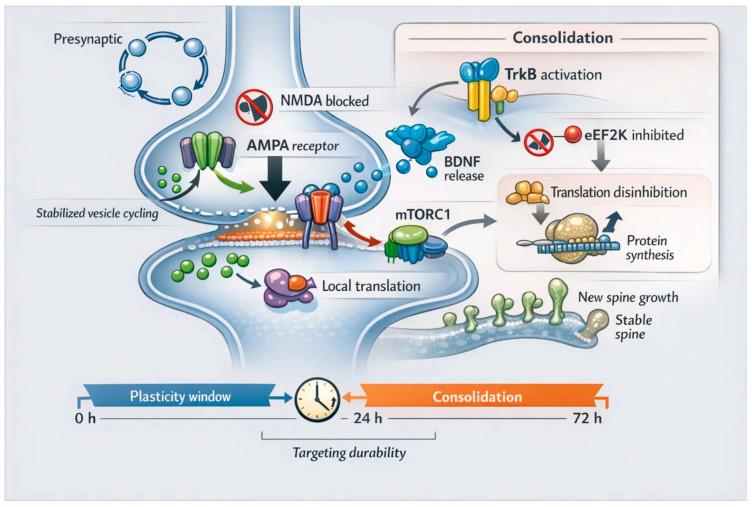
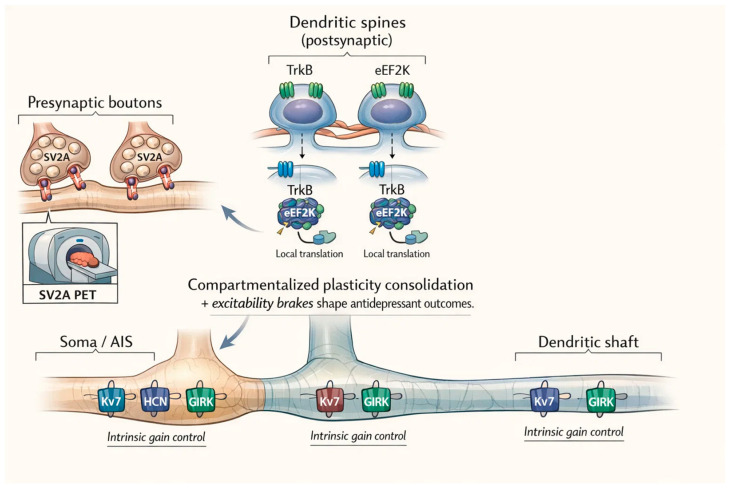
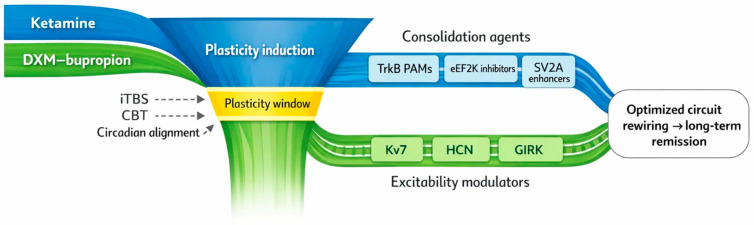
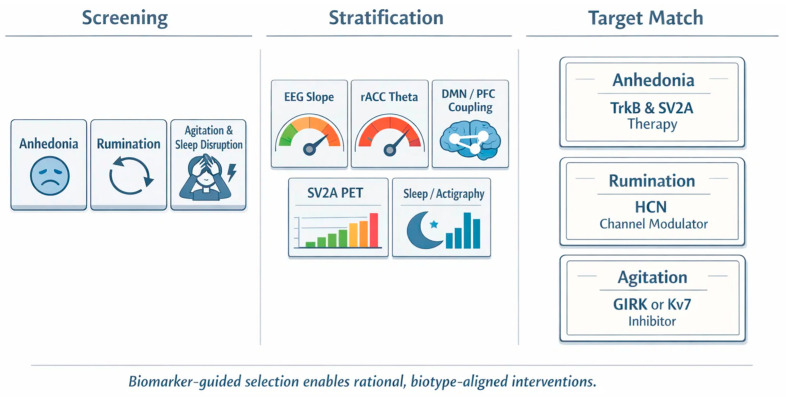
Major depressive disorder remains a leading cause of disability, and decades of monoamine-centered pharmacology have yielded delayed and often incomplete relief. Rapid-acting antidepressants reshaped the field by linking swift symptom improvement to glutamatergic plasticity, yet durable benefit depends on how newly reconfigured circuits are stabilized and tuned. This review synthesizes evidence that antidepressant efficacy arises from the coordinated engagement of synaptic plasticity, spanning induction and consolidation, and intrinsic excitability, which provides gain control, and proposes an integrated framework to guide future discovery. It first outlines induction through N-methyl-D-aspartate receptors (NMDARs) and α-amino-3-hydroxy-5-methyl-4-isoxazolepropionic acid receptors (AMPARs), exemplified by ketamine and esketamine, followed by consolidation mediated by tropomyosin receptor kinase B (TrkB) signaling, translational disinhibition via eukaryotic elongation factor 2 kinase (eEF2K), and presynaptic stabilization indexed by synaptic vesicle glycoprotein 2A (SV2A); together, these processes transform transient potentiation into persistent network change. It then highlights intrinsic excitability, emphasizing voltage-gated potassium channel subfamily Q (Kv7), hyperpolarization-activated cyclic nucleotide-gated (HCN), and G protein-gated inwardly rectifying potassium (GIRK) channels as circuit-level governors that normalize firing and limit relapse-prone hyperexcitability. Finally, it presents the Induction–Consolidation–Maintenance (ICM) framework as a hypothesis-generating roadmap for future studies, with SV2A positron emission tomography (PET), electroencephalography (EEG), and functional magnetic resonance imaging (fMRI) biomarkers discussed as candidate tools rather than validated guides for treatment timing or patient selection. The proposed contribution is not another list of plasticity pathways, but a phase-specific model that links synaptic induction, consolidation, and excitability-based maintenance to distinct therapeutic windows, biomarkers, and relapse-prevention strategies.
Overview
CoChat Summary
TL;DR
This narrative review proposes the Induction–Consolidation–Maintenance (ICM) framework, which treats antidepressant response as a temporally ordered process in which glutamatergic synaptic plasticity is induced, consolidated, and then stabilized by intrinsic excitability tuning. It argues that durable remission requires pairing plasticity inducers (e.g., ketamine/esketamine) with consolidation and maintenance mechanisms (TrkB, eEF2K, SV2A) and ion-channel–based gain control (Kv7, HCN, GIRK).
Key findings
- Antidepressant action is reframed as three mechanistically distinct phases: induction via NMDAR/AMPAR glutamatergic signaling (ketamine, esketamine, DXM-bupropion), consolidation via TrkB signaling, eEF2K-mediated translational disinhibition, and presynaptic stabilization indexed by SV2A, and maintenance via intrinsic excitability.
- Rapid glutamatergic strategies reliably produce rapid relief but responses "frequently decay within days to weeks, with high relapse rates following discontinuation"; maintenance regimens only partially offset this erosion.
- Intrinsic excitability channels are positioned as the maintenance layer: Kv7 (M-current) openers dampen hyperexcitability and show the strongest clinical signal (ezogabine reduced depressive symptoms and improved reward sensitivity in MDD with anhedonia, but pigmentation/urinary liabilities limited use), whereas HCN and GIRK strategies remain "largely mechanistic or preclinical."
- Translational failures are treated as boundary conditions: rapastinel failed to meet primary endpoints in three pivotal phase 3 adjunctive MDD trials, and no clinical-grade eEF2K inhibitor exists; TrkB agonists face reproducibility and target-specificity concerns.
Methods
- Narrative review synthesizing heterogeneous preclinical and clinical evidence; the author states the ICM framework "is used to organize heterogeneous evidence rather than to rank mechanisms by clinical readiness."
- Ketamine is treated as the best-established clinical entry point into rapid plasticity, with non-ketamine pathways discussed "according to their current evidentiary maturity."
- No systematic search strategy, inclusion criteria, or quantitative synthesis is reported; the paper is organized into sections on induction/consolidation, presynaptic and network integrity (SV2A), intrinsic excitability (Kv7, HCN, GIRK), combinatorial strategies, and future directions.
Limitations
- Stated: the ICM framework is "a narrative synthesis rather than a validated clinical algorithm"; biomarkers (SV2A PET, MRS, EEG, fMRI, actigraphy) "are not yet validated tools for routine patient stratification"; and TrkB modulators, eEF2K inhibitors, SV2A enhancers, and ion-channel strategies remain at earlier stages of translation than ketamine/esketamine.
- Stated: long-term modulation of plasticity pathways may stabilize maladaptive circuits, alter excitation–inhibition balance, or change seizure thresholds; concerns include off-target signaling, abuse liability, and uncertainty about chronic ketamine/esketamine exposure.
- Evident from the text: the review is single-authored and non-systematic, with no stated search protocol or evidence-grading method, so the relative weighting of mechanisms reflects the author's narrative judgment; the author also notes that figures and tables "should be read as organizing tools... not as evidence that all pathways or targets are equally validated."
Model-written summary. Check it against the paper before relying on it.
Integrity signals
Registry
Cites
Statistics
Figures
Verification
Claims the paper makes
189 Valid · 49 Not valid · 26 Not checked · 56 Own results and interpretations
Some cited sources support this claim and some don’t — read each source’s verdict below.
In the paper
“Through these convergent actions, SV2A functions as a molecular scaffold that stabilizes presynaptic terminals while postsynaptic strengthening consolidates [175,184,198].”
§ Synaptic Plasticity—Intrinsic Excitability and Antidepressant Discovery > 3. Stabilizing Presynaptic and Network Integrity > Synaptic Vesicle Glycoprotein 2A (SV2A) Enhancers
What the sources say
- Disputedcites [175] Löscher W. Gillard M. Sands Z.A. Kaminski R.M. Klitgaard H. Synaptic Vesicle Glycoprotein 2A Ligands in the Treatment of Epilepsy and Beyond CNS Drugs 2016 30 1055 1077 10.1007/s40263-016-0384-x 27752944 PMC5078162 sourceExperimental — accuracy not yet measured
In “Excitability in the Brain” (page not provided), the paper says SV2 proteins are not structural components of synapses and instead links SV2A to control of vesicle exocytosis. That contradicts the attributed role of SV2A as a scaffold stabilizing presynaptic terminals; the passage does not describe coordinated postsynaptic strengthening. (LLM, conf=0.87)
Checked by a reasoning model — may be wrong.
- Not checked — no full text of the sourcecites [184] Stout K.A. Dunn A.R. Hoffman C. Miller G.W. The Synaptic Vesicle Glycoprotein 2: Structure, Function, and Disease Relevance ACS Chem. Neurosci. 2019 10 3927 3938 10.1021/acschemneuro.9b00351 31394034 PMC11562936 source
- Partly supportedcites [198] Nowack A. Yao J. Custer K.L. Bajjalieh S.M. SV2 regulates neurotransmitter release via multiple mechanisms Am. J. Physiol. Cell Physiol. 2010 299 C960 C967 10.1152/ajpcell.00259.2010 20702688 PMC2980308 sourceExperimental — accuracy not yet measured
The Discussion (page unavailable) reports that SV2 contributes to presynaptic release probability and describes a vesicular-matrix scaffold as a hypothesis tested in the study. It does not establish that SV2A stabilizes presynaptic terminals or link its action to the consolidation of postsynaptic strengthening. (LLM, conf=0.83)
plainstates a cause- Asserted: passes — The authors put it forward as true.
- Checkable: passes — It can be checked against evidence.
- Load-bearing: unclear — It is unclear whether the paper’s conclusions depend on it.
- Based: passes — The paper gives a reason why it holds.
- Disputed
Some cited sources support this claim and some don’t — read each source’s verdict below.
In the paper
“Rather than increasing synapse number or global firing, it selectively scales AMPAR mediated currents, producing a controlled gain in synaptic efficacy [147,152,154,155].”
§ Synaptic Plasticity—Intrinsic Excitability and Antidepressant Discovery > 2. Induction and Consolidation of Synaptic Plasticity > 2.3. eEF2K Inhibitors
What the sources say
- Not checked — no full text of the sourcecites [147] Suzuki K. Monteggia L.M. The role of eEF2 kinase in the rapid antidepressant actions of ketamine Adv. Pharmacol. 2020 89 79 99 10.1016/bs.apha.2020.04.005 32616215 source
- Disputedcites [152] Weng W. Chen Y. Wang M. Zhuang Y. Behnisch T. Potentiation of Schaffer-Collateral CA1 Synaptic Transmission by eEF2K and p38 MAPK Mediated Mechanisms Front. Cell. Neurosci. 2016 10 247 10.3389/fncel.2016.00247 27826228 PMC5078695 sourceExperimental — accuracy not yet measured
The Discussion reports that eEF2K inhibition enhances synaptic transmission by increasing presynaptic vesicle-release probability, without changing the amplitude of synaptic events. It explicitly contrasts this with a change in glutamate-receptor density or conductance, which would have changed EPSC amplitude. The paper therefore supports a gain in synaptic transmission, but not the claimed selective scaling of AMPAR-mediated currents. (LLM, conf=0.88)
Checked by a reasoning model — may be wrong.
- Disputedcites [154] Beretta S. Gritti L. Ponzoni L. Scalmani P. Mantegazza M. Sala M. Verpelli C. Sala C. Rescuing epileptic and behavioral alterations in a Dravet syndrome mouse model by inhibiting eukaryotic elongation factor 2 kinase (eEF2K) Mol. Autism 2022 13 1 10.1186/s13229-021-00484-0 34980259 PMC8722032 sourceExperimental — accuracy not yet measured
The Results section ('eEF2K deletion enhances GABAergic transmission'; page unavailable) says excitatory postsynaptic currents were unchanged in previously studied eEF2K-deficient mice, while inhibitory currents increased. In the Dravet mouse model, the authors measured enhanced inhibitory currents and conclude in the Discussion (page unavailable) that eEF2K deletion selectively increases GABAergic transmission—not AMPAR-mediated currents. (LLM, conf=0.90)
Checked by a reasoning model — may be wrong.
- Partly supportedcites [155] Wierenga C.J. Ibata K. Turrigiano G.G. Postsynaptic expression of homeostatic plasticity at neocortical synapses J. Neurosci. 2005 25 2895 2905 10.1523/JNEUROSCI.5217-04.2005 15772349 PMC6725152 sourceExperimental — accuracy not yet measured
The Discussion reports that activity blockade in young neocortical cultures increased postsynaptic AMPAR accumulation and synaptic strength without significantly increasing excitatory synapse number. It does not attribute these effects to eEF2K inhibition, and it says increased boosting by sodium channels also contributed to the stronger currents, so the claim of selective AMPAR-current scaling is not fully supported. (LLM, conf=0.87)
plainstates a cause- Asserted: passes — The authors put it forward as true.
- Checkable: passes — It can be checked against evidence.
- Load-bearing: passes — The paper’s conclusions depend on it.
- Based: passes — The paper gives a reason why it holds.
The cited sources support only part of this claim — read each source’s verdict below.
In the paper
“In prefrontal and hippocampal circuits, channels such as voltage-gated potassium channel subfamily Q (Kv7), hyperpolarization-activated cyclic nucleotide-gated channel (HCN), and G protein-gated inwardly rectifying potassium gated channel (GIRK; Kir3.x) serve as key determinants of firing probability and network stability [27,28,29].”
§ Synaptic Plasticity—Intrinsic Excitability and Antidepressant Discovery > 1. Introduction: Beyond Monoamines to Plasticity and Excitability
What the sources say
- Partly supportedcites [27] Klemz A. Wildner F. Tütüncü E. Gerevich Z. Regulation of Hippocampal Gamma Oscillations by Modulation of Intrinsic Neuronal Excitability Front. Neural Circuits 2021 15 778022 10.3389/fncir.2021.778022 35177966 PMC8845518 sourceExperimental — accuracy not yet measured
The Discussion (page unavailable) says Kv7.2/3 channels regulate neuronal excitability and that blocking them increases gamma-oscillation power in hippocampal CA3 circuits. The Introduction (page unavailable) says HCN channels were excluded from the study. The cited paper does not establish the sentence’s broader claim about Kv7, HCN, and GIRK channels across both prefrontal and hippocampal circuits. (LLM, conf=0.88)
- Not checked — no full text of the sourcecites [28] Desai N.S. Rutherford L.C. Turrigiano G.G. Plasticity in the intrinsic excitability of cortical pyramidal neurons Nat. Neurosci. 1999 2 515 520 10.1038/9165 10448215 source
- Partly supportedcites [29] Soldado-Magraner S. Brandalise F. Honnuraiah S. Pfeiffer M. Moulinier M. Gerber U. Douglas R. Conditioning by subthreshold synaptic input changes the intrinsic firing pattern of CA3 hippocampal neurons J. Neurophysiol. 2020 123 90 106 10.1152/jn.00506.2019 31721636 sourceExperimental — accuracy not yet measured
Our copy supports only the Kv7 leg of the claim in the hippocampus: the Mechanisms of firing pattern transitions section names gKm (M-current, Kv7/KCNQ) together with gKd and gCa as the conductances shaping transitions through the firing-pattern space of CA3 cells, and the pharmacology/Results sections show XE991 blockade of Kv7/KCNQ abolishing the conditioned pattern change (Pharmacology; Inhibition of Kv7 and calcium channels...). Nothing in our copy treats HCN or GIRK/Kir3 as determinants — the only mentions of the h-current are inside cited-reference titles in the References (Hu et al. 2002), and GIRK/Kir3 does not appear at all. Equally, prefrontal circuits are not studied (only a reference title on rat medial prefrontal cortex, Van Aerde & Feldmeyer 2015) and the paper argues about intrinsic firing pattern and network states/ripples, not about these channels as determinants of network stability. (LLM, conf=0.75)
plainstates a cause- Asserted: passes — The authors put it forward as true.
- Checkable: passes — It can be checked against evidence.
- Load-bearing: passes — The paper’s conclusions depend on it.
- Based: passes — The paper gives a reason why it holds.
- Partly supported
The cited sources support only part of this claim — read each source’s verdict below.
In the paper
“Chronic stress induces cell-type-specific shifts in intrinsic excitability within medial prefrontal and hippocampal neurons, biasing circuits toward vulnerability or resilience depending on channel composition and neuromodulatory state [25,26].”
§ Synaptic Plasticity—Intrinsic Excitability and Antidepressant Discovery > 1. Introduction: Beyond Monoamines to Plasticity and Excitability
What the sources say
- Partly supportedcites [25] Debanne D. Russier M. The contribution of ion channels in input-output plasticity Neurobiol. Learn. Mem. 2019 166 107095 10.1016/j.nlm.2019.107095 31539624 sourceExperimental — accuracy not yet measured
The sections on homeostatic plasticity and GABAergic interneurons describe cell-type-dependent changes in intrinsic excitability involving ion channels, including in hippocampal neurons. They discuss activity deprivation and synaptic stimulation, not chronic stress; the passages do not establish shifts in medial prefrontal neurons or a resulting bias toward vulnerability or resilience. (LLM, conf=0.84)
- Could not verifycites [26] Hansel C. Yuste R. Neural ensembles: Role of intrinsic excitability and its plasticity Front. Cell. Neurosci. 2024 18 1440588 10.3389/fncel.2024.1440588 39144154 PMC11322048 sourceExperimental — accuracy not yet measured
The Introduction (page unavailable) discusses hippocampal excitability after conditioning, and the section on on/off modulation discusses SK channels and cholinergic signaling. Neither addresses chronic stress, medial prefrontal excitability, or vulnerability versus resilience. Searches for those terms found no passage supporting the attributed claim. (LLM, conf=0.74)
plainstates a cause- Asserted: passes — The authors put it forward as true.
- Checkable: passes — It can be checked against evidence.
- Load-bearing: passes — The paper’s conclusions depend on it.
- Based: passes — The paper gives a reason why it holds.
- Partly supported
The cited sources support only part of this claim — read each source’s verdict below.
In the paper
“For early plasticity to last, downstream signaling must stabilize structure, transcription, and protein synthesis [34,41].”
§ Synaptic Plasticity—Intrinsic Excitability and Antidepressant Discovery > 2. Induction and Consolidation of Synaptic Plasticity
What the sources say
- Partly supportedcites [34] Kennedy M.B. Synaptic Signaling in Learning and Memory Cold Spring Harb. Perspect. Biol. 2013 8 a016824 10.1101/cshperspect.a016824 24379319 PMC4743082 sourceExperimental — accuracy not yet measured
The Introduction (page not provided) describes early structural changes followed by signaling that increases local protein synthesis and activates transcription; it says these later changes can affect neuronal structure for hours to a lifetime. It does not establish that all three processes must be stabilized for early plasticity to last, so the claim overstates their necessity. (LLM, conf=0.82)
- Partly supportedcites [41] Shrestha P. Klann E. Spatiotemporally resolved protein synthesis as a molecular framework for memory consolidation Trends Neurosci. 2022 45 297 311 10.1016/j.tins.2022.01.004 35184897 PMC8930706 sourceExperimental — accuracy not yet measured
Our copy supports the protein-synthesis arm of the claim: the introduction (p.1) states that 'memory consolidation requires de novo PS', the Concluding remarks note that 'Subcellular PS fulfils the local demand for new proteins with exogenous stimuli-driven synaptic plasticity, which is the basis for long-lasting long-term potentiation', and the signalling sections describe mTORC1 and ERK as the downstream cascades that control translation initiation and elongation (eIF4F/4E-BP, S6K1-PDCD4, eEF2K). However, no passage in our copy attributes persistence of early plasticity to stabilization of structure or to transcription as such; transcription appears only mechanistically (ATF4-mediated induction of 4E-BPs, learning-induced IEG expression in engram cells), and structural change is not discussed as a requirement. The structural- and transcription-stabilization components of the citing sentence are therefore not supported by this source. (LLM, conf=0.72)
plainstates a cause- Asserted: passes — The authors put it forward as true.
- Checkable: passes — It can be checked against evidence.
- Load-bearing: passes — The paper’s conclusions depend on it.
- Based: passes — The paper gives a reason why it holds.
- Partly supported
89 more claims · 66 with their cited sources checked
Create a free account to see all 320 claims and to verify the 15 references still open.
- It may state two separate claims as one. 211
- Probably not a substantial claim. 41
- The quote only partly states this claim. 1
Citations
Cites
Items 201–400 of 452
Brain high-throughput multi-omics data reveal molecular heterogeneity in Alzheimer’s disease
Eteleeb, A. M., Novotny, B. C., Tarraga, C. S., Sohn, C., Dhungel, E., Brase, L., Nallapu, A., Buss, J., Farias, F., Bergmann, K., et al. (2024) · PLOS Biology · doi:10.1371/journal.pbio.3002607 · Cited by 64
Kaempf, N., Kochlamazashvili, G., Puchkov, D., Maritzen, T., Bajjalieh, S. M., Kononenko, N. L., & Haucke, V. (2015) · Proceedings of the National Academy of Sciences · doi:10.1073/pnas.1501627112 · Cited by 63
Signaling bias in drug discovery
Kenakin, T. (2017) · Expert Opinion on Drug Discovery · doi:10.1080/17460441.2017.1297417 · Cited by 63
Dextromethorphan-bupropion (Auvelity) for the Treatment of Major Depressive Disorder
McCarthy, B., Bunn, H., Santalucia, M., Wilmouth, C., Muzyk, A., & Smith, C. M. (2023) · Clinical Psychopharmacology and Neuroscience · doi:10.9758/cpn.23.1081 · Cited by 63
Hashimoto, K. (2024) · European Archives of Psychiatry and Clinical Neuroscience · doi:10.1007/s00406-024-01770-7 · Cited by 63
Shi, X., Zhou, X., Chen, G., Luo, W., Zhou, C., He, T.-J., Naik, M. T., Jiang, Q., Marshall, J. J., & Cao, C. (2024) · Science Signaling · doi:10.1126/scisignal.adn4556 · Cited by 63
Seshadri, A., Prokop, L. J., & Singh, B. (2024) · Journal of Affective Disorders · doi:10.1016/j.jad.2024.03.137 · Cited by 62
Chapman, C. A., Nuwer, J. L., & Jacob, T. C. (2022) · Frontiers in Synaptic Neuroscience · doi:10.3389/fnsyn.2022.911020 · Cited by 62
Neuronal G protein-gated K+ channels
Luo, H., Marron Fernandez de Velasco, E., & Wickman, K. (2022) · American Journal of Physiology-Cell Physiology · doi:10.1152/ajpcell.00102.2022 · Cited by 62
Heise, C., Taha, E., Murru, L., Ponzoni, L., Cattaneo, A., Guarnieri, F. C., Montani, C., Mossa, A., Vezzoli, E., Ippolito, G., et al. (2016) · Cerebral Cortex · doi:10.1093/cercor/bhw075 · Cited by 62
A Mitochondrial Role of SV2a Protein in Aging and Alzheimer’s Disease: Studies with Levetiracetam
Stockburger, C., Miano, D., Baeumlisberger, M., Pallas, T., Arrey, T. N., Karas, M., Friedland, K., & Müller, W. E. (2016) · Journal of Alzheimer's Disease · doi:10.3233/jad-150687 · Cited by 60
Li, S., Cai, Z., Zhang, W., Holden, D., Lin, S.-F., Finnema, S. J., Shirali, A., Ropchan, J., Carre, S., Mercier, J., et al. (2019) · European Journal of Nuclear Medicine and Molecular Imaging · doi:10.1007/s00259-019-04357-w · Cited by 59
Bridging Rapid and Sustained Antidepressant Effects of Ketamine
Kim, J.-W., Suzuki, K., Kavalali, E. T., & Monteggia, L. M. (2023) · Trends in Molecular Medicine · doi:10.1016/j.molmed.2023.02.003 · Cited by 59
Gupta, A. K., Gupta, S., Mehan, S., Khan, Z., Das Gupta, G., & Narula, A. S. (2025) · Molecular Neurobiology · doi:10.1007/s12035-025-05001-5 · Cited by 59
Parkinson’s Disease: Bridging Gaps, Building Biomarkers, and Reimagining Clinical Translation
Tanaka, M. (2025) · doi:10.20944/preprints202506.2099.v2 · Cited by 57
Self-citationDisruption of Neural Homeostasis as a Model of Relapse and Recurrence in Late-Life Depression
Andreescu, C., Ajilore, O., Aizenstein, H. J., Albert, K., Butters, M. A., Landman, B. A., Karim, H. T., Krafty, R., & Taylor, W. D. (2019) · The American Journal of Geriatric Psychiatry · doi:10.1016/j.jagp.2019.07.016 · Cited by 56
Costi, S., Soleimani, L., Glasgow, A., Brallier, J., Spivack, J., Schwartz, J., Levitch, C. F., Richards, S., Hoch, M., Stade, E. C., et al. (2019) · Neuropsychopharmacology · doi:10.1038/s41386-019-0365-0 · Cited by 56
Parkinson’s Disease: Bridging Gaps, Building Biomarkers, and Reimagining Clinical Translation
Tanaka, M. (2025) · Cells · doi:10.3390/cells14151161 · Cited by 56
Self-citationSelective Blockade of HCN1/HCN2 Channels as a Potential Pharmacological Strategy Against Pain
Dini, L., Del Lungo, M., Resta, F., Melchiorre, M., Spinelli, V., Di Cesare Mannelli, L., Ghelardini, C., Laurino, A., Sartiani, L., Coppini, R., et al. (2018) · Frontiers in Pharmacology · doi:10.3389/fphar.2018.01252 · Cited by 55
Ma, T. (2023) · Journal of Neurochemistry · doi:10.1111/jnc.15541 · Cited by 55
HCN Channel Targets for Novel Antidepressant Treatment
Ku, S. M., & Han, M.-H. (2017) · Neurotherapeutics · doi:10.1007/s13311-017-0538-7 · Cited by 54
Karakas, D., & Ozpolat, B. (2020) · Journal of Molecular Medicine · doi:10.1007/s00109-020-01917-8 · Cited by 54
The Role of Kv7 Channels in Neural Plasticity and Behavior
Baculis, B. C., Zhang, J., & Chung, H. J. (2020) · Frontiers in Physiology · doi:10.3389/fphys.2020.568667 · Cited by 54
Spatiotemporally resolved protein synthesis as a molecular framework for memory consolidation
Shrestha, P., & Klann, E. (2022) · Trends in Neurosciences · doi:10.1016/j.tins.2022.01.004 · Cited by 54
Sarrazin, D. H., Gardner, W., Marchese, C., Balzinger, M., Ramanathan, C., Schott, M., Rozov, S. V., Veleanu, M., Vestring, S., Normann, C., et al. (2024) · Nature Communications · doi:10.1038/s41467-024-51716-9 · Cited by 54
G protein-activated inwardly rectifying potassium channels as potential therapeutic targets
Kobayashi, T., & Ikeda, K. (2006) · Current Pharmaceutical Design · doi:10.2174/138161206779010468 · Cited by 53
Bringing Imaging Biomarkers Into Clinical Reality in Psychiatry
Etkin, A., & Mathalon, D. H. (2024) · JAMA Psychiatry · doi:10.1001/jamapsychiatry.2024.2553 · Cited by 53
Menon, V., Cerri, D., Lee, B., Yuan, R., Lee, S.-H., & Shih, Y.-Y. I. (2023) · Nature Communications · doi:10.1038/s41467-023-36616-8 · Cited by 53
The role of eEF2 kinase in the rapid antidepressant actions of ketamine
(2020) · Advances in Pharmacology · doi:10.1016/bs.apha.2020.04.005 · Cited by 52
Liu, S., Chen, L., Guo, M., Li, Y., Liu, Q., & Cheng, Y. (2024) · Research · doi:10.34133/research.0402 · Cited by 52
Vigil, F. A., Bozdemir, E., Bugay, V., Chun, S. H., Hobbs, M., Sanchez, I., Hastings, S. D., Veraza, R. J., Holstein, D. M., Sprague, S. M., et al. (2020) · Journal of Cerebral Blood Flow & Metabolism · doi:10.1177/0271678x19857818 · Cited by 51
Wlodarczyk, L., Szelenberger, R., Cichon, N., Saluk-Bijak, J., Bijak, M., & Miller, E. (2021) · International Journal of Molecular Sciences · doi:10.3390/ijms22083949 · Cited by 51
Personalized use of ketamine and esketamine for treatment-resistant depression
Medeiros, G. C., Demo, I., Goes, F. S., Zarate, C. A., & Gould, T. D. (2024) · Translational Psychiatry · doi:10.1038/s41398-024-03180-8 · Cited by 51
Antidepressant drug action--From rapid changes on network function to network rewiring
Rantamäki, T., & Yalcin, I. (2016) · Progress in Neuro-Psychopharmacology and Biological Psychiatry · doi:10.1016/j.pnpbp.2015.06.001 · Cited by 50
Donello, J. E., Banerjee, P., Li, Y.-X., Guo, Y.-X., Yoshitake, T., Zhang, X.-L., Miry, O., Kehr, J., Stanton, P. K., Gross, A. L., et al. (2019) · International Journal of Neuropsychopharmacology · doi:10.1093/ijnp/pyy101 · Cited by 50
BDNF receptor TrkB as the mediator of the antidepressant drug action
Casarotto, P., Umemori, J., & Castrén, E. (2022) · Frontiers in Molecular Neuroscience · doi:10.3389/fnmol.2022.1032224 · Cited by 50
Plasticity in the Hippocampus, Neurogenesis and Drugs of Abuse
Avchalumov, Y., & Mandyam, C. D. (2021) · Brain Sciences · doi:10.3390/brainsci11030404 · Cited by 49
Gerchen, M. F., & Kirsch, P. (2017) · Human Brain Mapping · doi:10.1002/hbm.23762 · Cited by 49
Suzuki, K., Kim, J.-W., Nosyreva, E., Kavalali, E. T., & Monteggia, L. M. (2021) · Cell Reports · doi:10.1016/j.celrep.2021.109918 · Cited by 49
Chen, S., Sun, H., Song, Y., Zhang, M., Huang, W., Zhao, C., Wang, Y., Wang, J., Meng, H., Zhou, L., et al. (2024) · Journal of Affective Disorders · doi:10.1016/j.jad.2024.06.067 · Cited by 49
Targeting metaplasticity mechanisms to promote sustained antidepressant actions
Brown, K. A., & Gould, T. D. (2024) · Molecular Psychiatry · doi:10.1038/s41380-023-02397-1 · Cited by 49
Medeiros, G. C., Matheson, M., Demo, I., Reid, M. J., Matheson, S., Twose, C., Smith, G. S., Gould, T. D., Zarate, C. A., Barrett, F. S., et al. (2023) · The Lancet Psychiatry · doi:10.1016/s2215-0366(23)00183-9 · Cited by 49
Pharmacotherapies Targeting GABA-Glutamate Neurotransmission for Treatment-Resistant Depression
Vecera, C. M., C. Courtes, A., Jones, G., Soares, J. C., & Machado-Vieira, R. (2023) · Pharmaceuticals · doi:10.3390/ph16111572 · Cited by 48
Majeed, A., Xiong, J., Teopiz, K. M., Ng, J., Ho, R., Rosenblat, J. D., Phan, L., Cao, B., & McIntyre, R. S. (2021) · Expert Opinion on Emerging Drugs · doi:10.1080/14728214.2021.1898588 · Cited by 48
Djebari, S., Iborra-Lázaro, G., Temprano-Carazo, S., Sánchez-Rodríguez, I., Nava-Mesa, M. O., Múnera, A., Gruart, A., Delgado-García, J. M., Jiménez-Díaz, L., & Navarro-López, J. D. (2021) · The Journal of Neuroscience · doi:10.1523/jneurosci.2849-20.2021 · Cited by 48
Vitaliano, G. D., Kim, J. K., Kaufman, M. J., Adam, C. W., Zeballos, G., Shanmugavadivu, A., Subburaju, S., McLaughlin, J. P., Lukas, S. E., & Vitaliano, F. (2022) · Communications Biology · doi:10.1038/s42003-022-03177-3 · Cited by 48
Ketamine’s rapid antidepressant effects are mediated by Ca2+-permeable AMPA receptors
Zaytseva, A., Bouckova, E., Wiles, M. J., Wustrau, M. H., Schmidt, I. G., Mendez-Vazquez, H., Khatri, L., & Kim, S. (2023) · eLife · doi:10.7554/elife.86022 · Cited by 48
Suzuki, A., Hara, H., & Kimura, H. (2023) · Neuropharmacology · doi:10.1016/j.neuropharm.2022.109308 · Cited by 46
Rantamäki, T., & Kohtala, S. (2020) · Pharmacological Reviews · doi:10.1124/pr.119.018697 · Cited by 45
Musella, S., Carotenuto, L., Iraci, N., Baroli, G., Ciaglia, T., Nappi, P., Basilicata, M. G., Salviati, E., Barrese, V., Vestuto, V., et al. (2022) · Journal of Medicinal Chemistry · doi:10.1021/acs.jmedchem.2c00911 · Cited by 45
GIRK Channels Mediate the Nonphotic Effects of Exogenous Melatonin
Hablitz, L. M., Molzof, H. E., Abrahamsson, K. E., Cooper, J. M., Prosser, R. A., & Gamble, K. L. (2015) · The Journal of Neuroscience · doi:10.1523/jneurosci.1597-15.2015 · Cited by 44
Advances in Targeting GIRK Channels in Disease
Zhao, Y., Gameiro-Ros, I., Glaaser, I. W., & Slesinger, P. A. (2021) · Trends in Pharmacological Sciences · doi:10.1016/j.tips.2020.12.002 · Cited by 44
TrkB transmembrane domain: bridging structural understanding with therapeutic strategy
Enkavi, G., Girych, M., Moliner, R., Vattulainen, I., & Castrén, E. (2024) · Trends in Biochemical Sciences · doi:10.1016/j.tibs.2024.02.001 · Cited by 44
Exploring depression in adults over a decade: a review of longitudinal studies
de Sousa, R. D., Zagalo, D. M., Costa, T., de Almeida, J. M. C., Canhão, H., & Rodrigues, A. (2025) · BMC Psychiatry · doi:10.1186/s12888-025-06828-x · Cited by 44
Mäki-Marttunen, T., & Mäki-Marttunen, V. (2022) · doi:10.1101/2022.03.30.486368 · Cited by 44
Mäki‐Marttunen, T., & Mäki-Marttunen, V. (2022) · PLoS Computational Biology · doi:10.1371/journal.pcbi.1010506 · Cited by 44
Targeting Kv7 Potassium Channels for Epilepsy
Perucca, E., & Taglialatela, M. (2025) · CNS Drugs · doi:10.1007/s40263-024-01155-3 · Cited by 43
Rosas-Sánchez, G. U., Germán-Ponciano, L. J., Guillén-Ruiz, G., Cueto‐Escobedo, J., Limón-Vázquez, A. K., Rodríguez‐Landa, J. F., & Soria-Fregozo, C. (2024) · Biomedicines · doi:10.3390/biomedicines12122744 · Cited by 43
Pankiewicz, P., Szybiński, M., Kisielewska, K., Gołębiowski, F., Krzemiński, P., Rutkowska-Włodarczyk, I., Moszczyński-Pętkowski, R., Gurba-Bryśkiewicz, L., Delis, M., Mulewski, K., et al. (2021) · Pharmaceuticals · doi:10.3390/ph14080704 · Cited by 42
Tanaka, M. (2025) · doi:10.20944/preprints202412.0679.v2 · Cited by 42
Self-citationTanaka, M. (2025) · Biomedicines · doi:10.3390/biomedicines13010167 · Cited by 42
Self-citationXu, Q., Qiao, Z., Kan, Y., Wan, B., Qiu, X., & Yang, Y. (2025) · Journal of Affective Disorders · doi:10.1016/j.jad.2025.120018 · Cited by 41
The enigmatic HCN channels: A cellular neurophysiology perspective
Mishra, P., & Narayanan, R. (2025) · Proteins: Structure, Function, and Bioinformatics · doi:10.1002/prot.26643 · Cited by 40
Lateral habenula perturbation reduces default-mode network connectivity in a rat model of depression
Clemm von Hohenberg, C., Weber-Fahr, W., Lebhardt, P., Ravi, N., Braun, U., Gass, N., Becker, R., Sack, M., Cosa Linan, A., Gerchen, M. F., et al. (2018) · Translational Psychiatry · doi:10.1038/s41398-018-0121-y · Cited by 39
Identification of a G-Protein-Independent Activator of GIRK Channels
Zhao, Y., Ung, P. M.-U., Zahoránszky-Kőhalmi, G., Zakharov, A. V., Martinez, N. J., Simeonov, A., Glaaser, I. W., Rai, G., Schlessinger, A., Marugan, J. J., et al. (2020) · Cell Reports · doi:10.1016/j.celrep.2020.107770 · Cited by 39
Ostacolo, C., Miceli, F., Di Sarno, V., Nappi, P., Iraci, N., Soldovieri, M. V., Ciaglia, T., Ambrosino, P., Vestuto, V., Lauritano, A., et al. (2020) · Journal of Medicinal Chemistry · doi:10.1021/acs.jmedchem.9b00796 · Cited by 39
Rátkai, A., Tárnok, K., Aouad, H. E., Micska, B., Schlett, K., & Szücs, A. (2021) · Scientific Reports · doi:10.1038/s41598-021-82775-3 · Cited by 38
The contribution of ion channels in input-output plasticity
Debanne, D., & Russier, M. (2019) · Neurobiology of Learning and Memory · doi:10.1016/j.nlm.2019.107095 · Cited by 38
Kv7 Channels and Excitability Disorders
Jones, F., Gamper, N., & Gao, H. (2021) · Handbook of Experimental Pharmacology · doi:10.1007/164_2021_457 · Cited by 38
Akbar, D., Rhee, T. G., Ceban, F., Ho, R., Teopiz, K. M., Cao, B., Subramaniapillai, M., Kwan, A. T. H., Rosenblat, J. D., & McIntyre, R. S. (2023) · CNS Drugs · doi:10.1007/s40263-023-01032-5 · Cited by 38
Lithium: Current state of the art and future directions
Gitlin, M., & Bauer, M. (2024) · International Journal of Bipolar Disorders · doi:10.1186/s40345-024-00362-7 · Cited by 38
Chemical modulation of Kv7 potassium channels
Borgini, M., Mondal, P., Liu, R., & Wipf, P. (2021) · RSC Medicinal Chemistry · doi:10.1039/d0md00328j · Cited by 37
Pharmacological Manipulation of Kv7 Channels as a New Therapeutic Tool for Multiple Brain Disorders
Vigil, F. A., Carver, C. M., & Shapiro, M. S. (2020) · Frontiers in Physiology · doi:10.3389/fphys.2020.00688 · Cited by 36
Liu, Y., Bian, X., & Wang, K. (2021) · Handbook of Experimental Pharmacology · doi:10.1007/164_2021_458 · Cited by 36
Dysfunction of Glutamatergic Synaptic Transmission in Depression: Focus on AMPA Receptor Trafficking
He, J.-G., Zhou, H.-Y., Wang, F., & Chen, J.-G. (2023) · Biological Psychiatry Global Open Science · doi:10.1016/j.bpsgos.2022.02.007 · Cited by 36
Vogl, C., Tanifuji, S., Danis, B., Daniels, V., Foerch, P., Wolff, C., Whalley, B. J., Mochida, S., & Stephens, G. J. (2015) · European Journal of Neuroscience · doi:10.1111/ejn.12799 · Cited by 35
Wu, P.-P., Cao, B.-R., Tian, F.-Y., & Gao, Z.-B. (2024) · Neuroscience Bulletin · doi:10.1007/s12264-023-01138-2 · Cited by 35
Biological sex differences in pharmacokinetics and adverse drug reactions
Aljohmani, A., & Yildiz, D. (2026) · Naunyn-Schmiedeberg's Archives of Pharmacology · doi:10.1007/s00210-025-04721-8 · Cited by 35
McPherson, K. B., Leff, E. R., Li, M.-H., Meurice, C., Tai, S., Traynor, J. R., & Ingram, S. L. (2018) · The Journal of Neuroscience · doi:10.1523/jneurosci.0516-18.2018 · Cited by 34
Kasica, N. P., Zhou, X., Yang, Q., Wang, X., Yang, W., Zimmermann, H. R., Holland, C. E., Koscielniak, E., Wu, H., Cox, A. O., et al. (2022) · Journal of Neurochemistry · doi:10.1111/jnc.15562 · Cited by 34
Synaptic changes in psychiatric and neurological disorders: State-of-the art of in vivo imaging
Howes, O., Marcinkowska, J., Turkheimer, F. E., & Carr, R. (2025) · Neuropsychopharmacology · doi:10.1038/s41386-024-01943-x · Cited by 34
Bidirectional Influence of Limbic GIRK Channel Activation on Innate Avoidance Behavior
Vo, B. N., Marron Fernandez de Velasco, E., Rose, T. R., Oberle, H., Luo, H., Hopkins, C. R., & Wickman, K. (2021) · The Journal of Neuroscience · doi:10.1523/jneurosci.2787-20.2021 · Cited by 33
Dahlström, M., Madjid, N., Nordvall, G., Halldin, M. M., Vazquez-Juarez, E., Lindskog, M., Sandin, J., Winblad, B., Eriksdotter, M., & Forsell, P. (2021) · Cells · doi:10.3390/cells10081871 · Cited by 33
Kim, J., Lei, Y., Lu, X.-Y., & Kim, C. S. (2022) · Molecular Psychiatry · doi:10.1038/s41380-022-01682-9 · Cited by 33
Neural ensembles: role of intrinsic excitability and its plasticity
Hansel, C., & Yuste, R. (2024) · Frontiers in Cellular Neuroscience · doi:10.3389/fncel.2024.1440588 · Cited by 33
Neuroinflammation and Natural Antidepressants: Balancing Fire with Flora
Figueiredo Godoy, A. C., Frota, F. F., Araújo, L. P., Valenti, V. E., Pereira, E. D. S. B. M., Detregiachi, C. R. P., Galhardo, C. M., Caracio, F. C., Haber, R. S. A., Fornari Laurindo, L., et al. (2025) · doi:10.20944/preprints202504.0573.v2 · Cited by 33
Self-citationMartinello, K., Giacalone, E., Migliore, M., Brown, D. A., & Shah, M. M. (2019) · Communications Biology · doi:10.1038/s42003-019-0408-4 · Cited by 32
Xu, Y., Cantwell, L., Molosh, A. I., Plant, L. D., Gazgalis, D., Fitz, S. D., Dustrude, E. T., Yang, Y., Kawano, T., Garai, S., et al. (2020) · Journal of Biological Chemistry · doi:10.1074/jbc.ra119.011527 · Cited by 32
Oh, H., Lee, S., Oh, Y., Kim, S., Kim, Y. S., Yang, Y., Choi, W., Yoo, Y.-E., Cho, H., Lee, S., et al. (2023) · Nature Communications · doi:10.1038/s41467-023-39203-z · Cited by 32
Neuroinflammation and Natural Antidepressants: Balancing Fire with Flora
Figueiredo Godoy, A. C., Frota, F. F., Araújo, L. P., Valenti, V. E., Pereira, E. D. S. B. M., Detregiachi, C. R. P., Galhardi, C. M., Caracio, F. C., Haber, R. S. A., Fornari Laurindo, L., et al. (2025) · Biomedicines · doi:10.3390/biomedicines13051129 · Cited by 32
Self-citationQuantification of SV2A Binding in Rodent Brain Using [18F]SynVesT-1 and PET Imaging
Sadasivam, P., Fang, X. T., Toyonaga, T., Lee, S., Xu, Y., Zheng, M.-Q., Spurrier, J., Huang, Y., Strittmatter, S. M., Carson, R. E., et al. (2021) · Molecular Imaging and Biology · doi:10.1007/s11307-020-01567-9 · Cited by 31
Rethinking the role of TRKB in the action of antidepressants and psychedelics
Brunello, C. A., Cannarozzo, C., & Castrén, E. (2024) · Trends in Neurosciences · doi:10.1016/j.tins.2024.08.011 · Cited by 31
Song, C., Orlandi, C., Sutton, L. P., & Martemyanov, K. A. (2019) · Journal of Biological Chemistry · doi:10.1074/jbc.ra119.007533 · Cited by 30
Quinoline Quest: Kynurenic Acid Strategies for Next-Generation Therapeutics via Rational Drug Design
Tanaka, M., Szatmári, I., & Vécsei, L. (2025) · doi:10.20944/preprints202503.2399.v1 · Cited by 30
Self-citationKahanovitch, U., Tsemakhovich, V., Berlin, S., Rubinstein, M., Styr, B., Castel, R., Peleg, S., Tabak, G., Dessauer, C. W., Ivanina, T., et al. (2014) · The Journal of Physiology · doi:10.1113/jphysiol.2014.283218 · Cited by 29
Characterization of drug binding within the HCN1 channel pore
Tanguay, J., Callahan, K. M., & D’Avanzo, N. (2019) · Scientific Reports · doi:10.1038/s41598-018-37116-2 · Cited by 29
Kong, Y., Huang, L., Li, W., Liu, X., Zhou, Y., Liu, C., Zhang, S., Xie, F., Zhang, Z., Jiang, D., et al. (2021) · Frontiers in Cell and Developmental Biology · doi:10.3389/fcell.2021.609908 · Cited by 29
Bertoglio, D., Zajicek, F., Lombaerde, S. D., Miranda, A., Stroobants, S., Wang, Y., Dominguez, C., Munoz-Sanjuan, I., Bard, J., Liu, L., et al. (2022) · Journal of Cerebral Blood Flow & Metabolism · doi:10.1177/0271678x221101648 · Cited by 29
Intrinsic Connectivity Networks of Glutamate-Mediated Antidepressant Response: A Neuroimaging Review
Demchenko, I., Tassone, V. K., Kennedy, S. H., Dunlop, K., & Bhat, V. (2022) · Frontiers in Psychiatry · doi:10.3389/fpsyt.2022.864902 · Cited by 29
Biomarkers of ketamine’s antidepressant effect: An umbrella review
Meshkat, S., Ho, R. C., Cao, B., Teopiz, K. M., Rosenblat, J. D., Rhee, T. G., Di Vincenzo, J. D., Ceban, F., Jawad, M. Y., & McIntyre, R. S. (2023) · Journal of Affective Disorders · doi:10.1016/j.jad.2022.12.021 · Cited by 29
Direct modulation of G protein-gated inwardly rectifying potassium (GIRK) channels
Nguyen, H., Glaaser, I. W., & Slesinger, P. A. (2024) · Frontiers in Physiology · doi:10.3389/fphys.2024.1386645 · Cited by 29
Serotonergic neuromodulation of synaptic plasticity
Higa, G. S. V., Viana, F. J. C., Francis-Oliveira, J., Cruvinel, E., Franchin, T. S., Marcourakis, T., Ulrich, H., & De Pasquale, R. (2024) · Neuropharmacology · doi:10.1016/j.neuropharm.2024.110036 · Cited by 29
Quinoline Quest: Kynurenic Acid Strategies for Next-Generation Therapeutics via Rational Drug Design
Tanaka, M., Szatmári, I., & Vécsei, L. (2025) · Pharmaceuticals · doi:10.3390/ph18050607 · Cited by 29
Self-citationOkada, M., Fukuyama, K., Shiroyama, T., & Ueda, Y. (2021) · Biomedicine & Pharmacotherapy · doi:10.1016/j.biopha.2021.111462 · Cited by 28
Visser, M., O’Brien, J. T., & Mak, E. (2024) · Ageing Research Reviews · doi:10.1016/j.arr.2024.102197 · Cited by 28
Rosas-Sánchez, G. U., German-Ponciano, L. J., Guillén-Ruiz, G., Cueto-Escobedo, J., Limón-Vázquez, A. K., Rodríguez-Landa, J. F., & Soria-Fregozo, C. (2024) · doi:10.20944/preprints202410.2591.v1 · Cited by 28
Synergistic excitability plasticity in cerebellar functioning
Ohtsuki, G., Shishikura, M., & Ozaki, A. (2020) · The FEBS Journal · doi:10.1111/febs.15355 · Cited by 27
Sex and gender differences in cancer pathogenesis and pharmacology
Bernardez, B., Higuera, O., Martinez-Callejo, V., Cardeña-Gutiérrez, A., Marcos Rodríguez, J. A., Santaballa Bertrán, A., Majem, M., & Moreno-Martínez, M.-E. (2025) · Clinical and Translational Oncology · doi:10.1007/s12094-025-03894-1 · Cited by 27
Tanaka, M. (2024) · Advances in Clinical and Experimental Medicine · doi:10.17219/acem/197425 · Cited by 27
Self-citationLi, R., Zhou, X., Wang, X., Cheng, P., Xu, J., Cao, J., Gao, Q., & Zhu, H. (2025) · Journal of Affective Disorders · doi:10.1016/j.jad.2025.04.106 · Cited by 27
Alario, A. A., & Niciu, M. J. (2021) · Chronic Stress · doi:10.1177/24705470211014210 · Cited by 26
Kozek, K. A., Du, Y., Sharma, S., Prael, F. J., Spitznagel, B. D., Kharade, S. V., Denton, J. S., Hopkins, C. R., & Weaver, C. D. (2019) · ACS Chemical Neuroscience · doi:10.1021/acschemneuro.8b00287 · Cited by 26
Soldado-Magraner, S., Brandalise, F., Honnuraiah, S., Pfeiffer, M., Moulinier, M., Gerber, U., & Douglas, R. (2020) · Journal of Neurophysiology · doi:10.1152/jn.00506.2019 · Cited by 25
The HCN channel as a pharmacological target: Why, where, and how to block it
Balducci, V., Credi, C., Sacconi, L., Romanelli, M. N., Sartiani, L., & Cerbai, E. (2021) · Progress in Biophysics and Molecular Biology · doi:10.1016/j.pbiomolbio.2021.07.010 · Cited by 25
Molecular pathways of ketamine: A systematic review of immediate and sustained effects on PTSD
Wellington, N. J., Bouças, A. P., Lagopoulos, J., Quigley, B. L., & Kuballa, A. (2025) · Psychopharmacology · doi:10.1007/s00213-025-06756-4 · Cited by 25
From Microbial Switches to Metabolic Sensors: Rewiring the Gut–Brain Kynurenine Circuit
Tanaka, M., & Vécsei, L. (2025) · doi:10.20944/preprints202506.0880.v1 · Cited by 24
Self-citationTanaka, M., Battaglia, S., & Liloia, D. (2025) · Biomedicines · doi:10.3390/biomedicines13051045 · Cited by 24
Self-citationCooper, T., Seigler, M. D., & Stahl, S. M. (2023) · Journal of Psychopharmacology · doi:10.1177/02698811231158891 · Cited by 23
Ren, L. (2024) · Progress in Neuro-Psychopharmacology and Biological Psychiatry · doi:10.1016/j.pnpbp.2023.110910 · Cited by 23
Xu, Y., Zhang, J., Yu, L., Zhang, W., Zhang, Y., Shi, Y., Zhang, S., Li, C., & Tian, J. (2023) · Journal of Cellular and Molecular Medicine · doi:10.1111/jcmm.17975 · Cited by 23
Progress on the development of Class A GPCR‐biased ligands
Morales, P., Scharf, M. M., Bermúdez, M., Egyed, A., Franco, R., Hansen, O. K., Jagerovic, N., Jakubík, J., Keserű, G. M., Kiss, D. J., et al. (2024) · British Journal of Pharmacology · doi:10.1111/bph.17301 · Cited by 23
All roads lead to glutamate: NMDA and AMPA receptors as targets for rapid-acting antidepressants
Freudenberg, F., Reif-Leonhard, C., Dawson, G. R., McKernan, R. M., & Reif, A. (2025) · Pharmacological Research · doi:10.1016/j.phrs.2025.107918 · Cited by 23
From Microbial Switches to Metabolic Sensors: Rewiring the Gut–Brain Kynurenine Circuit
Tanaka, M., & Vécsei, L. (2025) · Biomedicines · doi:10.3390/biomedicines13082020 · Cited by 23
Self-citationDrug targeting in psychiatric disorders — how to overcome the loss in translation?
Khodosevich, K., Dragičević, K., & Howes, O. D. (2023) · Nature Reviews Drug Discovery · doi:10.1038/s41573-023-00847-7 · Cited by 22
Fukuyama, K., & Okada, M. (2022) · International Journal of Molecular Sciences · doi:10.3390/ijms23094473 · Cited by 22
ERK/mTOR signaling may underlying the antidepressant actions of rapastinel in mice
Shen, M., Lv, D., Liu, X., & Wang, C. (2022) · Translational Psychiatry · doi:10.1038/s41398-022-02290-5 · Cited by 22
Regulation of Hippocampal Gamma Oscillations by Modulation of Intrinsic Neuronal Excitability
Klemz, A., Wildner, F., Tütüncü, E., & Gerevich, Z. (2022) · Frontiers in Neural Circuits · doi:10.3389/fncir.2021.778022 · Cited by 22
Klein, P., & Bourikas, D. (2024) · Advances in Therapy · doi:10.1007/s12325-024-02876-z · Cited by 21
Antos, Z., Żukow, X., Bursztynowicz, L., & Jakubów, P. (2024) · International Journal of Molecular Sciences · doi:10.3390/ijms252413658 · Cited by 21
Feng, M., Crowley, N. A., Patel, A., Guo, Y., Bugni, S. E., & Luscher, B. (2019) · Neuroscience · doi:10.1016/j.neuroscience.2019.03.003 · Cited by 20
Toyonaga, T., Fesharaki-Zadeh, A., Strittmatter, S. M., Carson, R. E., & Cai, Z. (2022) · Frontiers in Neuroscience · doi:10.3389/fnins.2022.787404 · Cited by 20
Accelerated global burden of depressive disorders during the COVID-19 pandemic from 2019 to 2021
Zhou, J., Zhang, Y., He, S., Xu, S., Sun, Q., Zhao, T., & Dai, Y. (2025) · Scientific Reports · doi:10.1038/s41598-025-93923-4 · Cited by 20
From Monoamines to Systems Psychiatry: Rewiring Depression Science and Care (1960s–2025)
Tanaka, M. (2025) · Biomedicines · doi:10.3390/biomedicines14010035 · Cited by 20
Self-citationBolsoni, L. M., & Zuardi, A. W. (2019) · Neurobiology of Stress · doi:10.1016/j.ynstr.2019.100194 · Cited by 19
Grupe, M., Bentzen, B. H., Benned-Jensen, T., Nielsen, V., Frederiksen, K., Jensen, H. S., Jacobsen, A.-M., Skibsbye, L., Sams, A. G., Grunnet, M., et al. (2020) · European Journal of Pharmacology · doi:10.1016/j.ejphar.2020.173440 · Cited by 19
Bloms-Funke, P., Bankstahl, M., Bankstahl, J., Kneip, C., Schröder, W., & Löscher, W. (2022) · Neuropharmacology · doi:10.1016/j.neuropharm.2021.108884 · Cited by 19
Madjid, N., Lidell, V., Nordvall, G., Lindskog, M., Ögren, S.-O., Forsell, P., & Sandin, J. (2023) · Psychopharmacology · doi:10.1007/s00213-023-06410-x · Cited by 19
Fronczak, K. M., Li, Y., Henchir, J., Dixon, C. E., & Carlson, S. W. (2021) · Molecular Neurobiology · doi:10.1007/s12035-021-02534-3 · Cited by 18
Beretta, S., Gritti, L., Ponzoni, L., Scalmani, P., Mantegazza, M., Sala, M., Verpelli, C., & Sala, C. (2022) · Molecular Autism · doi:10.1186/s13229-021-00484-0 · Cited by 18
Cai, M., Zhu, Y., Shanley, M. R., Morel, C., Ku, S. M., Zhang, H., Shen, Y., Friedman, A. K., & Han, M.-H. (2023) · Neurobiology of Stress · doi:10.1016/j.ynstr.2023.100565 · Cited by 18
AdipoRon’s Impact on Alzheimer’s Disease—A Systematic Review and Meta-Analysis
Barbalho, S. M., Laurindo, L. F., de Oliveira Zanuso, B., da Silva, R. M. S., Gallerani Caglioni, L., Nunes Junqueira de Moraes, V. B. F., Fornari Laurindo, L., Dogani Rodrigues, V., da Silva Camarinha Oliveira, J., Beluce, M. E., et al. (2025) · International Journal of Molecular Sciences · doi:10.3390/ijms26020484 · Cited by 18
Self-citationKoesters, A. G., Rich, M. M., & Engisch, K. L. (2024) · The Neuroscientist · doi:10.1177/10738584221112336 · Cited by 17
Lyman, K. A., Han, Y., Zhou, C., Renteria, I., Besing, G.-L., Kurz, J. E., & Chetkovich, D. M. (2021) · Science Translational Medicine · doi:10.1126/scitranslmed.abl4580 · Cited by 17
Wang, X., Yang, Q., Zhou, X., Keene, C. D., Ryazanov, A. G., & Ma, T. (2024) · Alzheimer's & Dementia · doi:10.1002/alz.13916 · Cited by 17
TMS as tool to investigate the effect of pharmacological medications on cortical plasticity
(2018) · PubMed · doi:10.26355/eurrev_201802_14321 · Cited by 17
Anderson, E. M., Loke, S., Wrucke, B., Engelhardt, A., Demis, S., O’Reilly, K., Hess, E., Wickman, K., & Hearing, M. C. (2021) · Neuropsychopharmacology · doi:10.1038/s41386-021-01063-w · Cited by 16
Bradberry, M. M., & Chapman, E. R. (2022) · The Journal of Physiology · doi:10.1113/jp282601 · Cited by 16
Botermans, W., Koole, M. J. B., Laere, K. V., Savidge, J. R., Kemp, J. A., Sunaert, S. G., Duffy, M. M., Ramael, S., Cesura, A. M., D’Ostilio, K., et al. (2023) · Frontiers in Pharmacology · doi:10.3389/fphar.2022.1066447 · Cited by 16
Ho, S.-I., Lin, I., Hsieh, J., & Yen, C. (2024) · Journal of Affective Disorders · doi:10.1016/j.jad.2024.06.041 · Cited by 16
Wang, H., Qiao, Z., Luan, K., Xiang, W., Chang, X., Zhang, Y., Wei, N., & Wang, K. (2024) · Epilepsia · doi:10.1111/epi.18092 · Cited by 16
Zou, B., Cao, W. S., Guan, Z., Xiao, K., Pascual, C., Xie, J., Zhang, J., Xie, J., Kayser, F., Lindsley, C. W., et al. (2019) · Sleep · doi:10.1093/sleep/zsy244 · Cited by 15
Shan, Q., Fang, Q., & Tian, Y. (2022) · ACS Chemical Neuroscience · doi:10.1021/acschemneuro.2c00304 · Cited by 15
Neurochemical mechanisms underlying serotonergic modulation of neuroplasticity in humans
Melo, L., Beaupain, M. C., Ghanavati, E., Kuo, M.-F., & Nitsche, M. A. (2024) · Brain Stimulation · doi:10.1016/j.brs.2024.04.001 · Cited by 15
Antidepressant-like activity of a brain penetrant HCN channel inhibitor in mice
Pinares-Garcia, P., Spyrou, J., McKenzie, C. E., Forster, I. C., Soh, M. S., Mohamed Syazwan, E., Atif, M., & Reid, C. A. (2023) · Frontiers in Pharmacology · doi:10.3389/fphar.2023.1159527 · Cited by 15
Bai, B., Li, Y., Chen, X., Huang, J., Chen, Q., Du, X., Huang, C., & Yang, Y. (2025) · BMC Psychiatry · doi:10.1186/s12888-025-06783-7 · Cited by 15
Donello, J. E., McIntyre, R. S., Pickel, D. B., & Stahl, S. M. (2025) · Pharmaceuticals · doi:10.3390/ph18020157 · Cited by 15
The Power Struggle: Kynurenine Pathway Enzyme Knockouts and Brain Mitochondrial Respiration
Juhász, L., Spisák, K., Szolnoki, B. Z., Nászai, A., Szabó, Á., Rutai, A., Tallósy, S. P., Szabó, A., Toldi, J., Tanaka, M., et al. (2025) · Journal of Neurochemistry · doi:10.1111/jnc.70075 · Cited by 15
Self-citationWeng, W., Chen, Y., Wang, M., Zhuang, Y., & Behnisch, T. (2016) · Frontiers in Cellular Neuroscience · doi:10.3389/fncel.2016.00247 · Cited by 14
Furukawa, Y., Oguro, S., Obata, S., Hamza, T., Ostinelli, E. G., & Kasai, K. (2022) · Psychiatry and Clinical Neurosciences · doi:10.1111/pcn.13438 · Cited by 14
Harde, E., Hierl, M., Weber, M., Waiz, D., Wyler, R., Wach, J.-Y., Haab, R., Gundlfinger, A., He, W., Schnider, P., et al. (2024) · Cell Chemical Biology · doi:10.1016/j.chembiol.2023.11.004 · Cited by 14
Positive Allosteric Modulators of Trk Receptors for the Treatment of Alzheimer’s Disease
Forsell, P., Parrado Fernández, C., Nilsson, B., Sandin, J., Nordvall, G., & Segerdahl, M. (2024) · Pharmaceuticals · doi:10.3390/ph17080997 · Cited by 14
Small, C., Harper, C., Jiang, A., Kontaxi, C., Pronot, M., Yak, N., Malapaka, A., Davenport, E. C., Wallis, T. P., Gormal, R. S., et al. (2024) · Journal of Neurochemistry · doi:10.1111/jnc.16186 · Cited by 14
Wang, H., Jin, W., Li, Z., Guo, C., Zhang, L., & Fu, L. (2024) · Drug Discovery Today · doi:10.1016/j.drudis.2024.104155 · Cited by 14
Chen, M., Jin, J., Bi, H., Zhang, Y., Sun, M., Li, X., & Wang, Y. (2025) · Asian Journal of Psychiatry · doi:10.1016/j.ajp.2025.104502 · Cited by 14
Induction of plasticity and metaplasticity using noninvasive brain stimulation
Bhattacharya, A., Darmani, G., Udupa, K., Nankoo, J.-F., Ding, M. Y. R., & Chen, R. (2025) · Trends in Neurosciences · doi:10.1016/j.tins.2025.07.009 · Cited by 14
Choquet, D., Opazo, P., & Zhang, H. (2025) · Translational Neurodegeneration · doi:10.1186/s40035-025-00470-z · Cited by 13
Presynaptic antiseizure medications-basic mechanisms and clues for their rational combinations
Czapińska-Ciepiela, E. K., Łuszczki, J., Czapiński, P., Czuczwar, S. J., & Lasoń, W. (2024) · Pharmacological Reports · doi:10.1007/s43440-024-00603-7 · Cited by 13
Asch, R. H., Abdallah, C. G., Carson, R. E., & Esterlis, I. (2025) · Neuropsychopharmacology · doi:10.1038/s41386-024-01913-3 · Cited by 13
Tanaka, M., Araujo, A. C., Valenti, V. E., Guiguer, E. L., Catharin, V. C. S., Gualhardi, C. M., de Souza Bastos Mazuqueli Pereira, E., de Alvares Goulart, R., de Argolo Haber, R. S., de Carvalho, A. C. A., et al. (2026) · International Journal of Molecular Sciences · doi:10.3390/ijms27052370 · Cited by 13
Self-citationSmall-Molecule Trk Agonists: Where Do We Go from Here?
Thompson, T. S., Sefiani, A., & Burgess, K. (2025) · Journal of Medicinal Chemistry · doi:10.1021/acs.jmedchem.4c02365 · Cited by 13
From Biomarkers to Behavior: Mapping the Neuroimmune Web of Pain, Mood, and Memory
Tanaka, M., & Battaglia, S. (2025) · Biomedicines · doi:10.3390/biomedicines13092226 · Cited by 13
Self-citationKashiwagi, Y., Tokuda, T., Takahara, Y., Masaki, Y., Sakai, Y., Yoshimoto, J., Yamashita, A., Yoshioka, T., Ogawa, K., Okada, G., et al. (2025) · Molecular Psychiatry · doi:10.1038/s41380-025-03224-5 · Cited by 13
Martos, D., Lőrinczi, B., Szatmári, I., Vécsei, L., & Tanaka, M. (2025) · doi:10.20944/preprints202504.1511.v2 · Cited by 13
Self-citationUsing Physiological System Networks to Elaborate Resilience Across Frailty States
Hao, M., Zhang, H., Li, Y., Hu, X., Hu, Z., Jiang, X., Wang, J., Sun, X., Liu, Z., Davis, D., et al. (2024) · The Journals of Gerontology: Series A · doi:10.1093/gerona/glad243 · Cited by 12
Mahajan, A. T., Shivani, Datusalia, A. K., Coluccini, C., Coghi, P., & Chaudhary, S. (2024) · Molecules · doi:10.3390/molecules29153560 · Cited by 12
Zheng, Y., Yu, X., Wei, L., Chen, Q., Xu, Y., Ni, P., Deng, W., Guo, W., Hu, X., Qi, X., et al. (2024) · Journal of Affective Disorders · doi:10.1016/j.jad.2024.08.176 · Cited by 12
Advances in neurotransmitter-mediated prefrontal circuitry in depression
Li, S., Gao, M., Mou, Z., Zhang, H., Wang, Y., & Zhang, Y. (2025) · Progress in Neuro-Psychopharmacology and Biological Psychiatry · doi:10.1016/j.pnpbp.2025.111475 · Cited by 12
Modular arrangement of synaptic and intrinsic homeostatic plasticity within visual cortical circuits
Wen, W., Prada, A. M., & Turrigiano, G. G. (2025) · Proceedings of the National Academy of Sciences · doi:10.1073/pnas.2504775122 · Cited by 12
Valentino, K., Teopiz, K., Wong, S., Le, G. H., Badulescu, S., Johnson, D., Ho, R., Rhee, T. G., Cao, B., Rosenblat, J., et al. (2025) · CNS Spectrums · doi:10.1017/s1092852925000318 · Cited by 12
Martos, D., Lőrinczi, B., Szatmári, I., Vécsei, L., & Tanaka, M. (2025) · Cells · doi:10.3390/cells14130973 · Cited by 12
Self-citationMartinez, J. D., Brancaleone, W. P., Peterson, K. G., Wilson, L. G., & Aton, S. J. (2023) · Sleep · doi:10.1093/sleep/zsac301 · Cited by 11
Estacion, M., Liu, S., Cheng, X., Dib-Hajj, S., & Waxman, S. G. (2023) · Frontiers in Pharmacology · doi:10.3389/fphar.2023.1138556 · Cited by 11
Hernandez, C. C., Tarfa, R. A., Miguel I. Limcaoco, J., Liu, R., Mondal, P., Hill, C., Duncan, K. R., Tzounopoulos, T., Stephenson, C. R. J., O'Meara, M. J., et al. (2022) · Bioorganic & Medicinal Chemistry Letters · doi:10.1016/j.bmcl.2022.128841 · Cited by 11
eEF2K Inhibitor Design: The Progression of Exemplary Structure-Based Drug Design
Klupt, K. A., & Jia, Z. (2023) · Molecules · doi:10.3390/molecules28031095 · Cited by 11
Pini, L., Brusini, L., Griffa, A., Cruciani, F., Allali, G., Frisoni, G. B., Corbetta, M., Menegaz, G., & Boscolo Galazzo, I. (2025) · Neurobiology of Disease · doi:10.1016/j.nbd.2025.106866 · Cited by 11
Ugalde‐Triviño, L., Tejeda, G. S., Esteban-Ortega, G. M., & Díaz‐Guerra, M. (2025) · Theranostics · doi:10.7150/thno.111272 · Cited by 11
Butterfield, N. N., Luzon Rosenblut, C., Fava, M., Correll, C. U., Rothschild, A. J., Murrough, J. W., Mathew, S. J., Beatch, G. N., Grayson, C., Harden, C., et al. (2025) · JAMA Network Open · doi:10.1001/jamanetworkopen.2025.14278 · Cited by 11
Neurogenesis and Neuroinflammation in Dialogue: Mapping Gaps, Modulating Microglia, Rewiring Aging
Tanaka, M. (2026) · Cells · doi:10.3390/cells15010078 · Cited by 11
Self-citationGerlach, A., Karim, H. T., Kolobaric, A., Boyd, B. D., Kahru, K., Krafty, R. T., Ajilore, O., Taylor, W. D., & Andreescu, C. (2025) · Neuropsychopharmacology · doi:10.1038/s41386-025-02138-8 · Cited by 11
Selective androgen receptor modulators: a critical appraisal
Bond, P., Smit, D. L., Verdegaal, T. J., & de Ronde, W. (2025) · Frontiers in Endocrinology · doi:10.3389/fendo.2025.1634799 · Cited by 11
Juhász, L., Galla, Z., Tanaka, M., & Vécsei, L. (2026) · Antioxidants · doi:10.3390/antiox15020261 · Cited by 11
Self-citationXie, M., Lu, Y., Ouyang, G., Li, X., Shi, T., Yang, M., Le, J., Hu, H., Zhang, L., Feng, W., et al. (2023) · British Journal of Haematology · doi:10.1111/bjh.18975 · Cited by 10
Chowdhury, A., Boukezzi, S., Costi, S., Hameed, S., Jacob, Y., Salas, R., Iosifescu, D. V., Han, M.-H., Swann, A., Mathew, S. J., et al. (2025) · Biological Psychiatry · doi:10.1016/j.biopsych.2025.02.897 · Cited by 10
Carotenuto, L., Keminer, O., Carleo, G., Zaliani, A., Leo, A., Citraro, R., De Sarro, G., Dirkx, N., Kaji, M., Weckhuysen, S., et al. (2025) · British Journal of Pharmacology · doi:10.1111/bph.70119 · Cited by 10
Tian, J., Xie, Y., Ye, S., Hu, Y., Feng, J., Li, Y., Lou, Z., Ruan, L., & Wang, Z. (2025) · Biochemical and Biophysical Research Communications · doi:10.1016/j.bbrc.2025.151965 · Cited by 10
Zahra, A., Liu, R., Wang, J., & Wu, J. (2023) · Neurological Sciences · doi:10.1007/s10072-023-06955-x · Cited by 9
Luque, M. A., Morcuende, S., Torres, B., & Herrero, L. (2024) · The Journal of Physiology · doi:10.1113/jp285244 · Cited by 9
HCN channels in the lateral habenula regulate pain and comorbid depressive-like behaviors in mice
Cao, X., Zhu, M., Xu, G., Li, F., Yan, Y., Zhang, J., Wang, J., Zeng, F., Bao, Y., Zhang, X., et al. (2024) · CNS Neuroscience & Therapeutics · doi:10.1111/cns.14831 · Cited by 9
Cortes-Briones, J., Urrutia-Gandolfo, J., Estévez, P. A., Sengupta, A., Basilico, M., Skosnik, P. D., Limoncelli, D., D’Souza, D. C., Petrakis, I. L., & Krystal, J. H. (2025) · Research Square · doi:10.1101/2025.05.12.653580 · Cited by 9
Special Issue “Translating Molecular Psychiatry: From Biomarkers to Personalized Therapies”
Tanaka, M. (2025) · International Journal of Molecular Sciences · doi:10.3390/ijms262010238 · Cited by 8
Self-citation
Metadata
- Authors
- Tanaka, M.
- Affiliations
- University of Szeged (HU)
- Corresponding author
- Tanaka, Masaru
- ORCID
- Tanaka, Masaru
- Venue
- Biomedicines
- Publisher
- MDPI AG
- Published
- 2026-06-01
- Volume
- 14
- Issue
- 6
- Pages
- 1265
- ISSN
- 2227-9059 (ISSN-L)
- PMC
- PMC13296422
- OpenAlex
- W7163031031
- Semantic Scholar
- 119b4225923ae7ae9d77729fe81d53521eaf9e53
- Cited by
- 0
- References
- 431
- FWCI
- 0.00
- Type
- journal article
- Language
- en
- Open access
- gold
- doi.org
- Licence
- Locations
- Biomedicines (publishedVersion, cc-by)
- Preprints.org (acceptedVersion, cc-by)
- PubMed Central (publishedVersion, cc-by)
- PubMed (publishedVersion)
- DOAJ (DOAJ: Directory of Open Access Journals) (submittedVersion)
- Topics
- Health Sciences › Medicine › Pharmacology (medical) › Treatment of Major Depression
- Life Sciences › Neuroscience › Cellular and Molecular Neuroscience › Neuroscience and Neuropharmacology Research
- Life Sciences › Neuroscience › Cellular and Molecular Neuroscience › Neurotransmitter Receptor Influence on Behavior
- Keywords
- synaptic plasticity, intrinsic excitability, major depressive disorder, rapid-acting antidepressants, NMDA receptor, AMPA receptors, ketamine, esketamine, TrkB signaling, eEF2K, SV2A, Kv7 channels, HCN channels, GIRK channels, gain control, hyperexcitability, relapse prevention, PET biomarkers, EEG biomarkers, fMRI biomarkers
About these checks
Registry, retraction, Cites and statistics results are computed, not judged, with one exception: a printed reference that no index lists is read once by a model before it counts as a citation error. Claims are extracted by a model and kept only when their quote appears verbatim in the text; each cited source is then checked, with a model’s help, for whether it says what the claim relies on. Those verdicts can be wrong — read the claim’s quote and the cited source before relying on one.
The claim verdicts this report counts are experimental: their accuracy is not yet measured.
A language model drew the claims from the paper on 2026-10-10, under version 3 of the claim definition (model deepseek-v4.1-flash, prompt extract-v3).
A second model labelled each claim on 2026-10-10 (model jev-1.13-20260917, definition revision gold-guideline-v0.2).
Cited sources are checked with a language model’s help (gpt-6-sol and qwen3.8-omni-flash).
Statistics and arithmetic are recomputed, not judged.
Confidence bands are shown only for fields calibrated on our annotated test set. None is calibrated yet, so no band is shown.
What counts as a claim ›How we measure confidence ›How we check this ›
Are you an author, or do you see a problem with this page? Request a review
Data sources
Bibliographic data: Semantic Scholar, OpenAlex, Crossref.
Contains information from the Semantic Scholar Academic Graph Datasets, made available under the ODC Attribution License (ODC-BY 1.0).
Semantic Scholar’s data is described in: Kinney, R., et al. (2023). The Semantic Scholar Open Data Platform. arXiv:2301.10140.
