

Synaptic Plasticity—Intrinsic Excitability and Antidepressant Discovery
Open accessThe DOI matches its Crossref record; 452 of the 452 references it cites were found in a registry or an index; 482 of the 632 sources its claims cite were checked for support.
Abstract
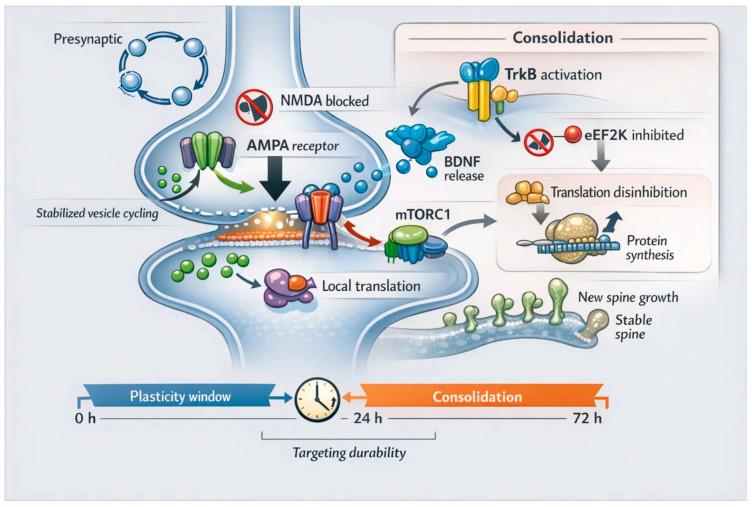
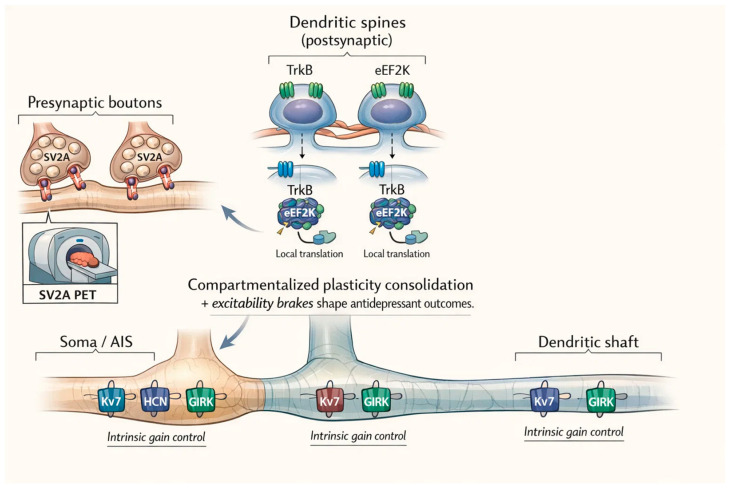
Major depressive disorder remains a leading cause of disability, and decades of monoamine-centered pharmacology have yielded delayed and often incomplete relief. Rapid-acting antidepressants reshaped the field by linking swift symptom improvement to glutamatergic plasticity, yet durable benefit depends on how newly reconfigured circuits are stabilized and tuned. This review synthesizes evidence that antidepressant efficacy arises from the coordinated engagement of synaptic plasticity, spanning induction and consolidation, and intrinsic excitability, which provides gain control, and proposes an integrated framework to guide future discovery. It first outlines induction through N-methyl-D-aspartate receptors (NMDARs) and α-amino-3-hydroxy-5-methyl-4-isoxazolepropionic acid receptors (AMPARs), exemplified by ketamine and esketamine, followed by consolidation mediated by tropomyosin receptor kinase B (TrkB) signaling, translational disinhibition via eukaryotic elongation factor 2 kinase (eEF2K), and presynaptic stabilization indexed by synaptic vesicle glycoprotein 2A (SV2A); together, these processes transform transient potentiation into persistent network change. It then highlights intrinsic excitability, emphasizing voltage-gated potassium channel subfamily Q (Kv7), hyperpolarization-activated cyclic nucleotide-gated (HCN), and G protein-gated inwardly rectifying potassium (GIRK) channels as circuit-level governors that normalize firing and limit relapse-prone hyperexcitability. Finally, it presents the Induction–Consolidation–Maintenance (ICM) framework as a hypothesis-generating roadmap for future studies, with SV2A positron emission tomography (PET), electroencephalography (EEG), and functional magnetic resonance imaging (fMRI) biomarkers discussed as candidate tools rather than validated guides for treatment timing or patient selection. The proposed contribution is not another list of plasticity pathways, but a phase-specific model that links synaptic induction, consolidation, and excitability-based maintenance to distinct therapeutic windows, biomarkers, and relapse-prevention strategies.
Overview
CoChat Summary
TL;DR
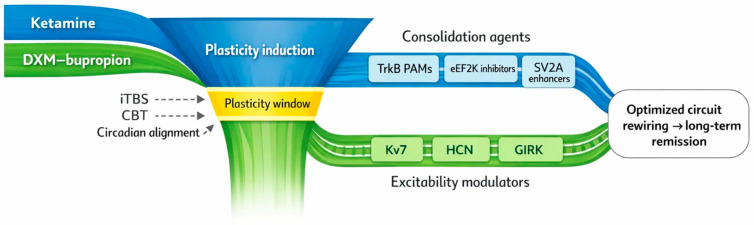
This narrative review proposes the Induction–Consolidation–Maintenance (ICM) framework, which treats antidepressant response as a temporally ordered process in which glutamatergic synaptic plasticity is induced, consolidated, and then stabilized by intrinsic excitability tuning. It argues that durable remission requires pairing plasticity inducers (e.g., ketamine/esketamine) with consolidation and maintenance mechanisms (TrkB, eEF2K, SV2A) and ion-channel–based gain control (Kv7, HCN, GIRK).
Key findings
- Antidepressant action is reframed as three mechanistically distinct phases: induction via NMDAR/AMPAR glutamatergic signaling (ketamine, esketamine, DXM-bupropion), consolidation via TrkB signaling, eEF2K-mediated translational disinhibition, and presynaptic stabilization indexed by SV2A, and maintenance via intrinsic excitability.
- Rapid glutamatergic strategies reliably produce rapid relief but responses "frequently decay within days to weeks, with high relapse rates following discontinuation"; maintenance regimens only partially offset this erosion.
- Intrinsic excitability channels are positioned as the maintenance layer: Kv7 (M-current) openers dampen hyperexcitability and show the strongest clinical signal (ezogabine reduced depressive symptoms and improved reward sensitivity in MDD with anhedonia, but pigmentation/urinary liabilities limited use), whereas HCN and GIRK strategies remain "largely mechanistic or preclinical."
- Translational failures are treated as boundary conditions: rapastinel failed to meet primary endpoints in three pivotal phase 3 adjunctive MDD trials, and no clinical-grade eEF2K inhibitor exists; TrkB agonists face reproducibility and target-specificity concerns.
Methods
- Narrative review synthesizing heterogeneous preclinical and clinical evidence; the author states the ICM framework "is used to organize heterogeneous evidence rather than to rank mechanisms by clinical readiness."
- Ketamine is treated as the best-established clinical entry point into rapid plasticity, with non-ketamine pathways discussed "according to their current evidentiary maturity."
- No systematic search strategy, inclusion criteria, or quantitative synthesis is reported; the paper is organized into sections on induction/consolidation, presynaptic and network integrity (SV2A), intrinsic excitability (Kv7, HCN, GIRK), combinatorial strategies, and future directions.
Limitations
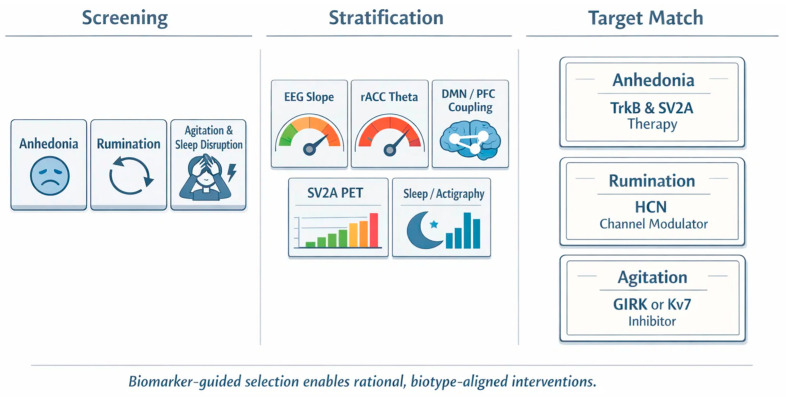
- Stated: the ICM framework is "a narrative synthesis rather than a validated clinical algorithm"; biomarkers (SV2A PET, MRS, EEG, fMRI, actigraphy) "are not yet validated tools for routine patient stratification"; and TrkB modulators, eEF2K inhibitors, SV2A enhancers, and ion-channel strategies remain at earlier stages of translation than ketamine/esketamine.
- Stated: long-term modulation of plasticity pathways may stabilize maladaptive circuits, alter excitation–inhibition balance, or change seizure thresholds; concerns include off-target signaling, abuse liability, and uncertainty about chronic ketamine/esketamine exposure.
- Evident from the text: the review is single-authored and non-systematic, with no stated search protocol or evidence-grading method, so the relative weighting of mechanisms reflects the author's narrative judgment; the author also notes that figures and tables "should be read as organizing tools... not as evidence that all pathways or targets are equally validated."
Model-written summary. Check it against the paper before relying on it.
Integrity signals
Registry
Cites
Statistics
Figures
Verification
Claims the paper makes
189 Valid · 49 Not valid · 26 Not checked · 56 Own results and interpretations
Some cited sources support this claim and some don’t — read each source’s verdict below.
In the paper
“Through these convergent actions, SV2A functions as a molecular scaffold that stabilizes presynaptic terminals while postsynaptic strengthening consolidates [175,184,198].”
§ Synaptic Plasticity—Intrinsic Excitability and Antidepressant Discovery > 3. Stabilizing Presynaptic and Network Integrity > Synaptic Vesicle Glycoprotein 2A (SV2A) Enhancers
What the sources say
- Disputedcites [175] Löscher W. Gillard M. Sands Z.A. Kaminski R.M. Klitgaard H. Synaptic Vesicle Glycoprotein 2A Ligands in the Treatment of Epilepsy and Beyond CNS Drugs 2016 30 1055 1077 10.1007/s40263-016-0384-x 27752944 PMC5078162 sourceExperimental — accuracy not yet measured
In “Excitability in the Brain” (page not provided), the paper says SV2 proteins are not structural components of synapses and instead links SV2A to control of vesicle exocytosis. That contradicts the attributed role of SV2A as a scaffold stabilizing presynaptic terminals; the passage does not describe coordinated postsynaptic strengthening. (LLM, conf=0.87)
Checked by a reasoning model — may be wrong.
- Not checked — no full text of the sourcecites [184] Stout K.A. Dunn A.R. Hoffman C. Miller G.W. The Synaptic Vesicle Glycoprotein 2: Structure, Function, and Disease Relevance ACS Chem. Neurosci. 2019 10 3927 3938 10.1021/acschemneuro.9b00351 31394034 PMC11562936 source
- Partly supportedcites [198] Nowack A. Yao J. Custer K.L. Bajjalieh S.M. SV2 regulates neurotransmitter release via multiple mechanisms Am. J. Physiol. Cell Physiol. 2010 299 C960 C967 10.1152/ajpcell.00259.2010 20702688 PMC2980308 sourceExperimental — accuracy not yet measured
The Discussion (page unavailable) reports that SV2 contributes to presynaptic release probability and describes a vesicular-matrix scaffold as a hypothesis tested in the study. It does not establish that SV2A stabilizes presynaptic terminals or link its action to the consolidation of postsynaptic strengthening. (LLM, conf=0.83)
plainstates a cause- Asserted: passes — The authors put it forward as true.
- Checkable: passes — It can be checked against evidence.
- Load-bearing: unclear — It is unclear whether the paper’s conclusions depend on it.
- Based: passes — The paper gives a reason why it holds.
- Disputed
Some cited sources support this claim and some don’t — read each source’s verdict below.
In the paper
“Rather than increasing synapse number or global firing, it selectively scales AMPAR mediated currents, producing a controlled gain in synaptic efficacy [147,152,154,155].”
§ Synaptic Plasticity—Intrinsic Excitability and Antidepressant Discovery > 2. Induction and Consolidation of Synaptic Plasticity > 2.3. eEF2K Inhibitors
What the sources say
- Not checked — no full text of the sourcecites [147] Suzuki K. Monteggia L.M. The role of eEF2 kinase in the rapid antidepressant actions of ketamine Adv. Pharmacol. 2020 89 79 99 10.1016/bs.apha.2020.04.005 32616215 source
- Disputedcites [152] Weng W. Chen Y. Wang M. Zhuang Y. Behnisch T. Potentiation of Schaffer-Collateral CA1 Synaptic Transmission by eEF2K and p38 MAPK Mediated Mechanisms Front. Cell. Neurosci. 2016 10 247 10.3389/fncel.2016.00247 27826228 PMC5078695 sourceExperimental — accuracy not yet measured
The Discussion reports that eEF2K inhibition enhances synaptic transmission by increasing presynaptic vesicle-release probability, without changing the amplitude of synaptic events. It explicitly contrasts this with a change in glutamate-receptor density or conductance, which would have changed EPSC amplitude. The paper therefore supports a gain in synaptic transmission, but not the claimed selective scaling of AMPAR-mediated currents. (LLM, conf=0.88)
Checked by a reasoning model — may be wrong.
- Disputedcites [154] Beretta S. Gritti L. Ponzoni L. Scalmani P. Mantegazza M. Sala M. Verpelli C. Sala C. Rescuing epileptic and behavioral alterations in a Dravet syndrome mouse model by inhibiting eukaryotic elongation factor 2 kinase (eEF2K) Mol. Autism 2022 13 1 10.1186/s13229-021-00484-0 34980259 PMC8722032 sourceExperimental — accuracy not yet measured
The Results section ('eEF2K deletion enhances GABAergic transmission'; page unavailable) says excitatory postsynaptic currents were unchanged in previously studied eEF2K-deficient mice, while inhibitory currents increased. In the Dravet mouse model, the authors measured enhanced inhibitory currents and conclude in the Discussion (page unavailable) that eEF2K deletion selectively increases GABAergic transmission—not AMPAR-mediated currents. (LLM, conf=0.90)
Checked by a reasoning model — may be wrong.
- Partly supportedcites [155] Wierenga C.J. Ibata K. Turrigiano G.G. Postsynaptic expression of homeostatic plasticity at neocortical synapses J. Neurosci. 2005 25 2895 2905 10.1523/JNEUROSCI.5217-04.2005 15772349 PMC6725152 sourceExperimental — accuracy not yet measured
The Discussion reports that activity blockade in young neocortical cultures increased postsynaptic AMPAR accumulation and synaptic strength without significantly increasing excitatory synapse number. It does not attribute these effects to eEF2K inhibition, and it says increased boosting by sodium channels also contributed to the stronger currents, so the claim of selective AMPAR-current scaling is not fully supported. (LLM, conf=0.87)
plainstates a cause- Asserted: passes — The authors put it forward as true.
- Checkable: passes — It can be checked against evidence.
- Load-bearing: passes — The paper’s conclusions depend on it.
- Based: passes — The paper gives a reason why it holds.
The cited sources support only part of this claim — read each source’s verdict below.
In the paper
“In prefrontal and hippocampal circuits, channels such as voltage-gated potassium channel subfamily Q (Kv7), hyperpolarization-activated cyclic nucleotide-gated channel (HCN), and G protein-gated inwardly rectifying potassium gated channel (GIRK; Kir3.x) serve as key determinants of firing probability and network stability [27,28,29].”
§ Synaptic Plasticity—Intrinsic Excitability and Antidepressant Discovery > 1. Introduction: Beyond Monoamines to Plasticity and Excitability
What the sources say
- Partly supportedcites [27] Klemz A. Wildner F. Tütüncü E. Gerevich Z. Regulation of Hippocampal Gamma Oscillations by Modulation of Intrinsic Neuronal Excitability Front. Neural Circuits 2021 15 778022 10.3389/fncir.2021.778022 35177966 PMC8845518 sourceExperimental — accuracy not yet measured
The Discussion (page unavailable) says Kv7.2/3 channels regulate neuronal excitability and that blocking them increases gamma-oscillation power in hippocampal CA3 circuits. The Introduction (page unavailable) says HCN channels were excluded from the study. The cited paper does not establish the sentence’s broader claim about Kv7, HCN, and GIRK channels across both prefrontal and hippocampal circuits. (LLM, conf=0.88)
- Not checked — no full text of the sourcecites [28] Desai N.S. Rutherford L.C. Turrigiano G.G. Plasticity in the intrinsic excitability of cortical pyramidal neurons Nat. Neurosci. 1999 2 515 520 10.1038/9165 10448215 source
- Partly supportedcites [29] Soldado-Magraner S. Brandalise F. Honnuraiah S. Pfeiffer M. Moulinier M. Gerber U. Douglas R. Conditioning by subthreshold synaptic input changes the intrinsic firing pattern of CA3 hippocampal neurons J. Neurophysiol. 2020 123 90 106 10.1152/jn.00506.2019 31721636 sourceExperimental — accuracy not yet measured
Our copy supports only the Kv7 leg of the claim in the hippocampus: the Mechanisms of firing pattern transitions section names gKm (M-current, Kv7/KCNQ) together with gKd and gCa as the conductances shaping transitions through the firing-pattern space of CA3 cells, and the pharmacology/Results sections show XE991 blockade of Kv7/KCNQ abolishing the conditioned pattern change (Pharmacology; Inhibition of Kv7 and calcium channels...). Nothing in our copy treats HCN or GIRK/Kir3 as determinants — the only mentions of the h-current are inside cited-reference titles in the References (Hu et al. 2002), and GIRK/Kir3 does not appear at all. Equally, prefrontal circuits are not studied (only a reference title on rat medial prefrontal cortex, Van Aerde & Feldmeyer 2015) and the paper argues about intrinsic firing pattern and network states/ripples, not about these channels as determinants of network stability. (LLM, conf=0.75)
plainstates a cause- Asserted: passes — The authors put it forward as true.
- Checkable: passes — It can be checked against evidence.
- Load-bearing: passes — The paper’s conclusions depend on it.
- Based: passes — The paper gives a reason why it holds.
- Partly supported
The cited sources support only part of this claim — read each source’s verdict below.
In the paper
“Chronic stress induces cell-type-specific shifts in intrinsic excitability within medial prefrontal and hippocampal neurons, biasing circuits toward vulnerability or resilience depending on channel composition and neuromodulatory state [25,26].”
§ Synaptic Plasticity—Intrinsic Excitability and Antidepressant Discovery > 1. Introduction: Beyond Monoamines to Plasticity and Excitability
What the sources say
- Partly supportedcites [25] Debanne D. Russier M. The contribution of ion channels in input-output plasticity Neurobiol. Learn. Mem. 2019 166 107095 10.1016/j.nlm.2019.107095 31539624 sourceExperimental — accuracy not yet measured
The sections on homeostatic plasticity and GABAergic interneurons describe cell-type-dependent changes in intrinsic excitability involving ion channels, including in hippocampal neurons. They discuss activity deprivation and synaptic stimulation, not chronic stress; the passages do not establish shifts in medial prefrontal neurons or a resulting bias toward vulnerability or resilience. (LLM, conf=0.84)
- Could not verifycites [26] Hansel C. Yuste R. Neural ensembles: Role of intrinsic excitability and its plasticity Front. Cell. Neurosci. 2024 18 1440588 10.3389/fncel.2024.1440588 39144154 PMC11322048 sourceExperimental — accuracy not yet measured
The Introduction (page unavailable) discusses hippocampal excitability after conditioning, and the section on on/off modulation discusses SK channels and cholinergic signaling. Neither addresses chronic stress, medial prefrontal excitability, or vulnerability versus resilience. Searches for those terms found no passage supporting the attributed claim. (LLM, conf=0.74)
plainstates a cause- Asserted: passes — The authors put it forward as true.
- Checkable: passes — It can be checked against evidence.
- Load-bearing: passes — The paper’s conclusions depend on it.
- Based: passes — The paper gives a reason why it holds.
- Partly supported
The cited sources support only part of this claim — read each source’s verdict below.
In the paper
“For early plasticity to last, downstream signaling must stabilize structure, transcription, and protein synthesis [34,41].”
§ Synaptic Plasticity—Intrinsic Excitability and Antidepressant Discovery > 2. Induction and Consolidation of Synaptic Plasticity
What the sources say
- Partly supportedcites [34] Kennedy M.B. Synaptic Signaling in Learning and Memory Cold Spring Harb. Perspect. Biol. 2013 8 a016824 10.1101/cshperspect.a016824 24379319 PMC4743082 sourceExperimental — accuracy not yet measured
The Introduction (page not provided) describes early structural changes followed by signaling that increases local protein synthesis and activates transcription; it says these later changes can affect neuronal structure for hours to a lifetime. It does not establish that all three processes must be stabilized for early plasticity to last, so the claim overstates their necessity. (LLM, conf=0.82)
- Partly supportedcites [41] Shrestha P. Klann E. Spatiotemporally resolved protein synthesis as a molecular framework for memory consolidation Trends Neurosci. 2022 45 297 311 10.1016/j.tins.2022.01.004 35184897 PMC8930706 sourceExperimental — accuracy not yet measured
Our copy supports the protein-synthesis arm of the claim: the introduction (p.1) states that 'memory consolidation requires de novo PS', the Concluding remarks note that 'Subcellular PS fulfils the local demand for new proteins with exogenous stimuli-driven synaptic plasticity, which is the basis for long-lasting long-term potentiation', and the signalling sections describe mTORC1 and ERK as the downstream cascades that control translation initiation and elongation (eIF4F/4E-BP, S6K1-PDCD4, eEF2K). However, no passage in our copy attributes persistence of early plasticity to stabilization of structure or to transcription as such; transcription appears only mechanistically (ATF4-mediated induction of 4E-BPs, learning-induced IEG expression in engram cells), and structural change is not discussed as a requirement. The structural- and transcription-stabilization components of the citing sentence are therefore not supported by this source. (LLM, conf=0.72)
plainstates a cause- Asserted: passes — The authors put it forward as true.
- Checkable: passes — It can be checked against evidence.
- Load-bearing: passes — The paper’s conclusions depend on it.
- Based: passes — The paper gives a reason why it holds.
- Partly supported
89 more claims · 66 with their cited sources checked
Create a free account to see all 320 claims and to verify the 15 references still open.
- It may state two separate claims as one. 211
- Probably not a substantial claim. 41
- The quote only partly states this claim. 1
Citations
Cites
mTOR-Dependent Synapse Formation Underlies the Rapid Antidepressant Effects of NMDA Antagonists
Li, N., Lee, B., Liu, R.-J., Banasr, M., Dwyer, J. M., Iwata, M., Li, X.-Y., Aghajanian, G., & Duman, R. S. (2010) · Science · doi:10.1126/science.1190287 · Cited by 2,881
NMDA receptor blockade at rest triggers rapid behavioural antidepressant responses
Autry, A. E., Adachi, M., Nosyreva, E., Na, E. S., Los, M. F., Cheng, P.-F., Kavalali, E. T., & Monteggia, L. M. (2011) · Nature · doi:10.1038/nature10130 · Cited by 1,926
Synaptic plasticity and depression: new insights from stress and rapid-acting antidepressants
Duman, R. S., Aghajanian, G. K., Sanacora, G., & Krystal, J. H. (2016) · Nature Medicine · doi:10.1038/nm.4050 · Cited by 1,750
Synaptic Dysfunction in Depression: Potential Therapeutic Targets
Duman, R. S., & Aghajanian, G. K. (2012) · Science · doi:10.1126/science.1222939 · Cited by 1,651
Liebetanz, D. (2002) · Brain · doi:10.1093/brain/awf238 · Cited by 1,383
Targeting integrin pathways: mechanisms and advances in therapy
Pang, X., He, X., Qiu, Z., Zhang, H., Xie, R., Liu, Z., Gu, Y., Zhao, N., Xiang, Q., & Cui, Y. (2023) · Signal Transduction and Targeted Therapy · doi:10.1038/s41392-022-01259-6 · Cited by 1,275
Psychedelics promote structural and functional neural plasticity
Ly, C., Greb, A. C., Cameron, L. P., Wong, J. M., Barragan, E. V., Wilson, P. C., Burbach, K. F., Soltanzadeh Zarandi, S., Sood, A., Paddy, M. R., et al. (2018) · Cell Reports · doi:10.1016/j.celrep.2018.05.022 · Cited by 1,207
BDNF function in adult synaptic plasticity: The synaptic consolidation hypothesis
Bramham, C. R., & Messaoudi, E. (2005) · Progress in Neurobiology · doi:10.1016/j.pneurobio.2005.06.003 · Cited by 1,193
Mechanisms of ketamine action as an antidepressant
Zanos, P., & Gould, T. D. (2018) · Molecular Psychiatry · doi:10.1038/mp.2017.255 · Cited by 1,127
Maeng, S., Zarate, C. A., Du, J., Schloesser, R. J., McCammon, J., Chen, G., & Manji, H. K. (2008) · Biological Psychiatry · doi:10.1016/j.biopsych.2007.05.028 · Cited by 1,103
Li, N., Liu, R.-J., Dwyer, J. M., Banasr, M., Lee, B., Son, H., Li, X.-Y., Aghajanian, G., & Duman, R. S. (2011) · Biological Psychiatry · doi:10.1016/j.biopsych.2010.12.015 · Cited by 1,082
BDNF and synaptic plasticity, cognitive function, and dysfunction
Lu, B., Nagappan, G., & Lu, Y. (2014) · Handbook of Experimental Pharmacology · doi:10.1007/978-3-642-45106-5_9 · Cited by 1,043
Duman, R. S., Sanacora, G., & Krystal, J. H. (2019) · Neuron · doi:10.1016/j.neuron.2019.03.013 · Cited by 1,026
Colucci-D’Amato, L., Speranza, L., & Volpicelli, F. (2020) · International Journal of Molecular Sciences · doi:10.3390/ijms21207777 · Cited by 991
Depression: A Global Public Health Concern: (517532013-004)
Marcus, M., Yasamy, M. T., van Ommeren, M. V., Chisholm, D., & Saxena, S. (2012) · PsycEXTRA Dataset · doi:10.1037/e517532013-004 · Cited by 985
Magee, J. C. (1998) · The Journal of Neuroscience · doi:10.1523/jneurosci.18-19-07613.1998 · Cited by 981
BDNF - a key transducer of antidepressant effects
Björkholm, C., & Monteggia, L. M. (2016) · Neuropharmacology · doi:10.1016/j.neuropharm.2015.10.034 · Cited by 958
Translational control of long-lasting synaptic plasticity and memory
Costa-Mattioli, M., Sossin, W. S., Klann, E., & Sonenberg, N. (2009) · Neuron · doi:10.1016/j.neuron.2008.10.055 · Cited by 944
Yan, C.-G., Chen, X., Li, L., Castellanos, F. X., Bai, T.-J., Bo, Q.-J., Cao, J., Chen, G.-M., Chen, N.-X., Chen, W., et al. (2019) · Proceedings of the National Academy of Sciences · doi:10.1073/pnas.1900390116 · Cited by 895
Castrén, E., & Rantamäki, T. (2010) · Developmental Neurobiology · doi:10.1002/dneu.20758 · Cited by 864
McIntyre, R. S., Alsuwaidan, M., Baune, B. T., Berk, M., Demyttenaere, K., Goldberg, J. F., Gorwood, P., Ho, R., Kasper, S., Kennedy, S. H., et al. (2023) · World Psychiatry · doi:10.1002/wps.21120 · Cited by 836
Plasticity in the intrinsic excitability of cortical pyramidal neurons
Desai, N. S., Rutherford, L. C., & Turrigiano, G. G. (1999) · Nature Neuroscience · doi:10.1038/9165 · Cited by 806
Synaptic Plasticity Forms and Functions
Magee, J. C., & Grienberger, C. (2020) · Annual Review of Neuroscience · doi:10.1146/annurev-neuro-090919-022842 · Cited by 806
Daly, E. J., Trivedi, M. H., Janik, A., Li, H., Zhang, Y., Li, X., Lane, R., Lim, P., Duca, A. R., Hough, D., et al. (2019) · JAMA Psychiatry · doi:10.1001/jamapsychiatry.2019.1189 · Cited by 795
Postsynaptic BDNF‐TrkB signaling in synapse maturation, plasticity, and disease
Yoshii, A., & Constantine‐Paton, M. (2010) · Developmental Neurobiology · doi:10.1002/dneu.20765 · Cited by 744
Neuroplasticity in cognitive and psychological mechanisms of depression: an integrative model
Price, R. B., & Duman, R. (2020) · Molecular Psychiatry · doi:10.1038/s41380-019-0615-x · Cited by 739
Brown, D. A., & Passmore, G. M. (2009) · British Journal of Pharmacology · doi:10.1111/j.1476-5381.2009.00111.x · Cited by 676
Antidepressant drugs act by directly binding to TRKB neurotrophin receptors
Casarotto, P. C., Girych, M., Fred, S. M., Kovaleva, V., Moliner, R., Enkavi, G., Biojone, C., Cannarozzo, C., Sahu, M. P., Kaurinkoski, K., et al. (2021) · Cell · doi:10.1016/j.cell.2021.01.034 · Cited by 663
Sustained rescue of prefrontal circuit dysfunction by antidepressant-induced spine formation
Moda-Sava, R. N., Murdock, M. H., Parekh, P. K., Fetcho, R. N., Huang, B. S., Huynh, T. N., Witztum, J., Shaver, D. C., Rosenthal, D. L., Alway, E. J., et al. (2019) · Science · doi:10.1126/science.aat8078 · Cited by 643
The Role of Neural Plasticity in Depression: From Hippocampus to Prefrontal Cortex
Liu, W., Ge, T., Leng, Y., Pan, Z., Fan, J., Yang, W., & Cui, R. (2017) · Neural Plasticity · doi:10.1155/2017/6871089 · Cited by 640
Lüscher, C., & Slesinger, P. A. (2010) · Nature Reviews Neuroscience · doi:10.1038/nrn2834 · Cited by 617
Unraveling mechanisms of homeostatic synaptic plasticity
Pozo, K., & Goda, Y. (2010) · Neuron · doi:10.1016/j.neuron.2010.04.028 · Cited by 565
Closed-loop neuromodulation in an individual with treatment-resistant depression
Scangos, K. W., Khambhati, A. N., Daly, P. M., Makhoul, G. S., Sugrue, L. P., Zamanian, H., Liu, T. X., Rao, V. R., Sellers, K. K., Dawes, H. E., et al. (2021) · Nature Medicine · doi:10.1038/s41591-021-01480-w · Cited by 535
Drug/device combinations for local drug therapies and infection prophylaxis
Wu, P., & Grainger, D. W. (2006) · Biomaterials · doi:10.1016/j.biomaterials.2005.11.031 · Cited by 491
Anti-tuberculosis treatment strategies and drug development: challenges and priorities
Dartois, V. A., & Rubin, E. J. (2022) · Nature Reviews Microbiology · doi:10.1038/s41579-022-00731-y · Cited by 490
Psychedelics promote plasticity by directly binding to BDNF receptor TrkB
Moliner, R., Girych, M., Brunello, C. A., Kovaleva, V., Biojone, C., Enkavi, G., Antenucci, L., Kot, E. F., Goncharuk, S. A., Kaurinkoski, K., et al. (2023) · Nature Neuroscience · doi:10.1038/s41593-023-01316-5 · Cited by 478
Phillips, J. L., Norris, S., Talbot, J., Birmingham, M., Hatchard, T., Ortiz, A., Owoeye, O., Batten, L. A., & Blier, P. (2019) · American Journal of Psychiatry · doi:10.1176/appi.ajp.2018.18070834 · Cited by 418
Abnormal neurotransmission in mice lacking synaptic vesicle protein 2A (SV2A)
Crowder, K. M., Gunther, J. M., Jones, T. A., Hale, B. D., Zhang, H. Z., Peterson, M. R., Scheller, R. H., Chavkin, C., & Bajjalieh, S. M. (1999) · Proceedings of the National Academy of Sciences · doi:10.1073/pnas.96.26.15268 · Cited by 415
Tartt, A. N., Mariani, M. B., Hen, R., Mann, J. J., & Boldrini, M. (2022) · Molecular Psychiatry · doi:10.1038/s41380-022-01520-y · Cited by 408
Depression: The disorder and the burden
Reddy, M. S. (2010) · Indian Journal of Psychological Medicine · doi:10.4103/0253-7176.70510 · Cited by 392
Candidate biomarkers in psychiatric disorders: state of the field
Abi‐Dargham, A., Moeller, S. J., Ali, F., DeLorenzo, C., Domschke, K., Horga, G., Jutla, A., Kotov, R., Paulus, M. P., Rubio, J. M., et al. (2023) · World Psychiatry · doi:10.1002/wps.21078 · Cited by 372
Translational control in synaptic plasticity and cognitive dysfunction
Buffington, S. A., Huang, W., & Costa-Mattioli, M. (2014) · Annual Review of Neuroscience · doi:10.1146/annurev-neuro-071013-014100 · Cited by 348
Autocrine BDNF-TrkB signalling within a single dendritic spine
Harward, S. C., Hedrick, N. G., Hall, C. E., Parra-Bueno, P., Milner, T. A., Pan, E., Laviv, T., Hempstead, B. L., Yasuda, R., & McNamara, J. O. (2016) · Nature · doi:10.1038/nature19766 · Cited by 325
Neurobiology of local and intercellular BDNF signaling
Sasi, M., Vignoli, B., Canossa, M., & Blum, R. (2017) · Pflügers Archiv - European Journal of Physiology · doi:10.1007/s00424-017-1964-4 · Cited by 324
Duman, R. S., Deyama, S., & Fogaça, M. V. (2021) · European Journal of Neuroscience · doi:10.1111/ejn.14630 · Cited by 321
Serotonin receptors involved in antidepressant effects
Artigas, F. (2013) · Pharmacology & Therapeutics · doi:10.1016/j.pharmthera.2012.09.006 · Cited by 311
Postsynaptic expression of homeostatic plasticity at neocortical synapses
Wierenga, C. J., Ibata, K., & Turrigiano, G. G. (2005) · The Journal of Neuroscience · doi:10.1523/jneurosci.5217-04.2005 · Cited by 306
Biased Receptor Signaling in Drug Discovery
Kenakin, T. (2019) · Pharmacological Reviews · doi:10.1124/pr.118.016790 · Cited by 294
Lu, B., Lin, L., & Su, X. (2024) · Journal of Affective Disorders · doi:10.1016/j.jad.2024.03.074 · Cited by 289
In vivo measurement of widespread synaptic loss in Alzheimer’s disease with SV2A PET
Mecca, A. P., Chen, M., O'Dell, R. S., Naganawa, M., Toyonaga, T., Godek, T. A., Harris, J. E., Bartlett, H. H., Zhao, W., Nabulsi, N. B., et al. (2020) · Alzheimer's & Dementia · doi:10.1002/alz.12097 · Cited by 288
Neuronal plasticity and neurotrophic factors in drug responses
Castrén, E., & Antila, H. (2017) · Molecular Psychiatry · doi:10.1038/mp.2017.61 · Cited by 284
Antidepressant Efficacy and Tolerability of Ketamine and Esketamine: A Critical Review
Molero, P., Ramos-Quiroga, J. A., Martin-Santos, R., Calvo-Sánchez, E., Gutiérrez-Rojas, L., & Meana, J. J. (2018) · CNS Drugs · doi:10.1007/s40263-018-0519-3 · Cited by 280
Neuroplasticity as a convergent mechanism of ketamine and classical psychedelics
Aleksandrova, L. R., & Phillips, A. G. (2021) · Trends in Pharmacological Sciences · doi:10.1016/j.tips.2021.08.003 · Cited by 276
Plasticity of intrinsic neuronal excitability
Debanne, D., Inglebert, Y., & Russier, M. (2019) · Current Opinion in Neurobiology · doi:10.1016/j.conb.2018.09.001 · Cited by 272
Synaptic Signaling in Learning and Memory
Kennedy, M. B. (2016) · Cold Spring Harbor Perspectives in Biology · doi:10.1101/cshperspect.a016824 · Cited by 270
Boosting focally-induced brain plasticity by dopamine
Kuo, M.-F., Paulus, W., & Nitsche, M. A. (2008) · Cerebral Cortex · doi:10.1093/cercor/bhm098 · Cited by 269
Regulation of Kv7 (KCNQ) K + Channel Open Probability by Phosphatidylinositol 4,5-Bisphosphate
Li, Y., Gamper, N., Hilgemann, D. W., & Shapiro, M. S. (2005) · The Journal of Neuroscience · doi:10.1523/jneurosci.2597-05.2005 · Cited by 265
Ketamine and rapid antidepressant action: New treatments and novel synaptic signaling mechanisms
Krystal, J. H., Kavalali, E. T., & Monteggia, L. M. (2024) · Neuropsychopharmacology · doi:10.1038/s41386-023-01629-w · Cited by 262
Synaptic Mechanisms Underlying Rapid Antidepressant Action of Ketamine
Kavalali, E. T., & Monteggia, L. M. (2012) · American Journal of Psychiatry · doi:10.1176/appi.ajp.2012.12040531 · Cited by 258
Tumor cell plasticity in targeted therapy-induced resistance: Mechanisms and new strategies
Shi, Z.-D., Pang, K., Wu, Z.-X., Dong, Y., Hao, L., Qin, J.-X., Wang, W., Chen, Z.-S., & Han, C.-H. (2023) · Signal Transduction and Targeted Therapy · doi:10.1038/s41392-023-01383-x · Cited by 256
Duman, R. S. (2014) · Dialogues in Clinical Neuroscience · doi:10.31887/dcns.2014.16.1/rduman · Cited by 249
Synaptic plasticity and mental health: methods, challenges and opportunities
Appelbaum, L. G., Shenasa, M. A., Stolz, L., & Daskalakis, Z. (2023) · Neuropsychopharmacology · doi:10.1038/s41386-022-01370-w · Cited by 240
G‐protein mediated gating of inward‐rectifier K+ channels
Mark, M. D., & Herlitze, S. (2000) · European Journal of Biochemistry · doi:10.1046/j.1432-1327.2000.01670.x · Cited by 236
Aleksandrova, L. R., Phillips, A. G., & Wang, Y. T. (2017) · Journal of Psychiatry and Neuroscience · doi:10.1503/jpn.160175 · Cited by 228
Finnema, S. J., Nabulsi, N. B., Mercier, J., Lin, S.-F., Chen, M.-K., Matuskey, D., Gallezot, J.-D., Henry, S., Hannestad, J., Huang, Y., et al. (2018) · Journal of Cerebral Blood Flow & Metabolism · doi:10.1177/0271678x17724947 · Cited by 218
Nuñez, N. A., Joseph, B., Pahwa, M., Kumar, R., Resendez, M. G., Prokop, L. J., Veldic, M., Seshadri, A., Biernacka, J. M., Frye, M. A., et al. (2022) · Journal of Affective Disorders · doi:10.1016/j.jad.2021.12.134 · Cited by 215
Xu, J., Van Dam, N. T., Feng, C., Luo, Y., Ai, H., Gu, R., & Xu, P. (2019) · Neuroscience & Biobehavioral Reviews · doi:10.1016/j.neubiorev.2018.11.005 · Cited by 212
SV2 modulates the size of the readily releasable pool of secretory vesicles
Xu, T., & Bajjalieh, S. M. (2001) · Nature Cell Biology · doi:10.1038/35087000 · Cited by 212
Synaptic Plasticity Shapes Brain Connectivity: Implications for Network Topology
Stampanoni Bassi, M., Iezzi, E., Gilio, L., Centonze, D., & Buttari, F. (2019) · International Journal of Molecular Sciences · doi:10.3390/ijms20246193 · Cited by 211
Synaptic vesicle protein 2 enhances release probability at quiescent synapses
Custer, K. L., Austin, N. S., Sullivan, J. M., & Bajjalieh, S. M. (2006) · The Journal of Neuroscience · doi:10.1523/jneurosci.2699-05.2006 · Cited by 211
Small Molecule NF-κB Pathway Inhibitors in Clinic
Ramadass, V., Vaiyapuri, T., & Tergaonkar, V. (2020) · International Journal of Molecular Sciences · doi:10.3390/ijms21145164 · Cited by 210
Matveychuk, D., Thomas, R. K., Swainson, J., Khullar, A., MacKay, M.-A., Baker, G. B., & Dursun, S. M. (2020) · Therapeutic Advances in Psychopharmacology · doi:10.1177/2045125320916657 · Cited by 209
KETAMINE'S MECHANISM OF ACTION: A PATH TO RAPID‐ACTING ANTIDEPRESSANTS
Abdallah, C. G., Adams, T. G., Kelmendi, B., Esterlis, I., Sanacora, G., & Krystal, J. H. (2016) · Depression and Anxiety · doi:10.1002/da.22501 · Cited by 206
Widman, A. J., & McMahon, L. L. (2018) · Proceedings of the National Academy of Sciences · doi:10.1073/pnas.1718883115 · Cited by 204
Kalmbach, B. E., Buchin, A., Long, B., Close, J., Nandi, A., Miller, J. A., Bakken, T. E., Hodge, R. D., Chong, P., de Frates, R., et al. (2018) · Neuron · doi:10.1016/j.neuron.2018.10.012 · Cited by 203
Iadarola, N. D., Niciu, M. J., Richards, E. M., Vande Voort, J. L., Ballard, E. D., Lundin, N. B., Nugent, A. C., Machado-Vieira, R., & Zarate, C. A. (2015) · Therapeutic Advances in Chronic Disease · doi:10.1177/2040622315579059 · Cited by 201
The role of eukaryotic elongation factor 2 kinase in rapid antidepressant action of ketamine
Monteggia, L. M., Gideons, E., & Kavalali, E. T. (2013) · Biological Psychiatry · doi:10.1016/j.biopsych.2012.09.006 · Cited by 198
Liu, C., Chan, C. B., & Ye, K. (2016) · Translational Neurodegeneration · doi:10.1186/s40035-015-0048-7 · Cited by 195
Ma, T., Chen, Y., Vingtdeux, V., Zhao, H., Viollet, B., Marambaud, P., & Klann, E. (2014) · The Journal of Neuroscience · doi:10.1523/jneurosci.1694-14.2014 · Cited by 191
Neuronal network plasticity and recovery from depression
Castrén, E. (2013) · JAMA Psychiatry · doi:10.1001/jamapsychiatry.2013.1 · Cited by 190
Pham, T. H., & Gardier, A. M. (2019) · Pharmacology & Therapeutics · doi:10.1016/j.pharmthera.2019.02.017 · Cited by 186
Neuromodulation of hippocampal long-term synaptic plasticity
Palacios-Filardo, J., & Mellor, J. R. (2019) · Current Opinion in Neurobiology · doi:10.1016/j.conb.2018.08.009 · Cited by 184
Synaptic Vesicle Glycoprotein 2A Ligands in the Treatment of Epilepsy and Beyond
Löscher, W., Gillard, M., Sands, Z. A., Kaminski, R. M., & Klitgaard, H. (2016) · CNS Drugs · doi:10.1007/s40263-016-0384-x · Cited by 184
Modulation of the antidepressant effects of ketamine by the mTORC1 inhibitor rapamycin
Abdallah, C. G., Averill, L. A., Gueorguieva, R., Goktas, S., Purohit, P., Ranganathan, M., Sherif, M., Ahn, K.-H., D’Souza, D. C., Formica, R., et al. (2020) · Neuropsychopharmacology · doi:10.1038/s41386-020-0644-9 · Cited by 184
Stepwise synaptic plasticity events drive the early phase of memory consolidation
Goto, A., Bota, A., Miya, K., Wang, J., Tsukamoto, S., Jiang, X., Hirai, D., Murayama, M., Matsuda, T., McHugh, T. J., et al. (2021) · Science · doi:10.1126/science.abj9195 · Cited by 184
Donse, L., Padberg, F., Sack, A. T., Rush, A. J., & Arns, M. (2018) · Brain Stimulation · doi:10.1016/j.brs.2017.11.004 · Cited by 183
Flückiger, C., Rubel, J., Del Re, A. C., Horvath, A. O., Wampold, B. E., Crits-Christoph, P., Atzil-Slonim, D., Compare, A., Falkenström, F., Ekeblad, A., et al. (2020) · Journal of Consulting and Clinical Psychology · doi:10.1037/ccp0000594 · Cited by 180
Effects of a ketamine metabolite on synaptic NMDAR function
Suzuki, K., Nosyreva, E., Hunt, K. W., Kavalali, E. T., & Monteggia, L. M. (2017) · Nature · doi:10.1038/nature22084 · Cited by 180
Modulation of Kv7 channels and excitability in the brain
Greene, D. L., & Hoshi, N. (2017) · Cellular and Molecular Life Sciences · doi:10.1007/s00018-016-2359-y · Cited by 177
Mechanisms of ketamine and its metabolites as antidepressants
Hess, E. M., Riggs, L. M., Michaelides, M., & Gould, T. D. (2022) · Biochemical Pharmacology · doi:10.1016/j.bcp.2021.114892 · Cited by 175
Selective Androgen Receptor Modulators: Current Knowledge and Clinical Applications
Solomon, Z. J., Mirabal, J. R., Mazur, D. J., Kohn, T. P., Lipshultz, L. I., & Pastuszak, A. W. (2019) · Sexual Medicine Reviews · doi:10.1016/j.sxmr.2018.09.006 · Cited by 174
CFTR modulator therapy: Transforming the landscape of clinical care in cystic fibrosis
Taylor-Cousar, J. L., Robinson, P. D., Shteinberg, M., & Downey, D. G. (2023) · The Lancet · doi:10.1016/s0140-6736(23)01609-4 · Cited by 173
Hu, H., Vervaeke, K., & Storm, J. F. (2007) · The Journal of Neuroscience · doi:10.1523/jneurosci.4463-06.2007 · Cited by 172
Nicolas, J., Hannestad, J., Holden, D., Kervyn, S., Nabulsi, N., Tytgat, D., Huang, Y., Chanteux, H., Staelens, L., Matagne, A., et al. (2016) · Epilepsia · doi:10.1111/epi.13267 · Cited by 169
Zrenner, C., & Ziemann, U. (2023) · Biological Psychiatry · doi:10.1016/j.biopsych.2023.09.014 · Cited by 169
Smith-Apeldoorn, S. Y., Veraart, J. K., Spijker, J., Kamphuis, J., & Schoevers, R. A. (2022) · The Lancet Psychiatry · doi:10.1016/s2215-0366(22)00317-0 · Cited by 169
Brain Modularity: A Biomarker of Intervention-related Plasticity
Gallen, C. L., & D’Esposito, M. (2019) · Trends in Cognitive Sciences · doi:10.1016/j.tics.2019.01.014 · Cited by 168
Klitgaard, H., Matagne, A., Nicolas, J., Gillard, M., Lamberty, Y., De Ryck, M., Kaminski, R. M., Leclercq, K., Niespodziany, I., Wolff, C., et al. (2016) · Epilepsia · doi:10.1111/epi.13340 · Cited by 168
Let’s talk about sex: Differences in drug therapy in males and females
Madla, C. M., Gavins, F. K. H., Merchant, H. A., Orlu, M., Murdan, S., & Basit, A. W. (2021) · Advanced Drug Delivery Reviews · doi:10.1016/j.addr.2021.05.014 · Cited by 167
Cotrafficking of SV2 and synaptotagmin at the synapse
Yao, J., Nowack, A., Kensel-Hammes, P., Gardner, R. G., & Bajjalieh, S. M. (2010) · The Journal of Neuroscience · doi:10.1523/jneurosci.4781-09.2010 · Cited by 164
Ketamine Treatment for Depression: A Review
Yavi, M., Lee, H., Henter, I. D., Park, L. T., & Zarate, C. A. (2022) · Discover Mental Health · doi:10.1007/s44192-022-00012-3 · Cited by 161
Cortical HCN channels: Function, trafficking and plasticity
Shah, M. M. (2014) · The Journal of Physiology · doi:10.1113/jphysiol.2013.270058 · Cited by 160
Liu, J., Liu, Y., Ma, W., Tong, Y., & Zheng, J. (2024) · Scientific Reports · doi:10.1038/s41598-024-62381-9 · Cited by 160
New directions for emerging therapies in acute myeloid leukemia: the next chapter
Daver, N., Wei, A. H., Pollyea, D. A., Fathi, A. T., Vyas, P., & DiNardo, C. D. (2020) · Blood Cancer Journal · doi:10.1038/s41408-020-00376-1 · Cited by 159
Kryst, J., Kawalec, P., Mitoraj, A. M., Pilc, A., Lasoń, W., & Brzostek, T. (2020) · Pharmacological Reports · doi:10.1007/s43440-020-00097-z · Cited by 159
Kim, C. S., Chang, P. Y., & Johnston, D. (2012) · Neuron · doi:10.1016/j.neuron.2012.05.027 · Cited by 158
Reducing Suicidal Ideation Through Insomnia Treatment (REST-IT): A Randomized Clinical Trial
McCall, W. V., Benca, R. M., Rosenquist, P. B., Youssef, N. A., McCloud, L., Newman, J. C., Case, D., Rumble, M. E., Szabo, S. T., Phillips, M., et al. (2019) · American Journal of Psychiatry · doi:10.1176/appi.ajp.2019.19030267 · Cited by 157
Development of small-molecule tropomyosin receptor kinase (TRK) inhibitors for NTRK fusion cancers
Jiang, T., Wang, G., Liu, Y., Feng, L., Wang, M., Liu, J., Chen, Y., & Ouyang, L. (2021) · Acta Pharmaceutica Sinica B · doi:10.1016/j.apsb.2020.05.004 · Cited by 157
Yue, C., & Yaari, Y. (2006) · Journal of Neurophysiology · doi:10.1152/jn.01333.2005 · Cited by 156
Neurobiology of rapid-acting antidepressants: convergent effects on GluA1-synaptic function
Duman, R. S., Shinohara, R., Fogaça, M. V., & Hare, B. (2019) · Molecular Psychiatry · doi:10.1038/s41380-019-0400-x · Cited by 154
TrkB/BDNF signaling pathway and its small molecular agonists in CNS injury
Wang, Y., Liang, J., Xu, B., Yang, J., Wu, Z., & Cheng, L. (2024) · Life Sciences · doi:10.1016/j.lfs.2023.122282 · Cited by 152
Harnett, M. T., Magee, J. C., & Williams, S. R. (2015) · The Journal of Neuroscience · doi:10.1523/jneurosci.2813-14.2015 · Cited by 148
BDNF signaling during the lifetime of dendritic spines
Zagrebelsky, M., Tacke, C., & Korte, M. (2020) · Cell and Tissue Research · doi:10.1007/s00441-020-03226-5 · Cited by 147
Soleimani, G., Nitsche, M. A., Bergmann, T. O., Towhidkhah, F., Violante, I. R., Lorenz, R., Kuplicki, R., Tsuchiyagaito, A., Mulyana, B. E., Mayeli, A., et al. (2023) · Translational Psychiatry · doi:10.1038/s41398-023-02565-5 · Cited by 144
Sartiani, L., Mannaioni, G., Masi, A., Novella Romanelli, M., & Cerbai, E. (2017) · Pharmacological Reviews · doi:10.1124/pr.117.014035 · Cited by 143
Novel Glutamatergic Modulators for the Treatment of Mood Disorders: Current Status
Henter, I. D., Park, L. T., & Zarate, C. A. (2021) · CNS Drugs · doi:10.1007/s40263-021-00816-x · Cited by 142
Ali, S., Rhodes, L., Moreea, O., McMillan, D., Gilbody, S., Leach, C., Lucock, M., Lutz, W., & Delgadillo, J. (2017) · Behaviour Research and Therapy · doi:10.1016/j.brat.2017.04.006 · Cited by 139
Translational Control in the Brain in Health and Disease
Sossin, W. S., & Costa-Mattioli, M. (2019) · Cold Spring Harbor Perspectives in Biology · doi:10.1101/cshperspect.a032912 · Cited by 138
Naganawa, M., Li, S., Nabulsi, N., Henry, S., Zheng, M.-Q., Pracitto, R., Cai, Z., Gao, H., Kapinos, M., Labaree, D., et al. (2021) · Journal of Nuclear Medicine · doi:10.2967/jnumed.120.249144 · Cited by 138
SV2 regulates neurotransmitter release via multiple mechanisms
Nowack, A., Yao, J., Custer, K. L., & Bajjalieh, S. M. (2010) · American Journal of Physiology-Cell Physiology · doi:10.1152/ajpcell.00259.2010 · Cited by 138
Mesoscopic Imaging: Shining a Wide Light on Large-Scale Neural Dynamics
Cardin, J. A., Crair, M. C., & Higley, M. J. (2020) · Neuron · doi:10.1016/j.neuron.2020.09.031 · Cited by 135
Vervaeke, K., Gu, N., Agdestein, C., Hu, H., & Storm, J. F. (2006) · The Journal of Physiology · doi:10.1113/jphysiol.2006.111336 · Cited by 135
Iosifescu, D. V., Jones, A., O’Gorman, C., Streicher, C., Feliz, S., Fava, M., & Tabuteau, H. (2022) · The Journal of Clinical Psychiatry · doi:10.4088/jcp.21m14345 · Cited by 135
Sarkar, A., & Kabbaj, M. (2016) · Biological Psychiatry · doi:10.1016/j.biopsych.2015.12.025 · Cited by 134
PET imaging of synaptic density: A new tool for investigation of neuropsychiatric diseases
Cai, Z., Li, S., Matuskey, D., Nabulsi, N., & Huang, Y. (2019) · Neuroscience Letters · doi:10.1016/j.neulet.2018.07.038 · Cited by 131
Levetiracetam Mechanisms of Action: From Molecules to Systems
Contreras-García, I. J., Cárdenas-Rodríguez, N., Romo-Mancillas, A., Bandala, C., Zamudio, S. R., Gómez-Manzo, S., Hernández-Ochoa, B., Mendoza-Torreblanca, J. G., & Pichardo-Macías, L. A. (2022) · Pharmaceuticals · doi:10.3390/ph15040475 · Cited by 131
Tejeda, G., & Díaz-Guerra, M. (2017) · International Journal of Molecular Sciences · doi:10.3390/ijms18020268 · Cited by 126
Numakawa, T., & Kajihara, R. (2025) · Molecules · doi:10.3390/molecules30040848 · Cited by 126
Beyond the hammer and the scalpel: selective circuit control for the epilepsies
Krook-Magnuson, E. I., & Soltész, I. (2015) · Nature Neuroscience · doi:10.1038/nn.3943 · Cited by 124
Synaptic Vesicle Glycoprotein 2A: Features and Functions
Rossi, R., Arjmand, S., Bærentzen, S. L., Gjedde, A., & Landau, A. M. (2022) · Frontiers in Neuroscience · doi:10.3389/fnins.2022.864514 · Cited by 123
Brown, T. E., Forquer, M. R., Cocking, D. L., Jansen, H. T., Harding, J. W., & Sorg, B. A. (2007) · Learning & Memory · doi:10.1101/lm.476207 · Cited by 121
Rădulescu, I., Drăgoi, A., Trifu, S., & Cristea, M. (2021) · Experimental and Therapeutic Medicine · doi:10.3892/etm.2021.10565 · Cited by 121
Liu, R., & Proud, C. G. (2016) · Acta Pharmacologica Sinica · doi:10.1038/aps.2015.123 · Cited by 117
Invernizzi, R. W., & Garattini, S. K. (2004) · Progress in Neuro-Psychopharmacology and Biological Psychiatry · doi:10.1016/j.pnpbp.2004.05.026 · Cited by 116
Dong, C., Zhang, J.-C., Yao, W., Ren, Q., Ma, M., Yang, C., Chaki, S., & Hashimoto, K. (2016) · International Journal of Neuropsychopharmacology · doi:10.1093/ijnp/pyw089 · Cited by 116
Zanos, P., Brown, K. A., Georgiou, P., Yuan, P., Zarate, C. A., Thompson, S. M., & Gould, T. D. (2023) · The Journal of Neuroscience · doi:10.1523/jneurosci.1316-22.2022 · Cited by 115
Hoeffer, C. A., Cowansage, K. K., Arnold, E. C., Banko, J. L., Moerke, N. J., Rodriguez, R., Schmidt, E. K., Klosi, E., Chorev, M., Lloyd, R. E., et al. (2011) · Proceedings of the National Academy of Sciences · doi:10.1073/pnas.1013063108 · Cited by 114
Genetic reduction of eEF2 kinase alleviates pathophysiology in Alzheimer’s disease model mice
Beckelman, B. C., Yang, W., Kasica, N. P., Zimmermann, H. R., Zhou, X., Keene, C. D., Ryazanov, A. G., & Ma, T. (2019) · Journal of Clinical Investigation · doi:10.1172/jci122954 · Cited by 113
The Synaptic Vesicle Glycoprotein 2: Structure, Function, and Disease Relevance
Stout, K. A., Dunn, A. R., Hoffman, C., & Miller, G. W. (2019) · ACS Chemical Neuroscience · doi:10.1021/acschemneuro.9b00351 · Cited by 112
Differential effects of transient and sustained activation of BDNF‐TrkB signaling
Guo, W., Nagappan, G., & Lu, B. (2018) · Developmental Neurobiology · doi:10.1002/dneu.22592 · Cited by 111
(2018) · doi:10.1038/s41467-018-06675-3 · Cited by 111
Ruggiero, R. N., Rossignoli, M. T., Marques, D. B., de Sousa, B. M., Romcy-Pereira, R. N., Lopes-Aguiar, C., & Leite, J. P. (2021) · Frontiers in Cellular Neuroscience · doi:10.3389/fncel.2021.732360 · Cited by 111
HCN2 Channels in Cholinergic Interneurons of Nucleus Accumbens Shell Regulate Depressive Behaviors
Cheng, J., Umschweif, G., Leung, J., Sagi, Y., & Greengard, P. (2019) · Neuron · doi:10.1016/j.neuron.2018.12.018 · Cited by 110
Wydeven, N., Marron Fernandez de Velasco, E., Du, Y., Benneyworth, M. A., Hearing, M. C., Fischer, R. A., Thomas, M. J., Weaver, C. D., & Wickman, K. (2014) · Proceedings of the National Academy of Sciences · doi:10.1073/pnas.1405190111 · Cited by 109
Santoro, B., & Shah, M. M. (2020) · Annual Review of Pharmacology and Toxicology · doi:10.1146/annurev-pharmtox-010919-023356 · Cited by 108
Imaging of Synaptic Density in Neurodegenerative Disorders
Carson, R. E., Naganawa, M., Toyonaga, T., Koohsari, S., Yang, Y., Chen, M.-K., Matuskey, D., & Finnema, S. J. (2022) · Journal of Nuclear Medicine · doi:10.2967/jnumed.121.263201 · Cited by 104
Mechanisms of Homeostatic Synaptic Plasticity in vivo
Lee, H.-K., & Kirkwood, A. (2019) · Frontiers in Cellular Neuroscience · doi:10.3389/fncel.2019.00520 · Cited by 101
Ih from synapses to networks: HCN channel functions and modulation in neurons
Combe, C. L., & Gasparini, S. (2021) · Progress in Biophysics and Molecular Biology · doi:10.1016/j.pbiomolbio.2021.06.002 · Cited by 101
Tornese, P., Sala, N., Bonini, D., Bonifacino, T., La Via, L., Milanese, M., Treccani, G., Seguini, M., Ieraci, A., Mingardi, J., et al. (2019) · Neurobiology of Stress · doi:10.1016/j.ynstr.2019.100160 · Cited by 101
Synaptic Mechanisms Regulating Mood State Transitions in Depression
Parekh, P. K., Johnson, S. B., & Liston, C. (2022) · Annual Review of Neuroscience · doi:10.1146/annurev-neuro-110920-040422 · Cited by 101
Kantrowitz, J. T., Dong, Z., Milak, M. S., Rashid, R., Kegeles, L. S., Javitt, D. C., Lieberman, J. A., & John Mann, J. (2021) · Translational Psychiatry · doi:10.1038/s41398-021-01541-1 · Cited by 100
Heise, C., Gardoni, F., Culotta, L., di Luca, M., Verpelli, C., & Sala, C. (2014) · Frontiers in Cellular Neuroscience · doi:10.3389/fncel.2014.00035 · Cited by 99
Levetiracetam and brivaracetam: A review of evidence from clinical trials and clinical experience
Steinhoff, B. J., & Staack, A. M. (2019) · Therapeutic Advances in Neurological Disorders · doi:10.1177/1756286419873518 · Cited by 99
A review of the pharmacology and clinical efficacy of brivaracetam
Klein, P., Diaz, A., Gasalla, T., & Whitesides, J. (2018) · Clinical Pharmacology: Advances and Applications · doi:10.2147/cpaa.s114072 · Cited by 99
Zhang, K., Xu, T., Yuan, Z., Wei, Z., Yamaki, V. N., Huang, M., Huganir, R. L., & Cai, X. (2016) · Science Signaling · doi:10.1126/scisignal.aai7884 · Cited by 98
Chiaretti, S., Vitale, A., Vignetti, M., Piciocchi, A., Fazi, P., Elia, L., Falini, B., Ronco, F., Ferrara, F., De Fabritiis, P., et al. (2016) · Haematologica · doi:10.3324/haematol.2016.144535 · Cited by 98
Chen, X.-D., Li, F., Zuo, H., & Zhu, F. (2025) · Depression and Anxiety · doi:10.1155/da/5553491 · Cited by 97
Bulteau, S., Laurin, A., Pere, M., Fayet, G., Thomas-Ollivier, V., Deschamps, T., Auffray-Calvier, E., Bukowski, N., Vanelle, J.-M., Sébille, V., et al. (2022) · Brain Stimulation · doi:10.1016/j.brs.2022.05.011 · Cited by 97
Wu, M., Minkowicz, S., Dumrongprechachan, V., Hamilton, P., & Kozorovitskiy, Y. (2021) · Biological Psychiatry · doi:10.1016/j.biopsych.2020.12.022 · Cited by 95
Wilkinson, S. T., Holtzheimer, P. E., Gao, S., Kirwin, D. S., & Price, R. B. (2019) · Biological Psychiatry · doi:10.1016/j.biopsych.2018.09.004 · Cited by 95
Joseph, A., & Turrigiano, G. G. (2017) · The Journal of Neuroscience · doi:10.1523/jneurosci.0618-17.2017 · Cited by 94
Multiplex quantitative assays indicate a need for reevaluating reported small-molecule TrkB agonists
Boltaev, U., Meyer, Y., Tolibzoda, F., Jacques, T., Gassaway, M., Xu, Q., Wagner, F., Zhang, Y.-L., Palmer, M., Holson, E., et al. (2017) · Science Signaling · doi:10.1126/scisignal.aal1670 · Cited by 94
de Lima, E. P., Laurindo, L. F., Catharin, V. C. S., Direito, R., Tanaka, M., Jasmin Santos German, I., Lamas, C. B., Guiguer, E. L., Araújo, A. C., Fiorini, A. M. R., et al. (2025) · Metabolites · doi:10.3390/metabo15020124 · Cited by 94
Self-citationKeck, T., Hübener, M., & Bonhoeffer, T. (2017) · Current Opinion in Neurobiology · doi:10.1016/j.conb.2017.02.003 · Cited by 93
The Relationship Between Glutamate Dynamics and Activity-Dependent Synaptic Plasticity
Barnes, J. R., Mukherjee, B., Rogers, B. C., Nafar, F., Gosse, M., & Parsons, M. P. (2020) · The Journal of Neuroscience · doi:10.1523/jneurosci.1655-19.2020 · Cited by 89
Jeremic, D., Sanchez-Rodriguez, I., Jimenez-Diaz, L., & Navarro-Lopez, J. D. (2021) · Pharmacology & Therapeutics · doi:10.1016/j.pharmthera.2021.107808 · Cited by 89
Adaptive Neuroplasticity in Brain Injury Recovery: Strategies and Insights
Zotey, V., Andhale, A., Shegekar, T., & Juganavar, A. (2023) · Cureus · doi:10.7759/cureus.45873 · Cited by 88
Ketamine and the Future of Rapid-Acting Antidepressants
Riggs, L. M., & Gould, T. D. (2021) · Annual Review of Clinical Psychology · doi:10.1146/annurev-clinpsy-072120-014126 · Cited by 87
Structural neural plasticity evoked by rapid-acting antidepressant interventions
Liao, C., Dua, A. N., Wojtasiewicz, C., Liston, C. M., & Kwan, A. C. (2024) · Nature reviews. Neuroscience · doi:10.1038/s41583-024-00876-0 · Cited by 87
Homeostatic mechanisms regulate distinct aspects of cortical circuit dynamics
Wu, Y. K., Hengen, K. B., Turrigiano, G. G., & Gjorgjieva, J. (2020) · Proceedings of the National Academy of Sciences · doi:10.1073/pnas.1918368117 · Cited by 86
Toward Directing Opioid Receptor Signaling to Refine Opioid Therapeutics
Grim, T. W., Acevedo-Canabal, A., & Bohn, L. M. (2020) · Biological Psychiatry · doi:10.1016/j.biopsych.2019.10.020 · Cited by 85
Bespalov, A., Steckler, T., Altevogt, B., Koustova, E., Skolnick, P., Deaver, D., Millan, M. J., Bastlund, J. F., Doller, D., Witkin, J., et al. (2016) · Nature Reviews Drug Discovery · doi:10.1038/nrd.2016.88 · Cited by 84
Visualizing synaptic plasticity in vivo by large-scale imaging of endogenous AMPA receptors
Graves, A. R., Roth, R. H., Tan, H. L., Zhu, Q., Bygrave, A. M., Lopez-Ortega, E., Hong, I., Spiegel, A. C., Johnson, R. C., Vogelstein, J. T., et al. (2021) · eLife · doi:10.7554/elife.66809 · Cited by 84
Price, R. B., Kissel, N., Baumeister, A., Rohac, R., Woody, M. L., Ballard, E. D., Zarate, C. A., Deakin, W., Abdallah, C. G., Feder, A., et al. (2022) · Molecular Psychiatry · doi:10.1038/s41380-022-01757-7 · Cited by 82
Levetiracetam Reverses Synaptic Deficits Produced by Overexpression of SV2A
Nowack, A., Malarkey, E. B., Yao, J., Bleckert, A., Hill, J., & Bajjalieh, S. M. (2011) · PLoS ONE · doi:10.1371/journal.pone.0029560 · Cited by 81
Lazarevic, V., Yang, Y., Flais, I., & Svenningsson, P. (2021) · Molecular Psychiatry · doi:10.1038/s41380-021-01246-3 · Cited by 81
Page, C. E., Epperson, C. N., Novick, A. M., Duffy, K. A., & Thompson, S. M. (2024) · Molecular Psychiatry · doi:10.1038/s41380-024-02625-2 · Cited by 80
iPlasticity: Induced juvenile‐like plasticity in the adult brain as a mechanism of antidepressants
Umemori, J., Winkel, F., Didio, G., Llach Pou, M., & Castrén, E. (2018) · Psychiatry and Clinical Neurosciences · doi:10.1111/pcn.12683 · Cited by 80
Kalmbach, D. A., Cheng, P., Ahmedani, B. K., Peterson, E. L., Reffi, A. N., Sagong, C., Seymour, G. M., Ruprich, M. K., & Drake, C. L. (2022) · Sleep · doi:10.1093/sleep/zsac251 · Cited by 79
Culpepper, L., Muskin, P. R., & Stahl, S. M. (2015) · The American Journal of Medicine · doi:10.1016/j.amjmed.2015.07.001 · Cited by 77
Walsh, K. H., Das, R. K., Saladin, M. E., & Kamboj, S. K. (2018) · Psychopharmacology · doi:10.1007/s00213-018-4983-8 · Cited by 77
Kang, M. J. Y., Hawken, E., & Vazquez, G. H. (2022) · Frontiers in Psychiatry · doi:10.3389/fpsyt.2022.860882 · Cited by 77
Solana‐Balaguer, J., Campoy‐Campos, G., Martín‐Flores, N., Pérez‐Sisqués, L., Sitjà‐Roqueta, L., Küçükerden, M., Gámez‐Valero, A., Coll‐Manzano, A., Martí, E., Pérez‐Navarro, E., et al. (2023) · Journal of Extracellular Vesicles · doi:10.1002/jev2.12355 · Cited by 77
Joffe, M. E., Santiago, C. I., Oliver, K. H., Maksymetz, J., Harris, N. A., Engers, J. L., Lindsley, C. W., Winder, D. G., & Conn, P. J. (2020) · Neuron · doi:10.1016/j.neuron.2019.09.044 · Cited by 76
The influence of ketamine on drug discovery in depression
Kraus, C., Wasserman, D., Henter, I. D., Acevedo-Diaz, E., Kadriu, B., & Zarate, C. A. (2019) · Drug Discovery Today · doi:10.1016/j.drudis.2019.07.007 · Cited by 75
Tokudome, K., Okumura, T., Shimizu, S., Mashimo, T., Takizawa, A., Serikawa, T., Terada, R., Ishihara, S., Kunisawa, N., Sasa, M., et al. (2016) · Scientific Reports · doi:10.1038/srep27420 · Cited by 75
El Iskandrani, K. S., Oosterhof, C. A., El Mansari, M., & Blier, P. (2015) · Journal of Psychopharmacology · doi:10.1177/0269881115573809 · Cited by 75
Medeiros, G. C., Gould, T. D., Prueitt, W. L., Nanavati, J., Grunebaum, M. F., Farber, N. B., Singh, B., Selvaraj, S., Machado-Vieira, R., Achtyes, E. D., et al. (2022) · Molecular Psychiatry · doi:10.1038/s41380-022-01652-1 · Cited by 75
Zobeiri, M., Chaudhary, R., Blaich, A., Rottmann, M., Herrmann, S., Meuth, P., Bista, P., Kanyshkova, T., Lüttjohann, A., Narayanan, V., et al. (2019) · Cerebral Cortex · doi:10.1093/cercor/bhz047 · Cited by 74
HCN Channels Modulators: The Need for Selectivity
Novella Romanelli, M., Sartiani, L., Masi, A., Mannaioni, G., Manetti, D., Mugelli, A., & Cerbai, E. (2016) · Current Topics in Medicinal Chemistry · doi:10.2174/1568026616999160315130832 · Cited by 73
Stahl, S. M. (2019) · CNS Spectrums · doi:10.1017/s1092852919001470 · Cited by 73
Liu, Z., & Kuai, M. (2025) · BMC Psychiatry · doi:10.1186/s12888-025-07201-8 · Cited by 73
Zhang, N., Gordon, S. L., Fritsch, M. J., Esoof, N., Campbell, D. G., Gourlay, R., Velupillai, S., Macartney, T., Peggie, M., van Aalten, D. M. F., et al. (2015) · The Journal of Neuroscience · doi:10.1523/jneurosci.4248-14.2015 · Cited by 72
Köhler‐Forsberg, K., Jorgensen, A., Dam, V. H., Stenbæk, D. S., Fisher, P. M., Ip, C.-T., Ganz, M., Poulsen, H. E., Giraldi, A. G. E., Ozenne, B., et al. (2020) · Frontiers in Psychiatry · doi:10.3389/fpsyt.2020.00641 · Cited by 72
Glutamatergic Modulators for Major Depression from Theory to Clinical Use
McIntyre, R. S., & Jain, R. (2024) · CNS Drugs · doi:10.1007/s40263-024-01114-y · Cited by 69
Finnema, S. J., Rossano, S., Naganawa, M., Henry, S., Gao, H., Pracitto, R., Maguire, R. P., Mercier, J., Kervyn, S., Nicolas, J., et al. (2019) · Epilepsia · doi:10.1111/epi.14701 · Cited by 65
Rapid fluctuations in functional connectivity of cortical networks encode spontaneous behavior
Benisty, H., Barson, D., Moberly, A. H., Lohani, S., Tang, L., Coifman, R. R., Crair, M. C., Mishne, G., Cardin, J. A., & Higley, M. J. (2024) · Nature Neuroscience · doi:10.1038/s41593-023-01498-y · Cited by 65
Enhancing AMPA to NMDA throughput as a convergent mechanism for antidepressant action
Du, J., Machado-Vieira, R., Maeng, S., Martinowich, K., Manji, H. K., & Zarate, C. A. (2006) · Drug Discovery Today: Therapeutic Strategies · doi:10.1016/j.ddstr.2006.11.012 · Cited by 64
Advancing non-invasive neuromodulation clinical trials in children: Lessons from perinatal stroke
Kirton, A. (2016) · European Journal of Paediatric Neurology · doi:10.1016/j.ejpn.2016.07.002 · Cited by 64
Drug Combinations as a First Line of Defense against Coronaviruses and Other Emerging Viruses
White, J. M., Schiffer, J. T., Bender Ignacio, R. A., Xu, S., Kainov, D., Ianevski, A., Aittokallio, T., Frieman, M., Olinger, G. G., & Polyak, S. J. (2021) · mBio · doi:10.1128/mbio.03347-21 · Cited by 64
Metadata
- Authors
- Tanaka, M.
- Affiliations
- University of Szeged (HU)
- Corresponding author
- Tanaka, Masaru
- ORCID
- Tanaka, Masaru
- Venue
- Biomedicines
- Publisher
- MDPI AG
- Published
- 2026-06-01
- Volume
- 14
- Issue
- 6
- Pages
- 1265
- ISSN
- 2227-9059 (ISSN-L)
- PMC
- PMC13296422
- OpenAlex
- W7163031031
- Cited by
- 0
- References
- 431
- FWCI
- 0.00
- Type
- journal article
- Language
- en
- Open access
- gold
- doi.org
- Licence
- Locations
- Biomedicines (publishedVersion, cc-by)
- Preprints.org (acceptedVersion, cc-by)
- PubMed Central (publishedVersion, cc-by)
- PubMed (publishedVersion)
- DOAJ (DOAJ: Directory of Open Access Journals) (submittedVersion)
- Topics
- Health Sciences › Medicine › Pharmacology (medical) › Treatment of Major Depression
- Life Sciences › Neuroscience › Cellular and Molecular Neuroscience › Neuroscience and Neuropharmacology Research
- Life Sciences › Neuroscience › Cellular and Molecular Neuroscience › Neurotransmitter Receptor Influence on Behavior
- Keywords
- synaptic plasticity, intrinsic excitability, major depressive disorder, rapid-acting antidepressants, NMDA receptor, AMPA receptors, ketamine, esketamine, TrkB signaling, eEF2K, SV2A, Kv7 channels, HCN channels, GIRK channels, gain control, hyperexcitability, relapse prevention, PET biomarkers, EEG biomarkers, fMRI biomarkers
About these checks
Registry, retraction, Cites and statistics results are computed, not judged, with one exception: a printed reference that no index lists is read once by a model before it counts as a citation error. Claims are extracted by a model and kept only when their quote appears verbatim in the text; each cited source is then checked, with a model’s help, for whether it says what the claim relies on. Those verdicts can be wrong — read the claim’s quote and the cited source before relying on one.
The claim verdicts this report counts are experimental: their accuracy is not yet measured.
A language model drew the claims from the paper on 2026-10-10, under version 3 of the claim definition (model deepseek-v4.1-flash, prompt extract-v3).
A second model labelled each claim on 2026-10-10 (model jev-1.13-20260917, definition revision gold-guideline-v0.2).
Cited sources are checked with a language model’s help (gpt-6-sol and qwen3.8-omni-flash).
Statistics and arithmetic are recomputed, not judged.
Confidence bands are shown only for fields calibrated on our annotated test set. None is calibrated yet, so no band is shown.
What counts as a claim ›How we measure confidence ›How we check this ›
Are you an author, or do you see a problem with this page? Request a review
Data sources
Bibliographic data: Semantic Scholar, OpenAlex, Crossref.
Contains information from the Semantic Scholar Academic Graph Datasets, made available under the ODC Attribution License (ODC-BY 1.0).
Semantic Scholar’s data is described in: Kinney, R., et al. (2023). The Semantic Scholar Open Data Platform. arXiv:2301.10140.
