

ChatGPT Utility in Healthcare Education, Research, and Practice: Systematic Review on the Promising Perspectives and Valid Concerns
Open accessPublished version of a preprint
The DOI matches its Crossref record; 116 of the 117 references it cites were found in a registry or an index; 110 of the 179 sources its claims cite were checked for support.
Abstract
ChatGPT is an artificial intelligence-powered chatbot. This systematic review synthesised the evidence regarding its application in healthcare education, research, and practice. ChatGPT shows remarkable utilities in summarizing research, translating materials, serving as a virtual tutor, drafting case scenarios, and automating administrative workflows. However, concerns regarding incorrect outputs (hallucinations), lack of analytical depth, risk of plagiarism, and algorithmic bias remain significant across the literature.
Overview
CoChat Summary
TL;DR
This systematic review of 60 records found that ChatGPT was cited as beneficial in 51/60 (85.0%) records for healthcare education, research, and practice, while concerns were raised in 58/60 (96.7%) records. The author concludes that ChatGPT has promising applications but requires cautious, guideline-driven use, and does not currently qualify for scientific authorship under ICMJE/COPE guidelines.
Key findings
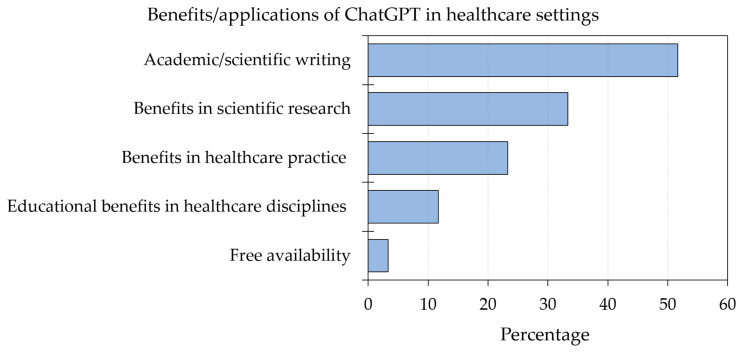
- Benefits were most frequently cited for academic/scientific writing (31 records, 51.7%), followed by scientific research (20, 33.3%), healthcare practice (14, 23.3%), healthcare education (7, 11.7%), and being a free package (2, 3.3%).
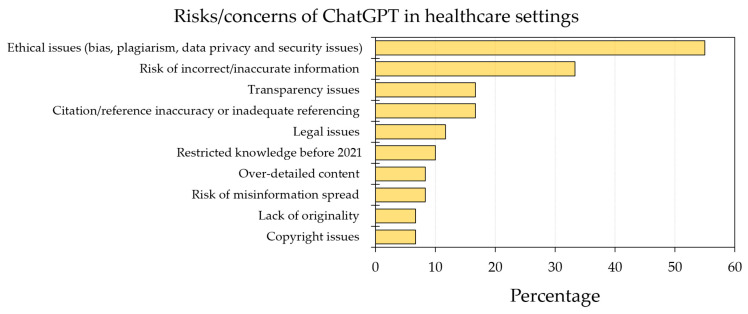
- Ethical concerns were the most common risk category (33 records, 55.0%), including risk of bias (18, 30.0%) and plagiarism (14, 23.3%); incorrect/inaccurate information was cited in 20 records (33.3%), citation/reference inaccuracy in 10 (16.7%), and transparency issues in 10 (16.7%).
- Other reported concerns included legal issues (7, 11.7%), restricted knowledge before 2021 (6, 10.0%), misinformation spread (5, 8.3%), over-detailed content (5, 8.3%), copyright issues (4, 6.7%), and lack of originality (4, 6.7%).
- The review states that ChatGPT does not qualify as an author under current ICMJE/COPE guidelines unless those guidelines are revised, and calls for stakeholder-developed ethics guidance for responsible LLM use in healthcare and academia.
Methods
- Systematic review conducted according to PRISMA guidelines, searching PubMed/MEDLINE and Google Scholar for English records on ChatGPT in healthcare practice/research, healthcare education, or academic writing; searches concluded on 16 February 2023.
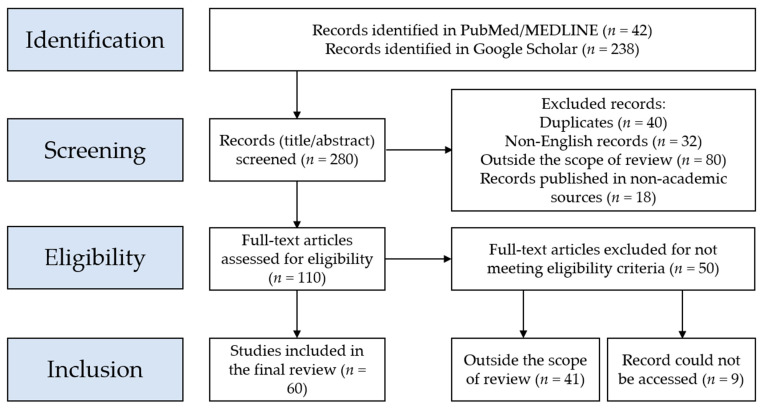
- PubMed/MEDLINE yielded 42 records and Google Scholar yielded 238 records, totaling 280 records; after duplicate removal (n = 40), non-English exclusion (n = 32), out-of-scope exclusion (n = 80), non-academic source exclusion (n = 18), full-text screening exclusions (n = 41), and inaccessible full texts (n = 9), 60 records were included.
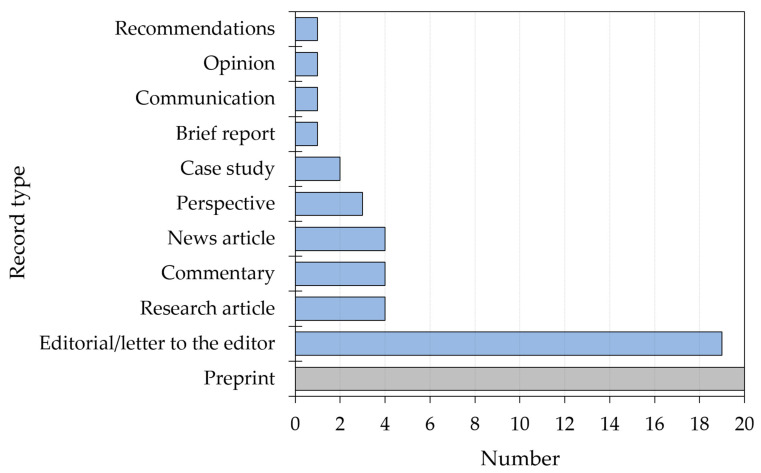
- Each included record was searched for record type, listed benefits/applications, listed risks/concerns, and main conclusions/recommendations regarding ChatGPT in healthcare education, practice, or scientific research/academic writing.
Limitations
- The paper states that included records had variable quality, non-English exclusion may have caused selection bias, inaccessible records may have led to missing relevant data, preprints were not peer reviewed, the literature is growing rapidly with the search ending 16 February 2023, and screening/interpretation was performed by a single author.
- Evident from the text: the review reports descriptive counts of mentions across heterogeneous record types rather than a formal meta-analysis or independent risk-of-bias assessment.
Model-written summary. Check it against the paper before relying on it.
Integrity signals
Registry
Cites
Statistics
Figures
Verification
Claims the paper makes
53 Valid · 1 Not valid · 6 Not checked · 37 Own results and interpretations
Every source the paper cites for this claim was checked and supports it.
In the paper
“This comes in light of the ability of ChatGPT to generate incorrect content that appears plausible from a scientific point of view [81].”
§ ChatGPT Utility in Healthcare Education, Research, and Practice: Systematic Review on the Promising Perspectives and Valid Concerns > 4. Discussion > 4.2. Limitations of ChatGPT Use in Scientific Research
What the sources say
- Supportedcites [81] Cascella M. Montomoli J. Bellini V. Bignami E. Evaluating the Feasibility of ChatGPT in Healthcare: An Analysis of Multiple Clinical and Research Scenarios J. Med. Syst. 2023 47 33 10.1007/s10916-023-01925-4 36869927 PMC9985086 source
In “Reasoning About Public Health Topics,” the paper says ChatGPT can produce believable answers that may be incorrect or nonsensical. In “Possible Misuse of GPT in Medicine and Research,” it describes a scientific abstract that appeared reliable and simulated statistical outputs that could seem plausible to readers. Together, these passages support the claim. (LLM, conf=0.94)
plain- Asserted: passes — The authors put it forward as true.
- Checkable: passes — It can be checked against evidence.
- Load-bearing: passes — The paper’s conclusions depend on it.
- Based: passes — The paper gives a reason why it holds.
- Supported
The sources with a verdict support this claim; the rest weren’t checked yet, have no full text we could read, or their verdicts aren’t rated yet.
In the paper
“This comes in light of the fact that authorship entails legal obligations that are not met by ChatGPT [43,48].”
§ ChatGPT Utility in Healthcare Education, Research, and Practice: Systematic Review on the Promising Perspectives and Valid Concerns > 4. Discussion > 4.2. Limitations of ChatGPT Use in Scientific Research
What the sources say
- Supportedcites [43] Zielinski C. Winker M. Aggarwal R. Ferris L. Heinemann M. Lapeña J. Pai S. Ing E. Citrome L. Chatbots, ChatGPT, and Scholarly Manuscripts WAME Recommendations on ChatGPT and Chatbots in Relation to Scholarly Publications Maced J. Med. Sci. 2023 11 83 86 10.3889/oamjms.2023.11502 37615142 source
The Introduction (p. 2) says chatbots are not legal entities, cannot be held legally liable, and that listing ChatGPT as an author may not be legally defensible. The WAME Recommendations (p. 2) add that chatbots cannot take responsibility for a paper or have the legal standing to sign a statement. (LLM, conf=0.93)
- Not checked — no full text of the sourcecites [48] Liebrenz M. Schleifer R. Buadze A. Bhugra D. Smith A. Generating scholarly content with ChatGPT: Ethical challenges for medical publishing Lancet Digit. Health 2023 5 e105 e106 10.1016/S2589-7500(23)00019-5 36754725 source
plain- Asserted: passes — The authors put it forward as true.
- Checkable: passes — It can be checked against evidence.
- Load-bearing: passes — The paper’s conclusions depend on it.
- Based: passes — The paper gives a reason why it holds.
- Supported
The cited sources support only part of this claim — read each source’s verdict below.
In the paper
“On one hand, ChatGPT, among other LLMs, can be beneficial in conversational and writing tasks, assisting to increase the efficiency and accuracy of the required output [11].”
§ ChatGPT Utility in Healthcare Education, Research, and Practice: Systematic Review on the Promising Perspectives and Valid Concerns > 1. Introduction
What the sources say
- Partly supportedcites [11] Deng J. Lin Y. The Benefits and Challenges of ChatGPT: An Overview Front. Comput. Intell. Syst. 2023 2 81 83 10.54097/fcis.v2i2.4465 sourceExperimental — accuracy not yet measured
Sections 4.1 (Increased Efficiency) and 4.2 (Improved Accuracy) say ChatGPT can make conversations more efficient and generate more accurate responses. The paper does not establish those benefits for writing tasks or for other LLMs, so the broader claim is only partially supported. (LLM, conf=0.88)
plainstates a cause- Asserted: passes — The authors put it forward as true.
- Checkable: passes — It can be checked against evidence.
- Load-bearing: unclear — It is unclear whether the paper’s conclusions depend on it.
- Based: passes — The paper gives a reason why it holds.
- Partly supported
The cited sources support only part of this claim — read each source’s verdict below.
In the paper
“Importantly, the concept of ChatGPT hallucination could be risky if the generated content is not thoroughly evaluated by researchers and health providers with proper expertise [37,56,73,77,79].”
§ ChatGPT Utility in Healthcare Education, Research, and Practice: Systematic Review on the Promising Perspectives and Valid Concerns > 4. Discussion > 4.2. Limitations of ChatGPT Use in Scientific Research
What the sources say
- Not checked — no full text of the sourcecites [37] Shen Y. Heacock L. Elias J. Hentel K.D. Reig B. Shih G. Moy L. ChatGPT and Other Large Language Models Are Double-edged Swords Radiology 2023 230163 10.1148/radiol.230163 36700838 source
- Partly supportedcites [56] Huh S. Are ChatGPT’s knowledge and interpretation ability comparable to those of medical students in Korea for taking a parasitology examination?: A descriptive study J. Educ. Eval. Health Prof. 2023 20 1 10.3352/jeehp.2023.20.1 36627845 PMC9905868 sourceExperimental — accuracy not yet measured
The Background says medical students must evaluate the accuracy of AI-generated medical information before creating reliable information for patients and the public. The Interpretation also reports that some ChatGPT explanations contained incorrect information. These passages support the need for scrutiny, but the paper does not specifically discuss hallucination or evaluation by researchers and health providers. (LLM, conf=0.84)
- Partly supportedcites [73] Duong D. Solomon B.D. Analysis of large-language model versus human performance for genetics questions medRxiv 2023 Preprint 10.1101/2023.01.27.23285115 PMC10999420 37246194 sourceExperimental — accuracy not yet measured
The Discussion (p. 6) says ChatGPT can give plausible explanations for incorrect answers and that its correctness requires additional verification, which is concerning in medical or other high-stakes settings. This supports the risk and need for evaluation, but the paper does not specify that researchers and health providers with proper expertise must perform it. (LLM, conf=0.83)
- Supportedcites [77] Jeblick K. Schachtner B. Dexl J. Mittermeier A. Stüber A.T. Topalis J. Weber T. Wesp P. Sabel B. Ricke J. ChatGPT Makes Medicine Easy to Swallow: An Exploratory Case Study on Simplified Radiology Reports arXiv 2022 10.48550/arxiv.2212.14882 2212.14882 PMC11126432 37794249 source
The Results (Free-text analysis) identify a ChatGPT hallucination that radiologists judged potentially harmful to a patient. The Key Points state that minimizing harm requires supervision by medical experts, supporting the claim’s warning about unevaluated medical content. (LLM, conf=0.90)
- Partly supportedcites [79] Lin Z. Why and how to embrace AI such as ChatGPT in your academic life PsyArXiv 2023 Preprint 10.31234/osf.io/sdx3j PMC10445029 37621662 sourceExperimental — accuracy not yet measured
The “Limitations of generative AI” section says ChatGPT may fabricate facts and false citations (“hallucination”) and urges users to critically evaluate and verify its responses, particularly when reliability is critical. It does not specifically say that researchers and health providers with proper expertise must evaluate the content; that part is more specific than the source. (LLM, conf=0.84)
hedgedstates a possible cause- Asserted: passes — The authors put it forward as true.
- Checkable: passes — It can be checked against evidence.
- Load-bearing: passes — The paper’s conclusions depend on it.
- Based: passes — The paper gives a reason why it holds.
- Rests on an assumption not shown here.
The sources with a verdict support this claim; the rest weren’t checked yet, have no full text we could read, or their verdicts aren’t rated yet.
In the paper
“This is particularly relevant for researchers who are non-native English speakers [23,25,63].”
§ ChatGPT Utility in Healthcare Education, Research, and Practice: Systematic Review on the Promising Perspectives and Valid Concerns > 4. Discussion > 4.1. Benefits of ChatGPT in Scientific Research
What the sources say
- Supportedcites [23] Chen T.J. ChatGPT and Other Artificial Intelligence Applications Speed up Scientific Writing Available online: https://journals.lww.com/jcma/Citation/9900/ChatGPT_and_other_artificial_intelligence.174.aspx (accessed on 16 February 2023) PMC12755446 36791246 source
In the main text (page not provided), Chen says many scientists who are not native English speakers struggle to write in English and describes AI translation and writing tools as ways to overcome that barrier. This supports the claim that language assistance in scientific writing is particularly relevant to those researchers. (LLM, conf=0.91)
- Not checked — no full text of the sourcecites [25] Kitamura F.C. ChatGPT Is Shaping the Future of Medical Writing but Still Requires Human Judgment Radiology 2023 230171 10.1148/radiol.230171 36728749 source
- Supportedcites [63] Gao C.A. Howard F.M. Markov N.S. Dyer E.C. Ramesh S. Luo Y. Pearson A.T. Comparing scientific abstracts generated by ChatGPT to original abstracts using an artificial intelligence output detector, plagiarism detector, and blinded human reviewers bioRxiv 2022 10.1101/2022.12.23.521610 source
The Discussion/Abstract section of our copy states directly that the technology 'could be used by scientists publishing in a language that is not their native language, to improve equity,' alongside the point that generated text 'may help alleviate the burden of writing' and that LLMs are 'a powerful tool to create readable scientific abstracts.' That covers the attributed content — AI-assisted language improvement being especially pertinent for non-native-English researchers — with the source's own hedge ('could be used') slightly weaker than the citing sentence's flat 'is particularly relevant.' No passage in our copy contradicts it. (LLM, conf=0.82)
plainstates an association- Asserted: passes — The authors put it forward as true.
- Checkable: passes — It can be checked against evidence.
- Load-bearing: unclear — It is unclear whether the paper’s conclusions depend on it.
- Based: passes — The paper gives a reason why it holds.
- Supported
42 more claims · 23 with their cited sources checked
Create a free account to see all 97 claims and to verify the 16 references still open.
- Probably not a substantial claim. 31
- It may state two separate claims as one. 27
Claims other papers make about this one
Each is checked against this paper’s own text: does it say what the citing paper says it does?
The source backs part of the claim, not all of it — or backs it for a different population, condition or comparison.
In the citing paper
“The reliance on ChatGPT may result in hindering the development of the skills needed to interpret and respond to social cues, which should be considered in health care education [9,91].”
From Assessing Health Students' Attitudes and Usage of ChatGPT in Jordan: Validation Study (2023) · cites this paper as [9]
Experimental — accuracy not yet measuredThe source backs part of the claim, not all of it — or backs it for a different population, condition or comparison.
In the citing paper
“A recent surge in the use of ChatGPT, in particular for mental health, is emergent for providing crucial personalized advice without clinical explanation, which can hurt user's safety, and thus trust (Sallam, 2023).”
From A review of the explainability and safety of conversational agents for mental health to identify avenues for improvement (2023) · cites this paper as Sallam, 2023
Experimental — accuracy not yet measuredThe source backs part of the claim, not all of it — or backs it for a different population, condition or comparison.
In the citing paper
“ChatGPT plays a crucial role in pandemic management by aiding in the swift and accurate dissemination of critical information.”
From A Systematic Review and Meta-Analysis of Artificial Intelligence Tools in Medicine and Healthcare: Applications, Considerations, Limitations, Motivation and Challenges (2024) · cites this paper as [6]
Experimental — accuracy not yet measuredThe source backs part of the claim, not all of it — or backs it for a different population, condition or comparison.
In the citing paper
“Its natural language processing capabilities enable it to generate coherent responses, making it a valuable tool for healthcare organisations.”
From A Systematic Review and Meta-Analysis of Artificial Intelligence Tools in Medicine and Healthcare: Applications, Considerations, Limitations, Motivation and Challenges (2024) · cites this paper as [6]
Experimental — accuracy not yet measuredThe source backs part of the claim, not all of it — or backs it for a different population, condition or comparison.
In the citing paper
“Specific advantages include its ability to provide rapid updates, preventive measures, and medical guidelines to the public.”
From A Systematic Review and Meta-Analysis of Artificial Intelligence Tools in Medicine and Healthcare: Applications, Considerations, Limitations, Motivation and Challenges (2024) · cites this paper as [6]
Experimental — accuracy not yet measured
31 more claims about this paper
Create a free account to see every claim other papers make about this one.
Citations
Cites
Preferred Reporting Items for Systematic Reviews and Meta-Analyses: the PRISMA statement
Moher, D., Liberati, A., Tetzlaff, J., Altman, D. G., & for the PRISMA Group (2009) · BMJ · doi:10.1136/bmj.b2535 · Cited by 83,823
Preferred Reporting Items for Systematic Reviews and Meta-Analyses: The PRISMA Statement
Moher, D., Liberati, A., Tetzlaff, J., Altman, D. G., & The PRISMA Group (2009) · PLoS Medicine · doi:10.1371/journal.pmed.1000097 · Cited by 64,042 · cited 1×
“The current systematic review was conducted according to the Preferred Reporting Items for Systematic Reviews and Meta-Analyses (PRIMSA) guidelines [21].”
Language Models are Few-Shot Learners
Brown, T. B., Mann, B., Ryder, N., Subbiah, M., Kaplan, J., Dhariwal, P., Neelakantan, A., Shyam, P., Sastry, G., Askell, A., et al. (2020) · arXiv · doi:10.48550/arxiv.2005.14165 · Cited by 23,372 · cited 3×
“The GPT architecture utilizes a neural network to process natural language, thus generating responses based on the context of input text [7].”
BackgroundWang, G., Ma, R., Qiao, G., Wada, K., Aizawa, Y., & Satoh, T. (2015) · Integrative Medicine International · doi:10.1159/000368408 · Cited by 18,657
Kaugeranna, R., Kaugeranna, E., & Aion, (. S. 4. 6. (2023) · DROPS (Schloss Dagstuhl – Leibniz Center for Informatics) · doi:10.4230/lipics.giscience.2023.43 · Cited by 13,690
Machine learning: Trends, perspectives, and prospects
Jordan, M. I., & Mitchell, T. M. (2015) · Science · doi:10.1126/science.aaa8415 · Cited by 9,955
Kung, T. H., Cheatham, M., Medenilla, A., Sillos, C., De Leon, L., Elepaño, C., Madriaga, M., Aggabao, R., Diaz-Candido, G., Maningo, J., et al. (2023) · PLOS Digital Health · doi:10.1371/journal.pdig.0000198 · Cited by 4,115 · cited 2×
“[59] An article showing the ChatGPT raised accuracy which enabled passing the USMLE Accuracy with high concordance and insight; it can facilitate patient communication; improved personalized medicine ChatGPT has a promising potential in medical education; future studies are recommended to consider non-biased approach…”
BackgroundKung, T. H., Cheatham, M., ChatGPT, Medenilla, A., Sillos, C., De Leon, L., Elepaño, C., Madriaga, M., Aggabao, R., Diaz-Candido, G., et al. (2022) · doi:10.1101/2022.12.19.22283643 · Cited by 4,115
Rajpurkar, P., Chen, E., Banerjee, O., & Topol, E. J. (2022) · Nature Medicine · doi:10.1038/s41591-021-01614-0 · Cited by 3,212 · cited 1×
“The promising utility of AI in health care has been outlined previously with possible benefits in personalized medicine, drug discovery, and the analysis of large datasets aside from the potential applications to improve diagnosis and clinical decisions [17,18].”
BackgroundChatting and cheating: Ensuring academic integrity in the era of ChatGPT
Cotton, D. R. E., Cotton, P. A., & Shipway, J. R. (2024) · Innovations in Education and Teaching International · doi:10.1080/14703297.2023.2190148 · Cited by 3,087 · cited 1×
“[62] An EdArXiv 2 preprint on the academic integrity in ChatGPT era Risk of plagiarism; academic dishonesty Careful thinking of educational assessment tools”
Background
Cited by
Items 2,501–2,600 of 3,095
Bernstein, E., Ramsamooj, A., Miller, K. L., & Lum, Z. C. (2024) · doi:10.2196/preprints.68603
El‐Dahiyat, F., Refae, G. A. E., Jairoun, A. A., Al‐Hemyari, S. S., Shahwan, M. J., Alshehri, F. S., & Alorfi, N. M. (2024) · Global Digital Health Knowledge Exchange & Empowerment Conference (gDigiHealth.KEE) · doi:10.1109/gdigihealth.kee62309.2024.10761615
“A review of several studies on Health Economic Evaluation (HEE) by Voets et al. [8] confirmed that AI saves cost [24, 28-30].”
Jairoun, A. A., Al‐Hemyari, S. S., Shahwan, M. J., Zyoud, S. H., Abu-Gharbieh, E., Alshehri, F. S., & Alorfi, N. M. (2024) · Global Digital Health Knowledge Exchange & Empowerment Conference (gDigiHealth.KEE) · doi:10.1109/gdigihealth.kee62309.2024.10761912
“25 Secondly, it can be observed that training of ChatGPT without proper contextual information leads to wrong conclusions being made with respect to identifying patterns in the spread of diseases.”
Ay, O. F., Dolu, F., Kupeli, A. H., et al. (2024) · doi:10.2196/preprints.68980
Chung, S., & Koos, J. A. (2024) · Journal of Consumer Health on the Internet · doi:10.1080/15398285.2024.2418777
“Language models such as ChatGPT can be helpful for brainstorming, creating event outlines, and rewording sentences based on predictions of the datasets they are trained on (Sallam 2023).”
Exploring GPT ‐4.0's efficiency in handling paediatric appendicitis questions
Zeng, D., Chen, G., Wang, G., Zhou, H., & Guo, C. (2024) · Surgical Practice · doi:10.1111/1744-1633.12733
Grange, C., Gualino, V., Klotz, L., Coutureau, T., Fournié, P., & Soler, V. J. (2024) · Journal Français d Ophtalmologie · doi:10.1016/j.jfo.2024.104368 · Cited by 3
Valdez, G. F. D., Alhowaymel, F. M., Abaoud, A., Pandaan, R. P. M., & Saeed, A. (2024) · doi:10.2196/preprints.69775 · Cited by 1
Advanced Topics in Systematic Reviews and Meta-Analysis
Purssell, E., & McCrae, N. (2024) · Springer eBooks · doi:10.1007/978-3-031-71159-6_12
Application Scenario Analysis of Large Language Models Education Based on Activity Theory
Zhang, Z., Hu, M., Zhang, B., & Jin, X. (2024) · IEEE/ACIS International Conference on Computer and Information Science (ICIS) · doi:10.1109/icis61260.2024.10778383
Facilitating Feature Selection and Extraction in Clinical Trials with Large Language Models
Guo, J., Sun, W., Wen, S., Wu, D., & Zhou, Y. (2024) · Lecture notes in computer science · doi:10.1007/978-981-96-0840-9_16
Overcoming Medical Overuse with Ai Assistance: An Experimental InvestigationPreprint
Wang, Z., Wei, L., & Xue, L. (2024) · SSRN Electronic Journal · doi:10.2139/ssrn.5037526
Mudenda, S., Mufwambi, W., Mwale, R. S., Kathewera, B. S., & Lubanga, A. F. (2024) · Research Square · doi:10.21203/rs.3.rs-5648361/v1
THE IMPACT OF ARTIFICIAL INTELLIGENCE ON LANGUAGE LEARNING
PONOMARENKO, N., Timchenko, G., & Neustroieva, G. (2024) · ТHE SOURCES OF PEDAGOGICAL SKILLS · doi:10.33989/2075-146x.2024.34.318106 · Cited by 8
CHATGPT DALAM PRAKTIK KEPERAWATAN: REVIEW LITERATUR LENGKAP
Simbolon, I., & Limbong, A. (2024) · JURNAL KEPERAWATAN TROPIS PAPUA · doi:10.47539/jktp.v7i2.382 · Cited by 3
Is ChatGPT a Useful Tool for Ophthalmology Practice?
Yavrum, F., & Kocabaş, D. Ö. (2024) · Acta Medica Alanya · doi:10.30565/medalanya.1531790
Salyers, A. J., Bull, S., Silvasstar, J., Howell, K., Wright, T., & Banaei‐Kashani, F. (2024) · doi:10.2196/preprints.69144
The Promise of ChatGPT in Medical Education: a systematic review (Preprint)Preprint
Tang, P., Xiao, R., Cao, Y., Ying, Z., Xiao, W., Wen, T., & Li, Y. (2025) · doi:10.2196/preprints.70796
Srivastava, H., Leel, M., Singh, P., Rashmi, R., Kumar, A., & Kumar, S. (2025) · SSRN Electronic Journal · doi:10.2139/ssrn.5091386
A New Approach: Generative Artificial Intelligence in Physiatry Resident Education
Muluk, S. Y., Altuntaş, V., & Şahin, Z. D. (2025) · Medical Records · doi:10.37990/medr.1581104
Leveraging LLMs for Fair Data Labeling and Validation in Crowdsourcing Environments [Vision Paper]
Serouis, I. M., & Sèdes, F. (2024) · IEEE International Conference on Big Data (BigData) · doi:10.1109/bigdata62323.2024.10825193 · Cited by 1
Fontana, A., Sinatti, G., Cicchinelli, S., Santini, S. J., Caputo, V., Letteri, I., Vittorini, P., & Balsano, C. (2024) · International Conference on Information Technology Based Higher Education and Training (ITHET) · doi:10.1109/ithet61869.2024.10837651
“In the specific context of medical education, LLMs were found to have promising but mixed results [11], [12], [13].”
Interpretable AI for medical image analysis: methods, evaluation, and clinical considerations
Gonçalves, T., Hedström, A., de Mortanges, A. P., Li, X., Müller, H., Cardoso, J. S., & Reyes, M. (2025) · Elsevier eBooks · doi:10.1016/b978-0-44-323761-4.00027-4 · Cited by 2
(2000) · Time to knit · doi:10.1016/j.abdp.2023.11.015
Exploring Digital Learning Pathways: Student Use of Online Information Resources and the Role of AI
Ruiz, L. M. S., Moraño, J.-A., Herrero-Debón, A., Moll-López, S., Vega-Fleitas, E., Sánchez, A. C., Nuñez-Pérez, A., López, S. S., & Caro, C. D. (2024) · World Engineering Education Forum - Global Engineering Deans Council (WEEF-GEDC) · doi:10.1109/weef-gedc63419.2024.10854954 · Cited by 1
Research on Ethical Issues of Classroom Dialogue in the Era of Large Language Model
Ling, J., Zhu, J., Shi, J., & Meo, P. D. (2025) · Communications in computer and information science · doi:10.1007/978-981-96-0055-7_19
AI in clinical research: Transforming methodologies and discoveries
Khan, S. M. (2025) · Elsevier eBooks · doi:10.1016/b978-0-443-33584-6.00009-8
Emerging trends in AI in healthcare: Innovations and opportunities
Khan, S. M. (2025) · Elsevier eBooks · doi:10.1016/b978-0-443-33584-6.00018-9
Saleh, Z. T., Elshatarat, R. A., Alharbi, M., Rababa, M., Alhumaidi, B. N., Alqarawi, N., Alasqah, I., Alharbi, T. A. F., niarat, T. F. A., Almagharbeh, W. T., et al. (2025) · doi:10.2196/preprints.70991
Innovazioni in classe: come l'IA sta trasformando l'insegnamento e l'apprendimento
Berardinetti, V., Santangelo, F. A., & Traetta, L. (2025) · EDUCATION SCIENCES AND SOCIETY · doi:10.3280/ess2-2024oa18474
Agentic AI: Service Operations with Augmentation and Automation AIPreprint
Yang, G. (2025) · SSRN Electronic Journal · doi:10.2139/ssrn.5109470 · Cited by 3
الجوانب القانونية للذكاء الاصطناعي التوليدي (تقنية شات جي بي تي Chat GPT كأنموذج)
محمد, أ. د. ع. ط. ب. (2025) · Journal of Law and Emerging Technologies · doi:10.54873/jolets.v4i1.205
Miller, M., DiCiurcio, W. T., Meade, M., Buchan, L. J., Gleimer, J., Woods, B. I., & Kepler, C. K. (2025) · Clinical Spine Surgery A Spine Publication · doi:10.1097/bsd.0000000000001768
Bibliometric analysis of ChatGPT research in medical education (Preprint)Preprint
Xu, Q., Zhang, Y., & Xie, X. (2025) · doi:10.2196/preprints.72356
The Future of Virology Diagnostics Using Wearable Devices Driven by Artificial Intelligence
Sallam, M., Mijwil, M. M., Abotaleb, M. S. A., & Sailawi, A. S. A. A. (2025) · Advances in computational intelligence and robotics book series · doi:10.4018/979-8-3693-7352-1.ch020 · Cited by 1
Self-citationEnhancing Course Performance Reports: Leveraging ChatGPT for Comprehensive Data Analysis
Bilquise, G., Siddartha, S., AlHassan, M., Sunil, B., & Ibaisi, L. A. (2025) · Communications in computer and information science · doi:10.1007/978-3-031-82931-4_25
Peng, L., Wu, Y., Sun, J., Xing, Y., Li, M., & Li, M. (2025) · AI Computer Science and Robotics Technology · doi:10.5772/acrt.20240045
Comparative utility analysis of Chordoma search information between ChatGPT vs. Google Web
Thiru, S. S., & Mesfin, A. (2025) · World Neurosurgery X · doi:10.1016/j.wnsx.2025.100437
On the Maintenance Oversight of the Healthcare Sector Based on Artificial Intelligence
Bhattacharya, S., Sinha, D., Bandyopadhyay, C., Majumder, S., & Biswas, A. (2025) · Studies in systems, decision and control · doi:10.1007/978-981-96-0085-4_21
The future of medical education
Byrne, M. H. V., Brown, M. E. L., Church, H., & Finn, G. M. (2025) · Oxford University Press eBooks · doi:10.1093/med/9780192848710.005.0001
Winberg, D., Xuan, D., Tang, T., & Shi, L. (2025) · Pharmacoeconomics and Policy · doi:10.1016/j.pharp.2025.03.003 · Cited by 4
Alharbi, L. Y., Alrashoud, R. R., Alotaibi, B. S., Dera, A. M. A., Alajlan, R. S., AlHuthail, R. R., & Alessa, D. (2025) · doi:10.2196/preprints.73642
Yaseen, K. N., & Dweikat, K. (2025) · Advances in computational intelligence and robotics book series · doi:10.4018/979-8-3693-9811-1.ch012
Students' Perception of Using ChatGPT as an AI-Integrated Tool in the Malay Language
Yaqin, L. N., Yusof, B., Yusof, N., & Damit, A. R. (2025) · Jurnal Penelitian dan Pengkajian Ilmu Pendidikan e-Saintika · doi:10.36312/e-saintika.v9i1.2584 · Cited by 4
“Sallam (2023) emphasized the importance of ethical use, copyright, and transparency in academic writing and healthcare education.”
Chen, T., Li, Q., Zhao, D., Zhang, W., Li, Y., Yang, J.-D., Pu, C., & Fu, Q. (2024) · JMIR Formative Research · doi:10.2196/64597
Application of generative artificial intelligence chatbots in the field of anesthesia
Barroso, A., & Casans, R. (2025) · Revista Española de Anestesiología y Reanimación (English Edition) · doi:10.1016/j.redare.2025.501667 · Cited by 2
ПСИХОЛОГИЧЕСКОЕ ВОЗДЕЙСТВИЕ ДИАЛОГОВЫХ ИИ-ТЕХНОЛОГИЙ НА УЧЕБНУЮ МОТИВАЦИЮ СТУДЕНТОВ.Preprint
Лукинова, П. (2025) · doi:10.24108/preprints-3113469
Análisis del rendimiento de ChatGPT-4 en las preguntas de oftalmología del examen MIR
Lucas, C. E. M., Caballero, C. M., Serrano, J. E., Machan, A., Martínez, G. C., Valero, D. R., & Lluch, J. C. (2025) · Archivos de la Sociedad Española de Oftalmología · doi:10.1016/j.oftal.2025.02.005
Chan, Y.-C., Huang, P., Chen, Z.-L., Wang, C.-N., Lin, W., Chiu, J.-P., Chiu, Y.-C., Lin, Y.-H., Huang, E. T. C., See, S. C. W., et al. (2025) · World Congress on Medical Physics and Biomedical Engineering, September 7 - 12, 2009, Munich, Germany · doi:10.1007/978-3-031-86323-3_38 · Cited by 1
Tian, M., Li, S., Du, W., et al. (2025) · Research Square · doi:10.21203/rs.3.rs-6220351/v1
Wang, J., Turney, A., Murray, L., Craven, A. M., Bragger-Wilkinson, P., dos Santos, B., Martasek, J., & Desaphy, J. (2025) · Nucleic Acids Research · doi:10.1093/nar/gkaf254
“To enable natural language queries, the integration of Retrieval-Augmented Generation methods (e.g. Go-rilla [ 89 ]) that queries the API could help mitigate inaccuracies commonly seen in global Large Language Models like ChatGPT [ 90 ].”
AI-Driven Innovation in Remote Music Education Models
Yaqi, M. O. (2025) · The Journal of Artificial Intelligence and Business · doi:10.71460/znzb4788
Boost Hospitality Management through Social Media: Applications in Higher Education
Karalazarou, M. M., Christou, E., Chatzigeorgiou, C., & Simeli, I. (2025) · The Proceedings of the International Conference on Tourism Management and Hospitality. · doi:10.33422/ictmh.v2i1.923
“Similarly, healthcare and medicine have leveraged SM for educational purposes, particularly in medical training, knowledge dissemination, and patient engagement (Manhas & Kaur, 2018; Singla, Kumar & Badyal, 2020; Scott, 2020; de Lade et al., 2021; Sallam, 2023).”
Yang, B. X., Zhou, F., Bai, N., Zhou, S., Luo, C., Wáng, Q., Wong, A. K. C., & Lin, F. (2025) · Frontiers of digital education. · doi:10.1007/s44366-025-0046-y · Cited by 2
Zhang, X., Xiong, Y., & Miller, A. (2025) · Digital studies in language and literature · doi:10.1515/dsll-2024-0011 · Cited by 1
Retina Meets Artificial Intelligence
Shah, P. P., Labkovich, M., Zhu, D., Goldburg, S. R., & Lieberman, R. M. (2025) · Advances in Ophthalmology and Optometry · doi:10.1016/j.yaoo.2025.02.004
Exploring the Landscape of ChatGPT Research: A Bibliometric Study Using Scopus Database
Dubey, P., Prasad, S., Tripathi, L., Sharma, R., Mashirkar, S., & Ghode, S. D. (2024) · International Conference on Emerging Trends in Engineering and Medical Sciences (ICETEMS) · doi:10.1109/icetems64039.2024.10965048 · Cited by 1
Role of artificial intelligence in answering common patient queries: Osteoarthritis: A viewpoint
Singhal, R. (2025) · Journal of the International Society of Physical and Rehabilitation Medicine · doi:10.1097/ph9.0000000000000074
Evaluation of the Effectiveness of MED·SMART-AI in Undergraduate Clinical Anesthesia Teaching
Wu, Z., Hou, J., Yin, L., Liu, W., Geng, J., & Wen, L. (2024) · Occupation and professional education. · doi:10.62381/o242c02
Trends and Challenges of Educational Application of Generative Artificial Intelligence
Zhou, P., Xu, H., Tan, Y., Liu, M., Zhou, X., Xiong, W., & Li, J. (2024) · doi:10.1145/3722237.3722379
“AI Simulation Technologies applications provide new dimensions and enhancements to the realism and interactive nature of clinical teaching in medical education, creating a safe and effective learning environment for students [11, 12].”
Sarı, M., & Tüfenkçi, P. (2025) · European Annals of Dental Sciences · doi:10.52037/eads.2025.0002
Oraño, J. F. V., Nogra, J. A. E., & Mangmang, G. B. (2025) · International Conference on Educational and Information Technology · doi:10.1109/iceit64364.2025.10975835
“"ChatGPT" emerged as a dominant tool, widely used for tutoring, language learning, and literacy development, reinforcing its role as a leading LLM in education, research, and practice [22].”
Pipia, E., & Gurgenishvili, T. (2025) · European Scientific Journal ESJ · doi:10.19044/esj.2025.v21n10p190 · Cited by 4
Balraj, B. M. (2025) · SocArXiv (OSF Preprints) · doi:10.31235/osf.io/nhc9u_v1
George, A., Dongara, D., Raghuraman, D., Li, J. S., Bhatia, M., Nagpal, N., & Jahanikia, S. (2025) · Preprints.org · doi:10.20944/preprints202505.0044.v1
OPINION MINING USING BERT REGARDING PERCEPTIONS OF CHATGPT USAGE FROM UNDERGRADUATE STUDENTSPreprint
Supriyadi, E., Mahmud, M. R., Maylawati, D. S., Ramdhani, M. A., & Pahmi, S. (2025) · SSRN Electronic Journal · doi:10.2139/ssrn.5213187
Mishra, S., & Lal, N. (2025) · Emerald Group Publishing Limited eBooks · doi:10.1108/978-1-83549-852-120251002
REVOLUTION OR DISTRACTION? ANALYZING GENERATIVE AI’S IMPACT ON UNDERGRADUATE STUDENT PERFORMANCE
Abdulrauf, A., Abodunrin, O. B., & Omoloba, O. (2025) · FUDMA Journal of Sciences · doi:10.33003/fjs-2025-0904-3574
“When students use ChatGPT excessively, their learning encounters become compromised because they lose chances to perform critical thinking and solve problems (Sallam, 2023; Vargas-Murillo et al., 2023).”
Richter, S., Buszello, C. H., Prem, M. G., et al. (2025) · doi:10.2196/preprints.77307
DESEMPENHO DO CHATGPT 3.5 PARA RESPONDER QUESTÕES DE MÚLTIPLA-ESCOLHA EM ORTOPEDIA E TRAUMATOLOGIA
Malvezzi, V. R. T., Fantuzzi, R., Mourão, S. D. M., Canhete, J., & da Silva, F. C. (2025) · Arquivos Catarinenses de Medicina · doi:10.63845/txjhe680
Kohan, N., Ahmady, S., Yaseen, S., Hoshmandjah, M., Keshavarzi, M. H., & Rezaei, P. (2024) · JMIR Medical Education · doi:10.2196/56325
Sadiq, M. A., Kefas, H. I., Ukaegbu, F. C., & Isiaku, L. (2025) · SSRN Electronic Journal · doi:10.2139/ssrn.5251679
ChatGPT's Performance on Iran's Medical Licensing Exams
Keshtkar, A., Hayat, A. A., Atighi, F., Ayare, N., Keshtkar, M., Yazdanpanahi, P., Sadeghi, E., Deilami, N., Reihani, H., Karimi, A., et al. (2025) · Medical Journal of the Islamic Republic of Iran · doi:10.47176/mjiri.39.24 · Cited by 10
Comparing AI and Human Mentoring in Supporting Dental Student Well-being: A Mixed-Methods StudyPreprint
Rath, A. (2025) · bioRxiv (Cold Spring Harbor Laboratory) · doi:10.1101/2025.05.20.655059
“12,13 However, its utility as a mentor remains underexplored in authentic educational settings, particularly in contexts where structured faculty mentoring is lacking.”
Exploring Prospects of Artificial Intelligence-Based ChatGPT for Higher Education Context
Makgato-Khunou, P., & Tlale, L. D. N. (2025) · Journal of Education and Learning Technology · doi:10.38159/jelt.2025652
Luther, T., Sommer, M., & Kimmerle, J. (2025) · Lecture notes in computer science · doi:10.1007/978-3-031-93536-7_7
Subjective Question Bank Generation Using Large Language Models with Custom Knowledge Base
Sayed, A., Kanojia, M. G., & Nabajja, S. (2025) · Lecture notes in networks and systems · doi:10.1007/978-3-031-78946-5_24 · Cited by 1
Gu, X., & Yuan, T. (2025) · Proceedings of the 2025 International Conference on Big Data and Informatization Education · doi:10.1145/3729605.3729646
“The application of AI in text mining involves leveraging large language models (LLMs), like ChatGPT, to extract insights from the textual content and generate coherent and contextually relevant content based on prompt input [ 13 ] .”
Xie, Z., Balatsoukas, P., Maguire, M. C., & Morris, A. P. (2025) · Lecture notes in computer science · doi:10.1007/978-3-031-93508-4_24
Bourguet, M.-L. (2025) · IEEE Global Engineering Education Conference (EDUCON) · doi:10.1109/educon62633.2025.11016372
Advanced RAG-LLM Prototype AI on PubMed for Cardiac Health
Simons, L. P. A., Murukannaiah, P. K., Han, B. S., & Neerincx, M. A. (2025) · Bled eConference · doi:10.18690/um.fov.4.2025.17
Determination of Criteria Priorities and Interactions in ChatGPT by a Fuzzy Model
Çakır, F. S., & Keleş, N. (2025) · Foundations of Computing and Decision Sciences · doi:10.2478/fcds-2025-0008
Geng, W., Jiang, Y. F., Zhai, W., Zhao, X., Zhao, Q. Y., Li, J., Cao, J., & Shi, L. (2025) · Medical Teacher · doi:10.1080/0142159x.2025.2515971
“For example, Sallam mentioned many benefits of ChatGPT in medical education, including the generation of realistic and variable clinical vignettes, customized clinical cases with immediate feedback based on the student ’ s needs, and enhanced communication skills, among other advantages [17].”
Yılmaz, İ. E., & Doğan, L. (2025) · European Journal of Ophthalmology · doi:10.1177/11206721251350862
ChatGPT in complex adaptive healthcare systems: embrace with caution
Olsson, A.-K., Arakelian, E., Lindberg, M., Göras, C., & Erikson, M. S. (2025) · International Journal of Electronic Healthcare · doi:10.1504/ijeh.2025.10071817
Exploring the EEG representation of English listening comprehension under hypoxic conditions
Song, Y., & Yu, Y. (2025) · Frontiers in Neuroscience · doi:10.3389/fnins.2025.1540539 · Cited by 1
ICT for development: Unravelling key research themes using text mining
Bhadauria, V. S., Mahapatra, R., & Nerur, S. (2025) · Journal of Global Information Technology Management · doi:10.1080/1097198x.2025.2520711
“The variety of tasks these models can perform and the ease with which they can be used has enormous implications for health care, education, policy-making, software development, e-commerce, climate control, and entertainment, among other things (Kalla & Smith, 2023; Paul et al., 2023; Sallam, 2023).”
A Dynamic Query Framework for Research Accessibility Using OpenAI and Langchain
Talip, L. G. L., & Recario, R. N. C. (2025) · Lecture notes in networks and systems · doi:10.1007/978-3-031-92605-1_11 · Cited by 1
Chat-GPT in Education: Learning Outcomes and Facilitating Knowledge Acquisition
Malik, N., Kousar, A., & Arshad, K. (2025) · Inverge Journal of Social Sciences · doi:10.63544/ijss.v4i2.131 · Cited by 9
Gupta, A., & Goyal, R. (2025) · Lecture notes in networks and systems · doi:10.1007/978-981-96-1918-4_21
AI-Facilitated Formative Assessment: Reimagining Feedback in the English Language Classroom
Kishore, S. (2025) · Advances in computational intelligence and robotics book series · doi:10.4018/979-8-3373-1952-0.ch004 · Cited by 1
Alluri, A. A., Gupta, A., Adsure, M. R., et al. (2025) · Journal of Public Health · doi:10.1007/s10389-025-02540-y
Filho, H. N. F., Furtado, J. F. C. U., Eulálio, E. C., Ribeiro, P. V. C., Paiva, L. M. A., Correia, M. M. G. B., & da Silva, G. B. (2025) · Brazilian Journal of Nephrology · doi:10.1590/2175-8239-jbn-2024-0254pt · Cited by 1
AI-Powered Knowledge Management in Curriculum Design and Content Delivery
Dahake, P. S., Santos, V., & Panchariya, R. (2025) · Advances in computational intelligence and robotics book series · doi:10.4018/979-8-3373-5092-9.ch015
Using generative artificial intelligence in dermatological research
Kaliyadan, F., Singh, R., Achar, A., Nagendran, P., Sakkaravarthi, V., & Anjaneyan, G. (2025) · Indian Journal of Dermatology Venereology and Leprology · doi:10.25259/ijdvl_420_2025
Building Healthcare Educational Scenarios by Tagging Clinical Narratives Using Large Language Models
Buendía, F., Gayoso-Cabada, J., & Sierra, J. L. (2025) · Lecture notes in educational technology · doi:10.1007/978-981-96-5658-5_25
Oudintsov, E. N., Bahlawane, S., Hayta, A., Seker, C., Akgün, D., Back, D. A., & Hazra, R.-O. D. (2025) · Arthroscopy Sports Medicine and Rehabilitation · doi:10.1016/j.asmr.2025.101216
“14 However, this tendency does not affect all areas in the same ways and is rather new in shoulder surgery.”
Luo, J., Ma, J., Wang, T., Qiu, Y., Yang, Y., Qiu, H., Chen, G., & Wang, W. (2025) · medRxiv · doi:10.1101/2025.07.15.25331552
From Referral to Reporting: The Potential of Large Language Models in the Radiological Workflow
Fink, A., Rau, S., Kästingschäfer, K. F., Weiß, J., Bamberg, F., & Russe, M. F. (2025) · RöFo - Fortschritte auf dem Gebiet der Röntgenstrahlen und der bildgebenden Verfahren · doi:10.1055/a-2641-3059
Shalavina, A. A., Shevtsova, Y. V., & Владимировна, П. С. (2025) · CARDIOVASCULAR THERAPY AND PREVENTION · doi:10.15829/1728-8800-2025-4471
Metadata
- Authors
- Sallam, M.
- Affiliations
- University of Jordan (JO)
- Corresponding author
- Sallam, Malik
- ORCID
- Sallam, Malik
- Venue
- Healthcare
- Publisher
- MDPI AG
- Published
- 2023-03-19
- Volume
- 11
- Issue
- 6
- Pages
- 887
- ISSN
- 2227-9032 (ISSN-L)
- PMC
- PMC10048148
- OpenAlex
- W4327946446
- Semantic Scholar
- dfdf7ff01aa6f691831e663fd29bc71890be39e2
- Cited by
- 3,126
- References
- 114
- Citations by year
- 2026: 561 · 2025: 839 · 2024: 1052 · 2023: 669
- FWCI
- 36.67
- Type
- journal article
- Language
- en
- Open access
- gold
- doi.org
- Licence
- Locations
- Healthcare (publishedVersion, cc-by)
- medRxiv (acceptedVersion, cc-by-nc-nd)
- Preprints.org (acceptedVersion, cc-by)
- PubMed Central (publishedVersion, cc-by)
- PubMed (publishedVersion)
- Topics
- Health Sciences › Medicine › Health Informatics › Artificial Intelligence in Healthcare and Education
- Physical Sciences › Computer Science › Artificial Intelligence › Artificial Intelligence Applications
- Social Sciences › Education › Artificial Intelligence in Education
- Keywords
- ChatGPT, large language models, artificial intelligence in healthcare, healthcare education, health care research, clinical practice, scientific writing, research equity, drug discovery, personalized medicine, health literacy, plagiarism, hallucinations, authorship criteria, AI ethics, infodemic
About these checks
Registry, retraction, Cites and statistics results are computed, not judged, with one exception: a printed reference that no index lists is read once by a model before it counts as a citation error. Claims are extracted by a model and kept only when their quote appears verbatim in the text; each cited source is then checked, with a model’s help, for whether it says what the claim relies on. Those verdicts can be wrong — read the claim’s quote and the cited source before relying on one.
The claim verdicts this report counts are experimental: their accuracy is not yet measured.
A language model drew the claims from the paper on 2026-10-10, under version 3 of the claim definition (model deepseek-v4.1-flash, prompt extract-v3).
A second model labelled each claim on 2026-10-10 (model jev-1.13-20260917, definition revision gold-guideline-v0.2).
Cited sources are checked with a language model’s help (gpt-6-sol and qwen3.8-omni-flash).
Statistics and arithmetic are recomputed, not judged.
Confidence bands are shown only for fields calibrated on our annotated test set. None is calibrated yet, so no band is shown.
What counts as a claim ›How we measure confidence ›How we check this ›
Are you an author, or do you see a problem with this page? Request a review
Data sources
Bibliographic data: Semantic Scholar, OpenAlex, Crossref.
Contains information from the Semantic Scholar Academic Graph Datasets, made available under the ODC Attribution License (ODC-BY 1.0).
Semantic Scholar’s data is described in: Kinney, R., et al. (2023). The Semantic Scholar Open Data Platform. arXiv:2301.10140.
