

ChatGPT Utility in Healthcare Education, Research, and Practice: Systematic Review on the Promising Perspectives and Valid Concerns
Open accessPublished version of a preprint
The DOI matches its Crossref record; 116 of the 117 references it cites were found in a registry or an index; 110 of the 179 sources its claims cite were checked for support.
Abstract
ChatGPT is an artificial intelligence-powered chatbot. This systematic review synthesised the evidence regarding its application in healthcare education, research, and practice. ChatGPT shows remarkable utilities in summarizing research, translating materials, serving as a virtual tutor, drafting case scenarios, and automating administrative workflows. However, concerns regarding incorrect outputs (hallucinations), lack of analytical depth, risk of plagiarism, and algorithmic bias remain significant across the literature.
Overview
CoChat Summary
TL;DR
This systematic review of 60 records found that ChatGPT was cited as beneficial in 51/60 (85.0%) records for healthcare education, research, and practice, while concerns were raised in 58/60 (96.7%) records. The author concludes that ChatGPT has promising applications but requires cautious, guideline-driven use, and does not currently qualify for scientific authorship under ICMJE/COPE guidelines.
Key findings
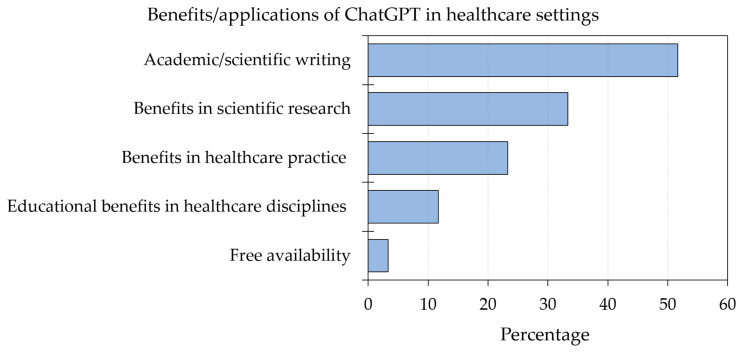
- Benefits were most frequently cited for academic/scientific writing (31 records, 51.7%), followed by scientific research (20, 33.3%), healthcare practice (14, 23.3%), healthcare education (7, 11.7%), and being a free package (2, 3.3%).
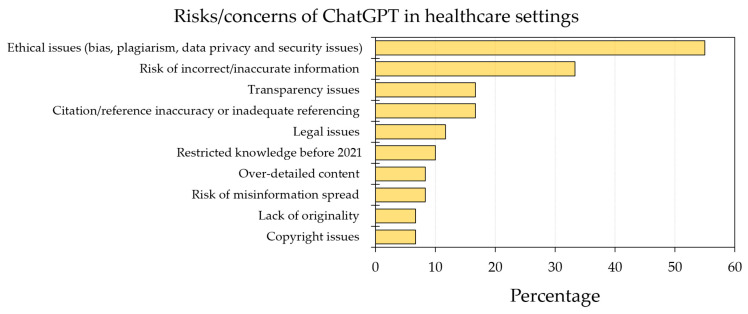
- Ethical concerns were the most common risk category (33 records, 55.0%), including risk of bias (18, 30.0%) and plagiarism (14, 23.3%); incorrect/inaccurate information was cited in 20 records (33.3%), citation/reference inaccuracy in 10 (16.7%), and transparency issues in 10 (16.7%).
- Other reported concerns included legal issues (7, 11.7%), restricted knowledge before 2021 (6, 10.0%), misinformation spread (5, 8.3%), over-detailed content (5, 8.3%), copyright issues (4, 6.7%), and lack of originality (4, 6.7%).
- The review states that ChatGPT does not qualify as an author under current ICMJE/COPE guidelines unless those guidelines are revised, and calls for stakeholder-developed ethics guidance for responsible LLM use in healthcare and academia.
Methods
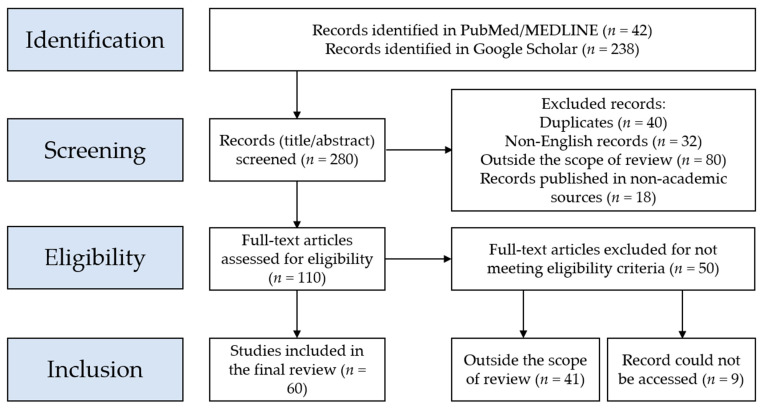
- Systematic review conducted according to PRISMA guidelines, searching PubMed/MEDLINE and Google Scholar for English records on ChatGPT in healthcare practice/research, healthcare education, or academic writing; searches concluded on 16 February 2023.
- PubMed/MEDLINE yielded 42 records and Google Scholar yielded 238 records, totaling 280 records; after duplicate removal (n = 40), non-English exclusion (n = 32), out-of-scope exclusion (n = 80), non-academic source exclusion (n = 18), full-text screening exclusions (n = 41), and inaccessible full texts (n = 9), 60 records were included.
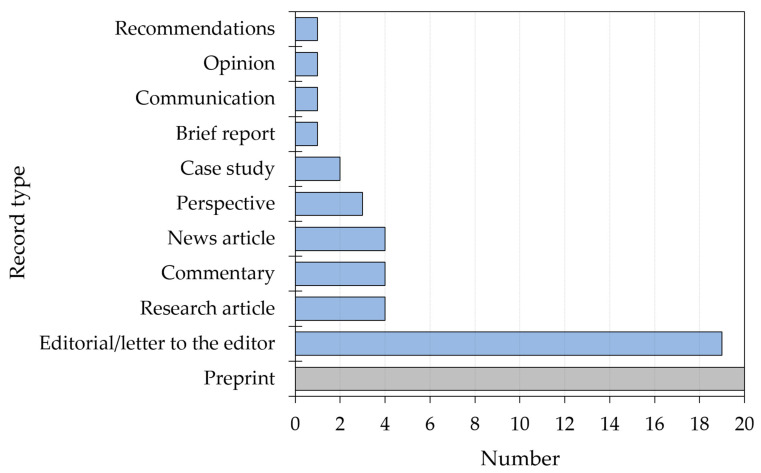
- Each included record was searched for record type, listed benefits/applications, listed risks/concerns, and main conclusions/recommendations regarding ChatGPT in healthcare education, practice, or scientific research/academic writing.
Limitations
- The paper states that included records had variable quality, non-English exclusion may have caused selection bias, inaccessible records may have led to missing relevant data, preprints were not peer reviewed, the literature is growing rapidly with the search ending 16 February 2023, and screening/interpretation was performed by a single author.
- Evident from the text: the review reports descriptive counts of mentions across heterogeneous record types rather than a formal meta-analysis or independent risk-of-bias assessment.
Model-written summary. Check it against the paper before relying on it.
Integrity signals
Registry
Cites
Statistics
Figures
Verification
Claims the paper makes
53 Valid · 1 Not valid · 6 Not checked · 37 Own results and interpretations
Every source the paper cites for this claim was checked and supports it.
In the paper
“This comes in light of the ability of ChatGPT to generate incorrect content that appears plausible from a scientific point of view [81].”
§ ChatGPT Utility in Healthcare Education, Research, and Practice: Systematic Review on the Promising Perspectives and Valid Concerns > 4. Discussion > 4.2. Limitations of ChatGPT Use in Scientific Research
What the sources say
- Supportedcites [81] Cascella M. Montomoli J. Bellini V. Bignami E. Evaluating the Feasibility of ChatGPT in Healthcare: An Analysis of Multiple Clinical and Research Scenarios J. Med. Syst. 2023 47 33 10.1007/s10916-023-01925-4 36869927 PMC9985086 source
In “Reasoning About Public Health Topics,” the paper says ChatGPT can produce believable answers that may be incorrect or nonsensical. In “Possible Misuse of GPT in Medicine and Research,” it describes a scientific abstract that appeared reliable and simulated statistical outputs that could seem plausible to readers. Together, these passages support the claim. (LLM, conf=0.94)
plain- Asserted: passes — The authors put it forward as true.
- Checkable: passes — It can be checked against evidence.
- Load-bearing: passes — The paper’s conclusions depend on it.
- Based: passes — The paper gives a reason why it holds.
- Supported
The sources with a verdict support this claim; the rest weren’t checked yet, have no full text we could read, or their verdicts aren’t rated yet.
In the paper
“This comes in light of the fact that authorship entails legal obligations that are not met by ChatGPT [43,48].”
§ ChatGPT Utility in Healthcare Education, Research, and Practice: Systematic Review on the Promising Perspectives and Valid Concerns > 4. Discussion > 4.2. Limitations of ChatGPT Use in Scientific Research
What the sources say
- Supportedcites [43] Zielinski C. Winker M. Aggarwal R. Ferris L. Heinemann M. Lapeña J. Pai S. Ing E. Citrome L. Chatbots, ChatGPT, and Scholarly Manuscripts WAME Recommendations on ChatGPT and Chatbots in Relation to Scholarly Publications Maced J. Med. Sci. 2023 11 83 86 10.3889/oamjms.2023.11502 37615142 source
The Introduction (p. 2) says chatbots are not legal entities, cannot be held legally liable, and that listing ChatGPT as an author may not be legally defensible. The WAME Recommendations (p. 2) add that chatbots cannot take responsibility for a paper or have the legal standing to sign a statement. (LLM, conf=0.93)
- Not checked — no full text of the sourcecites [48] Liebrenz M. Schleifer R. Buadze A. Bhugra D. Smith A. Generating scholarly content with ChatGPT: Ethical challenges for medical publishing Lancet Digit. Health 2023 5 e105 e106 10.1016/S2589-7500(23)00019-5 36754725 source
plain- Asserted: passes — The authors put it forward as true.
- Checkable: passes — It can be checked against evidence.
- Load-bearing: passes — The paper’s conclusions depend on it.
- Based: passes — The paper gives a reason why it holds.
- Supported
The cited sources support only part of this claim — read each source’s verdict below.
In the paper
“On one hand, ChatGPT, among other LLMs, can be beneficial in conversational and writing tasks, assisting to increase the efficiency and accuracy of the required output [11].”
§ ChatGPT Utility in Healthcare Education, Research, and Practice: Systematic Review on the Promising Perspectives and Valid Concerns > 1. Introduction
What the sources say
- Partly supportedcites [11] Deng J. Lin Y. The Benefits and Challenges of ChatGPT: An Overview Front. Comput. Intell. Syst. 2023 2 81 83 10.54097/fcis.v2i2.4465 sourceExperimental — accuracy not yet measured
Sections 4.1 (Increased Efficiency) and 4.2 (Improved Accuracy) say ChatGPT can make conversations more efficient and generate more accurate responses. The paper does not establish those benefits for writing tasks or for other LLMs, so the broader claim is only partially supported. (LLM, conf=0.88)
plainstates a cause- Asserted: passes — The authors put it forward as true.
- Checkable: passes — It can be checked against evidence.
- Load-bearing: unclear — It is unclear whether the paper’s conclusions depend on it.
- Based: passes — The paper gives a reason why it holds.
- Partly supported
The cited sources support only part of this claim — read each source’s verdict below.
In the paper
“Importantly, the concept of ChatGPT hallucination could be risky if the generated content is not thoroughly evaluated by researchers and health providers with proper expertise [37,56,73,77,79].”
§ ChatGPT Utility in Healthcare Education, Research, and Practice: Systematic Review on the Promising Perspectives and Valid Concerns > 4. Discussion > 4.2. Limitations of ChatGPT Use in Scientific Research
What the sources say
- Not checked — no full text of the sourcecites [37] Shen Y. Heacock L. Elias J. Hentel K.D. Reig B. Shih G. Moy L. ChatGPT and Other Large Language Models Are Double-edged Swords Radiology 2023 230163 10.1148/radiol.230163 36700838 source
- Partly supportedcites [56] Huh S. Are ChatGPT’s knowledge and interpretation ability comparable to those of medical students in Korea for taking a parasitology examination?: A descriptive study J. Educ. Eval. Health Prof. 2023 20 1 10.3352/jeehp.2023.20.1 36627845 PMC9905868 sourceExperimental — accuracy not yet measured
The Background says medical students must evaluate the accuracy of AI-generated medical information before creating reliable information for patients and the public. The Interpretation also reports that some ChatGPT explanations contained incorrect information. These passages support the need for scrutiny, but the paper does not specifically discuss hallucination or evaluation by researchers and health providers. (LLM, conf=0.84)
- Partly supportedcites [73] Duong D. Solomon B.D. Analysis of large-language model versus human performance for genetics questions medRxiv 2023 Preprint 10.1101/2023.01.27.23285115 PMC10999420 37246194 sourceExperimental — accuracy not yet measured
The Discussion (p. 6) says ChatGPT can give plausible explanations for incorrect answers and that its correctness requires additional verification, which is concerning in medical or other high-stakes settings. This supports the risk and need for evaluation, but the paper does not specify that researchers and health providers with proper expertise must perform it. (LLM, conf=0.83)
- Supportedcites [77] Jeblick K. Schachtner B. Dexl J. Mittermeier A. Stüber A.T. Topalis J. Weber T. Wesp P. Sabel B. Ricke J. ChatGPT Makes Medicine Easy to Swallow: An Exploratory Case Study on Simplified Radiology Reports arXiv 2022 10.48550/arxiv.2212.14882 2212.14882 PMC11126432 37794249 source
The Results (Free-text analysis) identify a ChatGPT hallucination that radiologists judged potentially harmful to a patient. The Key Points state that minimizing harm requires supervision by medical experts, supporting the claim’s warning about unevaluated medical content. (LLM, conf=0.90)
- Partly supportedcites [79] Lin Z. Why and how to embrace AI such as ChatGPT in your academic life PsyArXiv 2023 Preprint 10.31234/osf.io/sdx3j PMC10445029 37621662 sourceExperimental — accuracy not yet measured
The “Limitations of generative AI” section says ChatGPT may fabricate facts and false citations (“hallucination”) and urges users to critically evaluate and verify its responses, particularly when reliability is critical. It does not specifically say that researchers and health providers with proper expertise must evaluate the content; that part is more specific than the source. (LLM, conf=0.84)
hedgedstates a possible cause- Asserted: passes — The authors put it forward as true.
- Checkable: passes — It can be checked against evidence.
- Load-bearing: passes — The paper’s conclusions depend on it.
- Based: passes — The paper gives a reason why it holds.
- Rests on an assumption not shown here.
The sources with a verdict support this claim; the rest weren’t checked yet, have no full text we could read, or their verdicts aren’t rated yet.
In the paper
“This is particularly relevant for researchers who are non-native English speakers [23,25,63].”
§ ChatGPT Utility in Healthcare Education, Research, and Practice: Systematic Review on the Promising Perspectives and Valid Concerns > 4. Discussion > 4.1. Benefits of ChatGPT in Scientific Research
What the sources say
- Supportedcites [23] Chen T.J. ChatGPT and Other Artificial Intelligence Applications Speed up Scientific Writing Available online: https://journals.lww.com/jcma/Citation/9900/ChatGPT_and_other_artificial_intelligence.174.aspx (accessed on 16 February 2023) PMC12755446 36791246 source
In the main text (page not provided), Chen says many scientists who are not native English speakers struggle to write in English and describes AI translation and writing tools as ways to overcome that barrier. This supports the claim that language assistance in scientific writing is particularly relevant to those researchers. (LLM, conf=0.91)
- Not checked — no full text of the sourcecites [25] Kitamura F.C. ChatGPT Is Shaping the Future of Medical Writing but Still Requires Human Judgment Radiology 2023 230171 10.1148/radiol.230171 36728749 source
- Supportedcites [63] Gao C.A. Howard F.M. Markov N.S. Dyer E.C. Ramesh S. Luo Y. Pearson A.T. Comparing scientific abstracts generated by ChatGPT to original abstracts using an artificial intelligence output detector, plagiarism detector, and blinded human reviewers bioRxiv 2022 10.1101/2022.12.23.521610 source
The Discussion/Abstract section of our copy states directly that the technology 'could be used by scientists publishing in a language that is not their native language, to improve equity,' alongside the point that generated text 'may help alleviate the burden of writing' and that LLMs are 'a powerful tool to create readable scientific abstracts.' That covers the attributed content — AI-assisted language improvement being especially pertinent for non-native-English researchers — with the source's own hedge ('could be used') slightly weaker than the citing sentence's flat 'is particularly relevant.' No passage in our copy contradicts it. (LLM, conf=0.82)
plainstates an association- Asserted: passes — The authors put it forward as true.
- Checkable: passes — It can be checked against evidence.
- Load-bearing: unclear — It is unclear whether the paper’s conclusions depend on it.
- Based: passes — The paper gives a reason why it holds.
- Supported
42 more claims · 23 with their cited sources checked
Create a free account to see all 97 claims and to verify the 16 references still open.
- Probably not a substantial claim. 31
- It may state two separate claims as one. 27
Claims other papers make about this one
Each is checked against this paper’s own text: does it say what the citing paper says it does?
The source backs part of the claim, not all of it — or backs it for a different population, condition or comparison.
In the citing paper
“The reliance on ChatGPT may result in hindering the development of the skills needed to interpret and respond to social cues, which should be considered in health care education [9,91].”
From Assessing Health Students' Attitudes and Usage of ChatGPT in Jordan: Validation Study (2023) · cites this paper as [9]
Experimental — accuracy not yet measuredThe source backs part of the claim, not all of it — or backs it for a different population, condition or comparison.
In the citing paper
“A recent surge in the use of ChatGPT, in particular for mental health, is emergent for providing crucial personalized advice without clinical explanation, which can hurt user's safety, and thus trust (Sallam, 2023).”
From A review of the explainability and safety of conversational agents for mental health to identify avenues for improvement (2023) · cites this paper as Sallam, 2023
Experimental — accuracy not yet measuredThe source backs part of the claim, not all of it — or backs it for a different population, condition or comparison.
In the citing paper
“ChatGPT plays a crucial role in pandemic management by aiding in the swift and accurate dissemination of critical information.”
From A Systematic Review and Meta-Analysis of Artificial Intelligence Tools in Medicine and Healthcare: Applications, Considerations, Limitations, Motivation and Challenges (2024) · cites this paper as [6]
Experimental — accuracy not yet measuredThe source backs part of the claim, not all of it — or backs it for a different population, condition or comparison.
In the citing paper
“Its natural language processing capabilities enable it to generate coherent responses, making it a valuable tool for healthcare organisations.”
From A Systematic Review and Meta-Analysis of Artificial Intelligence Tools in Medicine and Healthcare: Applications, Considerations, Limitations, Motivation and Challenges (2024) · cites this paper as [6]
Experimental — accuracy not yet measuredThe source backs part of the claim, not all of it — or backs it for a different population, condition or comparison.
In the citing paper
“Specific advantages include its ability to provide rapid updates, preventive measures, and medical guidelines to the public.”
From A Systematic Review and Meta-Analysis of Artificial Intelligence Tools in Medicine and Healthcare: Applications, Considerations, Limitations, Motivation and Challenges (2024) · cites this paper as [6]
Experimental — accuracy not yet measured
31 more claims about this paper
Create a free account to see every claim other papers make about this one.
Citations
Cites
Preferred Reporting Items for Systematic Reviews and Meta-Analyses: the PRISMA statement
Moher, D., Liberati, A., Tetzlaff, J., Altman, D. G., & for the PRISMA Group (2009) · BMJ · doi:10.1136/bmj.b2535 · Cited by 83,823
Preferred Reporting Items for Systematic Reviews and Meta-Analyses: The PRISMA Statement
Moher, D., Liberati, A., Tetzlaff, J., Altman, D. G., & The PRISMA Group (2009) · PLoS Medicine · doi:10.1371/journal.pmed.1000097 · Cited by 64,042 · cited 1×
“The current systematic review was conducted according to the Preferred Reporting Items for Systematic Reviews and Meta-Analyses (PRIMSA) guidelines [21].”
Language Models are Few-Shot Learners
Brown, T. B., Mann, B., Ryder, N., Subbiah, M., Kaplan, J., Dhariwal, P., Neelakantan, A., Shyam, P., Sastry, G., Askell, A., et al. (2020) · arXiv · doi:10.48550/arxiv.2005.14165 · Cited by 23,372 · cited 3×
“The GPT architecture utilizes a neural network to process natural language, thus generating responses based on the context of input text [7].”
BackgroundWang, G., Ma, R., Qiao, G., Wada, K., Aizawa, Y., & Satoh, T. (2015) · Integrative Medicine International · doi:10.1159/000368408 · Cited by 18,657
Kaugeranna, R., Kaugeranna, E., & Aion, (. S. 4. 6. (2023) · DROPS (Schloss Dagstuhl – Leibniz Center for Informatics) · doi:10.4230/lipics.giscience.2023.43 · Cited by 13,690
Machine learning: Trends, perspectives, and prospects
Jordan, M. I., & Mitchell, T. M. (2015) · Science · doi:10.1126/science.aaa8415 · Cited by 9,955
Kung, T. H., Cheatham, M., Medenilla, A., Sillos, C., De Leon, L., Elepaño, C., Madriaga, M., Aggabao, R., Diaz-Candido, G., Maningo, J., et al. (2023) · PLOS Digital Health · doi:10.1371/journal.pdig.0000198 · Cited by 4,115 · cited 2×
“[59] An article showing the ChatGPT raised accuracy which enabled passing the USMLE Accuracy with high concordance and insight; it can facilitate patient communication; improved personalized medicine ChatGPT has a promising potential in medical education; future studies are recommended to consider non-biased approach…”
BackgroundKung, T. H., Cheatham, M., ChatGPT, Medenilla, A., Sillos, C., De Leon, L., Elepaño, C., Madriaga, M., Aggabao, R., Diaz-Candido, G., et al. (2022) · doi:10.1101/2022.12.19.22283643 · Cited by 4,115
Rajpurkar, P., Chen, E., Banerjee, O., & Topol, E. J. (2022) · Nature Medicine · doi:10.1038/s41591-021-01614-0 · Cited by 3,212 · cited 1×
“The promising utility of AI in health care has been outlined previously with possible benefits in personalized medicine, drug discovery, and the analysis of large datasets aside from the potential applications to improve diagnosis and clinical decisions [17,18].”
BackgroundChatting and cheating: Ensuring academic integrity in the era of ChatGPT
Cotton, D. R. E., Cotton, P. A., & Shipway, J. R. (2024) · Innovations in Education and Teaching International · doi:10.1080/14703297.2023.2190148 · Cited by 3,087 · cited 1×
“[62] An EdArXiv 2 preprint on the academic integrity in ChatGPT era Risk of plagiarism; academic dishonesty Careful thinking of educational assessment tools”
Background
Cited by
Items 3,001–3,095 of 3,095
Ahmed, M. J., Mansoor, M. M., Mahmood, H. A., & Ebrahim, R. S. (2026) · Cureus · doi:10.7759/cureus.115354
“This reflects a wider pattern of rapid, often unsupervised adoption of these tools across healthcare education, alongside documented concerns about accuracy and reliability [17].”
Carroll, M., Kentis, S., Kareff, H., Schechter, C. B., & Jariwala, S. P. (2026) · Applied Clinical Informatics · doi:10.1055/a-2946-7393 · Cited by 1
Kumar, R., Verma, R. K., Verma, R. K., Kaur, V., & Ameer, S. (2026) · Advances in computational intelligence and robotics book series · doi:10.4018/979-8-2600-1735-7.ch007
Baba, M. A., Bouzit, M., Mahlaq, S., Mohamed, M., & Ahmed, K. (2026) · Teaching and learning in nursing · doi:10.1016/j.teln.2026.08.005
Aleksandrenko, H. D., & Komenda, M. (2026) · Digital Health · doi:10.1177/20552076261481326
“6 Recent data suggest that around 21% of adults already use LLM-based chatbots for health-related queries, particularly younger users, 4,7 and nearly one-third of consumers report using GenAI to access healthcare information.”
Integration of artificial intelligence and multi-omics for precision medicine
Marei, H. E. S., Cenciarelli, C., & Vagni, D. (2026) · Functional & Integrative Genomics · doi:10.1007/s10142-026-02024-6
LipoAssist: a structured GPT-4–based clinical workflow for preliminary lipedema assessment
Yukselmis, O., Demirulus, S., Gökmen, İ. G., & Coşkun, H. (2026) · Frontiers in Medicine · doi:10.3389/fmed.2026.1909592 · Cited by 1
“These findings are consistent with previous studies reporting that LLMs perform well in history taking and organization of clinical information but are more limited in complex diagnostic and therapeutic decision-making (8– 11, 23, 24).”
Can LLMs reliably perform epidemiological extraction in elite football?
López-Álvarez, J., & Madueño, A. F. (2026) · Proceedings of the Institution of Mechanical Engineers Part H Journal of Engineering in Medicine · doi:10.1177/09544119261484234
Organoid intelligence: a promising paradigm for autism spectrum disorder research
Zuo, X., Zhang, X., Liu, Y., Li, X., Xia, M., Ma, Y., & Fan, X. (2026) · Molecular Psychiatry · doi:10.1038/s41380-026-03850-7
Silva, A., & Lino, M. (2026) · Nursing Inquiry · doi:10.1111/nin.70162
“…align with prior work showing that AI ethics priorities themselves diverge systematically across jurisdictions (Floridi and Cowls 2022) and that AI systems should be understood relationally, as embedded in the contexts that produced them rather than as neutral instruments (Sallam 2023).”
Practical guide to structuring the Background section in clinical and epidemiological studies
Leboeuf‐Yde, C., & Gudex, C. M. (2026) · Chiropractic & Manual Therapies · doi:10.1186/s12998-026-00643-1
“Several researchers have begun to discuss the advantages and disadvantages of using AI in academic writing, as in a recent systematic review [11].”
Patel, V., Jadav, V., & Patel, K. (2026) · International Journal of Science and Healthcare Research · doi:10.52403/ijshr.20260324
Zhou, S., & Wang, Y. (2026) · Applied Artificial Intelligence Research · doi:10.65455/2c4jes43
“This is important because few-shot prompting is often treated as a low-cost, universally beneficial intervention [8] .”
InfluentialZuo, X., Zuo, H., Zhang, M., & Zheng, W. (2026) · Frontiers in Public Health · doi:10.3389/fpubh.2026.1926980
From diagnosis to design: can generative artificial intelligence co-pilot aesthetic medicine?
Al-Khikani, F. H. O. (2026) · Journal of the Egyptian Womenʼs Dermatologic Society · doi:10.4103/jewd.jewd_122_25
Ata, B. N., Çınar, E., & Eyigör, S. (2026) · Ege Tıp Dergisi · doi:10.19161/etd.1891901
Gu, L., Gong, Z., Qian, X., Miao, L., & Gu, Z. (2026) · Frontiers in Public Health · doi:10.3389/fpubh.2026.1942799
Piterman, D., Dery, H., Bar, K., Meinlschmidt, G., Geller, A., Hadar‐Shoval, D., Elyoseph, Z., & Refoua, E. (2026) · Scientific Reports · doi:10.1038/s41598-026-58013-z · Cited by 2
Aransado, J. E., Viñas, J. V., Ayade, J. M., et al. (2026) · Multidisciplinary Reviews · doi:10.31893/multirev.2027109
Yaslı, G., & Uğurlu, L. (2026) · Healthcare · doi:10.3390/healthcare14172854
“This pattern highlights ongoing trust issues associated with AI-supported systems and underscores the need for further improvement in information accuracy and validation mechanisms [27].”
Srivastav, A. K., & Tanimoto, J. (2026) · Physica A Statistical Mechanics and its Applications · doi:10.1016/j.physa.2026.131999
Zhang, J., Tian, L., Lin, Q., Song, L., Meng, D., Shen, C., & Yu, D. (2026) · Nurse Education Today · doi:10.1016/j.nedt.2026.107397 · Cited by 1
Viewing Neurotech Through the Lens of the Ethical Principles: Considerations and Calls to Action
Hilsabeck, R. C., & Benge, J. F. (2026) · Oxford University Press eBooks · doi:10.1093/9780197814116.003.0004
Pena, F. M., Soares, J. D. S., & Pena, M. R. P. (2026) · Aracê. · doi:10.56238/arev8n9-027
Ahn, S. H. (2026) · Journal of Medical Internet Research · doi:10.2196/93519
AI-assisted learning in exercise physiology: a quasi-experimental study using PhysioExercise GPT
Junior, R. R. D. S., de Souza, L. N., Cavalcante, G. A., Fernandes, F. L., Silva, J. A., Hipólito, R. G., Gúzen, F. P., Pinto, E. F., Knackfuss, M. I., & Fernandes, T. A. A. D. M. (2026) · Frontiers in Physiology · doi:10.3389/fphys.2026.1894046
“Sallam (2023) highlights that AI-based systems have the potential to promote personalized learning and the development of critical thinking, while Sridharan and Sequeira (2024) emphasize their ability to adapt instruction to individual student needs.”
ScholarGuard-AI An Intelligent Framework for Research Paper Generation and Authenticity Detection
Karthik, S., Kumar, T., Kumari, S., & Kumar, P. (2026) · ITM Web of Conferences · doi:10.1051/itmconf/20269002013
“Instead of evaluating writers after the fact, new studies look at real-time feedback systems that can help them improve [15].”
Saffar, R. A. M. A. (2026) · Clinical Anatomy · doi:10.1002/ca.70210
Can GPT-4o reliably detect positioning errors in panoramic radiographs? A diagnostic accuracy study
DENİZ, H. A., & TÜRK, E. (2026) · Imaging Science in Dentistry · doi:10.5624/isd.20260122
Dong, Z., Huang, G., Geng, L., Zhang, R., 袁声贤, Xia, Y., & Liu, H. (2026) · Research Square · doi:10.21203/rs.3.rs-10750173/v1
Altunpak, B. (2026) · Surgical Innovation · doi:10.1177/15533506261488588
Zehnder, P., Hartz, F., Zyskowski, M., Ketzer, C., Resch, T., DGOU, A. D. D. D., Biberthaler, P., & Pförringer, D. (2026) · Scientific Reports · doi:10.1038/s41598-026-70337-4
“The constant improvement of the programs suggests that it may soon be possible to conduct better literature search or even prepare entire manuscripts 31 .”
Moganadas, S. R., Marín-González, F., Nun, S. H., & Gan, C. L. (2026) · Frontiers in Education · doi:10.3389/feduc.2026.1856839 · Cited by 1
Povis-Flores, E. S., Ramírez-Benavides, M. A., Meza-Ponce, F. A., Ramirez-Acuña, A. G., Benavides, M. L. R., & Saravia‐Rojas, M. Á. (2026) · Journal of Dentistry and Multidisciplinary Sciences · doi:10.3934/jdms.2026007
Ahmed, N. (2026) · BDJ · doi:10.1038/s41415-026-9954-6
“Applications of AI extend to dental and medical education and research, 17,18 and healthcare curricula must rapidly respond to the growing use of AI in clinical practice.”
Artificial Intelligence in Nursing Practice Education: A Systematic Review and Meta‐Analysis
Wang, J., Kuang, M., Chen, J., Yan, Y., & Li, Z. (2026) · Journal of Nursing Management · doi:10.1155/jonm/6626865 · Cited by 3
“Because of their natural language interaction, intelligent content creation, and real-time feedback capabilities, large language models like ChatGPT and DeepSeek have shown distinct advantages in the feld of education [6].”
Oruç, M. Ş., Günenç, A. C., Akdemır, O., et al. (2026) · Journal of Craniofacial Surgery · doi:10.1097/scs.0000000000013379
Quan, N. P. (2026) · Review of Artificial Intelligence in Education · doi:10.37497/rev.artif.intell.educ.v7ii.1413
Evaluating Argumentation Quality with Regard to Genetic Testing: Insights from College Students
Vinograd-Byk, H., Siani, M., & Assaraf, O. B. (2026) · Science & Education · doi:10.1007/s11191-026-00782-0
Verdaguer-Tremolosa, M., Kotoreni, G., Hoggart, S., & Cano, M. L. (2026) · Journal of Abdominal Wall Surgery · doi:10.3389/jaws.2026.17401
“Evidence synthesis has identified potential benefits for scientific writing, literature review, data analysis, code generation and education but has also emphasized risks related to ethics, transparency, legal responsibility, bias, plagiarism, hallucination and inaccurate citations [3].”
Finta, H., Cherecheș, M. C., Moga, I., Șuteu-Albu, A., Sonia Bianca, B. L. A. J., & Muntean, D.-L. (2026) · Healthcare · doi:10.3390/healthcare14183028
“AI-based tools are already used in pharmacy practice, ranging from clinical decision support to large language models [148,149].”
Almeshari, M. A., Asiri, O. A., Alahmari, A. D., Alghamdi, A. S., Alsaif, S. S., Alhammad, S. A., Bamogaddam, Y., Alowaisi, M., Alasmari, A., Alobaidi, N. Y., et al. (2026) · Frontiers in Medicine · doi:10.3389/fmed.2026.1935478
“These findings align with global trends documenting high adoption rates of generative AI among health professions students (7, 9).”
Machine learning classification and FAQs retrieval for postoperative oral surgery questions
Trachoo, V., Taetragool, U., Khanijoh, C., Saepong, P., Sae-Tae, F., & Warin, K. (2026) · International Journal of Oral and Maxillofacial Surgery · doi:10.1016/j.ijom.2026.09.002
Artificial Intelligence in Endometriosis Management: A Guideline-Concordance Study
Darıcı, E., Kemahli, M. N. C., Karabük, E., & Köse, M. F. (2026) · Cerasus journal of medicine. · doi:10.70058/cjm.1973205 · Cited by 1
Large language models in ophthalmology: promise, peril, and the urgent need for guardrails
Naleer, S. M., & Naleer, S. M. (2026) · Eye · doi:10.1038/s41433-026-04884-5
Soy, F., Kozan, Y., Aydemir, M., & PEHLİVAN, O. (2026) · Chirurgia · doi:10.23736/s0394-9508.25.06006-1
Moral reasoning and responsible academic use of generative AI among Peruvian university students
Cabe, R. B. A., Calizaya, A. A. M., Córdoba, F. B. H., et al. (2026) · Frontiers in Education · doi:10.3389/feduc.2026.1907151
Cavasin, A. M., Benedetti, A. R. T., Bellei, E. A., & Marchi, A. C. B. D. (2026) · IEEE Access · doi:10.1109/access.2026.3734862
“Concerns about source transparency and the handling of sensitive data recur across this literature too [53], [54], [55], reinforcing calls for guidance on the use of these technologies in health [9], [54].”
Iqbal, M. Z. (2026) · Intelligent Hospital · doi:10.1016/j.inhs.2026.100120
Stummer, F. O., Tsai, T. K., Wikberg, C., Nymberg, V. M., Radlgruber, I., Müller, A., Riegler, M. A., Petrazzuoli, F., Vinker, S., & Frese, T. (2026) · Scandinavian Journal of Primary Health Care · doi:10.1080/02813432.2026.2735209
“…or uncertainty [19]. existing evaluations test knowledge recall, single-encounter reasoning, or record-level language tasks rather than continuity [20–22], and we are aware of no benchmark that adequately simulates multi-morbidity, longitudinal reasoning, or continuity-based decision-making.…”
Generative artificial intelligence and the transformation of medical education: a scoping review
Zhao, J., Yang, K., Gao, H., & Jiang, G. (2026) · Frontiers in Education · doi:10.3389/feduc.2026.1907589 · Cited by 1
He, Q., Chang, G., Su, N., Yang, Y., & Ma, J. (2026) · Behavioral Sciences · doi:10.3390/bs16091694
“However, medical education places particularly high demands on evidence reliability, clinical reasoning, and professional responsibility (Gilson et al., 2023; Kung et al., 2023; Sallam, 2023).”
RadCoT: a Radiological Chain-of-Thought framework for enhanced error detection in radiology reports
Li, J., Zhou, Z.-C., Niu, Y.-T., Zhao, P.-F., Xu, Y., Wang, X.-H., Wang, L.-H., Dong, L.-N., Wei, W., Wei, X., et al. (2026) · European Radiology Experimental · doi:10.1186/s41747-026-00804-0
“LLMs have been actively explored for clinical and documentation support tasks, and their performance is known to vary strongly with prompting strategy, task framing, and model family-often requiring careful prompt engineering to obtain reliable behavior in safety-critical settings [35].”
Tkaczyk, F. M., Gotlib, J., & Siudak, Z. (2026) · Medical Studies · doi:10.5114/ms/208978
“Due to the large variety and amount of data used during training, ChatGPT ranks among the most advanced natural language processing models, capable of processing and generating text at a near-human level [6, 7].”
Shembesh, M., Köseoğlu, M., Fang, Q., Gheisarifar, M., Kattadiyil, M. T., Yuan, J. C., Barão, V. A. R., & Sukotjo, C. (2026) · Heliyon · doi:10.1016/j.heliyon.2026.e45465
Zeng, Q., Hu, J., & Liu, L. (2026) · Nurse Education Today · doi:10.1016/j.nedt.2026.107427
Atılan, A., & Çetın, N. (2026) · Cutaneous and Ocular Toxicology · doi:10.1080/15569527.2026.2733364 · Cited by 1
Guideline Concordance of ChatGPT‐Generated Responses on Antibiotic Prophylaxis in Endodontics
Diniz, F. M. M., Lourenço, P. R., Filho, A. M. D. C., Lopes‐Olhê, F. C., Mazzi‐Chaves, J. F., & Magri, L. V. (2026) · Journal of Dental Education · doi:10.1002/jdd.70343
Optimising Digital Health Interventions to Support Transition from Inpatient to Outpatient Care
Winter, N., & Cooper, P. (2026) · Springer eBooks · doi:10.1007/978-3-032-32552-5_5
Naher, K., Siddiqi, K. O., Mamun, M. A. A., Chakma, S., Rashid, F., Arju, U. H., Alam, S., & Tanchangya, T. (2026) · Discover Education · doi:10.1007/s44217-026-02075-8
“Eighthly, the relationship between ATT and CA indicates that ChatGPT enhances the possibility of adopting more AI tools in different sectors, including education [96].”
Artificial Intelligence in Orthopedics: Global Research Trends and Emerging Applications
Bosh, L., Gadikota, P., Viswanath, O., & Ganti, L. (2026) · Orthopedic Reviews · doi:10.52965/001c.171220
Adem, J. B., & Alhur, A. (2026) · PLOS Digital Health · doi:10.1371/journal.pdig.0001748
“Secondly, digital literacy is generally high among university students, which contributes to their higher likelihood of adopting emerging digital health technologies, like AI chatbots and large language model (LLM) systems, to search for health-related information [64,65].”
Xue, Z., Fu, K., Zhang, Y., Wu, B., & Wu, J. (2026) · Journal of Medical Internet Research · doi:10.2196/97852
“…to active knowledge generation, GenAI could empower both the general public and health professionals by personalizing complex health education [18-22], mitigating the psychological barriers of societal stigma [23-25], and accelerating macrolevel epidemiological surveillance [26,27] (Figure 1).”
Kutluay, G. E., & KONDİL, Y. (2026) · Cureus · doi:10.7759/cureus.116893
Agu, A. G., Obinna, E.-U. C., Etochkwu, O. G., Omotosho, T. D., Chiana, P. C. A., Onyeokoro, S. C., Njoku, P. O. (., Okpara, G. S., & Margaça, C. (2026) · Discover Education · doi:10.1007/s44217-026-02152-y
“Without sufficient awareness, individuals may be unable to form informed beliefs about utility or usability [62], which are central to the TAM.”
Sherlin, L. H., & Longo, R. E. (2026) · NeuroRegulation · doi:10.15540/nr.13.3.280
Gül, İ., Çolak, R., Çolak, M. K., & Çiçek, O. (2026) · Diagnostics · doi:10.3390/diagnostics16193158
Avcı, E. B., Dağtaş, B. B., Erdil, D. İ., Erdem, O., Salman, A., Korkmaz, S., & Solak, S. S. (2026) · JMIR Dermatology · doi:10.2196/99780
Ševčík, P., & Vojtěšek, J. (2026) · International Conference on Advanced Computer Information Technologies (ACIT) · doi:10.1109/acit69831.2026.11700165
“Language models are prone to “hallucinations”—generating factually incorrect but persuasively formulated information [2].”
Two-Phase Framework for Clinical Question-Answering: Auto-correction for Guideline-Concordance
Tariq, A., Das, A., Nakach, F.-Z., Yu, N., Patel, B. N., & Banerjee, I. (2025) · Studies in computational intelligence · doi:10.1007/978-3-032-11999-5_13
Huo, S., Li, Z., & Lin, Y. (2026) · Frontiers in Public Health · doi:10.3389/fpubh.2026.1938022
Wattanasirichaigoon, S. (2026) · JMIR Medical Education · doi:10.2196/99520
“Generative AI may produce plausible but incorrect information or sycophan-tically agree with flawed premises [31-35].”
Sajjad, M., Mirza, S., Sajjad, A., & Amer, R. (2026) · Cureus · doi:10.7759/cureus.117238
Karafil, B., & KARAKUYU, A. (2026) · Revista Española de Pedagogía · doi:10.9781/rep.2026.1813
Kara, A. K., & Işık, O. (2026) · Frontiers in Surgery · doi:10.3389/fsurg.2026.1932133
Juarto, B., Tiara, K. A., Rahmania, R., & Chen, V. F. (2026) · International Conference on ICT for Smart Society (ICISS) · doi:10.1109/iciss71466.2026.11715381
“Empirical studies now compare chatbot and physician answers [6], probe biases in model-assisted medical decisions [7], and assess the accuracy of chatbot responses to clinical queries [8], alongside reviews weighing both the promise and the valid concerns of these systems [9].”
Perceptions of ChatGPT- and veterinarian-generated responses to pet owners’ medical questions
Griot, A., & Ward, R. (2026) · Frontiers in Veterinary Science · doi:10.3389/fvets.2026.1939644
Sivaranjani, S., Janarthanan, S., Sandhiya, S., Shalini, M., Yousuf, K. S. M., Sreeja, P. A., & Pati, S. (2026) · Advances in computational intelligence and robotics book series · doi:10.4018/979-8-2600-0567-5.ch018
Artificial Intelligence-Powered Digital Transformation in Global Public Health
Sezgin, F. H. (2026) · Advances in computational intelligence and robotics book series · doi:10.4018/979-8-2600-4599-2.ch002
Nivedita, Raghav, D., & Nagar, A. (2025) · PAIN JOINTS SPINE · doi:10.1922/pjs.15.4.2025.1187
Akanshi, Agarwal, T., & Raghav, D. (2025) · PAIN JOINTS SPINE · doi:10.1922/pjs.15.4.2025.1183
Ekici, M., Yalvaç, E. S., Okur, K. T., Demir, E. B., Demir, M. A., Üner, Ç., & Aydemir, M. (2026) · The Knee · doi:10.1016/j.knee.2026.104648
Alenezi, A. F. (2026) · Discover Education · doi:10.1007/s44217-026-02221-2
“…explanations, adaptive feedback, and on-demand assistance tailored to individual learner needs, with potential benefits particularly pronounced for students requiring additional academic support, those studying in multilingual environments, and those with specific learning requirements [29, 46].”
Towards responsible AI in workplace-based assessment: a scoping review using Downing’s framework
Kondo, T., Miura, S., Kataoka, Y., Yakura, H., Nishigori, H., & Donkers, J. H. H. L. M. (2026) · Assessment in Education Principles Policy and Practice · doi:10.1080/0969594x.2026.2736631
Łapot, M., Hober, K., Krupnik, D., Skowron, W., Skowron, M., Bzdak, W., Szwemińska, P., Górak, J., & Neumann, W. (2026) · International Journal of Innovative Technologies in Social Science · doi:10.31435/ijitss.3(51).2026.6235
Guechairi, S., Smail, N., Махмудов, С., & Mohammed, K. S. (2026) · Social Sciences & Humanities Open · doi:10.1016/j.ssaho.2026.103771 · Cited by 1
Wang, C., Li, Y., Ma, Y., Wu, Z., & Qin, Y. (2026) · Research Square · doi:10.21203/rs.3.rs-10862831/v1
Yu, Y., Sabran, K., Wang, G., & Chen, Z. (2026) · International Journal of Medical Informatics · doi:10.1016/j.ijmedinf.2026.106757
Developing and validating the attitudes toward large language models scale
Liebherr, M., Almourad, M. B., Alshakhsi, S. A. A., Montag, C., Xu, G., Ali, R., & Yankouskaya, A. (2026) · Cogent Psychology · doi:10.1080/23311908.2026.2718273 · Cited by 2
Gandini, S., Lindskog, J., Yu, Y., Oettl, F. C., Willy, R. W., Adami, P. E., Villa, F. D., Paolo, S. D., Bonsanto, F., Mazzoni, S., et al. (2026) · Journal of Experimental Orthopaedics · doi:10.1002/jeo2.70939
Hosni, N. A. (2026) · Frontiers in Education · doi:10.3389/feduc.2026.1824854
Educación para la salud y el autocuidado: Alfabetización, prevención y calidad de vida
Canova-Barrios, C. J., & Garis, D. N. (2026) · doi:10.62486/978-9915-9928-4-6.ch09
Eminovic, S., Levita, B., Schmidt, R., Lindholz, M., Desser, D., Penzkofer, T., Wattjes, M. P., & Nawabi, J. (2026) · DIGITAL HEALTH · doi:10.1177/20552076261464745
Generative AI in Higher Education: Evidence Synthesis of Applied Learning Outcomes
Moen, M. N. M. B. A., Rohmatin, A., Nurazizah, M. S., & Kaleem, M. (2026) · International Journal of Applied Research and Innovation · doi:10.65310/x5zzye23
“Sallam (2023) documented this concern across early ChatGPT literature, and OpenAI (2023) acknowledged limitations involving hallucination and reliability.”
Metadata
- Authors
- Sallam, M.
- Affiliations
- University of Jordan (JO)
- Corresponding author
- Sallam, Malik
- ORCID
- Sallam, Malik
- Venue
- Healthcare
- Publisher
- MDPI AG
- Published
- 2023-03-19
- Volume
- 11
- Issue
- 6
- Pages
- 887
- ISSN
- 2227-9032 (ISSN-L)
- PMC
- PMC10048148
- OpenAlex
- W4327946446
- Semantic Scholar
- dfdf7ff01aa6f691831e663fd29bc71890be39e2
- Cited by
- 3,126
- References
- 114
- Citations by year
- 2026: 561 · 2025: 839 · 2024: 1052 · 2023: 669
- FWCI
- 36.67
- Type
- journal article
- Language
- en
- Open access
- gold
- doi.org
- Licence
- Locations
- Healthcare (publishedVersion, cc-by)
- medRxiv (acceptedVersion, cc-by-nc-nd)
- Preprints.org (acceptedVersion, cc-by)
- PubMed Central (publishedVersion, cc-by)
- PubMed (publishedVersion)
- Topics
- Health Sciences › Medicine › Health Informatics › Artificial Intelligence in Healthcare and Education
- Physical Sciences › Computer Science › Artificial Intelligence › Artificial Intelligence Applications
- Social Sciences › Education › Artificial Intelligence in Education
- Keywords
- ChatGPT, large language models, artificial intelligence in healthcare, healthcare education, health care research, clinical practice, scientific writing, research equity, drug discovery, personalized medicine, health literacy, plagiarism, hallucinations, authorship criteria, AI ethics, infodemic
About these checks
Registry, retraction, Cites and statistics results are computed, not judged, with one exception: a printed reference that no index lists is read once by a model before it counts as a citation error. Claims are extracted by a model and kept only when their quote appears verbatim in the text; each cited source is then checked, with a model’s help, for whether it says what the claim relies on. Those verdicts can be wrong — read the claim’s quote and the cited source before relying on one.
The claim verdicts this report counts are experimental: their accuracy is not yet measured.
A language model drew the claims from the paper on 2026-10-10, under version 3 of the claim definition (model deepseek-v4.1-flash, prompt extract-v3).
A second model labelled each claim on 2026-10-10 (model jev-1.13-20260917, definition revision gold-guideline-v0.2).
Cited sources are checked with a language model’s help (gpt-6-sol and qwen3.8-omni-flash).
Statistics and arithmetic are recomputed, not judged.
Confidence bands are shown only for fields calibrated on our annotated test set. None is calibrated yet, so no band is shown.
What counts as a claim ›How we measure confidence ›How we check this ›
Are you an author, or do you see a problem with this page? Request a review
Data sources
Bibliographic data: Semantic Scholar, OpenAlex, Crossref.
Contains information from the Semantic Scholar Academic Graph Datasets, made available under the ODC Attribution License (ODC-BY 1.0).
Semantic Scholar’s data is described in: Kinney, R., et al. (2023). The Semantic Scholar Open Data Platform. arXiv:2301.10140.
