

ChatGPT Utility in Healthcare Education, Research, and Practice: Systematic Review on the Promising Perspectives and Valid Concerns
Open accessPublished version of a preprint
The DOI matches its Crossref record; 116 of the 117 references it cites were found in a registry or an index; 110 of the 179 sources its claims cite were checked for support.
Abstract
ChatGPT is an artificial intelligence-powered chatbot. This systematic review synthesised the evidence regarding its application in healthcare education, research, and practice. ChatGPT shows remarkable utilities in summarizing research, translating materials, serving as a virtual tutor, drafting case scenarios, and automating administrative workflows. However, concerns regarding incorrect outputs (hallucinations), lack of analytical depth, risk of plagiarism, and algorithmic bias remain significant across the literature.
Overview
CoChat Summary
TL;DR
This systematic review of 60 records found that ChatGPT was cited as beneficial in 51/60 (85.0%) records for healthcare education, research, and practice, while concerns were raised in 58/60 (96.7%) records. The author concludes that ChatGPT has promising applications but requires cautious, guideline-driven use, and does not currently qualify for scientific authorship under ICMJE/COPE guidelines.
Key findings
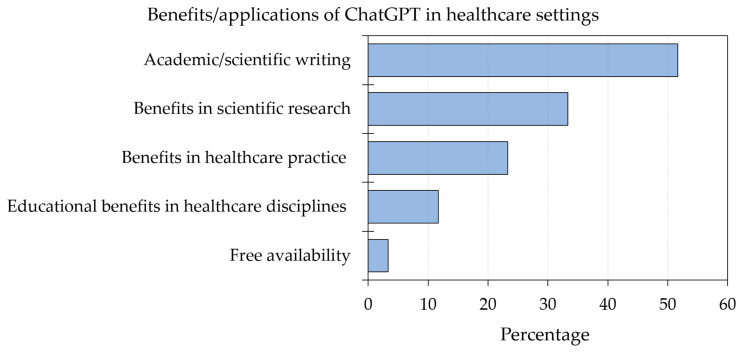
- Benefits were most frequently cited for academic/scientific writing (31 records, 51.7%), followed by scientific research (20, 33.3%), healthcare practice (14, 23.3%), healthcare education (7, 11.7%), and being a free package (2, 3.3%).
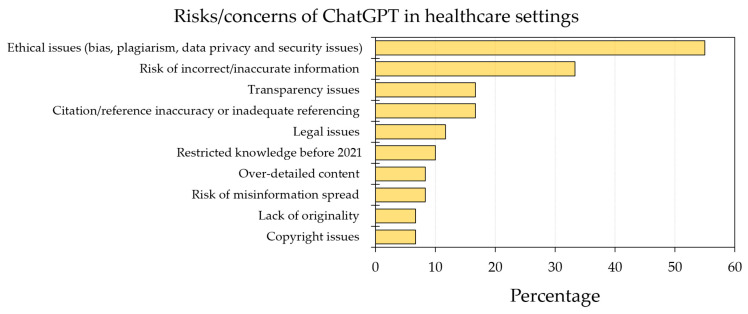
- Ethical concerns were the most common risk category (33 records, 55.0%), including risk of bias (18, 30.0%) and plagiarism (14, 23.3%); incorrect/inaccurate information was cited in 20 records (33.3%), citation/reference inaccuracy in 10 (16.7%), and transparency issues in 10 (16.7%).
- Other reported concerns included legal issues (7, 11.7%), restricted knowledge before 2021 (6, 10.0%), misinformation spread (5, 8.3%), over-detailed content (5, 8.3%), copyright issues (4, 6.7%), and lack of originality (4, 6.7%).
- The review states that ChatGPT does not qualify as an author under current ICMJE/COPE guidelines unless those guidelines are revised, and calls for stakeholder-developed ethics guidance for responsible LLM use in healthcare and academia.
Methods
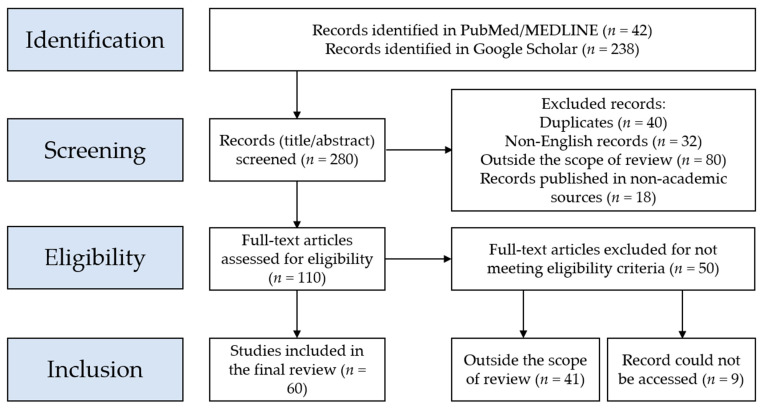
- Systematic review conducted according to PRISMA guidelines, searching PubMed/MEDLINE and Google Scholar for English records on ChatGPT in healthcare practice/research, healthcare education, or academic writing; searches concluded on 16 February 2023.
- PubMed/MEDLINE yielded 42 records and Google Scholar yielded 238 records, totaling 280 records; after duplicate removal (n = 40), non-English exclusion (n = 32), out-of-scope exclusion (n = 80), non-academic source exclusion (n = 18), full-text screening exclusions (n = 41), and inaccessible full texts (n = 9), 60 records were included.
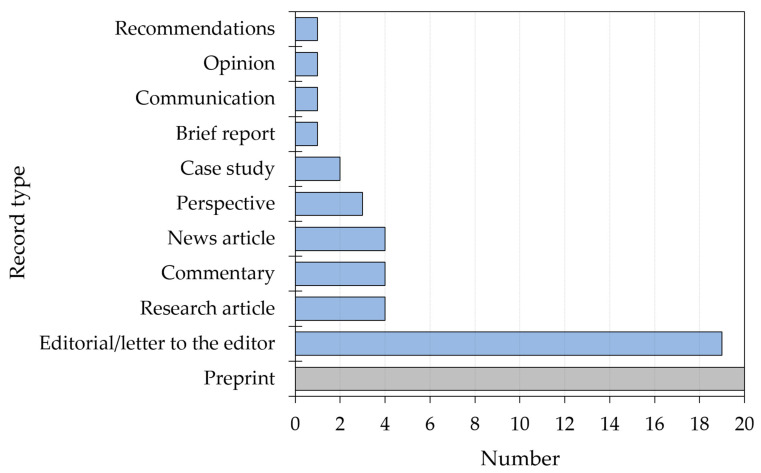
- Each included record was searched for record type, listed benefits/applications, listed risks/concerns, and main conclusions/recommendations regarding ChatGPT in healthcare education, practice, or scientific research/academic writing.
Limitations
- The paper states that included records had variable quality, non-English exclusion may have caused selection bias, inaccessible records may have led to missing relevant data, preprints were not peer reviewed, the literature is growing rapidly with the search ending 16 February 2023, and screening/interpretation was performed by a single author.
- Evident from the text: the review reports descriptive counts of mentions across heterogeneous record types rather than a formal meta-analysis or independent risk-of-bias assessment.
Model-written summary. Check it against the paper before relying on it.
Integrity signals
Registry
Cites
Statistics
Figures
Verification
Claims the paper makes
53 Valid · 1 Not valid · 6 Not checked · 37 Own results and interpretations
Every source the paper cites for this claim was checked and supports it.
In the paper
“This comes in light of the ability of ChatGPT to generate incorrect content that appears plausible from a scientific point of view [81].”
§ ChatGPT Utility in Healthcare Education, Research, and Practice: Systematic Review on the Promising Perspectives and Valid Concerns > 4. Discussion > 4.2. Limitations of ChatGPT Use in Scientific Research
What the sources say
- Supportedcites [81] Cascella M. Montomoli J. Bellini V. Bignami E. Evaluating the Feasibility of ChatGPT in Healthcare: An Analysis of Multiple Clinical and Research Scenarios J. Med. Syst. 2023 47 33 10.1007/s10916-023-01925-4 36869927 PMC9985086 source
In “Reasoning About Public Health Topics,” the paper says ChatGPT can produce believable answers that may be incorrect or nonsensical. In “Possible Misuse of GPT in Medicine and Research,” it describes a scientific abstract that appeared reliable and simulated statistical outputs that could seem plausible to readers. Together, these passages support the claim. (LLM, conf=0.94)
plain- Asserted: passes — The authors put it forward as true.
- Checkable: passes — It can be checked against evidence.
- Load-bearing: passes — The paper’s conclusions depend on it.
- Based: passes — The paper gives a reason why it holds.
- Supported
The sources with a verdict support this claim; the rest weren’t checked yet, have no full text we could read, or their verdicts aren’t rated yet.
In the paper
“This comes in light of the fact that authorship entails legal obligations that are not met by ChatGPT [43,48].”
§ ChatGPT Utility in Healthcare Education, Research, and Practice: Systematic Review on the Promising Perspectives and Valid Concerns > 4. Discussion > 4.2. Limitations of ChatGPT Use in Scientific Research
What the sources say
- Supportedcites [43] Zielinski C. Winker M. Aggarwal R. Ferris L. Heinemann M. Lapeña J. Pai S. Ing E. Citrome L. Chatbots, ChatGPT, and Scholarly Manuscripts WAME Recommendations on ChatGPT and Chatbots in Relation to Scholarly Publications Maced J. Med. Sci. 2023 11 83 86 10.3889/oamjms.2023.11502 37615142 source
The Introduction (p. 2) says chatbots are not legal entities, cannot be held legally liable, and that listing ChatGPT as an author may not be legally defensible. The WAME Recommendations (p. 2) add that chatbots cannot take responsibility for a paper or have the legal standing to sign a statement. (LLM, conf=0.93)
- Not checked — no full text of the sourcecites [48] Liebrenz M. Schleifer R. Buadze A. Bhugra D. Smith A. Generating scholarly content with ChatGPT: Ethical challenges for medical publishing Lancet Digit. Health 2023 5 e105 e106 10.1016/S2589-7500(23)00019-5 36754725 source
plain- Asserted: passes — The authors put it forward as true.
- Checkable: passes — It can be checked against evidence.
- Load-bearing: passes — The paper’s conclusions depend on it.
- Based: passes — The paper gives a reason why it holds.
- Supported
The cited sources support only part of this claim — read each source’s verdict below.
In the paper
“On one hand, ChatGPT, among other LLMs, can be beneficial in conversational and writing tasks, assisting to increase the efficiency and accuracy of the required output [11].”
§ ChatGPT Utility in Healthcare Education, Research, and Practice: Systematic Review on the Promising Perspectives and Valid Concerns > 1. Introduction
What the sources say
- Partly supportedcites [11] Deng J. Lin Y. The Benefits and Challenges of ChatGPT: An Overview Front. Comput. Intell. Syst. 2023 2 81 83 10.54097/fcis.v2i2.4465 sourceExperimental — accuracy not yet measured
Sections 4.1 (Increased Efficiency) and 4.2 (Improved Accuracy) say ChatGPT can make conversations more efficient and generate more accurate responses. The paper does not establish those benefits for writing tasks or for other LLMs, so the broader claim is only partially supported. (LLM, conf=0.88)
plainstates a cause- Asserted: passes — The authors put it forward as true.
- Checkable: passes — It can be checked against evidence.
- Load-bearing: unclear — It is unclear whether the paper’s conclusions depend on it.
- Based: passes — The paper gives a reason why it holds.
- Partly supported
The cited sources support only part of this claim — read each source’s verdict below.
In the paper
“Importantly, the concept of ChatGPT hallucination could be risky if the generated content is not thoroughly evaluated by researchers and health providers with proper expertise [37,56,73,77,79].”
§ ChatGPT Utility in Healthcare Education, Research, and Practice: Systematic Review on the Promising Perspectives and Valid Concerns > 4. Discussion > 4.2. Limitations of ChatGPT Use in Scientific Research
What the sources say
- Not checked — no full text of the sourcecites [37] Shen Y. Heacock L. Elias J. Hentel K.D. Reig B. Shih G. Moy L. ChatGPT and Other Large Language Models Are Double-edged Swords Radiology 2023 230163 10.1148/radiol.230163 36700838 source
- Partly supportedcites [56] Huh S. Are ChatGPT’s knowledge and interpretation ability comparable to those of medical students in Korea for taking a parasitology examination?: A descriptive study J. Educ. Eval. Health Prof. 2023 20 1 10.3352/jeehp.2023.20.1 36627845 PMC9905868 sourceExperimental — accuracy not yet measured
The Background says medical students must evaluate the accuracy of AI-generated medical information before creating reliable information for patients and the public. The Interpretation also reports that some ChatGPT explanations contained incorrect information. These passages support the need for scrutiny, but the paper does not specifically discuss hallucination or evaluation by researchers and health providers. (LLM, conf=0.84)
- Partly supportedcites [73] Duong D. Solomon B.D. Analysis of large-language model versus human performance for genetics questions medRxiv 2023 Preprint 10.1101/2023.01.27.23285115 PMC10999420 37246194 sourceExperimental — accuracy not yet measured
The Discussion (p. 6) says ChatGPT can give plausible explanations for incorrect answers and that its correctness requires additional verification, which is concerning in medical or other high-stakes settings. This supports the risk and need for evaluation, but the paper does not specify that researchers and health providers with proper expertise must perform it. (LLM, conf=0.83)
- Supportedcites [77] Jeblick K. Schachtner B. Dexl J. Mittermeier A. Stüber A.T. Topalis J. Weber T. Wesp P. Sabel B. Ricke J. ChatGPT Makes Medicine Easy to Swallow: An Exploratory Case Study on Simplified Radiology Reports arXiv 2022 10.48550/arxiv.2212.14882 2212.14882 PMC11126432 37794249 source
The Results (Free-text analysis) identify a ChatGPT hallucination that radiologists judged potentially harmful to a patient. The Key Points state that minimizing harm requires supervision by medical experts, supporting the claim’s warning about unevaluated medical content. (LLM, conf=0.90)
- Partly supportedcites [79] Lin Z. Why and how to embrace AI such as ChatGPT in your academic life PsyArXiv 2023 Preprint 10.31234/osf.io/sdx3j PMC10445029 37621662 sourceExperimental — accuracy not yet measured
The “Limitations of generative AI” section says ChatGPT may fabricate facts and false citations (“hallucination”) and urges users to critically evaluate and verify its responses, particularly when reliability is critical. It does not specifically say that researchers and health providers with proper expertise must evaluate the content; that part is more specific than the source. (LLM, conf=0.84)
hedgedstates a possible cause- Asserted: passes — The authors put it forward as true.
- Checkable: passes — It can be checked against evidence.
- Load-bearing: passes — The paper’s conclusions depend on it.
- Based: passes — The paper gives a reason why it holds.
- Rests on an assumption not shown here.
The sources with a verdict support this claim; the rest weren’t checked yet, have no full text we could read, or their verdicts aren’t rated yet.
In the paper
“This is particularly relevant for researchers who are non-native English speakers [23,25,63].”
§ ChatGPT Utility in Healthcare Education, Research, and Practice: Systematic Review on the Promising Perspectives and Valid Concerns > 4. Discussion > 4.1. Benefits of ChatGPT in Scientific Research
What the sources say
- Supportedcites [23] Chen T.J. ChatGPT and Other Artificial Intelligence Applications Speed up Scientific Writing Available online: https://journals.lww.com/jcma/Citation/9900/ChatGPT_and_other_artificial_intelligence.174.aspx (accessed on 16 February 2023) PMC12755446 36791246 source
In the main text (page not provided), Chen says many scientists who are not native English speakers struggle to write in English and describes AI translation and writing tools as ways to overcome that barrier. This supports the claim that language assistance in scientific writing is particularly relevant to those researchers. (LLM, conf=0.91)
- Not checked — no full text of the sourcecites [25] Kitamura F.C. ChatGPT Is Shaping the Future of Medical Writing but Still Requires Human Judgment Radiology 2023 230171 10.1148/radiol.230171 36728749 source
- Supportedcites [63] Gao C.A. Howard F.M. Markov N.S. Dyer E.C. Ramesh S. Luo Y. Pearson A.T. Comparing scientific abstracts generated by ChatGPT to original abstracts using an artificial intelligence output detector, plagiarism detector, and blinded human reviewers bioRxiv 2022 10.1101/2022.12.23.521610 source
The Discussion/Abstract section of our copy states directly that the technology 'could be used by scientists publishing in a language that is not their native language, to improve equity,' alongside the point that generated text 'may help alleviate the burden of writing' and that LLMs are 'a powerful tool to create readable scientific abstracts.' That covers the attributed content — AI-assisted language improvement being especially pertinent for non-native-English researchers — with the source's own hedge ('could be used') slightly weaker than the citing sentence's flat 'is particularly relevant.' No passage in our copy contradicts it. (LLM, conf=0.82)
plainstates an association- Asserted: passes — The authors put it forward as true.
- Checkable: passes — It can be checked against evidence.
- Load-bearing: unclear — It is unclear whether the paper’s conclusions depend on it.
- Based: passes — The paper gives a reason why it holds.
- Supported
42 more claims · 23 with their cited sources checked
Create a free account to see all 97 claims and to verify the 16 references still open.
- Probably not a substantial claim. 31
- It may state two separate claims as one. 27
Claims other papers make about this one
Each is checked against this paper’s own text: does it say what the citing paper says it does?
The source backs part of the claim, not all of it — or backs it for a different population, condition or comparison.
In the citing paper
“The reliance on ChatGPT may result in hindering the development of the skills needed to interpret and respond to social cues, which should be considered in health care education [9,91].”
From Assessing Health Students' Attitudes and Usage of ChatGPT in Jordan: Validation Study (2023) · cites this paper as [9]
Experimental — accuracy not yet measuredThe source backs part of the claim, not all of it — or backs it for a different population, condition or comparison.
In the citing paper
“A recent surge in the use of ChatGPT, in particular for mental health, is emergent for providing crucial personalized advice without clinical explanation, which can hurt user's safety, and thus trust (Sallam, 2023).”
From A review of the explainability and safety of conversational agents for mental health to identify avenues for improvement (2023) · cites this paper as Sallam, 2023
Experimental — accuracy not yet measuredThe source backs part of the claim, not all of it — or backs it for a different population, condition or comparison.
In the citing paper
“ChatGPT plays a crucial role in pandemic management by aiding in the swift and accurate dissemination of critical information.”
From A Systematic Review and Meta-Analysis of Artificial Intelligence Tools in Medicine and Healthcare: Applications, Considerations, Limitations, Motivation and Challenges (2024) · cites this paper as [6]
Experimental — accuracy not yet measuredThe source backs part of the claim, not all of it — or backs it for a different population, condition or comparison.
In the citing paper
“Its natural language processing capabilities enable it to generate coherent responses, making it a valuable tool for healthcare organisations.”
From A Systematic Review and Meta-Analysis of Artificial Intelligence Tools in Medicine and Healthcare: Applications, Considerations, Limitations, Motivation and Challenges (2024) · cites this paper as [6]
Experimental — accuracy not yet measuredThe source backs part of the claim, not all of it — or backs it for a different population, condition or comparison.
In the citing paper
“Specific advantages include its ability to provide rapid updates, preventive measures, and medical guidelines to the public.”
From A Systematic Review and Meta-Analysis of Artificial Intelligence Tools in Medicine and Healthcare: Applications, Considerations, Limitations, Motivation and Challenges (2024) · cites this paper as [6]
Experimental — accuracy not yet measured
31 more claims about this paper
Create a free account to see every claim other papers make about this one.
Citations
Cites
Preferred Reporting Items for Systematic Reviews and Meta-Analyses: the PRISMA statement
Moher, D., Liberati, A., Tetzlaff, J., Altman, D. G., & for the PRISMA Group (2009) · BMJ · doi:10.1136/bmj.b2535 · Cited by 83,823
Preferred Reporting Items for Systematic Reviews and Meta-Analyses: The PRISMA Statement
Moher, D., Liberati, A., Tetzlaff, J., Altman, D. G., & The PRISMA Group (2009) · PLoS Medicine · doi:10.1371/journal.pmed.1000097 · Cited by 64,042 · cited 1×
“The current systematic review was conducted according to the Preferred Reporting Items for Systematic Reviews and Meta-Analyses (PRIMSA) guidelines [21].”
Language Models are Few-Shot Learners
Brown, T. B., Mann, B., Ryder, N., Subbiah, M., Kaplan, J., Dhariwal, P., Neelakantan, A., Shyam, P., Sastry, G., Askell, A., et al. (2020) · arXiv · doi:10.48550/arxiv.2005.14165 · Cited by 23,372 · cited 3×
“The GPT architecture utilizes a neural network to process natural language, thus generating responses based on the context of input text [7].”
BackgroundWang, G., Ma, R., Qiao, G., Wada, K., Aizawa, Y., & Satoh, T. (2015) · Integrative Medicine International · doi:10.1159/000368408 · Cited by 18,657
Kaugeranna, R., Kaugeranna, E., & Aion, (. S. 4. 6. (2023) · DROPS (Schloss Dagstuhl – Leibniz Center for Informatics) · doi:10.4230/lipics.giscience.2023.43 · Cited by 13,690
Machine learning: Trends, perspectives, and prospects
Jordan, M. I., & Mitchell, T. M. (2015) · Science · doi:10.1126/science.aaa8415 · Cited by 9,955
Kung, T. H., Cheatham, M., Medenilla, A., Sillos, C., De Leon, L., Elepaño, C., Madriaga, M., Aggabao, R., Diaz-Candido, G., Maningo, J., et al. (2023) · PLOS Digital Health · doi:10.1371/journal.pdig.0000198 · Cited by 4,115 · cited 2×
“[59] An article showing the ChatGPT raised accuracy which enabled passing the USMLE Accuracy with high concordance and insight; it can facilitate patient communication; improved personalized medicine ChatGPT has a promising potential in medical education; future studies are recommended to consider non-biased approach…”
BackgroundKung, T. H., Cheatham, M., ChatGPT, Medenilla, A., Sillos, C., De Leon, L., Elepaño, C., Madriaga, M., Aggabao, R., Diaz-Candido, G., et al. (2022) · doi:10.1101/2022.12.19.22283643 · Cited by 4,115
Rajpurkar, P., Chen, E., Banerjee, O., & Topol, E. J. (2022) · Nature Medicine · doi:10.1038/s41591-021-01614-0 · Cited by 3,212 · cited 1×
“The promising utility of AI in health care has been outlined previously with possible benefits in personalized medicine, drug discovery, and the analysis of large datasets aside from the potential applications to improve diagnosis and clinical decisions [17,18].”
BackgroundChatting and cheating: Ensuring academic integrity in the era of ChatGPT
Cotton, D. R. E., Cotton, P. A., & Shipway, J. R. (2024) · Innovations in Education and Teaching International · doi:10.1080/14703297.2023.2190148 · Cited by 3,087 · cited 1×
“[62] An EdArXiv 2 preprint on the academic integrity in ChatGPT era Risk of plagiarism; academic dishonesty Careful thinking of educational assessment tools”
Background
Cited by
Items 2,901–3,000 of 3,095
Impacts of Generative Artificial Intelligence on Critical Thinking in Higher Education
Tan, Y., & Chen, C. (2026) · Lecture notes in computer science · doi:10.1007/978-3-032-29178-3_11
Chen, K., Chen, K. W., Patil, A., Diaconita, V., Chang, S., & Suh, L. H. (2026) · Ophthalmology Science · doi:10.1016/j.xops.2026.101315
GÖDE, A. (2026) · BMC Medical Education · doi:10.1186/s12909-026-09886-1
“…health information and potentially enhance digital health literacy, concerns remain regarding the accuracy, transparency, reliability, and verification of AI-generated content, particularly in health-related contexts where incorrect or misleading information may influence decision-making [24, 25].”
Uyar, A. (2026) · Journal of Learning and Teaching in Digital Age · doi:10.53850/joltida.1825745
Gao, Y.-P., Shu, J., Wang, D., Lv, W., Ding, Y., & Zeng, L. (2026) · Research Square · doi:10.21203/rs.3.rs-9843034/v1
Agha, A., & Anwar, E. (2026) · Research Square · doi:10.21203/rs.3.rs-10164745/v1
Zhang, H., Han, C., Hu, R., Zhou, X., Li, X. C., & Tan, J. (2026) · Clinical and Experimental Obstetrics & Gynecology · doi:10.31083/ceog50327 · Cited by 1
Optimisation of university instructors’ professional practice through AI agents: a systematic review
Doszhanov, B., Zhumadilla, B., & Zhapparbergenov, R. (2026) · Frontiers in Education · doi:10.3389/feduc.2026.1893124 · Cited by 1
Çelebi, V. (2026) · Acta Medica Young Doctors · doi:10.66288/actamedi.2026.92
Burgos‐Martínez, S. A., Neyem, A., Cadile, M., Alvarado, M. S., Farfán, E., Inzunza, Ó., Tubbs, R. S., & Ottone, N. E. (2026) · Clinical Anatomy · doi:10.1002/ca.70165 · Cited by 1
Guzmán, L., Aguilar, J. A. R., & Zea, L. Y. J. (2026) · Salud Medicina e Innovación Journal · doi:10.70577/n6y12k64
Mosher, M. A., Kohnke, S., Holman, K., Sulaimon, T., Dieker, L., & Frey, B. B. (2026) · Journal of Special Education Technology · doi:10.1177/01626434261464947
Canbaba, Z. U. (2026) · Acta Medica Young Doctors · doi:10.66288/actamedi.2026.95
Pop, M. A., Moca, A. E., Porumb, M., & Porumb, A. (2026) · Dentistry Journal · doi:10.3390/dj14070424
“Among these, large language models (LLMs) have attracted considerable interest from both the academic community and the general public [3].”
InfluentialBaek, G., Lee, H., Yang, D. H., Kang, M., Lee, K. H., Choi, M., Lee, Y., & Lee, K. H. (2026) · JMIR Medical Education · doi:10.2196/97822
“Consistent with this, recent ChatGPT education studies report that structured training significantly raises perceived AI competency among health care professionals [8,12], and experiential learning approaches outperform didactic instruction for skill-based outcomes [23].”
Dadir, İ. H. (2026) · Journal of orthopaedic surgery · doi:10.1177/10225536261469293
“21 In this context, the present study aimed to evaluate the reliability, quality, and readability of ChatGPT generated responses about olecranon fractures, a common orthopaedic condition that frequently prompts online health queries.”
Kremer, P., Knitza, J., Reichard, A., Holzer, M., Xiong, T., Schnoor, U., Melderis, S., Kötter, I., Haase, I., & Krusche, M. (2026) · Rheumatology International · doi:10.1007/s00296-026-06178-1 · Cited by 2
Główka, A., Bubnowska, M., Szukała, M., Więckowska, B., Banasiewicz, T., & Szmyt, K. (2026) · Polish Journal of Surgery · doi:10.5604/01.3001.0055.7863
Sibug, V. B., Miller, J. C., Grume, J. C., Bansil, J. A., Nacianceno, M. C. B., Salenga, J. L., Parreño, E. B., & Miranda, J. P. P. (2026) · Physical Education of Students · doi:10.15561/20755279.2026.0401
“Prior TAM-based studies in PE contexts have not examined this, and the result fits the argument of Sallam [11] that personal health goals go with AI tool engagement.”
Segarra, C. O. V., & García, J. D. M. (2026) · ASCE MAGAZINE · doi:10.70577/asce.v5i3.999
STUDENTS’ ATTITUDES TOWARDS CHATGPT AS A LEARNING ASSISTANT
Hamid, N. Z. A., Muzaini, A., Rahman, H. A., & Mohamad, M. (2026) · International Journal of Entrepreneurship and Management Practices · doi:10.35631/ijepc.1163058
Walker, E. R., Waller, L. A., Sarker, A., Comeau, D. L., & Cooper, H. L. F. (2026) · Pedagogy in Health Promotion · doi:10.1177/23733799261464510
Application of AI in Hypertension Health Education: Scoping Review
Chen, H., Xiao, S., Wan, T., Li, G., Peng, Y., & Wang, Z. (2026) · Journal of Medical Internet Research · doi:10.2196/95596
“As noted in evaluations of medical AI, LLMs remain prone to generating medical claims that appear plausible but lack evidence [60,61].”
The use of Image and Performance-Enhancing Drugs (IPED) in behavioural addictions
Corazza, O., Burkauskas, J., Luca, I. D., Zandonai, T., Szabó, A., Jiménez‐Múrcia, S., Fernández‐Aranda, F., Kun, B., Jennings, T. L., Gleason, N., et al. (2026) · Journal of Behavioral Addictions · doi:10.1556/2006.2025.00163
Schindler, M., Schiffelholz, D., Lang, S., Straub, J., Häckel, S., von der Höh, N. H., Dreimann, M., Neuhoff, J., Siller, S., Bratelj, D., et al. (2026) · Journal of Medical Internet Research · doi:10.2196/90364
“Large language models (LLMs), such as ChatGPT and Google Gemini, have recently emerged as tools capable of generating accessible health information [12,13].”
Du, J., Liu, Z., & Liao, N. (2026) · Acta Psychologica · doi:10.1016/j.actpsy.2026.107471 · Cited by 3
Wojtas, J., Pak, G., & Górski, W. J. (2026) · Cureus · doi:10.7759/cureus.112868 · Cited by 1
“Their potential uses include medical education, information retrieval, summarization of clinical documentation, support for differential diagnosis, and assistance in interpreting complex medical knowledge [1,2,3].”
Bilen, Y. E., Eroğlu, E., Atay, Y., et al. (2026) · European Archives of Oto-Rhino-Laryngology · doi:10.1007/s00405-026-10412-8
Artificial Intelligence in Formative and Shared Assessment in Higher Education
Herguedas, J. L. A., Soria, M. M., Fuentes, T., & Pastor, V. M. L. (2026) · Encyclopedia · doi:10.3390/encyclopedia6070158 · Cited by 1
DSCAM: A Three-Dimensional Evaluation Framework for Synthetic Corpus Quality in Online Education
Zhou, N., & Yuan, J. (2026) · Lecture notes in computer science · doi:10.1007/978-981-92-3761-6_28
İyilikci, E. A., Yurt, H. M., Keysan, E. E., Ağaoğulları, N., Dallar, H., Güven, L. S., Özkan, M. S., Şahin, M., Günhan, Z., Baykuşak, E., et al. (2026) · Çukurova Üniversitesi Sosyal Bilimler Enstitüsü Dergisi · doi:10.35379/cusosbil.1647141 · Cited by 1
Chancen und Herausforderungen Generativer KI: Eine Perspektive der Fachgruppe Gesundheitspsychologie
Lovis-Schmidt, A., Elmer, T., Warner, L., König, L. M., Kubiak, T., Sproesser, G., & Tomczyk, S. (2026) · Psychologische Rundschau · doi:10.1026/0033-3042/a000765
Riemma, G., Caniglia, F. M., Casolari, C., Maiorana, A., Cozzolino, M., Agrifoglio, V., FRANCISCIS, P. D., Cobellis, L., Carotenuto, R. M., & Etrusco, A. (2026) · Human Reproduction · doi:10.1093/humrep/deag116 · Cited by 1
TUTU, Ö. G., Bilen, V., & Ziroğlu, Z. (2026) · Family Practice · doi:10.1093/fampra/cmag051
Popa, D. I., Levai, C. M., Buleu, F. N., Burtic, S.-R., Militaru, M., Jugănaru, I., & Bratu, M. L. (2026) · International Medical Education · doi:10.3390/ime5030066 · Cited by 2
Liu, Z., Li, Y., Wang, J., Liu, Q., Feife, C., Zhu, L., Ren, Y., Xing, L., & Wang, X. (2026) · Journal of Medical Internet Research · doi:10.2196/87254 · Cited by 2
Yang, J., Bushati, Y., Lorger, S., Saad, J., & Rathore, P. (2026) · doi:10.2196/preprints.105684
Aşut, Ö., Çalı, Ş., Cynthia, A. N., Awad, R. A. O., Muhammad, H. S., Usman, A. S., & Husain, H. A. U. (2026) · Research Square · doi:10.21203/rs.3.rs-9880300/v1
PRACTALL 2025: Artificial intelligence—application of allergy and immunology to patient care
Shamji, M. H., Rider, N. L., Adcock, I. M., Pongdee, T., Giacco, S. D., Chang, C., Jaen, M. T., & Williams, P. V. (2026) · Journal of Allergy and Clinical Immunology · doi:10.1016/j.jaci.2026.04.031 · Cited by 1
Deng, Y., Zhu, Y., Li, J., & Xiong, Y. (2026) · Frontiers in Public Health · doi:10.3389/fpubh.2026.1917065
Yang, J., Wang, R., Guo, F., & Chen, Y. (2026) · Frontiers in Medicine · doi:10.3389/fmed.2026.1893231 · Cited by 1
“Therefore, NLP metrics alone are insufficient for medical AI evaluation; human-in-the-loop clinical adjudication remains irreplaceable (19).”
Çörekci, A. M., Ateş, B., Dinç, O., & Öztürk, A. A. (2026) · The Pediatric Infectious Disease Journal · doi:10.1097/inf.0000000000005335
Maximizing ChatGPT for Education: Strategies for Enhanced Learning Experiences
Naher, J., Maruf, M. H., Bakht, S. T., et al. (2026) · doi:10.1109/haxd70072.2026.11620923
“Its educational potential has sparked debate: while some view it as transformative, others raise concerns about misuse and disruption [2], [3].”
Artificial intelligence for medical imaging education: bibliometric and visual analysis
Wu, Y., & Wu, W. (2026) · Frontiers in Medicine · doi:10.3389/fmed.2026.1821176 · Cited by 1
“…in Sallam’s PRISMA-compliant review, this transformative potential is balanced against critical ethical risks and hallucination concerns, suggesting that the integration of LLMs into medical imaging curricula requires careful consideration of both educational benefits and safety challenges (43).”
InfluentialWu, M., Guo, X., Yang, S., Li, Y., Yu, T., & Liu, H. (2026) · BMC Nursing · doi:10.1186/s12912-026-05085-x · Cited by 1
“The rapid development of generative artificial intelligence (AI) has stimulated increasing interest in its application across health care research, education, and clinical practice [1–2].”
Zoabi, A. M., Salah, L. A., Deeb, T. Z., Igbaria, J. N., Mustafa, A. A., AbedRabbo, Q. M., Amer, S. F., Al-muhtaseb, D. N., Al-Haddad, T. Z., Kayed, D. A., et al. (2026) · Frontiers in Public Health · doi:10.3389/fpubh.2026.1893070
Tan, Q., Ma, Y., Zhao, J., & Hu, H. (2026) · Frontiers in Medicine · doi:10.3389/fmed.2026.1901004 · Cited by 2
Rathmann, R., Bozkurt, A., Kaindl, A., Piazza, A., & Garg, R. (2026) · Edition HMD · doi:10.1007/978-3-658-51795-3_19
Bernstein, E. M., Bol, B., Shanaa, J., Ramsamooj, A., Baldini, T. D., & Lum, Z. C. (2026) · Cureus · doi:10.7759/cureus.113654
The role of artificial intelligence in personalising the teaching process at medical universities
Ślęzak, D. (2026) · Humanities & Social Sciences Reviews · doi:10.18510/hssr.2026.1428
Neto, M., Pinto, R., Reis, J., & Antão, L. (2026) · Computers and Education Artificial Intelligence · doi:10.1016/j.caeai.2026.100654
D’Oria, M., Dorigo, W., Alexiou, V. G., Lepidi, S., Pacciani, C., Lareyre, F., Pulli, R., Speziali, S., Campolmi, M., & Giacomelli, E. (2026) · European Journal of Vascular and Endovascular Surgery · doi:10.1016/j.ejvs.2026.07.060
Requena, L. S., Rizzi, J. S., Ribeiro, Z. M. T., Filho, P. T. H., & Ferretti, R. (2026) · Medical Science Educator · doi:10.1007/s40670-026-02839-9
Naik, S., Nishadham, V., & Jackson, C. (2026) · CytoJournal · doi:10.25259/cytojournal_192_2025
Marya, A., & Selvaraj, S. (2026) · International Dental Journal · doi:10.1016/j.identj.2026.109802 · Cited by 1
Amalina, L. N., Antonio, F., Adiwena, S., Wuisan, D. S. S., & Massie, R. G. A. (2026) · JMIR Pediatrics and Parenting · doi:10.2196/100061
“This construct captures the mother’s evaluation of AI-generated nutritional information, focusing specifically on how she perceives its accuracy, completeness, and understandability [21,27].”
Leveraging AI for Low Literacy: Rethinking Interaction Accessibility Through Document Simplification
Guo, S., Leborgne, F., Baets, W. R. J., & Hu, J. (2026) · Lecture notes of the Institute for Computer Sciences, Social Informatics and Telecommunications Engineering · doi:10.1007/978-3-032-27585-1_22
Fan, T., Gao, T., Tang, W., Xu, Q., Wang, X., Su, Q., & Lyu, Q. (2026) · Frontiers in Public Health · doi:10.3389/fpubh.2026.1899528
“Generative artificial intelligence refers to systems that generate new content by learning statistical patterns from large datasets rather than by reasoning or understanding in human terms (4, 8, 9).”
Dai, H., Liu, M., Li, T., Jiancheng, W. A. N. G., & Fang, S. (2026) · Frontiers in Public Health · doi:10.3389/fpubh.2026.1916714
“And with personalized feedback, they could identify weaknesses and make targeted revisions—not just once, but throughout the development process (24, 25).”
AI‐Based Learning Experiences of Nursing Students: A Qualitative Study
Miao, J., Chen, H., Peng, X.-Y., Shi, L., Du, W., Li, W., Ge, M., Shen, L.-T., Mu, Z., Yu, Y., et al. (2026) · Journal of Evaluation in Clinical Practice · doi:10.1111/jep.70547 · Cited by 1
Zorcic, K., Bartsch, E., Lim, B., McCallum, G., Bakel, T. V., Hacker, A., & Fralick, M. (2026) · PLoS ONE · doi:10.1371/journal.pone.0351135
“[14,17,24] This was consistent with what we observed in our study.”
InfluentialPublic Perceptions of AI in Dentistry: Use, Trust, and Willingness in the Madinah RegionPreprint
Nafea, E. T., Sabr, F., Beladi, A. A., Al-Sehli, M., Halabi, L., & Nafea, M. (2026) · Research Square · doi:10.21203/rs.3.rs-10529339/v1
ChatGPT and Large Language Models in Contemporary Nursing
Uchmanowicz, I., Aldossary, H. M., Lee, C. S., Figura, M., Jędrzejczyk, M., Maria, M. D., Pucciarelli, G., Molka, E., Straiton, N., & Kołtuniuk, A. (2026) · Journal of Clinical Nursing · doi:10.1111/jocn.70490 · Cited by 4
Ormanci, U., SARIOĞLU, S., ÖZHAN, M. M., & ÇAVDAR, Y. (2026) · Educational Technology Research and Development · doi:10.1007/s11423-026-10691-2
Ela, H. A., Moustapha, R., Badran, A. S., Abou‐Bakr, A., & Almalahy, H. G. (2026) · Scientific Reports · doi:10.1038/s41598-026-65434-3 · Cited by 2
“Ethical issues, including the risk of bias and transparency issues, appeared as recurring major concerns 50 .”
Mayer, S., Knierim, P., Villa, S., & Schmidt, A. (2026) · Springer eBooks · doi:10.1007/978-3-319-27648-9_119-1
Padmavathi, T., Rajavel Murugan, P., Sethuraman, K. R., & Judson Neslin, J. (2026) · Cureus · doi:10.7759/cureus.114362
“AI-assisted learning refers to the use of GenAI tools, such as ChatGPT and Gemini, to facilitate learning through explanations, summaries, quizzes, and clarification of concepts [3].”
Lee, M., Cho, S., Yu, J. S., Yoon, J., Choi, J. H., Jung, K.-H., & Cho, J. (2026) · Journal of Medical Internet Research · doi:10.2196/92374 · Cited by 3
“This error manifests as a plausible generation of unfounded content inconsistent with the given questions or contexts, creating risks that general users or patients may misinterpret as factual information [14].”
Triantafyllidis, A. K., Segkouli, S., Lithoxoidou, E. E., Alexiadis, A., Votis, K., Koutra, K., Kilintzis, V., Kondylakis, H., Arana‐Arri, E., Haug, S., et al. (2026) · Information · doi:10.3390/info17080770 · Cited by 1
Çalışır, A., Şahin, M., Türkoğlu, F., Şener, S., Duyan, A. G., & Alptekin, H. (2026) · Updates in Surgery · doi:10.1007/s13304-026-02802-8
Evaluating DeepSeek, Gemini, and ChatGPT as Sources of Patient Information on Third Molars
Teke, M. T., & Kaygisiz, Ö. F. (2026) · International Journal of Clinical Practice · doi:10.1155/ijcp/6539988
Alefragkis, D., Aloizou, D., & Chougia, V. (2026) · Cureus · doi:10.7759/cureus.114402
“This is consistent with broader concerns regarding generative AI use in nursing education and healthcare settings [14,15].”
InfluentialPeng, J., Tuo, Y., Wang, G., 韩瑞琴, Wang, Q., Wang, Y., Hu, Z., & Hu, X. (2026) · Visual Computing for Industry Biomedicine and Art · doi:10.1186/s42492-026-00228-y
Verma, P., Pandey, G. K., Mishra, P. P., et al. (2026) · International Conference on Sustainable Computing and Smart Systems (ICSCSS) · doi:10.1109/icscss69635.2026.11645974
“Sallam [10] systematically reviews ChatGPT utility in medical education, demonstrating domain generalizability of LLM tutoring approaches.”
Ling, X., & Wang, C. (2026) · Discover Computing · doi:10.1007/s10791-026-10445-x
“…“future” and “opportunity,” it can be seen that scholars are concerned with the concrete implementation of LLMs in medical education in the future, using a diversified set of combined methods to address the limitations of LLMs, including prompt design and health literacy development [26, 63].”
InfluentialWegmann, S., Rosenkranz, T. A., Egenolf, P., Oikonomidis, S., Weber, M., & Lenz, M. (2026) · European Spine Journal · doi:10.1007/s00586-026-10280-0
Kajembula, I. M., Matheo, K. I., Simchimba, P. D., Massawe, D. D., Usiri, A. I., & Ambikile, J. S. (2026) · Journal of Medical Education and Curricular Development · doi:10.1177/23821205261479986
ChatGPT in the literature: A bibliometric analysis
Arık, M. A., Yalman, A., LİVBERBER, T., Aydoğan, H., Şeker, T., & Şeker, M. (2026) · Journal of Information Science · doi:10.1177/01655515261476215
Bafrouei, M. J., Rajabi, R., Khorramroo, F., Minoonejad, H., & Mousavi, S. H. (2026) · Sport Sciences for Health · doi:10.1007/s11332-026-01914-3
Wang, X., & Liu, W. (2026) · Science & Sports · doi:10.1016/j.scispo.2026.05.003
Na, K., & Jeong, Y. (2026) · The Journal of Academic Librarianship · doi:10.1016/j.acalib.2026.103328
Pirasteh, S., Hajibagheri, R., Jokar, M., Mohammaddoust, R., Behnamfar, F., Isazade, V., Zarbakhsh, H., Fang, Z., Almazroui, M., Samra, R. M. A., et al. (2026) · Geoscience Frontiers · doi:10.1016/j.gsf.2026.102445
Zhang, Z., Zhang, Y., Lu, X., & Zhang, M. (2026) · Frontiers in Public Health · doi:10.3389/fpubh.2026.1910408 · Cited by 2
Kaplan, T., Wang, K., Bichsel, O., Bacchi, S., & Gheihman, G. (2026) · Neurology Education · doi:10.1212/ne9.0000000000200351
Konti, E., & Kotsis, K. Τ. (2026) · International Journal of Changes in Education · doi:10.29333/ijce/19185
“Most of the literature so far has focused on specific application domains such as healthcare (Kostick-Quenet & Gerke, 2022; Sallam, 2023), education (Adiguzel et al., 2023; Kotsis, 2025a, 2025b; Mena-Guacas et al., 2023) or customer service (Gursoy et al., 2019) than attitudes across multiple…”
Takeshita, Y., Kawazu, T., Hisatomi, M., Fujikura, M., Okada, S., Shibanuma, A., Namba, Y., Yoshida, S., Yoshida, S., Nakamura, Y., et al. (2026) · Oral Radiology · doi:10.1007/s11282-026-00965-z
“Generative AI is now increasingly utilized not only for digital con - tent production and advertising, but also in the fields such as medical and healthcare [ 2–5 ].”
Kandasamy, G., Orayj, K. M., Asiri, R., Alshahrani, A. M., Alharbi, G., Abutaily, S. A., Suhaym, A. Y. A., & Alyahya, A. A. (2026) · Frontiers in Public Health · doi:10.3389/fpubh.2026.1862006
“Regression analysis identified awareness and trust/perceived usefulness as the strongest predictors of willingness to use ChatGPT, whereas risk perception showed a negative association (58, 63).”
Trust and Cognitive Shifts: How AI Reliance Reshapes Human Thinking and Decision-Making
Shodunke, A., & Olayemi, M. (2026) · ASEE Annual Conference & Exposition · doi:10.18260/1-2--61091
Palomino, L. A. V. (2026) · Revista Multidisciplinar Epistemología de las Ciencias · doi:10.71112/yfy1ba89
Belghachi, D., & Soussi, L. H. L. (2026) · International Conference on Circuit, Systems and Communication (ICCSC) · doi:10.1109/iccsc71566.2026.11650469
Arı, M., İlçin, N., Yağcıoğlu, H., & Akkar, I. (2026) · Revista da Associação Médica Brasileira · doi:10.1590/1806-9282.20260388
“The use of digital tools to access health information has increased significantly in recent years 7 .”
Polat, O., Koncalıoğlu, B., Gündoğdu, M., et al. (2026) · Healthcare · doi:10.3390/healthcare14172694
Bunjaku, I. B., Muhaxheri, E., & Bula, E. (2026) · Algorithms · doi:10.3390/a19090713
Artificial intelligence in rheumatoid arthritis: current applications and future perspectives
Sun, Z., Li, C., Zhu, K., Xu, L., Mu, Y., Wang, G., Shi, L., Li, Y., & Li, Y. (2026) · Frontiers in Medicine · doi:10.3389/fmed.2026.1914306
Yang, Q., Chen, N., & He, Y. (2026) · Open Journal of Applied Sciences · doi:10.4236/ojapps.2026.168155
Tietze, M. F., Tellson, A. M., Varghese, A., Knecht, K. L., & Dickerman, E. (2026) · Nursing Administration Quarterly · doi:10.1097/naq.0000000000000776
Wang, Y., Ji, M., Bai, X., & Zhuang, Y. (2026) · Nursing Open · doi:10.1002/nop2.70777
“This aligns with the ‘hallucination’ phenomenon in large language models summarized by Sallam in his systematic review, wherein models tend to generate content that appears reasonable but lacks factual basis (Sallam 2023).”
EduFairBench: reproducible evaluation of large language models for educational assessment
Villegas-Ch, W. E., Mera-Navarrete, A., Tello, F. Z., & Gutierrez, R. (2026) · Frontiers in Artificial Intelligence · doi:10.3389/frai.2026.1933445 · Cited by 1
“…their educational adoption requires rigorous empirical validation, transparent evaluation procedures, and systematic evidence regarding both their capabilities and limitations before they can be incorporated into high-impact assessment processes (Grassini, 2023; Kohnke et al., 2023; Sallam, 2023).”
Demirkıran, E. D. (2026) · Abant Medical Journal · doi:10.47493/abantmedj.1979162
Metadata
- Authors
- Sallam, M.
- Affiliations
- University of Jordan (JO)
- Corresponding author
- Sallam, Malik
- ORCID
- Sallam, Malik
- Venue
- Healthcare
- Publisher
- MDPI AG
- Published
- 2023-03-19
- Volume
- 11
- Issue
- 6
- Pages
- 887
- ISSN
- 2227-9032 (ISSN-L)
- PMC
- PMC10048148
- OpenAlex
- W4327946446
- Semantic Scholar
- dfdf7ff01aa6f691831e663fd29bc71890be39e2
- Cited by
- 3,126
- References
- 114
- Citations by year
- 2026: 561 · 2025: 839 · 2024: 1052 · 2023: 669
- FWCI
- 36.67
- Type
- journal article
- Language
- en
- Open access
- gold
- doi.org
- Licence
- Locations
- Healthcare (publishedVersion, cc-by)
- medRxiv (acceptedVersion, cc-by-nc-nd)
- Preprints.org (acceptedVersion, cc-by)
- PubMed Central (publishedVersion, cc-by)
- PubMed (publishedVersion)
- Topics
- Health Sciences › Medicine › Health Informatics › Artificial Intelligence in Healthcare and Education
- Physical Sciences › Computer Science › Artificial Intelligence › Artificial Intelligence Applications
- Social Sciences › Education › Artificial Intelligence in Education
- Keywords
- ChatGPT, large language models, artificial intelligence in healthcare, healthcare education, health care research, clinical practice, scientific writing, research equity, drug discovery, personalized medicine, health literacy, plagiarism, hallucinations, authorship criteria, AI ethics, infodemic
About these checks
Registry, retraction, Cites and statistics results are computed, not judged, with one exception: a printed reference that no index lists is read once by a model before it counts as a citation error. Claims are extracted by a model and kept only when their quote appears verbatim in the text; each cited source is then checked, with a model’s help, for whether it says what the claim relies on. Those verdicts can be wrong — read the claim’s quote and the cited source before relying on one.
The claim verdicts this report counts are experimental: their accuracy is not yet measured.
A language model drew the claims from the paper on 2026-10-10, under version 3 of the claim definition (model deepseek-v4.1-flash, prompt extract-v3).
A second model labelled each claim on 2026-10-10 (model jev-1.13-20260917, definition revision gold-guideline-v0.2).
Cited sources are checked with a language model’s help (gpt-6-sol and qwen3.8-omni-flash).
Statistics and arithmetic are recomputed, not judged.
Confidence bands are shown only for fields calibrated on our annotated test set. None is calibrated yet, so no band is shown.
What counts as a claim ›How we measure confidence ›How we check this ›
Are you an author, or do you see a problem with this page? Request a review
Data sources
Bibliographic data: Semantic Scholar, OpenAlex, Crossref.
Contains information from the Semantic Scholar Academic Graph Datasets, made available under the ODC Attribution License (ODC-BY 1.0).
Semantic Scholar’s data is described in: Kinney, R., et al. (2023). The Semantic Scholar Open Data Platform. arXiv:2301.10140.
