

Baseline-dependent effect of dopamine’s precursor L-tyrosine on working memory gating but not updating
Open accessThe DOI matches its Crossref record; 69 of the 70 references it cites were found in a registry or an index; 20 of the 61 sources its claims cite were checked for support.
Abstract
Adaptive goal-directed behavior requires a dynamic balance between maintenance and updating within working memory (WM). This balance is controlled by an input-gating mechanism implemented by dopamine in the basal ganglia. Given that dopaminergic manipulations can modulate performance on WM-related tasks, it is important to gain mechanistic insight into whether such manipulations differentially affect updating (i.e., encoding and removal) and the closely-related gate opening/closing processes that respectively enable/prevent updating. To clarify this issue, 2.0 g of dopamine’s precursor L-tyrosine was administered to healthy young adults (N = 45) in a double-blind, placebo-controlled, within-subjects study. WM processes were empirically distinguished using the reference-back paradigm, which isolates performance related to updating, gate opening, and gate closing. L-tyrosine had a selective, baseline-dependent effect only on gate opening, which was evidenced by markedly reduced variance across subjects in gate opening performance in the L-tyrosine compared with the placebo condition, whereas the whole-sample average performance did not differ between conditions. This indicates a pattern of results whereby low-performing subjects improved, whereas high-performing subjects were impaired on L-tyrosine. Importantly, this inverted U-shaped pattern was not explained by regression to the mean. These results are consistent with an inverted-U relationship between dopamine and WM, and they indicate that updating and gating are differentially affected by a dopaminergic manipulation. This highlights the importance of distinguishing these processes when studying WM, for example, in the context of WM deficits in disorders with a dopaminergic pathophysiology.
Overview
CoChat Summary
TL;DR
In a double-blind, placebo-controlled within-subjects study, 2.0 g L-tyrosine did not change mean working memory updating, gate opening, or gate closing performance. L-tyrosine selectively reduced between-subject variance in gate opening, consistent with a baseline-dependent inverted-U effect whereby low performers improved and high performers were impaired.
Key findings
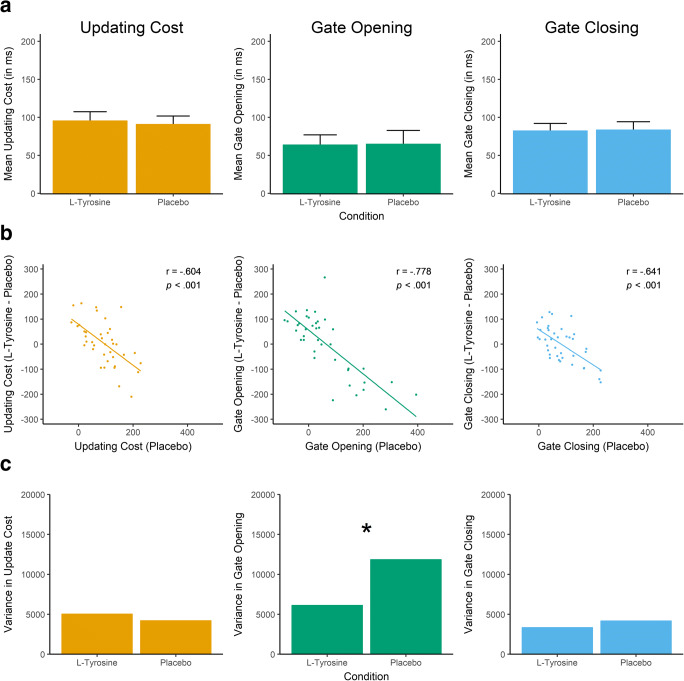
- L-tyrosine had no whole-sample effect on updating, gate opening, or gate closing in the reference-back task (planned paired tests, all ps ≥ 0.747).
- For gate opening, between-subject variance was significantly lower under L-tyrosine than placebo: one-tailed Pitman’s test t(37) = 2.072, p = 0.023 (S² = 6,143 vs. 11,874). This was not found for updating cost, t(37) = −0.552, p = 0.708 (S² = 5,044 vs. 4,219), or gate closing, t(37) = 0.711, p = 0.241 (S² = 3,356 vs. 4,183).
- The gate-opening effect was interpreted as baseline-dependent: low-performing subjects improved and high-performing subjects were impaired on L-tyrosine, beyond regression to the mean. Median-split correlations were positive in the below/at-median group, rs(18) = 0.476, p = 0.034, and numerically negative in the above-median group, rs(17) = −0.097, p = 0.692.
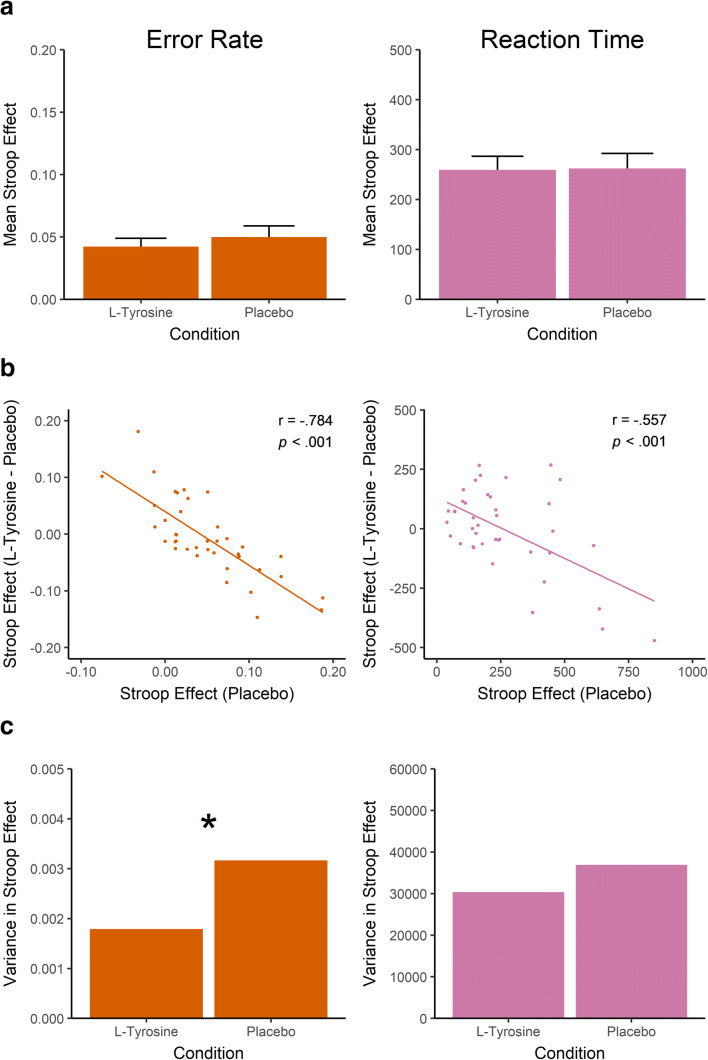
- In the Stroop task, there was no whole-sample L-tyrosine effect on congruency effects, but error-rate variance was lower under L-tyrosine, t(38) = 1.787, p = 0.041 (S² = 0.002 vs. 0.003); RT variance did not differ, t(38) = 0.718, p = 0.239. The paper treats the Stroop error-rate result as tentative because mean error rate was very low (≈0.05).
Methods
- Healthy young adults (N = 45 recruited; 25 females) completed two sessions separated by 1 week, receiving 2 g L-tyrosine or placebo in 400 mL orange juice in double-blind, counterbalanced order. Final task analyses included 42 subjects for reference-back, 40 for Stroop, and 41 for affect grid.
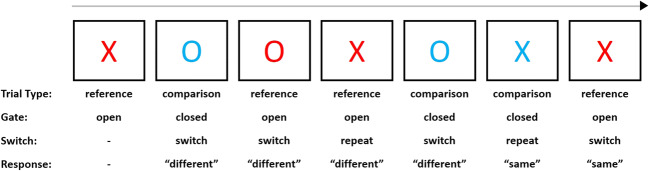
- The reference-back paradigm isolated updating cost (reference repeat minus comparison repeat), gate opening cost (reference switch minus reference repeat), and gate closing cost (comparison switch minus comparison repeat); subjects also completed a Stroop task and an auditory forward/backward WM span test.
- Analyses used repeated-measures ANOVAs, planned paired t tests, Pearson correlations between placebo performance and L-tyrosine-minus-placebo change, one-tailed Pitman’s tests of equality of variance in paired samples, and median-split Spearman correlations.
Limitations
- The paper states that L-tyrosine may also affect the noradrenergic system, so a noradrenergic explanation cannot be definitively ruled out; future work should include noradrenaline measures such as pupil dilation or salivary alpha amylase.
- The paper notes that Stroop error rates were very low (≈0.05) and may be unreliable, that no manipulation checks confirmed catecholamine elevation or individual response, and that median-split groups were small and may not capture the exact inverted-U turning point.
- The paper also states that the persistence of WM gate state across trials remains unresolved and requires designs with more consecutive reference/comparison trials and neurocomputational modelling; the experiment was not preregistered.
Model-written summary. Check it against the paper before relying on it.
Integrity signals
Registry
Cites
Statistics
Figures
Verification
Claims the paper makes
12 Valid · 0 Not valid · 24 Not checked · 65 Own results and interpretations
The sources with a verdict support this claim; the rest weren’t checked yet, have no full text we could read, or their verdicts aren’t rated yet.
In the paper
“In summary, the reference-back paradigm is well-suited to disentangle component processes of WM.”
§ Baseline-dependent effect of dopamine’s precursor L-tyrosine on working memory gating but not updating > Introduction
What the sources say
- Not checked — no full text of the sourcecites Rac-Lubashevsky & Kessler, 2016a matched to “Decomposing the n-back task: An individual differences study using the reference-back paradigm” (2016) source
- Supportedcites Rac-Lubashevsky et al., 2017 matched to “Tracking Real-Time Changes in Working Memory Updating and Gating with the Event-Based Eye-Blink Rate” (2017) source
The Introduction states that the reference-back task separates working-memory updating from gate opening and closing. It explains how reference and comparison trials distinguish these processes, supporting the claim that the paradigm is well-suited to disentangle components of working memory. (LLM, conf=0.94)
- Not matchedcites Nir-Cohen et al., 2019
An author–year citation the paper’s reference list doesn’t settle. We don’t search these by name.
boosted- Asserted: passes — The authors put it forward as true.
- Checkable: passes — It can be checked against evidence.
- Load-bearing: passes — The paper’s conclusions depend on it.
- Based: passes — The paper gives a reason why it holds.
The cited sources support only part of this claim — read each source’s verdict below.
In the paper
“Converging evidence that effects of L-tyrosine depend on baseline dopaminergic state in particular comes from a recent (preprinted) study in healthy older adults showing that L-tyrosine’s effect on the willingness to exert cognitive control was predicted by individual trait impulsivity (Froböse, Westbrook, Bloemendaal, Aarts, & Cools, 2019), a correlate of dopamine activity in BG (Buckholtz et al.”
§ Baseline-dependent effect of dopamine’s precursor L-tyrosine on working memory gating but not updating > Discussion
What the sources say
- Not matchedcites Froböse, Westbrook, Bloemendaal, Aarts, & Cools, 2019
An author–year citation the paper’s reference list doesn’t settle. We don’t search these by name.
- Supportedcites Buckholtz et al., 2011 matched to “Dopaminergic Network Differences in Human Impulsivity” (2010) source
Split into 2 atoms — 2 confirmed, 0 partially supported, 0 disputed, 0 misattributed, 0 unverifiable. Expand the claim to see per-atom verdicts.
boostedstates an association- Asserted: passes — The authors put it forward as true.
- Checkable: passes — It can be checked against evidence.
- Load-bearing: passes — The paper’s conclusions depend on it.
- Based: passes — The paper gives a reason why it holds.
- Not matched
The sources with a verdict support this claim; the rest weren’t checked yet, have no full text we could read, or their verdicts aren’t rated yet.
In the paper
“Second, trials requiring WM updating and gate switching elicited an increase in spontaneous eye blink rate (Rac-Lubashevsky, Slagter, & Kessler, 2017)—a presumed marker of dopamine activity in BG (Jongkees & Colzato, 2016), which implements the gating mechanism (Hazy et al., 2006).”
§ Baseline-dependent effect of dopamine’s precursor L-tyrosine on working memory gating but not updating > Introduction
What the sources say
- Supportedcites Rac-Lubashevsky et al., 2017 matched to “Tracking Real-Time Changes in Working Memory Updating and Gating with the Event-Based Eye-Blink Rate” (2017) source
The Discussion reports that trials requiring working-memory updating and trials requiring a switch in gate state increased the event-based eye-blink rate in all three experiments. The basal-ganglia dopamine-marker clause is attributed to a different citation in the citing sentence and is not part of this verdict. (LLM, conf=0.94)
- Not checked — no full text of the sourcecites Jongkees & Colzato, 2016 matched to “Spontaneous eye blink rate as predictor of dopamine-related cognitive function—A review” (2016) source
- Not checked — no full text of the sourcecites Hazy et al., 2006 matched to “Banishing the homunculus: Making working memory work” (2006) source
hedgedstates a cause- Asserted: passes — The authors put it forward as true.
- Checkable: passes — It can be checked against evidence.
- Load-bearing: passes — The paper’s conclusions depend on it.
- Based: passes — The paper gives a reason why it holds.
- Supported
The sources with a verdict support this claim; the rest weren’t checked yet, have no full text we could read, or their verdicts aren’t rated yet.
In the paper
“Second, baseline task performance (in a placebo condition) was considered, as it frequently predicts the behavioral effects of catecholaminergic manipulations (Cools & Robbins, 2004; Jepma et al., 2016, 2018) and therefore may indicate an individual’s baseline placement on the inverted-U curve relating dopamine activity and WM performance.”
§ Baseline-dependent effect of dopamine’s precursor L-tyrosine on working memory gating but not updating > Introduction
What the sources say
- Not checked — no full text of the sourcecites Cools & Robbins, 2004 matched to “Chemistry of the adaptive mind” (2004) source
- Supportedcites Jepma et al., 2016 matched to “Catecholaminergic Regulation of Learning Rate in a Dynamic Environment” (2016) source
The Discussion reports that participants’ placebo-session learning rate predicted the behavioral effect of atomoxetine: learning rates rose for those with low baseline rates and fell for those with high rates. It also notes similar baseline dependencies for other noradrenergic and dopaminergic drug effects. (LLM, conf=0.90)
- Supportedcites Jepma et al., 2018 matched to “Noradrenergic and Cholinergic Modulation of Belief Updating” (2018) source
In “Baseline-dependent Effects of Clonidine and Scopolamine on Learning Rate following Nonobvious Change Points” (page unavailable), the paper reports that placebo-session learning rate correlated with the effects of clonidine on learning rate. It also describes a similar baseline-dependent effect of atomoxetine in prior work. The paper qualifies its own finding: the clonidine effect exceeded what regression to the mean would predict specifically after nonobvious change points. (LLM, conf=0.88)
plainstates an association- Asserted: passes — The authors put it forward as true.
- Checkable: passes — It can be checked against evidence.
- Load-bearing: passes — The paper’s conclusions depend on it.
- Based: passes — The paper gives a reason why it holds.
Every source the paper cites for this claim was checked and supports it.
In the paper
“there is evidence it also indirectly modulates dopamine activity in BG (Fonteneau et al., 2018; Meyer et al., 2019; Tanaka et al., 2013).”
§ Baseline-dependent effect of dopamine’s precursor L-tyrosine on working memory gating but not updating > Discussion
What the sources say
- Supportedcites Fonteneau et al., 2018 matched to “Frontal Transcranial Direct Current Stimulation Induces Dopamine Release in the Ventral Striatum in Human” (2018) source
The Abstract reports that bifrontal tDCS was followed by a striatal change suggesting increased extracellular dopamine and describes the affected subcortical area as polysynaptically connected. The Discussion also reports a rat study finding increased dopamine in the basal ganglia after tDCS. Page numbers are not provided in our copy. (LLM, conf=0.92)
- Supportedcites Meyer et al., 2019 matched to “Increased Neural Activity in Mesostriatal Regions after Prefrontal Transcranial Direct Current Stimulation and l-DOPA Administration” (2019) source
The Significance Statement reports evidence of elevated striatal dopamine after prefrontal tDCS. The Discussion says the effect of prefrontal tDCS is likely mediated by corticosubcortical projections, supporting the claim that its effect on basal-ganglia dopamine activity is indirect. (LLM, conf=0.90)
- Supportedcites Tanaka et al., 2013 matched to “Transcranial direct-current stimulation increases extracellular dopamine levels in the rat striatum” (2013) source
The Results report that cathodal tDCS increased extracellular dopamine in the rat striatum, a basal ganglia region. The Discussion proposes that this effect could occur indirectly through a neural circuit, although it does not establish the mechanism. (LLM, conf=0.87)
plainstates a possible cause- Asserted: passes — The authors put it forward as true.
- Checkable: passes — It can be checked against evidence.
- Load-bearing: passes — The paper’s conclusions depend on it.
- Based: passes — The paper gives a reason why it holds.
- Supported
48 more claims · 1 with their cited sources checked
Create a free account to see all 101 claims and to verify the 1 reference still open.
- Probably not a substantial claim. 21
- It may state two separate claims as one. 36
Statistics recomputed
Every reported test result, recomputed from its test statistic and degrees of freedom. A result shows as not adding up only once an independent check has confirmed it.
- Consistentt(41.65) = -1.549reported p = .129 · recomputed p = .129
“t(41.65) = −1.549, p = .129”
- Consistentt(38) = 8.79reported p < .001 · recomputed p < .001
“t(38) = 8.79, p < .001”
- Consistentt(38) = 3.75reported p < .001 · recomputed p < .001
“t(38) = 3.75, p < .001”
- Consistentt(38) = 8.1reported p < .001 · recomputed p < .001
“t(38) = 8.10, p < .001”
- ConsistentF(1, 38) = 4.286reported p = .045 · recomputed p = .045
“F(1,38) = 4.286, p = .045”
24 more recomputed tests
Create a free account to see every test the Stats check recomputed.
Self-check
Percentages, sums and reported differences re-computed from the paper’s own numbers.
Each contradiction between two passages listed here was confirmed by an independent check.
Rated minor: it would not touch a result — a value no result rests on, a p-value that stays on the same side of the significance level, or a conflict that is clerical, resolved elsewhere in the paper, or outside its own findings.
In the paper
§ Baseline-dependent effect of dopamine’s precursor L-tyrosine on working memory gating but not updating > Discussion
“In the present study, this was the case only for gate opening performance in the L-tyrosine relative to placebo condition”
§ Baseline-dependent effect of dopamine’s precursor L-tyrosine on working memory gating but not updating > Results > No baseline-dependent effect of L-tyrosine on response interference
“one-tailed Pitman’s test of equality of variance in paired samples revealed smaller variance in the L-tyrosine than placebo condition for ER, t(38) = 1.787, p = 0.041 (S2 = 0.002 vs. 0.003)”
Cited works that were retracted
Works this paper cites that were later retracted, from the retraction notices publishers deposit. Major when the notice came out before this paper was published.
A note, not an issue: for example, a cited work that was retracted only after this paper was published, which its authors could not have known.
In the paper
“Jongkees, B. J., Sellaro, R., Beste, C., Nitsche, M. A., Kühn, S., & Colzato, L. S. (2017). L-Tyrosine administration modulates the effect of transcranial direct current stimulation on working memory in healthy humans. Cortex, 90, 103–114.”
Cited work 10.1016/j.cortex.2017.02.014 · retracted 2022-06-02 · notice 10.1016/j.cortex.2022.05.001 · this paper published 2020-03-04
Citations
Cites
1 retracted
Jongkees, B. J., Sellaro, R., Beste, C., Nitsche, M. A., Kühn, S., & Colzato, L. S. (2017) · Cortex · doi:10.1016/j.cortex.2017.02.014 · Cited by 21
Self-citationRetractedBaddeley, A. D., & Hitch, G. (1974) · Psychology of Learning and Motivation · doi:10.1016/s0079-7421(08)60452-1 · Cited by 15,284
Nitsche, M. A., & Paulus, W. (2000) · The Journal of Physiology · doi:10.1111/j.1469-7793.2000.t01-1-00633.x · Cited by 5,656
Baddeley, A. (1992) · Science · doi:10.1126/science.1736359 · Cited by 5,258
Cognition and Depression: Current Status and Future Directions
Gotlib, I. H., & Joormann, J. (2010) · Annual Review of Clinical Psychology · doi:10.1146/annurev.clinpsy.121208.131305 · Cited by 2,420
Affect Grid: A single-item scale of pleasure and arousal.
Russell, J. A., Weiss, A., & Mendelsohn, G. A. (1989) · Journal of Personality and Social Psychology · doi:10.1037//0022-3514.57.3.493 · Cited by 2,068
Grace, A. A. (1991) · Neuroscience · doi:10.1016/0306-4522(91)90196-u · Cited by 1,831
Decision making, the P3, and the locus coeruleus–norepinephrine system
Nieuwenhuis, S., Aston-Jones, G., & Cohen, J. D. (2005) · Psychological Bulletin · doi:10.1037/0033-2909.131.4.510 · Cited by 1,678
Inverted-U–Shaped Dopamine Actions on Human Working Memory and Cognitive Control
Cools, R., & D'Esposito, M. (2011) · Biological Psychiatry · doi:10.1016/j.biopsych.2011.03.028 · Cited by 1,673
Joshi, S., Li, Y., Kalwani, R. M., & Gold, J. I. (2016) · Neuron · doi:10.1016/j.neuron.2015.11.028 · Cited by 1,387
Dysregulation of the dopamine system in the pathophysiology of schizophrenia and depression
Grace, A. A. (2016) · Nature Reviews Neuroscience · doi:10.1038/nrn.2016.57 · Cited by 1,166
Proceedings of the 35th Annual Meeting of the Cognitive Science Society
Culbertson, J., & Wilson, C. (2013) · Cited by 1,139
Pupil fluctuations track rapid changes in adrenergic and cholinergic activity in cortex
Reimer, J., McGinley, M. J., Liu, Y., Rodenkirch, C., Wang, Q., McCormick, D. A., & Tolias, A. S. (2016) · Nature Communications · doi:10.1038/ncomms13289 · Cited by 926
Interactions between frontal cortex and basal ganglia in working memory: A computational model
FRANK, M. J., LOUGHRY, B., & O'REILLY, R. C. (2001) · Cognitive, Affective, & Behavioral Neuroscience · doi:10.3758/cabn.1.2.137 · Cited by 879
Pupil diameter covaries with BOLD activity in human locus coeruleus
Murphy, P. R., O'Connell, R. G., O'Sullivan, M., Robertson, I. H., & Balsters, J. H. (2014) · Human Brain Mapping · doi:10.1002/hbm.22466 · Cited by 819
Level of action of cathodal DC polarisation induced inhibition of the human motor cortex
Nitsche, M. A., Nitsche, M. S., Klein, C. C., Tergau, F., Rothwell, J. C., & Paulus, W. (2003) · Clinical Neurophysiology · doi:10.1016/s1388-2457(02)00412-1 · Cited by 736
Dopaminergic Network Differences in Human Impulsivity
Buckholtz, J. W., Treadway, M. T., Cowan, R. L., Woodward, N. D., Li, R., Ansari, M. S., Baldwin, R. M., Schwartzman, A. N., Shelby, E. S., Smith, C. E., et al. (2010) · Science · doi:10.1126/science.1185778 · Cited by 600
Durstewitz, D., & Seamans, J. K. (2008) · Biological Psychiatry · doi:10.1016/j.biopsych.2008.05.015 · Cited by 586
PITMAN, E. J. G. (1939) · Biometrika · doi:10.1093/biomet/31.1-2.9 · Cited by 480
Frank, M. J., & O'Reilly, R. C. (2006) · Behavioral Neuroscience · doi:10.1037/0735-7044.120.3.497 · Cited by 472
Biologically Based Computational Models of High-Level Cognition
O'Reilly, R. C. (2006) · Science · doi:10.1126/science.1127242 · Cited by 448
On the Control of Control: The Role of Dopamine in Regulating Prefrontal Function and Working Memory
(2000) · Control of Cognitive Processes · doi:10.7551/mitpress/1481.003.0044 · Cited by 416
Banishing the homunculus: Making working memory work
Hazy, T. E., Frank, M. J., & O’Reilly, R. C. (2006) · Neuroscience · doi:10.1016/j.neuroscience.2005.04.067 · Cited by 385
Banich, M. T., Mackiewicz, K. L., Depue, B. E., Whitmer, A. J., Miller, G. A., & Heller, W. (2009) · Neuroscience & Biobehavioral Reviews · doi:10.1016/j.neubiorev.2008.09.010 · Cited by 343
Estrogen Shapes Dopamine-Dependent Cognitive Processes: Implications for Women's Health
Jacobs, E., & D'Esposito, M. (2011) · The Journal of Neuroscience · doi:10.1523/jneurosci.6394-10.2011 · Cited by 342
Working Memory Capacity Predicts Dopamine Synthesis Capacity in the Human Striatum
Cools, R., Gibbs, S. E., Miyakawa, A., Jagust, W., & D'Esposito, M. (2008) · The Journal of Neuroscience · doi:10.1523/jneurosci.4475-07.2008 · Cited by 302
Spontaneous eye blink rate as predictor of dopamine-related cognitive function—A review
Jongkees, B. J., & Colzato, L. S. (2016) · Neuroscience & Biobehavioral Reviews · doi:10.1016/j.neubiorev.2016.08.020 · Cited by 300
Self-citationBoosting focally-induced brain plasticity by dopamine
Kuo, M.-F., Paulus, W., & Nitsche, M. A. (2008) · Cerebral Cortex · doi:10.1093/cercor/bhm098 · Cited by 269
Multiple gates on working memory
Chatham, C. H., & Badre, D. (2015) · Current Opinion in Behavioral Sciences · doi:10.1016/j.cobeha.2014.08.001 · Cited by 268
Chemistry of the adaptive mind
Cools, R., & Robbins, T. W. (2004) · Philosophical Transactions of the Royal Society of London. Series A: Mathematical, Physical and Engineering Sciences · doi:10.1098/rsta.2004.1468 · Cited by 257
Fonteneau, C., Redoute, J., Haesebaert, F., Le Bars, D., Costes, N., Suaud-Chagny, M.-F., & Brunelin, J. (2018) · Cerebral Cortex · doi:10.1093/cercor/bhy093 · Cited by 198
Foland-Ross, L. C., & Gotlib, I. H. (2012) · Frontiers in Psychology · doi:10.3389/fpsyg.2012.00489 · Cited by 197
Jongkees, B. J., Hommel, B., Kühn, S., & Colzato, L. S. (2015) · Journal of Psychiatric Research · doi:10.1016/j.jpsychires.2015.08.014 · Cited by 183
Self-citationProceedings of the 21st Annual Meeting of the Cognitive Science Society
Sturt, P., Branigan, H. P., & Matsumoto-Sturt, Y. (1999) · Cited by 181
Correcting for Regression to the Mean in Behavior and Ecology
Kelly, C., & Price, T. D. (2005) · The American Naturalist · doi:10.1086/497402 · Cited by 163
Warren, C. M., Tona, K., Ouwerkerk, L., van Paridon, J., Poletiek, F. H., van Steenbergen, H., Bosch, J. A., & Nieuwenhuis, S. (2018) · Brain stimulation · doi:10.1016/j.brs.2018.12.224 · Cited by 159
Distracted and down: neural mechanisms of affective interference in subclinical depression
Kaiser, R. H., Andrews-Hanna, J. R., Spielberg, J. M., Warren, S. L., Sutton, B. P., Miller, G. A., Heller, W., & Banich, M. T. (2015) · Social Cognitive and Affective Neuroscience · doi:10.1093/scan/nsu100 · Cited by 147
GIBBS, S. E. B., & D'ESPOSITO, M. (2005) · Cognitive, Affective, & Behavioral Neuroscience · doi:10.3758/cabn.5.2.212 · Cited by 145
Zetsche, U., Bürkner, P.-C., & Schulze, L. (2018) · Clinical Psychology Review · doi:10.1016/j.cpr.2018.06.001 · Cited by 142
Plewnia, C., Zwissler, B., Längst, I., Maurer, B., Giel, K., & Krüger, R. (2013) · Cortex · doi:10.1016/j.cortex.2012.11.002 · Cited by 134
Transcranial direct-current stimulation increases extracellular dopamine levels in the rat striatum
Tanaka, T., Takano, Y., Tanaka, S., Hironaka, N., Kobayashi, K., Hanakawa, T., Watanabe, K., & Honda, M. (2013) · Frontiers in Systems Neuroscience · doi:10.3389/fnsys.2013.00006 · Cited by 125
Effect of Menstrual Cycle Phase on Dopamine D2 Receptor Availability in Female Cynomolgus Monkeys
Czoty, P. W., Riddick, N. V., Gage, H. D., Sandridge, M., Nader, S. H., Garg, S., Bounds, M. C., Garg, P., & Nader, M. A. (2008) · Neuropsychopharmacology · doi:10.1038/npp.2008.3 · Cited by 120
Decomposing the n-back task: An individual differences study using the reference-back paradigm
Rac-Lubashevsky, R., & Kessler, Y. (2016) · Neuropsychologia · doi:10.1016/j.neuropsychologia.2016.07.013 · Cited by 96
Targeting the biased brain: non-invasive brain stimulation to ameliorate cognitive control
Plewnia, C., Schroeder, P. A., & Wolkenstein, L. (2015) · The Lancet Psychiatry · doi:10.1016/s2215-0366(15)00056-5 · Cited by 96
Growdon, J. H., Melamed, E., Logue, M., Hefti, F., & Wurtman, R. J. (1982) · Life Sciences · doi:10.1016/0024-3205(82)90596-3 · Cited by 91
Catecholaminergic Regulation of Learning Rate in a Dynamic Environment
Jepma, M., Murphy, P. R., Nassar, M. R., Rangel-Gomez, M., Meeter, M., & Nieuwenhuis, S. (2016) · PLOS Computational Biology · doi:10.1371/journal.pcbi.1005171 · Cited by 91
Gibbs, S. E. B., & D'Esposito, M. (2005) · Psychopharmacology · doi:10.1007/s00213-005-0077-5 · Cited by 88
Working Memory Reloaded: Tyrosine Repletes Updating in the N-Back Task
Colzato, L. S., Jongkees, B. J., Sellaro, R., & Hommel, B. (2013) · Frontiers in Behavioral Neuroscience · doi:10.3389/fnbeh.2013.00200 · Cited by 87
Self-citationDissociating working memory updating and automatic updating: The reference-back paradigm.
Rac-Lubashevsky, R., & Kessler, Y. (2016) · Journal of Experimental Psychology: Learning, Memory, and Cognition · doi:10.1037/xlm0000219 · Cited by 84
Norepinephrine transporter blocker atomoxetine increases salivary alpha amylase
Warren, C. M., van den Brink, R. L., Nieuwenhuis, S., & Bosch, J. A. (2017) · Psychoneuroendocrinology · doi:10.1016/j.psyneuen.2017.01.029 · Cited by 81
Tyrosine improves working memory in a multitasking environment
Thomas, J. R., Lockwood, P. A., Singh, A., & Deuster, P. A. (1999) · Pharmacology Biochemistry and Behavior · doi:10.1016/s0091-3057(99)00094-5 · Cited by 75
Tam, S. Y., Elsworth, J. D., Bradberry, C. W., & Roth, R. H. (1990) · Journal of Neural Transmission · doi:10.1007/bf01245830 · Cited by 75
Mesoprefrontal dopaminergic neurons: Can tyrosine availability influence their functions?
Tarn, S.-Y., & Roth, R. H. (1997) · Biochemical Pharmacology · doi:10.1016/s0006-2952(96)00774-5 · Cited by 74
Elevation of plasma tyrosine after a single oral dose of L-tyrosine
Glaeser, B. S., Melamed, E., Growdon, J. H., & Wurtman, R. J. (1979) · Life Sciences · doi:10.1016/0024-3205(79)90294-7 · Cited by 69
Neural Substrates of Working Memory Updating
Nir-Cohen, G., Kessler, Y., & Egner, T. (2020) · Journal of Cognitive Neuroscience · doi:10.1162/jocn_a_01625 · Cited by 67
Alavash, M., Lim, S.-J., Thiel, C., Sehm, B., Deserno, L., & Obleser, J. (2018) · NeuroImage · doi:10.1016/j.neuroimage.2018.01.048 · Cited by 64
Tracking Real-Time Changes in Working Memory Updating and Gating with the Event-Based Eye-Blink Rate
Rac-Lubashevsky, R., Slagter, H. A., & Kessler, Y. (2017) · Scientific Reports · doi:10.1038/s41598-017-02942-3 · Cited by 52
Stability-Flexibility Dilemma in Cognitive Control: A Dynamical System Perspective.
Musslick, S., Bizyaeva, A., Agaron, S., Leonard, N. E., & Cohen, J. D. (2019) · eScholarship (California Digital Library) · Cited by 50
Constraints associated with cognitive control and the stability-flexibility dilemma.
Musslick, S., Jang, S. J., Shvartsman, M., et al. (2018) · eScholarship (California Digital Library) · Cited by 48
Rac-Lubashevsky, R., & Kessler, Y. (2018) · Journal of Cognitive Neuroscience · doi:10.1162/jocn_a_01326 · Cited by 47
Wallace, D. L., Vytlacil, J. J., Nomura, E. M., Gibbs, S. E. B., & D'Esposito, M. (2011) · Frontiers in Human Neuroscience · doi:10.3389/fnhum.2011.00032 · Cited by 46
Kessler, Y. (2017) · Frontiers in Psychology · doi:10.3389/fpsyg.2017.02260 · Cited by 43
Meyer, B., Mann, C., Götz, M., Gerlicher, A., Saase, V., Yuen, K. S. L., Aedo-Jury, F., Gonzalez-Escamilla, G., Stroh, A., & Kalisch, R. (2019) · The Journal of Neuroscience · doi:10.1523/jneurosci.3128-18.2019 · Cited by 43
Eckart, C., Fuentemilla, L., Bauch, E. M., & Bunzeck, N. (2014) · NeuroImage · doi:10.1016/j.neuroimage.2014.03.011 · Cited by 43
Noradrenergic and Cholinergic Modulation of Belief Updating
Jepma, M., Brown, S. B. R. E., Murphy, P. R., Koelewijn, S. C., de Vries, B., van den Maagdenberg, A. M., & Nieuwenhuis, S. (2018) · Journal of Cognitive Neuroscience · doi:10.1162/jocn_a_01317 · Cited by 39
Catecholaminergic modulation of the cost of cognitive control in healthy older adults
Froböse, M. I., Westbrook, A., Bloemendaal, M., Aarts, E., & Cools, R. (2020) · PLoS ONE · doi:10.1371/journal.pone.0229294 · Cited by 22
Kishore, K., Ray, K., Anand, J. P., Thakur, L., Kumar, S., & Panjwani, U. (2013) · Brain and Cognition · doi:10.1016/j.bandc.2013.09.005 · Cited by 19
Joormann, J. (2018) · Cognition & Emotion · doi:10.1080/02699931.2018.1502656 · Cited by 18
Stock, A., Colzato, L. S., & Beste, C. (2018) · European Neuropsychopharmacology · doi:10.1016/j.euroneuro.2018.05.010 · Cited by 10
Catecholaminergic modulation of the cost of cognitive control in healthy older adultsPreprint
Froböse, M. I., Westbrook, A., Bloemendaal, M., et al. (2019) · doi:10.31234/osf.io/kypz3 · Cited by 1
Cited by
A literature review of dopamine in binge eating
Yu, Y. H., Miller, R. M., & Groth, S. W. (2022) · Journal of Eating Disorders · doi:10.1186/s40337-022-00531-y · Cited by 101
Meyer, B., Mann, C., Götz, M., Gerlicher, A., Saase, V., Yuen, K. S. L., Aedo-Jury, F., Gonzalez-Escamilla, G., Stroh, A., & Kalisch, R. (2019) · The Journal of Neuroscience · doi:10.1523/jneurosci.3128-18.2019 · Cited by 43
Verschooren, S., Kessler, Y., & Egner, T. (2021) · Cognition · doi:10.1016/j.cognition.2021.104668 · Cited by 38
Understanding subprocesses of working memory through the lens of model-based cognitive neuroscience
Trutti, A. C., Verschooren, S., Forstmann, B. U., & Boag, R. J. (2020) · Current Opinion in Behavioral Sciences · doi:10.1016/j.cobeha.2020.10.002 · Cited by 33
Cognitive Control of Working Memory: A Model-Based Approach
Boag, R. J., Stevenson, N., van Dooren, R., Trutti, A. C., Sjoerds, Z., & Forstmann, B. U. (2021) · Brain Sciences · doi:10.3390/brainsci11060721 · Cited by 34
Metadata
- Authors
- Jongkees, B. J.
- Affiliations
- Leiden University (NL)
- Corresponding author
- Jongkees, Bryant J.
- ORCID
- Jongkees, Bryant J.
- Venue
- Cognitive, Affective, & Behavioral Neuroscience
- Published
- 2020-03-04
- Volume
- 20
- Issue
- 3
- Pages
- 521-535
- ISSN
- 1530-7026 (ISSN-L)
- 1531-135X
- PMC
- PMC7266860
- OpenAlex
- W3009671945
- Semantic Scholar
- 06411070acfd9252784ab7e4a666c261c964bd99
- Cited by
- 28
- References
- 69
- Citations by year
- 2026: 1 · 2025: 5 · 2024: 13 · 2023: 1 · 2022: 3 · 2021: 3 · 2020: 1
- FWCI
- 0.96
- Type
- journal article
- Language
- en
- Open access
- hybrid
- doi.org
- Licence
- cc-by
- creativecommons.org/licenses/by/4.0 (tdm)
- creativecommons.org/licenses/by/4.0 (vor)
- Locations
- Cognitive Affective & Behavioral Neuroscience (publishedVersion, cc-by)
- PubMed Central (publishedVersion, cc-by)
- PubMed (publishedVersion)
- Leiden Repository (Leiden University) (submittedVersion, cc-by)
- Data Archiving and Networked Services (DANS) (submittedVersion, cc-by)
- Leiden Repository (Leiden University) (submittedVersion)
- Funders
- Leiden University
- Topics
- Life Sciences › Neuroscience › Cognitive Neuroscience › Neural and Behavioral Psychology Studies
- Life Sciences › Neuroscience › Cellular and Molecular Neuroscience › Neurotransmitter Receptor Influence on Behavior
- Social Sciences › Psychology › Experimental and Cognitive Psychology › Cognitive Abilities and Testing
- Keywords
- tyrosine, dopamine, working memory, memory updating, gate opening, basal ganglia, individual differences, inverted U-shaped relationship, regression to the mean
- MeSH terms
- Adult, Dopamine, Double-Blind Method, Female, Goals, Humans, Male, Memory, Short-Term, Neuropsychological Tests, Psychomotor Performance, Tyrosine, Young Adult, Stroop Test
About these checks
Registry, retraction, Cites and statistics results are computed, not judged, with one exception: a printed reference that no index lists is read once by a model before it counts as a citation error. Claims are extracted by a model and kept only when their quote appears verbatim in the text; each cited source is then checked, with a model’s help, for whether it says what the claim relies on. Those verdicts can be wrong — read the claim’s quote and the cited source before relying on one.
The claim verdicts this report counts are experimental: their accuracy is not yet measured.
A language model drew the claims from the paper on 2026-10-05, under version 3 of the claim definition (model deepseek-v4.1-flash, prompt extract-v3).
A second model labelled each claim on 2026-10-05 (model jev-1.13-20260917, definition revision gold-guideline-v0.2).
Cited sources are checked with a language model’s help (gpt-6-sol).
Statistics and arithmetic are recomputed, not judged.
Confidence bands are shown only for fields calibrated on our annotated test set. None is calibrated yet, so no band is shown.
What counts as a claim ›How we measure confidence ›How we check this ›
Are you an author, or do you see a problem with this page? Request a review
Data sources
Bibliographic data: Semantic Scholar, OpenAlex, Crossref.
Contains information from the Semantic Scholar Academic Graph Datasets, made available under the ODC Attribution License (ODC-BY 1.0).
Semantic Scholar’s data is described in: Kinney, R., et al. (2023). The Semantic Scholar Open Data Platform. arXiv:2301.10140.
