

The reliability paradox: Why robust cognitive tasks do not produce reliable individual differences
Open accessThe DOI matches its Crossref record; 146 of the 150 references it cites were found in a registry or an index.
Abstract
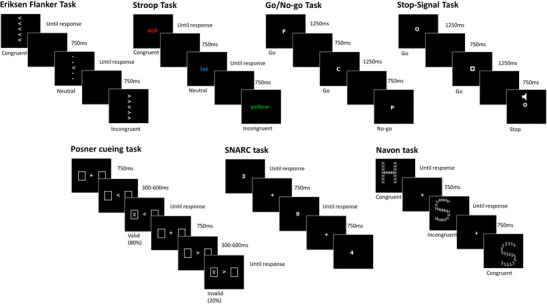
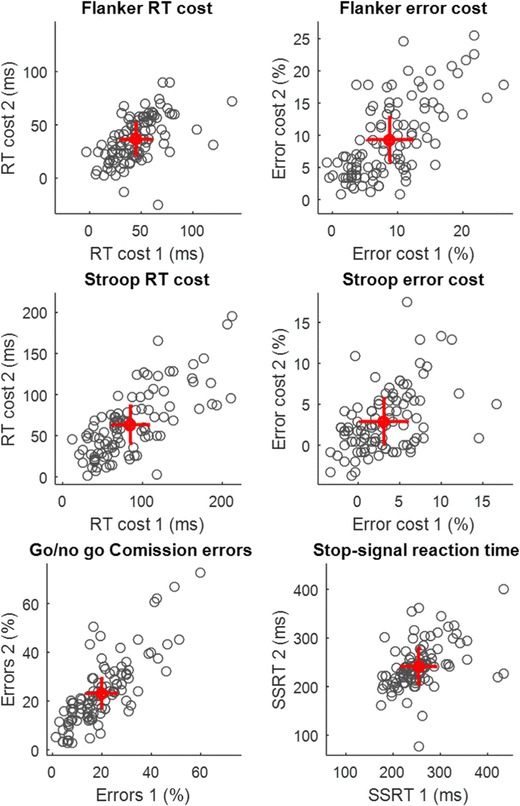
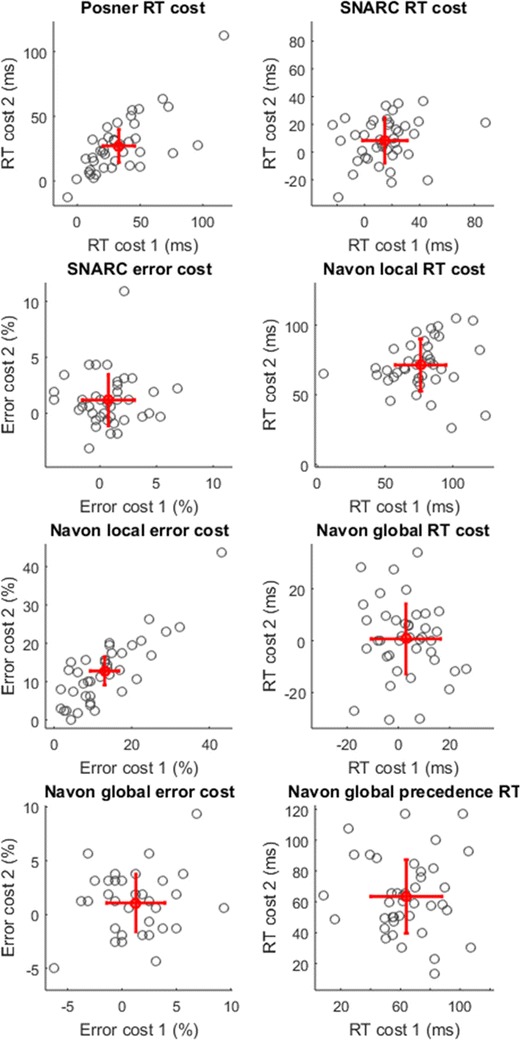
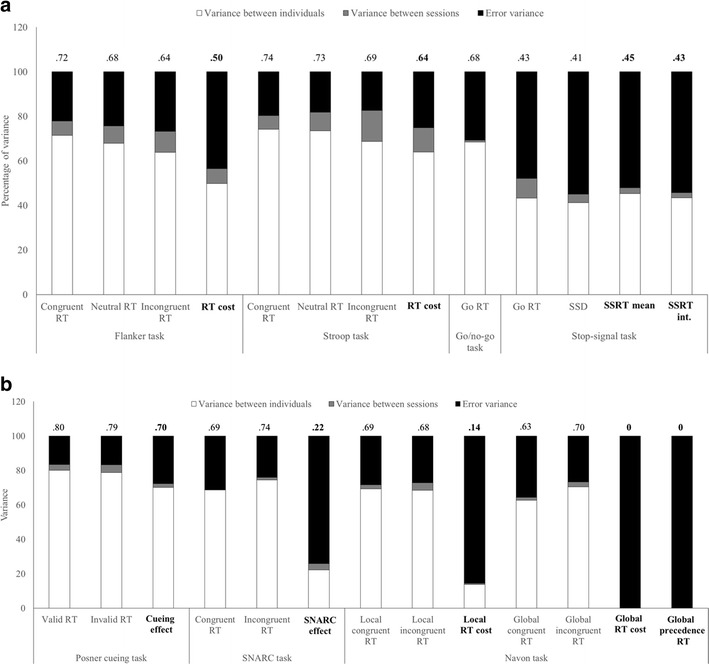
Individual differences in cognitive paradigms are increasingly employed to relate cognition to brain structure, chemistry, and function. However, such efforts are often unfruitful, even with the most well established tasks. Here we offer an explanation for failures in the application of robust cognitive paradigms to the study of individual differences. Experimental effects become well established - and thus those tasks become popular - when between-subject variability is low. However, low between-subject variability causes low reliability for individual differences, destroying replicable correlations with other factors and potentially undermining published conclusions drawn from correlational relationships. Though these statistical issues have a long history in psychology, they are widely overlooked in cognitive psychology and neuroscience today. In three studies, we assessed test-retest reliability of seven classic tasks: Eriksen Flanker, Stroop, stop-signal, go/no-go, Posner cueing, Navon, and Spatial-Numerical Association of Response Code (SNARC). Reliabilities ranged from 0 to .82, being surprisingly low for most tasks given their common use. As we predicted, this emerged from low variance between individuals rather than high measurement variance. In other words, the very reason such tasks produce robust and easily replicable experimental effects - low between-participant variability - makes their use as correlational tools problematic. We demonstrate that taking such reliability estimates into account has the potential to qualitatively change theoretical conclusions. The implications of our findings are that well-established approaches in experimental psychology and neuropsychology may not directly translate to the study of individual differences in brain structure, chemistry, and function, and alternative metrics may be required.
Overview
The claims and statistics of this paper haven’t been checked yet.
Free: it reads the open-access text and checks the first 5 claims that cite a source we can check. Create a free account to check every claim.
Integrity signals
Registry
Cites
Statistics
Figures
Verification
Claims the paper makes
The claims and statistics of this paper haven’t been checked yet.
Free: it reads the open-access text and checks the first 5 claims that cite a source we can check. Create a free account to check every claim.
Claims other papers make about this one
Each is checked against this paper’s own text: does it say what the citing paper says it does?
The source backs part of the claim, not all of it — or backs it for a different population, condition or comparison.
In the citing paper
“This contrast was used (cf. anticipation of social reward minus neutral outcomes) because reliability of difference scores is always lower than reliability of their individual parts,(53) which has been shown to diminish reliability of task-based fMRI(54) (see also(55)) and hinder mechanistic research.(56)”
From Amplification of Positivity Treatment for Anxiety and Depression: A Randomized Experimental Therapeutics Trial Targeting Social Reward Sensitivity to Enhance Social Connectedness (2024) · cites this paper as [53]
Experimental — accuracy not yet measuredThe source backs part of the claim, not all of it — or backs it for a different population, condition or comparison.
In the citing paper
“For the Stroop task, reliability was ρ congruent = .86, ρ incongruent = .82, and ρ interference = .78.”
From Problematic social media use and cognitive performance in young adults: Associations with selective attention and inhibitory control (2026) · cites this paper as Hedge, Powell, & Sumner, 2018
Experimental — accuracy not yet measuredThe cited source says what the claim attributes to it.
In the citing paper
“Further, it is often the case that cognitive tasks that produce robust effects in experimental settings are poorly suited for individual differences studies due to low between-participant reliability (Hedge et al. 2018).”
From Practicing Retrieval Facilitates Learning (2021) · cites this paper as Hedge et al. 2018
The check wasn’t confident either way, so it gives no verdict — never disputed.
In the citing paper
“For the Simon task, reliability was ρ_congruent = .84, ρ_incongruent = .81, and ρ_interference = .76.”
From Problematic social media use and cognitive performance in young adults: Associations with selective attention and inhibitory control (2026) · cites this paper as Hedge et al., 2018
Experimental — accuracy not yet measured
Self-check
Percentages, sums and reported differences re-computed from the paper’s own numbers.
The self-check needs the paper’s full text.
Citations
Cites
The Measurement of Observer Agreement for Categorical Data
Landis, J. R., & Koch, G. G. (1977) · Biometrics · doi:10.2307/2529310 · Cited by 81,148 · cited 4×
“Studies 1 and 2 None of the behavioral measures in Studies 1 and 2 (see Table 1) exceeded reliabilities of .8, typically considered excellent or of a clinically required standard (Cicchetti & Sparrow, 1981; Fleiss, 1981; Landis & Koch, 1977).”
BackgroundMethodResultInfluentialFaul, F., Erdfelder, E., Lang, A.-G., & Buchner, A. (2007) · Behavior Research Methods · doi:10.3758/bf03193146 · Cited by 65,971
Structural equation modeling in practice: A review and recommended two-step approach
Anderson, J. C., & Gerbing, D. W. (1988) · Psychological Bulletin · doi:10.1037/0033-2909.103.3.411 · Cited by 41,941
Statistical power analyses using G∗Power 3.1: tests for correlation and regression analyses
Faul, F., Erdfelder, E., Buchner, A., & Lang, A.-G. (2009) · Behavior Research Methods · doi:10.3758/brm.41.4.1149 · Cited by 37,615
Intraclass correlations: Uses in assessing rater reliability.
Shrout, P. E., & Fleiss, J. L. (1979) · Psychological Bulletin · doi:10.1037/0033-2909.86.2.420 · Cited by 24,532
Statistical Methods for Rates and Proportions
Fleiss, J. L., Levin, B., & Paik, M. C. (2003) · Wiley Series in Probability and Statistics · doi:10.1002/0471445428 · Cited by 18,646
Miyake, A., Friedman, N. P., Emerson, M. J., Witzki, A. H., Howerter, A., & Wager, T. D. (2000) · Cognitive Psychology · doi:10.1006/cogp.1999.0734 · Cited by 15,798
Review of Psychometric theory (2nd ed.).
SITGREAVES, R. (1979) · Contemporary Psychology: A Journal of Reviews · doi:10.1037/018882 · Cited by 11,425
Why Most Published Research Findings Are False
Ioannidis, J. P. A. (2005) · PLoS Medicine · doi:10.1371/journal.pmed.0020124 · Cited by 10,505
Posner, M. I. (1980) · Quarterly Journal of Experimental Psychology · doi:10.1080/00335558008248231 · Cited by 9,670 · cited 2×
“Study 3 Again, performance was comparable to previous reports in the literature (Navon, 1977; Posner, 1980; Rusconi et al., 2013).”
Research works printed but not linked: 7
- Crocker LM Algina J Introduction to Classicial and Modern Test Theory 1986 New York CBS College Publishing
- Hambleton RK Swaminathan H Rogers HJ Fundementals of Item Response Theory 1991 Newbury Park Sage
- Lynam DR Smith GT Whiteside SP Cyders MA The UPPS-P: Assessing give personality pathways to impulsive behavior (Technical Report) 2006 West Lafayette Purdue University
- Nunnally JC Psychometric theory 1978 2 New York. McGraw-Hill
- Peirce JW Introduction to Python and PsychoPy Perception 2013 42 2 3
- Rogosa D Gottman JM Myths and methods: "Myths about longitudinal research" plus supplemental questions The analysis of change 1995 Hillsdale Lawrence Ealbaum Associates pp. 3 65
- Zumbo BD Thompson B The simple difference score as an inherently poor measure of change: Some reality, much mythology Advances in Social Science Methodoloy 1999 Greenwich JAI Press pp. 269 304
Cited by
Items 901–1,000 of 1,003
Attentional Control in Subjective Cognitive Decline
Li, Y., Bian, J., & Li, Y. (2023) · Journal of Alzheimer s Disease · doi:10.3233/jad-230037 · Cited by 3
“We adopted the same list-wide and item-specific PCE tasks used in [41].”
Garobbio, S., Kunchulia, M., & Herzog, M. H. (2023) · Vision Research · doi:10.1016/j.visres.2023.108355 · Cited by 6
“…values for the Simon test might be attributed to the reliability paradox, that is, to the reduction of between-participants variance that is caused by how the difference score is derived from the incongruent and congruent conditions (Goodhew & Edwards, 2019; Hedge, Powell, & Sumner, 2018).”
Evans, T. C., Carlson, J. S., Zuberer, A., Fry, R., Agnoli, S., Britton, J. C., Degutis, J. M., & Esterman, M. S. (2024) · Motivation and Emotion · doi:10.1007/s11031-024-10076-z · Cited by 3
“Fourth, to facilitate analyses of covariance in individual differences research, SAAP task measures should robustly differ between individuals (Goodwin & Leech, 2006; Hedge et al., 2018; Martinez et al., 2020).”
Vasta, N., Xu, S., Verguts, T., & Braem, S. (2024) · Memory & Cognition · doi:10.3758/s13421-024-01626-4 · Cited by 5
“Hence, considering the aforementioned issue with difference scores (Hedge et al., 2018), we expected their reliability to be rather low as well.”
InfluentialMotka, F., Wittekind, C. E., Ascone, L., & Kühn, S. (2024) · Behaviour Research and Therapy · doi:10.1016/j.brat.2024.104672 · Cited by 4
Hu, Z., Zhang, Z., Li, H., & Yang, L. (2024) · Behavior Research Methods · doi:10.3758/s13428-024-02584-0 · Cited by 4
“This is often measured using the intra-class correlation (ICC) (Hedge et al., 2018), with higher ICC values indicating lower measurement error.”
Schneider, S., Hofmann, M. J., & Mokros, A. (2025) · Scientific Reports · doi:10.1038/s41598-025-91652-2 · Cited by 3
“A possible reason for the small magnitude of relationships found between psychopathic traits and AAT response latencies could be the so-called reliability paradox 50 .”
Thompson, C. R., Trawiński, T., Beevers, D., Harrison, N., & Donnelly, N. (2025) · Journal of Cognitive Psychology · doi:10.1080/20445911.2025.2495154 · Cited by 4
Revisiting Spontaneous Trait Inferences: Questions, Challenges, and Intradisciplinary Connections
Degner, J. (2025) · Social and Personality Psychology Compass · doi:10.1111/spc3.70072 · Cited by 3
Witte, K., Thalmann, M., & Schulz, E. (2025) · Scientific Reports · doi:10.1038/s41598-025-09152-2 · Cited by 9
“Difference measures are moreover known to have a stronger contamination by error variance 40,41,88 , which reduces their reliability.”
Psychometric Considerations in Assessing Fear Generalization as a Predictor of Anxiety
Stegmann, Y., Reutter, M., Hutterer, K., Hildebrandt, L. K., Deckert, J., Deserno, L., Domschke, K., Lonsdorf, T. B., Pauli, P., Reif, A., et al. (2025) · Biological Psychiatry Global Open Science · doi:10.1016/j.bpsgos.2025.100570 · Cited by 7
“Numerous indices to quantify individual fear generalization profiles have been proposed, but their psychometric properties, which are key for the prediction of individual differences (22,23), remain largely unexplored.”
Sosa, R. (2022) · Adaptive Behavior · doi:10.1177/10597123221097451 · Cited by 7
“This may be explained by poor psychometric properties associated with behavioral measures (Hedge et al. 2018).”
BackgroundRelating psychiatric symptoms and self-regulation during the COVID-19 crisis
Vaghi, M. M. S., Hagen, M. P., Jones, H. M., Mumford, J. A., Bissett, P. G., & Poldrack, R. A. (2022) · Translational Psychiatry · doi:10.1038/s41398-022-02030-9 · Cited by 3
“Formal analytical work has further clarified why tasks might be unsuitable to capture individual differences, as, by construction, they are characterized by low between—subject variability [28, 29].”
BackgroundFinn, P., Nemes, L., Bailey, A., Gunn, R. L., Wiemers, E. A., & Redick, T. S. (2022) · Journal of Cognitive Enhancement · doi:10.1007/s41465-022-00241-y · Cited by 6
“While these tasks consistently produce reliable and robust differences between congruent and incongruent conditions (Hedge et al., 2018), the use of difference scores to operationally define inhibitory ability can be problematic for individual difference analyses (Draheim et al.”
BackgroundGenetic variance in conscientiousness relates to youth psychopathology beyond executive functions.
Shields, A. N., Malanchini, M., Vinnik, L., Tucker–Drob, E. M., Harden, K. P., & Tackett, J. L. (2022) · Journal of Psychopathology and Clinical Science · doi:10.1037/abn0000781 · Cited by 6
Miyamoto, K., Taniyama, Y., Hine, K., & Nakauchi, S. (2023) · i-Perception · doi:10.1177/20416695231196835 · Cited by 6
“A previous study recommended the use of reaction time with the z-score to account for the difference of the individual processing speed (Hedge et al., 2018).”
MethodLee, H. J., Kang, J., Yu, H., Lim, C. E., Oh, E., Choi, J. M., You, S., & Cho, Y. S. (2023) · PLoS ONE · doi:10.1371/journal.pone.0295041 · Cited by 3
Fricke, K., Alexander, N., Jacobsen, T., & Vogel, S. (2023) · Scientific Reports · doi:10.1038/s41598-023-49864-x · Cited by 8
Reliability of the serial reaction time task: If at first you don’t succeed, try, try, try again
Oliveira, C. M., Hayiou‐Thomas, M. E., & Henderson, L. M. (2024) · Quarterly Journal of Experimental Psychology · doi:10.1177/17470218241232347 · Cited by 12
“The use of difference scores has been suggested as a contributing factor to poor reliability as such scores can reduce the signal-to-noise ratio (Hedge et al., 2018).”
InfluentialNon-clinical hallucinations and mental imagery across sensory modalities
Rogers, L. P. W., Yeebo, M. F., Collerton, D., Moseley, P., & Dudley, R. E. J. (2024) · Cognitive Neuropsychiatry · doi:10.1080/13546805.2024.2313467 · Cited by 4
Distinct but related abilities for visual and haptic object recognition
Chow, J. K., Palmeri, T. J., & Gauthier, L. (2024) · Psychonomic Bulletin & Review · doi:10.3758/s13423-024-02471-x · Cited by 5
“On the other hand, constructs that appear related in group-average studies can dissociate in analyses of individual differences for reasons that include heterogeneity in the population and the prominence of measurement errors and reliability issues in many cognitive measures (Hedge et al., 2017).”
Flanker interference at both stimulus and response levels decreases with age
Chiaro, N. V. D., & Holmes, N. P. (2024) · Experimental Brain Research · doi:10.1007/s00221-023-06773-9 · Cited by 5
“In one study, Hedge et al. (2018) showed a relatively low test–retest reliability (between 0.40 and 0.57) of the arrow-based Flanker task when testing homogeneous groups of mostly young adult psychology undergraduate students from a university population.”
BackgroundInfluentialThe value of error-correcting responses for cognitive assessment in games
Markovitch, B., Evans, N. J., & Birk, M. V. (2024) · Scientific Reports · doi:10.1038/s41598-024-71762-z · Cited by 6
“Typical conflict-based cognitive assessment tools face criticism for being boring 1,4 and behaviorally restrictive 3,4 while achieving limited psychometric reliability 16 .”
BackgroundGaze behavior in response to affect during natural social interactions
Vehlen, A., Belopolsky, A. V., & Domes, G. (2024) · Frontiers in Psychology · doi:10.3389/fpsyg.2024.1433483 · Cited by 5
Yuan, J., Shi, G., Zhang, Q., & Cui, L. (2024) · Psychophysiology · doi:10.1111/psyp.14724 · Cited by 3
“Although the reliability of RT-based measures in the dot-probe task has been questioned by some studies (Waechter et al., 2014; Waechter & Stolz, 2015), the reliability issue mainly arises from individual differences in research rather than task-based effects (Hedge et al., 2018).”
Lin, Y.-T., & Leber, A. B. (2025) · Journal of Experimental Psychology Learning Memory and Cognition · doi:10.1037/xlm0001398 · Cited by 5
Temporal binding: Task-dependent variations and reliability across experimental paradigms
de Azevedo, G. B., Cravo, A. M., & Buehner, M. J. (2024) · Attention Perception & Psychophysics · doi:10.3758/s13414-024-02996-2 · Cited by 8
“To assess the internal reliability of our temporal binding measures and sessions, we conducted a Monte Carlo analysis with 5,000 iterations, following suggested guidelines (Hedge et al., 2018; Parsons et al., 2019; Pronk et al., 2022).”
InfluentialInhibition of emotional faces in clinical and subclinical depression
Ridout, N., Dritschel, B., Wardall, H., Day, R. K., & O’Carroll, R. E. (2025) · Journal of Psychiatric Research · doi:10.1016/j.jpsychires.2025.01.025 · Cited by 4
von Seth, J., Aller, M., & Davis, M. H. (2025) · The Journal of the Acoustical Society of America · doi:10.1121/10.0034846 · Cited by 7
Gómez, P., Marcet, A., Rocabado, F., & Perea, M. (2025) · Psychological Research · doi:10.1007/s00426-025-02080-w · Cited by 4
“The questions and methodologies that have under-pinned cognitive psychology since its beginnings primarily focus on establishing whether an effect, such as the trans-posed-letter effect, is present at a population level (Rouder & Haaf, 2021), (Rouder andMehrvarz2024), (Hedge et al. 2018).”
Pupil size tracks attentional breadth in the Navon task
Teunisse, M. K., Koevoet, D., Baarda, Y., Paffen, C. L. E., der Stigchel, S. V., & Strauch, C. (2025) · Perception · doi:10.1177/03010066251345778 · Cited by 5
“While the Navon task is frequently used to measure attentional breadth, its limited reliability (Dale & Arnell, 2013; Hedge et al., 2018) and reliance on overt manual responses that might affect attentional breadth itself and only provide snapshot insights pose limitations.”
Impressions on the current state of cognitive neuroscience in occupational measurement
Williams, H., & Lewis, J. E. (2020) · Progress in brain research · doi:10.1016/bs.pbr.2020.05.032 · Cited by 4
TRANSFERABLE INHIBITION OF DIRECT SUPPRESSION: EVIDENCE FROM A DOT-PROBE TASK
Nishiyama, S., & Saito, S. (2021) · PSYCHOLOGIA · doi:10.2117/psysoc.2020-a112 · Cited by 4
“Hedge et al. (2018) demonstrated that robust cognitive tasks usually lead to low individual differences, in which it is difficult to make a correlation-based prediction simultaneously.”
BackgroundNo Meaningful Difference in Attentional Bias Between Daily and Non-Daily Smokers
Bartlett, J. E., Jenks, R. A., & Wilson, N. (2022) · Journal of Trial and Error · doi:10.36850/e11 · Cited by 4
Bujedo, J. G., Domínguez‐Salas, S., Pérez-Moreno, P. J., Barreno, E. M., & Lozano, O. M. (2019) · The American Journal of Drug and Alcohol Abuse · doi:10.1080/00952990.2018.1559848 · Cited by 3
“studies that analyze the test–retest reliability in tests that measure reaction times, some of which are found in tests such as the Drug Stroop or visual probe test, with results that are similar to or even lower than those found in the present study (40,41).”
ResultCurrent Directions in Psychiatric Classification: From the DSM to RDoC
Persson, B. N. (2019) · Contemporary clinical neuroscience · doi:10.1007/978-3-319-90065-0_11 · Cited by 4
Fox, E., & Keers, R. (2019) · Nebraska Symposium on Motivation/The Nebraska symposium on motivation · doi:10.1007/978-3-030-27473-3_4 · Cited by 3
Variable Self-Efficacy as a Measurement for Behaviors in Cyber Security Operations
Lugo, R. G., Knox, B. J., Jøsok, Ø., & Sütterlin, S. (2020) · Lecture notes in computer science · doi:10.1007/978-3-030-50439-7_27 · Cited by 5
Simultaneous modeling of reaction times and brain dynamics in a spatial cueing task
Steinkamp, S. R., Fink, G. R., Vossel, S., & Weidner, R. (2021) · Human Brain Mapping · doi:10.1002/hbm.25758 · Cited by 2
Need for cognition does not account for individual differences in metacontrol of decision making
Bolenz, F., Profitt, M., Stechbarth, F., Eppinger, B., & Strobel, A. (2022) · Scientific Reports · doi:10.1038/s41598-022-12341-y · Cited by 4
Kovacs, K., & Conway, A. R. A. (2020) · Journal of Applied Research in Memory and Cognition · doi:10.1016/j.jarmac.2020.04.005 · Cited by 3
Who Is and Is Not "Average'"? Random Effects Selection with Spike-and-Slab PriorsPreprint
Rodriguez, J. E., Williams, D. R., & Rast, P. (2021) · doi:10.31234/osf.io/4d9tv · Cited by 3
What should comparative cognition expect from direct replication studies?Preprint
Farrar, B. G., & Clayton, N. S. (2019) · PsyArXiv (OSF Preprints) · doi:10.31234/osf.io/4urm8 · Cited by 3
Individual differences in mathematical cognition: a Bert's eye viewPreprint
Smedt, B. D. (2022) · doi:10.31219/osf.io/cps3h · Cited by 3
Margaretto, B. B., & Brysbaert, M. (2022) · doi:10.31234/osf.io/ypu9w · Cited by 3
Neuro-cognitive processes as mediators of psychological treatment effectsPreprint
Reiter, A. M. F., Atiya, N. A. A., Berwian, I. M., & Huys, Q. J. M. (2020) · PsyArXiv (OSF Preprints) · doi:10.31234/osf.io/wz5rd · Cited by 4
“One potentially addressable reason might be poor psychometric properties of commonly used tasks, including poor test-retest validity [46,47].”
BackgroundZech, H., Waltmann, M., Lee, Y., Reichert, M., Bedder, R. L., Rutledge, R. B., Deeken, F., Wenzel, J. G., Wedemeyer, F., Aguilera, A., et al. (2022) · doi:10.31234/osf.io/6mhsw · Cited by 3
Xu, I., Passell, E. J., Strong, R. W., Grinspoon, E. A., Wu, C. Y., Jung, L., Wilmer, J. B., & Germine, L. T. (2022) · doi:10.31234/osf.io/58z4n · Cited by 3
Validation and optimization of the Japanese version of the Adult Executive Functioning InventoryPreprint
Kawagoe, T., Kanekama, Y., & Rupp, M. J. (2022) · medRxiv · doi:10.1101/2022.11.16.22282379 · Cited by 3
Roth, L., Jordan, V., Schwarz, S., Willmes, K., Nuerk, H., van Dijck, J., & Cipora, K. (2023) · doi:10.31234/osf.io/g4bjq · Cited by 3
Blott, L. M., Gowenlock, A. E., Kievit, R., Nation, K., & Rodd, J. M. (2023) · doi:10.31234/osf.io/rjubm · Cited by 3
Rouder, J. N., & Mehrvarz, M. (2023) · doi:10.31234/osf.io/xm6pn · Cited by 3
Moretti, L., Koch, I., Hornjak, R., & von Bastian, C. C. (2023) · doi:10.31234/osf.io/ndjy6 · Cited by 3
Ahmed, S. F., Kelly, D. P., Waters, N. E., & Chaku, N. (2023) · Elsevier eBooks · doi:10.1016/b978-0-323-96023-6.00057-9 · Cited by 7
Reliability of task-based fMRI in the dorsal horn of the human spinal cordPreprint
Dabbagh, A., Horn, U., Kaptan, M., Mildner, T., Müller, R., Lepsien, J., Weiskopf, N., Brooks, J. C. W., Finsterbusch, J., & Eippert, F. (2023) · bioRxiv (Cold Spring Harbor Laboratory) · doi:10.1101/2023.12.22.572825 · Cited by 3
Attentional Control Data Collection: A Resource for Efficient Data ReusePreprint
Haaf, J. M., Hoffstadt, M., & Lesche, S. (2024) · PsyArXiv (OSF Preprints) · doi:10.31234/osf.io/4evy6 · Cited by 8
How to Measure Fear Generalization? Reliability and Validity of Commonly Used IndicesPreprint
Stegmann, Y., Reutter, M., Hutterer, K., Hildebrandt, L. K., Deckert, J., Deserno, L., Lonsdorf, T. B., Domschke, K., Pauli, P., Reif, A., et al. (2024) · doi:10.31234/osf.io/fk26y · Cited by 3
Sicorello, M., Gianaros, P. J., Wright, A. G. C., Bogdan, P., Kraynak, T. E., Manuck, S. B., Schmahl, C. G., & Wager, T. D. (2025) · bioRxiv (Cold Spring Harbor Laboratory) · doi:10.1101/2025.05.15.653674 · Cited by 3
Hudson, C. C., Traynor, J. M., Björgvinsson, Þ., Beard, C., Forgeard, M. J. C., & Hsu, K. J. (2024) · Behaviour Research and Therapy · doi:10.1016/j.brat.2024.104476 · Cited by 3
Intergroup evaluative bias in facial representations of immigrants and citizens in the United States
Hutchings, R. J., Morgan, I., Sherman, J. W., & Todd, A. R. (2024) · PLoS ONE · doi:10.1371/journal.pone.0306872 · Cited by 2
Openness to experience predicts eye movement behavior during scene viewing
Wyche, N. J., Edwards, M., & Goodhew, S. C. (2024) · Attention Perception & Psychophysics · doi:10.3758/s13414-024-02937-z · Cited by 4
“2 Reliable effects are crucial for further analysis in individual-differences designs, as reliability constrains the strength of any relationships that can be observed between tasks (Goodhew & Edwards, 2019; Hedge et al., 2018; Parsons et al., 2019; Spearman, 1910).”
Psychometric Assessment of the Temporal Bisection Task with Discrete and Continuous Response Formats
Quan, I., Lagacé-Cusiac, R., & Grahn, J. A. (2024) · Timing & Time Perception · doi:10.1163/22134468-bja10114 · Cited by 2
Motka, F., Kühn, S., & Wittekind, C. E. (2025) · Addiction · doi:10.1111/add.70003 · Cited by 3
“The main findings of the complementary analyses were: (1) whose results should be interpreted with caution [37].”
The keyboards are (still) all right in response time experiments
Gómez, P., Perea, M., & Baciero, A. (2025) · Behavior Research Methods · doi:10.3758/s13428-025-02637-y · Cited by 2
“For this reason, we explored those two forms of variability in our simulations (for a more complete treatment of the issues around variability between and within participants, see Hedge et al., 2018; Rouder et al., 2023).”
Are we attending to climate change? A systematic review of the cognitive science literature
Carlson, J. M., Fang, L., Weiler, M., & Dawson, A. J. (2025) · Cognitive Processing · doi:10.1007/s10339-025-01284-7 · Cited by 2
Rey-Mermet, A., Singmann, H., & Oberauer, K. (2025) · Psychonomic Bulletin & Review · doi:10.3758/s13423-025-02696-4 · Cited by 13
Bilingual language control in oral language production: an overview and outlook
Xue, Q., Xu, J., & Chen, L. (2025) · Cognitive Processing · doi:10.1007/s10339-025-01297-2 · Cited by 2
“In practice, however, even bilinguals with relatively stable cognitive abilities may engage varying levels of control depending on the specific demands of each task (Hedge et al. 2018; Salig et al. 2021).”
A longitudinal exploration of inhibitory control in children with Developmental Language Disorder
Guirado-Moreno, J. L., Sanchez-Azanza, V. A., Esteller, À., Aguilar-Mediavilla, E. M., & Adrover‐Roig, D. (2025) · Journal of Communication Disorders · doi:10.1016/j.jcomdis.2025.106561 · Cited by 3
Representational context modulates the direction and transiency of practice effects on SNARC
Palaz, E., Çetınkaya, H., & Dural, S. (2025) · Quarterly Journal of Experimental Psychology · doi:10.1177/17470218251376338 · Cited by 2
“Cognitive tasks, specifically parity judgment tasks for measuring the SNARC effect have been considered not very reliable (Hedge et al., 2018; Viarouge et al., 2014).”
Casanova, A., Rodríguez, C., Ferreira, R. A., & Miranda, I. (2025) · Applied neuropsychology. Child · doi:10.1080/21622965.2025.2552198 · Cited by 4
Stable tendencies in spontaneous working memory usage during flexible behaviour
Kumle, L., Li, A. X., Kovoor, J., Rock, A. G., Hesselink, E., Jones, E., Brosnan, M. B., Nobre, A. C., & Draschkow, D. (2026) · Psychonomic Bulletin & Review · doi:10.3758/s13423-026-02955-y · Cited by 5
“This “reliability paradox” reflects the fact that group-level effects are strongest when between-participant variance is low, whereas reliable measurement of individual differences depends on substantial between-participant variability (Hedge et al., 2018).”
Michon, K. J., Zhou, Q., Osborne, J. B., Beltz, A. M., Jonides, J., Simmonite, M., & Polk, T. A. (2025) · Imaging Neuroscience · doi:10.1162/imag.a.995 · Cited by 2
“The Stroop effect, or the slowing of responses when participants view a color word in an incongruent ink color, is very reliable in the sense that it has been replicated many times ( Hedge et al., 2018).”
InfluentialGame-Based Cognitive Aging Assessment: Toward a Digital Biomarker of Cognitive Health
Markovitch, B., Markopoulos, P., & Birk, M. V. (2025) · Digital Biomarkers · doi:10.1159/000548350 · Cited by 4
“Tunnel Runner’s level of predictive accuracy is a notable achievement given the relative ease and low costs of obtaining the game’s metrics, and the relative instability of behavioral measures [35].”
Multimodal prediction of future depressive symptoms in adolescents
Wang, L., Zhou, N., Jaffe, N. M., Pidvirny, K., Tierney, A. O., Fisher, H., Morfini, F., Forbes, E. E., Pizzagalli, D. A., Cai, T., et al. (2025) · BMC Psychiatry · doi:10.1186/s12888-025-07665-8 · Cited by 4
Dück, K., Overmeyer, R., Eger, L., & Endraß, T. (2025) · Personality Science · doi:10.1177/27000710251408750 · Cited by 2
“Hedge et al. (2018) further highlight the reliability paradox: Cognitive behavioral tasks are optimized to minimize between-subjects variability to detect within-subject effects, which limits their utility for capturing individual differences, in contrast to self-report scales, which rely on such…”
Haller, P., Ding, C., Stegenwallner-Schütz, M., Reich, D. R., Koncic, I., Makowski, S., & Jäger, L. A. (2025) · Cognitive Science · doi:10.1111/cogs.70121 · Cited by 6
“As argued above, the measurement reliability of individual differences demands empirical support due to the reliability paradox described by Hedge et al. (2018).”
Rahmati, Y., & Jarrold, C. (2026) · PLoS ONE · doi:10.1371/journal.pone.0339846 · Cited by 3
“Another possible explanation, noted by Hedge et al. [119], is that well-established experimental effects derived from cognitive tasks might, almost by definition, lack the degree of individual differences needed to allow for correlations with other factors.”
The role of context in continuity and segmentation
Baror, S., Cohen, M., Haik, N., Avraham, G., & Ben-Yakov, A. (2026) · Nature Human Behaviour · doi:10.1038/s41562-026-02403-w · Cited by 6
Wilkey, E. D., Gilmore, C. K., & Cragg, L. (2026) · Journal of Cognition and Development · doi:10.1080/15248372.2026.2629825 · Cited by 3
“Second, the limitations of EF tasks as measures of individual differences have been increasingly recognized (e.g., Hedge et al., 2018; Judd et al., 2024; Langner et al., 2023; Rouder et al., 2023).”
From symptoms to signatures: a transdiagnostic predictive coding framework for precision psychiatry
Lyndon, S. (2026) · Nature Mental Health · doi:10.1038/s44220-026-00607-7 · Cited by 2
Delayed goal-directed processing underlies inhibitory control challenges in adult ADHD
Osborne, J. B., Sellers, J., Zhang, H., Wang, S., Liberatore, S., Sripada, C., Shah, P., & Jonides, J. (2026) · Scientific Reports · doi:10.1038/s41598-026-42307-3 · Cited by 2
Joint Cognitive Models Reveal Sources of Robust Individual Differences in Conflict Processing
Molloy, M. F., Lee, T. G., Jonides, J., Zhang, H., Sellers, J., Heathcote, A., Sripada, C., & Weigard, A. S. (2026) · Computational Brain & Behavior · doi:10.1007/s42113-026-00263-1 · Cited by 5
“First, within two large datasets from Hedge et al. (2018) and Eisen-berg et al. (2019) containing test and retest sessions for the Simon, Stroop, and Flanker tasks, we determine which conflict LBA model mechanisms are necessary to explain choice and response time in each task and sample.”
Exploring the link between sensory habituation in everyday life and attentional control abilities
Tarantino, V., Santostefano, A., Oliveri, M., Mento, G., Mandolesi, L., & Turriziani, P. (2026) · Scientific Reports · doi:10.1038/s41598-026-44401-y · Cited by 2
“Interestingly, Hedge et al. (2018) quantified the ability of classical cognitive tasks to rank individual differences using the Intraclass Correlation Coefficient (ICC) 49 .”
Are there Reliable Qualitative Individual Differences in Cognition? Probably Not
von Bastian, C. C. (2021) · Journal of Cognition · doi:10.5334/joc.174 · Cited by 2
Qualitative Individual Differences are Useful, but Reliability Should be Assessed and Not Assumed
Hedge, C. (2021) · Journal of Cognition · doi:10.5334/joc.169 · Cited by 2
Self-citationDonnelly, S., & Kidd, E. (2021) · Frontiers in Psychology · doi:10.3389/fpsyg.2021.661022 · Cited by 5
“These results may be further evidence of the argument that tasks developed to perform well in experimental paradigms may not be suitable for individual difference studies (Hedge et al., 2018).”
BackgroundResultUnderstanding the role of subpopulations and reliability in between-group studies
Wang, S., & Boeck, P. D. (2022) · Behavior Research Methods · doi:10.3758/s13428-021-01700-8 · Cited by 3
A spurious correlation between difference scores in evidence-accumulation model parameters
Grange, J. A., & Schuch, S. (2022) · Behavior Research Methods · doi:10.3758/s13428-022-01956-8 · Cited by 5
“One problem is the so-called “reliability paradox” (Hedge et al., 2017): It has repeatedly been observed that standard experimental effects such as the Stroop effect, the Simon effect, or the task-switch cost—effects that have been replicated in thousands of studies—have surprisingly low split-half…”
BackgroundBeauchene, C., Hinault, T., Sarma, S. V., & Courtney, S. M. (2022) · Computational Brain & Behavior · doi:10.1007/s42113-022-00153-2 · Cited by 2
“While many task performance measures have poor test-retest reliability (Hedge et al., 2018), the coefficients identified using a similar modeling approach may help better characterize individual differences, because they measure specific factors that feed into performance.”
BackgroundThe test–retest reliability of the retrieval practice effect
de Lima, M. F. R., & Buratto, L. G. (2022) · Quarterly Journal of Experimental Psychology · doi:10.1177/17470218221141586 · Cited by 3
“In this study, we attempted to show that a reliable experimental effect at the group level is not a sufficient condition to assume that we have a strong case for a reliable/stable individual-difference variable at the participant level (cf. Hedge et al., 2018).”
InfluentialEmpathic pain observation does not influence automatic imitation in an online setting
Galang, C. M., & Obhi, S. S. (2022) · Experimental Brain Research · doi:10.1007/s00221-022-06508-2 · Cited by 3
Respiratory and cardiac interoceptive sensitivity in the first two years of life
Tünte, M. R., Hoehl, S., Wunderwald, M., Bullinger, J., Boyadziheva, A., Maister, L., Elsner, B., Tsakiris, M., & Kayhan, E. (2025) · eLife · doi:10.31234/osf.io/vbtzq · Cited by 3
Meyerhoff, H. S., Stegemann, M. J., & Frings, C. (2023) · Multisensory Research · doi:10.1163/22134808-bja10100 · Cited by 2
The Impact of Interpreting Training Experience on the Attentional Networks and Their Dynamics
Xing, S., & Yang, J. (2023) · Brain Sciences · doi:10.3390/brainsci13091306 · Cited by 8
“Thirdly, most tasks used to measure individual differences in attention need better reliability [87–89].”
MethodNegative affective priming: Reliability and associations with depression symptoms in three samples
Quigley, L., Dobson, K. S., Russell, K., & Sears, C. R. (2023) · Behavior Research Methods · doi:10.3758/s13428-023-02248-5 · Cited by 2
“…of the NAP effect is problematic for statistical testing of any between-participant effects, whether individual continuous scores or group means are analyzed, although the latter context may be less ill-fated if the difference between group means is sufficiently large (Hedge et al., 2018).”
InfluentialPsychometrics and Cognitive Research: Contradictions and Possibility for Cooperation
Kuzmina, Y. V. (2023) · Voprosy Obrazovaniya/ Educational Studies Moscow · doi:10.17323/vo-2023-16875 · Cited by 3
Local but not global graph theoretic measures of semantic networks generalize across tasks
Robinson, M. M., DeStefano, I. C., Brady, T. F., & Vul, E. (2023) · Behavior Research Methods · doi:10.3758/s13428-023-02271-6 · Cited by 4
“…not unique to this research domain, but reflect a deeper challenge faced by all behavioral researchers when measuring individual differences (e.g., Hedge et al., 2018), as well as unobservable constructs, which is validating their choice of measurement (for related discussions see literature on…”
The role of visual working memory in capacity-limited cross-modal ensemble coding
Gillies, G., Fukuda, K., & Cant, J. S. (2023) · Neuropsychologia · doi:10.1016/j.neuropsychologia.2023.108745 · Cited by 2
Revisiting the ownership effect in adults with and without autism
Smith, M., Williams, D. M., Lind, S. E., & Ferguson, H. J. (2023) · PLoS ONE · doi:10.1371/journal.pone.0293898 · Cited by 2
Charvis, J. S., Vergara‐Lopez, C., Valencia, E. M. H., Fernandez, M. E., Rozum, W., & Lopez-Vergara, H. I. (2024) · The American Journal of Drug and Alcohol Abuse · doi:10.1080/00952990.2024.2316599 · Cited by 3
“…in empirical estimates of reliability that have occurred within the correlational “frac-ture” of psychology, there has been very little research applying modern psychometrics to methods that have emerged from the experimental “fracture” of psychology (e.g., experimental tasks) (e.g (2,3,18).”
Metadata
- Authors
- Hedge, C., Powell, G., & Sumner, P.
- Affiliations
- Cardiff University (GB)
- Corresponding author
- Hedge, Craig
- Venue
- Behavior Research Methods
- Published
- 2017-07-19
- Volume
- 50
- Issue
- 3
- Pages
- 1166-1186
- ISSN
- 1554-351X (ISSN-L)
- 1554-3528
- PMC
- PMC5990556
- OpenAlex
- W2724821146
- Cited by
- 1,457
- References
- 150
- Citations by year
- 2026: 165 · 2025: 168 · 2024: 178 · 2023: 207 · 2022: 188 · 2021: 192 · 2020: 175 · 2019: 111 · 2018: 61 · 2017: 9
- FWCI
- 125.87
- Type
- journal article
- Language
- en
- Open access
- hybrid
- doi.org
- Locations
- Behavior Research Methods (publishedVersion, cc-by)
- Europe PMC (PubMed Central) (publishedVersion, other-oa)
- PubMed Central (publishedVersion, cc-by)
- PubMed (publishedVersion)
- ORCA Online Research @Cardiff (Cardiff University) (acceptedVersion)
- Aston Publications Explorer (Aston University) (submittedVersion, cc-by)
- OSF Preprints (OSF Preprints) (submittedVersion)
- Funders
- Wellcome Trust (104943/Z/14/Z)
- Economic and Social Research Council (ES/K002325/1)
- Topics
- Social Sciences › Psychology › Experimental and Cognitive Psychology › Cognitive Abilities and Testing
- Social Sciences › Decision Sciences › Management Science and Operations Research › Psychometric Methodologies and Testing
- Life Sciences › Neuroscience › Cognitive Neuroscience › Neural and Behavioral Psychology Studies
- Keywords
- individual differences, test-retest reliability, between-subject variability, measurement reliability, cognitive paradigm, flanker task, Stroop task, stop-signal task, go/no-go task, Navon task, SNARC effect, neuropsychology, brain structure and cognition
- MeSH terms
- Brain, Cognition, Cues, Female, Humans, Individuality, Male, Neuropsychology, Reaction Time, Task Performance and Analysis, Reproducibility of Results
About these checks
Registry, retraction, Cites and statistics results are computed, not judged, with one exception: a printed reference that no index lists is read once by a model before it counts as a citation error. Claims are extracted by a model and kept only when their quote appears verbatim in the text; each cited source is then checked, with a model’s help, for whether it says what the claim relies on. Those verdicts can be wrong — read the claim’s quote and the cited source before relying on one.
Statistics and arithmetic are recomputed, not judged.
Confidence bands are shown only for fields calibrated on our annotated test set. None is calibrated yet, so no band is shown.
What counts as a claim ›How we measure confidence ›How we check this ›
Are you an author, or do you see a problem with this page? Request a review
Data sources
Bibliographic data: Semantic Scholar, OpenAlex, Crossref.
Contains information from the Semantic Scholar Academic Graph Datasets, made available under the ODC Attribution License (ODC-BY 1.0).
Semantic Scholar’s data is described in: Kinney, R., et al. (2023). The Semantic Scholar Open Data Platform. arXiv:2301.10140.
