

The reliability paradox: Why robust cognitive tasks do not produce reliable individual differences
Open accessThe DOI matches its Crossref record; 146 of the 150 references it cites were found in a registry or an index.
Abstract
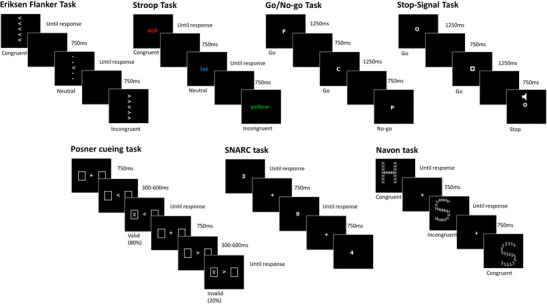
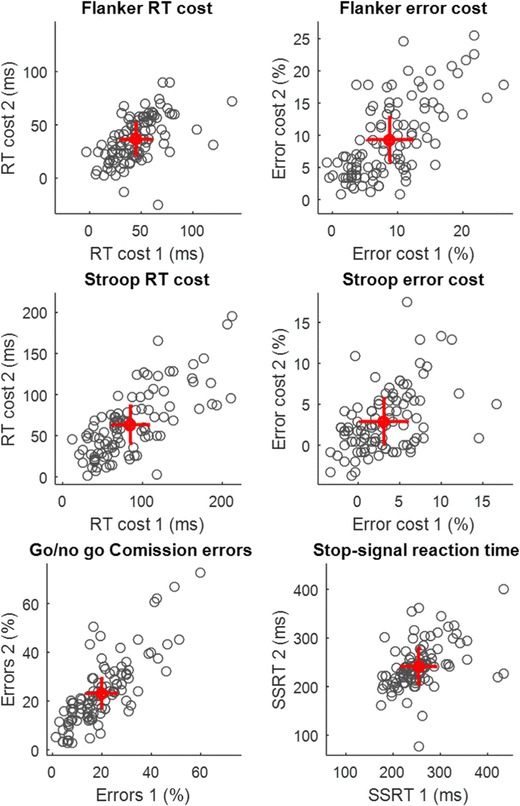
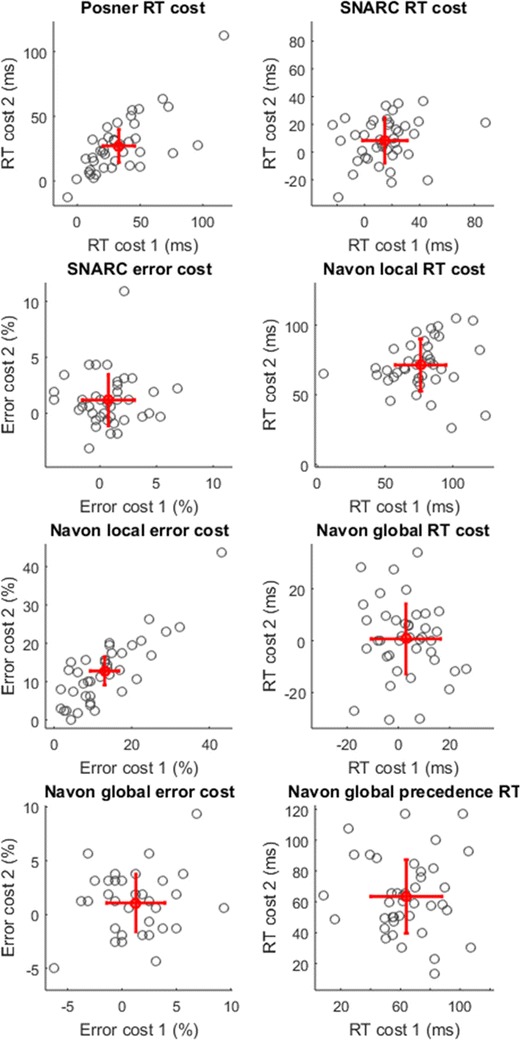
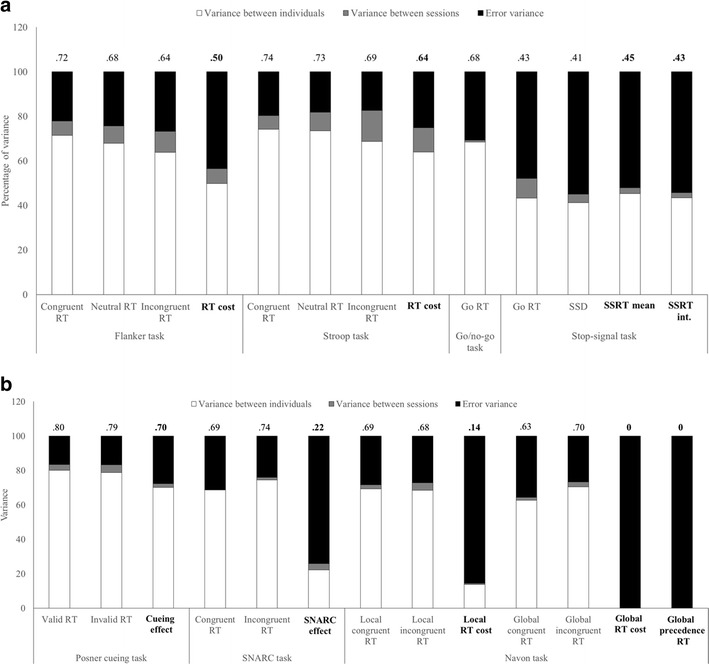
Individual differences in cognitive paradigms are increasingly employed to relate cognition to brain structure, chemistry, and function. However, such efforts are often unfruitful, even with the most well established tasks. Here we offer an explanation for failures in the application of robust cognitive paradigms to the study of individual differences. Experimental effects become well established - and thus those tasks become popular - when between-subject variability is low. However, low between-subject variability causes low reliability for individual differences, destroying replicable correlations with other factors and potentially undermining published conclusions drawn from correlational relationships. Though these statistical issues have a long history in psychology, they are widely overlooked in cognitive psychology and neuroscience today. In three studies, we assessed test-retest reliability of seven classic tasks: Eriksen Flanker, Stroop, stop-signal, go/no-go, Posner cueing, Navon, and Spatial-Numerical Association of Response Code (SNARC). Reliabilities ranged from 0 to .82, being surprisingly low for most tasks given their common use. As we predicted, this emerged from low variance between individuals rather than high measurement variance. In other words, the very reason such tasks produce robust and easily replicable experimental effects - low between-participant variability - makes their use as correlational tools problematic. We demonstrate that taking such reliability estimates into account has the potential to qualitatively change theoretical conclusions. The implications of our findings are that well-established approaches in experimental psychology and neuropsychology may not directly translate to the study of individual differences in brain structure, chemistry, and function, and alternative metrics may be required.
Overview
The claims and statistics of this paper haven’t been checked yet.
Free: it reads the open-access text and checks the first 5 claims that cite a source we can check. Create a free account to check every claim.
Integrity signals
Registry
Cites
Statistics
Figures
Verification
Claims the paper makes
The claims and statistics of this paper haven’t been checked yet.
Free: it reads the open-access text and checks the first 5 claims that cite a source we can check. Create a free account to check every claim.
Claims other papers make about this one
Each is checked against this paper’s own text: does it say what the citing paper says it does?
The source backs part of the claim, not all of it — or backs it for a different population, condition or comparison.
In the citing paper
“This contrast was used (cf. anticipation of social reward minus neutral outcomes) because reliability of difference scores is always lower than reliability of their individual parts,(53) which has been shown to diminish reliability of task-based fMRI(54) (see also(55)) and hinder mechanistic research.(56)”
From Amplification of Positivity Treatment for Anxiety and Depression: A Randomized Experimental Therapeutics Trial Targeting Social Reward Sensitivity to Enhance Social Connectedness (2024) · cites this paper as [53]
Experimental — accuracy not yet measuredThe source backs part of the claim, not all of it — or backs it for a different population, condition or comparison.
In the citing paper
“For the Stroop task, reliability was ρ congruent = .86, ρ incongruent = .82, and ρ interference = .78.”
From Problematic social media use and cognitive performance in young adults: Associations with selective attention and inhibitory control (2026) · cites this paper as Hedge, Powell, & Sumner, 2018
Experimental — accuracy not yet measuredThe cited source says what the claim attributes to it.
In the citing paper
“Further, it is often the case that cognitive tasks that produce robust effects in experimental settings are poorly suited for individual differences studies due to low between-participant reliability (Hedge et al. 2018).”
From Practicing Retrieval Facilitates Learning (2021) · cites this paper as Hedge et al. 2018
The check wasn’t confident either way, so it gives no verdict — never disputed.
In the citing paper
“For the Simon task, reliability was ρ_congruent = .84, ρ_incongruent = .81, and ρ_interference = .76.”
From Problematic social media use and cognitive performance in young adults: Associations with selective attention and inhibitory control (2026) · cites this paper as Hedge et al., 2018
Experimental — accuracy not yet measured
Self-check
Percentages, sums and reported differences re-computed from the paper’s own numbers.
The self-check needs the paper’s full text.
Citations
Cites
The Measurement of Observer Agreement for Categorical Data
Landis, J. R., & Koch, G. G. (1977) · Biometrics · doi:10.2307/2529310 · Cited by 81,148 · cited 4×
“Studies 1 and 2 None of the behavioral measures in Studies 1 and 2 (see Table 1) exceeded reliabilities of .8, typically considered excellent or of a clinically required standard (Cicchetti & Sparrow, 1981; Fleiss, 1981; Landis & Koch, 1977).”
BackgroundMethodResultInfluentialFaul, F., Erdfelder, E., Lang, A.-G., & Buchner, A. (2007) · Behavior Research Methods · doi:10.3758/bf03193146 · Cited by 65,971
Structural equation modeling in practice: A review and recommended two-step approach
Anderson, J. C., & Gerbing, D. W. (1988) · Psychological Bulletin · doi:10.1037/0033-2909.103.3.411 · Cited by 41,941
Statistical power analyses using G∗Power 3.1: tests for correlation and regression analyses
Faul, F., Erdfelder, E., Buchner, A., & Lang, A.-G. (2009) · Behavior Research Methods · doi:10.3758/brm.41.4.1149 · Cited by 37,615
Intraclass correlations: Uses in assessing rater reliability.
Shrout, P. E., & Fleiss, J. L. (1979) · Psychological Bulletin · doi:10.1037/0033-2909.86.2.420 · Cited by 24,532
Statistical Methods for Rates and Proportions
Fleiss, J. L., Levin, B., & Paik, M. C. (2003) · Wiley Series in Probability and Statistics · doi:10.1002/0471445428 · Cited by 18,646
Miyake, A., Friedman, N. P., Emerson, M. J., Witzki, A. H., Howerter, A., & Wager, T. D. (2000) · Cognitive Psychology · doi:10.1006/cogp.1999.0734 · Cited by 15,798
Review of Psychometric theory (2nd ed.).
SITGREAVES, R. (1979) · Contemporary Psychology: A Journal of Reviews · doi:10.1037/018882 · Cited by 11,425
Why Most Published Research Findings Are False
Ioannidis, J. P. A. (2005) · PLoS Medicine · doi:10.1371/journal.pmed.0020124 · Cited by 10,505
Posner, M. I. (1980) · Quarterly Journal of Experimental Psychology · doi:10.1080/00335558008248231 · Cited by 9,670 · cited 2×
“Study 3 Again, performance was comparable to previous reports in the literature (Navon, 1977; Posner, 1980; Rusconi et al., 2013).”
Statistical Methods for Rates and Proportions.
Everitt, B. S., & Fleiss, J. L. (1981) · Biometrics · doi:10.2307/2530193 · Cited by 8,990
The proof and measurement of association between two things
Spearman, C. (1904) · The American Journal of Psychology · doi:10.2307/1412159 · Cited by 8,039
Statistical Theories of Mental Test Scores
Rozeboom, W. W., Lord, F. M., Novick, M. R., & Birnbaum, A. (1969) · American Educational Research Journal · doi:10.2307/1162101 · Cited by 8,022
Review of research in education
Shulman, L. S., Mowry, S., & Berliner, D. C. (1973) · F.E. Peacock eBooks · Cited by 7,754
Power failure: why small sample size undermines the reliability of neuroscience
Button, K. S., Ioannidis, J. P. A., Mokrysz, C., Nosek, B. A., Flint, J., Robinson, E. S. J., & Munafò, M. R. (2013) · Nature Reviews Neuroscience · doi:10.1038/nrn3475 · Cited by 7,641
Forming inferences about some intraclass correlation coefficients.
McGraw, K. O., & Wong, S. P. (1996) · Psychological Methods · doi:10.1037/1082-989x.1.1.30 · Cited by 6,903 · cited 1×
“Alternative statistical approaches In our reliability analyses, we adopted the ANOVA-based approach to estimating components of variance (McGraw & Wong, 1996; Shrout & Fleiss, 1979).”
MethodHalf a century of research on the Stroop effect: An integrative review.
MacLeod, C. M. (1991) · Psychological Bulletin · doi:10.1037/0033-2909.109.2.163 · Cited by 5,500
Why Most Published Research Findings Are False
Ioannidis, J. P. A. (2005) · CHANCE · doi:10.1080/09332480.2005.10722754 · Cited by 4,702 · cited 1×
“The past decade has seen increasing attention paid to the failure of the biomedical sciences to always appropriately consider statistical power (Button et al., 2013b; Ioannidis, 2005).”
BackgroundPsychoPy—Psychophysics software in Python
Peirce, J. W. (2007) · Journal of Neuroscience Methods · doi:10.1016/j.jneumeth.2006.11.017 · Cited by 4,603
Ratcliff, R. (1978) · Psychological Review · doi:10.1037/0033-295x.85.2.59 · Cited by 4,513 · cited 1×
“Alternatively, mathematical models of decision making such as the drift-diffusion model (Ratcliff, 1978; Ratcliff & Rouder, 1998; Ratcliff, Smith, Brown, & McKoon, 2016) decompose RTand accuracy into parameters thought to reflect decision processes.”
MethodLeys, C., Ley, C., Klein, O., Bernard, P., & Licata, L. (2013) · Journal of Experimental Social Psychology · doi:10.1016/j.jesp.2013.03.013 · Cited by 4,147
Whiteside, S. P., & Lynam, D. R. (2001) · Personality and Individual Differences · doi:10.1016/s0191-8869(00)00064-7 · Cited by 4,123 · cited 2×
“For example, self-report measures such as the UPPS-P are developed with the explicit purpose of assessing stable traits (Whiteside & Lynam, 2001), such that they should be purposefully robust to natural or induced situational variation.”
MethodForest before trees: The precedence of global features in visual perception
Navon, D. (1977) · Cognitive Psychology · doi:10.1016/0010-0285(77)90012-3 · Cited by 4,005
Wolf, E. J., Harrington, K. M., Clark, S. L., & Miller, M. W. (2013) · Educational and Psychological Measurement · doi:10.1177/0013164413495237 · Cited by 3,931
Statistical Methods for Rates and Proportions, 2nd ed
GROVE, W. A. (1981) · American Journal of Psychiatry · doi:10.1176/ajp.138.12.1644-a · Cited by 3,748
Effect size guidelines for individual differences researchers
Gignac, G. E., & Szodorai, E. T. (2016) · Personality and Individual Differences · doi:10.1016/j.paid.2016.06.069 · Cited by 2,860
The g factor: the science of mental ability
(1998) · Choice Reviews Online · doi:10.5860/choice.36-2443 · Cited by 2,746
The Influence Curve and its Role in Robust Estimation
Hampel, F. R. (1974) · Journal of the American Statistical Association · doi:10.1080/01621459.1974.10482962 · Cited by 2,706
The mental representation of parity and number magnitude.
Dehaene, S., Bossini, S., & Giraux, P. (1993) · Journal of Experimental Psychology General · doi:10.1037//0096-3445.122.3.371 · Cited by 2,630
On the ability to inhibit thought and action: a theory of an act of control
Logan, G. D., & Cowan, W. B. (1984) · Psychological Review · doi:10.1037/0033-295x.91.3.295 · Cited by 2,590 · cited 1×
“There are two common methods of calculating SSRT: the mean method (SSRTm) and the integration method (SSRTi; Logan, 1981; Logan & Cowan, 1984).”
MethodRepeatability for Gaussian and non-Gaussian data: a practical guide for biologists.
Nakagawa, S., & Schielzeth, H. (2010) · Biological Reviews · doi:10.1111/j.1469-185x.2010.00141.x · Cited by 2,584 · cited 1×
“This is perhaps the most commonly used method in psychology, produced by popular packages such as SPSS. Variance components can alternatively be estimated via the use of linear mixed-effects (LMMs) and generalized linear mixed-effects models (GLLMs; Nakagawa & Schielzeth, 2010).”
MethodThe two disciplines of scientific psychology.
Cronbach, L. J. (1957) · American Psychologist · doi:10.1037/h0043943 · Cited by 2,523
How we should measure "change": Or should we?
Cronbach, L. J., & Furby, L. (1970) · Psychological Bulletin · doi:10.1037/h0029382 · Cited by 2,454
The relations among inhibition and interference control functions: A latent-variable analysis.
Friedman, N. P., & Miyake, A. (2004) · Journal of Experimental Psychology: General · doi:10.1037/0096-3445.133.1.101 · Cited by 2,309 · cited 6×
“Such difficulties with inter-task correlations and reliability have been discussed previously in studies of executive functioning, in the context of the Btask impurity^ problem (Friedman & Miyake, 2004; Miyake et al., 2000).”
BackgroundMethodInfluential(1981) · PubMed · Cited by 2,253
Measuring the Prevalence of Questionable Research Practices With Incentives for Truth Telling
John, L. K., Loewenstein, G., & Prelec, D. (2012) · Psychological Science · doi:10.1177/0956797611430953 · Cited by 2,239
At what sample size do correlations stabilize?
Schönbrodt, F. D., & Perugini, M. (2013) · Journal of Research in Personality · doi:10.1016/j.jrp.2013.05.009 · Cited by 2,232
Bergum, B. O., Long, J., & Baddeley, A. (1982) · The American Journal of Psychology · doi:10.2307/1422199 · Cited by 2,226
Gulliksen, H. (1950) · John Wiley & Sons, Inc. eBooks · doi:10.1037/13240-000 · Cited by 2,177
Inhibition and impulsivity: behavioral and neural basis of response control
Bari, A., & Robbins, T. W. (2013) · Progress in Neurobiology · doi:10.1016/j.pneurobio.2013.06.005 · Cited by 1,921
Diffusion decision model: Current issues and history
Ratcliff, R., Smith, P. L., Brown, S. D., & McKoon, G. (2016) · Trends in Cognitive Sciences · doi:10.1016/j.tics.2016.01.007 · Cited by 1,630
Modeling Response Times for Two-Choice Decisions
Ratcliff, R., & Rouder, J. N. (1998) · Psychological Science · doi:10.1111/1467-9280.00067 · Cited by 1,478
Puzzlingly High Correlations in fMRI Studies of Emotion, Personality, and Social Cognition
Vul, E., Harris, C., Winkielman, P., & Pashler, H. (2009) · Perspectives on Psychological Science · doi:10.1111/j.1745-6924.2009.01125.x · Cited by 1,475 · cited 1×
“There is certainly a higher range of effect sizes reported in imaging studies (e.g., Vul et al., 2009), though it is likely that these are inflated by the prevalence of small samples, publication bias and questionable research practices (Button et al., 2013b; John, Loewenstein, & Prelec, 2012).”
BackgroundMuller, H. J., & Rabbitt, P. (1989) · Journal of Experimental Psychology Human Perception & Performance · doi:10.1037//0096-1523.15.2.315 · Cited by 1,445
Speed-accuracy tradeoff and information processing dynamics
Wickelgren, W. A. (1977) · Acta Psychologica · doi:10.1016/0001-6918(77)90012-9 · Cited by 1,304 · cited 1×
“The practice of considering RT and errors costs as independent and interchangeable measures of performance has been questioned in several areas (e.g., Draheim, Hicks, & Engle, 2016; Ratcliff & Rouder, 1998; Wickelgren, 1977).”
BackgroundStatistical theories of mental test scores
Lord, F. M., Novick, M. R., & Birnbaum, A. (1974) · Cited by 1,158
CORRELATION CALCULATED FROM FAULTY DATA
SPEARMAN, C. (1910) · British Journal of Psychology, 1904-1920 · doi:10.1111/j.2044-8295.1910.tb00206.x · Cited by 1,144
Introduction to Psychological Measurement
Nunnally, J. C. (1970) · Medical Entomology and Zoology · Cited by 1,070
The structural basis of inter-individual differences in human behaviour and cognition
Kanai, R., & Rees, G. (2011) · Nature reviews. Neuroscience · doi:10.1038/nrn3000 · Cited by 1,055 · cited 1×
“Recent reviews have highlighted the potential for individual differences approaches to advance our understanding of the relationship between brain structure and function (Kanai & Rees, 2011).”
BackgroundThe proof and measurement of association between two things. By C. Spearman, 1904.
Spearman, C. (1987) · PubMed · Cited by 1,023
Dimensions of impulsive behavior: Personality and behavioral measures
Reynolds, B., Ortengren, A., Richards, J. B., & de Wit, H. (2006) · Personality and Individual Differences · doi:10.1016/j.paid.2005.03.024 · Cited by 885
Interactions between attention and working memory
Awh, E., Vogel, E. K., & Oh, S.-H. (2006) · Neuroscience · doi:10.1016/j.neuroscience.2005.08.023 · Cited by 883
On the ability to inhibit thought and action: General and special theories of an act of control.
Logan, G. D., Van Zandt, T., Verbruggen, F., & Wagenmakers, E.-J. (2014) · Psychological Review · doi:10.1037/a0035230 · Cited by 875
(1921) · Mind · doi:10.1093/mind/xxx.119.375 · Cited by 867
Cognitive and Brain Consequences of Conflict
Fan, J., Flombaum, J. I., McCandliss, B. D., Thomas, K. M., & Posner, M. I. (2003) · NeuroImage · doi:10.1006/nimg.2002.1319 · Cited by 676
Edwards, J. R. (2001) · Organizational Research Methods · doi:10.1177/109442810143005 · Cited by 676
Gilden, D. L., Thornton, T., & Mallon, M. W. (1995) · Science · doi:10.1126/science.7892611 · Cited by 641
Sharma, L., Markon, K. E., & Clark, L. A. (2014) · Psychological Bulletin · doi:10.1037/a0034418 · Cited by 630 · cited 1×
“…(Aichert et al., 2012; Cyders & Coskunpinar, 2011; Fan, Flombaum, McCandliss, Thomas, & Posner, 2003; Friedman & Miyake, 2004; Hamilton et al., 2015; Ivanov, Newcorn, Morton, & Tricamo, 2011; Khng & Lee, 2014; Scheres et al., 2004; L. Sharma et al., 2014; Stahl et al., 2014; Wager et al., 2005).”
Measurement error and the replication crisis
Loken, E., & Gelman, A. (2017) · Science · doi:10.1126/science.aal3618 · Cited by 628 · cited 1×
“A less intuitive consequence is that the published literature can overestimate effects (Loken & Gelman, 2017).”
BackgroundSequential Sampling Models in Cognitive Neuroscience: Advantages, Applications, and Extensions
Forstmann, B. U., Ratcliff, R., & Wagenmakers, E.-J. (2016) · Annual Review of Psychology · doi:10.1146/annurev-psych-122414-033645 · Cited by 620
Verbruggen, F., & Logan, G. D. (2008) · Journal of Experimental Psychology: General · doi:10.1037/a0013170 · Cited by 612
Separating Reliability and Stability in Test-Retest Correlation
Heise, D. R. (1969) · American Sociological Review · doi:10.2307/2092790 · Cited by 580
How reliable are the results from functional magnetic resonance imaging?
Bennett, C. M., & Miller, M. B. (2010) · Annals of the New York Academy of Sciences · doi:10.1111/j.1749-6632.2010.05446.x · Cited by 577
Chapter 9: Questions and Answers in the Measurement of Change
Willett, J. B. (1988) · Review of Research in Education · doi:10.3102/0091732x015001345 · Cited by 565
Implicit Measures of Attitudes
Stacks, D. W. (2007) · Journalism & Mass Communication Quarterly · Cited by 557
Cyders, M. A., & Coskunpinar, A. (2011) · Clinical Psychology Review · doi:10.1016/j.cpr.2011.06.001 · Cited by 531
The axioms and principal results of classical test theory
Novick, M. R. (1966) · Journal of Mathematical Psychology · doi:10.1016/0022-2496(66)90002-2 · Cited by 509
Latent state-trait theory and research in personality and individual differences
Steyer, R., Schmitt, M., & Eid, M. (1999) · European Journal of Personality · doi:10.1002/(sici)1099-0984(199909/10)13:5<389::aid-per361>3.0.co;2-a · Cited by 503
STOP-IT: Windows executable software for the stop-signal paradigm
Verbruggen, F., Logan, G. D., & Stevens, M. A. (2008) · Behavior Research Methods · doi:10.3758/brm.40.2.479 · Cited by 492
Common and unique components of response inhibition revealed by fMRI
Wager, T. D., Sylvester, C.-Y. C., Lacey, S. C., Nee, D. E., Franklin, M., & Jonides, J. (2005) · NeuroImage · doi:10.1016/j.neuroimage.2005.01.054 · Cited by 486
Many Labs 3: Evaluating participant pool quality across the academic semester via replication
Ebersole, C. R., Atherton, O. E., Belanger, A. L., Skulborstad, H. M., Allen, J. M., Banks, J. B., Baranski, E., Bernstein, M. J., Bonfiglio, D. B. V., Boucher, L., et al. (2016) · Journal of Experimental Social Psychology · doi:10.1016/j.jesp.2015.10.012 · Cited by 468 · cited 1×
“For example, in the recent BMany labs 3^ project (Ebersole et al., 2016), which examined whether effects could be reproduced when the same procedure was run in multiple labs, the Stroop effect was repli cated in 100% of attempts, compared to much lower rates for most effects tested.”
ResultQuestions and Answers in the Measurement of Change
Willett, J. B. (1988) · Review of Research in Education · doi:10.2307/1167368 · Cited by 454
Longitudinal Structural Equation Modeling
Newsom, J. T. (2015) · doi:10.4324/9781315871318 · Cited by 446
GUILFORD, J. P. (1954) · Andalas University Repository (Andalas University) · Cited by 440
Myths about longitudinal research.
Rogosa, D. (1988) · Cited by 436
Verbruggen, F., Chambers, C. D., & Logan, G. D. (2013) · Psychological Science · doi:10.1177/0956797612457390 · Cited by 386
Reaction times and intelligence differences: a population-based cohort study.
Deary, I. (2001) · Intelligence · doi:10.1016/s0160-2896(01)00062-9 · Cited by 361
Central and Peripheral Precuing of Forced-Choice Discrimination
Cheal, M., & Lyon, D. R. (1991) · The Quarterly Journal of Experimental Psychology Section A · doi:10.1080/14640749108400960 · Cited by 360
Ten ironic rules for non-statistical reviewers
Friston, K. (2012) · NeuroImage · doi:10.1016/j.neuroimage.2012.04.018 · Cited by 351
Behavioral components of impulsivity.
Stahl, C., Voss, A., Schmitz, F., Nuszbaum, M., Tüscher, O., Lieb, K., & Klauer, K. C. (2014) · Journal of Experimental Psychology: General · doi:10.1037/a0033981 · Cited by 319 · cited 3×
“These tasks are all considered to be measures of impulsivity, response inhibition or executive functioning (Friedman & Miyake, 2004; Stahl et al., 2014).”
BackgroundMethodEstimation and interpretation of 1/fα noise in human cognition
Wagenmakers, E.-J., Farrell, S., & Ratcliff, R. (2004) · Psychonomic Bulletin & Review · doi:10.3758/bf03196615 · Cited by 304
Diffusion models of the flanker task: Discrete versus gradual attentional selection
White, C. N., Ratcliff, R., & Starns, J. J. (2011) · Cognitive Psychology · doi:10.1016/j.cogpsych.2011.08.001 · Cited by 287
Effects of d-Amphetamine and alcohol on a measure of behavioral inhibition in rats.
Feola, T. W., de Wit, H., & Richards, J. B. (2000) · Behavioral Neuroscience · doi:10.1037/0735-7044.114.4.838 · Cited by 278
The Correction for Attenuation
Muchinsky, P. M. (1996) · Educational and Psychological Measurement · doi:10.1177/0013164496056001004 · Cited by 255
Watson, D. (2004) · Journal of Research in Personality · doi:10.1016/j.jrp.2004.03.001 · Cited by 247
Lord, F. M. (1956) · Educational and Psychological Measurement · doi:10.1177/001316445601600401 · Cited by 245
Response inhibition and ADHD traits: Correlates and heritability in a community sample
Crosbie, J., Arnold, P., Paterson, A., Swanson, J., Dupuis, A., Li, X., Shan, J., Goodale, T., Tam, C., Strug, L. J., et al. (2013) · Journal of Abnormal Child Psychology · doi:10.1007/s10802-012-9693-9 · Cited by 218 · cited 1×
“…of the neural, genetic, and behavioral correlates of performance on tasks with their origins in experimental research (e.g., Chen et al., 2015; Crosbie et al., 2013; Forstmann et al., 2012; Marhe, Luijten, van de Wetering, Smits, & Franken, 2013; L. Sharma, Markon, & Clark, 2014; Sumner,…”
BackgroundReliability and plasticity of response inhibition and interference control
Wöstmann, N. M., Aichert, D. S., Costa, A., Rubia, K., Möller, H.-J., & Ettinger, U. (2013) · Brain and Cognition · doi:10.1016/j.bandc.2012.09.010 · Cited by 217 · cited 1×
“Though counterbalancing is common practice in experimental studies, it is often preferable to administer tasks in a fixed order when correlating variables (though not all do, see e.g., Aichert et al., 2012; Wöstmann et al., 2013).”
BackgroundAn Introduction to Model-Based Cognitive Neuroscience
(2015) · Springer eBooks · doi:10.1007/978-1-4939-2236-9 · Cited by 211
P300 and response time from a manual Stroop task
Ila, A. B., & Polich, J. (1999) · Clinical Neurophysiology · doi:10.1016/s0168-5597(98)00053-7 · Cited by 204
Executive functioning in boys with ADHD: primarily an inhibition deficit?
SCHERES, A. (2004) · Archives of Clinical Neuropsychology · doi:10.1016/j.acn.2003.08.005 · Cited by 202
Alcohol and the ability to inhibit behavior in men and women.
Mulvihill, L. E., Skilling, T. A., & Vogel-Sprott, M. (1997) · Journal of Studies on Alcohol · doi:10.15288/jsa.1997.58.600 · Cited by 200
Effects of d-Amphetamine and ethanol on a measure of behavioral inhibition in humans.
de Wit, H., Crean, J. P., & Richards, J. B. (2000) · Behavioral Neuroscience · doi:10.1037//0735-7044.114.4.830 · Cited by 199
A test of alcohol dose effects on multiple behavioral measures of impulsivity
Dougherty, D. M., Marsh-Richard, D. M., Hatzis, E. S., Nouvion, S. O., & Mathias, C. W. (2008) · Drug and Alcohol Dependence · doi:10.1016/j.drugalcdep.2008.02.002 · Cited by 183
Forstmann, B. U., Keuken, M. C., Jahfari, S., Bazin, P.-L., Neumann, J., Schäfer, A., Anwander, A., & Turner, R. (2012) · NeuroImage · doi:10.1016/j.neuroimage.2011.12.044 · Cited by 178
Motivational influences on response inhibition measures.
Leotti, L. A., & Wager, T. D. (2010) · Journal of Experimental Psychology: Human Perception and Performance · doi:10.1037/a0016802 · Cited by 174
Individual Differences in Subconscious Motor Control Predicted by GABA Concentration in SMA
Boy, F., Evans, C. J., Edden, R. A. E., Singh, K. D., Husain, M., & Sumner, P. (2010) · Current Biology · doi:10.1016/j.cub.2010.09.003 · Cited by 172
Self-citationVerbruggen, F., Liefooghe, B., & Vandierendonck, A. (2004) · Acta Psychologica · doi:10.1016/j.actpsy.2003.12.011 · Cited by 163
More GABA, less distraction: a neurochemical predictor of motor decision speed
Sumner, P., Edden, R. A. E., Bompas, A., Evans, C. J., & Singh, K. D. (2010) · Nature Neuroscience · doi:10.1038/nn.2559 · Cited by 163
Self-citationYarkoni, T., & Braver, T. S. (2010) · Plenum series on human exceptionality · doi:10.1007/978-1-4419-1210-7_6 · Cited by 162
Associations between trait impulsivity and prepotent response inhibition
Aichert, D. S., Wöstmann, N. M., Costa, A., Macare, C., Wenig, J. R., Möller, H.-J., Rubia, K., & Ettinger, U. (2012) · Journal of Clinical and Experimental Neuropsychology · doi:10.1080/13803395.2012.706261 · Cited by 157
Hughes, M. M., Linck, J. A., Bowles, A. R., Koeth, J. T., & Bunting, M. F. (2013) · Behavior Research Methods · doi:10.3758/s13428-013-0411-5 · Cited by 156
Shah, L. M., Cramer, J. A., Ferguson, M. A., Birn, R. M., & Anderson, J. S. (2016) · Brain and Behavior · doi:10.1002/brb3.456 · Cited by 156
Rapid-response impulsivity: Definitions, measurement issues, and clinical implications.
Hamilton, K. R., Littlefield, A. K., Anastasio, N. C., Cunningham, K. A., Fink, L. H. L., Wing, V. C., Mathias, C. W., Lane, S. D., Schütz, C. G., Swann, A. C., et al. (2015) · Personality Disorders: Theory, Research, and Treatment · doi:10.1037/per0000100 · Cited by 153
Multivariate Correlational Analysis.
Ehrenberg, A. S. C., & DuBois, P. H. (1959) · Journal of the Royal Statistical Society Series A (General) · doi:10.2307/2343056 · Cited by 153
The place of innate individual and species differences in a natural-science theory of behavior.
Hull, C. L. (1945) · Psychological Review · doi:10.1037/h0056383 · Cited by 149
Weafer, J., & Fillmore, M. T. (2008) · Psychopharmacology · doi:10.1007/s00213-008-1284-7 · Cited by 147
Researchers’ Intuitions About Power in Psychological Research
Bakker, M., Hartgerink, C. H. J., Wicherts, J. M., & van der Maas, H. L. J. (2016) · Psychological Science · doi:10.1177/0956797616647519 · Cited by 146
Draheim, C., Hicks, K. L., & Engle, R. W. (2016) · Perspectives on Psychological Science · doi:10.1177/1745691615596990 · Cited by 140
The Two Disciplines of Scientific Psychology, or: The Disunity of Psychology as a Working Hypothesis
Borsboom, D., Kievit, R., Cervone, D., & Hood, S. B. (2009) · Springer eBooks · doi:10.1007/978-0-387-95922-1_4 · Cited by 139
LeBel, E. P., & Paunonen, S. V. (2011) · Personality and Social Psychology Bulletin · doi:10.1177/0146167211400619 · Cited by 139
CNTRICS Final Task Selection: Executive Control
Barch, D. M., Braver, T. S., Carter, C. S., Poldrack, R. A., & Robbins, T. W. (2009) · Schizophrenia Bulletin · doi:10.1093/schbul/sbn154 · Cited by 137
Differential components of the manual and vocal Stroop tasks
Sharma, D., & MCKENNA, F. P. (1998) · Memory & Cognition · doi:10.3758/bf03201181 · Cited by 131
Impulsive Personality and Alcohol Use: Bidirectional Relations Over One Year
Kaiser, A., Bonsu, J. A., Charnigo, R. J., Milich, R., & Lynam, D. R. (2016) · Journal of Studies on Alcohol and Drugs · doi:10.15288/jsad.2016.77.473 · Cited by 125
Confidence and precision increase with high statistical power
Button, K. S., Ioannidis, J. P. A., Mokrysz, C., Nosek, B. A., Flint, J., Robinson, E. S. J., & Munafò, M. R. (2013) · Nature Reviews Neuroscience · doi:10.1038/nrn3475-c4 · Cited by 121
A comprehensive reliability assessment of quantitative diffusion tensor tractography
Wang, J. Y., Abdi, H., Bakhadirov, K., Diaz-Arrastia, R., & Devous (2012) · NeuroImage · doi:10.1016/j.neuroimage.2011.12.062 · Cited by 119
Latent state-trait models in attitude research
Steyer, R., & Schmitt, M. (1990) · Quality & Quantity · doi:10.1007/bf00152014 · Cited by 118
Unconscious inhibition separates two forms of cognitive control
Boy, F., Husain, M., & Sumner, P. (2010) · Proceedings of the National Academy of Sciences · doi:10.1073/pnas.1001925107 · Cited by 116
Self-citationKhng, K. H., & Lee, K. L. (2014) · PLoS ONE · doi:10.1371/journal.pone.0101356 · Cited by 111
Retest reliability of the parameters of the Ratcliff diffusion model
Lerche, V., & Voß, A. (2016) · Psychological Research · doi:10.1007/s00426-016-0770-5 · Cited by 111
Marhe, R., Luijten, M., van de Wetering, B. J. M., Smits, M., & Franken, I. H. A. (2013) · Neuropsychopharmacology · doi:10.1038/npp.2013.7 · Cited by 108
Multivariate Correlational Analysis
Rao, C. R., & Dubois, P. H. (1958) · Revue de l Institut International de Statistique / Review of the International Statistical Institute · doi:10.2307/1401587 · Cited by 102
Salthouse, T. A., McGuthry, K. E., & Hambrick, D. Z. (1999) · Aging, Neuropsychology, and Cognition · doi:10.1076/anec.6.1.1.789 · Cited by 90
Trait Characteristics of Diffusion Model Parameters
Schubert, A., Frischkorn, G. T., Hagemann, D., & Voß, A. (2016) · Journal of Intelligence · doi:10.3390/jintelligence4030007 · Cited by 79
Evidence for interaction between the stop signal and the Stroop task conflict.
Kalanthroff, E., Goldfarb, L., & Henik, A. (2013) · Journal of Experimental Psychology: Human Perception and Performance · doi:10.1037/a0027429 · Cited by 73
Acute alcohol effects on subtypes of impulsivity and the role of alcohol-outcome expectancies
Caswell, A. J., Morgan, M. J., & Duka, T. (2013) · Psychopharmacology · doi:10.1007/s00213-013-3079-8 · Cited by 66
Zimmerman, D. W., & Williams, R. H. (1998) · British Journal of Mathematical and Statistical Psychology · doi:10.1111/j.2044-8317.1998.tb00685.x · Cited by 55
Reliability of composite-task measurements of holistic face processing
Ross, D. A., Richler, J. J., & Gauthier, I. (2015) · Behavior Research Methods · doi:10.3758/s13428-014-0497-4 · Cited by 54
Unreliable Yet Still Replicable: A Comment on LeBel and Paunonen (2011)
De Schryver, M., Hughes, S., Rosseel, Y., & De Houwer, J. (2016) · Frontiers in Psychology · doi:10.3389/fpsyg.2015.02039 · Cited by 52
Sample size and the fallacies of classical inference
Friston, K. J. (2013) · NeuroImage · doi:10.1016/j.neuroimage.2013.02.057 · Cited by 50
Barch, D. M., Carter, C. S., & the CNTRICS Executive Committee (2007) · Schizophrenia Bulletin · doi:10.1093/schbul/sbn037 · Cited by 49
Mikkelsen, M. E., Singh, K. D., Sumner, P., & Evans, J. (2015) · Magnetic Resonance in Medicine · doi:10.1002/mrm.25699 · Cited by 48
Self-citationInterpretive problems when correcting for attenuation
WlNNE, P. H., & BELFRY, M. J. (1982) · Journal of Educational Measurement · doi:10.1111/j.1745-3984.1982.tb00121.x · Cited by 48
Ironing out the statistical wrinkles in “ten ironic rules”
Lindquist, M. A., Caffo, B., & Crainiceanu, C. (2013) · NeuroImage · doi:10.1016/j.neuroimage.2013.02.056 · Cited by 47
Integrating Hot and Cool Intelligences: Thinking Broadly about Broad Abilities
Schneider, W. J., Mayer, J. D., & Newman, D. A. (2016) · Journal of Intelligence · doi:10.3390/jintelligence4010001 · Cited by 46
Test–retest reliability of Attention Network Test measures in schizophrenia
Hahn, E. W., Ta, T. M. T., Hahn, C., Kuehl, L. K., Ruehl, C., Neuhaus, A. H., & Dettling, M. (2011) · Schizophrenia Research · doi:10.1016/j.schres.2011.09.026 · Cited by 43
Caruso, J. C. (2004) · European Journal of Psychological Assessment · doi:10.1027/1015-5759.20.3.166 · Cited by 28
Critical Time Course of Right Frontoparietal Involvement in Mental Number Space
Rusconi, E., Dervinis, M., Verbruggen, F., & Chambers, C. (2012) · Journal of Cognitive Neuroscience · doi:10.1162/jocn_a_00330 · Cited by 26
Hedge, C., Oberauer, K., & Leonards, U. (2015) · Attention Perception & Psychophysics · doi:10.3758/s13414-015-0976-4 · Cited by 21
Self-citationBoy, F., & Sumner, P. (2013) · Journal of Experimental Psychology General · doi:10.1037/a0034881 · Cited by 21
Self-citationCorrelating Gray Matter Volume with Individual Difference in the Flanker Interference Effect
Chen, C., Yang, J., Lai, J., Li, H., Yuan, J., & Abbasi, N. U. H. (2015) · PLoS ONE · doi:10.1371/journal.pone.0136877 · Cited by 20
Multivariate Correlational Analysis
Lerner, A. (1959) · American Journal of Psychiatry · doi:10.1176/ajp.115.9.837 · Cited by 17
Ivanov, I., Newcorn, J. H., Morton, K., & Tricamo, M. (2011) · Springer eBooks · doi:10.1007/978-1-4419-1268-8_7 · Cited by 4
Newsom, J. T. (2015) · doi:10.4324/9781315871318-16 · Cited by 2
Neumann, H., & Schwabe, L. (2013) · Perception · doi:10.1068/v131001 · Cited by 1
Research works printed but not linked: 7
- Crocker LM Algina J Introduction to Classicial and Modern Test Theory 1986 New York CBS College Publishing
- Hambleton RK Swaminathan H Rogers HJ Fundementals of Item Response Theory 1991 Newbury Park Sage
- Lynam DR Smith GT Whiteside SP Cyders MA The UPPS-P: Assessing give personality pathways to impulsive behavior (Technical Report) 2006 West Lafayette Purdue University
- Nunnally JC Psychometric theory 1978 2 New York. McGraw-Hill
- Peirce JW Introduction to Python and PsychoPy Perception 2013 42 2 3
- Rogosa D Gottman JM Myths and methods: "Myths about longitudinal research" plus supplemental questions The analysis of change 1995 Hillsdale Lawrence Ealbaum Associates pp. 3 65
- Zumbo BD Thompson B The simple difference score as an inherently poor measure of change: Some reality, much mythology Advances in Social Science Methodoloy 1999 Greenwich JAI Press pp. 269 304
Cited by
Elliott, M. L., Knodt, A. R., Ireland, D., Morris, M. L., Poulton, R., Ramrakha, S., Sison, M. L., Moffitt, T. E., Caspi, A., & Hariri, A. R. (2020) · Psychological Science · doi:10.1177/0956797620916786 · Cited by 714
Why Are Self-Report and Behavioral Measures Weakly Correlated?
Dang, J., King, K. M., & Inzlicht, M. (2020) · Trends in Cognitive Sciences · doi:10.1016/j.tics.2020.01.007 · Cited by 634
“Executive functions are measured by various behavioral tasks with low between-person variance [7].”
BackgroundIndividual Differences in Language Acquisition and Processing
Kidd, E., Donnelly, S., & Christiansen, M. H. (2018) · Trends in Cognitive Sciences · doi:10.1016/j.tics.2017.11.006 · Cited by 507
“An experimental task that is reliable at the group level is, often by design, an unreliable ID task, because experimental tasks aim to minimize between-participant variability, whereas ID tasks should aim to maximize it [139].”
BackgroundLarge-scale analysis of test–retest reliabilities of self-regulation measures
Enkavi, A. Z., Eisenberg, I. W., Bissett, P. G., Mazza, G. L., MacKinnon, D. P., Marsch, L. A., & Poldrack, R. A. (2019) · Proceedings of the National Academy of Sciences · doi:10.1073/pnas.1818430116 · Cited by 489
“(33) argue, behavioral tasks designed with the subtraction logic to isolate specific cognitive processes become well-established in the literature precisely for their low between-subject variability.”
BackgroundUncovering the structure of self-regulation through data-driven ontology discovery
Eisenberg, I. W., Bissett, P. G., Zeynep Enkavi, A., Li, J., MacKinnon, D. P., Marsch, L. A., & Poldrack, R. A. (2019) · Nature Communications · doi:10.1038/s41467-019-10301-1 · Cited by 474
Metadata
- Authors
- Hedge, C., Powell, G., & Sumner, P.
- Affiliations
- Cardiff University (GB)
- Corresponding author
- Hedge, Craig
- Venue
- Behavior Research Methods
- Published
- 2017-07-19
- Volume
- 50
- Issue
- 3
- Pages
- 1166-1186
- ISSN
- 1554-351X (ISSN-L)
- 1554-3528
- PMC
- PMC5990556
- OpenAlex
- W2724821146
- Cited by
- 1,457
- References
- 150
- Citations by year
- 2026: 165 · 2025: 168 · 2024: 178 · 2023: 207 · 2022: 188 · 2021: 192 · 2020: 175 · 2019: 111 · 2018: 61 · 2017: 9
- FWCI
- 125.87
- Type
- journal article
- Language
- en
- Open access
- hybrid
- doi.org
- Locations
- Behavior Research Methods (publishedVersion, cc-by)
- Europe PMC (PubMed Central) (publishedVersion, other-oa)
- PubMed Central (publishedVersion, cc-by)
- PubMed (publishedVersion)
- ORCA Online Research @Cardiff (Cardiff University) (acceptedVersion)
- Aston Publications Explorer (Aston University) (submittedVersion, cc-by)
- OSF Preprints (OSF Preprints) (submittedVersion)
- Funders
- Wellcome Trust (104943/Z/14/Z)
- Economic and Social Research Council (ES/K002325/1)
- Topics
- Social Sciences › Psychology › Experimental and Cognitive Psychology › Cognitive Abilities and Testing
- Social Sciences › Decision Sciences › Management Science and Operations Research › Psychometric Methodologies and Testing
- Life Sciences › Neuroscience › Cognitive Neuroscience › Neural and Behavioral Psychology Studies
- Keywords
- individual differences, test-retest reliability, between-subject variability, measurement reliability, cognitive paradigm, flanker task, Stroop task, stop-signal task, go/no-go task, Navon task, SNARC effect, neuropsychology, brain structure and cognition
- MeSH terms
- Brain, Cognition, Cues, Female, Humans, Individuality, Male, Neuropsychology, Reaction Time, Task Performance and Analysis, Reproducibility of Results
About these checks
Registry, retraction, Cites and statistics results are computed, not judged, with one exception: a printed reference that no index lists is read once by a model before it counts as a citation error. Claims are extracted by a model and kept only when their quote appears verbatim in the text; each cited source is then checked, with a model’s help, for whether it says what the claim relies on. Those verdicts can be wrong — read the claim’s quote and the cited source before relying on one.
Statistics and arithmetic are recomputed, not judged.
Confidence bands are shown only for fields calibrated on our annotated test set. None is calibrated yet, so no band is shown.
What counts as a claim ›How we measure confidence ›How we check this ›
Are you an author, or do you see a problem with this page? Request a review
Data sources
Bibliographic data: Semantic Scholar, OpenAlex, Crossref.
Contains information from the Semantic Scholar Academic Graph Datasets, made available under the ODC Attribution License (ODC-BY 1.0).
Semantic Scholar’s data is described in: Kinney, R., et al. (2023). The Semantic Scholar Open Data Platform. arXiv:2301.10140.
