

Agriculture production as a major driver of the Earth system exceeding planetary boundaries
Open accessThe DOI matches its Crossref record; 86 of the 86 references it cites were found in a registry or an index.
Abstract
Campbell, B. M., D. J. Beare, E. M. Bennett, J. M. Hall-Spencer, J. S. I. Ingram, F. Jaramillo, R. Ortiz, N. Ramankutty, J. A. Sayer, and D. Shindell. 2017. Agriculture production as a major driver of the Earth system exceeding planetary boundaries. Ecology and Society 22(4):8. https://doi.org/10.5751/ES-09595-220408
Overview
The claims and statistics of this paper haven’t been checked yet.
Free: it reads the open-access text and checks the first 5 claims that cite a source we can check. Create a free account to check every claim.
Integrity signals
Registry
Cites
Statistics
Figures
Verification
Claims the paper makes
The claims and statistics of this paper haven’t been checked yet.
Free: it reads the open-access text and checks the first 5 claims that cite a source we can check. Create a free account to check every claim.
Claims other papers make about this one
Each is checked against this paper’s own text: does it say what the citing paper says it does?
The source backs part of the claim, not all of it — or backs it for a different population, condition or comparison.
In the citing paper
“Agricultural expansion and intensification are considered major drivers of habitat and biodiversity loss, soil and freshwater degradation, environmental pollution, and greenhouse gas emissions worldwide (1, 2).”
From Agricultural diversification promotes multiple ecosystem services without compromising yield (2020) · cites this paper as [1]
Experimental — accuracy not yet measuredThe cited source says what the claim attributes to it.
In the citing paper
“As a result, agriculture plays a major role in pushing the biosphere beyond planetary boundaries in terms of biodiversity and biogeochemical flows of nitrogen and phosphorus, and is a major contributor to climate change [3].”
From An Actor-Oriented Multi-Criteria Assessment Framework to Support a Transition towards Sustainable Agricultural Systems Based on Crop Diversification (2020) · cites this paper as [3]
The cited source says what the claim attributes to it.
In the citing paper
“The main driver of biodiversity loss is agriculture1, both through intensification of existing agricultural land and expansion of agriculture into pristine ecosystems2,3.”
From Farming practices to enhance biodiversity across biomes: a systematic review (2024) · cites this paper as [1]
In the citing paper
“Biodiversity is declining at an unprecedented pace around the world, with current estimates that around 5% of all species will be lost every ten years1.”
From Farming practices to enhance biodiversity across biomes: a systematic review (2024) · cites this paper as [1]
Self-check
Percentages, sums and reported differences re-computed from the paper’s own numbers.
The self-check needs the paper’s full text.
Citations
Cites
A safe operating space for humanity
Rockström, J., Steffen, W., Noone, K., Persson, Å., Chapin, F. S., Lambin, E. F., Lenton, T. M., Scheffer, M., Folke, C., Schellnhuber, H. J., et al. (2009) · Nature · doi:10.1038/461472a · Cited by 13,333 · cited 10×
“In 2009 Rockström et al. (2009 a,b ) introduced the concepts of “planetary boundaries” (PBs) and a “safe operating space for humanity,” which have recently been revised by Steffen et al. (2015).”
BackgroundMethodInfluentialGlobal Consequences of Land Use
Foley, J. A., DeFries, R., Asner, G. P., Barford, C., Bonan, G., Carpenter, S. R., Chapin, F. S., Coe, M. T., Daily, G. C., Gibbs, H. K., et al. (2005) · Science · doi:10.1126/science.1111772 · Cited by 13,272 · cited 4×
“According to Foley et al. (2005), croplands and pastures are one of the largest terrestrial biomes on the planet, occupying ~40% of land surface.”
InfluentialSelf-citationPlanetary boundaries: Guiding human development on a changing planet
Steffen, W., Richardson, K., Rockström, J., Cornell, S. E., Fetzer, I., Bennett, E. M., Biggs, R., Carpenter, S. R., de Vries, W., de Wit, C. A., et al. (2015) · Science · doi:10.1126/science.1259855 · Cited by 12,527 · cited 10×
“We have followed the Steffen et al. (2015) framing of the boundary.”
BackgroundMethodInfluentialSelf-citationNg, M., Fleming, T., Robinson, M., Thomson, B., Graetz, N., Margono, C., Mullany, E. C., Biryukov, S., Abbafati, C., Abera, S. F., et al. (2014) · The Lancet · doi:10.1016/s0140-6736(14)60460-8 · Cited by 11,952 · cited 1×
“…have to address the fact that at least a billion people do not have access to sufficient calories (FAO 2014), and more than two billion people lack sufficient nutrients (WHO and FAO 2014), while, paradoxically, at the same time over two billion people consume too many calories (Ng et al. 2014).”
Correspondence - Tranexamic acid for traumatic brain injury
(2005) · London School of Economics and Political Science Theses Online (London School of Economics and Political Science) · doi:10.1016/s0140-6736 · Cited by 11,894
Lim, S. S., Vos, T., Flaxman, A. D., Danaei, G., Shibuya, K., Adair-Rohani, H., AlMazroa, M. A., Amann, M., Anderson, H. R., Andrews, K. G., et al. (2012) · The Lancet · doi:10.1016/s0140-6736(12)61766-8 · Cited by 11,805 · cited 1×
“Because the Global Burden of Disease estimates that about 3.2 million premature deaths are attributable to small PM each year (Lim et al. 2012), this suggests that agriculture’s contribution to atmospheric aerosol loading may be responsible for ~450,000–660,000 premature deaths annually based on…”
InfluentialPlanetary Boundaries: Exploring the Safe Operating Space for Humanity
Rockström, J., Steffen, W., Noone, K., Persson, Å., Chapin, F. S. I., Lambin, E., Lenton, T. M., Scheffer, M., Folke, C., Schellnhuber, H. J., et al. (2009) · Ecology and Society · doi:10.5751/es-03180-140232 · Cited by 7,187
Transformation of the Nitrogen Cycle: Recent Trends, Questions, and Potential Solutions
Galloway, J. N., Townsend, A. R., Erisman, J. W., Bekunda, M., Cai, Z., Freney, J. R., Martinelli, L. A., Seitzinger, S. P., & Sutton, M. A. (2008) · Science · doi:10.1126/science.1136674 · Cited by 6,995 · cited 2×
“Large amounts of N required for plant and livestock production results in agricultural activities being the main driver of the N cycle (Galloway et al. 2008, Liu et al. 2010, Bodirsky et al. 2012).”
InfluentialSpreading dead zones and consequences for marine ecosystems
Diaz, R. J., & Rosenberg, R. (2008) · Science · doi:10.1126/science.1156401 · Cited by 6,626 · cited 1×
“The P cycle is accelerated two to three times over background rates (Smil 2000), leading to eutrophication of freshwater and estuarine systems (Diaz and Rosenberg 2008) in addition to the intended increase in agricultural production.”
Bounding the role of black carbon in the climate system: A scientific assessment
Bond, T. C., Doherty, S. J., Fahey, D. W., Forster, P. M., Berntsen, T., DeAngelo, B. J., Flanner, M. G., Ghan, S., Kärcher, B., Koch, D., et al. (2013) · Journal of Geophysical Research: Atmospheres · doi:10.1002/jgrd.50171 · Cited by 6,385 · cited 2×
“Assessment of the literature puts the share of anthropogenic emissions of black and organic carbon at about 3–14% (Bond et al. 2013).”
Self-citation
Research works printed but not linked: 3
- [42]42. Jaramillo, F., and G. Destouni. 2015b. Local flow regulation and irrigation raise global human water consumption and footprint. Science 350(6265):1248-1251. http://dx.doi.org/10.1126/science. · DOI · Paper page
- [76]76. in Edenhofer, O., R. Pichs-Madruga, Y. Sokona, E. Farahani, S. Kadner, K. Seyboth, A. Adler, I. Baum, S. Brunner, P. Eickemeier, B. Kriemann, J. Savolainen, S. Schlömer, C. von Stechow, T. Zwickel, and J. C. Minx, editors. Climate change 2014: mitigation of climate change. Contribution of Working Group III to the Fifth Assessment Report of the Intergovernmental Panel on Climate Change. Cambridge University Press, Cambridge, UK.
- [83]83. Trumbo, J., and D. Powell. 2016. Why transgenic plants are so controversial. Pages 366-382 in C. N. Stewart Jr, editor. Plant Ecology and Society 22(4): 8 https://www.ecologyandsociety.org/vol22/iss4/art8/ biotechnology and genetics: principles, techniques, and applications.
Cited by
Items 201–300 of 1,000
Carbon pricing and planetary boundaries
Engström, G., Gars, J., Krishnamurthy, C. K. B., Spiro, D., Calel, R. A., Lindahl, T., & Narayanan, B. G. (2020) · Nature Communications · doi:10.1038/s41467-020-18342-7 · Cited by 55
The complex challenge of governing food systems: The case of South African food policy
Kushitor, S. B., Drimie, S., Davids, R., Delport, C., Hawkes, C., Mabhaudhi, T., Ngidi, M. S. C., Slotow, R., & Pereira, L. M. (2022) · Food Security · doi:10.1007/s12571-022-01258-z · Cited by 61
“This has raised questions about the current modes of food production, consumption, and food system governance, particularly as environmental impacts have become stark (Campbell et al., 2017; Gill et al., 2015; Gordon et al., 2017; Tilman & Clark, 2014; Willett et al., 2019).”
BackgroundBerthy, F., Brunin, J., Allès, B., Reuzé, A., Touvier, M., Herçberg, S., Lairon, D., Pointereau, P., Mariotti, F., Baudry, J., et al. (2023) · American Journal of Clinical Nutrition · doi:10.1016/j.ajcnut.2023.03.029 · Cited by 50
Global potential of sustainable single-cell protein based on variable renewable electricity
Fasihi, M., Jouzi, F., Tervasmäki, P., Vainikka, P., & Breyer, C. (2025) · Nature Communications · doi:10.1038/s41467-025-56364-1 · Cited by 55
Contribution of honeybees towards the net environmental benefits of food
Sillman, J., Uusitalo, V., Tapanen, T., Salonen, A., Soukka, R., & Kahiluoto, H. (2020) · The Science of The Total Environment · doi:10.1016/j.scitotenv.2020.143880 · Cited by 53
Diets within planetary boundaries: What is the potential of dietary change alone?
Ridoutt, B. G., Baird, D., & Hendrie, G. A. (2021) · Sustainable Production and Consumption · doi:10.1016/j.spc.2021.07.009 · Cited by 49
Regenerative food systems and the conservation of change
Loring, P. A. (2021) · Agriculture and Human Values · doi:10.1007/s10460-021-10282-2 · Cited by 59
“Too, the continued growth of these systems has only been possible because of myriad unsustainable and unjust practices that degrade ecosystems (Campbell et al. 2017), destabilize global climate (Vermeulen et al. 2012), and impoverish rural communities (Sen 1983; Hornborg 2009).”
BackgroundThe net contribution of livestock to the supply of human edible protein: the case of Ireland
Hennessy, D., Shalloo, L., van Zanten, H. H. E., Schop, M., & de Boer, I. J. M. (2021) · The Journal of Agricultural Science · doi:10.1017/s0021859621000642 · Cited by 50
“Livestockrelated production contributes significantly to the crossing of some planetary boundaries and to the pressure on other planetary boundaries (Campbell et al., 2017; Bowles et al., 2019).”
BackgroundFarmers’ action space to adopt sustainable practices: a study of arable farming in Saxony
Gütschow, M., Bartkowski, B., & Felipe‐Lucia, M. R. (2021) · Regional Environmental Change · doi:10.1007/s10113-021-01848-1 · Cited by 50
Ndayisaba, P. C., Kuyah, S., Midega, C. A. O., Mwangi, P. N., & Khan, Z. R. (2020) · Field Crops Research · doi:10.1016/j.fcr.2020.107911 · Cited by 49
Iocola, I., Angevin, F., Bockstaller, C., Catarino, R., Curran, M., Messéan, A., Schader, C., Stilmant, D., Van Stappen, F., Vanhove, P., et al. (2020) · Sustainability · doi:10.3390/su12135434 · Cited by 47
“As a result, agriculture plays a major role in pushing the biosphere beyond planetary boundaries in terms of biodiversity and biogeochemical flows of nitrogen and phosphorus, and is a major contributor to climate change [3].”
BackgroundInstitutional Economics of Agricultural Soil Ecosystem Services
Bartkowski, B., Hansjürgens, B., Möckel, S., & Bartke, S. (2018) · Sustainability · doi:10.3390/su10072447 · Cited by 49
“Today, in the face of an increasing severity of environmental crises, many of which can be linked to agriculture [45], societal demands for land management that is more oriented towards the common good (i.”
BackgroundFernández-Mena, H., MacDonald, G. K., Pellerin, S., & Nesme, T. (2020) · Frontiers in Sustainable Food Systems · doi:10.3389/fsufs.2020.00041 · Cited by 50
“Current agricultural resource use and its impacts on nonagricultural ecosystems is a major contributor to pushing the Earth system beyond its safe operating space (Tilman and Clark, 2014; Campbell et al., 2017).”
BackgroundDiogo, V., Helfenstein, J., Mohr, F., Varghese, V., Debonne, N., Levers, C., Swart, R., Sonderegger, G., Nemecek, T., Schader, C., et al. (2022) · Environmental Science & Policy · doi:10.1016/j.envsci.2022.08.014 · Cited by 52
Identifying the safe operating space for food systems
Wierik, S. T., DeClerck, F., Beusen, A. H. W., Gerten, D., Maggi, F., Norberg, A., Noone, K. J., Schulte‐Uebbing, L., Springmann, M., Tang, F. H. M., et al. (2025) · Nature Food · doi:10.1038/s43016-025-01252-6 · Cited by 51
“Since FSBs respond to changes in mitigation cost and many other societal developments, they should be considered dynamic sectoral shares (aligned with the PB framework, albeit fundamentally different from the biophysical thresholds represented by PBs or targets derived from stakeholder negotiation or policy deliberati…”
InfluentialConsumer strategies towards a more sustainable food system: insights from Switzerland
Frehner, A., de Boer, I. J. M., Müller, A. W., van Zanten, H. H. E., & Schader, C. (2021) · American Journal of Clinical Nutrition · doi:10.1093/ajcn/nqab401 · Cited by 48
“Moreover, agricultural production has and continues to alter substantially the earth’s biogeochemical cycles (9).”
Baaken, M. C. (2022) · Regional Environmental Change · doi:10.1007/s10113-022-01892-5 · Cited by 48
“The present article offers a review to fill this research gap by identifying sustainable agri-environmental practices investigated in the academic literature and by analyzing their effects in relation to four major environmental domains (water quality, soil health, biodiversity and climate change) (Campbell et al. 201…”
BackgroundAgroecological practices increase farmers’ well-being in an agricultural growth corridor in Tanzania
Milheiras, S. G., Sallu, S. M., Loveridge, R., Nyiti, P. P., Mwanga, L., Baraka, E., Lala, M., Moore, E., Shirima, D. D., Kioko, E. N., et al. (2022) · Agronomy for Sustainable Development · doi:10.1007/s13593-022-00789-1 · Cited by 53
“However, there are growing concerns about their long-term sustainability and pressure on planetary boundaries (Campbell et al. 2017; Kremen and Merenlender 2018).”
BackgroundMiller-Klugesherz, J. A., & Sanderson, M. R. (2023) · Journal of Rural Studies · doi:10.1016/j.jrurstud.2023.103123 · Cited by 54
Permaculture enhances carbon stocks, soil quality and biodiversity in Central Europe
Reiff, J., Jungkunst, H. F., Mauser, K. M., Kampel, S., Regending, S., Rösch, V., Zaller, J. G., & Entling, M. H. (2024) · Communications Earth & Environment · doi:10.1038/s43247-024-01405-8 · Cited by 50
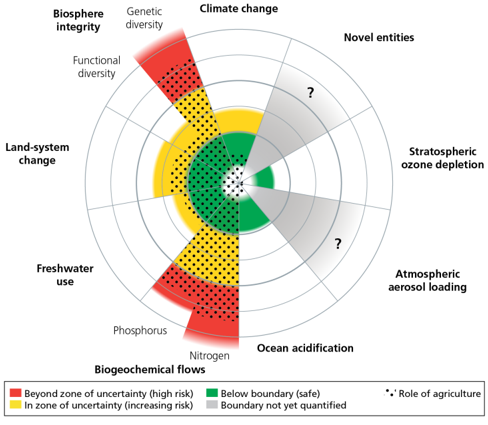
“Agriculture is a major driver for transgressing planetary boundaries of biosphere integrity and biogeochemical fl ows,aswellasforland-systemchange,freshwateruse,and climatechangebeing athighrisk 1 .”
Forest Conservation, Rights, and Diets: Untangling the Issues
Sunderland, T., & Vasquez, W. (2020) · Frontiers in Forests and Global Change · doi:10.3389/ffgc.2020.00029 · Cited by 50
“In addition to uncertain dietary outcomes, contemporary agriculture has also resulted in significant environmental damage, arguably to the limits of planetary boundaries (Campbell et al., 2017).”
BackgroundEnvironmental sustainability in agriculture: Identification of bottlenecks
Lankoski, J., & Lankoski, L. (2022) · Ecological Economics · doi:10.1016/j.ecolecon.2022.107656 · Cited by 45
Almagro, M., Díaz‐Pereira, E., Boix‐Fayos, C., Zornoza, R., Sánchez‐Navarro, V., Re, P., Fernández‐Soler, C., & Martínez‐Mena, M. (2022) · Agriculture Ecosystems & Environment · doi:10.1016/j.agee.2022.108320 · Cited by 47
Soulé, E., Charbonnier, R., Schlosser, L. O., Michonneau, P., Michel, N., & Bockstaller, C. (2023) · Journal of Cleaner Production · doi:10.1016/j.jclepro.2023.137784 · Cited by 48
Liu, L., Bai, Z., Yang, J., Yuan, Z., Lun, F., Wang, M., Strokal, M., Kroeze, C., Cui, Z., Chen, X., et al. (2024) · Nature Food · doi:10.1038/s43016-024-00977-0 · Cited by 44
“A few studies have reported that the low use efficiency of fertilizer P for crop and feed production has accelerated the unsustainability of P use 9–11 and is responsible for the exceedance of P concentrations in the water; that is, the PPB 7,12,13 .”
How food choices link sociodemographic and lifestyle factors with sustainability impacts
Frehner, A., van Zanten, H. H. E., Schader, C., de Boer, I. J. M., Pestoni, G., Rohrmann, S., & Müller, A. W. (2021) · Journal of Cleaner Production · doi:10.1016/j.jclepro.2021.126896 · Cited by 48
“There are many other areas of concern regarding environmental impacts of food production, such as marine and terrestrial biodiversity loss, soil degradation, and others (Campbell et al., 2017).”
BackgroundDwivedi, S. L., Goldman, I. L., Ceccarelli, S., & Ortiz, R. O. (2020) · Advances in agronomy · doi:10.1016/bs.agron.2020.02.002 · Cited by 51
Self-citationLimits to agricultural land for retaining acceptable levels of local biodiversity
Usubiaga‐Liaño, A., Mace, G. M., & Ekins, P. (2019) · Nature Sustainability · doi:10.1038/s41893-019-0300-8 · Cited by 47
Spanoghe, J., Vermeir, P., & Vlaeminck, S. E. (2021) · Bioresource Technology · doi:10.1016/j.biortech.2021.125364 · Cited by 53
What goes in and what comes out: a scoping review of regenerative agricultural practices
Voisin, R., Horwitz, P., Godrich, S. L., Sambell, R., Cullerton, K. B., & Devine, A. (2023) · Agroecology and Sustainable Food Systems · doi:10.1080/21683565.2023.2270441 · Cited by 45
“Conventional agriculture is a significant contributor to environmental damage and earth systems change, including biodiversity loss and disruption of biogeochemical nutrient flows (including phosphorus and nitrogen) (Campbell et al. 2017).”
BackgroundPrinciples of innovation to build nutrition-sensitive food systems in South Asia
Glover, D., & Poole, N. (2018) · Food Policy · doi:10.1016/j.foodpol.2018.10.010 · Cited by 51
“At the same time, intensified farming practices inflict heavy costs on the carrying capacity of agro-ecosystems, including the pollution of waterways and waterbodies, lowering of water tables and the salination and erosion of soils (Campbell et al., 2017; Vlek et al., 2017).”
BackgroundUrbano, B., Barquero, M., & González‐Andrés, F. (2022) · Scientia Horticulturae · doi:10.1016/j.scienta.2022.111126 · Cited by 44
Prairie Strips and Lower Land Use Intensity Increase Biodiversity and Ecosystem Services
Kemmerling, L. R., Rutkoski, C. E., Evans, S. E., Helms, J. A., Cordova-Ortiz, E. S., Smith, J. D., Custodio, J. A. V., Vizza, C., & Haddad, N. M. (2022) · Frontiers in Ecology and Evolution · doi:10.3389/fevo.2022.833170 · Cited by 43
Measuring sustainable consumer food purchasing and behavior
Polzin, S. S., Lusk, J. L., & Wahdat, A. Z. (2022) · Appetite · doi:10.1016/j.appet.2022.106369 · Cited by 42
Lucantoni, D. (2020) · Agroecology and Sustainable Food Systems · doi:10.1080/21683565.2020.1766635 · Cited by 41
“This statement has been confirmed by several authors (Wittman, Desmarais, and Wiebe 2010; Altieri 2011, Frison, Cherfas & Hodgkin 2011; Caplat 2012; Parmentier 2014, Campbell et al. 2017) and international research institutes (IAASTD 2009; IFOAM 2009, IPES-Food 2016; IPCC 2018).”
ResultQuantifying Earth system interactions for sustainable food production via expert elicitation
Chrysafi, A., Virkki, V., Jalava, M., Sandström, V., Piipponen, J., Porkka, M., Lade, S. J., La Mere, K., Wang-Erlandsson, L., Scherer, L., et al. (2022) · Nature Sustainability · doi:10.1038/s41893-022-00940-6 · Cited by 41
“(5) Each non-region-specific distribution was compared to the non-region-specific aggregated distribution with the Kullback–Leibler divergence metric within the ‘LaplacesDemon’ R package80.”
MethodSelf-citationLeydon, C. L., Leonard, U. M., McCarthy, S. N., & Harrington, J. M. (2023) · Advances in Nutrition · doi:10.1016/j.advnut.2023.07.007 · Cited by 44
“In addition, food production contributes to water and air pollution [6,16 – 18], accelerates biodiversity loss [19,20], and leads to deforestation [21, 22], and the overexploitation of fi sh stocks [23].”
BackgroundNanobiopesticides: Are they the future of phytosanitary treatments in modern agriculture?
Machado, S., Pereira, R., & Sousa, R. M. O. F. (2023) · The Science of The Total Environment · doi:10.1016/j.scitotenv.2023.166401 · Cited by 46
A bottom-up approach to model the environmental impact of the last-mile in an urban food-system
Stelwagen, R. E., Slegers, P. M., de Schutter, L., & Leeuwen, E. S. V. (2020) · Sustainable Production and Consumption · doi:10.1016/j.spc.2020.12.039 · Cited by 44
Nicholas‐Davies, P., Fowler, S., Midmore, P., Coopmans, I., Draganova, M., Petitt, A., & Senni, S. (2021) · Journal of Rural Studies · doi:10.1016/j.jrurstud.2021.07.027 · Cited by 45
Insecticide Risk in US Surface Waters: Drivers and Spatiotemporal Modeling
Wolfram, J., Stehle, S., Bub, S., Petschick, L. L., & Schulz, R. (2019) · Environmental Science & Technology · doi:10.1021/acs.est.9b04285 · Cited by 45
Ruuskanen, V., Givirovskiy, G., Elfving, J., Kokkonen, P., Karvinen, A., Järvinen, L., Sillman, J., Vainikka, M., & Ahola, J. (2020) · Journal of Cleaner Production · doi:10.1016/j.jclepro.2020.123423 · Cited by 40
Co-creating Agroecological Symbioses (AES) for Sustainable Food System Networks
Helenius, J., Hagolani‐Albov, S. E., & Koppelmäki, K. (2020) · Frontiers in Sustainable Food Systems · doi:10.3389/fsufs.2020.588715 · Cited by 75
Vasiljev, A., Simha, P., Demissie, N., Karlsson, C., Randall, D. G., & Vinnerås, B. (2021) · Chemical Engineering Journal · doi:10.1016/j.cej.2021.131026 · Cited by 48
Grasso, A. C., Besselink, J. J. F., Tyszler, M., & Bruins, M. J. (2023) · Nutrients · doi:10.3390/nu15112473 · Cited by 42
“Current food systems are unsustainable [1,2] and responsible for 21–37% of global greenhouse gas emissions (GHGE) [3], depleting natural resources [3–5], and destroying biodiversity [6].”
BackgroundMollaei, S., Minaker, L. M., Lynes, J. K., & Dias, G. M. (2023) · International Journal of Sustainability in Higher Education · doi:10.1108/ijshe-11-2022-0373 · Cited by 47
Regenerative farming as climate action
Alexanderson, M. S., Luke, H., & Lloyd, D. J. (2023) · Journal of Environmental Management · doi:10.1016/j.jenvman.2023.119063 · Cited by 44
An updated nitrogen budget for Canadian agroecosystems
Karimi, R., Pogue, S. J., Kröbel, R., Beauchemin, K. A., Schwinghamer, T. D., & Janzen, H. H. (2020) · Agriculture Ecosystems & Environment · doi:10.1016/j.agee.2020.107046 · Cited by 41
Landert (2020) · doi:10.3220/lbf1612794225000
Food loss and waste and the modernization of vegetable value chains in Thailand
Ortiz-Gonzalo, D., Ørtenblad, S. B., Larsen, M. N., Suebpongsang, P., & Bruun, T. B. (2021) · Resources Conservation and Recycling · doi:10.1016/j.resconrec.2021.105714 · Cited by 44
Impact of demand information sharing on organic farming adoption: An evolutionary game approach
Yu, Y., He, Y., & Zhao, X. (2021) · Technological Forecasting and Social Change · doi:10.1016/j.techfore.2021.121001 · Cited by 41
Quality and environmental footprints of diets by socio-economic status in Argentina
Arrieta, E. M., Geri, M., Coquet, J. B., Scavuzzo, C. M., Zapata, M. E., & González, A. D. (2021) · The Science of The Total Environment · doi:10.1016/j.scitotenv.2021.149686 · Cited by 45
Evolution of global water footprints of crop production in 1990–2019
Mialyk, O., Booij, M. J., Schyns, J. F., & Berger, M. (2024) · Environmental Research Letters · doi:10.1088/1748-9326/ad78e9 · Cited by 41
Assessment of technologies and economics for carbon dioxide removal from a portfolio perspective
Mühlbauer, A., Keiner, D., Gerhards, C., Caldera, U., Sterner, M., & Breyer, C. (2025) · International journal of greenhouse gas control · doi:10.1016/j.ijggc.2024.104297 · Cited by 39
Sharma, V., Ghosh, S., Bilal, M., Dey, S., & Singh, S. (2021) · Atmospheric Pollution Research · doi:10.1016/j.apr.2021.01.023 · Cited by 38
“Apart from the urban area, the rural area of north-western India adds substantially to aerosol loading especially during the monsoon (Kharif season-June to September) by intensive conventional cultivation and application of fertilizer (Campbell et al., 2017; Kuttippurath et al., 2020).”
BackgroundNature-Based One Health Approaches to Urban Agriculture Can Deliver Food and Nutrition Security
Ebenso, B., Otu, A., Giusti, A., Cousin, P., Adetimirin, V. O., Razafindralambo, H. L., Effa, E., Gkisakis, V., Thiaré, O., Levavasseur, V., et al. (2022) · Frontiers in Nutrition · doi:10.3389/fnut.2022.773746 · Cited by 42
“Agricultural intensification has relied on increasing amounts of chemical inputs to boost unsustainable yields, killing soils and drastically reducing the diversity of both plant and animal species with deleterious effects on human health (12, 13).”
BackgroundCan closed-loop microbial protein provide sustainable protein security against the hunger pandemic?
Durkin, A., Finnigan, T. J. A., Johnson, R., Kazer, J., Yu, J., Stuckey, D. C., & Guo, M. (2022) · Current Research in Biotechnology · doi:10.1016/j.crbiot.2022.09.001 · Cited by 41
How perceptions of meat consumption norms differ across contexts and meat consumer groups
Wolfswinkel, S. M. M., Raghoebar, S., Dagevos, H., de Vet, E., & Poelman, M. P. (2024) · Appetite · doi:10.1016/j.appet.2024.107227 · Cited by 37
“The production of meat is considered an important contributor to climate change, and particularly red and processed meat consumption is associated with diseases as type 2 diabetes, various types of cancer, as well as total mortality (Campbell et al., 2017; Nelson et al., 2016; Willett et al., 2019).”
BackgroundStudents’ Conceptions of Sustainable Nutrition
Dornhoff, M., Hörnschemeyer, A., & Fiebelkorn, F. (2020) · Sustainability · doi:10.3390/su12135242 · Cited by 43
Oliveira, L. F. C., Tega, D. U., Duarte, G. H. B., Barbosa, L. D., Ribeiro, H. C., Castello, A. C. D., Sawaya, A. C. H. F., & Sussulini, A. (2022) · Food Research International · doi:10.1016/j.foodres.2022.111107 · Cited by 37
(IPCC), I. P. O. C. C. (2023) · Cambridge University Press eBooks · doi:10.1017/9781009157926.014 · Cited by 45
OECD (2009) · Development Centre studies · doi:10.1787/19900295 · Cited by 37
Maughan, C., & Anderson, C. (2023) · Frontiers in Sustainable Food Systems · doi:10.3389/fsufs.2023.1162658 · Cited by 36
Pishgar-Komleh, S. H., Akram, A., Keyhani, A., Sefeedpari, P., Shine, P., & Brandão, M. (2019) · The International Journal of Life Cycle Assessment · doi:10.1007/s11367-019-01707-6 · Cited by 36
Lee, K. M., Dias, G. M., Boluk, K. A., Scott, S., Chang, Y.-S. G., Williams, T. E., & Kirkpatrick, S. I. (2021) · Advances in Nutrition · doi:10.1093/advances/nmab026 · Cited by 38
What does the UK public want farmland to look like?
Rust, N. A., Rehackova, L., Naab, F. Z., Abrams, A. L., Hughes, C., Merkle, B. G., Clark, B., & Tindale, S. J. (2021) · Land Use Policy · doi:10.1016/j.landusepol.2021.105445 · Cited by 42
Woody perennial polycultures in the U.S. Midwest enhance biodiversity and ecosystem functions
Kreitzman, M., Eyster, H. N., Mitchell, M. G. E., Czajewska, A., Keeley, K. O., Smukler, S., Sullivan, N. B., Verster, A. J., & Chan, K. M. A. (2022) · Ecosphere · doi:10.1002/ecs2.3890 · Cited by 40
Carvalho, C., Correia, D. M., Costa, S. A., Lopes, C. M. M., & Torres, D. P. M. (2023) · Journal of Cleaner Production · doi:10.1016/j.jclepro.2023.137973 · Cited by 41
The Political Economy of Food System Transformation: Pathways to Progress in a Polarized World
Resnick, D., & Swinnen, D. R. J. (2023) · doi:10.1093/oso/9780198882121.001.0001 · Cited by 45
Why has farming in Europe changed? A farmers’ perspective on the development since the 1960s
Mohr, F., Diogo, V., Helfenstein, J., Debonne, N., Dimopoulos, T., Dramstad, W., Martin, M. G., Hernik, J., Herzog, F., Kizos, T., et al. (2023) · Regional Environmental Change · doi:10.1007/s10113-023-02150-y · Cited by 38
“These changes have come at high environmental costs and raised serious concerns regarding the sustainability of agri-culture (Tilman 1999; Kleijn et al. 2009; Campbell et al. 2017).”
BackgroundFarming the sun: the political economy of agrivoltaics in the European Union
Vezzoni, R. (2025) · Sustainability Science · doi:10.1007/s11625-024-01601-7 · Cited by 43
“…2021), and agriculture remains the main driver of at least three other planetary boundaries: biogeochemical flows, land-system change [which disrupts biosphere integrity and is responsible for up to 70% of deforestation world-wide (Tittonell et al. 2020)], and freshwater use (Campbell et al. 2017).”
Agriculture and Food Systems to 2050: A Synthesis
Serraj, R., Krishnan, L., & Pingali, P. (2018) · World Scientific series in grand public policy challenges of the 21st century · doi:10.1142/9789813278356_0001 · Cited by 60
Agriculture's globalization: Endowments, technologies, tastes and policies
Anderson, K. (2022) · Journal of Economic Surveys · doi:10.1111/joes.12529 · Cited by 38
Mosnier, A., Schmidt‐Traub, G., Obersteiner, M. H., Jones, S. K., Javalera-Rincon, V., DeClerck, F., Thomson, M. J., Sperling, F., Harrison, P. A., Pérez-Guzmán, K., et al. (2022) · Sustainability Science · doi:10.1007/s11625-022-01227-7 · Cited by 38
“Water use for agriculture irrigation is projected to strongly increase by 2050 compared to current levels and future climate change might further increase this demand (Campbell et al. 2017; Hejazi et al. 2014; Wada and Bierkens 2014).”
BackgroundZhang, K., Maltais‐Landry, G., James, M., Mendez, V., Wright, D. L., George, S., & Liao, H. (2022) · Biology and Fertility of Soils · doi:10.1007/s00374-022-01675-4 · Cited by 35
“It has been demonstrated that agricultural expansion and intensification have resulted in a wide range of environmental issues, including loss of soil biodiversity, soil degradation and erosion, greenhouse gas emissions, and groundwater pollution (Tsiafouli et al. 2015; Bender et al. 2016; Campbell et al. 2017).”
BackgroundUn‐yielding: Evidence for the agriculture transformation we need
Chaplin‐Kramer, R., Chappell, M. J., & Bennett, E. M. (2022) · Annals of the New York Academy of Sciences · doi:10.1111/nyas.14950 · Cited by 38
Self-citationFarmers in the transition toward sustainability: what is the role of their entrepreneurial identity?
Rossi, E. S., Materia, V. C., Caracciolo, F., Blasi, E., & Pascucci, S. (2023) · Frontiers in Sustainable Food Systems · doi:10.3389/fsufs.2023.1196824 · Cited by 36
Meta-analysis of climate impact reduction potential of hydrogen usage in 9 Power-to-X pathways
Sillman, J., Havukainen, J., Alfasfos, R., Elyasi, N., Lilja, M., Ruuskanen, V., Laasonen, E., Leppäkoski, L., Uusitalo, V., & Soukka, R. (2024) · Applied Energy · doi:10.1016/j.apenergy.2024.122772 · Cited by 35
“PtFood can achieve considerable environmental benefits on environmental impacts other than climate impacts [22,28], which can be a greater benefit than climate impact for the agricultural sector [89].”
Life cycle assessment of culture media with alternative compositions for cultured meat production
Wali, M. E., Karinen, H., Rønning, S. B., Skrivergaard, S., Dorca-Preda, T., Rasmussen, M. K., Young, J. F., Therkildsen, M., Mogensen, L., Ryynänen, T., et al. (2024) · The International Journal of Life Cycle Assessment · doi:10.1007/s11367-024-02350-6 · Cited by 34
“Agriculture remains one of the main contributors to environmental burdens globally (Campbell et al. 2017), where livestock alone is responsible for approximately 20% of the global anthropogenic greenhouse gas (GHG) emissions (Xu et al. 2021).”
Pappalardo, S. E., Gislimberti, L., Ferrarese, F., Garlato, A., Vinci, I., Marchi, M. D., & Mozzi, P. (2019) · PLoS ONE · doi:10.1371/journal.pone.0210922 · Cited by 34
Bergmann, I. (2019) · Sustainability · doi:10.3390/su11195539 · Cited by 37
“Industrial animal agriculture is recognised as one of the main causes of exceeding planetary boundaries [11], of species extinction and climate collapse [12], and increasing human and nonhuman injustices ([6,13] [14] (p.”
BackgroundKyttä, V., Kårlund, A., Pellinen, T., Pietiläinen, O., Tuomisto, H. L., Kolehmainen, M., Pajari, A., & Saarinen, M. (2023) · The International Journal of Life Cycle Assessment · doi:10.1007/s11367-023-02217-2 · Cited by 34
“Food production and consumption greatly contribute to environmental changes (Campbell et al. 2017).”
BackgroundKühling, I., Beiküfner, M., Vergara, M., & Trautz, D. (2020) · Agronomy · doi:10.3390/agronomy11010064 · Cited by 36
“Nitrogen (N) plays an important role in global agriculture: on the one hand, more than 50% of the world’s population is nourished by N-fertilised crops [1]; on the other hand, the environmental impacts of N use is far beyond planetary boundaries [2,3], mainly caused by agriculture [4,5].”
BackgroundSzabo, D., Falconer, T. M., Fisher, C. M., Heise, T., Phillips, A. L., Vas, G., Williams, A. J., & Kruve, A. (2024) · Analytical Chemistry · doi:10.1021/acs.analchem.3c05705 · Cited by 33
Trade‐offs in the performance of alternative farming systems
Ramankutty, N., Ricciardi, V., Mehrabi, Z., & Seufert, V. (2019) · Agricultural Economics · doi:10.1111/agec.12534 · Cited by 34
Self-citationDiversifying cropping sequence reduces nitrogen leaching risks
Beillouin, D., Pelzer, E., Baranger, E., Carrouée, B., Cernay, C., de Chezelles, E., Schneider, A., & Jeuffroy, M. (2021) · Field Crops Research · doi:10.1016/j.fcr.2021.108268 · Cited by 32
Tradeoffs and Synergies Across Global Climate Change Adaptations in the Food‐Energy‐Water Nexus
Torhan, S. A., Grady, C., Ajibade, I. M., Galappaththi, E. K., Hernandez, R. R., Musah-Surugu, J. I., Nunbogu, A. M., Segnon, A. C., Shang, Y., Ulibarrí, N., et al. (2022) · Earth s Future · doi:10.1029/2021ef002201 · Cited by 34
“Additionally, certain sectors, particularly agriculture (Campbell et al., 2017; Conijn et al., 2018) and energy (Child et al., 2018; Sala et al., 2016), also contribute to climate change and resource extraction, affecting our ability to live within earth's carrying capacity.”
BackgroundArsic, M., Persson, D. P., Schjoerring, J. K., Thygesen, L. G., Lombi, E., Doolette, C. L., & Husted, S. (2022) · Physiologia Plantarum · doi:10.1111/ppl.13761 · Cited by 32
“Consequently, altered flows of nitrogen and P pose significant risks to the stability of key earth system functions (Campbell et al., 2017; Steffen et al., 2015).”
BackgroundRetaining natural vegetation to safeguard biodiversity and humanity
Simmonds, J. S., Suárez‐Castro, A. F., Reside, A. E., Watson, J. E. M., Allan, J. R., Atkinson, S., Pasquale, B., Dudley, N., Edwards, S., Fuller, R. A., et al. (2023) · Conservation Biology · doi:10.1111/cobi.14040 · Cited by 34
“Conversion to agriculture is the primary driver of clearing of natural and seminatural vegetation worldwide (Campbell et al., 2017; Gibbs et al., 2010).”
BackgroundMengen, D., Jagdhuber, T., Balenzano, A., Mattia, F., Vereecken, H., & Montzka, C. (2023) · Remote Sensing · doi:10.3390/rs15092282 · Cited by 36
Wang, F., Yang, Y., Gao, J., Li, X., Tian, S., Lu, Z., Zhou, Z., Sohn, W., Shon, H. K., & Ren, J. (2024) · Desalination · doi:10.1016/j.desal.2024.118027 · Cited by 31
Soil and crop management to save food and enhance food security
Gomiero, T. (2019) · Elsevier eBooks · doi:10.1016/b978-0-12-815357-4.00002-x · Cited by 37
Substitution, natural capital and sustainability
Reijnders, L. (2021) · Journal of Integrative Environmental Sciences · doi:10.1080/1943815x.2021.2007133 · Cited by 33
Environmental footprints of meat, milk and egg production in Argentina
Arrieta, E. M., Aguiar, S., Fischer, C. G., Cuchietti, A., Cabrol, D., González, A. D., & Jobbagy, E. G. (2022) · Journal of Cleaner Production · doi:10.1016/j.jclepro.2022.131325 · Cited by 31
A scientific transition to support the 21st century dietary transition
Tufford, A., Brennan, L., van Trijp, J. C. M., D’Auria, S., Feskens, E. J. M., Finglas, P. M., Kok, F. J., Kolesárová, A., Poppe, K. J., Zimmermann, K. L., et al. (2022) · Trends in Food Science & Technology · doi:10.1016/j.tifs.2022.11.021 · Cited by 31
Boulestreau, Y., Casagrande, M., & Navarrete, M. (2023) · Agricultural Systems · doi:10.1016/j.agsy.2023.103752 · Cited by 35
Causal Relations of Upscaled Urban Aquaponics and the Food-Water-Energy Nexus—A Berlin Case Study
Baganz, G. F. M., Schrenk, M., Körner, O., Baganz, D., Keesman, K. J., Goddek, S., Siscan, Z., Baganz, E., Doernberg, A., Monsees, H., et al. (2021) · Water · doi:10.3390/w13152029 · Cited by 34
Energy performance and crop yield production of a semitransparent photovoltaic greenhouse
Moreno, Á., Chemisana, D., & Férnández, E. F. (2025) · Applied Energy · doi:10.1016/j.apenergy.2025.125285 · Cited by 33
Actions to transform food systems under climate change
Steiner, A., Aguilar, G., Bomba, K., Bonilla, J. P., Campbell, A., Echeverria, R., Gandhi, R., Hedegaard, C., Holdorf, D., Ishii, N., et al. (2020) · AgEcon Search (University of Minnesota, USA) · doi:10.22004/ag.econ.310920 · Cited by 84
Self-citationMulti-objective optimization as a tool to identify possibilities for future agricultural landscapes
Todman, L., Coleman, K., Milne, A. E., Gil, J., Reidsma, P., Schwoob, M.-H., Treyer, S., & Whitmore, A. P. (2019) · The Science of The Total Environment · doi:10.1016/j.scitotenv.2019.06.070 · Cited by 33
Metadata
- Authors
- Campbell, B. M., Beare, D. J., Bennett, E. M., Hall-Spencer, J. M., Ingram, J. S. I., Jaramillo, F., Ortiz, R., Ramankutty, N., Sayer, J. A., & Shindell, D.
- Affiliations
- CGIAR (FR)
- McGill University (CA)
- University of Tsukuba (JP)
- University of Oxford (GB)
- Stockholm Resilience Centre (SE)
- University of Copenhagen (DK)
- University of British Columbia (CA)
- James Cook University (AU)
- Duke University (US)
- ORCID
- Venue
- Ecology and Society
- Publisher
- Resilience Alliance, Inc.
- Published
- 2017
- Volume
- 22
- Issue
- 4
- ISSN
- 1708-3087 (ISSN-L)
- OpenAlex
- W2762931876
- Cited by
- 1,197
- References
- 84
- Citations by year
- 2026: 137 · 2025: 204 · 2024: 182 · 2023: 157 · 2022: 182 · 2021: 140 · 2020: 101 · 2019: 56 · 2018: 35 · 2017: 1
- FWCI
- 36.59
- Type
- journal article
- Language
- en
- Open access
- gold
- doi.org
- Licence
- cc-by-nc
- Locations
- Ecology and Society (publishedVersion, cc-by-nc)
- Research at the University of Copenhagen (University of Copenhagen) (publishedVersion, cc-by)
- Epsilon Open Archive (Sveriges lantbruksuniversitet biblioteket (Swedish University of Agricultural Sciences)) (acceptedVersion)
- ResearchOnline at James Cook University (James Cook University) (submittedVersion)
- PEARL (University of Plymouth) (submittedVersion)
- CGSPace A Repository of Agricultural Research Outputs (Consultative Group for International Agricultural Research) (submittedVersion, other-oa)
- DOAJ (DOAJ: Directory of Open Access Journals) (submittedVersion, cc-by-sa)
- Funders
- Consortium of International Agricultural Research Centers
- Topics
- Physical Sciences › Environmental Science › Global and Planetary Change › Land Use and Ecosystem Services
- Physical Sciences › Environmental Science › Ecology › Agriculture Sustainability and Environmental Impact
- Life Sciences › Agricultural and Biological Sciences › Agronomy and Crop Science › Sustainable Agricultural Systems Analysis
- Keywords
- planetary boundaries, Earth system, anthropogenic impacts, land use change
About these checks
Registry, retraction, Cites and statistics results are computed, not judged, with one exception: a printed reference that no index lists is read once by a model before it counts as a citation error. Claims are extracted by a model and kept only when their quote appears verbatim in the text; each cited source is then checked, with a model’s help, for whether it says what the claim relies on. Those verdicts can be wrong — read the claim’s quote and the cited source before relying on one.
Statistics and arithmetic are recomputed, not judged.
Confidence bands are shown only for fields calibrated on our annotated test set. None is calibrated yet, so no band is shown.
What counts as a claim ›How we measure confidence ›How we check this ›
Are you an author, or do you see a problem with this page? Request a review
Data sources
Bibliographic data: Semantic Scholar, OpenAlex, Crossref.
Contains information from the Semantic Scholar Academic Graph Datasets, made available under the ODC Attribution License (ODC-BY 1.0).
Semantic Scholar’s data is described in: Kinney, R., et al. (2023). The Semantic Scholar Open Data Platform. arXiv:2301.10140.
