

Agriculture production as a major driver of the Earth system exceeding planetary boundaries
Open accessThe DOI matches its Crossref record; 86 of the 86 references it cites were found in a registry or an index.
Abstract
Campbell, B. M., D. J. Beare, E. M. Bennett, J. M. Hall-Spencer, J. S. I. Ingram, F. Jaramillo, R. Ortiz, N. Ramankutty, J. A. Sayer, and D. Shindell. 2017. Agriculture production as a major driver of the Earth system exceeding planetary boundaries. Ecology and Society 22(4):8. https://doi.org/10.5751/ES-09595-220408
Overview
The claims and statistics of this paper haven’t been checked yet.
Free: it reads the open-access text and checks the first 5 claims that cite a source we can check. Create a free account to check every claim.
Integrity signals
Registry
Cites
Statistics
Figures
Verification
Claims the paper makes
The claims and statistics of this paper haven’t been checked yet.
Free: it reads the open-access text and checks the first 5 claims that cite a source we can check. Create a free account to check every claim.
Claims other papers make about this one
Each is checked against this paper’s own text: does it say what the citing paper says it does?
The source backs part of the claim, not all of it — or backs it for a different population, condition or comparison.
In the citing paper
“Agricultural expansion and intensification are considered major drivers of habitat and biodiversity loss, soil and freshwater degradation, environmental pollution, and greenhouse gas emissions worldwide (1, 2).”
From Agricultural diversification promotes multiple ecosystem services without compromising yield (2020) · cites this paper as [1]
Experimental — accuracy not yet measuredThe cited source says what the claim attributes to it.
In the citing paper
“As a result, agriculture plays a major role in pushing the biosphere beyond planetary boundaries in terms of biodiversity and biogeochemical flows of nitrogen and phosphorus, and is a major contributor to climate change [3].”
From An Actor-Oriented Multi-Criteria Assessment Framework to Support a Transition towards Sustainable Agricultural Systems Based on Crop Diversification (2020) · cites this paper as [3]
The cited source says what the claim attributes to it.
In the citing paper
“The main driver of biodiversity loss is agriculture1, both through intensification of existing agricultural land and expansion of agriculture into pristine ecosystems2,3.”
From Farming practices to enhance biodiversity across biomes: a systematic review (2024) · cites this paper as [1]
In the citing paper
“Biodiversity is declining at an unprecedented pace around the world, with current estimates that around 5% of all species will be lost every ten years1.”
From Farming practices to enhance biodiversity across biomes: a systematic review (2024) · cites this paper as [1]
Self-check
Percentages, sums and reported differences re-computed from the paper’s own numbers.
The self-check needs the paper’s full text.
Citations
Cites
A safe operating space for humanity
Rockström, J., Steffen, W., Noone, K., Persson, Å., Chapin, F. S., Lambin, E. F., Lenton, T. M., Scheffer, M., Folke, C., Schellnhuber, H. J., et al. (2009) · Nature · doi:10.1038/461472a · Cited by 13,333 · cited 10×
“In 2009 Rockström et al. (2009 a,b ) introduced the concepts of “planetary boundaries” (PBs) and a “safe operating space for humanity,” which have recently been revised by Steffen et al. (2015).”
BackgroundMethodInfluentialGlobal Consequences of Land Use
Foley, J. A., DeFries, R., Asner, G. P., Barford, C., Bonan, G., Carpenter, S. R., Chapin, F. S., Coe, M. T., Daily, G. C., Gibbs, H. K., et al. (2005) · Science · doi:10.1126/science.1111772 · Cited by 13,272 · cited 4×
“According to Foley et al. (2005), croplands and pastures are one of the largest terrestrial biomes on the planet, occupying ~40% of land surface.”
InfluentialSelf-citationPlanetary boundaries: Guiding human development on a changing planet
Steffen, W., Richardson, K., Rockström, J., Cornell, S. E., Fetzer, I., Bennett, E. M., Biggs, R., Carpenter, S. R., de Vries, W., de Wit, C. A., et al. (2015) · Science · doi:10.1126/science.1259855 · Cited by 12,527 · cited 10×
“We have followed the Steffen et al. (2015) framing of the boundary.”
BackgroundMethodInfluentialSelf-citationNg, M., Fleming, T., Robinson, M., Thomson, B., Graetz, N., Margono, C., Mullany, E. C., Biryukov, S., Abbafati, C., Abera, S. F., et al. (2014) · The Lancet · doi:10.1016/s0140-6736(14)60460-8 · Cited by 11,952 · cited 1×
“…have to address the fact that at least a billion people do not have access to sufficient calories (FAO 2014), and more than two billion people lack sufficient nutrients (WHO and FAO 2014), while, paradoxically, at the same time over two billion people consume too many calories (Ng et al. 2014).”
Correspondence - Tranexamic acid for traumatic brain injury
(2005) · London School of Economics and Political Science Theses Online (London School of Economics and Political Science) · doi:10.1016/s0140-6736 · Cited by 11,894
Lim, S. S., Vos, T., Flaxman, A. D., Danaei, G., Shibuya, K., Adair-Rohani, H., AlMazroa, M. A., Amann, M., Anderson, H. R., Andrews, K. G., et al. (2012) · The Lancet · doi:10.1016/s0140-6736(12)61766-8 · Cited by 11,805 · cited 1×
“Because the Global Burden of Disease estimates that about 3.2 million premature deaths are attributable to small PM each year (Lim et al. 2012), this suggests that agriculture’s contribution to atmospheric aerosol loading may be responsible for ~450,000–660,000 premature deaths annually based on…”
InfluentialPlanetary Boundaries: Exploring the Safe Operating Space for Humanity
Rockström, J., Steffen, W., Noone, K., Persson, Å., Chapin, F. S. I., Lambin, E., Lenton, T. M., Scheffer, M., Folke, C., Schellnhuber, H. J., et al. (2009) · Ecology and Society · doi:10.5751/es-03180-140232 · Cited by 7,187
Transformation of the Nitrogen Cycle: Recent Trends, Questions, and Potential Solutions
Galloway, J. N., Townsend, A. R., Erisman, J. W., Bekunda, M., Cai, Z., Freney, J. R., Martinelli, L. A., Seitzinger, S. P., & Sutton, M. A. (2008) · Science · doi:10.1126/science.1136674 · Cited by 6,995 · cited 2×
“Large amounts of N required for plant and livestock production results in agricultural activities being the main driver of the N cycle (Galloway et al. 2008, Liu et al. 2010, Bodirsky et al. 2012).”
InfluentialSpreading dead zones and consequences for marine ecosystems
Diaz, R. J., & Rosenberg, R. (2008) · Science · doi:10.1126/science.1156401 · Cited by 6,626 · cited 1×
“The P cycle is accelerated two to three times over background rates (Smil 2000), leading to eutrophication of freshwater and estuarine systems (Diaz and Rosenberg 2008) in addition to the intended increase in agricultural production.”
Bounding the role of black carbon in the climate system: A scientific assessment
Bond, T. C., Doherty, S. J., Fahey, D. W., Forster, P. M., Berntsen, T., DeAngelo, B. J., Flanner, M. G., Ghan, S., Kärcher, B., Koch, D., et al. (2013) · Journal of Geophysical Research: Atmospheres · doi:10.1002/jgrd.50171 · Cited by 6,385 · cited 2×
“Assessment of the literature puts the share of anthropogenic emissions of black and organic carbon at about 3–14% (Bond et al. 2013).”
Self-citation
Research works printed but not linked: 3
- [42]42. Jaramillo, F., and G. Destouni. 2015b. Local flow regulation and irrigation raise global human water consumption and footprint. Science 350(6265):1248-1251. http://dx.doi.org/10.1126/science. · DOI · Paper page
- [76]76. in Edenhofer, O., R. Pichs-Madruga, Y. Sokona, E. Farahani, S. Kadner, K. Seyboth, A. Adler, I. Baum, S. Brunner, P. Eickemeier, B. Kriemann, J. Savolainen, S. Schlömer, C. von Stechow, T. Zwickel, and J. C. Minx, editors. Climate change 2014: mitigation of climate change. Contribution of Working Group III to the Fifth Assessment Report of the Intergovernmental Panel on Climate Change. Cambridge University Press, Cambridge, UK.
- [83]83. Trumbo, J., and D. Powell. 2016. Why transgenic plants are so controversial. Pages 366-382 in C. N. Stewart Jr, editor. Plant Ecology and Society 22(4): 8 https://www.ecologyandsociety.org/vol22/iss4/art8/ biotechnology and genetics: principles, techniques, and applications.
Cited by
Items 401–500 of 1,000
Agrobiodiversity Index Report 2019: risk and resilience
Remans, R., Jones, S. K., Dulloo, E., Villani, C., Estrada-Carmona, N., Juventia, S. D., & Laporte, M. (2019) · Wageningen University & Research Publications · Cited by 37
Prospects of Justice for Cellular Agriculture: A just Transition or Reinvesting in Unsustainability?
Moritz, J., Mazac, R., Ueta, M. H., Räty, N. S., Tuomisto, H. L., & Ryynänen, T. (2024) · Food Ethics · doi:10.1007/s41055-024-00156-8 · Cited by 21
“Planetary boundaries are scientific targets set as bounds for which the Earth system needs to remain within to keep a healthy environment for human well-being (Rockström et al. 2009; Campbell et al. 2017).”
Yeo, Y. T., Lim, C. M., Huaco, A. I. V., & Chen, W. N. (2024) · npj Science of Food · doi:10.1038/s41538-024-00309-3 · Cited by 20
van Dam, A. A., Robertson, H. A., Prieler, R., Dubey, A., & Finlayson, C. M. (2025) · Marine and Freshwater Research · doi:10.1071/mf24017 · Cited by 22
Estébanez, N. L., Ochoa, C. Y., & Olmo, R. M. (2022) · Land · doi:10.3390/land11040588 · Cited by 20
“One of the most serious impacts, at a global scale, is the effect of agricultural production on destabilising the planetary metabolism and the major role that this plays in crossing environmental boundaries [5].”
BackgroundChen, X., Wang, Z., Muneer, M. A., Ma, C., Dong-dong, H., White, P. J., Li, C., & Zhang, F. S. (2022) · Food and Energy Security · doi:10.1002/fes3.389 · Cited by 21
Hatjiathanassiadou, M., Rolim, P. M., & Seabra, L. M. J. (2023) · Frontiers in Sustainable Food Systems · doi:10.3389/fsufs.2022.1078997 · Cited by 20
“Arable land for agriculture and livestock causes significant emissions of greenhouse gases (GHG), and the use of agricultural pesticides contributes to impoverishing the soil and contaminating rivers and water, in addition to reducing biodiversity (Vermeulen et al., 2012; Aleksandrowicz et al., 2016; Campbell et al.,…”
BackgroundCOVID-19, social identity, and socially responsible food consumption between generations
Leyva-Hernández, S. N., Terán-Bustamante, A., & Martínez-Velasco, A. (2023) · Frontiers in Psychology · doi:10.3389/fpsyg.2023.1080097 · Cited by 23
“Therefore, many experts believe that the existing food and agricultural system is unsustainable (Campbell et al., 2017; Abbate et al., 2023), for which the redesign of value creation in businesses is necessary firms to reduce the use of resources and generation of pollutants (Abbate et al.”
BackgroundAnapalli, S. S., Pinnamaneni, S. R., Reddy, K. N., Wagle, P., & Ashworth, A. J. (2022) · Heliyon · doi:10.1016/j.heliyon.2023.e14696 · Cited by 21
Circular bio‐economy in aquaculture
Verreth, J. A. J., Roy, K., & Turchini, G. M. (2023) · Reviews in Aquaculture · doi:10.1111/raq.12812 · Cited by 21
Barriers and drivers to increasing sustainable bivalve seafood consumption in a mass market economy
Gawel, J. P. F., Aldridge, D. C., & Willer, D. F. (2023) · Food Frontiers · doi:10.1002/fft2.282 · Cited by 21
Trends in the circular economy applied to the agricultural sector in the framework of the SDGs
Craparo, G., Montero, E. I. C., & Peñalver, J. F. S. (2023) · Environment Development and Sustainability · doi:10.1007/s10668-023-03750-8 · Cited by 24
“…reuse of water is very important in achieving true circular agriculture, especially considering that in many parts of the world, irrigation is a key technique and proper water management would improve ecological flows in rivers (Abad-Segura et al., 2020; Campbell et al., 2017; Desing et al., 2020).”
Kesse‐Guyot, E., Pointereau, P., Brunin, J., Perraud, E., Toujgani, H., Berthy, F., Allès, B., Touvier, M., Lairon, D., Mariotti, F., et al. (2023) · Sustainable Production and Consumption · doi:10.1016/j.spc.2023.09.008 · Cited by 23
Günther, P., & Ekardt, F. (2023) · Frontiers in Climate · doi:10.3389/fclim.2023.1276606 · Cited by 20
Jensen, A., Mogensen, L., van der Werf, H. M. G., Xie, Y., Kristensen, H. L., & Knudsen, M. T. (2024) · Sustainable Production and Consumption · doi:10.1016/j.spc.2024.02.008 · Cited by 20
Food waste and the EU target: effects on the agrifood systems’ sustainability
Calabrò, G., & Vieri, S. (2024) · Journal of Foodservice Business Research · doi:10.1080/15378020.2024.2359656 · Cited by 22
“At present, the agri-food systems are recognized as being among the main responsible of the current environmental issues referable to climate changes, pollution and waste (Campbell et al., 2017; Hellweg et al., 2023; Reisman & Fairbairn, 2020).”
Torres-Martínez, J. A., Mahlknecht, J., Mora, A., Kaown, D., Koh, D., Mayer, B., & Tetzlaff, D. (2024) · Journal of Hydrology · doi:10.1016/j.jhydrol.2024.131622 · Cited by 31
Su, Y., Liang, C., Ma, X., Xiong, S., & Lu, X. (2024) · Environmental Impact Assessment Review · doi:10.1016/j.eiar.2024.107589 · Cited by 20
Schøn, M. L., Mikkelsen, M. V. N., Jensen, K., Poulsen, J. M., Berggreen, I. E., Schou, T. M., Nørgaard, J. V., & Overgaard, J. (2024) · Journal of Insects as Food and Feed · doi:10.1163/23524588-00001268 · Cited by 20
Common ground: restoring land health for sustainable agriculture
Larbodière, L., Davies, J., Schmidt, R., Magero, C., Vidal, A., Schnell, A. A., Bücher, P., Maginnis, S., Cox, N., Hasinger, O., et al. (2020) · doi:10.2305/iucn.ch.2020.10.en · Cited by 28
McCormack, J., Noble, C., Rutherford, S., ROSS, L. J., & Bialocerkowski, A. (2024) · BMC Medical Education · doi:10.1186/s12909-024-05968-0 · Cited by 22
“As dietitians work primarily with food, and the food system is responsible for 19–29% of total global greenhouse gas emissions in addition to other adverse impacts on planetary health, [32–36] it is essential to understand the relationship between the food system, the SDGs, and a dietitian’s role.”
BackgroundTransition from fermentation to precision fermentation: Role in sustainable food system
Obayomi, O. V., Malomo, A. A., Olaniran, A. F., Osemwegie, O. O., Olojede, A. O., Beyioku, O. E., & Adeyemı, O. S. (2026) · Biotechnology Reports · doi:10.1016/j.btre.2026.e00952 · Cited by 26
“Analysis of environmental implications, supported by the FAO, reveals that agriculture is the main agent of global deforestation, being responsible for around 80 % of it [140].”
Cifuentes, M. L., Penker, M., Kaufmann, L., Wittmann, F., Fiala, V., Gugerell, C., Lauk, C., Krausmann, F., Eder, M., & Freyer, B. (2023) · Sustainability Science · doi:10.1007/s11625-022-01287-9 · Cited by 20
Tardy, B. L., Greca, L. G., Mihhels, K., Lizundia, E., Dumée, L. F., & Vega, L. F. (2023) · ACS Sustainable Chemistry & Engineering · doi:10.1021/acssuschemeng.3c01853 · Cited by 20
Irz, X., Tapanainen, H., Saarinen, M., Salminen, J., Sares‐Jäske, L., & Valsta, L. M. (2024) · Public Health Nutrition · doi:10.1017/s1368980024000508 · Cited by 19
Environmental Impacts of Cultivated Meat
Tuomisto, H. L., & Ryynänen, T. (2024) · Springer eBooks · doi:10.1007/978-3-031-55968-6_14 · Cited by 24
Matse, D. T., Król, D., Richards, K. G., Danaher, M., Cummins, E., Wang, X., & Forrestal, P. J. (2024) · Frontiers in Environmental Science · doi:10.3389/fenvs.2024.1462098 · Cited by 19
Reforming Agricultural Policies Will Help to Improve Environmental Performance
DeBoe, G., Deconinck, K., Henderson, B., & Lankoski, J. (2020) · EuroChoices · doi:10.1111/1746-692x.12247 · Cited by 19
Indicators of Complexity and Over-Complexification in Global Food Systems
Loring, P. A., & Sanyal, P. (2021) · Frontiers in Sustainable Food Systems · doi:10.3389/fsufs.2021.683100 · Cited by 21
“While this is a tremendous technological achievement, these gains have required immense investments of social and ecological capital, and as such, have been accompanied by great environmental and societal costs (Campbell et al., 2017).”
BackgroundCaproni, L., Raggi, L., Ceccarelli, S., Negri, V., & Carboni, A. (2019) · Sustainability · doi:10.3390/su11195443 · Cited by 21
“In this regard, it should also be also noted that the nitrogen cycle has been quoted among the planet’s safe boundaries [13,14].”
BackgroundDietrich, A., Carini, V., Vico, G., Bommarco, R., & Hansson, H. (2025) · Ecological Economics · doi:10.1016/j.ecolecon.2025.108526 · Cited by 20
The Two Dimensions of Nutrition for the Planet: Environment and Health
Aydoğdu, G. S., & Karadağ, M. G. (2025) · Current Nutrition Reports · doi:10.1007/s13668-025-00642-3 · Cited by 19
“Food production systems are among the most important causes of environmental changes, pushing the planet's boundaries and posing a risk to the planet [2] and human health [3].”
Gordon, E., Hargreaves-Méndez, M., Smith, A. P., Gosnell, H., Hodbod, J., Himes, A., Mathisonslee, M., Pitts, H., & Vivas, J. (2025) · Agriculture and Human Values · doi:10.1007/s10460-025-10736-x · Cited by 18
“It is contributing to climate change, biodiversity loss, water pollution, deforestation, and deserti-fication (Campbell et al. 2017).”
Food availability and food habits among Ghanaians: Tracking the dietary transition in Ghana
Kushitor, S. B. (2021) · Nutrition and Health · doi:10.1177/02601060211066707 · Cited by 18
Teodoro, J. D., Baird, J., & Otung, I. (2022) · Society & Natural Resources · doi:10.1080/08941920.2022.2135152 · Cited by 18
“The practices used by agricultural producers (farmers) in these systems are thus critical to the discussions about sustainability from local to global levels (Campbell et al. 2017; Foley et al. 2011).”
BackgroundCommunity-supported agriculture as food democratic experimentalism: Insights from Germany
Degens, P., & Lapschieß, L. (2023) · Frontiers in Sustainable Food Systems · doi:10.3389/fsufs.2023.1081125 · Cited by 18
“Overall, agricultural production is a major stressor that contributes heavily to crossing planetary boundaries (Campbell et al., 2017).”
BackgroundJames, D., Blesh, J., Levers, C., Ramankutty, N., Bicksler, A., Mottet, A., & Wittman, H. K. (2023) · Elementa Science of the Anthropocene · doi:10.1525/elementa.2023.00011 · Cited by 20
Self-citationVingerhoets, R., Brienza, C., Sigurnjak, I., Buysse, J., Vlaeminck, S. E., Spiller, M., & Meers, E. (2023) · Chemical Engineering Journal · doi:10.1016/j.cej.2023.146984 · Cited by 18
Moral disengagement in the media discourses on meat and dairy production systems
Schüßler, C., Nicolai, S., Stoll‐Kleemann, S., & Bartkowski, B. (2024) · Appetite · doi:10.1016/j.appet.2024.107269 · Cited by 18
“Agrifood systems have significant sustainability impacts (Oter-os-Rozas et al., 2019; Campbell et al., 2017; Clark et al., 2020; Poore & Nemecek, 2018; Willett et al., 2019).”
BackgroundTransforming the food environment: An assemblage-based research approach
Cifuentes, M. L., & Sonnino, R. (2024) · Environmental Innovation and Societal Transitions · doi:10.1016/j.eist.2024.100874 · Cited by 18
Rocca, P. L., Guennebaud, G., Bugeau, A., & Ligozat, A. (2024) · Journal of Industrial Ecology · doi:10.1111/jiec.13568 · Cited by 20
“Limits such as biosphere integrity, or climate change are particularly concerned [Campbell et al., 2017].”
BackgroundJaisli, I., & Brunori, G. (2024) · Journal of Agriculture and Food Research · doi:10.1016/j.jafr.2024.101496 · Cited by 26
Risk and responsibility in the corporate food regime: research pathways beyond the COVID-19 crisis
Bowness, E., James, D., Desmarais, A. A., McIntyre, A. M., Robin, T., Dring, C. C., & Wittman, H. K. (2020) · Studies in Political Economy · doi:10.1080/07078552.2020.1849986 · Cited by 18
Rashid, M. A., Bruun, S., Styczen, M., Borgen, S. K., Hvid, S. K., & Jensen, L. S. (2022) · The Science of The Total Environment · doi:10.1016/j.scitotenv.2022.156927 · Cited by 18
van Bueren, B. J. A., Iyer‐Raniga, U., Argus, K., & Leenders, M. A. A. M. (2022) · Resources Conservation and Recycling · doi:10.1016/j.resconrec.2022.106554 · Cited by 19
Land Use Indicators in the Context of Land Use Efficiency
Kalisz, B., Żuk‐Gołaszewska, K., Radawiec, W., & Gołaszewski, J. (2023) · Sustainability · doi:10.3390/su15021106 · Cited by 18
A predictive indicator assessing effect of cropping system and surrounding landscape on biodiversity
Soulé, E., Hawes, C., Young, M., Henckel, L., Michel, N., Michonneau, P., & Bockstaller, C. (2023) · Ecological Indicators · doi:10.1016/j.ecolind.2023.110289 · Cited by 21
Future Food: Sustainable Diets for Healthy People and a Healthy Planet
Wiseman, S. A., Dötsch‐Klerk, M., Neufingerl, N., & Martins, F. D. O. (2019) · International Journal of Nutrology · doi:10.1055/s-0039-1695714 · Cited by 21
Lankoski, J., Nales, E., & Valin, H. (2025) · OECD food, agriculture and fisheries working papers · doi:10.1787/808f110c-en · Cited by 18
Poor Quality of Commercial Arbuscular Mycorrhizal Inoculants Used for Agriculture and Home Gardening
Boussageon, R., Eigenmann, M. F., Frommenwiler, J., & van der Heijden, M. G. A. (2025) · Journal of Sustainable Agriculture and Environment · doi:10.1002/sae2.70107 · Cited by 19
Enacting justice in food systems transitions: A critical lens on governance, power and participation
Cifuentes, M. L., Raj, G., Sonnino, R., & Edwards, F. (2025) · Environmental Innovation and Societal Transitions · doi:10.1016/j.eist.2025.101087 · Cited by 20
Organic agriculture: impact on the environment and food quality
Gomiero, T. (2021) · Elsevier eBooks · doi:10.1016/b978-0-12-821363-6.00002-3 · Cited by 24
Sustainable fisheries: Towards operationalization of decision making accounting for biodiversity
Gaillet, G., Asselin, A.-C., & Wermeille, A. (2022) · Journal of Cleaner Production · doi:10.1016/j.jclepro.2022.132103 · Cited by 17
Livestock exposure to future cumulated climate-related stressors in West Africa
Brouillet, A., & Sultan, B. (2023) · Scientific Reports · doi:10.1038/s41598-022-22544-y · Cited by 21
Healthy diets for sustainable food systems: a narrative review
Arrieta, E. M., & Aguiar, S. (2023) · Environmental Science Advances · doi:10.1039/d2va00214k · Cited by 19
“11,21 In order to supply food, ber and bioenergy to a continuously growing global population, humanity uses almost half of the Earth's ice-free land area: 22 3203 million hectares (Mha) of pastures (about 26% of Earth's ice-free land), and 1557 Mha of cropland (about 12% of Earth's ice-free…”
Hargreaves-Méndez, M., & Hötzel, M. J. (2023) · Animal Welfare · doi:10.1017/awf.2023.28 · Cited by 17
Dari, J., Quintana‐Seguí, P., Barella-Ortiz, A., Rahmati, M., Saltalippi, C., Flammini, A., & Brocca, L. (2024) · Water Resources Research · doi:10.1029/2023wr036510 · Cited by 17
“Agricultural water represents the primary source of anthropogenic water use, largely prevailing on domestic and industrial components (Abbot et al., 2019; Campbell et al., 2017; Foley et al., 2011).”
BackgroundMiddendorf, M., & Rommel, M. (2024) · Frontiers in Sustainable Food Systems · doi:10.3389/fsufs.2024.1205809 · Cited by 17
“Against this backdrop, both socially and ecologically-sustainable food systems are being called for (e.g., Hinrichs, 2000; Mars, 2015; Campbell et al., 2017).”
Lampiri, E., Yap, P. L., Berillis, P., Athanassiou, C. G., & Lošić, D. (2024) · Chemosphere · doi:10.1016/j.chemosphere.2024.143200 · Cited by 17
Agriculture as Energy Prosumer: Review of Problems, Challenges, and Opportunities
Sulewski, P., & Wąs, A. (2024) · Energies · doi:10.3390/en17246447 · Cited by 20
Taabodi, M., May, E., Bryant, R. B., Saporito, L. S., Skeen, O. K., Hashem, F., & Allen, A. L. (2020) · Heliyon · doi:10.1016/j.heliyon.2020.e03711 · Cited by 17
“m 10 February 2020; Accepted 2 en access article under the CC B agricultural drainage systems where nitrogen inputs periodically exceed those of natural systems such as forest, grassland or wetland drainages (Campbell et al., 2017).”
BackgroundImpact of grain virtual water flow on surface water and groundwater in China
Yin, Y., Sun, S., Wang, Y. B., Li, C., Sun, J. X., & Wu, P. (2021) · Advances in Water Resources · doi:10.1016/j.advwatres.2021.103848 · Cited by 17
Neher, D. A., Harris, J. M., Horner, C. E., Scarborough, M., Badireddy, A. R., Faulkner, J. W., White, A., Darby, H. M., Farley, J., & von Wettberg, E. (2022) · Phytobiomes Journal · doi:10.1094/pbiomes-10-21-0060-p · Cited by 20
Haas, V. P., Vollmar, S., Preuß, S., Rodehutscord, M., Camarinha‐Silva, A., & Bennewitz, J. (2022) · Genetics Selection Evolution · doi:10.1186/s12711-022-00697-8 · Cited by 20
Gimona, A., McKeen, M., Baggio-Compagnucci, A., Simonetti, E., Poggio, L., & Pakeman, R. J. (2022) · Land Use Policy · doi:10.1016/j.landusepol.2022.106532 · Cited by 18
Jaeger, S. R., Chheang, S. L., & Ares, G. (2023) · Food Quality and Preference · doi:10.1016/j.foodqual.2023.105019 · Cited by 20
Food systems transformation would reshape global agriculture
Gibson, M., Sundiang, M., Mason-D’Croz, D., Oliveira, T. D., Beier, F., Benavidez, L., Bos, A., Chepeliev, M. G., Doelman, J., Dunston, S., et al. (2026) · Nature · doi:10.1038/s41586-026-10775-2 · Cited by 23
Addressing Food Loss and Waste
Bank, W. (2020) · World Bank, Washington, DC eBooks · doi:10.1596/34521 · Cited by 17
Marchi, M. D., Diantini, A., & Pappalardo, S. E. (2022) · CRC Press eBooks · doi:10.1201/9780429052842 · Cited by 20
Perennial grassland agriculture restores critical ecosystem functions in the U.S. Upper Midwest
Wepking, C., Mackin, H. C., Raff, Z., Shrestha, D., Orfanou, A., Booth, E. G., Kucharik, C. J., Gratton, C., & Jackson, R. D. (2022) · Frontiers in Sustainable Food Systems · doi:10.3389/fsufs.2022.1010280 · Cited by 18
“Fortunately, agricultural approaches exist that have the potential to help stabilize global change as we move further into the Anthropocene (Campbell et al., 2017; Rockström et al., 2017).”
BackgroundSzczepanski, L., Sass, S., Olding, C., Dupont, J., & Fiebelkorn, F. (2024) · Food Quality and Preference · doi:10.1016/j.foodqual.2024.105132 · Cited by 16
The Marketing Systems Approach for Designing Effective Marketing Interfaces and a Circular Economy
Leenders, M. A. A. M., van Bueren, B. J. A., & Nguyen, N. (2024) · Journal of Macromarketing · doi:10.1177/02761467241233496 · Cited by 16
Leclère, M., Gorissen, L., Cuijpers, Y., Colombo, L., Schoonhoven-Speijer, M., & Rossing, W. A. H. (2024) · Agricultural Systems · doi:10.1016/j.agsy.2024.103985 · Cited by 18
Elsayed, H., Beusen, A. H. W., Prusty, A. K., & Bouwman, L. (2024) · Nutrient Cycling in Agroecosystems · doi:10.1007/s10705-024-10375-4 · Cited by 20
“On the other hand, excessive use of fertilisers, coupled with low nutrient use efficiency, results in high losses of nutrients (Campbell et al. 2017; Ren et al. 2023).”
Environmental impacts of meat and meat replacements
Scherer, L., Rueda, O., & Smetana, S. M. (2022) · Elsevier eBooks · doi:10.1016/b978-0-323-85838-0.00012-2 · Cited by 34
Low-energy ammonium recovery by a combined bio-electrochemical and electrochemical system
Georg, S., Puari, A. T., Hanantyo, M. P. G., Sleutels, T. H. J. A., Kuntke, P., ter Heijne, A., & Buisman, C. J. N. (2022) · Chemical Engineering Journal · doi:10.1016/j.cej.2022.140196 · Cited by 16
Accounting for diversity while assessing sustainability: insights from the Walloon bovine sectors
Riera, A., Duluins, O., Schuster, M., & Baret, P. V. (2023) · Agronomy for Sustainable Development · doi:10.1007/s13593-023-00882-z · Cited by 16
Pörtner, L. M., Schlenger, L., Gabrysch, S., & Lambrecht, N. (2025) · The Lancet Planetary Health · doi:10.1016/j.lanplh.2025.05.004 · Cited by 20
Waha, K., Folberth, C., Biemans, H., Boere, E., Bondeau, A., Hartley, A. J., Hoogenboom, G., Jägermeyr, J., Liu, Y., Mathison, C., et al. (2025) · Communications Earth & Environment · doi:10.1038/s43247-025-02724-0 · Cited by 16
de Oliveira, M. M., Lago, A., Pinto, N. G. M., de Araújo, C. F., & Velho, J. P. (2025) · Discover Applied Sciences · doi:10.1007/s42452-025-07788-3 · Cited by 17
“Nearly 30% of the food produced worldwide is lost or wasted at some stage of the food supply chain, contributing to environmental pollution and degradation, the depletion of natural resources, increased carbon emissions, and exacerbated food insecurity [10–12].”
Place in legal geography: Agency and application in agriculture research
Bartel, R., & Graham, N. G. (2022) · Geographical Research · doi:10.1111/1745-5871.12566 · Cited by 17
Heider, K., López, J. M. R., Bischoff, A., Balbo, A. L., & Scheffran, J. (2023) · Organic Agriculture · doi:10.1007/s13165-023-00444-3 · Cited by 18
“…from high nitrogen and phosphorus inputs, land system changes, and the high inputs of fresh water that increase water scarcity worldwide, particularly in the Mediterranean area (Campbell et al. 2017; Cramer et al. 2018; IAASTD 2009; Persson et al. 2020; Rockström et al. 2009; Steffen et al. 2015).”
BackgroundInfluentialHenningsen, J. N., Venturas, M. D., Quintero, J. M., Recena, R., Mühling, K. H., & Fernández, V. (2023) · Physiologia Plantarum · doi:10.1111/ppl.14093 · Cited by 15
López, I. Z., Cavero, J., Clavería, I., Álvaro‐Fuentes, J., & Climente, R. I. (2023) · The Science of The Total Environment · doi:10.1016/j.scitotenv.2023.169030 · Cited by 15
Kennedy, G., Ahern, M. B., Iannotti, L. L., Vie, S., Sherburne, L., & Thilsted, S. H. (2023) · Frontiers in Sustainable Food Systems · doi:10.3389/fsufs.2023.1241548 · Cited by 15
Jacobo, E. J., Ortíz, U. M., Cotroneo, S. M., & Rodriguez, A. M. (2024) · Sustainability · doi:10.3390/su16104229 · Cited by 15
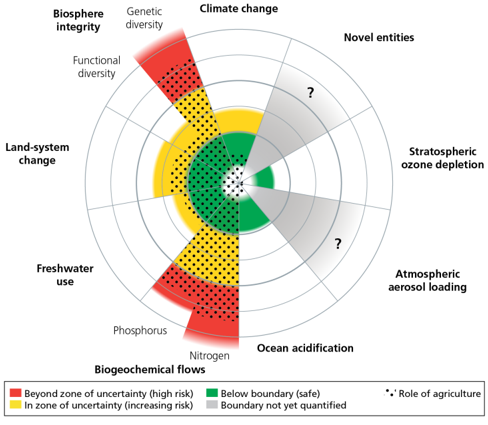
“Agricultural production is now considered to be a major driver of the Earth’s system exceeding planetary boundaries, such as land system change, biosphere integrity, biogeochemical cycles, and climate change [2].”
BackgroundDiets can be consistent with planetary limits and health targets at the individual level
Gebara, C. H., Berthet, E., Vandenabeele, M. I. D., Jolliet, O., & Laurent, A. (2025) · Nature Food · doi:10.1038/s43016-025-01133-y · Cited by 16
“11 and 12).”
Gender-based differences in eco-efficient farming
Fertő, I., Baráth, L., & Bojnec, Š. (2025) · Scientific Reports · doi:10.1038/s41598-025-00584-4 · Cited by 15
“Furthermore, this perspective reveals the importance of integrating gender considerations into global efforts to reduce agricultural greenhouse gas emissions and ecological footprints 37,40 .”
Aubert, P., Gardin, B., Huber, É., Schiavo, M., & Alliot, C. (2021) · Agriculture · doi:10.3390/agriculture11111119 · Cited by 17
Methods matter: Improved practices for environmental evaluation of dietary patterns
Ziegler, F., Tyedmers, P. H., & Parker, R. W. R. (2022) · Global Environmental Change · doi:10.1016/j.gloenvcha.2022.102482 · Cited by 17
Maharjan, K. L., Gonzalvo, C. M., & Aala, W. (2022) · Sustainability · doi:10.3390/su14095296 · Cited by 15
“Agriculture is one of the main drivers of climate change and many interventions will be necessary to reduce its role in going beyond the planetary boundaries [5].”
BackgroundEstimating Groundnut Yield in Smallholder Agriculture Systems Using PlanetScope Data
Kpienbaareh, D., Mohammed, K., Luginaah, I., Wang, J., Kerr, R. B., Lupafya, E., & Dakishoni, L. (2022) · Land · doi:10.3390/land11101752 · Cited by 19
Kozar, R., Djalante, R., Leimona, B., Subramanian, S. M., & Saitô, O. (2023) · Earth System Governance · doi:10.1016/j.esg.2023.100164 · Cited by 18
Dussiot, A., Fouillet, H., Perraud, E., Salomé, M., Huneau, J., Mariotti, F., & Kesse‐Guyot, E. (2023) · Journal of Cleaner Production · doi:10.1016/j.jclepro.2023.137600 · Cited by 16
Theerawitaya, C., Praseartkul, P., Taota, K., Tisarum, R., Samphumphuang, T., Singh, H. P., & Cha–um, S. (2023) · Plant Physiology and Biochemistry · doi:10.1016/j.plaphy.2023.107927 · Cited by 15
Barbieri, L. K., Ahamed, S., & Bliss, S. (2019) · interactions · doi:10.1145/3348795 · Cited by 15
Strategies for achieving healthy, sustainable, and equitable dietary transitions
Yang, Y., Tilman, D. G., Bellemare, M. F., Fanzo, J., Grebitus, C., Haws, K. L., Herrero, M., Jebb, S. A., Just, D. R., Levine, A. S., et al. (2026) · Science · doi:10.1126/science.adr7162 · Cited by 15
Naranjo, H. D., Rat, A., Zutter, N. D., Ridder, E. D., Lebbe, L., Audenaert, K., & Willems, A. (2023) · Microbiology Spectrum · doi:10.1128/spectrum.00747-23 · Cited by 14
“to climate change, declining biodiversity, and the general loss of ecosystem services (1).”
Can Organic Pork Help Achieve Sustainable Development Goals in Thailand?
Visetnoi, S., & Nelles, W. (2023) · Agriculture · doi:10.3390/agriculture13091822 · Cited by 16
“Some studies suggest a sustainable (and healthier) future implies reducing meat consumption [15–17].”
BackgroundToujgani, H., Brunin, J., Perraud, E., Allès, B., Touvier, M., Lairon, D., Mariotti, F., Pointereau, P., Baudry, J., & Kesse‐Guyot, E. (2023) · Scientific Reports · doi:10.1038/s41598-023-44872-3 · Cited by 15
Metadata
- Authors
- Campbell, B. M., Beare, D. J., Bennett, E. M., Hall-Spencer, J. M., Ingram, J. S. I., Jaramillo, F., Ortiz, R., Ramankutty, N., Sayer, J. A., & Shindell, D.
- Affiliations
- CGIAR (FR)
- McGill University (CA)
- University of Tsukuba (JP)
- University of Oxford (GB)
- Stockholm Resilience Centre (SE)
- University of Copenhagen (DK)
- University of British Columbia (CA)
- James Cook University (AU)
- Duke University (US)
- ORCID
- Venue
- Ecology and Society
- Publisher
- Resilience Alliance, Inc.
- Published
- 2017
- Volume
- 22
- Issue
- 4
- ISSN
- 1708-3087 (ISSN-L)
- OpenAlex
- W2762931876
- Cited by
- 1,197
- References
- 84
- Citations by year
- 2026: 137 · 2025: 204 · 2024: 182 · 2023: 157 · 2022: 182 · 2021: 140 · 2020: 101 · 2019: 56 · 2018: 35 · 2017: 1
- FWCI
- 36.59
- Type
- journal article
- Language
- en
- Open access
- gold
- doi.org
- Licence
- cc-by-nc
- Locations
- Ecology and Society (publishedVersion, cc-by-nc)
- Research at the University of Copenhagen (University of Copenhagen) (publishedVersion, cc-by)
- Epsilon Open Archive (Sveriges lantbruksuniversitet biblioteket (Swedish University of Agricultural Sciences)) (acceptedVersion)
- ResearchOnline at James Cook University (James Cook University) (submittedVersion)
- PEARL (University of Plymouth) (submittedVersion)
- CGSPace A Repository of Agricultural Research Outputs (Consultative Group for International Agricultural Research) (submittedVersion, other-oa)
- DOAJ (DOAJ: Directory of Open Access Journals) (submittedVersion, cc-by-sa)
- Funders
- Consortium of International Agricultural Research Centers
- Topics
- Physical Sciences › Environmental Science › Global and Planetary Change › Land Use and Ecosystem Services
- Physical Sciences › Environmental Science › Ecology › Agriculture Sustainability and Environmental Impact
- Life Sciences › Agricultural and Biological Sciences › Agronomy and Crop Science › Sustainable Agricultural Systems Analysis
- Keywords
- planetary boundaries, Earth system, anthropogenic impacts, land use change
About these checks
Registry, retraction, Cites and statistics results are computed, not judged, with one exception: a printed reference that no index lists is read once by a model before it counts as a citation error. Claims are extracted by a model and kept only when their quote appears verbatim in the text; each cited source is then checked, with a model’s help, for whether it says what the claim relies on. Those verdicts can be wrong — read the claim’s quote and the cited source before relying on one.
Statistics and arithmetic are recomputed, not judged.
Confidence bands are shown only for fields calibrated on our annotated test set. None is calibrated yet, so no band is shown.
What counts as a claim ›How we measure confidence ›How we check this ›
Are you an author, or do you see a problem with this page? Request a review
Data sources
Bibliographic data: Semantic Scholar, OpenAlex, Crossref.
Contains information from the Semantic Scholar Academic Graph Datasets, made available under the ODC Attribution License (ODC-BY 1.0).
Semantic Scholar’s data is described in: Kinney, R., et al. (2023). The Semantic Scholar Open Data Platform. arXiv:2301.10140.
