

Agriculture production as a major driver of the Earth system exceeding planetary boundaries
Open accessThe DOI matches its Crossref record; 86 of the 86 references it cites were found in a registry or an index.
Abstract
Campbell, B. M., D. J. Beare, E. M. Bennett, J. M. Hall-Spencer, J. S. I. Ingram, F. Jaramillo, R. Ortiz, N. Ramankutty, J. A. Sayer, and D. Shindell. 2017. Agriculture production as a major driver of the Earth system exceeding planetary boundaries. Ecology and Society 22(4):8. https://doi.org/10.5751/ES-09595-220408
Overview
The claims and statistics of this paper haven’t been checked yet.
Free: it reads the open-access text and checks the first 5 claims that cite a source we can check. Create a free account to check every claim.
Integrity signals
Registry
Cites
Statistics
Figures
Verification
Claims the paper makes
The claims and statistics of this paper haven’t been checked yet.
Free: it reads the open-access text and checks the first 5 claims that cite a source we can check. Create a free account to check every claim.
Claims other papers make about this one
Each is checked against this paper’s own text: does it say what the citing paper says it does?
The source backs part of the claim, not all of it — or backs it for a different population, condition or comparison.
In the citing paper
“Agricultural expansion and intensification are considered major drivers of habitat and biodiversity loss, soil and freshwater degradation, environmental pollution, and greenhouse gas emissions worldwide (1, 2).”
From Agricultural diversification promotes multiple ecosystem services without compromising yield (2020) · cites this paper as [1]
Experimental — accuracy not yet measuredThe cited source says what the claim attributes to it.
In the citing paper
“As a result, agriculture plays a major role in pushing the biosphere beyond planetary boundaries in terms of biodiversity and biogeochemical flows of nitrogen and phosphorus, and is a major contributor to climate change [3].”
From An Actor-Oriented Multi-Criteria Assessment Framework to Support a Transition towards Sustainable Agricultural Systems Based on Crop Diversification (2020) · cites this paper as [3]
The cited source says what the claim attributes to it.
In the citing paper
“The main driver of biodiversity loss is agriculture1, both through intensification of existing agricultural land and expansion of agriculture into pristine ecosystems2,3.”
From Farming practices to enhance biodiversity across biomes: a systematic review (2024) · cites this paper as [1]
In the citing paper
“Biodiversity is declining at an unprecedented pace around the world, with current estimates that around 5% of all species will be lost every ten years1.”
From Farming practices to enhance biodiversity across biomes: a systematic review (2024) · cites this paper as [1]
Self-check
Percentages, sums and reported differences re-computed from the paper’s own numbers.
The self-check needs the paper’s full text.
Citations
Cites
A safe operating space for humanity
Rockström, J., Steffen, W., Noone, K., Persson, Å., Chapin, F. S., Lambin, E. F., Lenton, T. M., Scheffer, M., Folke, C., Schellnhuber, H. J., et al. (2009) · Nature · doi:10.1038/461472a · Cited by 13,333 · cited 10×
“In 2009 Rockström et al. (2009 a,b ) introduced the concepts of “planetary boundaries” (PBs) and a “safe operating space for humanity,” which have recently been revised by Steffen et al. (2015).”
BackgroundMethodInfluentialGlobal Consequences of Land Use
Foley, J. A., DeFries, R., Asner, G. P., Barford, C., Bonan, G., Carpenter, S. R., Chapin, F. S., Coe, M. T., Daily, G. C., Gibbs, H. K., et al. (2005) · Science · doi:10.1126/science.1111772 · Cited by 13,272 · cited 4×
“According to Foley et al. (2005), croplands and pastures are one of the largest terrestrial biomes on the planet, occupying ~40% of land surface.”
InfluentialSelf-citationPlanetary boundaries: Guiding human development on a changing planet
Steffen, W., Richardson, K., Rockström, J., Cornell, S. E., Fetzer, I., Bennett, E. M., Biggs, R., Carpenter, S. R., de Vries, W., de Wit, C. A., et al. (2015) · Science · doi:10.1126/science.1259855 · Cited by 12,527 · cited 10×
“We have followed the Steffen et al. (2015) framing of the boundary.”
BackgroundMethodInfluentialSelf-citationNg, M., Fleming, T., Robinson, M., Thomson, B., Graetz, N., Margono, C., Mullany, E. C., Biryukov, S., Abbafati, C., Abera, S. F., et al. (2014) · The Lancet · doi:10.1016/s0140-6736(14)60460-8 · Cited by 11,952 · cited 1×
“…have to address the fact that at least a billion people do not have access to sufficient calories (FAO 2014), and more than two billion people lack sufficient nutrients (WHO and FAO 2014), while, paradoxically, at the same time over two billion people consume too many calories (Ng et al. 2014).”
Correspondence - Tranexamic acid for traumatic brain injury
(2005) · London School of Economics and Political Science Theses Online (London School of Economics and Political Science) · doi:10.1016/s0140-6736 · Cited by 11,894
Lim, S. S., Vos, T., Flaxman, A. D., Danaei, G., Shibuya, K., Adair-Rohani, H., AlMazroa, M. A., Amann, M., Anderson, H. R., Andrews, K. G., et al. (2012) · The Lancet · doi:10.1016/s0140-6736(12)61766-8 · Cited by 11,805 · cited 1×
“Because the Global Burden of Disease estimates that about 3.2 million premature deaths are attributable to small PM each year (Lim et al. 2012), this suggests that agriculture’s contribution to atmospheric aerosol loading may be responsible for ~450,000–660,000 premature deaths annually based on…”
InfluentialPlanetary Boundaries: Exploring the Safe Operating Space for Humanity
Rockström, J., Steffen, W., Noone, K., Persson, Å., Chapin, F. S. I., Lambin, E., Lenton, T. M., Scheffer, M., Folke, C., Schellnhuber, H. J., et al. (2009) · Ecology and Society · doi:10.5751/es-03180-140232 · Cited by 7,187
Transformation of the Nitrogen Cycle: Recent Trends, Questions, and Potential Solutions
Galloway, J. N., Townsend, A. R., Erisman, J. W., Bekunda, M., Cai, Z., Freney, J. R., Martinelli, L. A., Seitzinger, S. P., & Sutton, M. A. (2008) · Science · doi:10.1126/science.1136674 · Cited by 6,995 · cited 2×
“Large amounts of N required for plant and livestock production results in agricultural activities being the main driver of the N cycle (Galloway et al. 2008, Liu et al. 2010, Bodirsky et al. 2012).”
InfluentialSpreading dead zones and consequences for marine ecosystems
Diaz, R. J., & Rosenberg, R. (2008) · Science · doi:10.1126/science.1156401 · Cited by 6,626 · cited 1×
“The P cycle is accelerated two to three times over background rates (Smil 2000), leading to eutrophication of freshwater and estuarine systems (Diaz and Rosenberg 2008) in addition to the intended increase in agricultural production.”
Bounding the role of black carbon in the climate system: A scientific assessment
Bond, T. C., Doherty, S. J., Fahey, D. W., Forster, P. M., Berntsen, T., DeAngelo, B. J., Flanner, M. G., Ghan, S., Kärcher, B., Koch, D., et al. (2013) · Journal of Geophysical Research: Atmospheres · doi:10.1002/jgrd.50171 · Cited by 6,385 · cited 2×
“Assessment of the literature puts the share of anthropogenic emissions of black and organic carbon at about 3–14% (Bond et al. 2013).”
Self-citation
Research works printed but not linked: 3
- [42]42. Jaramillo, F., and G. Destouni. 2015b. Local flow regulation and irrigation raise global human water consumption and footprint. Science 350(6265):1248-1251. http://dx.doi.org/10.1126/science. · DOI · Paper page
- [76]76. in Edenhofer, O., R. Pichs-Madruga, Y. Sokona, E. Farahani, S. Kadner, K. Seyboth, A. Adler, I. Baum, S. Brunner, P. Eickemeier, B. Kriemann, J. Savolainen, S. Schlömer, C. von Stechow, T. Zwickel, and J. C. Minx, editors. Climate change 2014: mitigation of climate change. Contribution of Working Group III to the Fifth Assessment Report of the Intergovernmental Panel on Climate Change. Cambridge University Press, Cambridge, UK.
- [83]83. Trumbo, J., and D. Powell. 2016. Why transgenic plants are so controversial. Pages 366-382 in C. N. Stewart Jr, editor. Plant Ecology and Society 22(4): 8 https://www.ecologyandsociety.org/vol22/iss4/art8/ biotechnology and genetics: principles, techniques, and applications.
Cited by
Items 701–800 of 1,000
Sustainable and Resilient Agrifood Systems ( SARAS ). A Leibniz Position
Hunecke, C., Thom, F., Vogt, J., Bellingrath‐Kimura, S. D., Brück, T., Gaupp, F., Geppert, F., Grune, T., Herzfeld, T., Kulling, S. E., et al. (2025) · Sustainable Development · doi:10.1002/sd.3468 · Cited by 8
“…key contributor to climate change and loss of ESS and BD (Alexander et al. 2015; IPBES 2019; IPCC 2022; Willett et al. 2019), impacting biosphere integrity and phosphorus and nitrogen flows (Campbell et al. 2017; Gerten et al. 2020; Haines et al. 2014; Springmann et al. 2018a; Willett et al. 2019).”
Hsu, G., Ou, J., Ni, M., Lin, Z., & Ho, C. (2025) · Journal of Applied Ecology · doi:10.1111/1365-2664.70066 · Cited by 6
Think sink, not source: how vertical farming’s potential is limited by crop breeding
Heeling, D., Meeuws, G., Mogollón, J. M., Erisman, J. W., & Behrens, P. (2025) · Frontiers in Plant Science · doi:10.3389/fpls.2025.1621684 · Cited by 6
“Agriculture also plays a signi fi cant role in driving climate change, biodiversity loss, land use change, and nutrient pollution (Campbell et al., 2017; Tuomisto, 2019; Orsini et al., 2020); with climate change expected to exacerbate global food insecurity (Mirzabaev et al., 2023).”
Associating climate change mitigation with protein security: The case of Ireland
Merlo, M., Buckley, C., Hennessy, T., & O’Mahony, J. A. (2026) · Environmental Science & Policy · doi:10.1016/j.envsci.2026.104311 · Cited by 6
Weeks, D., & Jenkins, J. S. (2024) · Environmental Management · doi:10.1007/s00267-024-01969-3 · Cited by 6
“…major driver of global change crises and trajectories towards planetary boundary excee-dance, coupled economic-population growth trends provide for projections of 10 9 hectares of natural ecosystems to be converted to industrial agricultural lands by 2050 (Tilman et al. 2001; Campbell et al. 2017).”
BackgroundSufficiency in Business: The Transformative Potential of Business for Sustainability
Gossen, M., & Nießen, L. (2024) · Neue Ökonomie · doi:10.1515/9783839469101 · Cited by 13
Reduction potential of German environmental food impacts due to a planetary health diet
Eberle, U., & Mumm, N. (2024) · The International Journal of Life Cycle Assessment · doi:10.1007/s11367-024-02352-4 · Cited by 6
“These are biosphere integrity, land-system change, freshwater use and biogeochemical flows (Steffen et al. 2015; Campbell et al. 2017; Persson et al. 2022).”
Song, F., Wu, H., Sun, Z., Bai, J., Su, F., Xu, D., Cao, C., Li, H., Song, S., & Liu, Y. (2024) · Environmental Research Letters · doi:10.1088/1748-9326/ad786b · Cited by 6
“While the agricultural development environment is being threatened, the sustainability of agricultural systems has also been reduced due to increased reliance on non-renewable resources (Campbell et al 2017, Liu et al 2019).”
Mapping and Identification of Ecosystem Services Hotspots in the Brazilian Pampa Biome
da Silva, C. F. M., Campos, M. C. C., Costa, D. F. D. S., Schneck, F., & Hepp, L. U. (2024) · Environmental Management · doi:10.1007/s00267-024-02069-y · Cited by 9
“In recent decades, the natural landscape has been improved, mainly, by agricultural use, which occupies around 40% of the earth ’ s surface (Campbell et al., 2017; Ellis 2019).”
Bengtsson, A., & Haller, H. (2025) · Urban Agriculture & Regional Food Systems · doi:10.1002/uar2.70005 · Cited by 6
“…greenhouse gas emissions (Crippa et al., 2021) and is one of the strongest drivers of loss of biodiversity, loss of drinking water, disruption of our global nitrogen and phosphorus cycles, and deforestation (Campbell et al., 2017; Conijn et al., 2018; Springmann et al., 2018; Willett et al., 2019).”
Which types of quantitative foresight scenarios to frame the future of food systems? A review
Riera, A., Duluins, O., Antier, C., & Baret, P. V. (2025) · Agricultural Systems · doi:10.1016/j.agsy.2025.104270 · Cited by 7
Baleón-Sepúlveda, A., Mora, F., & Gavito, M. E. (2025) · The Science of The Total Environment · doi:10.1016/j.scitotenv.2025.178866 · Cited by 6
Busschaert, L., Bechtold, M., Modanesi, S., Massari, C., Raes, D., Kumar, S. V., & Lannoy, G. J. M. D. (2026) · Hydrology and earth system sciences · doi:10.5194/hess-30-2579-2026 · Cited by 7
Reconsidering the Soil–Water–Crops–Energy (SWCE) Nexus Under Climate Complexity—A Critical Review
Kourgialas, N. N. (2025) · Agriculture · doi:10.3390/agriculture15171891 · Cited by 6
“Interdisciplinary efforts often stumble on methodological incompatibility, for example, aligning probabilistic simulations with regulatory frameworks and community priorities [62].”
Kortetmäki, T., de Boon, A., Paloviita, A., Herman, A., Niemi, T., & Tribaldos, T. (2025) · Agriculture and Human Values · doi:10.1007/s10460-025-10801-5 · Cited by 6
“Food system activities (including input pro - duction and land use change) are among the main drivers of exceeding planetary boundaries (Campbell et al. 2017).”
Historical food consumption declines and the role of alternative foods
Ferraro, D. M., Cottrell, R. S., Blasco, G. D., Froehlich, H. E., & Halpern, B. S. (2021) · Environmental Research Letters · doi:10.1088/1748-9326/ac4072 · Cited by 6
Siverwood-Cope, K., & Ling, M. (2021) · Ocean and Coastal Research · doi:10.1590/2675-2824069.21009ksc · Cited by 6
Uhlig, D., Berns, A. E., Wu, B., & Amelung, W. (2023) · Plant and Soil · doi:10.1007/s11104-023-06047-x · Cited by 6
“Negative effects of this development are omnipresent and include land use changes like deforestation, groundwater pollution, and freshwater depletion (Campbell et al. 2017).”
BackgroundOladapo, M. O., Abualqumboz, M., Ngoe, L. M., Oyetunji, A. K., Amaechi, C. V., Bello, R., & Amaechi, E. C. (2023) · Economies · doi:10.3390/economies11090222 · Cited by 10
Mehdi, B., Zoboli, O., Schürz, C., Strenge, E., Lima, E. M., Párajka, J., Wang, C., Zessner, M., & Schönhart, M. (2024) · The Science of The Total Environment · doi:10.1016/j.scitotenv.2024.170730 · Cited by 6
Rode, P. D. A., Ferla, J. J., Bizarro, G. L., Schüssler, M., & Ferla, N. J. (2024) · Biota Neotropica · doi:10.1590/1676-0611-bn-2023-1602 · Cited by 6
The role of planetary health in urologic oncology
Lawaczeck, L., Rudolph, J. E., Norz, V., Tsaur, I., & Rausch, S. (2024) · Expert Review of Anticancer Therapy · doi:10.1080/14737140.2024.2350631 · Cited by 6
“Agriculture is estimated to contribute at least 11–14%, or approximately 5.0–5.8 gigatons of CO 2 e per year, to total anthropogenic greenhouse gas emissions, of which approximately 75% comes from livestock farming [7,16].”
BackgroundInfluentialVaravallo, G., Rugani, B., Allocco, M., Barbera, F., & Calfapietra, C. (2024) · Corporate Social Responsibility and Environmental Management · doi:10.1002/csr.2879 · Cited by 6
Carlier, J., Doyle, M., Finn, J. A., hUallacháin, D. Ó., Ruas, S., VOGT, P. R., & Moran, J. (2024) · The Science of The Total Environment · doi:10.1016/j.scitotenv.2024.174509 · Cited by 7
Postgrowth food systems: critique, visions, pathways
Feola, G. (2025) · Degrowth Journal · doi:10.36399/degrowth.003.01.02 · Cited by 8
“…of taste, and human nutrition), and limited access to food (as indicated by the increasing diffusion of food banks); the expulsion of smallholders and peasants from the land and markets; and the loss of often-diverse traditional practices and cultivars (Jones et al., 2010; Campbell et al., 2017).”
Agricultural environmental ethics: an emerging way to understand and solve sustainability challenges
Congreves, K. A. (2025) · npj Sustainable Agriculture · doi:10.1038/s44264-025-00071-3 · Cited by 7
Durigon, J., & Seifert, C. A. (2022) · Revista Arqueologia Pública · doi:10.20396/rap.v17i00.8667910 · Cited by 6
Engagement in water governance action situations in the Lake Champlain Basin
Bitterman, P., & Koliba, C. (2023) · PLoS ONE · doi:10.1371/journal.pone.0282797 · Cited by 6
Planetare Gesundheit – Ein holistisches Gesundheitskonzept inmitten multipler planetarer Krisen
Schmid, J., & Schwienhorst-Stich, E. (2023) · Zeitschrift für medizinische Ethik · doi:10.30965/29498570-20230050 · Cited by 8
Sustainable food systems, development paths, and scenarios for cellular agriculture
Newell, R., & Glaros, A. (2024) · Elsevier eBooks · doi:10.1016/b978-0-443-18767-4.00022-6 · Cited by 7
A Human Ecological Approach to Policy in the Context of Food and Nutrition Security
Dyball, R., Davila, F., & Wilkes, B. (2020) · Springer eBooks · doi:10.1007/978-981-13-0370-8_11-1 · Cited by 8
Mora, M. D. L. L., Calabi-Floody, M., & Rumpel, C. (2021) · Agronomy · doi:10.3390/agronomy11061158 · Cited by 6
“Expansion of farmland with food production as a major service has been largely associated with conversion of natural ecosystems like the Amazon and Savanna into new agricultural land [1].”
BackgroundFolsche, E., & Fiebelkorn, F. (2022) · Journal of Biological Education · doi:10.1080/00219266.2022.2108104 · Cited by 6
“In particular, the keeping of fattening pigs and dairy cows for meat and milk production plays a significant role in exceeding the Earth System planetary boundaries (Campbell et al. 2017).”
BackgroundOlofsson, J. (2021) · Energies · doi:10.3390/en14144219 · Cited by 5
“The present forestry and agricultural practices have been debated from various sustainability perspectives [34,35].”
BackgroundCalabi-Floody, M., Medina, J., Richardson, A. E., Guarda-Reyes, M. J., Villegas-Pizarro, P., Zirotti-Lecaros, I., Mora-Pérez, L., Aponte, H., Knicker, H., Rumpel, C., et al. (2024) · Journal of soil science and plant nutrition · doi:10.1007/s42729-024-01997-2 · Cited by 5
“In order to provide food security, agriculture practices have been one of the primary causes of these trans-gressions (Campbell et al. 2017; Richardson et al. 2023).”
Counter‐hegemonic ethics for sustainable business
Hurtado, J. H., Heikkurinen, P., Ruuska, T., Hagolani‐Albov, S. E., & Koppelmäki, K. (2024) · Business Ethics the Environment & Responsibility · doi:10.1111/beer.12745 · Cited by 5
Zougris, K., Miles, A. F., Benjamin, R., & Geismar, E. (2025) · Frontiers in Sustainable Food Systems · doi:10.3389/fsufs.2024.1490923 · Cited by 5
Bartkowski, B., Baaken, M. C., Nagpal, M., Sodoge, J., & de Brito, M. M. (2025) · People and Nature · doi:10.1002/pan3.70003 · Cited by 5
Cultivating control? How cultured meat threatens Food Sovereignty
Moss, M. F. (2025) · npj Sustainable Agriculture · doi:10.1038/s44264-025-00058-0 · Cited by 5
Widespread but reducing irrigation deficit in the Yellow River Basin over the past 20 years
Ainiwaer, S., Zhang, L.-L., Jin, L., Yan, Y., Zhao, Q., Gao, Y., Huang, L., & Wang, X. (2025) · Journal of Hydrology · doi:10.1016/j.jhydrol.2025.133400 · Cited by 5
Berthy, F., Allès, B., Fezeu, L., Lairon, D., Pointereau, P., Touvier, M., Herçberg, S., Galan, P., Baudry, J., & Kesse‐Guyot, E. (2025) · International Journal of Epidemiology · doi:10.1093/ije/dyaf011 · Cited by 5
“12,13 In order to limit this double health and environmental burden, the international EAT-Lancet Commission developed in 2019 a planetary health diet.”
Becoming Nature Positive: Transitioning to a Safe and Just Future
Lambertini, M., Bull, J. W., Bear, L. L., Locke, H., Zabey, E., Maseke, D., & Rodríguez, C. M. (2025) · Routledge eBooks · doi:10.4324/9781003474043 · Cited by 5
Toward energy systems within the planetary boundaries
Meramo, S., Mesa, J. A., Cano, N., Pupo-Roncallo, O., & González‐Quiroga, A. (2025) · AMBIO · doi:10.1007/s13280-025-02197-7 · Cited by 5
“Considering defor-estation driven by agriculture, Campbell et al. (2017) attributed 80% of land-use change to this sector.”
InfluentialDoes scale matter? How local sourcing affects land use for circular food systems in the Netherlands
Tamsma, D. W., SCHUT, A. G. T., van Ittersum, M. K., van Selm, B., van Middelaar, C. E., & de Boer, I. J. M. (2025) · Agricultural Systems · doi:10.1016/j.agsy.2025.104436 · Cited by 6
Representation of a two-way coupled irrigation system in the Common Land Model
Zhang, S., Liang, H., Li, F., Lu, X., & Dai, Y. (2025) · Hydrology and earth system sciences · doi:10.5194/hess-29-3119-2025 · Cited by 6
“Around 70% of global freshwater has been withdrawn for irrigation (Campbell et al., 2017), accounting for 90% of consumptive water use (Siebert and Döll, 2010), with irrigated areas providing approximately 40% of global food production on just 2.5% of global land (Abdullah, 2006).”
InfluentialPathways for biodiversity enhancement in German agricultural landscapes
Sponagel, C., Thompson, A., Paetow, H., Mupepele, A., Bieling, C., Sommer, M., Klein, A., Settele, J., Finger, R., Huber, R., et al. (2025) · People and Nature · doi:10.1002/pan3.70103 · Cited by 6
“Globally, current agricultural intensification is a major driver of biodiversity loss (Beaumelle et al., 2023 ; Campbell et al., 2017; IPBES, 2019 ; Kehoe et al., 2017 ).”
Arango‐Angarita, A., Unar‐Munguía, M., Zepeda‐Tello, R., Batis, C., & Rivera, J. Á. (2025) · BMC Public Health · doi:10.1186/s12889-025-23988-3 · Cited by 7
“Additionally, these dietary patterns have a significant environmental impact [7, 8].”
Soil moisture in the Anthropocene: a tipping component in planetary boundary transgressions
Tefera, G. W., Ray, R. L., Kumar, N., Gashaw, T., & Sarkar, R. (2025) · Environmental Research Letters · doi:10.1088/1748-9326/adfcea · Cited by 5
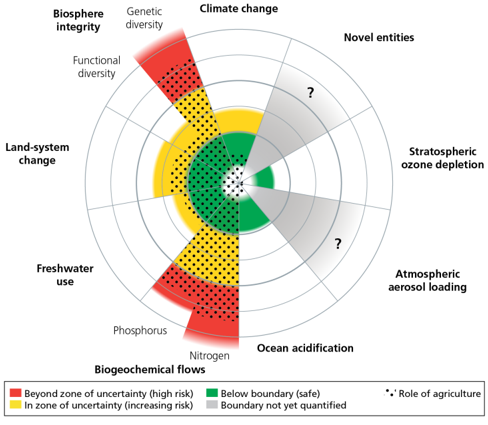
“…nine planetary boundaries: land-system change, freshwater change, climate change, biogeochemical flows, biosphere integrity, ocean acidification, stratospheric ozone depletion, atmospheric aerosol loading, and the introduction of novel entities (Rockström et al 2009a, Campbell et al 2017, 2023).”
de Oliveira, R. E., de Magalhães, L. P., Gallo, A. D. S., de Oliveira, J. A., & Sais, A. C. (2025) · Land Use Policy · doi:10.1016/j.landusepol.2025.107802 · Cited by 6
Kesse‐Guyot, E., Chayre, A., Perraud, E., Berger, S., Richard, A., Berlivet, J., Touvier, M., Allès, B., Herçberg, S., Lairon, D., et al. (2025) · The Lancet Regional Health - Europe · doi:10.1016/j.lanepe.2025.101481 · Cited by 5
“6,7 Livestock production, including beef and dairy as well as, to a lesser extent, monogastric breeding, shows the most significant environmental impacts across many indicators: acidification, eutrophication, greenhouse gas emissions (GHGe), soil and water use, etc. 8,9 Observational studies have…”
Characterization of irrigation timing using thermal satellite observations, a data-driven approach
Jalilvand, E., Kumar, S. V., Truong, C., Haacker, E., & Mahanama, S. (2025) · Remote Sensing of Environment · doi:10.1016/j.rse.2025.115153 · Cited by 6
Liang, Z., Ma, B., Yu, R.-P., Huo, Y., Mudare, S., Ying, F., Li, L., Zhang, F., & Cong, W.-F. (2025) · Field Crops Research · doi:10.1016/j.fcr.2025.110269 · Cited by 6
Järviö, N., Uusitalo, V., & Ekroos, J. (2026) · The International Journal of Life Cycle Assessment · doi:10.1007/s11367-026-02602-7 · Cited by 5
Chen, D., Zeng, X., Dongwei, G. U. I., Wang, D., & Wu, J. (2026) · Hydrology and earth system sciences · doi:10.5194/hess-30-3741-2026 · Cited by 5
Bad animals, techno-fixes, and the environmental narratives of alternative protein
Hedberg, R. C. (2023) · Frontiers in Sustainable Food Systems · doi:10.3389/fsufs.2023.1160458 · Cited by 5
“The first decades of the Twenty-First Century brought with them significant public attention to the environmental problems associated with industrial food systems (e.g., Pollan, 2006; Kenner, 2008; Vermeulen et al., 2012; Campbell et al., 2017; Hawken, 2017).”
BackgroundOliveira, L. F. C., Pereira, T. F. D., Matos, T. S., Sawaya, A. C. H. F., & Sussulini, A. (2024) · Microchemical Journal · doi:10.1016/j.microc.2024.110374 · Cited by 5
Gustafson, C. R., Gitungwa, H., Sapkota, S., & Rose, D. J. (2024) · Frontiers in Nutrition · doi:10.3389/fnut.2024.1454271 · Cited by 6
Reiff, J., Jungkunst, H. F., Antes, N., & Entling, M. H. (2025) · Peer Community Journal · doi:10.24072/pcjournal.521 · Cited by 6
Dymond, K., Celis-Diez, J. L., Díaz‐Siefer, P., Rojas‐Bravo, V., Martínez‐Harms, J., Potts, S. G., & Garratt, M. P. D. (2025) · Frontiers in Sustainable Food Systems · doi:10.3389/fsufs.2025.1560802 · Cited by 5
FIVE DIATOM SPECIES IDENTIFIED BY USING POTENTIAL APPLICATION OF NEXT GENERATION DNA SEQUENCING
Al-Meshhdany, W. Y., & Hassan, F. M. (2020) · Bulletin of The Iraq Natural History Museum · doi:10.26842/binhm.7.2020.16.1.0039 · Cited by 5
Chapter 8 Terrestrial CO2-Concentrating Mechanisms in a High CO2 World
Sage, R. F., & Stata, M. (2021) · Advances in photosynthesis and respiration · doi:10.1007/978-3-030-64926-5_8 · Cited by 9
Drones for Good: UAS Applications in Agroecology and Organic Farming
Pappalardo, S. E., & Andrade, D. (2022) · CRC Press eBooks · doi:10.1201/9780429052842-8 · Cited by 5
Prades, F. M. C. (2022) · Revista REGENERATIO · doi:10.55924/ucireg.v1i2.12 · Cited by 5
Li, Y., Roy, A., & Dong, X. (2022) · Foods · doi:10.3390/foods11213459 · Cited by 5
Transdisciplinary approaches to graduate student training for food–energy–water challenges
Gittlin, M. L., Clarizio, T., Lamiño, P., Michels, A., Opejin, A., & Barrera, E. L. (2023) · Natural sciences education · doi:10.1002/nse2.20119 · Cited by 5
Water footprint of irrigated rice in the state of Rio Grande do Sul, 2019/2020 crop
Recktenwalt, F., de Morais, F. A., & Pereira, M. A. F. (2023) · Environmental Monitoring and Assessment · doi:10.1007/s10661-023-12029-4 · Cited by 5
“Campbell et al. (2017) claim that agricultural production, due to its high demand, is one of the main causes that lead the Earth sys-tem to exceed planetary limits.”
Lanjouw, M., Jansen, H. M., & van der Meer, J. (2024) · Ecological Modelling · doi:10.1016/j.ecolmodel.2024.110883 · Cited by 5
A scoping review of food consumer aspects in transitioning to a safe and just agrifood system
Moghayer, S., Manouchehrabadi, B., Tiboldo, G., Ferrer‐Pérez, H., Kozicka, M., van Dijk, M., Farina, G., Castellari, E., Moro, D., & Philippidis, G. (2024) · Q Open · doi:10.1093/qopen/qoae030 · Cited by 6
Jiménez-Aceituno, A., López-Rodríguez, M. D., Castro, A. A., Cortés-Calderón, S. V., Collste, D., Aparicio, G., Rölfer, L., Díaz, M. A. B., Marín, L., Gómez-Tenorio, M. A., et al. (2025) · Global Food Security · doi:10.1016/j.gfs.2025.100829 · Cited by 6
Reichenspurner, M., & Matzdorf, B. (2025) · Biological Conservation · doi:10.1016/j.biocon.2025.111108 · Cited by 9
Food security and nutrition in agro-food sustainability transitions
Bilali, H. E., Palmisano, G. O., Bottalico, F., Cardone, G., & Capone, R. (2021) · Elsevier eBooks · doi:10.1016/b978-0-12-820521-1.00003-4 · Cited by 5
Alcaraz, J. M. M., Tirado, F., & Gálvez, A. (2021) · Business Ethics the Environment & Responsibility · doi:10.1111/beer.12362 · Cited by 6
Effects of Agricultural Use on Endangered Plant Taxa in Spain
Molina-Pardo, J. L., Rodríguez‐Caballero, E., Cueto, M., Vega, P. B., Sánchez-Robles, M., Allué, A. L., & Luque, E. G. (2021) · Agriculture · doi:10.3390/agriculture11111097 · Cited by 5
“biosphere integrity, biogeochemical flows, land-system change, and freshwater use [17].”
BackgroundDiverse crops and input subsidies: a village-scale analysis in Mali
Assima, A., Smale, M., & Koné, B. (2021) · International Journal of Agricultural Sustainability · doi:10.1080/14735903.2021.2016261 · Cited by 7
“Over the course of human history, modern human activities, and notably agriculture, have degraded biodiversity (Campbell et al., 2017; Foley et al., 2011; Pereira et al., 2012).”
BackgroundMuñoz‐Ulecia, E., Bernués, A., Briones-Hidrovo, A., Franzese, P. P., Buonocore, E., Santagata, R., Ulgiati, S., & Collado, D. (2023) · Communications Earth & Environment · doi:10.1038/s43247-023-00933-z · Cited by 5
Are there enough stimuli to develop sustainable farming in Lithuania?
Baležentis, T., Galnaitytė, A., Namiotko, V., Novickytė, L., & Chen, X. (2018) · Management of Environmental Quality An International Journal · doi:10.1108/meq-09-2018-0160 · Cited by 5
An Intelligent Marketspace Mobile Application for Marketing Organic Products
Arogundade, O. '., Abayomi-Alli, A. A., Adesemowo, A. K., Bamigbade, T., Odusami, M., & Olowe, V. I. O. (2020) · Lecture notes in computer science · doi:10.1007/978-3-030-44999-5_23 · Cited by 5
“Today, Agriculture is not only a dominating factor of environmental degradation, it is a major force compelling the Earth System beyond the ‘safe-operating space’ for humanity [4, 5].”
Ricord, M. (2018) · UWSpace (University of Waterloo) · Cited by 6
Moreno, Y., Lopez-Villalobos, N., Donaghy, D., López, I. F., MacGibbon, A. K. H., & Holroyd, S. E. (2024) · New Zealand Journal of Agricultural Research · doi:10.1080/00288233.2024.2416042 · Cited by 4
“As agriculture continues to push planetary boundaries, there is a pressing need to explore innovative farming practices that not only sustain but regenerate our eco-systems (Campbell et al. 2017; Broom 2019).”
Dymond, K., Celis-Diez, J. L., Lymna‐Dennis, C., Rojas‐Bravo, V., Martínez‐Harms, J., Potts, S. G., & Garratt, M. P. D. (2025) · Conservation Science and Practice · doi:10.1111/csp2.70043 · Cited by 4
“Multiple factors contribute to this decline, however, the most influential threat is agricultural intensification and expansion due to the associated natural habitat loss and fragmentation, and the application of pesticides (Campbell et al., 2017; Vanbergen et al., 2020).”
“But don't think it is a game”: Agricultural videogames and “good farming”
Foureaux, S., & Daum, T. (2025) · Journal of Rural Studies · doi:10.1016/j.jrurstud.2025.103686 · Cited by 4
Replacing conventional meat with mycoprotein: relative and absolute environmental perspectives
Pasutto, E., Dahlin, J., Sukumara, S., & Meramo, S. (2025) · Sustainable Production and Consumption · doi:10.1016/j.spc.2025.04.019 · Cited by 6
A Comparative Study Between the Dietary Pattern in Argentina and International Recommendations
Hunziker, C. I., Arrieta, E. M., Diaz, M. P., & León, A. E. (2025) · Foods · doi:10.3390/foods14111920 · Cited by 4
“Due to its scale, agriculture is among the human activities with the highest environmental impact, contributing significantly to the transgression of planetary boundaries [4].”
Ferreira, J. V. A., de Almeida‐Rocha, J. M., Morante‐Filho, J. C., Storck‐Tonon, D., & Benchimol, M. (2025) · Sociobiology · doi:10.13102/sociobiology.v72i3.11410 · Cited by 4
Khairo, A. M., Farhan, M. J., & Islam, K. R. (2025) · Communications in Soil Science and Plant Analysis · doi:10.1080/00103624.2025.2557385 · Cited by 6
“Conventional agriculture, while yielding larger quantities of food and feed, has led to a surge in the use of chemical fertilizers and other agrochemicals, resulting in deteriorating soil quality (Campbell et al. 2017; Khangura et al. 2023; Tilman et al. 2002).”
Sarkar, R., & Ray, R. L. (2025) · Geocarto International · doi:10.1080/10106049.2025.2597423 · Cited by 4
“…climate change but also the transgression of six out of nine planetary boundaries (Rockström et al. 2024), with agricultural production being a major driver of Earth’s systems (Campbell et al. 2017), sequestering SOC emerges as a proven solution to these issues (Lal et al. 2015; Don et al. 2024).”
Li, X., Wu, K., Cai, W., Zhang, B., Liu, Y., & Li, X. (2026) · Field Crops Research · doi:10.1016/j.fcr.2025.110320 · Cited by 4
Meinilä, J. M., Mazac, R., Vepsäläinen, H., Katajajuuri, J., Tuomisto, H. L., Fogelholm, M., Erkkola, M., & Nevalainen, J. (2026) · npj Science of Food · doi:10.1038/s41538-026-00721-x · Cited by 4
Organic carbon sequestration under straw return: Region-specific modelling framework
Du, B., Song, C., Wang, G., Ren, S., Jiang, J., Gao, P., Sijing, Y. E., & Kuzyakov, Y. V. (2026) · Agricultural Systems · doi:10.1016/j.agsy.2026.104757 · Cited by 4
Sustainable Food Support during an Ultra-Endurance and Mindfulness Event: A Case Study in Spain
Pastor, M. G. G., Díaz, F. M. S. C., Fernández-López, N., Ferro, A., & Sillero‐Quintana, M. (2021) · International Journal of Environmental Research and Public Health · doi:10.3390/ijerph182412991 · Cited by 4
A Vicious Cycle Between Agriculture Supply Chain and Climate Change
Guo, X. (2023) · Highlights in Business Economics and Management · doi:10.54097/hbem.v5i.5098 · Cited by 4
Liu, S., Wang, L., Khan, I. A., Li, G., Rehman, A., Suo, R., Chang, L., Alabbosh, K. F., & Khan, K. A. (2024) · Environment Development and Sustainability · doi:10.1007/s10668-024-04617-2 · Cited by 5
“The escalating global population poses a challenge to both food security and sovereignty (Campbell et al., 2017).”
Model-based agricultural landscape assessments: a review
Heidenreich, A., Müller, A. W., Oggiano, P., Pfeifer, C., Moakes, S., Six, J., & Stolze, M. (2024) · Environmental Research Letters · doi:10.1088/1748-9326/ad57d3 · Cited by 4
Meier, T., Schade, S., Forner, F., & Eberle, U. (2024) · Sustainability · doi:10.3390/su162310658 · Cited by 4
SErious Game for AgroEcology (SEGAE): How much can be delivered with a 4-hour lesson?
Graeuwe, M. D., Dumont, B., & Maréchal, K. (2025) · Agricultural Systems · doi:10.1016/j.agsy.2024.104212 · Cited by 4
Ragone, G., Laterza, I., Tedone, B., Otlu, A., Yüksel, D., Cornara, D., Addante, R., de Lillo, E., & Tamburini, G. (2025) · Oecologia · doi:10.1007/s00442-024-05661-5 · Cited by 4
“The fast growth of world population poses a significant challenge for the future sustainability of food production (Campbell et al. 2017; Crist et al. 2017).”
Babin, N. L., Tan, J., Church, S. P., & Radulski, B. (2025) · Agroecology and Sustainable Food Systems · doi:10.1080/21683565.2025.2472770 · Cited by 4
Greenhouse gas emissions reduction potential by increasing aquatic food consumption in China
Chen, Y., Wu, F., & Zeng, H. (2025) · npj Science of Food · doi:10.1038/s41538-025-00457-0 · Cited by 4
“In addition, it is widely recognized that global dietary patterns have a signi fi cant environment impact and serve as a critical driver of climate change 10 .”
Li, Y., Lian, R., Wang, W., Zhang, K., Quan, Z., Liu, K., Li, J., Li, D., Li, D., Zhang, L., et al. (2025) · Soil and Tillage Research · doi:10.1016/j.still.2025.106668 · Cited by 4
Progress in Low-Impact Processing Technologies to Deliver More Sustainable and Healthy Food Tomorrow
Rosa, M. D., Romani, S., Rocculi, P., Tylewicz, U., & Tappi, S. (2025) · Foods · doi:10.3390/foods14132332 · Cited by 5
“…more plant-based and flexitarian diet is needed to stay within the midpoint of the greenhouse gas (GHG) limit, in combination with other factors like food loss and waste reduction, and technological improvements, especially to stay within the mean values of cropland and blue water boundaries [7,8].”
Metadata
- Authors
- Campbell, B. M., Beare, D. J., Bennett, E. M., Hall-Spencer, J. M., Ingram, J. S. I., Jaramillo, F., Ortiz, R., Ramankutty, N., Sayer, J. A., & Shindell, D.
- Affiliations
- CGIAR (FR)
- McGill University (CA)
- University of Tsukuba (JP)
- University of Oxford (GB)
- Stockholm Resilience Centre (SE)
- University of Copenhagen (DK)
- University of British Columbia (CA)
- James Cook University (AU)
- Duke University (US)
- ORCID
- Venue
- Ecology and Society
- Publisher
- Resilience Alliance, Inc.
- Published
- 2017
- Volume
- 22
- Issue
- 4
- ISSN
- 1708-3087 (ISSN-L)
- OpenAlex
- W2762931876
- Cited by
- 1,197
- References
- 84
- Citations by year
- 2026: 137 · 2025: 204 · 2024: 182 · 2023: 157 · 2022: 182 · 2021: 140 · 2020: 101 · 2019: 56 · 2018: 35 · 2017: 1
- FWCI
- 36.59
- Type
- journal article
- Language
- en
- Open access
- gold
- doi.org
- Licence
- cc-by-nc
- Locations
- Ecology and Society (publishedVersion, cc-by-nc)
- Research at the University of Copenhagen (University of Copenhagen) (publishedVersion, cc-by)
- Epsilon Open Archive (Sveriges lantbruksuniversitet biblioteket (Swedish University of Agricultural Sciences)) (acceptedVersion)
- ResearchOnline at James Cook University (James Cook University) (submittedVersion)
- PEARL (University of Plymouth) (submittedVersion)
- CGSPace A Repository of Agricultural Research Outputs (Consultative Group for International Agricultural Research) (submittedVersion, other-oa)
- DOAJ (DOAJ: Directory of Open Access Journals) (submittedVersion, cc-by-sa)
- Funders
- Consortium of International Agricultural Research Centers
- Topics
- Physical Sciences › Environmental Science › Global and Planetary Change › Land Use and Ecosystem Services
- Physical Sciences › Environmental Science › Ecology › Agriculture Sustainability and Environmental Impact
- Life Sciences › Agricultural and Biological Sciences › Agronomy and Crop Science › Sustainable Agricultural Systems Analysis
- Keywords
- planetary boundaries, Earth system, anthropogenic impacts, land use change
About these checks
Registry, retraction, Cites and statistics results are computed, not judged, with one exception: a printed reference that no index lists is read once by a model before it counts as a citation error. Claims are extracted by a model and kept only when their quote appears verbatim in the text; each cited source is then checked, with a model’s help, for whether it says what the claim relies on. Those verdicts can be wrong — read the claim’s quote and the cited source before relying on one.
Statistics and arithmetic are recomputed, not judged.
Confidence bands are shown only for fields calibrated on our annotated test set. None is calibrated yet, so no band is shown.
What counts as a claim ›How we measure confidence ›How we check this ›
Are you an author, or do you see a problem with this page? Request a review
Data sources
Bibliographic data: Semantic Scholar, OpenAlex, Crossref.
Contains information from the Semantic Scholar Academic Graph Datasets, made available under the ODC Attribution License (ODC-BY 1.0).
Semantic Scholar’s data is described in: Kinney, R., et al. (2023). The Semantic Scholar Open Data Platform. arXiv:2301.10140.
