

Agriculture production as a major driver of the Earth system exceeding planetary boundaries
Open accessThe DOI matches its Crossref record; 86 of the 86 references it cites were found in a registry or an index.
Abstract
Campbell, B. M., D. J. Beare, E. M. Bennett, J. M. Hall-Spencer, J. S. I. Ingram, F. Jaramillo, R. Ortiz, N. Ramankutty, J. A. Sayer, and D. Shindell. 2017. Agriculture production as a major driver of the Earth system exceeding planetary boundaries. Ecology and Society 22(4):8. https://doi.org/10.5751/ES-09595-220408
Overview
The claims and statistics of this paper haven’t been checked yet.
Free: it reads the open-access text and checks the first 5 claims that cite a source we can check. Create a free account to check every claim.
Integrity signals
Registry
Cites
Statistics
Figures
Verification
Claims the paper makes
The claims and statistics of this paper haven’t been checked yet.
Free: it reads the open-access text and checks the first 5 claims that cite a source we can check. Create a free account to check every claim.
Claims other papers make about this one
Each is checked against this paper’s own text: does it say what the citing paper says it does?
The source backs part of the claim, not all of it — or backs it for a different population, condition or comparison.
In the citing paper
“Agricultural expansion and intensification are considered major drivers of habitat and biodiversity loss, soil and freshwater degradation, environmental pollution, and greenhouse gas emissions worldwide (1, 2).”
From Agricultural diversification promotes multiple ecosystem services without compromising yield (2020) · cites this paper as [1]
Experimental — accuracy not yet measuredThe cited source says what the claim attributes to it.
In the citing paper
“As a result, agriculture plays a major role in pushing the biosphere beyond planetary boundaries in terms of biodiversity and biogeochemical flows of nitrogen and phosphorus, and is a major contributor to climate change [3].”
From An Actor-Oriented Multi-Criteria Assessment Framework to Support a Transition towards Sustainable Agricultural Systems Based on Crop Diversification (2020) · cites this paper as [3]
The cited source says what the claim attributes to it.
In the citing paper
“The main driver of biodiversity loss is agriculture1, both through intensification of existing agricultural land and expansion of agriculture into pristine ecosystems2,3.”
From Farming practices to enhance biodiversity across biomes: a systematic review (2024) · cites this paper as [1]
In the citing paper
“Biodiversity is declining at an unprecedented pace around the world, with current estimates that around 5% of all species will be lost every ten years1.”
From Farming practices to enhance biodiversity across biomes: a systematic review (2024) · cites this paper as [1]
Self-check
Percentages, sums and reported differences re-computed from the paper’s own numbers.
The self-check needs the paper’s full text.
Citations
Cites
A safe operating space for humanity
Rockström, J., Steffen, W., Noone, K., Persson, Å., Chapin, F. S., Lambin, E. F., Lenton, T. M., Scheffer, M., Folke, C., Schellnhuber, H. J., et al. (2009) · Nature · doi:10.1038/461472a · Cited by 13,333 · cited 10×
“In 2009 Rockström et al. (2009 a,b ) introduced the concepts of “planetary boundaries” (PBs) and a “safe operating space for humanity,” which have recently been revised by Steffen et al. (2015).”
BackgroundMethodInfluentialGlobal Consequences of Land Use
Foley, J. A., DeFries, R., Asner, G. P., Barford, C., Bonan, G., Carpenter, S. R., Chapin, F. S., Coe, M. T., Daily, G. C., Gibbs, H. K., et al. (2005) · Science · doi:10.1126/science.1111772 · Cited by 13,272 · cited 4×
“According to Foley et al. (2005), croplands and pastures are one of the largest terrestrial biomes on the planet, occupying ~40% of land surface.”
InfluentialSelf-citationPlanetary boundaries: Guiding human development on a changing planet
Steffen, W., Richardson, K., Rockström, J., Cornell, S. E., Fetzer, I., Bennett, E. M., Biggs, R., Carpenter, S. R., de Vries, W., de Wit, C. A., et al. (2015) · Science · doi:10.1126/science.1259855 · Cited by 12,527 · cited 10×
“We have followed the Steffen et al. (2015) framing of the boundary.”
BackgroundMethodInfluentialSelf-citationNg, M., Fleming, T., Robinson, M., Thomson, B., Graetz, N., Margono, C., Mullany, E. C., Biryukov, S., Abbafati, C., Abera, S. F., et al. (2014) · The Lancet · doi:10.1016/s0140-6736(14)60460-8 · Cited by 11,952 · cited 1×
“…have to address the fact that at least a billion people do not have access to sufficient calories (FAO 2014), and more than two billion people lack sufficient nutrients (WHO and FAO 2014), while, paradoxically, at the same time over two billion people consume too many calories (Ng et al. 2014).”
Correspondence - Tranexamic acid for traumatic brain injury
(2005) · London School of Economics and Political Science Theses Online (London School of Economics and Political Science) · doi:10.1016/s0140-6736 · Cited by 11,894
Lim, S. S., Vos, T., Flaxman, A. D., Danaei, G., Shibuya, K., Adair-Rohani, H., AlMazroa, M. A., Amann, M., Anderson, H. R., Andrews, K. G., et al. (2012) · The Lancet · doi:10.1016/s0140-6736(12)61766-8 · Cited by 11,805 · cited 1×
“Because the Global Burden of Disease estimates that about 3.2 million premature deaths are attributable to small PM each year (Lim et al. 2012), this suggests that agriculture’s contribution to atmospheric aerosol loading may be responsible for ~450,000–660,000 premature deaths annually based on…”
InfluentialPlanetary Boundaries: Exploring the Safe Operating Space for Humanity
Rockström, J., Steffen, W., Noone, K., Persson, Å., Chapin, F. S. I., Lambin, E., Lenton, T. M., Scheffer, M., Folke, C., Schellnhuber, H. J., et al. (2009) · Ecology and Society · doi:10.5751/es-03180-140232 · Cited by 7,187
Transformation of the Nitrogen Cycle: Recent Trends, Questions, and Potential Solutions
Galloway, J. N., Townsend, A. R., Erisman, J. W., Bekunda, M., Cai, Z., Freney, J. R., Martinelli, L. A., Seitzinger, S. P., & Sutton, M. A. (2008) · Science · doi:10.1126/science.1136674 · Cited by 6,995 · cited 2×
“Large amounts of N required for plant and livestock production results in agricultural activities being the main driver of the N cycle (Galloway et al. 2008, Liu et al. 2010, Bodirsky et al. 2012).”
InfluentialSpreading dead zones and consequences for marine ecosystems
Diaz, R. J., & Rosenberg, R. (2008) · Science · doi:10.1126/science.1156401 · Cited by 6,626 · cited 1×
“The P cycle is accelerated two to three times over background rates (Smil 2000), leading to eutrophication of freshwater and estuarine systems (Diaz and Rosenberg 2008) in addition to the intended increase in agricultural production.”
Bounding the role of black carbon in the climate system: A scientific assessment
Bond, T. C., Doherty, S. J., Fahey, D. W., Forster, P. M., Berntsen, T., DeAngelo, B. J., Flanner, M. G., Ghan, S., Kärcher, B., Koch, D., et al. (2013) · Journal of Geophysical Research: Atmospheres · doi:10.1002/jgrd.50171 · Cited by 6,385 · cited 2×
“Assessment of the literature puts the share of anthropogenic emissions of black and organic carbon at about 3–14% (Bond et al. 2013).”
Self-citation
Research works printed but not linked: 3
- [42]42. Jaramillo, F., and G. Destouni. 2015b. Local flow regulation and irrigation raise global human water consumption and footprint. Science 350(6265):1248-1251. http://dx.doi.org/10.1126/science. · DOI · Paper page
- [76]76. in Edenhofer, O., R. Pichs-Madruga, Y. Sokona, E. Farahani, S. Kadner, K. Seyboth, A. Adler, I. Baum, S. Brunner, P. Eickemeier, B. Kriemann, J. Savolainen, S. Schlömer, C. von Stechow, T. Zwickel, and J. C. Minx, editors. Climate change 2014: mitigation of climate change. Contribution of Working Group III to the Fifth Assessment Report of the Intergovernmental Panel on Climate Change. Cambridge University Press, Cambridge, UK.
- [83]83. Trumbo, J., and D. Powell. 2016. Why transgenic plants are so controversial. Pages 366-382 in C. N. Stewart Jr, editor. Plant Ecology and Society 22(4): 8 https://www.ecologyandsociety.org/vol22/iss4/art8/ biotechnology and genetics: principles, techniques, and applications.
Cited by
Items 601–700 of 1,000
Comparative life cycle assessment of industrial and artisanal spirulina production systems
Vannini, V., & Achten, W. M. J. (2025) · Science of The Total Environment · doi:10.1016/j.scitotenv.2025.180184 · Cited by 9
Meatless Revolution: Exploring Consumers’ Perception of Meat Alternatives
Fetscherin, M., Kiefer, K., & Braun-Herr, A. N. S. (2024) · Journal of Food Products Marketing · doi:10.1080/10454446.2024.2377542 · Cited by 10
“…are associated with issues related to greenhouse gas (GHG) emissions (Ritchie & Roser, 2017, 2020), biodiversity loss (Aan den Toorn et al., 2017; Campbell et al., 2017), and high consumption of natural resources such as water and land (Aan den Toorn et al., 2017; Campbell et al., 2017).”
Regenerative Agriculture and Sustainable Development Goals
HIMSHIKHA, H., Sharma, T., Kaur, T., Singh, A., Mohapatra, A., & Saikia, N. (2024) · Springer eBooks · doi:10.1007/978-981-97-6691-8_5 · Cited by 12
I-DRo: A new indicator to assess spatiotemporal diversity and ecosystem services of crop rotations
Keichinger, O., Viguier, L., Corre‐Hellou, G., Messéan, A., Angevin, F., & Bockstaller, C. (2025) · European Journal of Agronomy · doi:10.1016/j.eja.2025.127531 · Cited by 9
Towards sustainable agriculture: A blueprint for European KPI-based farm-level assessment
Barış, B. T., Marselis, S. M., Ros, G. H., van Doorn, A., & Erisman, J. W. (2025) · Ecological Indicators · doi:10.1016/j.ecolind.2025.113560 · Cited by 11
A standardized nontargeted metabolomics method for cross-laboratory comparison of food profiles
Odenkirk, M. T., Michel, C. R., Doenges, K., Leaptrot, K. L., Sherrod, S. D., May, J. C., Read, M. L., Chaparro, J. M., Montgomery, N., Brinkley, S., et al. (2025) · Food Chemistry · doi:10.1016/j.foodchem.2025.145934 · Cited by 10
True Cost Accounting for Food application: Environmental, social and health impacts of bread
Crosnier, A., Baudry, G., Jeangros, L., Meier, E. S., Cisco, G., Spring, L., & Barjolle, D. (2025) · Journal of Cleaner Production · doi:10.1016/j.jclepro.2025.146224 · Cited by 9
Gordon, E., Davila, F., & Riedy, C. (2024) · Agroecology and Sustainable Food Systems · doi:10.1080/21683565.2024.2328117 · Cited by 9
“Agriculture currently occupies 38% of the planet’s terrestrial surface (Foley et al. 2011) so unsustainable agricultural practices contribute significantly to the degradation of earth systems (Campbell et al. 2017; Rockstrom et al. 2009).”
BackgroundLeydon, C. L., Harrington, J. M., Millar, S., & McCarthy, S. N. (2024) · Journal of Cleaner Production · doi:10.1016/j.jclepro.2024.142189 · Cited by 9
Nordman, M., Stockmarr, A., Lassen, A. D., & Trolle, E. (2024) · The Science of The Total Environment · doi:10.1016/j.scitotenv.2024.176155 · Cited by 9
Vezovnik, A., & Kamin, T. (2024) · Sustainability · doi:10.3390/su16209027 · Cited by 9
Past and Future Climate‐Driven Changes of Agricultural Land in Central Europe
Torbenson, M. C. A., Esper, J., Brázdil, R., Büntgen, U., Olesen, J. E., Semarádová, D., Vlach, M., Urban, O., Bálek, J., Kolář, T., et al. (2024) · Geophysical Research Letters · doi:10.1029/2024gl112363 · Cited by 9
“Simultaneously, there is a rising demand for sustainability in farming (Seufert et al., 2012), as agriculture is considered the biggest driver of many of the global environmental challenges (Campbell et al., 2017).”
Oster, M., Keiler, J., Schulze, M., Reyer, H., Wree, A., & Wimmers, K. (2018) · Annals of Anatomy - Anatomischer Anzeiger · doi:10.1016/j.aanat.2018.05.007 · Cited by 9
Shift to Healthy and Sustainable Consumption Patterns
Herrero, M., Hugas, M., Lele, U., Wira, A., & Torero, M. (2021) · bonndoc (University of Bonn) · doi:10.48565/scfss2021-9240 · Cited by 12
Identifying drivers of change and predicting future land-use impacts in established farmlands
Wartenberg, A. C., Moanga, D. A., & Butsic, V. (2021) · Journal of Land Use Science · doi:10.1080/1747423x.2021.2018061 · Cited by 10
“Today, global agricultural land-use (e.g. farmland and livestock pastures) occupies an estimated 40% of all land (Foley et al., 2005), constituting the largest terrestrial ‘biome’ (Campbell et al., 2017).”
BackgroundSharma, R., & Mishra, A. K. (2022) · Elsevier eBooks · doi:10.1016/b978-0-12-823500-3.00005-4 · Cited by 12
Food, Pandemics, and the Anthropocene – On the necessity of food and agriculture change
Rosol, M., & Rosol, C. (2022) · Canadian Food Studies / La Revue canadienne des études sur l alimentation · doi:10.15353/cfs-rcea.v9i1.532 · Cited by 10
“…unless decisive countermeasures are taken (greenhouse gas emissions, freshwater consumption, changes in land use, and, in particular, deforestation) (Rockström et al., 2020; cf. also Crippa et al., 2021; B. M. Campbell et al., 2017; Clapp et al., 2018; Shattuck, 2017; Williams et al., 2015).”
BackgroundMicrobial endophytes’ association and application in plant health: an overview
Solanki, M. K., Solanki, A. C., Singh, A. P. K., Kashyap, B. K., Rai, S., & Malviya, M. K. (2022) · Elsevier eBooks · doi:10.1016/b978-0-323-90620-3.00014-3 · Cited by 13
Giovannini, M., & Forno, F. (2023) · Journal of Entrpreneurial and Organizational Diversity · doi:10.5947/jeod.2023.004 · Cited by 9
Policies for the ecological transition of agriculture: the livestock issue
Dupraz, P. P. (2020) · Review of Agricultural Food and Environmental Studies · doi:10.1007/s41130-020-00135-7 · Cited by 9
Non-linearity in Marginal LCA: Application of a Spatial Optimization Model
Qin, Y., Yang, Y., Cucurachi, S., & Suh, S. (2021) · Frontiers in Sustainability · doi:10.3389/frsus.2021.631080 · Cited by 9
“Despite its immense successes, modern agriculture is also driving our planet beyond its safe operating space (Campbell et al., 2017).”
BackgroundClosing Research Investment Gaps for a Global Food Transformation
Bollington, A., DeLonge, M. S., Mungra, D., Hayek, M., Saifuddin, M., & McDermid, S. (2021) · Frontiers in Sustainable Food Systems · doi:10.3389/fsufs.2021.794594 · Cited by 10
“Mounting evidence shows that modern agriculture is also a major driver of global environmental change (Stevenson et al., 2013; Campbell et al., 2017).”
BackgroundParadigmes et scénarios de transition des systèmes alimentaires pour la neutralité carbone
Duru, M., & Thérond, O. (2023) · Cahiers Agricultures · doi:10.1051/cagri/2023016 · Cited by 10
“…de l’agriculture basée sur l’utilisation massive d’intrants sont si importants qu’elle est considérée comme une des premières activités humaines conduisant au dépassement des « limites planétaires », notamment pour les cycles biogéochimiques et la biodiversité (Campbell et al., 2017).”
Implementing result-based agri-environmental payments by means of modelling
Bartkowski, B., Droste, N., Ließ, M., Sidemo‐Holm, W., Weller, U., & Brady, M. V. (2019) · Social Science Open Access Repository (GESIS – Leibniz Institute for the Social Sciences) · doi:10.4126/frl01-006418891 · Cited by 12
Wichern, F., García-González, M. C., Moral, R., Papangelou, A., & Spiller, M. (2024) · Nutrient Cycling in Agroecosystems · doi:10.1007/s10705-024-10389-y · Cited by 9
“Consequently, global biogeochemical cycles are believed to have exceeded the safe operating space of planetary boundaries (Campbell et al. 2017) and to have triggered local tipping points (Rockström et al. 2023).”
Babaeian, M., Tavassoli, A., Rastegaripour, F., Rodrigo‐Comino, J., & Caballero‐Calvo, A. (2025) · Applied Fruit Science · doi:10.1007/s10341-024-01252-z · Cited by 8
Mennig, P., & Szigeti, Z. (2025) · Journal of Agriculture and Food Research · doi:10.1016/j.jafr.2025.101798 · Cited by 11
Perez, B., Weber, N., Haberkorn, I., & Mathys, A. (2025) · Algal Research · doi:10.1016/j.algal.2025.104125 · Cited by 8
Garcia, G. S., Craveiro, C., Rocha, C., & Recine, E. (2025) · Environmental and Sustainability Indicators · doi:10.1016/j.indic.2025.100782 · Cited by 10
Bonato, M., Burian, A., Equihua, J., Cord, A. F., Bartkowski, B., & Strauch, M. (2025) · Journal of Environmental Management · doi:10.1016/j.jenvman.2025.126939 · Cited by 9
Savallampi, J., Järviö, N., & Uusitalo, V. (2025) · The International Journal of Life Cycle Assessment · doi:10.1007/s11367-025-02527-7 · Cited by 8
“Extended author information available on the last page of the article of biosphere integrity (Campbell et al. 2017).”
Loera, B. L., Raverta, P., Bertero, A., Cresti, M., Stano, S., & Sapio, L. L. (2026) · Innovative Food Science & Emerging Technologies · doi:10.1016/j.ifset.2026.104459 · Cited by 8
Environmental Impact of Cultured Meat: A Systematic Review
Orsini, F., Pierini, L., Ardoino, I., & Franchi, C. (2026) · ACS Food Science & Technology · doi:10.1021/acsfoodscitech.5c00908 · Cited by 8
Sharma, V., Ghosh, S., Kumari, M., Taloor, A. K., Singh, S., Arola, A., & Devara, P. C. S. (2022) · Journal of Landscape Ecology · doi:10.2478/jlecol-2022-0019 · Cited by 9
Shift to plant-based proteins: environmental, economic, and social implications
Tomić, J., Škrobot, D., & Pojić, M. M. (2023) · Elsevier eBooks · doi:10.1016/b978-0-323-91739-1.00019-2 · Cited by 11
Chaudhary, A., & Hertel, T. W. (2024) · Environmental Science & Technology · doi:10.1021/acs.est.3c05137 · Cited by 8
Westaway, S., Żyłowski, T., Hardiman, S., & Smith, L. G. (2024) · Agricultural Systems · doi:10.1016/j.agsy.2024.104045 · Cited by 9
Impacts of Geopolitics and Policy on Latin American Biodiversity and Water Resources
Dumortier, J., Elobeid, A. E., & Carriquiry, M. (2024) · Agribusiness · doi:10.1002/agr.21965 · Cited by 8
Baaken, M. C., & Vollan, B. (2024) · Sustainability Science · doi:10.1007/s11625-024-01540-3 · Cited by 10
Durkin, A., Vinestock, T., & Guo, M. (2024) · Carbon Capture Science & Technology · doi:10.1016/j.ccst.2024.100319 · Cited by 15
Involving family and friends helps sustainable diets last longer
Severijns, R., Asanov, I., Streukens, S., Bruns, S. B., Moleman, P., Brouwer, J., van Griethuijsen, J., & Lizin, S. (2024) · npj Climate Action · doi:10.1038/s44168-024-00192-4 · Cited by 9
“Animal product consumption (APC) is one of the major contributors to climate change and other environmental issues such as inef fi cient land and water use, biodiversity loss, and pollution 1 – 4 .”
Giacomella, L., Rowe, T., Mathijs, E., & Vranken, L. (2025) · Journal of Cleaner Production · doi:10.1016/j.jclepro.2025.145318 · Cited by 9
Sarkar, R. (2018) · Environmental Earth Sciences · doi:10.1007/s12665-018-7600-6 · Cited by 8
The Role of Youth in Achieving the SDGs: Supporting Youth-Led Solutions for Sustainable Food Systems
Piselli, D., Loni, S. S., Colyard, K., & Nordquist, S. (2019) · Springer eBooks · doi:10.1007/978-3-030-23969-5_13 · Cited by 8
Badami, A. A. (2021) · Sustainability · doi:10.3390/su13084480 · Cited by 8
Introduction to livestock systems
Scialabba, N. E. (2022) · Elsevier eBooks · doi:10.1016/b978-0-12-823019-0.00010-6 · Cited by 9
Muurinen, J., Cairns, J., Ekakoro, J. E., Wickware, C. L., Ruple, A., & Johnson, T. A. (2022) · FEMS Microbiology Ecology · doi:10.1093/femsec/fiac060 · Cited by 8
De l’animal au territoire, regards sur l’efficience de l’azote dans les systèmes bovins laitiers
Godinot, O., Foray, S., Lemosquet, S., Delaby, L., & Edouard, N. (2022) · INRAE Productions Animales · doi:10.20870/productions-animales.2022.35.1.5498 · Cited by 8
Khanal, N., & Thapa, S. (2023) · Nepal Public Policy Review · doi:10.59552/nppr.v3i1.57 · Cited by 12
“Agriculture is attributed to be a driver of overshooting the planetary safe operating limits (Campbell et al., 2017).”
Automating relative and absolute environmental sustainability assessments of bio-based products
Meramo, S., Pasutto, E., & Sukumara, S. (2023) · Bioresource Technology · doi:10.1016/j.biortech.2023.130196 · Cited by 8
“The development of the microbial foods domain and other largely produced bio-based products will greatly benefit from applying the PB approach since the food sector is one of the major drivers of environmental impact globally (Campbell et al., 2017).”
Barreto, C. G., Carlos, A. C., Silva, I., Nunes, R., Lourenço, A., & Barbalho, S. C. M. (2024) · Sustainability · doi:10.3390/su16135634 · Cited by 12
Safe and Just Operating Space for India
Roy, A. B., & Pramanick, K. (2020) · Springer eBooks · doi:10.1007/978-3-319-58538-3_210-1 · Cited by 8
Eco-agriculture and Farming in the Anthropocene Epoch: A Philosophical Review
Mahaswa, R. K., Widhianto, A., & Hasanah, N. (2021) · E3S Web of Conferences · doi:10.1051/e3sconf/202122600035 · Cited by 8
Agricultural eco-design scenarios based on AGRIBALYSE® residual organic fertiliser inventories
Avadí, Á., Galland, V., Parnaudeau, V., Colomb, V., & Paillat, J. (2021) · Journal of Cleaner Production · doi:10.1016/j.jclepro.2021.128506 · Cited by 8
Hoyo, D. B., Giraldo, O. F., Rosset, P. M., López-Corona, O., Perez-Cassarino, J., & Nautiyal, S. (2022) · Agroecology and Sustainable Food Systems · doi:10.1080/21683565.2022.2039837 · Cited by 8
Sustainability in agri-food systems: transformative trajectories toward the post-Anthropocene
Keck, M. (2021) · Sustainability Science · doi:10.1007/s11625-021-00947-6 · Cited by 8
Enter the Prince of Denmark: Entrepreneurship for a Resilient and Sustainable Economy
Sanders, M. W. J. L. (2022) · Small Business Economics · doi:10.1007/s11187-022-00631-8 · Cited by 11
Roy, K., Verdegem, M. C. J., & Mráz, J. (2024) · Reviews in Aquaculture · doi:10.1111/raq.12999 · Cited by 9
Unravelling food carbon footprint heterogeneity in metropolitan areas using Tokyo as a case study
Nakayama, S., & Yan, W. (2025) · Sustainable Cities and Society · doi:10.1016/j.scs.2025.106236 · Cited by 8
Fresán, U., Núñez, M., Roche, I. V., & Rosenbaum, R. K. (2025) · Environmental Research · doi:10.1016/j.envres.2025.122147 · Cited by 7
Functional expression and secretion of basic fibroblast growth factor in Lactococcus lactis
Ho, P. L., Chua, Y. F., Quek, J. P., Ng, S. K., Wong, F. T., & Ow, D. S. (2025) · Frontiers in Bioengineering and Biotechnology · doi:10.3389/fbioe.2025.1560426 · Cited by 7
Bridle, S., Parsons, K., Poppy, G. M., Duncombe, T., Dicks, L. V., Doherty, B., Johnstone, A., Reynolds, C. J., Wagstaff, C., Lyon, F., et al. (2025) · Philosophical Transactions of the Royal Society B Biological Sciences · doi:10.1098/rstb.2024.0166 · Cited by 8
“Furthermore, the food system is the lead cause of major environmental degradation worldwide—including biodiversity loss, deforestation and freshwater pollution and depletion [4].”
Self-citationRethinking Urban Spaces to Improve Nutrition Security Through Urban Agriculture
Tolazzi, A., Galli, N., Marchioni, D. M. L., & Rulli, M. C. (2025) · Earth s Future · doi:10.1029/2025ef006641 · Cited by 7
“On one hand, food production negatively impacts each of the nine Planetary Boundaries (Campbell et al., 2017).”
FarmLCA: A novel approach to assess agroecological innovations in Life Cycle Assessment
Moakes, S., Oggiano, P., Landert, J., Pfeifer, C., & de Baan, L. (2025) · Agricultural Systems · doi:10.1016/j.agsy.2025.104560 · Cited by 8
“Agriculture is a main contributor to humanity exceeding the planetary boundaries (Campbell et al., 2017), particularly for the global climate and biodiversity crises.”
Overcoming yield gaps in organic and biodynamic viticulture: insights from an 18-year field trial
Döring, J., Steng, K., Wohlfahrt, Y., Meissner, G., Friedel, M., Scheidweiler, M., Stoll, M., Hofmann, M., & Kauer, R. (2026) · Agronomy for Sustainable Development · doi:10.1007/s13593-025-01079-2 · Cited by 7
“One major challenge of agriculture in the twenty-first century is ensuring agricultural production remains within planetary boundaries in order to guarantee the environmental sustainability of food systems (Campbell et al. 2017).”
Water loss associated with food loss and waste in Brazil
Cohim, E., Leão, A. S., Neto, H. D. A. S., & Santos, G. S. (2021) · Revista Brasileira de Ciências Ambientais · doi:10.5327/z21769478885 · Cited by 7
Belarmino, E. H., Kolodinsky, J., Ammerman, A. S., Volpe, L. C., Brown, C., Pitts, S. J., Hanson, K. L., Sitaker, M., Wang, W., McGuirt, J. T., et al. (2022) · Frontiers in Sustainable Food Systems · doi:10.3389/fsufs.2021.756584 · Cited by 7
Environmental Issues: Greenhouse Gas Emissions
Vetter, S. H., Nayak, D. R., McBey, D., Dondini, M., Kuhnert, M., & Oyesiku-Blakemore, J. (2022) · Elsevier eBooks · doi:10.1016/b978-0-12-823960-5.00043-3 · Cited by 7
Even low levels of tree cover improve dietary quality in West Africa
den Braber, B., Hall, C., Brandt, M., Reiner, F., Mugabowindekwe, M., & Rasmussen, L. V. (2024) · PNAS Nexus · doi:10.1093/pnasnexus/pgae067 · Cited by 7
“At the same time, agriculture is responsible for about a third of global greenhouse gas emissions (3), is the leading driver of de-forestation (4), is the largest user of global freshwater with-drawals, and is a major source of both freshwater and ocean pollution (5).”
BackgroundIntercropping system: A climate-smart approach for sustaining food security
Sahoo, U., Malik, G. C., Maitra, S., Banerjee, M., Sairam, M., Nath, S., & Suvadra, J. S. (2024) · Journal of Applied Biology & Biotechnology · doi:10.7324/jabb.2024.170871 · Cited by 16
“Campbell et al. [32] stated that sustainable intensification is helpful for both mitigation and adaptation actions against climate change as it positively impacts the soil quality and increase carbon storage through crop diversification, adaptation, and productivity strategies.”
BackgroundFacilitating unlearning in agricultural education: preparing for family-farm succession
Oers, L. M. V., Feola, G., Moors, E. H. M., & Runhaar, H. A. C. (2024) · The Journal of Agricultural Education and Extension · doi:10.1080/1389224x.2024.2379812 · Cited by 7
“Concerns about the ability of modern industrial agriculture to meet twenty-first-century expectations about sustainable food systems are mounting (Campbell et al. 2017; IPES-© food and ETC Group 2021).”
van Loon, M. P., Hijbeek, R., Vonk, W. J., & Oenema, J. (2024) · Resources Conservation and Recycling · doi:10.1016/j.resconrec.2024.107875 · Cited by 7
Zyngier, R. L., Archibald, C. L., Bryan, B. A., Lambert, H., Moallemi, E. A., Elliott, M., Lawrence, M. A., Hutchinson, J., Bennett, L. T., Reeves, T. G., et al. (2024) · Sustainability Science · doi:10.1007/s11625-024-01574-7 · Cited by 7
“Land-use change, biodiversity loss, freshwater use, atmospheric greenhouse gas (GHG) emissions, and nitrogen (N) and phosphorus (P) use have all surged due to agricultural expansion and intensification (Campbell et al. 2017; Foley et al. 2011; IPCC 2019; Sukhdev 2018).”
Assessing nitrogen circularity in food systems in the North China Plain
Tang, C., van Hal, O., Hou, Y., Oosting, S. J., & Gerber, P. (2024) · Resources Conservation and Recycling · doi:10.1016/j.resconrec.2024.108015 · Cited by 7
Urrego-Mesa, A., Infante‐Amate, J., & Tello, E. (2025) · Ecological Economics · doi:10.1016/j.ecolecon.2025.108541 · Cited by 10
Comprehensive assessment instruments for place-based sustainable agriculture: a scoping review
Voisin, R., Godrich, S. L., Blake, D., Sambell, R., Herrington, S., Joyce, J., Horwitz, P., & Devine, A. (2025) · Sustainability Science · doi:10.1007/s11625-025-01629-3 · Cited by 7
“Agri-culture has also contributed to massive land-use changes and biodiversity loss (Campbell et al. 2017; Gerten et al. 2020), damaging the integrity of the biosphere (Rockström et al. 2009, 2023).”
Lavandero, B. I., Maldonado-Santos, E., Muñoz-Quilodran, E., González-Chang, M., Salazar, A., Zepeda-Paulo, F., & Villegas, C. M. (2025) · Insects · doi:10.3390/insects16030286 · Cited by 7
Reintegrating livestock onto crop farms: A step towards agroenvironmental sustainability?
Meunier, C., Ryschawy, J., & Martin, G. (2025) · Agricultural Systems · doi:10.1016/j.agsy.2025.104356 · Cited by 8
Kesse‐Guyot, E., Baudry, J., Berlivet, J., Perraud, E., Julia, C., Touvier, M., Allès, B., Lairon, D., Herçberg, S., Fouillet, H., et al. (2025) · International Journal of Behavioral Nutrition and Physical Activity · doi:10.1186/s12966-025-01786-9 · Cited by 7
From sole crops to strip cropping: Decision rules of frontrunner farmers in The Netherlands
Juventia, S. D., van Apeldoorn, D. F., Faber, H., & Rossing, W. A. H. (2025) · PLoS ONE · doi:10.1371/journal.pone.0329133 · Cited by 8
“This approach has led to environmental degradation, transgressing the planetary boundaries [3–6].”
Jobs for Rural Youth: The Role of Local Food Economies
OECD (2021) · Development Centre studies · doi:10.1787/692c0ca1-en · Cited by 9
Transforming Foodways: Sustainability Sensemaking Processes among Finnish Food Companies
Jungell-Michelsson, J., & Autio, M. (2023) · Ethnologia Fennica · doi:10.23991/ef.v49i2.113006 · Cited by 9
Han, S., Leng, G., & Yu, L. (2023) · Water Resources Research · doi:10.1029/2022wr033646 · Cited by 9
“For example, territory-based researches mainly reveal the local effects of human water use, while consumption-based researches could help quantify the contributions different aspects of food and energy production to its impacts on water PB (Campbell et al., 2017; Destouni et al., 2013).”
BackgroundStephenson, J. A., Liebman, M., Niemi, J., Cruse, R. M., Tyndall, J., Witte, C., James, D. E., & Helmers, M. J. (2024) · Journal of Soil and Water Conservation · doi:10.2489/jswc.2024.00037 · Cited by 7
“…several ways to address challenges of global food, fiber, and fuel production at various scales including being more strategic with existing cropland and technology to maximize production on the most productive land (Lipper et al. 2014; Campbell et al. 2017; Porter et al. 2019; Gerten et al. 2020).”
BackgroundGava, O., Ardakani, Z., Delalić, A., & Monaco, S. (2024) · Sustainability · doi:10.3390/su16062563 · Cited by 7
Climate Change and Climate Wars in the Anthropocene
Kiyala, J. C. K. (2024) · The anthropocene: Politik - economics - society - science · doi:10.1007/978-3-031-48375-2_2 · Cited by 7
Lozano, S., Gutiérrez, E., & Aguilera, E. (2024) · OR Spectrum · doi:10.1007/s00291-024-00791-x · Cited by 9
Optimal management of plant nutrition in arid and semiarid regions for sustainable agriculture
Mousavi, S. M., Tohidtalab, P., & Sedaghat, A. (2024) · Elsevier eBooks · doi:10.1016/b978-0-443-23956-4.00019-3 · Cited by 11
Vale, D., Dantas, N. M., de Souza, C. V. S., Hatjiathanassiadou, M., & Seabra, L. M. J. (2021) · Research Society and Development · doi:10.33448/rsd-v10i12.20597 · Cited by 12
Harseim, L., Sprecher, B., & Zengerling, C. (2021) · Sustainability · doi:10.3390/su131910801 · Cited by 9
Teschner, R., Ruppen, J., Bornemann, B., Emmenegger, R., & Sánchez, L. A. (2021) · Sustainability · doi:10.3390/su132112076 · Cited by 7
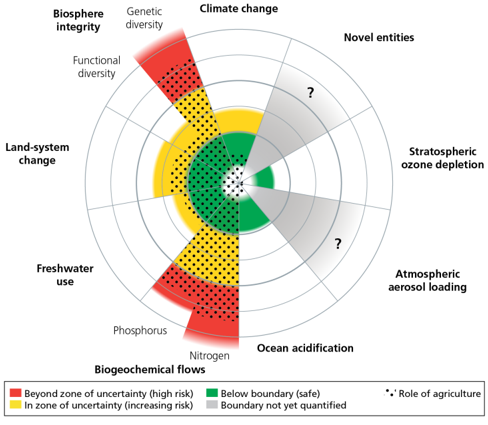
“Agriculture, in particular, is not only a significant contributor to climate change but also the greatest driver of transgressions of other planetary boundaries: biosphere integrity and biochemical flows (related to human‐induced changes in global nitrogen and phosphorus cycles), along with land‐system use, and freshw…”
BackgroundGuo, X., Guan, M., Bian, Z., & Wang, Q. (2022) · Land · doi:10.3390/land11071018 · Cited by 7
Spanoghe, J., Ost, K. J., Beeck, W. V., Vermeir, P., Lebeer, S., & Vlaeminck, S. E. (2022) · New Biotechnology · doi:10.1016/j.nbt.2022.08.005 · Cited by 7
“Conventional animal-based protein production is severely altering biogeochemical cycles of nitrogen and phosphorus, biodiversity and land-use [1].”
BackgroundThe triple bottom line framework can connect people, planet and profit in cellular agriculture
Ellis, M. J., Sexton, A. E., Dunsford, I., & Stephens, N. (2022) · Nature Food · doi:10.1038/s43016-022-00619-3 · Cited by 7
Role of Neglected Plant Foods in Achieving Dietary Diversity, Zero Hunger and Good Health
Rahmatov, M., & Lazarte, C. E. (2023) · Springer eBooks · doi:10.1007/978-3-031-37077-9_2 · Cited by 9
Eykelenboom, M., Mersch, D., Grasso, A. C., Vellinga, R. E., Temme, E. H. M., Steenhuis, I. H., & Olthof, M. R. (2024) · Public Health Nutrition · doi:10.1017/s1368980024000090 · Cited by 7
Fiebelkorn, F., Dupont, J., & Lammers, P. (2022) · Springer eBooks · doi:10.1007/978-3-030-87402-5_6 · Cited by 8
Rising farm costs, marginal land cropping, and ecosystem service marketsPreprint
Esch, E. H., McCann, K., Kamm, C., Arce, B., Carroll, O., Dolezal, A. J., Mazzorato, A. C. M., Noble, D. H., Fraser, E., Fryxell, J. M., et al. (2021) · Research Square · doi:10.21203/rs.3.rs-223049/v1 · Cited by 7
From Necrocene to Naíocene—promising pathways toward sustainable agri-food systems
Keck, M., & Flachs, A. (2022) · Sustainability Science · doi:10.1007/s11625-022-01255-3 · Cited by 7
“Campbell et al. (2017) Sustainability in Agri-Food Systems: Transformative Trajectories toward the Post-Anthropocene 1 3 have found that the agri-food system is the major driver of two planetary boundaries currently at high risk: biosphere integrity and biogeochemical flows of phosphorus and…”
Principles for guiding research and innovation toward sustainable and equitable agrifood systems
Zurek, M., Wirths, J., Hebinck, A., Crawford, S., Lidder, P., Prasad, P. V. V., Tittonell, P., Herrero, M., & Compton, J. (2023) · Frontiers in Sustainable Food Systems · doi:10.3389/fsufs.2023.1059063 · Cited by 6
Metadata
- Authors
- Campbell, B. M., Beare, D. J., Bennett, E. M., Hall-Spencer, J. M., Ingram, J. S. I., Jaramillo, F., Ortiz, R., Ramankutty, N., Sayer, J. A., & Shindell, D.
- Affiliations
- CGIAR (FR)
- McGill University (CA)
- University of Tsukuba (JP)
- University of Oxford (GB)
- Stockholm Resilience Centre (SE)
- University of Copenhagen (DK)
- University of British Columbia (CA)
- James Cook University (AU)
- Duke University (US)
- ORCID
- Venue
- Ecology and Society
- Publisher
- Resilience Alliance, Inc.
- Published
- 2017
- Volume
- 22
- Issue
- 4
- ISSN
- 1708-3087 (ISSN-L)
- OpenAlex
- W2762931876
- Cited by
- 1,197
- References
- 84
- Citations by year
- 2026: 137 · 2025: 204 · 2024: 182 · 2023: 157 · 2022: 182 · 2021: 140 · 2020: 101 · 2019: 56 · 2018: 35 · 2017: 1
- FWCI
- 36.59
- Type
- journal article
- Language
- en
- Open access
- gold
- doi.org
- Licence
- cc-by-nc
- Locations
- Ecology and Society (publishedVersion, cc-by-nc)
- Research at the University of Copenhagen (University of Copenhagen) (publishedVersion, cc-by)
- Epsilon Open Archive (Sveriges lantbruksuniversitet biblioteket (Swedish University of Agricultural Sciences)) (acceptedVersion)
- ResearchOnline at James Cook University (James Cook University) (submittedVersion)
- PEARL (University of Plymouth) (submittedVersion)
- CGSPace A Repository of Agricultural Research Outputs (Consultative Group for International Agricultural Research) (submittedVersion, other-oa)
- DOAJ (DOAJ: Directory of Open Access Journals) (submittedVersion, cc-by-sa)
- Funders
- Consortium of International Agricultural Research Centers
- Topics
- Physical Sciences › Environmental Science › Global and Planetary Change › Land Use and Ecosystem Services
- Physical Sciences › Environmental Science › Ecology › Agriculture Sustainability and Environmental Impact
- Life Sciences › Agricultural and Biological Sciences › Agronomy and Crop Science › Sustainable Agricultural Systems Analysis
- Keywords
- planetary boundaries, Earth system, anthropogenic impacts, land use change
About these checks
Registry, retraction, Cites and statistics results are computed, not judged, with one exception: a printed reference that no index lists is read once by a model before it counts as a citation error. Claims are extracted by a model and kept only when their quote appears verbatim in the text; each cited source is then checked, with a model’s help, for whether it says what the claim relies on. Those verdicts can be wrong — read the claim’s quote and the cited source before relying on one.
Statistics and arithmetic are recomputed, not judged.
Confidence bands are shown only for fields calibrated on our annotated test set. None is calibrated yet, so no band is shown.
What counts as a claim ›How we measure confidence ›How we check this ›
Are you an author, or do you see a problem with this page? Request a review
Data sources
Bibliographic data: Semantic Scholar, OpenAlex, Crossref.
Contains information from the Semantic Scholar Academic Graph Datasets, made available under the ODC Attribution License (ODC-BY 1.0).
Semantic Scholar’s data is described in: Kinney, R., et al. (2023). The Semantic Scholar Open Data Platform. arXiv:2301.10140.
