

Agriculture production as a major driver of the Earth system exceeding planetary boundaries
Open accessThe DOI matches its Crossref record; 86 of the 86 references it cites were found in a registry or an index.
Abstract
Campbell, B. M., D. J. Beare, E. M. Bennett, J. M. Hall-Spencer, J. S. I. Ingram, F. Jaramillo, R. Ortiz, N. Ramankutty, J. A. Sayer, and D. Shindell. 2017. Agriculture production as a major driver of the Earth system exceeding planetary boundaries. Ecology and Society 22(4):8. https://doi.org/10.5751/ES-09595-220408
Overview
The claims and statistics of this paper haven’t been checked yet.
Free: it reads the open-access text and checks the first 5 claims that cite a source we can check. Create a free account to check every claim.
Integrity signals
Registry
Cites
Statistics
Figures
Verification
Claims the paper makes
The claims and statistics of this paper haven’t been checked yet.
Free: it reads the open-access text and checks the first 5 claims that cite a source we can check. Create a free account to check every claim.
Claims other papers make about this one
Each is checked against this paper’s own text: does it say what the citing paper says it does?
The source backs part of the claim, not all of it — or backs it for a different population, condition or comparison.
In the citing paper
“Agricultural expansion and intensification are considered major drivers of habitat and biodiversity loss, soil and freshwater degradation, environmental pollution, and greenhouse gas emissions worldwide (1, 2).”
From Agricultural diversification promotes multiple ecosystem services without compromising yield (2020) · cites this paper as [1]
Experimental — accuracy not yet measuredThe cited source says what the claim attributes to it.
In the citing paper
“As a result, agriculture plays a major role in pushing the biosphere beyond planetary boundaries in terms of biodiversity and biogeochemical flows of nitrogen and phosphorus, and is a major contributor to climate change [3].”
From An Actor-Oriented Multi-Criteria Assessment Framework to Support a Transition towards Sustainable Agricultural Systems Based on Crop Diversification (2020) · cites this paper as [3]
The cited source says what the claim attributes to it.
In the citing paper
“The main driver of biodiversity loss is agriculture1, both through intensification of existing agricultural land and expansion of agriculture into pristine ecosystems2,3.”
From Farming practices to enhance biodiversity across biomes: a systematic review (2024) · cites this paper as [1]
In the citing paper
“Biodiversity is declining at an unprecedented pace around the world, with current estimates that around 5% of all species will be lost every ten years1.”
From Farming practices to enhance biodiversity across biomes: a systematic review (2024) · cites this paper as [1]
Self-check
Percentages, sums and reported differences re-computed from the paper’s own numbers.
The self-check needs the paper’s full text.
Citations
Cites
A safe operating space for humanity
Rockström, J., Steffen, W., Noone, K., Persson, Å., Chapin, F. S., Lambin, E. F., Lenton, T. M., Scheffer, M., Folke, C., Schellnhuber, H. J., et al. (2009) · Nature · doi:10.1038/461472a · Cited by 13,333 · cited 10×
“In 2009 Rockström et al. (2009 a,b ) introduced the concepts of “planetary boundaries” (PBs) and a “safe operating space for humanity,” which have recently been revised by Steffen et al. (2015).”
BackgroundMethodInfluentialGlobal Consequences of Land Use
Foley, J. A., DeFries, R., Asner, G. P., Barford, C., Bonan, G., Carpenter, S. R., Chapin, F. S., Coe, M. T., Daily, G. C., Gibbs, H. K., et al. (2005) · Science · doi:10.1126/science.1111772 · Cited by 13,272 · cited 4×
“According to Foley et al. (2005), croplands and pastures are one of the largest terrestrial biomes on the planet, occupying ~40% of land surface.”
InfluentialSelf-citationPlanetary boundaries: Guiding human development on a changing planet
Steffen, W., Richardson, K., Rockström, J., Cornell, S. E., Fetzer, I., Bennett, E. M., Biggs, R., Carpenter, S. R., de Vries, W., de Wit, C. A., et al. (2015) · Science · doi:10.1126/science.1259855 · Cited by 12,527 · cited 10×
“We have followed the Steffen et al. (2015) framing of the boundary.”
BackgroundMethodInfluentialSelf-citationNg, M., Fleming, T., Robinson, M., Thomson, B., Graetz, N., Margono, C., Mullany, E. C., Biryukov, S., Abbafati, C., Abera, S. F., et al. (2014) · The Lancet · doi:10.1016/s0140-6736(14)60460-8 · Cited by 11,952 · cited 1×
“…have to address the fact that at least a billion people do not have access to sufficient calories (FAO 2014), and more than two billion people lack sufficient nutrients (WHO and FAO 2014), while, paradoxically, at the same time over two billion people consume too many calories (Ng et al. 2014).”
Correspondence - Tranexamic acid for traumatic brain injury
(2005) · London School of Economics and Political Science Theses Online (London School of Economics and Political Science) · doi:10.1016/s0140-6736 · Cited by 11,894
Lim, S. S., Vos, T., Flaxman, A. D., Danaei, G., Shibuya, K., Adair-Rohani, H., AlMazroa, M. A., Amann, M., Anderson, H. R., Andrews, K. G., et al. (2012) · The Lancet · doi:10.1016/s0140-6736(12)61766-8 · Cited by 11,805 · cited 1×
“Because the Global Burden of Disease estimates that about 3.2 million premature deaths are attributable to small PM each year (Lim et al. 2012), this suggests that agriculture’s contribution to atmospheric aerosol loading may be responsible for ~450,000–660,000 premature deaths annually based on…”
InfluentialPlanetary Boundaries: Exploring the Safe Operating Space for Humanity
Rockström, J., Steffen, W., Noone, K., Persson, Å., Chapin, F. S. I., Lambin, E., Lenton, T. M., Scheffer, M., Folke, C., Schellnhuber, H. J., et al. (2009) · Ecology and Society · doi:10.5751/es-03180-140232 · Cited by 7,187
Transformation of the Nitrogen Cycle: Recent Trends, Questions, and Potential Solutions
Galloway, J. N., Townsend, A. R., Erisman, J. W., Bekunda, M., Cai, Z., Freney, J. R., Martinelli, L. A., Seitzinger, S. P., & Sutton, M. A. (2008) · Science · doi:10.1126/science.1136674 · Cited by 6,995 · cited 2×
“Large amounts of N required for plant and livestock production results in agricultural activities being the main driver of the N cycle (Galloway et al. 2008, Liu et al. 2010, Bodirsky et al. 2012).”
InfluentialSpreading dead zones and consequences for marine ecosystems
Diaz, R. J., & Rosenberg, R. (2008) · Science · doi:10.1126/science.1156401 · Cited by 6,626 · cited 1×
“The P cycle is accelerated two to three times over background rates (Smil 2000), leading to eutrophication of freshwater and estuarine systems (Diaz and Rosenberg 2008) in addition to the intended increase in agricultural production.”
Bounding the role of black carbon in the climate system: A scientific assessment
Bond, T. C., Doherty, S. J., Fahey, D. W., Forster, P. M., Berntsen, T., DeAngelo, B. J., Flanner, M. G., Ghan, S., Kärcher, B., Koch, D., et al. (2013) · Journal of Geophysical Research: Atmospheres · doi:10.1002/jgrd.50171 · Cited by 6,385 · cited 2×
“Assessment of the literature puts the share of anthropogenic emissions of black and organic carbon at about 3–14% (Bond et al. 2013).”
Self-citation
Research works printed but not linked: 3
- [42]42. Jaramillo, F., and G. Destouni. 2015b. Local flow regulation and irrigation raise global human water consumption and footprint. Science 350(6265):1248-1251. http://dx.doi.org/10.1126/science. · DOI · Paper page
- [76]76. in Edenhofer, O., R. Pichs-Madruga, Y. Sokona, E. Farahani, S. Kadner, K. Seyboth, A. Adler, I. Baum, S. Brunner, P. Eickemeier, B. Kriemann, J. Savolainen, S. Schlömer, C. von Stechow, T. Zwickel, and J. C. Minx, editors. Climate change 2014: mitigation of climate change. Contribution of Working Group III to the Fifth Assessment Report of the Intergovernmental Panel on Climate Change. Cambridge University Press, Cambridge, UK.
- [83]83. Trumbo, J., and D. Powell. 2016. Why transgenic plants are so controversial. Pages 366-382 in C. N. Stewart Jr, editor. Plant Ecology and Society 22(4): 8 https://www.ecologyandsociety.org/vol22/iss4/art8/ biotechnology and genetics: principles, techniques, and applications.
Cited by
Items 501–600 of 1,000
A global clustering of terrestrial food production systems
Jung, M., Boucher, T. M., Wood, S. A., Folberth, C., Wironen, M. B., Thornton, P. K., Bossio, D., & Obersteiner, M. H. (2024) · PLoS ONE · doi:10.1371/journal.pone.0296846 · Cited by 16
Assessing the sustainability of cultured meat in optimized Danish diets
Mazac, R., Bruno, M., Marini, M., & Caro, D. (2024) · Sustainable Production and Consumption · doi:10.1016/j.spc.2024.04.002 · Cited by 14
Blaix, C., Dumont, B., Bloor, J., Zagaria, C., Fleurance, G., Joly, F., & Huguenin‐Elie, O. (2025) · Agriculture Ecosystems & Environment · doi:10.1016/j.agee.2025.109938 · Cited by 17
A Holistic Wetland Ecological Water Replenishment Scheme with Consideration of Seasonal Effect
Duan, H., Xu, M., Cai, Y., Wang, X., Zhou, J., & Zhang, Q. (2019) · Sustainability · doi:10.3390/su11030930 · Cited by 15
Sihvonen, M., Pihlainen, S., Lai, T.-Y., Salo, T., & Hyytiäinen, K. (2020) · Agricultural Systems · doi:10.1016/j.agsy.2020.102985 · Cited by 16
Li, X., Wu, K., Zhao, R., Liu, Y., Li, X., & Yang, Q. (2021) · Land · doi:10.3390/land10121296 · Cited by 14
“Agricultural activities have become the main cause of global environmental degradation [19,20], and protecting the HC of cultivated land is urgent.”
BackgroundFuentes, I., Vervoort, W., McPhee, J., & Rojas, L. A. R. (2024) · Agricultural Water Management · doi:10.1016/j.agwat.2024.108676 · Cited by 16
Pronti, A., Zegarra, E., Vicario, D. R., & Graves, A. R. (2024) · World Development · doi:10.1016/j.worlddev.2024.106557 · Cited by 14
Assessing the Cost of Nutritionally Adequate and Low-Climate Impact Diets in Finland
Irz, X., Sares‐Jäske, L., Tapanainen, H., Niemi, J., Paalanen, L., Saarinen, M., & Valsta, L. M. (2024) · Current Developments in Nutrition · doi:10.1016/j.cdnut.2024.102151 · Cited by 14
“Recent research has produced a strong scienti fi c consensus that the global food system is fundamentally unsustainable [1,2] and that population-level dietary changes should form a central component of its required transformation toward sustainability [3 – 5].”
BackgroundAssessing the Environmental Impacts of Agricultural Policies
Henderson, B. B., & Lankoski, J. (2020) · Applied Economic Perspectives and Policy · doi:10.1002/aepp.13081 · Cited by 16
Innovations in food packaging—Sustainability challenges and future scenarios
Molina‐Besch, K., & Olsson, A. (2022) · Elsevier eBooks · doi:10.1016/b978-0-323-91001-9.00039-6 · Cited by 19
Community financing for sustainable food and farming: a proximity perspective
Behrendt, G., Peter, S., Sterly, S., & Häring, A. M. (2022) · Agriculture and Human Values · doi:10.1007/s10460-022-10304-7 · Cited by 14
“The current agri-food system needs to transform radically as it considerably contributes to the transgression of multiple planetary boundaries (Campbell et al. 2017).”
BackgroundSmit, M. F., Vonk, W. J., & Hijbeek, R. (2025) · European Journal of Agronomy · doi:10.1016/j.eja.2025.127845 · Cited by 17
Air Pollution and Greenhouse Gases Emissions: Implications in Food Production and Food Security
Kaur, H. (2022) · Springer eBooks · doi:10.1007/978-981-16-4482-5_6 · Cited by 16
Humans in/of/are nature: Re-embedding reality in sustainability sciences
Morgan, C., Brevik, K. A., Barbieri, L. K., & Ament, J. A. (2023) · Elementa Science of the Anthropocene · doi:10.1525/elementa.2021.00083 · Cited by 13
Nordman, M., Lassen, A. D., Christensen, L. M., & Trolle, E. (2024) · Nutrition Journal · doi:10.1186/s12937-024-00917-5 · Cited by 14
“The global food system is a leading driver of environmental degradation through its contributions to anthropogenic greenhouse gas emissions (GHGE), land system change, fresh-water withdrawal, biodiversity loss, and eutrophication [1].”
BackgroundAubin, J., Vieux, F., Féon, S. L., Tharrey, M., Peyraud, J. L., & Darmon, N. (2024) · animal · doi:10.1016/j.animal.2024.101182 · Cited by 14
Roy, K., Bernas, J., Gebauer, R., Tellbüscher, A. A., Nikl, O., Shaw, C., Folorunso, E. A., Kloas, W., Aubin, J., & Mráz, J. (2025) · Aquaculture · doi:10.1016/j.aquaculture.2025.742142 · Cited by 13
Moores, A., Charalampopoulos, D., Williams, A. G., & Rivera, X. C. S. (2025) · Frontiers in Sustainable Food Systems · doi:10.3389/fsufs.2024.1502468 · Cited by 15
Confronting the interconnection of chemical pollution and climate change
Bălan, S. A., van Bergen, S. K., Blake, A., Buck, T., Coffin, S., DeWitt, J. C., Goldenman, G., von Hippel, F. A., von Hippel, S. T., Leonetti, C. P., et al. (2025) · Environmental Innovation and Societal Transitions · doi:10.1016/j.eist.2025.100966 · Cited by 14
Coordinating food security and environmental performance in Belt and Road agri-food systems
Wang, Y., Wu, L., Wei, Z., Tan, T., Yu, Y., Wang, Z., & Huang, K. (2025) · Resources Conservation and Recycling · doi:10.1016/j.resconrec.2025.108304 · Cited by 13
Karimzadeh, S., Daccache, A., Rulli, M. C., & Ahamed, M. S. (2025) · Journal of Agriculture and Food Research · doi:10.1016/j.jafr.2025.101935 · Cited by 18
What good is agroecology? Predominant narratives about agroecology in Africa
Madsen, S., Laske, E., Fisher, J., Sall, A. N., Enloe, S. K., & Kerr, R. B. (2025) · Journal of Rural Studies · doi:10.1016/j.jrurstud.2025.103706 · Cited by 15
Bundling measures for food systems transformation: a global, multimodel assessment
Sundiang, M., Oliveira, T. D., Mason-D’Croz, D., Gibson, M., Beier, F., Benavidez, L., Bodirsky, B. L., Bos, A., Chepeliev, M. G., Chen, D. M.-C., et al. (2025) · The Lancet Planetary Health · doi:10.1016/j.lanplh.2025.101339 · Cited by 15
Wubuli, A., Gerlinger, C., Reyer, H., Oster, M., Muráni, E., Trakooljul, N., Ponsuksili, S., Wolf, P., & Wimmers, K. (2020) · BMC Genomics · doi:10.1186/s12864-020-07049-0 · Cited by 13
A portable microwave radiometer for proximal measurement of soil permittivity
Гудков, А. Г., Agasieva, S. V., Сидоров, И. А., Khokhlov, N. F., Chernikov, A. S., & Vagapov, Y. (2022) · Computers and Electronics in Agriculture · doi:10.1016/j.compag.2022.107076 · Cited by 14
Bockstaller, C., Galland, V., & Avadí, Á. (2022) · Ecological Modelling · doi:10.1016/j.ecolmodel.2022.110109 · Cited by 13
Sustainable Agriculture: Relationship between Knowledge and Attitude among University Students
Gabela, C. D., Trejos, B., Lamiño, P., & Boren-Alpízar, A. E. (2022) · Sustainability · doi:10.3390/su142315523 · Cited by 18
The Credit–Output–Productivity Nexus: A Comprehensive Review
Magazzino, C., Santeramo, F. G., & Schneider, N. (2024) · International Review of Environmental and Resource Economics · doi:10.1561/101.00000164 · Cited by 14
Vingerhoets, R., Sigurnjak, I., Spiller, M., Vlaeminck, S. E., & Meers, E. (2024) · Journal of Environmental Management · doi:10.1016/j.jenvman.2024.120646 · Cited by 13
Guyomarc’H, F., Héquet, F., Féon, S. L., Leconte, N., Garnier-Lambrouin, F., Auberger, J., Malnoë, C., Pénicaud, C., & Gésan-Guiziou, G. (2024) · Journal of Food Engineering · doi:10.1016/j.jfoodeng.2024.112147 · Cited by 13
Benton, T. G., Harwatt, H., Høyer-Lund, A., Meltzer, H. M., Trolle, E., & Blomhoff, R. (2024) · Food & Nutrition Research · doi:10.29219/fnr.v68.10453 · Cited by 15
Using FADN Data to Estimate CO2 Abatement Costs from Italian Arable Crops
Bazzani, G. M., Vitali, G., Cardillo, C., & Canavari, M. (2021) · Sustainability · doi:10.3390/su13095148 · Cited by 13
“Even if this is not the case of agriculture, one challenging issue is represented by assessing the abatement of CO2 emissions in the primary sector [4] to explore how agricultural practices could change, and the consequential costs for farmers.”
BackgroundOster, M., Reyer, H., Keiler, J., Ball, E., Mulvenna, C. C., Ponsuksili, S., & Wimmers, K. (2021) · The Science of The Total Environment · doi:10.1016/j.scitotenv.2021.148988 · Cited by 13
Beyond the Green Revolution: A roadmap for sustainable food systems research and action
Davis, K. F., Dalin, C., Kummu, M., Marston, L. T., Pingali, P., & Tuninetti, M. (2022) · Environmental Research Letters · doi:10.1088/1748-9326/ac9425 · Cited by 13
ON THE PROBLEM OF THE DEVELOPMENT OF ‘SUSTAINABLE’ AGRICULTURE IN MODERN ECONOMIC REALITIES
Amirova, E. F., Gavrilieva, N. K., Сергеевна, Р. Т., & Asfandiarova, R. A. (2022) · Siberian Journal of Life Sciences and Agriculture · doi:10.12731/2658-6649-2022-14-3-392-406 · Cited by 13
Barbosa, M. D. M., Carneiro, L. T., Pereira, M. F. D. C. D. S., Rodríguez, C. Z., Chagas, T. R. F., Moya, W., Bergamini, L. L., Mancini, M. C. S., Paes, N. D., & Pérez-Giraldo, L. C. (2020) · Biota Neotropica · doi:10.1590/1676-0611-bn-2019-0906 · Cited by 15
Ejigu, A. K., & Yeshitela, K. (2023) · Frontiers in Sustainable Cities · doi:10.3389/frsc.2023.1153502 · Cited by 12
Climate change critically affects the status of the land-system change planetary boundary
Tobian, A., Gerten, D., Fetzer, I., Schaphoff, S., Andersen, L. S., Cornell, S., & Rockström, J. (2024) · Environmental Research Letters · doi:10.1088/1748-9326/ad40c2 · Cited by 15
Evolution of climate-smart agriculture research: A science mapping exploration and network analysis
Zaidi, A. T., Ajibade, S.-S. M., Shah, M. A., Bashir, F. M., Falude, E., Dodo, Y. A., Adewolu, A. O., & Ngo-Hoang, D.-L. (2024) · Open Agriculture · doi:10.1515/opag-2022-0396 · Cited by 13
Wolfswinkel, S. M. M., Raghoebar, S., Stuber, J. M., de Vet, E., & Poelman, M. P. (2025) · BMC Medicine · doi:10.1186/s12916-025-03986-3 · Cited by 14
“Especially processed meat consumption is associated with increased chronic disease risk, such as cardiovascular diseases, type 2 diabetes, and some forms of cancer [2–8].”
Pulighe, G., Belocchi, A., Tani, A. C., & Lupia, F. (2025) · The Science of The Total Environment · doi:10.1016/j.scitotenv.2025.180111 · Cited by 12
Plinke, C., Sureth, M., & Kalkuhl, M. (2026) · Nature Food · doi:10.1038/s43016-025-01284-y · Cited by 13
“The global food system generates large externalities that impose pressure on the environment 1,2 and contribute to the risk of transgressing a number of planetary boundaries 3,4 .”
Severe, E., Errigo, I. M., Proteau, M., Sayedi, S. S., Kolbe, T., Marçais, J., Thomas, Z., Petton, C., Rouault, F., Vautier, C., et al. (2023) · The Science of The Total Environment · doi:10.1016/j.scitotenv.2023.163178 · Cited by 13
Oo, A. Z., Tsujimoto, Y., Rakotoarisoa, N. M., & Andrianary, B. H. (2023) · European Journal of Agronomy · doi:10.1016/j.eja.2023.126901 · Cited by 13
Global food trade alleviates transgressions of planetary boundaries at the national scale
Liao, X., Liu, A., & Chai, L. (2023) · iScience · doi:10.1016/j.isci.2023.107794 · Cited by 13
“…are selected for this study due to the difficulties in assessing biosphere integrity indicators as well as in estimating the agricultural impacts (Campbell et al. 2017).10 Furthermore, with scientific advancement, biosphere integrity is increasingly recognized as a global issue, same as global…”
BackgroundThe role of fisheries and fish farming in a circular food system in the European Union
van Hal, O., van Zanten, H. H. E., Ziegler, F., Schrama, J. W., Kuiper, K., & de Boer, I. J. M. (2023) · Sustainable Production and Consumption · doi:10.1016/j.spc.2023.10.017 · Cited by 12
Rahman, M. M., Hasan, S., Ahmed, M. R., & Adham, A. K. M. (2022) · Paddy and Water Environment · doi:10.1007/s10333-022-00904-8 · Cited by 12
Zhou, M., Guan, B., & Huang, L. S. (2022) · Nutrients · doi:10.3390/nu14204393 · Cited by 12
McCoard, S. A., Stevens, D. R., & Whitney, T. R. (2020) · Elsevier eBooks · doi:10.1016/b978-0-12-817052-6.00013-6 · Cited by 17
Ferrara, V., Ekblom, A., & Wästfelt, A. (2019) · Elsevier eBooks · doi:10.1016/b978-0-12-409548-9.12080-9 · Cited by 14
Ouattara, M. S., Paut, R., Valantin‐Morison, M., Verret, V., & Médiène, S. (2023) · Agriculture Ecosystems & Environment · doi:10.1016/j.agee.2023.108690 · Cited by 11
Fricke, E., Saborowski, R., & Slater, M. J. (2024) · Journal of the World Aquaculture Society · doi:10.1111/jwas.13070 · Cited by 11
Characteristics of temperate food forestry: a case study in Flanders, Belgium
Moereels, L., Bracke, J., Mertens, J., Reubens, B., Schelfhout, S., & Verheyen, K. (2024) · Agroforestry Systems · doi:10.1007/s10457-024-01052-0 · Cited by 12
“…output, post-war high-input agricultural practices have been identified as a major driver in the transgression of these planetary boundaries (Campbell et al. 2017; Gerten et al. 2020) and consequent environmental changes can feed back and hamper future food production (Ramankutty et al.…”
A knowledge creation framework for academia toward agroecological transformations of food systems
Muñoz-Araya, M., Williams, S. R., Geoghan, P. J., Ortiz-Gonzalo, D., Marshall, K. N., Brewer, K. M., Alston-Stepnitz, E., McCullough, S. R., & Wauters, V. M. (2024) · Frontiers in Sustainable Food Systems · doi:10.3389/fsufs.2024.1336632 · Cited by 12
Santolin, J., Larsen, O. C., Fritze, A., Xue, B., Yang, Z., & Rotter, V. S. (2024) · Journal of Material Cycles and Waste Management · doi:10.1007/s10163-024-02067-6 · Cited by 12
“According to Campbell et al., agriculture is the main driver for the transgression of this and other planetary boundaries [2].”
Baaken, M. C., Kühfuss, L., Bougherara, D., Czajkowski, M., Rodríguez‐Entrena, M., Höhler, J., Lagerkvist, C. J., Paparella, A., Quendler, E., Rommel, J., et al. (2024) · Applied Economic Perspectives and Policy · doi:10.1002/aepp.13488 · Cited by 12
Increased transparency in accounting conventions could benefit climate policy
Wedderburn-Bisshop, G. (2025) · Environmental Research Letters · doi:10.1088/1748-9326/adb7f2 · Cited by 13
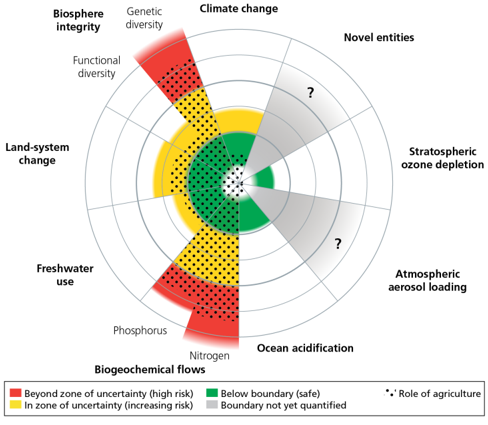
“Agriculture has become the major disruptor of five planetary boundaries: biosphere integrity, land system change, freshwater change, biogeochemical flows [48], and now climate change.”
Evaluating nutrient circularity in integrated aquaculture systems: criteria and indicators
Chary, K., Jaeger, C., Jansen, H. M., Harchaoui, S., & Aubin, J. (2025) · Journal of Cleaner Production · doi:10.1016/j.jclepro.2025.145414 · Cited by 14
Addressing key issues and knowledge gaps in resilience science for agriculture
Sundstrom, S. M., Awada, T. N., Bennett, E. M., Bestelmeyer, B. T., Hodbod, J., Pacheco, A., Spiegal, S. A., & Allen, C. R. (2025) · Agricultural Systems · doi:10.1016/j.agsy.2025.104335 · Cited by 12
Self-citationNotes on autonomy as an agroecological principle
de Molina, M. G. (2025) · Agroecology and Sustainable Food Systems · doi:10.1080/21683565.2025.2502092 · Cited by 12
“…community that the food system is the major driver of biophysical transformations (Foley et al. 2005; Weis 2013) and a main reason that planetary limits have been exceeded in terms of climate change, biogeochemical flows, and biodiversity loss (Campbell et al. 2017; Richardson et al. 2023).”
Life-cycle biodiversity assessment of global crop production: Advances, framework, and outlooks
Song, J., Chaudhary, A., Tang, R., Bai, X., & Yang, Y. (2025) · Journal of Environmental Management · doi:10.1016/j.jenvman.2025.126934 · Cited by 11
Moreira, T., Meesters, M. E., Kok, K. P. W., Legun, K., Ditzler, L., & Klerkx, L. (2025) · Agricultural Systems · doi:10.1016/j.agsy.2025.104512 · Cited by 12
Jander, W., Günther, J., & Prochnow, A. (2025) · Journal of Cleaner Production · doi:10.1016/j.jclepro.2025.146872 · Cited by 13
Agriculture over the Horizon: A Synthesis for the Mid-21st Century
McBratney, A. B., & Park, M. (2025) · Sustainability · doi:10.3390/su17219424 · Cited by 11
Comparative Analysis of Sensors for Soil Moisture Measurement
Nikolov, G. T., Ganev, B., Marinov, M. B., & Galabov, V. T. (2021) · International Scientific Conference Electronics (ET) · doi:10.1109/et52713.2021.9580162 · Cited by 11
Baaken, M. C., Bartkowski, B., & Rode, J. (2023) · Environmental Research Communications · doi:10.1088/2515-7620/ad03b0 · Cited by 11
Crop diversity used in branded products with focus on legume species worldwide
Salord, T., Magrini, M.-B., Lullien‐Pellerin, V., Cabanac, G., Amiot, M. J., Barron, C., Boire, A., Micard, V., & Weber, M. (2024) · npj Science of Food · doi:10.1038/s41538-024-00305-7 · Cited by 11
“Concerning packaged food markets, additional data on food product composition are required to uncover the relationship between species diversity and agrifood systems 2,16,20 .”
Gao, D., Huang, Y., Zhou, S., Li, B., & Wang, G. (2024) · Journal of Hazardous Materials · doi:10.1016/j.jhazmat.2024.136355 · Cited by 13
Enhancing Resilience for Food and Nutrition Security Within a Changing Climate
Behnassi, M., Rahman, M. A., D’Silva, J., Ramachandran, G., Gupta, H., Pollmann, O., & Ramachandran, N. (2021) · Springer eBooks · doi:10.1007/978-3-030-72987-5_1 · Cited by 14
Soil biota is decisive for overyielding in intercropping under low phosphorus conditions
Qiao, X., Bei, S., Wang, G., Li, C., Li, H., Zhang, J., & Zhang, F. S. (2022) · Journal of Applied Ecology · doi:10.1111/1365-2664.14187 · Cited by 11
Comparisons between Plant and Animal Stem Cells Regarding Regeneration Potential and Application
Liu, L., Qiu, L., Zhu, Y., Luo, L., Han, X., Man, M., Li, F., Ren, M., & Xing, Y. (2023) · International Journal of Molecular Sciences · doi:10.3390/ijms24054392 · Cited by 14
Oster, M., Reyer, H., Keiler, J., Ball, E., Mulvenna, C. C., Muráni, E., Ponsuksili, S., & Wimmers, K. (2020) · The Science of The Total Environment · doi:10.1016/j.scitotenv.2020.140490 · Cited by 11
Strip cropping in organically managed vegetable systems: agronomic and environmental effects
Campanelli, G., Iocola, I., Leteo, F., Montemurro, F., Platani, C., Testani, E., & Canali, S. (2023) · Renewable Agriculture and Food Systems · doi:10.1017/s1742170523000248 · Cited by 11
“…re-design (Lin, 2011; Wezel et al ., 2014) to improve ecosystem functionality, crop production, pest and disease control, soil quality (Duru et al ., 2015) and reduce the negative effects caused by agricultural specialization and industrialization (Campbell et al ., 2017; Robinson, 2018).”
Gratton, C., Strauser, J., Jordan, N. R., & Jackson, R. D. (2024) · Environmental Research Food Systems · doi:10.1088/2976-601x/ad382f · Cited by 13
Spatial Barriers to Transforming toward a Healthy Food System in the Noreste of Mexico
Roggema, R., Krstikj, A., & Flores-García, B. D. (2024) · Nutrients · doi:10.3390/nu16091259 · Cited by 10
External costs of water pollution in the drinking water supply sector
Cullmann, A., Rechlitz, J., Sundermann, G., & Wägner, N. (2024) · American Journal of Agricultural Economics · doi:10.1111/ajae.12490 · Cited by 12
Rural land systems both support and hinder the Sustainable Development Goals across Europe
Nicholas, K. A., & Scown, M. (2024) · Communications Earth & Environment · doi:10.1038/s43247-024-01736-6 · Cited by 10
“Land use and exploitation of animals and plants for consumption are the main drivers of global declines in nature 1 and large contributors to green-house gas emissions and impaired water quality 2,3 .”
Impacts of punctual solar trackers on soil biodiversity in agricultural lands
Leroy, V., Decocq, G., Noirot-Cosson, P.-E., & Marrec, R. (2024) · Geoderma · doi:10.1016/j.geoderma.2024.117147 · Cited by 10
Barrineau, S., Do, T., & Powell, N. (2025) · Ecosystems and People · doi:10.1080/26395916.2025.2461535 · Cited by 10
“Agriculture and linked food systems are simultaneously major contributors to overlapping social-ecological crises and hugely vulnerable to the effects of these crises (Paustian et al. 1997; Campbell et al. 2017; Béné 2020; van der Ploeg 2020; McGreevy et al. 2022; Clapp 2023).”
Scapino, M., Meloni, R., & Blandino, M. (2025) · Frontiers in Agronomy · doi:10.3389/fagro.2025.1546989 · Cited by 10
Global Food Demand: Overcoming Challenges to Healthy and Sustainable Diets
Muhammad, A., Barrera, E. L., & Wilson, N. L. W. (2025) · Annual Review of Resource Economics · doi:10.1146/annurev-resource-112923-040421 · Cited by 12
Environmental Outlook on the Triple Planetary Crisis: Stakes, Evolution and Policy Linkages
OECD (2025) · OECD environmental outlook · doi:10.1787/257ffbb6-en · Cited by 32
Goals in Nutrition Science 2025–2030
Berry, E. M., Cardoso, B. R. L., Cash, S. B., Cifuentes, A., Collado, M. C., le Coutre, J., German, J. B., Ibáñez, E., Lawrence, M. A., Nieman, D. C., et al. (2026) · Frontiers in Nutrition · doi:10.3389/fnut.2026.1784021 · Cited by 12
Forests and food security: a review
Sunderland, T., & O’Connor, A. (2020) · CABI Reviews · doi:10.1079/pavsnnr202015019 · Cited by 11
Theoretical and methodological aspects of ensuring the sustainable development of agro-food systems
Kadomtseva, M. Y. (2022) · Izvestiya of Saratov University Economics Management Law · doi:10.18500/1994-2540-2022-22-3-277-286 · Cited by 10
Deep Learning Solutions for Very High Resolution Mapping of Contour Levee Rice Production Systems
Dale, D. S., Lu, L., Zhong, L., Reba, M. L., & Runkle, B. R. K. (2023) · Computers and Electronics in Agriculture · doi:10.1016/j.compag.2023.107954 · Cited by 10
Planet-based diets: improving environmental sustainability of healthy diets
van Dooren, C. (2023) · Proceedings of The Nutrition Society · doi:10.1017/s0029665123003737 · Cited by 10
Si, Z., Dai, D. N., Chen, M. L., & Scott, S. (2024) · Agroecology and Sustainable Food Systems · doi:10.1080/21683565.2024.2336484 · Cited by 10
“…and biodiversity loss; social challenges include the widespread food safety anxiety, rural-urban inequality, and the aging farming population (Campbell et al. 2017; Fang and Meng 2013; Lu et al. 2015; Luan, Qiu, and Jing 2013; Pretty and Bharucha 2015; Reid, Song, and Zhang 2018; Wang et al.…”
BackgroundThe Agrarian Question as an Ecological Question: An Introduction
Grandón, D. G., Vasconcelos, J. S., & Smolski, A. R. (2024) · Latin American Perspectives · doi:10.1177/0094582x241252111 · Cited by 10
Age matters: The effect of regret and loss aversion on cultured meat acceptance
Duong, C., Sung, B., & Septianto, F. (2024) · Appetite · doi:10.1016/j.appet.2024.107614 · Cited by 10
“A diet that is heavily dependent on livestock products is not optimal for both human health and the environment (Aiking, 2014; Campbell et al., 2017; Ritchie et al., 2018).”
Confronting the United Nations’ Pro-growth Agenda: A Call to Reverse Ecological Overshoot
Bajaj, N., Crist, E. L., & Stade, K. (2024) · The Journal of Population and Sustainability · doi:10.3197/jps.63799977346495 · Cited by 14
Bonfanti, J., Langridge, J., Avadí, Á., Casajus, N., Chaudhary, A., Damour, G., Estrada-Carmona, N., Jones, S. K., Makowski, D., Mitchell, M. G. E., et al. (2025) · Ecology Letters · doi:10.1111/ele.70220 · Cited by 10
“Therefore, managing sustainably agricultural land—the world's largest managed biome—is crucial for preserving biodiversity and its vital contributions to people at local and global scales (Campbell et al. 2017; IPBES 2019).”
Prospects for regenerative agriculture in Chile
Wratten, S. D., Shields, M. W., & González-Chang, M. (2019) · Agro Sur · doi:10.4206/agrosur.2019.v47n2-01 · Cited by 11
“…AGRICULTURE tion through orthodox agricultural practices has been the largest cause of greenhouse-gas emissions, gross consumptive over-use of fresh water, loading of nutrients into the biosphere (nitrogen and phosphorus) and a major cause of pollution due to pesticides (Campbell et al., 2017).”
BackgroundPublic policies and food systems in Latin America
Coq, J.-F. L., Grisa, C., Guéneau, S., & Niederle, P. A. (2022) · Éditions Quæ eBooks · doi:10.35690/978-2-7592-3536-0 · Cited by 16
Du, W., Yan, H., Feng, Z., Zhang, C., & Yang, Y. (2022) · Chinese Geographical Science · doi:10.1007/s11769-022-1298-9 · Cited by 10
Including sustainability factors in the derivation of eater profiles of young adults in Canada
Mollaei, S., Minaker, L. M., Robinson, D. T., Lynes, J. K., & Dias, G. M. (2022) · British Food Journal · doi:10.1108/bfj-06-2022-0476 · Cited by 11
Private finance for food system climate adaptation: opportunity or contradiction?
Clapp, J., & Isakson, S. R. (2023) · Current Opinion in Environmental Sustainability · doi:10.1016/j.cosust.2023.101273 · Cited by 10
Recent Advances in Algal Biomass Production
Rajvanshi, M., & Sayre, R. T. (2021) · IntechOpen eBooks · doi:10.5772/intechopen.94218 · Cited by 12
“However, nitrogen utilization is inefficient in crop plants, resulting in ~50% of nitrogen loss through leaching, soil erosion and gaseous evaporation [12].”
BackgroundDumping of Toxic Waste into the Oceans
Häder, D. (2021) · Springer eBooks · doi:10.1007/978-3-030-75602-4_16 · Cited by 13
Metadata
- Authors
- Campbell, B. M., Beare, D. J., Bennett, E. M., Hall-Spencer, J. M., Ingram, J. S. I., Jaramillo, F., Ortiz, R., Ramankutty, N., Sayer, J. A., & Shindell, D.
- Affiliations
- CGIAR (FR)
- McGill University (CA)
- University of Tsukuba (JP)
- University of Oxford (GB)
- Stockholm Resilience Centre (SE)
- University of Copenhagen (DK)
- University of British Columbia (CA)
- James Cook University (AU)
- Duke University (US)
- ORCID
- Venue
- Ecology and Society
- Publisher
- Resilience Alliance, Inc.
- Published
- 2017
- Volume
- 22
- Issue
- 4
- ISSN
- 1708-3087 (ISSN-L)
- OpenAlex
- W2762931876
- Cited by
- 1,197
- References
- 84
- Citations by year
- 2026: 137 · 2025: 204 · 2024: 182 · 2023: 157 · 2022: 182 · 2021: 140 · 2020: 101 · 2019: 56 · 2018: 35 · 2017: 1
- FWCI
- 36.59
- Type
- journal article
- Language
- en
- Open access
- gold
- doi.org
- Licence
- cc-by-nc
- Locations
- Ecology and Society (publishedVersion, cc-by-nc)
- Research at the University of Copenhagen (University of Copenhagen) (publishedVersion, cc-by)
- Epsilon Open Archive (Sveriges lantbruksuniversitet biblioteket (Swedish University of Agricultural Sciences)) (acceptedVersion)
- ResearchOnline at James Cook University (James Cook University) (submittedVersion)
- PEARL (University of Plymouth) (submittedVersion)
- CGSPace A Repository of Agricultural Research Outputs (Consultative Group for International Agricultural Research) (submittedVersion, other-oa)
- DOAJ (DOAJ: Directory of Open Access Journals) (submittedVersion, cc-by-sa)
- Funders
- Consortium of International Agricultural Research Centers
- Topics
- Physical Sciences › Environmental Science › Global and Planetary Change › Land Use and Ecosystem Services
- Physical Sciences › Environmental Science › Ecology › Agriculture Sustainability and Environmental Impact
- Life Sciences › Agricultural and Biological Sciences › Agronomy and Crop Science › Sustainable Agricultural Systems Analysis
- Keywords
- planetary boundaries, Earth system, anthropogenic impacts, land use change
About these checks
Registry, retraction, Cites and statistics results are computed, not judged, with one exception: a printed reference that no index lists is read once by a model before it counts as a citation error. Claims are extracted by a model and kept only when their quote appears verbatim in the text; each cited source is then checked, with a model’s help, for whether it says what the claim relies on. Those verdicts can be wrong — read the claim’s quote and the cited source before relying on one.
Statistics and arithmetic are recomputed, not judged.
Confidence bands are shown only for fields calibrated on our annotated test set. None is calibrated yet, so no band is shown.
What counts as a claim ›How we measure confidence ›How we check this ›
Are you an author, or do you see a problem with this page? Request a review
Data sources
Bibliographic data: Semantic Scholar, OpenAlex, Crossref.
Contains information from the Semantic Scholar Academic Graph Datasets, made available under the ODC Attribution License (ODC-BY 1.0).
Semantic Scholar’s data is described in: Kinney, R., et al. (2023). The Semantic Scholar Open Data Platform. arXiv:2301.10140.
