

Agriculture production as a major driver of the Earth system exceeding planetary boundaries
Open accessThe DOI matches its Crossref record; 86 of the 86 references it cites were found in a registry or an index.
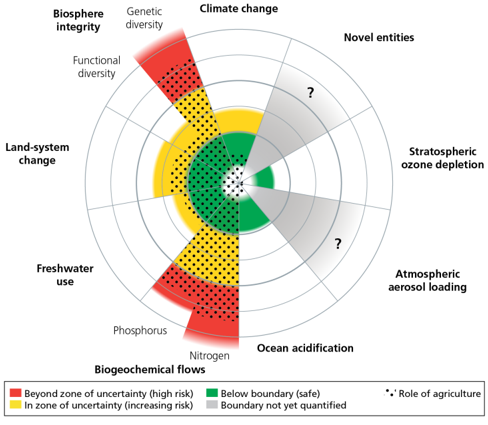
Abstract
Campbell, B. M., D. J. Beare, E. M. Bennett, J. M. Hall-Spencer, J. S. I. Ingram, F. Jaramillo, R. Ortiz, N. Ramankutty, J. A. Sayer, and D. Shindell. 2017. Agriculture production as a major driver of the Earth system exceeding planetary boundaries. Ecology and Society 22(4):8. https://doi.org/10.5751/ES-09595-220408
Overview
The claims and statistics of this paper haven’t been checked yet.
Free: it reads the open-access text and checks the first 5 claims that cite a source we can check. Create a free account to check every claim.
Integrity signals
Registry
Cites
Statistics
Figures
Verification
Claims the paper makes
The claims and statistics of this paper haven’t been checked yet.
Free: it reads the open-access text and checks the first 5 claims that cite a source we can check. Create a free account to check every claim.
Claims other papers make about this one
Each is checked against this paper’s own text: does it say what the citing paper says it does?
The source backs part of the claim, not all of it — or backs it for a different population, condition or comparison.
In the citing paper
“Agricultural expansion and intensification are considered major drivers of habitat and biodiversity loss, soil and freshwater degradation, environmental pollution, and greenhouse gas emissions worldwide (1, 2).”
From Agricultural diversification promotes multiple ecosystem services without compromising yield (2020) · cites this paper as [1]
Experimental — accuracy not yet measuredThe cited source says what the claim attributes to it.
In the citing paper
“As a result, agriculture plays a major role in pushing the biosphere beyond planetary boundaries in terms of biodiversity and biogeochemical flows of nitrogen and phosphorus, and is a major contributor to climate change [3].”
From An Actor-Oriented Multi-Criteria Assessment Framework to Support a Transition towards Sustainable Agricultural Systems Based on Crop Diversification (2020) · cites this paper as [3]
The cited source says what the claim attributes to it.
In the citing paper
“The main driver of biodiversity loss is agriculture1, both through intensification of existing agricultural land and expansion of agriculture into pristine ecosystems2,3.”
From Farming practices to enhance biodiversity across biomes: a systematic review (2024) · cites this paper as [1]
In the citing paper
“Biodiversity is declining at an unprecedented pace around the world, with current estimates that around 5% of all species will be lost every ten years1.”
From Farming practices to enhance biodiversity across biomes: a systematic review (2024) · cites this paper as [1]
Self-check
Percentages, sums and reported differences re-computed from the paper’s own numbers.
The self-check needs the paper’s full text.
Citations
Cites
A safe operating space for humanity
Rockström, J., Steffen, W., Noone, K., Persson, Å., Chapin, F. S., Lambin, E. F., Lenton, T. M., Scheffer, M., Folke, C., Schellnhuber, H. J., et al. (2009) · Nature · doi:10.1038/461472a · Cited by 13,333 · cited 10×
“In 2009 Rockström et al. (2009 a,b ) introduced the concepts of “planetary boundaries” (PBs) and a “safe operating space for humanity,” which have recently been revised by Steffen et al. (2015).”
BackgroundMethodInfluentialGlobal Consequences of Land Use
Foley, J. A., DeFries, R., Asner, G. P., Barford, C., Bonan, G., Carpenter, S. R., Chapin, F. S., Coe, M. T., Daily, G. C., Gibbs, H. K., et al. (2005) · Science · doi:10.1126/science.1111772 · Cited by 13,272 · cited 4×
“According to Foley et al. (2005), croplands and pastures are one of the largest terrestrial biomes on the planet, occupying ~40% of land surface.”
InfluentialSelf-citationPlanetary boundaries: Guiding human development on a changing planet
Steffen, W., Richardson, K., Rockström, J., Cornell, S. E., Fetzer, I., Bennett, E. M., Biggs, R., Carpenter, S. R., de Vries, W., de Wit, C. A., et al. (2015) · Science · doi:10.1126/science.1259855 · Cited by 12,527 · cited 10×
“We have followed the Steffen et al. (2015) framing of the boundary.”
BackgroundMethodInfluentialSelf-citationNg, M., Fleming, T., Robinson, M., Thomson, B., Graetz, N., Margono, C., Mullany, E. C., Biryukov, S., Abbafati, C., Abera, S. F., et al. (2014) · The Lancet · doi:10.1016/s0140-6736(14)60460-8 · Cited by 11,952 · cited 1×
“…have to address the fact that at least a billion people do not have access to sufficient calories (FAO 2014), and more than two billion people lack sufficient nutrients (WHO and FAO 2014), while, paradoxically, at the same time over two billion people consume too many calories (Ng et al. 2014).”
Correspondence - Tranexamic acid for traumatic brain injury
(2005) · London School of Economics and Political Science Theses Online (London School of Economics and Political Science) · doi:10.1016/s0140-6736 · Cited by 11,894
Lim, S. S., Vos, T., Flaxman, A. D., Danaei, G., Shibuya, K., Adair-Rohani, H., AlMazroa, M. A., Amann, M., Anderson, H. R., Andrews, K. G., et al. (2012) · The Lancet · doi:10.1016/s0140-6736(12)61766-8 · Cited by 11,805 · cited 1×
“Because the Global Burden of Disease estimates that about 3.2 million premature deaths are attributable to small PM each year (Lim et al. 2012), this suggests that agriculture’s contribution to atmospheric aerosol loading may be responsible for ~450,000–660,000 premature deaths annually based on…”
InfluentialPlanetary Boundaries: Exploring the Safe Operating Space for Humanity
Rockström, J., Steffen, W., Noone, K., Persson, Å., Chapin, F. S. I., Lambin, E., Lenton, T. M., Scheffer, M., Folke, C., Schellnhuber, H. J., et al. (2009) · Ecology and Society · doi:10.5751/es-03180-140232 · Cited by 7,187
Transformation of the Nitrogen Cycle: Recent Trends, Questions, and Potential Solutions
Galloway, J. N., Townsend, A. R., Erisman, J. W., Bekunda, M., Cai, Z., Freney, J. R., Martinelli, L. A., Seitzinger, S. P., & Sutton, M. A. (2008) · Science · doi:10.1126/science.1136674 · Cited by 6,995 · cited 2×
“Large amounts of N required for plant and livestock production results in agricultural activities being the main driver of the N cycle (Galloway et al. 2008, Liu et al. 2010, Bodirsky et al. 2012).”
InfluentialSpreading dead zones and consequences for marine ecosystems
Diaz, R. J., & Rosenberg, R. (2008) · Science · doi:10.1126/science.1156401 · Cited by 6,626 · cited 1×
“The P cycle is accelerated two to three times over background rates (Smil 2000), leading to eutrophication of freshwater and estuarine systems (Diaz and Rosenberg 2008) in addition to the intended increase in agricultural production.”
Bounding the role of black carbon in the climate system: A scientific assessment
Bond, T. C., Doherty, S. J., Fahey, D. W., Forster, P. M., Berntsen, T., DeAngelo, B. J., Flanner, M. G., Ghan, S., Kärcher, B., Koch, D., et al. (2013) · Journal of Geophysical Research: Atmospheres · doi:10.1002/jgrd.50171 · Cited by 6,385 · cited 2×
“Assessment of the literature puts the share of anthropogenic emissions of black and organic carbon at about 3–14% (Bond et al. 2013).”
Self-citation(2023) · doi:10.1126/science · Cited by 6,063
The contribution of outdoor air pollution sources to premature mortality on a global scale
Lelieveld, J., Evans, J. S., Fnais, M., Giannadaki, D., & Pozzer, A. (2015) · Nature · doi:10.1038/nature15371 · Cited by 5,977 · cited 1×
“…3.2 million premature deaths are attributable to small PM each year (Lim et al. 2012), this suggests that agriculture’s contribution to atmospheric aerosol loading may be responsible for ~450,000–660,000 premature deaths annually based on this analysis and another study (Lelieveld et al. 2015).”
InfluentialNitrous Oxide (N 2 O): The Dominant Ozone-Depleting Substance Emitted in the 21st Century
Ravishankara, A. R., Daniel, J. S., & Portmann, R. W. (2009) · Science · doi:10.1126/science.1176985 · Cited by 4,581
The State of Food Insecurity in the World
WFP, W. (2015) · Cited by 2,947
(2010) · doi:10.5194/acp-10-11707-2010 · Cited by 2,859 · cited 1×
“Crop residue burning is known to be a significant global source of atmospheric aerosols (van der Werf et al. 2010) although there is little consensus on the exact figures.”
BackgroundThe Evolution and Future of Earth’s Nitrogen Cycle
Canfield, D. E., Glazer, A. N., & Falkowski, P. G. (2010) · Science · doi:10.1126/science.1186120 · Cited by 2,697 · cited 2×
“Anthropogenic N sources now contribute more N to the Earth system than all natural terrestrial processes combined (Rockström et al. 2009 a , Canfield et al. 2010).”
BackgroundGreenhouse gas mitigation in agriculture
Smith, P., Martino, D., Cai, Z., Gwary, D., Janzen, H., Kumar, P., McCarl, B., Ogle, S., O'Mara, F., Rice, C., et al. (2008) · Philosophical Transactions of the Royal Society B: Biological Sciences · doi:10.1098/rstb.2007.2184 · Cited by 2,535 · cited 1×
“Increased nitrogen fertilizer use and increased animal manure production are projected to increase agricultural N 2 O emissions by 35–60% up to 2030 (Smith et al. 2008).”
Climate Change and Food Systems
Vermeulen, S. J., Campbell, B. M., & Ingram, J. S. I. (2012) · Annual Review of Environment and Resources · doi:10.1146/annurev-environ-020411-130608 · Cited by 2,423 · cited 1×
“The inclusion of emissions from the entire food system, from production to consumption, increases the contribution from 14– 24% (with agriculturally driven land use change included) to 19– 29% of total greenhouse gas emissions (Vermeulen et al. 2012).”
BackgroundSelf-citationGlobal depletion of groundwater resources
Wada, Y., van Beek, L. P. H., van Kempen, C. M., Reckman, J. W. T. M., Vasak, S., & Bierkens, M. F. P. (2010) · Geophysical Research Letters · doi:10.1029/2010gl044571 · Cited by 2,091 · cited 1×
“In addition to the absolute amount, ground water depletion in some regions is also a major concern with levels dropping by over 300 mm yr -1 in the Indo-Gangetic Plain (Wada et al. 2010).”
BackgroundFood consumption trends and drivers
Kearney, J. (2010) · Philosophical Transactions of the Royal Society B: Biological Sciences · doi:10.1098/rstb.2010.0149 · Cited by 1,987 · cited 1×
“Against this background is the fact that global human population is anticipated to reach ~9 billion by 2050, and food consumption patterns are changing rapidly as average wealth increases leading to consumption of more food overall, and particularly more meat (Kearney 2010).”
BackgroundCarbon and Other Biogeochemical Cycles
(2014) · Climate Change 2013 – The Physical Science Basis · doi:10.1017/cbo9781107415324.015 · Cited by 1,944
Farming the planet: 1. Geographic distribution of global agricultural lands in the year 2000
Ramankutty, N., Evan, A. T., Monfreda, C., & Foley, J. A. (2008) · Global Biogeochemical Cycles · doi:10.1029/2007gb002952 · Cited by 1,942 · cited 1×
“In 2000, there were ~15 million km² of cropland and 28 million km² of pasture on Earth corresponding to ~12% and 28% of its ice-free land surface, respectively (Ramankutty et al. 2008).”
Self-citationTropical forests were the primary sources of new agricultural land in the 1980s and 1990s
Gibbs, H. K., Ruesch, A. S., Achard, F., Clayton, M. K., Holmgren, P., Ramankutty, N., & Foley, J. A. (2010) · Proceedings of the National Academy of Sciences · doi:10.1073/pnas.0910275107 · Cited by 1,876 · cited 2×
“In the tropics, new agricultural land has come at the expense of rainforests, savanna, and other ecosystems, and future expansion will clear ever more (Gibbs et al. 2010).”
BackgroundSelf-citationContrasting futures for ocean and society from different anthropogenic CO 2 emissions scenarios
Gattuso, J.-P., Magnan, A., Billé, R., Cheung, W. W. L., Howes, E. L., Joos, F., Allemand, D., Bopp, L., Cooley, S. R., Eakin, C. M., et al. (2015) · Science · doi:10.1126/science.aac4722 · Cited by 1,441 · cited 1×
“Currently, Ω arag is ~84% of the preindustrial value and falling rapidly (Gattuso et al. 2015).”
Biophysical and economic limits to negative CO2 emissions
Smith, P., Davis, S. J., Creutzig, F., Fuss, S., Minx, J., Gabrielle, B., Kato, E., Jackson, R. B., Cowie, A., Kriegler, E., et al. (2016) · Nature Climate Change · doi:10.1038/nclimate2870 · Cited by 1,440
Non-CO2 greenhouse gases and climate change
Montzka, S. A., Dlugokencky, E. J., & Butler, J. H. (2011) · Nature · doi:10.1038/nature10322 · Cited by 1,424
An assessment of deforestation and forest degradation drivers in developing countries
Hosonuma, N., Herold, M., De Sy, V., De Fries, R. S., Brockhaus, M., Verchot, L., Angelsen, A., & Romijn, E. (2012) · Environmental Research Letters · doi:10.1088/1748-9326/7/4/044009 · Cited by 1,366 · cited 2×
“…excessive amount of N leads to soil and air pollution, drives biodiversity loss, pollutes coastal marine waters and watersheds (Howarth et al. 2011, Swaney et al. 2012), and increases the level of N 2 O and reactive N gases in the troposphere (Robertson and Vitousek 2009, Canfield et al. 2010,…”
Crutzen, P. J., Mosier, A. R., Smith, K. A., & Winiwarter, W. (2008) · Atmospheric Chemistry and Physics · doi:10.5194/acp-8-389-2008 · Cited by 1,298 · cited 1×
“Crutzen et al. (2008) calculate an anthropogenic N 2 O source of 5.6-6.5 Mt N 2 O-N yr -1 with agriculture contributing 4.3-5.8 Mt N 2 O-N yr -1 .”
InfluentialCrutzen, P. J., Mosier, A. R., Smith, K. A., & Winiwarter, W. (2007) · doi:10.5194/acpd-7-11191-2007 · Cited by 1,298
Nitrogen in agriculture: balancing the cost of an essential resource
Robertson, G. P., & Vitousek, P. M. (2009) · Annual Review of Environment and Resources · doi:10.1146/annurev.environ.032108.105046 · Cited by 1,177 · cited 2×
“…N leads to soil and air pollution, drives biodiversity loss, pollutes coastal marine waters and watersheds (Howarth et al. 2011, Swaney et al. 2012), and increases the level of N 2 O and reactive N gases in the troposphere (Robertson and Vitousek 2009, Canfield et al. 2010, Bodirsky et al. 2012).”
BackgroundSutton, M. A., Oenema, O., Erisman, J. W., Leip, A., van Grinsven, H., & Winiwarter, W. (2011) · Nature · doi:10.1038/472159a · Cited by 1,164
P HOSPHORUS IN THE E NVIRONMENT: Natural Flows and Human Interferences
Smil, V. (2000) · Annual Review of Energy and the Environment · doi:10.1146/annurev.energy.25.1.53 · Cited by 1,164
The global burden of women's cancers: a grand challenge in global health
Ginsburg, O., Bray, F., Coleman, M. P., Vanderpuye, V., Eniu, A., Kotha, S. R., Sarker, M., Huong, T. T., Allemani, C., Dvaladze, A., et al. (2017) · The Lancet · doi:10.1016/s0140-6736(16)31392-7 · Cited by 1,127
Has land use pushed terrestrial biodiversity beyond the planetary boundary? A global assessment
Newbold, T., Hudson, L. N., Arnell, A. P., Contu, S., De Palma, A., Ferrier, S., Hill, S. L. L., Hoskins, A. J., Lysenko, I., Phillips, H. R. P., et al. (2016) · Science · doi:10.1126/science.aaf2201 · Cited by 1,119
The Geological Record of Ocean Acidification
Hönisch, B., Ridgwell, A., Schmidt, D. N., Thomas, E., Gibbs, S. J., Sluijs, A., Zeebe, R., Kump, L., Martindale, R. C., Greene, S. E., et al. (2012) · Science · doi:10.1126/science.1208277 · Cited by 1,056 · cited 1×
“This has already caused a 34% increase in seawater acidity since 1800, and unless we reduce CO 2 emissions this will cause about a 150% increase in surface ocean acidity by 2100 (Hönisch et al. 2012).”
BackgroundAgriculture, Forestry and Other Land Use (AFOLU)
Smith, P., Bustamante, M., Ahammad, H., Clark, H., Dong, H., Elsiddig, E. A., Haberl, H., Harper, R. J., House, J. I., Jafari, M., et al. (2014) · Murdoch University Research Portal · Cited by 1,033
Elser, J., & Bennett, E. (2011) · Nature · doi:10.1038/478029a · Cited by 931 · cited 1×
“Several options exist to reduce agricultures’ contribution to the current transgression of this PB (Elser and Bennett 2011, Cordell and White 2013).”
Self-citationSiebert, S., & Döll, P. (2010) · Journal of Hydrology · doi:10.1016/j.jhydrol.2009.07.031 · Cited by 874
A Meta-Analysis of the Impacts of Genetically Modified Crops
Klümper, W., & Qaim, M. (2014) · PLoS ONE · doi:10.1371/journal.pone.0111629 · Cited by 869 · cited 1×
“Research also shows that transgenic crops reduced chemical pesticide use by 37% while increasing both yields by 22% and farmer profits by 68% (Klümper and Qaim 2014).”
Warming trends in Asia amplified by brown cloud solar absorption
Ramanathan, V., Ramana, M. V., Roberts, G., Kim, D., Corrigan, C., Chung, C., & Winker, D. (2007) · Nature · doi:10.1038/nature06019 · Cited by 808 · cited 1×
“This would also reduce the anthropogenic forcing of the climate system, ATMOSPHERIC AEROSOL LOADING Aerosol particles in the atmosphere are detrimental to human health and are well known to affect climate (Ramanathan et al. 2007).”
BackgroundAgricultural insecticides threaten surface waters at the global scale
Stehle, S., & Schulz, R. (2015) · Proceedings of the National Academy of Sciences · doi:10.1073/pnas.1500232112 · Cited by 782 · cited 1×
“In a review of the role of the global impact of agricultural insecticides on freshwaters, Stehle and Schulz (2015) report that the concentrations of 50% of the insecticides detected exceeded regulatory thresholds.”
BackgroundEliott, S., & Bellamy, J. C. (2001) · Cited by 705
Ingram, J. (2011) · Food Security · doi:10.1007/s12571-011-0149-9 · Cited by 681 · cited 1×
“This is because all food system activities, from agriculture, through processing, logistics and retail, to consuming, affect PBs to some extent (Ingram 2011), and thereby offer a wide range of mitigation possibilities.”
Self-citationWater for Agriculture: Maintaining Food Security under Growing Scarcity
Rosegrant, M. W., Ringler, C., & Zhu, T. (2009) · Annual Review of Environment and Resources · doi:10.1146/annurev.environ.030308.090351 · Cited by 680 · cited 1×
“Water use for irrigation can be lowered by increasing conveyance efficiency (taking water from the source to the farm), distribution efficiency (farm to field), and application efficiency (application to crops; Rosegrant et al. 2009).”
BackgroundHuman alteration of the global nitrogen and phosphorus soil balances for the period 1970–2050
Bouwman, A. F., Beusen, A. H. W., & Billen, G. (2009) · Global Biogeochemical Cycles · doi:10.1029/2009gb003576 · Cited by 625 · cited 1×
“Liu et al. (2010), for example, found total N input to croplands in 2000 to be about 137 Mt N yr -1 , whereas Bouwman et al. (2009) estimated total agricultural N input at 249 Mt N yr -1 .”
A high-resolution assessment on global nitrogen flows in cropland
Liu, J., You, L., Amini, M., Obersteiner, M., Herrero, M., Zehnder, A. J. B., & Yang, H. (2010) · Proceedings of the National Academy of Sciences · doi:10.1073/pnas.0913658107 · Cited by 620 · cited 3×
“Liu et al. (2010), for example, found total N input to croplands in 2000 to be about 137 Mt N yr -1 , whereas Bouwman et al. (2009) estimated total agricultural N input at 249 Mt N yr -1 .”
Coral and mollusc resistance to ocean acidification adversely affected by warming
Rodolfo-Metalpa, R., Houlbrèque, F., Tambutté, É., Boisson, F., Baggini, C., Patti, F. P., Jeffree, R., Fine, M., Foggo, A., Gattuso, J.-P., et al. (2011) · Nature Climate Change · doi:10.1038/nclimate1200 · Cited by 471
Self-citationDrivers of deforestation and forest degradation: A synthesis report for REDD+ policymakers
Kissinger, G., Herold, M., & Sy, V. D. (2012) · Socio-Environmental Systems Modeling · Cited by 458
Reconsideration of the planetary boundary for phosphorus
Carpenter, S. R., & Bennett, E. M. (2011) · Environmental Research Letters · doi:10.1088/1748-9326/6/1/014009 · Cited by 433 · cited 2×
“Steffen et al. (2015) also propose a two-level approach for the P component of the biogeochemical flows boundary, based on the analysis of Carpenter and Bennett (2011).”
BackgroundMethodInfluentialSelf-citationWorld water resources at the beginning of the twenty-first century
(2004) · Choice Reviews Online · doi:10.5860/choice.41-4063 · Cited by 413 · cited 1×
“1), following Shiklomanov and Rodda (2003) who estimated that blue water consumption by irrigated agriculture makes up 84% of all human blue water consumption.”
Signals from Chloroplasts Converge to Regulate Nuclear Gene Expression
Koussevitzky, S., Nott, A., Mockler, T. C., Hong, F., Sachetto-Martins, G., Surpin, M., Lim, J., Mittler, R., & Chory, J. (2007) · Science · doi:10.1126/science.1140516 · Cited by 400
Reducing emissions from agriculture to meet the 2 °C target
Wollenberg, E., Richards, M., Smith, P., Havlík, P., Obersteiner, M., Tubiello, F. N., Herold, M., Gerber, P., Carter, S., Reisinger, A., et al. (2016) · Global Change Biology · doi:10.1111/gcb.13340 · Cited by 356
Self-citationVulnerability and adaptation of US shellfisheries to ocean acidification
Ekstrom, J. A., Suatoni, L., Cooley, S. R., Pendleton, L. H., Waldbusser, G. G., Cinner, J. E., Ritter, J., Langdon, C., van Hooidonk, R., Gledhill, D., et al. (2015) · Nature Climate Change · doi:10.1038/nclimate2508 · Cited by 355 · cited 1×
“The CO 2 produced during microbial respiration increases acidity and adds to the regional effects of ocean acidification (Ekstrom et al. 2015).”
Howarth, R., Swaney, D., Billen, G., Garnier, J., Hong, B., Humborg, C., Johnes, P., Mörth, C.-M., & Marino, R. (2012) · Frontiers in Ecology and the Environment · doi:10.1890/100178 · Cited by 351 · cited 1×
“The excessive amount of N leads to soil and air pollution, drives biodiversity loss, pollutes coastal marine waters and watersheds (Howarth et al. 2011, Swaney et al. 2012), and increases the level of N 2 O and reactive N gases in the troposphere (Robertson and Vitousek 2009, Canfield et al. 2010,…”
Backgroundde Vries, W., Kros, J., Kroeze, C., & Seitzinger, S. P. (2013) · Current Opinion in Environmental Sustainability · doi:10.1016/j.cosust.2013.07.004 · Cited by 317 · cited 1×
“The Steffen et al. (2015) global boundary for N is taken from the analysis of de Vries et al. (2013), which proposed a PB of 62 Tg N yr -1 from industrial and intentional biological N fixation, set to avert eutrophication of aquatic ecosystems.”
Gerten, D., Hoff, H., Rockström, J., Jägermeyr, J., Kummu, M., & Pastor, A. V. (2013) · Current Opinion in Environmental Sustainability · doi:10.1016/j.cosust.2013.11.001 · Cited by 311 · cited 3×
“A further re-evaluation of the freshwater PB by Gerten et al. (2013) has reduced the global freshwater PB value to ~2800 km 3 yr -1 , with corresponding uncertainty range of 1100–4500 km 3 yr -1 , meaning that the current status of freshwater use is already in the zone of uncertainty (increasing…”
Chin, M., Diehl, T., Tan, Q., Prospero, J. M., Kahn, R. A., Remer, L. A., Yu, H., Sayer, A. M., Bian, H., Geogdzhayev, I. V., et al. (2014) · Atmospheric Chemistry and Physics · doi:10.5194/acp-14-3657-2014 · Cited by 311 · cited 1×
“The background AOD over the Indian subcontinent is ~0.15 (Chin et al. 2014) and the boundary was set at 0.3 (Steffen et al. 2015).”
BackgroundInfluentialSloan, S., & Sayer, J. A. (2015) · Forest Ecology and Management · doi:10.1016/j.foreco.2015.06.013 · Cited by 288 · cited 2×
“The world’s forests are rapidly being fragmented by a huge expansion of investments in infrastructure, with agriculture a key constituent of the new landscapes (Sloan and Sayer 2015).”
BackgroundSelf-citationGlobal agricultural intensification during climate change: a role for genomics
Abberton, M., Batley, J., Bentley, A., Bryant, J., Cai, H., Cockram, J., Costa de Oliveira, A., Cseke, L. J., Dempewolf, H., De Pace, C., et al. (2016) · Plant Biotechnology Journal · doi:10.1111/pbi.12467 · Cited by 284
Self-citationSignificant atmospheric aerosol pollution caused by world food cultivation
Bauer, S. E., Tsigaridis, K., & Miller, R. (2016) · Geophysical Research Letters · doi:10.1002/2016gl068354 · Cited by 279 · cited 1×
“…(Shindell 2015), indicating that emissions related to agricultural burning contributes about 3% and those related to fertilizer production and usage about 11% of global PM, though agriculture-related emissions are the dominant source of PM in some densely populated areas (Bauer et al. 2016).”
BackgroundHydroclimatic shifts driven by human water use for food and energy production
Destouni, G., Jaramillo, F., & Prieto, C. (2013) · Nature Climate Change · doi:10.1038/nclimate1719 · Cited by 275 · cited 1×
“…this perspective, the increase in human global consumption of freshwater during the 20th century and https://www.ecologyandsociety.org/vol22/iss4/art8/ beginning of the 21st century may have already transgressed the PB of 4000 km 3 yr -1 (Destouni et al. 2013, Jaramillo and Destouni 2015 a,b, ).”
BackgroundSelf-citationEstimating the Environmental Costs of Africa’s Massive “Development Corridors”
Laurance, W. F., Sloan, S., Weng, L., & Sayer, J. A. (2015) · Current Biology · doi:10.1016/j.cub.2015.10.046 · Cited by 202 · cited 1×
“These development corridors risk major fragmentation and occupation of existing forests, especially in the tropics, with potentially disastrous consequences for biosphere integrity (Laurance et al. 2015).”
Self-citationWlodarczyk, V., Pinabiaux, C., & Goumi, A. (2026) · HAL · doi:10.1146/annurev · Cited by 194
Sustainable Phosphorus Measures: Strategies and Technologies for Achieving Phosphorus Security
Cordell, D., & White, S. (2013) · Agronomy · doi:10.3390/agronomy3010086 · Cited by 193 · cited 3×
“…that can substantially reduce N loss. https://www.ecologyandsociety.org/vol22/iss4/art8/ Most agricultural production is dependent on P in the form of phosphate (PO 43) from fertilizers or manures, which improve soil and replenish what is removed when crops are harvested (Cordell and White 2013).”
BackgroundAgricultural innovation to protect the environment
Sayer, J., & Cassman, K. G. (2013) · Proceedings of the National Academy of Sciences · doi:10.1073/pnas.1208054110 · Cited by 185 · cited 1×
“There are numerous possible intervention points to reduce the impact of agriculture on PBs (Sayer and Cassman 2013).”
BackgroundSelf-citationSwaney, D. P., Hong, B., Ti, C., Howarth, R. W., & Humborg, C. (2012) · Current Opinion in Environmental Sustainability · doi:10.1016/j.cosust.2012.03.004 · Cited by 182 · cited 2×
“…excessive amount of N leads to soil and air pollution, drives biodiversity loss, pollutes coastal marine waters and watersheds (Howarth et al. 2011, Swaney et al. 2012), and increases the level of N 2 O and reactive N gases in the troposphere (Robertson and Vitousek 2009, Canfield et al. 2010,…”
Aerosol Deposition Impacts on Land and Ocean Carbon Cycles
Mahowald, N. M., Scanza, R., Brahney, J., Goodale, C. L., Hess, P. G., Moore, J. K., & Neff, J. (2017) · Current Climate Change Reports · doi:10.1007/s40641-017-0056-z · Cited by 181 · cited 1×
“There is another important interaction between the aerosol PB and the climate change PB (Mahowald et al. 2017).”
Nitrogen Fertilizers: Meeting Contemporary Challenges
Fixen, P. E., & West, F. B. (2002) · AMBIO: A Journal of the Human Environment · doi:10.1579/0044-7447-31.2.169 · Cited by 171 · cited 1×
“According to Fixen and West (2002) the use of N fertilizer in agriculture increased by approximately 800% from 1960 to 2000 although estimates vary.”
Comment on “Planetary boundaries: Guiding human development on a changing planet”
Jaramillo, F., & Destouni, G. (2015) · Science · doi:10.1126/science.aaa9629 · Cited by 168 · cited 6×
“…this perspective, the increase in human global consumption of freshwater during the 20th century and https://www.ecologyandsociety.org/vol22/iss4/art8/ beginning of the 21st century may have already transgressed the PB of 4000 km 3 yr -1 (Destouni et al. 2013, Jaramillo and Destouni 2015 a,b, ).”
BackgroundMethodInfluentialSelf-citationThe social cost of atmospheric release
Shindell, D. T. (2015) · Climatic Change · doi:10.1007/s10584-015-1343-0 · Cited by 166 · cited 1×
“The annual average population weighted PM exposure is ~38% from black and organic carbon and ~11% from ammonia (Shindell 2015), indicating that emissions related to agricultural burning contributes about 3% and those related to fertilizer production and usage about 11% of global PM, though…”
Self-citationWhat Next for Agriculture After Durban?
Beddington, J. R., Asaduzzaman, M., Clark, M. E., Fernández Bremauntz, A., Guillou, M. D., Howlett, D. J. B., Jahn, M. M., Lin, E., Mamo, T., Negra, C., et al. (2012) · Science · doi:10.1126/science.1217941 · Cited by 161 · cited 2×
“However, nothing less than a radically transformed system will be required, with numerous changes made to all aspects of production, with more attention to landscape-level management, and with changes made to all aspects of the broader food system (Beddington et al. 2012, Ingram and Porter 2015).”
BackgroundThe limits to global‐warming mitigation by terrestrial carbon removal
Boysen, L. R., Lucht, W., Gerten, D., Heck, V., Lenton, T. M., & Schellnhuber, H. J. (2017) · Earth's Future · doi:10.1002/2016ef000469 · Cited by 144 · cited 1×
“Thus recent studies suggest that BECCS may only be feasible on more modest scales as a “supporting actor” for strong mitigation actions (Boysen et al. 2017, Smith et al. 2016).”
Handoh, I. C., & Lenton, T. M. (2003) · Global Biogeochemical Cycles · doi:10.1029/2003gb002039 · Cited by 141 · cited 1×
“The global boundary is set at 11 Tg P yr -1 from freshwater systems into the ocean to avoid large-scale ocean anoxic events, which potentially explain past mass extinctions of marine life (Handoh and Lenton 2003).”
N 2 O emissions from the global agricultural nitrogen cycle – current state and future scenarios
Bodirsky, B. L., Popp, A., Weindl, I., Dietrich, J. P., Rolinski, S., Scheiffele, L., Schmitz, C., & Lotze-Campen, H. (2012) · Biogeosciences · doi:10.5194/bg-9-4169-2012 · Cited by 131 · cited 3×
“Several studies also reveal low N use efficiency in crops; only approximately half of the N applied to croplands is incorporated into plant biomass, while the remains are lost through leaching (16%), soil erosion (15%), and gaseous emission (14%; Liu et al. 2010, Bodirsky et al. 2012).”
BackgroundBlue Carbon: Coastal Ecosystems, Their Carbon Storage, and Potential for Reducing Emissions
Siikamaki, J. V., Sanchirico, J. N., Jardine, S. L., McLaughlin, D., & Morris, D. G. (2013) · Environment Science and Policy for Sustainable Development · doi:10.1080/00139157.2013.843981 · Cited by 125 · cited 1×
“Seaweed farming and the gradual restoration of mangroves in areas that have been converted to shrimp farms are ways in which agriculture can operate more safely within our PBs (Siikamäki et al. 2013).”
Costello, M. J., Wilson, S., & Houlding, B. (2013) · Systematic Biology · doi:10.1093/sysbio/syt024 · Cited by 122 · cited 1×
“Recent estimates suggest that there are likely to be ~5±3 million species on Earth and some current models predict extinction rates of less than 5% per decade, although the impact of climate change on extinctions is particularly uncertain (Costello et al. 2013).”
Economic and agronomic impact of commercialized GM crops: a meta-analysis
AREAL, F. J., RIESGO, L., & RODRÍGUEZ-CEREZO, E. (2013) · The Journal of Agricultural Science · doi:10.1017/s0021859612000111 · Cited by 112
Unwelcome Harvest: Agriculture and Pollution
Aspinall, R., Conway, G., & Pretty, J. (1992) · Geographical Journal · doi:10.2307/3060317 · Cited by 84 · cited 1×
“This is because the myriad of chemicals being produced and mobilized during the Anthropocene defy any straightforward attempt at quantification (Conway and Pretty 2013).”
Response to Comment on “Planetary boundaries: Guiding human development on a changing planet”
Gerten, D., Rockström, J., Heinke, J., Steffen, W., Richardson, K., & Cornell, S. (2015) · Science · doi:10.1126/science.aab0031 · Cited by 81 · cited 1×
“There is also considerable debate as to whether or not the freshwater use PB has been exceeded (Gerten et al. 2015).”
Perspective: Look beyond production
Ingram, J. S. I. (2017) · Nature · doi:10.1038/544s17a · Cited by 42
Self-citationCrop yield changes induced by emissions of individual climate‐altering pollutants
Shindell, D. T. (2016) · Earth s Future · doi:10.1002/2016ef000377 · Cited by 29
Self-citationPlanetary boundaries: The devil is in the detail
Molden, D. J. (2009) · Nature Climate Change · doi:10.1038/climate.2009.97 · Cited by 26 · cited 1×
“Molden (2009:117) argues that the water boundary suggested by Rockström et al. (2009 a ) may be too high because “the concept of a global limit overlooks the importance of local conditions and the role of management in magnifying or ameliorating problems.””
Plant science and the food security agenda
Ingram, J. S. I., & Porter, J. R. (2015) · Nature Plants · doi:10.1038/nplants.2015.173 · Cited by 24 · cited 1×
“However, nothing less than a radically transformed system will be required, with numerous changes made to all aspects of production, with more attention to landscape-level management, and with changes made to all aspects of the broader food system (Beddington et al. 2012, Ingram and Porter 2015).”
Self-citationPlant genetic engineering, climate change and food securityPreprint
Ortiz, R. O., Jarvis, A., Fox, P., Aggarwal, P. K., & Campbell, B. (2014) · RePEc: Research Papers in Economics · Cited by 18
Self-citationDichlorodiphenyl Trichloroethane (DDT) and its Observed Effects on Body Functions in Vertebrates
M’Arimi, M. M., Ambrose, K., Abraham, C., Nzila, C. K., & Kiriamiti, K. (2011) · East African Journal of Public Health · doi:10.4314/eajph.v8i4.110012 · Cited by 5
A Tale of Pesticides Then and NowPreprint
Pease, C. M. (2011) · SSRN Electronic Journal · Cited by 1
Research works printed but not linked: 3
- [42]42. Jaramillo, F., and G. Destouni. 2015b. Local flow regulation and irrigation raise global human water consumption and footprint. Science 350(6265):1248-1251. http://dx.doi.org/10.1126/science. · DOI · Paper page
- [76]76. in Edenhofer, O., R. Pichs-Madruga, Y. Sokona, E. Farahani, S. Kadner, K. Seyboth, A. Adler, I. Baum, S. Brunner, P. Eickemeier, B. Kriemann, J. Savolainen, S. Schlömer, C. von Stechow, T. Zwickel, and J. C. Minx, editors. Climate change 2014: mitigation of climate change. Contribution of Working Group III to the Fifth Assessment Report of the Intergovernmental Panel on Climate Change. Cambridge University Press, Cambridge, UK.
- [83]83. Trumbo, J., and D. Powell. 2016. Why transgenic plants are so controversial. Pages 366-382 in C. N. Stewart Jr, editor. Plant Ecology and Society 22(4): 8 https://www.ecologyandsociety.org/vol22/iss4/art8/ biotechnology and genetics: principles, techniques, and applications.
Cited by
Options for keeping the food system within environmental limits
Springmann, M., Clark, M., Mason-D’Croz, D., Wiebe, K., Bodirsky, B. L., Lassaletta, L., de Vries, W., Vermeulen, S. J., Herrero, M., Carlson, K. M., et al. (2018) · Nature · doi:10.1038/s41586-018-0594-0 · Cited by 3,380
Agricultural diversification promotes multiple ecosystem services without compromising yield
Tamburini, G., Bommarco, R., Wanger, T. C., Kremen, C., van der Heijden, M. G. A., Liebman, M., & Hallin, S. (2020) · Science Advances · doi:10.1126/sciadv.aba1715 · Cited by 1,110
Springmann, M., Wiebe, K., Mason-D'Croz, D., Sulser, T. B., Rayner, M., & Scarborough, P. (2018) · The Lancet Planetary Health · doi:10.1016/s2542-5196(18)30206-7 · Cited by 952
Feeding ten billion people is possible within four terrestrial planetary boundaries
Gerten, D., Heck, V., Jägermeyr, J., Bodirsky, B. L., Fetzer, I., Jalava, M., Kummu, M., Lucht, W., Rockström, J., Schaphoff, S., et al. (2020) · Nature Sustainability · doi:10.1038/s41893-019-0465-1 · Cited by 677
Positive but variable effects of crop diversification on biodiversity and ecosystem services
Beillouin, D., Ben‐Ari, T., Malézieux, E., Seufert, V., & Makowski, D. (2021) · Global Change Biology · doi:10.1111/gcb.15747 · Cited by 590
“These intensive agricultural practices have not only resulted in a homogenization of agricultural systems but also resulted in agriculture becoming the major contributor of the crossing of several planetary boundaries (Campbell et al., 2017).”
Background
Metadata
- Authors
- Campbell, B. M., Beare, D. J., Bennett, E. M., Hall-Spencer, J. M., Ingram, J. S. I., Jaramillo, F., Ortiz, R., Ramankutty, N., Sayer, J. A., & Shindell, D.
- Affiliations
- CGIAR (FR)
- McGill University (CA)
- University of Tsukuba (JP)
- University of Oxford (GB)
- Stockholm Resilience Centre (SE)
- University of Copenhagen (DK)
- University of British Columbia (CA)
- James Cook University (AU)
- Duke University (US)
- ORCID
- Venue
- Ecology and Society
- Publisher
- Resilience Alliance, Inc.
- Published
- 2017
- Volume
- 22
- Issue
- 4
- ISSN
- 1708-3087 (ISSN-L)
- OpenAlex
- W2762931876
- Cited by
- 1,197
- References
- 84
- Citations by year
- 2026: 137 · 2025: 204 · 2024: 182 · 2023: 157 · 2022: 182 · 2021: 140 · 2020: 101 · 2019: 56 · 2018: 35 · 2017: 1
- FWCI
- 36.59
- Type
- journal article
- Language
- en
- Open access
- gold
- doi.org
- Licence
- cc-by-nc
- Locations
- Ecology and Society (publishedVersion, cc-by-nc)
- Research at the University of Copenhagen (University of Copenhagen) (publishedVersion, cc-by)
- Epsilon Open Archive (Sveriges lantbruksuniversitet biblioteket (Swedish University of Agricultural Sciences)) (acceptedVersion)
- ResearchOnline at James Cook University (James Cook University) (submittedVersion)
- PEARL (University of Plymouth) (submittedVersion)
- CGSPace A Repository of Agricultural Research Outputs (Consultative Group for International Agricultural Research) (submittedVersion, other-oa)
- DOAJ (DOAJ: Directory of Open Access Journals) (submittedVersion, cc-by-sa)
- Funders
- Consortium of International Agricultural Research Centers
- Topics
- Physical Sciences › Environmental Science › Global and Planetary Change › Land Use and Ecosystem Services
- Physical Sciences › Environmental Science › Ecology › Agriculture Sustainability and Environmental Impact
- Life Sciences › Agricultural and Biological Sciences › Agronomy and Crop Science › Sustainable Agricultural Systems Analysis
- Keywords
- planetary boundaries, Earth system, anthropogenic impacts, land use change
About these checks
Registry, retraction, Cites and statistics results are computed, not judged, with one exception: a printed reference that no index lists is read once by a model before it counts as a citation error. Claims are extracted by a model and kept only when their quote appears verbatim in the text; each cited source is then checked, with a model’s help, for whether it says what the claim relies on. Those verdicts can be wrong — read the claim’s quote and the cited source before relying on one.
Statistics and arithmetic are recomputed, not judged.
Confidence bands are shown only for fields calibrated on our annotated test set. None is calibrated yet, so no band is shown.
What counts as a claim ›How we measure confidence ›How we check this ›
Are you an author, or do you see a problem with this page? Request a review
Data sources
Bibliographic data: Semantic Scholar, OpenAlex, Crossref.
Contains information from the Semantic Scholar Academic Graph Datasets, made available under the ODC Attribution License (ODC-BY 1.0).
Semantic Scholar’s data is described in: Kinney, R., et al. (2023). The Semantic Scholar Open Data Platform. arXiv:2301.10140.
