

Agriculture production as a major driver of the Earth system exceeding planetary boundaries
Open accessThe DOI matches its Crossref record; 86 of the 86 references it cites were found in a registry or an index.
Abstract
Campbell, B. M., D. J. Beare, E. M. Bennett, J. M. Hall-Spencer, J. S. I. Ingram, F. Jaramillo, R. Ortiz, N. Ramankutty, J. A. Sayer, and D. Shindell. 2017. Agriculture production as a major driver of the Earth system exceeding planetary boundaries. Ecology and Society 22(4):8. https://doi.org/10.5751/ES-09595-220408
Overview
The claims and statistics of this paper haven’t been checked yet.
Free: it reads the open-access text and checks the first 5 claims that cite a source we can check. Create a free account to check every claim.
Integrity signals
Registry
Cites
Statistics
Figures
Verification
Claims the paper makes
The claims and statistics of this paper haven’t been checked yet.
Free: it reads the open-access text and checks the first 5 claims that cite a source we can check. Create a free account to check every claim.
Claims other papers make about this one
Each is checked against this paper’s own text: does it say what the citing paper says it does?
The source backs part of the claim, not all of it — or backs it for a different population, condition or comparison.
In the citing paper
“Agricultural expansion and intensification are considered major drivers of habitat and biodiversity loss, soil and freshwater degradation, environmental pollution, and greenhouse gas emissions worldwide (1, 2).”
From Agricultural diversification promotes multiple ecosystem services without compromising yield (2020) · cites this paper as [1]
Experimental — accuracy not yet measuredThe cited source says what the claim attributes to it.
In the citing paper
“As a result, agriculture plays a major role in pushing the biosphere beyond planetary boundaries in terms of biodiversity and biogeochemical flows of nitrogen and phosphorus, and is a major contributor to climate change [3].”
From An Actor-Oriented Multi-Criteria Assessment Framework to Support a Transition towards Sustainable Agricultural Systems Based on Crop Diversification (2020) · cites this paper as [3]
The cited source says what the claim attributes to it.
In the citing paper
“The main driver of biodiversity loss is agriculture1, both through intensification of existing agricultural land and expansion of agriculture into pristine ecosystems2,3.”
From Farming practices to enhance biodiversity across biomes: a systematic review (2024) · cites this paper as [1]
In the citing paper
“Biodiversity is declining at an unprecedented pace around the world, with current estimates that around 5% of all species will be lost every ten years1.”
From Farming practices to enhance biodiversity across biomes: a systematic review (2024) · cites this paper as [1]
Self-check
Percentages, sums and reported differences re-computed from the paper’s own numbers.
The self-check needs the paper’s full text.
Citations
Cites
A safe operating space for humanity
Rockström, J., Steffen, W., Noone, K., Persson, Å., Chapin, F. S., Lambin, E. F., Lenton, T. M., Scheffer, M., Folke, C., Schellnhuber, H. J., et al. (2009) · Nature · doi:10.1038/461472a · Cited by 13,333 · cited 10×
“In 2009 Rockström et al. (2009 a,b ) introduced the concepts of “planetary boundaries” (PBs) and a “safe operating space for humanity,” which have recently been revised by Steffen et al. (2015).”
BackgroundMethodInfluentialGlobal Consequences of Land Use
Foley, J. A., DeFries, R., Asner, G. P., Barford, C., Bonan, G., Carpenter, S. R., Chapin, F. S., Coe, M. T., Daily, G. C., Gibbs, H. K., et al. (2005) · Science · doi:10.1126/science.1111772 · Cited by 13,272 · cited 4×
“According to Foley et al. (2005), croplands and pastures are one of the largest terrestrial biomes on the planet, occupying ~40% of land surface.”
InfluentialSelf-citationPlanetary boundaries: Guiding human development on a changing planet
Steffen, W., Richardson, K., Rockström, J., Cornell, S. E., Fetzer, I., Bennett, E. M., Biggs, R., Carpenter, S. R., de Vries, W., de Wit, C. A., et al. (2015) · Science · doi:10.1126/science.1259855 · Cited by 12,527 · cited 10×
“We have followed the Steffen et al. (2015) framing of the boundary.”
BackgroundMethodInfluentialSelf-citationNg, M., Fleming, T., Robinson, M., Thomson, B., Graetz, N., Margono, C., Mullany, E. C., Biryukov, S., Abbafati, C., Abera, S. F., et al. (2014) · The Lancet · doi:10.1016/s0140-6736(14)60460-8 · Cited by 11,952 · cited 1×
“…have to address the fact that at least a billion people do not have access to sufficient calories (FAO 2014), and more than two billion people lack sufficient nutrients (WHO and FAO 2014), while, paradoxically, at the same time over two billion people consume too many calories (Ng et al. 2014).”
Correspondence - Tranexamic acid for traumatic brain injury
(2005) · London School of Economics and Political Science Theses Online (London School of Economics and Political Science) · doi:10.1016/s0140-6736 · Cited by 11,894
Lim, S. S., Vos, T., Flaxman, A. D., Danaei, G., Shibuya, K., Adair-Rohani, H., AlMazroa, M. A., Amann, M., Anderson, H. R., Andrews, K. G., et al. (2012) · The Lancet · doi:10.1016/s0140-6736(12)61766-8 · Cited by 11,805 · cited 1×
“Because the Global Burden of Disease estimates that about 3.2 million premature deaths are attributable to small PM each year (Lim et al. 2012), this suggests that agriculture’s contribution to atmospheric aerosol loading may be responsible for ~450,000–660,000 premature deaths annually based on…”
InfluentialPlanetary Boundaries: Exploring the Safe Operating Space for Humanity
Rockström, J., Steffen, W., Noone, K., Persson, Å., Chapin, F. S. I., Lambin, E., Lenton, T. M., Scheffer, M., Folke, C., Schellnhuber, H. J., et al. (2009) · Ecology and Society · doi:10.5751/es-03180-140232 · Cited by 7,187
Transformation of the Nitrogen Cycle: Recent Trends, Questions, and Potential Solutions
Galloway, J. N., Townsend, A. R., Erisman, J. W., Bekunda, M., Cai, Z., Freney, J. R., Martinelli, L. A., Seitzinger, S. P., & Sutton, M. A. (2008) · Science · doi:10.1126/science.1136674 · Cited by 6,995 · cited 2×
“Large amounts of N required for plant and livestock production results in agricultural activities being the main driver of the N cycle (Galloway et al. 2008, Liu et al. 2010, Bodirsky et al. 2012).”
InfluentialSpreading dead zones and consequences for marine ecosystems
Diaz, R. J., & Rosenberg, R. (2008) · Science · doi:10.1126/science.1156401 · Cited by 6,626 · cited 1×
“The P cycle is accelerated two to three times over background rates (Smil 2000), leading to eutrophication of freshwater and estuarine systems (Diaz and Rosenberg 2008) in addition to the intended increase in agricultural production.”
Bounding the role of black carbon in the climate system: A scientific assessment
Bond, T. C., Doherty, S. J., Fahey, D. W., Forster, P. M., Berntsen, T., DeAngelo, B. J., Flanner, M. G., Ghan, S., Kärcher, B., Koch, D., et al. (2013) · Journal of Geophysical Research: Atmospheres · doi:10.1002/jgrd.50171 · Cited by 6,385 · cited 2×
“Assessment of the literature puts the share of anthropogenic emissions of black and organic carbon at about 3–14% (Bond et al. 2013).”
Self-citation
Research works printed but not linked: 3
- [42]42. Jaramillo, F., and G. Destouni. 2015b. Local flow regulation and irrigation raise global human water consumption and footprint. Science 350(6265):1248-1251. http://dx.doi.org/10.1126/science. · DOI · Paper page
- [76]76. in Edenhofer, O., R. Pichs-Madruga, Y. Sokona, E. Farahani, S. Kadner, K. Seyboth, A. Adler, I. Baum, S. Brunner, P. Eickemeier, B. Kriemann, J. Savolainen, S. Schlömer, C. von Stechow, T. Zwickel, and J. C. Minx, editors. Climate change 2014: mitigation of climate change. Contribution of Working Group III to the Fifth Assessment Report of the Intergovernmental Panel on Climate Change. Cambridge University Press, Cambridge, UK.
- [83]83. Trumbo, J., and D. Powell. 2016. Why transgenic plants are so controversial. Pages 366-382 in C. N. Stewart Jr, editor. Plant Ecology and Society 22(4): 8 https://www.ecologyandsociety.org/vol22/iss4/art8/ biotechnology and genetics: principles, techniques, and applications.
Cited by
Items 101–200 of 1,000
Farming practices to enhance biodiversity across biomes: a systematic review
Cozim-Melges, F., Ripoll-Bosch, R., (Ciska) Veen, G. F., Oggiano, P., Bianchi, F. J. J. A., van der Putten, W. H., & van Zanten, H. H. E. (2024) · npj Biodiversity · doi:10.1038/s44185-023-00034-2 · Cited by 97
“Most practices had majorly positive effects, some 100% or nearly 100% positive, however, these cases were usually speci fi c to practices with few data records, such as “ unproductive biodiversity zones ” for birds (8) and “ native grass vegetation ” for fungi (1).”
Sustainable food protein supply reconciling human and ecosystem health: A Leibniz Position
Weindl, I., Ost, M., Wiedmer, P., Schreiner, M., Neugart, S., Klopsch, R., Kühnhold, H., Kloas, W., Henkel, I. M., Schlüter, O., et al. (2020) · Global Food Security · doi:10.1016/j.gfs.2020.100367 · Cited by 109
Deciphering the Biodiversity–Production Mutualism in the Global Food Security Debate
Seppelt, R., Arndt, C., Beckmann, M., Martin, E. A., & Hertel, T. W. (2020) · Trends in Ecology & Evolution · doi:10.1016/j.tree.2020.06.012 · Cited by 104
“The quest for greater crop output for food and non-food products [1 – 3] leads to both an increase in agricultural land use and an increase in yields, typically achieved through an intensi fi cation of culti-vation methods that help to close yield gaps (see Glossary) [4,5,62].”
THE OPTIONS BY CONTEXT APPROACH: A PARADIGM SHIFT IN AGRONOMY
Sinclair, F., & Coe, R. (2019) · Experimental Agriculture · doi:10.1017/s0014479719000139 · Cited by 96
“Achieving the second United Nations sustainable development goal (SDG2) to end hunger by 2030 requires large numbers of smallholder farmers in the tropics to not only improve the performance of their farms but to do so while adapting to global change (Campbell et al., 2017).”
BackgroundEnvironmental life cycle assessment of long-term organic rice production in subtropical China
He, X., Qiao, Y., Liang, L., Knudsen, M. T., & Martin, F. (2017) · Journal of Cleaner Production · doi:10.1016/j.jclepro.2017.12.045 · Cited by 98
Wang, X., Xu, M., Lin, B., Bodirsky, B. L., Xuan, J., Dietrich, J. P., Stevanović, M., Bai, Z., Ma, L., Jin, S., et al. (2022) · Sustainability Science · doi:10.1007/s11625-022-01189-w · Cited by 98
Transforming food systems with trees and forests
Ickowitz, A., McMullin, S., Rosenstock, T. S., Dawson, I. K., Rowland, D., Powell, B., Mausch, K., Djoudi, H., Sunderland, T., Nurhasan, M., et al. (2022) · The Lancet Planetary Health · doi:10.1016/s2542-5196(22)00091-2 · Cited by 102
Regenerative agriculture: a potentially transformative storyline shared by nine discourses
Gordon, E., Davila, F., & Riedy, C. (2023) · Sustainability Science · doi:10.1007/s11625-022-01281-1 · Cited by 116
“Modern agriculture is contributing significantly to the vulnerability of food systems (Clapp and Moseley 2020) and the degradation of earth systems (Campbell et al. 2017; Rockstrom et al. 2009).”
BackgroundDitzler, L., van Apeldoorn, D. F., Schulte, R. P. O., Tittonell, P. A., & Rossing, W. A. H. (2020) · European Journal of Agronomy · doi:10.1016/j.eja.2020.126197 · Cited by 100
Global expansion of sustainable irrigation limited by water storage
Schmitt, R., Rosa, L., & Daily, G. C. (2022) · Proceedings of the National Academy of Sciences · doi:10.1073/pnas.2214291119 · Cited by 101
The role of traditional knowledge and food biodiversity to transform modern food systems
Kennedy, G., Wang, Z., Maundu, P., & Hunter, D. (2022) · Trends in Food Science & Technology · doi:10.1016/j.tifs.2022.09.011 · Cited by 105
Testing interventions to reduce food waste in school catering
Malefors, C., Sundin, N., Tromp, M., & Eriksson, M. (2021) · Resources Conservation and Recycling · doi:10.1016/j.resconrec.2021.105997 · Cited by 95
Mazac, R., Järviö, N., & Tuomisto, H. L. (2023) · The Science of The Total Environment · doi:10.1016/j.scitotenv.2023.162796 · Cited by 92
Santoso, M. V., Bezner Kerr, R. N., Kassim, N., Martin, H., Mtinda, E., Njau, P., Mtei, K., Hoddinott, J., & Young, S. L. (2021) · The Journal of Nutrition · doi:10.1093/jn/nxab052 · Cited by 69
“Although agriculture has the potential to improve food insecurity and nutrition, it also contributes to biodiversity loss, land degradation, water and air pollution, and climate change (4).”
BackgroundThe role of soil in defining planetary boundaries and the safe operating space for humanity
Kopittke, P. M., Menzies, N. W., Dalal, R. C., McKenna, B. A., Husted, S., Wang, P., & Lombi, E. (2020) · Environment International · doi:10.1016/j.envint.2020.106245 · Cited by 86
“Our study also value-adds to existing information on planetary boundaries, such as the study of Campbell et al. (2017) who examined the contribution of the entire agricultural system to the anthropogenic perturbation of critical Earth-system processes using the planetary boundaries framework.”
BackgroundAgriculture's Historic Twin-Challenge Toward Sustainable Water Use and Food Supply for All
Jägermeyr, J. (2020) · Frontiers in Sustainable Food Systems · doi:10.3389/fsufs.2020.00035 · Cited by 83
“The Holocene provides a stable and largely benign environment for humanity, but agricultural intensification became a local to global driver of critical influences on Earthsystem processes (Matson, 1997; Foley et al., 2005; Millennium Ecosystem Assessment, 2005; IAASTD, 2009; Campbell et al., 2017).”
BackgroundThe geography of megatrends affecting European agriculture
Debonne, N., Bürgi, M., Diogo, V., Helfenstein, J., Herzog, F., Levers, C., Mohr, F., Swart, R., & Verburg, P. H. (2022) · Global Environmental Change · doi:10.1016/j.gloenvcha.2022.102551 · Cited by 88
Aligning research with policy and practice for sustainable agricultural land systems in Europe
Scown, M., Winkler, K. J., & Nicholas, K. A. (2019) · Proceedings of the National Academy of Sciences · doi:10.1073/pnas.1812100116 · Cited by 84
“However, agriculture also has substantial negative impacts on land (4), biodiversity (5), water (6), and the global climate (7)—for example, agriculture contributes between 15% and 25% of global greenhouse gas emissions (7) and consumes ∼70% of global freshwater withdrawals (8).”
BackgroundTowards resolving the phosphorus chaos created by food systems
Withers, P. J. A., Forber, K., Lyon, C. J., Rothwell, S. A., Doody, D. G., Jarvie, H. P., Martín-Ortega, J., Jacobs, B. C., Cordell, D., Patton, M., et al. (2019) · AMBIO · doi:10.1007/s13280-019-01255-1 · Cited by 87
Food-energy-water nexus of different cacao production systems from a LCA approach
Armengot, L., Beltrán, M. J., Schneider, M., Fernández, X. S., & Neira, D. P. (2021) · Journal of Cleaner Production · doi:10.1016/j.jclepro.2021.126941 · Cited by 80
Contributions of biodiversity to the sustainable intensification of food production
Dawson, I. K., Park, S. E., Attwood, S. J., Jamnadass, R., Powell, W., Sunderland, T., & Carsan, S. (2019) · Global Food Security · doi:10.1016/j.gfs.2019.07.002 · Cited by 86
Sustainable agri-food investments require multi-sector co-development of decision tools
Negra, C., Remans, R., Attwood, S. J., Jones, S. K., Werneck, F., & Smith, A. G. (2019) · Ecological Indicators · doi:10.1016/j.ecolind.2019.105851 · Cited by 83
Framing of sustainable agricultural practices by the farming press and its effect on adoption
Rust, N. A., Jarvis, R. M., Reed, M. S., & Cooper, J. M. (2021) · Agriculture and Human Values · doi:10.1007/s10460-020-10186-7 · Cited by 84
Withers, P. J. A. (2019) · Nature Sustainability · doi:10.1038/s41893-019-0428-6 · Cited by 76
Simha, P., Barton, M. A., Perez-Mercado, L. F., McConville, J. R., Lalander, C., Magri, M. E., Dutta, S., Kabir, H., Jeyapaul, A. S., Zhou, X., et al. (2020) · The Science of The Total Environment · doi:10.1016/j.scitotenv.2020.144438 · Cited by 75
Enriquez, Y., Yadav, S., Evangelista, G. K., Villanueva, D., Burac, M. A., & Pede, V. O. (2021) · Frontiers in Sustainable Food Systems · doi:10.3389/fsufs.2021.675818 · Cited by 73
Soulé, E., Michonneau, P., Michel, N., & Bockstaller, C. (2021) · Journal of Cleaner Production · doi:10.1016/j.jclepro.2021.129291 · Cited by 84
Not so hidden anymore: Advances and challenges in understanding root growth under water deficits
Voothuluru, P., Wu, Y., & Sharp, R. E. (2024) · The Plant Cell · doi:10.1093/plcell/koae055 · Cited by 75
Burgaz, C., Gorasso, V., Achten, W., Batis, C., Castronuovo, L., Diouf, A., Asiki, G., Swinburn, B. A., Unar‐Munguía, M., Devleesschauwer, B., et al. (2023) · Food Security · doi:10.1007/s12571-023-01385-1 · Cited by 85
Facilitating Change for Climate-Smart Agriculture through Science-Policy Engagement
Dinesh, D., Zougmoré, R. B., Vervoort, J., Totin, E., Thornton, P. K., Solomon, D., Shirsath, P., Pede, V. O., Noriega, I. L., Läderach, P., et al. (2018) · Sustainability · doi:10.3390/su10082616 · Cited by 89
“In addition to climate change, agriculture is also a major driver for exceeding planetary boundaries for biosphere integrity, biogeochemical flows, land system change and freshwater use [8].”
Self-citationGreenhouse Gas Emissions and Blue Water Use of Dutch Diets and Its Association with Health
Vellinga, R. E., van de Kamp, M. E., Toxopeus, I. B., van Rossum, C. T. M., de Valk, E., Biesbroek, S., Hollander, A., & Temme, E. H. M. (2019) · Sustainability · doi:10.3390/su11216027 · Cited by 73
“Blue (surface water and ground water) and green (soil moisture) water resources are considered scarce due to human activities [9,10].”
BackgroundOpportunity for a Dietary Win-Win-Win in Nutrition, Environment, and Animal Welfare
Scherer, L., Behrens, P., & Tukker, A. (2019) · One Earth · doi:10.1016/j.oneear.2019.10.020 · Cited by 80
“Agriculture has also been identified as a major driver for transgressing or risking transgressing several planetary boundaries.(2) Three main impacts are those on human nutrition, the environment, and animal welfare.”
BackgroundHydrogen-oxidizing bacteria and their applications in resource recovery and pollutant removal
Lin, L., Huang, H., Zhang, X., Dong, L., & Chen, Y. (2022) · The Science of The Total Environment · doi:10.1016/j.scitotenv.2022.155559 · Cited by 74
Redford, K. H., Brooks, T. M., MacFarlane, N., & Adams, J. S. (2019) · doi:10.2305/iucn.ch.2019.05.en · Cited by 80
Farm size affects the use of agroecological practices on organic farms in the United States
Liebert, J. A., Benner, R., Kerr, R. B., Björkman, T., Master, K. T. D., Gennet, S., Gomez, M. I., Hart, A. K., Kremen, C., Power, A. G., et al. (2022) · Nature Plants · doi:10.1038/s41477-022-01191-1 · Cited by 77
Defining biodiverse reforestation: Why it matters for climate change mitigation and biodiversity
Andres, S. E., Standish, R. J., Lieurance, P. E., Mills, C. H., Harper, R. J., Butler, D. W., Adams, V. M., Lehmann, C. E. R., Tetu, S. G., Cuneo, P., et al. (2022) · Plants People Planet · doi:10.1002/ppp3.10329 · Cited by 75
Fantini, A. (2022) · Agroecology and Sustainable Food Systems · doi:10.1080/21683565.2022.2127044 · Cited by 76
“In this tumultuous scenario, it is also necessary to highlight how industrial agriculture itself has a considerable impact on ecosystems and climate CONTACT Andrea Fantini fantini.andrea78@gmail.com © 2022 Taylor & Francis (Campbell et al. 2017; Lynch et al. 2021; Mendelsohn 2008; Rivera-Ferre 2008; Tichit et al. 2011…”
BackgroundLinking global crop and livestock consumption to local production hotspots
Sun, Z., Scherer, L., Tukker, A., & Behrens, P. (2019) · Global Food Security · doi:10.1016/j.gfs.2019.09.008 · Cited by 72
An Evolutionary Approach on the Framework of Circular Economy Applied to Agriculture
Batlles‐delaFuente, A., Abad‐Segura, E., González-Zamar, M.-D., & Cortés‐García, F. J. (2022) · Agronomy · doi:10.3390/agronomy12030620 · Cited by 74
A research agenda for scaling up agroecology in European countries
Gascuel, C., Lescourret, F., Dedieu, B., Detang‐Dessendre, C., Faverdin, P., Hazard, L., Litrico, I., Petit, S., Roques, L., Reboud, X., et al. (2022) · Agronomy for Sustainable Development · doi:10.1007/s13593-022-00786-4 · Cited by 82
Lemasson, A. J., Hall-Spencer, J. M., Kuri, V., & Knights, A. M. (2018) · Marine Environmental Research · doi:10.1016/j.marenvres.2018.11.006 · Cited by 71
Self-citationDeveloping a Sustainability Vision for the Global Wine Industry
Wagner, M., Stanbury, P., Dietrich, T., Döring, J., Ewert, J., Foerster, C., Freund, M., Friedel, M., Kammann, C. I., Koch, M., et al. (2023) · Sustainability · doi:10.3390/su151310487 · Cited by 76
Microencapsulated diets to improve bivalve shellfish aquaculture for global food security
Willer, D. F., & Aldridge, D. C. (2019) · Global Food Security · doi:10.1016/j.gfs.2019.04.007 · Cited by 67
How accurately can we retrieve irrigation timing and water amounts from (satellite) soil moisture?
Zappa, L., Schlaffer, S., Brocca, L., Vreugdenhil, M., Nendel, C., & Dorigo, W. A. (2022) · International Journal of Applied Earth Observation and Geoinformation · doi:10.1016/j.jag.2022.102979 · Cited by 80
Agricultural intensification, Indigenous stewardship and land sparing in tropical dry forests
Pratzer, M., Fernández‐Llamazares, Á., Meyfroidt, P., Krueger, T., Baumann, M., Garnett, S. T., & Kuemmerle, T. (2023) · Nature Sustainability · doi:10.1038/s41893-023-01073-0 · Cited by 78
“Specifically, we asked: (1) Does the degree of market orientation of agriculture influence the relationship between agricultural intensification and deforestation? (2) Does the presence of Indigenous lands influence that same relationship between intensification and deforestation? (3) How does the association of defor…”
BackgroundReidsma, P., Accatino, F., Appel, F., Gavrilescu, C., Krupin, V., Manevska‐Tasevska, G., Meuwissen, M. P. M., Peneva, M., Severini, S., Soriano, B., et al. (2023) · Land Use Policy · doi:10.1016/j.landusepol.2023.106881 · Cited by 89
Chandrakumar, C., McLaren, S. J., Jayamaha, N. P., & Ramilan, T. (2018) · Journal of Industrial Ecology · doi:10.1111/jiec.12830 · Cited by 67
“It is, therefore, crucial to investigate how current and future agri-food systems can operate and develop within absolute environmental boundaries including the ones proposed for climate change (Campbell et al. 2017; McLaren 2017; Repar et al. 2017; Smith et al. 2013; Wolff et al. 2017).”
Zhang, X., Li, B., Xu, H. Y., Wells, M., Tefsen, B., & Qin, B. (2018) · Water Research · doi:10.1016/j.watres.2018.12.023 · Cited by 66
Michalke, A., Stein, L., Fichtner, R., Gaugler, T., & Stoll‐Kleemann, S. (2022) · Sustainability Science · doi:10.1007/s11625-022-01105-2 · Cited by 68
Kumara, T. M. K., Pal, S., Chand, P., & Kandpal, A. (2023) · Ecosystem Services · doi:10.1016/j.ecoser.2023.101537 · Cited by 80
Harwatt, H. (2018) · Climate Policy · doi:10.1080/14693062.2018.1528965 · Cited by 68
“Early mitigation reduces the financial costs of implementation, in comparison to delaying action to the long term (Cai, Lenton, & Lontzek, 2016; Campbell et al., 2017; Millar et al., 2017).”
BackgroundGlobal food loss and waste embodies unrecognized harms to air quality and biodiversity hotspots
Guo, Y., Tan, H., Zhang, L., Liu, G., Zhou, M., Vira, J., Hess, P., Liu, X., Paulot, F., & Liu, X. (2023) · Nature Food · doi:10.1038/s43016-023-00810-0 · Cited by 64
Toward sustainable climate change adaptation
Yang, Y., Liu, B., Wang, P., Chen, W., & Smith, T. M. (2020) · Journal of Industrial Ecology · doi:10.1111/jiec.12984 · Cited by 68
Combining diversification practices to enhance the sustainability of conventional cropping systems
Viguier, L., Cavan, N., Bockstaller, C., Cadoux, S., Corre-Hellou, G., Dubois, S., Duval, R., Keichinger, O., Toqué, C., Toupet de Cordoue, A.-L., et al. (2021) · European Journal of Agronomy · doi:10.1016/j.eja.2021.126279 · Cited by 61
Russell, P. S., & Knott, G. (2021) · Food Quality and Preference · doi:10.1016/j.foodqual.2021.104187 · Cited by 66
Protecting Half the Planet and Transforming Human Systems Are Complementary Goals
Crist, E. L., Kopnina, H., Cafaro, P., Gray, J., Ripple, W. J., Safina, C., Davis, J., DellaSala, D. A., Noss, R. F., Washington, H., et al. (2021) · Frontiers in Conservation Science · doi:10.3389/fcosc.2021.761292 · Cited by 66
“Food production constitutes the most extensive and destructive human economic system (Foley et al., 2011; Campbell et al., 2017; Urbina, 2019).”
BackgroundMaaroufi, N. I., & Long, J. R. D. (2020) · Frontiers in Forests and Global Change · doi:10.3389/ffgc.2020.00016 · Cited by 61
“This radical increase in CO2 has already had massive impacts on productivity (McMahon et al., 2010; Campbell et al., 2017) and litter quality (Norby”
BackgroundDisparate history of transgressing planetary boundaries for nutrients
Sandström, V., Kaseva, J., Porkka, M., Kuisma, M., Sakieh, Y., & Kahiluoto, H. (2022) · Global Environmental Change · doi:10.1016/j.gloenvcha.2022.102628 · Cited by 65
Food production and resource use of urban farms and gardens: a five-country study
Dorr, E., Hawes, J. K., Goldstein, B. P., Fargue‐Lelièvre, A., Fox-Kämper, R., Specht, K., Fedeńczak, K., Caputo, S., Cohen, N., Poniży, L., et al. (2023) · Agronomy for Sustainable Development · doi:10.1007/s13593-022-00859-4 · Cited by 60
Biostimulants for sustainable development of agriculture: a bibliometric content analysis
Meena, D. C., Birthal, P. S., & Kumara, T. M. K. (2025) · Discover Agriculture · doi:10.1007/s44279-024-00149-5 · Cited by 62
South African Consumer Adoption of Plant-Based and Cultivated Meat: A Segmentation Study
Szejda, K., Stumpe, M., Raal, L., & Tapscott, C. E. (2021) · Frontiers in Sustainable Food Systems · doi:10.3389/fsufs.2021.744199 · Cited by 59
“, 2017), water and land use (Poore and Nemecek, 2018), Nutrient pollution (Campbell et al., 2017), and greenhouse gas emissions (Campbell et al.”
BackgroundInfluentialTerrestrial mammal responses to oil palm dominated landscapes in Colombia
Pardo, L. E., Campbell, M. J., Edwards, W., Clements, G. R., & Laurance, W. F. (2018) · PLoS ONE · doi:10.1371/journal.pone.0197539 · Cited by 64
Dineva, M., Rayman, M. P., & Bath, S. C. (2020) · British Journal Of Nutrition · doi:10.1017/s0007114520003876 · Cited by 64
“With increasing awareness of the environmental impact of food production(14) and rising concerns over the health effects and sustainability of current eating habits(15), plant-based diets have become an area of growing interest.”
BackgroundEcological Economics Beyond Markets
Bliss, S., & Egler, M. (2020) · Ecological Economics · doi:10.1016/j.ecolecon.2020.106806 · Cited by 64
“In today's market-dominated food production and allocation regime, agriculture drives species extinctions, climate breakdown, and the surpassing of critical thresholds of earth-system sustainability (Campbell et al., 2017; Godfray, 2011; Vermeulen et al., 2012) while undernutrition and overnutrition together harm the…”
Loaiza, S., Verchot, L. V., Valencia, D. P., Guzmán, P., Amézquita, N., Garcés, G., Puentes, O., Trujillo, C., Chirinda, N., & Pittelkow, C. M. (2023) · Agriculture Ecosystems & Environment · doi:10.1016/j.agee.2023.108787 · Cited by 63
“It is estimated that agriculture consumes about 70% of the world ’ s freshwater supplies (Campbell et al., 2017), of which approximately 30 – 40% is used for rice cultivation (Bouman et al., 2007; FAOSTAT, 2020; Surendran et al., 2021).”
BackgroundGrain legume production in Europe for food, feed and meat-substitution
van Loon, M. P., Alimagham, S., Pronk, A. A., Fodor, N., Ion, V., Kryvoshein, О., Kryvobok, О., Marrou, H., Rurac, M., Mínguez, M. I., et al. (2023) · Global Food Security · doi:10.1016/j.gfs.2023.100723 · Cited by 70
Tui, S. H.-K., Descheemaeker, K., Valdivia, R. O., Masikati, P., Sisito, G., Moyo, E. N., Crespo, O., Ruane, A. C., & Rosenzweig, C. E. (2021) · Climatic Change · doi:10.1007/s10584-021-03151-8 · Cited by 72
Positive but variable effects of crop diversification on biodiversity and ecosystem servicesPreprint
Beillouin, D., Ari, T. B., Malézieux, É., Seufert, V., & Makowski, D. (2020) · bioRxiv (Cold Spring Harbor Laboratory) · doi:10.1101/2020.09.30.320309 · Cited by 61
James, D., Bowness, E., Robin, T., McIntyre, A. M., Dring, C. C., Desmarais, A. A., & Wittman, H. K. (2021) · Journal of Agriculture Food Systems and Community Development · doi:10.5304/jafscd.2021.102.019 · Cited by 61
“, 2021), including epidemics and pandemics (Wallace, 2016), toxic chemical exposure (Burger & Bellon, 2020; Elver & Tuncak, 2017; Shattuck, 2020), and biodiversity loss and climate change (Campbell et al., 2017).”
BackgroundInfluentialFoodomics: A Data-Driven Approach to Revolutionize Nutrition and Sustainable Diets
Ahmed, S., de la Parra, J., Elouafi, I. A., German, B. J., Jarvis, A., Lal, V., Lartey, A. A., Longvah, T., Malpica, C., Vázquez-Manjarrez, N., et al. (2022) · Frontiers in Nutrition · doi:10.3389/fnut.2022.874312 · Cited by 84
Taguta, C., Dirwai, T. L., Senzanje, A., Sikka, A. K., & Mabhaudhi, T. (2022) · Environmental Research Letters · doi:10.1088/1748-9326/ac7b39 · Cited by 59
“However, it consumes approximately 70% of global blue water, with water use varying regionally, with African and Arab countries consuming 87% and 90%, respectively (Campbell et al 2017).”
BackgroundGoal frames and sustainability transitions: how cognitive lock-ins can impede crop diversification
Weituschat, C. S., Pascucci, S., Materia, V. C., Tamás, P. A., de Jong, R., & Trienekens, J. H. (2022) · Sustainability Science · doi:10.1007/s11625-022-01156-5 · Cited by 64
Vizuete, B., Oteros‐Rozas, E., & García‐Llorente, M. (2024) · Agriculture and Human Values · doi:10.1007/s10460-023-10537-0 · Cited by 60
“The main driver of this change is the current agricultural model, which negatively affects genetic diversity, freshwater use, land-use changes, and biogeochemical flows (Campbell et al. 2017).”
Pardo, L. E., Campbell, M. J., Cove, M. V., Edwards, W., Clements, G. R., & Laurance, W. F. (2019) · Scientific Reports · doi:10.1038/s41598-019-44288-y · Cited by 62
Kusch, S., & Fiebelkorn, F. (2019) · Food Quality and Preference · doi:10.1016/j.foodqual.2019.103731 · Cited by 60
Freed, S., Kura, Y., Sean, V., Mith, S., Cohen, P. J., Miratori, K., Thay, S., & Chhy, S. (2020) · Fisheries Research · doi:10.1016/j.fishres.2020.105615 · Cited by 60
“Food and nutrition security and biodiversity conservation represent two of the leading sustainable development challenges of the 21st century (Brussaard et al., 2010; Campbell et al., 2017; Tscharntke et al., 2012).”
BackgroundPerennial Staple Crops: Yields, Distribution, and Nutrition in the Global Food System
Kreitzman, M., Toensmeier, E., Chan, K. M. A., Smukler, S., & Ramankutty, N. (2020) · Frontiers in Sustainable Food Systems · doi:10.3389/fsufs.2020.588988 · Cited by 62
“The challenge of growing and supplying food to a growing world population involves balancing the production of multiple outputs (food, fodder, rawmaterials, livelihoods) withmultiple ecosystem services and impacts (climate regulation, soil conservation, wildlife habitat, energy use, pollution, etc.; Robertson and Swin…”
BackgroundSelf-citationRupawalla, Z., Robinson, N., Schmidt, S., Li, S., Carruthers, S., Buisset, E., Roles, J., Hankamer, B. D., & Wolf, J. (2021) · The Science of The Total Environment · doi:10.1016/j.scitotenv.2021.148913 · Cited by 57
Glaros, A., Marquis, S., Major, C., Quarshie, P. T., Ashton, L., Green, A. G., Krishna Bahadur, K. C., Newman, L. L., Newell, R., Yada, R. Y., et al. (2021) · Trends in Food Science & Technology · doi:10.1016/j.tifs.2021.11.013 · Cited by 59
Spiller, M., Moretti, M., Paepe, J. D., & Vlaeminck, S. E. (2022) · Resources Conservation and Recycling · doi:10.1016/j.resconrec.2022.106406 · Cited by 55
Sustainable Development of Agriculture in Member States of the European Union
Kalinowska, B., Bórawski, P., Bełdycka-Bórawska, A., Klepacki, B., Perkowska, A., & Rokicki, T. (2022) · Sustainability · doi:10.3390/su14074184 · Cited by 54
Wei, W., Liu, T., Shen, L., Wang, X. H., Zhang, S., & Zhang, W. (2022) · Agriculture · doi:10.3390/agriculture12070996 · Cited by 59
“In the face of a growing global population, food security and food sovereignty are seriously threatened [2].”
BackgroundVingerhoets, R., Spiller, M., Backer, J. D., Adriaens, A., Vlaeminck, S. E., & Meers, E. (2023) · Journal of Cleaner Production · doi:10.1016/j.jclepro.2023.137278 · Cited by 58
“Agricultural emissions of N and P are the major reason for the exceedance of the planet’s carrying capacity (Campbell et al., 2017).”
BackgroundShang, Y., Olesen, J. E., Lærke, P. E., Manevski, K., & Chen, J. (2024) · Agriculture Ecosystems & Environment · doi:10.1016/j.agee.2024.108925 · Cited by 57
Wittstock, F., Paulus, A., Beckmann, M., Hagemann, N., & Baaken, M. C. (2022) · Land Use Policy · doi:10.1016/j.landusepol.2022.106371 · Cited by 63
Feliciano, D. (2022) · Scottish Geographical Journal · doi:10.1080/14702541.2022.2151041 · Cited by 61
“Nevertheless, agricultural expansion and intensification are considered major drivers of habitat and biodiversity loss, soil and freshwater degradation, environmental pollution, and greenhouse gas (GHG) emissions worldwide (Campbell et al., 2017; Power, 2010).”
BackgroundRuzgys, S., & Pickering, G. J. (2023) · Journal of Cleaner Production · doi:10.1016/j.jclepro.2023.140300 · Cited by 57
Deforestation reduces fruit and vegetable consumption in rural Tanzania
Hall, C., Rasmussen, L. V., Powell, B., Dyngeland, C., Jung, S., & Olesen, R. S. (2022) · Proceedings of the National Academy of Sciences · doi:10.1073/pnas.2112063119 · Cited by 62
“Likewise, agricultural intensification is a leading driver of environmental degradation (9–11).”
Globally widespread and increasing violations of environmental flow envelopes
Virkki, V., Alanärä, E., Porkka, M., Ahopelto, L., Gleeson, T., Mohan, C., Wang-Erlandsson, L., Flörke, M., Gerten, D., Gosling, S. N., et al. (2022) · Hydrology and Earth System Sciences · doi:10.5194/hess-26-3315-2022 · Cited by 52
“The pressure on freshwater ecosystems is only expected to increase in the future owing to population growth, agriculture (especially irrigation water use), and projected climate change (Best, 2019; Campbell et al., 2017; Graham et al., 2020; Thompson et al., 2021; Wada and Bierkens, 2014).”
BackgroundBunge, A. C., Wickramasinghe, K. K., Renzella, J., Clark, M., Rayner, M., Rippin, H. L., Halloran, A., Roberts, N. W., & Breda, J. (2021) · The Lancet Planetary Health · doi:10.1016/s2542-5196(21)00231-x · Cited by 57
One Swallow Does Not Make a Summer: Siloes, Trade-Offs and Synergies in the Water-Energy-Food Nexus
Kurian, M., Scott, C. A., Reddy, V. R., Alabaster, G., Nardocci, A. C., Portney, K. E., Boer, R., & Hannibal, B. (2019) · Frontiers in Environmental Science · doi:10.3389/fenvs.2019.00032 · Cited by 57
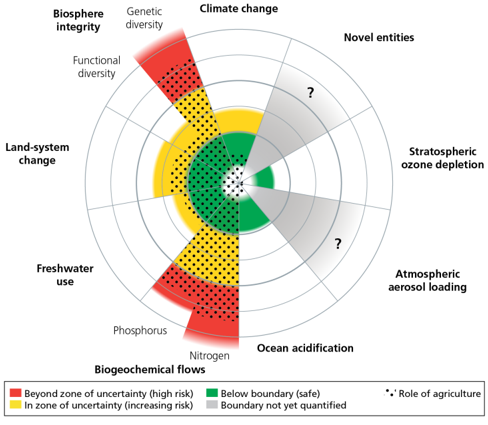
“Agriculture has today become a key driver for four of the eight Planetary Boundaries (PB’s) (identified by Rockstrom et al., 2009) that are at a critical stage of risk: freshwater use, biogeochemical flows, changes in biosphere integrity and climate change (Campbell et al., 2017).”
BackgroundJacobi, J., Mukhovi, S. M., Llanque, A., Giger, M., Bessa, A., Golay, C., Speranza, C. I., Mwangi, V., Augstburger, H., Buergi-Bonanomi, E., et al. (2020) · Scientific Reports · doi:10.1038/s41598-020-76284-y · Cited by 58
Optimising diets to reach absolute planetary environmental sustainability through consumers
Lucas, E., Guo, M., & Guillén‐Gosálbez, G. (2021) · Sustainable Production and Consumption · doi:10.1016/j.spc.2021.07.003 · Cited by 56
Fuentes, I., Fuster, R., Avilés, D., & Vervoort, W. (2021) · Hydrological Sciences Journal · doi:10.1080/02626667.2021.1903475 · Cited by 51
“However, many other factors can impact water availability, such as agricultural water use (Campbell et al. 2017) and changes in water consumption (Liu et al. 2017) or changes in land use (Navas et al. 2019).”
BackgroundHistorical simulation of maize water footprints with a new global gridded crop model ACEA
Mialyk, O., Schyns, J. F., Booij, M. J., & Hogeboom, R. J. (2022) · Hydrology and earth system sciences · doi:10.5194/hess-26-923-2022 · Cited by 53
D’Angelo, S. C., Martín, A. J., Cobo, S., Ordóñez, D. F., Guillén‐Gosálbez, G., & Pérez‐Ramírez, J. (2023) · Energy & Environmental Science · doi:10.1039/d2ee02683j · Cited by 52
Orsi, E., Nikel, P. I., Nielsen, L. K., & Donati, S. (2023) · Nature Communications · doi:10.1038/s41467-023-42166-w · Cited by 52
“Another drawback of plant-based production is the broader negative impact on planetary boundaries, including nitrogen-and phosphate-cycles, land-system change, fresh water use and the use of xenobiotics for pest control 11 .”
BackgroundAgbodjato, N. A., & Babalola, O. O. (2024) · PeerJ · doi:10.7717/peerj.16836 · Cited by 57
“…the intensive use of inputs, has generated signi fi cant environmental repercussions that it is now recognized as one of the main causes of overshooting “ planetary limits ” , especially in terms of biodiversity ( Campbell et al., 2017 ), hence continue in the same direction is no longer an option.”
BackgroundVertical Farming and Cultured Meat: Immature Technologies for Urgent Problems
Tuomisto, H. L. (2019) · One Earth · doi:10.1016/j.oneear.2019.10.024 · Cited by 55
Climate Benefits of Increasing Plant Diversity in Perennial Bioenergy Crops
Yang, Y., Reilly, E. C., Jungers, J. M., Chen, J., & Smith, T. M. (2019) · One Earth · doi:10.1016/j.oneear.2019.11.011 · Cited by 49
Metadata
- Authors
- Campbell, B. M., Beare, D. J., Bennett, E. M., Hall-Spencer, J. M., Ingram, J. S. I., Jaramillo, F., Ortiz, R., Ramankutty, N., Sayer, J. A., & Shindell, D.
- Affiliations
- CGIAR (FR)
- McGill University (CA)
- University of Tsukuba (JP)
- University of Oxford (GB)
- Stockholm Resilience Centre (SE)
- University of Copenhagen (DK)
- University of British Columbia (CA)
- James Cook University (AU)
- Duke University (US)
- ORCID
- Venue
- Ecology and Society
- Publisher
- Resilience Alliance, Inc.
- Published
- 2017
- Volume
- 22
- Issue
- 4
- ISSN
- 1708-3087 (ISSN-L)
- OpenAlex
- W2762931876
- Cited by
- 1,197
- References
- 84
- Citations by year
- 2026: 137 · 2025: 204 · 2024: 182 · 2023: 157 · 2022: 182 · 2021: 140 · 2020: 101 · 2019: 56 · 2018: 35 · 2017: 1
- FWCI
- 36.59
- Type
- journal article
- Language
- en
- Open access
- gold
- doi.org
- Licence
- cc-by-nc
- Locations
- Ecology and Society (publishedVersion, cc-by-nc)
- Research at the University of Copenhagen (University of Copenhagen) (publishedVersion, cc-by)
- Epsilon Open Archive (Sveriges lantbruksuniversitet biblioteket (Swedish University of Agricultural Sciences)) (acceptedVersion)
- ResearchOnline at James Cook University (James Cook University) (submittedVersion)
- PEARL (University of Plymouth) (submittedVersion)
- CGSPace A Repository of Agricultural Research Outputs (Consultative Group for International Agricultural Research) (submittedVersion, other-oa)
- DOAJ (DOAJ: Directory of Open Access Journals) (submittedVersion, cc-by-sa)
- Funders
- Consortium of International Agricultural Research Centers
- Topics
- Physical Sciences › Environmental Science › Global and Planetary Change › Land Use and Ecosystem Services
- Physical Sciences › Environmental Science › Ecology › Agriculture Sustainability and Environmental Impact
- Life Sciences › Agricultural and Biological Sciences › Agronomy and Crop Science › Sustainable Agricultural Systems Analysis
- Keywords
- planetary boundaries, Earth system, anthropogenic impacts, land use change
About these checks
Registry, retraction, Cites and statistics results are computed, not judged, with one exception: a printed reference that no index lists is read once by a model before it counts as a citation error. Claims are extracted by a model and kept only when their quote appears verbatim in the text; each cited source is then checked, with a model’s help, for whether it says what the claim relies on. Those verdicts can be wrong — read the claim’s quote and the cited source before relying on one.
Statistics and arithmetic are recomputed, not judged.
Confidence bands are shown only for fields calibrated on our annotated test set. None is calibrated yet, so no band is shown.
What counts as a claim ›How we measure confidence ›How we check this ›
Are you an author, or do you see a problem with this page? Request a review
Data sources
Bibliographic data: Semantic Scholar, OpenAlex, Crossref.
Contains information from the Semantic Scholar Academic Graph Datasets, made available under the ODC Attribution License (ODC-BY 1.0).
Semantic Scholar’s data is described in: Kinney, R., et al. (2023). The Semantic Scholar Open Data Platform. arXiv:2301.10140.
