

The DOI matches its Crossref record; 80 of the 81 references it cites were found in a registry or an index; 8 of the 191 sources its claims cite were checked for support.
Wearable sensors for clinical applications in epilepsy, Parkinson’s disease, and stroke: a mixed-methods systematic review
Open accessAbstract
OBJECTIVES: Wearable technology is increasingly used to monitor neurological disorders. The purpose of this systematic review was to synthesize knowledge from quantitative and qualitative clinical researches using wearable sensors in epilepsy, Parkinson's disease (PD), and stroke. METHODS: A systematic literature search was conducted in PubMed and Scopus spanning from 1995 to January 2017. A synthesis of the main findings, reported adherence to wearables and missing data from quantitative studies, is provided. Clinimetric properties of measures derived from wearables in laboratory, free activities in hospital, and free-living environment were also evaluated. Qualitative thematic synthesis was conducted to explore user experiences and acceptance of wearables. RESULTS: In total, 56 studies (50 reporting quantitative and 6 reporting qualitative data) were included for data extraction and synthesis. Among studies reporting quantitative data, 5 were in epilepsy, 21 PD, and 24 studies in stroke. In epilepsy, wearables are used to detect and differentiate seizures in hospital settings. In PD, the focus is on quantification of cardinal motor symptoms and medication-evoked adverse symptoms in both laboratory and free-living environment. In stroke upper extremity activity, walking and physical activity have been studied in laboratory and during free activities. Three analytic themes emerged from thematic synthesis of studies reporting qualitative data: acceptable integration in daily life, lack of confidence in technology, and the need to consider individualization. CONCLUSIONS: Wearables may provide information of clinical features of interest in epilepsy, PD and stroke, but knowledge regarding the clinical utility for supporting clinical decision making remains to be established.
Overview
AI snapshot
Written from the paper’s full text.
TL;DR
This mixed-methods systematic review synthesized 56 studies on wearable sensors in epilepsy, Parkinson’s disease (PD), and stroke, covering seizure detection, motor symptom quantification, activity monitoring, adherence, missing data, and user experiences. Wearables show promise for clinical features of interest, but the review concludes that clinical utility for decision making remains to be established.
Key findings
- Of 56 included studies, 50 reported quantitative data (5 epilepsy, 21 PD, 24 stroke) and 6 reported qualitative data (1 epilepsy, 3 PD, 2 stroke).
- In epilepsy, wrist accelerometers detected 95% of motor seizures identified by video-EEG; convulsive seizure detection sensitivity was 90–92%, with false alarms varying across studies (e.g., 40 false alarms in 16/73 patients; 81 false alarms in 17/30 patients). Differentiation of psychogenic non-epileptic from epileptic seizures showed sensitivity 93–100% and specificity 75–91%.
- In PD, wearables quantified bradykinesia, tremor, postural sway, dyskinesia, motor fluctuations, sleep, gait, freezing, falls, and physical activity; postural sway test–retest reliability was ICC 0.55–0.86, and mediolateral sway/jerk were sensitive to progression of postural instability.
- In stroke, upper extremity activity, walking, and physical activity were studied; step counts showed good agreement with 3D gait analysis or video counts, step count/energy expenditure test–retest reliability was ICC 0.61–0.98, gait step count reliability was ICC 0.83–0.99, and arm activity test–retest was r = 0.81–0.9. Adherence ranged from 61–68% for separate days and 53% for two consecutive days in a 2-day step monitor study (n = 408), while PD wrist-sensor non-adherence over 7 days was 4%. Missing data averaged 10% for technical errors (range 6–14%), 12% for human factors (range 4–24%), and 19% combined (range 6–24%). Qualitative themes were acceptable integration in daily life, lack of confidence in technology, and need to consider individualization.
Methods
- Mixed-methods systematic review with searches in PubMed, Scopus, Ovid SP, CINHAL, and Cochrane Library; English articles from 1995 to 2015, updated January 2017; PICO and SPIDER frameworks were used, with quantitative studies selected from PubMed and qualitative studies from Scopus.
- Quantitative inclusion required peer-reviewed original studies using wearable sensors in epilepsy, PD, or stroke, monitoring movements/physiological signs with clinically relevant outcomes; excluded studies with fewer than 10 participants, conference proceedings, reviews, case reports, non-human studies, grey literature, and implantable sensors. Qualitative inclusion required peer-reviewed original studies analyzing primary qualitative data on patient or clinician experiences/preferences regarding wearables.
- Reporting quality was assessed with STROBE for quantitative studies (12 key items, >50% cutoff) and CASP for qualitative studies; data extraction covered aims, sample characteristics, main findings, missing data, and adherence; qualitative data were synthesized thematically using NVivo. Meta-analysis was considered unfeasible due to large variation in study aims and designs.
Limitations
- The paper states that meta-analysis was unfeasible because of large variation in study aims and designs; only half of eligible studies had sufficient reporting quality; no studies directly addressed the effect of wearables on decision making or clinical treatment outcomes, so clinical utility remains to be established; no epilepsy studies were conducted in free-living conditions; and free-living comparison methods were often subjective and retrospective.
- Evident from the text: the search was limited to English-language articles from 1995–2015 (updated January 2017), and despite searching multiple databases, quantitative studies were selected from PubMed and qualitative studies from Scopus.
- Evident from the text: the qualitative synthesis was based on only 6 studies, and reliability and responsiveness of wearable measures were studied only in PD and stroke, not epilepsy.
Model-written summary. Check it against the paper before relying on it.
Integrity signals
Registry
Cites
Statistics
Figures
Verification
Claims the paper makes
84 Not checked yet · 31 Own result · 20 Own interpretation · 18 No basis given · 6 Own method · 4 Partly supported · 2 Supported · 2 Supported so far · accuracy not yet measured
Every source the paper cites for this claim was checked and supports it.
In the paper
“Individuals with a neurological condition might find it difficult to interact with technology due to physical or cognitive limitations, and visually conspicuous wearables may increase disease stigmatization [3].”
§ Wearable sensors for clinical applications in epilepsy, Parkinson’s disease, and stroke: a mixed-methods systematic review > Introduction
What the sources say
- Supportedcites [3] Ozanne A, Johansson D, Hallgren Graneheim U, Malmgren K, Bergquist F, Alt Murphy M (2017) Wearables in epilepsy and Parkinson’s disease—a focus group study. Acta Neurol Scand. https://doi.org/10.1111/ane.12798 source
Section 3.4.2, “Management that hinders,” says participants thought motor and cognition deficits could make it difficult to replace batteries, connect a USB cable, or put wearables on and take them off. This directly supports the quoted claim about physical or cognitive limitations making technology difficult to use. (LLM, conf=0.92)
hedgedconditional- Asserted: passes — The authors put it forward as true.
- Checkable: passes — It can be checked against evidence.
- Load-bearing: passes — The paper’s conclusions depend on it.
- Based: passes — The paper gives a reason why it holds.
- Supported
Every source the paper cites for this claim was checked and supports it.
In the paper
“Parkinson’s disease (PD) and stroke are the two neurological conditions, where accelerometry-based technology has been applied most [1].”
§ Wearable sensors for clinical applications in epilepsy, Parkinson’s disease, and stroke: a mixed-methods systematic review > Introduction
What the sources say
- Supportedcites [1] Steins D, Dawes H, Esser P, Collett J (2014) Wearable accelerometry-based technology capable of assessing functional activities in neurological populations in community settings: a systematic review. J Neuroeng Rehabil 11:36. https://doi.org/10.1186/1743-0003-11-36 source
In Results > Study quality (page not specified), the review says studies evaluating accelerometry-based methods were mainly in Parkinson’s disease (six studies), followed by stroke (three), with none involving other neurological conditions. This supports the citing sentence’s comparison within the scope of the review. (LLM, conf=0.88)
plain- Asserted: passes — The authors put it forward as true.
- Checkable: passes — It can be checked against evidence.
- Load-bearing: unclear — It is unclear whether the paper’s conclusions depend on it.
- Based: passes — The paper gives a reason why it holds.
- Supported
The sources with a verdict support this claim; the rest weren’t checked yet, have no full text we could read, or their verdicts aren’t rated yet.
In the paper
“In stroke, upper extremity activity [40–51], walking, and physical activity levels were investigated in several studies using step and activity counts [52–62].”
§ Wearable sensors for clinical applications in epilepsy, Parkinson’s disease, and stroke: a mixed-methods systematic review > Results > Studies reporting quantitative data
What the sources say
- Not checked yetcites [40] Gebruers N, Truijen S, Engelborghs S, Nagels G, Brouns R, De Deyn PP (2008) Actigraphic measurement of motor deficits in acute ischemic stroke. Cerebrovasc Dis 26(5):533–540. https://doi.org/10.1159/000160210 source
- Not checked yetcites [41] Gebruers N, Truijen S, Engelborghs S, De Deyn PP (2013) Predictive value of upper-limb accelerometry in acute stroke with hemiparesis. J Rehabil Res Dev 50(8):1099–1106. https://doi.org/10.1682/jrrd.2012.09.0166 source
- Not checked yetcites [42] Le Heron C, Fang K, Gubbi J, Churilov L, Palaniswami M, Davis S, Yan B (2014) Wireless accelerometry is feasible in acute monitoring of upper limb motor recovery after ischemic stroke. Cerebrovasc Dis 37(5):336–341. https://doi.org/10.1159/000360808 source
- Not checked yetcites [43] Thrane G, Emaus N, Askim T, Anke A (2011) Arm use in patients with subacute stroke monitored by accelerometry: association with motor impairment and influence on self-dependence. J Rehabil Med 43(4):299–304. https://doi.org/10.2340/16501977-0676 source
- Not checked yetcites [44] Lang CE, Wagner JM, Edwards DF, Dromerick AW (2007) Upper extremity use in people with hemiparesis in the first few weeks after stroke. J Neurol Phys Ther 31(2):56–63. https://doi.org/10.1097/NPT.0b013e31806748bd source
- Not checked yetcites [45] de Niet M, Bussmann JB, Ribbers GM, Stam HJ (2007) The stroke upper-limb activity monitor: its sensitivity to measure hemiplegic upper-limb activity during daily life. Arch Phys Med Rehabil 88(9):1121–1126. https://doi.org/10.1016/j.apmr.2007.06.005 source
- Not checked yetcites [46] van der Pas SC, Verbunt JA, Breukelaar DE, van Woerden R, Seelen HA (2011) Assessment of arm activity using triaxial accelerometry in patients with a stroke. Arch Phys Med Rehabil 92(9):1437–1442. https://doi.org/10.1016/j.apmr.2011.02.021 source
- Supportedcites [47] Shim S, Kim H, Jung J (2014) Comparison of upper extremity motor recovery of stroke patients with actual physical activity in their daily lives measured with accelerometers. J Phys Ther Sci 26(7):1009–1011. https://doi.org/10.1589/jpts.26.1009 source
The Introduction and Subjects and Methods describe measuring upper-extremity activity in stroke patients with accelerometers worn on both wrists. This supports the upper-extremity portion of the sentence, to which citations [40–51] are attached; the walking and step-count portion is attached to a different citation group. (LLM, conf=0.91)
- Not checked yetcites [48] Uswatte G, Foo WL, Olmstead H, Lopez K, Holand A, Simms LB (2005) Ambulatory monitoring of arm movement using accelerometry: an objective measure of upper-extremity rehabilitation in persons with chronic stroke. Arch Phys Med Rehabil 86(7):1498–1501 source
- Not checked yetcites [49] Uswatte G, Giuliani C, Winstein C, Zeringue A, Hobbs L, Wolf SL (2006) Validity of accelerometry for monitoring real-world arm activity in patients with subacute stroke: evidence from the extremity constraint-induced therapy evaluation trial. Arch Phys Med Rehabil 87(10):1340–1345. https://doi.org/10.1016/j.apmr.2006.06.006 source
plain- Asserted: passes — The authors put it forward as true.
- Checkable: passes — It can be checked against evidence.
- Load-bearing: unclear — It is unclear whether the paper’s conclusions depend on it.
- Based: passes — The paper gives a reason why it holds.
The cited sources support only part of this claim — read each source’s verdict below.
In the paper
“In addition, good agreement was found between sway and spatiotemporal gait measures from wearables and other established technologies [23, 31, 32].”
§ Wearable sensors for clinical applications in epilepsy, Parkinson’s disease, and stroke: a mixed-methods systematic review > Results > Wearables in laboratory environment
What the sources say
- Partly supportedcites [23] Mancini M, Salarian A, Carlson-Kuhta P, Zampieri C, King L, Chiari L, Horak FB (2012) ISway: a sensitive, valid and reliable measure of postural control. J Neuroeng Rehabil 9:59. https://doi.org/10.1186/1743-0003-9-59 sourceExperimental — accuracy not yet measured
The Discussion reports moderate-to-good correlations between wearable accelerometer and force-plate measures of postural sway, but says not all measures correlated and identifies exceptions. The paper does not assess agreement for spatiotemporal gait measures; that part of the multi-citation sentence cannot be supported by this source. (LLM, conf=0.84)
- Not checked yetcites [31] Lord S, Rochester L, Baker K, Nieuwboer A (2008) Concurrent validity of accelerometry to measure gait in Parkinsons Disease. Gait Posture 27(2):357–359. https://doi.org/10.1016/j.gaitpost.2007.04.001 source
- Not checked yetcites [32] Esser P, Dawes H, Collett J, Feltham MG, Howells K (2012) Validity and inter-rater reliability of inertial gait measurements in Parkinson’s disease: a pilot study. J Neurosci Methods 205(1):177–181. https://doi.org/10.1016/j.jneumeth.2012.01.005 source
plaincorrelational- Asserted: passes — The authors put it forward as true.
- Checkable: passes — It can be checked against evidence.
- Load-bearing: unclear — It is unclear whether the paper’s conclusions depend on it.
- Based: passes — The paper gives a reason why it holds.
- Partly supported
The cited sources support only part of this claim — read each source’s verdict below.
In the paper
“PD participants further expressed that it was stressful to fasten the sensors during an off state [64, 69].”
§ Wearable sensors for clinical applications in epilepsy, Parkinson’s disease, and stroke: a mixed-methods systematic review > Results > Lack of confidence in technology
What the sources say
- Not checked yetcites [64] Fisher JM, Hammerla NY, Rochester L, Andras P, Walker RW (2016) Body-worn sensors in Parkinson’s disease: evaluating their acceptability to patients. Telemed J E Health 22(1):63–69. https://doi.org/10.1089/tmj.2015.0026 source
- Partly supportedcites [69] Cancela J, Pastorino M, Tzallas AT, Tsipouras MG, Rigas G, Arredondo MT, Fotiadis DI (2014) Wearability assessment of a wearable system for Parkinson’s disease remote monitoring based on a body area network of sensors. Sensors (Basel) 14(9):17235–17255. https://doi.org/10.3390/s140917235 sourceExperimental — accuracy not yet measured
In Results and Discussion, “Interview and Complementary Questions” (page not supplied), one participant expressed concern about difficulty attaching the device in an OFF state. A separate participant described the device as causing stress and nervousness, but the paper does not explicitly link that stress to fastening sensors during an OFF state. (LLM, conf=0.84)
plain- Asserted: passes — The authors put it forward as true.
- Checkable: passes — It can be checked against evidence.
- Load-bearing: unclear — It is unclear whether the paper’s conclusions depend on it.
- Based: passes — The paper gives a reason why it holds.
The sources with a verdict support this claim; the rest weren’t checked yet, have no full text we could read, or their verdicts aren’t rated yet.
In the paper
“and sedentary or upright and walking behaviour measures have been shown to be sensitive to longitudinal changes [55, 60, 62].”
§ Wearable sensors for clinical applications in epilepsy, Parkinson’s disease, and stroke: a mixed-methods systematic review > Discussion
What the sources say
- Not checked yetcites [55] Askim T, Bernhardt J, Churilov L, Fredriksen KR, Indredavik B (2013) Changes in physical activity and related functional and disability levels in the first 6 months after stroke: a longitudinal follow-up study. J Rehabil Med 45(5):423–428. https://doi.org/10.2340/16501977-1137 source
- Supportedcites [60] Sanchez MC, Bussmann J, Janssen W, Horemans H, Chastin S, Heijenbrok M, Stam H (2015) Accelerometric assessment of different dimensions of natural walking during the first year after stroke: recovery of amount, distribution, quality and speed of walking. J Rehabil Med. https://doi.org/10.2340/16501977-1994 source
The paper reports longitudinal changes after stroke: time walking and sedentary time changed significantly from T1 to T2 (Discussion, p. 7), while time walking, time upright, and the number of walking bouts increased from T1 to T2 (Results, p. 2). It also notes that some other walking measures did not change significantly, so the claim is supported as referring to measures that detect change, not every measure studied. (LLM, conf=0.90)
- Not checked yetcites [62] Tieges Z, Mead G, Allerhand M, Duncan F, van Wijck F, Fitzsimons C, Greig C, Chastin S (2015) Sedentary behavior in the first year after stroke: a longitudinal cohort study with objective measures. Arch Phys Med Rehabil 96(1):15–23. https://doi.org/10.1016/j.apmr.2014.08.015 source
plaincorrelational- Asserted: passes — The authors put it forward as true.
- Checkable: passes — It can be checked against evidence.
- Load-bearing: passes — The paper’s conclusions depend on it.
- Based: passes — The paper gives a reason why it holds.
A result the paper reports from its own data — it cites no other source for it, so there is none to check. The quote shows it is in the paper.
In the paper
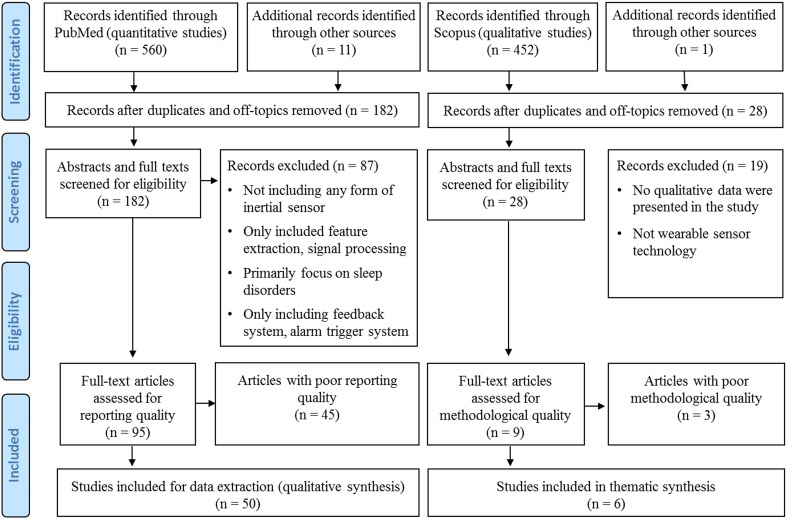
“In total, 56 studies (50 reporting quantitative and 6 reporting qualitative data) were included for data extraction and synthesis.”
- Also stated in: § Results · plain
“Thus, 50 studies reporting quantitative data and 6 studies reporting qualitative data were included for further data extraction and synthesis (Fig. 1).”
§ Wearable sensors for clinical applications in epilepsy, Parkinson’s disease, and stroke: a mixed-methods systematic review > Abstract > Results
plain- Asserted: passes — The authors put it forward as true.
- Checkable: passes — It can be checked against evidence.
- Load-bearing: passes — The paper’s conclusions depend on it.
- Based: passes — The paper gives a reason why it holds.
- Also stated in: § Results · plain
None of the sources cited for this claim have been checked yet.
In the paper
“In epilepsy, wearables are used to detect and differentiate seizures in hospital settings.”
- Also stated in: § Studies reporting quantitative data · plain
“In epilepsy, wrist-worn sensors with built-in accelerometers were used for detection and classification of seizures in hospital settings [14–18].”
§ Wearable sensors for clinical applications in epilepsy, Parkinson’s disease, and stroke: a mixed-methods systematic review > Abstract > Results
What the sources say
- Not checked yetcites [14] Nijsen TM, Arends JB, Griep PA, Cluitmans PJ (2005) The potential value of three-dimensional accelerometry for detection of motor seizures in severe epilepsy. Epilepsy Behav 7(1):74–84. https://doi.org/10.1016/j.yebeh.2005.04.011 source
- Not checked yetcites [15] Beniczky S, Polster T, Kjaer TW, Hjalgrim H (2013) Detection of generalized tonic-clonic seizures by a wireless wrist accelerometer: a prospective, multicenter study. Epilepsia 54(4):e58–e61. https://doi.org/10.1111/epi.12120 source
- Not checked yetcites [16] Velez M, Fisher RS, Bartlett V, Le S (2016) Tracking generalized tonic-clonic seizures with a wrist accelerometer linked to an online database. Seizure 39:13–18. https://doi.org/10.1016/j.seizure.2016.04.009 source
- Not checked yetcites [17] Bayly J, Carino J, Petrovski S, Smit M, Fernando DA, Vinton A, Yan B, Gubbi JR, Palaniswami MS, O’Brien TJ (2013) Time-frequency mapping of the rhythmic limb movements distinguishes convulsive epileptic from psychogenic nonepileptic seizures. Epilepsia 54(8):1402–1408. https://doi.org/10.1111/epi.12207 source
- Not checked yetcites [18] Gubbi J, Kusmakar S, Rao A, Yan B, O’Brien T, Palaniswami M (2015) Automatic detection and classification of convulsive psychogenic non-epileptic seizures using a wearable device. IEEE J Biomed Health Inform. https://doi.org/10.1109/jbhi.2015.2446539 source
plain- Asserted: passes — The authors put it forward as true.
- Checkable: passes — It can be checked against evidence.
- Load-bearing: unclear — It is unclear whether the paper’s conclusions depend on it.
- Based: passes — The paper gives a reason why it holds.
- Also stated in: § Studies reporting quantitative data · plain
The paper states this without a source or data behind it here, so there is nothing to check it against. The quote shows it is in the paper.
In the paper
“In stroke upper extremity activity, walking and physical activity have been studied in laboratory and during free activities.”
§ Wearable sensors for clinical applications in epilepsy, Parkinson’s disease, and stroke: a mixed-methods systematic review > Abstract > Results
plain- Asserted: passes — The authors put it forward as true.
- Checkable: passes — It can be checked against evidence.
- Load-bearing: unclear — It is unclear whether the paper’s conclusions depend on it.
- Based: passes — The paper gives a reason why it holds.
The paper states this without a source or data behind it here, so there is nothing to check it against. The quote shows it is in the paper.
In the paper
“In PD, the focus is on quantification of cardinal motor symptoms and medication-evoked adverse symptoms in both laboratory and free-living environment.”
§ Wearable sensors for clinical applications in epilepsy, Parkinson’s disease, and stroke: a mixed-methods systematic review > Abstract > Results
plain- Asserted: passes — The authors put it forward as true.
- Checkable: passes — It can be checked against evidence.
- Load-bearing: unclear — It is unclear whether the paper’s conclusions depend on it.
- Based: passes — The paper gives a reason why it holds.
A result the paper reports from its own data — it cites no other source for it, so there is none to check. The quote shows it is in the paper.
In the paper
“All studies in epilepsy were conducted in a hospital environment.”
§ Wearable sensors for clinical applications in epilepsy, Parkinson’s disease, and stroke: a mixed-methods systematic review > Results
plain- Asserted: passes — The authors put it forward as true.
- Checkable: passes — It can be checked against evidence.
- Load-bearing: unclear — It is unclear whether the paper’s conclusions depend on it.
- Based: passes — The paper gives a reason why it holds.
None of the sources cited for this claim have been checked yet.
In the paper
“In PD, wearables were used to detect and quantify cardinal motor symptoms including bradykinesia [19], tremor [20, 21], and postural sway [22, 23] as well as medication-evoked adverse symptoms such as dyskinesia [24–27] and motor fluctuations [28, 29].”
§ Wearable sensors for clinical applications in epilepsy, Parkinson’s disease, and stroke: a mixed-methods systematic review > Results > Studies reporting quantitative data
What the sources say
- Not checked yetcites [19] Dunnewold RJ, Hoff JI, van Pelt HC, Fredrikze PQ, Wagemans EA, van Hilten BJ (1998) Ambulatory quantitative assessment of body position, bradykinesia, and hypokinesia in Parkinson’s disease. J Clin Neurophysiol 15(3):235–242 source
- Not checked yetcites [20] Scanlon BK, Levin BE, Nation DA, Katzen HL, Guevara-Salcedo A, Singer C, Papapetropoulos S (2013) An accelerometry-based study of lower and upper limb tremor in Parkinson’s disease. J Clin Neurosci 20(6):827–830. https://doi.org/10.1016/j.jocn.2012.06.015 source
- Not checked yetcites [21] Heldman DA, Espay AJ, LeWitt PA, Giuffrida JP (2014) Clinician versus machine: reliability and responsiveness of motor endpoints in Parkinson’s disease. Parkinsonism Relat Disord 20(6):590–595. https://doi.org/10.1016/j.parkreldis.2014.02.022 source
- Not checked yetcites [22] Mancini M, Carlson-Kuhta P, Zampieri C, Nutt JG, Chiari L, Horak FB (2012) Postural sway as a marker of progression in Parkinson’s disease: a pilot longitudinal study. Gait Posture 36(3):471–476. https://doi.org/10.1016/j.gaitpost.2012.04.010 source
- Not checked yetcites [23] Mancini M, Salarian A, Carlson-Kuhta P, Zampieri C, King L, Chiari L, Horak FB (2012) ISway: a sensitive, valid and reliable measure of postural control. J Neuroeng Rehabil 9:59. https://doi.org/10.1186/1743-0003-9-59 source
plain- Asserted: passes — The authors put it forward as true.
- Checkable: passes — It can be checked against evidence.
- Load-bearing: unclear — It is unclear whether the paper’s conclusions depend on it.
- Based: passes — The paper gives a reason why it holds.
None of the sources cited for this claim have been checked yet.
In the paper
“In PD, wearables were used to detect and quantify cardinal motor symptoms including bradykinesia [19], tremor [20, 21], and postural sway [22, 23] as well as medication-evoked adverse symptoms such as dyskinesia [24–27] and motor fluctuations [28, 29].”
§ Wearable sensors for clinical applications in epilepsy, Parkinson’s disease, and stroke: a mixed-methods systematic review > Results > Studies reporting quantitative data
What the sources say
- Not checked yetcites [24] Lopane G, Mellone S, Chiari L, Cortelli P, Calandra-Buonaura G, Contin M (2015) Dyskinesia detection and monitoring by a single sensor in patients with Parkinson’s disease. Mov Disord. https://doi.org/10.1002/mds.26313 source
- Not checked yetcites [25] Pulliam CL, Burack MA, Heldman DA, Giuffrida JP, Mera TO (2014) Motion sensor dyskinesia assessment during activities of daily living. J Parkinsons Dis 4(4):609–615. https://doi.org/10.3233/jpd-140348 source
- Not checked yetcites [26] Ramsperger R, Meckler S, Heger T, van Uem J, Hucker S, Braatz U, Graessner H, Berg D, Manoli Y, Serrano JA, Ferreira JJ, Hobert MA, Maetzler W, team S-Ps (2016) Continuous leg dyskinesia assessment in Parkinson’s disease-clinical validity and ecological effect. Parkinsonism Relat Disord 26:41–46. https://doi.org/10.1016/j.parkreldis.2016.02.007 source
- Not checked yetcites [27] Mera TO, Burack MA, Giuffrida JP (2013) Objective motion sensor assessment highly correlated with scores of global levodopa-induced dyskinesia in Parkinson’s disease. J Parkinsons Dis 3(3):399–407. https://doi.org/10.3233/JPD-120166 source
- Not checked yetcites [28] Horne MK, McGregor S, Bergquist F (2015) An objective fluctuation score for Parkinson’s disease. PLoS One 10(4):e0124522. https://doi.org/10.1371/journal.pone.0124522 source
- Not checked yetcites [29] Rodriguez-Molinero A, Sama A, Perez-Martinez DA, Perez Lopez C, Romagosa J, Bayes A, Sanz P, Calopa M, Galvez-Barron C, de Mingo E, Rodriguez Martin D, Gonzalo N, Formiga F, Cabestany J, Catala A (2015) Validation of a portable device for mapping motor and gait disturbances in Parkinson’s disease. JMIR mHealth uHealth 3(1):e9. https://doi.org/10.2196/mhealth.3321 source
plain- Asserted: passes — The authors put it forward as true.
- Checkable: passes — It can be checked against evidence.
- Load-bearing: unclear — It is unclear whether the paper’s conclusions depend on it.
- Based: passes — The paper gives a reason why it holds.
None of the sources cited for this claim have been checked yet.
In the paper
“Different measures derived from wearables quantifying tremor, dyskinesia, postural sway, and spatiotemporal gait characteristics discriminated well between individuals with PD and healthy controls [20, 22, 24, 26, 31]; dyskinesia measures discriminated also between patients with and without dyskinesia [24, 26].”
§ Wearable sensors for clinical applications in epilepsy, Parkinson’s disease, and stroke: a mixed-methods systematic review > Results > Wearables in laboratory environment
What the sources say
- Not checked yetcites [20] Scanlon BK, Levin BE, Nation DA, Katzen HL, Guevara-Salcedo A, Singer C, Papapetropoulos S (2013) An accelerometry-based study of lower and upper limb tremor in Parkinson’s disease. J Clin Neurosci 20(6):827–830. https://doi.org/10.1016/j.jocn.2012.06.015 source
- Not checked yetcites [22] Mancini M, Carlson-Kuhta P, Zampieri C, Nutt JG, Chiari L, Horak FB (2012) Postural sway as a marker of progression in Parkinson’s disease: a pilot longitudinal study. Gait Posture 36(3):471–476. https://doi.org/10.1016/j.gaitpost.2012.04.010 source
- Not checked yetcites [24] Lopane G, Mellone S, Chiari L, Cortelli P, Calandra-Buonaura G, Contin M (2015) Dyskinesia detection and monitoring by a single sensor in patients with Parkinson’s disease. Mov Disord. https://doi.org/10.1002/mds.26313 source
- Not checked yetcites [26] Ramsperger R, Meckler S, Heger T, van Uem J, Hucker S, Braatz U, Graessner H, Berg D, Manoli Y, Serrano JA, Ferreira JJ, Hobert MA, Maetzler W, team S-Ps (2016) Continuous leg dyskinesia assessment in Parkinson’s disease-clinical validity and ecological effect. Parkinsonism Relat Disord 26:41–46. https://doi.org/10.1016/j.parkreldis.2016.02.007 source
- Not checked yetcites [31] Lord S, Rochester L, Baker K, Nieuwboer A (2008) Concurrent validity of accelerometry to measure gait in Parkinsons Disease. Gait Posture 27(2):357–359. https://doi.org/10.1016/j.gaitpost.2007.04.001 source
boostedcorrelational- Asserted: passes — The authors put it forward as true.
- Checkable: passes — It can be checked against evidence.
- Load-bearing: passes — The paper’s conclusions depend on it.
- Based: passes — The paper gives a reason why it holds.
The paper states this without a source or data behind it here, so there is nothing to check it against. The quote shows it is in the paper.
In the paper
“Video observations, clinical scales, and other technologies such as gait analysis were often used as standard reference to validate variables derived from wearables.”
§ Wearable sensors for clinical applications in epilepsy, Parkinson’s disease, and stroke: a mixed-methods systematic review > Results > Wearables in laboratory environment
plain- Asserted: passes — The authors put it forward as true.
- Checkable: passes — It can be checked against evidence.
- Load-bearing: unclear — It is unclear whether the paper’s conclusions depend on it.
- Based: passes — The paper gives a reason why it holds.
None of the sources cited for this claim have been checked yet.
In the paper
“Moderate-to-strong correlations were reported between dyskinesia detected from wearables and clinical ratings [24–26].”
§ Wearable sensors for clinical applications in epilepsy, Parkinson’s disease, and stroke: a mixed-methods systematic review > Results > Wearables in laboratory environment
What the sources say
- Not checked yetcites [24] Lopane G, Mellone S, Chiari L, Cortelli P, Calandra-Buonaura G, Contin M (2015) Dyskinesia detection and monitoring by a single sensor in patients with Parkinson’s disease. Mov Disord. https://doi.org/10.1002/mds.26313 source
- Not checked yetcites [25] Pulliam CL, Burack MA, Heldman DA, Giuffrida JP, Mera TO (2014) Motion sensor dyskinesia assessment during activities of daily living. J Parkinsons Dis 4(4):609–615. https://doi.org/10.3233/jpd-140348 source
- Not checked yetcites [26] Ramsperger R, Meckler S, Heger T, van Uem J, Hucker S, Braatz U, Graessner H, Berg D, Manoli Y, Serrano JA, Ferreira JJ, Hobert MA, Maetzler W, team S-Ps (2016) Continuous leg dyskinesia assessment in Parkinson’s disease-clinical validity and ecological effect. Parkinsonism Relat Disord 26:41–46. https://doi.org/10.1016/j.parkreldis.2016.02.007 source
plaincorrelational- Asserted: passes — The authors put it forward as true.
- Checkable: passes — It can be checked against evidence.
- Load-bearing: unclear — It is unclear whether the paper’s conclusions depend on it.
- Based: passes — The paper gives a reason why it holds.
In the paper
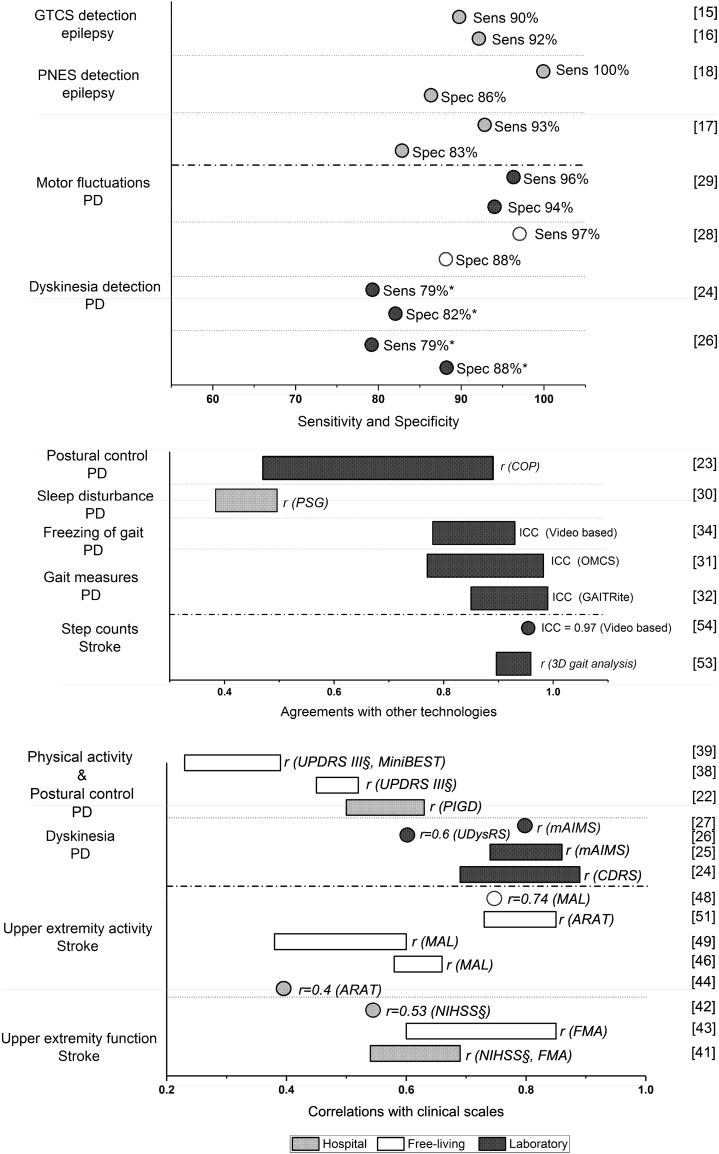
“Postural sway measures derived from wearables have been examined for test–retest reliability (ICC 0.55–0.86) [23] and the mediolateral sway and jerk were shown to be sensitive to detect progression of postural instability in PD over time [22].”
§ Wearable sensors for clinical applications in epilepsy, Parkinson’s disease, and stroke: a mixed-methods systematic review > Results > Wearables in laboratory environment
What the sources say
- Not checked yetcites [23] Mancini M, Salarian A, Carlson-Kuhta P, Zampieri C, King L, Chiari L, Horak FB (2012) ISway: a sensitive, valid and reliable measure of postural control. J Neuroeng Rehabil 9:59. https://doi.org/10.1186/1743-0003-9-59 source
plain- Asserted: passes — The authors put it forward as true.
- Checkable: passes — It can be checked against evidence.
- Load-bearing: unclear — It is unclear whether the paper’s conclusions depend on it.
- Based: passes — The paper gives a reason why it holds.
In the paper
“Postural sway measures derived from wearables have been examined for test–retest reliability (ICC 0.55–0.86) [23] and the mediolateral sway and jerk were shown to be sensitive to detect progression of postural instability in PD over time [22].”
§ Wearable sensors for clinical applications in epilepsy, Parkinson’s disease, and stroke: a mixed-methods systematic review > Results > Wearables in laboratory environment
What the sources say
- Not checked yetcites [22] Mancini M, Carlson-Kuhta P, Zampieri C, Nutt JG, Chiari L, Horak FB (2012) Postural sway as a marker of progression in Parkinson’s disease: a pilot longitudinal study. Gait Posture 36(3):471–476. https://doi.org/10.1016/j.gaitpost.2012.04.010 source
plaincorrelational- Asserted: passes — The authors put it forward as true.
- Checkable: passes — It can be checked against evidence.
- Load-bearing: unclear — It is unclear whether the paper’s conclusions depend on it.
- Based: passes — The paper gives a reason why it holds.
In the paper
“One study reported no significant correlation between step counts derived from arm worn sensors and manual observational step counting, while an inconsistent but moderate-to-strong correlation (r = 0.56–0.85) for measuring energy expenditure was noted with indirect calorimetry [59].”
§ Wearable sensors for clinical applications in epilepsy, Parkinson’s disease, and stroke: a mixed-methods systematic review > Results > Wearables in laboratory environment
What the sources say
- Not checked yetcites [59] Vanroy C, Vissers D, Cras P, Beyne S, Feys H, Vanlandewijck Y, Truijen S (2014) Physical activity monitoring in stroke: senseWear Pro2 activity accelerometer versus Yamax Digi-Walker SW-200 pedometer. Disabil Rehabil 36(20):1695–1703. https://doi.org/10.3109/09638288.2013.859307 source
plaincorrelational- Asserted: passes — The authors put it forward as true.
- Checkable: passes — It can be checked against evidence.
- Load-bearing: unclear — It is unclear whether the paper’s conclusions depend on it.
- Based: passes — The paper gives a reason why it holds.
None of the sources cited for this claim have been checked yet.
In the paper
“Different measures derived from wearables quantifying tremor, dyskinesia, postural sway, and spatiotemporal gait characteristics discriminated well between individuals with PD and healthy controls [20, 22, 24, 26, 31]; dyskinesia measures discriminated also between patients with and without dyskinesia [24, 26].”
§ Wearable sensors for clinical applications in epilepsy, Parkinson’s disease, and stroke: a mixed-methods systematic review > Results > Wearables in laboratory environment
What the sources say
- Not checked yetcites [24] Lopane G, Mellone S, Chiari L, Cortelli P, Calandra-Buonaura G, Contin M (2015) Dyskinesia detection and monitoring by a single sensor in patients with Parkinson’s disease. Mov Disord. https://doi.org/10.1002/mds.26313 source
- Not checked yetcites [26] Ramsperger R, Meckler S, Heger T, van Uem J, Hucker S, Braatz U, Graessner H, Berg D, Manoli Y, Serrano JA, Ferreira JJ, Hobert MA, Maetzler W, team S-Ps (2016) Continuous leg dyskinesia assessment in Parkinson’s disease-clinical validity and ecological effect. Parkinsonism Relat Disord 26:41–46. https://doi.org/10.1016/j.parkreldis.2016.02.007 source
boostedcorrelational- Asserted: passes — The authors put it forward as true.
- Checkable: passes — It can be checked against evidence.
- Load-bearing: passes — The paper’s conclusions depend on it.
- Based: passes — The paper gives a reason why it holds.
None of the sources cited for this claim have been checked yet.
In the paper
“In stroke, good agreement was found between step counts derived from wearables compared to step counts from 3D gait analysis [53] or video-based counts [54].”
§ Wearable sensors for clinical applications in epilepsy, Parkinson’s disease, and stroke: a mixed-methods systematic review > Results > Wearables in laboratory environment
What the sources say
- Not checked yetcites [53] Mudge S, Stott NS, Walt SE (2007) Criterion validity of the StepWatch activity monitor as a measure of walking activity in patients after stroke. Arch Phys Med Rehabil 88(12):1710–1715. https://doi.org/10.1016/j.apmr.2007.07.039 source
- Not checked yetcites [54] Fulk GD, Combs SA, Danks KA, Nirider CD, Raja B, Reisman DS (2014) Accuracy of 2 activity monitors in detecting steps in people with stroke and traumatic brain injury. Phys Ther 94(2):222–229. https://doi.org/10.2522/ptj.20120525 source
plaincorrelational- Asserted: passes — The authors put it forward as true.
- Checkable: passes — It can be checked against evidence.
- Load-bearing: unclear — It is unclear whether the paper’s conclusions depend on it.
- Based: passes — The paper gives a reason why it holds.
In the paper
“One study reported no significant correlation between step counts derived from arm worn sensors and manual observational step counting, while an inconsistent but moderate-to-strong correlation (r = 0.56–0.85) for measuring energy expenditure was noted with indirect calorimetry [59].”
§ Wearable sensors for clinical applications in epilepsy, Parkinson’s disease, and stroke: a mixed-methods systematic review > Results > Wearables in laboratory environment
What the sources say
- Not checked yetcites [59] Vanroy C, Vissers D, Cras P, Beyne S, Feys H, Vanlandewijck Y, Truijen S (2014) Physical activity monitoring in stroke: senseWear Pro2 activity accelerometer versus Yamax Digi-Walker SW-200 pedometer. Disabil Rehabil 36(20):1695–1703. https://doi.org/10.3109/09638288.2013.859307 source
plain- Asserted: passes — The authors put it forward as true.
- Checkable: passes — It can be checked against evidence.
- Load-bearing: unclear — It is unclear whether the paper’s conclusions depend on it.
- Based: passes — The paper gives a reason why it holds.
None of the sources cited for this claim have been checked yet.
In the paper
“Differentiation of psychogenic non-epileptic seizures from epileptic seizures showed a sensitivity of 93–100% with different machine learning approaches, while the specificity ranged from 75 to 91% [17, 18].”
§ Wearable sensors for clinical applications in epilepsy, Parkinson’s disease, and stroke: a mixed-methods systematic review > Results > Wearables in hospital environment
What the sources say
- Not checked yetcites [17] Bayly J, Carino J, Petrovski S, Smit M, Fernando DA, Vinton A, Yan B, Gubbi JR, Palaniswami MS, O’Brien TJ (2013) Time-frequency mapping of the rhythmic limb movements distinguishes convulsive epileptic from psychogenic nonepileptic seizures. Epilepsia 54(8):1402–1408. https://doi.org/10.1111/epi.12207 source
- Not checked yetcites [18] Gubbi J, Kusmakar S, Rao A, Yan B, O’Brien T, Palaniswami M (2015) Automatic detection and classification of convulsive psychogenic non-epileptic seizures using a wearable device. IEEE J Biomed Health Inform. https://doi.org/10.1109/jbhi.2015.2446539 source
plaincorrelational- Asserted: passes — The authors put it forward as true.
- Checkable: passes — It can be checked against evidence.
- Load-bearing: unclear — It is unclear whether the paper’s conclusions depend on it.
- Based: passes — The paper gives a reason why it holds.
A result the paper reports from its own data — it cites no other source for it, so there is none to check. The quote shows it is in the paper.
In the paper
“No studies investigated the test–retest reliability or responsiveness in free activities at hospital settings.”
§ Wearable sensors for clinical applications in epilepsy, Parkinson’s disease, and stroke: a mixed-methods systematic review > Results > Wearables in hospital environment
plain- Asserted: passes — The authors put it forward as true.
- Checkable: passes — It can be checked against evidence.
- Load-bearing: unclear — It is unclear whether the paper’s conclusions depend on it.
- Based: passes — The paper gives a reason why it holds.
None of the sources cited for this claim have been checked yet.
In the paper
“Upper extremity activity measures derived from accelerometers discriminated well between persons with stroke and healthy controls [41, 42, 44, 50] as well as between patients with different impairment levels [40, 41].”
§ Wearable sensors for clinical applications in epilepsy, Parkinson’s disease, and stroke: a mixed-methods systematic review > Results > Wearables in hospital environment
What the sources say
- Not checked yetcites [41] Gebruers N, Truijen S, Engelborghs S, De Deyn PP (2013) Predictive value of upper-limb accelerometry in acute stroke with hemiparesis. J Rehabil Res Dev 50(8):1099–1106. https://doi.org/10.1682/jrrd.2012.09.0166 source
- Not checked yetcites [42] Le Heron C, Fang K, Gubbi J, Churilov L, Palaniswami M, Davis S, Yan B (2014) Wireless accelerometry is feasible in acute monitoring of upper limb motor recovery after ischemic stroke. Cerebrovasc Dis 37(5):336–341. https://doi.org/10.1159/000360808 source
- Not checked yetcites [44] Lang CE, Wagner JM, Edwards DF, Dromerick AW (2007) Upper extremity use in people with hemiparesis in the first few weeks after stroke. J Neurol Phys Ther 31(2):56–63. https://doi.org/10.1097/NPT.0b013e31806748bd source
- Not checked yetcites [50] Michielsen ME, Selles RW, Stam HJ, Ribbers GM, Bussmann JB (2012) Quantifying nonuse in chronic stroke patients: a study into paretic, nonparetic, and bimanual upper-limb use in daily life. Arch Phys Med Rehabil 93(11):1975–1981. https://doi.org/10.1016/j.apmr.2012.03.016 source
boostedcorrelational- Asserted: passes — The authors put it forward as true.
- Checkable: passes — It can be checked against evidence.
- Load-bearing: passes — The paper’s conclusions depend on it.
- Based: passes — The paper gives a reason why it holds.
In the paper
“In epilepsy, stereotypical movement patterns for motor seizures were detected with three-axes accelerometers in 95% of the motor seizures identified with video-EEG [14].”
§ Wearable sensors for clinical applications in epilepsy, Parkinson’s disease, and stroke: a mixed-methods systematic review > Results > Wearables in hospital environment
What the sources say
- Not checked yetcites [14] Nijsen TM, Arends JB, Griep PA, Cluitmans PJ (2005) The potential value of three-dimensional accelerometry for detection of motor seizures in severe epilepsy. Epilepsy Behav 7(1):74–84. https://doi.org/10.1016/j.yebeh.2005.04.011 source
plaincorrelational- Asserted: passes — The authors put it forward as true.
- Checkable: passes — It can be checked against evidence.
- Load-bearing: unclear — It is unclear whether the paper’s conclusions depend on it.
- Based: passes — The paper gives a reason why it holds.
None of the sources cited for this claim have been checked yet.
In the paper
“Upper extremity activity measures derived from accelerometers discriminated well between persons with stroke and healthy controls [41, 42, 44, 50] as well as between patients with different impairment levels [40, 41].”
§ Wearable sensors for clinical applications in epilepsy, Parkinson’s disease, and stroke: a mixed-methods systematic review > Results > Wearables in hospital environment
What the sources say
- Not checked yetcites [40] Gebruers N, Truijen S, Engelborghs S, Nagels G, Brouns R, De Deyn PP (2008) Actigraphic measurement of motor deficits in acute ischemic stroke. Cerebrovasc Dis 26(5):533–540. https://doi.org/10.1159/000160210 source
- Not checked yetcites [41] Gebruers N, Truijen S, Engelborghs S, De Deyn PP (2013) Predictive value of upper-limb accelerometry in acute stroke with hemiparesis. J Rehabil Res Dev 50(8):1099–1106. https://doi.org/10.1682/jrrd.2012.09.0166 source
boostedcorrelational- Asserted: passes — The authors put it forward as true.
- Checkable: passes — It can be checked against evidence.
- Load-bearing: passes — The paper’s conclusions depend on it.
- Based: passes — The paper gives a reason why it holds.
In the paper
“One study reported 40 false alarms in 16 out of 73 patients [15], and another study found 81 false alarms reported in 17 patients out of a sample of 30 [16].”
§ Wearable sensors for clinical applications in epilepsy, Parkinson’s disease, and stroke: a mixed-methods systematic review > Results > Wearables in hospital environment
What the sources say
- Not checked yetcites [16] Velez M, Fisher RS, Bartlett V, Le S (2016) Tracking generalized tonic-clonic seizures with a wrist accelerometer linked to an online database. Seizure 39:13–18. https://doi.org/10.1016/j.seizure.2016.04.009 source
plainn = 17- Asserted: passes — The authors put it forward as true.
- Checkable: passes — It can be checked against evidence.
- Load-bearing: unclear — It is unclear whether the paper’s conclusions depend on it.
- Based: passes — The paper gives a reason why it holds.
None of the sources cited for this claim have been checked yet.
In the paper
“Differentiation of psychogenic non-epileptic seizures from epileptic seizures showed a sensitivity of 93–100% with different machine learning approaches, while the specificity ranged from 75 to 91% [17, 18].”
§ Wearable sensors for clinical applications in epilepsy, Parkinson’s disease, and stroke: a mixed-methods systematic review > Results > Wearables in hospital environment
What the sources say
- Not checked yetcites [17] Bayly J, Carino J, Petrovski S, Smit M, Fernando DA, Vinton A, Yan B, Gubbi JR, Palaniswami MS, O’Brien TJ (2013) Time-frequency mapping of the rhythmic limb movements distinguishes convulsive epileptic from psychogenic nonepileptic seizures. Epilepsia 54(8):1402–1408. https://doi.org/10.1111/epi.12207 source
- Not checked yetcites [18] Gubbi J, Kusmakar S, Rao A, Yan B, O’Brien T, Palaniswami M (2015) Automatic detection and classification of convulsive psychogenic non-epileptic seizures using a wearable device. IEEE J Biomed Health Inform. https://doi.org/10.1109/jbhi.2015.2446539 source
plain- Asserted: passes — The authors put it forward as true.
- Checkable: passes — It can be checked against evidence.
- Load-bearing: unclear — It is unclear whether the paper’s conclusions depend on it.
- Based: passes — The paper gives a reason why it holds.
None of the sources cited for this claim have been checked yet.
In the paper
“Moderate correlations were found between arm activity measures (activity counts) and clinical assessments in individuals with acute stroke [40–42, 44].”
§ Wearable sensors for clinical applications in epilepsy, Parkinson’s disease, and stroke: a mixed-methods systematic review > Results > Wearables in hospital environment
What the sources say
- Not checked yetcites [40] Gebruers N, Truijen S, Engelborghs S, Nagels G, Brouns R, De Deyn PP (2008) Actigraphic measurement of motor deficits in acute ischemic stroke. Cerebrovasc Dis 26(5):533–540. https://doi.org/10.1159/000160210 source
- Not checked yetcites [41] Gebruers N, Truijen S, Engelborghs S, De Deyn PP (2013) Predictive value of upper-limb accelerometry in acute stroke with hemiparesis. J Rehabil Res Dev 50(8):1099–1106. https://doi.org/10.1682/jrrd.2012.09.0166 source
- Not checked yetcites [42] Le Heron C, Fang K, Gubbi J, Churilov L, Palaniswami M, Davis S, Yan B (2014) Wireless accelerometry is feasible in acute monitoring of upper limb motor recovery after ischemic stroke. Cerebrovasc Dis 37(5):336–341. https://doi.org/10.1159/000360808 source
- Not checked yetcites [44] Lang CE, Wagner JM, Edwards DF, Dromerick AW (2007) Upper extremity use in people with hemiparesis in the first few weeks after stroke. J Neurol Phys Ther 31(2):56–63. https://doi.org/10.1097/NPT.0b013e31806748bd source
plaincorrelational- Asserted: passes — The authors put it forward as true.
- Checkable: passes — It can be checked against evidence.
- Load-bearing: unclear — It is unclear whether the paper’s conclusions depend on it.
- Based: passes — The paper gives a reason why it holds.
In the paper
“Test–retest reliability for step counts and energy expenditure (ICC = 0.61–0.98) was also reported [59].”
§ Wearable sensors for clinical applications in epilepsy, Parkinson’s disease, and stroke: a mixed-methods systematic review > Results > Wearables in laboratory environment
What the sources say
- Not checked yetcites [59] Vanroy C, Vissers D, Cras P, Beyne S, Feys H, Vanlandewijck Y, Truijen S (2014) Physical activity monitoring in stroke: senseWear Pro2 activity accelerometer versus Yamax Digi-Walker SW-200 pedometer. Disabil Rehabil 36(20):1695–1703. https://doi.org/10.3109/09638288.2013.859307 source
plaincorrelational- Asserted: passes — The authors put it forward as true.
- Checkable: passes — It can be checked against evidence.
- Load-bearing: unclear — It is unclear whether the paper’s conclusions depend on it.
- Based: passes — The paper gives a reason why it holds.
In the paper
“One study reported 40 false alarms in 16 out of 73 patients [15], and another study found 81 false alarms reported in 17 patients out of a sample of 30 [16].”
§ Wearable sensors for clinical applications in epilepsy, Parkinson’s disease, and stroke: a mixed-methods systematic review > Results > Wearables in hospital environment
What the sources say
- Not checked yetcites [15] Beniczky S, Polster T, Kjaer TW, Hjalgrim H (2013) Detection of generalized tonic-clonic seizures by a wireless wrist accelerometer: a prospective, multicenter study. Epilepsia 54(4):e58–e61. https://doi.org/10.1111/epi.12120 source
plainn = 73- Asserted: passes — The authors put it forward as true.
- Checkable: passes — It can be checked against evidence.
- Load-bearing: unclear — It is unclear whether the paper’s conclusions depend on it.
- Based: passes — The paper gives a reason why it holds.
None of the sources cited for this claim have been checked yet.
In the paper
“More recent studies demonstrated detection sensitivity ranging from 90 to 92% for convulsive seizures [15, 16], but the false positive events varied between the studies.”
§ Wearable sensors for clinical applications in epilepsy, Parkinson’s disease, and stroke: a mixed-methods systematic review > Results > Wearables in hospital environment
What the sources say
- Not checked yetcites [15] Beniczky S, Polster T, Kjaer TW, Hjalgrim H (2013) Detection of generalized tonic-clonic seizures by a wireless wrist accelerometer: a prospective, multicenter study. Epilepsia 54(4):e58–e61. https://doi.org/10.1111/epi.12120 source
- Not checked yetcites [16] Velez M, Fisher RS, Bartlett V, Le S (2016) Tracking generalized tonic-clonic seizures with a wrist accelerometer linked to an online database. Seizure 39:13–18. https://doi.org/10.1016/j.seizure.2016.04.009 source
boosted- Asserted: passes — The authors put it forward as true.
- Checkable: passes — It can be checked against evidence.
- Load-bearing: unclear — It is unclear whether the paper’s conclusions depend on it.
- Based: passes — The paper gives a reason why it holds.
In the paper
“A more recent study showed that a commercial proprietary algorithm could discriminate between individuals with and without motor fluctuations, and detect changes in fluctuations before and after deep brain stimulation [28].”
§ Wearable sensors for clinical applications in epilepsy, Parkinson’s disease, and stroke: a mixed-methods systematic review > Results > Wearables in a free-living environment
What the sources say
- Not checked yetcites [28] Horne MK, McGregor S, Bergquist F (2015) An objective fluctuation score for Parkinson’s disease. PLoS One 10(4):e0124522. https://doi.org/10.1371/journal.pone.0124522 source
hedgedcorrelational- Asserted: passes — The authors put it forward as true.
- Checkable: passes — It can be checked against evidence.
- Load-bearing: unclear — It is unclear whether the paper’s conclusions depend on it.
- Based: passes — The paper gives a reason why it holds.
In the paper
“The results showed that acceleration of extremities and immobility measures was effective to discriminate individuals with PD from controls [19].”
§ Wearable sensors for clinical applications in epilepsy, Parkinson’s disease, and stroke: a mixed-methods systematic review > Results > Wearables in a free-living environment
What the sources say
- Not checked yetcites [19] Dunnewold RJ, Hoff JI, van Pelt HC, Fredrikze PQ, Wagemans EA, van Hilten BJ (1998) Ambulatory quantitative assessment of body position, bradykinesia, and hypokinesia in Parkinson’s disease. J Clin Neurophysiol 15(3):235–242 source
plaincorrelational- Asserted: passes — The authors put it forward as true.
- Checkable: passes — It can be checked against evidence.
- Load-bearing: passes — The paper’s conclusions depend on it.
- Based: passes — The paper gives a reason why it holds.
In the paper
“A more recent study showed that a commercial proprietary algorithm could discriminate between individuals with and without motor fluctuations, and detect changes in fluctuations before and after deep brain stimulation [28].”
§ Wearable sensors for clinical applications in epilepsy, Parkinson’s disease, and stroke: a mixed-methods systematic review > Results > Wearables in a free-living environment
What the sources say
- Not checked yetcites [28] Horne MK, McGregor S, Bergquist F (2015) An objective fluctuation score for Parkinson’s disease. PLoS One 10(4):e0124522. https://doi.org/10.1371/journal.pone.0124522 source
hedgedcorrelational- Asserted: passes — The authors put it forward as true.
- Checkable: passes — It can be checked against evidence.
- Load-bearing: unclear — It is unclear whether the paper’s conclusions depend on it.
- Based: passes — The paper gives a reason why it holds.
None of the sources cited for this claim have been checked yet.
In the paper
“Quantification of missteps and risk of falling was shown to discriminate non-fallers and fallers [35, 36].”
§ Wearable sensors for clinical applications in epilepsy, Parkinson’s disease, and stroke: a mixed-methods systematic review > Results > Wearables in a free-living environment
What the sources say
- Not checked yetcites [35] Weiss A, Herman T, Giladi N, Hausdorff JM (2014) Objective assessment of fall risk in Parkinson’s disease using a body-fixed sensor worn for 3 days. PLoS One 9(5):e96675. https://doi.org/10.1371/journal.pone.0096675 source
- Not checked yetcites [36] Iluz T, Gazit E, Herman T, Sprecher E, Brozgol M, Giladi N, Mirelman A, Hausdorff JM (2014) Automated detection of missteps during community ambulation in patients with Parkinson’s disease: a new approach for quantifying fall risk in the community setting. J Neuroeng Rehabil 11:48. https://doi.org/10.1186/1743-0003-11-48 source
plaincorrelational- Asserted: passes — The authors put it forward as true.
- Checkable: passes — It can be checked against evidence.
- Load-bearing: unclear — It is unclear whether the paper’s conclusions depend on it.
- Based: passes — The paper gives a reason why it holds.
In the paper
“In one study, the walking activity measured with ankle accelerometers in hospital showed low correlation with stroke severity, but interestingly, a greater level of asymmetry was detected for individuals with stroke during their daily walking at hospital compared to laboratory gait analysis [61].”
§ Wearable sensors for clinical applications in epilepsy, Parkinson’s disease, and stroke: a mixed-methods systematic review > Results > Wearables in hospital environment
What the sources say
- Not checked yetcites [61] Prajapati SK, Gage WH, Brooks D, Black SE, McIlroy WE (2011) A novel approach to ambulatory monitoring: investigation into the quantity and control of everyday walking in patients with subacute stroke. Neurorehabil Neural Repair 25(1):6–14. https://doi.org/10.1177/1545968310374189 source
plaincorrelational- Asserted: passes — The authors put it forward as true.
- Checkable: passes — It can be checked against evidence.
- Load-bearing: unclear — It is unclear whether the paper’s conclusions depend on it.
- Based: passes — The paper gives a reason why it holds.
A result the paper reports from its own data — it cites no other source for it, so there is none to check. The quote shows it is in the paper.
In the paper
“Clinical scales were commonly used to determine relationships between wearables and clinical assessments (Fig. 2 and Table 3).”
§ Wearable sensors for clinical applications in epilepsy, Parkinson’s disease, and stroke: a mixed-methods systematic review > Results > Wearables in a free-living environment
plaincorrelational- Asserted: passes — The authors put it forward as true.
- Checkable: passes — It can be checked against evidence.
- Load-bearing: unclear — It is unclear whether the paper’s conclusions depend on it.
- Based: passes — The paper gives a reason why it holds.
In the paper
“In PD, acceleration-based assessment of bradykinesia in free-living settings was already described in 1998 [19].”
§ Wearable sensors for clinical applications in epilepsy, Parkinson’s disease, and stroke: a mixed-methods systematic review > Results > Wearables in a free-living environment
What the sources say
- Not checked yetcites [19] Dunnewold RJ, Hoff JI, van Pelt HC, Fredrikze PQ, Wagemans EA, van Hilten BJ (1998) Ambulatory quantitative assessment of body position, bradykinesia, and hypokinesia in Parkinson’s disease. J Clin Neurophysiol 15(3):235–242 source
plain- Asserted: passes — The authors put it forward as true.
- Checkable: passes — It can be checked against evidence.
- Load-bearing: unclear — It is unclear whether the paper’s conclusions depend on it.
- Based: passes — The paper gives a reason why it holds.
In the paper
“In one study, the walking activity measured with ankle accelerometers in hospital showed low correlation with stroke severity, but interestingly, a greater level of asymmetry was detected for individuals with stroke during their daily walking at hospital compared to laboratory gait analysis [61].”
§ Wearable sensors for clinical applications in epilepsy, Parkinson’s disease, and stroke: a mixed-methods systematic review > Results > Wearables in hospital environment
What the sources say
- Not checked yetcites [61] Prajapati SK, Gage WH, Brooks D, Black SE, McIlroy WE (2011) A novel approach to ambulatory monitoring: investigation into the quantity and control of everyday walking in patients with subacute stroke. Neurorehabil Neural Repair 25(1):6–14. https://doi.org/10.1177/1545968310374189 source
plaincorrelational- Asserted: passes — The authors put it forward as true.
- Checkable: passes — It can be checked against evidence.
- Load-bearing: unclear — It is unclear whether the paper’s conclusions depend on it.
- Based: passes — The paper gives a reason why it holds.
In the paper
“In stroke, arm activity measures discriminated effectively between individuals with stroke and healthy controls [45], and between different motor impairment levels [45, 47, 48].”
§ Wearable sensors for clinical applications in epilepsy, Parkinson’s disease, and stroke: a mixed-methods systematic review > Results > Wearables in a free-living environment
What the sources say
- Not checked yetcites [45] de Niet M, Bussmann JB, Ribbers GM, Stam HJ (2007) The stroke upper-limb activity monitor: its sensitivity to measure hemiplegic upper-limb activity during daily life. Arch Phys Med Rehabil 88(9):1121–1126. https://doi.org/10.1016/j.apmr.2007.06.005 source
plaincorrelational- Asserted: passes — The authors put it forward as true.
- Checkable: passes — It can be checked against evidence.
- Load-bearing: passes — The paper’s conclusions depend on it.
- Based: passes — The paper gives a reason why it holds.
In the paper
“Over a 1-year period, a decline in physical activity levels was detected using accelerometers in individuals with PD [37].”
§ Wearable sensors for clinical applications in epilepsy, Parkinson’s disease, and stroke: a mixed-methods systematic review > Results > Wearables in a free-living environment
What the sources say
- Not checked yetcites [37] Cavanaugh JT, Ellis TD, Earhart GM, Ford MP, Foreman KB, Dibble LE (2012) Capturing ambulatory activity decline in Parkinson’s disease. J Neurol Phys Ther 36(2):51–57. https://doi.org/10.1097/NPT.0b013e318254ba7a source
plain- Asserted: passes — The authors put it forward as true.
- Checkable: passes — It can be checked against evidence.
- Load-bearing: unclear — It is unclear whether the paper’s conclusions depend on it.
- Based: passes — The paper gives a reason why it holds.
None of the sources cited for this claim have been checked yet.
In the paper
“Moderate-to-strong correlations were found between accelerometer measures (threshold-based counts per time unit) and clinical upper extremity scales in chronic stroke [46, 49].”
§ Wearable sensors for clinical applications in epilepsy, Parkinson’s disease, and stroke: a mixed-methods systematic review > Results > Wearables in a free-living environment
What the sources say
- Not checked yetcites [46] van der Pas SC, Verbunt JA, Breukelaar DE, van Woerden R, Seelen HA (2011) Assessment of arm activity using triaxial accelerometry in patients with a stroke. Arch Phys Med Rehabil 92(9):1437–1442. https://doi.org/10.1016/j.apmr.2011.02.021 source
- Not checked yetcites [49] Uswatte G, Giuliani C, Winstein C, Zeringue A, Hobbs L, Wolf SL (2006) Validity of accelerometry for monitoring real-world arm activity in patients with subacute stroke: evidence from the extremity constraint-induced therapy evaluation trial. Arch Phys Med Rehabil 87(10):1340–1345. https://doi.org/10.1016/j.apmr.2006.06.006 source
plaincorrelational- Asserted: passes — The authors put it forward as true.
- Checkable: passes — It can be checked against evidence.
- Load-bearing: passes — The paper’s conclusions depend on it.
- Based: passes — The paper gives a reason why it holds.
None of the sources cited for this claim have been checked yet.
In the paper
“A poor-to-moderate correlation was reported between measures from accelerometers (e.g., step counts and activity counts) and unified Parkinson’s disease rating scale [38, 39].”
§ Wearable sensors for clinical applications in epilepsy, Parkinson’s disease, and stroke: a mixed-methods systematic review > Results > Wearables in a free-living environment
What the sources say
- Not checked yetcites [38] Skidmore FM, Mackman CA, Pav B, Shulman LM, Garvan C, Macko RF, Heilman KM (2008) Daily ambulatory activity levels in idiopathic Parkinson disease. J Rehabil Res Dev 45(9):1343–1348 source
- Not checked yetcites [39] Nero H, Benka Wallen M, Franzen E, Conradsson D, Stahle A, Hagstromer M (2016) Objectively assessed physical activity and its association with balance, physical function and dyskinesia in Parkinson’s disease. J Parkinsons Dis 6(4):833–840. https://doi.org/10.3233/jpd-160826 source
plaincorrelational- Asserted: passes — The authors put it forward as true.
- Checkable: passes — It can be checked against evidence.
- Load-bearing: unclear — It is unclear whether the paper’s conclusions depend on it.
- Based: passes — The paper gives a reason why it holds.
A result the paper reports from its own data — it cites no other source for it, so there is none to check. The quote shows it is in the paper.
In the paper
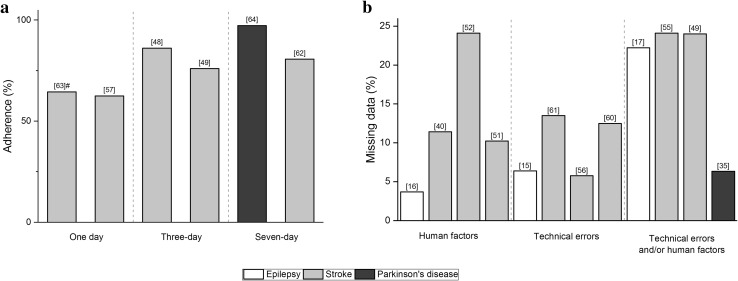
“Five studies in stroke and one in PD have reported compliance regarding the use of wearables (Fig. 3a).”
§ Wearable sensors for clinical applications in epilepsy, Parkinson’s disease, and stroke: a mixed-methods systematic review > Results > Adherence to wearables
plain- Asserted: passes — The authors put it forward as true.
- Checkable: passes — It can be checked against evidence.
- Load-bearing: unclear — It is unclear whether the paper’s conclusions depend on it.
- Based: passes — The paper gives a reason why it holds.
In the paper
“Measures of activity levels (e.g., amount of time spent in an upright position) showed changes over time both during the acute and subacute stage of stroke [55].”
§ Wearable sensors for clinical applications in epilepsy, Parkinson’s disease, and stroke: a mixed-methods systematic review > Results > Wearables in a free-living environment
What the sources say
- Not checked yetcites [55] Askim T, Bernhardt J, Churilov L, Fredriksen KR, Indredavik B (2013) Changes in physical activity and related functional and disability levels in the first 6 months after stroke: a longitudinal follow-up study. J Rehabil Med 45(5):423–428. https://doi.org/10.2340/16501977-1137 source
plaincorrelational- Asserted: passes — The authors put it forward as true.
- Checkable: passes — It can be checked against evidence.
- Load-bearing: unclear — It is unclear whether the paper’s conclusions depend on it.
- Based: passes — The paper gives a reason why it holds.
None of the sources cited for this claim have been checked yet.
In the paper
“In stroke, arm activity measures discriminated effectively between individuals with stroke and healthy controls [45], and between different motor impairment levels [45, 47, 48].”
§ Wearable sensors for clinical applications in epilepsy, Parkinson’s disease, and stroke: a mixed-methods systematic review > Results > Wearables in a free-living environment
What the sources say
- Not checked yetcites [45] de Niet M, Bussmann JB, Ribbers GM, Stam HJ (2007) The stroke upper-limb activity monitor: its sensitivity to measure hemiplegic upper-limb activity during daily life. Arch Phys Med Rehabil 88(9):1121–1126. https://doi.org/10.1016/j.apmr.2007.06.005 source
- Not checked yetcites [47] Shim S, Kim H, Jung J (2014) Comparison of upper extremity motor recovery of stroke patients with actual physical activity in their daily lives measured with accelerometers. J Phys Ther Sci 26(7):1009–1011. https://doi.org/10.1589/jpts.26.1009 source
- Not checked yetcites [48] Uswatte G, Foo WL, Olmstead H, Lopez K, Holand A, Simms LB (2005) Ambulatory monitoring of arm movement using accelerometry: an objective measure of upper-extremity rehabilitation in persons with chronic stroke. Arch Phys Med Rehabil 86(7):1498–1501 source
plaincorrelational- Asserted: passes — The authors put it forward as true.
- Checkable: passes — It can be checked against evidence.
- Load-bearing: passes — The paper’s conclusions depend on it.
- Based: passes — The paper gives a reason why it holds.
In the paper
“A large study (n = 408) that investigating adherence to the use of step activity monitor over 2-day reported adherence rates between 61 and 68% for separate days, but only 53% of participants wore the sensors for two consecutive days [63].”
§ Wearable sensors for clinical applications in epilepsy, Parkinson’s disease, and stroke: a mixed-methods systematic review > Results > Adherence to wearables
What the sources say
- Not checked yetcites [63] Barak S, Wu SS, Dai Y, Duncan PW, Behrman AL (2014) Adherence to accelerometry measurement of community ambulation poststroke. Phys Ther 94(1):101–110. https://doi.org/10.2522/ptj.20120473 source
plainn = 408- Asserted: passes — The authors put it forward as true.
- Checkable: passes — It can be checked against evidence.
- Load-bearing: unclear — It is unclear whether the paper’s conclusions depend on it.
- Based: passes — The paper gives a reason why it holds.
In the paper
“Threshold-based activity counts of arm activity were also shown to be reliable (r = 0.81–0.9) in test–retest [49].”
§ Wearable sensors for clinical applications in epilepsy, Parkinson’s disease, and stroke: a mixed-methods systematic review > Results > Wearables in a free-living environment
What the sources say
- Not checked yetcites [49] Uswatte G, Giuliani C, Winstein C, Zeringue A, Hobbs L, Wolf SL (2006) Validity of accelerometry for monitoring real-world arm activity in patients with subacute stroke: evidence from the extremity constraint-induced therapy evaluation trial. Arch Phys Med Rehabil 87(10):1340–1345. https://doi.org/10.1016/j.apmr.2006.06.006 source
plaincorrelational- Asserted: passes — The authors put it forward as true.
- Checkable: passes — It can be checked against evidence.
- Load-bearing: unclear — It is unclear whether the paper’s conclusions depend on it.
- Based: passes — The paper gives a reason why it holds.
In the paper
“Measures based on gait (e.g., step counts and step rate) over 1- or 3-day periods showed good test–retest reliability (ICC = 0.83–0.99) [52].”
§ Wearable sensors for clinical applications in epilepsy, Parkinson’s disease, and stroke: a mixed-methods systematic review > Results > Wearables in a free-living environment
What the sources say
- Not checked yetcites [52] Mudge S, Stott NS (2008) Test–retest reliability of the StepWatch activity monitor outputs in individuals with chronic stroke. Clin Rehabil 22(10–11):871–877. https://doi.org/10.1177/0269215508092822 source
plaincorrelational- Asserted: passes — The authors put it forward as true.
- Checkable: passes — It can be checked against evidence.
- Load-bearing: unclear — It is unclear whether the paper’s conclusions depend on it.
- Based: passes — The paper gives a reason why it holds.
In the paper
“The amount of time spend walking, standing, and number of walking bouts were also shown to be sensitive to change over a 12-week period after stroke [60].”
§ Wearable sensors for clinical applications in epilepsy, Parkinson’s disease, and stroke: a mixed-methods systematic review > Results > Wearables in a free-living environment
What the sources say
- Not checked yetcites [60] Sanchez MC, Bussmann J, Janssen W, Horemans H, Chastin S, Heijenbrok M, Stam H (2015) Accelerometric assessment of different dimensions of natural walking during the first year after stroke: recovery of amount, distribution, quality and speed of walking. J Rehabil Med. https://doi.org/10.2340/16501977-1994 source
plaincorrelational- Asserted: passes — The authors put it forward as true.
- Checkable: passes — It can be checked against evidence.
- Load-bearing: unclear — It is unclear whether the paper’s conclusions depend on it.
- Based: passes — The paper gives a reason why it holds.
In the paper
“A large study (n = 408) that investigating adherence to the use of step activity monitor over 2-day reported adherence rates between 61 and 68% for separate days, but only 53% of participants wore the sensors for two consecutive days [63].”
§ Wearable sensors for clinical applications in epilepsy, Parkinson’s disease, and stroke: a mixed-methods systematic review > Results > Adherence to wearables
What the sources say
- Not checked yetcites [63] Barak S, Wu SS, Dai Y, Duncan PW, Behrman AL (2014) Adherence to accelerometry measurement of community ambulation poststroke. Phys Ther 94(1):101–110. https://doi.org/10.2522/ptj.20120473 source
plainn = 408- Asserted: passes — The authors put it forward as true.
- Checkable: passes — It can be checked against evidence.
- Load-bearing: unclear — It is unclear whether the paper’s conclusions depend on it.
- Based: passes — The paper gives a reason why it holds.
In the paper
“Acceptable wearing time was reported to be 7 days for patients with PD [64].”
§ Wearable sensors for clinical applications in epilepsy, Parkinson’s disease, and stroke: a mixed-methods systematic review > Results > Acceptable integration in daily life
What the sources say
- Not checked yetcites [64] Fisher JM, Hammerla NY, Rochester L, Andras P, Walker RW (2016) Body-worn sensors in Parkinson’s disease: evaluating their acceptability to patients. Telemed J E Health 22(1):63–69. https://doi.org/10.1089/tmj.2015.0026 source
plain- Asserted: passes — The authors put it forward as true.
- Checkable: passes — It can be checked against evidence.
- Load-bearing: unclear — It is unclear whether the paper’s conclusions depend on it.
- Based: passes — The paper gives a reason why it holds.
A result the paper reports from its own data — it cites no other source for it, so there is none to check. The quote shows it is in the paper.
In the paper
“The average percentage of missing data attributable to technical errors in the reported studies was 10% (range 6–14%).”
§ Wearable sensors for clinical applications in epilepsy, Parkinson’s disease, and stroke: a mixed-methods systematic review > Results > Missing and incomplete data
plain- Asserted: passes — The authors put it forward as true.
- Checkable: passes — It can be checked against evidence.
- Load-bearing: unclear — It is unclear whether the paper’s conclusions depend on it.
- Based: passes — The paper gives a reason why it holds.
A result the paper reports from its own data — it cites no other source for it, so there is none to check. The quote shows it is in the paper.
In the paper
“Four studies reported technical errors including device failures, disconnection between sensors, and data storage problems (Fig. 3b).”
§ Wearable sensors for clinical applications in epilepsy, Parkinson’s disease, and stroke: a mixed-methods systematic review > Results > Missing and incomplete data
plain- Asserted: passes — The authors put it forward as true.
- Checkable: passes — It can be checked against evidence.
- Load-bearing: unclear — It is unclear whether the paper’s conclusions depend on it.
- Based: passes — The paper gives a reason why it holds.
In the paper
“Persons with epilepsy reported that they would agree to use a seizure registration device, and 65% would want to use it permanently [67].”
§ Wearable sensors for clinical applications in epilepsy, Parkinson’s disease, and stroke: a mixed-methods systematic review > Results > Acceptable integration in daily life
What the sources say
- Not checked yetcites [67] Hoppe C, Feldmann M, Blachut B, Surges R, Elger CE, Helmstaedter C (2015) Novel techniques for automated seizure registration: Patients’ wants and needs. Epilepsy Behav 52(Pt A):1–7. https://doi.org/10.1016/j.yebeh.2015.08.006 source
hedged- Asserted: passes — The authors put it forward as true.
- Checkable: passes — It can be checked against evidence.
- Load-bearing: unclear — It is unclear whether the paper’s conclusions depend on it.
- Based: passes — The paper gives a reason why it holds.
A result the paper reports from its own data — it cites no other source for it, so there is none to check. The quote shows it is in the paper.
In the paper
“Four studies reported that human factors, such as the device being removed and/or used incorrectly, were the predominant reasons for incomplete data.”
§ Wearable sensors for clinical applications in epilepsy, Parkinson’s disease, and stroke: a mixed-methods systematic review > Results > Missing and incomplete data
plaindirect- Asserted: passes — The authors put it forward as true.
- Checkable: passes — It can be checked against evidence.
- Load-bearing: unclear — It is unclear whether the paper’s conclusions depend on it.
- Based: passes — The paper gives a reason why it holds.
In the paper
“Persons with epilepsy reported that they would agree to use a seizure registration device, and 65% would want to use it permanently [67].”
§ Wearable sensors for clinical applications in epilepsy, Parkinson’s disease, and stroke: a mixed-methods systematic review > Results > Acceptable integration in daily life
What the sources say
- Not checked yetcites [67] Hoppe C, Feldmann M, Blachut B, Surges R, Elger CE, Helmstaedter C (2015) Novel techniques for automated seizure registration: Patients’ wants and needs. Epilepsy Behav 52(Pt A):1–7. https://doi.org/10.1016/j.yebeh.2015.08.006 source
hedged- Asserted: passes — The authors put it forward as true.
- Checkable: passes — It can be checked against evidence.
- Load-bearing: unclear — It is unclear whether the paper’s conclusions depend on it.
- Based: passes — The paper gives a reason why it holds.
A result the paper reports from its own data — it cites no other source for it, so there is none to check. The quote shows it is in the paper.
In the paper
“Missing data, as reported in 12 studies, was attributed to technical errors and/or human factors.”
§ Wearable sensors for clinical applications in epilepsy, Parkinson’s disease, and stroke: a mixed-methods systematic review > Results > Missing and incomplete data
plaindirect- Asserted: passes — The authors put it forward as true.
- Checkable: passes — It can be checked against evidence.
- Load-bearing: unclear — It is unclear whether the paper’s conclusions depend on it.
- Based: passes — The paper gives a reason why it holds.
The paper states this without a source or data behind it here, so there is nothing to check it against. The quote shows it is in the paper.
In the paper
“The average of missing data resulted from both human factors and technical errors was 19% (range 6–24%).”
§ Wearable sensors for clinical applications in epilepsy, Parkinson’s disease, and stroke: a mixed-methods systematic review > Results > Missing and incomplete data
plain- Asserted: passes — The authors put it forward as true.
- Checkable: passes — It can be checked against evidence.
- Load-bearing: unclear — It is unclear whether the paper’s conclusions depend on it.
- Based: passes — The paper gives a reason why it holds.
A result the paper reports from its own data — it cites no other source for it, so there is none to check. The quote shows it is in the paper.
In the paper
“Missing data attributable to human factors were on average 12% (range 4–24%).”
§ Wearable sensors for clinical applications in epilepsy, Parkinson’s disease, and stroke: a mixed-methods systematic review > Results > Missing and incomplete data
plain- Asserted: passes — The authors put it forward as true.
- Checkable: passes — It can be checked against evidence.
- Load-bearing: unclear — It is unclear whether the paper’s conclusions depend on it.
- Based: passes — The paper gives a reason why it holds.
None of the sources cited for this claim have been checked yet.
In the paper
“An intervention study with stroke showed that participants wore accelerometers 76–89% of waking hours in a 3-day measurement [48, 49].”
§ Wearable sensors for clinical applications in epilepsy, Parkinson’s disease, and stroke: a mixed-methods systematic review > Results > Adherence to wearables
What the sources say
- Not checked yetcites [48] Uswatte G, Foo WL, Olmstead H, Lopez K, Holand A, Simms LB (2005) Ambulatory monitoring of arm movement using accelerometry: an objective measure of upper-extremity rehabilitation in persons with chronic stroke. Arch Phys Med Rehabil 86(7):1498–1501 source
- Not checked yetcites [49] Uswatte G, Giuliani C, Winstein C, Zeringue A, Hobbs L, Wolf SL (2006) Validity of accelerometry for monitoring real-world arm activity in patients with subacute stroke: evidence from the extremity constraint-induced therapy evaluation trial. Arch Phys Med Rehabil 87(10):1340–1345. https://doi.org/10.1016/j.apmr.2006.06.006 source
plain- Asserted: passes — The authors put it forward as true.
- Checkable: passes — It can be checked against evidence.
- Load-bearing: unclear — It is unclear whether the paper’s conclusions depend on it.
- Based: passes — The paper gives a reason why it holds.
None of the sources cited for this claim have been checked yet.
In the paper
“In general, individuals with epilepsy, PD, and stroke were positive towards using wearables, such as body-worn small separate sensor units [64], gloves [65], smart glasses [66], and “intelligent” clothes [67].”
§ Wearable sensors for clinical applications in epilepsy, Parkinson’s disease, and stroke: a mixed-methods systematic review > Results > Acceptable integration in daily life
What the sources say
- Not checked yetcites [64] Fisher JM, Hammerla NY, Rochester L, Andras P, Walker RW (2016) Body-worn sensors in Parkinson’s disease: evaluating their acceptability to patients. Telemed J E Health 22(1):63–69. https://doi.org/10.1089/tmj.2015.0026 source
- Not checked yetcites [65] Simone LK, Sundarrajan N, Luo X, Jia Y, Kamper DG (2007) A low cost instrumented glove for extended monitoring and functional hand assessment. J Neurosci Methods 160(2):335–348. https://doi.org/10.1016/j.jneumeth.2006.09.021 source
- Not checked yetcites [66] Zhao Y, Heida T, van Wegen EE, Bloem BR, van Wezel RJ (2015) E-health support in people with Parkinson’s disease with smart glasses: a survey of user requirements and expectations in the Netherlands. J Parkinsons Dis. https://doi.org/10.3233/JPD-150568 source
plain- Asserted: passes — The authors put it forward as true.
- Checkable: passes — It can be checked against evidence.
- Load-bearing: unclear — It is unclear whether the paper’s conclusions depend on it.
- Based: passes — The paper gives a reason why it holds.
None of the sources cited for this claim have been checked yet.
In the paper
“Some felt self-consciousness using when they could be seen by others, especially during summer [64, 69].”
§ Wearable sensors for clinical applications in epilepsy, Parkinson’s disease, and stroke: a mixed-methods systematic review > Results > Lack of confidence in technology
What the sources say
- Not checked yetcites [64] Fisher JM, Hammerla NY, Rochester L, Andras P, Walker RW (2016) Body-worn sensors in Parkinson’s disease: evaluating their acceptability to patients. Telemed J E Health 22(1):63–69. https://doi.org/10.1089/tmj.2015.0026 source
- Not checked yetcites [69] Cancela J, Pastorino M, Tzallas AT, Tsipouras MG, Rigas G, Arredondo MT, Fotiadis DI (2014) Wearability assessment of a wearable system for Parkinson’s disease remote monitoring based on a body area network of sensors. Sensors (Basel) 14(9):17235–17255. https://doi.org/10.3390/s140917235 source
plain- Asserted: passes — The authors put it forward as true.
- Checkable: passes — It can be checked against evidence.
- Load-bearing: unclear — It is unclear whether the paper’s conclusions depend on it.
- Based: passes — The paper gives a reason why it holds.
In the paper
“Some participants also expressed feelings of stress and awkwardness towards the very idea of wearing a technological device [69].”
§ Wearable sensors for clinical applications in epilepsy, Parkinson’s disease, and stroke: a mixed-methods systematic review > Results > Lack of confidence in technology
What the sources say
- Not checked yetcites [69] Cancela J, Pastorino M, Tzallas AT, Tsipouras MG, Rigas G, Arredondo MT, Fotiadis DI (2014) Wearability assessment of a wearable system for Parkinson’s disease remote monitoring based on a body area network of sensors. Sensors (Basel) 14(9):17235–17255. https://doi.org/10.3390/s140917235 source
plain- Asserted: passes — The authors put it forward as true.
- Checkable: passes — It can be checked against evidence.
- Load-bearing: unclear — It is unclear whether the paper’s conclusions depend on it.
- Based: passes — The paper gives a reason why it holds.
None of the sources cited for this claim have been checked yet.
In the paper
“The participants found that wrist-worn sensors were easy to put on and take off [64]; however, in other studies, some participants with stroke felt that extra help would be needed to put the wrist sensors on but the sensors were comfortable to wear during daily activities [65, 68, 69].”
§ Wearable sensors for clinical applications in epilepsy, Parkinson’s disease, and stroke: a mixed-methods systematic review > Results > Acceptable integration in daily life
What the sources say
- Not checked yetcites [65] Simone LK, Sundarrajan N, Luo X, Jia Y, Kamper DG (2007) A low cost instrumented glove for extended monitoring and functional hand assessment. J Neurosci Methods 160(2):335–348. https://doi.org/10.1016/j.jneumeth.2006.09.021 source
- Not checked yetcites [68] Mountain G, Wilson S, Eccleston C, Mawson S, Hammerton J, Ware T, Zheng H, Davies R, Black N, Harris N, Stone T, Hu H (2010) Developing and testing a telerehabilitation system for people following stroke: issues of usability. J Eng Des 21(2):223–236. https://doi.org/10.1080/09544820903333792 source
- Not checked yetcites [69] Cancela J, Pastorino M, Tzallas AT, Tsipouras MG, Rigas G, Arredondo MT, Fotiadis DI (2014) Wearability assessment of a wearable system for Parkinson’s disease remote monitoring based on a body area network of sensors. Sensors (Basel) 14(9):17235–17255. https://doi.org/10.3390/s140917235 source
plain- Asserted: passes — The authors put it forward as true.
- Checkable: passes — It can be checked against evidence.
- Load-bearing: unclear — It is unclear whether the paper’s conclusions depend on it.
- Based: passes — The paper gives a reason why it holds.
None of the sources cited for this claim have been checked yet.
In the paper
“Participants with stroke and PD described that wearables did not impact their daily activities [64, 65, 68, 69].”
§ Wearable sensors for clinical applications in epilepsy, Parkinson’s disease, and stroke: a mixed-methods systematic review > Results > Acceptable integration in daily life
What the sources say
- Not checked yetcites [64] Fisher JM, Hammerla NY, Rochester L, Andras P, Walker RW (2016) Body-worn sensors in Parkinson’s disease: evaluating their acceptability to patients. Telemed J E Health 22(1):63–69. https://doi.org/10.1089/tmj.2015.0026 source
- Not checked yetcites [65] Simone LK, Sundarrajan N, Luo X, Jia Y, Kamper DG (2007) A low cost instrumented glove for extended monitoring and functional hand assessment. J Neurosci Methods 160(2):335–348. https://doi.org/10.1016/j.jneumeth.2006.09.021 source
- Not checked yetcites [68] Mountain G, Wilson S, Eccleston C, Mawson S, Hammerton J, Ware T, Zheng H, Davies R, Black N, Harris N, Stone T, Hu H (2010) Developing and testing a telerehabilitation system for people following stroke: issues of usability. J Eng Des 21(2):223–236. https://doi.org/10.1080/09544820903333792 source
- Not checked yetcites [69] Cancela J, Pastorino M, Tzallas AT, Tsipouras MG, Rigas G, Arredondo MT, Fotiadis DI (2014) Wearability assessment of a wearable system for Parkinson’s disease remote monitoring based on a body area network of sensors. Sensors (Basel) 14(9):17235–17255. https://doi.org/10.3390/s140917235 source
plain- Asserted: passes — The authors put it forward as true.
- Checkable: passes — It can be checked against evidence.
- Load-bearing: unclear — It is unclear whether the paper’s conclusions depend on it.
- Based: passes — The paper gives a reason why it holds.
None of the sources cited for this claim have been checked yet.
In the paper
“The participants found that wrist-worn sensors were easy to put on and take off [64]; however, in other studies, some participants with stroke felt that extra help would be needed to put the wrist sensors on but the sensors were comfortable to wear during daily activities [65, 68, 69].”
§ Wearable sensors for clinical applications in epilepsy, Parkinson’s disease, and stroke: a mixed-methods systematic review > Results > Acceptable integration in daily life
What the sources say
- Not checked yetcites [65] Simone LK, Sundarrajan N, Luo X, Jia Y, Kamper DG (2007) A low cost instrumented glove for extended monitoring and functional hand assessment. J Neurosci Methods 160(2):335–348. https://doi.org/10.1016/j.jneumeth.2006.09.021 source
- Not checked yetcites [68] Mountain G, Wilson S, Eccleston C, Mawson S, Hammerton J, Ware T, Zheng H, Davies R, Black N, Harris N, Stone T, Hu H (2010) Developing and testing a telerehabilitation system for people following stroke: issues of usability. J Eng Des 21(2):223–236. https://doi.org/10.1080/09544820903333792 source
- Not checked yetcites [69] Cancela J, Pastorino M, Tzallas AT, Tsipouras MG, Rigas G, Arredondo MT, Fotiadis DI (2014) Wearability assessment of a wearable system for Parkinson’s disease remote monitoring based on a body area network of sensors. Sensors (Basel) 14(9):17235–17255. https://doi.org/10.3390/s140917235 source
plain- Asserted: passes — The authors put it forward as true.
- Checkable: passes — It can be checked against evidence.
- Load-bearing: unclear — It is unclear whether the paper’s conclusions depend on it.
- Based: passes — The paper gives a reason why it holds.
In the paper
“The participants found that wrist-worn sensors were easy to put on and take off [64]; however, in other studies, some participants with stroke felt that extra help would be needed to put the wrist sensors on but the sensors were comfortable to wear during daily activities [65, 68, 69].”
§ Wearable sensors for clinical applications in epilepsy, Parkinson’s disease, and stroke: a mixed-methods systematic review > Results > Acceptable integration in daily life
What the sources say
- Not checked yetcites [64] Fisher JM, Hammerla NY, Rochester L, Andras P, Walker RW (2016) Body-worn sensors in Parkinson’s disease: evaluating their acceptability to patients. Telemed J E Health 22(1):63–69. https://doi.org/10.1089/tmj.2015.0026 source
plain- Asserted: passes — The authors put it forward as true.
- Checkable: passes — It can be checked against evidence.
- Load-bearing: unclear — It is unclear whether the paper’s conclusions depend on it.
- Based: passes — The paper gives a reason why it holds.
In the paper
“Feeling “embarrassed” and that the sensors might “look funny” were described by participants with stroke [65].”
§ Wearable sensors for clinical applications in epilepsy, Parkinson’s disease, and stroke: a mixed-methods systematic review > Results > Lack of confidence in technology
What the sources say
- Not checked yetcites [65] Simone LK, Sundarrajan N, Luo X, Jia Y, Kamper DG (2007) A low cost instrumented glove for extended monitoring and functional hand assessment. J Neurosci Methods 160(2):335–348. https://doi.org/10.1016/j.jneumeth.2006.09.021 source
plain- Asserted: passes — The authors put it forward as true.
- Checkable: passes — It can be checked against evidence.
- Load-bearing: unclear — It is unclear whether the paper’s conclusions depend on it.
- Based: passes — The paper gives a reason why it holds.
In the paper
“They worried that unpredictable technical errors would lead to confusion about how to handle the wearables [68].”
§ Wearable sensors for clinical applications in epilepsy, Parkinson’s disease, and stroke: a mixed-methods systematic review > Results > Lack of confidence in technology
What the sources say
- Not checked yetcites [68] Mountain G, Wilson S, Eccleston C, Mawson S, Hammerton J, Ware T, Zheng H, Davies R, Black N, Harris N, Stone T, Hu H (2010) Developing and testing a telerehabilitation system for people following stroke: issues of usability. J Eng Des 21(2):223–236. https://doi.org/10.1080/09544820903333792 source
plaindirect- Asserted: passes — The authors put it forward as true.
- Checkable: passes — It can be checked against evidence.
- Load-bearing: unclear — It is unclear whether the paper’s conclusions depend on it.
- Based: passes — The paper gives a reason why it holds.
None of the sources cited for this claim have been checked yet.
In the paper
“and in PD, this was even more challenging during an off state [64, 69].”
§ Wearable sensors for clinical applications in epilepsy, Parkinson’s disease, and stroke: a mixed-methods systematic review > Results > Lack of confidence in technology
What the sources say
- Not checked yetcites [64] Fisher JM, Hammerla NY, Rochester L, Andras P, Walker RW (2016) Body-worn sensors in Parkinson’s disease: evaluating their acceptability to patients. Telemed J E Health 22(1):63–69. https://doi.org/10.1089/tmj.2015.0026 source
- Not checked yetcites [69] Cancela J, Pastorino M, Tzallas AT, Tsipouras MG, Rigas G, Arredondo MT, Fotiadis DI (2014) Wearability assessment of a wearable system for Parkinson’s disease remote monitoring based on a body area network of sensors. Sensors (Basel) 14(9):17235–17255. https://doi.org/10.3390/s140917235 source
plaincorrelational- Asserted: passes — The authors put it forward as true.
- Checkable: passes — It can be checked against evidence.
- Load-bearing: unclear — It is unclear whether the paper’s conclusions depend on it.
- Based: passes — The paper gives a reason why it holds.
In the paper
“Participants with stroke felt a need for clear instructions on how to use the device, including both how to wear and how to operate it [68].”
§ Wearable sensors for clinical applications in epilepsy, Parkinson’s disease, and stroke: a mixed-methods systematic review > Results > Lack of confidence in technology
What the sources say
- Not checked yetcites [68] Mountain G, Wilson S, Eccleston C, Mawson S, Hammerton J, Ware T, Zheng H, Davies R, Black N, Harris N, Stone T, Hu H (2010) Developing and testing a telerehabilitation system for people following stroke: issues of usability. J Eng Des 21(2):223–236. https://doi.org/10.1080/09544820903333792 source
plain- Asserted: passes — The authors put it forward as true.
- Checkable: passes — It can be checked against evidence.
- Load-bearing: unclear — It is unclear whether the paper’s conclusions depend on it.
- Based: passes — The paper gives a reason why it holds.
None of the sources cited for this claim have been checked yet.
In the paper
“They experienced that keeping and placing the sensors at correct positions were difficult [64, 68, 69]”
§ Wearable sensors for clinical applications in epilepsy, Parkinson’s disease, and stroke: a mixed-methods systematic review > Results > Lack of confidence in technology
What the sources say
- Not checked yetcites [64] Fisher JM, Hammerla NY, Rochester L, Andras P, Walker RW (2016) Body-worn sensors in Parkinson’s disease: evaluating their acceptability to patients. Telemed J E Health 22(1):63–69. https://doi.org/10.1089/tmj.2015.0026 source
- Not checked yetcites [68] Mountain G, Wilson S, Eccleston C, Mawson S, Hammerton J, Ware T, Zheng H, Davies R, Black N, Harris N, Stone T, Hu H (2010) Developing and testing a telerehabilitation system for people following stroke: issues of usability. J Eng Des 21(2):223–236. https://doi.org/10.1080/09544820903333792 source
- Not checked yetcites [69] Cancela J, Pastorino M, Tzallas AT, Tsipouras MG, Rigas G, Arredondo MT, Fotiadis DI (2014) Wearability assessment of a wearable system for Parkinson’s disease remote monitoring based on a body area network of sensors. Sensors (Basel) 14(9):17235–17255. https://doi.org/10.3390/s140917235 source
plain- Asserted: passes — The authors put it forward as true.
- Checkable: passes — It can be checked against evidence.
- Load-bearing: unclear — It is unclear whether the paper’s conclusions depend on it.
- Based: passes — The paper gives a reason why it holds.
None of the sources cited for this claim have been checked yet.
In the paper
“Individuals with epilepsy, PD, and stroke reported a wide spectrum of expectations in terms of usability of wearables [65–69].”
§ Wearable sensors for clinical applications in epilepsy, Parkinson’s disease, and stroke: a mixed-methods systematic review > Results > The need to consider individualization
What the sources say
- Not checked yetcites [65] Simone LK, Sundarrajan N, Luo X, Jia Y, Kamper DG (2007) A low cost instrumented glove for extended monitoring and functional hand assessment. J Neurosci Methods 160(2):335–348. https://doi.org/10.1016/j.jneumeth.2006.09.021 source
- Not checked yetcites [66] Zhao Y, Heida T, van Wegen EE, Bloem BR, van Wezel RJ (2015) E-health support in people with Parkinson’s disease with smart glasses: a survey of user requirements and expectations in the Netherlands. J Parkinsons Dis. https://doi.org/10.3233/JPD-150568 source
- Not checked yetcites [67] Hoppe C, Feldmann M, Blachut B, Surges R, Elger CE, Helmstaedter C (2015) Novel techniques for automated seizure registration: Patients’ wants and needs. Epilepsy Behav 52(Pt A):1–7. https://doi.org/10.1016/j.yebeh.2015.08.006 source
- Not checked yetcites [68] Mountain G, Wilson S, Eccleston C, Mawson S, Hammerton J, Ware T, Zheng H, Davies R, Black N, Harris N, Stone T, Hu H (2010) Developing and testing a telerehabilitation system for people following stroke: issues of usability. J Eng Des 21(2):223–236. https://doi.org/10.1080/09544820903333792 source
- Not checked yetcites [69] Cancela J, Pastorino M, Tzallas AT, Tsipouras MG, Rigas G, Arredondo MT, Fotiadis DI (2014) Wearability assessment of a wearable system for Parkinson’s disease remote monitoring based on a body area network of sensors. Sensors (Basel) 14(9):17235–17255. https://doi.org/10.3390/s140917235 source
plain- Asserted: passes — The authors put it forward as true.
- Checkable: passes — It can be checked against evidence.
- Load-bearing: passes — The paper’s conclusions depend on it.
- Based: passes — The paper gives a reason why it holds.
None of the sources cited for this claim have been checked yet.
In the paper
“Participants worried that the sensors would get wet while washing dishes or showering [64, 69].”
§ Wearable sensors for clinical applications in epilepsy, Parkinson’s disease, and stroke: a mixed-methods systematic review > Results > Lack of confidence in technology
What the sources say
- Not checked yetcites [64] Fisher JM, Hammerla NY, Rochester L, Andras P, Walker RW (2016) Body-worn sensors in Parkinson’s disease: evaluating their acceptability to patients. Telemed J E Health 22(1):63–69. https://doi.org/10.1089/tmj.2015.0026 source
- Not checked yetcites [69] Cancela J, Pastorino M, Tzallas AT, Tsipouras MG, Rigas G, Arredondo MT, Fotiadis DI (2014) Wearability assessment of a wearable system for Parkinson’s disease remote monitoring based on a body area network of sensors. Sensors (Basel) 14(9):17235–17255. https://doi.org/10.3390/s140917235 source
plain- Asserted: passes — The authors put it forward as true.
- Checkable: passes — It can be checked against evidence.
- Load-bearing: unclear — It is unclear whether the paper’s conclusions depend on it.
- Based: passes — The paper gives a reason why it holds.
None of the sources cited for this claim have been checked yet.
In the paper
“Participants with PD and stroke described that wearables should be easy to learn and use [65, 66, 68, 69].”
§ Wearable sensors for clinical applications in epilepsy, Parkinson’s disease, and stroke: a mixed-methods systematic review > Results > The need to consider individualization
What the sources say
- Not checked yetcites [65] Simone LK, Sundarrajan N, Luo X, Jia Y, Kamper DG (2007) A low cost instrumented glove for extended monitoring and functional hand assessment. J Neurosci Methods 160(2):335–348. https://doi.org/10.1016/j.jneumeth.2006.09.021 source
- Not checked yetcites [66] Zhao Y, Heida T, van Wegen EE, Bloem BR, van Wezel RJ (2015) E-health support in people with Parkinson’s disease with smart glasses: a survey of user requirements and expectations in the Netherlands. J Parkinsons Dis. https://doi.org/10.3233/JPD-150568 source
- Not checked yetcites [68] Mountain G, Wilson S, Eccleston C, Mawson S, Hammerton J, Ware T, Zheng H, Davies R, Black N, Harris N, Stone T, Hu H (2010) Developing and testing a telerehabilitation system for people following stroke: issues of usability. J Eng Des 21(2):223–236. https://doi.org/10.1080/09544820903333792 source
- Not checked yetcites [69] Cancela J, Pastorino M, Tzallas AT, Tsipouras MG, Rigas G, Arredondo MT, Fotiadis DI (2014) Wearability assessment of a wearable system for Parkinson’s disease remote monitoring based on a body area network of sensors. Sensors (Basel) 14(9):17235–17255. https://doi.org/10.3390/s140917235 source
plain- Asserted: passes — The authors put it forward as true.
- Checkable: passes — It can be checked against evidence.
- Load-bearing: unclear — It is unclear whether the paper’s conclusions depend on it.
- Based: passes — The paper gives a reason why it holds.
In the paper
“PD participants wanted wearables to assist with physiotherapy training, to improve gait and balance problems [66].”
§ Wearable sensors for clinical applications in epilepsy, Parkinson’s disease, and stroke: a mixed-methods systematic review > Results > The need to consider individualization
What the sources say
- Not checked yetcites [66] Zhao Y, Heida T, van Wegen EE, Bloem BR, van Wezel RJ (2015) E-health support in people with Parkinson’s disease with smart glasses: a survey of user requirements and expectations in the Netherlands. J Parkinsons Dis. https://doi.org/10.3233/JPD-150568 source
plain- Asserted: passes — The authors put it forward as true.
- Checkable: passes — It can be checked against evidence.
- Load-bearing: unclear — It is unclear whether the paper’s conclusions depend on it.
- Based: passes — The paper gives a reason why it holds.
In the paper
“Persons with epilepsy wanted features that would allow improved diagnosis and seizure management [67].”
§ Wearable sensors for clinical applications in epilepsy, Parkinson’s disease, and stroke: a mixed-methods systematic review > Results > The need to consider individualization
What the sources say
- Not checked yetcites [67] Hoppe C, Feldmann M, Blachut B, Surges R, Elger CE, Helmstaedter C (2015) Novel techniques for automated seizure registration: Patients’ wants and needs. Epilepsy Behav 52(Pt A):1–7. https://doi.org/10.1016/j.yebeh.2015.08.006 source
plain- Asserted: passes — The authors put it forward as true.
- Checkable: passes — It can be checked against evidence.
- Load-bearing: unclear — It is unclear whether the paper’s conclusions depend on it.
- Based: passes — The paper gives a reason why it holds.
None of the sources cited for this claim have been checked yet.
In the paper
“Wearables need to be small and non-obtrusive [64, 65, 68, 69]”
§ Wearable sensors for clinical applications in epilepsy, Parkinson’s disease, and stroke: a mixed-methods systematic review > Results > The need to consider individualization
What the sources say
- Not checked yetcites [64] Fisher JM, Hammerla NY, Rochester L, Andras P, Walker RW (2016) Body-worn sensors in Parkinson’s disease: evaluating their acceptability to patients. Telemed J E Health 22(1):63–69. https://doi.org/10.1089/tmj.2015.0026 source
- Not checked yetcites [65] Simone LK, Sundarrajan N, Luo X, Jia Y, Kamper DG (2007) A low cost instrumented glove for extended monitoring and functional hand assessment. J Neurosci Methods 160(2):335–348. https://doi.org/10.1016/j.jneumeth.2006.09.021 source
- Not checked yetcites [68] Mountain G, Wilson S, Eccleston C, Mawson S, Hammerton J, Ware T, Zheng H, Davies R, Black N, Harris N, Stone T, Hu H (2010) Developing and testing a telerehabilitation system for people following stroke: issues of usability. J Eng Des 21(2):223–236. https://doi.org/10.1080/09544820903333792 source
- Not checked yetcites [69] Cancela J, Pastorino M, Tzallas AT, Tsipouras MG, Rigas G, Arredondo MT, Fotiadis DI (2014) Wearability assessment of a wearable system for Parkinson’s disease remote monitoring based on a body area network of sensors. Sensors (Basel) 14(9):17235–17255. https://doi.org/10.3390/s140917235 source
plain- Asserted: passes — The authors put it forward as true.
- Checkable: passes — It can be checked against evidence.
- Load-bearing: unclear — It is unclear whether the paper’s conclusions depend on it.
- Based: passes — The paper gives a reason why it holds.
The paper states this without a source or data behind it here, so there is nothing to check it against. The quote shows it is in the paper.
In the paper
“In PD, the focus was on quantification of dyskinesia, tremor, and bradykinesia, and in stroke, the focus was on upper extremity activity, gait, and physical activity.”
§ Wearable sensors for clinical applications in epilepsy, Parkinson’s disease, and stroke: a mixed-methods systematic review > Discussion
plain- Asserted: passes — The authors put it forward as true.
- Checkable: passes — It can be checked against evidence.
- Load-bearing: unclear — It is unclear whether the paper’s conclusions depend on it.
- Based: passes — The paper gives a reason why it holds.
The paper states this without a source or data behind it here, so there is nothing to check it against. The quote shows it is in the paper.
In the paper
“Despite an increasing number of studies using wearables in clinical applications, only half of the eligible studies identified were of sufficient reporting quality.”
§ Wearable sensors for clinical applications in epilepsy, Parkinson’s disease, and stroke: a mixed-methods systematic review > Discussion
plain- Asserted: passes — The authors put it forward as true.
- Checkable: passes — It can be checked against evidence.
- Load-bearing: passes — The paper’s conclusions depend on it.
- Based: passes — The paper gives a reason why it holds.
The paper states this without a source or data behind it here, so there is nothing to check it against. The quote shows it is in the paper.
In the paper
“In epilepsy, the wearables were primarily used to detect and differentiate seizures.”
§ Wearable sensors for clinical applications in epilepsy, Parkinson’s disease, and stroke: a mixed-methods systematic review > Discussion
plain- Asserted: passes — The authors put it forward as true.
- Checkable: passes — It can be checked against evidence.
- Load-bearing: unclear — It is unclear whether the paper’s conclusions depend on it.
- Based: passes — The paper gives a reason why it holds.
The paper states this without a source or data behind it here, so there is nothing to check it against. The quote shows it is in the paper.
In the paper
“In PD, the focus was on quantification of dyskinesia, tremor, and bradykinesia, and in stroke, the focus was on upper extremity activity, gait, and physical activity.”
§ Wearable sensors for clinical applications in epilepsy, Parkinson’s disease, and stroke: a mixed-methods systematic review > Discussion
plain- Asserted: passes — The authors put it forward as true.
- Checkable: passes — It can be checked against evidence.
- Load-bearing: unclear — It is unclear whether the paper’s conclusions depend on it.
- Based: passes — The paper gives a reason why it holds.
The paper states this without a source or data behind it here, so there is nothing to check it against. The quote shows it is in the paper.
In the paper
“This systematic review illustrates how wearables have been used to monitor movement and disease-related signs in epilepsy, PD, and stroke in different environments, including laboratory, hospital, and free-living.”
§ Wearable sensors for clinical applications in epilepsy, Parkinson’s disease, and stroke: a mixed-methods systematic review > Discussion
plain- Asserted: passes — The authors put it forward as true.
- Checkable: passes — It can be checked against evidence.
- Load-bearing: passes — The paper’s conclusions depend on it.
- Based: passes — The paper gives a reason why it holds.
A result the paper reports from its own data — it cites no other source for it, so there is none to check. The quote shows it is in the paper.
In the paper
“The validity of measures derived from wearables was to some extent addressed in several studies, but the reliability and responsiveness have only been studied in PD and stroke.”
§ Wearable sensors for clinical applications in epilepsy, Parkinson’s disease, and stroke: a mixed-methods systematic review > Discussion
plain- Asserted: passes — The authors put it forward as true.
- Checkable: passes — It can be checked against evidence.
- Load-bearing: passes — The paper’s conclusions depend on it.
- Based: passes — The paper gives a reason why it holds.
The paper states this without a source or data behind it here, so there is nothing to check it against. The quote shows it is in the paper.
In the paper
“The validity of measures derived from wearables was to some extent addressed in several studies, but the reliability and responsiveness have only been studied in PD and stroke.”
§ Wearable sensors for clinical applications in epilepsy, Parkinson’s disease, and stroke: a mixed-methods systematic review > Discussion
hedged- Asserted: passes — The authors put it forward as true.
- Checkable: passes — It can be checked against evidence.
- Load-bearing: passes — The paper’s conclusions depend on it.
- Based: passes — The paper gives a reason why it holds.
The paper states this without a source or data behind it here, so there is nothing to check it against. The quote shows it is in the paper.
In the paper
“Several studies in PD and stroke using wearables during free activities or in free-living conditions reported moderate-to-strong correlations between measures derived from wearables and clinical scales.”
§ Wearable sensors for clinical applications in epilepsy, Parkinson’s disease, and stroke: a mixed-methods systematic review > Discussion
plaincorrelational- Asserted: passes — The authors put it forward as true.
- Checkable: passes — It can be checked against evidence.
- Load-bearing: passes — The paper’s conclusions depend on it.
- Based: passes — The paper gives a reason why it holds.
A result the paper reports from its own data — it cites no other source for it, so there is none to check. The quote shows it is in the paper.
In the paper
“The qualitative thematic analysis of studies which reported users’ experiences and acceptance rendered three main analytic themes: acceptable integration in daily life, lack of confidence in technology, and the need to consider individualization.”
§ Wearable sensors for clinical applications in epilepsy, Parkinson’s disease, and stroke: a mixed-methods systematic review > Discussion
plain- Asserted: passes — The authors put it forward as true.
- Checkable: passes — It can be checked against evidence.
- Load-bearing: passes — The paper’s conclusions depend on it.
- Based: passes — The paper gives a reason why it holds.
A result the paper reports from its own data — it cites no other source for it, so there is none to check. The quote shows it is in the paper.
In the paper
“As a reflection of this, we found no studies on epilepsy based on measurements during free-living conditions.”
§ Wearable sensors for clinical applications in epilepsy, Parkinson’s disease, and stroke: a mixed-methods systematic review > Discussion
plain- Asserted: passes — The authors put it forward as true.
- Checkable: passes — It can be checked against evidence.
- Load-bearing: passes — The paper’s conclusions depend on it.
- Based: passes — The paper gives a reason why it holds.
The paper states this without a source or data behind it here, so there is nothing to check it against. The quote shows it is in the paper.
In the paper
“The lack of data on clinical utility of using wearables in free-living conditions is a gap that needs to be filled.”
§ Wearable sensors for clinical applications in epilepsy, Parkinson’s disease, and stroke: a mixed-methods systematic review > Discussion
plain- Asserted: passes — The authors put it forward as true.
- Checkable: passes — It can be checked against evidence.
- Load-bearing: passes — The paper’s conclusions depend on it.
- Based: passes — The paper gives a reason why it holds.
The paper states this without a source or data behind it here, so there is nothing to check it against. The quote shows it is in the paper.
In the paper
“Predominantly acceleration signals were used in hospital and free-living settings, even though gyroscope signals have shown promise for increasing the sensitivity and specificity when measuring dyskinesia and postural instability in laboratory settings [23–26].”
§ Wearable sensors for clinical applications in epilepsy, Parkinson’s disease, and stroke: a mixed-methods systematic review > Discussion
plain- Asserted: passes — The authors put it forward as true.
- Checkable: passes — It can be checked against evidence.
- Load-bearing: unclear — It is unclear whether the paper’s conclusions depend on it.
- Based: passes — The paper gives a reason why it holds.
The paper states this without a source or data behind it here, so there is nothing to check it against. The quote shows it is in the paper.
In the paper
“One thing common to the three disorders, however, is that during free-living monitoring, the comparison methods are often subjective and retrospective.”
§ Wearable sensors for clinical applications in epilepsy, Parkinson’s disease, and stroke: a mixed-methods systematic review > Discussion
plain- Asserted: passes — The authors put it forward as true.
- Checkable: passes — It can be checked against evidence.
- Load-bearing: passes — The paper’s conclusions depend on it.
- Based: passes — The paper gives a reason why it holds.
A result the paper reports from its own data — it cites no other source for it, so there is none to check. The quote shows it is in the paper.
In the paper
“The lack of confidence in handling the new technology was also one of the main themes that emerged from our thematic synthesis.”
§ Wearable sensors for clinical applications in epilepsy, Parkinson’s disease, and stroke: a mixed-methods systematic review > Discussion
plain- Asserted: passes — The authors put it forward as true.
- Checkable: passes — It can be checked against evidence.
- Load-bearing: passes — The paper’s conclusions depend on it.
- Based: passes — The paper gives a reason why it holds.
A result the paper reports from its own data — it cites no other source for it, so there is none to check. The quote shows it is in the paper.
In the paper
“Interestingly, we found that in studies where the monitoring time was longer, better adherence to wearables was reported.”
§ Wearable sensors for clinical applications in epilepsy, Parkinson’s disease, and stroke: a mixed-methods systematic review > Discussion
plaincorrelational- Asserted: passes — The authors put it forward as true.
- Checkable: passes — It can be checked against evidence.
- Load-bearing: unclear — It is unclear whether the paper’s conclusions depend on it.
- Based: passes — The paper gives a reason why it holds.
A result the paper reports from its own data — it cites no other source for it, so there is none to check. The quote shows it is in the paper.
In the paper
“A positive acceptance towards the use of wearables emerged as one of the main themes from our thematic synthesis and technical support and feedback were considered important factors for increasing motivation and confidence in the use of wearables.”
§ Wearable sensors for clinical applications in epilepsy, Parkinson’s disease, and stroke: a mixed-methods systematic review > Discussion
plain- Asserted: passes — The authors put it forward as true.
- Checkable: passes — It can be checked against evidence.
- Load-bearing: passes — The paper’s conclusions depend on it.
- Based: passes — The paper gives a reason why it holds.
A result the paper reports from its own data — it cites no other source for it, so there is none to check. The quote shows it is in the paper.
In the paper
“Human factors contributed to between 4 and 24% of data loss in the included studies.”
§ Wearable sensors for clinical applications in epilepsy, Parkinson’s disease, and stroke: a mixed-methods systematic review > Discussion
plaindirect- Asserted: passes — The authors put it forward as true.
- Checkable: passes — It can be checked against evidence.
- Load-bearing: passes — The paper’s conclusions depend on it.
- Based: passes — The paper gives a reason why it holds.
A result the paper reports from its own data — it cites no other source for it, so there is none to check. The quote shows it is in the paper.
In the paper
“A positive acceptance towards the use of wearables emerged as one of the main themes from our thematic synthesis and technical support and feedback were considered important factors for increasing motivation and confidence in the use of wearables.”
§ Wearable sensors for clinical applications in epilepsy, Parkinson’s disease, and stroke: a mixed-methods systematic review > Discussion
plaindirect- Asserted: passes — The authors put it forward as true.
- Checkable: passes — It can be checked against evidence.
- Load-bearing: passes — The paper’s conclusions depend on it.
- Based: passes — The paper gives a reason why it holds.
In the paper
“Individuals with a neurological condition might find it difficult to interact with technology due to physical or cognitive limitations, and visually conspicuous wearables may increase disease stigmatization [3].”
§ Wearable sensors for clinical applications in epilepsy, Parkinson’s disease, and stroke: a mixed-methods systematic review > Introduction
What the sources say
- Not checked yetcites [3] Ozanne A, Johansson D, Hallgren Graneheim U, Malmgren K, Bergquist F, Alt Murphy M (2017) Wearables in epilepsy and Parkinson’s disease—a focus group study. Acta Neurol Scand. https://doi.org/10.1111/ane.12798 source
hedgedconditional- Asserted: passes — The authors put it forward as true.
- Checkable: passes — It can be checked against evidence.
- Load-bearing: unclear — It is unclear whether the paper’s conclusions depend on it.
- Based: passes — The paper gives a reason why it holds.
A conclusion the paper draws from its own results — it cites no other source for it, so there is none to check. The quote shows it is in the paper.
In the paper
“Wearables may provide information of clinical features of interest in epilepsy, PD and stroke, but knowledge regarding the clinical utility for supporting clinical decision making remains to be established.”
§ Wearable sensors for clinical applications in epilepsy, Parkinson’s disease, and stroke: a mixed-methods systematic review > Abstract > Conclusions
plain- Asserted: passes — The authors put it forward as true.
- Checkable: passes — It can be checked against evidence.
- Load-bearing: passes — The paper’s conclusions depend on it.
- Based: passes — The paper gives a reason why it holds.
A conclusion the paper draws from its own results — it cites no other source for it, so there is none to check. The quote shows it is in the paper.
In the paper
“Wearables may provide information of clinical features of interest in epilepsy, PD and stroke, but knowledge regarding the clinical utility for supporting clinical decision making remains to be established.”
§ Wearable sensors for clinical applications in epilepsy, Parkinson’s disease, and stroke: a mixed-methods systematic review > Abstract > Conclusions
hedgedconditional- Asserted: passes — The authors put it forward as true.
- Checkable: passes — It can be checked against evidence.
- Load-bearing: passes — The paper’s conclusions depend on it.
- Based: passes — The paper gives a reason why it holds.
A conclusion the paper draws from its own results — it cites no other source for it, so there is none to check. The quote shows it is in the paper.
In the paper
“A meta-analysis was considered unfeasible for the quantitative studies due to large variation of study aims and designs.”
§ Wearable sensors for clinical applications in epilepsy, Parkinson’s disease, and stroke: a mixed-methods systematic review > Results
plaindirect- Asserted: passes — The authors put it forward as true.
- Checkable: passes — It can be checked against evidence.
- Load-bearing: passes — The paper’s conclusions depend on it.
- Based: passes — The paper gives a reason why it holds.
A conclusion the paper draws from its own results — it cites no other source for it, so there is none to check. The quote shows it is in the paper.
In the paper
“To overcome these problems, advanced algorithm development is often required to reach sufficient accuracy.”
§ Wearable sensors for clinical applications in epilepsy, Parkinson’s disease, and stroke: a mixed-methods systematic review > Results > Wearables in a free-living environment
plainconditional- Asserted: passes — The authors put it forward as true.
- Checkable: passes — It can be checked against evidence.
- Load-bearing: passes — The paper’s conclusions depend on it.
- Based: passes — The paper gives a reason why it holds.
None of the sources cited for this claim have been checked yet.
In the paper
“In stroke, the step counts and measures of upper extremity and physical activity were shown to be reliable [48, 49, 52, 56–59]”
§ Wearable sensors for clinical applications in epilepsy, Parkinson’s disease, and stroke: a mixed-methods systematic review > Discussion
What the sources say
- Not checked yetcites [48] Uswatte G, Foo WL, Olmstead H, Lopez K, Holand A, Simms LB (2005) Ambulatory monitoring of arm movement using accelerometry: an objective measure of upper-extremity rehabilitation in persons with chronic stroke. Arch Phys Med Rehabil 86(7):1498–1501 source
- Not checked yetcites [49] Uswatte G, Giuliani C, Winstein C, Zeringue A, Hobbs L, Wolf SL (2006) Validity of accelerometry for monitoring real-world arm activity in patients with subacute stroke: evidence from the extremity constraint-induced therapy evaluation trial. Arch Phys Med Rehabil 87(10):1340–1345. https://doi.org/10.1016/j.apmr.2006.06.006 source
- Not checked yetcites [52] Mudge S, Stott NS (2008) Test–retest reliability of the StepWatch activity monitor outputs in individuals with chronic stroke. Clin Rehabil 22(10–11):871–877. https://doi.org/10.1177/0269215508092822 source
- Not checked yetcites [56] Hale LA, Pal J, Becker I (2008) Measuring free-living physical activity in adults with and without neurologic dysfunction with a triaxial accelerometer. Arch Phys Med Rehabil 89(9):1765–1771. https://doi.org/10.1016/j.apmr.2008.02.027 source
- Not checked yetcites [57] Rand D, Eng JJ, Tang PF, Jeng JS, Hung C (2009) How active are people with stroke? Use of accelerometers to assess physical activity. Stroke 40(1):163–168. https://doi.org/10.1161/strokeaha.108.523621 source
- Not checked yetcites [58] Haeuber E, Shaughnessy M, Forrester LW, Coleman KL, Macko RF (2004) Accelerometer monitoring of home- and community-based ambulatory activity after stroke. Arch Phys Med Rehabil 85(12):1997–2001 source
- Not checked yetcites [59] Vanroy C, Vissers D, Cras P, Beyne S, Feys H, Vanlandewijck Y, Truijen S (2014) Physical activity monitoring in stroke: senseWear Pro2 activity accelerometer versus Yamax Digi-Walker SW-200 pedometer. Disabil Rehabil 36(20):1695–1703. https://doi.org/10.3109/09638288.2013.859307 source
plain- Asserted: passes — The authors put it forward as true.
- Checkable: passes — It can be checked against evidence.
- Load-bearing: passes — The paper’s conclusions depend on it.
- Based: passes — The paper gives a reason why it holds.
None of the sources cited for this claim have been checked yet.
In the paper
“For example, the postural sway measures in PD have been shown to be reliable and sensitive to longitudinal changes in laboratory settings [22, 23].”
§ Wearable sensors for clinical applications in epilepsy, Parkinson’s disease, and stroke: a mixed-methods systematic review > Discussion
What the sources say
- Not checked yetcites [22] Mancini M, Carlson-Kuhta P, Zampieri C, Nutt JG, Chiari L, Horak FB (2012) Postural sway as a marker of progression in Parkinson’s disease: a pilot longitudinal study. Gait Posture 36(3):471–476. https://doi.org/10.1016/j.gaitpost.2012.04.010 source
- Not checked yetcites [23] Mancini M, Salarian A, Carlson-Kuhta P, Zampieri C, King L, Chiari L, Horak FB (2012) ISway: a sensitive, valid and reliable measure of postural control. J Neuroeng Rehabil 9:59. https://doi.org/10.1186/1743-0003-9-59 source
plaincorrelational- Asserted: passes — The authors put it forward as true.
- Checkable: passes — It can be checked against evidence.
- Load-bearing: unclear — It is unclear whether the paper’s conclusions depend on it.
- Based: passes — The paper gives a reason why it holds.
A conclusion the paper draws from its own results — it cites no other source for it, so there is none to check. The quote shows it is in the paper.
In the paper
“It is, therefore, a bigger step to move from controlled to uncontrolled environments.”
§ Wearable sensors for clinical applications in epilepsy, Parkinson’s disease, and stroke: a mixed-methods systematic review > Discussion
plain- Asserted: passes — The authors put it forward as true.
- Checkable: unclear — It is unclear whether it could be checked against evidence.
- Load-bearing: passes — The paper’s conclusions depend on it.
- Based: passes — The paper gives a reason why it holds.
In the paper
“and correctly classifying individuals with dyskinesia using a single ankle-worn sensor in home environment [26].”
§ Wearable sensors for clinical applications in epilepsy, Parkinson’s disease, and stroke: a mixed-methods systematic review > Discussion
What the sources say
- Not checked yetcites [26] Ramsperger R, Meckler S, Heger T, van Uem J, Hucker S, Braatz U, Graessner H, Berg D, Manoli Y, Serrano JA, Ferreira JJ, Hobert MA, Maetzler W, team S-Ps (2016) Continuous leg dyskinesia assessment in Parkinson’s disease-clinical validity and ecological effect. Parkinsonism Relat Disord 26:41–46. https://doi.org/10.1016/j.parkreldis.2016.02.007 source
plaincorrelational- Asserted: passes — The authors put it forward as true.
- Checkable: passes — It can be checked against evidence.
- Load-bearing: unclear — It is unclear whether the paper’s conclusions depend on it.
- Based: passes — The paper gives a reason why it holds.
A conclusion the paper draws from its own results — it cites no other source for it, so there is none to check. The quote shows it is in the paper.
In the paper
“The evaluation is much more challenging in complex and unpredictable free-living conditions.”
§ Wearable sensors for clinical applications in epilepsy, Parkinson’s disease, and stroke: a mixed-methods systematic review > Discussion
plaindirect- Asserted: passes — The authors put it forward as true.
- Checkable: unclear — It is unclear whether it could be checked against evidence.
- Load-bearing: passes — The paper’s conclusions depend on it.
- Based: passes — The paper gives a reason why it holds.
A conclusion the paper draws from its own results — it cites no other source for it, so there is none to check. The quote shows it is in the paper.
In the paper
“Data collection in a standardized environment such as laboratory and hospital allows a more detailed evaluation of algorithm and device performance during well-defined movements and tasks in comparison with other established methods like video, optical motion capture or EEG.”
§ Wearable sensors for clinical applications in epilepsy, Parkinson’s disease, and stroke: a mixed-methods systematic review > Discussion
plaindirect- Asserted: passes — The authors put it forward as true.
- Checkable: passes — It can be checked against evidence.
- Load-bearing: passes — The paper’s conclusions depend on it.
- Based: unclear — It is unclear why the paper says it holds.
None of the sources cited for this claim have been checked yet.
In the paper
“Predominantly acceleration signals were used in hospital and free-living settings, even though gyroscope signals have shown promise for increasing the sensitivity and specificity when measuring dyskinesia and postural instability in laboratory settings [23–26].”
§ Wearable sensors for clinical applications in epilepsy, Parkinson’s disease, and stroke: a mixed-methods systematic review > Discussion
What the sources say
- Not checked yetcites [23] Mancini M, Salarian A, Carlson-Kuhta P, Zampieri C, King L, Chiari L, Horak FB (2012) ISway: a sensitive, valid and reliable measure of postural control. J Neuroeng Rehabil 9:59. https://doi.org/10.1186/1743-0003-9-59 source
- Not checked yetcites [24] Lopane G, Mellone S, Chiari L, Cortelli P, Calandra-Buonaura G, Contin M (2015) Dyskinesia detection and monitoring by a single sensor in patients with Parkinson’s disease. Mov Disord. https://doi.org/10.1002/mds.26313 source
- Not checked yetcites [25] Pulliam CL, Burack MA, Heldman DA, Giuffrida JP, Mera TO (2014) Motion sensor dyskinesia assessment during activities of daily living. J Parkinsons Dis 4(4):609–615. https://doi.org/10.3233/jpd-140348 source
- Not checked yetcites [26] Ramsperger R, Meckler S, Heger T, van Uem J, Hucker S, Braatz U, Graessner H, Berg D, Manoli Y, Serrano JA, Ferreira JJ, Hobert MA, Maetzler W, team S-Ps (2016) Continuous leg dyskinesia assessment in Parkinson’s disease-clinical validity and ecological effect. Parkinsonism Relat Disord 26:41–46. https://doi.org/10.1016/j.parkreldis.2016.02.007 source
hedgedconditional- Asserted: passes — The authors put it forward as true.
- Checkable: passes — It can be checked against evidence.
- Load-bearing: unclear — It is unclear whether the paper’s conclusions depend on it.
- Based: passes — The paper gives a reason why it holds.
In the paper
“Promising results have been reported for capturing motor fluctuations in PD using a single wrist sensor [28]”
§ Wearable sensors for clinical applications in epilepsy, Parkinson’s disease, and stroke: a mixed-methods systematic review > Discussion
What the sources say
- Not checked yetcites [28] Horne MK, McGregor S, Bergquist F (2015) An objective fluctuation score for Parkinson’s disease. PLoS One 10(4):e0124522. https://doi.org/10.1371/journal.pone.0124522 source
plaincorrelational- Asserted: passes — The authors put it forward as true.
- Checkable: passes — It can be checked against evidence.
- Load-bearing: unclear — It is unclear whether the paper’s conclusions depend on it.
- Based: passes — The paper gives a reason why it holds.
A conclusion the paper draws from its own results — it cites no other source for it, so there is none to check. The quote shows it is in the paper.
In the paper
“The clinical utility, therefore, remains to be established.”
§ Wearable sensors for clinical applications in epilepsy, Parkinson’s disease, and stroke: a mixed-methods systematic review > Discussion
plain- Asserted: passes — The authors put it forward as true.
- Checkable: passes — It can be checked against evidence.
- Load-bearing: passes — The paper’s conclusions depend on it.
- Based: passes — The paper gives a reason why it holds.
A conclusion the paper draws from its own results — it cites no other source for it, so there is none to check. The quote shows it is in the paper.
In the paper
“Optimal wearing time will also vary depending on the nature of the symptoms targeted.”
§ Wearable sensors for clinical applications in epilepsy, Parkinson’s disease, and stroke: a mixed-methods systematic review > Discussion
plaincorrelational- Asserted: passes — The authors put it forward as true.
- Checkable: passes — It can be checked against evidence.
- Load-bearing: unclear — It is unclear whether the paper’s conclusions depend on it.
- Based: passes — The paper gives a reason why it holds.
In the paper
“One epilepsy study has suggested that the use of electrodermal activity together with accelerometry might increase sensitivity and specificity in seizure detection, compared to the use of accelerometry only [72].”
§ Wearable sensors for clinical applications in epilepsy, Parkinson’s disease, and stroke: a mixed-methods systematic review > Discussion
What the sources say
- Not checked yetcites [72] Poh MZ, Loddenkemper T, Reinsberger C, Swenson NC, Goyal S, Sabtala MC, Madsen JR, Picard RW (2012) Convulsive seizure detection using a wrist-worn electrodermal activity and accelerometry biosensor. Epilepsia 53(5):e93–e97. https://doi.org/10.1111/j.1528-1167.2012.03444.x source
hedgedconditional- Asserted: passes — The authors put it forward as true.
- Checkable: passes — It can be checked against evidence.
- Load-bearing: unclear — It is unclear whether the paper’s conclusions depend on it.
- Based: passes — The paper gives a reason why it holds.
A conclusion the paper draws from its own results — it cites no other source for it, so there is none to check. The quote shows it is in the paper.
In the paper
“This could indicate that increased confidence with the use of wearables could have a positive impact on adherence.”
§ Wearable sensors for clinical applications in epilepsy, Parkinson’s disease, and stroke: a mixed-methods systematic review > Discussion
hedgedconditional- Asserted: passes — The authors put it forward as true.
- Checkable: passes — It can be checked against evidence.
- Load-bearing: unclear — It is unclear whether the paper’s conclusions depend on it.
- Based: passes — The paper gives a reason why it holds.
- Probably not a substantial claim. 24
- It may state two separate claims as one. 31
The cited sources support only part of this claim — read each source’s verdict below.
In the paper
“Fulfilment of these 12 STROBE items corresponds to more than 50% of all 22 STROBE items, a cutoff which has been used in several previous studies [9–11].”
§ Wearable sensors for clinical applications in epilepsy, Parkinson’s disease, and stroke: a mixed-methods systematic review > Methods > Quality assessment
What the sources say
- Not checked yetcites [9] Folletti I, Zock JP, Moscato G, Siracusa A (2014) Asthma and rhinitis in cleaning workers: a systematic review of epidemiological studies. J Asthma 51(1):18–28. https://doi.org/10.3109/02770903.2013.833217 source
- Not checked yetcites [10] Cheng HM, Guitera P (2015) Systematic review of optical coherence tomography usage in the diagnosis and management of basal cell carcinoma. Br J Dermatol 173(6):1371–1380. https://doi.org/10.1111/bjd.14042 source
- Partly supportedcites [11] Soares NM, Leao AS, Santos JR, Monteiro GR, dos Santos JR, Thomazzi SM, Silva RJ (2014) Systematic review shows only few reliable studies of physical activity intervention in adolescents. Sci World J 2014:206478. https://doi.org/10.1155/2014/206478 sourceExperimental — accuracy not yet measured
Methods §2.4 uses STROBE scores of 50–69.9% for moderate risk of bias and scores below 50% for high risk, so the paper does use a 50% threshold. It does not describe a cutoff of 12 specified items out of 22 or classify studies meeting that cutoff as having sufficient reporting quality; its low-risk category instead requires at least 70%. (LLM, conf=0.85)
plain- Asserted: passes — The authors put it forward as true.
- Checkable: passes — It can be checked against evidence.
- Load-bearing: passes — The paper’s conclusions depend on it.
- Based: passes — The paper gives a reason why it holds.
Probably not a substantial claim. It may state two separate claims as one.
The cited sources support only part of this claim — read each source’s verdict below.
In the paper
“They wanted repeated instructions, confirmation, supervised practice, and external support for technical problems in follow-up sessions to improve their confidence [68, 69].”
§ Wearable sensors for clinical applications in epilepsy, Parkinson’s disease, and stroke: a mixed-methods systematic review > Results > Lack of confidence in technology
What the sources say
- Not checked yetcites [68] Mountain G, Wilson S, Eccleston C, Mawson S, Hammerton J, Ware T, Zheng H, Davies R, Black N, Harris N, Stone T, Hu H (2010) Developing and testing a telerehabilitation system for people following stroke: issues of usability. J Eng Des 21(2):223–236. https://doi.org/10.1080/09544820903333792 source
- Partly supportedcites [69] Cancela J, Pastorino M, Tzallas AT, Tsipouras MG, Rigas G, Arredondo MT, Fotiadis DI (2014) Wearability assessment of a wearable system for Parkinson’s disease remote monitoring based on a body area network of sensors. Sensors (Basel) 14(9):17235–17255. https://doi.org/10.3390/s140917235 sourceExperimental — accuracy not yet measured
The Conclusions (page unavailable) recommend clearer feedback, training material, and instructions for handling device errors. The interviews (page unavailable) also mention rehearsal and caregiver help. But the participants had Parkinson’s disease, not stroke, and the paper does not report that they requested repeated instructions, supervised practice, or external technical support in follow-up sessions. (LLM, conf=0.87)
plaindirect- Asserted: passes — The authors put it forward as true.
- Checkable: passes — It can be checked against evidence.
- Load-bearing: unclear — It is unclear whether the paper’s conclusions depend on it.
- Based: passes — The paper gives a reason why it holds.
It may state two separate claims as one.
A result the paper reports from its own data — it cites no other source for it, so there is none to check. The quote shows it is in the paper.
In the paper
“Among studies reporting quantitative data, 5 were in epilepsy, 21 PD, and 24 studies in stroke.”
- Also stated in: § Results · plain
“Of the 50 papers reporting quantitative data, 5 (10%) were in epilepsy, 21 (42%) in PD, and 24 (48%) in stroke.”
§ Wearable sensors for clinical applications in epilepsy, Parkinson’s disease, and stroke: a mixed-methods systematic review > Abstract > Results
plain- Asserted: passes — The authors put it forward as true.
- Checkable: passes — It can be checked against evidence.
- Load-bearing: unclear — It is unclear whether the paper’s conclusions depend on it.
- Based: passes — The paper gives a reason why it holds.
It may state two separate claims as one.
- Also stated in: § Results · plain
A result the paper reports from its own data — it cites no other source for it, so there is none to check. The quote shows it is in the paper.
In the paper
“The search results from different databases were largely overlapping, but PubMed showed the best coverage for quantitative and Scopus for qualitative studies in terms of relevance and number of articles.”
§ Wearable sensors for clinical applications in epilepsy, Parkinson’s disease, and stroke: a mixed-methods systematic review > Methods
plaincorrelational- Asserted: passes — The authors put it forward as true.
- Checkable: passes — It can be checked against evidence.
- Load-bearing: unclear — It is unclear whether the paper’s conclusions depend on it.
- Based: passes — The paper gives a reason why it holds.
It may state two separate claims as one.
A result the paper reports from its own data — it cites no other source for it, so there is none to check. The quote shows it is in the paper.
In the paper
“Three analytic themes emerged from thematic synthesis of studies reporting qualitative data: acceptable integration in daily life, lack of confidence in technology, and the need to consider individualization.”
- Also stated in: § Studies reporting qualitative data · plain
“Three analytic themes emerged in the qualitative thematic synthesis: acceptable integration in daily life, lack of confidence in technology, and the need to consider individualization (Table 4).”
§ Wearable sensors for clinical applications in epilepsy, Parkinson’s disease, and stroke: a mixed-methods systematic review > Abstract > Results
plain- Asserted: passes — The authors put it forward as true.
- Checkable: passes — It can be checked against evidence.
- Load-bearing: passes — The paper’s conclusions depend on it.
- Based: passes — The paper gives a reason why it holds.
It may state two separate claims as one.
- Also stated in: § Studies reporting qualitative data · plain
A result the paper reports from its own data — it cites no other source for it, so there is none to check. The quote shows it is in the paper.
In the paper
“Qualitative data were reported in one study in epilepsy, three in PD, and two in stroke.”
§ Wearable sensors for clinical applications in epilepsy, Parkinson’s disease, and stroke: a mixed-methods systematic review > Results
plain- Asserted: passes — The authors put it forward as true.
- Checkable: passes — It can be checked against evidence.
- Load-bearing: unclear — It is unclear whether the paper’s conclusions depend on it.
- Based: passes — The paper gives a reason why it holds.
It may state two separate claims as one.
A result the paper reports from its own data — it cites no other source for it, so there is none to check. The quote shows it is in the paper.
In the paper
“In PD, 13 studies were conducted in a laboratory, one study in a hospital environment, and 7 studies in a free-living environment.”
§ Wearable sensors for clinical applications in epilepsy, Parkinson’s disease, and stroke: a mixed-methods systematic review > Results
plain- Asserted: passes — The authors put it forward as true.
- Checkable: passes — It can be checked against evidence.
- Load-bearing: unclear — It is unclear whether the paper’s conclusions depend on it.
- Based: passes — The paper gives a reason why it holds.
It may state two separate claims as one.
A result the paper reports from its own data — it cites no other source for it, so there is none to check. The quote shows it is in the paper.
In the paper
“The initial PubMed and Scopus literature search resulted in the retrieval of a total of 1012 articles (Fig. 1).”
§ Wearable sensors for clinical applications in epilepsy, Parkinson’s disease, and stroke: a mixed-methods systematic review > Results
plain- Asserted: passes — The authors put it forward as true.
- Checkable: passes — It can be checked against evidence.
- Load-bearing: fails — The paper’s conclusions may not depend on it.
- Based: passes — The paper gives a reason why it holds.
Probably not a substantial claim. The paper’s conclusions may not depend on it.
A result the paper reports from its own data — it cites no other source for it, so there is none to check. The quote shows it is in the paper.
In the paper
“Fifty quantitative studies were assigned sufficient reporting quality and 6 out of 9 studies that reported qualitative data passed the critical appraisal for methodological quality.”
§ Wearable sensors for clinical applications in epilepsy, Parkinson’s disease, and stroke: a mixed-methods systematic review > Results
plain- Asserted: passes — The authors put it forward as true.
- Checkable: passes — It can be checked against evidence.
- Load-bearing: passes — The paper’s conclusions depend on it.
- Based: passes — The paper gives a reason why it holds.
It may state two separate claims as one.
A result the paper reports from its own data — it cites no other source for it, so there is none to check. The quote shows it is in the paper.
In the paper
“In stroke, 4 studies were conducted in a laboratory, 6 in a hospital environment, and 14 studies used wearables in a free-living environment.”
§ Wearable sensors for clinical applications in epilepsy, Parkinson’s disease, and stroke: a mixed-methods systematic review > Results
plain- Asserted: passes — The authors put it forward as true.
- Checkable: passes — It can be checked against evidence.
- Load-bearing: unclear — It is unclear whether the paper’s conclusions depend on it.
- Based: passes — The paper gives a reason why it holds.
It may state two separate claims as one.
A result the paper reports from its own data — it cites no other source for it, so there is none to check. The quote shows it is in the paper.
In the paper
“From these, 210 studies were included in the full-text review, and 104 studies were eligible for quality assessment.”
§ Wearable sensors for clinical applications in epilepsy, Parkinson’s disease, and stroke: a mixed-methods systematic review > Results
plain- Asserted: passes — The authors put it forward as true.
- Checkable: passes — It can be checked against evidence.
- Load-bearing: unclear — It is unclear whether the paper’s conclusions depend on it.
- Based: passes — The paper gives a reason why it holds.
It may state two separate claims as one.
None of the sources cited for this claim have been checked yet.
In the paper
“Wearables were also used to quantify sleep disturbances [30], gait measures [31, 32], freezing of gait [33, 34], missteps and fall [35, 36], and physical activity levels [37–39].”
§ Wearable sensors for clinical applications in epilepsy, Parkinson’s disease, and stroke: a mixed-methods systematic review > Results > Studies reporting quantitative data
What the sources say
- Not checked yetcites [30] Maglione JE, Liu L, Neikrug AB, Poon T, Natarajan L, Calderon J, Avanzino JA, Corey-Bloom J, Palmer BW, Loredo JS, Ancoli-Israel S (2013) Actigraphy for the assessment of sleep measures in Parkinson’s disease. Sleep 36(8):1209–1217. https://doi.org/10.5665/sleep.2888 source
- Not checked yetcites [31] Lord S, Rochester L, Baker K, Nieuwboer A (2008) Concurrent validity of accelerometry to measure gait in Parkinsons Disease. Gait Posture 27(2):357–359. https://doi.org/10.1016/j.gaitpost.2007.04.001 source
- Not checked yetcites [32] Esser P, Dawes H, Collett J, Feltham MG, Howells K (2012) Validity and inter-rater reliability of inertial gait measurements in Parkinson’s disease: a pilot study. J Neurosci Methods 205(1):177–181. https://doi.org/10.1016/j.jneumeth.2012.01.005 source
- Not checked yetcites [33] Yungher DA, Morris TR, Dilda V, Shine JM, Naismith SL, Lewis SJ, Moore ST (2014) Temporal characteristics of high-frequency lower-limb oscillation during freezing of gait in Parkinson’s disease. Parkinsons Dis 2014:606427. https://doi.org/10.1155/2014/606427 source
- Not checked yetcites [34] Morris TR, Cho C, Dilda V, Shine JM, Naismith SL, Lewis SJ, Moore ST (2012) A comparison of clinical and objective measures of freezing of gait in Parkinson’s disease. Parkinsonism Relat Disord 18(5):572–577. https://doi.org/10.1016/j.parkreldis.2012.03.001 source
plain- Asserted: passes — The authors put it forward as true.
- Checkable: passes — It can be checked against evidence.
- Load-bearing: unclear — It is unclear whether the paper’s conclusions depend on it.
- Based: passes — The paper gives a reason why it holds.
It may state two separate claims as one.
A result the paper reports from its own data — it cites no other source for it, so there is none to check. The quote shows it is in the paper.
In the paper
“In PD, both accelerometers and gyroscopes were used, while step counts from accelerometers and energy expenditure during walking were investigated in stroke (Fig. 2 and Table 1).”
§ Wearable sensors for clinical applications in epilepsy, Parkinson’s disease, and stroke: a mixed-methods systematic review > Results > Wearables in laboratory environment
plain- Asserted: passes — The authors put it forward as true.
- Checkable: passes — It can be checked against evidence.
- Load-bearing: unclear — It is unclear whether the paper’s conclusions depend on it.
- Based: passes — The paper gives a reason why it holds.
It may state two separate claims as one.
In the paper
“Wearables showed good agreement with video-based ratings regarding the number of freezing episodes and the percentage of time with freezing of gait [34].”
§ Wearable sensors for clinical applications in epilepsy, Parkinson’s disease, and stroke: a mixed-methods systematic review > Results > Wearables in laboratory environment
What the sources say
- Not checked yetcites [34] Morris TR, Cho C, Dilda V, Shine JM, Naismith SL, Lewis SJ, Moore ST (2012) A comparison of clinical and objective measures of freezing of gait in Parkinson’s disease. Parkinsonism Relat Disord 18(5):572–577. https://doi.org/10.1016/j.parkreldis.2012.03.001 source
plaincorrelational- Asserted: passes — The authors put it forward as true.
- Checkable: passes — It can be checked against evidence.
- Load-bearing: unclear — It is unclear whether the paper’s conclusions depend on it.
- Based: passes — The paper gives a reason why it holds.
It may state two separate claims as one.
The paper states this without a source or data behind it here, so there is nothing to check it against. The quote shows it is in the paper.
In the paper
“Only accelerometer data were reported and measurements lasted between 1 and 9 days.”
§ Wearable sensors for clinical applications in epilepsy, Parkinson’s disease, and stroke: a mixed-methods systematic review > Results > Wearables in hospital environment
plain- Asserted: passes — The authors put it forward as true.
- Checkable: passes — It can be checked against evidence.
- Load-bearing: unclear — It is unclear whether the paper’s conclusions depend on it.
- Based: passes — The paper gives a reason why it holds.
It may state two separate claims as one.
The paper states this without a source or data behind it here, so there is nothing to check it against. The quote shows it is in the paper.
In the paper
“The wearing time in studies conducted in the free-living environment varied between 8 h and 7 days and only data from accelerometers were used.”
§ Wearable sensors for clinical applications in epilepsy, Parkinson’s disease, and stroke: a mixed-methods systematic review > Results > Wearables in a free-living environment
plain- Asserted: passes — The authors put it forward as true.
- Checkable: passes — It can be checked against evidence.
- Load-bearing: unclear — It is unclear whether the paper’s conclusions depend on it.
- Based: passes — The paper gives a reason why it holds.
It may state two separate claims as one.
In the paper
“The test–retest reliability varied in different studies, but moderate agreements (ICC 0.54 and 0.68) were found for 3- and 7-day monitoring of daily activity counts [56].”
§ Wearable sensors for clinical applications in epilepsy, Parkinson’s disease, and stroke: a mixed-methods systematic review > Results > Wearables in a free-living environment
What the sources say
- Not checked yetcites [56] Hale LA, Pal J, Becker I (2008) Measuring free-living physical activity in adults with and without neurologic dysfunction with a triaxial accelerometer. Arch Phys Med Rehabil 89(9):1765–1771. https://doi.org/10.1016/j.apmr.2008.02.027 source
plaincorrelational- Asserted: passes — The authors put it forward as true.
- Checkable: passes — It can be checked against evidence.
- Load-bearing: unclear — It is unclear whether the paper’s conclusions depend on it.
- Based: passes — The paper gives a reason why it holds.
It may state two separate claims as one.
In the paper
“Older individuals and those with better balance self-efficacy and walking endurance showed better adherence [63].”
§ Wearable sensors for clinical applications in epilepsy, Parkinson’s disease, and stroke: a mixed-methods systematic review > Results > Adherence to wearables
What the sources say
- Not checked yetcites [63] Barak S, Wu SS, Dai Y, Duncan PW, Behrman AL (2014) Adherence to accelerometry measurement of community ambulation poststroke. Phys Ther 94(1):101–110. https://doi.org/10.2522/ptj.20120473 source
plaincorrelational- Asserted: passes — The authors put it forward as true.
- Checkable: passes — It can be checked against evidence.
- Load-bearing: unclear — It is unclear whether the paper’s conclusions depend on it.
- Based: passes — The paper gives a reason why it holds.
It may state two separate claims as one.
In the paper
“A study evaluating acceptability of wrist-worn sensors in PD reported that only two persons of 34 did not wear the sensors for the full 7-day period and the non-adherence time was 4% [64].”
§ Wearable sensors for clinical applications in epilepsy, Parkinson’s disease, and stroke: a mixed-methods systematic review > Results > Adherence to wearables
What the sources say
- Not checked yetcites [64] Fisher JM, Hammerla NY, Rochester L, Andras P, Walker RW (2016) Body-worn sensors in Parkinson’s disease: evaluating their acceptability to patients. Telemed J E Health 22(1):63–69. https://doi.org/10.1089/tmj.2015.0026 source
plainn = 2- Asserted: passes — The authors put it forward as true.
- Checkable: passes — It can be checked against evidence.
- Load-bearing: unclear — It is unclear whether the paper’s conclusions depend on it.
- Based: passes — The paper gives a reason why it holds.
It may state two separate claims as one.
None of the sources cited for this claim have been checked yet.
In the paper
“Participants with PD and stroke were mostly positive and agreed to use wearables both at home and in public environments.”
§ Wearable sensors for clinical applications in epilepsy, Parkinson’s disease, and stroke: a mixed-methods systematic review > Results > Lack of confidence in technology
plain- Asserted: passes — The authors put it forward as true.
- Checkable: passes — It can be checked against evidence.
- Load-bearing: unclear — It is unclear whether the paper’s conclusions depend on it.
- Based: passes — The paper gives a reason why it holds.
It may state two separate claims as one.
A result the paper reports from its own data — it cites no other source for it, so there is none to check. The quote shows it is in the paper.
In the paper
“A potential cause of embarrassment and stigmatization was anticipated when other people might ask or question what they were wearing, and in this way make their disease more apparent.”
§ Wearable sensors for clinical applications in epilepsy, Parkinson’s disease, and stroke: a mixed-methods systematic review > Results > Lack of confidence in technology
hedgedconditional- Asserted: passes — The authors put it forward as true.
- Checkable: passes — It can be checked against evidence.
- Load-bearing: fails — The paper’s conclusions may not depend on it.
- Based: passes — The paper gives a reason why it holds.
Probably not a substantial claim. The paper’s conclusions may not depend on it.
None of the sources cited for this claim have been checked yet.
In the paper
“In addition, participants with PD and stroke reported difficulties in using the device correctly, handling technical errors, and charging the battery.”
§ Wearable sensors for clinical applications in epilepsy, Parkinson’s disease, and stroke: a mixed-methods systematic review > Results > Lack of confidence in technology
plain- Asserted: passes — The authors put it forward as true.
- Checkable: passes — It can be checked against evidence.
- Load-bearing: unclear — It is unclear whether the paper’s conclusions depend on it.
- Based: passes — The paper gives a reason why it holds.
It may state two separate claims as one.
None of the sources cited for this claim have been checked yet.
In the paper
“Both epilepsy and PD participants further described desirable features of wearables, including the possibility of real-time analysis of data, getting reminders to take drugs and waterproof design [66, 67, 69].”
§ Wearable sensors for clinical applications in epilepsy, Parkinson’s disease, and stroke: a mixed-methods systematic review > Results > The need to consider individualization
What the sources say
- Not checked yetcites [66] Zhao Y, Heida T, van Wegen EE, Bloem BR, van Wezel RJ (2015) E-health support in people with Parkinson’s disease with smart glasses: a survey of user requirements and expectations in the Netherlands. J Parkinsons Dis. https://doi.org/10.3233/JPD-150568 source
- Not checked yetcites [67] Hoppe C, Feldmann M, Blachut B, Surges R, Elger CE, Helmstaedter C (2015) Novel techniques for automated seizure registration: Patients’ wants and needs. Epilepsy Behav 52(Pt A):1–7. https://doi.org/10.1016/j.yebeh.2015.08.006 source
- Not checked yetcites [69] Cancela J, Pastorino M, Tzallas AT, Tsipouras MG, Rigas G, Arredondo MT, Fotiadis DI (2014) Wearability assessment of a wearable system for Parkinson’s disease remote monitoring based on a body area network of sensors. Sensors (Basel) 14(9):17235–17255. https://doi.org/10.3390/s140917235 source
plain- Asserted: passes — The authors put it forward as true.
- Checkable: passes — It can be checked against evidence.
- Load-bearing: unclear — It is unclear whether the paper’s conclusions depend on it.
- Based: passes — The paper gives a reason why it holds.
It may state two separate claims as one.
None of the sources cited for this claim have been checked yet.
In the paper
“Both epilepsy and PD participants further described desirable features of wearables, including the possibility of real-time analysis of data, getting reminders to take drugs and waterproof design [66, 67, 69].”
§ Wearable sensors for clinical applications in epilepsy, Parkinson’s disease, and stroke: a mixed-methods systematic review > Results > The need to consider individualization
What the sources say
- Not checked yetcites [66] Zhao Y, Heida T, van Wegen EE, Bloem BR, van Wezel RJ (2015) E-health support in people with Parkinson’s disease with smart glasses: a survey of user requirements and expectations in the Netherlands. J Parkinsons Dis. https://doi.org/10.3233/JPD-150568 source
- Not checked yetcites [67] Hoppe C, Feldmann M, Blachut B, Surges R, Elger CE, Helmstaedter C (2015) Novel techniques for automated seizure registration: Patients’ wants and needs. Epilepsy Behav 52(Pt A):1–7. https://doi.org/10.1016/j.yebeh.2015.08.006 source
- Not checked yetcites [69] Cancela J, Pastorino M, Tzallas AT, Tsipouras MG, Rigas G, Arredondo MT, Fotiadis DI (2014) Wearability assessment of a wearable system for Parkinson’s disease remote monitoring based on a body area network of sensors. Sensors (Basel) 14(9):17235–17255. https://doi.org/10.3390/s140917235 source
plain- Asserted: passes — The authors put it forward as true.
- Checkable: passes — It can be checked against evidence.
- Load-bearing: unclear — It is unclear whether the paper’s conclusions depend on it.
- Based: passes — The paper gives a reason why it holds.
It may state two separate claims as one.
None of the sources cited for this claim have been checked yet.
In the paper
“Both epilepsy and PD participants further described desirable features of wearables, including the possibility of real-time analysis of data, getting reminders to take drugs and waterproof design [66, 67, 69].”
§ Wearable sensors for clinical applications in epilepsy, Parkinson’s disease, and stroke: a mixed-methods systematic review > Results > The need to consider individualization
What the sources say
- Not checked yetcites [66] Zhao Y, Heida T, van Wegen EE, Bloem BR, van Wezel RJ (2015) E-health support in people with Parkinson’s disease with smart glasses: a survey of user requirements and expectations in the Netherlands. J Parkinsons Dis. https://doi.org/10.3233/JPD-150568 source
- Not checked yetcites [67] Hoppe C, Feldmann M, Blachut B, Surges R, Elger CE, Helmstaedter C (2015) Novel techniques for automated seizure registration: Patients’ wants and needs. Epilepsy Behav 52(Pt A):1–7. https://doi.org/10.1016/j.yebeh.2015.08.006 source
- Not checked yetcites [69] Cancela J, Pastorino M, Tzallas AT, Tsipouras MG, Rigas G, Arredondo MT, Fotiadis DI (2014) Wearability assessment of a wearable system for Parkinson’s disease remote monitoring based on a body area network of sensors. Sensors (Basel) 14(9):17235–17255. https://doi.org/10.3390/s140917235 source
plain- Asserted: passes — The authors put it forward as true.
- Checkable: passes — It can be checked against evidence.
- Load-bearing: unclear — It is unclear whether the paper’s conclusions depend on it.
- Based: passes — The paper gives a reason why it holds.
It may state two separate claims as one.
In the paper
“some stroke participants suggested that sensors could be worn on the upper arm instead of the wrists to make them less noticeable [65].”
§ Wearable sensors for clinical applications in epilepsy, Parkinson’s disease, and stroke: a mixed-methods systematic review > Results > The need to consider individualization
What the sources say
- Not checked yetcites [65] Simone LK, Sundarrajan N, Luo X, Jia Y, Kamper DG (2007) A low cost instrumented glove for extended monitoring and functional hand assessment. J Neurosci Methods 160(2):335–348. https://doi.org/10.1016/j.jneumeth.2006.09.021 source
hedged- Asserted: passes — The authors put it forward as true.
- Checkable: passes — It can be checked against evidence.
- Load-bearing: fails — The paper’s conclusions may not depend on it.
- Based: passes — The paper gives a reason why it holds.
Probably not a substantial claim. The paper’s conclusions may not depend on it.
The paper states this without a source or data behind it here, so there is nothing to check it against. The quote shows it is in the paper.
In the paper
“Clinimetric properties were predominantly investigated in studies using discrete outcome variables such as activity counts or other acceleration-derived variables, in contrast to studies, where complicated algorithms were developed and in which the correct classification and precision of these algorithms were usually tested.”
§ Wearable sensors for clinical applications in epilepsy, Parkinson’s disease, and stroke: a mixed-methods systematic review > Discussion
plaincorrelational- Asserted: passes — The authors put it forward as true.
- Checkable: passes — It can be checked against evidence.
- Load-bearing: passes — The paper’s conclusions depend on it.
- Based: passes — The paper gives a reason why it holds.
It may state two separate claims as one.
A result the paper reports from its own data — it cites no other source for it, so there is none to check. The quote shows it is in the paper.
In the paper
“The current review also showed that technical errors and human factors influenced adherence and are important reasons for loss of data.”
§ Wearable sensors for clinical applications in epilepsy, Parkinson’s disease, and stroke: a mixed-methods systematic review > Discussion
plaindirect- Asserted: passes — The authors put it forward as true.
- Checkable: passes — It can be checked against evidence.
- Load-bearing: passes — The paper’s conclusions depend on it.
- Based: passes — The paper gives a reason why it holds.
It may state two separate claims as one.
The paper states this without a source or data behind it here, so there is nothing to check it against. The quote shows it is in the paper.
In the paper
“This review included 22 studies conducted in free-living environments, 16 studies in laboratory, and 12 in hospital settings.”
§ Wearable sensors for clinical applications in epilepsy, Parkinson’s disease, and stroke: a mixed-methods systematic review > Discussion
plain- Asserted: passes — The authors put it forward as true.
- Checkable: passes — It can be checked against evidence.
- Load-bearing: passes — The paper’s conclusions depend on it.
- Based: passes — The paper gives a reason why it holds.
It may state two separate claims as one.
A result the paper reports from its own data — it cites no other source for it, so there is none to check. The quote shows it is in the paper.
In the paper
“We identified a wide range of outcome measures, but no studies directly addressed the question of the effect wearables may have on decision making or clinical treatment outcomes.”
§ Wearable sensors for clinical applications in epilepsy, Parkinson’s disease, and stroke: a mixed-methods systematic review > Discussion
plain- Asserted: passes — The authors put it forward as true.
- Checkable: passes — It can be checked against evidence.
- Load-bearing: passes — The paper’s conclusions depend on it.
- Based: passes — The paper gives a reason why it holds.
It may state two separate claims as one.
In the paper
“A critical appraisal of the reporting quality of the quantitative studies eligible for the review was performed using the Strengthening the Reporting of Observational Studies in Epidemiology (STROBE) statement [6].”
§ Wearable sensors for clinical applications in epilepsy, Parkinson’s disease, and stroke: a mixed-methods systematic review > Methods > Quality assessment
What the sources say
- Not checked yetcites [6] von Elm E, Altman DG, Egger M, Pocock SJ, Gotzsche PC, Vandenbroucke JP, Initiative S (2008) The strengthening the reporting of observational studies in epidemiology (STROBE) statement: guidelines for reporting observational studies. J Clin Epidemiol 61(4):344–349. https://doi.org/10.1016/j.jclinepi.2007.11.008 source
plain- Asserted: passes — The authors put it forward as true.
- Checkable: passes — It can be checked against evidence.
- Load-bearing: fails — The paper’s conclusions may not depend on it.
- Based: passes — The paper gives a reason why it holds.
Probably not a substantial claim. The paper’s conclusions may not depend on it.
In the paper
“There is also a growing interest in using wearable devices to detect seizures in epilepsy [2].”
§ Wearable sensors for clinical applications in epilepsy, Parkinson’s disease, and stroke: a mixed-methods systematic review > Introduction
What the sources say
- Not checked yetcites [2] Ramgopal S, Thome-Souza S, Jackson M, Kadish NE, Sanchez Fernandez I, Klehm J, Bosl W, Reinsberger C, Schachter S, Loddenkemper T (2014) Seizure detection, seizure prediction, and closed-loop warning systems in epilepsy. Epilepsy Behav 37:291–307. https://doi.org/10.1016/j.yebeh.2014.06.023 source
plain- Asserted: passes — The authors put it forward as true.
- Checkable: passes — It can be checked against evidence.
- Load-bearing: fails — The paper’s conclusions may not depend on it.
- Based: passes — The paper gives a reason why it holds.
Probably not a substantial claim. The paper’s conclusions may not depend on it.
What the paper did — it cites no source for this, so there is none to check. The quote shows it is in the paper.
In the paper
“Discrepancies were resolved by discussions between the two reviewers until a consensus was reached.”
§ Wearable sensors for clinical applications in epilepsy, Parkinson’s disease, and stroke: a mixed-methods systematic review > Methods
plaindirect- Asserted: passes — The authors put it forward as true.
- Checkable: passes — It can be checked against evidence.
- Load-bearing: fails — The paper’s conclusions may not depend on it.
- Based: passes — The paper gives a reason why it holds.
Probably not a substantial claim. The paper’s conclusions may not depend on it.
What the paper did — it cites no source for this, so there is none to check. The quote shows it is in the paper.
In the paper
“Each title and abstract was screened for inclusion by two independent reviewers (DJ, MAM).”
§ Wearable sensors for clinical applications in epilepsy, Parkinson’s disease, and stroke: a mixed-methods systematic review > Methods
plain- Asserted: passes — The authors put it forward as true.
- Checkable: passes — It can be checked against evidence.
- Load-bearing: passes — The paper’s conclusions depend on it.
- Based: passes — The paper gives a reason why it holds.
Probably not a substantial claim.
What the paper did — it cites no source for this, so there is none to check. The quote shows it is in the paper.
In the paper
“All 22 items of the STROBE statement were discussed between two reviewers before quality assessment (DJ, MAM) to reach a consensus of understanding on each item of the checklist.”
§ Wearable sensors for clinical applications in epilepsy, Parkinson’s disease, and stroke: a mixed-methods systematic review > Methods > Quality assessment
plain- Asserted: passes — The authors put it forward as true.
- Checkable: passes — It can be checked against evidence.
- Load-bearing: fails — The paper’s conclusions may not depend on it.
- Based: passes — The paper gives a reason why it holds.
Probably not a substantial claim. The paper’s conclusions may not depend on it.
What the paper did — it cites no source for this, so there is none to check. The quote shows it is in the paper.
In the paper
“The first 20 articles from an alphabetically sorted list were scored independently by the two reviewers to ensure consensus.”
§ Wearable sensors for clinical applications in epilepsy, Parkinson’s disease, and stroke: a mixed-methods systematic review > Methods > Quality assessment
plain- Asserted: passes — The authors put it forward as true.
- Checkable: passes — It can be checked against evidence.
- Load-bearing: fails — The paper’s conclusions may not depend on it.
- Based: passes — The paper gives a reason why it holds.
Probably not a substantial claim. The paper’s conclusions may not depend on it.
What the paper did — it cites no source for this, so there is none to check. The quote shows it is in the paper.
In the paper
“The rest of the included articles (n = 73) were then scored by one reviewer (DJ), and any uncertainties were discussed and rescreened with the second reviewer (MAM).”
§ Wearable sensors for clinical applications in epilepsy, Parkinson’s disease, and stroke: a mixed-methods systematic review > Methods > Quality assessment
plainn = 73- Asserted: passes — The authors put it forward as true.
- Checkable: passes — It can be checked against evidence.
- Load-bearing: fails — The paper’s conclusions may not depend on it.
- Based: passes — The paper gives a reason why it holds.
Probably not a substantial claim. The paper’s conclusions may not depend on it. It may state two separate claims as one.
In the paper
“The methodological quality of studies that reported qualitative data was assessed with the Critical Appraisal Skills Programme (CASP) [12].”
§ Wearable sensors for clinical applications in epilepsy, Parkinson’s disease, and stroke: a mixed-methods systematic review > Methods > Quality assessment
What the sources say
- Not checked yetcites [12] Programme CAS (2017) CASP (Qualitative Checklists). http://www.casp-uk.net . Accessed 29 Dec 2017
plain- Asserted: passes — The authors put it forward as true.
- Checkable: passes — It can be checked against evidence.
- Load-bearing: fails — The paper’s conclusions may not depend on it.
- Based: passes — The paper gives a reason why it holds.
Probably not a substantial claim. The paper’s conclusions may not depend on it.
What the paper did — it cites no source for this, so there is none to check. The quote shows it is in the paper.
In the paper
“The aim, sample characteristics, main findings, proportion of reported missing data, and adherence were extracted from studies with sufficient reporting quality only.”
§ Wearable sensors for clinical applications in epilepsy, Parkinson’s disease, and stroke: a mixed-methods systematic review > Methods > Data extraction and synthesis
plain- Asserted: passes — The authors put it forward as true.
- Checkable: passes — It can be checked against evidence.
- Load-bearing: passes — The paper’s conclusions depend on it.
- Based: passes — The paper gives a reason why it holds.
Probably not a substantial claim.
A conclusion the paper draws from its own results — it cites no other source for it, so there is none to check. The quote shows it is in the paper.
In the paper
“Monitoring of movement related symptoms and deficits in a free-living environment is challenging.”
§ Wearable sensors for clinical applications in epilepsy, Parkinson’s disease, and stroke: a mixed-methods systematic review > Results > Wearables in a free-living environment
plain- Asserted: passes — The authors put it forward as true.
- Checkable: passes — It can be checked against evidence.
- Load-bearing: passes — The paper’s conclusions depend on it.
- Based: passes — The paper gives a reason why it holds.
Probably not a substantial claim.
A conclusion the paper draws from its own results — it cites no other source for it, so there is none to check. The quote shows it is in the paper.
In the paper
“Differentiating or quantifying disease-related movement patterns like epileptic seizures from common voluntary movements such as teeth brushing can be challenging.”
§ Wearable sensors for clinical applications in epilepsy, Parkinson’s disease, and stroke: a mixed-methods systematic review > Results > Wearables in a free-living environment
plain- Asserted: passes — The authors put it forward as true.
- Checkable: passes — It can be checked against evidence.
- Load-bearing: passes — The paper’s conclusions depend on it.
- Based: passes — The paper gives a reason why it holds.
Probably not a substantial claim.
A conclusion the paper draws from its own results — it cites no other source for it, so there is none to check. The quote shows it is in the paper.
In the paper
“As these phenomena influence quality of life and can be influenced by changes in treatment, improved detection and evaluation with wearables can be expected to improve disease-specific quality of life and other measurements of disease burden.”
§ Wearable sensors for clinical applications in epilepsy, Parkinson’s disease, and stroke: a mixed-methods systematic review > Discussion
hedgedconditional- Asserted: passes — The authors put it forward as true.
- Checkable: fails — It may be too vague to check against evidence.
- Load-bearing: fails — The paper’s conclusions may not depend on it.
- Based: fails — The paper may give no reason why it holds.
Probably not a substantial claim. It may be too vague to check against evidence. The paper’s conclusions may not depend on it. The paper may give no reason why it holds.
A conclusion the paper draws from its own results — it cites no other source for it, so there is none to check. The quote shows it is in the paper.
In the paper
“One explanation is that gyroscope signals consume more battery power and in this way limit the measuring time.”
§ Wearable sensors for clinical applications in epilepsy, Parkinson’s disease, and stroke: a mixed-methods systematic review > Discussion
hedgeddirect- Asserted: passes — The authors put it forward as true.
- Checkable: passes — It can be checked against evidence.
- Load-bearing: fails — The paper’s conclusions may not depend on it.
- Based: fails — The paper may give no reason why it holds.
Probably not a substantial claim. The paper’s conclusions may not depend on it. The paper may give no reason why it holds. It may state two separate claims as one.
A conclusion the paper draws from its own results — it cites no other source for it, so there is none to check. The quote shows it is in the paper.
In the paper
“For the detection of seizures, which are relatively rare and brief events, the requirement for accuracy is greater than for detecting symptoms of PD and activity measures in stroke.”
§ Wearable sensors for clinical applications in epilepsy, Parkinson’s disease, and stroke: a mixed-methods systematic review > Discussion
plain- Asserted: passes — The authors put it forward as true.
- Checkable: fails — It may be too vague to check against evidence.
- Load-bearing: passes — The paper’s conclusions depend on it.
- Based: passes — The paper gives a reason why it holds.
Probably not a substantial claim. It may be too vague to check against evidence.
A conclusion the paper draws from its own results — it cites no other source for it, so there is none to check. The quote shows it is in the paper.
In the paper
“These themes reflect some challenges that need to be met for wearables to be integrated in the clinical practice.”
§ Wearable sensors for clinical applications in epilepsy, Parkinson’s disease, and stroke: a mixed-methods systematic review > Discussion
plain- Asserted: passes — The authors put it forward as true.
- Checkable: fails — It may be too vague to check against evidence.
- Load-bearing: passes — The paper’s conclusions depend on it.
- Based: passes — The paper gives a reason why it holds.
Probably not a substantial claim. It may be too vague to check against evidence.
None of the sources cited for this claim have been checked yet.
In the paper
“Although the clinical scales may adequately reflect the patients’ symptoms or disabilities, they are often limited by the predefined ordinal scoring levels and lack sensitivity to more detailed and subtle changes in the clinical status [22, 37, 70, 71].”
§ Wearable sensors for clinical applications in epilepsy, Parkinson’s disease, and stroke: a mixed-methods systematic review > Discussion
What the sources say
- Not checked yetcites [22] Mancini M, Carlson-Kuhta P, Zampieri C, Nutt JG, Chiari L, Horak FB (2012) Postural sway as a marker of progression in Parkinson’s disease: a pilot longitudinal study. Gait Posture 36(3):471–476. https://doi.org/10.1016/j.gaitpost.2012.04.010 source
- Not checked yetcites [37] Cavanaugh JT, Ellis TD, Earhart GM, Ford MP, Foreman KB, Dibble LE (2012) Capturing ambulatory activity decline in Parkinson’s disease. J Neurol Phys Ther 36(2):51–57. https://doi.org/10.1097/NPT.0b013e318254ba7a source
- Not checked yetcites [70] Kubota KJ, Chen JA, Little MA (2016) Machine learning for large-scale wearable sensor data in Parkinson’s disease: concepts, promises, pitfalls, and futures. Mov Disord 31(9):1314–1326. https://doi.org/10.1002/mds.26693 source
- Not checked yetcites [71] Bustren EL, Sunnerhagen KS, Alt Murphy M (2017) Movement kinematics of the ipsilesional upper extremity in persons with moderate or mild stroke. Neurorehabil Neural Repair 31(4):376–386. https://doi.org/10.1177/1545968316688798 source
hedged- Asserted: passes — The authors put it forward as true.
- Checkable: passes — It can be checked against evidence.
- Load-bearing: passes — The paper’s conclusions depend on it.
- Based: passes — The paper gives a reason why it holds.
It may state two separate claims as one.
In the paper
“To improve precision, patient-specific algorithms have recently been suggested in epilepsy [73].”
§ Wearable sensors for clinical applications in epilepsy, Parkinson’s disease, and stroke: a mixed-methods systematic review > Discussion
What the sources say
- Not checked yetcites [73] Cuppens K, Karsmakers P, Van de Vel A, Bonroy B, Milosevic M, Luca S, Croonenborghs T, Ceulemans B, Lagae L, Van Huffel S, Vanrumste B (2014) Accelerometry-based home monitoring for detection of nocturnal hypermotor seizures based on novelty detection. IEEE J Biomed Health Inform 18(3):1026–1033. https://doi.org/10.1109/jbhi.2013.2285015 source
hedged- Asserted: passes — The authors put it forward as true.
- Checkable: passes — It can be checked against evidence.
- Load-bearing: fails — The paper’s conclusions may not depend on it.
- Based: passes — The paper gives a reason why it holds.
Probably not a substantial claim. The paper’s conclusions may not depend on it.
A conclusion the paper draws from its own results — it cites no other source for it, so there is none to check. The quote shows it is in the paper.
In the paper
“The idea of measuring multiple physiological modalities can also be transferred to the detection of non-motor symptoms in PD.”
§ Wearable sensors for clinical applications in epilepsy, Parkinson’s disease, and stroke: a mixed-methods systematic review > Discussion
plain- Asserted: passes — The authors put it forward as true.
- Checkable: fails — It may be too vague to check against evidence.
- Load-bearing: fails — The paper’s conclusions may not depend on it.
- Based: fails — The paper may give no reason why it holds.
Probably not a substantial claim. It may be too vague to check against evidence. The paper’s conclusions may not depend on it. The paper may give no reason why it holds.
A conclusion the paper draws from its own results — it cites no other source for it, so there is none to check. The quote shows it is in the paper.
In the paper
“The practical problems of processing and storing large volumes of data will, however, increase with the use of multiple sensors and modalities.”
§ Wearable sensors for clinical applications in epilepsy, Parkinson’s disease, and stroke: a mixed-methods systematic review > Discussion
plaindirect- Asserted: passes — The authors put it forward as true.
- Checkable: passes — It can be checked against evidence.
- Load-bearing: fails — The paper’s conclusions may not depend on it.
- Based: fails — The paper may give no reason why it holds.
Probably not a substantial claim. The paper’s conclusions may not depend on it. The paper may give no reason why it holds.
A conclusion the paper draws from its own results — it cites no other source for it, so there is none to check. The quote shows it is in the paper.
In the paper
“For monitoring motor fluctuations in PD or physical activity levels in stroke, 7 days would be ideal because of expected variations between activity during weekdays and weekends, although 1–3 days may be more practical.”
§ Wearable sensors for clinical applications in epilepsy, Parkinson’s disease, and stroke: a mixed-methods systematic review > Discussion
hedged- Asserted: passes — The authors put it forward as true.
- Checkable: fails — It may be too vague to check against evidence.
- Load-bearing: passes — The paper’s conclusions depend on it.
- Based: passes — The paper gives a reason why it holds.
Probably not a substantial claim. It may be too vague to check against evidence. It may state two separate claims as one.
A conclusion the paper draws from its own results — it cites no other source for it, so there is none to check. The quote shows it is in the paper.
In the paper
“For example, 1 month or more could be needed for monitoring seizures in an epilepsy outpatient.”
§ Wearable sensors for clinical applications in epilepsy, Parkinson’s disease, and stroke: a mixed-methods systematic review > Discussion
hedged- Asserted: passes — The authors put it forward as true.
- Checkable: passes — It can be checked against evidence.
- Load-bearing: fails — The paper’s conclusions may not depend on it.
- Based: passes — The paper gives a reason why it holds.
Probably not a substantial claim. The paper’s conclusions may not depend on it.
The paper relies on this without support.
Wearable technology is increasingly used to monitor neurological disorders.
“Wearable technology is increasingly used to monitor neurological disorders.”
The paper relies on this without support.
In neurology, wearables offer new possibilities to achieve continuous and objective symptom monitoring in clinical as well as out-of-hospital settings.
“In neurology, wearables offer new possibilities to achieve continuous and objective symptom monitoring in clinical as well as out-of-hospital settings.”
The paper relies on this without support.
There are several general problems in using wearables across neurological diseases where solutions from one disease area might be generalizable and of interest to the other.
“The different needs for monitoring in the diseases addressed in this review create specific challenges for the use of wearables, but there are also several general problems, where solutions from one disease area might be generalizable and of interest to the other.”
Claims other papers make about this one
Each is checked against this paper’s own text: does it say what the citing paper says it does?
The cited source says what the claim attributes to it.
In the citing paper
“Johansson et al [26] systematically reviewed 24 studies of stroke survivors”
The cited source says what the claim attributes to it.
In the citing paper
“Indeed, one systematic review highlighted an interrelationship between these factors, reporting improved adherence in studies with longer monitoring durations [26].”
In the citing paper
“Similarly, they have facilitated the identification of symptoms of epilepsy through wearable data, enabling early intervention and treatment [198].”
From The emergence of AI-based wearable sensors for digital health technology: a review (2023) · cites this paper as [198]
In the citing paper
“Millions of early versions 1 of sensors, computers and transmitters woven into flexible films, patches, bandages or tattoos are being deployed in dozens of trials in neurology applications alone 2 ; and their numbers growing rapidly.”
From Skin sensors are the future of health care (2019) · cites this paper as [2]
Citations
Cites
von Elm, E., Altman, D. G., Egger, M., Pocock, S. J., Gøtzsche, P. C., Vandenbroucke, J. P., & Initiative, F. T. S. (2007) · PLoS Medicine · doi:10.1371/journal.pmed.0040296 · Cited by 23,020
von Elm, E., Altman, D. G., Egger, M., Pocock, S. J., Gøtzsche, P. C., & Vandenbroucke, J. P. (2008) · Journal of Clinical Epidemiology · doi:10.1016/j.jclinepi.2007.11.008 · Cited by 17,893
von Elm, E., Altman, D. G., Egger, M., Pocock, S. J., Gøtzsche, P. C., Vandenbroucke, J. P., & Initiative, F. T. S. (2007) · Annals of Internal Medicine · doi:10.7326/0003-4819-147-8-200710160-00010 · Cited by 17,796
Methods for the thematic synthesis of qualitative research in systematic reviews
Thomas, J., & Harden, A. (2008) · BMC Medical Research Methodology · doi:10.1186/1471-2288-8-45 · Cited by 9,312
Vandenbroucke, J. P., von Elm, E., Altman, D. G., Gøtzsche, P. C., Mulrow, C. D., Pocock, S. J., Poole, C., Schlesselman, J. J., Egger, M., & Initiative, F. T. S. (2007) · PLoS Medicine · doi:10.1371/journal.pmed.0040297 · Cited by 8,613
The well-built clinical question: A key to evidence-based decisions
(1995) · ACP Journal Club · doi:10.7326/acpjc-1995-123-3-a12 · Cited by 2,931
Vandenbroucke, J. P., von Elm, E., Altman, D. G., Gøtzsche, P. C., Mulrow, C. D., Pocock, S. J., Poole, C., Schlesselman, J. J., & Egger, M. (2007) · Epidemiology · doi:10.1097/ede.0b013e3181577511 · Cited by 2,779
Beyond PICO: The SPIDER Tool for Qualitative Evidence Synthesis
Cooke, A., Smith, D., & Booth, A. (2012) · Qualitative Health Research · doi:10.1177/1049732312452938 · Cited by 2,608
Technology in Parkinson’s disease: challenges and opportunities
Espay, A. J., Bonato, P., Nahab, F. B., Maetzler, W., Dean, J. M., Klucken, J., Eskofier, B. M., Merola, A., Horak, F., Lang, A. E., et al. (2016) · Movement Disorders · doi:10.1002/mds.26642 · Cited by 654
ISway: a sensitive, valid and reliable measure of postural control
Mancini, M., Salarian, A., Carlson-Kuhta, P., Zampieri, C., King, L., Chiari, L., & Horak, F. B. (2012) · Journal of NeuroEngineering and Rehabilitation · doi:10.1186/1743-0003-9-59 · Cited by 499
Cited by
Sorted by citations
The emergence of AI-based wearable sensors for digital health technology: a review
Shajari, S., Kuruvinashetti, K., Komeili, A., & Sundararaj, U. (2023) · Sensors · doi:10.3390/s23239498 · Cited by 535
Seizure prediction – ready for a new era
Kuhlmann, L., Lehnertz, K., Richardson, M. P., Schelter, B., & Zaveri, H. P. (2018) · Nature Reviews Neurology · doi:10.1038/s41582-018-0055-2 · Cited by 450
Sensors for daily life: A review
Javaid, M., Haleem, A., Rab, S., Singh, R. P., & Suman, R. (2021) · Sensors International · doi:10.1016/j.sintl.2021.100121 · Cited by 484
Porciuncula, F., Cataldo, A. V. R., Kumar, D., Davis, I. S., Roy, S. H., Walsh, C. J., & Awad, L. N. (2018) · PM&R · doi:10.1016/j.pmrj.2018.06.013 · Cited by 309
Critical slowing down as a biomarker for seizure susceptibility
Maturana, M. I., Meisel, C., Dell, K. L., Karoly, P. J., D'Souza, W. J., Grayden, D. B., Burkitt, A. N., Jiruška, P., Kudláček, J., Hlinka, J., et al. (2020) · Nature Communications · doi:10.1038/s41467-020-15908-3 · Cited by 282
Metadata
- Authors
- Johansson, D., Malmgren, K., & Alt Murphy, M.
- Affiliations
- University of Gothenburg (SE)
- Venue
- Journal of Neurology
- Published
- 2018-02-09
- Volume
- 265
- Issue
- 8
- Pages
- 1740-1752
- ISSN
- 0012-1037 (ISSN-L)
- 0340-5354
- 1432-1459
- PMC
- PMC6060770
- OpenAlex
- W2789915296
- Cited by
- 188
- References
- 81
- Citations by year
- 2026: 9 · 2025: 22 · 2024: 16 · 2023: 25 · 2022: 23 · 2021: 24 · 2020: 34 · 2019: 26 · 2018: 9
- FWCI
- 2.73
- Type
- journal article
- Language
- en
- Open access
- hybrid
- doi.org
- Licence
- Locations
- Journal of Neurology (publishedVersion, cc-by)
- Europe PMC (PubMed Central) (publishedVersion, cc-by)
- PubMed Central (publishedVersion, cc-by)
- PubMed (publishedVersion)
- Funders
- Stiftelsen för Strategisk Forskning (grant SBE 13-0086)
- Västra Götalandsregionen (grant ALFGBG-429901)
- Topics
- Physical Sciences › Computer Science › Computer Vision and Pattern Recognition › Context-Aware Activity Recognition Systems
- Health Sciences › Medicine › Rehabilitation › Stroke Rehabilitation and Recovery
- Life Sciences › Neuroscience › Cognitive Neuroscience › EEG and Brain-Computer Interfaces
- Keywords
- wearable sensors, epilepsy, Parkinson's disease, stroke, seizure detection, physical activity, user experience, technology acceptance, free-living monitoring
- MeSH terms
- Wearable Electronic Devices, Epilepsy, Humans, Parkinson Disease, Stroke
About these checks
Registry, retraction, Cites and statistics results are computed, not judged, with one exception: a printed reference that no index lists is read once by a model before it counts as a citation error. Claims are extracted by a model and kept only when their quote appears verbatim in the text; each cited source is then checked, with a model’s help, for whether it says what the claim relies on. Those verdicts can be wrong — read the claim’s quote and the cited source before relying on one.
A language model drew the claims from the paper on 2026-10-09, under version 3 of the claim definition (model deepseek-v4.1-flash, prompt extract-v3).
A second model labelled each claim on 2026-10-09 (model jev-1.13-20260917, definition revision gold-guideline-v0.2).
Cited sources are checked with a language model’s help (gpt-6-sol).
Statistics and arithmetic are recomputed, not judged.
Confidence bands are shown only for fields calibrated on our annotated test set. None is calibrated yet, so no band is shown.
What counts as a claim ›How we measure confidence ›How we check this ›
Are you an author, or do you see a problem with this page? Request a review
