

A Tutorial on THz Pulse Analysis: Accurate Retrieval of Pulse Arrival Times, Spectral Energy Density and Absolute Spectral Phase
Open accessThe DOI matches its Crossref record; 44 of the 44 references it cites were found in a registry or an index; 14 of the 34 sources its claims cite were checked for support.
Abstract
Electro-optic sampling allows the electric field of THz, mid-infrared and visible light pulses to be measured directly as a function of time, with data analysis often performed in the frequency domain after fast Fourier transform. Here, we review aspects of Fourier theory relevant to the frequency-domain analysis of light pulses recorded in the time domain. We describe a “best practise” approach to using the discrete Fourier transform that ensures consistency with analytical results from the continuous Fourier transform. We summarise a phenomenological time-domain model of THz pulses, based on carrier and envelope waves, and show that it can reproduce a wide variety of experimental single- to multi-cycle THz pulses, with exemplary data from lab-based sources (photoconductive antennae, optical rectification, spintronic emitters) and a THz free-electron laser. A quantitative comparison of the spectral energy density of these distinct sources is enabled by the amplitude-accurate discrete Fourier transform. We describe a method that ensures the accurate calculation of the absolute spectral phase (valid for arbitrary sampling windows in the time domain) and summarise how the carrier-envelope phase, pulse arrival time, and chirp can be obtained from the phase. Our aim with this overview of THz pulse analysis is to highlight algorithms and concepts that are useful to newcomers to time-domain spectroscopy and experts, alike.
Overview
CoChat Summary
TL;DR
This tutorial reviews Fourier-transform best practices for time-domain THz pulse analysis, providing an amplitude- and phase-accurate discrete Fourier transform and a phenomenological carrier-envelope pulse model. It demonstrates how accurate absolute spectral phase and amplitude scaling enable retrieval of pulse arrival times, carrier-envelope phase, chirp, and quantitative spectral energy density comparisons across THz sources.
Key findings
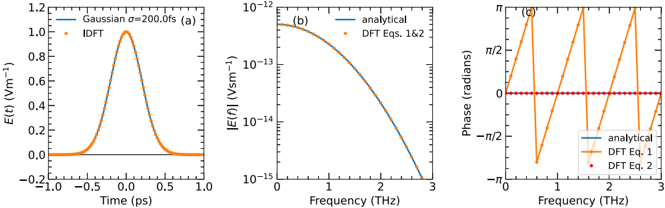
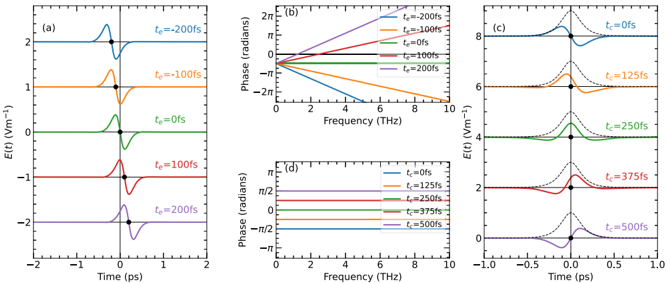
- A phase-corrected DFT, \(\tilde{E}(\omega_k)=\delta t \sum_m E_m e^{i\omega_k t_m} e^{-i\omega_k T_0}\), reproduces the continuous Fourier transform’s amplitude and absolute phase, whereas the standard DFT returns a spurious linear phase that depends on the sampling window; this was validated for a Gaussian pulse with \(\sigma=200\) fs and \(T_0=1\) ps.
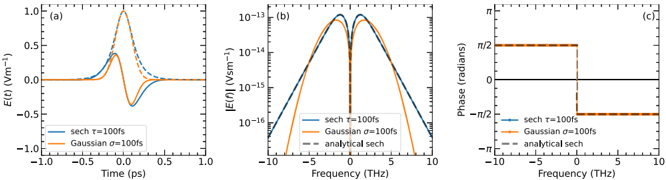
- A carrier-envelope model with a sine carrier and sech or Gaussian envelope reproduces single- and multi-cycle THz pulses; for a sech envelope the high-frequency amplitude spectrum decays exponentially with slope \(d|\tilde{E}|/d\omega=-\pi\tau/2\), allowing the envelope duration \(\tau\) to be inferred.
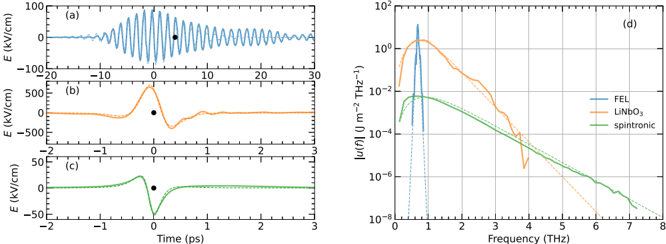
- Spectral energy density comparisons: TELBE free-electron laser at 0.68 THz, 50 kHz, \(\sim32\) mW, \(E_{\text{pulse}}=0.65\ \mu\)J, peak field \(\sim87\) kV/cm, max \(u(f)=13.5\ \text{J m}^{-2}\text{THz}^{-1}\); LiNbO\(_3\) optical rectification gave \(\sim650\) kV/cm, \(E_{\text{pulse}}=1\ \mu\)J, \(u(f)=2.5\ \text{J m}^{-2}\text{THz}^{-1}\); a spintronic emitter gave \(\sim50\) kV/cm, \(E_{\text{pulse}}=3.8\) nJ, with lower energy density below 3.8 THz but broader bandwidth.
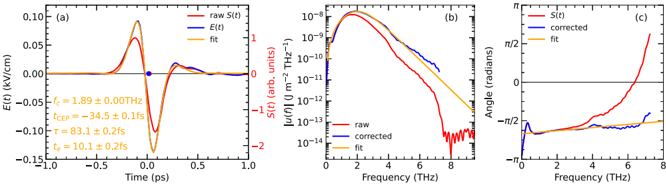
- For an experimental photoconductive emitter, the absolute phase started near \(-\pi/2\), and after detector-response deconvolution the phase was flatter; a time-domain fit yielded \(t_e=10.1\pm0.2\) fs, \(\tau=83\pm1\) fs, \(f_c=1.89\pm0.01\) THz, and \(t_{\text{CEP}}=-35\pm1\) fs.
Methods
- Tutorial/review design: derives amplitude- and phase-correct forward and inverse DFT expressions, validates them against analytical continuous Fourier transform results for Gaussian and sech pulses, and provides Python implementation in an appendix.
- Phenomenological time-domain model: electric field as carrier wave \(-\sin(\omega_c(t-t_e)-\phi_0)\) times a Gaussian or sech envelope, extended for finite carrier-envelope phase using an analytic representation with Heaviside step function and global phase factor.
- Experimental data: THz-TDS waveforms from a photoconductive antenna, optical rectification in LiNbO\(_3\), a spintronic emitter, and the TELBE free-electron laser; electro-optic sampling with GaP; spectral energy density calculated via Parseval’s theorem; literature reports of spectral phase also reviewed.
Limitations
- The paper states the carrier-envelope model is not based on generation physics or propagation and does not produce realistic pulses for short envelopes (\(\tau \le 2\pi/\omega_c\)) when the carrier-envelope phase makes the carrier close to a cosine.
- The paper states the model fit did not capture the more complex TELBE pulse structure at times above 5 ps, and that arrival-time methods have limitations: the educated-guess method fails for finite CEP, the mean-arrival-time method is pulled by pulse echoes, and the group-delay method stumbles if the spectral phase is complex near maximum amplitude.
- Evident from the text: the literature survey of spectral phase is described as representative but non-exhaustive, and the experimental comparison is limited to selected sources; detector-response correction was only possible below 7.5 THz because the electro-optic signal dropped below the noise floor.
Model-written summary. Check it against the paper before relying on it.
Integrity signals
Registry
Cites
Statistics
Figures

Verification
Claims the paper makes
10 Valid · 1 Not valid · 11 Not checked · 74 Own results and interpretations
The cited sources support only part of this claim — read each source’s verdict below.
In the paper
“The electromagnetic pulses from common laser-based THz sources, such as photoconductive switches [14, 15], optical rectification [16, 17], and spintronic emitters [18] are often close to single-cycle in shape.”
What the sources say
- Could not verifycites [14] 14. C.D.W.Mosley,M.Failla,D.Prabhakaran,andJ.Lloyd-Hughes.Terahertzspectroscopyofanisotropic materials using beams with rotatable polarization. Scientific Reports , 7:12337, 2017. sourceExperimental — accuracy not yet measured
Citation [18] is attached to “spintronic emitters,” but the paper’s Methods and Results describe a photoconductive emitter, not a spintronic one. Its Results discuss THz pulse waveforms without stating that they are close to single-cycle; searches for “single-cycle” and “spintronic emitters” found no supporting passage. No page numbers are available in our copy. (LLM, conf=0.76)
- Could not verifycites [15] 15. H. Ou, R. I. Stantchev, X. Chen, T. Blu, M. Semtsiv, W. T. Masselink, A. Hernandez Serrano, G. Costa, J. Young, N. Chopra, J. Lloyd-Hughes, and E. MacPherson. Simultaneous measurement of orthogonal terahertz fields via an emission multiplexing scheme. Opt. Expr. , 32:5567-5581, 2 2024. sourceExperimental — accuracy not yet measured
Our copy of Ou et al. (Opt. Express 2024) describes its interdigitated multi-contact PCA and the THz pulses it produces (Sec. 2.1, p. 3: 90 fs, 1550 nm pump, transient photocurrents emitting THz waves; Sec. 3.1/Fig. 4 discussion, p. 7: pulse duration and -30 dB bandwidth at ~2 THz), but no passage states that pulses from common laser-based THz sources are close to single-cycle in shape. Searches for 'single-cycle', 'few-cycle', and for optical rectification/spintronic emitters as sources returned nothing on point — the only mentions of ZnTe/optical schemes concern electro-optic detection (p. 2), and spintronic emission is not discussed at all. The paper simply does not address the general waveform-shape claim attributed to it. (LLM, conf=0.70)
- Not checked — no full text of the sourcecites [16] 16. M. C. Hoffmann, K.-L. Yeh, J. Hebling, and K. A. Nelson. Efficient terahertz generation by optical rectification at 1035 nm. Opt. Expr. , 15:11706-11713, 2007. source
- Supportedcites [17] 17. H.Hirori, A. Doi, F. Blanchard, and K. Tanaka. Single-cycle terahertz pulses with amplitudes exceeding 1 MV/cm generated by optical rectification in LiNbO 3 . Appl. Phys. Lett. , 98:091106, 2011. source
The paper’s opening summary (p. 1) says it generates single-cycle THz pulses by optical rectification of femtosecond laser pulses in LiNbO3. It therefore supports the optical-rectification example for which this citation is offered; the other source types have separate citations. (LLM, conf=0.93)
- Partly supportedcites [18] 18. T. Seifert, S. Jaiswal, U. Martens, J. Hannegan, L. Braun, P. Maldonado, F. Freimuth, A. Kronenberg, J. Henrizi, I. Radu, E. Beaurepaire, Y. Mokrousov, P. M. Oppeneer, M. Jourdan, G. Jakob, D. Turchinovich, L. M. Hayden, M. Wolf, M. Münzenberg, M. Kläui, and T. Kampfrath. Efficient metallic spintronic emitters of ultrabroadband terahertz radiation. Nature Photonics , 10:483-488, 2016. sourceExperimental — accuracy not yet measured
The spintronic-emitter citation [18] supports the laser-driven, ultrashort-pulse part: the Spintronic THz emitter section (pp. 2–3) describes femtosecond-laser excitation and a broadband, Fourier-limited THz pulse. The Performance test (p. 5) also calls its time-domain signal short, but the available text does not establish that its shape is close to single-cycle. (LLM, conf=0.78)
plain- Asserted: passes — The authors put it forward as true.
- Checkable: passes — It can be checked against evidence.
- Load-bearing: unclear — It is unclear whether the paper’s conclusions depend on it.
- Based: passes — The paper gives a reason why it holds.
- Could not verify
The cited sources support only part of this claim — read each source’s verdict below.
In the paper
“Although we presented and validated our methods using data from THz time-domain spectroscopy, the approaches summarised here are equally applicable to mid-infrared and visible time-domain spectroscopic methods that use electro-optic sampling (or similar approaches) to uncover the electric field of light pulses [2-4].”
What the sources say
- Not checked — no full text of the sourcecites [2] 2. R. Huber, A. Brodschelm, F. Tauser, and A. Leitenstorfer. Generation and field-resolved detection of femtosecond electromagnetic pulses tunable up to 41THz. Appl. Phys. Lett. , 76:3191-3193, 2000. source
- Not checked — no full text of the sourcecites [3] 3. D. Zimin, M. Weidman, J. Schötz, M. F. Kling, V. S. Yakovlev, F. Krausz, and N. Karpowicz. Petahertzscale nonlinear photoconductive sampling in air. Optica , 8:586-590, 5 2021. source
- Partly supportedcites [4] 4. A. Herbst, K. Scheffter, M. M. Bidhendi, M. Kieker, A. Srivastava, and H. Fattahi. Recent advances in petahertz electric field sampling. Journal of Physics B: Atomic, Molecular and Optical Physics , 55:172001, 8 2022. sourceExperimental — accuracy not yet measured
The Introduction describes electro-optic sampling at THz and mid-infrared frequencies, and section 2.2 describes a related field-sampling method spanning mid-infrared to ultraviolet frequencies. These passages support the existence of electric-field measurements across the cited spectral ranges, but do not establish that the citing authors’ THz-tested approaches are equally applicable to those methods. (LLM, conf=0.82)
plain- Asserted: passes — The authors put it forward as true.
- Checkable: passes — It can be checked against evidence.
- Load-bearing: unclear — It is unclear whether the paper’s conclusions depend on it.
- Based: passes — The paper gives a reason why it holds.
A result the paper reports from its own data — it cites no other source for it, so there is none to check. The quote shows it is in the paper.
In the paper
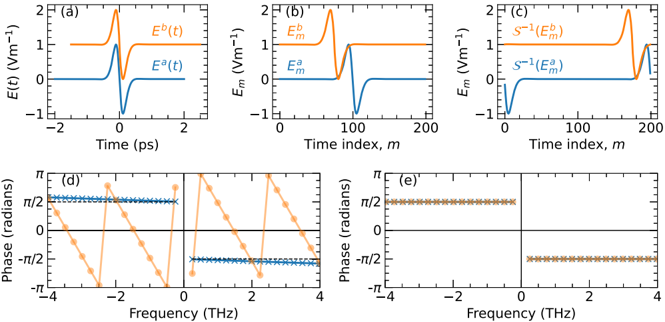
“Hence, both an odd number of points and a symmetric time window are required for the 'shift' approach to achieve accurate phase retrieval.”
plainstates a causen = 2- Asserted: passes — The authors put it forward as true.
- Checkable: passes — It can be checked against evidence.
- Load-bearing: passes — The paper’s conclusions depend on it.
- Based: passes — The paper gives a reason why it holds.
A result the paper states — it cites no source for it, so there is none to check. The quote shows it is in the paper.
In the paper
“Thus, despite the apparently longer time-domain envelope for the sech envelope, at higher frequencies (above 5THz for this particular case) sech pulses have larger spectral amplitude than Gaussian pulses.”
plainstates an association- Asserted: passes — The authors put it forward as true.
- Checkable: passes — It can be checked against evidence.
- Load-bearing: unclear — It is unclear whether the paper’s conclusions depend on it.
- Based: passes — The paper gives a reason why it holds.
A result the paper reports from its own data — it cites no other source for it, so there is none to check. The quote shows it is in the paper.
In the paper
“In contrast, Eq.2 returns the same amplitude (orange points in (b)) and also phase (red points in (c)) as the CFT, demonstrating that the definition of the DFT in Eq.2 accurately reproduces the correct absolute phase in this case.”
boostedSingle case- Asserted: passes — The authors put it forward as true.
- Checkable: passes — It can be checked against evidence.
- Load-bearing: passes — The paper’s conclusions depend on it.
- Based: passes — The paper gives a reason why it holds.
36 more claims
Create a free account to see all 96 claims and to verify the 4 references still open.
- Probably not a substantial claim. 20
- It may state two separate claims as one. 45
- The quote only partly states this claim. 1
Self-check
Percentages, sums and reported differences re-computed from the paper’s own numbers.
Each contradiction between two passages listed here was confirmed by an independent check.
Rated minor: it would not touch a result — a value no result rests on, a p-value that stays on the same side of the significance level, or a conflict that is clerical, resolved elsewhere in the paper, or outside its own findings.
In the paper
§ 4.3 Experimental Phase Spectra · p. 17
“The time-domain pulse, E ( t ) , was close to single-cycle in shape and can be accurately modelled via Eq.8, as illustrated by the yellow line in Fig. 7a.”
§ 4.3 Experimental Phase Spectra · p. 16
“A fit using Eq. 5 is shown by the orange line.”
Rated minor: it would not touch a result — a value no result rests on, a p-value that stays on the same side of the significance level, or a conflict that is clerical, resolved elsewhere in the paper, or outside its own findings.
In the paper
§ Appendix 1: Useful results from continuous Fourier transforms · p. 18
“The strongest frequency component of a light pulse is its 'carrier frequency,' the frequency of the maximum spectral amplitude.”
§ 3.2 Influence of Pulse Duration: Spectral Slope · p. 10
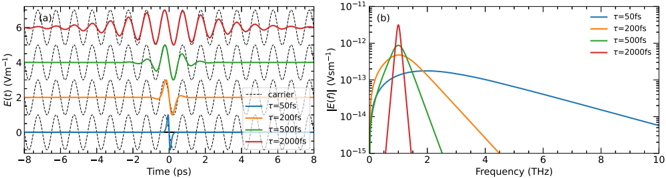
“For pulse durations below τ = 100fs, the spectrum became ultra-broadband: the spectral peak shifted to higher frequencies”
Citations
Cites
Efficient metallic spintronic emitters of ultrabroadband terahertz radiation
Seifert, T., Jaiswal, S., Martens, U., Hannegan, J., Braun, L., Maldonado, P., Freimuth, F., Kronenberg, A., Henrizi, J., Radu, I., et al. (2016) · Nature Photonics · doi:10.1038/nphoton.2016.91 · Cited by 944 · cited 3×
“[18], and were found to have close to zero spectral phase over a 30 THz bandwidth, signifying chirp-free (Fourier limited) pulse durations.”
Hirori, H., Doi, A., Blanchard, F., & Tanaka, K. (2011) · Applied Physics Letters · doi:10.1063/1.3560062 · Cited by 859
The 2023 terahertz science and technology roadmap
Leitenstorfer, A., Moskalenko, A. S., Kampfrath, T., Kono, J., Castro-Camus, E., Peng, K., Qureshi, N., Turchinovich, D., Tanaka, K., Markelz, A. G., et al. (2023) · Journal of Physics D: Applied Physics · doi:10.1088/1361-6463/acbe4c · Cited by 514 · cited 1×
“The accurate determination of the pulse arrival time may prove useful in THz time-of-flight, layer thickness or tomography applications [38], and further helps to correct arrival time differences in dual-beam THz spectroscopy [26].”
A Review of the Terahertz Conductivity of Bulk and Nano-Materials
Lloyd-Hughes, J., & Jeon, T.-I. (2012) · Journal of Infrared, Millimeter, and Terahertz Waves · doi:10.1007/s10762-012-9905-y · Cited by 503
Self-citationDetectors and sources for ultrabroadband electro-optic sampling: Experiment and theory
Leitenstorfer, A., Hunsche, S., Shah, J., Nuss, M. C., & Knox, W. H. (1999) · Applied Physics Letters · doi:10.1063/1.123601 · Cited by 461 · cited 4×
“Our aim in this section is not to claim the highest time-domain E ( t ) , pulse energy or spectral energy density: rather the aim is to show how the spectral energy density of sources of THz pulses can be quantitatively compared.”
InfluentialGeneration and field-resolved detection of femtosecond electromagnetic pulses tunable up to 41 THz
Huber, R., Brodschelm, A., Tauser, F., & Leitenstorfer, A. (2000) · Applied Physics Letters · doi:10.1063/1.126625 · Cited by 413
Gallot, G., Zhang, J., McGowan, R. W., Jeon, T.-I., & Grischkowsky, D. (1999) · Applied Physics Letters · doi:10.1063/1.124124 · Cited by 241 · cited 3×
“However, this cannot be seen straightforwardly from the reported time-domain electro-optic signal, which had a finite pulse arrival time (250 fs), which would imply a linear slope to the phase (not reported), and an asymmetric pulse shape, which should give finite (non-zero) CEP (Fig.”
Kübler, C., Huber, R., Tübel, S., & Leitenstorfer, A. (2004) · Applied Physics Letters · doi:10.1063/1.1808232 · Cited by 240 · cited 1×
“Starting from the time-domain definition of the instantaneous energy density of an electromagnetic wave in free space, u ( t ) = ε 0 c | E ( t ) | 2 , the energy per pulse per unit area, U , can be calculated from where Parseval’s theorem (Eq.”
Coherent sampling of active mode-locked terahertz quantum cascade lasers and frequency synthesis
Barbieri, S., Ravaro, M., Gellie, P., Santarelli, G., Manquest, C., Sirtori, C., Khanna, S. P., Linfield, E. H., & Davies, A. G. (2011) · Nature Photonics · doi:10.1038/nphoton.2011.49 · Cited by 223 · cited 2×
“The key requirement is knowledge of the pulse’s arrival time, T 0 , which we provide methods for determining in the next Section, along with a Fourier treatment of the properties of THz pulses.”
Efficient terahertz generation by optical rectification at 1035 nm
Hoffmann, M. C., Yeh, K.-L., Hebling, J., & Nelson, K. A. (2007) · Optics Express · doi:10.1364/oe.15.011706 · Cited by 193 · cited 1×
“The electromagnetic pulses from common laser-based THz sources, such as photoconductive switches [14, 15], optical rectification [16, 17], and spintronic emitters [18] are often close to single-cycle in shape.”
Numerical studies on the electro-optic detection of femtosecond electron bunches
Casalbuoni, S., Schlarb, H., Schmidt, B., Schmüser, P., Steffen, B., & Winter, A. (2008) · Physical Review Special Topics - Accelerators and Beams · doi:10.1103/physrevstab.11.072802 · Cited by 161 · cited 2×
“For a Gaussian profile centred at time t = 0, the pulse can be described by g ( t ) = Ae − t 2 / 2 σ 2 , where a shorter pulse has smaller standard deviation σ .”
High-Field High-Repetition-Rate Sources for the Coherent THz Control of Matter
Green, B., Kovalev, S., Asgekar, V., Geloni, G., Lehnert, U., Golz, T., Kuntzsch, M., Bauer, C., Hauser, J., Voigtlaender, J., et al. (2016) · Scientific Reports · doi:10.1038/srep22256 · Cited by 157 · cited 2×
“This waveform is representative of narrow-band THz pulses containing a few cycles, such as produced by some optical rectification schemes [19], while mode-locked THz QCLs [22] and THz FELs [23] generate multi-cycle THz pulses with even larger pulse envelopes.”
Generation of tunable narrow-band THz radiation from large aperture photoconducting antennas
Weling, A. S., Hu, B. B., Froberg, N. M., & Auston, D. H. (1994) · Applied Physics Letters · doi:10.1063/1.111543 · Cited by 134 · cited 1×
“The key requirement is knowledge of the pulse’s arrival time, T 0 , which we provide methods for determining in the next Section, along with a Fourier treatment of the properties of THz pulses.”
Phase Retrieval in Terahertz Time-Domain Measurements: a 'how to' Tutorial
Jepsen, P. U. (2019) · Journal of Infrared, Millimeter and Terahertz Waves · doi:10.1007/s10762-019-00578-0 · Cited by 114 · cited 2×
“In the context of transmission THz-TDS, Jepsen discussed difficulties in unwrapping the relative phase of sample and reference spectra, and provided an algorithm that made relative phase retrieval more robust by subtracting a linear phase term from sample and reference spectra [10].”
The 2021 ultrafast spectroscopic probes of condensed matter roadmap
Lloyd-Hughes, J., Oppeneer, P. M., Pereira dos Santos, T., Schleife, A., Meng, S., Sentef, M. A., Ruggenthaler, M., Rubio, A., Radu, I., Murnane, M., et al. (2021) · Journal of Physics: Condensed Matter · doi:10.1088/1361-648x/abfe21 · Cited by 111 · cited 1×
“Schemes that modify the carrier-envelope phase of a THz pulse have been reported [5,8], and are particularly important when using intense THz electric fields to drive non-linear processes, such as in THz scanning tunneling microscopy [8,9].”
Self-citationNumerical phase correction method for terahertz time-domain reflection spectroscopy
Vartiainen, E. M., Ino, Y., Shimano, R., Kuwata-Gonokami, M., Svirko, Y. P., & Peiponen, K.-E. (2004) · Journal of Applied Physics · doi:10.1063/1.1786345 · Cited by 79
Barbieri, S., Ravaro, M., Gellie, P., Santarelli, G., Manquest, C., Sirtori, C., Khanna, S. P., Linfield, E. H., & Davies, A. G. (2011) · Nature Photonics · doi:10.1038/nphoton.2011.117 · Cited by 79
Terahertz radiation from a photoconducting antenna array
Froberg, N. M., Hu, B. B., Zhang, X.-C., & Auston, D. H. (1992) · IEEE Journal of Quantum Electronics · doi:10.1109/3.159536 · Cited by 73 · cited 1×
“Multi-cycle THz pulses can be obtained from optical rectification [19], photoconductive antenna arrays [20,21], quantum cascade lasers [22], or free electron lasers [23,24].”
Spatiotemporal transformations of ultrashort terahertz pulses
Kužel, P., Khazan, M. A., & Kroupa, J. (1999) · Journal of the Optical Society of America B · doi:10.1364/josab.16.001795 · Cited by 53 · cited 1×
“…even occur during propagation in free space: broadband electromagnetic pulses change spectral phase as a result of the geometric aberrations of the optical system, which alter the path length [6]; the Gouy effect causes the carrier-envelope phase to evolve as a beam propagates through a focus [7].”
Terahertz spectroscopy of anisotropic materials using beams with rotatable polarization
Mosley, C. D. W., Failla, M., Prabhakaran, D., & Lloyd-Hughes, J. (2017) · Scientific Reports · doi:10.1038/s41598-017-12568-0 · Cited by 53 · cited 1×
“The electromagnetic pulses from common laser-based THz sources, such as photoconductive switches [14, 15], optical rectification [16, 17], and spintronic emitters [18] are often close to single-cycle in shape.”
Self-citationHigh-bandwidth perovskite photonic sources on silicon
Ren, A., Wang, H., Dai, L., Xia, J., Bai, X., Butler-Caddle, E., Smith, J. A., Lai, H., Ye, J., Li, X., et al. (2023) · Nature Photonics · doi:10.1038/s41566-023-01242-9 · Cited by 49 · cited 1×
“The same fs laser and EOS scheme was instead used to determine the THz pulse from a commercial trilayer spintronic emitter [18] from TeraSpinTec, in an optical-pump, THz probe spectrometer [30] that achieved around 50 kV/cm peak electric field ( σ = 200 µ m, E pulse = 3 .”
Self-citationPetahertz-scale nonlinear photoconductive sampling in air
Zimin, D., Weidman, M., Schötz, J., Kling, M. F., Yakovlev, V. S., Krausz, F., & Karpowicz, N. (2021) · Optica · doi:10.1364/optica.411434 · Cited by 40 · cited 1×
“While demonstrated first for THz pulses, time-domain spectroscopy has been widely utilised in the mid-infrared [2] and recently even in the visible (or “petahertz”) range [3,4].”
Recent advances in petahertz electric field sampling
Herbst, A., Scheffter, K., Bidhendi, M. M., Kieker, M., Srivastava, A., & Fattahi, H. (2022) · Journal of Physics B: Atomic, Molecular and Optical Physics · doi:10.1088/1361-6455/ac8032 · Cited by 40 · cited 2×
“While demonstrated first for THz pulses, time-domain spectroscopy has been widely utilised in the mid-infrared [2] and recently even in the visible (or “petahertz”) range [3,4].”
Carrier envelope phase shifter for broadband terahertz pulses
Kawada, Y., Yasuda, T., & Takahashi, H. (2016) · Optics Letters · doi:10.1364/ol.41.000986 · Cited by 30 · cited 3×
“…spectrum is reported, the spectral phase, φ ( ω ) , contains a wealth of information about an electromagnetic pulse, including the pulse’s arrival time (from the group delay) and the carrier-envelope phase of the pulse, which creates a frequency-independent offset to the spectral phase [5].”
Mosley, C. D. W., Lake, D. S., Graham, D. M., Jamison, S. P., Appleby, R. B., Burt, G., & Hibberd, M. T. (2023) · Optics Express · doi:10.1364/oe.475604 · Cited by 27 · cited 2×
“The key requirement is knowledge of the pulse’s arrival time, T 0 , which we provide methods for determining in the next Section, along with a Fourier treatment of the properties of THz pulses.”
Chopra, N., & Lloyd-Hughes, J. (2023) · Journal of Infrared, Millimeter, and Terahertz Waves · doi:10.1007/s10762-023-00949-8 · Cited by 21 · cited 2×
“…even occur during propagation in free space: broadband electromagnetic pulses change spectral phase as a result of the geometric aberrations of the optical system, which alter the path length [6]; the Gouy effect causes the carrier-envelope phase to evolve as a beam propagates through a focus [7].”
Self-citationAllerbeck, J., Kuttruff, J., Bobzien, L., Huberich, L., Tsarev, M., & Schuler, B. (2023) · ACS Photonics · doi:10.1021/acsphotonics.3c00555 · Cited by 20 · cited 4×
“The ability to find the carrier-envelope phase easily from the absolute spectral phase will allow setups to be optimised for maximal peak electric field [8], relevant for nonlinear THz spectroscopy techniques such as 2D THz and THz STM.”
InfluentialDonaldson, P. M. (2022) · Analytical Chemistry · doi:10.1021/acs.analchem.2c04287 · Cited by 18 · cited 1×
“This can be understood as a result of the electro-optic sampling process: the measured electro-optic signal does not have exactly the same temporal shape as the true electric field of the THz pulse incident on the detection crystal [31, 36].”
The effect of the Gouy phase in optical-pump-THz-probe spectroscopy
Ahmed, S., Savolainen, J., & Hamm, P. (2014) · Optics Express · doi:10.1364/oe.22.004256 · Cited by 16
Knorr, M., Steinleitner, P., Raab, J., Gronwald, I., Merkl, P., Lange, C., & Huber, R. (2018) · Optics Express · doi:10.1364/oe.26.019059 · Cited by 16 · cited 2×
“…the spectral energy density (assuming our ‘Physics’ definition of the scaling in the Fourier transform) is The SI units for u ( f ) are J m − 2 s, or J m − 2 Hz − 1 , and hence plotting the spectral energy density in units of J m − 2 THz − 1 allows an easy estimate of the energy fluence, U .”
Active THz beam shaping using a one-dimensional array of photoconductive emitters
Chopra, N., Deveikis, J., & Lloyd‐Hughes, J. (2023) · Applied Physics Letters · doi:10.1063/5.0132207 · Cited by 15 · cited 1×
“We recorded the time-domain THz waveform from an interdigitated photoconductive switch, made on semi-insulating GaAs and photoexcited with 800 nm central wavelength pulses from a mode-locked Ti:sapphire oscillator (Newport Spectra Physics Mai Tai) with a pulse duration of 100 fs [35].”
Self-citationMeng, F., Walla, F., Kovalev, S., et al. (2023) · Physical Review Research · doi:10.1103/physrevresearch.5.043141 · Cited by 13 · cited 1×
“4.3.”
InfluentialPhase evolution of terahertz radiation from femtosecond laser-induced air plasma
Zhang, Z., Chen, Y., Zhang, Z., Xia, T., Zhang, J., Sheng, Z. M., & Zhang, J. (2020) · Optics Letters · doi:10.1364/ol.385292 · Cited by 10 · cited 1×
“As a class of intense narrowband sources with high spectral energy density, THz FELs have found use recently in studies of THz harmonic generation [24,28].”
Simultaneous measurement of orthogonal terahertz fields via an emission multiplexing scheme
Ou, H., Stantchev, R. I., Chen, X., Blu, T., Semtsiv, M., Masselink, W. T., Serrano, A. H., Costa, G., Young, J., Chopra, N., et al. (2024) · Optics Express · doi:10.1364/oe.505567 · Cited by 9 · cited 1×
“The key requirement is knowledge of the pulse’s arrival time, T 0 , which we provide methods for determining in the next Section, along with a Fourier treatment of the properties of THz pulses.”
Self-citationChopra, N., & Lloyd-Hughes, J. (2025) · ACS Photonics · doi:10.1021/acsphotonics.4c01934 · Cited by 8 · cited 2×
“The absolute phase of the electro-optic signal, reported in Fig.”
Self-citationSnedden, E. W., Walsh, D. A., & Jamison, S. P. (2015) · Optics Express · doi:10.1364/oe.23.008507 · Cited by 8 · cited 1×
“…of the time-domain electric field E ( t ) is not determined directly in a THz spectrometer (e.g. the electro-optic or photoconductive signal is in arbitrary units), then common practise is to use the measured THz pulse energy and beam profile to deduce the electric field strength by substituting…”
Terahertz-slicing — an all-optical synchronization for 4th generation light sources
Chen, M., de Oliveira, T. V. A. G., Ilyakov, I., Nörenberg, T., Kuschewski, F., Deinert, J.-C., Awari, N., Ponomaryov, A., Kuntzsch, M., Kehr, S. C., et al. (2022) · Optics Express · doi:10.1364/oe.454908 · Cited by 6 · cited 2×
“The key requirement is knowledge of the pulse’s arrival time, T 0 , which we provide methods for determining in the next Section, along with a Fourier treatment of the properties of THz pulses.”
InfluentialTerahertz harmonic generation and nonlinear spectroscopy of metamaterial-gated/graphene resonators
Degl’Innocenti, R., Lu, Y., Zaman, A. M., Woolley, J. M., Chopra, N., Tadbier, W., Michailow, W., Hofmann, S., & Lloyd‐Hughes, J. (2025) · APL Photonics · doi:10.1063/5.0264305 · Cited by 6 · cited 1×
“6(b), following the tilted-pulse front method [17], using a 40 fs, 1 kHz Ti:sapphire amplifier and a 1 mJ excitation pulse, and electro-optic detection using a 200 µ m-thick GaP crystal [29].”
Self-citationSimultaneous measurement of orthogonal terahertz fields via an emission multiplexing scheme
Ou, H. (2023) · Figshare · doi:10.6084/m9.figshare.24611124 · Cited by 1
Meng, F., Walla, F., Kovalev, S., et al. (2023) · RWTH Publications (RWTH Aachen) · doi:10.48550/arxiv.2303.01564 · Cited by 1
Phase evolution of terahertz radiation from femtosecond laser-induced air plasma: publisher’s note
Zhang, Z., Chen, Y., Zhang, Z., et al. (2020) · Optics Letters · doi:10.1364/ol.393644
Mosley, C. D. W., Lake, D. S., Graham, D. M., Jamison, S. P., & Hibberd, M. T. (2022) · International Conference on Infrared, Millimeter, and Terahertz Waves (IRMMW-THz) · doi:10.1109/irmmw-thz50927.2022.9895495
Gase electro-optic sensors for ultrabroadband detection of multi-THz field transients
Kübler, C., Huber, R., Tübel, S., & Leitenstorfer, A. (2006) · International Conference on Infrared, Millimeter, and Terahertz Waves (IRMMW-THz) · doi:10.1109/icimw.2004.1422187
Allerbeck, J., Kuttruff, J., Bobzien, L., et al. (2023) · 2023 Conference on Lasers and Electro-Optics Europe & European Quantum Electronics Conference (CLEO/Europe-EQEC) · doi:10.1109/cleo/europe-eqec57999.2023.10232728
Cited by
Laser-driven few-cycle terahertz sources with high average power
Löscher, R., Vogel, T., Mansourzadeh, S., Khalili, M., Omar, A., Wang, Y., Hoffmann, M., & Saraceno, C. J. (2025) · APL Photonics · doi:10.1063/5.0288917 · Cited by 9
“Recent standardization efforts have proposed methods for reporting relationships between recorded THz spectra and THz average power, enabling a first step toward absolute spectral calibration 244 .”
Active terahertz modulation via functional materials: Recent advances and applications
Rho, E. Y., Kang, J., Kim, T., & Seo, M. (2026) · TrAC Trends in Analytical Chemistry · doi:10.1016/j.trac.2026.118647 · Cited by 3
Ou, H., Pickwell‐MacPherson, E., & Lloyd‐Hughes, J. (2026) · Journal of Applied Physics · doi:10.1063/5.0319459 · Cited by 1
Self-citationCha, M., Ryeom, J., Kang, B. J., Park, H., Jang, H., Hong, S. J., & Bahk, Y.-M. (2026) · Journal of Infrared, Millimeter and Terahertz Waves · doi:10.1007/s10762-026-01162-z
“As shown in the following section, even timing uncertainties on the order of several tens of femtoseconds can significantly influence the extraction of complex conductivity and dielectric parameters [46, 47].”
Kyoung, J. (2026) · Optics Express · doi:10.1364/oe.596522
Metadata
- Authors
- Lloyd-Hughes, J., Chopra, N., Deveikis, J., Pandya, R., & Woolley, J.
- Affiliations
- University of Warwick (GB)
- Venue
- Journal of Infrared, Millimeter, and Terahertz Waves
- Published
- 2025-05-16
- Volume
- 46
- Issue
- 6
- ISSN
- 1866-6892 (ISSN-L)
- 1866-6906
- OpenAlex
- W4410452786
- Cited by
- 6
- References
- 38
- Citations by year
- 2026: 5 · 2025: 1
- FWCI
- 1.35
- Type
- journal article
- Language
- en
- Open access
- hybrid
- doi.org
- Licence
- cc-by
- creativecommons.org/licenses/by/4.0 (tdm)
- creativecommons.org/licenses/by/4.0 (vor)
- Locations
- Journal of Infrared Millimeter and Terahertz Waves (publishedVersion, cc-by)
- arXiv (Cornell University) (submittedVersion)
- Figshare (submittedVersion, public-domain)
- arXiv (Cornell University)
- Funders
- EPSRC (EP/V047914/1)
- Horizon Europe (101103873)
- Topics
- Physical Sciences › Engineering › Electrical and Electronic Engineering › Terahertz technology and applications
- Physical Sciences › Physics and Astronomy › Atomic and Molecular Physics, and Optics › Laser-Matter Interactions and Applications
- Physical Sciences › Engineering › Electrical and Electronic Engineering › Particle Accelerators and Free-Electron Lasers
- Keywords
- electro-optic sampling, discrete Fourier transform, continuous Fourier transform, spectral energy density, carrier-envelope phase, pulse arrival time, chirp, photoconductive antenna, optical rectification, spintronic emitters, time-domain spectroscopy
About these checks
Registry, retraction, Cites and statistics results are computed, not judged, with one exception: a printed reference that no index lists is read once by a model before it counts as a citation error. Claims are extracted by a model and kept only when their quote appears verbatim in the text; each cited source is then checked, with a model’s help, for whether it says what the claim relies on. Those verdicts can be wrong — read the claim’s quote and the cited source before relying on one.
The claim verdicts this report counts are experimental: their accuracy is not yet measured.
A language model drew the claims from the paper on 2026-10-10, under version 3 of the claim definition (model deepseek-v4.1-flash, prompt extract-v3).
A second model labelled each claim on 2026-10-10 (model jev-1.13-20260917, definition revision gold-guideline-v0.2).
Cited sources are checked with a language model’s help (gpt-6-sol and qwen3.8-omni-flash).
Statistics and arithmetic are recomputed, not judged.
Confidence bands are shown only for fields calibrated on our annotated test set. None is calibrated yet, so no band is shown.
What counts as a claim ›How we measure confidence ›How we check this ›
Are you an author, or do you see a problem with this page? Request a review
Data sources
Bibliographic data: Semantic Scholar, OpenAlex, Crossref.
Contains information from the Semantic Scholar Academic Graph Datasets, made available under the ODC Attribution License (ODC-BY 1.0).
Semantic Scholar’s data is described in: Kinney, R., et al. (2023). The Semantic Scholar Open Data Platform. arXiv:2301.10140.
