

Exploring the Physiological and Psychological Effects of Group Chanting in Australia: Reduced Stress, Cortisol and Enhanced Social Connection
Open accessThe DOI matches its Crossref record; 83 of the 84 references it cites were found in a registry or an index.
Abstract
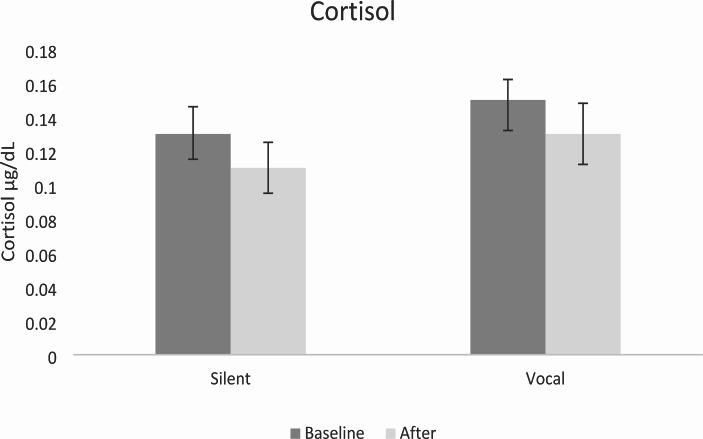
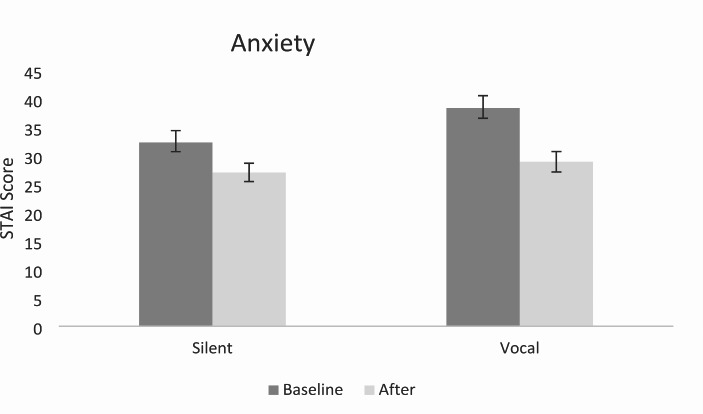
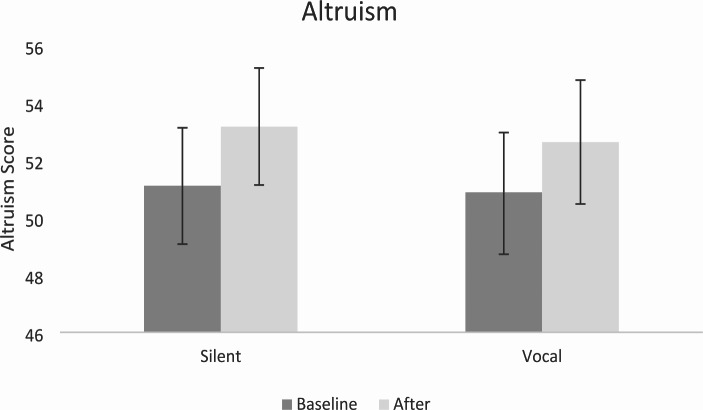
Chanting, an ancient ritual practiced in diverse cultures and traditions worldwide, has typically been employed for meditation, healing, self-awareness, and psychological growth. However, there is little understanding of the physiological and psychological benefits of chanting, and how vocalization might contribute to such effects. This study aimed to determine whether 12-minutes of group chanting, through vocal or silent repetition of the sound “om,“ would reduce stress and anxiety, while increasing feelings of social connection, and whether vocal chanting would yield stronger effects. Thirty-four participants were randomly assigned to vocal or silent group chanting conditions. Saliva samples were collected before and after chanting to assess cortisol levels, while self-report measures included the State Trait Anxiety Inventory and the Adapted Self-Report Altruism Scale (including additional items on cross-cultural altruism). Following chanting, participants also provided a written description of their experiences. Both vocal and silent chanting resulted in significant decreases in cortisol levels and self-reported anxiety. The reduction in cortisol was similar for vocal and silent chanting, but self-reported anxiety decreased more following vocal chanting. Altruism scores increased following both vocal and silent chanting. However, there was no evidence of altruistic tendencies extending toward people from a culture other than one’s own. Results are discussed in relation to the phenomenology of chanting, and to current theory and evidence on the physiological and psychological effects of chanting and singing.
Overview
The claims and statistics of this paper haven’t been checked yet.
Free: it reads the open-access text and checks the first 5 claims that cite a source we can check. Create a free account to check every claim.
Integrity signals
Registry
Cites
Statistics
Figures
Verification
Claims the paper makes
The claims and statistics of this paper haven’t been checked yet.
Free: it reads the open-access text and checks the first 5 claims that cite a source we can check. Create a free account to check every claim.
Self-check
Percentages, sums and reported differences re-computed from the paper’s own numbers.
The self-check needs the paper’s full text.
Citations
Cites
Three Approaches to Qualitative Content Analysis
Hsieh, H.-F., & Shannon, S. E. (2005) · Qualitative Health Research · doi:10.1177/1049732305276687 · Cited by 44,601
(1954) · Cited by 15,935
Rush, A. J., Trivedi, M. H., Wisniewski, S. R., Nierenberg, A. A., Stewart, J. W., Warden, D., Niederehe, G., Thase, M. E., Lavori, P. W., Lebowitz, B. D., et al. (2006) · American Journal of Psychiatry · doi:10.1176/ajp.2006.163.11.1905 · Cited by 5,643
The role of inflammation in depression: from evolutionary imperative to modern treatment target
Miller, A. H., & Raison, C. L. (2016) · Nature Reviews Immunology · doi:10.1038/nri.2015.5 · Cited by 3,942
Measurement and Control of Response Bias
Paulhus, D. L. (1991) · Measures of Personality and Social Psychological Attitudes · doi:10.1016/b978-0-12-590241-0.50006-x · Cited by 3,598
State-Trait Anxiety Inventory for Adults
Spielberger, C. D. (2012) · PsycTESTS Dataset · doi:10.1037/t06496-000 · Cited by 3,479
Fehr, E., & Fischbacher, U. (2003) · Nature · doi:10.1038/nature02043 · Cited by 3,475
Attention regulation and monitoring in meditation
Lutz, A., Slagter, H. A., Dunne, J. D., & Davidson, R. J. (2008) · Trends in Cognitive Sciences · doi:10.1016/j.tics.2008.01.005 · Cited by 2,659
A wandering mind is an unhappy mind
Killingsworth, M. A., & Gilbert, D. T. (2010) · Science · doi:10.1126/science.1192439 · Cited by 2,575
Benson, H., Beary, J. F., & Carol, M. P. (1974) · Psychiatry · doi:10.1080/00332747.1974.11023785 · Cited by 2,317
Salivary cortisol in psychoneuroendocrine research: recent developments and applications
Kirschbaum, C., & Hellhammer, D. H. (1994) · Psychoneuroendocrinology · doi:10.1016/0306-4530(94)90013-2 · Cited by 2,107
Wiltermuth, S. S., & Heath, C. (2009) · Psychological Science · doi:10.1111/j.1467-9280.2008.02253.x · Cited by 1,717
Pruessner, J. C., Wolf, O. T., Hellhammer, D. H., Buske-Kirschbaum, A., von Auer, K., Jobst, S., Kaspers, F., & Kirschbaum, C. (1997) · Life Sciences · doi:10.1016/s0024-3205(97)01008-4 · Cited by 1,450
The altruistic personality and the self-report altruism scale
Philippe Rushton, J., Chrisjohn, R. D., & Cynthia Fekken, G. (1981) · Personality and Individual Differences · doi:10.1016/0191-8869(81)90084-2 · Cited by 1,049
Neural correlates of attentional expertise in long-term meditation practitioners
Brefczynski-Lewis, J. A., Lutz, A., Schaefer, H. S., Levinson, D. B., & Davidson, R. J. (2007) · Proceedings of the National Academy of Sciences · doi:10.1073/pnas.0606552104 · Cited by 983
Joint music making promotes prosocial behavior in 4-year-old children
Kirschner, S., & Tomasello, M. (2010) · Evolution and Human Behavior · doi:10.1016/j.evolhumbehav.2010.04.004 · Cited by 896
The evolution of the stress concept
Selye, H. (1970) · The American Journal of Cardiology · doi:10.1016/0002-9149(70)90796-4 · Cited by 590
Mindfulness mediates the physiological markers of stress: Systematic review and meta-analysis
Pascoe, M. C., Thompson, D. R., Jenkins, Z. M., & Ski, C. F. (2017) · Journal of Psychiatric Research · doi:10.1016/j.jpsychires.2017.08.004 · Cited by 579
Association of depression with medical illness: Does cortisol play a role?
Brown, E. S., Varghese, F. P., & McEwen, B. S. (2004) · Biological Psychiatry · doi:10.1016/s0006-3223(03)00473-6 · Cited by 578
Jerath, R., Edry, J. W., Barnes, V. A., & Jerath, V. (2006) · Medical Hypotheses · doi:10.1016/j.mehy.2006.02.042 · Cited by 574
Music and social bonding: “self-other†merging and neurohormonal mechanisms
Tarr, B., Launay, J., & Dunbar, R. I. M. (2014) · Frontiers in Psychology · doi:10.3389/fpsyg.2014.01096 · Cited by 548
Lee, C. M., Cadigan, J. M., & Rhew, I. C. (2020) · Journal of Adolescent Health · doi:10.1016/j.jadohealth.2020.08.009 · Cited by 526
The rhythm of joint action: synchrony promotes cooperative ability.
Valdesolo, P., Ouyang, J., & DeSteno, D. (2010) · Journal of Experimental Social Psychology · doi:10.1016/j.jesp.2010.03.004 · Cited by 521
Bernardi, L., Wdowczyk-Szulc, J., Valenti, C., Castoldi, S., Passino, C., Spadacini, G., & Sleight, P. (2000) · Journal of the American College of Cardiology · doi:10.1016/s0735-1097(00)00595-7 · Cited by 516
The ice-breaker effect: Singing mediates fast social bonding
Pearce, E., Launay, J., & Dunbar, R. I. M. (2015) · Royal Society Open Science · doi:10.1098/rsos.150221 · Cited by 507
Effect of rosary prayer and yoga mantras on autonomic cardiovascular rhythms: comparative study
Bernardi, L., Sleight, P., Bandinelli, G., Cencetti, S., Fattorini, L., Wdowczyc-Szulc, J., & Lagi, A. (2001) · BMJ · doi:10.1136/bmj.323.7327.1446 · Cited by 486
Effects of choir singing or listening on secretory immunoglobulin A, cortisol, and emotional state
Kreutz, G., Bongard, S., Rohrmann, S., Hodapp, V., & Grebe, D. (2004) · Journal of Behavioral Medicine · doi:10.1007/s10865-004-0006-9 · Cited by 474
Assessment of Mindfulness: Review on State of the Art
Sauer, S., Walach, H., Schmidt, S., Hinterberger, T., Lynch, S., Büssing, A., & Kohls, N. (2013) · Mindfulness · doi:10.1007/s12671-012-0122-5 · Cited by 464
The Psychology of Rituals: An Integrative Review and Process-Based Framework
Hobson, N. M., Schroeder, J., Risen, J. L., Xygalatas, D., & Inzlicht, M. (2018) · Personality and Social Psychology Review · doi:10.1177/1088868317734944 · Cited by 354
The Difficulty of Defining Mindfulness: Current Thought and Critical Issues
Chiesa, A. (2013) · Mindfulness · doi:10.1007/s12671-012-0123-4 · Cited by 349
Effects of Relaxing Music on Salivary Cortisol Level after Psychological Stress
KHALFA, S., BELLA, S. D., ROY, M., PERETZ, I., & LUPIEN, S. J. (2003) · Annals of the New York Academy of Sciences · doi:10.1196/annals.1284.045 · Cited by 341
Silent disco: dancing in synchrony leads to elevated pain thresholds and social closeness
Tarr, B., Launay, J., & Dunbar, R. I. M. (2016) · Evolution and Human Behavior · doi:10.1016/j.evolhumbehav.2016.02.004 · Cited by 341
Hawthorne, G. (2008) · Social Psychiatry and Psychiatric Epidemiology · doi:10.1007/s00127-007-0279-8 · Cited by 279
Does singing facilitate social bonding?
Kreutz, G. (2014) · Music and Medicine · doi:10.47513/mmd.v6i2.180 · Cited by 254
Kokal, I., Engel, A., Kirschner, S., & Keysers, C. (2011) · PLoS ONE · doi:10.1371/journal.pone.0027272 · Cited by 254
Safe but Lonely? Loneliness, Anxiety, and Depression Symptoms and COVID-19
Okruszek, Ł., Aniszewska-Stańczuk, A., Piejka, A., Wiśniewska, M., & Żurek, K. (2020) · Frontiers in Psychology · doi:10.3389/fpsyg.2020.579181 · Cited by 244
Bernardi, L., Gabutti, A., Porta, C., & Spicuzza, L. (2001) · Journal of Hypertension · doi:10.1097/00004872-200112000-00016 · Cited by 243
MacLean, C. R. K., Walton, K. G., Wenneberg, S. R., Levitsky, D. K., Mandarino, J. P., Waziri, R., Hillis, S. L., & Schneider, R. H. (1997) · Psychoneuroendocrinology · doi:10.1016/s0306-4530(97)00003-6 · Cited by 234
Cortisol as a marker for improvement in mindfulness-based stress reduction
Matousek, R. H., Dobkin, P. L., & Pruessner, J. (2010) · Complementary Therapies in Clinical Practice · doi:10.1016/j.ctcp.2009.06.004 · Cited by 233
Dingle, G. A., Sharman, L. S., Bauer, Z., Beckman, E., Broughton, M., Bunzli, E., Davidson, R., Draper, G., Fairley, S., Farrell, C., et al. (2021) · Frontiers in Psychology · doi:10.3389/fpsyg.2021.713818 · Cited by 227
Beck, R. J., Cesario, T. C., Yousefi, A., & Enamoto, H. (2000) · Music Perception · doi:10.2307/40285902 · Cited by 221
Fancourt, D., Williamon, A., Carvalho, L. A., Steptoe, A., Dow, R., & Lewis, I. (2016) · ecancermedicalscience · doi:10.3332/ecancer.2016.631 · Cited by 201
Promoting wellbeing and health through active participation in music and dance: a systematic review
Sheppard, A., & Broughton, M. C. (2020) · International Journal of Qualitative Studies on Health and Well-being · doi:10.1080/17482631.2020.1732526 · Cited by 200
TEACHING EMPATHY: A FRAMEWORK ROOTED IN SOCIAL COGNITIVE NEUROSCIENCE AND SOCIAL JUSTICE
Gerdes, K. E., Segal, E. A., Jackson, K. F., & Mullins, J. L. (2011) · Journal of Social Work Education · doi:10.5175/jswe.2011.200900085 · Cited by 197
Breathing Practices for Treatment of Psychiatric and Stress-Related Medical Conditions
Brown, R. P., Gerbarg, P. L., & Muench, F. (2013) · Psychiatric Clinics of North America · doi:10.1016/j.psc.2013.01.001 · Cited by 196
Music performance anxiety and its relationship with social phobia and dimensions of perfectionism
Dobos, B., Piko, B. F., & Kenny, D. T. (2018) · Research Studies in Music Education · doi:10.1177/1321103x18804295 · Cited by 183
Sanada, K., Montero-Marin, J., Alda Díez, M., Salas-Valero, M., Pérez-Yus, M. C., Morillo, H., Demarzo, M. M. P., García-Toro, M., & García-Campayo, J. (2016) · Frontiers in Physiology · doi:10.3389/fphys.2016.00471 · Cited by 161
How Does Prayer Help Manage Emotions?
Sharp, S. (2010) · Social Psychology Quarterly · doi:10.1177/0190272510389129 · Cited by 160
Tomasino, B., Fregona, S., Skrap, M., & Fabbro, F. (2013) · Frontiers in Human Neuroscience · doi:10.3389/fnhum.2012.00346 · Cited by 145
Impact of saliva collection methods on sIgA and cortisol assays and acceptability to participants
Strazdins, L., Meyerkort, S., Brent, V., D'Souza, R. M., Broom, D. H., & Kyd, J. M. (2005) · Journal of Immunological Methods · doi:10.1016/j.jim.2005.09.010 · Cited by 140
The effects of mother–infant singing on emotional closeness, affect, anxiety, and stress hormones
Fancourt, D., & Perkins, R. (2018) · Music & Science · doi:10.1177/2059204317745746 · Cited by 136
A conceptual review on action-perception coupling in the musicians’ brain: what is it good for?
Novembre, G., & Keller, P. E. (2014) · Frontiers in Human Neuroscience · doi:10.3389/fnhum.2014.00603 · Cited by 131
Kuhn, D. (2002) · Journal of Music Therapy · doi:10.1093/jmt/39.1.30 · Cited by 118
The effects of group singing on mood
Unwin, M. M., Kenny, D. T., & Davis, P. J. (2002) · Psychology of Music · doi:10.1177/0305735602302004 · Cited by 117
Effect of contact on intercultural acceptance: a field study
Nesdale, D., & Todd, P. (2000) · International Journal of Intercultural Relations · doi:10.1016/s0147-1767(00)00005-5 · Cited by 112
Kokotsaki, D., & Davidson, J. W. (2003) · Music Education Research · doi:10.1080/14613800307103 · Cited by 109
The social neuroscience of music: Understanding the social brain through human song.
Greenberg, D. M., Decety, J., & Gordon, I. (2021) · American Psychologist · doi:10.1037/amp0000819 · Cited by 108
Barnhofer, T., Chittka, T., Nightingale, H., Visser, C., & Crane, C. (2010) · Mindfulness · doi:10.1007/s12671-010-0004-7 · Cited by 100
Examining the Effects of Meditation Techniques on Psychosocial Functioning
Wolf, D. B., & Abell, N. (2003) · Research on Social Work Practice · doi:10.1177/104973102237471 · Cited by 88
Using focus groups to explore the nature of prayer in late life
KRAUSE, N. M., Chatters, L. M., Meltzer, T., & Morgan, D. L. (2000) · Journal of Aging Studies · doi:10.1016/s0890-4065(00)80011-0 · Cited by 81
Bormann, J. E., Oman, D., Walter, K. H., & Johnson, B. D. (2014) · Medical Care · doi:10.1097/mlr.0000000000000200 · Cited by 77
The sound of cooperation: Musical influences on cooperative behavior
Kniffin, K. M., Yan, J., Wansink, B. C., & Schulze, W. D. (2016) · Journal of Organizational Behavior · doi:10.1002/job.2128 · Cited by 74
Vanderark, S. D., & Ely, D. (1993) · Perceptual and Motor Skills · doi:10.2466/pms.1993.77.1.227 · Cited by 73
Rhythmic Chanting and Mystical States across Traditions
Perry, G., Polito, V., & Thompson, W. F. (2021) · Brain Sciences · doi:10.3390/brainsci11010101 · Cited by 71
Self-citationTwal, W. O., Wahlquist, A. E., & Balasubramanian, S. (2016) · BMC Complementary and Alternative Medicine · doi:10.1186/s12906-016-1286-7 · Cited by 59
WALTON, K. G., FIELDS, J. Z., LEVITSKY, D. K., HARRIS, D. A., PUGH, N. D., & SCHNEIDER, R. H. (2004) · Annals of the New York Academy of Sciences · doi:10.1196/annals.1314.023 · Cited by 58
Effervescence and solidarity in religious organizations
Draper, S. (2014) · Journal for the Scientific Study of Religion · doi:10.1111/jssr.12109 · Cited by 57
Boster, J. B., Spitzley, A. M., Castle, T. W., Jewell, A. R., Corso, C. L., & McCarthy, J. (2020) · Journal of Music Therapy · doi:10.1093/jmt/thaa015 · Cited by 56
How Chanting Relates to Cognitive Function, Altered States and Quality of Life
Perry, G., Polito, V., Sankaran, N., & Thompson, W. F. (2022) · Brain Sciences · doi:10.3390/brainsci12111456 · Cited by 47
Self-citationChanges in mood, oxytocin, and cortisol following group and individual singing: a pilot study
Good, A., & Russo, F. A. (2022) · Psychology of Music · doi:10.1177/03057356211042668 · Cited by 46
Mantram repetition fosters self-efficacy in veterans for managing PTSD: A randomized trial.
Oman, D., & Bormann, J. E. (2015) · Psychology of Religion and Spirituality · doi:10.1037/a0037994 · Cited by 44
Niva, W. J., Sekhar, L., Manikandan, A., Kuppusamy, M., Ganesan, T., Shriraam, V., Silambanan, S., & Padmavathi, R. (2020) · Advances in Integrative Medicine · doi:10.1016/j.aimed.2020.05.007 · Cited by 39
Assessing Vocal Chanting as an Online Psychosocial Intervention
Simpson, F. M., Perry, G., & Thompson, W. F. (2021) · Frontiers in Psychology · doi:10.3389/fpsyg.2021.647632 · Cited by 34
Self-citationFukui, H., & Toyoshima, K. (2013) · Frontiers in Psychology · doi:10.3389/fpsyg.2013.00910 · Cited by 33
Klimes‐Dougan, B., Chong, L. S., Samikoglu, A., Thai, M., Amatya, P., Cullen, K. R., & Lim, K. O. (2019) · Stress · doi:10.1080/10253890.2019.1656714 · Cited by 33
DeAngelis, R. T., Upenieks, L., & Louie, P. (2023) · Journal of Racial and Ethnic Health Disparities · doi:10.1007/s40615-022-01505-1 · Cited by 30
Malviya, S., Meredith, P., Zupan, B., & Kerley, L. (2022) · Journal of Spirituality in Mental Health · doi:10.1080/19349637.2021.2010631 · Cited by 18
Malviya, S., Zupan, B., & Meredith, P. J. (2022) · Complementary Therapies in Clinical Practice · doi:10.1016/j.ctcp.2022.101668 · Cited by 18
Music increase altruism through regulating the secretion of steroid hormones and peptides
Fukui, H., & Toyoshima, K. (2014) · Medical Hypotheses · doi:10.1016/j.mehy.2014.09.023 · Cited by 16
Li, I., Chwo, S.-M., & Pawan, C. (2013) · Psychology · doi:10.4236/psych.2013.46a2004 · Cited by 10
Under Pressure: Reports of Performance Anxiety Across Multiple Singing Genres
Henshaw, A., & Collyer, S. (2022) · Journal of Singing · doi:10.53830/jeta7812 · Cited by 10
Chanting meditation improves mood and social cohesion
Perry, G., Polito, V., & Thompson, W. F. (2016) · Cited by 7
Self-citationBroughton, M. C. (2021) · Cited by 1
Research works printed but not linked: 3
- Perry, G., & Polito, V. (2021). Music and Healing rituals. The Science and psychology of music: From Beethoven at the Office to Beyoncé at the Gym (pp. 197-204).
- Walton, K. G., Cavanaugh, K. L., & Pugh, N. D. (2005). Effect of Group Practice of the Transcenden- tal Meditation Program on biochemical indicators of stress in non-meditators: A prospective Time Series Study. Journal of Social Behavior & Personality, 17, 339-373. https://www.proquest.com/ docview/203615959?pq-origsite=gscholar&fromopenview=true
- Wiltermuth, S. S.,H. C (2008). Synchrony and Cooperation. Psychological Science, 20(1), 1-5. · DOI · Paper page
Cited by
Music Engagement as a Source of Cognitive Reserve
Wolff, L., Quan, Y., Perry, G., & Thompson, W. F. (2023) · American Journal of Alzheimer s Disease & Other Dementias® · doi:10.1177/15333175231214833 · Cited by 60
“63 Thus, one source of the bene fi t of music engagement for CR is that it can help to reduce physiological stress, like other leisure activities.”
BackgroundSelf-citationTing, B., Chen, D. T.-L., Hsu, W.-T., Tsai, C.-L., Malau, I. A., Lee, S.-L., & Jingling, L. (2024) · European Journal of Investigation in Health Psychology and Education · doi:10.3390/ejihpe14020024 · Cited by 10
“Om” chanting and its impact on selected neuropsychological functions: a literature overview
Thanneeru, S. K., Sutar, R. F., Singh, V., Kushwah, A., Das, S., Atlani, M. K., Mittal, M., & Agrawal, A. (2022) · Manipal Journal of Medical Sciences · doi:10.55889/2582-5984.1149 · Cited by 6
Neurobiological and psychological effects of reciting the Quran from the Mushaf
Okur, S., & Bayraktar, B. (2026) · Discover Psychology · doi:10.1007/s44202-026-00658-y · Cited by 6
Music in the Human Experience: An Introduction to Music Psychology
Hodges, D. A., & McPherson, G. E. (2025) · Routledge eBooks · doi:10.4324/9781003460244 · Cited by 5
Metadata
- Authors
- Perry, G., Polito, V., & Thompson, W. F.
- Affiliations
- Bond University (AU)
- Macquarie University (AU)
- Corresponding author
- Perry, Gemma
- Venue
- Journal of Religion and Health
- Published
- 2023-12-13
- Volume
- 63
- Issue
- 6
- Pages
- 4793-4815
- ISSN
- 0022-4197 (ISSN-L)
- 1573-6571
- PMC
- PMC11576810
- OpenAlex
- W4389672392
- Cited by
- 22
- References
- 84
- Citations by year
- 2026: 12 · 2025: 7 · 2024: 2 · 2023: 1
- FWCI
- 6.50
- Type
- journal article
- Language
- en
- Open access
- hybrid
- doi.org
- Licence
- cc-by
- creativecommons.org/licenses/by/4.0 (tdm)
- creativecommons.org/licenses/by/4.0 (vor)
- Locations
- Journal of Religion and Health (publishedVersion, cc-by)
- PubMed Central (publishedVersion, cc-by)
- Bond University Research Portal (Bond University) (publishedVersion, cc-by)
- PubMed (publishedVersion)
- Funders
- Australian Research Council (DP190102978)
- Topics
- Social Sciences › Psychology › Social Psychology › Music Therapy and Health
- Social Sciences › Psychology › Clinical Psychology › Mindfulness and Compassion Interventions
- Social Sciences › Health › Religion, Spirituality, and Psychology
- Keywords
- Om chanting, stress reduction, anxiety, cortisol, social connectedness, altruism, singing
- MeSH terms
- Adult, Altruism, Anxiety, Australia, Ceremonial Behavior, Female, Humans, Hydrocortisone, Male, Religion and Psychology, Saliva, Stress, Psychological, Young Adult
About these checks
Registry, retraction, Cites and statistics results are computed, not judged, with one exception: a printed reference that no index lists is read once by a model before it counts as a citation error. Claims are extracted by a model and kept only when their quote appears verbatim in the text; each cited source is then checked, with a model’s help, for whether it says what the claim relies on. Those verdicts can be wrong — read the claim’s quote and the cited source before relying on one.
Statistics and arithmetic are recomputed, not judged.
Confidence bands are shown only for fields calibrated on our annotated test set. None is calibrated yet, so no band is shown.
What counts as a claim ›How we measure confidence ›How we check this ›
Are you an author, or do you see a problem with this page? Request a review
Data sources
Bibliographic data: Semantic Scholar, OpenAlex, Crossref.
Contains information from the Semantic Scholar Academic Graph Datasets, made available under the ODC Attribution License (ODC-BY 1.0).
Semantic Scholar’s data is described in: Kinney, R., et al. (2023). The Semantic Scholar Open Data Platform. arXiv:2301.10140.
