

The DOI matches its Crossref record; 125 of the 128 references it cites were found in a registry or an index; none of the 41 sources its claims cite is checked for support yet.
Blockchain technology in the smart city: a bibliometric review
Open accessAbstract
Blockchain can function as a foundational technology with numerous applications in smart cities. The objective of this paper is twofold. First, it provides a detailed overview of the extant literature on blockchain applications in smart cities; second, it reveals the trends and suggests future research directions for scholars who wish to contribute to this rapidly growing field. We conducted a bibliometric review using a keyword co-occurrence network and article co-citation analysis. The analysis includes the assessment of 148 articles published between 2016 and 2020 in 76 academic journals. The review results demonstrate that the number of articles devoted to the study of blockchain applications and smart cities has increased exponentially in recent years. More importantly, the research identifies some of the most influential studies in this area. The paper discusses trends and highlights the challenges related to the deployment of blockchain in smart cities. To the authors’ best knowledge, this represents the first study to review the literature from leading journals on blockchain applications in smart cities using bibliometric techniques.
Overview
AI snapshot
Written from the paper’s full text.
TL;DR
This bibliometric review maps 148 journal articles published between 2016 and 2020 on blockchain applications in smart cities, identifying publication trends, leading countries and journals, keyword clusters, and co-cited works. It reports exponential growth in the field and highlights challenges including scalability, lack of standards, and technological immaturity.
Key findings
- The review analyzed 148 articles published from 2016 to 2020 in 76 academic journals; annual output peaked in 2020 with 92 papers.
- Leading contributing countries were China (32 papers), India (27), and the USA (27), followed by South Korea (17), the UK (15), Australia (13), and Spain (11); countries with fewer than five papers totaled 35 papers.
- Leading journals were IEEE Access (15 articles), IEEE Internet of Things Journal (10), and Future Generation Computer Systems (6); 66 “Other” journals published 85 papers.
- Keyword co-occurrence produced six clusters with 89 nodes; article co-citation with a threshold of at least two citations displayed 58 nodes in four clusters. The most cited articles were Khan and Salah (2018) with 548 citations, Sharma et al. (2017) with 189, and Sun et al. (2016) with 172.
Methods
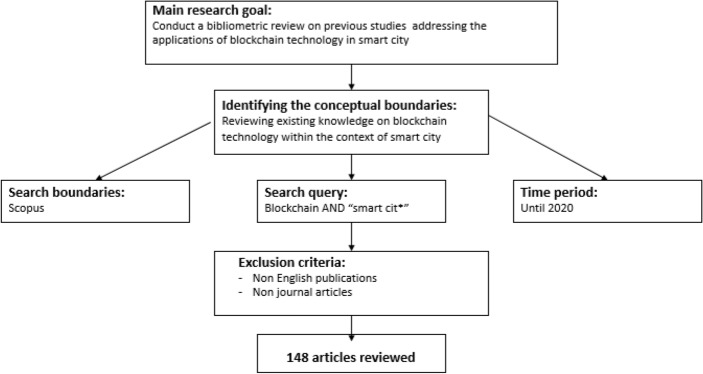
- Bibliometric review using Scopus, searching title, abstract, and keywords with `Blockchain AND "smart cit*"`; limited to English journal articles published before 2021 in engineering, computer science, social sciences, business/management/accounting, decision sciences, and economics. Scopus returned 162 documents, reduced to 150, then screened to 148 final articles.
- Descriptive analysis of publication year, country, and journal, plus keyword co-occurrence network and article co-citation analysis using VOSviewer and Bibexcel with LinLog/modularity normalization. Keyword co-occurrence threshold was a minimum of two; co-citation threshold was at least two citations per article.
Limitations
- Stated: the review covers a short period (2016–2020) and specific subject areas; the collection is not exhaustive; only article co-citation analysis was used, not bibliographic coupling, author co-citation, or co-authorship; results depend on the search keywords; only journal articles were selected, excluding conference proceedings, books, and book chapters; and only Scopus was used because VOSviewer cannot merge multiple databases.
- Evident: the study is a bibliometric and network analysis rather than an empirical test of blockchain outcomes; the paper itself notes that some application fields, such as healthcare, data sharing, and sharing economy services, have received less empirical attention.
Model-written summary. Check it against the paper before relying on it.
Integrity signals
Registry
Cites
Statistics
Figures
Verification
Claims the paper makes
34 Own result · 30 Own interpretation · 27 Not checked yet · 17 No basis given · 8 Own method · 1 Sources not found
A result the paper reports from its own data — it cites no other source for it, so there is none to check. The quote shows it is in the paper.
In the paper
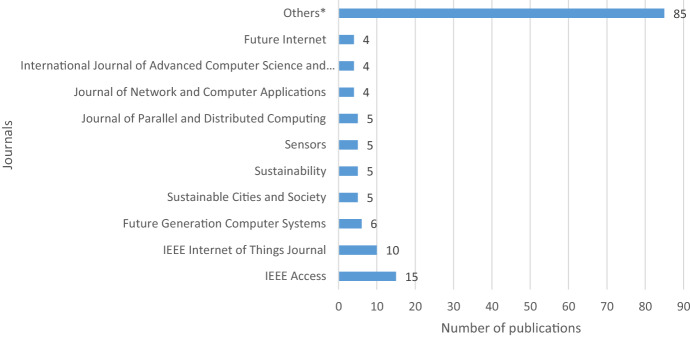
“In terms of output, IEEE Access was the journal publishing the highest number of articles (n = 15).”
§ Blockchain technology in the smart city: a bibliometric review > Findings > Distribution of publications by journal
plainn = 15- Asserted: passes — The authors put it forward as true.
- Checkable: passes — It can be checked against evidence.
- Load-bearing: unclear — It is unclear whether the paper’s conclusions depend on it.
- Based: passes — The paper gives a reason why it holds.
A result the paper reports from its own data — it cites no other source for it, so there is none to check. The quote shows it is in the paper.
In the paper
“The review results demonstrate that the number of articles devoted to the study of blockchain applications and smart cities has increased exponentially in recent years.”
§ Blockchain technology in the smart city: a bibliometric review > Abstract
boosteddirect- Asserted: passes — The authors put it forward as true.
- Checkable: passes — It can be checked against evidence.
- Load-bearing: passes — The paper’s conclusions depend on it.
- Based: passes — The paper gives a reason why it holds.
The paper states this without a source or data behind it here, so there is nothing to check it against. The quote shows it is in the paper.
In the paper
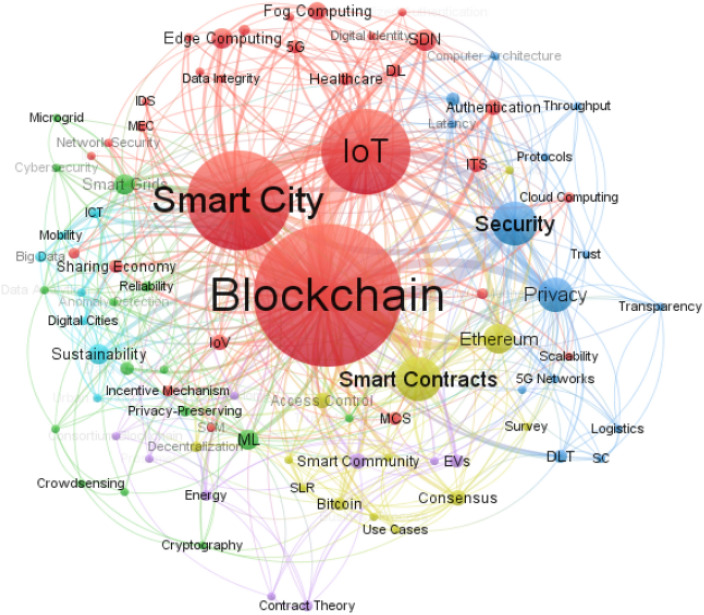
“The blue cluster is related to the technical characteristics of blockchain technologies such as security, privacy, latency, throughput, transparency, and trust.”
§ Blockchain technology in the smart city: a bibliometric review > Bibliometric analysis > Keyword co-occurrence network
plaincorrelational- Asserted: passes — The authors put it forward as true.
- Checkable: passes — It can be checked against evidence.
- Load-bearing: unclear — It is unclear whether the paper’s conclusions depend on it.
- Based: passes — The paper gives a reason why it holds.
A result the paper reports from its own data — it cites no other source for it, so there is none to check. The quote shows it is in the paper.
In the paper
“The category “Others” consists of 66 journals that published less than four articles on blockchain applications in the smart city.”
§ Blockchain technology in the smart city: a bibliometric review > Findings > Distribution of publications by journal
plain- Asserted: passes — The authors put it forward as true.
- Checkable: passes — It can be checked against evidence.
- Load-bearing: unclear — It is unclear whether the paper’s conclusions depend on it.
- Based: passes — The paper gives a reason why it holds.
A result the paper reports from its own data — it cites no other source for it, so there is none to check. The quote shows it is in the paper.
In the paper
“In total, these journals published 85 papers.”
§ Blockchain technology in the smart city: a bibliometric review > Findings > Distribution of publications by journal
plain- Asserted: passes — The authors put it forward as true.
- Checkable: passes — It can be checked against evidence.
- Load-bearing: unclear — It is unclear whether the paper’s conclusions depend on it.
- Based: passes — The paper gives a reason why it holds.
A result the paper reports from its own data — it cites no other source for it, so there is none to check. The quote shows it is in the paper.
In the paper
“Moreover, the keyword “AI” appeared frequently in the cluster, illustrating the criticality of this technology to support the development of future smart cities.”
§ Blockchain technology in the smart city: a bibliometric review > Bibliometric analysis > Keyword co-occurrence network
plaincorrelational- Asserted: passes — The authors put it forward as true.
- Checkable: passes — It can be checked against evidence.
- Load-bearing: unclear — It is unclear whether the paper’s conclusions depend on it.
- Based: passes — The paper gives a reason why it holds.
A result the paper reports from its own data — it cites no other source for it, so there is none to check. The quote shows it is in the paper.
In the paper
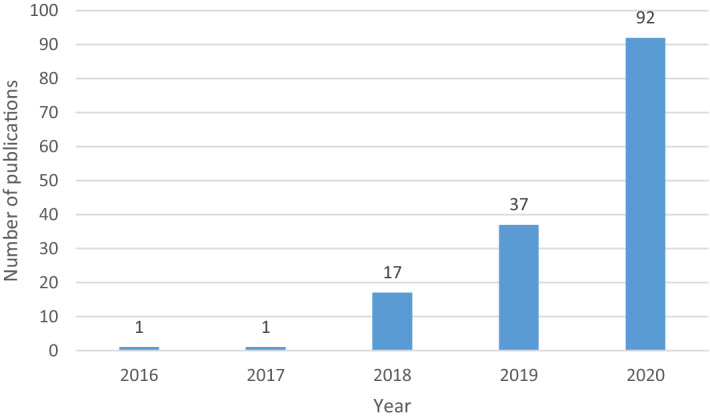
“The first article that addresses the applications of blockchain technology in the smart city appeared in 2016.”
§ Blockchain technology in the smart city: a bibliometric review > Findings > Distribution of publications by year
plain- Asserted: passes — The authors put it forward as true.
- Checkable: passes — It can be checked against evidence.
- Load-bearing: unclear — It is unclear whether the paper’s conclusions depend on it.
- Based: passes — The paper gives a reason why it holds.
In the paper
“Our research reveals it took 7–8 years for the joint usage of blockchain and smart city in a research paper authored by Sun et al. (2016), who studied the contribution of blockchain technology in supporting the development of shared services in smart cities.”
§ Blockchain technology in the smart city: a bibliometric review > Findings > Distribution of publications by year
What the sources say
- Not checked yetcites Sun et al. (2016) source
plainSingle case- Asserted: passes — The authors put it forward as true.
- Checkable: passes — It can be checked against evidence.
- Load-bearing: passes — The paper’s conclusions depend on it.
- Based: passes — The paper gives a reason why it holds.
A result the paper reports from its own data — it cites no other source for it, so there is none to check. The quote shows it is in the paper.
In the paper
“However, the scholarly output in 2019 and 2020 doubled from the previous year.”
§ Blockchain technology in the smart city: a bibliometric review > Findings > Distribution of publications by year
plain- Asserted: passes — The authors put it forward as true.
- Checkable: passes — It can be checked against evidence.
- Load-bearing: unclear — It is unclear whether the paper’s conclusions depend on it.
- Based: passes — The paper gives a reason why it holds.
A result the paper reports from its own data — it cites no other source for it, so there is none to check. The quote shows it is in the paper.
In the paper
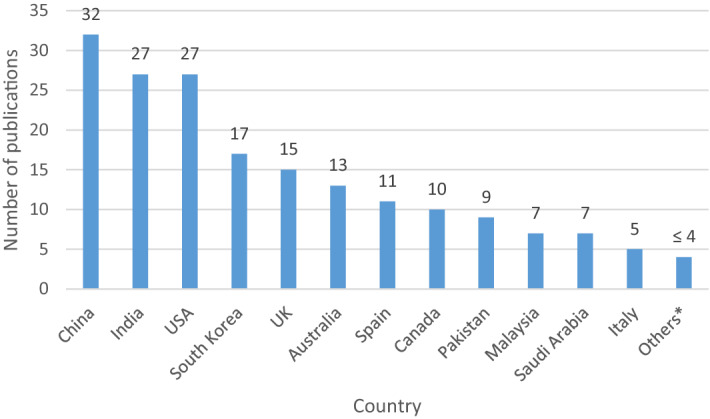
“From Fig. 3, it is observed that a significant contribution to the blockchain and smart city literature came from China, India and the USA, with 32, 27 and 27 papers each, respectively.”
§ Blockchain technology in the smart city: a bibliometric review > Findings > Distribution of publications by country
plain- Asserted: passes — The authors put it forward as true.
- Checkable: passes — It can be checked against evidence.
- Load-bearing: unclear — It is unclear whether the paper’s conclusions depend on it.
- Based: passes — The paper gives a reason why it holds.
- It may state two separate claims as one. 43
- Probably not a substantial claim. 58
- The quote only partly states this claim. 1
A result the paper reports from its own data — it cites no other source for it, so there is none to check. The quote shows it is in the paper.
In the paper
“The analysis includes the assessment of 148 articles published between 2016 and 2020 in 76 academic journals.”
- Also stated in: § Data collection · plain
“Eventually, 148 journal articles were retrieved for the final review and analysis”
- Also stated in: § Distribution of publications by journal · plain
“The 148 articles were published in 76 journals.”
§ Blockchain technology in the smart city: a bibliometric review > Abstract
plain- Asserted: passes — The authors put it forward as true.
- Checkable: passes — It can be checked against evidence.
- Load-bearing: passes — The paper’s conclusions depend on it.
- Based: passes — The paper gives a reason why it holds.
It may state two separate claims as one.
- Also stated in: § Data collection · plain
A result the paper reports from its own data — it cites no other source for it, so there is none to check. The quote shows it is in the paper.
In the paper
“It should be noted that the category “Others” comprises all countries with less than five papers (total papers from such countries = 35).”
§ Blockchain technology in the smart city: a bibliometric review > Findings > Distribution of publications by country
plain- Asserted: passes — The authors put it forward as true.
- Checkable: passes — It can be checked against evidence.
- Load-bearing: fails — The paper’s conclusions may not depend on it.
- Based: passes — The paper gives a reason why it holds.
Probably not a substantial claim. The paper’s conclusions may not depend on it. It may state two separate claims as one.
A result the paper reports from its own data — it cites no other source for it, so there is none to check. The quote shows it is in the paper.
In the paper
“The remaining journals on the list published either four or five articles each.”
§ Blockchain technology in the smart city: a bibliometric review > Findings > Distribution of publications by journal
plain- Asserted: passes — The authors put it forward as true.
- Checkable: passes — It can be checked against evidence.
- Load-bearing: fails — The paper’s conclusions may not depend on it.
- Based: passes — The paper gives a reason why it holds.
Probably not a substantial claim. The paper’s conclusions may not depend on it.
A result the paper reports from its own data — it cites no other source for it, so there is none to check. The quote shows it is in the paper.
In the paper
“As illustrated in Fig. 5, six clusters emerged, with 89 nodes appearing in the network.”
§ Blockchain technology in the smart city: a bibliometric review > Bibliometric analysis > Keyword co-occurrence network
plain- Asserted: passes — The authors put it forward as true.
- Checkable: passes — It can be checked against evidence.
- Load-bearing: unclear — It is unclear whether the paper’s conclusions depend on it.
- Based: passes — The paper gives a reason why it holds.
It may state two separate claims as one.
A result the paper reports from its own data — it cites no other source for it, so there is none to check. The quote shows it is in the paper.
In the paper
“Researchers from the United Kingdom (UK), Australia, and Spain have also contributed substantially to the literature with 15, 13, and 11 papers, respectively.”
§ Blockchain technology in the smart city: a bibliometric review > Findings > Distribution of publications by country
plain- Asserted: passes — The authors put it forward as true.
- Checkable: passes — It can be checked against evidence.
- Load-bearing: unclear — It is unclear whether the paper’s conclusions depend on it.
- Based: passes — The paper gives a reason why it holds.
It may state two separate claims as one.
A result the paper reports from its own data — it cites no other source for it, so there is none to check. The quote shows it is in the paper.
In the paper
“From 2018 onward, there is a significant increase in the annual volume of articles, peaking in 2020 with 92 papers.”
§ Blockchain technology in the smart city: a bibliometric review > Findings > Distribution of publications by year
plaincorrelational- Asserted: passes — The authors put it forward as true.
- Checkable: passes — It can be checked against evidence.
- Load-bearing: unclear — It is unclear whether the paper’s conclusions depend on it.
- Based: passes — The paper gives a reason why it holds.
It may state two separate claims as one.
A result the paper reports from its own data — it cites no other source for it, so there is none to check. The quote shows it is in the paper.
In the paper
“Based on the size, the red cluster represents the most significant, containing several keywords that are strongly related to blockchain’s foundational components, the IoT, and a wide range of technologies that could be leveraged in the smart city.”
§ Blockchain technology in the smart city: a bibliometric review > Bibliometric analysis > Keyword co-occurrence network
boostedcorrelational- Asserted: passes — The authors put it forward as true.
- Checkable: passes — It can be checked against evidence.
- Load-bearing: fails — The paper’s conclusions may not depend on it.
- Based: passes — The paper gives a reason why it holds.
Probably not a substantial claim. The paper’s conclusions may not depend on it. It may state two separate claims as one.
A result the paper reports from its own data — it cites no other source for it, so there is none to check. The quote shows it is in the paper.
In the paper
“IEEE Internet of Things Journal and Future Generation Computer Systems published 10 and 6 articles, respectively.”
§ Blockchain technology in the smart city: a bibliometric review > Findings > Distribution of publications by journal
plain- Asserted: passes — The authors put it forward as true.
- Checkable: passes — It can be checked against evidence.
- Load-bearing: unclear — It is unclear whether the paper’s conclusions depend on it.
- Based: passes — The paper gives a reason why it holds.
It may state two separate claims as one.
A result the paper reports from its own data — it cites no other source for it, so there is none to check. The quote shows it is in the paper.
In the paper
“The second significant cluster is the green one, and it comprises terms such as “ML” (Machine Learning), “Smart Grids”, “Data Security”, “Privacy-Preserving”, “Reliability”, “Anomaly Detection”, “Crowdsensing”.”
§ Blockchain technology in the smart city: a bibliometric review > Bibliometric analysis > Keyword co-occurrence network
plain- Asserted: passes — The authors put it forward as true.
- Checkable: passes — It can be checked against evidence.
- Load-bearing: fails — The paper’s conclusions may not depend on it.
- Based: passes — The paper gives a reason why it holds.
Probably not a substantial claim. The paper’s conclusions may not depend on it.
The paper states this without a source or data behind it here, so there is nothing to check it against. The quote shows it is in the paper.
In the paper
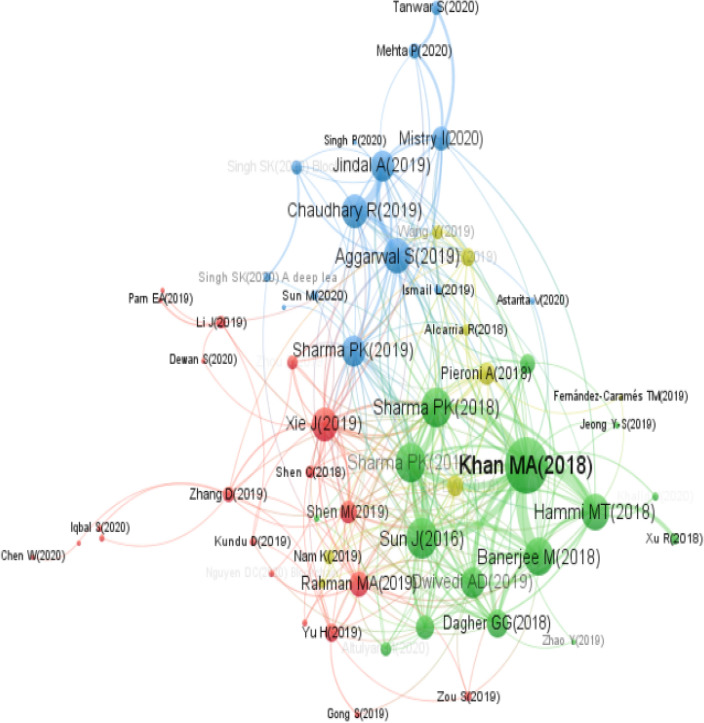
“For example, the thick arc connecting Khan and Salah (2018) and Hammi et al (2018) suggests that these articles have a strong co-citation relationship and share common ideas and/or related concepts.”
§ Blockchain technology in the smart city: a bibliometric review > Bibliometric analysis > Article co-citation network
hedgedcorrelational- Asserted: passes — The authors put it forward as true.
- Checkable: passes — It can be checked against evidence.
- Load-bearing: fails — The paper’s conclusions may not depend on it.
- Based: passes — The paper gives a reason why it holds.
Probably not a substantial claim. The paper’s conclusions may not depend on it. It may state two separate claims as one.
None of the sources cited for this claim have been checked yet.
In the paper
“Furthermore, the blue cluster revolves around the potentials of blockchain solutions for smart communities (Aggarwal et al. 2019), energy trading (Chaudhary et al. 2019; Jindal et al. 2019), transportation (Astarita et al. 2020; Mehta et al. 2020; Sharma and Park 2018), artificial intelligence (Singh et al. 2019, 2020a, b), and construction (Sun and Zhang 2020).”
§ Blockchain technology in the smart city: a bibliometric review > Bibliometric analysis > Article co-citation network
What the sources say
plaincorrelational- Asserted: passes — The authors put it forward as true.
- Checkable: passes — It can be checked against evidence.
- Load-bearing: unclear — It is unclear whether the paper’s conclusions depend on it.
- Based: passes — The paper gives a reason why it holds.
It may state two separate claims as one.
In the paper
“In contrast, the thin arc between Hammi et al. (2018) and Mistry (2020) reflects a weak co-citation strength, and thus the lack of content similarities (Mishra et al. 2017, 2018).”
§ Blockchain technology in the smart city: a bibliometric review > Bibliometric analysis > Article co-citation network
What the sources say
- Not matchedcites Mishra et al. 2017, 2018
Couldn’t be matched to a paper in Crossref, so it can’t be checked.
plaindirect- Asserted: passes — The authors put it forward as true.
- Checkable: passes — It can be checked against evidence.
- Load-bearing: unclear — It is unclear whether the paper’s conclusions depend on it.
- Based: passes — The paper gives a reason why it holds.
It may state two separate claims as one.
- Not matched
A result the paper reports from its own data — it cites no other source for it, so there is none to check. The quote shows it is in the paper.
In the paper
“Setting a threshold of at least two citations per article, only 58 nodes of the most co-cited articles are displayed in the co-citation network in Fig. 6.”
§ Blockchain technology in the smart city: a bibliometric review > Bibliometric analysis > Article co-citation network
plain- Asserted: passes — The authors put it forward as true.
- Checkable: passes — It can be checked against evidence.
- Load-bearing: fails — The paper’s conclusions may not depend on it.
- Based: passes — The paper gives a reason why it holds.
Probably not a substantial claim. The paper’s conclusions may not depend on it.
A result the paper reports from its own data — it cites no other source for it, so there is none to check. The quote shows it is in the paper.
In the paper
“Moreover, four clusters were generated by VOSviewer.”
§ Blockchain technology in the smart city: a bibliometric review > Bibliometric analysis > Article co-citation network
plain- Asserted: passes — The authors put it forward as true.
- Checkable: passes — It can be checked against evidence.
- Load-bearing: fails — The paper’s conclusions may not depend on it.
- Based: passes — The paper gives a reason why it holds.
Probably not a substantial claim. The paper’s conclusions may not depend on it.
The paper states this without a source or data behind it here, so there is nothing to check it against. The quote shows it is in the paper.
In the paper
“However, these application fields have received less attention, especially from the empirical point of view.”
§ Blockchain technology in the smart city: a bibliometric review > Bibliometric analysis > Article co-citation network
plain- Asserted: passes — The authors put it forward as true.
- Checkable: passes — It can be checked against evidence.
- Load-bearing: fails — The paper’s conclusions may not depend on it.
- Based: fails — The paper may give no reason why it holds.
Probably not a substantial claim. The paper’s conclusions may not depend on it. The paper may give no reason why it holds.
The paper states this without a source or data behind it here, so there is nothing to check it against. The quote shows it is in the paper.
In the paper
“Our findings reveal that the concept of blockchain has rapidly evolved over recent years.”
§ Blockchain technology in the smart city: a bibliometric review > Discussion and research implications > Discussion
plain- Asserted: passes — The authors put it forward as true.
- Checkable: passes — It can be checked against evidence.
- Load-bearing: fails — The paper’s conclusions may not depend on it.
- Based: fails — The paper may give no reason why it holds.
Probably not a substantial claim. The paper’s conclusions may not depend on it. The paper may give no reason why it holds.
The paper states this without a source or data behind it here, so there is nothing to check it against. The quote shows it is in the paper.
In the paper
“The number of articles considered was reduced to 150.”
§ Blockchain technology in the smart city: a bibliometric review > Research methodology > Data collection
plaindirectn = 150- Asserted: passes — The authors put it forward as true.
- Checkable: passes — It can be checked against evidence.
- Load-bearing: fails — The paper’s conclusions may not depend on it.
- Based: passes — The paper gives a reason why it holds.
Probably not a substantial claim. The paper’s conclusions may not depend on it. The quote only partly states this claim.
A result the paper reports from its own data — it cites no other source for it, so there is none to check. The quote shows it is in the paper.
In the paper
“As shown, the highly co-cited pair of articles are those connected with thick arcs.”
§ Blockchain technology in the smart city: a bibliometric review > Bibliometric analysis > Article co-citation network
plaincorrelational- Asserted: passes — The authors put it forward as true.
- Checkable: passes — It can be checked against evidence.
- Load-bearing: fails — The paper’s conclusions may not depend on it.
- Based: passes — The paper gives a reason why it holds.
Probably not a substantial claim. The paper’s conclusions may not depend on it.
A result the paper reports from its own data — it cites no other source for it, so there is none to check. The quote shows it is in the paper.
In the paper
“The study of Khan and Salah (2018) has received the highest number of citations and gained a significant level of academic attention.”
§ Blockchain technology in the smart city: a bibliometric review > Bibliometric analysis > Article co-citation network
plain- Asserted: passes — The authors put it forward as true.
- Checkable: passes — It can be checked against evidence.
- Load-bearing: unclear — It is unclear whether the paper’s conclusions depend on it.
- Based: passes — The paper gives a reason why it holds.
It may state two separate claims as one.
A result the paper reports from its own data — it cites no other source for it, so there is none to check. The quote shows it is in the paper.
In the paper
“Eventually, 148 journal articles were retrieved for the final review and analysis (two of the 150 articles were considered “false positives” for the search result).”
§ Blockchain technology in the smart city: a bibliometric review > Research methodology > Data collection
plain- Asserted: passes — The authors put it forward as true.
- Checkable: passes — It can be checked against evidence.
- Load-bearing: fails — The paper’s conclusions may not depend on it.
- Based: passes — The paper gives a reason why it holds.
Probably not a substantial claim. The paper’s conclusions may not depend on it.
A result the paper reports from its own data — it cites no other source for it, so there is none to check. The quote shows it is in the paper.
In the paper
“Finally, the last cluster consists of the following keywords: “Sustainability”, “Big Data”, “ICT”, “Citizens”.”
§ Blockchain technology in the smart city: a bibliometric review > Bibliometric analysis > Keyword co-occurrence network
plain- Asserted: passes — The authors put it forward as true.
- Checkable: passes — It can be checked against evidence.
- Load-bearing: fails — The paper’s conclusions may not depend on it.
- Based: passes — The paper gives a reason why it holds.
Probably not a substantial claim. The paper’s conclusions may not depend on it.
A result the paper reports from its own data — it cites no other source for it, so there is none to check. The quote shows it is in the paper.
In the paper
“After this step, the Scopus database returned 162 documents.”
§ Blockchain technology in the smart city: a bibliometric review > Research methodology > Data collection
plain- Asserted: passes — The authors put it forward as true.
- Checkable: passes — It can be checked against evidence.
- Load-bearing: fails — The paper’s conclusions may not depend on it.
- Based: passes — The paper gives a reason why it holds.
Probably not a substantial claim. The paper’s conclusions may not depend on it.
The paper states this without a source or data behind it here, so there is nothing to check it against. The quote shows it is in the paper.
In the paper
“The use cases of blockchain in the smart city have become a priority topic for investigation by scholars, practitioners, and governments worldwide.”
§ Blockchain technology in the smart city: a bibliometric review > Discussion and research implications > Discussion
plain- Asserted: passes — The authors put it forward as true.
- Checkable: passes — It can be checked against evidence.
- Load-bearing: fails — The paper’s conclusions may not depend on it.
- Based: fails — The paper may give no reason why it holds.
Probably not a substantial claim. The paper’s conclusions may not depend on it. The paper may give no reason why it holds.
The paper states this without a source or data behind it here, so there is nothing to check it against. The quote shows it is in the paper.
In the paper
“Benefitting from the technical characteristics of blockchain, smart contracts can be applied in numerous trading applications due to their automation, which offers transparent and reliable data sharing among service providers and network participants.”
§ Blockchain technology in the smart city: a bibliometric review > Conclusions
plaindirect- Asserted: passes — The authors put it forward as true.
- Checkable: passes — It can be checked against evidence.
- Load-bearing: passes — The paper’s conclusions depend on it.
- Based: fails — The paper may give no reason why it holds.
Probably not a substantial claim. The paper may give no reason why it holds. It may state two separate claims as one.
The paper states this without a source or data behind it here, so there is nothing to check it against. The quote shows it is in the paper.
In the paper
“Finally, blockchain is found to empower smart communities and foster sustainability in smart cities.”
§ Blockchain technology in the smart city: a bibliometric review > Conclusions
plaindirect- Asserted: passes — The authors put it forward as true.
- Checkable: passes — It can be checked against evidence.
- Load-bearing: passes — The paper’s conclusions depend on it.
- Based: passes — The paper gives a reason why it holds.
It may state two separate claims as one.
The paper states this without a source or data behind it here, so there is nothing to check it against. The quote shows it is in the paper.
In the paper
“Blockchain also provides privacy for the implementation of machine learning algorithms in the smart city.”
§ Blockchain technology in the smart city: a bibliometric review > Conclusions
plaindirect- Asserted: passes — The authors put it forward as true.
- Checkable: passes — It can be checked against evidence.
- Load-bearing: passes — The paper’s conclusions depend on it.
- Based: fails — The paper may give no reason why it holds.
Probably not a substantial claim. The paper may give no reason why it holds.
The paper states this without a source or data behind it here, so there is nothing to check it against. The quote shows it is in the paper.
In the paper
“To gain significant insights from IoT devices, machine learning can be utilized during data analysis, and its outcomes can be maintained in blockchain for secure storage and sharing.”
§ Blockchain technology in the smart city: a bibliometric review > Conclusions
plaindirect- Asserted: passes — The authors put it forward as true.
- Checkable: passes — It can be checked against evidence.
- Load-bearing: fails — The paper’s conclusions may not depend on it.
- Based: fails — The paper may give no reason why it holds.
Probably not a substantial claim. The paper’s conclusions may not depend on it. The paper may give no reason why it holds. It may state two separate claims as one.
The paper states this without a source or data behind it here, so there is nothing to check it against. The quote shows it is in the paper.
In the paper
“For instance, the fusion of blockchain and IoT is shown to boost security in accessing the data collected by sensors and preserving data integrity for IoT-enabled smart city systems.”
§ Blockchain technology in the smart city: a bibliometric review > Conclusions
plaindirect- Asserted: passes — The authors put it forward as true.
- Checkable: passes — It can be checked against evidence.
- Load-bearing: passes — The paper’s conclusions depend on it.
- Based: fails — The paper may give no reason why it holds.
Probably not a substantial claim. The paper may give no reason why it holds. It may state two separate claims as one.
The paper states this without a source or data behind it here, so there is nothing to check it against. The quote shows it is in the paper.
In the paper
“To our best knowledge, this is the first study attempting to conduct a bibliometric review on blockchain and the smart city, unravel the content of this research field, and classify co-cited works.”
§ Blockchain technology in the smart city: a bibliometric review > Conclusions
hedged- Asserted: passes — The authors put it forward as true.
- Checkable: passes — It can be checked against evidence.
- Load-bearing: passes — The paper’s conclusions depend on it.
- Based: fails — The paper may give no reason why it holds.
Probably not a substantial claim. The paper may give no reason why it holds. It may state two separate claims as one.
The paper states this without a source or data behind it here, so there is nothing to check it against. The quote shows it is in the paper.
In the paper
“As per this review’s findings, the nature of embedded security and trust stresses the importance of blockchain to enhance the integrity of smart city systems to overcome perceived security risks.”
§ Blockchain technology in the smart city: a bibliometric review > Discussion and research implications > Discussion
plaindirect- Asserted: passes — The authors put it forward as true.
- Checkable: passes — It can be checked against evidence.
- Load-bearing: passes — The paper’s conclusions depend on it.
- Based: passes — The paper gives a reason why it holds.
Probably not a substantial claim.
The paper states this without a source or data behind it here, so there is nothing to check it against. The quote shows it is in the paper.
In the paper
“This study shows that blockchain can hasten moves towards a more sustainable smart city, in which the wise management of resources is aligned with social inclusion and urban liveability.”
§ Blockchain technology in the smart city: a bibliometric review > Discussion and research implications > Discussion
plaindirect- Asserted: passes — The authors put it forward as true.
- Checkable: passes — It can be checked against evidence.
- Load-bearing: passes — The paper’s conclusions depend on it.
- Based: passes — The paper gives a reason why it holds.
Probably not a substantial claim.
A conclusion the paper draws from its own results — it cites no other source for it, so there is none to check. The quote shows it is in the paper.
In the paper
“The high co-occurrence of blockchain with IoT, as shown by the thick edge connecting them in the network, reflects the criticality of these technologies to change the way smart citizens interact, think, live, and manage information.”
§ Blockchain technology in the smart city: a bibliometric review > Bibliometric analysis > Keyword co-occurrence network
plaincorrelational- Asserted: passes — The authors put it forward as true.
- Checkable: passes — It can be checked against evidence.
- Load-bearing: fails — The paper’s conclusions may not depend on it.
- Based: passes — The paper gives a reason why it holds.
Probably not a substantial claim. The paper’s conclusions may not depend on it.
A conclusion the paper draws from its own results — it cites no other source for it, so there is none to check. The quote shows it is in the paper.
In the paper
“Taking a closer look at the scope of all journals, we observed that research on blockchain in the smart city context has received remarkable attention from the engineering and computer science communities and appeared in journals with a high impact factor.”
§ Blockchain technology in the smart city: a bibliometric review > Findings > Distribution of publications by journal
plaincorrelational- Asserted: passes — The authors put it forward as true.
- Checkable: passes — It can be checked against evidence.
- Load-bearing: fails — The paper’s conclusions may not depend on it.
- Based: passes — The paper gives a reason why it holds.
Probably not a substantial claim. The paper’s conclusions may not depend on it. It may state two separate claims as one.
In the paper
“The smart community represents an essential element of the Internet of Energy (IoE), to which blockchain can contribute by securing EV charging, optimizing the allocation of energy resources, and satisfying EV's individual energy consumption preferences (Su et al. 2019).”
§ Blockchain technology in the smart city: a bibliometric review > Bibliometric analysis > Keyword co-occurrence network
What the sources say
- Not checked yetcites Su et al. 2019
plaindirect- Asserted: passes — The authors put it forward as true.
- Checkable: passes — It can be checked against evidence.
- Load-bearing: fails — The paper’s conclusions may not depend on it.
- Based: passes — The paper gives a reason why it holds.
Probably not a substantial claim. The paper’s conclusions may not depend on it. It may state two separate claims as one.
In the paper
“Thus, the technology can facilitate electricity trading between charging stations and electric vehicles (Bhushan et al. 2020).”
§ Blockchain technology in the smart city: a bibliometric review > Bibliometric analysis > Keyword co-occurrence network
What the sources say
- Not checked yetcites Bhushan et al. 2020 source
plaindirect- Asserted: passes — The authors put it forward as true.
- Checkable: passes — It can be checked against evidence.
- Load-bearing: fails — The paper’s conclusions may not depend on it.
- Based: passes — The paper gives a reason why it holds.
Probably not a substantial claim. The paper’s conclusions may not depend on it.
A conclusion the paper draws from its own results — it cites no other source for it, so there is none to check. The quote shows it is in the paper.
In the paper
“Blockchain technology has advanced as a potential solution to complex or persistent challenges within the smart city by enhancing transparency and providing a trust and accountability layer through its transaction immutability.”
§ Blockchain technology in the smart city: a bibliometric review > Introduction
plaindirect- Asserted: passes — The authors put it forward as true.
- Checkable: passes — It can be checked against evidence.
- Load-bearing: passes — The paper’s conclusions depend on it.
- Based: passes — The paper gives a reason why it holds.
Probably not a substantial claim.
A conclusion the paper draws from its own results — it cites no other source for it, so there is none to check. The quote shows it is in the paper.
In the paper
“In the bargain, smart cities can take advantage of blockchain to advance economic, environmental, and social sustainability.”
§ Blockchain technology in the smart city: a bibliometric review > Bibliometric analysis > Keyword co-occurrence network
plainconditional- Asserted: passes — The authors put it forward as true.
- Checkable: passes — It can be checked against evidence.
- Load-bearing: passes — The paper’s conclusions depend on it.
- Based: passes — The paper gives a reason why it holds.
Probably not a substantial claim.
A conclusion the paper draws from its own results — it cites no other source for it, so there is none to check. The quote shows it is in the paper.
In the paper
“The emergence of blockchain technology promises vast improvements for smart city applications.”
§ Blockchain technology in the smart city: a bibliometric review > Introduction
boostedconditional- Asserted: passes — The authors put it forward as true.
- Checkable: fails — It may be too vague to check against evidence.
- Load-bearing: fails — The paper’s conclusions may not depend on it.
- Based: fails — The paper may give no reason why it holds.
Probably not a substantial claim. It may be too vague to check against evidence. The paper’s conclusions may not depend on it. The paper may give no reason why it holds.
A conclusion the paper draws from its own results — it cites no other source for it, so there is none to check. The quote shows it is in the paper.
In the paper
“Related to waste, the coupling of blockchain, IoT sensors and AI has the potential to assist in waste management processes, including waste collection, disposal, and recycling.”
§ Blockchain technology in the smart city: a bibliometric review > Bibliometric analysis > Keyword co-occurrence network
hedgedconditional- Asserted: passes — The authors put it forward as true.
- Checkable: passes — It can be checked against evidence.
- Load-bearing: fails — The paper’s conclusions may not depend on it.
- Based: fails — The paper may give no reason why it holds.
Probably not a substantial claim. The paper’s conclusions may not depend on it. The paper may give no reason why it holds.
A conclusion the paper draws from its own results — it cites no other source for it, so there is none to check. The quote shows it is in the paper.
In the paper
“Blockchain technology can transform smart city infrastructures, alter ecosystems for enhanced consumer services, and facilitate innovative applications.”
§ Blockchain technology in the smart city: a bibliometric review > Introduction
plaindirect- Asserted: passes — The authors put it forward as true.
- Checkable: fails — It may be too vague to check against evidence.
- Load-bearing: fails — The paper’s conclusions may not depend on it.
- Based: passes — The paper gives a reason why it holds.
Probably not a substantial claim. It may be too vague to check against evidence. The paper’s conclusions may not depend on it. It may state two separate claims as one.
A conclusion the paper draws from its own results — it cites no other source for it, so there is none to check. The quote shows it is in the paper.
In the paper
“Blockchain can function as a foundational technology with numerous applications in smart cities.”
§ Blockchain technology in the smart city: a bibliometric review > Abstract
plain- Asserted: passes — The authors put it forward as true.
- Checkable: passes — It can be checked against evidence.
- Load-bearing: passes — The paper’s conclusions depend on it.
- Based: fails — The paper may give no reason why it holds.
Probably not a substantial claim. The paper may give no reason why it holds.
A conclusion the paper draws from its own results — it cites no other source for it, so there is none to check. The quote shows it is in the paper.
In the paper
“Furthermore, blockchain encourages P2P transactions and ushers in new prosumer markets, where transactive energy systems are the predominant paradigm.”
§ Blockchain technology in the smart city: a bibliometric review > Bibliometric analysis > Keyword co-occurrence network
plaindirect- Asserted: passes — The authors put it forward as true.
- Checkable: passes — It can be checked against evidence.
- Load-bearing: fails — The paper’s conclusions may not depend on it.
- Based: passes — The paper gives a reason why it holds.
Probably not a substantial claim. The paper’s conclusions may not depend on it. It may state two separate claims as one.
In the paper
“By utilizing blockchain in smart mobility, there is a chance for less vehicles and road traffic, helping to reduce air pollution and fossil fuel emissions (Wong et al. 2020).”
§ Blockchain technology in the smart city: a bibliometric review > Bibliometric analysis > Keyword co-occurrence network
What the sources say
- Not checked yetcites Wong et al. 2020 source
hedgedconditional- Asserted: passes — The authors put it forward as true.
- Checkable: passes — It can be checked against evidence.
- Load-bearing: fails — The paper’s conclusions may not depend on it.
- Based: passes — The paper gives a reason why it holds.
Probably not a substantial claim. The paper’s conclusions may not depend on it. It may state two separate claims as one.
None of the sources cited for this claim have been checked yet.
In the paper
“This cluster provides a general overview of blockchain applications in the smart city (Rahman et al., 2019; E. Xie et al., 2006) and the role of the technology in optimizing the efficiency and strengthening the security and privacy of various smart city applications such as IoT (Gong et al. 2019; Shen et al. 2019; Viriyasitavat et al. 2019), IoV (Chen et al. 2020; Iqbal et al. 2020; Yin et al. 202”
§ Blockchain technology in the smart city: a bibliometric review > Bibliometric analysis > Article co-citation network
What the sources say
plaindirect- Asserted: passes — The authors put it forward as true.
- Checkable: passes — It can be checked against evidence.
- Load-bearing: fails — The paper’s conclusions may not depend on it.
- Based: passes — The paper gives a reason why it holds.
Probably not a substantial claim. The paper’s conclusions may not depend on it. It may state two separate claims as one.
In the paper
“Compared to Ethereum blockchains, Hyperledger Fabric-based blockchains are more efficient and able to maintain stable time consumption during smart city transactions (Chiu and Meng 2021).”
§ Blockchain technology in the smart city: a bibliometric review > Bibliometric analysis > Keyword co-occurrence network
What the sources say
- Not checked yetcites Chiu and Meng 2021 source
plaindirect- Asserted: passes — The authors put it forward as true.
- Checkable: passes — It can be checked against evidence.
- Load-bearing: fails — The paper’s conclusions may not depend on it.
- Based: passes — The paper gives a reason why it holds.
Probably not a substantial claim. The paper’s conclusions may not depend on it. It may state two separate claims as one.
In the paper
“This analysis helps to reveal the interaction between the different research directions and partition the field of knowledge (Ding et al. 2001).”
§ Blockchain technology in the smart city: a bibliometric review > Research methodology > Bibliometric methods
What the sources say
- Not checked yetcites Ding et al. 2001 source
plaindirect- Asserted: passes — The authors put it forward as true.
- Checkable: passes — It can be checked against evidence.
- Load-bearing: passes — The paper’s conclusions depend on it.
- Based: passes — The paper gives a reason why it holds.
Probably not a substantial claim. It may state two separate claims as one.
In the paper
“The selection of journal articles helps to ensure the reliability and academic nature of the analysis (Ramos-Rodríguez and Ruíz-Navarro 2004) because these resources provide a representative sample of international scientific activity.”
§ Blockchain technology in the smart city: a bibliometric review > Research methodology > Data collection
What the sources say
- Not checked yetcites Ramos-Rodríguez and Ruíz-Navarro 2004 source
plaindirect- Asserted: passes — The authors put it forward as true.
- Checkable: passes — It can be checked against evidence.
- Load-bearing: passes — The paper’s conclusions depend on it.
- Based: passes — The paper gives a reason why it holds.
It may state two separate claims as one.
A conclusion the paper draws from its own results — it cites no other source for it, so there is none to check. The quote shows it is in the paper.
In the paper
“As a result, this suggests that the low output from these journals may be explained by either few submissions or high rejections if not aligned with the charter of the journal.”
§ Blockchain technology in the smart city: a bibliometric review > Findings > Distribution of publications by journal
hedgedconditional- Asserted: passes — The authors put it forward as true.
- Checkable: fails — It may be too vague to check against evidence.
- Load-bearing: fails — The paper’s conclusions may not depend on it.
- Based: passes — The paper gives a reason why it holds.
Probably not a substantial claim. It may be too vague to check against evidence. The paper’s conclusions may not depend on it. It may state two separate claims as one.
A conclusion the paper draws from its own results — it cites no other source for it, so there is none to check. The quote shows it is in the paper.
In the paper
“Blockchain is considered a new engine of growth and prosperity in the smart city as it enhances efficiencies, secures the communication of sensitive data, and increases the interoperability of smart city platforms.”
§ Blockchain technology in the smart city: a bibliometric review > Introduction
plaindirect- Asserted: passes — The authors put it forward as true.
- Checkable: passes — It can be checked against evidence.
- Load-bearing: fails — The paper’s conclusions may not depend on it.
- Based: passes — The paper gives a reason why it holds.
Probably not a substantial claim. The paper’s conclusions may not depend on it. It may state two separate claims as one.
In the paper
“Similarly, the use of bibliometric reviews ensures objectivity and offers unique insights into the literature (Koseoglu, 2016).”
§ Blockchain technology in the smart city: a bibliometric review > Research methodology > Data collection
What the sources say
- Not checked yetcites Koseoglu, 2016 source
plaindirect- Asserted: passes — The authors put it forward as true.
- Checkable: fails — It may be too vague to check against evidence.
- Load-bearing: fails — The paper’s conclusions may not depend on it.
- Based: passes — The paper gives a reason why it holds.
Probably not a substantial claim. It may be too vague to check against evidence. The paper’s conclusions may not depend on it. It may state two separate claims as one.
A conclusion the paper draws from its own results — it cites no other source for it, so there is none to check. The quote shows it is in the paper.
In the paper
“To mitigate cyber threats and ensure safe data capture, data storage and data access in smart cities, blockchain’s distributed ledger, encryption, and immutability features can provide a foundation layer for various citizen and business interaction applications with increased efficiency, improved security, and enhanced privacy.”
§ Blockchain technology in the smart city: a bibliometric review > Discussion and research implications > Discussion
plaindirect- Asserted: passes — The authors put it forward as true.
- Checkable: passes — It can be checked against evidence.
- Load-bearing: passes — The paper’s conclusions depend on it.
- Based: passes — The paper gives a reason why it holds.
It may state two separate claims as one.
A conclusion the paper draws from its own results — it cites no other source for it, so there is none to check. The quote shows it is in the paper.
In the paper
“Terms shown in this cluster reveal the role of blockchain to incorporate sustainability in the infrastructure of smart cities.”
§ Blockchain technology in the smart city: a bibliometric review > Bibliometric analysis > Keyword co-occurrence network
plaindirect- Asserted: passes — The authors put it forward as true.
- Checkable: passes — It can be checked against evidence.
- Load-bearing: fails — The paper’s conclusions may not depend on it.
- Based: passes — The paper gives a reason why it holds.
Probably not a substantial claim. The paper’s conclusions may not depend on it.
The paper states this without a source or data behind it here, so there is nothing to check it against. The quote shows it is in the paper.
In the paper
“However, a bibliometric approach synthesizing research on blockchain applications in smart cities is still lacking, making this study the first attempt to analyze this topical area using quantitative tools.”
§ Blockchain technology in the smart city: a bibliometric review > Bibliometric analysis > Keyword co-occurrence network
plain- Asserted: passes — The authors put it forward as true.
- Checkable: passes — It can be checked against evidence.
- Load-bearing: passes — The paper’s conclusions depend on it.
- Based: unclear — It is unclear why the paper says it holds.
It may state two separate claims as one.
In the paper
“Apart from this, Scopus is one of the most highly regarded academic databases globally, indexing approximately 70% more sources than the Web of Science (Brzezinski 2015).”
§ Blockchain technology in the smart city: a bibliometric review > Research methodology > Data collection
What the sources say
- Not checked yetcites Brzezinski 2015 source
plain- Asserted: passes — The authors put it forward as true.
- Checkable: passes — It can be checked against evidence.
- Load-bearing: fails — The paper’s conclusions may not depend on it.
- Based: passes — The paper gives a reason why it holds.
Probably not a substantial claim. The paper’s conclusions may not depend on it. It may state two separate claims as one.
What the paper did — it cites no source for this, so there is none to check. The quote shows it is in the paper.
In the paper
“We did not cover all the potential applications of blockchain, as we were concerned only with their impact on the smart city sectors.”
§ Blockchain technology in the smart city: a bibliometric review > Conclusions
plaindirect- Asserted: passes — The authors put it forward as true.
- Checkable: passes — It can be checked against evidence.
- Load-bearing: passes — The paper’s conclusions depend on it.
- Based: passes — The paper gives a reason why it holds.
Probably not a substantial claim.
What the paper did — it cites no source for this, so there is none to check. The quote shows it is in the paper.
In the paper
“non-journal articles may offer interesting insights that are not covered in our reviewed literature.”
§ Blockchain technology in the smart city: a bibliometric review > Discussion and research implications > Research implications
hedgedconditional- Asserted: passes — The authors put it forward as true.
- Checkable: fails — It may be too vague to check against evidence.
- Load-bearing: fails — The paper’s conclusions may not depend on it.
- Based: passes — The paper gives a reason why it holds.
Probably not a substantial claim. It may be too vague to check against evidence. The paper’s conclusions may not depend on it.
The paper states this without a source or data behind it here, so there is nothing to check it against. The quote shows it is in the paper.
In the paper
“Even though these tools have been applied in other fields, there is a lack of knowledge regarding the investigation of blockchain applications in the smart city using bibliometrics.”
§ Blockchain technology in the smart city: a bibliometric review > Conclusions
plain- Asserted: passes — The authors put it forward as true.
- Checkable: passes — It can be checked against evidence.
- Load-bearing: passes — The paper’s conclusions depend on it.
- Based: passes — The paper gives a reason why it holds.
Probably not a substantial claim.
A conclusion the paper draws from its own results — it cites no other source for it, so there is none to check. The quote shows it is in the paper.
In the paper
“As a result, the use of blockchain to better manage the risks related to system security may increase citizens’ acceptance and usage of information technology-enabled services and maximize the effectiveness of the smart city initiative.”
§ Blockchain technology in the smart city: a bibliometric review > Discussion and research implications > Discussion
hedgedconditional- Asserted: passes — The authors put it forward as true.
- Checkable: fails — It may be too vague to check against evidence.
- Load-bearing: passes — The paper’s conclusions depend on it.
- Based: fails — The paper may give no reason why it holds.
Probably not a substantial claim. It may be too vague to check against evidence. The paper may give no reason why it holds. It may state two separate claims as one.
What the paper did — it cites no source for this, so there is none to check. The quote shows it is in the paper.
In the paper
“The review results are based on a short period of the publications involved (2016–2020) and are restricted to specific subject areas.”
§ Blockchain technology in the smart city: a bibliometric review > Discussion and research implications > Research implications
plain- Asserted: passes — The authors put it forward as true.
- Checkable: passes — It can be checked against evidence.
- Load-bearing: unclear — It is unclear whether the paper’s conclusions depend on it.
- Based: passes — The paper gives a reason why it holds.
It may state two separate claims as one.
A conclusion the paper draws from its own results — it cites no other source for it, so there is none to check. The quote shows it is in the paper.
In the paper
“By integrating blockchains, cities are expected to become able to realize sustainable targets because the technology can support several smart city sectors such as healthcare, transportation, logistics and supply chain management, and public administration.”
§ Blockchain technology in the smart city: a bibliometric review > Conclusions
hedgedconditional- Asserted: passes — The authors put it forward as true.
- Checkable: passes — It can be checked against evidence.
- Load-bearing: passes — The paper’s conclusions depend on it.
- Based: passes — The paper gives a reason why it holds.
It may state two separate claims as one.
In the paper
“Ismail and Materwala (2019) argue that the low scalability of blockchain is essentially caused by data redundancies and increasing computational and communication overheads.”
§ Blockchain technology in the smart city: a bibliometric review > Discussion and research implications > Discussion
What the sources say
- Not checked yetcites Ismail and Materwala 2019 source
plaindirect- Asserted: passes — The authors put it forward as true.
- Checkable: passes — It can be checked against evidence.
- Load-bearing: fails — The paper’s conclusions may not depend on it.
- Based: passes — The paper gives a reason why it holds.
Probably not a substantial claim. The paper’s conclusions may not depend on it.
What the paper did — it cites no source for this, so there is none to check. The quote shows it is in the paper.
In the paper
“We have only selected journal articles, ignoring other vital sources of knowledge such as conference proceedings, books, and book chapters.”
§ Blockchain technology in the smart city: a bibliometric review > Discussion and research implications > Research implications
plain- Asserted: passes — The authors put it forward as true.
- Checkable: passes — It can be checked against evidence.
- Load-bearing: fails — The paper’s conclusions may not depend on it.
- Based: passes — The paper gives a reason why it holds.
Probably not a substantial claim. The paper’s conclusions may not depend on it.
In the paper
“To advance IoT-enabled smart cities, blockchain can play a critical role in improving IoT networks, achieving fault tolerance, optimizing resource consumption, and enhancing data processing performance (Liu et al. 2020).”
§ Blockchain technology in the smart city: a bibliometric review > Discussion and research implications > Discussion
What the sources say
- Not checked yetcites Liu et al. 2020 source
plainconditional- Asserted: passes — The authors put it forward as true.
- Checkable: passes — It can be checked against evidence.
- Load-bearing: passes — The paper’s conclusions depend on it.
- Based: passes — The paper gives a reason why it holds.
It may state two separate claims as one.
What the paper did — it cites no source for this, so there is none to check. The quote shows it is in the paper.
In the paper
“We only conducted one method of co-citation analysis, namely, article co-citation analysis. Many different methods exist to perform co-citation analyses, such as bibliographic coupling, author co-citation analysis, and co-authorship analysis.”
§ Blockchain technology in the smart city: a bibliometric review > Discussion and research implications > Research implications
plain- Asserted: passes — The authors put it forward as true.
- Checkable: passes — It can be checked against evidence.
- Load-bearing: fails — The paper’s conclusions may not depend on it.
- Based: passes — The paper gives a reason why it holds.
Probably not a substantial claim. The paper’s conclusions may not depend on it. It may state two separate claims as one.
- Rests on an assumption: Many different methods exist to perform co-citation analyses, such as bibliographic coupling, author co-citation analysis, and co-authorship analysis.
In the paper
“Consequently, blockchain implementation enables system designers to create a sustainable smart city, which is the engine of economic efficiency, growth, and social inclusiveness (Berglund et al. 2020).”
§ Blockchain technology in the smart city: a bibliometric review > Discussion and research implications > Discussion
What the sources say
- Not checked yetcites Berglund et al. 2020 source
plaindirect- Asserted: passes — The authors put it forward as true.
- Checkable: passes — It can be checked against evidence.
- Load-bearing: passes — The paper’s conclusions depend on it.
- Based: passes — The paper gives a reason why it holds.
Probably not a substantial claim. It may state two separate claims as one.
In the paper
“While weak citizen involvement, poor governance, and threats of system failure are the main concerns hampering the development of sustainable smart cities (Aghimien et al. 2020)”
§ Blockchain technology in the smart city: a bibliometric review > Conclusions
What the sources say
- Not checked yetcites Aghimien et al. 2020 source
plaindirect- Asserted: passes — The authors put it forward as true.
- Checkable: passes — It can be checked against evidence.
- Load-bearing: passes — The paper’s conclusions depend on it.
- Based: passes — The paper gives a reason why it holds.
It may state two separate claims as one.
In the paper
“the bibliometric software (i.e., VOSviewer) is only able to read data from one database and cannot merge data from multiple databases (Yeung et al. 2019).”
§ Blockchain technology in the smart city: a bibliometric review > Discussion and research implications > Research implications
What the sources say
- Not checked yetcites Yeung et al. 2019 source
plain- Asserted: passes — The authors put it forward as true.
- Checkable: passes — It can be checked against evidence.
- Load-bearing: passes — The paper’s conclusions depend on it.
- Based: passes — The paper gives a reason why it holds.
It may state two separate claims as one.
A conclusion the paper draws from its own results — it cites no other source for it, so there is none to check. The quote shows it is in the paper.
In the paper
“By integrating sustainability with blockchain technology, the smart city can drive sustainable development and growth from an economic, social, and environmental perspective.”
§ Blockchain technology in the smart city: a bibliometric review > Discussion and research implications > Discussion
plaindirect- Asserted: passes — The authors put it forward as true.
- Checkable: fails — It may be too vague to check against evidence.
- Load-bearing: passes — The paper’s conclusions depend on it.
- Based: passes — The paper gives a reason why it holds.
Probably not a substantial claim. It may be too vague to check against evidence.
A conclusion the paper draws from its own results — it cites no other source for it, so there is none to check. The quote shows it is in the paper.
In the paper
“The application of blockchain technology for the smart city can create reliable storage of big data, resulting in better smart city services.”
§ Blockchain technology in the smart city: a bibliometric review > Discussion and research implications > Discussion
plaindirect- Asserted: passes — The authors put it forward as true.
- Checkable: passes — It can be checked against evidence.
- Load-bearing: fails — The paper’s conclusions may not depend on it.
- Based: fails — The paper may give no reason why it holds.
Probably not a substantial claim. The paper’s conclusions may not depend on it. The paper may give no reason why it holds. It may state two separate claims as one.
A conclusion the paper draws from its own results — it cites no other source for it, so there is none to check. The quote shows it is in the paper.
In the paper
“Blockchain technology is expected to penetrate the foundations layers of smart cities and pave the way for more innovative, secure, and smarter applications.”
§ Blockchain technology in the smart city: a bibliometric review > Discussion and research implications > Research implications
hedgedconditional- Asserted: passes — The authors put it forward as true.
- Checkable: fails — It may be too vague to check against evidence.
- Load-bearing: fails — The paper’s conclusions may not depend on it.
- Based: fails — The paper may give no reason why it holds.
Probably not a substantial claim. It may be too vague to check against evidence. The paper’s conclusions may not depend on it. The paper may give no reason why it holds. It may state two separate claims as one.
A conclusion the paper draws from its own results — it cites no other source for it, so there is none to check. The quote shows it is in the paper.
In the paper
“The use of blockchain is not without its challenges, given the embryonic nature of the technology and its technical limitations.”
§ Blockchain technology in the smart city: a bibliometric review > Discussion and research implications > Research implications
plaindirect- Asserted: passes — The authors put it forward as true.
- Checkable: fails — It may be too vague to check against evidence.
- Load-bearing: fails — The paper’s conclusions may not depend on it.
- Based: fails — The paper may give no reason why it holds.
Probably not a substantial claim. It may be too vague to check against evidence. The paper’s conclusions may not depend on it. The paper may give no reason why it holds.
What the paper did — it cites no source for this, so there is none to check. The quote shows it is in the paper.
In the paper
“The results of the review were determined by the keywords used for the search and collection of studies.”
§ Blockchain technology in the smart city: a bibliometric review > Discussion and research implications > Research implications
plaindirect- Asserted: passes — The authors put it forward as true.
- Checkable: passes — It can be checked against evidence.
- Load-bearing: fails — The paper’s conclusions may not depend on it.
- Based: passes — The paper gives a reason why it holds.
Probably not a substantial claim. The paper’s conclusions may not depend on it.
A conclusion the paper draws from its own results — it cites no other source for it, so there is none to check. The quote shows it is in the paper.
In the paper
“Without standards and regulations, the smart city’s systems would not be able to interoperate, making it impossible to share information across platforms.”
§ Blockchain technology in the smart city: a bibliometric review > Discussion and research implications > Discussion
hedgeddirect- Asserted: passes — The authors put it forward as true.
- Checkable: passes — It can be checked against evidence.
- Load-bearing: passes — The paper’s conclusions depend on it.
- Based: passes — The paper gives a reason why it holds.
It may state two separate claims as one.
What the paper did — it cites no source for this, so there is none to check. The quote shows it is in the paper.
In the paper
“Although the list is comprehensive and covers leading academic journals with highly cited and co-cited articles, the collection of studies is not exhaustive.”
§ Blockchain technology in the smart city: a bibliometric review > Discussion and research implications > Research implications
plain- Asserted: passes — The authors put it forward as true.
- Checkable: passes — It can be checked against evidence.
- Load-bearing: fails — The paper’s conclusions may not depend on it.
- Based: passes — The paper gives a reason why it holds.
Probably not a substantial claim. The paper’s conclusions may not depend on it. It may state two separate claims as one.
A conclusion the paper draws from its own results — it cites no other source for it, so there is none to check. The quote shows it is in the paper.
In the paper
“The integration of blockchain technology can transform every sector of the smart city.”
§ Blockchain technology in the smart city: a bibliometric review > Discussion and research implications > Discussion
plainconditional- Asserted: passes — The authors put it forward as true.
- Checkable: fails — It may be too vague to check against evidence.
- Load-bearing: fails — The paper’s conclusions may not depend on it.
- Based: fails — The paper may give no reason why it holds.
Probably not a substantial claim. It may be too vague to check against evidence. The paper’s conclusions may not depend on it. The paper may give no reason why it holds.
A conclusion the paper draws from its own results — it cites no other source for it, so there is none to check. The quote shows it is in the paper.
In the paper
“With the emergence of the blockchain, these proliferating issues can be effectively overcome thanks to the intrinsic properties of the technology, including immutability, transparency, auditability, and decentralization.”
§ Blockchain technology in the smart city: a bibliometric review > Conclusions
plaindirect- Asserted: passes — The authors put it forward as true.
- Checkable: passes — It can be checked against evidence.
- Load-bearing: passes — The paper’s conclusions depend on it.
- Based: fails — The paper may give no reason why it holds.
Probably not a substantial claim. The paper may give no reason why it holds.
- Rests on an assumption: Smart cities are endangered by a wide array of security and privacy threats.
The paper relies on this without support.
No previous study has reviewed blockchain and smart city research using bibliometric tools such as keyword co-occurrence network and article co-citation analyses.
“Previous studies have attempted to review the existing applications of blockchain in the context of smart cities (Bernabe et al. 2019; Li et al. 2019), but to the best of our knowledge, no previous study has reviewed blockchain and smart city research using bibliometric tools such as keyword co-occurrence network and article co-citation analyses.”
The paper relies on this without support.
Current database technologies do not effectively manage and securely store voluminous data.
“However, current database technologies do not effectively manage and securely store voluminous data.”
The paper relies on this without support.
Bitcoin blockchain is widely used for cryptocurrency and not appropriate for general purpose applications.
“This blockchain is widely used for cryptocurrency and not appropriate for general purpose applications.”
The paper relies on this without support.
Bitcoin provides a safe and strong payment system that outperforms any other blockchains.
“Nevertheless, being the initial and largest public blockchain, Bitcoin provides a safe and strong payment system that outperforms any other blockchains.”
The paper relies on this without support.
The technology's infancy does not constitute a problematic issue since blockchain applications are expected to mature with time.
“However, the technology's infancy does not constitute a problematic issue since blockchain applications are expected to mature with time.”
The paper relies on this without support.
Smart cities are endangered by a wide array of security and privacy threats.
“Nevertheless, smart cities are still endangered by a wide array of security and privacy threats.”
The paper relies on this without support.
Many different methods exist to perform co-citation analyses, such as bibliographic coupling, author co-citation analysis, and co-authorship analysis.
“Many different methods exist to perform co-citation analyses, such as bibliographic coupling, author co-citation analysis, and co-authorship analysis.”
Claims other papers make about this one
Each is checked against this paper’s own text: does it say what the citing paper says it does?
The cited source says what the claim attributes to it.
In the citing paper
“To ensure data integrity, provide authentication/authorization, and enable cryptocurrency transactions [55], the key features of blockchains are:”
From A Survey of Video Surveillance Systems in Smart City (2023) · cites this paper as [55]
Self-check
Percentages, sums and reported differences re-computed from the paper’s own numbers.
Each contradiction between two passages listed here was confirmed by an independent check.
Rated minor: it would not touch a result — a value no result rests on, a p-value that stays on the same side of the significance level, or a conflict that is clerical, resolved elsewhere in the paper, or outside its own findings.
In the paper
§ Blockchain technology in the smart city: a bibliometric review > Bibliometric analysis > Keyword co-occurrence network
“"EVs" (Electronic Vehicles)”
§ Blockchain technology in the smart city: a bibliometric review > Bibliometric analysis > Keyword co-occurrence network
“EV: Electrical Vehicles”
Rated minor: it would not touch a result — a value no result rests on, a p-value that stays on the same side of the significance level, or a conflict that is clerical, resolved elsewhere in the paper, or outside its own findings.
In the paper
§ Blockchain technology in the smart city: a bibliometric review > Bibliometric analysis > Keyword co-occurrence network
“"ITS" (Intelligent Transport System)”
§ Blockchain technology in the smart city: a bibliometric review > Bibliometric analysis > Keyword co-occurrence network
“ITS: Information Transportation System”
Citations
Cites
Software survey: VOSviewer, a computer program for bibliometric mapping
van Eck, N. J., & Waltman, L. (2010) · Scientometrics · doi:10.1007/s11192-009-0146-3 · Cited by 21,484
Bibliometric Methods in Management and Organization
Zupic, I., & Čater, T. (2015) · Organizational Research Methods · doi:10.1177/1094428114562629 · Cited by 7,495
Fast algorithm for detecting community structure in networks
Newman, M. E. J. (2004) · Physical Review E · doi:10.1103/physreve.69.066133 · Cited by 5,415
Co‐citation in the scientific literature: A new measure of the relationship between two documents
Small, H. (1973) · Journal of the American Society for Information Science · doi:10.1002/asi.4630240406 · Cited by 5,345
Caragliu, A., Del Bo, C., & Nijkamp, P. (2011) · Journal of Urban Technology · doi:10.1080/10630732.2011.601117 · Cited by 3,409
IoT security: Review, blockchain solutions, and open challenges
Khan, M. A., & Salah, K. (2018) · Future Generation Computer Systems · doi:10.1016/j.future.2017.11.022 · Cited by 2,488
Hawk: The Blockchain Model of Cryptography and Privacy-Preserving Smart Contracts
Kosba, A., Miller, A., Shi, E., Wen, Z., & Papamanthou, C. (2016) · 2016 IEEE Symposium on Security and Privacy (SP) · doi:10.1109/sp.2016.55 · Cited by 2,227
Google Scholar, Scopus and the Web of Science: A Longitudinal and Cross-Disciplinary Comparison
Harzing, A.-W., & Alakangas, S. (2016) · Scientometrics · doi:10.1007/s11192-015-1798-9 · Cited by 1,784
The structure and dynamics of cocitation clusters: A multiple‐perspective cocitation analysis
Chen, C., Ibekwe-Sanjuan, F., & Hou, J. (2010) · Journal of the American Society for Information Science and Technology · doi:10.1002/asi.21309 · Cited by 1,679
Ramos‐Rodríguez, A., & Ruíz‐Navarro, J. (2004) · Strategic Management Journal · doi:10.1002/smj.397 · Cited by 1,626
Research works printed but not linked: 2
- Rejeb, A., Sűle, E., Keogh, J.G.: Exploring new technologies in procurement. Transp. Logis. Int. J. 18(45), 76–86 (2018)
- Szabo, N.: Smart contracts: building blocks for digital free markets. Extropy J. Trans. Thought 16, 1–10 (1996)
Cited by
Sorted by citations
Rejeb, A., Rejeb, K., Simske, S., Treiblmaier, H., & Zailani, S. H. M. (2022) · Internet of Things · doi:10.1016/j.iot.2022.100565 · Cited by 237
Self-citationA Survey of Video Surveillance Systems in Smart City
Myagmar-Ochir, Y., & Kim, W. (2023) · Electronics · doi:10.3390/electronics12173567 · Cited by 134
“To ensure data integrity, provide authentication/authorization, and enable cryptocurrency transactions [55], the key features of blockchains are:”
BackgroundDigital twin-supported smart city: Status, challenges and future research directions
Wang, H., Chen, X., Jia, F., & Cheng, X. (2023) · Expert Systems with Applications · doi:10.1016/j.eswa.2023.119531 · Cited by 141
Wireless Sensor Networks in Agriculture: Insights from Bibliometric Analysis
Abdollahi, A., Rejeb, K., Rejeb, A., Mostafa, M. M., & Zailani, S. H. M. (2021) · Sustainability · doi:10.3390/su132112011 · Cited by 139
Self-citationWaseem, M., Khan, M. A., Goudarzi, A., Fahad, S., Sajjad, I. A., & Siano, P. (2023) · Energies · doi:10.3390/en16020820 · Cited by 106
Metadata
- Authors
- Rejeb, A., Rejeb, K., Simske, S. J., & Keogh, J. G.
- Affiliations
- Széchenyi István University (HU)
- Tunis El Manar University (TN)
- Colorado State University (US)
- University of Reading (GB)
- Corresponding author
- Rejeb, Abderahman
- Rejeb, Karim
- Simske, Steven J.
- Keogh, John G.
- Venue
- Quality & Quantity
- Published
- 2021-10-06
- Volume
- 56
- Issue
- 5
- Pages
- 2875-2906
- ISSN
- 0033-5177 (ISSN-L)
- 1573-7845
- PMC
- PMC8493053
- OpenAlex
- W3204566152
- Semantic Scholar
- 975e28806752336fa57ec5a3e7c6376de8549187
- Cited by
- 104
- References
- 128
- Citations by year
- 2026: 13 · 2025: 25 · 2024: 28 · 2023: 25 · 2022: 11 · 2021: 1
- FWCI
- 14.68
- Type
- journal article
- Language
- en
- Open access
- hybrid
- doi.org
- Locations
- Quality & Quantity (publishedVersion, cc-by)
- PubMed Central (publishedVersion, cc-by)
- PubMed (publishedVersion)
- RePEc: Research Papers in Economics (submittedVersion)
- Greater South Information System
- Funders
- Széchenyi István University
- Topics
- Physical Sciences › Computer Science › Information Systems › Blockchain Technology Applications and Security
- Social Sciences › Urban Studies › Smart Cities and Technologies
- Physical Sciences › Computer Science › Information Systems › Blockchain Technology in Education and Learning
- Keywords
- blockchain, smart cities, blockchain applications, research trends, research directions, keyword co-occurrence network, co-citation analysis
About these checks
Registry, retraction, Cites and statistics results are computed, not judged, with one exception: a printed reference that no index lists is read once by a model before it counts as a citation error. Claims are extracted by a model and kept only when their quote appears verbatim in the text; each cited source is then checked, with a model’s help, for whether it says what the claim relies on. Those verdicts can be wrong — read the claim’s quote and the cited source before relying on one.
A language model drew the claims from the paper on 2026-10-09, under version 3 of the claim definition (model deepseek-v4.1-flash, prompt extract-v3).
A second model labelled each claim on 2026-10-09 (model jev-1.13-20260917, definition revision gold-guideline-v0.2).
Statistics and arithmetic are recomputed, not judged.
Confidence bands are shown only for fields calibrated on our annotated test set. None is calibrated yet, so no band is shown.
What counts as a claim ›How we measure confidence ›How we check this ›
Are you an author, or do you see a problem with this page? Request a review
